
In short
The episode explains why the UK Type 45 destroyer HMS Dragon is taking at least a week to reach Cyprus and may arrive too late to matter in the Iran conflict. Topic: Dragon’s capabilities and limitations (slower than supersonic speeds), and broader UK naval shortages and readiness problems driven by decades of reduced defence spending and maintenance “cupboard” constraints.
Guest
Tom Sharp, defence analyst and communications expert; former Royal Navy officer with 27 years service, 20 at sea, commanding four ships.
Key claims
Dragon’s Samson radar enables an area air-defence “bubble” and can track multiple drone threats; it carries Sea Viper missiles (up to 48) plus Phalanx and automated 30mm guns.
Notable examples
Dragon’s Red Sea missile/drone interceptions; possible future roles protecting RAF Akrotiri or supporting efforts around the Strait of Hormuz.
Written by AI. May contain mistakes. Listen to the episode to check what was said.
Chapters
Tap a time to open that second in VOThe Role of HMS Dragon in the Iran Conflict
0:46 to 2:45
Discussion on HMS Dragon's delayed deployment and its implications for military strategy.
“And look, no one would deny it is very impressive.”
Understanding HMS Dragon's Specifications
2:46 to 5:15
Tom Sharp explains the design and capabilities of HMS Dragon, including its radar systems.
“but whether it's a task group or a shore base, it throws a net up and nothing can fly into that net without them either knowing about it or being able to engage it.”
Weaponry and Defense Systems of HMS Dragon
5:16 to 8:45
An overview of the weapon systems on HMS Dragon, including Sea Viper missiles and automated cannons.
“a thing called martlets, which is particularly useful, again, for drones.”
The Crew and Life on Board HMS Dragon
8:46 to 11:49
Insight into the crew size, daily life, and operational readiness aboard the ship.
“would be stamped upon my heart you know ship shortages is not a new thing so we've got to get the message out there.”
Political and Historical Context of the Navy's Decline
11:50 to 14:00
Discussion on the historical decline of the Royal Navy and its impact on current military readiness.
“The first part is this is the result of a, I call it the 30-year decline.”
Challenges Facing HMS Dragon's Deployment
14:00 to 15:56
Explore the reasons behind the delayed deployment of HMS Dragon and the frustrations within the Royal Navy.
“fragile carter of type 45 destroyers so this is one of the reasons why she wasn't sent because if we send her early earlier than we were expecting what do we now lose what can we not do in in six months' time.”
Travel Time and Operational Capability of HMS Dragon
15:56 to 16:49
Learn about the estimated travel times for HMS Dragon and the challenges posed by limited naval assets.
“I mean, how long would it take dragon to get to Akritiri?”
Transcript
Automatic transcript. May contain errors.0:02Sky News, the full story first.
0:11HMS Dragon might not arrive in time to be of any use in the Iran conflict. This is why.
0:26Hi everyone, Neil here and at the end of a week of what feels like wall-to-wall coverage of the Iran war we thought we'd slow things down slightly which of course is something our military planners have been accused of After all, why don't we already have ships in the region? Well, the decision has finally been taken to send HMS Dragon a Type 45 destroyer to bolster our kit and manpower in the Middle East.
0:54And look, no one would deny it is very impressive. It was the first Navy ship to shoot down a supersonic, a faster than sound missile. But Dragon's top speed is significantly slower than supersonic. It's going to take at least a week to get there. And it's top of the line in a Navy that is anything but. This is one of the reasons why she wasn't sent, because if we send her early, earlier than we were expecting, what do we now lose? What can we not do in six months' time? So there's a real sort of nervousness about even using these precious assets anymore. So what is HMS Dragon? What can it actually do?
1:30And shouldn't it have been setting sail quite some time ago? Tom Sharp is a defence analyst and communications expert. Before that, he spent 27 years in the Royal Navy, 20 of them at sea, with four ships under his command. Tom, look, this Type 45 HMS Dragon, for those who've not been on board, for those who've not even been alongside it, what does it look like? It looks like a fairly modern stealth warship. So it's quite angular. Everything is designed to not reflect radar. So that's the first thing you notice. Everything's on a slope. It's not a regular shape. And there are many uncovered bits and pieces outside.
2:08Again, it's all covered up. And this is to try and keep the ship stealthy. It's about 154 metres long, roughly 7 ,500 tonnes. So, you know, if you compare that to a merchant vessel or a ferry, it's actually quite small. But in destroyer terms, I mean, it used to be quite big. They're all getting bigger now. I'm obviously clearly not going to be using the technical terms here, but there's a big pointy bit that comes out of the ship with a ball at the top. That to me seems the most striking feature of it. What exactly is that? So that is the Samson radar. And if you consider that a destroyer's core role is area air defence, Its primary reason for existing is to throw an air defense bubble over whatever it is you want, but whether it's a task group or a shore base, it throws a net up and nothing can fly into that net without them either knowing about it or being able to engage it.
2:57And the radar is fundamental to that. And the Samsung radar is a big eight ton top weight. It's one of the reasons the ship was made so big, because if you put something that heavy, that high up, then clearly you can create stability problem. So the ship was big because of the size of the radar. And you want the radar as high as possible because of the curvature of the Earth. You have what's called a radar horizon. So the higher you put it, the further you can see. And so that's, as you say, the defining characteristic of the ship. So that's the net. What does it do when it catches things in the net?
3:33What capabilities does this particular Type 45 have that have meant that we are sending it, or soon to send it, out to war. Yeah, the primary weapon system, the Type 45, once that ball that we just discussed has detected and seen the threat, that then talks to the command system. The command system will then spin up the ship's primary weapon system, which is the Sea Viper missile. And this is a surface to air weapon system with a significant range, very high speed, very high manoeuvrability. What else, what other capacity does it have in terms of what I would call guns and ammo? it's got the phalanx close-in weapon system the 20 millimeter rapid fire cannon that will essentially put up a wall of lead in front of whatever's coming a very short range i mean it's the eyes stuff if a target's coming at you very fast and you're using phalanx it's touch and go as to whether you'll hit it or actually whether it'll make any difference because you've just split the thing up but it's still a very powerful weapon system they have automated 30 millimeter cannons, these are becoming increasingly important because they're very good against drones and slower moving targets.
4:41When I was serving, you still had someone in the seat pointing these weapons at these targets. Now it's automated and not surprisingly, therefore, better. And critically, of course, a 30 millimeter shell that you're firing at a drone costs an absolute fraction of what a Sea Viper missile costs. So these sorts of weapons are becoming very important. And then at the back, very importantly, a flight deck with space for either one Merlin helicopter, the big submarine hunting specialist helicopter, or two Wildcat helicopters, which are much smaller, more agile and carry a thing called martlets, which is particularly useful, again, for drones.
5:20So, you know, it's bristling. A remarkable ship by all accounts. But what about the men and women who serve upon it? I mean, what sort of crew are we talking about? It's relatively lean, crude, about 200 people, which is not much for a ship that size. There's a dilemma here. You want fewer people because it costs less and it's easier to maintain. But then you get to battle damage control. And if you take a hit, you need lots and lots of people. So there's a balance to be struck. The other thing numbers gives you is flexibility to do concurrent tasks. You might want to be launching your helicopter, for example, in the middle of a surface threat.
5:55You might specifically want to manoeuvre to get your helicopter or your sea boats away. So having more people gives you this sort of ability to multitask. Well, I'm wondering then, what is life like for those who serve on HMS Dragon, particularly now, of course? There is nothing better than being on operations. So HMS Dragon right now will be straining at the leash to get out of Portsmouth Harbour, leave the headquarters behind you, get across Biscayne and get amongst it. Like HMS Diamond in the Red Sea when she was shooting down ballistic missiles and drones. You know, morale will never have been high because you're doing the thing you joined to do.
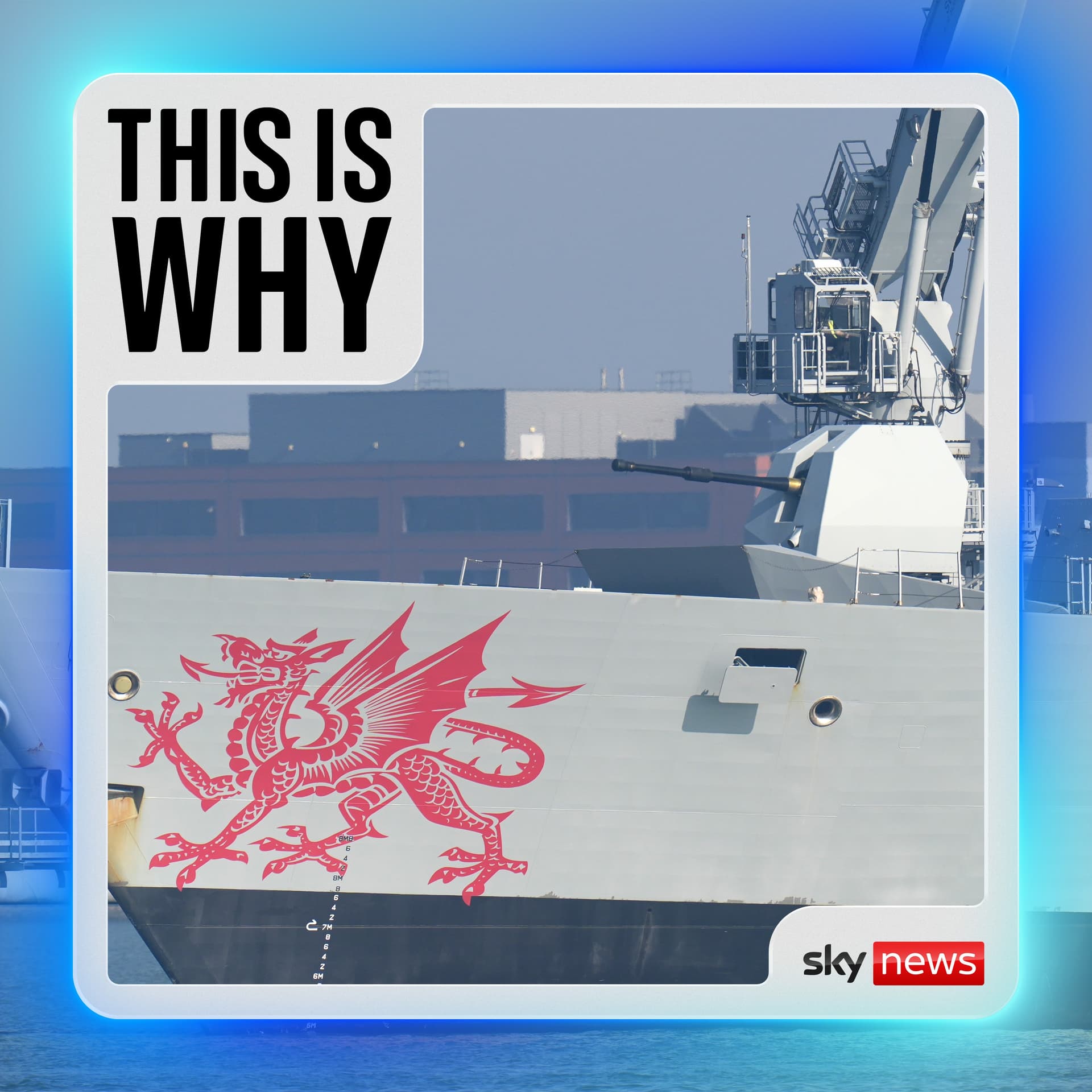
6:31You're busy, you're up threat. There's a clear role for the ship. Explain the connection between HMS Dragon and Wales. Because, and correct me if I'm wrong here, but there is a big dragon painted on the front of the ship. And I'm just wondering, is that entirely wise? If you're not just painted a big red target on the side of a big grey ship. So I have a view on this. Others are available, and most of them are different to mine, but it's not a target. But what it does do is it does make it easier to identify which ship it is. Our submarines, they go to great lengths to try and not make it clear which is which.
7:06And that is just sensible sort of operational deception. It's not sophisticated. But in the great scheme of making things more difficult for the enemy, you don't want them necessarily to know who you are. So my view is a big red sticker, which is what I call it, is not cool. Of course, the flip side of that is it's branding and badging and it gives you an affiliation with your home port and so on. So there's arguments both ways. HMS Dragon hasn't just been sitting in docks since it's been commissioned, waiting for a conflict to break out somewhere, has it? This is the power of the Navy. There's a continuum from do nothing, posture, be there, be ready, to high-end warfighting.
7:44And the great sort of perk of the warship is it can do humanitarian and disaster relief to constabulary operations, to boarding operations, taking down merchant vessels, whatever it is. The amount of time they spend warfighting is minute across history. Still, it's not all warfare, humanitarian efforts and smashing criminal gangs. Occasionally Dragon pops up in Hollywood movies. There's a Bond connection here as well. I've done a couple and it's great fun when you're on board. I bet it is. You get bent out of shape by the directors quite a lot. I remember they walked into the ops room of a Type 23 frigate, which at the time was our newest ship.
8:22And this was for one of the Bond movies. And the director walked in and looked at this ops room and went, no, no, no, no, this doesn't look like an ops room at all. and so we had to put sort of boards and switches and blinking lights over the top of the actual ops room and also of course it's important in the business of raising the awareness of navies which is a fundamental issue that we've always had nelson said if i were to die today want of frigates would be stamped upon my heart you know ship shortages is not a new thing so we've got to get the message out there. The Navy PR system has to get its messages out there.
9:00And when you're asked to appear in a Hollywood blockbuster, you know, go for it. Still, if I'm remembering correctly, I think Dragon appears in No Time to Die and was actually responsible for the death of James Bond when it launched an assault on the island. So I'm not entirely certain we should be that grateful to Dragon on that occasion. And did so with an array of weapons that it doesn't have. But, you know, that doesn't matter. OK, so let's focus then very quickly on what's going on in and around the Middle East. Dragon, at some point, is going to be sent. But for what purpose? What's it going to be doing there?
9:31Well, as ever, there are options. And that, as I said before, that's the joy of a warship. You've got a range of options. Her primary task, and what she'll be sailing, expecting to do, is to sit somewhere between RAF Akrotiri in southern Cyprus and the Hezbollah coastline, where that threat sits. She will be there doing that area air defence job and protecting the base at RAF Akritiri. One of the golden rules of deploying in a warship is that you don't end up doing what you thought you were going to do. And halfway across Biscay, they'll be fiercely reconfiguring for something else because there are other things she could do.
10:07One of which is to go through sewers and head into the Gulf of Oman and start becoming part of the Abraham Lincoln task group down there as the Hormuz is, you know, Hormuz is shut right now to all intents and purposes. And the oil markets and the traders are really getting nervous about this. And at some point, someone's going to have to try and lever that open. The Type 45 in that environment would be very, very useful to the American effort down there to help get Hormuz back open. Whether in the Straits of Hormuz or defending the RAF Akritiri, it does feel like a big part of the threat comes from the Iranian drones, of which we know they have lots.
10:45The Shahid drones, not desperately expensive to manufacture. I mean, when faced with a barrage of multiple Iranian drones. Is this ship, the T-45, is it capable of dealing with that? Yeah, up to the limit of the number of missiles it's got on board, which will be 48. So yes, this is where Samson and the command system on board are so good at multiple target acquisition and tracking. Back in the day, you used to have to kind of put a radar on each target. Now, the Samson radar can literally multitask at an extraordinary rate and will determine for you which is the greatest threat. And I say this with caution because the enemy only needs to get lucky once, but the shared drone is bread and butter stuff for the Type 45, to the extent where in the Red Sea, they shot one down with their gun.
11:34If Dragon is so suited to what is going on in the Middle East right now, why on earth is it still in dock? Why was it not placed there when we had the first inkling that the Americans were moving assets to the region? There's two parts to this answer. Neither are good. The first part is this is the result of a, I call it the 30-year decline. That graph of defence expenditure has been tenuating to zero since I can remember. The Strategic Defence Review of 2010, the Cameron Osborne Austerity Review really expedited that decline. And for that entire period of Tory government, no new warships were ordered.
12:15The replacement frigates were put on ice, and so on. and so on. I mean, so there's a real culpability here to that entire era. And this is what we're getting to now. So we've essentially got seven frigates and six destroyers. And if you do the rule of three to one, which is one working up, one on operations and one in maintenance, that leaves your cupboard very, very bare. And we have effectively two destroyers that are seaworthy at the moment. And it just so happens that neither of them are at immediate notice to go. So the second part is the political decision-making around our Navy. The requirement to get A45 ready for sea in and out of the door was blatantly obvious.
12:58And the Navy, and this is an important point, the Navy would have said so, but that's not their decision. They just present options. This is what we've got. This is what we recommend. And then it's not in their hands. So somewhere between the Navy and number 10, this decision-making process this time around has gone really, really badly wrong. As you say, a 30-year decline. I saw someone suggest that we have fewer ships now than we've had since the English Civil War, of all things. What were we capable of doing that we are not capable of doing now? It's a really good question. It's a boring answer, and the answer is sustainability.
13:35We still have the building blocks of anti-submarine warfare, of air defence, of mine warfare is getting very, very fragile now. they're just way for thin and we can't sustain any of it and one of the reasons the 45 was slow out of the door was because we sent a carrier strike group around the world last year and that used up you know all those sort of hours maintenance hours in that very small very fragile carter of type 45 destroyers so this is one of the reasons why she wasn't sent because if we send her early earlier than we were expecting what do we now lose what can we not do in in six months' time.
14:12So there's a real sort of nervousness about even using these precious assets anymore. Tom, I think I'm right in saying, you know, you've spent a quarter of a century in the Royal Navy yourself. You've commanded a number of ships. When you and your former colleagues in the senior service get together and discuss what is going on right now, are you depressed? Are you frustrated? Are you angry at the state of the Navy, given, you know, back when you were serving, you could, with a degree of validity, say that Britannia ruled the way. What makes me angry is that throughout my career, the gradual decline was a function of defence not being a spending priority.
14:52And I get that. Against everything else that was going on, and of course welfare and education, they can all tell a story. So if you weigh all that up, and I'm being slightly philosophical here, but the sort of gradual decline, the reduction in defence spending, I absolutely get it. I didn't think it was right. And dare I say it, it's one of the reasons I left. But I understood it. Those excuses have now gone. I mean, they probably went when Crimea was invaded. They certainly went in 2022. And this is just the last in a long line of sort of lack of preparedness. It just so happens that it's the naval one that's perhaps resonated the most, but it is not the first.
15:33They can afford it. They are still electing not to. And that's what makes me angry. The excuses have gone. The justifications are no longer there. The evidence to increase defence spending is absolutely blatant. And this current government don't seem to understand that. Just to take us back to Dragon to conclude, I mean, assuming everything is ship shape in Bristol fashion and it's ready to go in the not too distant future. I mean, how long would it take dragon to get to Akritiri? I mean, is there a possibility that it's going to get there and everything's done and dusted? Well, get there and the French will go, alright lads.
16:12Of course, because the French are there already. If the Biscay is kind to her, which at this time of year, heading into it, it may well not be, but she can, let's say, do 20 knots, then it takes about six and a half days to get from Pompey to on station. At 12 knots, which is a sensible planning speed for this time of year, that it's more like 11 days. So there's a very real chance that she'll get there and come storming in at the last minute and everyone will go, thanks very much. You can carry on now. HMS Dragon is extraordinary. Sophisticated, capable and crewed by sailors at the top of their game.
16:49But the Royal Navy's challenge isn't how good its ships are. It's how few we have available. One Dragon, however fierce, can't guard the seven seas. and that's it for the first week of This Is Why we all hope you've been enjoying it remember we are always in the market for ideas for topics to cover on the podcast or for comment on the stories we have covered you can email me directly why at sky.uk and if you haven't given us a follow yet why not do so now should be just a click away we are back Monday till then take care and have a great weekend
17:28Thank you.
From the publisher
The warship HMS Dragon is now not expected to leave for the Mediterranean until next week to begin its mission to defend a British military base in Cyprus from attacks by Iran.
The ship is one of six Type 45 air defence destroyers in the Royal Navy and one of three that aren’t currently out of service.
It is well-equipped to deal with Iran’s Shahed-type drones, so why has it taken so long to send it to the region?
Niall speaks to defence analyst Tom Sharpe, who also spent 27 years in the Royal Navy, about the military capabilities of HMS Dragon, the state of the Navy currently, and when the warship might finally arrive in the Med.
Have you got a question for Niall? Email the show – why@sky.uk