
In short
Kanye West (Ye) remains famous despite UK visa denial over anti-Semitic remarks; episode argues cancellation is unlikely and uses him as a case study for celebrity accountability and industry “duty of care.”
Guest backgrounds
Nicholas Tyrell Scott, music and culture journalist; has written for NME, Rolling Stone, and Ten Magazine.
Key claims
Government action may set a dangerous precedent; the music industry and teams may be “blindsided” by genius and fail to address mental health; fans excuse harm via nostalgia and media numbness; apologies may be seen as too quick or profit-driven.
Notable examples
Death Con 3 tweets; praise of Hitler; pro-Nazi imagery; pro-slavery “choice” comments; KKK claims; Super Bowl t-shirt ads; bipolar/brain injury apology; 2009 Taylor Swift mic-rip rant; meeting Trump in MAGA hat; Wireless headline controversy; Wall Street Journal one-page apology.
Written by AI. May contain mistakes. Listen to the episode to check what was said.
Chapters
Tap a time to open that second in VOKanye's Controversial History
0:33 to 2:00
Discussion of Kanye West's controversial actions and statements over the years.
“Music has never been the same since Kanye West, now known as Ye, burst onto the scene in 2004 and reshaped hip-hop.”
Industry Reactions and Accountability
2:00 to 5:04
Exploration of how the music industry reacts to Kanye's behavior and the need for accountability.
“And what can he do to restore his reputation there?”
Mental Health and Celebrity Culture
5:04 to 7:20
Analysis of the impact of mental health on artists and the responsibilities of those around them.
“And I think those are really the main two issues across that statement and then outline his mental health and struggles with bipolar.”
Fan Loyalty and Cultural Impact
7:20 to 12:04
Discussion on why fans continue to support Kanye despite controversies and the cultural significance of his music.
“for multiple artists where they had public outbursts on social media.”
Apologies and Community Engagement
12:04 to 13:50
Debate on the sincerity of Kanye's apologies and the need for genuine engagement with affected communities.
“He has apologised for some of his behaviour.”
Transcript
Automatic transcript. May contain errors.0:02Kanye West:Sky News, the full story first.
0:12Kanye West is barred from entering the UK after anti-Semitic comments, but despite his tarnished reputation, for many he will always be famous. And this is why.
0:33Hello, Gareth Barlow here with you. Music has never been the same since Kanye West, now known as Ye, burst onto the scene in 2004 and reshaped hip-hop. It was no surprise then that one of the UK's biggest festivals, Wireless, would book Ye to headline for three days this summer, except for his history of anti-Semitism. There were the tweets calling for Death Cons 3 on Jewish people, a professed love for Hitler, and the buying of ad space during the 2025 Super Bowl to sell t-shirts featuring the Swaz sticker. Ye has apologised, attributing his behaviour to an undiagnosed brain injury and a mental health crisis.
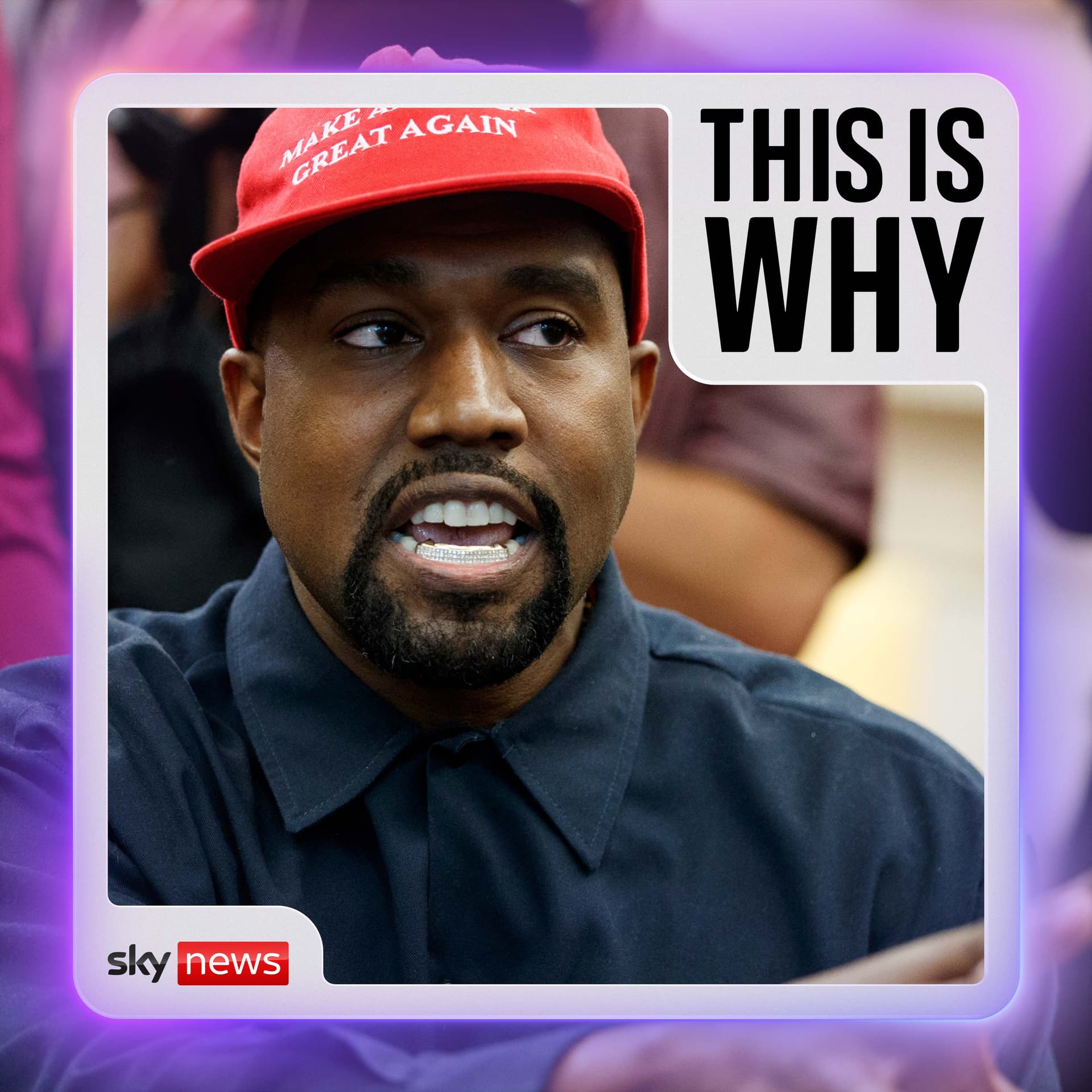
1:10It's not the first time he's shocked his fans. The KKK outfit, falsely claiming that the enslavement of black people was a choice, and his meeting with Donald Trump in the Oval Office while wearing a MAGA hat. It was something about when I put this hat on, it made me feel like Superman. You made a Superman. That's my favorite superhero. And you made a Superman cake for me also as a guy that looks up to you, looks up to Rathmore and looks up to American industry guys. Non-political, no bull****. Put the beef on it, however you want to do it, five seconds delay, and just goes in and gets it done.
1:44He's apologized for his anti-Semitism, attributing the behavior to an undiagnosed brain injury and a severe mental health crisis. Despite it all, there are still those, as shown in the disappointed comments section of the post by wireless, who would have bought tickets had the UK government not blocked his visa. So why was his behaviour tolerated by the music industry and the people around him? And what can he do to restore his reputation there? Nicholas Tyrell Scott is a music and culture journalist who's written for NME, Rolling Stone and Ten Magazine. Talk to me then about this headlining wireless, but they're not headlining wireless and then being banned from entering the UK.
2:22what's your initial reaction when you heard the news that yay had been banned i think it potentially sets a dangerous precedent because i think the government used that kind of language to pick and choose who can stay in the country who can't who can enter who can leave and what's really not made clear to the public is what is that line what isn't in the best public interest So it just opened up more questions for me, more than a concrete, this is bad, this is good. We're talking 2026. If you start opening up the timeline of Kanye or Ye and controversies that go with it, it goes back years and years and years.
3:04And it's not just anti-Semitism. It's anti-Black people at times. It's anti-women at times. I think some of those first instances take place towards the middle of last decade where Ye explicitly says slavery was a choice. And I think that starts to really create a tension within the black community, particularly in North America, where he's from. And I think globally, it started a discourse of, well, is he okay? And then as you go through the latter years of last decade, you start to see real anti-Semitism take play. You see praising of Hitler. You see him announce presidential campaigns. You see more sexual assault allegations, more advocation for Diddy, especially during his issues with the law in the last couple of years as well.
4:01And then you see the direct sell of iconography, imagery, which is pro-Nazi. And then we see instances of him explicitly talk about issues pertaining to porn addiction, mental health, medicinal misuse or addiction. And I think it creates a cocktail of issues that the public have to then work their way through. And I think a lot of people have reaffirmed lines with him, have said they'll still stand by him. Some people have left his music aside. We've seen some people really struggle and grapple because outside of all of this, look, it's a fact. Kanye West is one of the most talented musicians to hit the world stage in the 21st century.
4:45His behavior during both his ascension, peak, post-peak has been controversial and has impacted various communities. So I think over those last decade to 12 years, we've seen the real unmasking of some of the inner workings of Kanye. And then obviously in January with the Wall Street Journal, he took up ad space to issue a one page statement apologizing for issues pertaining to anti-Semitism, anti-blackness. And I think those are really the main two issues across that statement and then outline his mental health and struggles with bipolar. The controversies stem from everything pro-Nazi iconography all the way through to the more bizarre, the VMAs in 2009, ripping the mic off 19-year-old Taylor Swift and going on a rant about Beyonce.
5:35And I wonder why he manages to keep coming back, considering all of that. You know, a lot of people would probably go, why don't you just wash your hands of him? I'm going to shout out a critic I love, Shamira Ibrahim. him we've had conversations about celebrity and in this era of the tortured genius and I think in the public consciousness sometimes people like that narrative not all geniuses are saying the narratives that they must be insane to be so great and I think so long as we endorse such a narrative I think we get people who push the boundaries like that and then our reactions to it excuse a lot and I think it's not about necessarily just condemning Kanye West maybe it is time to reassess our relationship with artists entertainers and that doesn't necessarily mean just cancellation I think a larger relationship in terms of how we consume what modern celebrity looks like should we be worshipping these figures unapologetically in the first place because then I think it leads to disappointment and a search for accountability as we're doing so with Kanye West right now.
6:46Kanye West isn't working in isolation you know he's collaborating with other artists performing at shows like Wireless or was supposed to perform at events like Wireless. Do you think that the industry is also slightly blindsided sometimes by the genius behind the music? I know there's a conversation right now with record labels in the last few years about mental health funds, making sure all artists sign up, or just the pursuit of considering mental health into the equation of work ethic. I think as we look to artist teams, we can do better as a society to maybe demand more. I think there's been multiple signs for multiple artists where they had public outbursts on social media.
7:25Britney, for example, cut her hair. We should look at those moments in a lens of this is time for urgent care. This isn't time to engage in tabloid culture i think justin bieber's faced that tension in the recent months and years where paparazzi haven't left him alone and almost egged that mentality on knowing a artist is vulnerable and i think it's looking at how can we troubleshoot that how can record labels not allow an album submission until someone's done an x program or a y program and it's not about putting these artists in cages it's about understanding how extremely rare this field of work is and looking at how it can potentially aggravate certain underlying issues how the cult of celebrity can bring some things to the surface a bit quicker than in everyday life and i think it's acknowledging that landscape and really trying to take that duty of care over commerce completely and then the commerce can come after when we know that that person is in the right state to go through a 12 18 month album cycle and tour on top of that i think it's about really the stewards behind artists who make the music industry go around actually and make pop culture go around really taking a look at the parameters and guardrails for successful but also healthy artists and musicians there is the issue is there not that kangyo west wasn't making the t-shirts himself he wasn't uploading the music to spotify and so one can't by help but wonder to what degree does the people around him need to take responsibility for for some of the actions that he has said was a result of the mania from his bipolar.
8:58That may have been the case. And not everyone with bipolar will do this at all. But if that is the case with Kanye, some people are still working to further what he's doing. Yeah, and leverage it and profit off of it. So I think, yes, looking at the people profiting or aiding or supporting a certain move, which extends the life cycle of an artist. I think that ultimately Kanye should be used as a case study for the parameters of celebrity and some of the issues that need to be tackled moving forward. Kanye has a huge following. His latest album, Bully, is three in the album charts at the moment.
9:32It may well rise even further as a result of this furore around him. Why are fans still so attracted to him? And why are they able to put so much aside, do you think? He hit number two in the US, but I think his sales have taken a dent as well. So some people have left the fandom, But I think to still have a cult of audience speaks to something I said earlier in the conversation. He is one of the most talented artists of the 21st century. I think he set the precedent of being a controversial figure just on the other side. He said George Bush doesn't care about black people. I think he started that precedent of being an artist that's not cookie cutter, not a straight, laced, safe, PG artist.
10:19An artist that is going to push those boundaries. And I think as you outlined with Taylor Swift, as we've just gone through some of the coloured history since the middle of the last decade, he's controversial, offensive to some people, even in some of the earlier statements, which if you were to do analysis made sense. But I think people have been primed to understand how he operates. So I think that already set the parameters for when some of the harsher, more offensive, more downright wrong things happened in more recent history for people to use those excuses to be like he's just controversial he's Kanye I've heard those statements so many times over the last few years from various people online parts of his fandom and it's just like this album changed my life I think nostalgia we talk about it all the time I remember being in a youth oriented club night with those shutter shades that he helped to repopularize through some of his earlier work and i think some people tie themselves to those memories and almost use it as a shield from looking at the real behavior and real impact as well that he harmed communities or some people just don't care i think we've been numbed by the media cycles as well there's so much that happens on the day-to-day news i mean you're a reporter you know there's so much going on in the world.
11:41There's so many people who need liberation. Even COVID, we saw death tolls every single day. So I think part of that numbs people. They're not taking in, they're not ingesting what the impact of said comments, endorsement of certain figures of past are doing. I think that's some of the rationale behind why some people still advocate for his music. He's denied some of the allegations about his behaviour. He has apologised for some of his behaviour. He's offered to meet Jewish leaders, which ultimately can't happen at the moment because of that ban and entering the UK. How genuine do you think he is when he then says sorry?
12:18I think a lot of the discourse I've seen this week is, it's too early. Why is he performing? Why is he profiting off of an apology in January if we're taking it for that one? I think some people needed to see time, real engagement with communities raw effort and look an apology doesn't mean forgiveness it just means if it's a true apology you're willing to accept the consequences of your actions so I think some people people who haven't left the train and people who are on the fence would have loved to have potentially seen just time heal those wounds and him not necessarily go into album mode weeks after an apology for commerce even if the album was free free download if or he did something like that.
13:00I think that would have, to some people who are willing to hear him out, would have probably gone down a lot better than what we've seen. And I think engagement with the offer to meet with those communities, the actual tangible meeting of those communities before stage-like wireless was even announced, the black community, women, considering some of the allegations, I think would have been received with a little less skepticism and more, even if it's love from afar we're gonna watch this from afar there would have been a calmer reaction than announcing a wireless stage and an album and an LA show sold out two nights in the space of days literally days thank you so much really interesting and really appreciate you sharing time as well thank you thank you for having me that's it from me Neil is back tomorrow with a look at the US midterms thank you so much for listening
From the publisher
Kanye West is one of the 21st Century’s most talented musicians, but his controversial remarks are just as famous as his music – and his antisemitic comments have now got him banned from the UK.
Wireless festival, which he was due to headline in London this summer, has been cancelled as a result.
Since he burst onto the music scene in the early 2000s, Ye, as he is now known, has been breaking the mould – both as an artist and with his controversial opinions.
This includes releasing a song called Heil Hitler, selling swastika T-shirts, saying slavery was a choice and supporting Diddy during his sex trafficking trial.
Gareth Barlow speaks to music and culture journalist Nicolas Tyrell-Scott about why Ye remains popular, how much the music industry is responsible and will anything now change?
Ye denies allegations of sexual assault.