
In short
A Sky News “Stuff Matters” episode explaining the Aug 12 partial solar eclipse in the UK (90–95% coverage), how to watch safely, why eclipses happen, and why they captivate people; it also links the eclipse to the Perseids meteor shower and broader astronomy (light travel time, what’s visible despite light pollution).
Guests/backgrounds
Dr Jennifer Millard, astronomer/astrophysicist and space communicator; Ed Conway hosts.
Key claims
The moon’s apparent size matches the sun because it’s ~400x smaller but ~400x farther away; partial eclipses can still feel like “twilight” with ~5°C temperature drop and birds quieting. Eclipses aren’t monthly due to the moon’s orbital tilt (~5°) and alignment near orbital nodes. The cosmic microwave background is ~2% of radio “crackle.”
Notable examples
Eclipse path through Greenland/Iceland/Spain/Balearics; UK timings (~6:15 start, ~7:15 maximal, after 8 end); safe viewing via eclipse glasses, ukeclipse.com events, or pinhole projection (cardboard/colander). Perseids peak with a new moon enabling 100+ meteors/hour in dark skies; ISS is a bright satellite.
Written by AI. May contain mistakes. Listen to the episode to check what was said.
Chapters
Tap a time to open that second in VOUnderstanding the Eclipse
0:50 to 2:06
Ed Conway discusses what to expect during the solar eclipse and its significance.
“Just search for it on your podcast app and follow Eclipse Glasses the sun by just after seven, it will cover more than 90 % of it.”
The Science Behind Eclipses
2:06 to 4:19
Dr. Jennifer Millard explains the mechanics of solar eclipses and their rarity.
“So it's a partial eclipse, which means that some of the sun will always be visible, but it's a really deep partial eclipse.”
Viewing the Solar Eclipse Safely
4:19 to 6:20
Tips for safely observing the eclipse and the use of various viewing methods.
“So why don't we get a solar eclipse every month?”
Cosmic Events on Eclipse Night
6:20 to 9:10
Discussion on additional astronomical events occurring during the eclipse night.
“Because look, we've all had it drummed into us since we were knee high.”
The Cultural Impact of Eclipses
9:10 to 11:14
Exploration of why eclipses draw crowds and create social experiences.
“Our competition used to be you can see the most Perseids, but now our competition is actually what do we see more of, Perseids or satellites?”
Astronomy for Everyone
11:14 to 13:59
Encouragement for viewers to engage with astronomy despite urban light pollution.
“things that you can see when you when you look up to the skies.”
Introduction to Astronomy
14:00 to 14:30
Explore the concept of looking back in time when observing stars.
“Here is what might sound like a slightly random question.”
The Journey of Light and Cosmic Background
14:30 to 17:50
Learn how light travels through space and its significance in astronomy.
“You will see how, together, they tell a fascinating new story about the world we live in.”
A Personal Journey into Astronomy
17:50 to 19:02
Discover Jennifer's passion for astronomy and its roots in her childhood.
“Your enthusiasm for this topic, not just for the eclipse, but for staring up at the skies is contagious.”
Transcript
Automatic transcript. May contain errors.0:02Sky News, the full story first.
0:11On Wednesday, more than 90 % of the sun will disappear. Don't panic. Also, definitely don't look straight at it. This is why. Hello, Ed Conway here. Here's what might sound like a slightly random question. What do AirPods, bananas and a pair of shoddily made running trainers from the 1970s have in common? On the surface, not very much But on my podcast Stuff Matters I will uncover the deeper stories behind each of them You will see how together they tell a fascinating new story about the world we live in The first full series of Stuff Matters is out now Just search for it on your podcast app and follow
1:25Eclipse Glasses the sun by just after seven, it will cover more than 90 % of it. So today, obviously, we are going to explain what to expect and how to watch safely, glasses or no glasses. But just a couple of hours after everything briefly goes dark, there'll be even more wonders in the sky. Yeah, I'm calling it a cosmic collision. For astronomers, August the 12th, it's just insane. And that got me thinking. Most of us only really look up when we're told something special is happening, but in reality, that's the case practically every night. I've been talking to the astronomer, astrophysicist and space communicator, Dr Jennifer Millard.
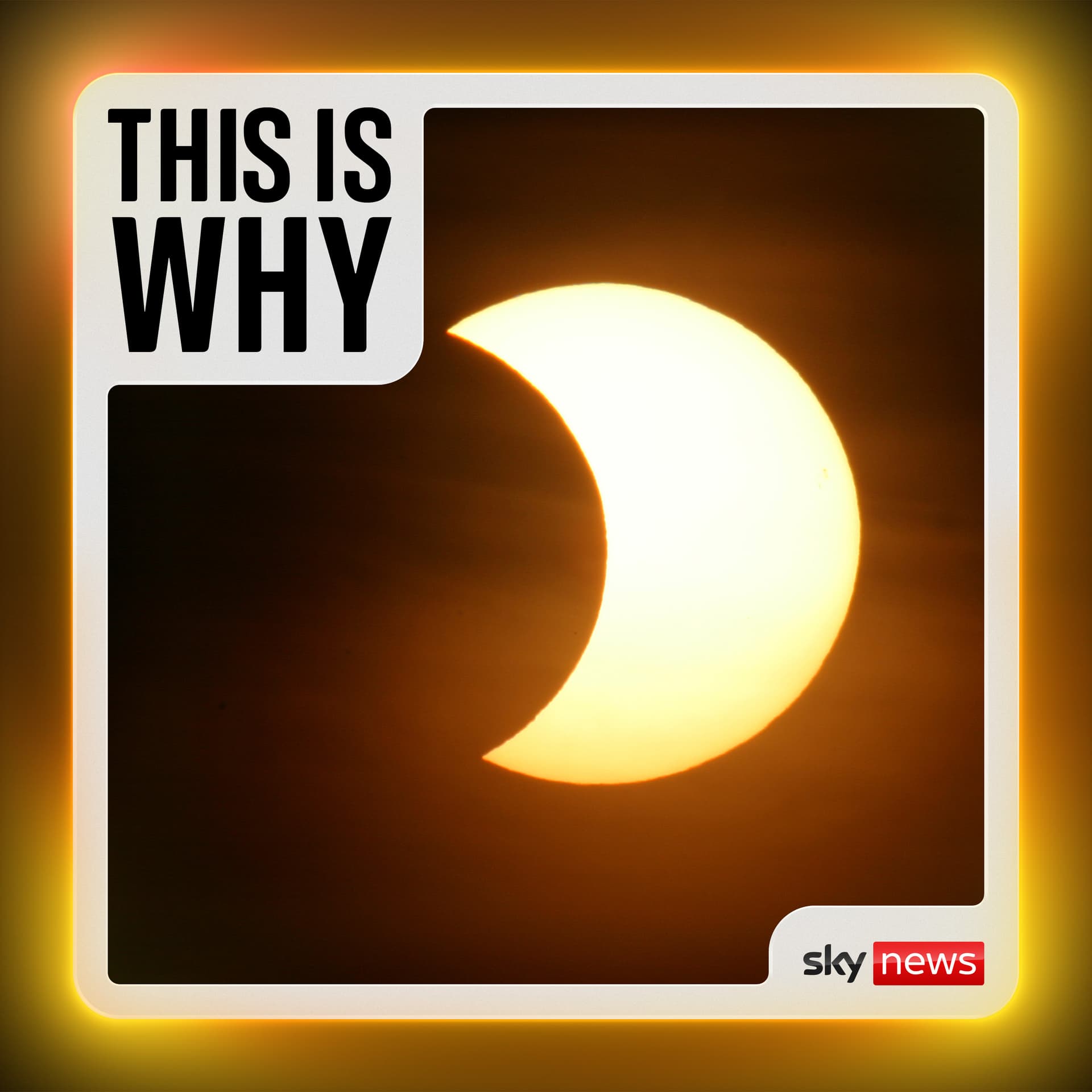
2:05It's a very special solar eclipse, this one. So it's a partial eclipse, which means that some of the sun will always be visible, but it's a really deep partial eclipse. And so that means it's only going to be the thinnest crescent of the sun at maximal eclipse. And you start to get some of the effects that you see during totality during these types of partial eclipses. So that means a really kind of eerie light near maximal eclipse. It's not quite twilight, it's got this really ethereal feel to it. You also get a dramatic temperature drop about five Celsius, you really do feel it. And you notice the animals starting to go quiet, you know, the birds will stop singing.
2:43And that's because they think it's sunset, you know, they think it's time for bed. So a partial eclipse like this one, it really engages so many of your senses. It's very dramatic and absolutely worth engaging with. So just explain how this all works, because of course the moon is a very specific size. It's a very specific distance from the earth and a very specific distance from the sun all the way off in the distance. So was it just a complete coincidence that the moon is exactly where it needs to be in the universe to block out the sun? Yeah, we actually live a very special time because at the moment, the disk of the moon compared to the size of the sun's disk, the moon is about 400 times smaller, but the sun is 400 times further away.
3:30So the effects cancel them out. And so that's why in our skies, from our perspective, the sun and the moon appear the same size. And we live a very special time for this because the moon is slowly moving further away from us. So there was a time when the moon was a little bit closer. and so it would really fully cover a lot of the sun. You wouldn't see all these beautiful little prominences that we see at the edge and all of these sorts of things. And then in the future, eventually, it's hard to say exactly when, but in a few hundred thousand years, there's not going to be a total eclipse anymore because the moon continues to move further away and so eventually it just won't be able to cover the disk of the sun fully.
4:10So we'll still get annular eclipses, but not as spectacular as total eclipses. But I thought the moon passes between us and the sun every month. So why don't we get a solar eclipse every month? that is a very excellent question so this is because the tilt of the moon's orbit is not exactly the same as the tilt of the earth's orbit around the sun so our orbit is inclined by about five degrees compared to ours and so that means the moon quite often it's it's higher than where the sun is or it's lower so they don't line up properly there's a couple of opportunities every year at the crossing points of these orbits we call them nodes and what we need is we need the sun to be near a node and we also need new moon to occur near a node and then that's where we can get a total eclipse like this one a solar eclipse now as you say it's an almost total eclipse but not quite so just run us through what we should be expecting to see on wednesday evening yeah so the path of totality for this eclipse runs through greenland iceland spain and then the baleric islands and so because that path of totality is so close to us in the uk this is why we're going going to have between 90 and 95 percent of the sun covered depending on where you are across the country so more of the sun is covered in the southwest part and then it's a little bit less as you go more towards the northeast but wherever you are in the uk it's a very very significant partial eclipse and the event will kick off it depends again exactly where you are in the country the timings do vary due to the perspective and your relative location but it starts around about 10 past six quarter past six maximal eclipse then is around 10 past seven quarter past seven and then the whole thing wraps up just after eight o 'clock and what you'll see is at first they'll just be tiny little chunks like a little bite like out of a cookie of the sun so you'll just see this little disc of the sun disappearing slowly slowly until at maximal eclipse you've just got this beautifully thin crescent of the sun and then as the moon continues on its path around us then you'll see more and more of the sun coming back.
6:16I suppose that the key question that we need to ask right now is, is how do we look at it? Because look, we've all had it drummed into us since we were knee high. You do not look directly at the sun. So how can we view this eclipse safely then? Yeah, you're exactly right. Because this is a partial eclipse from the UK, some of the sun will always be visible and you cannot look at it directly unless you've got solar eclipse glasses. Now, I know that those have become like gold dust lately, but there's a wonderful website. it's been set up by UK astronomers called ukeclipse.com and on there they are listing all of the events that are going on right across the country for the eclipse and so if you head on there you can see where your nearest one is many of them are free to attend or it's just a couple of pounds if you want eclipse glasses some of them are giving away eclipse glasses for free so there's that sort of option but if you can't get hold of any you can use lots of different projection methods and they involve your colander from your kitchen anything that's got a small hole you can have a couple of pieces of cards and just punch a little pinhole in one of them as well and you can even make one using a cardboard box and some tinfoil and some cards and the details and instructions for the cardboard box methods are on places like the NASA website or the European Space Agency things like that but with the two pieces of cards you just punch a tiny little hole using a pin I've done it with the back of a knee ring before you know anything that's sharp and pointy that you can get your hands on.
7:39You then stand with your back to the sun and so you hold the piece of card that's got the small hole in it closer to you and then the other piece of card and then wiggle them around. Getting the alignment right, the distance right, takes a little bit of practice but then you will, that little hole acts like a pinhole camera and it will project an image of the eclipse and I think this is a really nice activity if you've got kids especially because you can put that paper on a table or on a wall and they can start drawing around the sun and then as the eclipse progresses, they can get different sizes of the crescent and they can see how it's changing.
8:11And because your back is always to the sun, it's really, really safe. We'll stick that link in the notes attached to this particular episode. But I think that the thing that is remarkable about this almost total eclipse is that it's not the only event happening in our skies on Wednesday evening. If you stay out a wee bit longer, you might be able to see some more. Yeah, I'm calling it a cosmic collision. For astronomers, August the 12th, it's just insane. So we have this eclipse, this amazing eclipse. And then later on in the evening, we have the peak of the Perseids meteor shower. And the Perseids is one of the most prolific meteor showers of the calendar year.
8:46It's very reliable. It's really joyful because, you know, it happens at the height of summer. And the eclipse means we have a new moon. So there's no light pollution from the moon in the skies, only, you know, the lamps and stuff that are around us, the streetlights. and with the perseus if you're under truly dark skies you can see over a hundred meteors an hour and even if you've got some light pollution you can still see one every few minutes and the perseus are known for bright meteors what we call fireballs ones that leave persistent trains that you can see for a few seconds so it's not just the brief flash of light but you can see some glowing gas afterwards i always have a tradition me and my dad always watch it every single year and we have a bit of competition.
9:27Our competition used to be you can see the most Perseids, but now our competition is actually what do we see more of, Perseids or satellites? So there's lots of fun that you can have with Perseids watching and you don't need special telescopes or binoculars. You just need your eyes and a comfy chair and then a blanket. Obviously, given the day job, you will be watching, I presume from inside the zone of totality. Where will you be watching it? Greenland? Iceland? I'm off to Ibiza. That's where I'm going. Ideal. Yes. Yeah, I've been fortunate enough to be invited to a private event out there. And I'm taking my dad.
10:04He had a special birthday this year. This year he was 70. And so he's never seen totality. And so I'm really, really hoping that this is his chance that we get to see it. We'll keep our fingers crossed for you that the weather holds up. Look, but just as an experience, it brings people together. It brings people out. Why? Why do you think that is? I think the sun is just so integral to our lives. And so when something dramatic happens to it, it's almost like instinct that we can't help but want to look and want to see that we're going to be okay. It's just some kind of instincts within us, I think.
10:40And I think what's so beautiful about an eclipse is that it takes so long to happen. You know, it's an almost two-hour event. And so it really is a social occasion. You don't look at the sun for the entire two hours. You sort of have a look and chat with your mates. have a look again five minutes later and then you really notice that progression and how everything is changing. I think that they are wonderful and because all you need are you know a pair of those eclipse glasses or you just need some card with a hole in or even a condor it's so accessible as well and so I think all of that combined makes it a special event.
11:13But it applies to so many other things that you can see when you when you look up to the skies. You talk there about those Those are those parts of the country which have truly dark skies. I live in central London. We do not have those. But during the COVID years, I was put on to the International Space Station, which you can see clear as day from the middle of London with the streetlights on. I mean, just just explain what's going on there. Yeah, the International Space Station. So it's our orbiting laboratory that's been continually crewed for well over two decades now. But the ISS is enormous and it has these gigantic solar panels.
11:52And because they're so big, they reflect so much sunlight. And it makes the ISS, it's one of the brightest things in the night sky. You know, it rivals the planets. And it's certainly our brightest satellite at the minute. We already know that to see the eclipse, you just need a pair of eclipse glasses. Or indeed, as you've correctly pointed out, a colander. But I suppose what that reminds me is that for a lot of people, astronomy, looking up at the skies, they assume they can't do it for two reasons. One, too bright, won't be able to see anything. Two, I don't have a giant telescope sitting at home.
12:29But actually, you can see plenty, can't you? You can, even under light pollution. So the moon is a great target, is not impacted by light pollution. so just after the eclipse we'll start going through all of the lunar phases again so you know we'll start with that thin crescent and it'll get fatter half illuminated working our way to full and you know there's so much that you can see you can see the dark patches on the surface of the moon the lunar mare so these are basaltic seas that formed billions of years ago when the moon went into heavy bombardment by asteroids and it cracked through the surface and allowed that magma to well up and then it cooled and so that's what all those dark patches are And beyond that as well, the naked eye planets, they're not impacted by light pollution either.
13:14Naked eye planets, you can see the planets in the solar system with the naked eye? Yes, you can. So the planets that were familiar to antiquity, so sort of the Romans, the Greeks, all of the ancient civilizations, ancient China. So we've got Mercury, Venus, we've got Mars and Jupiter and Saturn. Those are all visible to the naked eye. And actually, at the minute, we have all of the planets visible in the night sky at the same time it's we've a really really special time so we've got venus in the evening just after the sun has set and then before the dawn we've got jupiter mercury mars saturn and we also have two more hidden planets so they require binoculars or a small telescope but uranus and neptune are also up there but the jupiter mercury mars and saturn those four they can be seen with the naked eye
14:11Hello, Ed Conway here. Here is what might sound like a slightly random question. What do AirPods, bananas and a pair of shoddily made running trainers from the 1970s have in common? On the surface, not very much. But on my podcast, Stuff Matters, I will uncover the deeper stories behind each of them. You will see how, together, they tell a fascinating new story about the world we live in. The first full series of Stuff Matters is out now. Just search for it on your podcast app and follow.
14:50One of the things that I don't think many people perhaps realise or at the very least dwell on very often is that when you look up at the night sky and you see a star twinkling back at you, that what you're seeing isn't taking place in real time. You're kind of looking into the past, aren't you? Yeah, exactly. I think this is one of my favourite things about astronomy is it's real lifetime travel because the speed of light is finite. So although it's fast, it's the fastest thing in the universe, light still takes time to travel through the universe to get to us. Just like we take time to go from one destination to another, you know takes time for us to walk to the shops it's true for light as well and so when we look out into the night sky we see everything as it was depending on its distance so it's like when we look at the sun if you've got your solar eclipse glasses when we're looking at the sun the light that left the sun it's taken eight minutes to get to us so we see the sun as it was eight minutes ago and when we look at the you know the brightest stars in the night sky generally speaking they're the closest ones to us and we're seeing them as they were maybe a few dozen years ago or maybe a few hundred years ago and then the most faintest ones then we're seeing them as they were thousands and thousands of years ago and then when we're looking at other galaxies or and things like that we're seeing them as they were millions of years ago so you know you think about uh there's a galaxy out there that's say 65 million light years away you know it's looking at an earth that's just coming to the end of the reign of the dinosaurs.
16:22It's amazing to think that the further you look away, you're looking back in time and it does make astronomy magical. I suspect you probably need more than a pair of binoculars, but with the tech at your fingertips and the fingertips of other academics, how far back can we actually look? So we can go almost all the way back to the Big Bang, but not quite. So the Big Bang was about 13.8 billion years ago, as we currently understand. and after the Big Bang the universe was too hot for light to escape it was all all the light and all the matter was trapped up in something we call the cosmic soup and then eventually as the universe is expanding from the Big Bang it's cooling and eventually it cooled enough for atoms to form the very first atom so hydrogen and helium and a little bit of lithium and when that happened it allowed the light that had been trapped all those photons that had been bouncing around locked away to free stream through the universe.
17:14And we can detect that light today. So it was emitted about 400 ,000 years after the Big Bang, and we call it the cosmic microwave background. And if you've got an old analog radio and you tune it in between stations, you hear a crackle. About 2 % of that crackle is the cosmic microwave background. So you can actually hear it. Yeah, which I think is amazing. So that is the earliest light. We can't see anything further back from that. We're hoping in the future to go further back than that with gravitational waves. But, you know, time, time will tell and it'll come. It'll happen at some point. Your enthusiasm for this topic, not just for the eclipse, but for staring up at the skies is contagious.
17:56Jennifer, where does it come from? Do you know what? It comes from my dad. So my dad is not a trained astronomer. You know, he left school at 16, but he was always interested in astronomy. And when I was like seven, eight ish, I was deemed trustworthy enough to look through the telescope because he has a telescope. And the first thing he showed me was the moon. You know, the moon is fantastic. But when you look at it on the sky, it almost looks like a sticker. It's like very two dimensional. But any magnifying tool that you turn on it, it really transforms into a world. So you suddenly you can see the craters and you can just see that sunlight glinting off their edges and you can see mountain chains and valleys and it was so transformative i just remember thinking what else am i not seeing like the moon looks so different what else is there so then i started you know looking at books and and things like learning all about space um i learned then you know that someone who studies space and learns about space is an astronomer or an astrophysicist so i was like that's what i want to do and then you know i i did my gcses and a levels and did my degrees and and who we are.
19:03Jennifer, it's been an absolute joy talking to you. Thanks again. Thanks for having me. It's been really good fun. And that is your lot for today. Do get in touch with your thoughts on today's episode. Perhaps even send us your pictures if you are out and about. Plenty of you getting in touch about last week's episode about the drought threatening national security. And given the temperatures, plenty of you returning to that episode. Jill says, with expected droughts affecting food crops around the world, Why are we putting up solar panels on agricultural land? A fair point, perhaps, Jill. Why at sky.uk is the email.
19:38We're back tomorrow.
20:00common. On the surface, not very much. But on my podcast, Stuff Matters, I will uncover the deeper stories behind each of them. You will see how together they tell a fascinating new story about the world we live in. The first full series of Stuff Matters is out now. Just search for it on your podcast app and follow.
From the publisher
In what might feel like a rare break from sunshine, the UK is preparing itself for the most spectacular solar eclipse in a generation.
The cosmic phenomenon occurs when the moon passes directly between Earth and the sun, meaning the country will be slowly plunged into darkness.
So, how can you watch safely? What is it about an eclipse that fascinates us? And with the Perseid meteor shower also taking place, what other celestial wonders might you witness if you make a habit of gazing up at the night sky?
Niall Paterson is joined by Dr Jenifer Millard, co-presenter of the Awesome Astronomy podcast.
To find your nearest eclipse event, click here.
Have you got a question for Niall? Email us: why@sky.uk