
In short
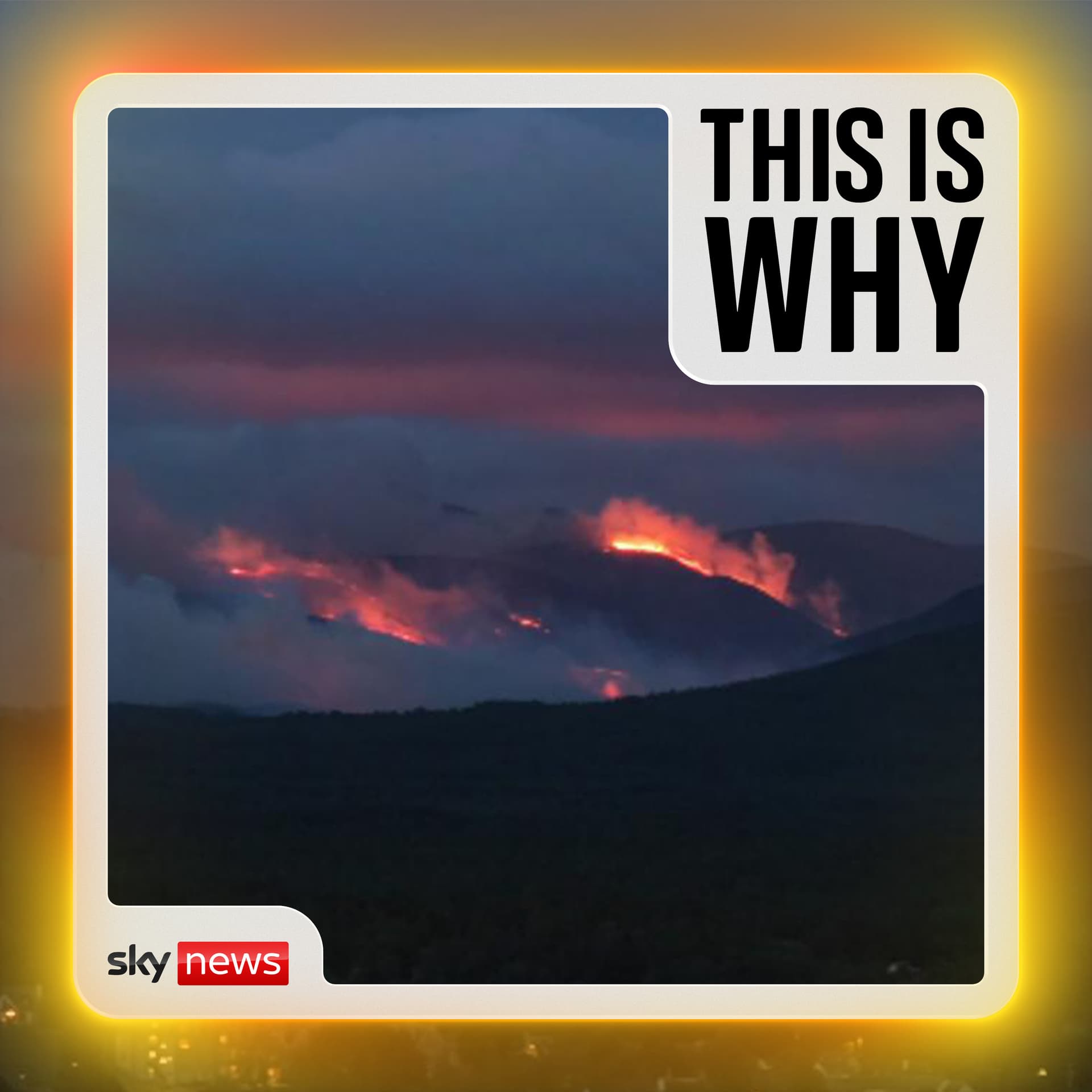
The UK’s growing wildfire risk, driven by decades of vegetation “fuel” plus drought and heatwaves, and what it should learn from Europe’s current fires through prevention, preparedness, and household/community protection.
Guests
Michael Bruce, wildfire expert and managing director of Firebreak Services; previously worked on Scotland’s wildfire strategy (2003). Sky correspondent Sadia Chowdhury reports from Gironde, southwestern France, during large evacuations.
Key claims
Most UK/European wildfires are human-caused and often accidental. The UK has a “second” summer fire season forming. Prevention needs multi-sector funding (land managers, conservation agencies, fire services, planners, utilities), not just firefighting equipment. Landscape-scale fires can’t be reliably extinguished; peat fires are especially hard.
Notable examples
France’s Gironde evacuations (250,000+); Portugal’s €111m annual prevention; 2022 Wennington London rural-urban interface fires; Tintwhistle peat fire near Manchester.
Written by AI. May contain mistakes. Listen to the episode to check what was said.
Chapters
Tap a time to open that second in VOThe Growing Threat of Wildfires in the UK
0:49 to 1:21
Discussion about the increasing frequency of wildfires in the UK due to climate change.
“Just search for it on your podcast app and follow We can see the smoke probably about four and a half, maybe five miles away from where we are.”
On the Ground in Southwestern France
1:21 to 2:35
Sadia Chowdhury reports from France on the severe wildfire situation and its impact on residents.
“Seven areas of England are now officially declared in drought by the Environment Agency, and parts of the UK are experiencing their fourth heatwave of the summer.”
Introducing Wildfire Expert Michael Bruce
2:35 to 3:02
Mari Arora interviews Michael Bruce about the causes of recent wildfires in the UK and Europe.
“And we've spoken to the firefighting teams.”
Understanding the Causes of Wildfires
3:02 to 4:37
Michael Bruce explains the factors contributing to the rise of wildfires, including drought and vegetation.
“I'm Mari Arora and I'm joined by Michael Bruce, a wildfire expert and managing director of Firebreak Services.”
Preparedness and Strategic Fire Management
4:37 to 5:54
Discussion on the UK's preparedness for wildfires and strategies like firebreaks that can help mitigate fire risks.
“and we're all going to have to work together doing lots of different things to try and help mitigate its impact.”
Investment in Wildfire Prevention
5:54 to 8:11
Michael Bruce emphasizes the need for investing in wildfire prevention and the importance of collaboration across sectors.
“And you have to break up the continuity of fuels in particular.”
Learning from International Examples
8:11 to 11:40
Discussion about how other countries are managing wildfires and the lessons the UK can learn from them.
“So they're very complicated incidents to manage.”
The Challenges of Peat Fires
11:40 to 13:57
Michael Bruce explains the difficulties involved in extinguishing peat fires and their implications in the UK.
“and see that as a warning for us here in the UK?”
Top Tips for Preventing Wildfires
14:00 to 15:14
Learn essential tips to prevent wildfires and respect the countryside.
“Sky lanterns, it might be nice at a party, but they float up and they burn and they drop down still burning somewhere else.”
Transcript
Automatic transcript. May contain errors.0:02Sky News, the full story first.
0:11The UK is set for bigger and more dangerous wildfires. And this is why.
0:22Hello, Ed Conway here. Here's what might sound like a slightly random question. What do AirPods, bananas and a pair of shoddily made running trainers from the 1970s have in common? On the surface, not very much But on my podcast Stuff Matters I will uncover the deeper stories behind each of them You will see how together they tell a fascinating new story about the world we live in The first full series of Stuff Matters is out now Just search for it on your podcast app and follow
1:00We can see the smoke probably about four and a half, maybe five miles away from where we are. I myself have seen fires before, but this is something of a, it looks like an apocalyptic scale. Wildfires are becoming more common in the UK as climate change affects weather patterns across the world. Seven areas of England are now officially declared in drought by the Environment Agency, and parts of the UK are experiencing their fourth heatwave of the summer. But in continental Europe, the situation is even more extreme. France and Spain are currently battling huge wildfires. Sky correspondent Sadia Chowdhury is on the ground in southwestern France, where more than 250 ,000 people have been evacuated from their homes.
1:52Hi, Mari. Sadia here. I'm in Gironde province. My team and I have been here since Friday night. And in that time, we have seen this wildfire as a thin line on the ground spreading, but we've also seen it as tall flames climbing up pylons and trees. At one point, we were surrounded by some of those flames. We've also seen it in the daytime as a big fire. and in the night time as small flare-ups. And in this time, we've also spoken to lots of people that have been impacted by this fire, primarily the residents in Gironde who have been forcefully evacuated and now sheltering in Bordeaux. Many of them told us that they'd fled in the middle of the night, having received an SMS alert.
2:37And we've spoken to the firefighting teams. They've told us sometimes they've had three hours of sleep. And we've also met and spent lots of time with local farmers. They're the civilian workers here on the ground who know the lay of the land, who are really leading in many ways this effort to tackle this blaze. So could the scenes we are witnessing in Europe soon become a reality here? I'm Mari Arora and I'm joined by Michael Bruce, a wildfire expert and managing director of Firebreak Services. Michael, thank you for being with us. What is it about this year in the UK, but also in Europe, that seems to be the year for really large wildfires?
3:24It's a combination of the development of fuel over decades. That's a buildup of vegetation and that being combined with drought and then heat waves. And when you say fuel, what are we talking about here? Well, anything that grows can become fuel in the right conditions. And it's what is dry enough to burn we call available fuel. And the issue that you have with the drought is that more and more vegetation becomes dry enough to burn. And am I right in thinking that there are actually two fire seasons in the UK, but this one is the kind of second season of the year? That's correct, and it may surprise people.
4:13The main fire season in the UK is in the late winter to spring period. And what's happening now in the development of a summer fire season is quite concerning because usually we don't have one. Usually we have bands of rain that cover the UK and then we have fewer summer fires. So we have to learn to live with fire. And that's the message that everyone says internationally. It's going to be a problem. It's going to be a growing problem. and we're all going to have to work together doing lots of different things to try and help mitigate its impact. What actually causes these fires? Is it spontaneous combustion just because it's hot or is it for instance somebody leaving a barbecue unattended or a campfire or a cigarette?
5:03What is it that's causing most of these fires? Most wildfires are human caused in the UK and probably in most of Europe, although they do have some lightning-started fires in Europe. But no, here in the UK and most of Europe, it's people. And the majority of causes are accidental. Now, you worked on Scotland's wildfire strategy back in 2003. 23 years on, are we more prepared than we were or have we kind of stagnated? We are definitely more prepared. The response and the response is growing and it's growing fast. And the interest from government is growing. But at the moment, there's not a huge amount of funding for cross-sectoral working.
5:53And that's a problem. You have to tackle the fuels issue. And you have to break up the continuity of fuels in particular. So we need to think about things like where do we place strategic firebreaks? So what is a firebreak? For people who've never heard of that before, what is that? A firebreak is a line, like a track, that has been cleared of all fuel. And the width that it needs to be cleared of all fuel needs to be three times the length of the flames that are approaching it. when you've got deep heather, you can have flame lengths up to six or eight meters. So that means that you need to have a fire break, which is 15 to 20 meters wide.
6:38But generally, you need this place where no fire can pass. You don't want to put firefighters in front of a fire because that's the most dangerous place that they can be placed. We don't want heroes. We want to be good managers. We're good fire managers. So that, in a sense, if you think about that. Who's going to manage the vegetation? Well, that's a role for land managers. So we need to work in partnership with the fire services. We need to identify where strategic fire breaks should be placed on the landscape. And that's going to need the engagement of conservation agencies as well, because inevitably there's going to be an impact on habitats and species.
7:17So what I'm asking for is a balanced approach. It's multi-sectoral. It's going to involve a lot lot of partners. And indeed, it actually involves the whole of society, because there are programs abroad which we are investigating in the UK as to how we apply them. In the United States, they've got a program called Firewise, and in Canada, the equivalent is called FireSmart. And this is a program that's been adopted around the world. And it's how do you protect individual households? How do you protect small rural communities in particular? How do you protect towns and cities at the rural urban interface?
7:58The Wennington fires in London in 2022, an example of a rural urban interface fire. And these are the most difficult to combat because you've got people, you've got assets, you've got infrastructure, all close together. So they're very complicated incidents to manage. So what would your advice to Andy Burnham be? What would you like him to do? Well, the government for England and Wales have just announced investment of£97 million in firefighting equipment for fire and rescue services. However, this is the usual response by governments faced with an immediate problem, is they invest in response.
8:40You know, if you ask international fire management people, they will say you should actually be investing much more in prevention and in preparedness and also in recovery. How much do you reckon that would cost? Not as much as you think. But what it will require is for everybody involved to think outside their silos, to actually be prepared to change how they work so that they can work better in partnership with these other interests. So these WIFAR forums that I've mentioned, they're multi-stakeholder groups. They have got representatives of land managers, conservation agencies, fire and rescue services, emergency planners, utility companies.
9:28Yeah, they're all talking in the same room. But what I'm trying to get across is that there's no real funding support for that multi-sectoral work. But that's the crucial investment that needs to be made so that we can break down barriers between these different interests and work more effectively together. What do you think the consequences could be if we don't invest our time, energy and cash enough into prevention of wildfires? What could we be facing? In the UK, I actually think the most significant threat is to rural infrastructure. And if you think of where power lines go, if you think of where the phone mast is, if you think of where private water supplies, you know, generate water for rural households, There's a huge and very well-meaning desire for nature restoration.
10:35But as I was mentioning, as you increase the vegetation in certain circumstances, that becomes fuel. So I think we need a bit of pragmatism to break up those fuels and places. Because when you get landscape scale, high intensity wildfires, nobody can put them out. So each tool, tactic, strategy you might want to deploy to suppress a wildfire has an upper limit that it can be successful at. Even helicopters can only extinguish flame lengths up to four meters. Only four meters. And as I've already indicated, you can get heather fires with flame lengths of six to eight meters, if not more. And if you go into Gorse, they're just phenomenal flamelinks.
11:28So you have to be more defensive. You have to protect your firefighters in those circumstances. And that means you can't always put a fire out when you might want to. Should we look at what is happening currently in France, in Spain, and see that as a warning for us here in the UK? Well, we had the chairman of AGIF, which is a specific wildfire prevention rural agency from Portugal, Professor Tiago Oliveira. He attended the UK wildfire conference in Aberdeen in 2024. And he showed how in Portugal, they're investing 111 million euros in wildfire prevention every year. Also, it's more likely that Portugal's climate is going to become our climate in some decades, but we don't need to think of the extremes.
12:27So whenever you get an extreme drought or an extreme heat wave, that's when you've got the potential for extreme fire behavior. So it's the number of days where we get those conditions each year, they're going to increase. So we're going to need to make some investments in wildfire prevention. And one of the things that we have got in the UK, probably because we're usually a relatively wet country, is that we've got a huge amount of fuel on our landscapes. I keep on coming back to this issue about fuels. So everyone thinks of fuel as being the surface vegetation, the heather you can see. but as you go into a drought more and more of the undecomposed organic matter and then the peat becomes available to burn and it creates a a huge potential fuel load they've had this in particular at the tint whistle fire just east of manchester which has been going on for weeks and weeks and weeks and it keeps on smoldering and reigniting smoldering and reigniting because the fire's got down into the peat.
13:35And that's in, you know, in the UK, I'd say is our, is, is a real problem. And we need to get really good at putting out peat fires. How do you put out a peat fire? You either dig it out or you wet it. And it's some of one of the dirtiest, hardest jobs that you would ever ask anyone to do. It's really not nice. Michael for everyone in the UK wanting to do their bit what are your top tips for us in terms of what we can do to help when the top tip is when you see warning messages saying don't have any naked flames don't have any naked flames and in particular don't have things like disposable barbecues out in the woods or up in the moor.
14:31Sky lanterns, it might be nice at a party, but they float up and they burn and they drop down still burning somewhere else. So listen to the messages about high fire danger. Be sensible. Don't have naked flames when you get those messages. And be respectful of the countryside because there aren't that many rural managers and workers and there are an awful lot of people who want to visit and enjoy the countryside we want them to enjoy the countryside but they need to be respectful of the countryside too michael thank you so much thank you and if you've got ideas for future episodes don't forget to email us at why at sky.uk and this is why we'll be back tomorrow
15:51The End of Stuff Matters is out now. Just search for it on your podcast app and follow.
From the publisher
Continental Europe is ablaze. Could Britain be next?
While we are yet to see the sort of devastation being experienced in France and Spain, record temperatures and drought conditions have already contributed to hundreds of wildfires across parts of the country.
And experts are warning the UK can expect bigger and more dangerous fires in the future. So, what is causing this threat and how well prepared are we?
Mhari Aurora hears from Sky correspondent Sadiya Chowdhury on France's frontline and speaks to wildfire safety expert Michael Bruce.