In short
The episode argues that US “boots on the ground” in Iran would likely be limited, risky, and could repeat the political/military trap of Iraq/Afghanistan rather than achieving decisive results.
Guests
General Sir Nick Carter, former head of Britain’s armed forces; served in Kosovo, Afghanistan, and Iraq.
Key claims
US troop numbers in the region may rise, but “combat power” (tanks/armored vehicles) is not yet evident; invasion-scale forces are unlikely. Iran’s defenses and asymmetric strategy (submarines, mines, maritime drones, missiles/drones) would make island raids or coastal actions costly. The US could face a “sucked in” extraction problem, with likely casualties undermining political support and risking another “forever war.”
Notable examples
Three US aircraft carrier groups (Abraham Lincoln, Gerald R. Ford, George Bush); Marine Expeditionary Units from Japan and San Diego; possible 82nd Airborne elements. Potential targets discussed include Karg Island (near Iraqi border) and Kashum Island (near Iranian coast, tourist resort with 100,000+ residents).
Written by AI. May contain mistakes. Listen to the episode to check what was said.
Chapters
Tap a time to open that second in VOUS Military Presence and Strategy
0:45 to 2:45
Discussing the current US military presence in the Gulf and potential strategies.
“very soon we could be entering a very different phase of this war.”
Potential Consequences of Ground Troops
2:45 to 4:45
Exploring the implications of deploying US troops in Iran and historical context.
“And then you've got the 11th, which is coming from California, from San Diego, which again, 2 ,500 US Marines.”
Military Capabilities and Challenges
4:45 to 7:45
Analyzing the military capabilities required for potential operations in Iran.
“If the Americans were to have the taking of that island as a priority, how might they go about it and what resistance might they meet?”
Geography and Tactical Considerations
7:45 to 9:45
Understanding the geographical challenges for military operations near Iran.
“And yes, it's got beaches and things like that.”
Iran's Defensive Strategies
9:45 to 12:15
Reviewing the defensive measures Iran has in place against potential invasions.
“And indeed, you know, its capital city, Tehran, is pretty challenging to get to.”
Political Ramifications of Military Action
12:15 to 14:03
Discussing the political implications of US military actions in Iran.
“And, you know, of course, all politicians in democracies are conscious of what their electorate think.”
NATO's Role and the Just War Theory
14:03 to 15:19
Explore the complexities of NATO's responsibilities and the concept of just war.
“Whilst we have you, Nick, we're talking on the day that Donald Trump made it clear yet again that the United States might soon be looking for the exit door from NATO.”
Transcript
Automatic transcript. May contain errors.0:02Sky News, the full story first.
0:11A grounding vision of Iran is now on the cards. And this is why.
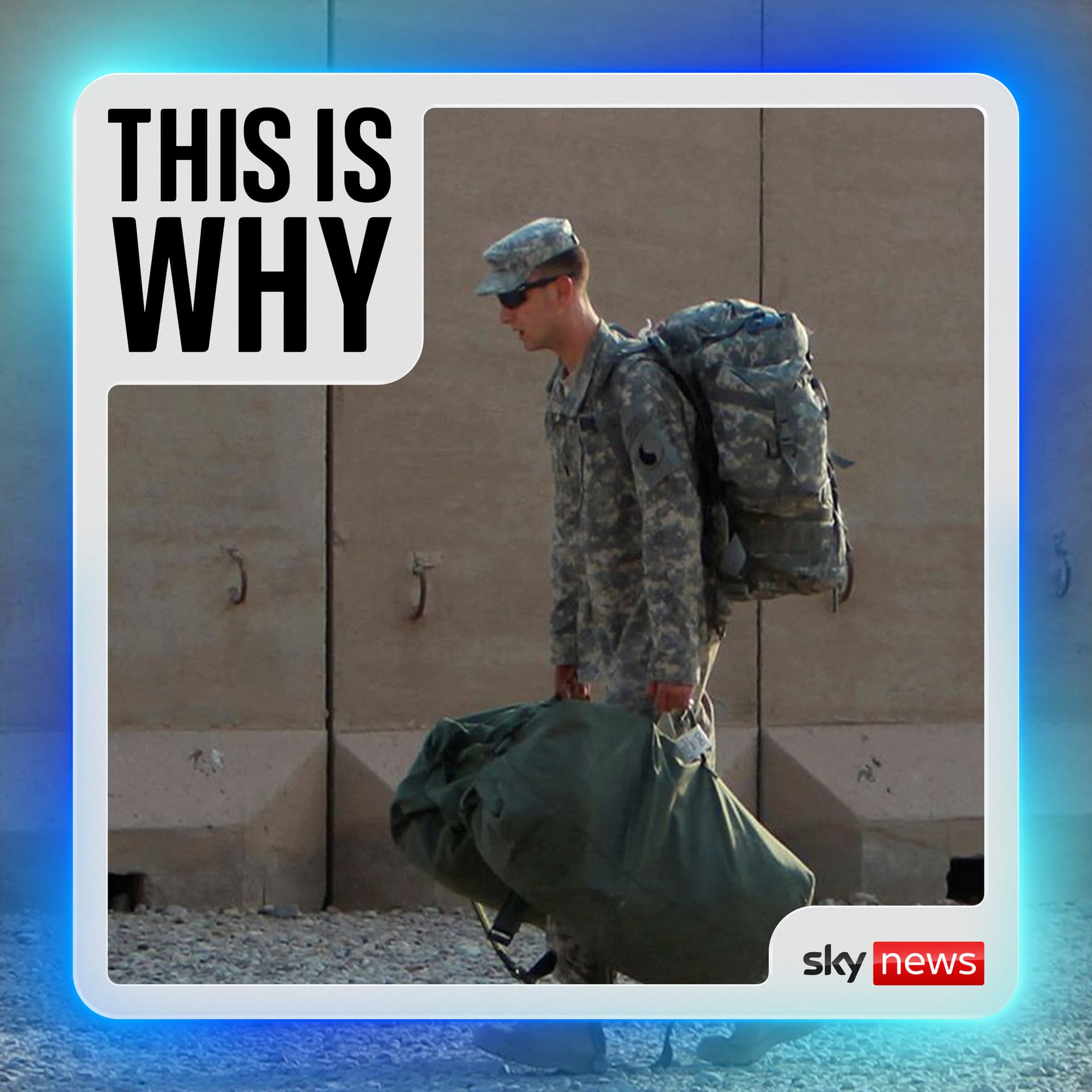
0:27Hi everyone, Neil here and after a full month of combat operations today we're going to be focusing on what might come next on the military side of what's going on in the Gulf Now we all know the US president is fond of sending, how shall I put this mixed signals but you don't need to be a Trump whisperer to understand very soon we could be entering a very different phase of this war. As the Iranian regime has told Sky News, if you put boots on the ground in Iran, it will be another VNM. Are you afraid of that? No, I'm not afraid of, I'm really not afraid of anything. Tens of thousands of American troops were already based in the region.
1:03Thousands more have followed, along with the sort of logistical support you would need to conduct ground operations. Now, all of this could well prove to be nothing more than posturing, but maybe not. Our adversary right now thinks there are 15 different ways we could come at them with boots on the ground. And guess what? There are. All of which brings back memories of the Iraq War of 2003 and not happy ones. Hundreds of thousands of troops were deployed. Hundreds of thousands of Iraqis were killed in a conflict which lasted the best part of a decade. Trump's voter base won't be impressed, I suspect, if they start seeing too many Americans coming home in body bags, which will be the likely consequence of any form of boots on any bits of ground.
1:46And of course, they won't want to see another forever war getting underway. General Sir Nick Carter was head of Britain's armed forces, having served in Kosovo, Afghanistan and Iraq. Nick, look, if boots are to be on the ground, then the people wearing those boots need to be there. I mean, what do we know about what the Americans have been moving into theatre most recently? Well, I mean, I think it's interesting, reported just simply today as an additional aircraft carrier. So you've got already the Abraham Lincoln, the Gerald R. Ford, and now the George Bush is joining it. So first time for many, many years, you're seeing three US aircraft carrier groups in the theatre, which is extraordinary.
2:27But in terms of, you know, as you describe it, boots on the ground, essentially there are two what are called marine expeditionary units, either there or arriving. The 31st one, which has come from Japan, which is about 2 ,500 US Marines with a range of different capabilities, including F-35B aircraft and those sorts of things, the jets and the like. And then you've got the 11th, which is coming from California, from San Diego, which again, 2 ,500 US Marines. And then we don't know, but there are certainly elements of the 82nd Airborne Division, so from the US Army. People are talking about thousands.
3:08I mean, my guess is that it'll be about sort of brigade-sized force to begin with, which is probably about between 3 ,000 and 5 ,000 troops. So we're not, I think, in terms of combat troops, talking about massive numbers at the moment, and certainly not the sorts of numbers that you'd need if you wanted to get into Iran proper, rather than simply raiding along the outskirts. The Americans do, though, in and around the Middle East, have several tens of thousands of additional troops. So a lot of the speculation around what might be coming next has been due to this extra injection of manpower. Well, I mean, I think one also needs to be careful about the definition of the term troops.
3:46I mean, the answer is there's an American military presence. But the combat indicator, if I can use that military term for something a bit more substantial, is if you actually saw tanks and armoured vehicles beginning to arrive. And that isn't the case, as far as I can see. One wants to be careful about, you know, talking about 50 ,000 troops. I mean, it's a 50 ,000 military presence. I don't think it necessarily infers that you've got the beginnings of an invading army turning up. So the sorts of numbers of combat troops that we're talking about, they're much more likely to be of value and use in relation to raiding and seizing islands or maybe hitting the coastline.
4:25Conceivably, going after the 430 kilograms of highly enriched uranium, which might still be somewhere in Iran, perhaps. I mean, those are the sorts of things that are being posited publicly at the moment. Well, let's start with that, shall we? Of course, I mean, one island, which I think before all of this was perhaps not as famous, Haag Island. Very, very central, very, very key to the Iranian oil production operation. If the Americans were to have the taking of that island as a priority, how might they go about it and what resistance might they meet? It would be difficult to do it with the Marines because to get them into place right up there at the top of the Gulf, and I think people need to understand the geography here.
5:05I mean, Karg Island is almost up at the very top of the Gulf, up near the Iraqi border, really. Now, to get the sort of amphibious capabilities that the US Marine Corps might want to use for an operation like this, they'd have to sail them through the Straits of Hormuz, or they'd have to be flown from the amphibious vessels in some port up into Saudi Arabia or Kuwait or wherever, and then brought in by either Osprey tilt aircraft come helicopters and other helicopters to do it. So I suspect, you know, people speculating on the fact that it's more likely to be a task for the brigade of the 82nd Airborne Division that we seem to assume is coming.
5:47But it would be a phenomenally risky operation to do. I mean, you're landing onto what is essentially a large lump of limestone. And I'm no expert on parachuting, but I think those who are would reckon that even in a normal parachute jump that's done for exercise purposes onto a reasonably soft landing site, you're going to take casualties in the jump itself from broken this and that. So actually jumping in a combat environment onto a large lump of limestone rock is not for the faint hearted, I suspect. And then, of course, once you're there, and let's assume that you seize the island, you're then, of course, only about some 30 kilometres from the Iranian coast.
6:31And that makes you, of course, very vulnerable to Iranian missile, drone or even perhaps longer range artillery attack. And of course, you know, as a humble infantryman, we're all well aware that under those circumstances, you want to dig yourself down deep so that you're protected. And of course, that may be challenging on Karg Island, given the nature of the topography. So, you know, if I was providing military advice on the seizure of Karg Island, one would need to be pretty confident and that by seizing the island, it really would be a helpful card for the US administration to have in its pack when it comes to negotiate with Iran, because it will not be casualty free.
7:09Karg Island, of course, has been dominating the headlines, but there are other islands which could well prove to be US targets. Which ones are we talking about? Well, these are ones that, of course, are down nearer or inside the Straits of Hormuz. And the sort of largest one is an island called Kashum Island, which is very close to the Iranian coastline. But I think before we get into the islands, it's just worth people understanding the topography here. It's very similar to the Strait of Hormuz to a Norwegian fjord. You're talking about really substantial cliffs. And you then have these smaller islands that are in the strait itself, the biggest one of which is called Kashum Island, which is at the foot of the cliffs that I'm describing, which is a notable tourist resort in Iran and has, I think, a population of over 100 ,000 people who live there.
7:54And yes, it's got beaches and things like that. So it's perfectly feasible to land a military force on it. But recognising how close it is to the Iranian coastline and recognising that the Iranian Republican Guard will undoubtedly have defended it effectively. The Iranians have clearly been planning for this for quite some time. So what are the items in their defensive arsenal? The Iranians have a range of different capabilities at their disposal to be able to interdict traffic going through the strait, whether that's submarines, whether that's mines that are on the seabed floor, which can be kickstarted to do what they need to do and are probably acoustic or magnetic censored, whether that's maritime drones, whether that's fast patrol vessels, or whether it's missiles or drones from the coastline.
8:41So there are a range of different capabilities that can be used. So on the face of it, just simply sitting on an island in the Strait of Homoose is not necessarily going to be decisive in terms of making it less risky for non-military traffic to pass through the strait. Whenever people hear boots on the ground, particularly those of us of a certain age, an age which includes the year 2003, they often do go back to the Iraq war. But from what you've been telling me so far, you know, if the American plan is to enter Iran in the same way that they did Iraq, they are nowhere near the numbers that they would require.
9:17No, definitely not. I mean, Iran is a very different problem set to what Iraq looked like in 2003. And the invasion force into Iraq at that stage was probably about 150 ,000 troops at the beginning of it. Iran is double the size in real estate, but also in terms of population. You know, whereas Iraq's population was 40 million or so, the Iranian population is around 90 million. And it's a country that's the size of Germany and France put together, which is significantly larger than Iraq was. And indeed, you know, its capital city, Tehran, is pretty challenging to get to. Quite how good Iran's military capabilities are, I don't know.
9:56But given that Iran sees this as an existential struggle, you can expect them to fight. And if they're going to fight, that will be challenging. And when you consider that Iran has had 47 years to prepare for this moment, that's why you've seen really quite a sophisticated Iranian, what we call asymmetric strategy. against the United States and Israel. What I think is interesting there about the Iranian approach so far is that their escalation has been very calibrated. And that I suggest might mean that they are keen also to find a way to have an off ramp. They haven't gone, as it were, apocalyptic, something they might have done.
10:34And they haven't done that. But going back to your basic question, if you're going to invade Iran in the hope of achieving, discuss what the objective might be, you would want a great deal more combat power than is currently available in the Middle East to do that. Well, it's ultimately the one lesson that the Americans have learned from the Iraq war, not to try the same thing with Iran. The extended period of war, years of war, and then years of having to have a military force there, it doesn't strike me as something that Donald Trump would ever be particularly keen on anyway. No, and you know, this is the president who came to power, determined to end the forever wars, and, you know, frankly, to have a Western Hemisphere strategy.
11:15Of course, you know, I think what has obviously happened over the last six to nine months of his presidency is he's realised that the military instrument is very effective in certain ways. And I suspect that there might have been a sense that if the Ayatollah was removed and his closest advisers, then that would lead to victory. What we've seen is that the regime is really rather more robust and resilient than that. You'd have to think very, very carefully, wouldn't you, about any of your forces stepping foot onto another country's soil? I mean, this may sound like a stupid question, but what are the dangers for any president or prime minister who sends their troops into Iranian territory?
12:00Well, the problem is you get sucked in and then it becomes extraordinarily difficult to extract, regardless of what happens. And of course, we saw that in Afghanistan. And of course, the trouble is, you know, the temptation is just to double down each time. And each time you double down, you get even more immersed in it. So I think that's the great risk. And, you know, of course, all politicians in democracies are conscious of what their electorate think. And Trump's voter base won't be impressed, I suspect, if they start seeing too many Americans coming home in body bags, which will be the likely consequence of any form of boots on any bits of ground.
12:37And of course, they won't want to see another forever war getting underway. So how does this end? You know, what are your objectives? How do you, the big lesson that should have been learned from Iran and Afghanistan was, how do you align your political objectives with what is achievable militarily? And that is the big question that people need to understand because the military can't deliver everything. It has significant limitations. And if it's not set the right political objectives, it never ends well. Well, no doubt the kind of the US military brass will have been warning Donald Trump about the potential outcomes of not just, you know, striking around in the first place, but putting troops in there.
13:18Do you think, on the basis of what you have seen, that Donald Trump is listening to his military advisors? I mean, I very much hope that the uniformed military are able to get the ear of President Donald Trump. I very much hope that's happening. I mean, I think that we will know quite soon, in terms of what unfolds, inverted commas, on the ground, as to whether or not the advice has really been listened to. And if you begin to see, I think, casualties happening as a consequence of all of that, then I suspect that the military advice will have been overruled by the political considerations. And we shouldn't get away from that.
13:54The fact of the matter is that the military is just there to provide advice. At the end of the day, we live in a democracy, and the president is the commander-in-chief, and he ultimately makes the call. Whilst we have you, Nick, we're talking on the day that Donald Trump made it clear yet again that the United States might soon be looking for the exit door from NATO. You know, the irony is NATO was created as a defensive alliance. It wasn't created as an offensive alliance. And of course, it was always an alliance which generally believed in everybody being equal around the table. So you expected to share information before you got committed to anything.
14:31And indeed, allies need to be consulted before things happen. So there's a sort of bit of an irony about a narrative from the White House now that NATO should be stepping up to the plate. Well, NATO was never consulted as a body, nor were its allies. NATO wasn't designed for one of its allies to go off on a war of its own choosing without having that very conversation and perhaps being able to demonstrate the extent to which the war was a just war. And of course, part of the narrative we've seen from the White House is to try and describe this as just war on the basis of the fact that it's about preemption, because of course, Iran, according to the White House, was likely to attack America and America's assets.
15:10Now, I hold no candle for the Iranian regime and indeed soldiers that I have commanded have been killed by either Iranian proxies or maybe even Iranians. But I am conscious that it's important that we follow, I think, the idea of just war theory if we're going to be involved in these sorts of encounters. Nick, been a pleasure having you on the podcast. Thanks so much for your time. Well, for much more on the Iran war, you just need to scroll back in your podcast app or head over to YouTube. Find the Sky News channel. There's a This Is Why playlist there. Plenty more for you to be catching up with.
15:43We're back again tomorrow.
From the publisher
Donald Trump has kept the world guessing over whether he will launch a ground invasion in Iran.
However, the arrival of thousands of US paratroopers in the region might be the clearest indication yet of the disrupter-in-chief’s thinking.
A month of airstrikes is one thing but the deployment of troops is quite another - so how would it work? Has Trump learned nothing from Iraq and Afghanistan?
Niall is joined by the former head of the UK armed forces General Sir Nick Carter.
Have you got a question for the podcast? Email us: why@sky.uk