
In short
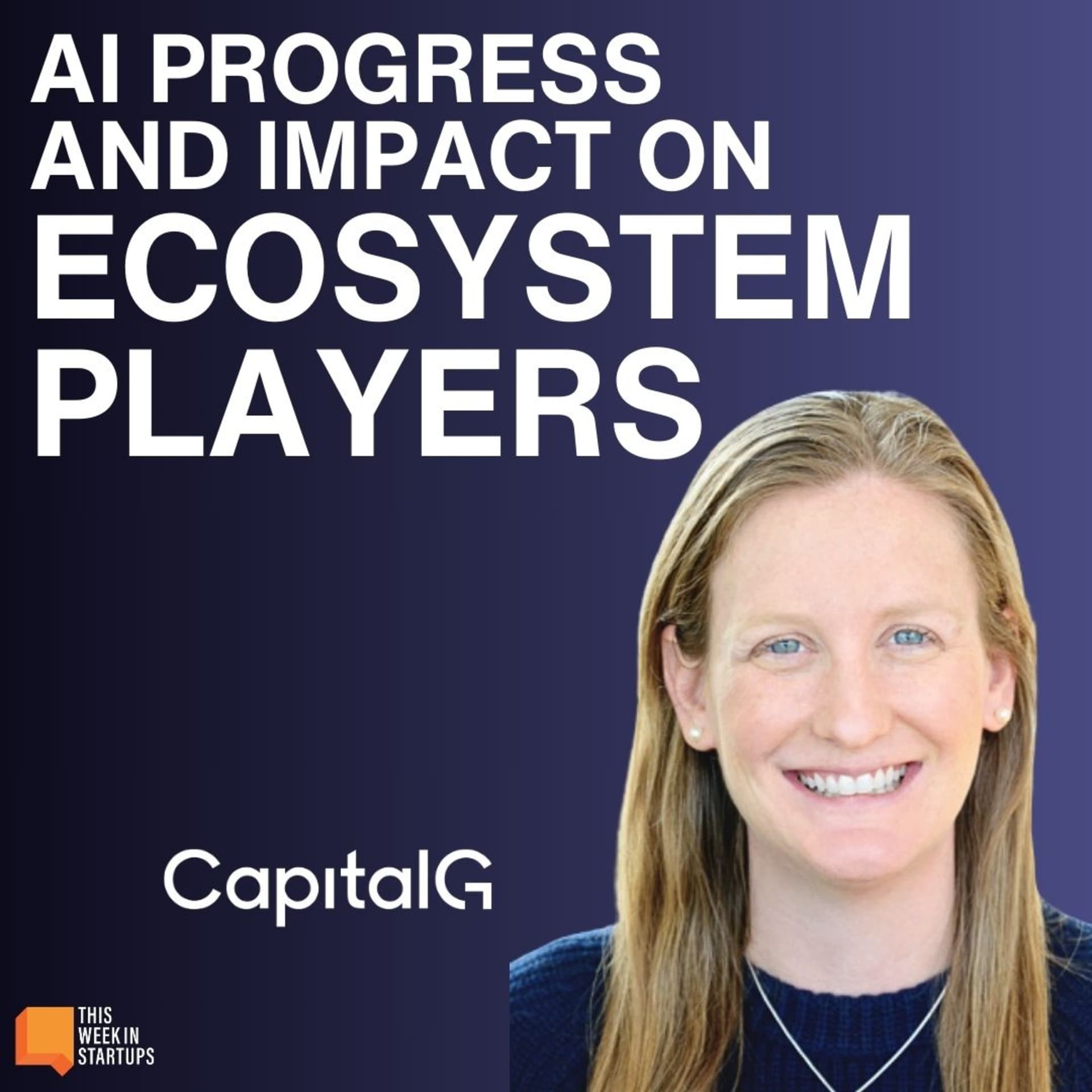
Episode Notes: AI Progress and Impact on Ecosystem Players with CapitalG’s Jill Chase
Podcast Overview
- Title: This Week in Startups
- Host: Jason Calacanis
- Guest: Jill Chase, Partner at CapitalG (Alphabet’s independent growth fund)
- Episode Focus: Examining how AI is reshaping the startup ecosystem, including perspectives on investment strategies, practical applications, and the transition from AI copilots to agents.
Key Themes and Discussions
- AI Investment Strategy
- CapitalG's Approach:
- Focus on post-product market fit investments, typically around Series B.
- Emphasis on thematic and thesis-driven investments.
- Notable portfolio companies include Stripe, Databricks, CrowdStrike, and UiPath.
- Investment Categories in AI:
- Base Layer: Infrastructure powering AI (e.g., chips, model companies like OpenAI).
- Model Layer: Companies producing foundational models.
- Application Layer: Software companies integrating AI, which are increasingly viewed as standard software companies.
- Market Dynamics and Challenges
- Durability vs. Speed:
- Speed alone is insufficient; startups must build durable advantages.
- The rapid pace of AI development means frequent reassessment of investment strategies is necessary.
- Emerging Applications:
- Examples of strong use cases include coding automation and healthcare applications (e.g., Abridge, an AI-powered scribe).
- Potential for rapid growth and significant profit pools in sectors like coding and healthcare.
- AI Integration in Business
- Operational Efficiency:
- AI tools enable startups to operate with smaller teams without sacrificing growth (e.g., one person using AI for customer support instead of a large team).
- Innovation and Testing:
- Lowered barrier for rapid testing and innovation—founders can conduct numerous product tests quickly using AI tools.
- Founders should leverage AI both “in the business” (product development) and “on the business” (operations, go-to-market strategies).
- Building Durable Businesses
- Focus on Customer Trust:
- Founders face the challenge of distinguishing their products as competition grows.
- Building a strong brand and customer relationships is essential for long-term success.
- Case Studies:
- Motif: A next-gen CAD for architecture, facing high barriers to entry and building a complex product.
- Abridge: An AI healthcare solution with a clear runway for innovation beyond its initial transcription capabilities.
- From Copilots to Autonomous Agents
- Evolution of AI Tools:
- The transition from AI as a mere assistant (co-pilot) to fully capable agents is expected to reshape industries.
- Emphasis on learning from interactions with users to enhance model performance and efficiency.
Key Takeaways
- AI is a transformative force in the startup ecosystem, with significant opportunities for founders leveraging technology.
- CapitalG emphasizes thematic consistency in investments, focusing on durable business models that can withstand competitive pressures.
- The ability to test, iterate, and innovate quickly using AI tools is vital for startups to capitalize on emerging markets.
- Building customer trust and maintaining a focus on delivering exceptional experiences are essential for long-term success.
Resources
- Future of AI: Perspectives for Startups Report: [Read the report](https://goo.gle/futureofai)
- Google Cloud: [Visit Google Cloud](https://cloud.google.com/)
- CapitalG: [Explore CapitalG](https://www.capitalg.com/)
- Jason Calacanis: [Follow Jason on LinkedIn](https://www.linkedin.com/in/jasoncalacanis)
Follow Jill Chase
- LinkedIn: [Jill Chase LinkedIn](https://www.linkedin.com/in/jill-greenberg-chase-53747538/)
- X (formerly Twitter): [Jill Chase X](https://x.com/jillchase124)
Conclusion This episode of "This Week in Startups" presents critical insights into the evolving landscape of AI in startups, highlighting the importance of strategic investment, rapid innovation, and building durable businesses in a competitive environment.
Written by AI. May contain mistakes. Listen to the episode to check what was said.
Transcript
Automatic transcript. May contain errors.0:04All right, everybody. Welcome back to another episode of AI Basics. Yes, here at This Week in startups, we'd like to do basics because we get asked the same questions over and over and over again. So we catalog them all at thisweekinstartups.com slash basics. We have accounting, we have legal, now AI. Because let's face it, if you're doing a startup today, you're either using AI to build your startup or your product is going to have an AI bent to it. If it doesn't do both of those things, well, you're probably missing out on some huge opportunities. We have a great partner for this Google Cloud.
0:38They just published a report, The Future of AI, Perspectives for Startups. It features insights from 23 leading AI experts, including today's guest, Jill Chase. She is a partner at Capital G, which is Alphabet's independent growth fund. And yeah, Jill, you invest in AI. So welcome to the program. Thanks for having me. We could talk about AI models, agents, and we'll get into that. But I want to work backwards here from investment and your investment thesis. You could invest in chips that power AI. You could invest in language models that enable the application layer. And then of course, there's services.
1:19And as I said in the introduction, my Lord, the ability to run a startup and scale a startup using AI tools yourself is just been such an accelerant to the number of startups created and how quickly they can hit critical mass. Let's start with maybe how you build a mental model of investment in the startup space in specifically AI companies. Yeah, for sure. Well, thank you so much again for having me. I'm thrilled to be here. And as you noted, just a quick reminder, Capital G is Alphabet's independent growth fund. So independent, meaning we invest purely for financial return and growth is typically sort of post-product market fit.
1:57And we've invested in companies like Stripe and Databricks and CrowdStrike and UiPath. among many others. And the hallmark of our approach is we tend to try to back companies sort of right around that series B sort of right post-product market fit and work with them for a very long period of time, both in terms of pouring continued capital into the business to support them and then spending quite a bit of time with them. The reason I share all of that is because I think sort of so core to our approach in investing is this idea of being extremely thematic and thesis driven. And so that's been quite a fun ride, I would say, as the sort of AI stuff has unfolded over the past, you know, really three years since the chat GPT moment.
2:35We've tried to maintain the sort of thematic consistency around really deeply understanding and building a mental model and then going from there. And the reality is the only constant is we have to continue to revisit this on almost like a six month period because so much changes so fast. I would be excited. Maybe we should revisit this in six months because the only constant we know for sure is it will change because the rate of progress is truly mind blowing. And so let me share a little bit about where we're at today. The real question is, where will the value accrue? Because AI is without a doubt the next platform shift that we're seeing.
3:09So we saw internet, we saw mobile, we saw cloud, and now we're seeing AI. Now, in each of these major platform shifts, there is no real pattern around when the Cambrian moment happened for the technology and when the most valuable startups were created. And so obviously, if there were a pattern around that, if we could say, okay, the technology was developed at point zero and exactly 18 months later, all of the most valuable startups were created, that would be amazing. because then we could just say, okay, let's sort of let all this progress sort of follow for the next 18 months and then we invest.
3:44The reality is it's really different across internet, mobile, cloud, and now AI is completely different for a whole host of reasons, which I'm sure we'll jump into later. And so what we've been doing is studying what are the different areas in which we can invest and what are our sort of mental models for investing in each of those categories. To your point, there is the base layer, there's the model layer, which is you could invest in the foundation model companies. Right now, that's companies like Anthropic, OpenAI, Cohere, DeepSeek, et cetera. There is a layer above that, which is the infrastructure to make those models accessible or usable by consumers or businesses.
4:22The infrastructure layer is really compelling because you both don't have to bet on an individual model company winning or even what will happen, whether they commoditize or not. And you also don't have to bet on which individual AI application is winning. you just have to bet that AI will be leveraged in increasing capacity over the next decade, which I think is a bet we're all very willing to take. That's that sort of second category. And then the third category are the AI applications, which as you noted, I think even two years ago, we might have said, okay, these are like AI apps. They're different from other software.
4:57These are AI applications. Now it's really just a software company. Like these are just, to your point, if you're not building with AI, you're really missing the boat as it relates to what you can either offer your customers or how you can become a more cost-effective business in itself. And so those are kind of the three categories we look at, and they all have different pros and cons. Yeah, and the messy middle, I think, is a very interesting thing for us to maybe unpack. It's very hard for us as investors and capital allocators to know what's going to happen from the introduction to the technology to true scale.
5:31And if you look at the mobile phone, who would have guessed something like Uber or maybe Coinbase and Robinhood would become such huge mega hits. They started out as consumer applications that solved a very narrow problem. But my Lord, those came in, I don't know, year four, maybe year three, four or five of the smartphone. They weren't the first applications on the smartphone. The first applications were a calculator and a flashlight and your calendar and your Gmail. So we're kind of in that messy middle. are you seeing things start to emerge on the application level that you find particularly interesting?
6:07Yeah, I think it's a really good point, Jason. And just to, I think, expand on that first, and then I'll come back to your question. The reason it's especially hard in AI, even as compared to previous platform shifts, is because there's really no analogy for the model brain and intelligence, which takes over some of the value creation for end customers. Because with each iteration of these models becoming ever more powerful, there's even more that those model companies can do to pick off some of these low-hanging fruit consumer use cases. So a great example of this would be coding. Coding is an incredibly obvious and compelling use case for generative AI.
6:47That's been true since the very beginning. It's very obvious why all of these companies are hyper-focused on it. It's a ton of structured data. It's sort of rules-based in the way that you can sort of build the model. And it's targeting a massive profit pool of currently human labor that can be either made much more productive or made more efficient, depending on which way you look at it. So it's an incredibly obvious use case. The models themselves, when they started, okay, pretty good, not so great. Enter something like a cursor that comes in and says like, okay, amazing profit pool, amazing market.
7:20We're going to come in, take the off-the-shelf models, and then build a bunch of different technical advantages to make these models better using techniques like RAG, and then offer an incredibly compelling UI to our end customers, which in this case is the developer. Awesome. What's different here is, and those companies sort of grow, as you've seen, zero to 100 million, incredible pace. And so as an investor, you might sit there and think like, wow, damn, that's incredibly impressive, zero to 100, like for sure that's a company, you know, I want to back up the truck for, this looks incredible.
7:53I think what the skeptic might say is, okay, as these models, these core models that are sort of off the shelf today get better and better, they're eating into some of that technical differentiation that Cursor has built. And so if those models become increasingly powerful, and the model providers are seeing that there's a ton of demand for coding agents, wouldn't they just then also build the UI on top and compete directly with those that are leveraging the model APIs today? And you're seeing that with cloud code right now. Yeah, it's really interesting. I think of Canva, what an incredible product.
8:32And something about inducing a market to exist or servicing a market that doesn't yet exist is fascinating to me as a capital allocator. It was very hard for Canva to get investors, Melanie took many years to, it was also because they were in Australia and listen, talent does not know borders. Talent is just talent and it's going to be where it is. And we're going to have to go find it as capital allocators. And that team was supremely talented, but they were making, you know, Photoshop for people who were not professional designers. And that was a market of zero. There were zero people using a product like that.
9:07And then when the product got introduced, all of a sudden millions of people are drawn to it. Now, I was just thinking as you were unpacking this, they've incorporated AI, but of course, you know, you could use, I was using Gemini and Grok and all these different models. You can make an invite in those as well. So you have to consider, you know, who's going to get the value here? I do think the value for dollar is extraordinary. I don't know if I've ever seen so much value for such a small dollar amount. Maybe you could talk a little bit about, and you mentioned it in passing there, how quickly Cursor got to$100 million in revenue.
9:42We've never seen that kind of pace, but with app stores, with the internet, with virality, people inviting people over social media or across email or social networks, it's so fluid for a great product to get in the hands of a million people. and if a million people feel it's worth 10, 20, 30, even$100 a month, you've got a tremendous business out of the gate. Totally. I think it's a really compelling point. And the way we talk about it with our portfolio companies is you need to think about using and leveraging AI in the business and on the business. Okay. I'll start with on the business. What we mean by that is growing your business super effectively.
10:24And so leveraging AI in categories in the P &L things like customer support and sales and marketing, where maybe it used to take a team of 10 people to go out and sell and market whatever product you're selling. And now it might be one person and several AI tools. And you can, in addition to a lot of the virality components that you mentioned, you can have this thing grow in a much faster fashion. And that's not just more efficient. It also just, you don't need to hire 10 people to do it, which takes time and energy. So that's the on the business piece. It's so great beyond the business piece that you've unpacked there, because there were some things that startups just couldn't do because they didn't have 10 people.
11:05So they would just say, well, I'm just not going to do that now. I'll wait till my series B or wait till my series C. But now they can be like, huh, maybe I'll do that. I was mentoring an executive on finding talent. And she said, oh, I have a list of these D2C companies are looking for an operations person for a D2C company. And they had a list of 10. I said, okay, give me the list of 10. I put it into Gemini. I said, give me the 10 competitors of these 10. And now I had a list of 100. And they were like, oh, why didn't I think of that? And I was like, well, what else didn't you think of? And so then I explained to Gemini, and I used deep research, here's what we're trying to accomplish.
11:39What would the next steps be? And they were like, oh, do you have a culture page at your website? Oh, do you have this? Have you written a job description? Have you used your internal network? And all of those things that you would have maybe hired a consultant for, now the language model is the consultant. And that is just scary. Like you've compressed the amount of time between a problem set and knowing the solution and then executing on the solution. So now I guess in the product is the next piece of the puzzle. Yeah, totally. And I think just briefly on that point, I think it's why so many CEOs and we're doing it internally as well.
12:12And I think every organization should be, you know, you saw the Shopify CEO come out very recently saying like, hey, everybody better be experimenting with these tools because the only fact we know for sure is we will be leveraging over the next decade and beyond. And so start figuring out what they're capable of now. And I think that's so true exactly to your point. You need to start, even if they're not quite as powerful as they will be, or even if they fall short in certain use cases, at the very least, getting used to having them as part of our workflows, I think is really critically important.
12:42In the business piece, I think it's sort of exactly as you described, I think the barrier to finding product market fit for new product features is so low today. Because you can just go on, you can... Honestly, the only constraint is imagination. Because you just say like, Hey, what if our customers could do XYZ and then go on leveraging off-the-shelf API, get something stood up with one of the vibe coding apps, lovable, and you create any of these, and then test it. And hey, that's pretty inexpensive. It doesn't take that much time. And if it seems compelling and customers seem really excited by it, That's when you think about optimizing the cost, building it out for reliability and production.
13:23But we've really just shrunk the amount of time it takes to get from idea to really testing it and seeing if there's value. And that is so that is like the most powerful thing when you're a startup. And so not doing that today, that's like, you know, priority number one. Yeah. And to slow down and iterate it for people who maybe are new to this, there was a concept that startups that won were the ones who ran the most tests. What's the test? Hey, I wonder if people would pay$49 for a meditation app. What's the least amount of work you could do to find the answer to that question? Well, you could spend two days building a website that allowed people to come see it, make some ads, run those ads, some Google search ads, some Facebook ads, and then send a thousand people to that page and see how many people put in their email address or phone number to say they wanted to sign up.
14:13And when they did sign up, you could say, pick a pricing plan. You could try a multivariate thing. So this, you know, would be 20, 30, 40, 50 hours of work. But what you just described could be done in two hours of work. If you can do a 50 hour test in two hours, another way of stating that is you might be able to run 25 tests. And that means somewhere on those 25 tests might actually be the greatest feature that you just would have never gotten to. In other words, you're knocking, you're opening doors to closets and then all of a sudden finding a bag of diamonds in one, but you don't know which of the 25 closets is the bag of diamonds closet.
14:47And so it's just, it's so awesome to think about, you know, a five person team being able to do this kind of stuff. Totally. I do think though, there is a shadow side to this, which is you can do all of this and I can do all of this and 20 million other people can do all of this, which is the thing that's most exciting about what AI is sort of empowering as we think about what is likely to be created over the next decade, leveraging the technology. But the reality is, because it's democratizing the ability to run these tests and to build these companies, and you can do 100 million ARR company with 20 people, that means that you really need to focus on not only finding what is that lightning in a bottle and what is going to resonate with customers, but almost more importantly, how do I take that lightning in a bottle and make it much more durable and have some sustained differentiation over time.
15:41Because startups are going to copy you. And as we just talked about, it's easier today to get things up and running. Incumbents who have distribution are going to be able to leverage the technology to build out... They could use the startup ecosystem as almost free product market fit testing, see what seems to be resonating and growing quickly, and then build out those features internally, again, leveraging these off-the-shelf models, I think it just puts in... This is what's hard and fun as an investor. It really puts even more pressure on this durability question. And when I have conversations with founders, I really get in the hearts and minds of like, okay, it's awesome what you have today.
16:23Do you have some way to be durably differentiated over the long term? And that's where we spend 90 % of the conversation. It's so interesting you bring up durability because I was just talking to somebody about quality of revenue and the durability of their business in the face of, hey, well, if anybody can copy this very quickly and that undercut us, what do we do? And, you know, I said, you know, what really is a great defense is your resiliency and your focus and the resiliency focus of your team to just not stop innovating. So, yes, people can start competitors. they can do fast fashion and knock off a Prada or, you know, an Armani or, you know, a Tom Ford suit, whatever it is.
17:06Of course, people can do that in fast fashion. It happens all the time. But if you build that perfect bag that becomes iconic and you just keep working on quality and working on that customer relationship and brand, well, you're going to be just fine. But founders sometimes, and this is the tragedy and the double-edged sword that you described, what if you get distracted and you want to make sure people don't get distracted, right? And founders need to stay focused. Totally. I do think there are also, there are sort of two different ways, and maybe I'll use two examples, both for my portfolio to really describe.
17:37There are many different ways in which you could build this durability. On one hand, you have something like a portfolio company of mine, a company called Motif, which is building sort of a next generation Autodesk founded by the former CEO of Autodesk. That is just incredibly hard to build. Like it's just hard to put 3D CAD software in the browser, make it cloud native, have it work in a way that feels sort of compelling and exciting for architects and make it AI native with a ton of features that you could imagine and build out a ton of features that are wildly compelling to the architect audience.
18:11That's one way to be differentiated. And I am obsessed with that team. They are hunkering down and building something really hard, and they are the exact right team to do it. And that's extremely compelling. Alternatively, you could build something like... I'm also an investor in a company called A Bridge, which is a healthcare AI company. Its first product is an automated scribe in doctor's offices. It sort of automatically transcribes your conversations with your doctors. Now, that product in and of itself, you can sort of see a world where over time it gets commoditized. Right now, I think, you know, Abridge is far and away the best and does an exceptional job at it.
18:45But you can see how that technology, when pulled to its logical conclusion, could get commoditized over time because it asymptotes at 100 % accuracy of transcription. But the thing that gets you excited about it there, about that company is, okay, that's their first product, but they are landing in these massive health organizations that really are craving an AI partner. And there is what I like to call a runway of innovation that is limitless of things that they can do once they've landed in these organizations that they can build out, you know, RCM and beyond. And so that's where it gets to your point you're making.
19:19We're like, as long as you're hyper focused on delivering an exceptional experience with your first product so that you can land with the customers you want to land with. And you have a long runway of innovation. Like there's a lot more you can do with that customer base. and you have an ethos and culture internally of iterating very quickly and shipping very quickly. That is another very different way for Motif, but another way to sort of create this durable advantage over time. Yeah, it's the classic tip of the spear wedge strategy. You get in there, you build trust and they love your product.
19:51And then you just, it opens up the wedge, just like if you were cracking open a log, it opens up and you get more opportunities. And the key there is trust. So it's interesting you bring up like, hey, what if it gets to 100 % accuracy? Well, you know, the cost of a mistake, a hallucination, or any kind of mistake, or the server going down in transcribing something a doctor's doing, as you know, you know, being associated with Google, even though you're independent, important to state, every time Marissa added speed to the search, I remember talking to her about it in year four or five of Google, they were so obsessed with just getting a couple of milliseconds off that result and consumption went up.
20:29The number of searches went up. So there's something about stability and trust. Why would you switch is then the question you have to ask. And, you know, at a reasonable price, consumers don't feel the need to switch. This is something I'm trying to get, wrap my head around, which is in order to get somebody to switch off a product they're using that they love, you know, we're taping on Zoom or you might be using Google Docs or you might be using Slack, whatever it is. It has to be a magnitude better to take it out, learn something new. And I think that's where, you know, founders can take some solace in this conversation.
21:04Yes, it's easy to copy it. Yes, it's easy to stand it up and test it. But building trust, having a brand that you're known for and building those adjacencies, you cannot defeat that. That is sustainable, right? Oh, 100%. And to be clear, there has literally never been a better time to be a founder than right now. It's like, It's just the ability to ship very quickly and iterate very quickly and all of that. It's so exciting. It's worth noting the sort of shadow sides like we described so that founders can be really focused on building fully exceptional customer experiences and thinking towards sort of what is my differentiated perspective in the long term.
21:42But it's absolutely possible. And I think over the next decade, we'll see a lot of massive businesses built by very small teams, which is so exciting. It is exciting as well that we can, when you bring up those small teams, you can start to fill in nooks and crannies that people might not have considered a business opportunity. It's very strange, but, you know, I have a passion for skiing and there's an app called Slopes. This thing has become a bit of a phenomenon in the ski community. Dave Morin and I, you know, we're friends and we ski and we added each other on the app. We've never skied together, but we get to see each other's statistics.
22:14It's kind of like Strava, you know, in that regard. and I just sometimes just I'm so excited that this exists because it's a niche piece of software that has now saturated all of skiing where people share their different speeds and what runs they've done what mountains they've gone to you could ski together and there's so many things like that that maybe weren't viable when it cost 10 million dollars to stand up an app company but if it cost a million dollars to stand up an app company or a weekend and 250k wow we can start delighting customers with more niche products and services that, of course, as you pointed out, could become, you know, bigger as time goes on.
22:53I started also with this meditation app, Calm, that we invested in. Everybody wanted to copy Calm. There were 50 or so, you know, meditation apps that got built after people saw Calm's success. And then probably of those 50, maybe five of them are still updating the app regularly. So I don't get dissuaded if you're a founder, if you get a bunch of people copying you. That's what happens in this industry. You just got to stay focused. Man, this has been a great conversation. Will you come back again? And maybe in six months, we can talk about it again and all the things that have changed. Yeah, I feel like I could talk to you for like an hour more.
23:24It's been awesome. I get that sometimes. I do get that sometimes. When you talk for a living, absolutely. Listen, if people are in that Series A zone where they're going to be going to their Series B, how can people reach out to you, Jill, and find out more about working with your firm? Yes, please do. You can shoot me a note anytime. Jill Greenberg, B-E-R-G at capital G dot com. I would love to chat with any of you. I'm super excited about what everyone's building. And, you know, as we've discussed over the past half hour here, the time to build is now. And we're super excited to support founders who are on that journey.
23:55And Jill's part of the report, this excellent report that Google's done, is moving from a world of co-pilots to agents. We all know how important that is. People are using co-pilots and agents are coming. I mean, this concept of going from co-pilots, people can read the report, of course, but this, I suspect, is co-pilots. When we use them, in some ways, we're training them to be solo pilots, aren't we? Yep, that's exactly right. I think that the journey from sort of co-pilot to agent is one that we've been studying. I think people oftentimes think of that as sort of like, hey, there's the co-pilot offerings, and then there's the agent offering, and those are going to be completely different businesses.
Read the full transcript
24:29I think the reality is we're probably not super close to a world where we can 100 % get rid of all humans in really any category tomorrow. I think what it's going to look like is, hey, the models are really good at these types of tasks right now. Let's give the humans a co-pilot to help them get more efficient and more productive and better. And then let's make the models better and better and sort of transition those products from what feels like a co-pilot today to a fully autonomous agent going forward. All right. Thank you so much, Jill, from Capital G for joining us on our AI Basic Series.
25:03Go check out Google Cloud's report, Future of AI Perspectives for Startups. Head to goo.gle slash futureofai for expert insights, practical examples. A couple of my besties are in there as well. So thanks for tuning in, everybody. And we'll see you next time on Startup Basics here at This Week in Startups. Bye-bye.
From the publisher
In this episode of AI Basics, Jason sits down with CapitalG partner Jill Chase to break down how AI is reshaping the startup ecosystem — from founders to investors to incumbents. They cover how CapitalG (Alphabet’s independent growth fund) thinks about the AI stack, why speed alone isn’t enough for startups today, and how to build durable advantages in a world where anyone can copy your product. Jill shares insights from portfolio companies like Motif (next-gen CAD for architecture) and Abridge (AI-powered doctor’s scribe), plus how startups can use AI “in the business” (product) and “on the business” (ops, GTM, etc). They also explore the transition from copilots to agents — and what that means for the next wave of software. If you’re building or investing in AI, this is a must-watch.
*
Timestamps:
(0:00) Jason kicks off the show
(1:10) CapitalG's investment strategy in AI
(3:04) Understanding value in AI investments
(5:16) Durability in AI startups and market challenges
(10:18) Practical applications of AI in business
(17:52) Case studies of successful AI startups
(21:35) Building massive businesses with small teams
(23:55) Evolution from AI copilots to autonomous agents
*
Uncover more valuable insights from AI leaders in Google Cloud's 'Future of AI: Perspectives for Startups' report. Discover what 23 AI industry leaders think about the future of AI—and how it impacts your business. Read their perspectives here: https://goo.gle/futureofai
*
Check out all of the Startup Basics episodes here: https://thisweekinstartups.com/basics
Check out Google Cloud: https://cloud.google.com/
Check out CapitalG: https://www.capitalg.com/
*
Follow Jill:
LinkedIn: https://www.linkedin.com/in/jill-greenberg-chase-53747538/
*
Follow Jason:
LinkedIn: https://www.linkedin.com/in/jasoncalacanis
*
Follow TWiST:
Twitter: https://twitter.com/TWiStartups
YouTube: https://www.youtube.com/thisweekin
Instagram: https://www.instagram.com/thisweekinstartups
TikTok: https://www.tiktok.com/@thisweekinstartups
Substack: https://twistartups.substack.com


