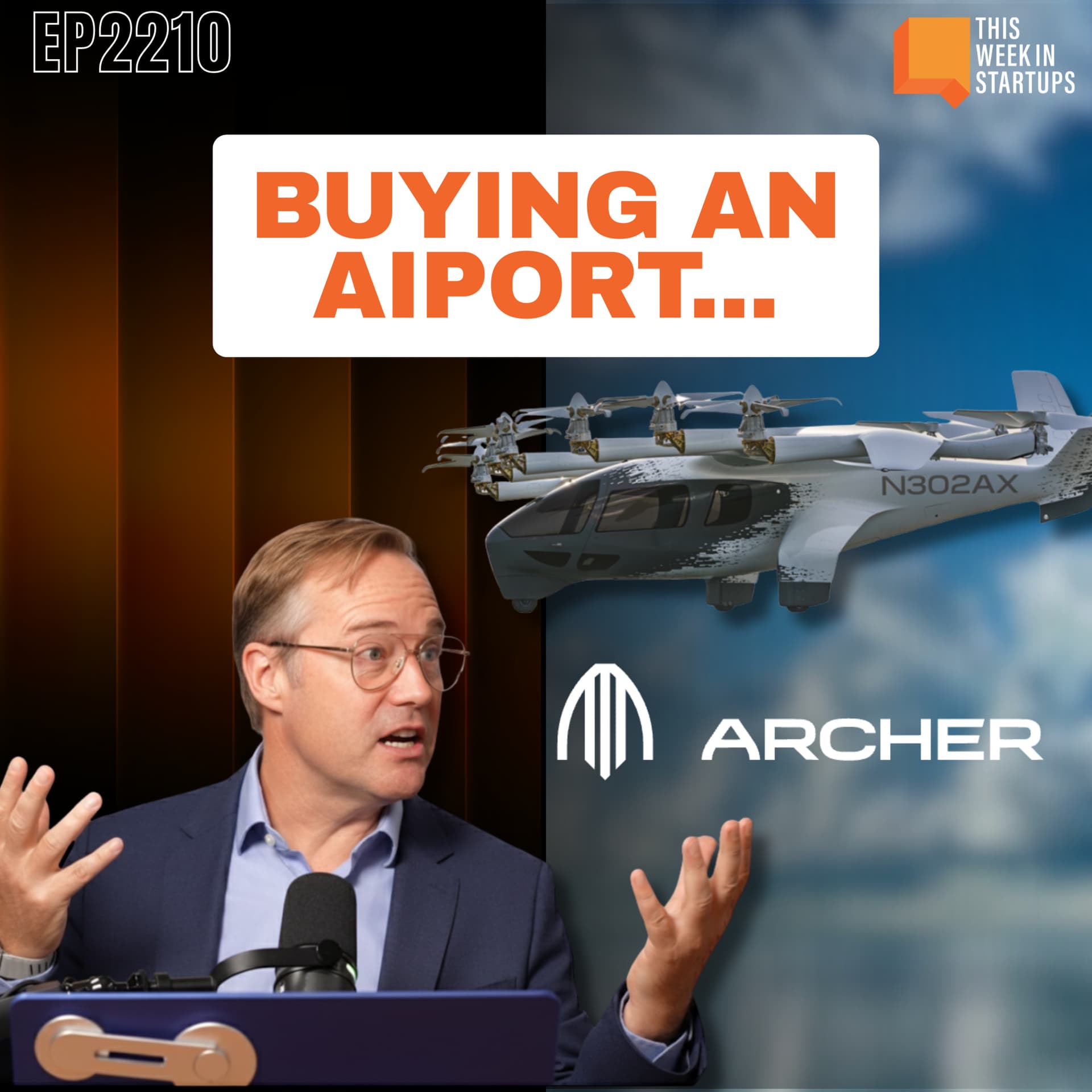

In short
This Week in Startups - Episode 2210 Summary
Podcast Title: This Week in Startups Episode Title: Archer buys an airport, Ramp’s huge raise, RIP KitKat, Bezos returns to the C-Suite, and more Release Date: [Insert Date]
---
Overview
In this episode of *This Week in Startups*, host Jason Calacanis discusses a range of pressing topics in the startup and technology sectors. Notable discussions include Archer's acquisition of Hawthorne Airport, Ramp's significant funding round, the ongoing evolution of AI startups compared to traditional SaaS companies, the impact of AI on job markets, and a brief tribute to a beloved local cat.
---
Key Highlights
- Bezos Returns to C-Suite
- Jeff Bezos steps into the role of co-CEO of Project Prometheus, a company focused on bridging AI systems with real-world applications.
- The project has secured $6.2 billion in funding and aims to integrate AI into industries such as automotive and aerospace.
- Archer and Joby Aviation
- Archer's acquisition of Hawthorne Airport is a pivotal moment for the eVTOL market.
- Discussions about whether we are nearing "Peak eVTOL" as Joby Aviation also makes strides with flights originating from Abu Dhabi.
- Ramp’s Funding Round
- Ramp successfully raised $300 million at a $32 billion valuation.
- The company reported a doubling of its revenue to $1 billion within the past year.
- Discussion on the concept of "intelligent money" as Ramp employs AI for more efficient financial management.
- The Trouble with Dropbox
- Dropbox reported a slight decrease in revenue, raising concerns about its future.
- The conversation highlights how Dropbox has struggled to innovate beyond basic file storage services, becoming a feature rather than a standalone product.
- AI Growth vs. SaaS Companies
- The episode emphasizes the rapid growth of AI startups compared to traditional SaaS companies, prompting discussions about investment strategies in these sectors.
- Questions raised about job displacement due to AI advancements, with insights from Dario Amodei of Anthropic.
- Local Community and AI Regulation
- The episode touches on local responses to self-driving technologies, highlighted by a recent incident involving a Waymo vehicle and a local cat named KitKat.
- The broader implications of AI safety and local governance are explored.
- Economic Trends in Crypto
- The discussion includes fluctuations in cryptocurrency prices and the possible correlation with broader economic sentiment.
- Viewer Questions
- Addressed strategies for founders navigating the current fundraising landscape.
---
Key Takeaways
- Opportunities in AI: There's a significant opportunity for startups that leverage AI to enhance human capabilities rather than replace them entirely.
- Investor Mindset: Investors are currently favoring high-growth companies, particularly in the AI sector, which necessitates that startups demonstrate measurable growth to attract funding.
- Navigating Challenges: Founders are encouraged to raise funds during periods of growth, even if it's not immediately necessary, to secure their startups’ financial futures.
---
Conclusion
This episode of *This Week in Startups* encapsulates the vibrant and often tumultuous landscape of the tech startup world. With insights from Jason Calacanis and his guests, listeners gain a deeper understanding of the factors influencing startup success in an age marked by rapid technological advancement and changing market dynamics.
For more information and to listen to the full episode, visit [This Week in Startups](https://thisweekinstartups.com).
Written by AI. May contain mistakes. Listen to the episode to check what was said.
Transcript
Automatic transcript. May contain errors.0:00All right, Jason. So perhaps the biggest news today in startup land is that Jeff Bezos is going to be CEO again. What? Not of Amazon. I know. Hear me out, though. Not of Amazon. And it's going to help kind of bridge the difference between AI systems and the real world. The company has raised$6.2 billion, just came out of stealth. What we're talking about is real world AI. Does that mean humanoid robotics? Does that mean robots? Bezos is now back in the CEO seat. This is extraordinary news. I thought for sure Bezos was going to come back to Amazon. I think there's two things left for Bezos. Number one is to go back to Amazon at some point.
0:43Possible, not probable. The second is to run for president. And that would be a bummer for his lifestyle, I think, because being prepped. So, and he's still young, like. This Week in Startups is brought to you by DevStats. DevStats integrates your dev work and your business goals into a shared language that everyone can understand. Get 20 % off plus access to their dedicated Slack channel. Just go to devstats.com slash twist. Vanta. Compliance and security shouldn't be a deal breaker for startups to win new business. Vanta makes it easy for companies to get a SockTube report fast. Get$1 ,000 off for a limited time at vanta.com slash twist.
1:26And NetSuite. The business landscape is very chaotic right now. That's why you need NetSuite by Oracle. Download the CFO's Guide to AI and Machine Learning for free at netsuite.com slash twist. All right, everybody, welcome back to This Week in Startups. I'm your host, jet-lagged J. Cal here on the program. I am back from one of the longest business trips I've ever been on in my life. I think the longest I ever did was like 15 or 16 days, and this one was like 13 or 14. I left on a Saturday, came back on a Saturday. Man, the jet lag hit me hard last night. I was up till three or four in the morning.
2:05But I got some sleep and the night before I got 12 hours of sleep. I am just whipsawing around. But man, did I have the trip of a lifetime. So I want to start there, actually, because I'm really curious what you're hearing. I mostly talk to people that are very much in the Silicon Valley American startup technology mindset. But you were in Japan, you were over Mina. So what's the vibes out there, Jason? And what surprised you from founders and investors that you talked to? I have the luxury at this point in my career to pursue opportunities that I think are either personally interesting or accretive to the returns of our funds.
2:43And in this case, I've been studying what's going on around the world my whole career. I've been traveling, doing speaking gigs, covering as a journalist, you know, different regions. And for the last three or four years, I've been going to the Middle East. And I went with Brad Gerstner. He was going. I was sitting at a poker table. This is in the early days of all in, like maybe in the first six, 12 months. And he had started going there. But, you know, when I asked around the table, had anybody else gone there? I think almost nobody in my friend group had been to the Middle East. I had been invited many times, Israel, Dubai, even to the FII conference.
3:19And I had declined. So, you know, had enough going on in America and had other things on my short list of places to go. But having watched the amount of money that was starting to be invested in startups from the region, specifically watching Uber raise from the region, I said, I need to get educated. So I started going. What I learned was these are some of the great entrepreneurial families in the world, in Saudi, in Abu Dhabi, in Doha, in Dubai, in Bahrain, all these places. And they have been educated in the West and we're now boomeranging back to their home countries and building businesses there.
4:02And people started to ask me, hey, you know, do you have funds? You know, can we be LPs? And I started those discussions, but currently don't have LPs really from the region because I had just started going there and had just basically wrapped up the Launch Fund 4. But one of the discussions that came there was, hey, we're trying to build a domestic Silicon Valley. Everybody in the world wants to replicate Silicon Valley. And I had some experience with that, having champion Silicon Alley with the Silicon Alley reporter in the 90s. And everybody told me, oh, Silicon Alley will never hold a candle to Silicon Valley.
4:37And at the time, Boston and Silicon Valley were basically, Yeah, there were two centers. And Boston was actually taken very seriously at the time as the tech hub. But I watched the tech hub up close and personal grow from a couple of dozen people to the modern day Silicon Alley, which is thriving and has plenty of unicorns and venture capitalists. They asked me, would I bring Founder University? As we've heard on this program before, it's had a profound impact on people's lives. They're thinking about starting a company. They come to Founder University. They're not incorporated. We give them a 25K check, you know, just to get them started their first check in.
5:14And they learn all these different skills from the curriculum, product market fit, how to set up your cap table, how to hire, how to do world class design. And so I was invited to bring Founder University to Riyadh by Sonobel. Sonobel is the venture arm of the PIF, which is the sovereign wealth fund, which is, you know, to be sure, you know, quite a quite an honor to be asked to do that. And I said, you know, this would be a very interesting thing to do to take what I've learned over 30 years and bring it to that region and help build companies there. They're in decade zero of building technology companies there.
5:53We were going to have 25 companies. We had 60. I spent three days. I was able to bring Amanda Bradford from the league, which she sold to Barry Diller and IAC. and my friend, William Barnes, who was one of Travis's lieutenants at Uber to be mentors. So the three of us went out there, a couple of people from our team were out there, Ismael and Bianca. And we did three days with these companies. And I was really impressed. These are great entrepreneurs with great ideas. The companies are different. The needs are different. So I had to take our curriculum that was working in America really well and refined over 11 cohorts.
6:29And then I had to adapt it in real time, which was intellectually very rewarding for me. And really great companies there. And then I headed on to Japan. And it sounds like basically the same enthusiasm and excitement for AI and fintech and the stuff we're seeing here in the States is replicated elsewhere. Or are there like entire different categories of startup focus, Jason, that we should be aware of that are bubbling up? Both. First, there's a lot of construction going on in the Middle East. They're investing in their society. So if you were to imagine, you know, China 10, 20 years ago when they were starting to build out the infrastructure, that's what's happening in the Middle East right now.
7:08So you hear about these incredible projects, almost like science fiction projects in the Middle East where they're building the future. They're skipping building airports as we know them and building airports of the future with things like Joby. Joby is launching basically airports there. Pretty amazing in Abu Dhabi. And they started flights between Abu Dhabi and some other regions. Pretty interesting, right? Here's the video, Jason. Oh, okay, great. I have the sound off, but if you're on the audio version, we are looking at a desert. We are looking at a eVTOL aircraft taking off, flying out. Joby in Dubai is the headline.
7:48Imagine a Cessna 172 stretch, but instead of one engine on the front, it's got four that pivot. Six. Six blades. Six blades that pivot. I'm sorry. Yeah. But I would love... Oh, you're right. It is six. I can't count. It's gorgeous. And I love to see commercial progress. This is the real deal. There'll be flying passengers in 2026. They've been flying tons and tons of routes. So there's a lot of construction startups there. Another thing that's happened is finance in the region for various cultural reasons and just developmental reasons hasn't been developed fully. So there's a ton of fintech. So you have two areas where they really need, have a big need.
8:34Financing a lot of these real estate projects, whether it's, you know, residential or it's commercial or it's infrastructure, like we saw there, roads and bridges and transportation. And then that requires tools. So marketplaces, we saw some marketplaces that were helping people procure cement and, you know, workers, et cetera. Then you saw, we saw some marketplaces for people who were selling different units in buildings that were under construction. So that was really encouraging to see. Now, we had to look at the, we looked at which parts of the curriculum people needed help with. Turned out design in the Middle East is maybe behind places like Scandinavia or Germany or the US.
9:23Kind of makes sense, right? Like it's, they're focused on infrastructure, people building construction. Maybe they're not working on the logos of their app, like Comm and Uber might be 10 years into those programs. So we adapt. And then also there's not a lot of developers in the region. There's talent in the region, but there's just not enough developers to go around. Got it. So finding and recruiting developers is something in Saudi, in Abu Dhabi, Dubai, Doha, you know, in different places where we needed to build a module for that. A module is just like an educational module. My social media feed is filled with all these experts giving me stock tips, investment advice, but we know nobody's got the crystal ball.
10:06Everyone is just guessing. They're making their best guesstimate. But now you can take the guesswork out of your business planning and strategy when you use NetSuite by Oracle. NetSuite is the number one AI cloud enterprise resource planning software on the market today. That means every facet of your business comes together in a single easy to use fluid platform, giving you a single source of truth and the data you need to make smart informed decisions. And like all great businesses, NetSuite is constantly updating their product with great new features. For example, their new AI powered intelligent payment automation system allows you to not just automate, but optimize your payment process, which is going to lower your costs, accelerate your payments, and it'll build stronger relationships with your vendors.
10:52So find out why over 43 ,000 businesses, including a number of my own portcos have future-proof their operations with NetSuite by Oracle. Plus, our friends at NetSuite want to give you a free gift. Download the CFO's Guide to AI and Machine Learning for free at netsuite.com slash twist. That's netsuite.com slash twist. So we're working really hard on changing the curriculum in real time. So we have this beautiful curriculum over 12 weeks. So I said, hey, can we move these up? How to find a designer, how to find a developer, how to take your design from a three, four, or five out of 10 to a six, seven, or eight out of 10, which is kind of easy to do.
11:34It's when you get to the higher echelons, it's hard to do. So that was super rewarding. We're going to be doing two classes a year in Riyadh. It's open to anybody, as long as you are willing to spend time in Riyadh. and there was some preference for people who are based in Riyadh and, of course, for citizens of Saudi Arabia first. So we were going to have 25 startups. We went to 50 and then I cut it off. I said, that's it. We doubled. I don't want any more. And then word got out and then all the lobbying starts. People are, you know, hey, can you just add one more? OK, so we got 60. And then I headed started after a brief stint in Dubai.
12:16My friend Sammy had a great party for me. That was incredibly nice. I'll have him on the program shortly to show off his water product, which I don't want to tell anybody about right now. But I got a friend in Dubai who's got a water product that's incredible that I'm going to try to invest in and promote when I get a chance. Brief stop in Dubai and then went on to Japan. In Japan, we're also launching Founder University. There we're doing it with JETRA, which is the Japanese Economic Trade Association. All these countries have trade associations, and they have a very robust economy and startup scene.
12:50However, it's different than the one in Saudi, and it's different than the one in MENA, and it's different than the one in the United States. Design is really great. The entrepreneurs have great UX. They understand paid marketing really well, but they're going after Japanese customers. It turns out the Japanese customer base is extremely well-served and depocketed. In other words, they understand great products. They like to try great products. They're tech first. They're tech forward. They have an obsession with UX, whether you're going to get pancakes or you're going to get ramen. They are obsessed with your experience.
13:25But one example, I went to Stand Up Sushi there. And I always tell founders, go to Japan if you want to learn about product. There's a stand-up, there are stand-up sushi bars. Sushi started as like bar food. It used to be given out for free in bars. It wasn't like an elite. Yeah, the whole history of sushi. It's really interesting to think about product market fit. They used to put fish into rice with vinegar to preserve it. Then they would slice it and you would eat it. They would cook it. But then some people were like, hey, I don't need you to cook it. It's been preserved in vinegar with the rice.
13:54And you can leave the rice on there. It kind of tastes interesting with the rice on it. That's the story. Anyway, they have these stand-up sushi places. You can go, you can gorge yourself on sushi for 20 bucks and eat every, all the great pieces and Toro, et cetera, that you would normally pay 50, 60, 70 for dollars for a normal cost-save, just on a design. You just walk up, you order from the counter, you point at things on the menu. They have a little hot water spigot at every station. There's a stand-up sushi counter. Now, that one I don't think has the hot water at each counter, but if you look at mine, I may have shared on mine, but they have a hot water spigot in front of each one.
14:29they have matcha powder and they have a tea glass there you shake a little matcha powder into your glass you push it in like a normal water fountain like you use for soda pop in the movie theater you push it in but hot water comes out you make your own hot tea and you refresh your own hot tea now it's a stupid silly little example but if you're trying to turn over you know the stations here letting people serve themselves hot tea is worth the time to put those hot water spigots there because you eliminate a third of the experience that would slow it down. You want more hot tea in between pieces of sushi.
15:02Now you don't need a waiter there to provide it. They understand product market fit, but the challenge is maybe being outward facing as opposed to internal facing. So we're going to try to educate the founders there on the opportunity outside of Japan. Remember Sony and, you know, many other Japanese products or services from movies to anime to toys. It used to be that they were very outward facing. You buy a Toyota. We were obsessed in the 80s and 90s with Japanese products, 90s and 2000s with Japanese entertainment. But if you got all these really rich customers and you have the number three economy in the world, you don't need to be outward facing.
15:47So that's one of the things we're going to work about is how do you get English speaking customers building English products in parallel to building the Japanese product. So we're launching Founding University there in January. And we will put a QR code here in the video. Next up on the docket, Jason Ramp has raised$300 million more. This came out just before we went on air. The company is now worth$32 billion. The company's revenue doubled to a billion dollars over the last year. So this is not a run rate metric, Jason, which is a little bit odd. I think it's a trailing number, which is pretty baller, frankly, from them.
16:20And they see they're growing about 10x faster than the median public SaaS company, super proud of their progress. And they have a pitch about intelligent money. So I'm going to try to gist this down for you. But the idea is that in traditional companies, average public SaaS company growing 16 % year over year, and the top 10 SaaS are growing about 30 % year over year. You know, SaaS is a grinded out business and the AI startups in the market are growing much faster than SaaS companies today. This is defined as companies with$500 million in annual gross profit and generating cash. So these are the profitable SaaS companies that are public.
16:59And yeah, they are growing slow and steady. Ramp is ramping up 153 % year over year, 16.2x. Super impressive stuff. I mean, it's a company that's just been crushing it. Their pitch, though, is that their use of AI is turning money into essentially something more intelligent. I think their point was that for a long time, spend costs and how money was moved around companies was kind of hidden behind static rules. And it was a little bit opaque and ossified. And so their pitch is that their AI agents, they have an agent for procurement, they have an agent for compliance and so forth, are turning money into something that's more intelligent and less stupid.
17:46And they have a couple of stats, Jason. They said that their policy agent prevented more than a half million out-of-policy transactions that saved$290 million. And their treasury agent is moving money into higher yielding accounts and that sort of thing. And I think that while this is clearly a marketing ploy to call money now intelligent, I think it actually has some merit. Because I do think that AI agents for specific policies and specific rules inside of a large corporation can save a lot of time and money. So I think even though it's marketing, I buy it. It's definitely some PR person spent a lot of time on intelligent money.
18:22Let's just explain what they do. They do expense tracking. They do procurement and making sure that things are labeled properly. People will sometimes expense things they're not supposed to. And they'll categorize things wrong. Why is this important? Well, if you're categorizing something that's a business product, like a laptop, well, it has a depreciation schedule. Can you expense it all in year one? Obviously not. But if you were buying, like, I don't know, a headset, maybe you can if it's under a certain dollar amount. There's all different rules. There's all and these are very important to get right.
18:58Humans were the people who would do this. It would be a$20 an hour job here in America,$30 an hour job for somebody who worked in bookkeeping. Then it went to offshoring for$3,$4 an hour. And now it's being done by AI. This is the trend right now, just a chart of the amount of data centers being built versus the amount of office space being built. And it's about to flip. If anybody was wondering what's happening here, this chart is super illustrative and indicative of where the world is heading. we're making office space for robots at a faster growth rate than we're making office space for humans work faster that's not just my personal motto it's my number one piece of advice for founders that's how you build a successful business and when your startup is starting to attract those big enterprise clients you're going to need a way to keep building and shipping products that they're asking you for and that your competitors might be already providing.
20:07But you got to do that without falling behind all of your security and compliance requirements. What do we do here? Well, what you do is you relax. You take a deep breath and you get a partner and that partner's Vantive. Their AI and automation is going to make it easier than ever for you to get big deal ready. You're going to do that in days, not weeks. They're going to help you scale your company and continuously keep an eye on your compliance. So you're always ready for the next big deal whenever it arrives. AI is here, folks. It's changing all around us, all the rules, and it's changing your customers' expectations.
20:38So it's time to get secure with our friends at Vanta. Twist listeners can get$1 ,000 off by going to vanta.com slash twist. V-A-N-T-A dot com slash twist for$1 ,000 off. Thank you to Vanta. How does this make you feel about RTO? Because I feel like we're eventually going to need more office space down the road. Does that chart indicate we're not going to go back to the office? We probably overbuilt office space. If anybody with a job is probably going to come back to an office, because if the things that are wrote are done offshore, if you can work at home as an American, then it can be sent offshore.
21:15Things that are sent offshore can be automated by AI. So you just kind of take that path down logically. If it can be done work from home, it can be done by somebody in a low cost market like the Philippines, like India, like South America, like Portugal. So that work is finding its way from the US to Canada, to Portugal, to India, and then on to the Philippines. Then it gets to$1 an hour or$2 an hour. So it would make sense that the next stop is AI. And in fact, the companies that do business process outsourcing are the ones who are embracing AI. Work from home, unless you're like super elite, it's probably going to be a thing of the past because people will want to have humans doing the thing that is uniquely human, which is brainstorming and collaborating and building cultures and all of those soft, touchy-feely things around culture that work better when we're in person.
22:09Yes. What I'm curious about, though, is the valuation for this ramp round, Jason. Billion dollars in trailing revenue,$32 billion valuation, 32X. Fair enough. The thing is, Navon went public the other day, and this is the rebranded Trip Actions. Mostly, it's a platform that helps companies book travel, but they also have some kind of corporate spend work in there. So it's a bit of a loose comp to overseen here from Ramp. It's struggled post-IPO. It's just not done that well. And I thought that was going to take some of the enthusiasm for these products away for a bit. But no, it seems that Ramp is just doing so well that it's transcending category concerns, which is impressive.
22:46The question for Nivan is what's their growth rate? Because when people do make these investments and you get a really lofty valuation, it's typically indicative of a high growth rate, which is exactly what Ramp was going on about here. And the whole news peg here is that they're growing 10 times faster than the public stats markets. So if they're trailing$1 billion, what's the forward looking like? If the forward is looking like they are going to double revenue next year and they're going to be 2 million, well, then that multiple gets cut in half. If they're tripling, the multiple is a third of what it is.
23:24The bond's growing in the 30s, Jason, so not anything like as quick as we're seeing from Ramp itself. But still, that's the upper end of public sass, if you will. Yeah. So if you're growing at 30%, 32%, it looks like they're growing at, yeah, they're a slow growth. There are a high growth amongst their contemporaries. There'd be slow growth versus this category of AI startups. So what's happening is there's a changing of the guard. The revenue growth rate of AI startups is just whooping the SaaS companies. And so if you're going to put your dollar somewhere, would you want to bet on the future with an AI startup that's high growth?
24:03Or would you like to place in investors' mind, public investors, a bet on the past The only reason to bet on the past is if they were mispriced. So if the startups that are SaaS-based are growing 30 % and they're being priced extremely low, then they would be takeout targets. And they're private. Exactly. Yeah. So we have seen a little bit of that on the margins. And then you might be able to make a short-term trade on buying them because they could get taken out. All of this is to say your growth rate matters. whether you're a two-year-old startup or a 20-year-old company, an established one, the growth rate matters and your profitability matters.
24:47And then in combination, eventually, your valuation is weighed on a scale. So the famous quote is, valuations and stock prices are a voting mechanism, and then they eventually become a weighing mechanism. The voting mechanism is what happens in private markets. Okay, Ramp is private. We're all voting on this is going to be a very important company. Okay, you know, Micro One in our portfolio has done exceptionally well. Okay, everybody's voting that they're going to be a great public company someday. Oh, OpenAI, people are voting that this is going to be a great public company someday. But then - Once it becomes public, then you get weighed based on your performance.
25:28And sometimes you can be the hottest company in the world, Jason, an absolute icon of the private markets. And then you can go public and then after a certain amount of time, you can end up looking a little bit like Dropbox. The company shrank 0.7 % in its most recent quarter. I don't think we talked about this, but this has been stuck in my head ever since it happened. Wait, wait, Dropbox is shrinking? Dropbox, yeah, see, see, no one noticed. Dropbox is shrinking. Look at this. Total revenue was$634.4 million, a decrease of 0.7 % from the same period last year. Even worse on constant currency.
26:02This is what you're fighting against. This is why Salesforce is so desperate to keep buying companies to stay above 10 % growth because they're just, you don't want to end up trying to yank more free cashflow out of flat revenues. It's busy. Yeah, I wonder why Dropbox revenue declined. I guess that would be indicative of people unsubscribing from the business or somebody introduced a free product in the market that competes with them. Paying users totaled 18.07 million as compared to 18.24 million in the same period last year. So exactly what you're saying, Jason. I just think that the problem with Dropbox and Box is that they ended up building a service that became a feature of other suites and they never managed to build a service that could compete with G Suite or Office.
Read the full transcript
26:44And so they kept trying to build intelligent tools on top of enterprise file sync and storage, EFSS, we've talked about forever. And it's just tough. Now, in the case of Box, I know we're a little bit off topic here, but I think the reason why Aaron Levy has been so vocal about AI agents is that they're data predicated. And so if you're Box and you hold up that corporate data and you sell to enterprises and you think agents of the future, then you can see a growth path down the road. But Dropbox is famous for serving designers, you know, and then Figma and Canva came along. So it's just, it's a tough place to be.
27:16Interestingly, Dropbox created a bunch of new products. They were trying to get into the application stack and then I think they stopped. So they bought a bunch of products, right? They bought a few. I went to their office back a thousand years ago and they bought or launched Mailbox. They bought some. They bought Mailbox, yeah. In 2013, we acquired Mailbox because we believed the way it was making mobile email better. We believed in the way. In 2014, we launched Carousel to create a new way to experience and share photos. With both, we aspire to extend the simplicity of Dropbox to other parts of users' lives.
27:48Building new product is about learning as much as it's about making. It's also tough choices. Over the past few months, we've increased our team's focus on collaboration, simplifying the way people work together. In light of that, we've made the difficult decision to shut Carousel and Mailbox. I was in San Francisco at the time and I went to the launch event for Carousel. And it was, I think this is the time when everyone was trying to replicate the Apple keynotes that were like in person, you know, they would sit up there and talk about things. And it was such an oddly packed room, but all the media knows each other because there's only like 20 of us.
28:19And so we could all tell that we were in a little area and that everyone else was like from the company or their PR teams. And there was so much AstroTurf clapping after every single pronouncement from the company's leadership, but it was just kind of surreal. and then carousel kind of flopped. But at that time, Dropbox was this absolute preeminent member of the technology scene. I mean, Jason, it was worth like, what,$7,$10 billion back before that was normal. Yeah, they launched at TechCrunch 40. So I remember coaching them at Sequoia's offices and they were incubated in Sequoia's offices. It didn't work at the time.
28:51I remember sitting with Drew and his co-founder and they were having a hard time getting the little system tray to work. But boy, did they learn a lot. These were really sharp cats. And they had learned that making it simple and putting it in the system tray on a Mac was the magic. At that time, you had to go set up a server, get an FTP. And it was just hard. And they just were the first. And they had an offer to sell to Steve Jobs famously, pitched them hard on becoming the back end there. And that would have been, I guess, probably a good trade if they got all stock in Apple. but they also have a DocuSign competitor.
29:32And I guess that is something people don't understand. I think a decent part of what Dropbox does for people is, did they buy HelloSign? I think they bought HelloSign for, I think it was a low nine figures. I'll get the numbers for us. So this is, you know, one of the hard things to do is to compete with Apple, Google, and Microsoft in the suite of products. Now, competing with DocuSign, a little bit easier, right? But I just saw like Calendarling, the Calendly product, where like it gives you, hey, here are your open times. Gmail just added that. So Calendly was launched 10 plus years ago. A lot of people love that product.
30:16Yeah. And that product just this past week was added to Gmail. One of the great challenges of running a startup is getting your business and engineering teams on the same page. It's almost impossible to build the sleek, effective product your customers need if these teams aren't communicating well. If this sounds anything like your company, you need to check out DevStats. DevStats integrates your dev work and your business goals into a shared language that everyone can understand. One team using DevStats was dedicating half of their dev time to low impact bug fixes and other internal busy work.
30:55And none of this was improving their product or more importantly, delighting their customers. But after using DevStats, they were able to revise their allocations and workflow and start actually moving the company forward with impactful updates. So it's time to start focusing your team on the work that actually matters. check out DevStats today, and we're going to give you 20 % off, plus access to their dedicated Slack channel. Just go to devstats.com slash twist for your 20 % discount. That's D-E-V-S-T-A-T-S dot com slash twist.
31:31Startups, that's your opportunity. That's how long it takes for Google to come after you. A decade. It's like a five to 10 year window. No, in all honesty, I think the time between which you make an innovation and a big company commoditizes it as part of their default product is between five and 10 years on average. So for Grammarly, as an example, like when will that product be built into Apple or, you know, Android? Like they do spell check in those products, but they don't have like a true Grammarly competitive. When would Speechify, a product I love, when would that be abstracted into the platforms?
32:06I usually like five to 10 years is what I would say. And I don't think this is Google Docs have a signing platform yet. I wonder if Google Docs has added that. I don't think so. But Dropbox did acquire HelloSign in 2019, as we thought, Jason. And I was right. Low nine figures,$230 million in cash. And it brought also 80 ,000 customers over, which is great. But it just doesn't seem to have quite work. And the thing is, I'm not trying to be rude here. If you're a Dropbox fan, employer, whatever. I think it's a cool company of smart people. It's just interesting to see how sometimes you can get public and then, and then struggle.
32:41If you follow me, x.com slash Jason or Instagram.com slash Jason, we do a thing called bang bang, which is you hit two restaurants for dinner or two restaurants for lunch and you try different things, but you don't need a full meal at either. And so for like two days I was out with my friends and we just, I have, I have lists that I keep for the year of the best places to eat. And instead of going and eating full meals, three people or two people will just order half and you just try everything thing and you just go to the next one. Man, I ate so much good food. Can't wait. Now that's like one of the reasons I wanted to do this, found a university in Japan, is I go there skiing once a year.
33:15So I'll go twice a year now, bring the kids. It'll be great. You and I have talked a lot about how eventually there's going to come a time when a Waymo hits somebody and kills them. And then we were curious what the reaction is going to be from the market, from regulators, from individuals out there. We kind of got that situation. So recently a Waymo in the Mission District of San Francisco ran over and killed a beloved bodega cat. Now, if you don't know what a bodega cat is, it's a cat that lives in the small corner markets that populate major metro areas here in the US. And they often roam around the neighborhood.
33:49This cat in question, Kit Kat, was a frequenter of the delirium dive bar area of the mission, a place where I've spent a lot of time and drank a lot, frankly, and love it. And locals are pretty torn up because this was a character from their neighborhood. Waymo said, yes, we did kill the cat. It, quote, darted under our vehicle as it was pulling away. We send our deepest sympathies to the cat's owner and the community who knew and loved him. Let me guess. The people in the mission are making the dying cat a reason to ban Waymo. Now they want to ban Waymo, right? Is that where this is all going?
34:23Not really. And that's why I wanted to talk about it on the show. Because San Francisco is a tale of two cities. It's got a bunch of OG San Francisco types who tend to be crunchy liberals. and kind of the same group that I grew up with in Oregon. And they did kick up some fuss. There's shrines, there's complaints. There's one person in this city. It's a Kit Kat memorial and it's super cute. But what matters here? We reached a moment when something alive that was beloved was killed by a self-driving car in a town full of crunchies. And based on all the coverage that I can read, the reaction is kind of like, well, that's not going to change much.
34:56So I think this is actually very positive for the progress of self-driving cars because as we know, human drivers are much more dangerous and they kill a lot more animals. So I'm glad, Jason, that Kit Kat's untimely demise, RIP, is not going to preclude our ability to prevent future Kit Kat deaths. They should probably do a telethon. With a sad music in the background. They should do a tribute concert and a telethon for Kit Kat. Quietly, and we talked about it here on the program, in Arizona, a motorcycle has died involving a Waymo near the Tempe campus. And here you see the headline breaking, motorcycle is dead after accident involving a Waymo.
35:34Police investigating the accident, which involved the Waymo, motorcycle, and third vehicle. So the journalists here are using what's called restraint and accuracy. The Waymo did not hit the motorcycle. A Waymo was involved in a car accident resulting in a death near Lemon Street, according to police. 1.30 a.m., 1.30 a.m., Waymo spokesman told AZ family that a motorcycle rear-ended the Waymo before a second car struck the motorcyclist and continued to drive. This had nothing to do with the Waymo, obviously. So here they could have said motorcycle is dead after rear-ending a Waymo. So I would give this, the state press, like a C in terms of headline accuracy here.
36:26They should have just said it rear-ended. Instead, they said involving, they didn't say Waymo killed. And so this is where like the press needs to just keep doing a little bit better. Jason, the reason why they didn't do it that way is they're not ascribing blame because then you can get sued. And then if you're the, what is this? The state press with their$4 legal budget, you want to get sued? You want to go out of business? No, you hedge. So they said what's accurate and entirely defensible in the headline. If you want to increase legal protection for media companies so they can be a little bit more funsies at their headlines, sure.
37:02But I'm not going to knock them for that one. Well, it says here that Waymo said it rear-ended the Waymo. So they do have, they didn't take the time to get that quote. So I think they could have been more. I'm not saying they're completely inaccurate here. It's not like they said that Waymo killed. But I feel they could have been a little more accurate here. The main point here is this happened, by the way, September 14th. Yeah. So this was but two months ago. And nobody knows about this. Waymo inadvertently killed the cat. People are not losing their mind that much, except for you have to get the video of the local supervisor.
37:41This supervisor is bonkers. Wait till you hear the lunatic, and San Francisco is known for these lunatic supervisors. The video of this supervisor is unbelievable. I thought this was performance art or AI or Sora. All right, Jason, you want to see the video? This is Jackie Fielder from the San Francisco City Government. And here she is outside of the bodega in question, around this mart, talking with a bunch of teamsters from the union behind her. for any waymo other tnc lobbyists in the crowd we are absolutely coming for your bottom dollar
38:20price of power coming for you and this would not have happened if we had this choice much earlier yes again it's about democracy Yes. There's a quote by Justice Brandeis who basically it said that we can either have wealth concentrated in the hands of a few or we can have democracy, but we cannot have both. That's right. We can either kill cats and have Waymos or billionaires can make more money. You can't have both. I mean, Louis Brandeis was the former associate justice of the Supreme Court, Jason. What I'm questioning is like, what does that quote have to do with the inadvertent killing of the cat?
39:06So I think what she's doing is she's connecting the inability of local communities to make decisions about their roads. And to be clear, I think this is a state level issue, not something you should do neighborhood by neighborhood. With the growth of concentrated wealth in the hands of large technology companies, we celebrate the market cap expansion of MAG7 here on the show. but for a lot of folks, it represents a risk to democracy as they have more and more power, they can more influence policy and so forth to the point to which you can end up with less local say in how things run. And I think city level people are always going to be very focused on their local communities.
39:39Number one, we don't celebrate it here. We report on it, but we don't celebrate it. I mean, so the market cap's the market cap. I don't know if we celebrate it. I mean - We don't not celebrate it. I mean, it celebrates like a shrugger. We report on it. Okay. I mean, I'm pleased if some of my share prices go up in my retirement account, I suppose. But the question here is, I think she's more concerned about the unions and the money being made and who gets the money, the union. That's why she's got the union people behind her and that she's talking about the dollars. I don't hear much talk about the cat.
40:16I think she's concerned about who gets the money, the unions, workers, or the big tech companies. There is an interesting question of who gets to decide what happens on their roads. There's a group of people who think it should be federal because, you know, we have federal speed limits. And if you want federal dollars, I think you have to reasonably have those speed limits. But some people have their own speed limits state by state. And should states have their own ability to choose? I had that debate with Chamath. I was like, yeah, you know, California standards actually drove a lot of the clean air that we now breathe.
40:53Yes. So I was kind of in favor of California doing that. And if the car companies say, you know what, instead of making two versions of this truck, we'll just make the one that we can sell in California and other states. That's the choice of the company. They could also opt out of being in California and sell to the other 49 states the dirty one. So I kind of like that the states can lead their own decisions. I am concerned if they make too many choices because we see that with gambling. If you want to play online poker, like each state has to make a decision and then you have to have an IP address.
41:31So it is annoying to consumers. Yes. So I think the way to do this is to get consensus from states over time. And then if you get to the majority of states, 35, 40, there's a certain number where, hey, maybe going for the federal mandate makes sense. Sure. But individual states have shown, just in the case of AI regulation, Jason, that this is a very popular thing to retain for themselves. I mean, Tennessee, a famously lefty state, I'm kidding, wanted to protect its music industry, right? In the case of IP theft from AI companies, Texas passed AI regulation. I think it was earlier this year. We point a lot of fingers at California for being a bit too regulatorily happy, but it's a pretty much Pan-American issue.
42:17Now, the reason why I really wanted to talk about this, though, is I think it's interesting because I was expecting, frankly, a bit more forceful public response to this because it seemed like the perfect San Francisco storm, right? Bodega Cat, Mission Dive Bars, Waymo. So it's like the guy who got punched in the face in San Francisco for wearing the Google Glass. It was the perfect story for the perfect money. I think it was actually a woman, by the way, who got punched. It was the woman who got punched in the face. There is a growing buzz in the background of AI criticism, not from the people who are like, oh, it's going to take over the world.
42:51And not from the people who think that there's too much debt going into data center construction. But like the Sanders-Warren wing of Democrats, the Hawley wing of the GOP are all very worried about job destruction. Right. And we're seeing a lot more pushback against data centers by local communities who think that there's not enough benefits for them to take on the power and water requirements. We're seeing more data center projects stall. It seems like there's like a broad, loose pushback against certain AI technologies. And I'm curious if we've crossed the hump in self-driving that people are now kind of like, OK, this is coming.
43:26It's better. We'll get used to it. But I don't think we've reached that point in a lot of other places. And I think that as we discuss tech and startups in the next year, we should just keep our ear to the ground a little bit about what folks out there think and not just the folks in our conversation. It's pretty clear that there is a growing tension around job displacement. You know, there's a group of people who believe it's like a de-sell to think that it's coming to even bring it up. Some people don't want you to bring it up. I have friends who are like, hey, can you stop talking about this?
44:01Literally, I have friends who are like, hey, you're making too big a deal out of it. And I'm like, am I? Because math, you know, it's just pretty obvious to me. And I think there's a group of people who are saying, myself, Bernie Sanders, Elon Musk, this is going to be an issue. The founder of Anthropic was on 60 Minutes last night. Dario Anadei, yes. and Dario, I guess we have the clip here. We can play it if you have the clip of him. I was going to point out that even the Trump administration is saying that there may be a little bit of a, quote, quiet time in the labor market due to AI. Quiet time defined as what?
44:37Lower levels of hiring due to AI adoption. So my point is, Jason, you're not being uniquely loud here if the administration's aide can say it. Why can't you? There is definitely concern in the Trump White House for sure over this issue. In fact, I know there is because JD talked about it at the AI summit. And, you know, at the AI summit, everybody was like super excited about all this stuff. But, you know, there were like, you know, in the background and, you know, people talking, you know, in the lobby about, hey, yeah, we're going to have to think about this and what are the strategies. So I wrote a piece, I think just right before, I think I wrote the piece when I was in, I think I published it when I was in Saudi or Japan, where I just went through Amazon.
45:23I think studying Amazon is the company to study because you have to look at what technologists are doing, not what they're saying. What he said was, oh, the 30 ,000 layoffs we did, you know, that was for efficiency, it wasn't really AI based. But before that, Jassy had said, hey, big AI things are coming. He said that in June. Then we had this leaked report from a year earlier that they were doing a PR campaign or doing communication strategies of calling the robots that were replacing jobs and displacing future jobs as co-bots. They were trying to figure out a way to soften the blow of not hiring 600 ,000 people.
46:01And they are the company that has installed the largest number of robots, I think, of any American company. They're also the second largest employer in the country. So it's Walmart. Then you have Amazon. And then I think Uber maybe collectively with all their drivers and DoorDash. If you put those two companies together and made those part-time gig works into full-time, they would probably be bringing up third place position. All of those companies, two of those three are really focused on this. Uber and DoorDash are investing heavily in self-driving technology. DoorDash, in fact, has their own speeder bike that goes and drives in the car lane to deliver.
46:42So they're going to get rid of dashers as quickly as possible. Uber is investing in multiple companies. Now, do they want to get rid of their driver network? No, that's an asset they have. But they realize that the self-driving technology is coming. So maybe we'll have those people doing different jobs on the network. And they've stopped recruiting drivers in the markets where there are Waymos. So let that sink in. Oh, that is a sign of the times. So recruiting of drivers is like a key thing in the history of Uber, DoorDash, and Lyft. It's expensive. They were in a dogfight to do it. The workforce was transient at times.
47:22They would last six months. They would last two years. Then they would get a full-time job. So you had this like revolving door thing and then whoever had the most drivers had the most liquidity. But to stop the outreach to get more drivers in a market tells you that they want the existing drivers to get the jobs, not putting new ones in there and then having everybody make 10, 20, 30 percent less as the self-driving comes in. So again, you watch what companies do with their dollars. You watch what they do in terms of hiring. And what you get now is not quiet quitting, but quiet hiring. There's a quiet firing, maybe, or quiet hiring.
48:04There's a quiet freeze. There's a quiet hiring freeze, I guess would be the most accurate. Nobody's talking about it, but there's a hiring freeze that has very quietly been on. And there's been quiet firing, quiet quitting, and now there's a quiet hiring freeze. Why is there a quiet hiring freeze? Why would I phrase it like that? Well, people realize, well, AI is going to have an impact. If I hire people this year and that impact is realized in the next two years, I'm going to be firing that same person I just spent six months hiring, a year training. only to fire them. So the writing's on the wall, folks.
48:43And that's what the Trump administration is referring to there when they say quiet, what did they say? Quiet time. AI could be causing a quiet time in the labor market, according to Hassett. But the thing is, if you go back to the AI summit, Jason, because I went through a bunch of quotes prepping for the show today, trying to find illustrative things. And JD said, the vice president, I'm sorry, said that if the robots were going to take our jobs, wouldn't they have already or something like that. He had a very non-concerned vibe that he put out about this. And that struck me as interesting and bullish for near-term AI investment, but not what I kind of foresee happening in the labor market over the next 18, 24 months.
49:23Why would the greatest companies in the world, the most efficient companies in the world, take 40 % of their profits, 50 % of their profits, and deploy the greatest infrastructure project in the history of humanity? Why would they do that if they didn't see an opportunity? So they see a major opportunity. What is the major opportunity? It's to replace humans. So if it's to replace humans and make humans more efficient, will other jobs show up in time? That's what I don't know. That's what David Sachs doesn't know. That's what everybody in President Trump doesn't know. Bill Gates doesn't know. Larry and Sergey doesn't know.
50:04Nobody knows. Nobody knows what will happen over that time frame. Will new jobs be created? We have the lowest unemployment of our lifetimes right now. And we had massive immigration. So with massive immigration, we have the lowest unemployment of our lifetime. Something good's happening in the labor market. Something's changing as well. This is what happens during a change. There is opportunity. The opportunity for startups right now is to build tools that make people superhuman. Not to shout out Superhuman, which is now Coda Grammarly and the Superhuman email product. Shout out, I'm a shareholder.
50:38Great job to the team over there. But making people superhuman is the trend. What happens when people become superhuman? You need fewer of them, Jason. Or you can create more startups and create more opportunities. So we're going to do This Week in AI. Part of the reason we're going to do This Week in AI is to teach people a spinoff show that we're going to do. And we're doing demos. And Oliver has been doing great demos. Yeah, Oliver. Shout out to Oliver. We'll have some more on this program. And you can look in our show notes for links to the This Week in AI newsletter that we're just, you know, we're piloting right now.
51:20Now we're doing some sample demos. But I charged my team with doing a couple of demos a week of how to use this. And we had a demo on how to make music a couple of weeks ago. And we'll have more demos like that coming. Just how to use this technology to be better at your job. What that means is there'll be more startups. There'll be more podcasts. So will we be able to produce podcasts faster and launch more of them because of this technology? Or will we just say we need less people? Let's stop hiring because one video editor can do the work of two. One producer can do the work of three. Both of these things can be true.
51:57We'll see if people use it to make more profitable stuff or not. This Week in AI or TWIAI.substack.com. Jason, I know we have to go in a second, but have you seen what's going on with crypto prices? This is not in the docket. This is just me freaking out a little bit. Yeah, Bitcoin had a surge because more regulations, a crypto-friendly presidency, and it went up to 125 ,000, I guess. 118 is what I saw. Now it's down to just under 92. And I've just been checking this. Oh, it's under 90. Whoa. Yeah. You see? I mean, this is what I'm talking about. I wonder if this is indicative of anything else regarding sentiment.
52:39Is this part of the risk-off vibes we're feeling or is this uncorrelated? Let's just check the high of Bitcoin because I remember 120 something in my book. I'm on it. Okay, no problem. So Bitcoin, I think, hit 122, maybe 123. And it was 90K before President Trump came in. And we were going to have crypto regulation as opposed to this sort of crypto winter. You are correct. According to Reuters in early October,$125 ,000 per coin. I was off by 7 ,000. So Bitcoin obviously is worth following since it is the gold standard, no pun intended. But if you look at the one year chart, you know, right at the present, as it became clear that Trump was going to win, which I think was, you know, basically in the spring, it was becoming clear that Biden wasn't up for the task.
53:36And you had sometime in the spring of 23, it was becoming clearer to people then into 24. So yeah. This is the one year chart we're looking at here. And so you can see Trump gets sworn in around here. Bitcoin's about 100K, had a rough summer, shot off to some absolute record, record highs. And then we've had a pretty sharp decline. Now Bitcoin is basically flat on the year, the last 12 months, I should say. So I think in the spring of 2024 is when you got the sense that Trump was going to win. That is where the crypto intelligentsia realized, hey, he spoke at that crypto conference. I wonder what the date was he keynoted that Bitcoin conference.
54:22But at some point, Peter Thiel, whoever told him, go all in on Bitcoin, go all in. And he did a keynote at a Bitcoin conference. Let's look up that date. It might have been June of 2024. and I think the first debate was in June of 2024. If you go to June of 2024. July 27th, 2024 was Trump at the Bitcoin conference, Jason. So if it was July, it was 64 ,000. Bitcoin was trading roughly 64 ,000 when he spoke at that conference. And I think that that's when it started to really start to rip. So if you go July 13th, 2024, it's trading at 59 ,000. You said what date was he? Did he give that keynote?
55:06July 27th. Perfect. So July 27th, it's trading at 67 or so, 66, 67. And then you go right to October, November, boom, 100K. So by December, it goes to 100K. He wins. That was the spike. When you saw the time to make the trade, the time to go all in was when he gave the keynote at a Bitcoin conference. Why? That means, you know, everybody around him was advising him, hey, crypto is going to be a big win. It's a constituency. He embraced it. This is why the Democrats are idiots. Literally could have done any embracing of technology, any embracing of crypto. They did the opposite. They said, ban the billionaires.
55:49They said, ban crypto. They didn't invite you on to this, you know, EV summit, whatever, back in the day. All of that stuff stacked up in the technology community. and the back channel technology community was, hey, Biden is like captured by Elizabeth Warren, Bernie Sanders. They hate tech. They hate billionaires. They hate crypto. That is why they, part of why they lost this election. Trump did like two really smart things. They realized the working man and woman didn't appreciate the borders being open. Number two, the top half of the country wanted less regulation. They wanted a more favorable tech and crypto administration, boom.
56:29Sure. They captured both of those groups. They captured both of those groups and that was when you should put the trade on. Now, it peaked, just correlates with how people feel about the economy. That's what I'm trying to get at. It feels like a sentiment shift. Yeah, so people right now see a soft labor market or softening, still record lows of our lifetime. So it's not disastrous, but when they see that quiet period happening in companies, the quiet hiring freeze, when they see the layoffs happening, people get a little shaky because we are in a consumer-driven economy, two-thirds of every dollar spent is consumers.
57:05Then they see the layoffs, businesses, okay. And then they just realize, hey, things got overheated. People were going all in on the AI trade, all in on the crypto trade. And maybe it's not going to be a great consumer market. So you have these like two conflicting factors that are happening at the same time. What that means is, I don't know if this is, I guess this would be a correction, right? 20 % is a correction, technically? 10 % is a correction, 20 % is a bear market. So, you know, it is then a bear market pretty clearly for crypto. And then the stock market is in correction territory. So if you look at Nvidia stock or Robinhood or, you know, anybody in the AI space, we're probably, you know, in this schizophrenic market where it's topped out and we need a couple of little corrections.
57:58We need those 10 % corrections. Yeah. It's just, it's too, the market was too hot. That's all. By the way, there was a good question from the audience that came in. You know, we do this live folks, youtube.com. If you go to thisweekinstartups.com slash YouTube, we'll automatically subscribe you to the channel. You just got to hit the bell to get an alert or you follow x.com, TWI startups, you'll get an alert every day when we go live. And you can ask questions. Here's a question from Craig. From your experience, what do you see as a key strategy founders should consider when navigating the current funding landscape?
58:29Okay, yeah, great question. Current funding landscape is you're up against high growth companies that are raising money at high valuations. If you're not high growth, VCs have high growth companies they can invest in. There's enough options on the menu to invest in high growth companies. Those founders are being very savvy and hiring two rounds, three rounds a year. So what should a savvy founder do? If they find themselves tripling revenue year over year, they find themselves doubling revenue every six months, they should raise into that. They should raise money into that growth. Even if they don't need it, they should take the dilution and take the money off the table because what if their growth slows?
59:16Well, they will regret not having raised money. Yes. So you make hay when the sun shines. If you're growing and you have a war chest, so let's say you raised$5 million in your seed round and you're growing and you haven't touched it, but you doubled revenue in the last five months, what should you do? Well, people would say, well, you have 5 million, you're doubling, you don't need the money and you're at breakeven or slightly profitable. Just keep growing. No. You should take your$5 million in cash you have and the$5 million, let's say, in revenue you hit. And you should tell people, listen, we doubled our revenue in four months.
59:55We're going to double it again. We'll be at$10 million. Therefore, we should be raising at a$300 million valuation. We should get 60 times our revenue. 60 times 5 is$300 million. You should raise$30 million at a$300 million valuation. Put it in the bank. Now you've got$35 million in the bank. You start doing marketing. you hire you know more developers you hire more marketers you do more content marketing you do a launch video for a million bucks and let's say you do happen to get to that 10 million number okay now 60 times 10 million is 600 million you should raise again you should raise three times in a year and dilute another 10 and raise another 60 million now you got 60 let's say you spent of the 35 million from the first two rounds you spent 10 of it now you got 25 million you're sitting there with$85 million, let's say you get to next year and you hit$100 million, what should you do?
1:00:46To raise again at a$6 million valuation. What does that mean for startups that are not growing? It means those investors have placed bets, not on you, but on the momentum of those other companies. And you are SOL, you're sugar out of luck. You've got to figure out a way to get high growth, which means, hey, go to an accelerator and figure out, you know, and just take the 125K, 250K, do a seed round with people who couldn't get into those other rounds or, and then raise a small amount of money and try to match that growth and try to get that growth going and study those other companies. But if you're trying to sell based on a story right now, unless you got a track record, it's unlikely.
1:01:30That's the challenge. Some founders will try to raise Alex on a story that they're similar to those other companies. And what investors will do is say, okay, I believe you. Contact me in six months after the product launches and you have 10 weeks worth of data. Prove it. So then what you need to do is lower your valuation, raise a smaller amount of money and get the product to market and just start showing you're part of that cohort. I'm sorry that it seems unfair to people, but it's a marketplace. And the marketplace is screaming, put money into the momentum stocks. The same thing happened in the public markets.
1:02:10Everybody started investing in the Mag 7. And the Mag 7 had higher growth than the, you know, not so magnificent 700 stocks. And those stocks are valued lower, and people are less interested in them. Sorry. It's just the nature. People go for the momentum. All right, Jason. So perhaps the biggest news today in startup land is that Jeff Bezos is going to be CEO again. What? Not of Amazon. I know. Hear me out though. Not of Amazon. Andy Jassy is still in charge over there. Instead, he's going to be the co-CEO of a company called Project Prometheus. He's going to found this company with Vic, I'm going to ruin his last name, Bajaj, who's a former Google X employee, former founder of Verily, former founder of Foresight Labs.
1:02:52The company has raised$6.2 billion, just came out of stealth, and it's going to help kind of bridge the difference between AI systems and the real world. Companies like Periodic Labs, Emerald Cloud Lab, and Radical AI are also working in this area. But the idea is to help bits and bytes work together better and essentially make AI work for the automotive, aerospace, and just physical industries. I think is fantastic. What we're talking about is real world AI. Does that mean humanoid robotics? Does that mean robots? I think it does. I don't know if it's humanoid robots specifically. I think it's more like getting enough real world information into the system so that way the AIs can do some of the work for us.
1:03:34But you can't do reinforcement learning with just more words if you're trying to do stuff that works in the real world. So these companies want to, I think, create systems of like laboratories, for example, to bring real-world information into AI models so that way they can learn from the actual world and therefore make predictions about the actual world? If the Emerald Cloud Lab and Radical AI are being pitched as the comparables, that means either a journalist or somebody inside of the company leaked that information. So either that was intentionally told, the PR people told journalists that, or somebody internally made that comparison, or somebody made that comparison to investors.
1:04:20So the way I would try to back into this is, who made that comparison to Periodic Labs? So Periodic was New York Times, and then Emerald, Cloud Lab, and Radical AI were, for me, trying to find more comps to the company to expand our conversation. Perfect. So Periodic Labs came from the New York Times. So then you have to ask yourself, this is like a little media, I'm just giving you a little media savvy training for the audience. Yeah, yeah, yeah. The New York Times didn't come up with that idea themselves, in all likelihood. It's a 10 % chance that the journalist said when they heard stuff, oh, that like periodic labs, and somebody said, yeah, similar, but maybe a little different.
1:05:00What in all likelihood happened was the journalist doing a random act of journalism talk to an investor who maybe invested, didn't invest, and said, oh, yeah, so are there contemporaries to this, or is anybody else in the space? And they said, this company is similar to, or what they're doing is similar to Periodic Labs. So let's pull up the Periodic Labs website. And this is where we can start to really understand. And then what we would do is, in terms of our diligence, look at Periodic Labs employees that have gone from LinkedIn, on LinkedIn, Periodic Labs employees on LinkedIn, and how many of those Periodic Labs people are now working at Prometheus.
1:05:42This is how I do diligence, right? This is how you can figure stuff out, just from first principles. Looking at Vic's background, he worked at Zara Therapeutics. So this is how I do research into companies, you know, and this would be under the concept of competitive intelligence. So if we look here, here, he was somebody who worked here. It's November, they announced, but he worked at Foresight Labs and he worked at Foresight Capital Management. We provide capital and support companies with transformative projects and services, becoming healthcare leaders. So it's the healthcare space. And he worked at, was the co-founder of Zaria, Zaria, X-A-I-R-A, Therapeutics.
1:06:30So obviously, and he's a professor at Stanford of Medicine. So this is definitely doing something in labs. So my guess is they're going to do something around LLMs that study and work in chemicals to, and biology to make better. The way that I kind of tried to break this down, because the company itself is pretty much under wraps. This was a time scoop and there's not a lot out there on them. So we're working with a couple of data points here. I think the crossover between the digital realm and meat space is going to be very, very important. We're getting good at RAG. We're getting good at reinforcement learning.
1:07:10But if we're going to bring embodied AI to so many physical products, be it Optimus, be it Figure, be it XPengs, humanoid robots, etc., Jason, we're going to need tons of data. And I think we're gonna have to go out there and get it. And so I don't know if this is wet labs en masse or - It's gonna be AI driven labs. I think it's not gonna be going up against, based on the founder, the other CEO, and based on my deduction from Amazon having a lot of bets in robotics, Amazon doesn't need any bets. Bezos would be competing against Amazon. That would be no bueno. that would be read, especially as CEO, because then he'd be CEO against his company.
1:07:53So he can't be doing humanoid robotics, can't be a figure competitor, can't be an optimist competitor. And then they drop periodic labs, which is doing AI driven autonomous laboratories. This is a thing. Taking the actual laboratory, then running more experience and having AI do the experiments, like literally the robotics in a robotic laboratory. I remember 10 years ago, we were pitched by a company that was doing robot arms to just make the literal running of an experiment faster because the people who run those experiments are humans and are fallible. It's a lot of pipetting often. Yes. That rip dropping and all that stuff.
1:08:33It's inaccurate. They make mistakes. They get tired. They're fooling around in the office playing candy crush. And Periodic Labs is doing that. Periodic Labs was dropped. This is going to be a laboratory company. They're going to try to find new compounds and run experiments faster and then do drug discovery, et cetera, et cetera, et cetera. Great. I don't know why he's taking the co-CEO title. Is he co-CEO of Blue Origin as well? This might be a little Elon envy here of the CEO title. David Lemp is the CEO of Blue Origin right now. Took over from Bob Smith. Does Bezos have a title at Blue Origin?
1:09:13I guess is the question. I wonder if he's going to start being a multi-CEO, multi-CEO, multi-co-CEO. I don't think he has a LinkedIn. Yeah, he's just founder. He's just founder of Blue Origin, is according to Wikipedia what they say. So interesting. Well, this is a big deal. The fact that he's taking the CEO title is intentional. They know what they're doing. They know that's going to signal us freaking out that he's going to be in the office. He's going to get off the yacht, going to be at less fashion shows. I think what this says to me is Lawrence Sanchez was like, you need to get a job. Yeah, you're around too much.
1:09:56This is a little much. Like how many fashion, because he's had a lot of fashion shows. I think Lawrence Sanchez said, listen, it's enough already. We went on a lot of vacations. We're going to a lot of fashion shows. We're going to a lot of Super Bowl, a lot of, you know, fundraisers. Y 'all need to get a job. Bezos is now back in the CEO seat. This is extraordinary news. I thought for sure Bezos was going to come back to Amazon. Still could. Still could. I think there's two things left for Bezos. Number one is to go back to Amazon at some point. possible not probable the second is to run for president and that would be a bummer for his lifestyle i think because being so and he's still young like i think that after the starbucks guy ran and got demolished i think that didn't that kind of like end some of the enthusiasm for running for president bezos would be such a great president bloomberg would have been a great president.
1:11:00Jamie Dimon would be a great president. I do think somebody will want, I think Bob Iger definitely wants to run. Jamie Dimon definitely wants to run. And then Bezos. This would be post-Trump era, one of the great things that could happen to America, because what box do you put them in? Are they Democrats? Are they Republicans? They're just... Well, it's interesting because JD and Ted are already gearing up for 2028, right? So that does leave half of the slots in the presidential tickets open on the Democratic side. JD is definitely going to run. And then who did you say? Ted Cruz is also gearing up.
1:11:40And they're on kind of other sides of a couple of things. So there's going to be an interesting argument about folks like your friend Tucker. Yeah, Tucker might run. No, no. Well, listen, let's not get too far down the road. He might run. I think it's not out of the question. I think a lot of what people have learned is if you're good on a podcast, you could run because you'll be good in a debate and you'll be good on other podcasts. Kind of explaining yourself and being entertaining. People want communicators now to run for office. and my daughters and my friends wanted me to run for mayor of San Francisco and Dan Laurie ran.
1:12:22I didn't run. And I was offered a couple of million dollars from friends of mine to run. I don't know if I've ever talked about that here and I got the domain name mayorjason.com. You can type in mayorjason.com. Given what's happened in New York City, my daughters were like, you should run for mayor of New York and we should move there. And I was like, huh. And if Mondami destroys my hometown. Which he won't. We'll see. I mean, we serve on Eric Adams, who was like the most corrupt man of all time. He was - I don't know. I mean, he was - The upgrading of the - I mean, yeah. I mean, based on mayors, he's maybe not the most corrupt.
1:13:00There might be somebody in Providence, Rhode Island or Chicago who gets that title. Hey, hey, look, we're famous for a reason up here. I'm just saying, I think everyone's freaking out about Mondami. We'll see. We'll see what happens. he's keeping the mypd intact exactly as it is we'll see i mean if they i i'm gonna guess right now crime will be up taxes will be up yeah all right budget deficit will be higher in four years so we'll see i mean it's he is definitely starting from a low point you are correct in that the city is at a low point right now in terms of safety and i was there every time i go to my hometown i'm like this place is dangerous.
1:13:40And just, yeah, something needs to change there. It's pretty lawless. All right, everybody, another amazing This Week in Startups is in the can. CautiousOptimism.news, throw him a hundy, subscribe and get Alex every day in his email newsletter. I am, I think, Calacanis.substack.com. If you care about my newsletter, I'm starting to write a little bit more. And most importantly, write a review or put a comment, screenshot it and send it to the team at thisweekinstartups.com, team at thisweekinstartups.com, or DM it to us, and we will shout you out at the end of the episode. We'll see you next time.
1:14:14Bye-bye.
From the publisher
*Are we finally reaching Peak eVTOL? Jason and Alex on Joby’s big Abu Dhabi moves and Archer’s purchase of LA’s Hawthorne Airport.
On a PACKED Monday TWiST, Jason is BACK from MENA and Tokyo. Hear tales from his whirlwind trips launching new Founder University satellite programs… and find out why construction and fintech are BOOMING across the Middle East.
PLUS Ramp raised $300M… here’s why Alex calls the round “pretty baller.” We question why AI companies are growing SO MUCH FOUNDER than their SaaS counterparts. We’re digging into the Problem with Dropbox.
AND we’re saying goodbye to KitKat, the beloved SF bodega cat who was reportedly run over by a Waymo. Here’s why Jason’s not too broken up about it (but he’s JUST JOKING!)
👉 Register here for Founder University Japan’s kickoff: https://luma.com/cm0x90mk
Today’s show:
Timestamps:
(2:17) Big takeaways from Jason’s MENA Founder University trip
(6:54) Why construction and fintech are booming across the Middle East(9:56) Netsuite. The business landscape is very chaotic right now. That’s why you need NetSuite, by Oracle. Download the CFO’s Guide to AI and Machine Learning for free at https://www.netsuite.com/twist
(12:35) Everything was very different at Founder University Japan! It’s coming in January.
(15:59) Ramp raised $300M at a $32B valuation… why Alex says it’s “pretty baller”
(17:15) Ramp says AI agents are making money more intelligent… the heck does that mean?
(19:26) We’re building more space for machines than humans now… and why Jason’s not sure this will last
(19:48) Vanta - Get $1000 off your SOC 2 at https://www.vanta.com/twist
(23:41) Why AI is growing SO MUCH faster than even top SaaS companies
(25:32) The Problem with Dropbox…
(30:21) DevStats - DevStats integrates your dev work and your business goals into a shared language that everyone can understand. Get 20% off, plus access to their dedicated Slack channel. Just go to https://www.DevStats.com/twist.
(32:39) Jason ate his way across Tokyo… here’s all the deets
(33:16) RIP KitKat, beloved SF bodega cat killed by a Waymo
(39:03) So who SHOULD get to make decisions about local roads?
(44:15) Dario Amodei from Anthropic shares Jason’s concerns about AI job displacement
(52:02) What’s going on with crypto prices? Is this vibe-based? Just based on the wider economy?
(58:14) Viewer questions: What strategies should founders employ in the current fundraising landscape?
(1:02:42) Bezos RETURNS to the C-Suite. What IS “Project Prometheus”?
(1:10:24) Jason thinks Bezos still returns to Amazon at some point… or runs for President.
Subscribe to the TWiST500 newsletter: https://ticker.thisweekinstartups.com
Check out the TWIST500: https://www.twist500.com
Subscribe to This Week in Startups on Apple: https://rb.gy/v19fcp
Follow Lon:
Follow Alex:
LinkedIn: https://www.linkedin.com/in/alexwilhelm
Follow Jason:
LinkedIn: https://www.linkedin.com/in/jasoncalacanis
Thank you to our partners:
(9:56) Netsuite. The business landscape is very chaotic right now. That’s why you need NetSuite, by Oracle. Download the CFO’s Guide to AI and Machine Learning for free at https://www.netsuite.com/twist
(19:48) Vanta - Get $1000 off your SOC 2 at https://www.vanta.com/twist
(30:21) DevStats - DevStats integrates your dev work and your business goals into a shared language that everyone can understand. Get 20% off, plus access to their dedicated Slack channel. Just go to https://www.DevStats.com/twist.
Check out Jason’s suite of newsletters: https://substack.com/@calacanis
Follow TWiST:
Twitter: https://twitter.com/TWiStartups
YouTube: https://www.youtube.com/thisweekin
Instagram: https://www.instagram.com/thisweekinstartups
TikTok: https://www.tiktok.com/@thisweekinstartups
Substack: https://twistartups.substack.com


