
In short
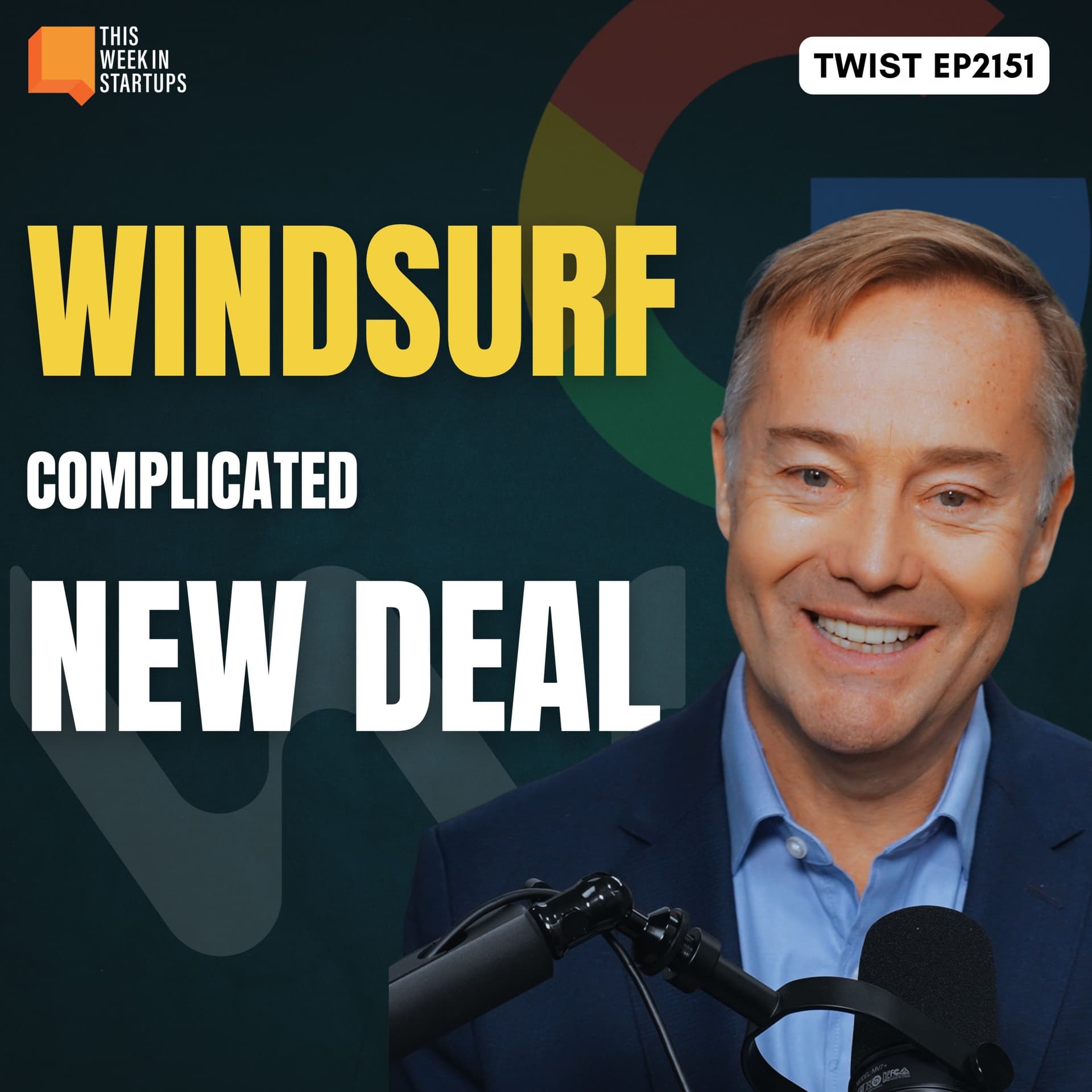
This Week in Startups: Blitzhiring and the Complicated Case of Windsurf, OpenAI and Google | E2151
Episode Overview In this episode, Jason Calacanis and co-host Alex Wilhelm discuss various pivotal topics in the tech and startup world, focusing on the aftermath of Windsurf's dealings with OpenAI, Google, and Cognition AI, the concept of "blitzhiring," and predictions for AI's impact on the job market. They also cover Tesla's Austin robotaxi service expansion, Mistral's role in the AI model race, and server obsolescence.
Key Topics Discussed
- Windsurf's Deal Dynamics
- Event Summary: Windsurf’s near-acquisition by OpenAI fell through, leading Google to step in with a significant agreement.
- Financials:
- Proposed acquisition price by OpenAI was initially around $3 billion.
- Windsurf had an ARR of $100 million, suggesting a potential valuation of $10 billion based on growth.
- Google acquired Windsurf for $2.4 billion, focusing on talent and IP rather than the existing product.
- Blitzhiring Explained
- Definition: Blitzhiring refers to accelerated hiring strategies used to quickly onboard talent without going through lengthy acquisition processes.
- Legal Context:
- Deals over $150 million require scrutiny under the HSR Act, causing delays that are untenable in fast-moving sectors like AI.
- Companies are opting for strategic investments (e.g., minority stakes) to sidestep these lengthy processes.
- AI Job Market Predictions
- Job Displacement:
- AI is expected to displace jobs, particularly in roles not directly related to AI development.
- The discussion highlights a historical parallel with workers training machines that will eventually replace them.
- Tesla's Robotaxi Expansion
- Overview: Tesla has expanded its robotaxi service area in Austin significantly, with initial reports indicating successful operation and few incidents.
- Regulatory Concerns: The episode discusses how regulators may influence the adoption of technologies like Tesla's robotaxis, particularly regarding safety features such as LiDAR.
- Server Obsolescence
- Timeline for Servers:
- Initial estimates suggested servers would become obsolete in 3-4 years.
- Discussion on depreciation schedules revealed varying timelines across major tech companies, with Alphabet extending server lifespan to 6 years.
Insights and Predictions
- AI’s Future Market Value: The discussion encapsulates a belief that the value of AI could reach $10 trillion, driven by the competition and innovation in the sector.
- Open Source Developments: Despite skepticism, there's potential for open-source AI projects, particularly with emerging players like Moonshot AI in China, challenging established norms.
- European AI Landscape: Mistral is noted as a significant player in Europe for open-source AI, indicating a potential shift in market dynamics.
Conclusion The episode provides a rich exploration of the evolving landscape of startups and technology, particularly as it relates to AI and employment. The conversation underscores the urgent need for innovation and adaptability in response to rapid technological advancements, with a focus on talent acquisition strategies and the implications for the job market.
Timestamps
- 02:20 - Influencer-led incident in LA
- 12:56 - Updates on Windsurf’s deal
- 34:56 - Tesla’s Austin rollout progress
- 54:31 - Discussion on server obsolescence
Resources
- Subscribe to the TWiST500 newsletter: [TWiST500](https://ticker.thisweekinstartups.com)
- Check out the TWIST500: [TWIST500](https://www.twist500.com)
- Follow on social media:
- [Jason Calacanis on X](https://twitter.com/Jason)
- [Alex Wilhelm on X](https://x.com/alex)
Notes
- The episode demonstrates the interconnected nature of technology, legal frameworks, and market dynamics, emphasizing the importance of understanding these elements for startup success.
Written by AI. May contain mistakes. Listen to the episode to check what was said.
Transcript
Automatic transcript. May contain errors.0:00There are drivers, safety drivers in Waymos, in Zoox, in Volkswagen, in Tesla's right now. Those safety drivers are there to solve the last 10 % of the problems so that all drivers lose their jobs. The same thing is happening with developers right now. When developers are using a product like Cursor, they're training Cursor how to take their job. It's literally like what happened in factories or in farms or other things where the people who had become the middle class are teaching the people who are going to replace them and they complain about it. this is now happening with machines.
1:03When you're ready to launch, use offer code TWIST to save 10 % off your first purchase of a website or domain. And AWS Activate. AWS Activate helps startups bring their ideas to life. As you build and scale your business, Activate Credits grow with you to support your changing needs. Apply to AWS Activate today and receive up to$100 ,000 in credits. Visit aws.amazon.com slash startups slash credits. All right, everybody, welcome back to This Week in Startups. I'm your host, Jason Calacanis, with my co-host is Alex Wilhelm. It is Monday, July 14th. I'm in the Bay Area for the Launch Accelerators graduation.
1:46I have a little demo day at Google on Wednesday. We'll go see some of our friends at Sequoia tomorrow. Today, I'll go up to Fenwick's office and help the companies practice their pitches and do a little Q &A. So busy, busy couple of days for me. I had no rest for the weary. Yeah. I was going to say, you just got home. You're like, I'm so glad I'm back. Finally, I'm at home. My feet are, you know, shoes are off. And now I turn around, you're back in the Bay area, but I'm not going to lie. I am jealous because I do love the Bay area and my feet are nailed to the ground out here for a little bit.
2:16So, you know, just enjoy it for me. So two babies will do that. But, uh, Hey, I, did you see this, uh, social media thing go by with the, uh, I used to hike in Runyon Canyon when I lived in LA my friend Sean Gold who go up Runyon Canyon. Okay. Even back then, 20 years ago, all beautiful people. Like it was like a celebrity. I think this is where you would get discovered walking up Runyon Canyon. So people would dress up to work out or undress to work out. Like people with the most ridiculous bodies you've ever seen running around, working out. So all of these incredibly beautiful people would be walking up and down Runyon Canyon.
2:56So if you're in LA, you know, it's kind of an institution, you know, you see celebrities on the margins or whatever, but it's filled with influencers now posting to their TikToks and whatnot. So it's pretty annoying. And, um, but I think they redeemed themselves. I think there was a redemption arc here because I saw this video play the video of, uh, uh, what I think is a bunch of influencers who caught one of these lunatic arsonists. All right. So we're going to play this everybody and we're going to narrate but just in case you're listening to the audio version runyon canyon is dirt shrubgrass it's gorgeous great walking path looks like a growthless skateboard let's take a watch yeah so uh there's a crazy person he started a fire who started a fire
3:51This guy confronts an arsonist
4:00He's wearing a Nicaragua shirt, I think, Jason I mean, I can't tell, but he looks like a Vagavond Looks like a hobo Like maybe unhoused, mentally ill person. But he might pass for just a mentally ill influencer because he's wearing sports clothes too, so he could just be hiking. You see people with their dogs and a fire. And I guess this person on social media recorded it and posted it to their Instagram and a fire truck's coming to put out this fire. But this is what I believe happened with the... I believe like half the fires were arsonists. Thank you, Scotty. I mean, tragically, who knows what percentage of them, but here they are arresting a dude towards the end of the video.
4:46Here comes a helicopter. Helicopter dropping water. And yeah, put your arms behind your back. I mean. Oh, my Lord. So anyway, I just want to say all is forgiven to be from all influencers and running gang and having those cameras and being aware. If see something, say something, folks. So one thing I was really impressed with, Jason, is how quickly the LAFD, the fire department, got this taken care of. So they responded to a call at 1147 a.m. and the fire was fully extinguished by 1225 p.m. So about 45 minutes. I mean, not not bad at all. And we did a little digging on this. And we think the guy who stopped him, the larger black man in the athletic gear is Scott Anthony Mitchell.
5:34and it turns out that he was actually a wide receiver, played at Kentucky, and then ended up doing a little bit of games in the AFL and then the Canadian Football League in 2008. But just citizens, stop this guy and held him, and he's arrested. Now, there's been no reporting yet on exactly who he is. We don't know, but what was he thinking? Lon was telling me about how running a canyon is just so popular, you would know you're going to get caught. So I wonder if the guy just wanted to get arrested. I mean, you either you're there are so many different theories about this now. Number one, there were gangs robbing homes, setting fires.
6:13This was one theory during those big wildfires. So you set a fire over here and you go rob the houses over there. I don't know if that theory ever came to. But yeah, if you were going to if you were going to start a fire and you wanted to get away with it, You would not do it in Runyon Canyon. The place is like a nightclub during the day. Yeah, you could start a blaze, 20 other places, and people have. So this all goes to all these great startups that we've seen. There's always a startup angle, folks. Anytime you see a problem in the world, there is a startup angle. Problems equal potential products or services to solve those problems.
6:52Number one, cameras everywhere looking for smoke. And so we just need to have more of those. There was a company in the Twist 500. You'll remind me of which it is because you can search twist500.com real easy. Thank you to our friends at Coda for helping us make this database. And we're using the Twist 500, the top 500 private companies, to drive our secondary purchases in breakout companies at thesyndicate.com. What's thesyndicate.com? It's 11 ,000 angel investors who read my book, Angel, and who invest with us alongside. So my team over there, Kelly and Maddie, are using the Twist 500, which Alex and I created here for the past year, or maybe six months, nine months that we've been on this project.
7:34Now they're taking it over and they're looking through for great companies. And then they're going to go through those companies, put them in front of our investment committee at the syndicate.com, which is now, I think we have 30 people on the investment committee. they hear pitches and then we make an offer to companies to maybe buy secondary shares or just put an extra 500K to$2 million is typically the range into companies on that list. So it's editorial here at This Week in Starts Driving That. But what was that company we saw that was using cameras to early detect fires? Yes. Do you remember that?
8:07Using AI? We were talking about a company called Pano AI. Here's a new story of them. They raised$44 million last month, which is why I think they were back on the show, Jason. But what's really interesting is actually, I was running a search of the Twist 500. We have two companies that do wildfire detection. We also have Dryad Networks because this is one in Germany and then one in the US. But just evidence that there's a lot of work to be done here. Great that people found this guy, but most of the time you're not going to have 8 ,400 influencers with smartphones and great connections right there.
8:37So I think we need a better system. I wonder when we're going to do from space because couldn't you detect it can but you know there's a lag between the time those images get downloaded etc and i'm not sure they have the fidelity to pinpoint very tiny fires like certainly when you see images from space of the fires that have broken out you're going to see them but to see a micro fire just a little plume of smoke probably better for these 360 degree cameras, all that consumerization of Insta360 and GoPro cameras, as those drove down the prices, even your iPhone camera for that matter, and security cameras like Nest cameras, drop cams, all of that put together equals such a cheap solution, internet everywhere.
9:23You can now buy cameras, like living on a ranch, you start to realize you don't have internet everywhere, Your Wi-Fi is not going to reach everywhere on a multi-acre ranch. You've got dozens or hundreds of acres, certainly. So they actually sell now 5G solar cameras. And you can find them all over Amazon if you type in 5G solar camera. And people put these on the edges of their ranch. They pay like an extra 5G fee. I guess I don't know what that costs, 25 bucks a month, 50 bucks a month for these data plans. and you can put cameras into the forest. Now with Starlink, you could build a Starlink Mini and then have this.
10:06So here's an example of one. This is a real Link for 129 bucks. You get like a camera, battery, solar panel, and you can put this anywhere. And it has a 5G and obviously 2.4 gigahertz wifi. And it has local storage. It's crazy, right? For$129. Jason, that's free. That means it costs nothing. Yeah, I mean, if you're building out a ranch and you have 100 acres, you can afford 100 bucks. This is the cost of life. It's really the cost of installation, the time it takes. Founders, you got a lot on your plate. You're running a company, and that means you have endless tasks to get done, and you're juggling a ton of priorities, all while trying to hit your KPIs.
10:51That's why I love Coda for keeping everything under control. It's the all-in-one platform that consolidates your documents, your spreadsheets, your apps into a single scalable workspace with a beautiful intuitive UI. Coda helps define planning sessions so you don't lose focus. And it creates flexible agendas so you can adapt to shifting priorities. It's going to help you set your OKRs and you get access to hundreds of templates for tasks like setting priorities and mapping dependencies. We use Coda every day at Twist for important projects like the Twist 500 and Founder University. It's truly an all-in-one hub for startups.
11:28Head over to coda.io slash twist right now, and you're going to get six months of the team plan for startups for free. That's coda.io slash twist to get six months of the team plan for free. Coda.io slash twist. So now you start thinking about fire, fire, you know, prevention and these wildfires. Every one of these trails could have every five miles up in a tree, up on a pole. You put these things. We could get to these fires very quickly. And obviously the next piece is instead of a helicopter dropping that, that's got to be a drone that does it automatically. I mean, the worst case scenario of a drone that puts out a fire that it shouldn't have put out is a bunch of kids at a campfire having water doused over their heads, which would be hilarious.
12:17Which I was going to say, that's a great story. You won't believe what happened to us. So that's the next piece that somebody has to build. Somebody come up with a drone that can carry that fire retardant material and zip it over there and do a sortie of those. Like Zipline should be making this. Forget about delivering burritos. Like, let's put these fires out early. You know how much a class is sent to a helicopter? I think a helicopter is like$10 ,000 an hour is what they charge you, you know, if you have to send one. So you could send a drone for essentially like$5. Yeah, I was - Well, if Zipline uses our idea, they owe us 5 % of the company.
12:55You heard it here first. All right, but Jason, enough about this. I want to talk about Windsurf. I'm so excited. I've been waiting and dying to talk about this deal. Wait, Windsurf was going to get bought by OpenAI and you and I talked about this, You laid out the numbers for me of their revenue and the price. It was something like$10 billion price tag by OpenAI. Walk us through the numbers. Oh, it was$3 billion. Yeah. And they were making how much at the time? $100 million ARR. Got it. And we said 30 times, it should be 100 times based on the growth, I think is what we came to. And we said it should be a$10 billion deal.
13:28Don't sell. Yep. Well, it turns out they were trying to sell. They had an agreement with OpenAI. I openly, I almost announced this in May. They almost put out a press release saying, we've bought it. And then it all fell apart. And the moment the period of exclusivity ended, Google swooped in and did another one of these very fancy slash tricky, give the company a lot of money, don't buy the whole thing, get the founders type agreement. Essentially, it's a talent way. What do we call these agreements now? Is there, do we come up with a name for it on the show? I think I came up with like the 49 % purchase.
13:59There was something about 49 % we talked about in the context of scale AI and meta, because Meta put a lot of money in and then actually bought shares. But I'm actually pretty sympathetic to the view from, it's Illy over at Category VC. He calls this blitz hiring and he explains what's okay. All right. I mean, it's not exactly blitz hiring. I like it's a faux acquisition or a backdoor merger, a backdoor acquisition. Yeah. But anyway, let's hear his thesis. Okay. It's probably the same thing, which is the bad name. Well, again, not defending the name, But what he does is point out that in the old days, you bought a company, you bought all the shares and you owned it, or you bought the IP and hired the employees.
14:40OK, the problem is with deals of that story is that anything over one hundred and fifty million dollars has to go through the HSR Act test, which is an addendum to, I believe, the Sherman Antitrust Act that came out in the 70s. Essentially, if you're going to buy a company for nine figures or more, you have to tell the government, I'm going to buy this thing. And then they get to go, let's take a look at it. And then most of the time you go through and it's fine. What the problem, Jason, is, is not that you'll get your deal denied. It's that that process can take up to a year. And currently in AI moments like this, you can't afford to wait a year.
15:12A year is 10 ,000 years. So if you want to buy some talent now, how do you do it? Well, that's where these deals come into play. So his argument is it's less about the wrath of Lena Kahn. It's more about just getting the people you want in your company, in your company now, and avoiding the regulatory, just oversight, let alone block it. Yeah, so it's probably both of those things could be true at the same time. And so there have now been a bunch of these 49 % agreements, and the issue becomes for LPs and GPs, for the venture firms, how is that money accounted for? When you buy a share of a company, that is a capital gains, a capital gain.
15:57When you do an asset sale, an asset sale or a licensing deal is revenue into that company. An asset sale, I believe, would be considered cap gains. Now, what's the difference? Well, depending on the structure of the company, you could be taxed twice. So let's say you bought a piece of software from a company. If you license a piece of software for a million dollars a year, it's going to use that to make a clean number,$1 million. That company puts a million dollars in. If they have a million dollars in profit that year, let's assume they had no expenses. Then they would pay corporate tax on that and then send a dividend to the shareholders.
16:37So then you have to ratchet up the price to make up for that difference. And capital gains, if the person lived in a, let's say, no tax state like Florida or Texas, et cetera, they would not, or Nevada, they would not be paying, they would just pay the federal capital gains tax. And then you have QSBS, Qualified Small Business. Is it QSBS? It's QSBS. Yeah. So you have QSBS where the first$10 million theoretically could be if your asset value of the company is under$50 million, you get a waiver for the first$10 million in gains. So if you're an LP in a fund that made$100 million and you were$10 million of it, you would not pay that tax.
17:19So you basically get$10 million straight. So these deals, qualified small business stock, yes, QSBS, you can look it up. We talked about it in a previous episode recently because the law changed a little bit. Talk to your accountants. Obviously, this is not legal advice, not accounting advice. No, people always want me to give them legal or business advice on it. It's something you have to actually work out with your own accountants, et cetera. But it does come up with syndicates all the time. Like if a syndicate doesn't qualify for QSBS, we try to figure that out. Anyway, these 49 % agreements, these backdoor acquisitions, I'm going to call it a backdoor acquisition because that's most accurate.
17:56Yeah, they seem to be for two reasons. One, speed. Two, harder to block. So what was the line from Jurassic Park? Nature finds a way. Life finds a way. Life finds a way. Okay. VCs find a way. Corporate M &A finds a way. So this post from Billy, and I'm going to link it in the show notes and put it in the newsletter today. So take a look at it because it's quite good. He's actually pretty, I think, insightful here. He says you have to do a dance, Jason, because you can't just basically leave a dead company in the wake of one of these deals because then the regulators will say, well, there was, there's no startup that existed after this, you're clearly circumventing the rules.
18:36So you have to leave enough of a carcass that's still breathing behind you. And in the case of Windsurf, people were trying to figure out why there was about a hundred million dollars left behind. People were thinking, well, maybe that's because they're trying to make sure that the company can keep operating for a while to keep up this kind of facade. Now, in the case of Windsurf, there's some questions. I'm curious what you think about this, but people are saying, if you look at the numbers and the cap table and kind of what you would expect the non-vested employees to be holding in terms of value.
19:04Maybe it's about a hundred million. They have about a hundred million. Maybe they would shut down the company and then just give out that hundy to the employees. No, this is actually an interesting rub. If those were an investment from an investor, this is back to the tax treatment issue. You're an investor. Let's say you would put a hundred million into the company. Now, the company, let's just say, theoretically, was profitable, didn't need the 100 million. So they got 100 million in an interest-bearing account. They're making$5 million a year just sitting on that money. So you got$105 million sitting there.
19:38What they could do is the investors, based on their document, could take their investment back, especially if it was a convertible note, and not pay tax on it, right? Because they put 100 million and they got 100 million back, there's no gain. So if you think about that, any of the licensing fee that we talked about might have bad tax treatment, they would get that 100 million back. And maybe that note had interest on it. Maybe if it was a convertible note, it had a 5 % thing on it, or maybe it had, I'm gonna get this much interest on it. So that could make these deals even more possible. Your website is the face of your company.
20:16People judge a book by its cover. It's how you make a powerful first impression. We all know that. And let's be honest, you might be a little embarrassed by your current website. Well, don't worry. Squarespace is going to help you build a new, beautiful, professional, attention-grabbing website in just a few simple steps. Let's say you've got products to sell or a gallery of your work that you want to showcase. Maybe you've got some services you want to promote. You're a consultant. You're a developer. Well, Squarespace is going to give you all the tools you need to grow and prosper. We're talking stunning, world-class design, plus templates to fit every possible business or purpose.
20:51Start an online course, schedule appointments, even generate invoices for clients with just a few clicks. Their mobile blog editor makes it extremely simple for you to create and update posts on your favorite device. You know, you might be on the go. You might be on vacation and you need to update something on your website. You don't want to wait. It's all easy to use out of the box. Plus, they've added a new AI feature, Blueprint. This makes it easier than ever to customize and upgrade your website until it's exactly what you want. Choose from one of the personalized layouts, add a layer of on-brand visuals, and boom, zip, zip, zip, you're done.
21:24So check out squarespace.com slash twist for a free trial. And when you're ready to launch, go to squarespace.com slash twist to get 10 % off your first website or domain purchase. That's squarespace.com slash twist. What we're seeing in the industry is AI is such a big prize. I would say the AI prize is worth$10 trillion in market cap, right? We see NVIDIA is worth$4 trillion. Let's just say, theoretically, the AI super intelligence prize is worth$10 trillion. It's going to cost$10 trillion in market cap to appear incrementally on top of Google, Microsoft, Tesla, just could be$500 billion here, a trillion here,$2 trillion there.
22:05Just say there was$10 trillion at stake. Like, you know, it's a rounding error for these kind of acquisitions that are sub 50 billion, if you actually believe that. There's a group of people who don't believe it. They believe, I was listening to Adam Curry the other day, and he has a great show called No Agenda with John C. Dvorak, who was like a hero of mine when I was a kid. He wrote the PC Magazine columns in the 80s. So when, like, I was a kid in the 80s. He was probably 15, 20 years older than me writing columns about PC stuff. When I saw John C. Dvorak write these really curmudgeonly columns, Jim Seymour was another one.
22:42You can pull up their PC Magazine. You can pull up an image of it, but there was Jim Seymour, who was a big, robust guy. There was John C. Dvorak, who had glasses, who was kind of like a Boston curmudgeoned. And then there was Michael McCrone, I think, was the editor-in-chief of PC Magazine for a while. Anyway, there was this cohort of people who would write these columns in PC Magazine, and you would like go to those columns pre-Walt Mossberg, I believe, and they would sort of set the tone. Anyway, Adam Curry was talking about VibeCode and he's like, none of this stuff actually works to completion.
23:14And he was wondering if this whole thing is just BS. There's a group of people who actually think like the whole AI thing is a bubble and it's not gonna finish the last 20%, which totally makes sense. There is a lot of work left to be done to make these things actually production ready. The people who are building the technology, they believe that last 10, 20%, the important finishing touches that get rid of hallucinations and make things production ready. So the code actually can get produced. Not just it makes the developer 10 or 20 % better, but the full job gets done, which, you know, I think I'm in the camp that it will get done.
23:53The timeline might be three years. It might be seven. But somewhere between those things, each of these massive castles will fall and these cities will fall to AI. And then there'll be job displacement. You will not need as many people. And then you'll need many more companies to emerge to solve other problems to hire those people. And that's the other thing we've been talking about on this show for a long time. I did my KPMG talk last year. I think you helped me with that presentation. Did you help me with that? Yeah, I got to find that presentation. I'm doing it again at KPMG this summer. And I do my like trends based on what we talk about here.
24:30And one of them was that static team size that we've talked about over and over again. The only people who are coveted right now are like the tip of the spear AI experts. Everybody else, podcasters, journalists, lawyers, accountant, developers who are not part of the echelon of AI developers, designers, UX, everybody else is, you know, customer support, obviously, operations. Everybody's looking at those jobs and saying, how do we hire these people for$100 million to get rid of those other 99 people? So, or get rid of, it's kind of crazy when you think about it. It's Darwinian. There, the drivers, there are drivers, safety drivers in Waymos, in Zoox, in Volkswagens, in Teslas right now.
25:18Those safety drivers are there to solve the last 10 % of the problems so that all drivers lose their jobs. The same thing is happening with developers right now. When developers are using a product like Cursor, they're training Cursor how to take their job. It's literally like what happened in factories or in farms or other things where the people who had become the middle class are teaching the people who are going to replace them and they complain about it. This is now happening with machines. And so whenever you're doing work and it's being monitored by an AI, the explicit goal is to take that person's job.
Read the full transcript
25:59And in fact, there are startups now that are putting on glasses on workers and you can watch them work. and that's becoming the training data to take that person's job. I've seen what you're talking about and it's gotta be brutal to sit there and realize that not only are you not getting paid much to do hand assembly work that's going to be automated, but you won't be paid anything for it in the near future. All right, anyways, Devin's buying Windsurf. Devin? Wait. Yes. So Cognition AI, which is the startup behind Devin, announced right before we went to air that they're going to buy what's left of Windsurf that Google is not buying for$2.4 billion.
26:40Got it. Okay, so there's a breaking news story while we're taping. Devin is buying the remnants, but we don't know what the remnants of that carcass are. Essentially, OpenAI wanted to buy all of Windsurf. That didn't work out because Microsoft was a sticking point as they sort out some deals with IP between OpenAI and Microsoft. The period of exclusivity ended. Google swooped in with$2.4 billion, bought out most of the investors, got the founders and researchers they wanted, left behind the company. Everyone thought it was going to be a carcass. Then Cognition, who's behind Devin, showed up and bought everything that was left.
27:16Which is the ARR. And Devin is what? What does that company do? I'm curious. So Devin is the much vaunted AI engineer that you could hire to work with your company. It was essentially, going back in time, it was the early agentic developer, if you know. Got it. So the Cursor product is loved by a large number of people, right? And it's making 100 million. 500 million. Cursor's now at 500 million AR. Okay. Yeah. It's mind boggling how fast that was going. So who gets that? Who gets that? Well, so no, wait, Cursor or Windsurf, Jason? Okay. Cursor's a separate company. Windsurf is this company. Windsurf's product competes with Cursor.
27:56What is Windsurf's product called? Is it called Windsurf? It's called Windsurf. Got it. Okay. So Curse is the leader in the space. They're making 500 million. Winsurf was at 100. I've now got it in my mind. I was juxtaposing the two. So whatever's left of the Winsurf product is going to go to this Devon company. And then the talent goes to Google. But will they have a competitive product, I'm wondering. I mean, I don't think - Because Google Gemini does code. There's actually a code project. Yes. What's the name of their code project? Google has a cursor competitor, a Windsurf competitor already.
28:34So Google has a product called CLI that brings its Gemini AI models for coding into the terminal. There's a similar product from, I believe, Anthropic, which is Cloud Code, and then OpenAI's operators around the same thing. There's also Gemini Code Assist. Yeah, that's the direct competitor, I think. Do you want to make this even more hilarious? Please. So today, just because why not? Today, Amazon released a new thing called Hero, and it is a new agentic IDE that works alongside of you from, quote, prototype to production, made by some folks at the AWS team. They're kind of keeping it on a separate brand.
29:15You can pay for it, but now there's another one. So everyone's trying to solve this particular nut and they're spending a lot of money. I'm just glad that we had Varun on the show a couple months back, link to the show notes. And now he's a billionaire. So shout out Varun. Well done, man. Great. All right. So there's going to be 20 different ways for you to have a code assistant help you. It's all going to be free or close to free. And these products were greatly under, I mean, there's tons of free products and even the paid ones, which I guess GitHub's co-pilot was the original, it's like$100 a year or$100 a month.
29:50These products all seem phenomenally cheap for what they are. We're all familiar with AWS, Amazon Web Services. That's the cloud platform that powers so many of your favorite brands. But do you know about AWS Activate? That's their program for startups, where they provide up to$100 ,000 in AWS credits for all startups. whether you're backed by an investor or you're bootstrapping, money is time to keep innovating, time to delight customers, and time for you to keep gaining traction. You need runway, and AWS's Activate is going to help you with that runway. We hear this story from so many of our founding university companies.
30:29They're finding product market fit, the words getting out about their product, just a little boost, finding some savings here or there to get a little extra time can be the difference between getting traction and bringing in revenue, or hey, let's call it what it is, running out of money, okay, and shutting down. AWS knows this. That's why they've created the ultimate toolkit for early stage startups looking to boost growth. With AWS Activate, you're going to get up to$100 ,000 in AWS credits, hands-on support and training, plus exclusive discounts with some of our favorite companies and tools.
31:00So start getting the support you need at every stage of your startup journey. To learn more, visit aws.amazon.com slash startups slash credits. That's right. AWS.amazon.com slash startups slash credits. Now, the question that we often hear is, what are the margins like at a company like this? And you were mentioning earlier, Jason, the kind of last 10 % problem, last 20 % problem. That dovetails neatly with the company that I was talking to for the show today called Vellum. They're a YC winter 23 batch company. They raised a$20 million Series A. Why do we care? It's another company in the AI space raising around.
31:36Well, what I liked about them was that they were trying to work on essentially what you're describing, that the gap from prototype to production in AI is still huge. And these founders had run into this problem at their last company. They were at Dover for a while. And so they made a company to do this. And I think it's a pretty cool idea. I have a lot of notes about how they're going about helping companies kind of solve the AI pipeline. But what I care about a lot is on the pricing point, I asked them, do you have SaaS gross margins or do you have like 50 % gross margins? And this company says that they have SaaS gross margins as they're growing three to four X every year.
32:11So maybe even with relatively inexpensive pricing, a lot of AI companies will make economic sense long-term. Maybe they're not as gross margin negative as we anticipated. Yeah. So when we see the price we talked about in the last episode, the price of like tokens keeps plummeting as we have this crazy competition, then if you build a product that uses Claude, Grok, pick your open AI as your backend, and these things keep, the tokens keep collapsing, plus you have DeepSeek, plus everything else on HuggingFace available to you, yeah, then the margin might actually be growing as the cost goes down.
32:50How many of these backdoor acquisitions have there been? And I just wanted to note for the audience, I think you did a little bit of research on it. Is this the sixth or seventh one? Yeah, yeah, yeah. Go through it. And maybe we could show it on the screen. One, two, three, four, five. Five. Okay. Yeah, I'll just pull this up for everyone so they can enjoy an excellent view we have here in Notion. And you can see the docket, folks. This week in startups.com slash docket, you can see the notes we use here for the show. Yeah. So just pulling them up here. So the first one that kicked this all off was the Microsoft Inflection AI deal.
33:26That was back in March of 24,$650 million in cash. It was an IP deal. That's a common refrain in these acquisitions. Took the founders, most of the talent, and then the company pivoted to the enterprise. Go forward a couple of months. Amazon, Adept AI, June 24. We know it's in the nine figures, Jason, but no one got closer than that. Again, a licensing deal. Took the founders and some of the research team. Then number three, Google, Character AI, August 24. two and a half billion. That's getting expensive. Non-exclusive IP. So the same idea of buying intellectual property access, founders, and some researchers.
34:01Then this year we saw Meta and Scale AI. This was kind of the weird one. 14.8 billion, but they bought a stake in the company and took the talent. But then the company was poisoned because no one wants to work with Meta's subsidiary effectively on their data. So that's going to be a mess. And then most recently, Google and Windsurf, July of this year, 2.4 billion for the license. co-founders and some talent. And then as we saw later on, Cognition slash Devin is buying whatever's left. So this has now happened five times. You know, trend starts at three. This has all happened in the last year, couple of months.
34:35I'm curious to talk to an attorney. If anybody knows an attorney who structured one of these deals, we'd love to talk to them in the background. He's Alex at launch.co. I'm Jason at launch.co. Alex W at launch.co. Alex W at launch.co. So I'm, yeah. You're not JCC. You're just JCC. You were here first. I was, yeah. There's no other Alex here. All right, let's keep going. What else is in the docket? So I was particularly excited to see that we are seeing Tesla expand their geofence in Austin. Well, okay. No, I saw the image go by like everybody else. Yeah. All right. So we're going to try to do this with the minimum of jokes possible.
35:17Friends, we've been covering the expansion of robotaxis around the world from Chinese companies to Waymo to Zoox to everyone else. Of course, Tesla is now in the mix, Jason. They launched in Austin. Seemed to go pretty well. There have not been headlines of fires and explosions and crashes. There was one, a tire touched a car a little bit. I would say there were three notable instances. The tire touching, the going into the wrong lane. Oh, that's right. And then there was the phantom stop. There were three. And all of those at low speed, all of those, the car was basically in control. All of those, there were safety monitors there.
35:57So even in the worst case scenario, I think in any of those instances, it would have been a fender bender and no harm to human life. So will society be okay with this? Well, there were, remember there was a Waymo that went down an alley? So there was the Waymo that bumped into a pole in an alley. Now, it probably shouldn't have been in the alley. Alleys are probably edge cases. And it hit a pole. But it hit it at such low speed that it looks like it hit it at, I would say, that dent is a 10 to 15 mile per hour dent. Yep. And, you know, if there had been a, you know, God forbid, a person between the pole at the time, it would have stopped, I'm sure.
36:46But how did a Waymo hit a pole, you have to ask? Now, when did that happen? I think that was like two years ago. So I think you're going to see that type of mistake. Zooks had one as well. Zooks had somebody pull out. It was going extremely low speed, and it was in the right-hand lane. somebody pulled out into that right-hand lane, and it kind of moved to avoid it or slammed on the brakes or something. I think there might've been a touchy-touchy, tappy-tappy. But these little ticky-tacky, tappy-tappies, if they occur once every couple of thousand rides and nobody's hurt, I think society will accept it.
37:26But will regulators accept it becomes the issue. And will regulators accept it if you don't have LiDAR. Not that LiDAR would have solved any of the problems, but if they feel there's like a higher level of, you know, technology that could be there, whether they're right or wrong, I think regulators are going to, if these ticky-tackies happen too consistently, regulators are going to step in. This is why I'll keep saying it. There's no shame in the safety driver game. Put a safety driver in there, folks. Volkswagen's doing safety drivers. Zooks, Tesla or safety monitor in Tesla's case, I would have put them in the left-hand side.
38:06That's just me. I can disagree with Elon on stuff. He's obviously a little closer to the issue than me. I just think for optics, I would have put it in the left-hand side. But whatever it is. But here it's an expansion. It goes up, it looks like, to the northern part of the city. It does. And it hits the, I think, University of Texas, which is kind of a big deal. And this means Lon could go from the University of Texas or this could be our office could be in this zone and it could go to south of Congress. I don't know, Lon, if this could actually do that. Less people think that this expansion to the tip of the northern part of Austin.
38:46I thought we were going to pull it off. All right. Yeah. I mean, it looks like it's expanded like 5X. I don't know if that's average, but it looks like about five. It looks like, you know, when you look at the map, it looks like it got an extra three inches of expansion there. I don't know if that's average or not. All jokes aside. All jokes aside, this is the Tesla logo. Okay? You've all been trolled. Unless you're seeing something here that's not here, it's just the upside-down Tesla logo. That was my joke. I can't move it. What I have now up on the screen is the Waymo service area in Austin with the Tesla service area imposed on top of it.
39:24And according to all the data we could find, Jason, this is roughly a doubling of the Tesla geofence. And also it now has people are calculating about 40 square miles versus Waymo's 37 square miles. So it may be now that the robotaxi effort from Tesla is now larger in footprint geographically than Waymo. So, and I just, I mean, I try to never have you going up against your friends because it's not what the show is for, but you were pretty serious about like, let's go slow. Let's be moderate. Let's be safe. And this is faster than even my bullishness expected. So too fast or just better data on the operational side?
40:01You know, there's a great self-correcting mechanism here. if you go too fast and you get a tappy-tappy, touchy-touchy, regulators are going to be lobbied by haters, by concerned citizens, by people in government who might think slow is better. And in technology, you have had this position for a long time of like, hey, net-net, it's going to save lives because distracted drivers. I 100 % think statistically you're right. Then I look at regulators and knowing what I know about regulators after that cruise mishap, which really wasn't their fault. Somebody got hit by a car. The person ricocheted, as crazy as that is, into a slow-moving cruise.
40:47And the reason cruise got in big trouble in San Francisco is because they dragged the person a little bit. And then? And then edited the video and didn't show it. It's not the crime, it's the cover-up. The cover-up always worse than the crime. But even still, life happens. People will get hit by cars. People will jump in front of cars, right? People put cones on Waymos. So the self-correcting mechanism is if Tesla goes too fast, if Volkswagen, if Zooks, anybody goes too fast, then a regulator might say, hey, you're going too fast, and then correct them. There's a lot of edge cases. I've been having perfect rides in my hardware for Juniper model of the Model Y.
41:29I will say, like, you get into a construction zone on 290, which is a highway that goes east-west from, you know, hill country all the way to Bastrop and past the airport, the Austin airport. You know, my Tesla cannot figure out what they're doing with that construction zone because they are going for it. So construction zones, mislabeled signs, tricky stuff. This is the stuff, the edge case is where it really matters because I've had one or two instances, even with my hardware four, where it could have done serious property damage, serious harm to me, like life harm at 45 or 60 miles an hour.
42:10It's a lot of speed. And that's why I think staying off the highways, keeping these cars to 35 miles per hour, even if the speed limit's 40, I think they should just throttle them to 30. You know, if I was running this, minus five miles per hour, whatever the speed limit is, which I think is legal to do. And then, you know, unless it's like 25 miles an hour, just keep it slow, steady, wins the race. Because what's going to happen is somebody is going to feel like they're losing the competition. And I don't think Tesla feels this pressure. Waymo doesn't feel this pressure. Volkswagen's not going to feel this pressure.
42:46But there's going to be somebody who feels the pressure that they're falling behind. And somebody's area is faster than theirs. And it kind of feels like the Waymo, Uber, Volkswagen, Zooks, Tesla competition is now heating up. This is where regulators can do their job and say, here's the rules of the road, literally. We want you all. Well, I think the regulators should pick the zones that are. I don't know why Tesla and Waymo get to pick their area. I think the regulators should approve that. And I think local regulators have the right to do it. So I don't think this should be a federal thing or a national thing.
43:22I think local regulators should set their rules. They should have their say in this. And everybody should go nice and slow and steady. And they should go nice and slow and steady and add Providence, Rhode Island, as the next stop in their expansion. I'm going to keep saying that until it happens or until you tell me to stop. Oh, you know what the other big note here is? Very disruptive. I saw some influencers who are in the thing here because it's not open to the public yet. It's open to influencers and their friends or whatever. Oh, RoboTaxis in Austin. RoboTaxis in Austin are open. It's not open like Waymo is.
43:54It's invite only. It's invite only still. And they let their influencers in because I think they feel like they would get a bad, you know, that people have it out for them, which I get. You know, it's a politicized moment or whatever. it's still 420. I can tell you that ride from the northern tip to the base, from tip to base, that's not a 420 ride. That's like a$15 ride. So actually, if you happen to have that commute area and you happen to have this, it's kind of like the early days of Lyft, Sidecar, and Uber. You're going to be subsidized for your ride. That's a really cheap ride. Well, producer Lon just weighed in.
44:34He thinks the Omni, where a capital factory is, is inside the Tesla peen. And as is his neighborhood. So he is going to take a Tesla commute. We're going to get him to apply. And then we're going to make him do an on-screen reporting about how it goes. So producer Lon goes self-driving. He's L-O-N-S on x.com. Somebody invite him. Or his email is lon at launch.com. So if you're in it, please email Lon and invite him to go take some rides. Yeah, we want to see how it is from Lon's—I'm not going to—what is Lon? He's not the team Luddite at all, but he's like slightly more skeptical than we are. No, he's pro-tech.
45:14He's pro-tech. Yeah, he's just a little sprinkling of—no, he's just—actually, I'd say he's probably like slightly more liberal than like a Clinton Democrat, but not like an Elizabeth Warren, but he's probably got some Bernie Sanders to him a little bit. He cares about the working man, probably very Trump-esque in that way. I'll let him speak for himself. I think he believes in universal healthcare. He was a Bernie bro in 2016, but it's eight years later. I don't know if he's still a Bernie bro. Joe Rogan was a Bernie bro. All right, let's keep going. Let's move on. Okay. I've been keeping tags on open source AI because we talked about this a lot a year ago, back when Meta's LLAMA project was doing quite well.
45:55And then Meta has pretty publicly stumbled with its LLAMA 4 release. And everyone kind of went back to thinking that we're going to see essentially closed source AI run the world as XAI, Anthropic, and OpenAI kind of battle it out. Well, turns out the answer is maybe not. And there's a company in China called Moonshot AI, and they have been referred to as an AI tiger by Chinese media, essentially putting them in the deep seek kind of collection of the Chinese AI industry. they're the they're part of the mag 7 of chinese ai if you will and they dropped a couple of new models that are called the kimmy k2 models and here's the thing that's killer they're legitimately open source weights and everything and they're very very good and i just did not expect this to happen because this is a company that raised a billion dollars last year and most recently raised another 300 million with tencent participating at a three billion dollar pre-money valuation and they're dropping arse-kicking open source models.
46:53Here's some of the data, Jason, just showing off how they do. Now, keep in mind, this dropped, I believe, before anyone could get their hands on Grok 4. So there's no XAI comparisons here, but this is against DeepSeek, Quinn, which is Alibaba, OpenAI, and Anthropic. And as you can see, these models are competitive with kind of current state of the art and they're now absolutely free. Now, I don't think American companies are going to adopt open source Chinese AI models or closed source Chinese AI models, just given tensions between the two nations. But from the rest of the world's perspective, this is an enormous gift.
47:28And I find it to be honestly pretty encouraging and optimistic that we're still seeing this level of improvement. And I just can't believe what a gift it is to have open source information out there of this magnitude, Jason. I'm blown away. Well, this was what OpenAI was supposed to be doing before they closed it down and made it a for-profit company. It was supposed to be the original premise that they sold the world on with their nonprofit status was, we're going to make this free as a gift to humanity. It's too powerful for any one person to have. Therefore, if everybody has it, that's the way to go.
48:05Something changed along that way, and people changed their mind. And now we have this great paradox that China and that country is saying, you know what? We might be six months behind, 12 months behind, whatever the test might be, three months behind. Who cares? You know, what? Having an open source option that's six months behind the state of the art or 12 months behind the state of the art or maybe sometimes dips ahead of the state of the art. Yeah, it's got the great price. So for, we'll be sitting here in four or five years and it will feel very much like MySQL, right? There was a period of time where people said like, I'll never use WordPress or MySQL.
48:48How would I ever use something open source in a corporate environment? And then the White House is running on WordPress, open source, you know? Or large companies, you know, Uber, Airbnb are probably using MySQL or, you know, some version of, you know, those. So it's going to be really amazing to see. This might relate to the story we saw with Windsurf. We were trying to figure out, like, why do they not care about the product and they care about the people? Maybe everything being built right now isn't as important as what's to come. And having those people iterating at a high velocity in your organization is more important.
49:32If you don't know exactly where this innovation ends, then what's been accomplished to now is going to feel like the web pages of the 90s. So you got to get the talent, have them locked in for five, 10 years in your company. But, you know, four or five years is realistic. And if they're locked in for the next five years, you increase your chances at the$10 trillion prize. Which is – I'm writing that down because we keep going back to that. So I think that's going to be one of our trends for the back half of the year. Okay. Looping back though to AI. I want to make a point really quick because there's something interesting going on that I don't think we've actually talked about enough.
50:12So we talked about China, talked about the United States, and that's kind of where the conversation stops when it comes to foundation AI models. There's not really any other major nations out there except for Jason. Have you heard of France? because it turns out Mistral is the only other company on the open router leaderboard by token percentage of just users from that service. But Mistral, the French kind of like AI champion, is ranked sixth in the world for token usage on open router. Shockingly, look at them. They're actually pulling it off and Europe might have an actual stake in the AI future.
50:49We joked, we joked, but they're still here doing it. Yeah, I mean, it does feel like with these open source projects and talent moving around, the papers being written, we have some parity between these platforms. There's a funny meme of a circle of who's in the lead. I got it. You know, I don't know if we showed it here before or we were, did we show it last episode or we showed it in our group chat? I can't recall, we do a lot of shows, guys. Yeah, I think it was like, you are here. And it's like, it had DeepSeek, it had Grok, it had Gemini, it had Claude, it had OpenAI, like a circle. And it's like, takes the lead.
51:25You are here. And then here he goes. So yeah, Grok introduced the world's most powerful model. Next, OpenAI introduces the world's most powerful C. So you basically need to do this once a year. And then Polymarket has betting on this. And you know what? I wonder if Polymarket resolved Grok winning. Because remember, we had brought up the poly market. It was the AI. It was the leading AI model by a certain date. And it was, I wonder what the result, what it was using to resolve the bet, right? Cause all of these markets have to be resolved. And that's where this is. This is very interesting. Okay.
52:05So I found it. Juicy, juicy, juicy. Pull it up. This is the question is which AI, sorry, which company will have the best AI model at the end of July. And we talked about it probably somewhere in here. Google was storming. And then you'll note that with the release of Grok 4, XAI seems to have made a dent. And then they've kind of lost it again, which is interesting because the market is now re-betting actually more than ever that Google is going to have the best AI model by the end of July. So either Grok 4's benchmark. Maybe they pee too early because look, somewhere in the middle of July, if you hover your mouse over when the gap closed.
52:44When was that? When was the gap? That was July 8th. Right. So last week, between July 8th or whatever, the gap closed and X almost flipped it. But remember, this market is closing on July 31st. So there's no way for XAI to drop another model. No, they've done it. They dropped the numbers. Yeah. So I don't think folks are doing this based on the poly market when they're dropping it. But if we scroll down here, you'll see DeepSeek and Meta have no chance. What is the rule? Less than one, less than one. The market will resolve to the company which owns the model, which has the highest arena score based on the chat about Arena LLM leaderboard.
53:27When the table under the leaderboard tab is checked on July 31st. Okay, so this is not using the same thing that we were talking about Grok last week. We're using something else for Grok, But yeah, so this will be the arena. There's a variety of ways to look at things. And you'll note here that actually, according to LM Arena right now, Grok 4 is not really showing up yet. Number three. I don't know if it's actually been - It's number three, actually. Oh no, that GPT-4? Where is Grok? That's Grok 3. Grok 4 isn't in here yet. So Grok is three. I don't know if - No, but that's Grok 3, not Grok 4.
54:06So Grok 4 isn't on the leaderboard yet. Yeah, not yet. Okay. But that does not mean that it won't show up there. It means that right now. But all this is fun and games just to show everybody that if you were ever curious about what it's like to live during a time of great technological change, well, here we are. This is what it looks like. It's messy. It's aggressive. It's expensive. It's exciting. And at the end of the day, we get lots of cool new tools. So I just love technology. Hey, one thing, and we should end on this, I think, because we've got a lot of show here. I had asked you to look into the depreciation of servers.
54:39Did we do that? I have a lot of good data on that for you. Great. Let's start this discussion because I was told by some folks in the know three years, and then these things are going to be obsolete. You said some people had expanded it to four. This is critical because putting in 100 ,000, 200 ,000 servers at Colossus, Grox, or CoreWeave is a company that 5x their valuation or something when it went public at the peak. Their valuation is based on all this. you have open AI, incredible revenue numbers, but what is it costing them? Because they're putting a lot of servers to work. So what is the depreciation schedule?
55:22My challenge to you is to figure out the depreciation schedule that people were using for like H100s or these latest NVIDIA servers. What did you come up with? What did you find? All right, so I looked at this from two different perspectives. The first one is what are the hyperscalers doing? And when they discuss servers, They don't always break down strictly AI versus strictly not. There's some commentary in earnings reports, but the big numbers are as follows. Alphabet raised - And by the way, you can show this on the screen, I think, because it's in the docket. This week in startups.com slash docket if you want to follow along with us.
55:53And you can find today's date, July 14th. We keep all the dockets up there. So you have tons of content you can look at and you can build on this and put comments into our notion if you want to. Yeah. I'd always turn on comments so you can always drop in, leave notes. I love when people do that. Okay. So Alphabet increased its sural lifespan most recently to a six-year depreciation timeline. That was back in 23. Meta moved it to five and a half years this year. Microsoft moved from four to six years back in 2022. And then this is when it gets interesting. Amazon moved the other direction. They moved from six years depreciation to five, shortening the timeframe and therefore just increasing the effective cost of their data center investments, their CapEx, if you will, Jason.
56:33Now, the Financial Times did an analysis of this back in 2024, looking at the aggregate impact of those changes. So not an entirely up-to-date number, but they calculated that the hyperscalers alone are going to save about$10 billion by increasing the length of time they think they can use their servers. So what does this kind of look like in practice? Well, I went to the CoreWeave latest earnings report, their Q1 numbers. And as you can see in this little data set here, the depreciation and amortization cost at CoreWeave, which is a NeoCloud, rose from basically 80 million in the first quarter of 24, all the way up to 444 million in the first quarter of this year.
57:14So when you spend a lot of money, your costs go up. Now, should we worry about this? Is this a concern for the profitability of some companies? The hyperscalers, no. So I went ahead and looked through some Q1 data from both Meta and Google. And if you look at their CapEx, which is servers and so forth, they're spending$14 and$17 billion apiece. And their depreciation and amortization costs in the same quarter were basically$4 and$4.5 billion. So it's a lot of money, and those costs will go up as they invest more money, Jason. But nothing that I saw struck me as worrisome, I guess, if that makes sense.
57:51Yeah. I mean, I think the bigger issue, putting aside worrying, is how much revenue are these generating versus what they're costing? So when we looked at those first set of servers, those are Amazon Cloud, CPUs. They're not the GPUs in all likelihood. The meta Facebook ones, that's to serve up your Facebook page. That's not an NVIDIA H100 or whatever it is doing that. So I guess the question is CoreWeave might be the closest number. So how much money is CoreWeave making on those servers is the next piece of the puzzle we have to sort of tease out. Forget about worrying about it. Just does it pencil out?
58:30Does the 100 ,000 servers in Colossus, if they last for four years, and 100 ,000 servers times$100 ,000, whatever that equals in billions of dollars in servers, what does that generate in revenue? And then the next piece is what happens to those in year five or six? Do they get turned off? Do they get thrown out? Those are the two remaining questions I have. So if anybody has feedback on that, AlexW at launch.co or Alex on Twitter, you can just reply to us at Jason at Lons. Yeah, that's the piece I would like to know. What happens in year five or six of these? Do they go into like, do they get resold?
59:15Do they have some afterlife doing some other purpose, like indexing images or something for, you know, tagging of photos? Or do we just not know the value of those? We put them out to pasture slowly to do the last bit of data crunching. And Kabir did find for us, NLS Kabir, that NVIDIA has a recycling program, which is pretty cool. So I think if something gets so old that you're just going to throw it away, you can send it back to the mothership and they can do something with it. But we have seen the past cases. I wonder if that's even real. That could just be window dressing. Like they take them back, but who knows what they do with them.
59:46Do they actually take the time? Is the cost of taking them apart and melting it down and doing something with it actually, does that actually cost them money? or do they break even on that? Apple will take back your products as well. So I wonder if those are just greenwashing programs. I always suspected the Apple one was a greenwashing program for the oldest machines. I know they can resell an iPhone that's three years old or four years old in an emerging market, but is there a market for an H100 that's five years old is the question. Well, if you have a five-year-old mega NVIDIA GPU, I want to put it on my wall.
1:00:25So yeah, just shoot me an email because that'd be a fun, fun walk. I'll have all that for you, Jason, on Wednesday when we're back. Yeah, okay. You can read the docket, thisweekinstartups.com slash docket. He is at Alex, I'm at Jason, executive producer Lon at LONS, and we will see you all next time on This Week in Startups. Bye-bye. Bye-bye.
From the publisher
Today’s show:
On today’s show… Jason and Alex are considering the fallout of Windsurf’s OpenAI deal, the company’s latest agreements with both Google and Cognition AI, and how “blitzhiring” is actually playing out in real-world startups.Plus Jason’s short- and medium-term predictions for AI’s impact on the job market, Tesla’s latest expansion of its Austin robotaxi service, Mistral giving the EU a real stake in the AI model race, a look back at the SnapStream live TV archiving service, AND an update on how much more time we have until all our servers are obsolete.All that and more on a brand new Monday edition of This Week in Startups.
Timestamps:
(02:20) Influencers caught an arsonist in LA’s Runyon Canyon? (Don’t worry, there’s always a startup angle)
(10:38) Coda - Empower your startup with Coda’s Team plan for free—get 6 months at https://www.Coda.io/twist
(12:56) Windsurf’s OpenAI deal fell through… but there are breaking updates!
(20:11) Squarespace - Use offer code TWIST to save 10% off your first purchase of a website or domain at https://www.Squarespace.com/TWIST
(23:46) The gap from prototype to production in AI remains HUGE
(29:52) AWS Activate - AWS Activate helps startups bring their ideas to life. Apply to AWS Activate today to learn more. Visit aws.amazon.com/startups/credits
(34:56) Things are going well for Tesla’s Austin rollout, but will regulators demand LIDAR systems anyway?
(45:47) Maybe NOTHING that’s happening right now in AI is as important as what’s to come?
(54:31) Follow-Up: So how much more time until all of our servers are obsolete? What happens to them when they’re removed?
Subscribe to the TWiST500 newsletter: https://ticker.thisweekinstartups.com
Check out the TWIST500: https://www.twist500.com
Subscribe to This Week in Startups on Apple: https://rb.gy/v19fcp
Follow Lon:
Follow Alex:
LinkedIn: https://www.linkedin.com/in/alexwilhelm
Follow Jason:
LinkedIn: https://www.linkedin.com/in/jasoncalacanis
Thank you to our partners:
(10:38) Coda - Empower your startup with Coda’s Team plan for free—get 6 months at https://www.Coda.io/twist
(20:11) Squarespace - Use offer code TWIST to save 10% off your first purchase of a website or domain at https://www.Squarespace.com/TWIST
(29:52) AWS Activate - AWS Activate helps startups bring their ideas to life. Apply to AWS Activate today to learn more. Visit aws.amazon.com/startups/credits
Great TWIST interviews: Will Guidara, Eoghan McCabe, Steve Huffman, Brian Chesky, Bob Moesta, Aaron Levie, Sophia Amoruso, Reid Hoffman, Frank Slootman, Billy McFarland
Check out Jason’s suite of newsletters: https://substack.com/@calacanis
Follow TWiST:
Twitter: https://twitter.com/TWiStartups
YouTube: https://www.youtube.com/thisweekin
Instagram: https://www.instagram.com/thisweekinstartups
TikTok: https://www.tiktok.com/@thisweekinstartups
Substack: https://twistartups.substack.com
Subscribe to the Founder University Podcast: https://www.youtube.com/@founderuniversity1916


