
In short
This Week in Startups - Episode E2213 Summary
Podcast Overview
Title
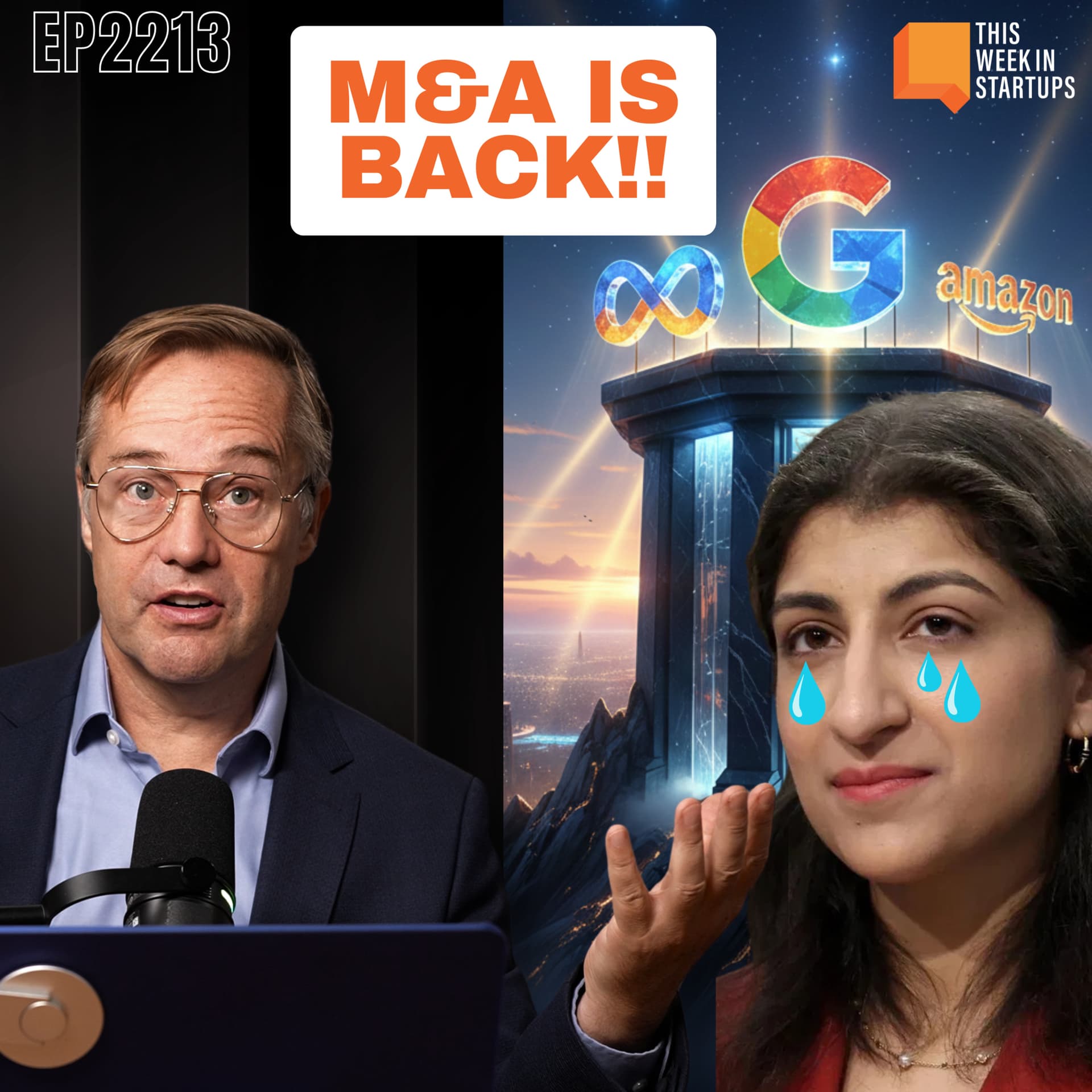
Jason predicts a “major M&A moment” in the next six months!
Host
Jason Calacanis
Guests
Alex Wilhelm
Description
In this episode, Jason Calacanis discusses current events in tech and business, including predictions about mergers and acquisitions, industry news, and insights on AI developments.
---
Key Topics Discussed
- Current Events in Tech
- Google and Meta Legal Cases: Recent cases against Google and Meta have resulted in dismissals, signaling a less stringent regulatory environment.
- AI Market Trends: Despite skepticism, AI companies continue to thrive and launch new products.
- Predictions for M&A Activity
- Major M&A Moment: Jason predicts significant mergers and acquisitions in the next six months, potentially involving companies valued between $25 billion and $250 billion.
- Possible Candidates: Speculations include companies like Amazon, DoorDash, and Tesla, potentially merging or acquiring smaller tech firms.
- Performance of AI Companies
- Nvidia's Earnings: A discussion around Nvidia's recent earnings report, indicating strong performance despite mixed market reactions.
- Google vs. OpenAI: Jason highlights Google's recent advancements in AI, suggesting that Google may be outpacing OpenAI in consumer adoption.
- Michael Burry's Comments on GPU Depreciation
- Debate on Depreciation: Burry argues about the potential fraud in how tech companies report the depreciation of GPUs, suggesting that extending the useful life of these assets artificially inflates earnings.
- Discussion Context: Jason counters Burry's perspective by emphasizing the practical usage and longevity of existing GPUs.
- AI Product Developments
- Nano Banana Pro: Introduction of a new AI tool for graphic design that can produce visually appealing infographics quickly and effectively.
- Comparison with OpenAI: Discussed the performance of Nano Banana Pro versus ChatGPT, highlighting significant differences in output quality.
- Market Dynamics and Predictions
- Rate Cuts and Economic Indicators: Discussion on potential rate cuts by the Federal Reserve and their implications for the market.
- Kalshi's Growth: The prediction of Kalshi raising a billion dollars at an $11 billion valuation, highlighting its growing importance in market prediction.
---
Key Takeaways
- Globalization of Startups: Jason emphasizes that the future of startups is global, with opportunities in diverse markets such as Japan.
- Significance of AI in Business: Companies that can effectively leverage AI tools will have a competitive advantage, suggesting that understanding and adapting to AI technologies is crucial for future success.
- M&A Landscape: Anticipation of a bustling M&A landscape where tech companies will merge to gain market share and efficiencies.
---
Timestamps of Notable Segments
- (1:54) - Jason's location and context for the episode.
- (50:13) - Jason's prediction for a major M&A moment.
- (52:09) - Viewer question on what software engineers should focus on now.
---
Conclusion This episode of "This Week in Startups" features insightful discussions on the current state and future predictions of the tech industry, particularly focusing on M&A activity, AI advancements, and market dynamics. Jason Calacanis remains optimistic about the future while urging startups to adapt and leverage new technologies effectively.
Written by AI. May contain mistakes. Listen to the episode to check what was said.
Transcript
Automatic transcript. May contain errors.0:00If that's happening every two to three years, that means theoretically that you might buy more of them. But that does not mean that you're throwing the old ones away. That's ludicrous. That would be like saying I had a Corvette C7 and the C8, eighth generation came out. So I took the C7 and I parked it in the garage. And yeah, I just took the air out of the tires and the battery and I put it on a cinderbox and that's it. It's over. That car can't be used ever. It's got 30 ,000 miles on it. That car is going to be driven for another 10 years. What are we talking about here? It's not that egregious to think that Oracle believed in 2020 that they would get five years of life out of one of these depreciating assets.
0:39Then, you know, the next three years, they said, yeah, it's still five. And then in 2024, they said, you know what? We think it's six. And the Microsoft One is more dramatic. It goes from three years of useful life to six. So they doubled. But everybody's winding up at five and a half, six, six, six, five. And the year before, it was four and a half, six, six, six, six. So Amazon brought it down a year. These are all kind of within 30%. Right? This Week in Startups is brought to you by Northwest Registered Agent. Starting your business should be simple. With Northwest Registered Agent, you can form your entire business identity in just 10 clicks and 10 minutes.
1:13From LLCs to trademarks, domains to custom websites, they have got you covered. Get more privacy, more options, and more done. Visit northwestregisteredagent.com slash twist today. Crusoe Cloud. Crusoe is the AI factory company. reliable infrastructure, and expert support. Visit crusoe.ai slash build to reserve your capacity for the latest GPUs today. And Pipedrive, bring clarity and control to your sales process with Pipedrive, the number one CRM for small and medium-sized businesses. Supercharge your sales today. Start with a 30-day free trial, pipedrive.com slash twist. All right, everybody, welcome back to This Week in Startups.
1:56I'm your host, Jason Calaghanis, here with me, Alex Wilhelm, again. And I am in Vegas. If you're watching the video on YouTube or Spotify, I'm in my suite at the Venetian. Thanks to my friends at the Venetian for their hospitality. I'm here for F1 with the All In podcast. I'm going to do a hot lap. And then they did all these really nice things for me. Look, they built this little chocolate thing for me. Oh, there goes all the chocolates. You can eat this whole thing. I can eat the track, I guess. and all the little chocolates on top of it. Is that a roulette wheel made of candy? Yeah, basically.
2:30It's a roulette wheel, but it's also like a track. They redid the Venetian. They redid the poker room. And they've got like a live poker room where you can do live shows. So we did a live show where we played a little poker with Jason Kuhn, Alan Keating, if you know that maniac, and Phil Hellmuth. So we're having a blast. Sounds good, man. Venetians are gorgeous. They redid the poker room there. You would like it. The poker room has like a nice spread of one, two, three, five. You can get in all kinds of different games. Good crowd. And very classy. You know, they got a nice espresso machine. They classed it up.
2:59You know, most of these poker rooms, they leave a little bit to be desired. My local poker room, it looks like the back office of like a 1970s accounting firm. There's no curb appeal whatsoever. I really want to go back to Vegas and play cards, but I haven't gone to Vegas since I quit drinking, to be honest. Just haven't made it back since, so. Go for the games. Yeah, I mean, you got kids too. I mean, it's nice to see a show. You know what the most amazing thing is? The restaurant scene in Vegas is absolutely absurd. It's the best in the world now because what they do is they're in a competition.
3:26People book their hotels based on the restaurants. So last night we ate at a restaurant, C-O-T-E. It's a Korean Michelin-starred restaurant from New York. They built an outpost here. Amazing, like six-course tasting menu. Unbelievable. There's a famous Peking duck place. I love to go when I'm in Hong Kong, but I don't travel to Hong Kong like I used to because I've been a little bit critical of the government over there. And I don't need to, and I can't do business there anymore. It's kind of a bummer, actually. I kind of liked it when we were partners. Maybe that'll happen again in our lifetime.
3:57Mott 32. Turns out Mott 32 just opened in Dubai, and they opened one here at the Venetian. So now they're collecting the best restaurants. I had dinner at Carbone when I got here on Wednesday. That's over at the Aria. So they're in this competition to see who can get the top restaurants around the world to open their outpost here. And then they have now like, they'll put more effort into the restaurant here. Like the quality of the meats, the quality of the produce. It really just goes to show you the value of IP. These restaurants are kind of IP machines. So they opened the second carbone here.
4:31And then when I was in Riyadh, the hotel I was staying in, which was a very nice hotel, had a carbone in it. And I was like, what? And then I found out the PIF, the Sovereign Wealth Fund from Saudi Arabia had somebody told me, oh, yeah, they invested in the restaurant group that does carbone, the very elite New York institution. so then literally i ate at carbone in riad carbone in vegas in the same 30 days you start to think about like which one was better come on do it do a side by side honestly if you took the experience from each they're sourcing everything from the same place so the parmesan cheese uh the salami the pasta the rigatoni their spicy rigatoni is like a very famous dish it was exactly the same.
5:16If you were to swap it out, it would be the same. So it's kind of like just a really interesting lesson for entrepreneurs. There are many different markets where you can bring your product. So if Carbone can exist in all these different markets, then they opened up at the Bellagio a Carbone on the water there, and they changed the menu a little bit. So now there's two Carbones in Vegas in two different properties. Both, I think, are owned by the MGM group. And so I was talking with the CEO of the Venetian, a really nice guy, a fan of the pods. And he was explaining how now people sometimes come for a show.
5:55Sometimes I like the games, but most frequently people are talking about coming for the food. They're perfecting specific dishes. So when I was talking about Japan on the show last week, they will do like one dish really well at most restaurants. And that's what they do. So it's a soba place or it's a sushi place, but it's not like a sushi place where you can get soba. It's a tempura place, but you can't get sushi, vice versa, as opposed to in America or experience. All of this is to say, if you can perfect something in one market, the markets are now becoming very similar. We have a global culture now that has emerged.
6:31So the people in Saudi, Dubai, Tokyo, Vegas, New York, Europe, they're all kind of becoming connoisseurs of great products. And if you can make a great product, it can make it to those different cities, whether it's Uber, Airbnb, or Carbone or Mott 32. Speaking of global expansion, part of why I'm bringing this up is we had something work inside of our organization, Founder University. It really clicked with people. And so we're going to be launching Founder University in Tokyo. Started in America, we've done 11 cohorts. Then we brought it to Riyadh, and I was just talking about that. And last week I announced that we are going to have it start in Tokyo in January.
7:15So we have the details for you. Applications are now open for the 2026 cohort. Startups are going to get to be part of basically a three-part experience. Let me just say it in plain English. And this will help them expand their reach. We're going to have a bootcamp in Tokyo, January 12th to 16th. Then the program will move to online from January 19th to March 6th. Finally, you're going to come to the US for a week, March 9th to the 20th. So we've designed this so you get to have the Tokyo experience, you get to hunker down, get work done, and then you get to come to Silicon Valley and meet investors and meet founders there.
7:51We're also looking for mentors. Some of my friends, if you're an angel investor and you want to work with the 35 companies, you can join us there. To apply, it's very simple, launch.co. There are a couple of unique things about the program. The program is for companies that are in Japan, Japanese founders, or focused on the Japanese market as well as the US market. So go ahead and go to launch.co slash Tokyo. I'll see you in Tokyo. I'll be there for the launch. Just for folks out there who are listening and heard us talk about the Riyadh program last week, Jason, you said that in Riyadh, it was mostly for Saudi founders, but you could also join if you weren't Saudi.
8:32They were focused on Saudi nationals because they're trying to build an ecosystem there. But if you're willing to spend time in Saudi, great, come. Similar for our friends at Jetro in Tokyo. If you're going to spend some time there or address the market or you're a Japanese national, you'll have a preference there coming in. And you can see the picture there. I had the incredible hospitality. If you look on the website, I just gave like an opening keynote where I explained what the program would be. And they had 200 people show up for this thing, 150, 200 people. And they had like 100 or 200 people on the wait list trying to get in.
9:05But there is a big founder community there. And there is a very large group of Americans who are based there now. So I met with, I won't say which ones, but there's a half dozen Americans who I had lunch with who are active investors from America, spending either half time, full time, or majority time in Japan and still investing in the US. So we're really seeing this globalization where you can be in any market, you can address any market, and there's investors in every market. And I think the future of startups is really going to be folks starting in whatever market they want to go after first, but then going global.
9:45Just like Carbone can exist in different places, they can build an incredible product. That product might need to be adapted. For example, in Saudi, they had mocktails, you know, and like some very flavored, really nice mocktails without alcohol in them. And because alcohol is not approved in all regions in the Middle East yet, but it's starting to be. And so you can't have an effective sales team without an organized sales process. Trust me on this. I've seen thousands of startups up close and personal. And man, a messy, chaotic sales process. That is a major red flag. This show, This Week in Startups, is about helping founders.
10:22I want to tell you about the tool I use, PipeDrive. PipeDrive brings together your entire sales process in one clear, easy-to-understand, and centralized space, giving you one place to check on all your customers and the deal information and to keep you and your team moving faster and working together as a single team. Teams using PipeDrive close an average of three times more deals every month. You could average three times more deals every month by joining over 100 ,000 companies that use PipeDrive. And when you use our link, you'll get that 30-day free trial. No credit card or payment needed.
10:56Go to pipedrive.com slash twist to get started. That's pipedrive.com slash twist. I have been using this product for close to a decade. I don't have time to babysit the sales team. I need them to have the right tools. And that's why I use PipeDrive. You have to adapt for the local culture. I'm sure if Carbone was in Japan, they might have some nuance there. Maybe you have to take your shoes off when you go in, like you do in some homes or restaurants, depending on how you sit. So there you have it, folks. And I will be there. I'm going to be in Japan again. I'll be doing the show for two weeks from Tokyo in January.
11:30Which is going to be a lot of fun, because I think that's also when I'm going to be on paternity leave. So we're going to have some fun scheduling times. Easy peasy. Easy peasy. All right, what's in the news? Let's get some news done here. After we finished the show on Wednesday, Jason, NVIDIA dropped its earnings. I think we should spend just a minute explaining to folks what happened so they understand the lay of the land. Just in case people didn't read the news, NVIDIA beat on revenue. It beat on earnings per share and it beat on guidance. And then it shares rose and then it shares fell. Jensen actually made a comment about this in an internal meeting that Business Insider got a recording of.
12:04And he said, quote, if we delivered a bad quarter, it's evidence that there is an AI bubble. If we delivered a great quarter, we are fueling the AI bubble. So a little bit of damned if you do, damned if you don't from NVIDIA. But overall, a very impressive print. I'm curious what the vibes are amongst the group chats regarding the current AI bubble discourse, Jason, now that we have NVIDIA's numbers in hand. I mean, the number one thing people are talking about is obviously AI build out is going spectacularly. Obviously, NVIDIA can't keep their chips on the shelf. Obviously, the market got a bit overheated.
12:36So people throwing money into late stage startups or public companies without really understanding the details is people's concern. There was an interesting tweet from Gavin Baker that I retweeted. Essentially, the gist of it is NVIDIA came out, I believe, in this quarterly earnings and they addressed the open AI investment. And they addressed also, I guess, their potential investment in Anthropic. So what the themes are now showing is, and what people are starting to discuss, you know, walking from casino to casino between playing games or, you know, in the group chats is, which of these deals are actually guaranteed?
13:19And I asked you that question. Hey, I don't know if you remember on a previous show. I was like, is that guaranteed? Can you look it up? And it was like, we can't find anything. Okay. As you speculated correctly, we'll find out in coming quarters when they announce because they're going to need to disclose this. This is from Gavin Baker. It's a bit long. I'm going to read it verbatim, everybody. Just bear with me. We expect to continue investing in strategic partnerships in the third quarter of - This is Jensen. This is Jensen speaking. Yeah. In the third quarter of fiscal year 2026, we entered into a letter of intent with an opportunity to invest in OpenAI.
13:50In November, 2025, we entered into an agreement subject to certain closing conditions to invest up to$10 billion in Anthropic. There is no assurance that we will enter into definitive agreements with respect to the OpenAI opportunity or other potential investments or that any investment will be completed on expected terms, if at all. The timing and magnitude of these and other investments we may make will depend on various factors, including the ability of our partners to successfully develop and deploy AI infrastructure. There can be no certainty as to the timing or amount of capital we may ultimately invest in these or other strategic partnerships, and we may be limited by our available liquidity and capital resources.
14:27In other words, Jason, this is all handshakes and good vibes, nothing locked down and they can all kind of walk away if they want. Yeah. Essentially, you know, the opportunity is doing a lot of work in that sentence and may, I think you have a lot of work in those sentences. Lots. They obviously have an agreement. It's, it's probably more than a handshake. It's probably written in fairness to them. It's probably a memorandum of understanding or, you know, a letter of intent. You know, we call it a letter of nothing in the startup community. So when people are like, Oh my God, we got a letter of intent.
14:59We're like, you've got a letter of nothing, people will do these as favors for each other. Now, when big companies do them, okay, well, there's a little more at stake. So if you're a cloud provider and you write, we're going to get tens of billions of dollars in build out, those are the ones that I really want to see. So this is the one where NVIDIA is sending money to OpenAI and Anthropic as an investment. Obviously, those two companies are buying compute, whether they're buying it themselves or buying it through a cloud provider, you know, doesn't matter. They're going to be buying compute. So that's where the round tripping concern comes in.
15:37Is this a round tripping? So there's one interpretation of this. Okay, they're making sure people understand that these two things might not be tied together. In other words, we're agreeing to invest, you're agreeing to buy. Now they're kind of backtracking it, right? This sounds very different than the initial announcements. Now, part of that could be that the press ran with these, which is why here on the show, I'm always like, can I get the details on this? Where are the details? Because the press does run with things sometimes, and the companies might run with things sometimes. Social media might run with things sometimes.
16:09And we're like, oh my God, look at all this money. It's all optional. So this chart of all of this round tripping, et cetera, we now need to redo that chart. And we need to know if it's a dotted line, which means it can be broken, or if it's a solid line, which means it has to occur, right? It's an actual commitment. And just you're referring to this famous chart right here, I presume, right? Yeah. And so at the center of this is NVIDIA at a$4.5 trillion valuation. And what you see is Oracle, Intel, CoreWeave, Microsoft, OpenAI, AMD, XAI, Figure, Mistral, we had on the program recently. So they're all sort of explaining where the money goes and investment services.
16:55So the red lines on here are hardware or software. I guess the blue is investment, et cetera. It's complicated, but now if we have dotted lines, we'd actually know. So I think in some ways, this is a good way to let a little air out of the bubble and remove the concerns around round tripping. That's my two interpretations here. I also think Jensen's a little pissed off at Sam Altman. OK, tell me why. I think, you know, if you're going to offer to invest all this money and then the next week, you know, he's buying chips from AMD and, you know, dropping these other announcements. I think he maybe thought maybe he was part of a tighter, more narrow relationship set.
17:38And I think Sam just did. How many deals did Sam announce over from the summer till now? 574 deals. No, no, but it was literally, I think, closer to 10 than five, right? I mean, we should actually do a little research on it because it seemed like he was announcing one or two a week, right? Investment, the secondary, sale, AMD, NVIDIA. I mean, it was pretty Amasa's investment. It was notable. It was absolutely notable. But the thing is, we've talked about how people at OpenAI, when Sam was ejected for a couple of days, had struggles with him, working with him. And there were discussions of elements of truthfulness.
18:18Then we have OpenAI and Microsoft. That relationship eventually kind of breaks. Now we're seeing OpenAI and NVIDIA cracks there. You know, Jason, if everyone you date is a jerk, might be you. I mean, I think he makes, he's a great, he's a consummate dealmaker. I mean, I've known him for, I guess, close to 20 years, I guess. He's always been like an operator, A networker, a deal maker, really knows how to get into the room where it happens, understands how power works, understands how to take power. That's how he wound up on the top of the pile of a crazy scrum that is known as OpenAI. And it's working out.
18:52I do think when we look at this, the company that's going to have the most market share decline because they were first up the hill is going to be OpenAI. So their percentage of AI jobs from APIs and their lock on the consumer is going to go from essentially 100 % of consumers, right? They had the first chat product. It's going to go down to less than 50%. And I don't know what their percentage is now of consumer searches. And I don't know if we're tracking them in a robust or refined way because some of the companies are private, Mishra, Anthropic, XAI, and a long tail of different LLMs. And I don't know if Google's taking the time to break out Gemini searches or the AI results that you can click over to and how many people are defaulting to AI versus search.
19:42They said in their Gemini 3 announcement to Jason that there's over 2 billion users now of the AI overviews in search. And they said that their Gemini mobile app now has 650 million monthly active users. Hold on a second. Wait a second. so that they have two billion people using ai search launching a new company is all about finding your first customers and then just learning how to solve their problems and that is going to put you on a relentless pace and that means you're going to be releasing new products and features hopefully at a brisk pace or better but my lord the complexities of working with ai it's going to slow your developers down you're going to have to install new gpu drivers they're going to be provisioning clusters.
20:22All of this detail-oriented, labor-intensive work can distract you from working on the thing that you're building, your product. But now there's Crusoe. They are the AI factory that worries about your backend so you can focus on your code. And their hardware has been designed specifically for AI development, so they're going to make sure that your models run with unparalleled performance every time. Head to crusoe.ai.build to apply and receive $100 ,000 in credits for virtualized NVIDIA GB200 NVL72 on Crusoe Cloud. Pending availability, okay? That's C-R-U-S-O-E dot AI slash build to apply and get those$100 ,000 in credits.
21:08And OpenAI was at 850, I think, the last time, or 800 monthly active users. That means Google has two and a half times the number of people using AI on a consumer basis. How come nobody's talking about that? This is incredible information. Yeah, I'm just double checking. So AI overviews now have 2 billion users every month. The Gemini app surpasses 650 million users per month and more than 70 % of our cloud customers use our AI. That's from the Gemini 3 announced. But I think people aren't counting them as MAUs or Ds in the same way just because you can use them by accident. I can do a search and Google might give me one of these, but I don't know if that's as strong an intent signal as actually loading chatgpt.com, for example.
21:46If we're going to use, did you go to, did you start at an AI portal? Fair enough. 650 million users of the Gemini app. Is that correct? Unless Google's lying to us. That's what they said. I'm just confirming with you how they phrase it. The Gemini app surpasses 650 million users per month. And what is the latest from chatgpt on their number of users per month? 800 million per week. Per week. Okay. So we give them 900 million a month, give them 10 % more. So that means the Gemini app is already two thirds of chat GPT. This blows my mind. How many of the 2 billion clicked on the AI result? 10%, 20%, 30 % as opposed to just serving it up.
22:27Let's say 30%. Let's be generous. Okay. So 600 million. Okay. 600 plus 650 is 1.2. And you do 10 % overlap, 20 % overlap. You're at a billion. Yep. Google's ahead. I mean, this is like major news that nobody's reporting on here. Nobody's just taken out a calculator and done this. Let me just state this clearly. If this information is correct, Gemini now has 20 % more users every month than ChatGPT. Gemini is beating ChatGPT in consumer adoption of AI. Just flat out. I would say the Google AI family of products is beating the open AI family of products at reaching the most number of consumers, just to be a little bit simplified.
23:10So Google's winning consumer AI. That's an interesting question. I don't know if I would go quite that far. Winning implies to me a revenue and usage calculation. And I don't think we know enough about Gemini's monetization. But just in terms of consumer adoption, they're winning. If we use the term consumer adoption, I think you can see it, consumer adoption. I mean, Google doesn't need to make money from this. This actually dovetails neatly with another story, Jason, before Gemini 3 came out, I think OpenAI had a little bit of an inkling about what was coming. And so the information got a memo that Sam Altman sent out around OpenAI.
23:43And he said that basically Google's progress could create some temporary economic headwinds for our company. And then he said that we know we have some work to do, but we're catching up fast. I expect the vibes out there to be rough for a bit. So I think that we are kind of in the open AI nadir. Like they're getting beat up on infrastructure costs. Their rivals are launching impressive models. They're losing some of their consumer edge. They're not winning the API game Viz Anthropic. And so I think they're struggling a bit. They're doing great as a business. They're going to reach 20 billion annualized revenue by the end of the year, Sam says.
24:17But certainly the open AI of January 1st, 2025 is not going to be the open AI of December 31st, 2025. And I think the, if I were to steel man this, the defense that the open AI team and investors would say is the AI results from Gemini are being forced upon these consumers, right? Because they do have it in Google Docs now. So I wonder if they're counting those as Gemini searches when you do something in Google Docs. Did they just say any Google Docs searches that were done through the AI button are part of the overall Gemini? It would seem fair to do that. Would seem fair. But this would go back to the Teams versus Slack.
Read the full transcript
24:59If you remember when Microsoft Teams came out, they turned it on for everybody who uses Office 365. Whether you want it or not, it was bundled. Therefore, if you were to click on it in the interface, and I don't use Office 365, I'm on Google Docs, I'm going to use Slack. But my understanding was, it's just all automatically in your interface and you're going to wind up clicking on it at some point. Therefore, their active user count compared to Slack's, and there's like this dramatic chart of how, boom, they just got everybody. But this was always my thought was whoever has the guts to put AI first in their product with an established product is going to win the day.
25:38Meta has some number of people on Instagram doing AI first searches. When you do a search on Instagram, you cannot do a normal search anymore. It is by default an AI search, right? Instagram is the worst app in the world. I just want to say that I use the desktop interface on this and meta. It's just garbage. Like try again. Two things, Jason. First of all, here's one of the charts you're mentioning with Slack versus Microsoft Teams. This only goes to 2012, but it shows the hockey stick like growth of Microsoft Teams DAUs compared to Slack, which was a major narrative up until Slack's eventual exit.
26:08And then the other thing, just based on what we're talking about, consumer usage. This is a top apps for iPhone ranking for the US. And if you look at the top of this, you'll note that it's ChadGPT and Google Gemini. Yeah. It's kind of impressive how popular they are. But if you look, Grok's number six. And Sora's number nine. These AI products are incredibly impressive. And as you point out repeatedly on the show, this is new downloads. This is not a usage chart. This is still downloading. The App Store rankings are based, I think, in a blended algorithm that benefits the new so that it doesn't become self-perpetuating top list because people will go to the top 10 list or top 100 list to listen to music.
26:53And then those artists stay in the top 10. So new entrants do get a little bit of, I think, a push. Same thing happens in podcasting. Somebody comes up with a new podcast. They always tweet and they're like, oh my God, we're the number one podcast in the world. And it's like, okay, you're the number one new podcast this month. Therefore, Apple gives you a little shine. They do the same thing on their podcast rankings. Before we move on from this entire hardware conversation, there's a detail that I wanted to just bring out of the earnings call, Jason. We've talked on the show about GPU depreciation.
27:19How long will this hardware last? Is it just going to be a couple of years? During its earnings rundown, the CFO said, most accelerators with CUDA, which is their software suite, and NVIDIA's time-tested and versatile app architecture become obsolete within a few years. Thanks to CUDA, the A100 GPUs we shipped six years ago are still running at full utilization today, powered by a vastly improved software stack. Six years ago. Yes. It's NVIDIA is using their same hardware. Yes, the A100 GPUs. So Michael Burry, you may have seen, and you can pull up some of Michael Burry's tweets. Michael Burry likes to delete his tweets.
27:53I don't know if he's deleted them, but if you follow the Michael Burry account, famous from The Big Short, he is accusing the big tech companies from committing fraud, literally thinks that this is fraud and that they're cooking the books because they're taking the depreciation schedule for servers from three, four, five years to four, five, six, seven. Now, we had a very granular discussion about this on All In and Freeberg went deep into the generally accepted accounting practices. You have a new piece of hardware here. It's my take on it. How long do you get to spread out the lifetime value of them?
28:30So when you buy a building for your office space, or you buy an airplane as an airline, instead of just taking a charge for a $100 million airplane in year one, you say, this has a 20-year life. We're going to take the$100 million and theoretically$5 million per year. It might be more in the early years and it may taper off a little bit, but essentially there's some lifetime. What people are finding is with these NVIDIA chips, some people thought, well, we're just going to rip them out because NVIDIA is doubling the power of them every 18 months or 24 months, or maybe even better. So therefore, they're going to be ripped out and new ones are going to be put in and they're just going to be turned off in year four, year five, and nobody's going to want them.
29:15Well, it turns out like there might be jobs that these are perfectly suited for and they might last in year five, six, and seven. So then the question becomes, when are these consuming so much power? Because there's also power and there's like the facilities that they're housed in. So you have power, water, staffing, cooling, all that stuff is involved in the maintenance of them. So let's say you get to year seven and the maintenance cost is higher than the appreciation of a new one in the first year. And the cost of swapping them out isn't that expensive. So therefore you get to some reasonable moment in time where you would just turn these off.
29:51Now, what they're finding is, well, maybe those Sora jobs where people are making goofy five second videos and eventually becomes five minute videos. Maybe these old ones will be just sitting there ripping those for people or making new advertisements for people or indexing their iPhoto or their Google photos in the background so that when they open up their photo app, you know, the AI is already done for it. Being a founder is a lot of work. You have to focus on your fundraising. Then you got to hire the perfect team. Oh gosh, product market fit, finding your first customers. But all of this means nothing if you're not actually a real business that's structured properly, giving your investors and clients the confidence to partner with you.
30:31At launch, we're constantly recommending Northwest Registered Agent to our founders because for just$39 plus state fees, they will act as your registered agent. That means they take care of all the paperwork, making sure your business remains compliant, protecting your privacy, and more. And as a founder, hey man, there are so many organizational odds and ends that you have to worry about, so why not have a partner who can focus on all those little details? Then you can obsess about your customers. And Northwest Registered Agent is even going to help you set up a phone line, a professional email account, and find you a great domain name.
31:05So here's your call to action. Go to northwestregisteredagent.com slash twist to get your company set up the right way. Michael Burry is correctly saying, hey, if you double the lifespan of these, and these are your major expense, and you're doing this massive build out, well, then it might be the equivalent of 10 % of your earnings, 20 % of your earnings. And he's kind of insinuating. And I don't know if he's explicitly used the word fraud or cooking the books, but let's see what he says here, because that's kind of what people are interpreting this as, is that there is shenanigans. I'll use the technical term shenanigans, but let's see what he says.
31:43So Michael Burry says, understating depreciation by extending useful life of assets artificially boosts earnings. One of the more common frauds of the modern era. Again, this is quoting here. I'm not saying this. Massively ramping CapEx through purchase of NVIDIA chips and servers on a two to three year product cycle should not result in the extension of useful lives of compute equipment. Yet this is exactly what all the hyperscalers have done. By my estimates, they will understate depreciation by 176 billion between 2026 and 2028. By 2028, Oracle will overstate earnings 26.9%, Meta by 20.8%, et cetera.
32:18It gets worse more coming later on. Here is the table that he showed, Jason, and it shows the depreciation schedules for compute, essentially chips, if you will, inside major hyperscalers, Meta, Google, Oracle, Microsoft, Amazon, and you'll note that they've risen over time. The reason why the six-year point from the NVIDIA earnings call matters so much now is because most of these companies, Google, Alphabet, Oracle, and Microsoft, are all running six-year depreciation schedules on their GPUs. So it seems that they might not be nuts. But I do think that what Michael Burry is saying is that if these do burn out in one to three years, then these numbers they're putting out are, in fact, BS.
32:58I think he's confusing something here. If you look at the original tweet in that first sentence, he's saying the, I'm sorry, in the second paragraph, NVIDIA chip servers are on a two to three year product cycle. So that's the product cycle. Okay. They come out with a new one every two years or like new, it might not be a new version because obviously they're versioning these things up, like a new platform, like a new, the new version. Hopper to Blackwell. Exactly. And so if that's happening every two to three years, that means theoretically that you might buy more of them. But that does not mean that you're throwing the old ones away.
33:39That's ludicrous. That would be like saying I had a Corvette C7 and the C8, eighth generation came out. So I took the C7 and I parked it in the garage. And yeah, I just took the air out of the tires and the battery and I put it on a cinderbox and that's it. It's over. That car can't be used ever. It's got 30 ,000 miles on it. That car is going to be driven for another 10 years. What are we talking about here? I think he might be making a story here that isn't in touch with reality. And then using the term fraud is like, that's a big, big accusation. It might just be when you pull up that chart one more time.
34:15Thank you. And you look at that table. It's not that egregious to think that Oracle believed in 2020 that they would get five years of life out of one of this depreciating assets. Then, you know, the next three years, they said, yeah, it's still five. And then in 2024, they said, you know what? We think it's six. OK, it's 20. It lasts 20 % longer. That'd be like saying, oh, yeah, that Corvette I'm talking about. You know what? We change the oil and we change the filters on it and we maintain the tires and we rotate the tires so we think it can get another 20 % of life out of it. And Meta going from, I don't know why Meta was so low at three or Microsoft was so low at three.
34:49And the Microsoft One is more dramatic. It goes from three years of useful life to six. So they doubled. but everybody's winding up at five and a half, six, six, six, five. And the year before it was four and a half, six, six, six, six. So Amazon brought it down a year. These are all kind of within 30%, right? Yes, absolutely. We do have the kind of rejoinder from Michael Burry here, Jason. I'm just going to pull that up for us. He argues in a November 19th kind of update to his argument that the idea of a useful life for depreciation being longer because chips from more than three to four years ago are fully booked confuses physical utilization with value creation.
35:22Just because something is used does not mean it is profitable. Gap refers to economic benefits. Airlines keep planes around for overflow. Sure. A100s take two to three X more power per flop. So they cost two to three X more than H100s. Yeah. NVIDIA claims H200 is less energy efficient than Blackboard for inference. Okay. So his argument is that, yeah, everyone pointed this out to him, but maybe these chips won't be profitable. Here's the thing. The chips will be turned off when they are no longer gross margin positive. And so far we have not seen that. And as you pointed out, Microsoft for four years now has had this six-year depreciation calendar.
35:54If it was wrong, they would already have some early warning signals and would be telling investors about that. So I like that Burry here is poking at things. I just think he's a little bit overly certain before enough of the facts have come in. But then again, that's how you make money. Has he talked to the people? I mean, Shemaf made this point on All In. Like, has he actually gone and visited the data centers and talked to the people who run the data centers and looked at the jobs they're running? because if that airplane, in his analogy, is flying people on Thanksgiving and Thanksgiving and holiday tickets and July 4th tickets, Memorial Day, if those extra planes are incredibly profitable during those peak seasons, then you just do the math on it.
36:36Like, is it worth keeping this one around for the overflow? In these cases, the overflow jobs, like I was saying, are things that might be running in the background that need to get done. And then you're going to do whatever the newest jobs are in three years on the latest generation. Like maybe they're going to be doing synthetic data. Maybe they're going to be doing self-driving data. Like just more complex things. Doesn't mean people don't want to make bulldog superhero videos for their daughters still. And those will get done to those jobs. And there is the backstop of the power consumption.
37:05Because power consumption and the staffing of data centers and the cooling of data centers and the HVACs and all that, the water consumption. Because that all exists, that's a backstop against keeping this stuff online unnecessarily because those bills keep coming in. That's not part of the depreciation schedule. That's just cash off the book. So there is a real incentive to turn off things that don't work. Like for the airplane, I guess, would be the maintenance contracts on the engines, etc. You still have to maintain the engines, etc. Every certain number of hours, the airframe, etc. You have to have a hanger, right?
37:37You have to have somewhere to put it. So at some point, they might be like, you know what? we don't use this plan that much and it's costing us more than we make on Thanksgiving. Anyway, I think he's off on this one. I do think it's great that he's stress testing it. All right, moving on. Really quickly, I want to talk about Nano Banana Pro. This is actually Gemini 3 Pro image, but we did a little test, Jason. We're going to get your take on this. So we gave it a prompt. This is Oliver and I. Shout out to our friend. The prompt is create an infographic of the top five barbecue spots in Austin.
38:07And we have one version from... This is great. I haven't seen this. so I can give you my... Yes. So actually, here is the Nano Banana Pro image. I want your take on the information because I know you know Austin Barbecue and your rating on the overall design. So this is very interesting. So they were able to make this without giving it the data and the text that's in the image. It went and did the research as a language model and then also did this beautiful image. Okay, so let's start. First of all, it's a good looking image. If you were to make this in a magazine, this could, in the 90s, in early 2000s, if you had a magazine that was doing a feature, this could be an infographic in the magazine as is.
38:50It might not be one in a Condé Nast magazine, but every other magazine, it would be totally fine. Time Out New York, whatever, would be fine with this as an infographic. It would have been improved. So that's mind-blowing. And it would have taken a week for a designer to make this. Yes. So, and that designer would have been a 50, 60,$70 ,000 a year designer. for a mid-tier magazine. Maybe they would have been a 70, 80, 90 if they worked at a Condé Nast. Actually, you probably don't get paid that much at Condé Nast. But putting it aside, this would have cost$2 ,000 to do internally, internal costs.
39:20So now we go to the data. Franklin Barbecue, Leroy & Lewis, Interstellar, La Barbecue, Terry Black's Barbecue. I'm just looking for spelling errors. And do you see any spelling errors in this? I didn't see anything that caught my eye when I went through it before the show, but I still don't see anything. I'm just more terrified about the idea of fatty brisket, which is not my jam. Yeah. I like a little, they call that wet brisket in the business, but looking at these, Terry Black's, I always say get the beef rib and the brisket there. That's my order. It is cafeteria style service. It is consistently excellent.
39:51It is spacious and they do have a quick moving line. It does have family legacy. That's all true. For a barbecue Michelin star, I don't know. Female owned, I don't know. Locally sourced meats, I actually do know that. And they are known for their brisket. I don't know if it's known for the fatty brisket, but they are known for the brisket. This peach tea glazed pork belly from Interstellar, I have heard about that and I'm certain they have the Michelin star. I do remember hearing that. Leroy, smoked beef cheek sounds amazing. And for Franklin, they are considered the best brisket in Austin. This is unbelievable just from the design to the accuracy.
40:29I'll tell you the other thing here that's interesting is that is what Terry Black's looks like. The illustration is close to the vibe and interstellar and the barbecue. I think that is also the vibe. I think interstellar is like a strip mall. Well done. I mean, apologies to info graphic creators and graphic designers everywhere. If you're a graphic designer, you need to know how to use these tools and know how to edit from third base, essentially. Like you're starting on third base. It's literally like. It is not, it is not as good when we do the same prompt through open AI, just so people know the process here.
41:05I asked ChatGPT 5.1, my version of it, to give me the same thing. It gave me a written list and then said, would you like me to design an infographic? I said, yes. Jason, this is what it looks like in comparison. And I made this this morning. So this is absolutely, you know, same in the art from what we have in ChatGPT. It's a mess. So a couple of things that are wrong here. One, beef briskexit, comma, id. Oh my God. Yes. And you can just, there's overlaps between the images. It's inconsistent about what's shown. Go-ia-yul if possible. Mikkel Thwaite Kraft Meats? What is that? Anti-conditional sides.
41:43Mikkel Thwaite Kraft Meats. Anti-conditional sides. It's not reliable, Central. It's relable. But the point is, this just goes to show how good the new Google model is. And I think this goes to underscore the earlier points about their growth in consumer, their rising app store rankings, and the fact that OpenAI is kind of just not winning right now, which feels weird given where we were most of the year. If you're going to look at where gains will be compounded, the person who is first up the hill, who has to spend all their time fighting to raise money, fighting to build out infrastructure, is going to spend, let's just take these three buckets of founder time.
42:23One third spent fundraising, one third spent building infrastructure, one third building the product, right? Now we move over to Google. Infrastructure is taken care of and fundraising is taken care of. It's called profits. So that team over there now has but one thing to focus on, the output of their image and the output of their language models, which is spectacular. And so this is super important for founders to understand when they're making a company. If you were spending your time, to my points earlier about outsourcing things, there might be an argument for having your own servers and saving money in a robust business, or maybe you have some competitive advantage because you don't have to pay overages for your bandwidth and you're a bandwidth driven business like YouTube, and they would do well to put up their own servers and not have to pay somebody for the overages.
43:14Putting all that aside, the more you can focus on the thing, the better. And that's why not having side quests, not having things you're doing that are not the core thing is so critical because eventually a competitor does show up. And this is why Zuckerberg was such a formidable competitor. MySpace was trying to keep their servers up and running. They were trying to deal with the politics inside of News Corp and the integration. And Zuckerberg was just like, I'm just going to focus on growth and making the service faster and growing the product. And that's it. And then he ran them over. So you got to focus on what matters.
43:44Quick recap before we move on to Kalshi. On Monday, Grok 4.1, excellent. Tuesday, Gemini 3, excellent. Wednesday, Grok 4.1 fast, well-reviewed. GPT 5.1 Pro, GPT 5.1 Codex Max. Thursday, Nano Banana Pro. What a week for AI models. There's no training wall. What a time to be alive. I mean, literally everybody firing on all cylinders. This is why people are looking at the space and there is an America first, America only movement that is gaining steam in America. The reason is people are starting to believe on the right and on the left, we're getting into this horseshoe theory, that my warning that job displacement could happen faster than we think it will and that I am concerned about it.
44:34Now, I'm not a doomerist. I'm just saying, hey, I just think it's a little bit faster. And people inside my circles, a number of people have pulled me aside and say, can you stop saying this? This is like, you just, people want to be in the room where it happens. I've had multiple people in the industry. Hey, can we keep the music playing here? Like, please don't not scare the public that jobs are going away. But I just showed that image. And I just said, like, if you're running a magazine, why would you have a graphic designer on staff when you could just do that? That's more than enough to get the point across.
45:05If you had three designers on your team and one of them did illustrations, you would just get rid of the illustrator. That's it. Period. Full stop. And so here we are, folks. Get concerned. Get curious. Somewhere in between those is the truth. I'm curious about why this is happening and I am concerned. I'm not a doomerist. I'm not saying ban AI. To your point that like five things came out in one week and like we're going into the holiday week, like I don't think this is slowing down. And AI is going to make these AI tools better. Disgraciad version that ChatGPT made. If you were to use AI and just say, hey, we made this and Gemini made this.
45:43Why is our software suck compared to Gemini? AI is going to start fixing those problems. That's where the compounding gets really weird. In the open AI memo that or conversation that the information reported, Sam does stress the importance of working towards super intelligence and eating some losses along the way to get there. because I do think that there is a moment in which one company reaches this idea of a self-improving AI, Jason. And it might be that the first person there has a long-term advantage over their rivals. But right now, dear God, it feels like everyone's at the cutting edge and I love it.
46:15Moving on. Kalshi is going to raise again. TechCrunch reports that Kalshi is raising new capital, this time a billion dollars at an$11 billion valuation. Keep in mind that Kalshi last raised 300 at a$5 billion valuation in October and raised in a$2 billion valuation in June. So what the hell is going on? Well, I went and pulled the data. So Jason, from The Block, a crypto-focused news and data service, this is their reporting of Polymarket and Kalshi volume on a monthly basis. Now, Kalshi is in blue if you're looking at this on the visual version. Polymarket's in red. What matters is that after some very modest growth through August of this year, Colossary employee market had grown very rapidly in the last couple of months, Jason.
46:58And this to me explains why investors are salivating to get more capital in because they're seeing incredibly impressive growth from maybe about$2 billion in volume between the two companies in August up to$7.5 billion in October. Amazing. It's becoming an integral part of understanding the world. And I think it's fantastic. We now have people doing research in the world and there's consulting firms and survey firms, people who do polling data, right? Then you have journalists over here. You have experts going direct and talking directly to consumers on podcasts. And so as a consumer, I've always felt it's your job to take all these disparate news sources, data sources, and try to figure things out.
47:42And now area where people are placing bets. they're putting skin in the game and trying to make a profit. Well, it really does help people understand where the market's going. So pull a poly market and the chances of a rate cut in December. The stock market, as you were pointing out in the first story, we didn't get too deeply into it, has had a little mini correction, like 10 % or so. Some stocks, 30%. But if we were to look at the Fed's decision here in December, and let's put it at like one week so we can get a yeah, a little bit of a better picture here. You had the stock market crash on, not crash, but correct a bit on November 20th, right?
48:24Today's the 21st, I believe. Yep. Yesterday was a blood bath. The crypto market specifically has gotten really, has really corrected. So we believed that there was going to be no change. That was, looks like 70, almost 80 % chance of no change in December yesterday, right? 67, 76, it looks like. 76%, yeah. And I think also this is after the jobs report. That was better than expected. But not ridiculously so. Then here, you look at today. Now the chance of no change is down to 34%. So if you hover over today, it literally flipped. Now, why did it flip? Well, there was one of the people who work for the Fed said, some things that might indicate.
49:09Right here. Here we go. Yeah. New York Fed, John Williams said that we might actually need a rate cut in December. And people are kind of thinking out loud that the Fed doesn't communicate on accident, Jason. So if John Williams is saying this, they're probably trying to calm the market a little bit and make it clear that there's a good chance we'll get a 25 bps rate cut in December 10th. Not financial advice, but I think the market's going to rip when we have these rate cuts. It's going to be super stimulating to the economy. And we already have a ton of money being invested in America through a lot of these international deals that Bessett and Lutnik negotiated for Trump in America.
49:49That investment is going to be starting to land at the same time that we're continuing to spend money. Japan's spending money. Everybody's doing stimulus. So this is going to be like, man, a lot of pent-up energy going into spending. I don't know what that does for debt load. I guess we'll kick the can down the road, but I think it could be an absolutely crazy market. And then if you look at M &A, the fact that the meta deal resulted in a nothing burger. The meta FTC scrap over a monopoly in the personal social networking market. Nothing burger, right? Just absolute nothing. And then the Google one was like, it was this.
50:26Yeah. It was like a tap on the wrist. They're like, Here's a speeding ticket. So M &A is going to be on fire. I'm going to predict on the show right now, we're going to see a major M &A moment in the next six months. In the next six months, we're going to see a company on the scale of an Airbnb, an Uber, a Coinbase, call it the mid caps, not the MAG7. Between$50 billion and$500 billion. Let's say$50 to$250. I'll narrow it a little bit. It can't be as high as$500 billion. And those things are going to, all kinds of alarms are going to go up. But I'll say$25 billion to$250 billion. We're going to see two or three of these get discussed.
51:07And we're going to see at least one of them get popped. It's going to pop in the next year. So I'll say in the next year, well, in the next year, there'll be a half dozen discussions. And we're going to see one of these pop. And it's going to be Amazon buying DoorDash or DoorDash and Uber merging or Uber buying and Waymo spinning out into the same company or Tesla buying Uber. I don't have any inside information here. Autonomy in cars, delivery of products, Amazon. Maybe, you know, somebody like Apple says, where's our growth going to come from in the future? What would be interesting for us to own?
51:44Yeah, you know, maybe it would be really interesting to own Adobe or Figma. Oh, if Apple bought Figma, oh my gosh. Well, I mean, let's just, I don't have, again, I don't have any inside information, But the M &A teams are on. That I know because we have a portfolio. And once in a while, we'll hear, that's not somebody at my suite. Oh, I got to turn over your room. That's the M &A people are knocking. The knocking is starting to happen. It's going to be really juicy 2026 is my prediction. Question from Arnody Rishav Rajain. Hey man, what do you think software engineers should work on considering AI?
52:19Answer this question, Jason, in terms of self-learning and what they should be adding to their roster if they want to be employable in the next couple of years? You know, the thing that is top of mind for all organizations is trying to make agents, which is to say something that runs like a cron job, we used to call them, on some set schedule, could be every minute, could be every second, that does something for the organization that would fall into chores. So if you can study chores that people do, whether it's in customer support or sales, you know, distribution, whatever those chores are that are going on and being able to study people in an organization and build an agent that allows this to occur on some regular basis.
53:02I was just saying the other day, man, I really wish somebody could make me an agent that just went to these 10 homepages and told me the top news stories on each and then made me a ranked list, a weighted list of the top stories and then made them on a graph so I could see, okay, the Epstein story is, you know, waning. Oh, interesting. And this story is coming back. Oh, the Comey story is coming back. Oh, the unemployment story is back. It spiked today. Oh, it went away. And then just tell me over time in some reasonable way what is happening. And there's no Bloomberg terminal of that, but I could architect it really easy.
53:39There used to be meta lists that would do this. You know, Pop URLs was a product that did it where you just see all the top things. Tech meme does this really well for tech. So anyway, long story short, I would look at agentic workflows, whether it's in the accounting department, the HR department, whatever it is, because people want to be more fit in their companies. They don't want to have fat. They want to have muscle. They want to be lean, mean, fighting machines. All right. We're super excited about Startup Supper Club. Remember, we were doing Founder Fridays. Well, our friends over at River, Rachel Lambert, she's the CEO of River, she realized through just studying all the people who were coming to Founder Fridays that what people really wanted was to just share dinner.
54:26They wanted a very simple concept. So if you go to startupsupperclub.dnr.io, December 5th, they're going to start doing amazing dinners in New York City, Austin, and San Francisco. I might just randomly show up in one of those cities in the future. I don't know if I'll do it on December 5th, but I might. It's pretty simple. You take a little personality quiz. They do the logistics. You show up. You have a great dinner. You make new friends. Maybe there's a little after party. It's working. They tested this. People loved it. So get matched with other founders, investors, and just tech people who share your interest.
55:08The dinner reservation set, all you got to do is show up. Yeah, a lot of the groups, they'll meet at a bar afterwards. So New York City, Austin and San Francisco, December 5th at 7 p.m. The link is in the show notes.
55:22Startupsupperclub.dnr.io. Check it out. Founders, investors, go make some friends. That's what life's all about. All right, everybody. That's another week in the books for this week in startups. We'll see everybody on Monday. Bye-bye.
From the publisher
Register here to join Founder University Japan’s kickoff: https://luma.com/cm0x90mk
Today’s show:
Google and Meta had their cases dismissed (or received a slap on the wrist)… Despite all the backlash and cynicism, AI companies continue making bank and releasing hot new products… What does it all mean?
For Jason Calacanis, the signs are pointing to a “major M&A moment,” with huge opportunities for increased efficiency and consolidation among America’s favorite brands and largest companies?
Who will it be? Join Jason and Alex for a round of hot speculation.
PLUS why Jason thinks Michael Burry is both right and wrong about GPU depreciation, why NOTHING is certain about these OpenAI mega-deals, Google’s Nano Banana Pro can make infographics and they’re VERY impressive… and much more.
Timestamps:
(1:54) Jason’s calling in from Vegas… He’s doing a hot lap at F1!
(3:18) How restaurants are becoming the new Hot IP
(6:50) Founder University is heading to TOKYO!
(9:27) Why Jason thinks the future of startups is truly global
(10:06) Pipedrive - Bring your entire sales process into one elegant space. Get started with a 30 day free trial at pipedrive.com/twist
(11:39) Nvidia killed it on the numbers… but what are the vibes around AI? Jason sounds off.
(13:05) Why nothing is certain when it comes to the Nvidia/OpenAI deal
(19:40) Is Google now WINNING consumer adoption of AI? How did it get this close?
(19:57) Crusoe Cloud: Crusoe is the AI factory company. Reliable infrastructure and expert support. Visit https://crusoe.ai/build to reserve your capacity for the latest GPUs today.
(26:07) Meanwhile, AI apps are still dominating the iOS Store
(27:09) Why Jason and Alex think Michael Burry’s both right and wrong about GPU depreciation
(30:13) Northwest Registered Agent - Form your entire business identity in just 10 clicks and 10 minutes. Get more privacy, more options, and more done—visit https://www.northwestregisteredagent.com/twist today!
(37:46) We’re testing out Nano Banana Pro on a BBQ infographic challenge
(43:42) What a week for AI models! It doesn’t seem like things are slowing down…
(46:12) Kalshi is growing fast, but can it catch Polymarket?
(47:50) Is a rate cut coming? Jason and Alex read the tea leaves.
(50:13) Why Jason predicts a “major M&A moment” in the next six months
(52:09) VIEWER QUESTION: What should a software engineer be working on RIGHT NOW.
(54:02) Founder Friday is now… STARTUP SUPPER CLUB
Subscribe to the TWiST500 newsletter: https://ticker.thisweekinstartups.com
Check out the TWIST500: https://www.twist500.com
Subscribe to This Week in Startups on Apple: https://rb.gy/v19fcp
Follow Lon:
Follow Alex:
LinkedIn: https://www.linkedin.com/in/alexwilhelm
Follow Jason:
LinkedIn: https://www.linkedin.com/in/jasoncalacanis
Thank you to our partners:
(10:06) Pipedrive - Bring your entire sales process into one elegant space. Get started with a 30 day free trial at pipedrive.com/twist
(19:57) Crusoe Cloud: Crusoe is the AI factory company. Reliable infrastructure and expert support. Visit https://crusoe.ai/build to reserve your capacity for the latest GPUs today.
(30:13) Northwest Registered Agent - Form your entire business identity in just 10 clicks and 10 minutes. Get more privacy, more options, and more done—visit https://www.northwestregisteredagent.com/twist today!
Great TWIST interviews: Will Guidara, Eoghan McCabe, Steve Huffman, Brian Chesky, Bob Moesta, Aaron Levie, Sophia Amoruso, Reid Hoffman, Frank Slootman, Billy McFarland
Check out Jason’s suite of newsletters: https://substack.com/@calacanis
Follow TWiST:
Twitter: https://twitter.com/TWiStartups
YouTube: https://www.youtube.com/thisweekin
Instagram: https://www.instagram.com/thisweekinstartups
TikTok: https://www.tiktok.com/@thisweekinstartups
Substack: https://twistartups.substack.com


