
In short
This Week in Startups - Episode E2129 Summary
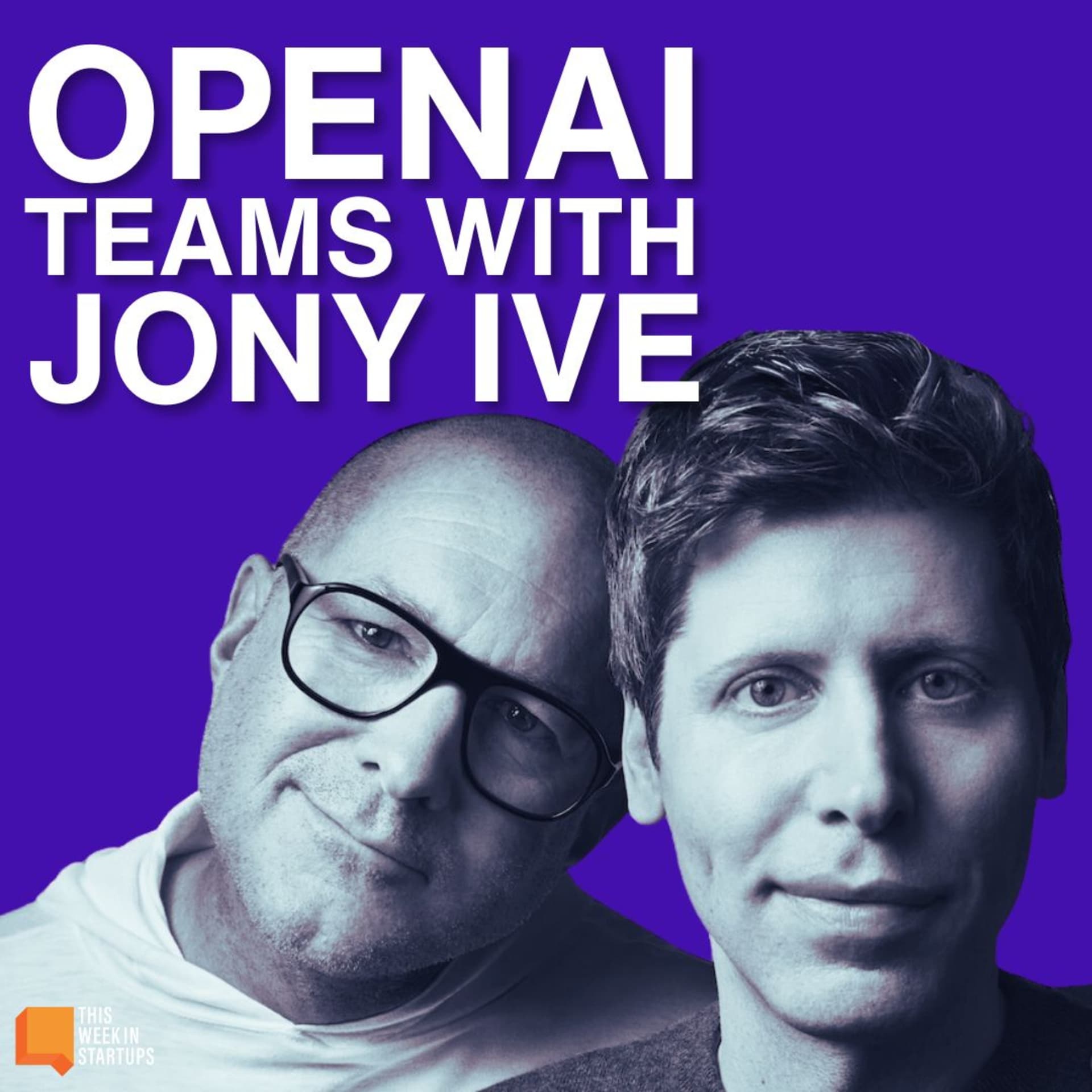
Episode Overview In this episode of This Week in Startups, Jason Calacanis and Alex Wilhelm delve into various pivotal topics in the tech and startup landscape, including Jony Ive's major deal with OpenAI, the current state of robotaxi services, implications for AI regulation, and insights on launching a marketplace from scratch.
Key Topics Discussed
- Jony Ive Joins OpenAI
- Deal Overview: Jony Ive's design firm, *Love From*, is acquired by OpenAI in a $6.5 billion all-stock deal.
- Significance: Potential for innovative AI hardware designs, especially given the current gaps in Apple's integration of AI into hardware.
- Implications: The deal raises questions about the future of design in AI technologies and whether Ive's involvement will enhance OpenAI’s offerings.
- Waymo Hits 10 Million Rides
- Milestone: Waymo has achieved 10 million paid rides, with half of those occurring in the last five months.
- Commercial Viability: The rapid growth suggests that autonomous vehicle technology is maturing.
- Comparison with Tesla: Discussion on differences between Waymo's LiDAR-based approach and Tesla's AI-driven model.
- Marketplace Launch Strategies
- Challenges: Common issues include the "chicken and egg" problem of balancing supply and demand.
- Practical Tactics:
- Example from DoorDash: Initially creating fake websites and fulfilling orders personally to establish a marketplace.
- Creative Marketing: Using targeted flyers, local ads, and leveraging personal networks to build initial customer bases.
- The GENIUS Act and Stablecoin Regulation
- Overview: The Senate advanced a new bill aimed at regulating stablecoins.
- Market Context: Discussion on the current state of stablecoins, their growth post-2022, and the potential impact of new regulations.
- Concerns: Emphasis on the need for regulatory clarity and the implications of allowing offshored entities to operate without strict oversight.
- Ethical Considerations in AI Technologies
- Privacy Concerns: Debate on the ethics of AI-powered devices, particularly smart glasses with recording capabilities.
- Need for Regulation: Advocated for clear legislation to govern the use of recording devices in public spaces.
- Partnerships and Collaborations in Startups
- Brex and Zip Partnership: Brex teams up with Zip for corporate procurement orchestration, emphasizing collaboration over competition in startup ecosystems.
- Potential for Acquisitions: The discussion touches on how collaborations may pave the way for future acquisitions.
Key Takeaways
- Design and AI Integration: Jony Ive's acquisition by OpenAI could signify a new era in AI hardware design.
- Ride-Sharing Evolution: The growth of Waymo’s ride service indicates the potential for autonomous vehicles to coexist with human drivers in the near future.
- Market Entry: Founders are encouraged to use creative, low-cost strategies to build initial traction for their marketplaces.
- Regulatory Landscape: The evolving regulations surrounding stablecoins highlight the need for transparency and accountability in the crypto space.
Additional Insights
- Jason Calacanis' Reflections: He emphasizes the importance of systems thinking in startups, inspired by Scott Adams, and the impact of individual experiences on broader business philosophies.
- Marketplace Dynamics: Founders should be prepared to adapt their strategies based on customer feedback and market conditions.
Closing Remarks The episode wraps up with a nod to the evolving nature of the tech industry, the necessity for ethical considerations in AI development, and the ongoing dialogue about the future of startups amidst changing regulations and competitive landscapes.
---
For more insights, subscribe to the This Week in Startups newsletter and follow the hosts on their respective social media platforms for real-time updates and discussions.
Written by AI. May contain mistakes. Listen to the episode to check what was said.
Transcript
Automatic transcript. May contain errors.0:00So instead of like the pie being static and being the ratios of who owns what being changed, the pie is going to get larger and there'll be a healthy mix of both human and autonomous. drivers, that extends the longevity of human drivers for another five years. But I still see this going to an eventual point in which we're not driving, but it sounds like that'll take, ah, I just want to go faster, Jason. You're probably right. I mean, listen, there's a group of people who will never drive in an autonomous car. It might be a third of people ultimately just do not want to be in an autonomous car.
0:30I think it's that high? Yeah, sure. I mean, how many people do you know who will like refuse to get a smartphone for 20 years. How many people do you know who refuse to do email or get an Instagram account? I mean, it took, those things took 10, 20 years to boil the laggards and finally push them into it. This Week in Startups is brought to you by Vanta. Compliance and security shouldn't be a deal breaker for startups to win new business. Vanta makes it easy for companies to get a SOC 2 report fast. Twist listeners can get$1 ,000 off for a limited time at vanta.com slash twist. squarespace turn your idea into a new website go to squarespace.com slash twist for a free trial when you're ready to launch use offer code twist to save 10 off your first purchase of a website or domain and brex the financial stack founders can bank on unlike traditional business banking solutions brex has no minimums and no transaction fees and you get 20 times the standard fdic protection get the business account trusted by one in three startups at brex.com slash banking dash solutions.
1:31All right, everybody, welcome back to This Week in Startups. I'm your host, Jason Calacanis, with me, Alex Wilhelm, and we do this three days a week, Monday, Wednesday, Friday, 12 o 'clock Texas time. I'm out here in the Hill Country at Austin Tech. Big docket. There's a lot going on, so we'll do a little big tech, a little medium tech, and some tiny tech as well. Breaking news as we're sitting here. Oh, and before we start, I just wanted to broadcast broadcaster everybody knows in the tech community and may or may not agree with his positions on certain topics uh scott adams he is a vocal trump supporter and podcaster he does a daily show and as a broadcaster just unbelievably consistent an iron man 365 days a year christmas thanksgiving you just i'm in awe of the effort he puts it now i was on his show we had a little debate before the election.
2:26And he is super brilliant when it comes to specific topics. He's got great insights. And tragically, he has the same cancer that Joe Biden has, and it's terminal. Prostate, bone cancer, or prostate cancer spread to the bones. And yeah, my dad has prostate cancer. He survived for many years, and he's still alive and thriving. Hugh Scott Adams, broadcaster to broadcaster, and as a guest on your show and friends online who trade DMs once in a while, you did a great job. And what an epic life, creating Dilbert and your podcast, and you inspired a lot of people with your books. And I always tell people inside my company or at startups, hey, systems over goals.
3:10And I was always a systems guy from the early days, doing Lotus Notes, Alex, and trying to make processes. But I never added that part, like, people have goals, but they don't create systems. And I heard him say that over and over again. And I was like, oh yeah, I'm a systems guy, but I never told people why the system is important. And systems are important because if you create a good system, the goals take care of themselves. And he has really helped a lot of folks without knowing it, the people who are founders or who work for me, people I touch, I always tell them, hey, listen, create a system for that.
3:39I understand your goal. Goal's pretty clear. You want to reach a million customers. What's the system by which you'll collect those customers and get them to not turn? Have you created any systems around them? They say, I don't know what you're talking about. And I explained it to them. Yeah, he says he's going to die this summer. And it just got me thinking, my gosh, we do all this broadcasting. We touch a lot of people. And I just wanted to let him know he touched me. Yeah. And have a great final lap. And what a great life lived. Dilbert touched so many people. You got a little bumpy there along the way.
4:12He got canceled. There was a lot of brouhaha. He had spicy opinions, but none of that matters at the end of the day. I think the totality of the person matters and their intent matters. And I always thought his intent was to help people. He kind of raised me in a way because I read so much Dilbert growing up. I had like a stack of like the compendiums. Yeah, sure. And I learned words like paradigm from him because I thought it was pronounced paradigm because I'd never said it out loud. So I used that word out in the public once and got got wrecked um but i used to be like the world's biggest dilbert fan and then i kind of grew out of my comic books phase but like i read thousands of his of his strips and even though i don't agree with him at all politically anymore there's an impactful person who touched the law of the world with this art uh we don't have to only judge someone in the last act of their life and what who cares about political differences at the end of the day right like it's uh it's a team sport everybody it's like a blood sport uh so yeah anyway broadcaster broadcaster what a career What a career.
5:11All right. What's in the news? I know there's a breaking news story. I don't know if you want to start. Yeah, let's just get that out of the way. So as we were sitting down and literally hitting go, everybody, we saw a headline from Bloomberg, which is that OpenAI is going to buy Johnny Ives' company, Love From, for$6.5 billion. This is an all-stock transaction. And if you don't know Johnny Ives, he's the guy behind a lot of the kind of iconic, maybe even seminal Apple products, Jason, known for his design sense, misunderstanding of aesthetics and usability. And the thought here, as far as I can tell from the last couple of minutes, is that he was working on some hardware for the AI game.
5:46And what does OpenAI do? Well, some of the biggest, the most popular models out there. So put the two together and you could see a very interesting hardware device from OpenAI. Just given how far Apple has dropped the ball on hardware AI integration compared to just, for example, this week, Google and Android, this is actually very exciting to me. My first thought was, yuck, what a waste of money do you really need this it's a lot but then if they nail it what's the value of the iphone today for apple it's it's like what oh i mean it is it is the company yeah so i mean i'd say it's 80 of the value of the of apple is the iphone right it's got to be 90 of the profits or something along those lines you know taking out like maybe the google deal yeah love now or love from is it love from love from love from yes yeah uh and uh you know that was his design studio so he was doing jobs for other people no pun intended so he was kind of acting like for any startup that wanted to do something and i think everybody realizes there'll be a pendant a physical device that incorporates ai and maybe creates a new format most people think it's glasses i just got the um the ray-bans from facebook and i see google's coming out with their new glasses that will be augmented and i'm just gonna play with them over the summer on vacation take some videos, et cetera, with the kids.
7:05Thought it would be a fun thing to experiment with. And so this is very interesting. I bet you Johnny Ive is going to make more from this than he is from his tenure at Apple. It's 2 % of the company he's basically getting. And you have to ask yourself, as a founder, will Johnny Ive's designs make OpenAI 2 % more successful? That's the bet you're making when you give him$6 billion. And I'm certain it's has$6 billion in cash. I'm sure it's five - It's all stock, according to Bloomberg. Yeah, I was about to say. I mean, I could see like$100 million or$250 million in cash or something if they got cash laying around.
7:41But I think he believes, probably correctly, that it could be a trillion-dollar company. So if he gets$6 billion now and it triples, this could be an$18 billion opportunity. And$18 billion is a lot of money. So congratulations is Johnny Ive and his team over there. And I think this was a more of a collaborative organization. I don't know how many employees there are on LinkedIn for love from as a company, or if they're even allowed to put themselves on LinkedIn. Yeah, that was my thought. I don't know if that's going to be the right number. Well, I mean, the really interesting thing, I think about this is you're making some sort of a bet.
8:18And if you think in bets, as Andy Duke would say in the poker world, thinking in bets is her book. you know what are the odds that johnny ive doesn't make the company one percent more valuable i think it's zero low yeah yeah i mean he's got to make the company one percent more valuable now what are the chances he makes it ten percent more valuable that's that's probably not going to happen so the truth might lie between one and three percent four percent more valuable to have the world's greatest designer of the last 30 years or one of the top five certainly uh on your team focused only on the chat gpt app or a piece of hardware i was at dinner the other night and somebody had one of those pendants and it was on and he showed it he showed me the app and he said do you have a problem with it on i'm like at dinner i said if you weren't my friend i would punch you in the face if i found out halfway through dinner you were recording me the whole time.
9:16No, when we sat down, it was on and creating summaries. And my friend Adeo from Founders Institute, he also was wearing that life pin. Remember the life pin that would take a picture every second and then you would have life casting. Just a piece of advice, man. Do not wear this stuff around your friends if you want to have friends in the world. honestly if somebody were to record me like that now i assume as a micro celebrity which is the form of celebrity alex that exists below the lowest rated reality show that just got canceled so that's d list and then you're kind of like bringing up the pinnacle of the e-list okay precisely precisely i am the tip of the spear of the e-list uh and the d list would be like yeah bravo or e-network just real housewives of x yeah well no that would be a successful one i'm talking about one that got canceled after one season uh man yeah that's where the podcasting tech celebrity exists all right founders i know you're building something amazing and you're going to change the world and now hey the big logos they're taking your calls right but here's the catch.
10:26If you're not SOC 2 or ISO 27001 compliant, these deals won't close. Now, some of you are saying, I've never heard of those terms. Some of you are saying, I've heard of them, but I don't know what they are. And that's where Vanta comes in. They're going to be your partner and they are the all-in-one compliance solution that helps startups get audit ready. And that's going to build a strong security foundation for your company, which you want, but they're going going to do it quickly and painlessly. Vanta automates the manual security tasks that slow you down and that streamlines your audit. So here's your call to action.
11:01Whether you're closing your first deal or you're gearing up for growth, Vanta is going to make compliance easy for you. Join over 8 ,000 companies, simplify your compliance and get$1 ,000 off at vanta.com slash twist. That's V-A-N-T-A dot com slash T-W-I-S-T. Yeah, don't wear these things, folks. It's absurd. You know, even in a Zoom call, you know, I now have to think that every Zoom call I have is being recorded. So now, you know, sometimes I'm out here on the ranch and I just did something, you know, I mowed the grass or, you know, I went to feed the chickens and I'm disheveled or I did a workout in the barn.
11:40I assume I'm being recorded. So then in terms of zooms now sometimes i'll just say yeah i'm not going to be on camera today because it's enough with the on-camera stuff and then i'm like maybe somebody's recording this and like i look disheveled i don't need a recording of me on a board call or whatever and then i see people recording their board calls by the way board calls are not intended to be summarized by ai or recorded talk to your counsel but you're supposed to just take very top level notes so you don't open yourself up to discovery in a lawsuit where you know when you have an opposing attorney with an axe to grind and they had a transcript, they could just twist somebody's words around, as you've seen when people are on the stand who have had a phone call recorded or something.
12:18So anyway, the Oizon recording stuff and those designs are really pernicious. And I think we are going to have laws around them, which will be similar to guns. So in Texas, people can request that you don't have a gun on their property and you can put up a specific type of sign that they're not allowed to. And I think it can be like you get a penalty if you went on somebody's property who has that specific type of sign that they don't want you on private property. Good. Point is, we need that analogy for recording devices. There needs to be a standard. It should be a federal standard of recording devices in public spaces.
12:52And although the assumption is you're being recorded, there needs to be a penalty for this. There needs to be new legislation. It needs to be reasonable. But it should be a bright, blinking red light if you've taken a photo in the last 30 seconds and before you take a photo. So if photo, 15 second warning of a blinking red light before the photo is taken, 15 seconds after. If in public, maybe that's reasonable. I don't know. Or maybe it blinks three times or something. So this is what it looks like on the meta ray bonds, Jason. I'm just going to show everyone this so they can get kind of a feel for it.
13:32But I really want to talk about the title of this video, which is, can you hide the blinking light on the Ray-Ban meta glasses? And I believe the answer to this is yes. So let's hope that we don't have to get to the point of legislation for this and we can sort it out. Even in that picture, that white light, see, they made it white, which is like, yeah, Zuckerberg once again. And when you look at some of these pictures, it really doesn't feel like a very strong light that's being lit. In my personal estimation, it should be red and it should stay on when you're recording. Here's another example.
14:07This one from our dear friend Lon, who is slightly under the weather today. We love you, Lon. Feel better soon. This is a little better to me, Jason. I think this is the snap spectacles. Yeah, but this is the yellow rim and I can see that a little bit more in your face. There's a reason. They're trying to get people away from the universal red that means recording. There's a reason it's blaring red because people don't want to be recorded. So I think there's going to have to be legislation because the first two people up the hill are not doing a good enough job. Bringing this back to Johnny Ive, though, and OpenAI, it's actually really fun.
14:41I was reading Hacker News, as I always do, and there was an interesting discussion about OpenAI's new Codex coding agent. And I was reading the reviews and the conversation about it because I thought we might talk about it on the show at some point in time. Love to get the developer perspective, people who are actually testing this stuff, who know what they're doing. And what really kind of struck me was the UX was criticized. And so I wonder if a little bit of Johnny Ive magic across the OpenAI organization might help them file off some of those kind of rough edges and just help make all their products work a little bit better.
15:11Because the Johnny Ive era of Apple is famous for a reason. Like it's an earned reputation from a lot of really just great work. The way they do what they do, the secret was they would make many design ideas in a studio, and then Steve Jobs would come and have a discussion with him and go have lunch with him or whatever. So they'd be like, here's a table filled with pendants, and the pendant team is working on this. Apple never released a pendant. Here's the team working on televisions. They famously were going to release a television. I had heard that that was like a fait accompli that they were going to release, and then they never did.
15:44For whatever reason, they just released the box for Apple TV. Long story short, 99 % of what Johnny Ive did there with this incredible design team never saw the light of day. It was all an exercise, and then they would just skim the cream. Most startups, you know, design's an afterthought. They make a bunch of stuff, and then they produce it. So you really basically have to produce 10 times what you need, and then skim the cream of the best. That's my best advice for design. Let's keep going through the docket here. I want to talk about Brex and Zit. So Brex, Jason, I think we all probably know is a corporate spin startup famous for their corporate cards that were startup friendly back in the day.
16:21They bought out all the bus stops in San Francisco, big buzz, low budget, now quite a large company. There's another firm called Zip and I was less familiar with Zip. Turns out it's actually worth about$2 billion. And what they do is corporate procurement orchestration, which is very fancy words for helping companies buy stuff and pay for it without losing track of POs, making sure it's going into the right budget. if you're a large company that buys a lot of stuff, it's actually a pretty big deal. So the news item here is that Brex has teamed up with Zip instead of competing with them directly.
16:51And they do have some shared customers, so there's some overlap. But it does feel kind of interesting to see Brex, a company that I think is worth more than$10 billion, partnered with Navon, previously Trip Actions, which is kind of like corporate travel management, if you will. And now with Zip, who also kind of overlaps a little bit with them. I'm still very bullish on Brex and its competitor, Ramp, but I'm kind of... This almost feels like politeness and kindness inside the startup world versus combatedness. I just kind of wanted to get your take on why Brex is making this choice. Yeah, some people understand they have a lane and they want to stay in that lane and be the best at that and then let other people plug in as a platform.
17:27So the example of that might be in today's market, DoorDash doesn't do CloudKitchens. CloudKitchens, Travis's new company, provides CloudKitchens. those people who uh rent space in a cloud kitchen then they go put their food on doordash direct websites increasingly and uh on uber eats postmates whatever and so in each of those cases cloud kitchen saying you know what there's enough work to do here we don't need to compete with doordash and uber eats uber eats and doordash are like we don't want to be in that business that's going to be a lot of work to stand up all these things and travis is going to do a better job so you know if you stay in your lane you can create a lot of partnerships and get to market quicker the the best example today would be that one or what's happening in self-driving cars with uber tesla volkswagen etc so way most like we make this stuff we have an app but suddenly they were like well we have an app but uber's got you know 20 000 cities and 150 million or 250 million customers whatever it is and 30 million of them are uber one we don't need to recreate the wheel here.
18:33Let's have them. Let's go into their distribution system, their network. And then Uber sold famously. Big question if they should have. Still, jury's out. They sold their autonomous because they said, hey, there's going to be 15 providers of autonomous. It's going to be a commoditized service. It turns out it is going to be a commoditized service. Now, there is a chance, never bet against Elon, that he will create this robo-taxi, the specific two-door one, and be able to produce 10 million of those a year, and he will take the number one position. That's possible. Some people might say probable.
19:04There's a big bet going on. Will Uber having Volkswagen, the number two car maker, Waymo, the number one leader in this, Waymo providing to Toyota, Toyota providing here, will that whole consortium where everybody does their best work beat somebody who's a verticalized player? Time will tell. I think in this case, it will not be winner take all. It will be three winners take most. and those three winners will be Waymo, Tesla, and Uber. That's my belief. And then I think there'll be mergers and acquisitions in it. So that's probably what's happening here is Brex is like, you know what? We have enough work to do here that we don't want to do the corporate backend.
19:39Let them do the corporate backend. They don't want to do corporate cards. Then they could go to everybody and say, hey, we're not in your business, but we are in this business. Do you want to partner with us? When people are in your software, they can click this button to create an account with us. You'll get credit for that. When they're in our software, they can click over to you. We'll get credit for that. And they will probably monitor account creation and then say, together, we can beat other people who are trying to full stack it. That's the concept. All right, founders, let's talk about your website, huh?
20:11It might be a little bit of a sensitive subject. You might be a little embarrassed about it. Let's fix that right now. If you're launching something new, give your brand the refresh it deserves. You're working so hard on your company and your website looks terrible. Do what I do. Use Squarespace. It's the all-in-one platform to make a stunning professional website. And it's ridiculously easy to use. It's going to work for everything. If you're selling products, it's got all that e-commerce built in. If you're selling services, it works perfectly. And they have a new AI product called Blueprint.
20:43Want more control? Well, of course, you can choose one of the award-winning templates and use the intuitive drag-and-drop tools to make it your own. Easy peasy. Squarespace equals the most functional and beautiful website on planet Earth. Go ahead, squarespace.com slash twist to get a free trial. And when you're ready to launch, go to squarespace.com slash twist to get 10 % off your first website or domain purchase. That's squarespace.com slash twist. The cross-selling element of this makes perfect sense to me. Yeah. My question is kind of what comes next. So Brex was last raised at valued at$7.4 billion.
21:16Sorry, everybody not over 10. And then Zip was valued at$2.4 billion post. If this partnership goes well, Jason, is there a heightened chance that they decide to link up kind of like Coda and Grammarly did? Is this a first step in that process or just a potential? Yeah, I don't know if Coda and Grammarly had a partnership previously, but if they did, yeah, that could be what we call a partnership to purchase. So with Weblogs Inc., I started a partnership discussion with AOL and Jim Bankoff, who was like EVP of whatever at AOL at the time. and they wanted blog software. Maybe they wanted Engadget's inventory.
21:52They were going to make a small investment. And then after like, but six weeks of discussing this, Ted Leonsis called me on the phone and said, my Greek brother, I'm going to make you very rich and your family's going to be taken care of forever. We're buying your whole company. It's going to be great for you. And I said, thank you, Mr. Leonsis. And that was that. So yes, and that's why being a good partner and being professional in partnership is a better way to pursue M &A than, you know, asking to be bought. So if you solve a major problem for a major player, then they will, in the partnership, say, wow, what a great management team.
22:29Oh, great engineering team. Ooh, product design's great. We don't have that. Which, by the way, OpenAI was, with Johnny Ive, our previous story, working with him. And then bought the company. And then bought the company. So there it is. That was a, you know, consulting deal that resulted in a purchase, right? So that was partnership to purchase. In the previous story, this is an awful lot of announced M &A. Two companies bought by DoorDash, two companies bought by OpenAI, right? They bought where they're in the process of buying. We told them not to buy it. The company doing a programming, a Copala.
23:04Winsurf. Winsurf. Yeah, something's happening here. I think since Trump gave up on his, or folded, or slowed his role. Yeah, that's why I'll say it so I don't trigger any of the TDS people in the audience, the Trump dedication syndrome sufferers. We have both in this audience. Trump derangement and Trump dedication syndrome. We're in the middle here. He stopped barrel rolling the plane known as America, the American economy, and all of a sudden, M &A's back. So this is great. I think this is why we're starting to see the stock market come back. I think this will be amazing for venture firms who two out of three went out of business.
23:41And this is why I haven't given up on venture. I'm like, I think that this is where venture capitalists are made. When you're forced to survive four years, four years of no M &A, that's going to make you, if you get to the other side of it, that's like going to the new world, Alex. Everybody went on these ships. People didn't bring enough lemons. They didn't have the resiliency. They went crazy, jumped off the ship, got eaten by sharks, scurvy, cannibalism, whatever. and we'll see who's left after this boom-bust cycle. It's kind of like a pond where the fish get too big, they eat all the small fish, then there's not enough fish to eat, the algae goes away.
24:20You have these boom-bust cycles in nature. That's just what happened in venture and startup land. The startups don't have to worry about it because they can always raise money, but venture has been... This is the ice age. That's probably the best analogy. Who survives the ice age right now, right? And I can tell you, I'm sitting here with a lot of saber-toothed tigers coming at me and woolly mammoth pelts around our team trying to stay warm while we wait for DPI to arrive. And sure enough, the secondary markets have started to wake up. Hey, are you interested in buying more of this company? Are you interested in selling some of this company?
24:59And the prices are anywhere from a flat to 90 % discount of the peak, but transactions are occurring. So green shoots, folks. Just to understand, Jason, 90 % lower than the peak or 90 % of the peak? 90 % lower than the peak. So if somebody had, let's say, a$2 billion valuation, they might be a$200,$300,$400, $500 million offer for the common shares of those companies. Why? The employees selling common are behind the preference stack. So the preference stack might be what the company sells for if they raise too much money. That whole conversation of, did you raise too much money? And is that, are you ever going to get past the preference stack?
25:37on what happens to comment. That's literally what's happening now, quite literally. Okay, let's keep moving. Let's talk about Waymo reaching 10 million paid rights. I think this is very important. Waymo is a company that sits kind of in between the public and private markets, but certainly is one of the leading kind of American AI companies. And Jason, the latest news from them is that they have reached 10 million rides. And the reason why I think that matters is not just the big round number that we all love, but because they did half of that in the last five months, which implies about a million rides a month that are paid, which to me is like real commercial viability because I have not heard a resurgence in Waymo runs over your dog or whatever.
26:15So it seems to me that as this ramps up, the technology really must be maturing to the point in which they can take on this much volume, which frankly, I think bodes well for Elon and company because if the tech has gotten this far, maybe it's the right time to do something bigger. The real question is, how different are these two technologies and how big of a part is LiDAR in Waymo's success and how big a part of Tesla's success is their generalized driving technology? Waymo started with constrained areas and really trying to solve a constrained area problem where they were, let's just say, bespoke solutions, right, in a lot of cases for how to deal with this traffic circle.
Read the full transcript
26:54Now, large language models and reinforcement learning and just generalized AI is the route Elon has gone without liner. And so that's the big question. That's a lot of hand wringing. And Elon restated yesterday, hey, we're going to have these Austin testing units out at the end of the month. Wisely, it seems there will be safety remote drivers. So that's unclear if those people will be one-to-one. In other words, there'll be somebody sitting there with a joystick, like literally with a Nintendo joystick or a steering wheel at Tesla HQ one-to-one, just so there's not somebody in the car. So you get the feeling of a Waymo, but there's literally somebody in an office somewhere driving it.
27:39Now, Waymo says, we don't do that. We will, when there's a problem, tell the AI how to solve the problem. So if the AI was stuck because it's behind an ambulance, they say, okay, is there ability to make a U-turn here? Is there an extra lane to go around it? is there, you know, whatever. And sometimes they will draw, from what I understand, a line of which way it should go. Oh, that's cool. In this case, I think Tesla's going with the, because they're all 5G cars, LTE, a driver, but the latency's there. So, you know, this is going to be a very consequential month. I would say July will be the consequential month.
28:18It's only opening up 10 cars to 20 cars with, you know, closed beta. this is also a very smart decision if i was advising elon and i am not or tesla writ large which i am not i would have put the safety driver in for the first year just so regularly for the whole year i would just said listen you're going to get in the car there's going to be a person there you're going to watch them use the software they're not going to touch the wheel but if something does happen where you know a little kitty you know or a you know a baseball and a football soccer ball goes running into the street we're going to take over just out of an abundance of caution and you get to talk to the person and they'll explain to you the virtues of the model y of which i just ordered my second model y which will be oh you're going to get the uh the updated juniper update yeah the new one with a light beam on the back so uh yeah congratulations to waymo this is going to have zero impact on the drivers uh now why would i say that right because you already have, like a certain number of rides in San Francisco are being done by Waymo.
29:25I have a new theory based on data. I think what we're going to see is the same number or a growing driver base of humans for years while the autonomous ones get put into the market. And we're going to see the humans do the routes that the autonomous ones can't. So Ubers and lifts will be coming to the suburbs more doing, you know, so it'll expand the area of ride sharing. What's that going to do? People in the suburbs who couldn't wait 15 minutes for a ride, get it down to five, they're going to start using it and they're going to start using it for commutes. As a founder, you can't be putting business expenses on your personal card.
30:10Oh my God, that's a disaster. You should be taking those as business expenses and paying for them with pre-taxed dollars. Brex has built the killer banking experience, which will take your dollars further. They're going to protect your cash while extending your startup's runway. It's not just the Brex card, although people are over the moon. I'm literally looking at my new Brex card right now. Amazing. All the other great banking things you need, a checking account, treasury, and of course, FDIC insurance. Nearly 40 % of startups fail because they run out of cash. 100 % of startups cannot afford to make financial mistakes.
30:44It's hard enough to get product market fit. So get a great banking partner like Brex. That's the one I use. 20 times the standard FDIC protection through program banks. Industry leading yield on your cash. Yeah. Earn a little cheddar, what your beak. And the ability for you to send money worldwide at lightning speed. Brex is used by one in every three U.S. startups. So get the financial stack that founders trust, including me, your boy, jcal at brex.com slash banking dash solutions and that's going to be super powerful at the last uber demo day they did a week or two ago they have a new system where you can say this is my commute this is the time i leave and then it sends you active alerts hey um if you're gonna if you normally leave between 7 30 and 7 45 here's the cost the cost is going up the cost is going down and this is when you should leave so they created this like very elegant product for daily commuters which means Uber believes daily commutes are coming.
31:41The second thing is many parents are sending their kids to school in Waymos now. I think what we're going to see is autonomy takes over the city centers, 50, 60, 70 % of that in the next couple of years, moving the other drivers out. The other drivers move out and get more rides that move faster. That'll net-net make them as much money because there'll be longer rides. So instead of like the pie being static and being the ratios of who owns what being changed, the pie is going to get larger and there'll be a healthy mix of both human and autonomous drivers. That extends the longevity of human drivers for another five years.
32:15But I still see this going to an eventual point in which we're not driving, but it sounds like that'll take, ah, I just want to go faster, Jason. You're probably right. I mean, listen, there's a group of people who will never drive in an autonomous car. It might be a third of people ultimately just do not want to be in an autonomous car. I think it's that high. Yeah, sure. I mean, how many people do you know who will like Like, refuse to get a smartphone for 20 years. How many people do you know who refuse to do email or get an Instagram account? I mean, it took... Yeah. Those things took 10, 20 years to boil the laggards and finally push them into it.
32:49Like, if you're a laggard, the only reason you got a smartphone was because there were some things you could not do. Like, you couldn't get an Uber on a flip phone. So, there was this, like, there were use cases that forced people into it. So, eventually, there will be a use case that forces people into it. All right, let's keep going. So in the same way that we like to see Waymo and Tesla competing to grow the market, improve the products, I'm also very excited to see that Microsoft has added XAI's Grok models to their Azure AI foundry business, which is essentially the place where you can run models on top of Azure's compute systems.
33:21The reason why this is important to me, Jason, is because I feel like OpenAI, DeepSea, and Anthropic to a small degree in Google, which we'll get to, just control too much of the market. I want to see more players, more competition, more steel on steel. And so to see Microsoft say, we are going to host every major commercial model, period, to me, just speaks well for at once having lots of competitors and also to people having the option to pick and choose and tinker. You're not locked in to just one thing. This is also has to speak to the chat GPT open AI relationship. You know, if you're running Azure, you need to support everything, obviously.
33:57And if you're Satya Nadella, you probably want to have a strong relationship with Elon in the chance that his model becomes better than chat GPT's, which is a significant chance. I mean, betting against Elon has been a fool's errand for a long time. So he's definitely going to be number one, two or three. And, you know, that could flip. So keep your relationships open. why would you limit yourself to having a relationship with just the top, you know, model right now? It's just topsy-turvy to me. Like I remember so vividly the era of Microsoft that was like anti-open source, didn't want to work with other people, wanted to crush all markets.
34:36And now Satya is like, we want everybody to come party with us. Come on in. Okay, let's keep moving. So the Senate just advanced the stable coin build, the Genius Act. Now this is not passed yet. We'll get to that in a second. But the context for everyone here is just this. If you take a look look at the chart that I have on the screen, this is from our friends over at DeFi Llama, it shows the current aggregate market cap or just value of all the stable coins out there in the world today. And it peaked in early 2022 and then entered a kind of a long trough, Jason. And that was a bit dispiriting for folks like myself who thought the stable coins were awesome and we're going to have a big future.
35:10Things have dramatically changed since kind of early 2024. And now there's about$250 billion worth of stables out there. Really great growth over the last year and a half. Very positive. And I think that's really pushing Congress to get its act together. Now, on the compromise point, there was dissension in the ranks for both Democrats and Republicans. The GOP lost a couple of votes. Democrats lost more, mostly over concerns about the Trump family and their crypto efforts. But what matters is that, and we can always debate about the fine points here, but the big picture is we're going to probably get a strong industry friendly set of regulations for having stable coins here in the US.
35:51And that means that I think every single technology company is going to be able to spin up their own stable and there'll be some sort of liquidity between them all. And so they'll be fungible, but it's going to be kind of interesting to see every company managing. So people didn't want to do it because they were concerned about the Trump meme coin or Trump's family's connections to stable coins. That was the reason or was it because they didn't have other nuances in this legislation around tether and offshore and know your customer what was the actual reason people dissented do we know i think it's it's not just one answer i think some people are anti-crypto and i would loosely put elizabeth warren senator uh in that group some people felt that the world liberty financial stablecoin deal to fund Binance from, was it the UAE?
36:39It was indicative of that stablecoins need to have more structure and stability around how they're regulated and that sort of transaction shouldn't be allowed. But I think also just some bad blood there between Democrats and the Trump family. The key thing here is that American companies based in America that have a big four accounting firm auditing them as opposed to Tether, which has had attestations. And I guess Howard Lutnick's previous firm, Cantor Fitzgerald, is trying to work with them to clean things up, interpreting maybe their involvement in it. And I think a lot of this has to do with Lutnick and Tether.
37:19That's not being spoken about here. But in my estimation, Howard Lutnick stands to have massive gains at his firm. Now, I don't know if he's sheltered from them because he's part of the administration or cabinet, I guess. So I don't know the exact details there, but I do think there's probably Democrats as well looking at the Tether issue. And they had that congressional hearing, I believe, where Tether was sort of taken to task because of the attestations, the history of the firm, and then how people are using the stablecoins. If stablecoins are going to exist, I think we should not allow offshore companies to operate without an onshore entity, without a board, without insurance, without regulation.
38:03it should be an on-shoring American only. So this Genius Act, which I don't know, and I have some questions about that, maybe we can answer in the next episode or the audience can help us out with. I really want to understand offshore companies. I really want to understand, you know, your customer and how people use these. Of course, the tethers of the world will claim, well, we can track how people use them. But, you know, typically when people burn their tethers and they've traded them 10 times, yes, there's a trail, but whoever was at the start of that trail is long gone and absconded and done human trafficking, terrorism, et cetera.
38:39There needs to be very tight regulations on who's trading stable coins, how they're trading them, know your customer. And that's really the offshoring I want to understand. That's the details that needs to be in this genius act that I don't think are. There's a little bit of a weirdness that we should talk about because when we think about the Genius Act, which by the way, if you don't know, stands for the Guiding and Establishing National Innovation for U.S. Stablecoins Act, which is the most hilarious backronome ever. There's kind of two tiers of regulation, Jason. There's stablecoins that have more than 10 billion AUMs, so 10 million, like$1 units on the market.
39:15And if you're over that level, you're privy to the federal regulations. If you're under that state level, or you can choose that. My concern is that some states may have overly loose standards to attract smaller stable coins and that we could then run into some of the KYC, offshore, just the stuff that we don't want to see pollute the USD ecosystem because most stables are USD backed and so forth. So I almost wonder a little bit about the distinction between big stables and little stables and the different regulatory regimes they go under. I'm also sympathetic to it because less regulation for smaller products makes sense.
39:52But when it comes to finance, it gets sticky. So I'm with you on this. I have been pushing for regulation over and over again for years that there should be a safe harbor for small projects and then increasing regulation as they get bigger. And who's permitted to do this? And the audits and transparency are the details we're going to need. And I think there's some certification and people putting their names on things and outside auditors putting their names on things that has not happened with tether you know i don't want to see like tether previous was like here's an attestation from i don't know if it was like the bvi or something like that virgin islands it was like hey guys if this isn't done in new york by ernston young or kpmg i'm not interested like and it this whole attestation thing as explained to me was like by accountants and people online was like it's like here we took a picture of a bank statement essentially we we know there was money in account, but we don't know all the underlying transactions and how you got there.
40:52These things need to be regulated. There needs to be feds inside your office looking at these transactions all the time in detail. Yes. There's way too much. It's just way too dangerous to have this be the Wild West anymore. And you know what? For Tether, that's making tens of billions of dollars a year on the float, that business is going to collapse because there's also regulation. This is a little bit detailed. They want you to be able to buy stablecoins and then share the interest with you on them. So an interest-bearing stablecoin account is the next piece of dialogue you'll start hearing, because I was talking to some people off the record, and they're like short tether.
41:36They're not literally short tether, but they're short theoretically tether, because instead of, you know, tether's making 5%, 6%, 7%, whatever it is, off these treasuries and other devices they have with people's deposits. What happens when you say, I'll give you 5%, I'll keep one point. You get five points, I get one point. Well, why would you ever use Tether? Yeah. So you'll have 85 % contraction in the revenue generated here, which is what should happen. What idiots? The only people who would leave a billion dollars in a stable coin are probably people and let Tether take 5 % and make 50 million on that are probably people who have some shaky relationship in their transactions.
42:16That's my interpretation and I'm no expert, but this industry needs to get cleaned up. Uh, and of course, when you hear people, and I'll end on this, Alex, whenever you hear people saying, well, criminals do this and this, I mean, you can bring a suitcase with a hundred dollar bills. Whenever you hear people talking about like how criminals do stuff and that's a justification for them being marginally better than them, those people are typically criminals. Oh, yes. Yes. It's my experience. I'm not saying tell there's criminals. I'm just saying in my experience, the people who are like, you know, there's criminals who have done far worse.
42:49I'm like, probably should get a magnifying glass on whoever said that. Jason, we need to talk about Polymark.
43:02we have a partnership bet that i want to talk about and a partnership too so why don't you walk us into this and then i'm going to pull up some really cool i love polymarket i i can't stop thinking in bets shane from polymark is a friend of mine we decided to do an exciting partnership here which is i'm constantly talking about the odds of something happening as a poker player that's how i see the world right and we just had a conversation about this earlier in the show So what I asked the team here to do is to integrate a market into the show. Now, I don't know which ones. I asked the team to go there and surprise me with a couple of markets.
43:37So hit me. Hit me with a market here from Polymarket. This is what I was absolutely fixated by. This is the market for which company has the best AI model on June 30th, the midpoint of this year. And if you're watching the video version, as you can see, the people that have taken the lead recently are Google. But if you go back in time, just a little bit, you're seeing earlier this year, open AI far ahead. Now Google has absolutely soared. And I think this is partially because the Gemini model family has improved quickly. I think Google has really managed to build out a series of technology products in the AI realm that people are impressed with.
44:12And they just had their Google IO event this week and they started talking about their new, oh man, what the hell is it? Google Gemini Pro Ultra Max, whatever. that's supposed to be quite impressive. But the market here has essentially given OpenAI and XAI the same chance, Jason, of having the best model on June 30th, which is low. And Anthropic is basically a zero. So Google, yeah. Here's a great idea. Go take a look at the rules. This market will resolve to yes, if any model owned by Google has the highest arena score based off the chatbot arena LLM leaderboard. So when making these markets, they resolve.
44:47How you resolve a market is critically important. and we've been doing them on all in and we have a partnership over there as well uh so you just have to when we look at these or we're going to create some of our own so i think an interesting one would be to do on self-driving and uber pretty interesting and then if you start thinking about who has the most robo taxis on the market by the end of 2026 or 2025 if you did that waymo is going to win. So you maybe would say, who outside of Waymo will have the most number of robo-taxis or the largest number of cities, right? You can come up with something.
45:24And then you say, how many cities will Uber have robo-taxis on the ground at? And today, you have the WeRide folks, Pony AI, Waymo, and then Volkswagen's coming. And then you have to define robo-taxi with a safety driver or not. And so I would like to know just even with safety drivers, how many different cities you have. That's like a very interesting wager. It's a very interesting market, I should say. And as a market, what's interesting about that is then people could say, well, yeah, I mean, maybe Waymo is going to just go very wide, but not deep. Or maybe Uber is going to go really wide, not deep.
46:08You kind of start to have to think about things in order to to pick which outcome you think is going to happen. The reason these outcome markets are very interesting to me is if you had a large position in Uber, you could place a wager, you could pick a side that would be Uber not winning, which would then hedge you against your Uber stock. Or if you were a Tesla shareholder and you were like, okay, Tesla has a million cars on the road next year, what are the chances of that happening? If you bet against it, but you're a Tesla shareholder and they don't hit it and the share goes down or Tesla's flat, you would win this bet.
46:44Right. So you could place a wager. I don't know exactly how they phrase these, but you could pick which outcome. And when you pick which outcome, that could be a hedge against other things happening. This is what people were doing with climate and climate change. Farmers would do this. Oh, if there's going to be a frost, there's a 5 % chance of a frost. I will put some money in that 5 % chance. So if I lose, if it's a one in 20 and I have a million dollars in oranges coming and there's an orange frost, I'll put$50 ,000 on it. If my oranges freeze, I still make the same amount of money. It's$50 ,000 in insurance.
47:20It's interesting how a wager on an outcome can have the same vibes as an insurance policy and also a hedge. Because it feels like you just went through several different ways you can kind of approach this. now we did talk about how the ma the market we showed resolved i want to show everyone what we're talking about so it's using the lm arena uh leaderboard which is actually really really cool so take a look at this jason this is the new uh ui for the lm arena leaderboard but you can see why google's currently leading on the market because well they're crushing everywhere they're on top of the leaderboard for text for web dev vision search not copilot but text image etc so So very, very, very strong models from Google today.
48:03And I brought up the Ellen Marina, Jason, not just because it's cool as a data source, but also Bloomberg reports that the company, we talked about them spinning out, making their own kind of actual company about this. Turns out they've gotten around, put together, and it's going to be$100 million. Wow. Because of course it is. And Jason Horowitz, the UC system, and then also some capital from Lightspeed, Felicis, Kleiner, and others. Valuation? Take a guess. I mean,$750 million. $600. But still, that's a lot of money. 15%, yeah. I thought, well, 20 % might be a lot. That'd be a billion dollars.
48:43$500 would be 20%. 10 % would be a billion. I just picked in between those two numbers. But remember when Instagram sold for a billion and we all kind of collectively crapped our pants? Different era, man. Different number of people online, different amount of revenue per person, different amount of e-commerce spend per person. Everything just keeps growing 30%, 10 % a year. There's big prizes here. And if you place a bet, and we don't know what the actual pitch is under this. Okay, any startup stuff? I think there was a couple of startup items here where people ask me questions or I answer them.
49:18Rapid response, maybe we end with one or two of them. And again, when we do Reddit rapid response, I don't know ahead of time the question, but I am Jason Calacanis. uh, on, so I'm you slash Jason Calacanis on Reddit, follow me, say hi, DM me, whatever. And, uh, go look for me answering questions in anti-work. I love anti-work. I love engaging with people who hate capitalism because I want to convert them in some ways, but I also want to understand their hatred of free markets, competition, and capitalism just helps me sharpen my position. Yeah. A secret vegan going to the barbecue. That's Jason in anti-work.
49:57Yes. All right. So from Lon and the r slash startups subreddit, I absolutely love that place. I read it every single day. There's a great question that I think we should talk about. So how can I build a marketplace from scratch? Jason, people talk a lot about the chicken and the egg problem, how to get early momentum going. They want to know what's the best way to launch a marketplace. I know you're supposed to have supply before launching, probably do that, but I'm not sure about how to reach the first customers apart from people they know. So for the Reddit user, Elon Jr. Musk, what you got?
50:29This person answered their own question. When DoorDash started, they picked one or two restaurants in Palo Alto. They put up phony websites. They bought some ads and sent people to this, I think, Indian restaurant, if the story is correct. Then they took their personal credit card, ordered from the Indian restaurant, picked it up with their personal credit card and then ran to the person's house and dropped it off. And the person thought, okay. They didn't even question it. They had no idea that this marketplace was glued together by literally you taking the name of a restaurant, let's call it Palo Alto Dosa, and they didn't have a website.
51:06They didn't have online ordering. You put up Palo Alto Dosa, you put the menu, you say, pick what you want. They vibe coded something, or in that case, actually coded. And then they bought ads against it and said Indian food Palo Alto delivery, and then finally got somebody to order. The order came in. They were like, what? An order came in? And then they went and just called the order in on the phone and got it to the person. So there's your example. When you get going, you could offer people some amount of a base guarantee. That's a more advanced technique when you have funding, perhaps. And you really want to be in a certain geo or a certain vertical.
51:45So let's say you wanted to do all home services, painting, you know, painting cabinets, I don't know, gardening, pool cleaning. Just start with pool cleaning. Sure. Find 10 pool cleaners. Do phone calls and interviews with them and say, I'm making a marketplace for home services. Pool cleaning is what we're going after. I just want to understand what you charge. And I was wondering if I could send you the ability to get a customer and I'll text message you, the customer, what they want. And we're trying to achieve 24 hour turnaround, if not same day. And we'll pay a premium for that. Might you be interested in being part of this?
52:24And they'll be like, yeah, sure. Here's my phone number. We're done. And so that's how these things all get together. They're done in ways that don't scale. And your friends and your sweat equity are part of that equation. Yes. If you DoorDash used the four DoorDash founders, as the first four DoorDashers. The end. Yeah. So you are the supply. Go clean the pool yourself in this analogy. Or if you're a banker, go drive Uber for a bit to get the deal. Elon Jr. Musk does talk about in his Reddit post the importance of marketing and so forth. And you did touch on the supply side, Jason, but on the demand side, when the DoorDash guys were putting together their ads to get their first couple of orders in, what do we know about that?
53:05And what do you recommend for founders today who might be cash strapped that are looking to build out that other side of the marketplace? Yeah, I mean, it's super easy. If you're in a specific geo and a specific vertical, you would be surprised how affordable Google search ads are. Yeah, you could be paying a dollar to a click. So you might only need$100 to$500 to run this test. If you can't get$100 to$500 together, you probably shouldn't be a founder. So there's pretty easy ways to do this. And of course, you could make a mailing list of everybody on your campus and test it there if you were doing the DoorDash example or delivering people or doing a laundry service.
53:48You could just find the first 50 customers amongst your friend group in a neighborhood. Or you could offer people$10 off your, let's say this is the pool cleaning service. You just go on Google Maps. You find everybody's got a pool by looking at satellite photos. You literally just see them. Yes. Correct. You then print out flyers. You then hang them on people's doors and slide them under their things. And if the person happens to open the door when you say, hi, I'm an entrepreneur. I started this company. Please don't kill me. And then you get that person 100 % as a customer. And put a laser printer from Brother for like 150 bucks and paper's free.
54:25And he's like 100 bucks for a thousand pieces of paper. You just laser print the offer and you hand sign them. say, hey, my name's Jason and Alex. We've started a new marketplace for pool cleaners. We want to save you money and we want it to be on demand and easy breezy. Just text us if you need your pool serviced anytime and we'll put you on a weekly thing and here's the price. Boom. And you can trust us because we live in the area. I would say the door hanging flyer thing, door to door thing, a lot of founders don't do. It works. Emailing people next door, if you were doing again in a geo, next door is a good place to do it because you can find all your neighbors.
55:00And so once you find all your neighbors, you can start messaging them or you can literally just fake it. So if your marketplace was a marketplace for, again, we'll go back to pool cleaning and a geo, you can very easily just go in there and say, hey, I'm looking for a pool cleaner. And then Alex says, I found this great one. And you reply to yourself, this would be in the gray hat area. You're not committing a crime, but you are doing something that some people would be like is slightly unethical. I'll say it's clever. everything you've said thus far though is just doing the work the hard way like the doordash folks delivering the food themselves yes going around the neighborhood passing out flyers i'm getting a cheap brother laser printer which you can keep until it runs out of bank and you throw it away like i mean none of this is expensive this is a thousand dollars two thousand dollars why don't you pick a category for me pick a category of marketplace think about your own life i picked like food and i picked pools but you pick one that's kind of random or out there that i wouldn't think one that's near and dear to my heart uh our on uh home visit arborists so we have people that come take care of our trees sure tree marketplace great if i went onto facebook right now and i typed in arborists or i went to the austin um subreddit and i typed in austin uh arborists and uh you know i'm going to find arborists uh threads and the first one i found in austin was arborists are going to be raking it in no pun intended from two years ago right and i guess this is when they had the big freeze here and a bunch of trees die oh okay yeah yeah yeah so uh now if i go to facebook and i type in Facebook.
56:45Let's do this right now. I'm going to do a search here. You can do it as well. Well, Jason does that. I did the same test for Providence, typed in arborist, and I immediately found best arborist in Providence, which I guarantee you get search traffic. Yes. You could just drop a comment there and get some gorilla. Facebook arborists, Brooklyn. And you're going to find arborists of Brooklyn. And so there's your supply folks. There is a Facebook, a LinkedIn, a subreddit for every group. And there's message boards and forums. So if you append to that, you know, Brooklyn Arborist message board. Back in the day, people use these different message board software, you know, before Facebook and subreddits kind of took it over and you'll find there's Brownstoner.
57:27This is something in Brooklyn. That's a message board in Brooklyn Forum Archive tree removal company, right? So because these things have ranked on Google in search or DuckDuckGo in search, that means they had some validity. So literally that's like having an intern go find those things for you you infiltrate those groups you'll be honest about it like i was looking for ranch hands and because we're going to probably get a ranch hand here eventually when we get the horses and i had no idea what they get paid and it turns out if you provide them a tiny home there's like an infinite number of people in their 20s who didn't go to college but who love horses who if you if you put them up and give them three squares a day or some food and a thing, they'll work for minimum wage to just be around horses.
58:08It's kind of crazy, right? Ranch hands are pretty affordable. People love horses. And it's a global thing. You got people in Germany, people in Australia who just want to be ranch hands. They just want to teach horseback riding and equestrian stuff. So I had no idea. I did my research just for that in 10 seconds. And I was going to create one for domestic staff, like estate managers and stuff like that. And I never got around to it, but Marketplaces are great. You can build them with three or four people. You can hack the inventory. You can hack the supply side. And then once you get going, then you can say, I know I'm going to make a lifetime value of this amount per customer.
58:45Therefore, I know how much inventory drives, how much supply. And you can do a little bit of math, right? And those math formulas are online. Pretty easy for you to figure out. Jason, do we have time for a funny joke about startups before we go? Sure. I mean, Alex, you're going to tell a joke. Okay, here we go. Maybe this is going to be a dad joke. I'm not telling a joke. Lon found the best thing I've ever seen in my life, which is this. It reads, every piece of SaaS advice ever, all at once. Roll with me here. Advice goes as follows. Validate before you build. Build before you validate. Launch fast, but make sure it's polished.
59:22Don't waste time, but also don't rush. Talk to users, but then don't build what they say. ship fast, but don't break trust. Cool. So I'll just build, unbuild, relaunch, and question my life choices in a nice little loop. Feels like the advice self contradicts. You know what? I kind of feel for this person because I've read a lot of SaaS advice and a lot of it goes in kind of contrasting directions. The reason for this is because people will look back on a successful startup and they will attribute some technique to the success of the startup when really it was just maybe there was a market need and it just, man, everybody needs Uber or Lyft and it's just going to get sucked up.
1:00:01So people think, oh, it's the mustache on the front of Lyft that made them popular. And I was like, well, the mustache had nothing to do with it. Oh, it's a talkative driver having character. No, it was about utility, Uber's approach. So in a vacuum, you can get all kinds of advice. And my advice to founders is to write it all down and then you will pick which way you want to do it. there are multiple ways to get to the new world. Some people got to the new world by going through the Bering Strait, right? When it was frozen over, they would walk across it supposedly and come down into North America.
1:00:33Other people would risk their lives going across the Atlantic. Many different ways to get there. And some people will have their startup succeed because they build something, show it to customers, and customers are like, oh my God, I never thought about renting out somebody's house and staying there. I always stay at a hotel. This Airbnb thing is incredible. Other times you're like, look, there's all these people couch surfing on Craigslist. If we made a gorgeous website and had more inventory, so it wasn't random, that would remove friction. And we could just tell everybody to go from couch surfing to Airbnb.
1:01:08Both of those approaches could work and have worked for Airbnb. So that's why you do get contradictory advice. So once you've you know got the early adopters what's the advice for the the massive middle and what's the advice for the laggers the advice for the laggers is going to be super different right like than the advice for you know the people who are uh the true vanguard of using products the vanguard is like tell me about the features how much ram does it have you know and then the laggers are like what colors are available you know when you buy an ipad today there are people who pick their phone or their ipad based on the color and then there are that's you okay i i mean i kind of get it i keep my phones for like four years so like the color i mean but if you if a new color comes out would that put you in the upgrade cycle i'm always wondering hell no okay also i forget what color my phone is oh it's this color when i see that i'm like yes whatever that is when i see people buying based on the color i'm like what's going on here and it's like i get it you know like Like you're a mom or you're a teenager and you love red and the red came out and it gets you to visit the store and reminds you, maybe I should get a new phone.
1:02:17Yeah. For the rest of us, we're like, what are the specs? Is anything, it's a tool for us, right? So you have one group of people who's buying it based on aesthetics and forgets about it and the other group cares about this. That's like the perfect example of like people have different motivations to engage at different times in your startup's life. Write all this advice down, take it all in. The most important thing is to get close to your company. As best as I can tell, this is why I narrow advice down to three things. Best team possible. Product velocity, keep iterating on that product. And bear hug and understand your customers and delight them.
1:02:55Because all the advice you'll see, there'll be tactics that are on the periphery of that. But most of the advice, if you pull up that list one more time, and you put it through my sort of startups are about three things, rubric, I think you're going to find that they fit into those three things. So validate before you build has to do with product and customers. Build before you validate, that has to do with building a product that you validate with customers. Launch fast, that has to do with product. And having a team that is capable of launch fast, but make sure it's polished. That has to do with your team and your product.
1:03:24Don't waste time, that's on the periphery, but don't rush, that's on the periphery. Talk to users, that has to do with your customer. But don't build what they say, it has to do with your customer ship fast, that has to do with your product and product velocity, which is driven by your team, but don't break trust. That has to do with your customer relationship. So if you look at all this advice, it almost comes down to those three core principles. If you're wondering what to do today, talk to a customer and ask them about the product or look at the product's metrics and look at your competitor's metrics or go look at an award-winning product that has nothing to do with yours and then think, how might that influence me here.
1:04:01So if the car of the year is the Tesla Model Y or the Corvette is the best one or the ID Buzz is the best family car, go take a test drive and then look at it and say, why aesthetically are reviewers losing their minds over these cars and how does that apply to my product? You can open your mind up and have a really interesting moment or look at your team and say, is there anybody on this team who's not bringing it and I can do some professional development or should I replace a team member or should I add a team member or should I stop them from doing some repetitive work and give them some more interesting work to do?
1:04:36All right. It's been another amazing episode of This Week in Startups and happy one year anniversary, Alex. You made it to a year. Well done. I know. You cost me all my hair and half my sanity, but ladies and gentlemen, year two, let's do it. Let's do it. Let's double down here. Let's get focused. X.com slash Alex. I am X.com slash Jason. The show is at TWI Startups. If you love the show, Hey, we have a subreddit. Go to TWI Startups in Reddit. And you can find me again. I'm Jason Calacanis, one word over there. And we will see you next time on This Week in Startups. Bye, everybody. Bye-bye. There you go.
From the publisher
Today’s show: Jason and Alex dicsuss Jony Ive's $6.5B deal with OpenAI and what it means for the future of AI hardware, Tesla’s push into robotaxis vs. Waymo’s 10M paid rides, and Microsoft’s latest move partnering with xAI. We dive into the GENIUS Act and what it means for stablecoin regulation, explore practical, gritty tactics for launching and scaling a marketplace from scratch, and debate the ethics of AI-powered smart glasses and always-on recording. Plus, Jason reflects on the legacy of Scott Adams and the power of systems thinking.
Timestamps:
(0:00) Episode Teaser(2:00) A broadcaster-to-broadcaster moment for Scott Adams(5:18) OpenAI teams with Jony Ive, and why wearables are banned from the J-Ranch(10:16) Vanta - Get $1000 off your SOC 2 at https://www.vanta.com/twist(16:11) From Partnership to Purchase: The M&A Story(20:09) Squarespace - Use offer code TWIST to save 10% off your first purchase of a website or domain at https://www.Squarespace.com/TWIST(25:42) Robotaxis EVERYWHERE, and thoughts on the continuing self-driving car rollout(30:12) Brex. Get the business account trusted by 1 in 3 US startups at https://www.brex.com/banking-solutions(34:41) Should we trust stablecoins now? And who is actually monitoring this?(42:54) Polymarkets: Checking in with some of our favorite market(49:58) REDDIT QUESTION: How do I build a marketplace?(58:53) Customer feedback's role in product iteration(58:55) Every piece of SaaS advice EVER
Subscribe to the TWiST500 newsletter: https://ticker.thisweekinstartups.com
Check out the TWIST500: https://www.twist500.com
Subscribe to This Week in Startups on Apple: https://rb.gy/v19fcp
Links from episode:
Polymarket: https://polymarket.com/
Polymarket for AI Leaderes: https://polymarket.com/event/which-company-has-best-ai-model-on-june-30
LMArena: https://www.lmarena.ai
Real Coffee with Scott Adams: https://www.youtube.com/RealCoffeeWithScottAdams
Follow Lon:
Follow Alex:
LinkedIn: https://www.linkedin.com/in/alexwilhelm
Follow Jason:
LinkedIn: https://www.linkedin.com/in/jasoncalacanis
Thank you to our partners:
(10:16) Vanta - Get $1000 off your SOC 2 at https://www.vanta.com/twist
(20:09) Squarespace - Use offer code TWIST to save 10% off your first purchase of a website or domain at https://www.Squarespace.com/TWIST
(30:12) Brex. Get the business account trusted by 1 in 3 US startups at https://www.brex.com/banking-solutions
Great TWIST interviews: Will Guidara, Eoghan McCabe, Steve Huffman, Brian Chesky, Bob Moesta, Aaron Levie, Sophia Amoruso, Reid Hoffman, Frank Slootman, Billy McFarland
Check out Jason’s suite of newsletters: https://substack.com/@calacanis
Follow TWiST:
Twitter: https://twitter.com/TWiStartups
YouTube: https://www.youtube.com/thisweekin
Instagram: https://www.instagram.com/thisweekinstartups
TikTok: https://www.tiktok.com/@thisweekinstartups
Substack: https://twistartups.substack.com
Subscribe to the Founder University Podcast: https://www.youtube.com/@founderuniversity1916


