
In short
Podcast Summary: This Week in Startups (Episode E2181)
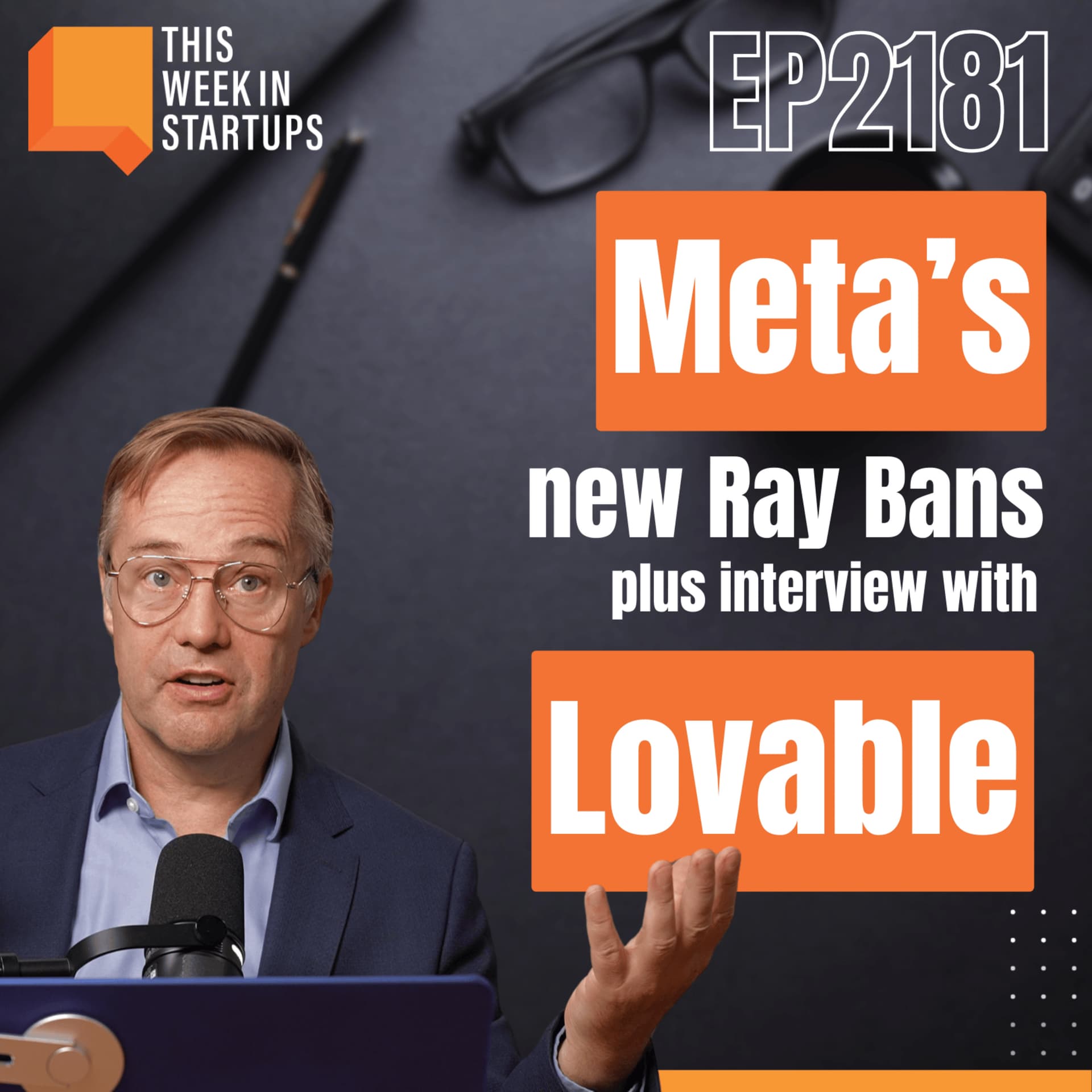
Episode Overview In this episode of "This Week in Startups," Jason Calacanis and Alex Wilhelm discuss the latest developments in the tech world, including Meta's new Smart Ray-Ban glasses, trends in AI, and insights from Lovable CEO Anton Osika. The episode also covers a new partnership between Beehiiv and Discord, Google's integration of Gemini into Chrome, and more.
---
Key Topics Discussed
- Meta's Smart Ray-Ban Glasses
- Creepiness Factor: Jason expresses concern over the new $799 Smart Ray-Bans that can covertly record in 3K, suggesting they may intrude on privacy.
- User Experience: While the previous generation had some utility, the new version offers a heads-up display and improved functionality through a haptic wrist controller.
- Privacy and Regulations: The need for clear recording indicators (like a blinking light) is discussed, highlighting the lack of societal norms regarding wearable recording devices.
- Lovable CEO Anton Osika
- Company Growth: Anton shares that Lovable has grown significantly, scaling from 20,000 to nearly 400,000 paying customers.
- Vibe Coding: Lovable aims to simplify software development for non-coders, introducing tools for rapid application creation.
- Security Features: Emphasis on the importance of security in applications built on the Lovable platform, with AI playing a role in maintaining secure code.
- Building a Community: Anton discusses strategies for fostering a community around Lovable, including hackathons and educational events.
- Beehiiv and Discord Partnership
- New Features: Beehiiv introduces a feature allowing newsletter creators to easily set up communities on Discord, aiming for tighter engagement with subscribers.
- Community Building: The discussion touches on the challenges and opportunities in building niche communities and how this may lead to more focused interactions away from larger social media platforms.
- Google's AI Integration in Chrome
- Gemini in Chrome: Google integrates AI into its browser, which will enable features like summarizing web pages and advanced search options.
- Concerns About Regulation: The integration raises questions about potential regulatory issues, especially concerning self-preferencing against competitors.
- Audience Questions
- Audience interaction was encouraged, with various inquiries made about AI ethics, Lovable's market position, and community engagement strategies.
---
Key Takeaways
- Meta's glasses raise significant privacy concerns that need to be addressed through legislation and societal norms.
- The rapid growth of Lovable demonstrates a strong demand for platforms that enable non-technical users to create software easily.
- Community engagement is crucial for startups, and platforms like Discord can facilitate deeper connections among users.
- Google's integration of AI into Chrome is a significant step forward, but it raises ethical questions about competition and user choice.
- Audience involvement enhances the discussion, highlighting the importance of feedback and community sentiment in the tech landscape.
---
Conclusion The episode combines a deep dive into emerging technologies with practical insights from a successful startup founder, providing listeners with a comprehensive view of the current tech landscape and future possibilities. For anyone interested in the intersection of technology, entrepreneurship, and community building, this episode offers valuable perspectives and actionable advice.
Written by AI. May contain mistakes. Listen to the episode to check what was said.
Transcript
Automatic transcript. May contain errors.0:00When do you think it crosses over? Like if you were to give an honest assessment, or if we were going to make a polymarket and we were going to place a bet on it. that lovable's security is twice as good as an expert. Twice as good as an expert. For applications built fully in lovable compared to sysadmin building it from scratch, I think on average, like on average, it'd be more secure, two weeks more secure, it's going to be in the coming 18 months. This Week in Startups is brought to you by AlphaSense. Get deeper insights into your business with the power of AI search and market intelligence.
0:42Start with a free trial at alpha-sense.com slash twist. Sentry. Your team should be focused on shipping features, not chasing down bugs. New users get three months free of the business plan, which covers 150 ,000 errors. Go to sentry.io slash twist and use the code twist. And dot tech. Say it without saying it. Head to get.tech slash twist or your favorite registrar to get a clean, sharp.tech domain today. Hey, everybody. Welcome back to This Week in Startups. I'm your host, Jason Calacanis. With me, my co-host, Alex Wilhelm. We've got a full docket. You can watch the show live thisweekinstartups.com.
1:24There should be some live links, but x.com, LinkedIn if you follow me, Substack if you follow the show there, plenty of places to follow us live, including YouTube. So go over to YouTube and just do a search for This Week in Startups, and we take questions from the live audience. If you're listening to this and you're part of the podcast crew, no problem. Monday, Wednesday, Thursdays, 12 p.m. Central Time, also known as Texas Time. So we've got a lot on the docket today. And I guess the biggest news story in big tech, not little tech, is AI's Meta Glasses. Seem to be a hit, huh? Meta's AI glasses.
2:06This is the thing we talked about on the show quite a lot, Jason. Just to remind everybody, they dropped an earlier version of their Ray-Ban meta glasses that could take, I believe, photos and such. They just updated that to the second generation. But Jason, I think the big news this week is that they put out new glasses that have a screen built in. A pretty large technological jump from the preceding generation. Yeah, I have the Gen 2s. They're incredibly creepy. I have a friend, Amanda, who brings them out at dinner and turns them on and tries to record the dinner. And we all boo her when she does because it's a little tiny white LED light.
2:41And, you know, before we get to the new ones, I'll tell you my experience with the old ones. The old ones are really great when you're with your kids. So I was on the ferry in New York. New York City is like really punched up the ferry game big time. And it's quite nice to take the ferry from Brooklyn. I was staying at this Brooklyn hotel, you know, right under the Brooklyn Bridge. We took the ferry into Manhattan, went to get Korean food in K-Town, yada, yada. What was super interesting about it is when I put these on and I'm interacting with them, they don't think they're on camera because it's covert recording.
3:14So they act natural. And then they found out I was recording them and they got really upset. But they're kind of fun in that way. the problem is you're constantly having to look down at your phone to figure out what you're doing so i did a live stream with it but what i found with the live stream was when people were asking me questions i'm like looking down at my phone so it's a terrible experience so the people watching my live stream on instagram when i tested it were looking at me looking at the phone of myself and the chat room i was like well this is dumb But I guess the reason it's not dumb is because this new version.
3:52So if you look at this new version, I think now I can play the video. It has a heads up display. It has AR. So in these big chunky glasses, when you put them on and here we go, you get to see a little faded image. And then instead of controlling it with your phone, you control it with this haptic around your wrist. This is, I think, what everybody wants. I'll be honest. and this is what Google Glass was 10, 15 years ago. And that they gave up on that at Google, which was a huge mistake, you know, in the technology business, not quitting is how you succeed. So Google should have kept the Google Glass movement going just like, you know, Zuckerberg did after buying Oculus, which is, you know, I don't want to say it's a flop, but, you know, it never hit the mainstream, I think, you know, it's never really an application.
4:47And I think the application has always been AR and here we are. So the question is, will Apple give up? And I think Google's getting back in the game. I was told that they have something in the works. I don't know if it's public or not. Maybe producer Claude can help us with that. But it is a, this is a vision that is both disturbing and awesome because when you're walking down the street to not look at your phone, when you're trying to get directions or to answer the phone or to see your text without looking down, that's all great. But now you've become permanently online and you're creeping out on people by recording them covertly.
5:25So we're going to need a whole set of new norms and new regulations. I think these things need to have a red blinking light when recording. I think since Zuckerberg did it in a way to foster the covert recording, he put a very low led light um and i think he did that on purpose or the team did so that you could covertly record uh we're gonna need legislation because they're not going to do it on their own it should be a red blinking light like everybody is used to when you're recording yeah uh producer claude from our dear friends over at anthropic says that at google io 2025 they did confirm quote android xr as a platform for both glasses and headsets and they're also working with warby Parker, Gentle Monster, and others to ensure the glasses that come out of this are stylish and wearable.
6:14For more, Claude.ai slash twist. We love those guys. Jason, what do you think about the hand gestures? Because to me, that actually is a pretty compelling piece of technology. Putting the privacy element of this aside, having a wearable that can tell what your fingers are doing by tracking your motion, it's a technological and engineering success. I was impressed. I found out that Apple, my Apple Watch has that. So if you double tap your fingers together, you can answer a call. Like this? Yeah. Yeah, it literally, yeah. We'll ask producer Claude what the motions are and which Apple watch that is.
6:46But, you know, the CEO of Whoop who's been on the program is so nice. He sent me a Whoop 5. Okay. And I only care about my health data. I found the watch kind of a dud for me. I just want my heart rate. I want to like record my workouts. I want to record my sleep. But the sleep app and the exercise apps and all that stuff on Apple, I think are mid. You know, they're not great. and then they sort of push you to other apps. So it's not like an integrated, but the whoop five is super integrated. So I am now addicted and I love the whoop. Um, I think the whoop is a super game changer because I get my workout, my sleep, my energy, my stress level, my VO2, they kind of extrapolate to give you your VO2, which is important, resting heart rate.
7:33And then it makes a calculation for your biological age versus your chronological age, I guess. And all of that has me a bit addicted to it. And it lasts, the battery lasts forever. Oh, that's clutch. Yeah. And then in order to charge it, you just slide this little battery pack on top of the wristband and you don't need to take it off. So people are keeping these things on. I've kept it on for over a hundred days. I am addicted to the Whoop. I think when they pair that with blood testing, it's going to be great. If you could have all your blood results from Superpower or Function Health or any number of people who are doing that.
8:14And in the Whoop app, they have labs. So they're going to be adding that product. And this is the start of, you know, user-led healthcare. And I don't really engage with doctors like I used to for healthcare because I feel like they're behind the curve in nine out of 10 cases because they're so stressed out. They don't have a lot of time for patients and patients with these new platforms like Function, like Superpower, like Whoop, you can just take control of it. So on the haptic side, it's going to take a little interface getting together, but it's going to work because people have gotten used to it with their headsets.
8:57Do you use AirPods? Do you use Pixel? What do you use for your, your, when you're listening or going on a run? Right now I have a pair of Beats Pro in-ear that I bought out of an airport vending machine. For twice as much. And what do you do? Do you tap it to like pause the music or answer? Do you use that? It has a little button, a button you push on them. So it's not, it's not happening. It's just literally a physical button. It's chunky. So yeah, with these new ones, you can shoot the lock off your wallet. You're so frugal. I give you permission to buy. I like the Nothing ear set. I have that company Nothing.
9:28They have a cool ear set that I like. And they just announced the 3.0 of that. And I have the Apple ones. And I also have the Sony ones. So I've been testing all of these. I'm like just very promiscuous with buying new technology. What do you think of this haptic revolution and like the possibilities there.
9:51We all understand the importance of a crisp, memorable, easy to spell domain name. One of those names you can say over the phone and people know how to type it in without asking you the spelling. But let's get real. The good ones are either taken or there's some poacher who's holding it and waiting for some huge payday and they don't reply to you. Even if you want to pay for a premium domain, you don't want to use up all your runway on a domain name. That's just the truth for a startup. You want to put that valuable cash back into your startup's operations. So you should consider this, a.tech domain.
10:25You can get a clean, crisp, super memorable name for your website and company and signal out loud to your customers and investors, we're a tech company. That's instant branding for you. That's why over 500 ,000 founders have collectively raised over$5 billion in investment, building their companies on.tech. So skip the hassle, head to www.get.tech slash twist, or go to your favorite registra and grab your.tech domain today. I'm really excited by it. I share all your privacy concerns with these new meta Ray-Ban displays, by the way, 800 bucks to start and you can go get your bus. Whoa, that's a great price.
11:04It's better than I expected. Yeah, that's a great price for that much product, but continue. Yeah, I think it's an enormous step forward. So it does have to use your phone. It's kind of a base. You don't have to have your phone out. Enormous upgrade. I think the 600 by 600 pixel display looks pretty darn crisp. And it's bringing some of the stuff that I love from Google Glass to now, which is like live translation. If you recall, there was an app for Glass that would translate signs for you. Now you can do that with these. And I think on the privacy front, they're doing some intelligent things.
11:33So if you try to cover up the light that displays when you're recording, it'll tell you to stop doing that. So it's actually has a sensor to block you from blocking it, which I think is a good step forward in terms of, you know. That is actually, I didn't know they did that. I think they did that because a bunch of these YouTube prank shows or TikTok prank shows, producer Nick sent Lon and I a link to it. Maybe Lon can find it in our group chat, but these kids are running around like haranguing people, harassing people with these glasses. Listen, I was a punk kid too. I would have been doing this exact same thing.
12:08but yeah, that's a good thing that they are now, because what these kids were doing was putting a little piece of gaffers tape over it. Yeah, I'm just - And that's just unacceptable to me. The thing is though, I agree that society is just not here yet. I don't think we're gonna have these be in regular use. I think Snap should get a lot of praise for their Spectacles product, for getting those a bit more into the mainstream, into the normies, into the kids. But I think right now, if I showed up to anything in my personal life wearing these and I said, I'm gonna take a video, people would be like, I don't know, man, Seems a bit much.
12:38Like I thought we were sitting down. Yeah. I think if you're at a kid's party and it's very clear that like you're going to take some pictures of like the happy birthday song and you declare, hey, I'm going to put my glasses on to record this. That's why you see the light and you kind of that's going to be the next couple of years is people declaring they're going to do it. I could see in four or five years, just like everybody takes their phone out and records the happy birthday song and nobody blinks an eye. I think people are going to be doing that. It'll just be normalized pretty quick. But then you're going to have to take them off.
13:13I think that's going to be, that's the thing I'm wondering about. But maybe we're just old Gen Xers who are curmudgeonly and, you know, care about privacy. These young kids don't. So this is going to be a hit. I predict it's a hit. It took them a decade to get here. um i think they also have a branding problem at meta because these are the meta ray band somethings uh meta ray band display i guess i believe that's the current working name yeah that's four names four words um by facebook and instagram i you know they should just call them you know whatever ray band somethings and did they did meta buy ray band is that what i read that they bought Ray-Ban?
14:00I forgot if they bought all of Luxottica or a part of it, but look, Meta's not amazing at naming things. They've kept Instagram's name. I think that's the best choice they've made. I mean, Oculus, Horizon, Worlds, VR, whatever. It's never been, Jason, the most crisp of brands. And then what app do you load? And does the app work? I need one of these. Actually, producer Claude is telling us Meta bought a minority stake in Ray-Ban's pairing company. Essilor, Luxottica. Okay, yeah. It's the conglomerate that owns essentially every single brand of eyeglasses out there. They're essentially a cartel or a monopoly, if you will.
14:36I would like to, you know, with these, see them come. I would like to see a third party come up with one of these that's not tied to any of the platforms. I just want one that is just independent of everybody and works with everybody seamlessly so that I can use it on YouTube. I can, you know, and it's not like, I feel like Meta did this to keep people in there and I guess Spectacles to a certain extent to keep people into their ecosystem. I'd like these to work like natively with my Apple photos, my Apple camera. Like, why can't I open up the camera app and have it just work there? And then when I open up Instagram where I'm using Substack or whatever I'm using, it should just work.
15:22And, you know, somebody should, um, make an open source kind of version of this that, uh, or open hardware version of this since it's so important, I think, with society. Um, but these are going to be great. AR is awesome. I've never liked VR gives me motion sickness. And I've always loved AR because it kind of keeps you in the real world. And there'll be so many small applications. And I think iMessage is the one that is the key, which is why Apple is doing the Vision Pro. And I think Apple will have a competing product out. I think Apple will show a competing product, not available for purchase, but a competing product to this, which is what I'll say is glasses that connect to your phone, not a big rig.
16:06I think they'll have that out or announced and show it within 18 months. And I would like to make a poly market on that. So if we could talk to our friends at poly market, when will Apple have a pair of AR glasses for consumers and, you know, they announced them and announced the release date. I'll say 18 months. You take the over or the under, Alex. Apple to have a pair of AR glasses for consumers. Comes down to price, Jason. These are 800 bucks from meta and up for the bracelet and the glasses. So let's just say under 1 ,500. Oh, I'll take, for fun, I'll take the over on that one. Take the over.
16:43Okay, then I'll just take the under. Another$100 bet. we'll record it at this week in startups.com slash bets. And that will be, you can send it in Bitcoin. You can send it in an Uber card, but you know, somebody should vibe code all of this. And if only there was a vibe coding platform that could do this. There was a vibe coding platform. You know, Jason, I recall when we talked to a founder back in February, his name was Anton Osaika and he's the CEO of Lovable. So I think we should have him back on. In fact, I think he's here. Hey, there he is. There he is. Anton, where are you calling him from?
17:18Stockholm, Sweden. That's where we're building from. Stockholm, Sweden. Yeah. This is the place where... You get that smorgasbord? I'm not a huge fan of the smorgasbords, personally. Ida Davidson? Davidson? You ever been to Ida Davidson, that place where they make them? I think I've been to Ida Davidson once, but... What about Noma? You've been to Noma? Yes. I don't go to the fancy places though, Jason. I go to the ones where you get your food fast and then you go back to a building. So you're building the company there. Yes. And you had an incredible revenue run rate. Tell us about the incredible run rate that Lovable had and then we'll get into product.
18:02Yeah. So I think Stockholm is very underrated. And what we're set on is to build the first trillion dollar company from Europe from here. And I can talk more about that. I'm sorry, did you say trillion? That's the plan. Wow. So I think we're seeing more unicorns being minted in Stockholm than other European cities this year. And this is a lot of momentum that's building up right now. I think you're going to see a lot more. But as per your question, last time we spoke in February, I think we had just hit 20 ,000 paying customers or something. and now we're almost at 20x that. And we're still very early days on the product.
18:46What we're going to do is to let the 99 % who don't know how to code instantly turn their ideas into software. And that's unlocking entrepreneurship and it's speeding up very, very large enterprises where product managers, designers, marketeers can move without being bottlenecked by engineers. And as the product becomes much more capable, we're naturally being able to capture more of the value that's being unlocked by the software eating the world, right? So what I'd love to talk more about is specifically how I think Stockholm is an underrated place and why we're going to be successful in this endeavor.
19:24Yeah, we'll totally get into that. The thing that was very interesting when I knew you were onto something is I said, we need to make like a community portal for the syndicate.com. That's our angel syndicate, like 11 ,000 members, 4 ,000 have made an investment. And like, there's like 500 who are super into it. And I was like, they really want to hang out. So we had a Slack room, but I was like, we need something that's like our own portal, you know, kind of like AngelList, but they don't have community features over there really. But I want more like a community driven thing. And so, uh, well, interestingly, Kelly on my team, uh, was like, Oh, I built it.
19:58And I'm like, you built it. And she's like, yeah, here, I've been spending like a hundred hours on this. and she shows it to me and I'm like, that looks like you. And she, she vibe coded it and lovable. And I'm like, what is it going to take to make this production ready? So I feel safe. So tell me about that aspect of the business. We had that one company that was vibe coded, um, tea, I think. And I don't think it was lovable, but if it was, it's fine to talk about, but they didn't lock it down. So tell me about security and being production ready.
20:37When your website or your app goes down, it just want to fix that problem as quick as possible. And that's why there's Sentry, application monitoring software that's essential for over 4 million developers today. Sentry handles all of your real-time error monitoring and tracing. So the moment something breaks, you know what happened and you know why, and you know how to clean it up. But the real reason we love Sentry is like all great startups, they're obsessed about their product and constantly shipping incredible new features for their customers. Some examples, Sear, their AI-powered debugging agent that uncovers the root of your bugs and errors in 95 % of cases.
21:14They also have an AI agent monitoring system, and this is going to become more important in the future, folks. We all know that. That's going to help you track down specific problems happening behind the scenes when your LLM starts hallucinating. And they just added structured logs, allowing you to view and search everything going on between your front end and your back end, helping you track everything on your application, not just the errors. Don't just listen to me. Try it out for yourself. Go to Sentry.io slash twist and take your monitoring and debugging to the next level. That's Sentry.io slash twist.
21:44Yep. Yeah, so we take security as the top priority because if you are building something that's not secure, you should not have built it at all, right? And it's clear to me, if you look at like in the 60s, you were sending people to the moon and you could have put a human in the cockpit, like steering that rocket ship. But what you realized back then already was that you need a computer to run this rocket ship mission because it's much more reliable in a certain scope of running, at least launching that rocket in the 60s. Humans always make errors. And we're going to see the same thing happen to computer security where you're just simply not going to trust a human writing secure code.
22:29You need an AI system. You need an AI system to write secure code. And we've launched over the last few months, we launched several security features that scans everything, all the kinds of calls that the AI has written for you. I cannot say that it's more secure than a security expert today. So I do recommend looping in a security expert for like life and death applications or like some very sensitive data, 100%. When do you think it crosses over? Like if you were to give an honest assessment or if we were going to make a poly market and we were going to place a bet on it, that lovable's security is twice as good as a human, you know, chief security officer, like a, you know, a sysadmin, a sysops who's just top 10%.
23:23So better, twice as good as the elite. As an expert. As an expert. Twice as good as an expert. So like, look, I don't, I really don't trust like the average developer to write something securely, average human developer. So it's good you picked the elite ones. It does depend on how much time the human gets and how much time both of them get. Let's say unlimited time. With unlimited time, when does it cross over? For applications built fully and lovable compared to sysadmin building it from scratch, I think on average it'd be more secure, two weeks more secure, it's going to be in the coming 18 months.
24:05Okay, I was going to guess 18 months. Not for arbitrary projects. I think for super special projects where the AI has never seen a project like this, the humans are still the ones cutting the frontier of novelty and figuring things out. But in 18 months, for basically all standards, all software, like bank software, everything, we're going to see AI being more secure for the leading platforms. Anton, I want to dig into that because one theme we've seen since we spoke to you in February is that people have become a little bit disillusioned at the pace of progress with new AI models. People say they're not getting better as fast as we expected.
24:40And so I think that people are pushing back their timelines on when we'll replace, you know, Function X from a human with an AI service. Your 18-month timeline feels pretty aggressive in a good way. Talk to me about the improving models, improving agentic work, and how you're going to take Lovable from where it is today to that point in just six quarters. So if you look at the product lifecycle, like building software, there's actually much more steps than you might imagine it's not just a human writing all the code and then it's done it's all of this like okay this is my hypothesis of what we should build these are my hypotheses of how the user flow should be like and then validating those going ahead building out the application and then after you build applications all of this operating it looking at the scaling observing if there are any bugs running in production and so on and what we're doing is to build out that full platform where we make it as easy as possible for the AI to take the decisions within that domain, like within our specific architecture for how applications are built.
25:44And there's a very strong synergy, like 1 plus 1 equals 3 in terms of doing that really well, adapting it to the AI, polishing everything around it and the guardrails for the AI, as well as, as you know, the big labs releasing new models every three months that are showing vastly greater capabilities than the last months. So that's the synergy in how we do it. And us making it opinionated, unlike Claude Code and the cursor and so on, is why it's rapidly becoming more reliable, even for the people who are non-technical, who don't know how to write code. So having a unified stack that's opinionated helps, and also improving AI models.
Read the full transcript
26:24But that kind of hits on my point. So in your view, Anton, the products from your OpenAI, Anthropics, and the other major AI model companies are still improving at a pretty quick clip even at this point in the year. Yeah, exactly. And that's what's going to enable creating almost all software. We talk about 95 % of all SaaS businesses should be able to be built much faster and more reliably on our platform than other platforms. And with it, you get like one-click payments are set up, one-click in the future, maybe your entire company is incorporated and you have your bank set up on one platform.
27:00That's really interesting. So you're thinking of all the preconditions and post conditions that happen around Vibe coding. And, you know, Stripe did the same thing, right? They have a service. Stripe Atlas. I used Stripe Atlas to do, oh, you used it to incorporate? Yeah, same here, same here. Okay, great. So like a shout out to our guys at Stripe. This is like a really interesting thing. and these APIs are all available. And then hosting apps is the other big piece. So it was always very expensive to host on these platforms. How do you look at hosting as a moneymaker versus maybe a competitive advantage?
27:43And walk us through how you're pricing all this right now, because I played with lovable, you know, just to kind of get my feet wet, but it was like a 50 a month subscription or something or a hundred bucks. And I was like, wow, it's 25. Yeah. And I was like, well, I'm just, I'm not really doing this other than just playing with it. But I felt like there were a bunch of roadblocks, you know, or paywalls. So you have to balance these paywalls with engagement. So as a founder, how are you thinking about getting as many people onto the platform versus making money? That's a great question. We're looking at making it cheaper and cheaper to build so that when we're really providing all the value you get from running your product on the platform that's when you're never going to leave and because it's so much value and then you you will pay more at that point currently hosting is completely free you have you pay for buying a custom domain in the platform but the building consumes a lot of AI compute, right?
28:45So that's what we've been charging for to date. I will be able to say more about this next week so people can stay tuned for the biggest launch to date on our product actually happening in the coming days. Around hosting or just around the pricing? Yes, so hosting, default hosting is still going to be free. What's adding some more capabilities where we just have to somehow be able to charge because of that cost us a lot of money. And that's something that we'll be talking more about next week. And as an example of what value you're getting, once you have built something, you're going to be able to have to charge your customers.
29:32And that's how Stripe makes their money, for example. And now most companies and software has AI built in, right? And that's something that you shouldn't have to think about how that works. It should just work. And that's something we will be doing our utmost to take care of for our customers.
29:55My founders know if you don't have the right data, you're not going to be able to make great decisions. To make important calls, you need to have a source of truth. And hopefully it's one source of truth that is reliable, accurate, and it's got real-time information in it. And that exists today in AlphaSense. They're an AI search and market intelligence platform that's been trained on over 500 million earnings transcripts, equity research packets, corporate filings, expert interviews, and more. Their GenSearch platform is going to give you a blazingly fast start on your research projects, and it's going to help you pull together an analyst-level deep dive on any topic, any industry, or company in just minutes.
30:33Plus, you can use GenGrid to keep tabs on multiple different companies or topics over time. They've even got an AI interviewer, which is going to keep you plugged into the latest thoughts from industry experts. It's time to remove uncertainty from your process and start making better, smarter decisions. So here is your call to action. We're going to start you off with a free trial, alpha-sense.com slash TWIST for your free trial. Go try it. And if you love it, tell us about that. Go ahead and give them a shout out on the socials. are you upside down on the economics right now um in terms of profitability on a per user basis or is it break even or modestly profitable because i do hear that some of these deep research type projects that fire off 50 threads at once um that companies will actually lose money on those but they're kind of like abstracting that into the overall or maybe they don't mind losing money every user because the cost of compute and tokens is coming down so dramatically.
31:33Walk us through that journey. Yeah. Again, we want to make it as cheap as possible to build and create things. It's a part of the mission to let human creativity be a driver, which is a more optimistic future than us just consuming brain rot. But today, we're in a very good place where we can very easily become profitable without big changes to how our business works. So, Anton, just to be clear, that's like just gross margin positivity? That's what you're kind of implying there? Yes. You split up your users into the free users and the paying users, and we have gross margin profitability on the paying ones.
32:11So that means that we can grow users very rapidly without me being freaking out about our bank account. Yeah, your burn rate could get pretty significant. But in today's age, you are facing serious competitors. So there's an argument to, like Uber did and Lyft did, hey, if we lose a couple of rides per, if we lose a couple of bucks per ride, no big deal, because at some point we could flip the switch. So take me through what it's like when you hit this kind of revenue as a startup so quickly, and then competitors emerge, and then thinking about pricing. and is this going to turn into a pricing war?
32:53Has it turned into a pricing war yet? I don't think much about the pricing. I think thinking more about the pricing in our conversation here than I do most weeks. We're just thinking about really building a product that our customers love and making that into a generational product and the generational company on top of that where we want Lovable to be used by a billion developers or builders that don't have to write software code. There's like 50 million developers out there today, right? And it should be the foundation where people build anything with Lovable. And what's possible for us to do here is to not just have this trillion dollar outcome as a goal, but to have it as a proving ground where more of the great ambition and the talent and a strong culture from European companies can be inspired to have this large global goals as we are currently pursuing.
33:54Anton, there was a really interesting piece that came out in early September. It was called, Where's the Shelf Aware? Why AI Coding Claims Don't Add Up? It was a complaint that we're not seeing as many new iOS applications come out. Basically, if AI makes it so easy to build, why aren't we seeing more of it? Then I turned to your guys' numbers, 100 million ARR, and your user base has exploded. So are people building apps that are a little bit out of the visibility of like most traditional developers? Because in my view, if I built a thing for my mom, that would not show up on GitHub, it wouldn't show up on the App Store.
34:25So I'm just curious about like, are people building tons and tons of apps or are the critics here a little bit mistaken in where they're looking? I think they are mistaken. Like there's so many software products that we use today, so it's harder to go like into mainstream media with success cases. But if you take, Lovable is very global. There is a company called Q Group in Brazil where the founder himself, it's a quite large company, but he sat down and built a new product for them in three weeks, launched it, made$3 million in the first two days after launch with some existing distribution channels of course.
35:06And that's just one of thousands of businesses that are being built oftentimes by people who were previously did not have the foundation, the capital required, a specialized skill set to build a business. So there are lots of success stories. And what I can say as well in how lovable is driving value for companies is that very large companies are using this technology and they're using it for a part of the product life cycle. And that's oftentimes the most time-consuming part, the 60 % of figuring out, is this actually worth investing in and taking it all the way to our customers? So product managers, designers, and marketeers, they're often moving much, much faster and prefer, like, Lovable is the best tool for them to prove out, here's my great idea.
36:01I'm not just going to talk about the idea. I'm just going to build it in a few hours, show it to my manager, Show it to my, try it with customers and then say, let's launch this. And then you've saved 60 % of the time. And engineers have this perfect specification to go out and implement in the system. That's so funny. I thought you were just going to say, yeah, you don't see them on GitHub or the App Store because they're web apps. But that's a different answer and also a really good one. Jason, I think you want to do something. Well, I think it's actually could be quite a revolution for young people.
36:29We've been talking, Alex, on the program about static team size. Big companies aren't hiring. and we've seen this massive increase, quite disturbing this past year in the United States of young people not being able to get jobs specifically in big tech. And I talked to Vice President J.D. Vance about it at the AI Summit, he was a little concerned. And for young people, the benchmark is gonna go up for you to show that you're valuable in this new world. Well, here's the easiest way to do it. If you have initiative, you know, on top of the hard work, that's what all bosses want. They just want somebody to show initiative because they're busy.
37:11Your boss is busy and they've got a boss and their boss has a boss. And there's all these goals and existing things you have to get done. So if a young person coming up in their career says, hey, I looked at this thing you asked me to do. It's repetitive. It's boring. And it's time consuming and expensive for our company. So I vibe coded something. Would this be okay? I have that happening in our organization. Now it's, it's not just lovable. People are doing it in notion with Zapier and kind of doing little workflows there with these form programs. So there seems to be like two parallel ways to do this, design a full product in a lovable, um, and then show that or doing, you know, what I'll call scripting and, and, and light coding, but this could be a game changer for young folks who can't get employed.
37:58And they called this spec work, Anton, back in the day. Have you heard that term before, spec work? I'm not that old though. Yeah, I know. That's what I'm trying to explain it to you. So there was a whole movement called the no spec movement. Somebody can pull up the webpage for this. When design became commoditized because, hey, Canva came out and other tools, uh, Figma, et cetera. Um, and even back in the day, Photoshop became more, um, you know, um, more common up and coming designers, especially from around the world would start making logos and they'd say, Hey, I redid your logo. Would you like to buy one for$500 or can I get a job?
38:39And then CEOs started to see this. So they started to ask people, Hey, I'm looking for a new logo. Will somebody make me one? And the designers got really upset because back then a logo design was five to 15 K. If you can imagine that, Anton, imagine five to$15 ,000. It seems crazy to you. We thought, okay, well, I raised a million dollars for my startup. Why wouldn't I spend 25 ,000 or 10 ,000 on a logo? And this was bread and butter. People would get two logo deals a month. They would do 20 a year. They'd make 5K each. They would be a freelancer making a hundred, 150 grand a year. It was quite common in web 2.0.
39:17And then the spec movement came out and then everybody started saying, don't do spec work. That was like... Yeah, I think we're seeing like a no spec 3.0. That's what we're seeing. And it's coming both from the people inside of companies, product managers and so on. But I foresee that what you're saying is definitely going to happen where young people who often learn faster, they have more initiative taking capability, are going to come to companies and say like, hey, I can do all these new things that your staff currently cannot because I grew up AI native. I actually have this 20-year-old who's helping with automations in our company.
39:50I can't put the most senior engineers on it because there's automations. But the mission I'm telling him is you have to automate lovable. That's the goal for you, automate everything lovable. And I love the positive vision you're putting on for young people out there. Yeah, and then if you can't get a job, even if you've done all that spec work, the company that doesn't hire you or you're inside a company and you build all this stuff and they're like, yeah, we don't want to do that. Well, here's what you do. You just think, are there other companies who would want this product or service? And maybe I can sell it for a hundred bucks a month or a thousand dollars a year and get a hundred people to buy it.
40:28And now I am working from home in my underwear three days a week and I make more money than I work for my current employer. So that's going to be a really interesting tension. That happened to Alex, by the way. He's now wearing pants, by the way. I am wearing very comfortable shorts, but from the waist up. I knew it. I knew he wasn't wearing pants. Okay, all right. Let's plug in. Are you wearing a belt? You left TechCrunch and now you have like two jobs, three jobs and you can actually start to say, you know what? I'll make more money. I have more freedom, more agency, I guess is the word I'm looking for.
40:58So it's kind of exciting. It's a really cool future. It is. Anton, quickly on the student discount that I showed, building off what Jason just said, how popular is Lovewell amongst students and is that a critical cohort of your overall user base? It's very popular. just because students are a bit disillusioned by feeling that the only thing they do in college is to ask Chatsipasti and put their answer into their take-homes and so on. And they're thinking about what's next. I heard at the most prominent technical university here in Sweden people thinking about starting a company as students after they graduate.
41:36It went from 8 % to 80 % over the last 10 years, which is huge. And you can really feel that in the atmosphere here when you go to events, that there's so many young people who want to build successful startups. And they often come up to me at least and say like, oh my God, I'm so grateful you saved my company or you made it possible for me to raise a big round based on what I built in Lovable. Students, they're not so well capitalized. So it's not the biggest chunk of our revenue yet. We're betting on that to become the case when they become founders, which is the biggest source of our revenue today.
42:13So founders are your biggest customer base? Yes, founders, entrepreneurs of small companies, the developer agencies and so on that have been bottlenecked by not being able to find great engineers or paying for great engineers. That's the biggest source of revenue for us. Wow. Hey, you know, one thing I wanted to talk to you about was when you have a startup like this and you're trying to build a community and a movement around it, what are the tactical things you can share with other startup founders listening about tactically building a community of power users? I know you guys have a Discord.
42:48Not sure how vibrant that is. Yeah. But maybe you can talk about that. Jason, 106 ,258 members on the lovable Discord, 8 ,744 online. So you got 8 ,000 people in a Discord grinding. How did you get that flywheel started and what impact does Discord have on your business, would you say? So the community and users wanting to teach each other how to unlock the full potential of this tool. It looks very simple. It's just a chat box. But there is actually so much to learn to really master it and be able to work in tandem with the AI. That educational part is huge. And all the hackathons and events, I think we're on track with 300 grassroots events being run about Lovable to the end of this year.
43:37In person? It's a big part. Really? In person events. Yeah. And what do you use to manage that? Are you using river? That's a good question. For physical events, I think the team, they're understaffed. There's like one person mostly working on this. And we're not being proactive in the sense that we could be on empowering that community. So that means an opportunity, yeah. It's a huge opportunity for us to empower that more and empower the Discord community more to put some structure around that. But I can just say, like, what you want to do is to think about what's the journey for people coming into the community and giving them a platform.
44:17If they are good ambassadors that can educate, giving them a platform, a personal platform that they can leverage in the community. And again, this is an opportunity that we haven't really jumped on. But if someone is listening to this and wants to help out on the community, reach out to me. All right, we'll talk about Stockholm in a minute and your love of that great city. But let's take a couple of questions from our live audience. If you're listening to this on podcast, you can go to YouTube and sign up for This Week in Startups, hit the subscribe button, and then there's like a little dropdown down when you hit an alert bell and then you'll get alerted when we go live.
44:53We're going to start doing some random live streams, by the way, Alex. So I'm giving you permission, Alex and Lon and Oliver to next week. When a live news story happens, go live on the channel and just talk about one story and do it in under 10 minutes. So I'm giving official permission to my team to do that. I think there's like, people want a little more content. I did it yesterday on space as I talked about the Jimmy Kimmel situation. I don't know if you saw that, Alex, but I did. You said you got good engagement on that. Unbelievable. People are like, do this more often. I want to talk more often.
45:27So we had so many questions come in for you, Anton, across our Substack live, LinkedIn live, YouTube live, um, and x.com live that we thought we'd take a couple if you're okay with that, Anton. It's a little dangerous to take five questions. So here we go. Um, editorial director, Lon Harris. I don't have any dangerous questions for you, Anton. They're Very above board. First up from Alex Ray. What do you think of Anthropic CEOs? AI is going to take over. We must regulate Tor. Alex saw him speak at an event in DC and felt like they're trying to get regulatory capture to happen. What are your thoughts?
46:04I hate like over-regulating things. I think Europe is a good example of where we're maybe too happy to pull the trigger on over-regulating before you see a problem. I think there is a, I mean, it's a bit scary with introducing a species that like humans are the dominant species on this planet because we are intelligent. And then when you introduce some new intelligence that could might be more intelligent than us in all ways in a few years, it's more unpredictable. and it's possible that we should think about regulating some of it ahead of time. I think you can do it in a way that is not regulatory capture.
46:50And I think everyone who is listening to this leader should really think first principles and question them in terms of if we should regulate, which I think we should, can we do it in a way that it prevents regulatory capture? Can we do it in a way that prevents regulatory capture? And I think the answer is yes. And that we can get all the benefits from the smaller players, the smaller ones that are tropic, to not be taking on the regulatory burden, while only the large players actually have to take on the regulatory burden. I think that's the case. But I'm not an expert. Let's take another question.
47:31Go ahead, Lon. So this one comes from PMDev, a little bit more technical. Lovable being built on an opinionated stack by definition dramatically narrows Lovable's capabilities. Pivoting off of that, what's Anton's technical background? So I've been a founding engineer at the company that just became a unicorn here in Stockholm. So I think I did some good work there. And I was the CEO. We're a cloner, true caller, kingfisher. It's called Sama Labs. So it just became a unicorn, I think, officially and exited. But since then, after that, I actually started the Y Company company that raised$20 million from top of VCs after growing really fast.
48:17And I was a CTO. So I went from CTO to founding and being a CEO at this company. And to the question, how we think about it is that Lovable needs to have all the primitives on the kind of software architectural side to be able to create everything you need for 95 % of SaaS companies. On the Facebook scale, maybe it's going to be hard to vibe code it on Lovable. but how these different primitives come together in the technical architecture that's what's opinionated but as long as you have all the primitives there should not be a significant narrowing of what you can produce and that's why people love using lovable I love to use it as well especially if you are technical you can do your hobby project in minutes instead of taking a few days for them Alright, any more questions from the audience that are notable?
49:14One more. This is the spiciest one. Uh-oh. Okay, here we go. Andre Ionescu, is vibe coding a little bit cheating? Do you think software engineers maybe are better off without it long term? Your reaction. Okay, so if it's cheating, would software engineers be better off without it? No, I think everything is a fun company. I don't know so much about them, but they're called Cluelay, and they talk a lot about they are going to build the ultimate cheating tool, and everything that was once a technological advancement, like the calculator, was considered cheating in the beginning, but a calculator is not considered cheating today.
49:53It's just a new tool to learn as fast as possible to increase your competitiveness in the job market. Absolutely fantastic. As we wrap here, Stockholm has had many, many unicorns. Sweden is a small country. Is Sweden 30 million population, I think? It's barely 10. Oh, Sweden's barely 10. Which one is 30 million in the Nordics? Was it Switzerland? I know that's the biggest, I think that's the biggest country, but you have Norway with like five or 10. I think if you count them up, it might be 30. Oh, it might be 30 all across all of them. So the number of unicorns per million people, Alex, in my book, Angel, I had talked about that, like as a per capita.
50:38Think about this list, Klarna, Spotify, clash of clans um i forgot the name of maybe that was king that was king that was king yes it was he's not in um minecraft i think minecraft am i right um and then lovable true caller any others i mentioned sauna now i think there's going to be more potentially soon so what's in the water in Stockholm that makes this possible in your mind, Anton? It's great water. It's super clean. Drink it from the tap. But specifically, there's just a deep pool of engineers here who are very curious, grounded, and serious about building good products. And people building are not just chasing clout, hopping between startups every year, but they really care about what they're doing and I think this culture of long term thinking matters a lot.
51:40When I was on the AI side specifically 10 years ago deep learning, you know, neural networks you feel a lot of data was coming out and then some of us here we built one of the early AI communities where there's like a great list of alumni from it. It wasn't hype, it was just a small group of people reading the most recent research papers and building them, actually caring about implementation, getting it all the way to a product. And I think that spirit stuck around of like building products on top of AI. And now I think we're seeing a new wave. Stockholm is a magnet for talent. There are people moving here.
52:20I'm having a large part of my leadership team coming from SF, moving to Stockholm. Still hard to find apartments there. I know that was like one of the blockers. I remember when a friend of mine, Tyler - It's good now. Is it better? You're building more housing stock. It was hard to get an apartment, right? And the apartments were affordable, but you had to wait years to get your apartment, I remember. I mean, there is a bit of this regulated pricing market. I think we have it in a few cities, but it's always possible to get an apartment. Have things moved outside of Stockholm? Is there a satellite city or two that have become popular?
52:55Stockholm is the one accelerating. I mean, there are two other big cities with some significant tech scene in Sweden, but Stockholm is the one ramping up the fastest. And I mean, as an example, Lovable is built from Stockholm by alumni of unicorns and a lot of global tech firms, top talent. That's the key thing. Whenever we see a startup community start to thrive, it's because you have some unicorn company create a bunch of alumni and that diaspora then invests in because if they made some money and you had stock options, they go invest in other things. And Canva came out of the Atlassian founders.
53:39And now you've got all these Canva millionaires, billionaires who are then starting new companies. and so now you've got like multiple generations and I think Stockholm with the same thing so many of the people who were in Skype and made a bunch of money then and those founders started investing in more companies and then obviously you're going to see that with Spotify founder Daniel Ek invests and starts other companies and I'm sure he's an LP and supports the community so it's absolutely fantastic and I think people should be taking notes yeah as to what happened there. Anton said one month ago that in 10 years quote people will talk about the quote lovable mafia.
54:15So Anton, I have to ask, are you already shedding talent, people leaving to go start their own companies? Or are you thinking about more in the future, people are going to head out? No, I think about more in the future. I used to say this in the last company I built, that I mentioned. And from there, we're seeing, I mean, four YC companies come out and multiple of them valued at hundreds of millions of dollars. Incredible. Yeah. And you have a view on secondary sales. I'm sure when a company accelerates in valuation, you have some early investors and or employees who want to sell. But obviously, if there's liquidity in your stock, then they might get too much liquidity too fast and not see any reason to come to work.
55:04So what's your take on that as a founder? and allow ourselves. Yeah. No, we want to help our employees. I think it's important I talk about not, we have a long way to go and the big thing you should be proud of after you're done here is what the generational product, the generational company team we built. And if you take some of the chips off the table, it should be done just so you can like think less about being like risk averse. And we, in secondary sales, how we do it is that we limit the total amount. Yeah, that's, I mean, that's what Elon figured out when SpaceX, and I think the Stripe team figured that out as well, just do like two orderly sales a year.
55:53I think both companies do that process. And then people make their requests and management says, okay, yeah, you want to sell 50 % of your position and you've been here for four years. Well, you sell 25 and whatever it is. some orderly fashion. Listen, Anton, continued success. You're incredibly focused. It's so much opportunity and you're doing everything right. So congratulations and I'll see you when I'm in Saco. Yes, come here, please. Yeah, I mean, I used to come all the time. There were so many tech events would invite me out. I just, I got too many invites right now and not enough time.
56:23I would like to come back out. Yeah. I found something you cannot say no to. Okay, there you go. Well, we'll talk soon and great job, Anton. Thanks, bro. See ya. All right. They'll ask you to upload your file. Yeah, another great founder doing great work. Great job with the questions from the audience. We always love that. And again, we're going to do a little more live, a little more experimenting. They're always experimenting here. You're excited about doing a breaking news story at some point? I'm totally here for it. I mean, Jason, fundamentally in my DNA, I'm a news guy. So like to me, when there's a lot going on and it feels very active and busy, I thrive on that.
57:00But I'm just so glad we had Anton back on so quickly because when we had him on, his company was at 4 million ARR. Now they're over a hundred million. And that's not how technology worked when I was learning about startups. That was just not at all. What a different world. You know, you have broadband, you have billions of users, you have credit card rails, and these tools are providing so much value at a low price. It's kind of hard not to engage with them. So if If you're working at a big company and you have a corporate card or you have a personal card, why wouldn't you spend 25 bucks, you know, um, you know, to just improve your lot in life.
57:41So for young people, I really recommend trying to, uh, you know, if you've got to spend your own 25 bucks, just do it. Can you imagine if you go to your boss and you're like, Hey, I, I started using this lovable tool. I paid for it. Don't worry. I did it on my personal card. Uh, it didn't cost the company anything. I spent a hundred bucks the last four months and I made this. Now your boss is like, get in here, talk to me, let's go get lunch. Let's, let's have a coffee. Tell me everything. Also, your boss is going to name drop you when they take your work one level up. They'll say, Bob did this or Jane did this.
58:10And then suddenly that person who never knew who you were knows exactly who you are. Huge for your career. Yeah. And this is why like, you know, keeping your head down is not the best advice. Like you want to, um, rise up and get some attention for what you're doing and be ambitious and just saying, Hey, over the weekend, I did something. I had two of my team members tell me last minute that they applied to get scholarships at the All-In Summit. They paid for like these$1 ,500 tickets. And they went there and they're like, I just didn't want to get in trouble, but we're taking vacations to go to your event.
58:41And I'm like, oh my Lord, you can not use your PTO days for those two or three days. Since you were so ambitious, I am so thrilled that you did that. That's amazing. Now, of course, now I've got 20 people who are going to do it next year and nobody gets any work done that week. but um i'll be here i'll be at home don't worry jason i'll hold the fort down you'll hold the fort down okay a couple of other news stories we should probably hit on um yeah what do you think the most pressing here i saw google is uh doing what comet and some other folks are doing with an ai first browser is that true and have we used it have we seen it or is it just an announcement just an announcement it's rolling out uh very soon i'm hoping to have this in my chrome by next week so we'll have some more hands-on notes some of the features though jason are going to be coming out a little bit later.
59:27So Google is baking Gemini into Chrome. That's the big headline. It'll be in the upper right section. You can click on it and then it'll help you summarize web pages or groups of tabs that you currently have open. It'll help find websites you visited in the past. So kind of a really advanced history search, which of course brings up some interesting privacy points, but we'll get to that later on. And of course, integrations with other Google products like Calendar and YouTube so you can kind of connect work from one tab to the next. down the road, Jason, that's when we get to agentic browsing, a bit more like Comet from Perplexity or maybe kind of what Diaz doing from the browser company.
1:00:00And there will be a feature coming later on. I think this is the most important thing that will turn your search and URL bar into effectively the chat interface you see with most AI products. Now, they're not going to turn that on by default, I don't think, because they can't afford to take everyone in Chrome and send them to the AI search tool versus the traditional one because all their money is made on the traditional side. but this certainly feels like Google now does not have to divest Chrome. We learned that from the judge in the search monopoly remedies section of the trial. So they get to keep Chrome.
1:00:30So now they're going to use it. And so to me, this is Google saying we've, we've shaken off the courts and now we're going to go straight pedal to pedal. Timing. Yeah. Oh, very interesting. Yeah. They wouldn't, they were probably, obviously they've been working on this for some time, probably a year, I would guess. And so if they've been working on this for a year, cause they did include it, I'm seeing lots of AI pop-ups when I'm using Google Docs and Gmail. I haven't seen it in YouTube all that often. I guess you can ask questions of a transcript now. I would just like the search box in YouTube to be AI-driven or in x.com, have it be AI-driven.
1:01:07I think the meta team has done a good job of making their search box in Instagram default to an AI result, which is kind of cool. But yeah, so many possibilities when the Chrome browser or your browser has AI built in. So this is going to be a big deal, a big, big deal. It begs a question though, and I'm not trying to pick a fight here. So don't, don't take this in a negative sense, but people in the consumer side, they're going to grumble and then end up using it anyways. OpenAI is building a browser. Fine, fine, fine, fine, fine. XAI sued Apple over, it claims, preferencing OpenAI in the App Store.
1:01:45Now, Now, no matter what you think about that, it shows that XAI is willing to go fight for what it says is a fair marketplace. If Google's going to bake Gemini into Chrome, isn't that a much bigger self-preferencing point? So I'm curious if XAI is going to stand up and plant a flag here. Or the Justice Department or anybody. I think it's one of these things where they're just we don't have necessarily a savvy enough group in Washington across any administration. Just historically, we haven't had people savvy enough to be at the tip of the spear like us. Like here we are. We've used Comet. We've used, you know, the other browsers.
1:02:22We're reading every update on them. We're hypothesizing as to how they will help people in the change. That's not how it works in Washington. In Washington, somebody comes and complains and says, hey, you know, check this out. And they try to spin it and, you know, get some maybe edge on their competitors. I do think the ultimate way to self-regulate in these cases, and ultimately the way the government can regulate these, is to give consumers more choice. Because at the heart of this is the consumer is not having a choice, right? It's just being bundled. It's being shoved down your throat. You've got Microsoft Office.
1:02:58Now you have Teams. And it's like you can't get away from Teams, right? Or remember when Google Plus came out, you couldn't get away from it. It was kind of everywhere. and Meta is doing that with their AI product. You can't get away from it. But if you say, when you load up your new browser, it says, would you like to use XAI, Claude? Would you like to use this open source product? Which LLM would you like to use as your default? Just like you can pick the search engine. And I think in Europe, they actually forced Google with Chrome to give that choice when you install it. I'm not sure if that...
1:03:33There's the browser ballot screen and more recently, September 11th. So one week ago, Jason, the EU commission accepted Microsoft's commitment to de-bundle teams to avoid a penalty. So we're still having these fights right now. Okay, great. So thank you for having that knowledge at your fingertips. This is the easiest way to do it is just give consumers choice. And ultimately, consumers are going to win in all this, as we just had with our guest from Lovable. that's 25 bucks to go make apps. And you could go from having no job and being a DoorDash or an Uber driver to starting to make little apps for your local dentist or your local, you know, I don't know, your local bakery wants to have a website and build something really unique.
1:04:18And you go in there and you build it for them. Just like there were people who would go build websites 30 years ago, or there were Squarespace consultants, you know, that go to local businesses. This is like one of the great hacks. You build a bunch of beautiful businesses using Squarespace, use the promo code twist, longest running sponsor here, partner. People would make, I remember it's in the early days of Squarespace, they would make websites, email them and say, Hey, I built a website for you. If you want it, I can set it up for you for a hundred bucks a month. And, you know, maybe Squarespace was 20 or 30 bucks a month.
1:04:52And they would take the difference and you know, the bakery would be like, this is amazing. I have a website that's gorgeous and represents us well. Thank you. So that's a really interesting hack. But I think the point about people going to private communities is interesting because Beehive, a company we've talked about on the show quite a lot. We use them. They're incredible for our newsletter. Yeah, big fan. Shout out to Tyler Dank. They just dropped a new feature. And I was thinking about it in this kind of vein because they now have a new button inside of Beehive that will help you set up a exclusive community on Discord for your paying subscribers.
1:05:23So kind of a tight, tight. It's a small new feature they just put out, but it made me think of like, here's a way for people that have a newsletter or a blog to quickly spin up their own community, just like you were talking about with Anton. And I was like, oh, this is fantastic. People are going to use it. And then my second thought was, oh, great. More people going into tiny little internet rabbit holes and having small communities. And so to me, it's this really interesting dichotomy between I love people getting to gather and have their interests and be niche and be weird. And then also the further from the light we go, the more I think we also have a reason to worry.
1:05:55You know, this could also be a positive because you get out of the slop on YouTube serving you like more and more extreme stuff and trying to tickle your rage or X algorithm trying to do that or TikTok algorithm trying to do that. And you say, you know what? I just want to be in the Knicks community. So I'm part of the Knicks fan TV community. And I have a private x.com group chat with a bunch of famous Knicks fans. And I also have the Knicks fan TV discord. And I find myself increasingly when I'm like, God, this is all so rageful and annoying and all politics all the time on different social networks.
1:06:34I'm like, I kind of like the respite of just saying, Hey, we're here to talk about startups. And so this weekend, we're going to fire up the, uh, this weekend startups discord. I'm going to try to see if the young ambitious people who work for me, I can get a couple of them to do a little weekend work and pop up a discord here, uh, for the show. And then we'll invite you all to that discord. Um, and I'm thinking about doing a paid membership. I know Leo has done really good with club twit and I spent some time there and I'm wondering, you know, I think I may start it off as free, but then go to a paid thing so we can actually put moderators on it or editorial people on it and make it self-sustaining.
1:07:12Not to make a profit, but just make it self-sustaining, right? Because these communities rise and fall with like the moderation, I find. Oh, well, we do. As of minutes ago, actually about two hours ago, we do have our Discord set up, Jason. So once we have it tuned, we'll invite everyone in. but stay tuned and we'll hang out there as often as we can just to be accessible. There was an IPO. I know you love your IPOs. Tell us about the IPO. Two IPOs. I'll do them in 30 seconds. StubHub, the online ticketer, went public at the midpoint of its range and then immediately started to go down. Not a great IPO, but then happily for everyone out there who likes liquidity, Netscope, the cybersecurity unicorn priced at the top end of its raised range, Jason,$19 a share, and then immediately rose 18 % in its first day.
1:07:58And then today, this morning, its second day of trading was up another six or seven percent. So I think the more tech IPO of the week did well. And we're seeing basically continued success from debuts. So everyone out there, Databricks, cough, cough, go public. StubHub was public previously, I believe. So maybe it went private and then went public again. If memory serves, it was public. It went private, sold, and then taken out again. So we're back, back, back to the future on that one. I just love this idea that Beehive is connected to Discord with the membership because this is a known problem.
1:08:32There's I think there's another company, Memberful or something, that creates glue between all of these different communities because you can turn on a sub stack, a Beehive, a Patreon, X, I have subscribers now for my commenting. And so you have all these disparate subscriber bases, YouTube. How do you get them all into the same Discord? and then when they stop paying for it, turn off their Discord. This is a complicated technical problem. And I guess people are just going to choose one location for their subscribers. But it would be nice if this was, you had the ability to subscribe anywhere and then manage it from anywhere.
1:09:14The world's getting complicated. There's just too many options. It used to be you could just start a Patreon and that was it. Now it's like... There's too many options. But I was just thinking about our Discord because I think it'd be great to have one. but we also have Slack that I got to keep tabs on. I've got iMessage, LinkedIn notes, Twitter DMs. And I do, I feel like at some point in time, don't shout at me, but like some sort of like super app that brings it all together. I know technology is just bundling and unbundling, but right now I feel like whenever I'm working, I'm not watching the 48 channels.
1:09:43So like today I came back to our Slack after trying to get prepped for the lovable chat. And then we had done AI images for startup idea pitches. And I was like, boop, oh no, I got to catch up. It's tough, man. The problem with chat is chat is like, it's just like a river. Like if you miss, you know, the leaf floating down the river, you want it to pull out of the river. It's just, it could be way downstream and you just, you lost it. This is where AI summaries, we have, we upgraded our Slack to like the more professional version because we had to do like more security because of our global operations.
1:10:16and the AI summaries are not great, but they're okay. And I find myself once in a while, like once a week, if I'm gone for two days looking at it and I'm like, this could be so much better. So for the Slack team, it's like if I had to rate the AI summaries right now and like their integration, it feels like a five out of 10. I would keep grinding on that and helping surface them more. Superhuman does a really good job. Every time you open up a superhuman email, it already has the summary at the top and they do it before you open it. So it's like preloaded in your inbox. So they take the time to do that, even if you don't see it so that it's just faster and better.
1:11:01Jason, do you want to read some comments from the people? Oh yeah, let's just grab one and we'll shout one person at you, pull it up on the screen. Here it is. This is from our Spotify comments. We love everyone over there. Jason, take it away. Oh, yeah, Spotify comments is on there. So this is comments, not reviews. But okay, yeah, we'll take a comment from Spotify. Who do we got? We got Giorno Passporto, 1533. Love reading that out loud. I have to give Eric Jackson, this is from, I believe, our last episode, so much props for finding the value of the company wherein value investors could not.
1:11:31For the retail investor, we had the best opportunity to get in as if it was a seed funding, paying cheap on the stock that we can then hold for a while. This person is just a big fan of Eric Jackson and the open door thesis, Jason, which you had quite a lot to say about. Yeah, I mean, I love the fact that there's now a group of maniacs out there who find companies that are distressed or there's an opportunity in and say, here's my vision for that company. They're kind of activists. You could call them meme stonks, whatever. But I think they're getting better at it and the collective knowledge they have and the time they have.
1:12:09and the motivation they have is, you know, greater than some of the stock analysts who work at, you know, whatever banks and they, you know, they don't have the time to obsess over stocks and it's a nine to five job for them. And these lunatics are like, I'm going to place a bet on open door. I'm going to say this CEO needs to go. They're not doing a great job. These are the CEOs I think who would, these board members don't have skin in the game. That was like the best part of that discussion with Eric was his, oh, if you buy even$50 ,000 worth of shares, it tells us something. And I got to tell you, that does change behavior.
1:12:42And we talk a lot here on this program about generation bet and, oh, people have concerns about it. I got no concerns, man. My concern is that people are not thinking probabilistically. They're not making bets. They're not making investments, investments, bets, wagers, they all require you to have a higher, um, a higher duty of handicapping and thinking through possibilities, which then makes everybody better at their game. Yeah. So put a little skin in the game. I invest to understand. I invest to understand. I bought KDEF, because I heard people talking about it and I started reading articles about President Trump negotiating with Korea over shipbuilding, because they're good at building ships.
1:13:33We don't build ships here anymore. And now I've like gone down that rabbit hole and I'm like, wow, there is a whole group of people who are better at building weapon systems, ships that are not in the United States. and then Andrel and all these other US-based companies are competing with them. It's a really great way to learn, great way to learn. Speaking of Andrel, just one last little note, just got a$750 million contract with the Ministry of Defense over in the UK. Not a bad thing for them. But anyways, Jason, I don't want to drag us down another rabbit hole here at the very end. So great that we got the review, Oliver, but great that we got the comments, Oliver.
1:14:10What I was looking for was a review, but I guess we'll do that as a concept. What I want to do is if y 'all take the time to write a review on Apple, we're going to take the time to post it at the end of the show. So watch the end of the show. I'm going to have producer Oliver or Lon or you, Alex, just read the review and shout the person out. So at the end of the show, you may get a shout out for your comment or your review. So get on the YouTube, get on the Spotify comments, get on the Apple podcast comments, write a review, write a comment, and you might get shouted out here and we'll give you a little plug for your company if you happen to mention it in there.
1:14:46Okay. See you all next time. Have a great weekend, everybody. Bye. Bye-bye.
From the publisher
Today’s show:
On an action-packed TWiST, Alex and Jason check out Meta’s latest wearables, which promise to fix the “constantly staring down at your phone” problem and prevent you from blocking that little light letting others know you’re filming them. Think the upgrade is worth $799 of your hard-earned money?
PLUS, Lovable CEO Anton Osika stops by to answer YOUR questions, talk about how people are using the iconic vibecoding app, balancing accessibility and user engagement with the need to actually bring in revenue, and why Stockholm has become arguably Europe’s leading tech hub.
AND Beehiiv joins with Discord, Google bakes Gemini into Chrome, and MORE of the week’s biggest tech news. Check out all this and more in a brand-new “This Week in Startups”!
Timestamps:
(0:00) Why Jason thinks Meta’s new $799 Smart Ray Bans, which covertly record people in 3K, are creepy!
(04:14) Why, in the technology business, not quitting is how you succeed.
(09:47) .TECH: Say it without saying it. Head to get.tech/twist or your favorite registrar to get a clean, sharp .tech domain today.
(10:54) Show Continues…
(17:02) Anton Osika from Lovable calls in from Stockholm: Why he thinks it’s Europe’s biggest tech hub.
(20:37) Sentry - New users get 3 months free of the Business plan (covers 150k errors). Go to http://sentry.io/twist and use code TWIST
(21:44) A look at Lovable’s new security features, to make founders feel more confident in their vibe coding
(27:31) How Lovable is balancing engagement with the need to make money
(29:55) Alphasense - Get deeper insights into your business with the power of AI search and market intelligence. Start with a free trial at https://www.alpha-sense.com/twist
(31:03) Show Continues…
(42:29) Anton’s tactical advice for founders who want to build a community around their product.
(49:14) A viewer asks: Is vibe coding CHEATING?
(59:01) Google is baking Gemini into Chrome… but how will it work? And what about privacy?
(01:05:05) Beehiiv links up with Discord. Why Alex has a few concerns!
(01:11:01) Responding to some of YOUR comments. (Leave us reviews and comments on Apple and Spotify!)
Subscribe to the TWiST500 newsletter: https://ticker.thisweekinstartups.com
Check out the TWIST500: https://www.twist500.com
Subscribe to This Week in Startups on Apple: https://rb.gy/v19fcp
Follow Lon:
Follow Alex:
LinkedIn: https://www.linkedin.com/in/alexwilhelm
Follow Jason:
LinkedIn: https://www.linkedin.com/in/jasoncalacanis
Thank you to our partners:
.TECH: Say it without saying it. Head to get.tech/twist or your favorite registrar to get a clean, sharp .tech domain today.
Sentry - New users get 3 months free of the Business plan (covers 150k errors). Go to http://sentry.io/twist and use code TWIST
Alphasense - Get deeper insights into your business with the power of AI search and market intelligence. Start with a free trial at https://www.alpha-sense.com/twist
Great TWIST interviews: Will Guidara, Eoghan McCabe, Steve Huffman, Brian Chesky, Bob Moesta, Aaron Levie, Sophia Amoruso, Reid Hoffman, Frank Slootman, Billy McFarland
Check out Jason’s suite of newsletters: https://substack.com/@calacanis
Follow TWiST:
Twitter: https://twitter.com/TWiStartups
YouTube: https://www.youtube.com/thisweekin
Instagram: https://www.instagram.com/thisweekinstartups
TikTok: https://www.tiktok.com/@thisweekinstartups
Substack: https://twistartups.substack.com
Subscribe to the Founder University Podcast: https://www.youtube.com/@founderuniversity1916


