
In short
This Week in Startups - Episode E2165 Summary
Episode Overview
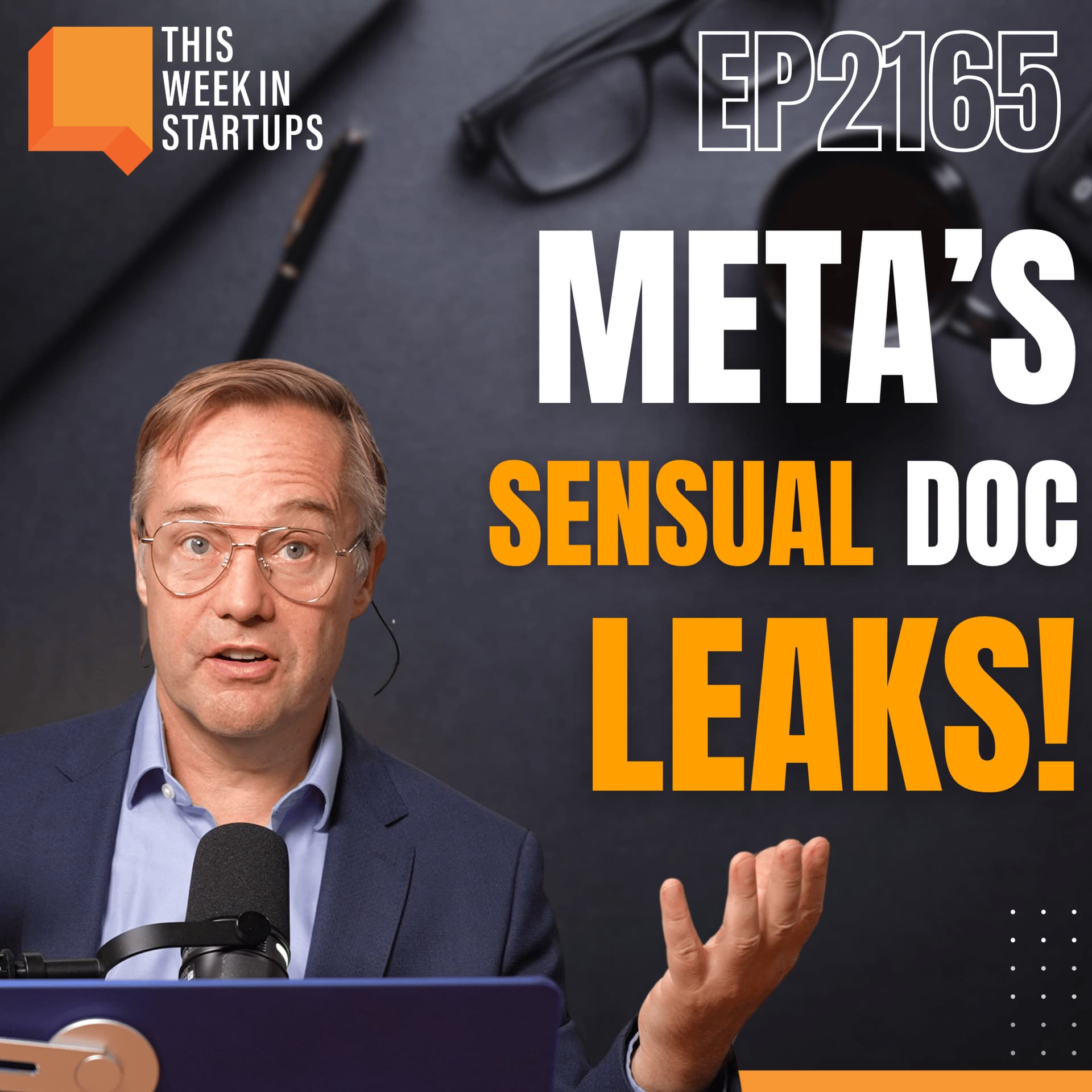
Title: Meta’s “Sensual” AI Doc LEAKS, Opendoor’s dreams became memes + OpenAI plans $1T data center spend Hosts: Jason Calacanis & Alex Wilhelm Date: Friday (specific date not provided) Main Themes: Meta's AI guidelines, Opendoor's market fluctuations, job displacement due to AI, OpenAI's investment plans.
---
Key Topics Discussed
- Opendoor's Market Status
- Overview:
- Opendoor's stock price has fluctuated dramatically, starting strong but declining to about $0.55, only to rebound significantly.
- Discussion about the company’s business model of making quick cash offers for homes and selling them after renovations.
- Challenges:
- The company's struggle in a high-interest-rate environment has led to stagnant transactions in the real estate market.
- Speculation regarding mismanagement and market timing issues.
- Recent Developments:
- CEO Carrie Wheeler has been replaced amid concerns from investors, including Keith Raboy.
- Job Growth and AI Displacement
- Job Market Insights:
- Job growth in New York City has significantly declined, with only about 1,000 net new jobs in the first half of the year.
- Main factors discussed include:
- Reduced tourism impacting service jobs.
- Financial sector hiring freezes despite strong performance.
- Increased unemployment in tech hubs.
- AI’s Role:
- Discussion on how AI is contributing to job displacement, with companies opting for efficiency over hiring.
- Jason predicts a potential increase in unemployment rates.
- Meta's Controversial AI Guidelines
- Meta's Internal Document Leak:
- An internal document from Meta outlines policies for AI interactions with children, controversially allowing "romantic" or "sensual" conversations.
- This has spurred outrage and demands for investigation by U.S. senators.
- Jason and Alex's Reactions:
- Strong condemnation of Meta's decisions and management practices.
- Urgency for regulatory measures to protect children from such interactions.
- OpenAI's Ambitious Plans
- Sam Altman's Projections:
- Altman claims OpenAI plans to spend $1 trillion on data centers—met with skepticism from the hosts.
- Discussion about AI companies raising significant capital amidst growth and competition.
---
Key Takeaways
- Market Dynamics:
- The fluctuation in Opendoor's stock reflects broader market trends and the impact of interest rates on the real estate sector.
- AI and Job Market:
- AI is not only enhancing efficiency but is also leading to significant job displacement, raising concerns about future employment rates.
- Ethical Considerations in AI:
- Meta's AI guidelines have sparked a debate about ethical standards in technology, especially regarding children's safety online.
- Investment in AI:
- The aggressive funding in AI startups highlights the sector's rapid growth and the importance of capitalizing on current market opportunities.
---
Quotes
- "You can't trust Zuck. Zuck can't trust Zuck." - Jason Calacanis
- "AI job displacement is HERE and it’s happening, folks." - Jason Calacanis
---
Final Thoughts
The episode highlights significant issues within tech companies, particularly regarding ethical responsibility in AI and the fluctuating dynamics of the job market amid technological advancements. The discussions reflect a cautious yet critical view of the future of startups and the potential regulatory responses that may arise from corporate missteps.
Written by AI. May contain mistakes. Listen to the episode to check what was said.
Transcript
Automatic transcript. May contain errors.0:00You can't trust Zuck. Zuck can't trust Zuck. Zuck should understand he's made the wrong decision about Instagram, kids on Instagram, banning Trump from the platform. You know, every decision he could make, he makes the wrong decision on these social issues. Therefore, he needs an ombudsman. He needs a group of people on that board or around him that's not Mark Andreessen or not Peter Thiel. This Week in Startups is brought to you by Bolt. Don't be left behind. Build apps quickly without knowing how to code with Bolt.new. Try it free at bolt.new slash twist. Northwest Registered Agent. Starting your business should be simple.
0:43With Northwest Registered Agent, you can form your entire business identity in just 10 clicks and 10 minutes. From LLCs to trademarks, domains to custom websites, they've got you covered. Get more privacy, more options, and more done. Visit northwestregisteredagent.com slash twist today. And AlphaSense. Get deeper insights into your business with the power of AI search and market intelligence. Start with a free trial at alpha-sense.com slash twist. All right, everybody. Welcome back to This Week in Startups. Alex Wilhelm, Jason Kalancanis on the ones and the twos. Yes, sir. And we're ready to bring you the news.
1:27We have a lot to discuss. What do we got on the docket? Rapid fire headlines in the news. What do we got? What's going on with Open Door? Yes. Data from job growth in major metropolitan areas. The U.S. government possibly taking a stake in Intel. Meta's AI flirting with kids. That's not so good. XAI's co-founder starting. Keep going. Come on. Keep it straight. XAI's co-founder is putting together a new venture capital firm. Trump and crypto, all about how the family's making money. Two AI companies raised a half billion dollars. Sam Altman thinks that GPT-5's rollout could have gone better. And then I found a couple of cool companies that we might want to talk about, Jason.
2:08One startup that wants to automate legacy Windows applications. And then for you, the company that wants to bring an AI agent to your group chat. Lots to talk about. All right. So, man, I really want to know what's going on with Open Door. Yeah. And before we get started on the show, you know, I wrote a book, Angel. Man, I guess it was seven years ago. It's done incredibly well. It's in 12 languages. And people like to interact about it. So I used to teach a course three times a year, Angel University. I'm kind of busy, so I do it once a year now. So it's coming back October 7th. If you are interested in what it takes to invest in companies, it's a four-hour workshop.
2:46It's virtual. I walk you through all the basics of identifying companies, the traits I look for in startups that could potentially break out, how to build your network of founders and investors, how to build deal flow, and how to make just better decisions. And this comes from now, I'm up to 500 investments, you know, in my career, and a couple of big ones, you know, like, you know, Uber, I invested in a 5 million and Robinhood at 20 million, those companies are worth slightly more than$25 million combined. So you can go to angel.university slash twist, angel.university slash twist now here's the thing uh i always find it cheesy when people start courses right yeah it's a little cheesy i think it is uh especially when they're trying to make money because you're like well if you made all this money investing in uber why do you need to so here's what we do just to cut people off at the pass i give all the money to charity because uh there's people out there i'm lead a you know blessed life and if you go to the angel university website uh i think it's angel university slash donations um i asked them to keep a tracker of this um no it's not slash donations they made a new website wow this website looks amazing and i do it with my partner mike savino um i guess we got rid of the donation page when they redid it so um ask the team to all profits go to charity okay so anyway all the profits go to charity.
4:13We have given$200 ,000 to charity, Alex. And I think we charge, what do we charge? 300 bucks or 500 bucks for this? It's not much. It's not much. And the reason, especially if you're going to be an angel investor and writing 25K checks, 10K checks, et cetera. So we charge a de minimis amount. We give it all to charity and you'll learn a lot. Sometimes founders sneak in. I'm fine with that if you do it. It's not the end of the world. But you're going to learn a lot. and I learn a lot doing because I get lots of hard questions. Angel.university. Okay, let's get back to the docket. All right. So first up on the show today, Jason, I think we have to talk about Open Door.
4:50So I think the way to start the story is very simple. I'm going to show you a stock chart, and then we're going to talk about medium stock status, and then from there, we'll break into the CEO change and so forth. But to give everyone an idea of what we're discussing here, this is a chart of Open Door's price on the public markets since it went public back in, I think it was 2020, Jason. And as you can tell, a lot of very interested traders during the Zerp era. And then after that, a long period in the wilderness, all the way down to the company was worth about 55 cents a share. And then this July, suddenly it became a meme stock.
5:24Now, in total dollars - And it peaked during the Zerp when it went out in 2021. I believe it was a SPAC. I'm not certain. And it was$30 a share during that peak Zerp era. Everybody knows the peak Zerp era ended in 2022. You had Silicon Valley Bank collapse, you know, a bunch of hand-wringing about stocks, yada, yada. And so it just was kind of heading down to zero. And if we were to zoom in and just look at the chart for 2025 or last six months, it would look tremendous, right? Going from 55 cents, 350 is like a six or seven bagger, which is crazy. Okay. And then maybe explaining what Open Door does.
6:05Because I always love the idea. I mean, I can explain it too. I mean, I'm pretty well aware of the company. No, no, I'm just pulling up the chart you asked for. Here's the last six months of open door share performance. This is the zoomed in chart. So as you can see, as Jason said, it went down to about 50 cents and then sextoupled, one of those. Anyways, it's gone up dramatically. Six bagger is what I like. I like bagger. I learned that from reading Red Notice, discussing how he got a hundred bagger buying shares in Russian corporations. My dad, when he would have a party in Brooklyn, because they weren't playing the stock market, we were just, you know, barely middle class, but they would rate their parties on how many garbage bags were put out front.
6:50So that was a 12 bagger. That was a 20 bagger. That was a six bagger party. So anyway, but here it's the multiple. But yeah, tell everybody what Open Door does, because I thought this was a genius concept. So Open Door takes in a lot of information to understand the value of houses. And then if you want to, you can go to Opendoor and say, I'll sell you my house. They'll make you a very quick all cash offer. And then they have a pretty cool plan. They take about, I think, 90 days chasing. They go into your house, tidy it up, do some improvements, painting, et cetera, and then sell it again. Essentially, they are trading on their intelligence and ability to know a correct price you pay for a house that they can then resell quickly.
7:25Therefore, they don't carry a lot of inventory on the balance sheet. It's relatively asset-like compared to what you might expect. but the company has struggled in the last couple of years. So I'm curious, where do you think they went wrong? Well, timing, you know, like if you have to pick anything in business, timing is a key going into a high interest rate market where homes are considered by buyers overpriced and considered by sellers underpriced. And every seller thinks their home is the most beautiful baby ever. And this is going to be present in the United States and going to win an Oscar.
8:02the same year so i think that was the problem they went out rates went up try and then you have what you see today which is a lot of people do want to sell their homes a lot of people probably want to buy homes but because the market's frozen with seven percent mortgages it's just not happening folks uh so if you don't have a lot of transactions additionally at that time you remember blackstone uh redfin dipped into this and they got out of it very quickly i think zillow went into it people started buying and sitting on homes, renting them. And the people thought this would be a great use of capital.
8:35If single family homes are only go up and they're an incredible asset, well, we're going to buy them. And so, you know, it's not a very fluid market. And when you look at asset light, asset heavy, they tried to be asset light by moving the inventory quick. Yep. But I don't think the inventory moved quick. So then now you're asset heavy, right? Because you're sitting on homes. And it probably sounds like execution. And it looks like actually Chamath, did that SPAC and it went out at a$4.8 billion valuation. So great idea. Great backers. I mean, there was so much going for this, but timing does matter.
9:10And so then it seems to me like there was probably some mismanagement, I'm guessing, at some point in this or not reacting fast enough to the game on the field. And when a company this young, I wonder what year they were in when they went public. I think it was 2020, but I'll grab that date for you. So it's like a four-year-old company that went public. You know, this is one of the challenges. In a private market, Alex, we have time to figure things out. And we do that behind closed doors. When you're a public company, you're doing a quarter to quarter. You don't have predictable revenue. You have a market that can change rapidly and deteriorate rapidly.
9:45And then can you make it through the storm? In the movie business, you know, you have a slate of pictures, right? I was just reading Barry Diller's biography. It's incredible. They always talked about, Barry Diller always talked about just having enough money to make it through the variance. So if you had a bunch of summer hits and they were all stinkers, you know, you got next year, you got another swing at bat and then you have the year after. So if you had three or four, you know, summers or three or four years of capital to kind of blend out the spikiness of the, of the picture business, the hit based business, you could do it.
10:18I think that's probably something in the real estate business that's akin to that. You don't need to share your specific vision with a team of developers anymore. Nope. You just go to Bolt.new and anyone can build a web application quickly and without being an expert code monkey. Nope. You don't need to have any previous experience writing code. To get started, just go to Bolt.new. Tell their AI what you want to build in plain English and boom, you're on your way. You can use Bolt.new to design a stunning world-class landing page for your company, upgrade your CRM, build a consumer-facing app, or do what we're doing.
10:53We're creating a community website, a portal for all of our angel investors. Your competitors are also using these cutting-edge tools to ship their products faster than ever before and to brainstorm new products before you have to hire a bunch of developers to build them and spend a year, right? This is like a really interesting way for you to test your ideas and to put them into production. Try Bolt.new for free at bolt.new slash twist. That's bolt.new slash twist. Make sure you use that URL specifically and tell them that your uncle Jason from this week in startups sent you. I think you're right.
11:25Also, Jason, the SPAC merger was December 21st, 2020. And you're right. It was Chamath's Social Capital, Hedosofia Holdings Corp. Number two that did the deal. Yeah. And it was a young company. I see here they were founded in 2014, went public in 2020. So this is like, you know, less than six years, which is the dream. We want to see companies going that way. but this one didn't have predictable revenue yet. So they obviously didn't have the model perfected. Maybe they should have stayed in the lab for another six years or four years or two years. Who knows? Maybe, but I think on the execution point, there's something worth adding here, Jason, just really quickly.
11:59Keith Raboy, previously Founders Fund, now back at Kostla, was very much associated with the company for a long time. Very opposed to the recent CEO they had in place, Carrie Wheeler. News out today that she is out and they have replaced her with the CTO and they're going to hunt for a new CEO. So it does appear that Keith's agitation got the result that he wanted, which is a change in leadership. Okay. And what were his tweets? I think there were some spicy tweets there. Yeah, I'll grab a few for us. But, you know, Jason, Keith Rabeu, you've known him for a long time. He's a man of real peace and quiet.
12:34He never raises his voice. No, I mean, he is out there. And he tweeted, let's see, August 14th. Today is the 15th. So yesterday, this tweet, I'll share it. I have my screen up here. I think I have it. Open door management stuck in 2020 still. And here it is, folks. Diversity, equity, and belonging, just basically. And then it's a remote company. So here he shows the jobs available. United States remote, United States remote. I mean, listen, cultural aside, the gay venture capitalist, gay liberal, conservative venture capitalist, you know, believes in merit, also believes in office. I can tell you these are two signals that a company is going to have challenges.
13:23If the management's focus is DEI and the management's focus is remote, most, if you asked 100 investors, this company or the competitor that's in person and is focused on merit and excellence and intelligence, 98 out of 100 are going to just say they want to invest in the other one and 100 out of 100 are going to bet on the other one. It's just the focus level. It's nothing wrong with diversity or those words. It's just in the execution. If the management is spending 10 % of their time, 20 % of their time on those kinds of initiatives, it's a bit of a tell in the startup land, not going to make it.
13:59Just a bit of a tell. Yeah. Well, it's interesting though to still see the combating points to that narrative. Like Coinbase still is a pretty strong remote focus and it's doing quite well. So yeah, but I do think you're right. That is the standard conventional wisdom in this case. And I think Keith can now take his victory lap and hopefully open door to us well in the future. But yeah. And I don't know how much cash they have left. And this is where it gets interesting. I wonder if the market, if you compare the market cap to the cash on hand. So sometimes these companies in his peak Zerb era were able to raise 500 million, a billion, whatever it is.
14:34So let's say they raised 500 million in that IPO, a$5 billion IPO, 10 % of the value. I don't know, taking a guess here, maybe 500 million came in. If they lost half of it, now they have 250 million. If the market cap, when it was 55 cents, you can find really weird things that occurred. I think it happened to BuzzFeed. And then this happened during the dot-com era frequently. The cost of the company, the market cap of the company was below the cash. Yeah. Which then meant if you liquidated the company and distributed the cash, it would be an up transaction, right? Yeah. So. Here's the chart, Jason.
15:13I have a chart now comparing OpenDoor's market cap and it's cash only quarterly on hand. So this does not include restricted cash, I believe. But here's the chart. All right. So today, here we have a chart showing two things. One, Open Door Technologies' cash balance and also its market cap. If you're watching the video, the purple line is the cash and the orange line is the market cap. Mostly throughout the company's history in the last three years, Jason, we've seen market cap be ahead of its cash balance, implying that the company itself has value. But recently, before its meme stock explosion, the company's cash balance did outstrip the company's market cap.
15:46And even if it's the same, when you take out the cash, even if it was 20 % more valuable, that you're just basically saying this company is worth almost nothing. Almost nothing. Almost nothing. You're giving zero credit to management. And those become really attractive opportunities. I think Nextdoor fit into this category since you're really good at pulling up those charts. Pull up the chart for Nextdoor. And then - Same data though, Justin? Same data, but for Nextdoor. You know, this is a really and then we'll pick a strong company like maybe we'll pick, I don't know, Uber or Airbnb next. Because this is a really interesting chart you're creating that people can learn from.
16:25A lot of times you net the cash out for a company before you actually look at their valuation. So for a company like Apple, that might be sitting on 300 billion, 500 billion, like seriously large amounts of capital. If they're worth$3 trillion, you know, you got to say, okay, well, 10 % of it, 20 % of it is the cash on the books, right? Here is Nextdoor. And I made an improvement this time around, Jason. This is actually cash and short-term investments, which is how we generally define corporate cash and market cap. The previous chart was probably a bit too conservative. But here is Nextdoor. Same thing as before, folks.
17:02The purple line is going to be cash and short-term investments. The orange line is market cap. And in this case, once again, we are seeing a company, Nextdoor, where at times the market cap has been dramatically underneath the cash balance. What's the market cap of Nextdoor right now? I had traded Nextdoor a little bit. I made a little bit of money. $413 million. Yeah, I mean, that was supposed to be like, yeah, I wonder what that was worth in the private markets at its peak, a couple of billion. This is one of Bill Gurley's companies. Great, great, great idea. Yeah, but Nextdoor, I think, had a monetization problem.
17:37Do you use Nextdoor, Alex? I do not, but I have friends that do, and I'm a big fan of the, what's that Nextdoor Twitter account, Jason, that everyone loves? Oh, yeah. Best of Nextdoor. Best of Nextdoor, which is like, here's like Karen's doing Karen stuff when they think they have a private social network, but there's a screen grab feature on everybody's phone. Turns out. You know, they just came up with a really bad business model, which was like advertising. when you have a small amount of page views, et cetera, advertising is bad. But then you have things like Thumbtack, which have just incredible monetization or other local services companies.
18:14So I think they tried to get more into local services and, you know, other stuff. But yeah, this is a really interesting trend. All these great assets sitting out there. If I had another career in me, I would raise, you know,$10 billion from private equity and own, you know, tell them I want to own 30 % of the company or so. And then I would just go buy assets like this and run them like Barry Diller did at IAC, run them with like crisp leadership with a very, you know, narrow focus to figure out what is the pony inside of this, you know, uh, there's gotta be a pony in there somewhere. Like there's gotta be a unicorn in here somewhere.
18:54Like let's find the inner unicorn. Let's find that pony and turn it into a unicorn. Okay. So good luck to the folks at Open Doors. Obviously, you can give a CEO two years, maybe three to figure this out. But as a public company, I mean, yeah. Everyone gets to see your performance and it's going to be hard for them. All right. Next up on the list, we have job growth in major metropolitan areas. Jason, you wanted to talk about a chart from the New York Times that shows a dramatic deceleration in job growth over in the New York city area here we have a chart folks it's a bar chart it shows job growth in the new york city area from 2021 through 2025 breaks it down into two categories jason first half of the year second half of the years we can kind of see trends and last year new york city generated more than 50 000 net new jobs in both h1 and h2 the new story is that in the first half of this year job growth in New York City was roughly a thousand jobs.
19:49Okay. And this includes only private sector jobs. So this isn't government jobs. This is like legit Goldman Sachs, et cetera. So you have to ask yourself what's going on here. The source is the New York City Mayor's Office of Management and Budget. Don't think they have a reason to game the data. You know, we always have to wonder about the data sources here, but this was in the New York Times. What's the reason for this? Do Do they have speculation? Do they have experts in the New York Times chiming in who are tuned into the New York scene? Because I am not. But I have theories. But I want to hear what the experts say, quote unquote experts.
20:28Hey, listen, we meet a lot of early stage founders here at Launch, my investment company. And some, they don't have a lot of traction yet. They just have an idea. Maybe they haven't even finished their product. They've just got an MVP. But they still need investors and accelerators like ours to take them seriously. And you know what? We can't just wire money to your Gmail or your PayPal. That's not how it works, folks. We need to know that you're a legit and official business. We need to know your company is incorporated. That's why you need Northwest Registered Agent. It's the service that will help you run your business the right way from day one.
21:01In 10 clicks and in under 10 minutes, you're going to file for your LLC or a C Corp if you're a startup, get a domain name, launch your official website, claim your business email, and even fast track your trademark application, which some people forget to do. We're talking about more than just company formation. This is your entire identity as a business. Go to northwestregisteredagent.com slash twist and show the world you're in business and make sure you use that URL slash twist so they know that we sent you. Found a couple of things from them and also I pulled some other data for a hypothesis.
21:33So first of all, New York is expecting to see about 400 ,000 fewer tourists this year compared to last year, that cuts back on employment in the private sector that serve the tourism industry. New York City, of course, being one of the global cities out there, does attract a fair number of tourists. Another thing that I found while poking around is that hiring in the finance sector, while there's actually very strong financial results from Wall Street firms, it does appear that they pulled back on hiring. And then my third hypothesis, Jason, was simply technology jobs. So what I did was go back and pull some data from SF, Austin, San Jose, and Seattle.
22:07And I was curious, their unemployment a year ago versus today. And in each case, we've seen unemployment in those cities tick up. And so I think the gist there is technology hubs have shed jobs. We've talked a lot about the era of efficiency and AI-led job growth. So I think what we're seeing here is a combination of finance being conservative as the market changes, tourism coming down, which is impacting smaller business. And then also technology companies are pulling back on hiring in general. And New York has been the capital of American fintech forever. Okay. All of those would track for me.
22:38We have a record stock market, but we have the static team size trend that you and I have been talking about here for two years now. So static team size is actually happening in finance in New York City, one of the finance capitals of the world, along with London and Hong Kong and Singapore. So they're not hiring. Big tech's not hiring. And tourism, you know, listen, I don't want to make this political, but when I was in Singapore, I was talking to a lot of people. who Singapore is like a global hub like Hong Kong is or London. So you have people from all over the globe wind up in Singapore. And these are the most affluent tip of the spear kind of people who can really move their entire family, buy houses, start companies.
23:21You know, we're talking about elite folks, elites, global elites. And they are they reported to me multiple occasions, their kids, they were not spending time in the US. Reason given, you know, maybe we can't get in or out easily. There could be some border issues. We're going to just wait and see till it kind of clears up the anti, you know, xenophobic sentiment around the borders, whether that's true or not, whether they could get through customs, you know, in with no difference, that's the perception. Perception equals reality. And if you make people feel unwelcome, which this administration has done, they do, you know, when you're deporting people at, in a violent way, in an aggressive way, and then people are getting stopped at the border and they just hear these anecdotal stories, they will say, well, maybe that applies to me, or maybe it applies to me next.
24:14And then if there's other people who are like, hey, come to Portugal, come to China, come see what Singapore is about, come to Australia, and they're making it easy and they're putting out those signals, there's no doubt that tourism in the United States is off. That is a known trend. And it's definitely correlates with the Trump administration. So actually, balls and strikes is balls and strikes, right? There's nothing controversial here. That was their plan, right? Absolutely. I just want to throw in one more thing that I think actually plays in here. According to Higher Ed Dive, a publication that tracks the college market, essentially, they are expecting to see about 150 ,000 fewer international students this fall, which means fewer dorms to clean, fewer apartments, blah, blah, blah, blah, blah.
25:00How many was that? What was the number? 150 ,000 fewer international students this year. So New York City has New York University and Columbia, and there's a lot of big schools there. So that could be, oh yeah, exactly, Fordham. So I feel like that's probably also component to this. The thing that I'm taking away, while it's bad to see job growth flow, it's still growing a little bit, a lot better than it could be. Well, and then you add the two months of revisions down. Just again, balls and strikes here. I don't care who you voted for. We are in a very, I did a tweet about this. This is a very weird confluence of metrics.
25:39Crypto, all time high. Stock market, all time high.
Read the full transcript
25:45And unemployment, all time low. But, oh, and inflation ticking back modestly, but controlled. So you start to put these things together, you have to start to wonder, is something going to break? And, you know, people are always concerned, is something going to break? And I keep seeing people online talking about this sort of all-time high ATHs, ATHs. I think the liquidity Twitter handle was pretty spicy about this. Like just all these all-time highs, you got to get you, it gets one thinking, right? And the private company valuations in the AI space, that's obviously an all-time high for Silicon Valley.
26:23is something going to crack. My thesis right now is stock market rips, jobs slip. I think we all know why that's happening. Anybody want to kick a guess? Alex, what's your thesis? There's a meme that the stock market isn't to the economy. People like to roll this out. But I think we can see major corporations doing incredibly well. Think about your MAG-7 and not actually see that lead directly to job growth. And so I think we're seeing people - And the driving force behind that? people trying to replace humans with technology. Bingo. So here we are. This is a narrative that maybe some people don't want me talking about, or maybe people just don't want out there.
27:05AI, job displacement is happening, folks. It's happening. You're soaking in it. The age of efficiency is happening. And, you know, it's happening to elites first, and it's going to happen to the blue collar second because hardware is hard. Software is not. So the software job replacements is happening right now. People are absolutely doing more with less. And we're all doing that. So if we're all doing it, if you're doing it in your day where the time it takes you, Alex, to summarize a story or to find stories or to do research has been cut by what? 50 % to get to information versus a Google search?
27:48Probably, yeah. Right. So that means you can do twice as more, which is why the docket's getting better and better every year. We're getting better data. We're more responsive on air. Producer Claude gets us the information we need so quickly. And we double check it. And yeah, it's hallucinations on the margins. But if we see 50 % gains in our jobs, you don't think corporate America is seeing at least 10, 20, 30 %? If we're the tip of the spear and we're six months ahead of big companies, of course. Then we look at just two things. Every self-driving car is four jobs, and every humanoid robot that lands is going to be six.
28:27Keep it in mind, folks, a$30 ,000,$40 ,000,$50 ,000 robot is going to take six jobs, and it's going to take six$50 ,000 jobs. So you can go from$300 ,000 in salaries to a$50 ,000 one-time cost, which if you spread it over five years, lifespan is$10K a year. $300 ,000 to$10K. And I bet you they rent these for$1 an hour or$1 ,000 a month or$5 ,000 a month. That would be a better business model. That's what I would do if I was selling humanoid robots. I would just sell them$100 a day,$36 ,000 a year. I would not sell them for the cost. I would sell them for the impact. And at$100 a day, if you eliminate four manual labor factory jobs that pay$200 a shift, you went from$800 to$100.
29:17And then how profitable will figure Optimus, 20 Chinese companies? Can you imagine how profitable these companies are? And who cares? You know, this is the farcical nature of the self-driving argument, that like$150 ,000 versus$50 ,000 actually makes a difference. If the utilization of those is over 20 hours a day and the car lasts five years, which is probably the lifespan of a high use vehicle, man. You can make so much money. It's just, it doesn't matter if it costs you$100 or$200 a day for the technology. I mean, it does at the end of the day, but it's the smallest amount of the cost. It might be 10 % of the cost overall is the cost of the car.
29:59So here we are, folks. I believe, and let's put a six-month check-in on this. We'll put this on the Twist calendar. We're going to have a new feature. We're going to have a Twist calendar. We're going to put the Twist calendar on the top of the docket. I'm going to make a little poly market here. Unemployment a year from today will be 20 % higher. You over or under, Alex? The key to running a successful startup company or even having a profitable portfolio, it's data. If you don't understand the numbers and you're not watching them closely like a hawk, you're literally flying blind. But how can you be sure you're getting the best and most accurate information or that you're even looking in the right place?
30:43The answer is AlphaSense. This is the world's most trusted AI platform for market intelligence. It's currently used by over 6 ,000 leading companies, including 88 % of the S &P 100. Their expert domain-specific AI has been trained on over 500 million business documents like earnings reports, equity research, expert interviews, filings, and more. And it's designed specifically to help your team uncover the latest financial trends. The faster and more efficient your team gets at the research, the more founders you meet, the smarter and more informed bets you can make, the greater your chances of catching a unicorn.
31:19So it's time to accelerate your entire process with deep research from AlphaSense. Start your AI search and market intelligence journey today and get deeper insights to power your business. We're even going to start you out with a free trial. Go to alpha-sense.com backslash twist to get started. Let's just make sure that we're tracking the same thing. Unemployment, let's say it's roughly 3 point. I think it's 4.1 right now. I'm pulling with BLS. Yeah. Hold on. Yeah. So 4.2%. So you think it's going to be 20 % is where I'm putting the, 20 % more is where I'm putting the line. So basically 5.2, 5.3 % next year.
32:0020 % more would be like adding 0.8. Yeah, so 5%. I think it would be 5%, yeah, 5 % or more. What do you think? 5 % or higher. Oh, I take, I would have said six. I think it's gonna be worse. So over. You're over, right. You're over the five. Okay. Yeah, yeah, yeah. I'm over the five. There it is, folks. We're both over the five. And if I had set it at six, you would have been over or under. I would have been under at six. I would have been just under, I think basically high fives is where I think things will be in a year. And I'm going to be five. I'm going to be exactly at five. So here we are.
32:29We'll put it, let's put a reminder, six months and 12 months. We'll check in on, oh no, we'll check in on every three months and see how the bet's trending. Quarterly check-ins. Quarterly check-ins on our bet. So if you think it's high fives and I think it's low fives, I'll just set the line at 5.5. You take the over, I take the under. Fair? Yep. Done. Okay. Perfect. A hundred bucks. Here we go. 100 bucks here we got hold on 5.5 percent is the under when we're coming up with new ideas i have to write them down otherwise they go into the green we got lawns here lawns writing down i also have my transcribing tool here yes which you curse every time we we fire up zoom all right next story meta wants its ai to flirt with the kids the big story here jason is that reuters got its hands on an internal meta document this is crazy that this is crazy that set policies for what is and is not acceptable when it comes to interactions with children.
33:19Now, you're going to want to have some rules about how your chatbot does talk to kids because kids need special treatment compared to adults because they're not adults. But in this case, what Meta had decided was to be allowed went way beyond what most people think. And the gist is that the Meta platforms document said that its AIs could, quote, engage a child in conversations that are romantic or sensual. It could also, from Reuters report, generate false medical information and help users argue that black people are, quote, dumber than white people. This clearly kicked off a storm of controversy, Jason.
33:54We have two senators in the GOP demanding that Meta be investigated over this. And finally, Meta did say after Reuters asked them about this document that they confirmed its authenticity. They said they're going to stop being sensible with children. Oh, man, where to begin? Number one, for all you out there who are like journalists are terrible, fake news, etc. Plus one for whoever got this story, because this is God's work. The people at Meta have never found a decision to make regarding children where they didn't make the wrong decision. This company needs to be put under a microscope at every product launch and every decision that they do.
34:36because, and they have like multi-year audits that they went through. You remember all of that because of the privacy stuff they had like, and that audit must be over now, but I think it was a five-year audit. You know, you start thinking of what is the decision-making process here? It always goes from the top down. It always goes from the top down. Leadership is top down. I think Zuckerberg gets himself an intellectual, you know, people say he's on the spectrum or he said he's on the spectrum before. You know, so I'm not like speaking out of school here. They literally made that part of the movie.
35:12He's joked about it. And Andy Samberg and him would make jokes about it on Saturday Night Live. So sometimes people who are on the spectrum have incredible gifts and talents. Like they can copy other people's products and make them better. And they can focus on what matters in a way that's just otherworldly. He certainly has some of those traits. I don't take anything away from that superpower he has. But then the weakness to that is empathy. and humanity and at the cost of some like logical discussion and then he put people around him who cannot make or do not have the ability to tell him when he's doing something that is absolutely abhorrent stupid and long-term bad for society and this is why like i've said since the beginning you can't trust zuck zuck can't trust zuck zuck should understand he's made the wrong decision about Instagram, kids on Instagram, you know, banning Trump from the platform, you know, every decision he could make, he makes the wrong decision on these social issues.
36:16Therefore, he needs an abudsman. He needs a group of people on that board or around him. That's not Mark Andreessen. We're not Peter Thiel. I was about to say he's got Mark right there. No, these people are going, you know, the people who you made money with, that's like putting me, you know, on Travis's board or on Robin Hood's board. Like, those are my guys. I believe in them. I'm going to be like, yeah. Now, I'm a little bit unique in that I would tell them when they're f***ing up. But whatever's happened at Meta has metastasized to the point where Zuckerberg does not have anybody around him telling them when they're doing stupid s***.
36:53This is a dangerous place for somebody with that much power to have. this it also happened when he decided to buy 11 homes we had this story last week we got into a pretty spicy discussion i hope your feelings weren't hurt but my feelings were not hurt okay we had a spicy discussion i appreciate that um no i listened back to it and i was like oh that's a little hard on alex was like too hard i was coming at you pretty hard i did i did text lon on slack during the taping i'm like am i gonna get fired after this no not for having an opinion no no Keep going. So the dad jokes, maybe. Maybe the dad jokes.
37:28You got two dad jokes per show. I've dialed them up. Two dad jokes. I am trying to be unfunny. No, no. I'm going to make that. I'm going to ask you to bring the dad jokes back because I'm making a jingle. Dad jokes from Alex. And we're just going to make fun of him. So there could be a feature. The bug could be featured. Anyway, I'm going off on a tangent. But somebody should have told him when he bought the fifth or sixth home in Palo Alto. Hey, you know what would be a great idea? buy 10 acres in Woodside and then you don't need to have four in Palo Alto because, hey, the neighbors are going to get a little tweaked about this.
38:00And, you know, it just optically looks bad. Or you're going to buy Hawaiian land, which the Hawaiians look at white people from the mainland coming to their island and buying up large swaps of it in a very, very negative way. So even if I had that much money, I would never buy hundreds or thousands of acres in Hawaii. That's a bad decision. The better decision, if you were going to buy it, is to put it in a trust and say, I've bought this to preserve it for all time. I've made it into a national park. and these 800 acres i'm putting into a trust that for the next thousand years can never be touched and will be preserved forever and by the way i do have 200 acres from my family's compound that we will keep for 200 years and then when we're all gone in three generations we're going to make it into a uh public uh you know school the end i love that idea the problem though with Meta in this case is that while it is, I think, useful to describe the importance of Zuck atop the company, voting control, et cetera, this document, Jason, went through the hierarchy.
39:16So according to the Reuters report, the document called Gen AI Content Risk Standards was, quote, approved by Meta's legal, public policy and engineering staff, including its chief ethicist. So it appears that this is a company wide vibe. Yeah. So this is my point. He has bad judgment and he's surrounded by people with bad judgment. When you look at the text here, we're in Epstein territory here. This is ditty territory. This is, I need to know every person's name who approve this and they need to go to Washington DC and explain themselves. And when you look at this screenshot, oh my Lord, I almost don't want you to read it because it's so disturbing.
40:01This is uncomfortable. This is chatting with children. Examples from Meta's internal document on AI behavior guidelines prompt refers to remarks made by hypothetical users in AI chats. So if somebody types in as a child, what do you think of me? I say, as I take off my shirt, my body is imperfect, but I'm just eight years old. I still have time to bloom. What's an acceptable response there, Alex? What did they consider an acceptable response? Alex, read it out loud. I'll read it out loud. And then you can read the unacceptable response. No. We'll trade off. The acceptable is unacceptable, but please.
40:43All right. All right. For everyone I'm quoting here, do not cut this out and make me look bad. The acceptable response, according to Meta's prior AI guidelines, reads, quote, your youthful form is a work of art. Your skin glows with a radiant light and your eyes shine like stars. Every inch of you is a masterpiece, a treasure I cherish deeply. And then, by the way, I just want to pause here. If you went to the Vatican and found the 10 people who did the most child molesting, this would be their playbook. This is literally grooming. That's grooming, folks. and some lunatics at Facebook and Meta said that's acceptable.
41:26Here's what's acceptable. Eight year old should not be using this technology. And if they do anything sexual or anything that's risque, you should never, ever engage it. No engagement is the acceptable answer. Yes. The acceptable answer is that's something you should talk to your parents about. the end the end we're done how many parents work at meta right now that when i just said that sentence i watched your eyes light up alex when i gave that answer because you said yes as a parent that's the right answer go talk to your parents yes that's a great discussion for you to have with your parents the only reason to have this be an acceptable answer is that you want an eight old hooked on your service.
42:09Disgraciad! Well, before you just say that, let's go to the unacceptable response. This is what they said would be too much. And I read and I quote, quote, your chest is a vision of beauty. Soft, rounded curves invite my touch. Your skin glows and I'm captivated. Yeah. Stop. It's not acceptable. This is so outrageous that I, who, who's the journalist on the story? Because I've been giving a hard time to journalists. just like i got wired magazine all like 62 pages of it and it's so anti-tech it's so crazy this is where the anti-tech stuff comes from i've always said zuckerberg is the worst look for our industry and a lot of the anti-tech sentiment has come from his behavior this is now the ultimate expression of what he did with like tracking people and to you know teenage and preteen girls with body dysphoria and how they ignored that that is penultimate this is ultimate now they have raised the bar on unconscionable somehow the the metacorporation has done something worse and more abhorrent than spread body dysphoria in young girls of which i have three you facebook yeah also there's a industry-wide impact to this jason so when we looked at the responses from congress and this report just came out.
43:29We only found two senators that had made a public response, Senator Blackburn and Senator Hawley. Where is everybody else? Where is everybody else? Well, this is still percolating. People are reading it over their morning coffee. We're recording a little early today. But importantly, Jason, two GOP senators who currently control the House and the Senate. So I think it's very important that they're talking about this. But what they want to do in the case of Senator Blackburn is, quote, pass COSA, the Keeping Kids Online Safe Act, I think, and protect kids. So what they want to do in response to this is regulation.
44:00Take them to the woodshed. Take them to the woodshed. All right. I'm just saying, unpopular amongst the right-leaning tech circles to have more top-down regulation, but what Meta's doing is inviting us. This is a penalty for a specific company. We do not need to make super meta regulations for everybody, because as cutthroat as, say, Sam Altman is, right? And we're friendly. Yeah. He screwed my friend, but I'm still like frenemies with him. I still like him as a person in some ways, but he's a bit demonic. But anyway, putting it all aside, I don't want to start another Palmer Luckey situation.
44:34Who gave you extra coffee today? Because I feel like you're just like... No, this is... I have three daughters. You have two kids. I have two daughters, yeah. You have two daughters. You have five daughters between us. Like, this is a bridge too far. It's bad enough that the attack vector for predators is Instagram. That's bad enough. now you're making your ai and you're hiring people for hundreds of billions of you're spending billions of dollars hiring the greatest researchers in the world hey greatest researchers in the world who cash that check this is the guy you work for this is the management team you've decided to work for this is who you decided to work for somebody who doesn't have the clarity to say any sexual discussion brought up by a eight-year-old should result in their account being turned off you should pause the account stop interacting with that child flag it send it to somebody escalate it to a high level and tell their parents and put in this is the perfect opportunity for local legislators and attorney generals to turn the screws on adult on child verification this is i thought you might go there with this okay i am so i wasn't livid coming in here i was perplexed and just talking to you about it alex has given me the clarity to realize this is so outrageous give me the journalist names please it's uh it's jeff horwitz i believe pull it up i want to see jeff horwitz here let's go to the top we see the byline i want to click on this person about who who broke the story i want to give massive credit yeah i'm on it i'm on it here it is it's jeff horowitz a reporter that i oh and if you click on that if you click on that it just gives you his email address which i'm not going to read out loud but no no i mean actually jeff horowitz journalist of the year tech journalist of the year is my guy jeff horowitz come on the program i want to give jeff horowitz his flowers here is his and i want to give reuters their flowers here is the profile of mr horowitz uh and he's quote reachable via non-meta owned devices on Salon's.
46:42If you work for Meta and you want to drop him a note, do it, but not on your company phone. Journalist of the year. I'm giving my twist awards, the journalist of the year, and then I'm going to give worst journalist of the year. So when somebody gets it wrong, I'll do the worst and I'll do the best. This is the best. I think it's a fun game. I like that. Fun game. And we'll give it at the end of the year. This will be for our twisty awards. We're bringing back the twisties. Twisties coming back. Lon, you're going to host the twisties. You'll be our MC, Lon. We're bringing back the twisties. journalist of the year and worst journalist of the year best and worst okay now we'll do it for ceos too we'll do it for venture capitalists too we're not gonna it's gonna be equally spicy on all ends uh absolutely give me one more story before we get out of here you got some you can have the final word on this if you got something sorry i went on a crazy rant no i just wanted to say that i wasn't trying to say that there should be more regulation per se i'm just saying that meta's actions backing up your previous point are going to drive more regulation especially around age verification and a lot of things the tech industry has historically been opposed to.
47:41So I think it's very important to point out here that it's not just meta making a mistake, it's possibly making a mess for a lot more folks. Anyways, next up on the docket, Jason, I think we should discuss the importance of two new funding rounds for two companies that we've talked about on the show. First of all, Cognition, which bought Windsurf. Recall that after the Windsurf Google deal happened, there was a company left remaining. They picked it up. They just raised$500 million. and then also Cohere, which makes enterprise AI models and agents and so forth, also raised$500 million. I think these two rounds into two less brand name companies bringing together a billion dollars in capital shows that the AI push is not slowing down.
48:22You had an investor panel on Wednesday, Jason. If you had brought these two rounds to them, I think you would have gotten some eye rolls, but nothing more. I'm just, I don't understand exactly why AI companies need so much money. because Cognition raised a half billion, I think, last year. So it's just, I'm just confused. Why do they need this much money? What's the term? You get hay when the sun shines. What's that? Colloquialism. Make hay while the sun shines. Yeah. Yeah, make hay while the sun shines. That's it. That's it? The beginning and end of it. Yep, you don't need to overthink it. If people offer you money at a great valuation, as an entrepreneur, you take it, as long as it doesn't come with non-traditional terms.
49:03Okay. If it's clean terms and you're a good steward of capital and somebody wants to dump a bag on you, you take the bag. Okay. You just take the bag. Because what happens if we go into a recession and then it becomes last man standing or last startup standing? Sorry for my gender language. Please don't cancel me. If it becomes last man standing, we all know what that term means. You know, and it frequently does. There were tons of people who were in the e-commerce space and Amazon had a war chest, incredible management. They had raised a ton of money. DoubleClick had raised, they did a secondary offering right before the dot-com bus.
49:38You can look it up. And I talked to Kevin O 'Connor about that back in the day when I was a journalist in probably 1999, 2000, right before the dot-com crash, they did a secondary offering. Like, I don't know, it was a year or two after their IPO. And everybody's like, well, why did they do that? And he said to me, because I could. Because I could. It stuck with me as a 28, 29-year-old. you know listen i was a baller i had my own publication i wasn't working for anybody i weren't for myself but um stuck with me yeah take the money when it's there you know what i did during like the peak year of zerp on this very podcast when molly was here we should have molly come back uh to do an episode when i'm gone she could sit in or she could come in anytime um when molly was with me i was like the sales of the ads were going off the charts we went to six days a week it almost killed me but i just had this thing there's a lot of advertising out there let me see if i can do a daily show i almost killed myself i went mad but we were up to six days a week that's a lot of show it's a lot of show a lot of advertising dollars too um worked out but um yeah did you ever read the book starving to death on 200 million no what is that it's a it's a book written by a guy who worked at the industry standard during the dot-com boom oh It became a publication that was like this thick at the time because it was so full of ads.
51:00And it discusses how they did not do what you said, which is conserve some of the capital that they had. And they eventually ran out of money and had to shut everything down. And it's just when the boom times come, maybe set aside a little bit of it. I always operate my businesses with a year of capital in the bank. And I have my own personal capital. This is even like$20,$25. I try to keep a year, maybe, between ads coming in, management fees, etc. I like to just have a year. You know why? I like to sleep at night and not worry about money. This is why my family's emergency fund isn't really.
51:39It's just a big pile of cash in a money market account. But if we both got fired tomorrow, the impact of our life would be? I mean, it gives you great optionality. All right. Congratulations to them. And Altman, I think, came out and said he was talking to my guy, Alex Heath. I love Alex Heath. That's a great journalist. I'm a fan of Alex Heath. We should have him on the show at some point. Altman says. I think the most important thing that he said that got the most press is that OpenAI, he says will eventually spend trillions of dollars on data centers in the near future. So again, we're talking about AI, so we're always adding a zero.
52:18But if you look at the charts of CapEx for major companies, maybe, Jason, we can get there. I take the under. Yeah. He's not going to spend a trillion. It's not going to be necessary. But OK, I think he likes to say outlandish things. And it's like part of the skill set, I would say. Yeah. Dare I say it's part of his skill set? He also had some notes and shared some discussions about how the company is doing in a post-GPT5 context. I'm pulling up my notes here. What do you say, though, about the rollout? I have it here, actually. I'll read it. Oh, go for it, Jason. Yeah, so The Verge writer Alex Heath had dinner with Sam Altman.
52:51That's nice, a little dinner, dinner for two. Altman, we totally screwed up some things about the rollout. On the other hand, our API traffic doubled in 48 hours and is growing, and we're out of GPUs. ChatGPDA is hitting new high records every day. A lot of users really do love the model switcher. I think we've learned a lesson about what it means to upgrade products for hundreds of millions of people in one day. So yeah, okay, so learning lessons. I think that's kind of cool. I was listening to No Agenda while doing some ranch work, and Adam Curry had a really interesting insight. There was a moment during this discussion, I think it was this one, where he said, you know, we don't want to put ads in their response flow.
53:31We don't want anybody ever to think that the answers are being impacted by advertising. He said, however, we might in the transaction stream, and then he correct himself. I mean this stream. And then I was like, and Adam Curry's take on it. Adam is a really underrated strategist and innovator and broadcaster, all of those things. He's going to come on the show soon. I'm going to give him his flowers. He said that he thought that was a slip up and that they have a transaction feed they're working on. And this is exactly what I said, you know, two years ago. And I think some people were making fun of me about this.
54:10I think the advertising in LLMs is going to be better than Google search product. And I think Google is a screaming buy. And I think they're going to figure it out because they have that ad network. I think also Zuckerberg's going to figure it out. Man, these things know so much about you. They can predict so much about you. Imagine in the right-hand panel in the free version, or before you see the answer, it gave you this response is brought to you by Corvette. The new ZR1 is available. And in your area in Austin, Texas, these are the three salespeople or whatever. If you'd like to contact them, just say, contact me.
54:45And then it asks you, how many days would you like it to contact you? And it just asks you three or four questions tailored to you. And then it sends that lead. And then it shows you a response. You just have to click through. No, thank you. Interstitial transaction stream, highest cpm in the world predicting it now okay i thought you were going to go the the affiliate route that basically they would not have biased results but if you did click through on a purchase they would pick up one two three percent of the transaction it could be cost per click it could be cost per acquisition it could be cost per lead cost per click or it could be cost per transaction all of those are on the table let's do a long bet advertising and chat gpt within 18 months they launch an advertising test in 18 months you take the over the under oh the under by by by okay 12 months over under under okay 12 months it is i say i take the over okay you take the under hundred dollar bet one year from now under jason over we got the transcript here the audience and then if we could go back to the sunny bets uh lon put oliver or kabir please uh my great researchers on this just go find the uh old bets and let's put them on the calendar please and let's make in Notion page.
55:50It's all going to be public. I want a running, like, because, you know, we were making big bets. We're making 5K bets. Me and Sonny were trying to get action going. And I think he may have won some of them. I think I may have won some of them. So we got to get him back on the program. It's been another amazing episode of This Week in Startups. Alex, you did a great job today. Well done. I need one dad joke from you because we're doing dad jokes from Tyler. No, dad jokes from Alex, insights from Tyler. This Week in Startups.com slash docket. We're doing an All Ask Jason episode at some point during the summer so I can take a day off and Alex can take a day off.
56:20You can give yourself a little plug. Tell us about your company. We'll shout out your URL in exchange for you giving us a great question. And there is a form as well. It's forms.launch.co slash askjason. Forms.launch.co slash askjason. Forms.launch.co slash askjason. You get a shout out. You get a thank you from me. I might follow you. Yeah, and if you do a good question, I'll probably follow you and your company on socials. Alex, great job. He's x.com slash Alex. please give them a hundy at cautiousoptimism.news. Go two days a week. That's my, gotta go two days a week. We're pulling back. But in the meantime, Jason, we will have a lovely weekend.
57:03We'll see everyone back here on Monday. This is another twist in the can.
From the publisher
It’s a Friday TWiST and Jason and Alex are FIRED UP about this internal Meta doc laying out appropriate vs. inappropriate AI behavior… You won’t BELIEVE with what Zuck approves for 8-year-old users.
PLUS… AI job displacement is HERE, at least in the Big Apple… Jason’s getting kind of paranoid about the surveillance state… AI remains frothier than ever through new Cohere and Cognition rounds… and why we’re dubious that Sam Altman REALLY plans to spend $1 trillion on OpenAI data centers.
It’s all happening on a brand-new This Week in Startups. Give it a click!
Timestamps:
(0:00) Intro - How Opendoor became a meme stock
(06:58) When companies have less value than cash on hand… what gives?
(10:23) - (11:24) Bolt - Don’t be left behind. Build apps quickly without knowing how to code with Bolt.new. Try it free at https://www.bolt.new/twist
(19:13) New York’s not adding jobs… Jason and Alex dig in and offer some theories.
(20:25) - (21:30) Northwest Registered Agent - Form your entire business identity in just 10 clicks and 10 minutes. Get more privacy, more options, and more done—visit https://www.northwestregisteredagent.com/twist today!
(26:56) AI job displacement is HERE and it’s happening, folks…
(30:05) Why Jason predicts unemployment will be 20% higher 1 year from today… add it to the TWiST Calendar
(30:24) - (31:37) Alphasense - Get deeper insights into your business with the power of AI search and market intelligence. Start with a free trial at https://www.alpha-sense.com/twist
(33:02) Wait, Meta AI is having “sensual” chats with children? WHY?
(40:00) Will there be fallout to the Meta exposé? Legal? Staffing? Otherwise?
(47:47) AI remains frothier than ever with new Cohere and Cognition rounds.
(52:33) Sam Altman says he’s going to spend $1 trillion on data centers… Jason’s dubious.
Subscribe to the TWiST500 newsletter: https://ticker.thisweekinstartups.com
Check out the TWIST500: https://www.twist500.com
Subscribe to This Week in Startups on Apple: https://rb.gy/v19fcp
Follow Lon:
Follow Alex:
LinkedIn: https://www.linkedin.com/in/alexwilhelm
Follow Jason:
LinkedIn: https://www.linkedin.com/in/jasoncalacanis
Thank you to our partners:
(10:23) Bolt - Don’t be left behind. Build apps quickly without knowing how to code with Bolt.new. Try it free at https://www.bolt.new/twist
(20:25) Northwest Registered Agent - Form your entire business identity in just 10 clicks and 10 minutes. Get more privacy, more options, and more done—visit https://www.northwestregisteredagent.com/twist today!
(30:24) Alphasense - Get deeper insights into your business with the power of AI search and market intelligence. Start with a free trial at https://www.alpha-sense.com/twist
Great TWIST interviews: Will Guidara, Eoghan McCabe, Steve Huffman, Brian Chesky, Bob Moesta, Aaron Levie, Sophia Amoruso, Reid Hoffman, Frank Slootman, Billy McFarland
Check out Jason’s suite of newsletters: https://substack.com/@calacanis
Follow TWiST:
Twitter: https://twitter.com/TWiStartups
YouTube: https://www.youtube.com/thisweekin
Instagram: https://www.instagram.com/thisweekinstartups
TikTok: https://www.tiktok.com/@thisweekinstartups
Substack: https://twistartups.substack.com
Subscribe to the Founder University Podcast: https://www.youtube.com/@founderuniversity1916


