
In short
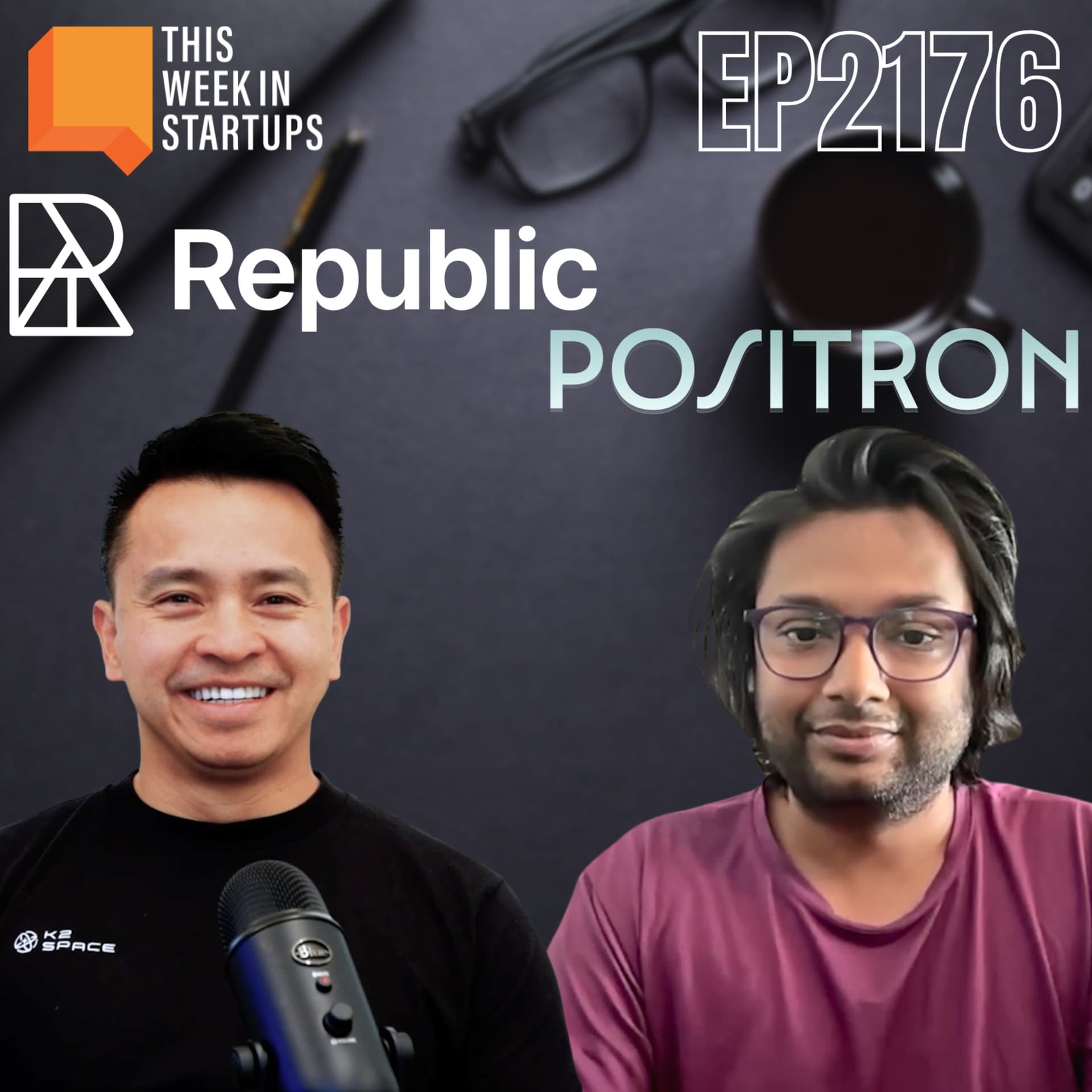
This Week in Startups: Episode E2176 Summary
Podcast Title: This Week in Startups Episode Title: Republic opens private markets as Positron takes on GPUs: A TWiST500 doubleheader! Release Date: [Insert Release Date]
Episode Overview In this episode of "This Week in Startups," Jason Calacanis interviews two innovative companies: Republic and Positron. The discussions center on democratizing private investment and addressing the inefficiencies in AI compute hardware, particularly in relation to GPUs.
---
Key Segments
- Republic: Making Private Markets Accessible
- Guest: Kendrick Nguyen, Co-CEO of Republic
- Overview:
- Republic is a financial crowdfunding platform that has evolved beyond traditional equity crowdfunding to include features like secondary trading and asset tokenization.
- The company aims to democratize finance by allowing everyday investors to participate in previously inaccessible investment opportunities.
Key Points Discussed
- Current State of Crowdfunding:
- Equity crowdfunding has gained traction since the law changed in 2016, allowing non-accredited investors to participate.
- Republic has expanded its offerings and is focused on creating a comprehensive financial infrastructure.
- Republic's Product Offerings:
- Republic Capital: Focused on larger investments from accredited investors.
- Republic Venture: Targets early-stage investments.
- Secondary Trading: Efforts to enable non-accredited investors to trade shares, which is currently constrained by regulations.
- Future Aspirations:
- Kendrick discusses the potential for increasing the crowdfunding cap beyond $5 million and the goal of creating a unified "e-finance" infrastructure.
---
- Positron: Challenging GPU Dominance
- Guest: Mitesh Agrawal, CEO of Positron
- Overview:
- Positron is developing custom chips specifically designed for AI inference workloads, aiming to outperform traditional GPUs in efficiency and power consumption.
Key Points Discussed
- Inefficiencies of GPUs:
- Mitesh highlights that while NVIDIA dominates the GPU market, their chips are not the most efficient for inference workloads due to memory bandwidth limitations.
- Positron's approach utilizes FPGAs to quickly demonstrate their architecture's capabilities.
- Atlas System:
- The Atlas system, currently in production, features eight Archer Accelerator cards and is designed to be energy-efficient and powerful for inference tasks.
- Positron aims to ship thousands of Atlas systems, already securing significant bookings.
- Future Developments:
- The next generation, Asimov, is set to launch in 2026, boasting two terabytes of memory capacity to handle more extensive AI models effectively.
- Mitesh expresses confidence that Positron's architecture will remain relevant and competitive in the evolving AI landscape.
---
Notable Quotes
- Kendrick Nguyen on the future of finance: "I think the true potential, the size of it is something that is to be seen in the months and years ahead."
- Mitesh Agrawal on AI innovation: "We are fundamentally a linear algebra accelerator... the fundamentals of deep learning will be in matrix multiplication."
---
Timestamps
- (0:00) Future insights on intelligence and energy efficiency.
- (2:43) Introduction to Republic and its evolution.
- (12:25) Discussion of Republic’s diverse financial products.
- (25:45) Mitesh discusses Positron’s AI chips.
- (32:22) Examination of Positron's Atlas system performance.
- (42:51) Insights into the shift from AI training to inference workloads.
---
Key Takeaways
- Republic is paving the way for broader investment opportunities while addressing regulatory challenges in private markets.
- Positron is strategically positioned to compete with established GPU manufacturers by focusing on efficiency and specialized design for AI inference.
- The discussions highlight the importance of innovation in both financial technology and AI hardware to ensure accessibility and efficiency in the future.
---
Conclusion This episode of "This Week in Startups" provides valuable insights into the changing landscape of private investment and AI computing hardware. Both Republic and Positron showcase how targeted innovations can disrupt traditional markets and pave the way for more inclusive and efficient solutions.
Written by AI. May contain mistakes. Listen to the episode to check what was said.
Transcript
Automatic transcript. May contain errors.0:00It just strikes me that we're going to have a future that's going to be a little bit more efficient than people think. We're not going to boil all the oceans. We're still going to have power for our appliances. And we're going to have essentially infinite intelligence in our pockets and all of our screens. And to me, that's a pretty exciting future. And we better. We will need to have infinite intelligence. And that's the whole goal. Like, if you ask NVIDIA, if you ask us, if you ask any other silicon company, I think they're all trying to say that, you know, we are approaching it with some different approaches.
0:27But basically, it's like, how can we bring cost per token or cost per generation down so that we can afford to have infinite intelligence while increasing our energy production as much as we can?
0:57Clients and security shouldn't be a deal breaker for startups to win new business. Vanta makes it easy for companies to get a SOC 2 report fast. Get$1 ,000 off for a limited time at vanta.com slash twist. And Oracle. Oracle Cloud Infrastructure, or OCI, is a single platform for your infrastructure, database, application development, and AI needs. Save up to 50 % on your cloud bill at oracle.com slash twist. Hey everybody, welcome back to This Week in Startups. My name is Alex and today I am bringing you two startup interviews. Now, both of these companies share a backer, Valor Equity Partners.
1:38So if you want to know what one venture capital firm sees in the future, well, here is a good look at it. First up, we're going to talk to Republic. You may know them back in the day as an equity crowdfunding platform, but since then it's gotten into quite a lot more activities. A little bit of venture capital, some secondary shares, tokenization of assets, you name it, they're working on it. I care about this company because it's democratizing finance and bringing more investment opportunities to more people. So that way, when my kids are older, well, they're going to have a lot more different things to put their capital into than I did when I was their age.
2:08Then we're going to talk to Positron, another company that wants to build chips for faster and more energy efficient AI inference compute. Given that around the world, we're seeing data centers run into power availability problems, what they are working on could have enormous application, enormous revenues, and also may just challenge NVIDIA a little bit around the edges in the next couple of years. These chats were a lot of fun. I learned a lot. I hope you love them. Let's get into it. Here's Republic. To set the stage, now, making normally out-of-reach assets and investing methods more accessible to everyday investors is big business.
2:42Robinhood grew on the back of zero-cost trading and bringing access to more exotic financial trading tools to regular folks, to pick an example. Now, Republic, in contrast, has long been known for its place in the crowdfunding market. Spun out of AngelList, the company has raised more than$200 million, including a well-known$150 million round in late 2021, led by Valor Equity Partners. Now, in the intervening years, Republic has expanded its feature set far beyond traditional crowdfunding. So to tell us more about the state of alternative investing and where Republic sees our democratized financial world heading, Please welcome to the show, it's Kendrick Nguyen, co-CEO of Republic.
3:19Kendrick, how you doing? Alex, thank you so much for having me. I'm doing fantastic. I also love that we have in your background the, and I say this with nothing but love, the de facto Silicon Valley office. It is standing desks, multiple monitors, and people typing. And that is exactly my happy place. I love to see it. How many folks do you have behind you? You know, maybe about 40 or so, and we're in Silicon Valley. So New York has become quite the tech hub as well. And we're super proud to be here. But our heritage, our roots go all the way back to Silicon Valley a decade ago. So this is off topic, but I'm just curious while I have you here, I'm talking about the geographic split because I'm on the East Coast too.
3:59As the co-CEO of a leading technology startup, do you ever feel that magnetic drag back to San Francisco? Because the way I hear it told, in the AI era, SF has once again regained its primacy as kind of, if you will, the New York City of tech. You know, when we launched Republic back in 2016, Naval Ravikon, my mentor and boss at the time, was like, hey, everyone is, you know, based in or come to Silicon Valley. Why are you looking to move to New York? And my view is twofold. One is that we already have AngelList and San Francisco as the roots, right? That's how I get to know a lot of the VCs from my days at AngelList.
4:39And secondly, if you're building fintech, then I think it's a good thing to be based out of the financial capital of the world. And that's obviously New York City. So in the particular industry that we're in, in the business that we're in, I think that us being headquartered in New York with a lot of trips and events and network back into the valley is a very ideal way, an ideal setup for us. Yeah, I don't even want to know how many frequent flyer miles you've racked up flying to SFO over the years. Okay, but let's get down to brass tacks here. I know Republic. I've known about the company since it was founded.
5:21I've always thought about it as a crowdfunding platform. Clearly, you guys do a lot more, and we'll talk about that in a second. But just to get people caught up, what is the state of crowdfunding today? It was pitched as a way to really break open a lot of private companies for folks. So has it lived up to that potential, and is it still growing? Alex, if I may just define crowdfunding first and foremost, is that is so, you know, it's so broad. Kickstarter is crowdfunding. Indiegogo is crowdfunding. AngelList is crowdfunding, right? You have accredited investor coming in to co-invest in a deal.
5:56Republic only took advantage of a law that changed in 2016 that allowed for anyone, no matter what net worth, what income can come in and back and invest and have equity upside in a wide variety of businesses. So fast forward nearly 10 years now, there's no doubt that the business model has proven to work, not just for early stage tech companies, but late stage movie financing, music financing, crypto, that is digital securities being fractionalized. So I think that we're still in a long first inning this next era, but there's no question that is well on the way. But I think the true potential, the size of it is something that is to be seen in the months and years ahead.
6:47I appreciate the clarification. I probably should have said equity crowdfunding versus crowdfunding writ large. I mean, one of my favorite bands, Archspire, is crowdfunding their next record. That's not the same thing as what we're discussing here. Okay, so fair enough. But there was a change in late 2020 that raised the cap that a company could raise in equity crowdfunding dollar amount from, I think it was, Kendrick, 1.1 million to five. And so I'm curious now, four or five years past that point, what impact did that have on an equity crowdfunding and also on Republic's business. You know, it brings later stage companies because$1 million is still a lot of money, but, you know, for a company that's already in its Series A, Series B, Series C, $5 million as a cap is a little bit more meaningful.
7:32They can engage in bringing more customers, more community members. And, you know, I'm optimistic that cap will continue to go up, you know, to perhaps 20 millions. And even there's been talk in D.C. of potentially expanding it to$100 million and beyond. So again, just the very beginning, but there's no question that currently, as is, we're working with large enterprises across a wide range of sectors and industries who want to engage the public through this regulatory framework in the US. So generally speaking, I'm in favor of the cap going up. I'm curious though, is there a ceiling that you would put on it?
8:14Is there a dollar amount that's probably too big? Or is there no real limit here in your view of how high we should raise that max limit? You know, I am definitely a firm believer in free market to do so sensibly. But I think this arbitrary cap on 5 million or 10 million, I think it's a little bit artificial. I think there are other ways to address, to protect investors' interests rather than arbitrary thresholds. So if it were up to me, I would not put a threshold on it, similar to, you know, under Regulation D or if you're going to go public, you know, for example. Yeah. No, I'm with you on that.
8:54I was curious if there was any technical or hidden risk that I wasn't thinking of, but I'm glad that we're aligned there. Now, equity crowdfunding, one part of the business, clearly not the entire thing. You also have Republic Capital, which I believe has something like 500, 600 million AUM. Is that a traditional venture capital vehicle that I should kind of think of as in competition with a Sequoia? Or does it have a different posture on the market that I should keep in mind? Alex, it's a great question. And allow me to define what we are today. And I think it ties everything in together. The business of Republic is building the infrastructure that can accommodate capital raising and community investing next generation.
9:38What does it mean? It means that the repertory framework to take in non-accredited retail, the ability to accommodate institutional as well to SPV or direct, the ability to do secondary trading, the ability to tokenize and put a whether it's a small business or a, you know, a certain crypto project on a revenue sharing basis on chain. So when we first launched, the first piece was equity crowdfunding. We added on capital and, of course, to generate revenue. We did syndication and other things. But think of it as different components that went all in together and able an enterprise to fractionalize, tokenize, and engage with the retail public globally with liquidity.
10:30That's obviously a very ambitious plan. And it took us 10 years to get to where we are today, which is the first year that we have a completely functional infrastructure for RWA, real asset tokenization, for true retail participation. And we're the only one, as far as I know, in the market that have that complete regulatory framework. Now, we do have, you know, we add on business line, business model. But no, we're not looking to compete with Sequoia. We do SBB. We do syndication. I'm wearing a shirt from one of our portfolio company called K2, but the business requires venture capital. The business of Republic is in financial infrastructure and asset tokenization.
11:16I don't want to ruin your day, but have you taken a look at your cloud computing bill lately? They probably give you some kind of deal to start, but over time, those bills start to add up. Well, our friends over at Oracle Cloud Infrastructure want to help you cut your cloud bill in half. Yes, that's right, 50%, while you're getting better performance at the same time. OCI is a next-generation cloud designed to work with any application, including AI. It's faster, it's more secure, and you can do it for less. We're talking complete cloud infrastructure and services, regardless of your specific setup or workload.
11:51And OCI costs significantly less than other clouds with a span of 50 interconnected cloud regions and more than 150 OCI services apiece. So you can access your cloud from anywhere and keep your prices consistently low worldwide. So join modal Skydance Animation and more innovative AI tech companies who upgraded to OCI and saved. See if you qualify for half off at Oracle.com slash twist. That's Oracle.com slash twist. this offer is only for new US customers with a minimum commitment. Okay. It's almost like you read my notes because that's where I was going to take us after a couple of questions.
12:30So we're going to loop back to the tokenization and the platform element of this. I just wanted to break down the different things you're doing today, and then we'll talk about how they come together. So Republic Capital then is a tool to collect retail and probably family office money and put it into SPVs. Is that the main work that it does? Correct. That you aggregate larger check side from family offices and institutions into SPVs and deploy them into more mature companies. That's typically private equity or venture capital. And that is typically Republic Capital. And then you have a separate product called Republic Venture that is only open to accredited investors.
13:11So not the masses, as it were, but folks that meet a certain test or threshold set by the government. And you and I have probably similar views about that. But I'm curious, can Republic Venture customers invest in the Republic Capital product? Yes. I mean, Republic Venture is just earlier stage deals. And Republic Capital aims at larger check in later stage companies. Again, so you can see within Republic that we have businesses that almost replicate miniature version of the entire ecosystem. In the broader market, you have venture firms, you have PE firms, you have platforms. We have all of these things just so that we then can replicate and change and bring forth the entire financial ecosystem.
14:00And another element that you're bringing forward is secondary trading. You guys purchased Cedars, which is now Republic Europe, and you've also moved into secondary trading. We talk a lot about secondary shares here on Twist because there was the venture liquidity crisis. everyone was desperate to get a little DPI. I'm curious, Kendrick, how big of a business is the secondary trading part of Republic today? Is it large? Is it small? I'm just curious relative to the rest of what you do. Yes. So today's still relatively small. That is, you mentioned Cedars, which is now Republic Europe. That's our UK European side that does both primary and secondary trading.
14:37For example, if you go into Republic Europe, you're going to see Revolut, one of the largest private, you know, neobank out of Europe. You're going to see shares of Revolut being actively traded among non-accredited investor on Republic Europe. In the U.S., the regulatory framework is a lot more complicated. That's why Carter failed at it. That's why Forge and Equity Day and Equity Zen only deal with, you know, high net worth investors. That's why AngelList, there are some secondaries. I mean, I think we did the first one when I was still there and structured it. But that's only for high net worth individuals.
15:15No one has managed to do secondary trading for non-accredited investor in the United States. A company that we are in the process of acquiring called INX. And INX is a very unique set of licenses as an ATS that has the ability to do so. So we're very excited to roll out at scale true secondary trading of private securities for non-accredited investor sometime over the next six months or so. Kendrick, when I hear the acronym ATS, I think applicant tracking system. I presume that's not what it means. So can you define that acronym for us? It's automated trading system. Ah, that makes way more sense.
15:56Notice, you know, in exchange, I think this is just a legal thing. For most people, there's no difference. but regulatory-wise, you call yourself an exchange. You take on certain regulatory obligations. If you call yourself an ATS, which is like an exchange light, then you're under a different regulatory framework. So one, I don't mean to be a spoil sport, but one thing that has always made me a little bit leery of secondary investing is a lack of information. And there seems to be a pretty big disparity at times between what primary investors get in the venture round and what secondary investors may get later on if they purchase their shares on Equity Forge or on Republic, et cetera.
16:37Equity Zen, I guess, or Forge Global. How do you fix that? How do you make sure there's enough information coming out from these companies to allow for a retail investor to take a position in Revolut, for example, without just gambling? Yeah. Alex, this is a great question. First of all, the same information disparity or the lack of or the insufficiency of applies to venture capital, to the traditional private and public market. I'll give you an example. I say investment on AngelList, right? So if you have a doctor coming to AngelList to look at a YC company, information available literally fits on one page.
17:19There's not really a ton more information there. And of course, we trust that that doctor can make the investment sensibly. So about 10 years ago, the SEC and Congress already made a decision that, hey, just because you're not a millionaire, it doesn't mean that you shouldn't be able to participate in the private market. In the same way that, you know, the information on Amazon when you buy a product may be different than if you were to buy a product directly on the company's website. But you've got to trust in the market and in the public to make sensible decisions for themselves. Now, the law does add on a few things.
18:03You know, ATSs and exchanges and broker dealers have the obligation to do their own due diligence and make sure that they introduce things that are suitable for their customers. But I don't think that the public disclosure requirement for the public market to go IPO is some sort of a gold standard that lasts forever. I don't know about you, but I, even though I'm relatively informed and do have a, you know, meaningful public equity portfolio, I can't remember the last time I read a 10K or an 8K or an SEC filing before making an investment in Tesla or Facebook. So at the end. Sure. But Kendrick, you're taking on.
18:43So one, I appreciate the clarity here. This is very useful. But it sounds like you as a company take on a lot of responsibility then to not bring trash, essentially, to your customers. So the due diligence is in some ways mediated by Republic. In a way. So our goal is to make sure that we have the legitimacy lens. And of course, we also apply an additional lens on suitability. But we don't aim, nor is it feasible to say that these are high quality deals and if you invest in hand and you're going to make money online, that's not how the industry works. I do think that market maturation in the phase ahead is through education, onboarding the investor base, and then present legitimate, that is non-fraudulent, ideally companies that don't make misrepresentations and leave it to the general public to make that decision that if they have$1 ,000 to invest, they should invest$15 or$20 in 50 different companies and not putting$1 ,000 in one.
19:52So it's about education and access, not about some curative lens of any one particular firm or fund. Right. You make sure it's a suitable investment and not a clear fraud. But after that, it's up to the people to make their own choices. That's why that makes sense to me.
20:14Work faster isn't just my personal motto. It's the key to success for busy founders everywhere. Startups have always had to move quickly, but even with that pace, that doesn't mean you can ignore security and regulatory requirements. But fear not, there's Vanta. Their AI-powered platform makes it easy to ensure compliance in days and keeps you on top of everything so nothing holds you up today or down the road. Keep moving at startup speed with confidence because Vanta scales with you. With round-the-clock support, in case you run into any problems, they're going to be there for you. Vanta understands your company's needs because they're a fast-moving startup too.
20:51In fact, I'm an investor, and man, that company is growing because they have a great product and they care. Just last month, Vanta added a bunch of new features, including AI-powered questionnaires that help you breeze through vendor security protocols and autonomous penetration testing baked directly into the platform. Twist listeners get$1 ,000 off by going to vanta.com slash twist. That's V-A-N-T-A dot com slash twist for a thousand dollars off. There's a clear parallel to commerce and e-commerce as well. Right. So like 40 years ago, what people purchased, which is basically what was produced and made locally with the advent of e-commerce, Amazon one click purchase.
21:37Now we all buy things online with a magnitude of volume and choices. Many things we don't even need. And I think they've got to be the same lens that applies here, which is when it comes to commerce or investing, you make things accessible. you do require the company to post fair information, but you got to leave it to the general public to decide and participate in shaping the technological and the economy of the future that we're all going to be living in. We could solve this, by the way, by just having greater disclosure requirements for private companies, but that's my own hobby horse. I won't bring that up today.
22:19Okay, now Kendrick, we have to talk about a couple of things here. So there is Republic Note, which is a quote, revenue sharing digital security that allows you to benefit from the economic upside of select Republic portfolio companies. And you also have a tokenization business and a Web3 console business. And my question before you kind of brought this up earlier was going to be, are you eventually going to have a single infrastructure layer that would underpin or undergird each kind of like pillar that we've described at the business? because it seems like you're doing many things that all kind of point in the same direction.
22:55Is that where the company's going? For sure, Alex. It's already that way. So from the technology and legal framework, it's one system. That is the, you know, let's say to do for a company to be traded secondarily, you have to have primary issuance. When you deal with primary issue and you deal with some are non-accredited, some are accredited, some are institutional, some are non-U.S., they require different regulatory accommodation and frameworks to bring them in. So we, over the years, all of these things are part of the same operating system where in the early days we add on distinct business lines only to take in revenue.
23:43But the legal infrastructure and the technical infrastructure is one cohesive one that underpins a wide array of industry. Again, to use, you know, poorly Amazon as an analogy, once you have the e-payment and e-commerce infrastructure, you can sell books, you can sell grocery, you can do movie streaming, wildly different sectors in exactly the same way. It's just that when it comes to finance, it takes a lot longer to build because it's much more regulated. But we are building that e-finance infrastructure similar to Amazon as an e-commerce infrastructure for that work. Kendrick, would a better analogy be you're building the AWS for investing?
24:28Like you're building a base level of like infrastructure to allow a variety of different things to happen on top of it. Yes. Now, but there are different components. I think when I think of AWS, I think just like storage. In this one case, when you talk about investing, primary issuance, secondary trading on a cross-border basis, then you have to deal with banking, disbursement, all of these components that power Wall Street now is being redone pieces at a time by Republic and a few other firms in the space. So, yes, we're building one singular operating system, but we're not Elon. So we have to generate revenue and not just, you know, for 10 years.
25:13But yes, we still in the very early days of about to launch. Nothing that we've done today is meant to be, you know, the business republic. The old data version of what we're about to launch ahead. Kendrick, an absolute pleasure. Republic.com is the URL. And we'll have you back on in six months or a year to see how far things are going. But I would not bet against you. Thanks for coming on. The pleasure is all mine. Thank you so much, Alex. I keep really looking forward to next time.
26:07to expand green power and it's pretty tough. So to learn more about these chips and the companies behind them, please join me in welcoming the CEO of Positron, Mr. Mitesh Agarwal. Mitesh, how are you doing? I'm very good. Thank you so much for having me here. I'm really excited to chat actually. And I do have a comment about the power if you want. Oh, I'll never take an offer. I'll never not take an offer. So go for it. Well, one thing I want to clarify is as much as we'll go into Positron and how we are trying to be very power efficient, but I personally am a very big believer in we should generate as much power as we can.
26:39So there should be no restrictions on power generation. Just use that power that we're generating a lot better. So that's the comment. So you're an all the above kind of guy. I presume. Small module reactors, solar, wind. Okay. For fun, what's the most exotic form of power generation you favor in the next 10 years? I have one. I have one too. Electricity generation on wave, like wave movements, ocean wave movements. Tidal power, essentially, right? Tidal power, exactly. Okay. There's a company called Exo... Because you asked exotic, so that's why. Well, no, no, I appreciate that. I think ExoWatt is a company that I've talked to and they're doing storing industrial heat via lensed solar power.
Read the full transcript
27:21And I was like, that's awesome. Okay, that's even more exotic. The company that popped in my head was Pantalasa that is doing the tidal power thing where they're deploying data centers in the middle of the ocean and using the electricity. Okay, so free cooling, essentially, right? I mean, if you do data centers in space, it's harder to have to radiate it and all that business. But the oceans are big. Here's my concern, though, and we'll probably cut all this out of the episode, but who cares? If you put all the data centers in the ocean and we're dealing already with rising ocean temperatures, are we just slowly boiling all of the remaining ice in the broader ocean world?
27:57The effect is very, very, very minimal compared to what the hit is. But yes, that is actually a really good question. I'm concerned because that will 100 % come up in their investor deck. Luckily, I don't have to answer that. No, not at all. Okay, so Positron, let's talk about it. So Positron is a company that's building basically digital brains to run transformer architecture to power large language models as we understand them today. But to make people care about that, I think we need to talk about why GPUs are not always the best computing choice for AI workloads. And people will be surprised, Mitesh, because NVIDIA is worth$80 trillion today and everyone cannot get their hands on enough GPUs.
28:38So why are GPUs not the be-all end-all for AI compute workloads? Yeah, so the first thing I'll start with is GPUs, especially NVIDIA GPUs, are the major, like over 90 % deployment of compute today, right? Across both training applications and inference applications. So training is when you're making the model learn and inference when you're generating whatever you're generating, tokens, videos, images, right? And today training is the majority of the compute spend. So it's still well over 65 % of the compute spend. Inference is the 30-35 % remainder of the compute spend. NVIDIA GPUs super well defined and designed initially for shader processing back in 10 years ago when AI was not as hot.
29:18But then really found out that for matrix-matrix multiplication, which is similarly in that realm, and which is exactly what is used for training application, absolutely phenomenal. You are generally flops bound, so the amount of transistors and compute bound. So the more you can push flops through, the more you can really do more training workloads and much more efficiently. And that's what NVIDIA GPUs are phenomenal at, training applications. On inference side, though, inference is a much more nuanced or more nuanced beast in the terms of it depends not only just on the flops, but it depends on memory capacity and memory bandwidth.
29:56And at any given point of time, depending on how you're running the workloads, any of those three could be your bottlenecks. So NVIDIA is really good at inference, but is it the most efficient at inference for certain types of workload? No, there can be always, you can always push the envelope just by existing silicon technology, whether that's by maximizing memory bandwidth or memory capacity on that. And that's where Positron steps in. This is where we are coming in and we are saying for inference applications, especially the frontier inference applications. So really large, like really in multi-trial parameter model sizes, video generations, which require massive amounts of memory capacity and bandwidth.
30:34we can effectively really scale out our memory capacity and memory bandwidth through our architecture. And because of that, we can be very efficient at inference. The last thing I'll end here, where the reason why NVIDIA is not the most efficient at inference is because although NVIDIA is using the latest cutting edge high bandwidth memory, what is called HPM in general terms, for the memory thing, which is the fastest memory bandwidth on theoretical specs that is available. Unfortunately, when you run inference workloads on NVIDIA, you are not able to fully utilize the available theoretical bandwidth.
31:11If you want to run a successful company or maintain a profitable portfolio like I'm trying to do, you need reliable data. And without the most accurate and up-to-date information, you're flying blind. That's why you and your company need a partner like AlphaSense. They're the world's number one most trusted AI platform for market intelligence. That means they can help you and your team track the latest economic trends before your competitors even know they exist. Hey, listen, here at Twist, we eat our own dog food. We only pick advertisers and partners here on the show that we love their products.
31:49AlphaSense has a massive searchable database of public companies, and that lets us quickly dig up the most relevant facts and context, and their equity funding screener includes private companies, not just the public ones. They save us time and they make us superhuman. So start your AI search and market intelligence journey today and get deeper insights to power your business. We're even going to start you off with a free trial. How great is that? Alpha-sense.com slash twist to get started. Make sure you use that URL so they know we sent you and you can get this great deal. That's where I wanted to go with this because I did talk to the guys over at Etched back in March.
32:28And a really good chat learned a lot. I would say they're probably your closest competitor, but they were really big on how NVIDIA GPUs don't end up using all of their compute power when running inference workloads. They were like 30, 40 % efficient. I presume it's the other bottlenecks that come into play there that you just mentioned. Yes, correct. Exactly. So because you're not able to, because of the way the silicon and memory architecture is laid out and basically how the movement of bytes happen, NVIDIA is not effectively really having the same ratio of memory movement to the amount of compute available.
32:59So they have a lot more specked out on compute rather than the memory movement. So they end up consuming less than what is efficient. And there are many software tricks that all of us try to do, whether that's spec decoding, flash attention, all those things. It can drive up the needle, but it goes up from 25 % to 40%. It doesn't take it all the way. Which is still terrible. Yeah, that's just super inefficient. Okay, so let's get to what you guys have built to start, which is the Atlas system. It has eight Archer Accelerator cards. It has up to two terabytes of system memory. It looks like a server rack.
33:30Tell me why it's awesome. Yeah, so the main reason why we really wanted to do the Atlas system was, if you look at silicon companies, you know, any silicon company, any silicon company that over the last 10 years, they've all gone down the route of, okay, we're going to design our ASIC or custom silicon, and it takes them three, four, five years to get a product out in the market. What we did with Atlas system was we chose FPGA as our baseline product. We knew that Atlas has limitations in terms of specs. Like it only has 32 gigabyte of HBM memory or the number of flops on it is like one 30th of H100 GPU.
34:04But what we knew is that if we put FPGAs are programmable gate arrays, like think of them as. Field programmable gate array, if you will. Exactly. Yeah. So it's basically the best way I can simply put is like a sea of transistors, right? And you can shape how you want to structure the CF transistor however you want it. So you can basically... It's the versatility that's so important in FPGAs. Yeah, exactly. You can inflict your hardware architecture on top of the FPGA and really show that as a proof of concept that your architecture is worth something to the world. And it works, basically. So that's what we did with Atlas.
34:40The point was it allowed us to get out of the blocks quickly, get a product out in 18 months from the launch. And get an Atlas system out, which is a typical 4U server. So this is a very standard 4U system with eight GPUs. This has kind of been the standard so far until the GB300s and 200s came about in the AI accelerator world. And you can stack a rack of them. It's very, very energy efficient. You know, each server is only two kilowatts. For comparison, an H100 system is 10 kilowatts of power. And what you can do is today with our Atlas system, and this is in production today. We're shipping it out en masse in thousands of quantities.
35:19Basically, you can run transformer architecture workloads, so all types of LLMs. And what we've shown with our architecture is we can drive the same amount of memory bandwidth that we were talking at 35%, 40 % for NVIDIA. We can drive over 93 % of available theoretical bandwidth and use that. So even with FPGAs, which are, as I said, limited cards in terms of specs, we can drive a comparable performance to H100s. And because we consume a lot less power and they are a lot less cheap, they're cheaper than H100s, we can really say that we are performance per dollar and performance per watt. We are two and a half, three, three and a half X better than H100, depending on each of the inference workloads.
36:01And if you're curious why he's saying performance per watt also, it's because, as we talked about at the top of the show, we are often not just compute limited, but electricity limited. So both vectors really, really matter. So I'm glad you brought up the ASIC versus FPGA point, because I was curious why you started there. I know your next system is going to be ASIC based, but you said that it's a good proof of concept to show that your approach works. So essentially the way that I'm reading them, correct me if I'm wrong, is that you had an idea and you applied it via FPGAs to start because it's faster.
36:34It kind of quick and dirty, get it up, show that it works. And then you take the same overall concept, map that to an ASIC, takes longer, but you'll have higher, more performance technology down the road. But using the same overall principles that you proved out with Atlas and field programmable Gatorades. Is that fair? That is very, very fair. And the big part there is you get immediate customer feedback. So we have the systems deployed in production right now. So people are testing their workloads on us. We understand, like, so for example, you know, like when DeepSea came out, the attention mechanism changed from MHA to NHLA.
37:05We got that real-time feedback. How does that impact our architecture? How our architecture performs for that performance? Rather than just doing some kind of emulation or simulation, you have real world performance feedback and numbers that you get. So that was a big part of getting the product out quickly. And then the second part is, you know, you talk about like a lot of, all of us hardware companies talk a lot about hardware. The other big kind of feature is software. You have to be really, really good at it. It inference the pressure of being CUDA compatible or being very easy is a lot lesser than on the training side.
37:38On training side, you cannot, you know, NVIDIA absolutely, like, you know, you cannot be not in the CUDA ecosystem. On inference, it's lesser so, especially for bigger workloads. but still you want to make it as easy where, you know, as long as you don't make people change their code, that should be your baseline kind of target is that you don't want to make people change their code. And this allows us to not only test that out real time, we can literally import that same stack over onto our ASIC because the fundamental elemental unit or the compute unit and the architecture stays the same. What you're really boosting on the custom silicon are the massive amount of specs because you get to go to the latest process node.
38:13You get to do real new memory architecture and technology, and then you can really drive memory capacity and bandwidth up. So that's kind of our goal. And then lastly, I'll say to just one point add, it also helps with getting investments because you can really prove out your chip works to customers and so on. It also doesn't hurt that it drives a good chunk of revenue. So Atlas as a bridge over to Asimov, which will be your ASIC system that comes out, I think you guys said 2026. Yes. How much does an Atlas cost? How many of them are you selling? And are they mostly like proof of concepts with customers that want Asimov and are waiting?
38:47Or are these people that really want to use Atlas for what it is today to run inference workloads? Yeah. So we have now booked revenue. So when I said booked, it means it has not converted into revenue because we have to produce and ship it to them. But we have now booked in tens of millions of dollars for Atlas systems. So as you said, it gives us real revenue. And the big part here is that the people that are buying today are basically two major things. One is they're buying because the system already performs and gives them enough of performance leverage for their use cases that they're thinking, okay, this is worthwhile investment to get my return on capital in 18, 24 months.
39:27That's kind of the time period. And then the second thing is people want optionality or people at least want to give a chance to non-NVIDIA accelerators. And I think this is where they're like, okay, this also serves as a test for your company. Can you productionize a system? First thing. Second, is your architecture worth anything? Like, you know, does it actually work? And does it actually scale out? And the way you predict and simulate and it really drives. So what we call, like, maybe we're using the term, maybe we are using the term wrongly, but like, we call it the long socket strategy. It's like, hey, you buy Atlas, you pay for, you know, we make money, we make revenue, we make profits.
40:05And most importantly, with Atlas, we're not saying that we're going to scale out revenue to hundreds of millions or billions, right? I think it's unfair to expect that off of the Atlas system. But what we really want is the customer list that will spend that much money on the Asimov and Titan system. And that's kind of how we really approach it. So we call it the long socket kind of approach there. Well, no, I really appreciate it. It's always good to see a company that has a vision not just for their first product, but their second and their third. I mean, I mostly prepped on Atlas and Asimov, Titan.
40:36I was like, that's going to come later. We'll talk about that next year. But I appreciate that. Now, the customer mix is interesting here because I'm curious if you guys are selling these into the hyperscalers or if your early customer base for Atlas is more like, I don't know, companies that want to stand up their own inference stack because they're tired of paying someone else's margin on their compute needs. Yeah, so the two companies that we have publicly announced are Cloudflare and Paracel. So Cloudflare is a content distribution network. Paracel is an inference as a service provider, right?
41:07So kind of different use cases, but they both are looking at it from cost effectiveness. And with Cloudflare, power effectiveness, because they have these data centers in metropolitan cities. They can't, you know, supply more power to it or can't liquid cool it, right? So they need, in air-cooled setup, how to drive more tokens from a given amount of power. So that's kind of where they get interested. In terms of other customer bases that we have not announced, it is a mix of a NeoCloud, a hyperscaler to your point. And we'll announce that in due time and in coming months as we get to it. So Lambda or a CoreWeave and then an AWS or an Azure, just to put some names to the categories that you're describing, I'm not saying this is the actual customers.
41:47Correct. I'm just going to explain to people, yes. Yeah, to the categories. And then also, we're now starting to get some traction in the financial trading ecosystem, right? That makes a lot of sense to me. Yeah, so those are the ecosystems that we are really going after. And again, the goal is to get them really excited about what it represents for Asimov, because where we are going with Asimov is somewhere no other chip will be. So if you draw on a map, like, okay, memory capacity, memory bandwidth, and the computability, The big claim to fame for Asimov for us is it's going to have two terabytes of memory capacity.
42:22So just to give you a comparison, Asimov is launching end of 2026. NVIDIA will be on their Rubin generation, which is the one after Blackwell. So that's the next generation that they will be around starting to ship it out then. Rubin initially will have 384 gigabytes. So that's 0.38 terabytes of memory. We'll have two terabytes. So you're looking at a 5x memory capacity differential between NVIDIA Rubin and Positron as an offer. Okay. At the top of the chat, you said currently AI workloads are like 65 % training, 35 % inference. Yes. I presume that was 90-10 a few years back. Yeah, a couple of years back.
43:03Yeah. So how long until it's 50-50? So what I do know is what that rate of inference spend is growing. So this year, roughly$105 billion of compute spend, like not data center, just the compute spend that goes in an inference data center, that will be spent on inference,$105 billion. It's estimated that it'll reach$300 billion, so$250 billion in 2027 and roughly$350 to $400 billion in 2028. So that's kind of where it'll grow to, the inference compute spend. The training spend is already well over$300,$350 billion today. and the thing is if XAI keeps on increasing the Colossus if OpenAI keeps on actually spending the Stargate full-on project Anthropics spends with Tranium I actually see the Tranium training spend go up above a$500 billion to$600 billion mark by 2028 so you're looking at a trillion compute spend on training so it might maintain that ratio of 60-40 for the foreseeable future or in that kind of territory but there will be an inflection point someday I don't know whether it's 3 years, 5 years, 10 years but it will have that.
44:07That's very interesting because listening to you talk, I was like, why isn't NVIDIA trying, you know, getting off of their GPU train and having a second effort to just focus on inference? Because what you guys are building and what Etch is working on and a couple of other companies really seems to me like the right approach to handling inference compute because you don't need to have the same stack that you use for training precisely. But if the training market is going to stay the majority case for AI compute for the next couple of years, nevermind, I take it all back. InVIDIA is barking up the right tree.
44:38But in 10 years, though, we're not going to, I presume, we'll spend a lot more on AI inference than AI training. And so I think that long term, you guys are going to end up with the majority of the market. It just may be a little further out than I thought, I guess. Well, yeah. And look, two things. I think I'm going to be grounded about this and actually not even humble just for the sake of being, I'm going to be very humble about it. NVIDIA not only is the most valuable company in the world, they are one of the smartest companies in the world. It's not like they do not understand this differential between where the training workloads and inference workloads and efficiencies are, right?
45:10What they're saying is there is no option in the market today that can even compete with the GPUs on inference. And they're absolutely spot on, right? That is true. That is actually a true statement today. And they're saying, so why divert our margin stack where they make 75 % margins on this very high-end cards to create a cheaper or more efficient inference? I'm not saying that they're not trying to make it more efficient. and then the second part which is where the humbleness comes in is the proof is in the pudding none of us or esht or any other company for that matter literally zero other companies have proven out a better cost efficiency uh setup than nvidia today in the market right like we can we can claim for for atlas for example we can claim it for certain transformer models or certain types of transformer models but if you look at the overall market no one has come out and said yeah like oh of everything, you know, we can beat NVIDIA across the board because no one can.
46:02And even for the foreseeable future, that's not going to be the case. It's about finding the right niches. Like for example, for Asimov, two terabyte of memory. What does that immediately get us? You can fit a Frontierian model. So like Grok 4 is expected to be 2.4 trillion. That's what the rumor mill suggests. You can fit that on a single chip of our card of Asimov, whereas you need like four or five GPUs to fit that weights of the model or video generation. Today, video generation is limited to like eight second or 10 second or 20 second clips with that much memory now you can generate a continuous video to a minute two minute you know even multiple minutes long so so you have to find your use cases where you stand out against nvidia and go for that and this is also why nvidia wouldn't be like hey we're going to create a single chip for every application because why are they going to sacrifice the margins for for their but the cool thing is because nvidia is going after what is currently the majority case and the high margin case and the proven out case and the known They're going to make a lot of money, but they're going to leave some gaps that you can step in.
46:58Yes. So I want to ask about that because for fun, I looked up NVIDIA's R &D spend for the last quarter and it was$4.3 billion. Your last round was about 50 million. So about like, I don't know, 27 minutes of NVIDIA's R &D spend. I know companies like Valor are backing you, but I'm curious, are you guys going to need an order of magnitude more money to pursue the Asimov vision and then putting them together to make Titan? or is it going to be more capital efficient than NVIDIA's R &D spend might lead me to think to get you through your 2026, 2027-ish roadmap? Yeah, two things on that. First, an internal kind of introspection.
47:35We are very capital efficient. So we got our Atlas out with only a few single digit millions of money raised. And with Asimov, actually, and look, Valor is a well-known fund for their diligence. They looked at our kind of capital spending plan. And they like capital-efficient companies. And when they looked at it and they saw that with the Series A, we could tape out our Asimov chip. So you are right. Generally or traditionally, if you look at silicon companies, they have raised$300,$400 million to tape out a single chip. We are going into the market with a total raise so far of$75 million, including our seed and Series A.
48:11And we are saying that we're going to tape out our first-generation chip in that$75 to$80 million kind of spend range. And then to your point, after that, when it comes to production scaling, it doesn't mean that we are done raising. I would be lying to you if I sit here that's saying that, hey, like we are not planning on raising more. We absolutely will raise more. But I think that will come for scaling off our Asimov into Titan systems, as you said, and really going out to market. But, you know, we don't like personally, we have a very strong person, both my strong belief and the company. We have a very strong belief that, you know, you're only showing market validity and valuableness if you are both doing that with a very huge amount of capital efficiency.
48:54And your chip is only worth it if the market wants to pay for it. What I mean by that is what we really want is third parties and, you know, hyperscalers and cloud providers and companies buying our chips. What we don't want to do is just like, hey, build out our own cloud and then sell token as a service, right? because that's kind of where the economics values, whether the companies are economically profitable or not, is not clear. So we really, like, we want to do what NVIDIA and AMD does, which is sell to third parties, really. And then that's kind of where the vision goes. And if you're selling to third parties, which means you're making revenue, which means that profit can fund your future tape outs.
49:29So that's the introspection side of things. With NVIDIA's 4.3 billion number, sorry, just quickly addressing that. obviously they're not just spending that on their silicon. NVIDIA is a company that is just even, it's not just a silicon company. I know that$200 billion worth of their revenue is driven by silicon, but they're spending R &D on robotics, on networking. Actually, one of the key things - Self-driving with their Thor system, et cetera, yeah. Yeah, and one of the things that I genuinely think where their R &D expense has been really worth it is looking at their at least projection of their optical networking and what they have, the CPO, that they have projected at GTC.
50:11It was really phenomenal to see what they're kind of scratching on the surface there, right? So they spend the money on a lot of things. So actually, again, I come back to it. I'm very both, obviously, like I'm very bullish about Positron, what it can achieve from market share perspective because the market is like going to be 300 billion. You know, we're going to achieve a big part of that inference market. Obviously, that's the goal. That's what we're trying for. But I also see kind of where NVIDIA spending R &D on different areas of domains of market. It's not just training. It's not just inference.
50:39You know, you talk to a self-driving, robotics, other things as well. I guess what I'm trying to drive at is like, is there enough private capital in the market that is available to companies like Positron to do the work you need to do to earn your spot in one of these niches that we're describing? Like, does Valor and friends have enough gumption to give you the capital you need when you need it? Because there has been a little bit of a sentiment shift about AI in the last couple of months. I think GPT-5, I like GPT-5. Me too, I love it. Less impressed. And so it makes me wonder about like how open the wallets are as we look into 2026.
51:14Yeah, I think the interesting thing is like, you know, obviously if I speak about Valor, like I have to give them kudos and it's the same thing with Valor and Atreides, you know, Antonio Gavin and these guys, they backed unfashionable thesis early with us, right? You know, like, you know, you know, the fashionable thing is obviously NVIDIA is going to keep on being the 95 % of the market or 92 % of the market. But even if they are the market is growing so rapidly that the rest of the market is still pretty large. But the second thing that I will say is the answer is absolutely unequivocally yes.
51:46Like, you know, even just like, you know, like if you look at Valorant, Atreides and DFJ who are backers for Series A, generally these are growth funds, right? Like they generally back companies in Series B, Series C, like when you're raising growth rounds, they came in early in Depositron. And that's not because, you know, They just fashioned one day that we want to be early stage investors. I think it's because they basically decided that, hey, this company, if it actually proves and delivers and executes on what they're showing and promising, is actually going to be on a very fast growth curve.
52:17and we're going to be there to back them up. Because again, that's where their actually main capital comes in. Especially Valor, if you look at Antonio's thesis, he doubles down every single time on a company once they show execution and success. So we have no doubts about that, both on our ability to prove it out to the market and that there's capital available for us to keep on growing and really finding a very, very good revenue stream for us. Okay, one last question before I let you go. And it's just about the durability of transformer-based AI. Like you guys clearly have made a directional bet on transformers staying at the forefront of AI progress.
53:00And as I alluded to a second ago, some people are a little bit worried about training walls or token prices not coming down as we burn more of them in reasoning models. And there was that MIT study that everyone I think kind of misread, but took to the fences. So tell me a little bit about your, just your and Pelzadron's confidence in Transformers staying at the heart of AI, and hopefully as well, that there's still good performance gains to be had out of Transformer-based LLMs in the future. Yeah. Can I say one thing to begin with in terms of clarification though? Like we are fundamentally a linear algebra accelerator, right?
53:34What we are accelerating is the matrix multiplication. And so, and, you know, if you look at back 30 years ago, and I think if you look forward 30 years ago, the fundamentals of deep learning will be in the matrix multiplication. So linear algebra will still be the driver of the different, whether it's transformer architecture, whether it was CNN, and whether it will be whatever the future architecture of the world is. Like I would - Natasha, are you working towards saying that I am being overly specific by saying transformer when really what I'm talking about is just matrix multiplication? You are being, I'm saying you are being overly specific that our marketing word is, yes, we focus on transformers because that's where the use cases are.
54:10And that's where we actually really stand out as well. But if tomorrow, something changes like you know a new model architecture comes out for us we are not actually specifically tied to transformer what we can do we are you know just like gpus can adopt a new architecture we absolutely can adopt to the new architecture it'll just be we have to we'll have to spend more time on instruction sets and then you know software that's a software point not a hardware point correct yeah from from a from an architectural perspective we can actually serve much more wider. Even today with our Azimov and with our FPGAs, we can serve diffusion, we can serve other types of models.
54:47We have focused on transformer because that's where over 90 % of generation or inference use cases today lies. And also that's where people are really deploying it. So from our side, we're making some decisions to optimize for it. For example, big transformer models require lots of memory. So we are going and chasing after having a lot of memory on our chip rather than... So you can run those two trillion parameter models. Yeah, exactly. On a single chip, exactly, right? But from an architectural perspective, we can actually run much more broader ecosystem of models for inference, not training.
55:21Well, normally I end these chats with, well, thanks for coming on. Where can people find you online? And what's the job you're hiring for that you're having a hard time filling? But instead, I'm going to ask you this, Mitesh. Can I give you$5 in your next round? Absolutely, yes. To be clear, I'm kidding. I'm just, I'm very impressed. And I'm also, I'm also very, I'm still a big AI bull. Yeah, me too. And I think that when I think about the Asimov, you know, system being put into like groups of eight and Solus Titan and so forth, it's all, it just strikes me that we're going to have a future that's going to be a little bit more efficient than people think.
55:53We're not going to boil all the oceans. We're still going to have power for our appliances. And we're going to have essentially infinite intelligence in our pockets and all of our screens. And to me, that's a pretty exciting future. And we better, we will need to have infinite intelligence. And that's the whole goal. Like if you ask NVIDIA, if you ask us, if you ask any other Silicon company, I think they're all trying to say that, you know, we are approaching it with some different approaches, but basically it's like, how can we bring like cost per token or cost per generation down so that we can afford to have infinite intelligence while increasing our energy production as much as we can.
56:28Well, I'm totally here for it. I appreciate it so much. It's positron.ai if people want to go take a look at it. And Mitesh, when Asimov comes out, will you come back on and tell us how it's going? Absolutely. I would be the happiest person to come back on because that would actually put us into an untouched territory, as I said, in terms of a couple of the specs that we're targeting there. Late 2026, you said, right? Correct. We are taping out Q3 end of 2026 and then production. So initial sample systems will be late 2026 and production scaling in early 2027. That's kind of the schedule. Well, that means you have quite a lot of homework to do.
57:02I'll see you in 365 days. Thank you so much. Thanks for coming on, man. My pleasure. Thank you so much for having me.
From the publisher
Today’s show:
In this founder-focused episode of This Week in Startups, we sit down with Republic’s Kendrick Nguyen to learn more about the company’s efforts to make the private markets accessible to the common investor. Best known for its work in equity crowdfunding, the Valor-backed startup now offers access to secondary shares, tokenized assets, and much more. Following, TWiST spoke with Positron CEO Mitesh Agrawal to learn more about his company’s inference-focused AI compute hardware. Related to fellow TWiST500 company Etched, Positron is building custom chips to take on the computing work required to deliver your AI query results faster and with less power draw than what GPUs can offer. With AI inference compute demand rising, the fellow Valor-backed startup has even more powerful systems coming to market in 2026 that have our hopes up that the AI cost curve can continue to point downward.
Timestamps:
(0:00) A future with more efficient and accessible intelligence(0:41) the following sponsors are mentioned: AlphaSense, Vanta, and Oracle Cloud Infrastructure(1:26) Introduction to the episode and the two featured companies, Republic and Positron(2:43) The history and purpose of Republic, a financial crowdfunding platform(5:39) Discussion of the current state and growth of equity crowdfunding(9:19) Kendrick Nguyen explains Republic's role as a financial infrastructure company, not a competitor to venture capital firms(11:17) Oracle - Try OCI and save up to 50% on your cloud bill at https://www.oracle.com/twist (12:25) Republic's different products, Republic Capital and Republic Venture, are explained(14:00) The challenges and progress of secondary trading for non-accredited investors(20:14) Vanta - Get $1000 off your SOC 2 at https://www.vanta.com/twist(21:21)The concept of a unified "e-finance" infrastructure is introduced(25:45) Positron CEO Mitesh Agarwal discusses the future of AI chips and the limitations of current GPUs for inference workloads(31:12) Alphasense - Get deeper insights into your business with the power of AI search and market intelligence. Start with a free trial at https://www.alpha-sense.com/twist(32:22) Discussion on the inefficiency of GPUs for inference and how Positron's Atlas system addresses it(38:30) Positron's strategy of using their Atlas system to prove their technology and generate revenue(42:51) The market shift from AI training to inference and the future of Positron's chips(51:14) The confidence in Positron's capital efficiency and their ability to compete with NVIDIA(52:47) Positron's focus on linear algebra acceleration rather than just transformers
Subscribe to the TWiST500 newsletter: https://ticker.thisweekinstartups.com
Check out the TWIST500: https://www.twist500.com
Subscribe to This Week in Startups on Apple: https://rb.gy/v19fcp
Follow Lon:
Follow Alex:
LinkedIn: https://www.linkedin.com/in/alexwilhelm
Follow Jason:
LinkedIn: https://www.linkedin.com/in/jasoncalacanis
Thank you to our partners:
(09:04) Netsuite - Download the ebook CFO’s Guide to AI and Machine Learning for free at https://www.netsuite.com/twist
(21:20) Coda - Empower your startup with Coda’s Team plan for free—get 6 months at https://www.Coda.io/twist
(31:43) .TECH: Say it without saying it. Head to get.tech/twist or your favorite registrar to get a clean, sharp .tech domain today.
Great TWIST interviews: Will Guidara, Eoghan McCabe, Steve Huffman, Brian Chesky, Bob Moesta, Aaron Levie, Sophia Amoruso, Reid Hoffman, Frank Slootman, Billy McFarland
Check out Jason’s suite of newsletters: https://substack.com/@calacanis
Follow TWiST:
Twitter: https://twitter.com/TWiStartups
YouTube: https://www.youtube.com/thisweekin
Instagram: https://www.instagram.com/thisweekinstartups
TikTok: https://www.tiktok.com/@thisweekinstartups
Substack: https://twistartups.substack.com
🎥 Watch the full episode here 👇


