
In short
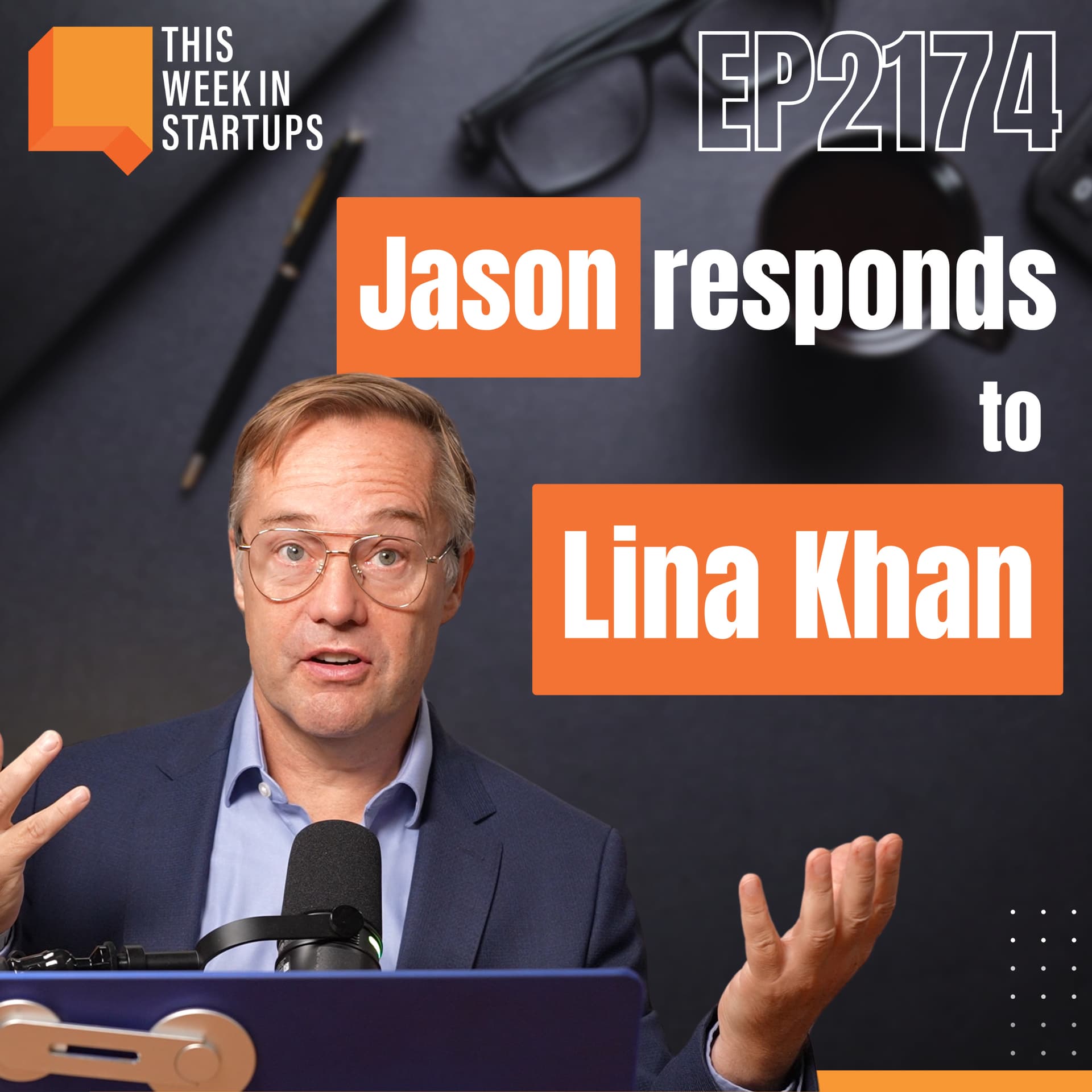
Podcast Notes: This Week in Startups - Episode E2174
Episode Overview Title: The Browser Wars heat up! PLUS, Khan on The Bulwark, rules for great domain names, and Polymarket returns Host: Jason Calacanis Guests: Lon Harris, Alex Wilhelm Date: [Insert Date Here]
Key Topics Discussed
- Reactions to Lina Khan's appearance on The Bulwark.
- Google's situation with Chrome and implications of recent monopolistic behavior.
- Atlassian’s acquisition of THE Browser Company.
- Insights on AI utilization in job searches and market challenges.
- Jason’s theory on “two stock markets.”
- Domain name strategies for startups.
- The anticipated return of Polymarket to the US market.
- Predictions and strategies for effective investing.
---
Detailed Notes
Intro and Recent Events
- Sony's K-pop Demon Hunters: Jason expresses skepticism regarding Sony's defense for missing a potential hit on Netflix.
- Lina Khan's podcast appearance: Jason is critical of her viewpoints and expresses concern about anti-competitive behavior in tech, particularly focusing on Google’s market position.
Google's Browser Monopoly
- Discussion on whether Google should divest Chrome following monopoly claims.
- Key Argument: Google does not have to invest significantly in Chrome; the market seems to be correcting itself.
Acquisition Highlights
- Atlassian Acquires THE Browser Company:
- Deal valued at $610 million.
- Aim to enhance the future of work with a more AI-driven browser experience.
AI and Job Market
- Exploration of AI tools that aid in job searches.
- Jason and Alex discuss the MIT study suggesting that many companies aren't effectively using AI.
Domain Name Strategies
- Discussion on the importance of choosing effective domain names:
- Tips for founders on selecting memorable and easy-to-spell domain names.
- Jason’s tips: Keep it short and phonetic.
Polymarket's Return
- Anticipated positive movement with Polymarket as the CFTC allows prediction markets.
- Mention of the acquisition of QCX and its significance for Polymarket’s operations in the US.
The Stock Market Dynamics
- Jason’s theory of two stock markets—mainstream vs. meme or YOLO markets.
- Companies like American Eagle and their response to market pressures.
Mistral and AI Market Trends
- Mistral aims to raise funds at a valuation of €12 billion.
- Discussion on how European companies can still thrive in the AI sector.
Stripe and Blockchain Developments
- Stripe developing a blockchain for stablecoins named Tempo.
- The goal is to facilitate cheaper transactions compared to traditional banking.
Churn Management Strategies
- Q&A segment where Jason shares insights on managing customer churn effectively:
- Implement feedback mechanisms post-cancellation.
- Understand your audience and adjust your product offerings accordingly.
---
Takeaways
- Market Dynamics: The podcast emphasizes the fluid nature of tech markets, with companies needing to adapt swiftly to changing competitive landscapes.
- AI and Employment: There is a growing focus on the role of AI in job markets and the need for tools that assist businesses in navigating these changes.
- Investment Opportunities: Identifying trends and potential market disruptions can provide significant opportunities for startups and investors alike.
- Domain Name Importance: The significance of a strong online presence through effective domain names cannot be understated in today’s digital economy.
---
Conclusion This episode of *This Week in Startups* dives into various contemporary issues affecting startups, tech markets, and investment strategies. From Google's market behavior to domain naming conventions, Jason and his guests provide actionable insights and lively discussions that are crucial for anyone involved in the startup ecosystem.
Additional Resources
- [Sentry](http://sentry.io/twist) - Error monitoring and bug tracking service.
- [CLA](https://claconnect.com/tech) - Business consultancy and CPA services.
- [Public](http://public.com/twist) - Investment platform with competitive APY options.
---
For more episodes and insights, check out [This Week in Startups](https://www.thisweekinstartups.com).
Written by AI. May contain mistakes. Listen to the episode to check what was said.
Transcript
Automatic transcript. May contain errors.0:00Remember, there is an attack vector for these LLMS. They record everything you do. And when the police come or a civil case comes, whatever it is, they dump your information. They use your information. They're looking at your information. Sam Altman said this. Now, what if Brave took their same privacy approach to browsing where they remove ads, they remove cookies, they make your searches private, all that good stuff. And that's their commitment. I think they even have a VPN built in or you can pay like 10 bucks a year. It's de minimis. I think they should just do 100 % VPN so they don't even know where you're coming from unless you want to disclose, you know, your city maybe.
0:39And then make all your AI absolutely anonymous. And this is where I think Apple should buy Brave and DuckDuckGo, maybe Perplexity. This Week in Startups is brought to you by Public. You take investing seriously, Public does too. Build a multi-asset portfolio and earn an industry-leading 4.1 % APY on your cash with no fees or minimums. Learn more at public.com slash twist. CLA. Innovation takes balance. Our CPAs, consultants, and wealth advisors can help you get from startup to where you want to end up. Get started now at claconnect.com slash tech. And Sentry. Your team should be focused on shipping features, not chasing down bugs.
1:32New users get three months free of the business plan, which covers 150 ,000 errors. Go to Sentry.io slash twist and use the code twist. All right, everybody. Welcome back to This Week in Startups. I'm your host, Jason Calacanis. with me air editorial director lon harris give me a salute there he is yes sir sir yes sir immediately of course yes chef alex wilhelm how you doing boys i i'm really good i have a new light set up and i didn't have a producer help me and i think i'm gonna go blind by the end of the show but i hope i hope my lights look good now jason i hope you're happy because i did it for you i saw your tiktok and uh it was literally like you were in an interrogation where were you on the fifth alex wilhelm do you have any contacts within the party sadly no uh we need to see your papers all right listen enough with the nonsense i got 16 different i got literally notions ai taker i got the zoom ai taker and now i got granola ai taker it's just three that's two too many i'm gonna retire one i think well i mean what if they reply with very different notes i mean you want you want one of them to be fact checking the other what am i the king of uh france over here i need multiple people taking notes it's just all uh mishugana am i am i getting it right mishugana you got that that was correct you were you're used to get mishugana and mishigas mixed up but i think we've mishigas is the person mishugana is the behavior mishugana is the person mishigas is like it's a chaotic situation that's out of control the mishigas on this program's out of control there you go because alex is a mishugana Just to be clear, and Meshuggah is the progressive heavy metal band that's famous for its instrumental and progressive music.
3:19So there we go. Well, there you go. This week in heavy metal. We're expanding the network, everybody. Nice. You know, Lon, we had this debate on the zombie K-pop, what is it? Zombie apocalypse. Demon hunters. Sure, whatever. They're K-pop demon hunters, James. Okay, right. I'm a, okay, boomer. um but what was interesting about this story to all of us and my daughters were thrilled that we discussed it by the way because they've watched it 17 times i'm sure but sony had this incredible ip correct they left it on the doorstep of netflix netflix was like this is a beautiful baby yeah sony pictures had this deal with netflix during the pandemic if netflix refunds the production budget for the movie plus a$20 million sweetener, Netflix gets the movie outright.
4:11And so this was one of the movies that was produced under that deal. So naturally people are like, well, this is the biggest movie phenomenon of the summer. They released a sing-along version in theaters that was a smash hit. The soundtrack is a smash hit. They're making a sequel already. This could have been a huge new Sony franchise. And they're a company that's desperate for new franchises. And they left that on the table. Well, now their CEO, Soty Pictures CEO, kind of defending their decision in variety today, which I thought was interesting. Really? What defense does this dipshit have for giving away Harry Potter?
4:44Because this is why when people email me, hey, I want you to invest in my film. I immediately reply back. Thanks so much for thinking of me. I like money. So I don't invest in movies because these people are sharks. When they would offer me to invest in these Sundance movies, I was like, oh, maybe I'll get in on this, you know, drop 50 dimes, 100 dimes, 250 dimes. Maybe I'll put my name up there in lights. They're like, yeah, you can get back up to 100 percent of your investment. And I'm like, so I put in 250. The most I can make is 500. Why don't I invest in five startups, give them 50K each and have unlimited upside?
5:19They literally put caps on this. Yeah, there's no it's not people do not get into producing films because they want to make a ton of money. It's like maybe something that has happened to people, but no, no, it's because exactly what you said. It's they want to be in the movie business. All right. So what is this guy's excuse? So Ravi Ahuja, he says that the deal with Netflix made sense and that the big issue is there's no guarantee that this movie would have been a hit in theaters just because it was a hit on Netflix. Here's the quote. It started out on Netflix and then word of mouth made it grow.
5:52In theatrical, that's a lot harder to do. It's hard to sustain momentum theatrically. So I think it was in the right home. I would say our mission is to make great content and find the right home. And I think K-pop demon hunters right home was Netflix, but it's an interesting question. He's leaving open. It's, it's theoretical. We can't really know, but his suggestion is being on Netflix is what made this a hit and that it would have maybe gotten lost in the shuffle. If you'd released it to movie theaters. I don't, I don't agree with that at all, but I do like the idea that streaming platforms could be a good way to give a show a longer chance at finding this audience.
6:24because the theatrical window lawn's pretty short, whereas on streaming, it's, I mean, effectively infinite, but in reality, it's until the next major release. Well, what we're seeing now is that's even condensing more. It used to be a movie would have maybe two, three weeks, and then that first weekend became all important. Now, some movies we're seeing, the drop-off on week two is massive. Like, this was the big issue with Fantastic Four this summer, had a huge opening weekend, but week two, it had major drop-off. And so what that means is all the, you know, the Marvel fandom has shrunk. Those guys are crazy.
6:56They'll go out first weekend for everything, but the rest of America, the world not as into it anymore. And the drop off is pretty severe. So yeah, you really get one big shot at it in theaters that if you don't capture everybody's imagination right away, it's hard. All right. He's just doing CYA. He's, he's getting the screws turned to him. There's somebody in Tokyo right now who's like, Hey boss, what's going on? You know, they're, They're hardcore investors there, and they bought Columbia and all this stuff. TriStar? TriStar. They had a lot of assets there. And to give away upside, just for$20 million,$20 million don't move the needle for anybody.
7:34They're making a really stupid decision. $20 million is so small that it's like, well, even one big weekend, you would have covered more than$20 million, let alone if this had played for a month or two. We'll give it to you. cost plus 25 percent 50 50 partners yes or no we're going to hulu next we're going to disney next we're going to amazon next let us know yes or no he could have done that deal he would have got that deal right they would have given him instead of 40 million they would have given the 20 million in production costs and then he gets another 5 million for you know whatever uh the a little uh profit a little a little margin and then we own 50 50 we'll be partners together they're unexploiting this it does seem like not asking for well if this breaks records if this is a hundred million view kind of thing like you gotta you gotta have some sort of structure to that deal just giving it to them for 20 million no matter how many people watch it even if it's the biggest movie of the year like that's crazy you only do that if you think you have crap content that's not going to make money right and sony pictures animation has had a string of hits they do the across the spider verse movies they did mitchell's versus the machines which is a big hit on netflix like they've had some they did that teenage mutant ninja turtles movie they've had some big hits gotta read this book something like an autobiography by akira kurosawa just bought this used copy of the original version from uh from a library the library thank you tost louis community college that's where i got my original copy uh here's the thing toho studios they owned everything.
9:07They hired the actors. They hired the writers. They had the sets. They had a full stack, just like Elon's got a full stack. So the lesson here for entrepreneurs is entrepreneurship and business in general is never limit your upside, control your destiny, go full stack, own as much as you can of the process. Barry Diller must have read this biography or just studied it because when he did movie of the week, he said, you know what? He had all these deals from movie studios, Lon. Hey, we'll make the movies for you. We take it. You give us money and then you can put it on ABC and then we get it afterwards.
9:40And he was like, nope, we're going to do it all ourselves. And they're like, well, you can't be involved in it. You're just a studio. You don't, you're just like a TV network. You don't get to do this. We do this. The creatives do it. And he was like, nope, I'm going to do it, which is really what Netflix has done. They own all their IP for all time. And that's what makes it brilliant. Someday I'll be a studio head. If I get to live another 50 years or 100 years, I'll carve out 10 years to be a studio head. that's what I was meant to do. And among other things, man, I would have loved that job.
10:08All right. Thanks so much for the update, Lon. Very important update there from Hollywood. From the Hollywood part of Austin, Texas. Yes. Absolutely. Wow. There's also, they're building a lot of studios here. They're building some studios. Yeah. It's moving here. Rodriguez has got his whole operation out of Austin. Sure. This is it. Comedy, technology, music, and film. It's all happening, folks. In Central Texas. Central Texas. All right. The little drop of blue making a purple little city we got here called Austin. All right. Thanks, Lonnie Donnie.
10:44When your website or your app goes down, you don't want to hear a bunch of excuses and you don't want to waste your time. You just want the problem fixed fast. And that's where Sentry comes in. They're handling all the real-time error monitoring and tracing. So the moment something breaks, you know exactly what happened and why. They've also got SEER, S-E-E-R, an AI-powered debugging agent that can sniff out the root causes of your problems 94 % of the time and growing. And like all great startups, Sentry is constantly shipping new features, bells and whistles and updates. They just added AI agent monitoring to the platform.
11:18When your LLM agent starts hallucinating, Sentry traces the entire timeline to find out what went wrong and take the guesswork out of it. Plus, it's built into the same system that your team is already using and relying on. So try it out for yourself. Go to Sentry.io slash twist and actually start making sense of what your agents are doing. That's Sentry.io slash twist. You know, I saw that Lena Kahn was on the Bulwark. My guy, Tim Miller, had her on and he confronted her about my sort of statements about the wrath of Kahn and how she iced the industry. And she didn't exactly put up a great defense for it.
11:56And, you know, one of my core premises was work on the stuff like right to repair or dark patterns where you can never unsubscribe to stuff, all that stuff bundling. That's like the classic law we have here in the United States. You don't need to make up. You can predict the future as some 30 something, you know, yell. I don't know what Ivy League school she went to has no job experience or and it was obviously political. She was very clear in Tim's podcast, The Bulwark, that she was a Democrat and they didn't like large businesses. I'll leave it at that. And Google was the obvious case because we all sat here and we're like, Google's got a lot of challenges.
12:40They may have a search monopoly for the past 20 years. Okay, nobody's going to deny that, but they don't have a browser monopoly. They don't have a Google Docs monopoly. They don't have an Android monopoly. We talked on the last episode that they're down to 40 something percent to Apple's almost 60 percent market share here in the United States. So the market fixes these things. We don't need some 30 something elitist predicting the future because I can't predict the future and I do it for a living and I do it goddamn well. I mean, I hit some grand slams here, folks. Grand slams. Robinhood, Uber.
13:17I hit the grand wealth. I've hit a lot of grand slams. And I can't tell you which one's going to be the grand slam. I think it's a really interesting point because I've been wrestling with this, Jason, and the context, folks, is that this week, the judge laid out the remedies in the Google search monopoly case. And it did not go as far, Jason, as many people thought. And honestly, the reason behind that kind of limited reach at the end was the rise of generative AI and AI search as a concept and, frankly, a rising market category. So I agree with you that we are seeing the fruits of competition and the results of private market investment and things are going well.
13:54I use GPT-5 50 times as much as Google now, so it's worked for me. Here's the question, though, that I don't know the answer to this. What do we do for the 20 years in which Google did have a monopoly and did get to operate with impunity? Because I don't think really divesting Chrome right now would solve anything. But I do also think that if you act in a monopoly fashion, a monopolist fashion for that amount of time, in contravention of the general rules of the American marketplace, there should be some punishment for it. And I don't know if the remedies element of this case was the right place to do it.
14:27But it does feel like they got called out from a monopolist for a long time. And then they just got their earlobe flicked. And it just feels like an encouragement for other companies to do the same thing. Alina Khan makes this point. Hey, poor people and, you know, the rank and file when they do a speeding ticket or they commit a crime, you know, they get taken to the shed. Right. Yeah. And they get raked over the coal. So big companies should also pay a price. So there is something to that. And the answer to that would be if you were on your game and you were actually watching what they were doing, it was very clear that they were doing really hardcore exclusive deals with Mozilla and Firefox and Safari and search on iPhones and, you know, their browser over at Apple.
15:13Those things would be technically, you know, or they could be anti-competitive. Therefore, you would just go right after that and you'd give them the speeding ticket for that. Hey, you did this. You can no longer do it. Here's the fine. But there was like a vindictiveness to this and a, we have to like take down this kingdom. We have to break them up. You don't have to break them up, man. What you have to do is say, these are the rules. You break the rules. You get a penalty. What happens in, you know, football, if you grab somebody's face mask, you'll lose 15 yards, right? And you lose it down.
15:46I think I don't watch football anymore, but face masks are still very, very sharp punishments because of the potential for neck and head injuries. So yeah. Yeah. So you, you know, in this probably, maybe this is face masking or maybe it's offsides. I don't know. It would come to a decision as a society, but you give the penalty and then you get the hell off the court and you let the people play the game and the winner wins. You don't need to get this up in, you know, you're not a player on the field. And I think that's the problem is when the referees think they're the show and you see this happen in any number of sports where there's a referee who's like there was one who kept getting giving rasheed wallace technicals like crazy and he gave a technical to rasheed wallace for staring at him i don't know if you remember that moment and he's like everybody's like what and it's i don't i think this might have been for me to like a playoff game and he was like he was intimidating me it's like okay we'll grow up you know this is the nba for folks who are outside yes and and this one you know uh referee thought he was the show i think that was the problem.
16:47So based on the remedies, the judge said, hey, no more. This is the quote. Google will be barred from entering or maintaining any exclusive contract relating to the distribution of Google Search, Chrome Assistant, or Gemini. Great. Love it. Good for the industry. Now, that means when you're Apple, you can say to Google, hey, we'd love to give you an exclusive deal, but we'll give you 50 % of the searches coming in. Or it's an auction. If Yahoo or Bing from Microsoft or DuckDuckGo, if they want to get a certain number of searches this month, they raise some money, they can insert themselves into there.
17:26Imagine how the world would be different if DuckDuckGo said, hey, to a bunch of venture capitalists, we got a better mousetrap here. Can we get$10 billion to buy half of the search deal from Apple? And I think we can make it back. Great. Great. What else wound up happening here? So Google will not have to divest Chrome, which I thought was a pretty important point. And we're going to get to how that's impacting the news already, Jason, in just a moment. They're also not barred from making payments, as you mentioned. They're going to share some data with competitors. Essentially, the argument was that because Google would buy market share, they would therefore get more search volume and therefore they would get more data and then they can make a better product.
18:05And there was a flywheel of essential unfairness. So they're trying to break that to some degree. Now, people are a bit split on how effective that will be. We'll have to see. And then finally, they won't have to do a ballot screen, essentially on Android to let you pick a search provider. So really, it's not much other than a forced end of exclusives. And we could end up in a world in which Gemini wins, Jason, and we kind of maintain Google's monopoly status for a longer time in the Gen AI search era. But I don't think that's going to be the case. I think OpenAI is big enough now to really be a real competitor.
18:35I just think we need a better, faster mechanism to punish companies that are being anti-competitive in the moment. And I don't think we know what that would be. So disappointing. So I did see, speaking of browsers, that the browser company sold to Atlassian. One of my favorite companies, shout out to Scott, one of the co-founders of, along with Mike, of Atlassian from Down Under. You know, they make Jira and a bunch of other cool products. They're buying it? Yep. $610 million in cash off the balance sheet, less, of course, whatever cash the company had on hand. Deal is expected to close in the second quarter of Atlassian's fiscal 26.
19:19And if you want to know what that means, it means Q4 of calendar this year. So basically by the end of 2025. And the whole team's going to move over and they're going to be treated as a separate entity. Now, Jason, you and I both know that acquisitions are often pitched to companies that are purchased as, don't worry, come over, be a startup. And this is one of those cases. We'll see how long they stay independent over at Atlassian, a 44, $45 billion company. It's huge. But I thought this was a kind of bold move by Atlassian, a surprise one. But I think if you want to consider the future of work in a agentic AI perspective or, you know, era, this is a really smart move because Dia, their browser is relatively AI forward.
20:01So cool. I'm here for it. Well, you know, I talked a little bit about the Comet browser having a pretty good experience there. And then of course, uh, Claude is coming out with their own browser. Yeah. Over in Anthropic. So they made a Chrome extension. Open AI is theoretically making their own browser, I think is the split. So, you know, this idea of like the browsers where work gets done, it's the portal to, you know, on the desktop to the extent that, you know, when Google wanted to, um, take some market share, they created the Chromebook. They named it after the browser. And essentially their thesis was, if we just make a really fast, lightweight operating system that works on any computer, even one with very meager specs, you can use everything through a browser.
20:46Now you can use Slack through a browser. You could use Notion through a browser. So you don't have to download the apps. You don't have to make a unique app. We'll just do it that way. That's been a relatively good success for them, especially in education.
21:01One of the themes we talk about over and over again on this week in startups is making sure you do your chores. I'm no expert on these things. I have some experience. Steven Estes from CLA is an expert. Let's talk about being cash efficient. Tell us about efficiency and what you see in the top tier startups in your practice. We're seeing kind of an interesting trend out there where companies aren't needing to raise quite as much as they had in the past. You really have to be careful as a founder to only take on as much money as you really need. You've got to do the forecasting. You've got to do the modeling and you've got to dial it in and get it right.
21:37Otherwise, you're going to end up either not raising enough capital to get to where you're going and you're going to have to go get venture debt or go back, have an extender to the round, or you're going to give up too much of the company because you just didn't recognize how much money you actually needed. Yeah, very important to get this stuff right, folks. And that's really a bummer when startups don't do things in a button-up way. Always have a great partner, a good partner to have on this adventure while things change. My friend Steven over at CLA. Visit claconnect.com slash tech. And don't forget to mention that your boy Jake Al sent you.
22:09That's claconnect.com slash tech. Start today. So this makes a lot of sense to me. The price, they have cash. Companies worth$45 billion or so. So this is like 1.x % of the market cap. Yeah, it's not much. It's very affordable. And if, man, if they figure something out, this could be yum yum. I think this is a great acquisition. And this is the type, back to our first story, of mid-market acquisition. You got a$44 billion company buying a$600 million company. Let's go. Let's see these kinds of acquisitions happen all the time. If you're over a trillion dollar market cap, if you're over a billion users, yeah, maybe we create a second set of rules for those companies that are at scale, which is how it works in a lot of other geographies.
22:58If you have a specific amount of market share in Korea, you can't gain any more. So you have to essentially do other things with your company. So this makes a lot of sense to me. I want to ask you a question though. So the company's lost valuation, March 2024, 550 million post money. Now I raised capital a couple And sure, the early investors did fine. My question, though, is when you think about around Jason at like a half unicorn valuation in 2024, do you think the last money in to the browser company had protections so that way they're not essentially just getting their money back one to one, but they're probably making more than that?
23:42I'm just curious about the economics from the venture side of this type of deal. So if this was, if that deal was done in 2018, 19, 2020, 21, peak ZERP, the founder could have said, listen, you're lucky to invest. There's going to be no protective provisions. You're just going to convert to common on a sale like anybody else. So if you bought 10 % of the business, you're going to get 10 % back. And if that 10 % is worth 25 million, 50 million, or 100 million, that's just the way it is. But since this was done in 2024, you could see a savvy investor saying, OK, we're happy to pay this valuation you want.
24:16You don't have anywhere near the revenue that would justify it. So can we just make an agreement that if you sell, we get two times our money back? So we get$100 million minimum. You said it was a$50 million round the last one? Yeah. So, you know, OK, they sell for$600 ,000,$100K comes off the top. Then the rest of the preference stack, the rest of the investors would all convert into common and they would just sell their percentage and get the percentage of 500 million, which I think the folks at the browser company would be OK with. And I would think the investor going back to their LPs and saying, you know, it's a 500 million dollar fund.
24:51We put 50 million of your money into this. We got back 100 million. It's paying back, you know, 10 percent of the fund. Plus, you got, you know, it's going to pay back 20 percent of the fund. And so we're getting closer to the hurdle. or if it's already a profitable fund, the fund manager might say, okay, we're just dropping 100 million. If that fund was at 2X, now the fund, if it was a$500 million fund, is at 2.X, you know? And that's a really nice thing to happen in a time when, back to the wrath of Lena Kahn, there wasn't a lot of DPI. So early DPI is better than no DPI and losing money. And there's also a clause in some venture funds which is called recycling dollars.
25:30the first 10 % of returns can get reinvested into the fund. So in this case, if it's a$500 million fund, a hundred million comes back. If they had said 10 % can be recycled, give 50 million to the LPs. And this would be the GPs, the general partners decision. And hey, we're going to take that 50 million. We also happen to have perplexity in that fund. We're going to offer perplexity to that 50 million. We're going to double down on an existing investment, which, you know, the people who are LPs in funds tend to like that recycling because it gives a little kicker at the end of the fund where you might have some inside information.
26:06Private companies should trade on inside information. Public companies, you go to jail for doing so. So you're on the board of the company. It's private. You say, wow, this is pretty good. Maybe we buy$100 million in secondary from the early employees or angel investors in the company. So great to see this happening. The wrath of Khan is over. And all of this M &A is happening. And this was the thing with Lena Kahn's other comments with Tim Miller on the bulwark, which you can go see. It was this week. And I really appreciate him playing the clip because she was like, well, you know, we're not really seeing a difference in M &A.
26:37It's like, yeah, because people gave up doing M &A because the juice wasn't worth the squeeze. They knew you were going to run them through the mill. So that's like in San Francisco being like, oh, car break ins are going down. Nobody in San Francisco for some period of time would ever report a car breaking because they knew nothing would happen. And the police would tell you, nothing's going to happen. You can report it. Nothing's going to happen. So people just went and got their windows fixed. The end. Statistics be damned. Statistics be damned. Next up, OpenAI, Jason, this came out Thursday evening, announced that they're going to do an OpenAI jobs platform and also certifications.
Read the full transcript
27:14This was a little surprising to me. Now, I don't think they're going to take on LinkedIn, but the CEO of applications at OpenAI, Fiji, previously the CEO of Instacart through its IPO, announced a couple of things. So the OpenAI Jobs platform is going to be a place where essentially workers with AI skills can be matched with jobs that need AI skilled workers. So it's kind of a subset of the economy. But if you're a business that's having a hard time finding the right people to help, I don't know, modernize or agentecise your business, this is a way to go about it. Obvious question, how do you tell who's qualified, Jason?
27:46Glad you asked. Well, that's called OpenAI Certifications, a new tool that'll be inside the OpenAI app that will let people essentially prove, and I also presume learn, their AI chops. So a bit of a surprise move from OpenAI. I think I like it, but I haven't really digested it yet. You know, one of the things that happens when you build a platform is you start seeing opportunities everywhere. So you study the data and Google saw, wow, people keep typing in stocks and they type in price. Oh, maybe we should put the stock price right there at the top of our chart and they build Google finance or they keep asking for, I don't know, movies like whatever.
28:28So then they build a database of movies and they show you movies like get them to the Greek and you get the 40 year old version. That's one of my favorites. Oh, what a great film. I wish they made films like that. You know, you get Tropic Thunder is always a nice way to find stuff. So that's what I suspect. I knew a guy who wanted to be a studio head and had some money. I mean, And like, it's almost like if that person had money and time, they could. I mean, making raunchy stoner comedy seems like a genre that, you know, you could do some real damage. That's like my personality after 8 p.m. So I'm totally here for it.
28:57That was a dad joke from Alex. I heard the crickets. I heard that. No, don't apologize. We love it. I don't even mean to. Anyways, keep going. So this seems like a good idea. There probably are people who are looking for AI experts to use OpenAI's tools to do stuff inside of their enterprise. Now, just like the channel at Microsoft, Microsoft would have like certified Microsoft engineers. I was a certified Novell engineer at a point. Those certifications allow you to have a little bit of trust that this person is going to do some good work for you. They get to charge a higher fee for their services.
29:38They get to, and then OpenAI has something to do with all the people calling on the phone who say, can you do this for me? Can you do this for me? We'll give you a million dollars. We'll give you$10 million. Yeah, talk to these firms. Go to this page. You're going to find folks. So that's really what this is about. They're building up a channel to help applications get deployed. It goes back to that MIT story we covered. What was that, two weeks ago? 95 % of corporate AI pilots didn't make it to production. And the data was a little bit... Suspect. Not suspect. It just, it felt like there was a lot of really interesting data points and people found the one that was going to make the best headline.
30:17No one's ever complained about headlines before in the history of journalism, so don't worry. But in this case, I felt like there was actually some more interesting news in there. But Jason, that report and that particular data point, I think took like 20 % of the air out of the AI balloon. right now. It did. And that just shows you people can get skittish during a transition. We had this happen many times with the internet. Oh my God, the internet, you can't trust it. Everybody's going to use AOL. Everybody's going to use CompuServe. You got to use one of these online services, Prodigy, whatever it is.
30:46That's the way commerce will happen. That's the way content will happen. And you have this hand wringing. This helps people make better decisions. It'll help them execute better. I think it's a good idea.
31:01Every time you turn on the news, it's about AI getting smarter and smarter. These models are writing perfect code. They're acing the world's most difficult exams. And it turns out they're also pretty good at making money. That's why there's public.com, the investing platform for people who take their money seriously. What really sets public apart are their AI-powered tools and features. Check this out. You can ask public a question about any stock in plain language and get a straightforward answer. If you want to see why a particular stock's price jumped or crashed, they've got a clickable AI generated summary right there in the performance chart.
31:35You can build multi-asset portfolios on public stocks, bonds, options, obviously, but hey, maybe you want a little crypto in there, some ETFs. I will advise you to try public.com and access industry-leading yields like 4.1 % APY on your cash, but no fees or minimums. Plus, for a limited time, earn 1 % match on all IRA deposits, IRA transfers, and 401k rollovers. Never too soon to get that retirement dialed in. So go to public.com slash twist today to fund your new account in five minutes or less. That's public.com slash twist. Disclaimer, paid for by public investing. Full disclosures in podcast description.
32:13We were talking about browsers, so I just want to get some other data points for the listeners on who else is building what? Now, Brave, Jason, you've talked about is a privacy-focused browser. It raised some venture capital, had an ICO for its basic attention token, or BAT, back in 2017. And to my surprise, and this is why I included it, it's actually pretty big. So in August, Brave's monthly active users grew to just under 98 million, up about 4 % month to month. Now, if you're a YC company, 4 % month-over-month growth, Jason, doesn't blow your top off. But the company's high watermark DAUs, so in the last month, what was their biggest day of usage, was 41 million.
32:54That's, you know, if it was all American, that would be 10%. Yeah, it's quite significant. And I think it just goes to show that when we think about browsing technology, we think about Chrome, and then somewhere down there, there's Firefox, Safari, Edge. But really, there's a bit more dynamism in the market than I think we have been discussing. So I wanted to bring that for everybody. And there's a project called Ladybird, which is a open source browser that I just heard over on Hacker News. So there's quite a lot of names out there. I think if you think about every percentage point of search being worth a certain amount of market cap, every percentage point of ride sharing being worth a certain amount of market cap, I've been having this debate about, you know, self-driving again today.
33:36I keep getting dragged into it, so I have to keep making this point to everybody. I think self-driving is a$10 trillion opportunity, and that means every 1 % is worth$100 billion. So here you have, let's just round it up to 100 million users for their browser. If there's 4 million internet users on desktop or using browsers, I'm just going to pull a number out, that means 400 million would be 10%. They have two and a half, they've got two, three percentage points of that possible pie. Now, people might use multiple browsers. Obviously, some do. So I think it starts to get interesting. It does.
34:12Based upon how much search there is that occurs through a browser. And they're a takeout candidate as well. They need to go all in on AI on top of having gone all in on privacy. Remember, there is an attack vector for these LLMs. They record everything you do. And when the police come or a civil case comes, whatever it is, they dump your information. They use your information. They're looking at your information. Sam Altman said this. Now, what if Brave took their same privacy approach to browsing where they remove ads, they remove cookies, they make your searches private, all that good stuff.
34:49And that's their commitment. I think they even have a VPN built in or you can pay like 10 bucks a year. It's de minimis. I think they should just do 100 % VPN. So they don't even know where you're coming from unless you want to disclose, you know, your city maybe. and then make all your AI absolutely anonymous. And this is where I think Apple should buy Brave and DuckDuckGo, maybe perplexity. And I've been thinking, you know, I've got that domain name begin.com. I mean, it's burning a hole in my pocket. And I contacted one of these billion dollar startups, the CEO, and I was like, hey, you know, you're doing something that this might be very good for.
35:27So I started a dialogue there. Instead of me building the company, I was thinking, man, maybe if I can get one or 2 % of one of these great companies, that's already worth a billion. I get 10, 20 million now for the domain and for the, maybe be an advisor. And then if they go 10 X, this could be a big hit for me, but begin would be such a great starting point for searches. Certainly better. Because it's where you, perplexity is a terrible name. No, I mean, I'm trying to think of a worse name than perplexity. That's what happens when an engineer named something perplexity. Okay. How many syllables?
35:59How do you spell it? Begin. begin google well google was g-o-o-g-o-l and they changed it right to the the more phonetically and spellable friendly one but like that's what you get when you let an engineer name something you get a large number which is what a google is or a googleplex yeah but once you get past five characters you know now the person's still typing you know you can type in you know google six uh bing four begin five yahoo five like you can't you have to be able to say it over the phone this is like a really important thing for founders to understand you have to be able to say it over the phone and you have to be able to spell it if it's hard to spell no bueno if it's hard to hear over the phone and you can misinterpret it no bueno it's no good it's boring you see that scene from the Spielberg movie with the horizon?
36:58The horizon? Oh wait, the drilling rig? What's the Spielberg The Fablemans Hopefully Lon's listening. Lon will tell us. There's this incredible scene where Spielberg is on the lot and he goes and sees this director. Incredible scene. Here we go. John Ford. This is the John Ford scene. We'll pull it up here. Well, maybe we shouldn't because we get a strike on that. Then I won't pull it up. It's the Fablemans. It's about, it's basically the, it's basically Spielberg's biopic. And there's this great scene where he goes to John Ford to get some advice. He happens to be on the lot. John Ford's on the lot.
37:35And he says, kid, you see this picture over here? And it's David Lynch who's playing John Ford. And they smoke a cigar and I think he's got an eye patch on. He's like, kid, look at this picture. Where's the horizon? He's like, I'm looking at the picture. He's like yelling at him. He's yelling at a 12 year old, where's the horizon? He said, it's at the top. He goes, okay, what about this picture? And he's got paintings. And he says, where's the horizon? Spielberg is nervous. He says, it's at the bottom. He says, and where's the horizon in this picture? It's in the middle. He goes, when the horizon's at the top of the frame, it's interesting.
38:12When the horizon's at the bottom of the frame, it's interesting. And when the horizon's in the middle it's boring as shit now get the hell out of my office and he kicks him out of his office and then every spilum movie has whether it's jaws you know the horizon for the ocean and the boat are at the bottom right just you see it now you can't unsee it this incredible moment this is me telling you about domain names and branding if it's too long it sucks if you can't spell it over the phone it sucks this is honestly this is why it's good this is why x.com no matter i'm not trying to bring elon into this but i will say compared to twitter which used to be t-w-t-t-r then it became something you could spell yeah x.com is still a far superior domain name because to your point it's short you can spell it over the phone it's fanatic like i mean it's memorable i'm a big fan of short domains in general because much like land they they're not making more of them so i think it's it's cool to see what people do anyway i put begin.com up and i'm having people apply to tell me what they want to do with it i'll either lease it or lease loan it to a founder or i might try to find a big company like i think perplexity should just rebrand as begin such a better domain they could do a national campaign and then people would remember it.
39:39I'm going to apply. I'm going to get an email from me later. All right. This could be my biggest hit of my goddamn career. I bust my ass on 10 different ideas and startups. I'll probably make my fortune off of a five letter domain name. All right, let's keep going. There's a lot more to discuss. A lot more to discuss. I want to talk about Polymarket. We talk about Polymarket on the show all the time. This week, Jason, the CFTC kind of said that they're going to be good to go. Now, there's a little bit of nuance here because they bought a thing called QCX that was in the United States, and that was the entity that the CFTC said they're going to have a no-enforcement agreement with.
40:16But essentially, it does appear that making prediction bets, prediction markets as a concept, are going to be allowed here in the United States. And I don't want to get into politics. I will say that 1789 Capital and Donald Trump Jr. recently put a little bit of money into the company, and then they got kind of - And then got the green light. So that makes me a little bit unhappy as a capitalist. But I do think that if you're a fan of Polymarket, as we are on the show, this is great news. And I'm looking forward to see what impact this has on their numbers. Because what's fun about Polymarket is that it's on the Polygon blockchain, which is an Ethereum level two, which means that I've been watching their usage data pretty closely.
40:53And I'm fascinated to see what's going to happen once you get a bunch of Americans showing up and making wagers, bets or predictions, whatever you want to call it. I cannot wait. And yeah, there's a correlation between these two news stories. They both happened in two weeks, but I don't think it's a correlation. I think the correlation is with the QCX acquisition. They spent like over$100 million to buy that company. And essentially what they were buying is, you know, a company that already had the rights to do this because it does take years or so to get permission. So, OK, here we are. That was like my dad bought a second bar.
41:25He bought out the previous owner who had the liquor license. So you could just buy and liquor licenses in New York, you know, they cost$5 ,000 to apply, but it took two or three years. They didn't want to give out too many because, you know, you don't want your neighborhood to become like, you know, college town. So, you know, there was you could trade them for 25 grand or something. They had a market value like medallions. I was about to say, just like taxi medallions. Yeah, exactly. So that's what's going on here. I don't think there's anything nefarious with DJ. T. Jr. Well, I'm glad that you think that that's actually.
41:57I'm glad there's less corruption than I was concerned about. That's a good thing. I'll take that as a win. Yeah, 100%. So do you want to, I think we should show some charts here, Jason, because one thing people know is that the polymarket and the prediction market game have done very, very well in and around the election cycle. But I think people don't know that they've actually held up reasonably well afterwards. So I pulled some charts for us from Dune, which we love. And if you look here, this is the polymarket monthly volume clearly spiked right around election time. fell very rapidly and people were worried it was going to do that.
42:29But instead, it's actually recovered and it's doing, I would say, pretty well. This is a known function in startup land and in company land. You have some event that drives a lot of attention to your platform, product or service. Then that event ends and things come down, but they come down to a higher average, a new plateau, if you will, than the previous one. So as an example on All In, when we had Vlad during the GameStop, or when Chamath said something about the Uyghurs being below his line, or when Donald Trump came on, or when Elon came on, each of those events caused a massive spike. But then when it came back down, we retained some of those people.
43:13And the crazy thing about this, if you look at the history of say ride sharing, you would have bad things happen in a Lyft, sidecar, or Uber. You would have people complaining about it. You would have bad press. And then people would go like, what's ride sharing? What's Uber? What's Lyft? It's an app. Okay. The first thing people will do is take out the phone. Tell me more about the story. Oh yeah. It's like, this is horrible. That's horrible. There was a car accident. They killed a puppy, whatever it is. and here's the dark secret it went up so you have this jeans company that uh sydney sweeney we talked about that ad nauseum surprised this didn't make the docket i thought for sure you would have had this in your sights um but uh american eagle uh got crushed for this like oh is that eugenics or are you guys just dumb that you don't know that that's eugenics and you know like it feels a little white supremacist um you know and when i say they got crushed they they got they were criticized by some lefty tiktokers let's be honest jason it wasn't like there was a national campaign i think actually people mad about the response were a much bigger wave you have to fill a lot of time on right-wing podcasts exactly my point so this negative story this faux pas you know people were like, oh my God, it's going to damage the brand.
44:33Like that's some people's reaction. They just had their results. Um, yes. Second quarter results, total net revenue, 1.28 billion, uh, down 1 % year over year. Uh, gross profit was 500 million, 39%, uh, up 30 basis points. Not bad. Um, operating profit was 103 million up 2%. What am I looking at here? Oh, maybe we have the wrong quarter, but the, the quarter just came out in the last couple of days and I saw it. They beat earnings they beat and the share price went up. So they had a beat on both was what I read. Oh, here you go. So this is the right data. Here's probably the key quote. This is from September 3rd from their investment investor relations site.
45:13Quote, the fall season is off to a positive start fueled by stronger product offerings and the success of recent marketing campaigns with Sydney Sweeney and Travis Kelsey. Shout out Taylor. We have seen an uptick in consumer awareness, engagement, and comparable sales. So it does appear that their results into this were relatively blah but i don't know much about clothing companies i'm not gonna lie i don't read these reports often pop 25 as well so what yeah why i think people thought it was gonna get crushed so maybe just not getting crushed and having more awareness uh they think the hype is going to drive uh some future sales or it's gonna tip over into meme category you know this is the when you have so many people.
45:56It's not 25%, 38 % today. It's up 38 %? I'm sorry, I didn't mean to interrupt, but 38 % is insane. Yeah, and it's still rising after hours. Now the company's worth, oh, wow. Clothing's a tough game, Jason. With over a billion dollars in revenue in the second quarter, the whole company's worth now 3.2. Yeah, so three times. Well, that's just quarterly revenue. Yeah, so it's less than 1x revenue. Less than 1x yearly revenue. Wow. You do have this GameStop effect. You do have the stonks effect. I remember I YOLO'd into Open Door for 50K. I then was like, you know what? I'm just going to put a sell order in for 1 ,000 shares at$6,$7,$8 or$6,$7,$9 or whatever.
46:39So I'll clear my cost and then have the last 2 ,000 shares for free and let those roll. Because I know how these meme stocks are. I was like, let me see. I just got the alert before I got on the show that my first 1 ,000 sold at$6. yeah uh and so when it hits seven or eight i'll sell another thousand when it hits 10 i'll sell another thousand i'll have covered the original maybe i just yolo 25k in um and then yeah i'll be uh you know sitting there with 2 000 free shares as it were so uh open door technologies the stock we're discussing is up 16.2 today and why so why look i just to be clear if everyone's listening thinking that I'm just mashing my teeth.
47:20I think Cindy Sweeney is a gorgeous human. Good for her. But I'm blown away by the stock market at times. It does seem that the stock market that I learned about as a child, Jason, is not the one that we're playing with today. And I'm not blaming Vlad. I'm not blaming anybody. No, no, there's a second stock market. Okay, I like this. And that is the YOLO market. That is the, let's see if we can make something into a phenomenon. And if the CEO and management team can take that momentum him and actually do something with it. And with Open Door, you know, the, it seems the CEO has engaged this debate.
47:56He started getting meme-y, meme-y, if that's a word. Sure. Meme-ish. Meme-ish. He started getting, he's not squeamish anymore. He's meme-ish. Good. I like it better. He's, he's gotten meme-ish on the Twitter. So he's kind of leaning into being a stonk and stonks only go up is the joke over on Reddit. So here we are, folks. It's just, uh, it's also like the consumers taking, having their say and being able to participate in capitalism and holding equity. So that in a way is also interesting. That goes back to, was it David Lynch? Um, the, uh, stock picker who said like, you know, go to the mall, see which one stocks are growing, et cetera um and then buy the ones where you like it you know and like you would have bought apple based on that and starbucks based on that so now like let's pick a retailer that's kind of middling you say hey i think this thing's undervalued let's all start using our dollars to buy more i don't know in and out burgers or maybe that's not public so uh shake shack we'll buy more shake shack we'll start doing videos on shake shack we'll say shake shack's underdone and And then if the Shake Shack CEO gives a salute to the, yeah, Peter Lynch.
49:15Sorry, did I say David Lynch? I've got movies on my mind. Peter Lynch. Didn't David Lynch do dude? Yeah. David Lynch? No, he did. Yeah. But invest in what you know was his slogan. Thank you, Producer Claude. Producer Claude coming to my rescue. Thank you, Producer Claude. No, David Lynch, I was wrong. Sorry, I did Wild at Heart and Blue Velvet. Mulholland Drive. Oh, Blue Velvet. That was a creepy film. So you talked earlier Jason about how companies that have a big moment will go to a new height and come down to a higher plateau Interestingly enough, this is not a great chart, but if you look at this you'll see this is GameStop's Shares and here you can see kind of the pre meme era.
49:55Yeah, to my surprise It's held on to more of its, you know post meme stock value than I would have kind of estimated so maybe there's amazingly enough more staying power to meme stonk status, that's a sentence I never thought I'd say out loud, than I thought because they've kept it afloat for four years now. It's what you do with the energy. So I think what the GameStop CEO realized, and I think the AMC one realized this as well, is if people want to buy the shares, why don't I create more of them and sell them the shares? So if they don't want to go to the stores and buy physical games because they're getting them on Steam or whatever, what can i sell them i can sell them more shares and then i can use them to promote the amc movie club so now you got all these amc movie club people have become a little bit of a cult and that's what you do is you use that energy say hey we got a new product or service can you go out there and be the ambassadors for us so you know how like vcs go on cnbc and talk their book and you know after i don't know bill ackman loads up on uber like he did he's like hey i'm gonna start talking about Uber all the time, or Warren Buffett gets his position in Apple, and then he talks about it all the time, and then he gets rid of his position, he stops talking about it.
51:06So that's where we get the term, talking your book. The public's doing it. The public's talking their collective book. More power to them. More power to them. And then to the CEOs of these companies, okay. And Tesla's one of them as well. People always try to figure out, well, how does Tesla's market cap makes sense. It makes sense because a lot of people see in Elon and those companies a massive amount of ambition and they're willing to pay ahead of the growth. So, you know, if their market cap would be half of what it was based on performance, the other half is based on promise. And now you've got all these people.
51:40This is what I was telling you I'm getting dragged into is the the people who hate Tesla and love Tesla. Every time I talk about self-driving or Uber, they get their, what's the term I'm supposed to say? Knickers and a twist. Yeah. I don't know if I'm supposed to say that. I was going to say panties and a crunch, but I'm going to say. Well, I think, I think knickers and a twist is British. So I think you get away with it. Yeah. It was just like, you know, before we got on the show and you were using the C word over and over again. And I was like, you can't call me the C word, Alex. You're like, I'm in, I'm zooming in from England.
52:09I'm in England right now. I have the UK pass. I'm Australian. I'm allowed to say that Jason is capacious. You're correct. Yes. You did say capacious multiple times. I took it the right way i took it in the spirit it was intended when i first went to the uk people started calling each other the z word or started calling cigarettes fags i was i was like what yeah you're right there they're like if we have to do this with every american you're in a pub yes you can say these things i'm like are you sure you can say this yes here you can say those things this is what it means and i was like oh okay yes fine it has nothing to do with the you know the slur words okay no there's your little social uh yeah commentary for the day uh let's keep it moving so mistral my favorite french unicorn jason i know you love it when i bring it up on the show favorite favorite and only three seconds on your list of one three seconds into the clip jason's like i hate europe all right i thought i hate europe i like disneyland i like epcot center and i like europe i like all those places to go and pretend it's another time and place i'm gonna take a long sip of coffee this is what i have to deal with every single week three times a week everybody it's funny it is like a fantasy land you know people in spain spain is like this massive destination they were getting pretty bent out of shape knickers in a bunch did you see the squirt guns they were squirting people with squirt guns and then in mexico city um they had a little bit of this with um the not expats but what do you call the people nomads digital nomads digital All nomads have been like, hey, this place is great.
53:42I can get an apartment for$500 and I can go out to dinner every night for 50. And I can go to a Michelin star restaurant for 100, for two. Like, it's crazy how affordable it is. They also had some protests there. I found out after talking to them, people who live there, Mexicans, they were like, oh, those protests are paid for. The Socialist Party pays people to just run around and get press headlines. I'm like, okay, just like America. They're paying people to do this on all sides. You can't even believe any protest anymore. I do not know enough about the current political landscape of Mexican Tuesday.
54:20This is told to be by a bunch of liberals. I think Gloria Steinbaum's doing fine. That's my take. My mom's half Mexican, so I care a lot about the country. Where was I? Oh, Europe. Right. France. Right. Mistral. Yes. AI. Mistral is going to raise money, not at the expected$10 billion valuation target that it had in mind, Jason. Instead, it's gonna be about 12 billion euro, about 14 billion USD. And it could raise, according to Bloomberg reporting, Kate Clark over there, 2 billion euro, which is, I know, not a lot for an American AI foundation model company, but for any other company in the world, that's an enormous amount of money.
55:02And I think that we could actually see some deuce in this firm, not because of the fundraising, not because I'm a fan of Europe, not because we disagree a little bit on the future of its economy, but because I keep seeing token usage of its models over on OpenRouter. It's ranked eighth on LM Arena. Somehow they're still in the game. They're holding their own. I'm happy there's more competition. Yeah. I mean, it's not like the United States is the only place that great companies can be built. There are headwinds in other countries on the margins, but some places are a great lifestyle and they want to build a team.
55:37And then the question is, can that team compete long term with the work ethic here in the United States? And if you were to look at happiness studies, people in Scandinavian countries, people in Europe have a much higher degree of happiness because, well, you know, they put their kids to bed and they go to dinner and they leave work at a decent hour. And then in America, people are less happy, more successful. And if you define success by career and money. And so, you know, people get all bent out of shape when I talk about this stuff. These are choices, folks. If you want to live an incredible life, move to Denmark.
56:14Move to Denmark. They have a thing in the UN and, you know, at Davos where they say getting to Denmark. Why? It's a high-functioning society where people play safe. Now, they also have to pay 60 % or 70 % taxes at the margins. So you do pay for it, but people are happy. and you know that there's a ranking of happiness this is when i run for president i'm going to make happiness oh that's going to be your platform one of my oh well it's going to be a pillar of my platform is more happiness and joy in the country that's it so have some pillars i i don't mean to keep bringing up my mom but my mom is is half danish half mexican so i think this show is actually dedicated to her shout out to mom uh last thing here jason is on the mistral front they're expected to end the year on above a$100 million run rate.
57:01Well, no and yes, because if you think about Anthropic going from$1 billion to$5 billion this year or OpenAI going from like$5 to$12, I think we've become desensitized to how insane it is that many other AI companies are getting from zero to$100 million revenue. It does not compare to what we've seen from OpenAI and Anthropic. But any other time, any other point in history, a French company going to$100 million would have been - It's fantastic. The, the, this game that's being played is being played at a level that I've only remembered few times in my career. Um, there was a time when people were doing big MNA in the media business, you know, which ended, you know, the peak was AOL buying time Warner essentially.
57:47Yeah. Which was crazy. Uh, but you know, you had this kind of high stakes game of chicken who can really be the most audacious. I think in the on-demand economy, we saw that like audaciousness who can lose the most money, but get the most riders, get the most deliveries. And in e-commerce with Amazon, which didn't make a profit for how long? 10 years, 15 years. They just decided to go break even. And, you know, that's what we're seeing now. So that does make you wonder, can Mistro for the long-term carve a niche for themselves? And what would that niche be? Would it be other languages outside of English and they just have the best French, Italian, German LLMs?
58:31Is it that they are more privacy-based or compliant, you know, and their data centers are in those locations or who knows, but they're going to have to, I think in the next year or two, figure out how not to be roadkill. I think that's an interesting point, and I think we're going to learn a lot over the next couple of quarters. But this reminds me of a story. I didn't throw in the docket because it felt a little bit too small, but I'll just mention it now. Switzerland has built its own open-weight AI model, trained on public data. And I feel the same way about that as I do when Databricks made its own AI model a couple years back.
59:08Like, a cool experiment. I don't know what it's for, but I kind of just filed it away in the huh category. So if you're curious about that, guys, or you're Swiss, well, there you go. You have your own model now. All right, moving on. Stripe is building a blockchain just for stable coins. Jason, Stripe, of course, is the enormous online payments, nearly centicorns worth like, I don't know, 90 billion or something now. And we don't know when this is going to come out, but it's going to be called Tempo. It will not have a native token. It will support a wide array of stable coins. And I think this is going to be fantastic.
59:40Up to 100 ,000 transactions per second in theory. Starb's working with Paradigm on this and critically will compete with, I think it's called ARK. Yes, ARK, which is Circle's upcoming stablecoin blockchain. So we're going to have two kind of neutral-ish blockchains out there. I think this is cool. And I think it just shows how far stablecoins have come in the last 12 months. And this exists, Alex, so that people don't need to pay a large fee to Visa, MasterCard, American Express, etc. Is that kind of the idea here is these things will be clearing houses to let people and wire fees. The loser in all of this are banks and credit cards.
1:00:23Yeah. Oh, no. I'm going to cry an enormous tear for my bank. Yes. All of them. I hate them all. I mean, it's so dumb when you try to do a wire transfer and it's like, they're like, oh, yeah, let me just I'm going to get on my horse and buggy and I'll be at your ranch in a in a in two days. And then I'll meet you at sunset at the back end of the ranch by the cattle. And then we'll get some wax and some papers and some. Yeah, we'll use my ring to wax it and certify it. then I'll get back to San Francisco by horse two or three days later and it will be logged. And it's like, how is this taking so much time and costing$45 or$25?
1:01:10It's so dumb. It's an amount of money that's shocking for the modern world when we're talking about literally just moving some numbers from that column to that column in a big spreadsheet. I've made a grand total of one angel investment in my life and wiring that money was an enormous pain in the butt. And I sat there going, ah, this is why VCs are always complaining about this. It's miserable. But if Tempo does work out, I think we'll see Stripe own a good chunk of the rails for the future stablecoin market, which is, I think, going to be a pretty large market. I don't know if it's going to be the$100 billion or$1 trillion markets that we're talking about.
1:01:43But as stablecoins become increasingly better understood and better adopted, I think Stripe wants to ensure that it owns that future, too. So good on them. This will be a trillion-dollar market. Really? Yeah. in terms of the market cap of all these companies collecting, you've got Tether in there as well. And my understanding is Tether is going to clean up their act very quickly. Or they have been in the process of cleaning up the criticisms there have been of them. And I'm not going to say, I'll put allegedly, I'll put criticisms, I'll put actions taken against them. All of the hand wringing, you can look it up on producer Claude yourself, I've got a, you know, Claude AI.
1:02:22Use the promo code TWIST to get 50 % off. I don't know what our code is. It's something like that. There's a Claude thing you can use TWIST and you'll make us look good. It's worth looking into. And Tether, if that does become the case, Jason, is an enormously awesome business. Makes tons of money. Have you heard about the controversy, though, between banks and the crypto world about the Genius Act and how they handle interest, essentially? Yeah, you can't earn interest. That was the one concession they made by making stable coins legal. They can come up with some ideas to route around that, but you can be certain in another two or three years, we'll be sitting here and then stable coins will become a big thing.
1:03:00And people will be like, I need to make money on my stable coin. The banks will catch up, have their own stable coins. And then all of a sudden, miraculously, everybody's going to be able to make interest on their stable coins. But that could really undercut elements of the traditional banking market, because what have we seen in the crypto world? We've seen essentially higher APYs than you're going to get from Citibank, from Chase, from Wells Fargo, et cetera. 10 ,000 ATMs to maintain and 1 ,000 branches and tellers and people in the building. I mean, Wells Fargo has to have a large staff to do the amount of fraud and abuse they've done over the years.
1:03:34And I'm not even going to say allegedly because you can go look up the enforcements from the government. It takes a lot of people to be that terrible a business. Wells Fargo, American fraud. I mean, they were the one who got raked over the coals in D.C. for opening accounts for people that they didn't ask for? Yes, because they were just trying to hit internal numbers. I think HSBC got busted for making larger windows in their banks to allow cartels to put money through the windows faster. And then they were given a small fine and allowed to stay in business. So, cool. Do we have any Ask Jasons or any other important news we should cover today?
1:04:12All right, Jason, there was a great question over on Twitter from a founder talking about churn. And I know this is something that every single founder watching this show deals with. So he said, I'll pay anyone$1 ,000 per percent. They help me get off my churn currently at 21.6 for his startup Post Bridge. And this chart, if you're on the audio version, just shows his churn rate historically over time. Churn, Jason, is the death of SaaS. So what are your tips for founders dealing with it? Well, I did see this actual thread because it kind of, you know, when we took the screenshot, had 136 ,000 views on X, but I think it's grown since.
1:04:47And there were a lot of great replies. So we should pull up the replies there because one of the first people who responded gave him like three things. And he was like, I didn't think of two of those three. I'm going to go do them and I'll report back the impact it had on churn. And so this is a really interesting idea. $1 ,000 for somebody giving you an idea is like, great, I'll do that all day long. I got ideas to spare. But for him, the lowest his churn is going to go is 5%. So he's essentially bet$15 ,000 that people could lower, up to$15 ,000 could lower his churn. Now, if he was making but$100 ,000, it would pay for itself.
1:05:31So if he's making a million, he's paying out 1.5 of his revenue to solve that problem. If he's making 10 million, it's like nothing. So what a genius idea to also get, to get great ideas, to crowdsource is what we called this back in the day. But additionally, to get attention for your startup. I don't know who Jack Frick's is. I didn't know the startup or maybe I met them and I forgot. But this kind of was really interesting because Yasser, as you see there, said, add a form after they cancel, asking why. Of course, that's like a no-brainer. Some pieces of software have that built in, but who knows if he did that or not.
1:06:06Email people who cancel every day and try to understand why. Great. Watch people using your product for the first time and you will learn much, then create an onboarding flow, of course. Have zero bugs. Yeah, obvious. UI UX redesigned to make it easier. Okay, so this is really interesting as a concept to crowdsource this, to get attention for yourself and get your brain flowing. I love it. Now, while we're on the screen though, Jason, if you scroll down just a little bit here, EP says, no point hyper fixating on this. Instead, focus on distribution. The best way to kill churn is to outpace it.
1:06:44I like that point too. Is that, okay, so you agree with that? Because I was really curious what you were going to say. Because when I read that, I was like, I don't know if that's true. So talk to me. Two things can be true at the same time. You can lower churn because people, let's say, didn't understand your product or they were confused by it and your onboarding confused them or they don't know about a feature yet. That is the feature they need. That all happens with communication. The way superhuman had superhuman levels of engagement and low churn is because they did a 30 minute interview with you before you got to use to even buy the product.
1:07:21So they pre-churned you. They did pre-churn. And so their churn was natural love. Somebody said, I'm in my email for 20 minutes a day. It's like, well, maybe you shouldn't pay$365 a year. This is not for you. Not for you. It's not for you. Who was the superhuman founder? I forget. Oh, Raul. Raul. Yeah. We had him on when the Grammarly deal was announced. I never met the guy before, but after just 20 minutes of them, I would sell my house to back whatever he builds next. Just one of those guys. So one of the things here in terms of outrunning it, well, what if you're trying to outrun it, but you're damaging your product because one in five people are saying this product sucks and they become detractors.
1:08:04That's the problem with trying to outrun it. And it eventually will catch up with you because you have CAC, customer acquisition costs, and you're not learning from the churn. The point of studying churn and why there's even a term is so that you can make a better product. Or you can understand who your product's for and not go after the wrong audience. One of the major, major mistakes people make is they go to a small company that's only got two people and they don't have somebody in charge of marketing and they try to sell them a marketing tool. Well, guess what? There's nobody there who even understands the basics of marketing.
1:08:46Now you get to a seven person company and they've got four locations for their bakery. And the eighth person they hired is their marketing, their CMO, their marketing and their growth person. Now, when you sell that tool to them, that person was like, yeah, I've been in four different marketing positions over 25 years. I've worked in retail. I've worked in business. I've worked here. I worked there. And yeah, I've used tools like yours before. And this one's particularly great. And then they just understand the value problem. um so you know listen i could i could sell you a saddle but if you don't got a horse what the goods are gonna do uh while we're here before we move on i want to give jack his flowers this is the website for post bridge post-bridge.com very cute website but jason my favorite part is if you scroll down way past the testimonials look it's the founder i kind of love that it's kind of cute it's like hey it's jack the guy who made it here's why it feels very personal there's an even bigger reason for that personal means trust and so having trust really works um i had read a thing about um people and buying decisions somebody did a study where they put behind the salesperson in the cubicle behind them an incredibly attractive well-dressed person uh and if the gender was the opposite of the person who was you were selling to so if it was a woman who is well-dressed men would be would more often buy the product and if the person behind them was a well-dressed man i think the woman not to the extent that men did and they were like how do we explain this how do we explain this one am i supposed to hire a model to sit behind me when i'm on sales calls but here we are folks get a color printer you know you could literally do a cardboard cutout but this is um you know the and they were all it was interesting like all these different psychologists were sort of commenting on.
1:10:41They said, oh, well, a man does not want to not be decisive and buy something in the presence of an attractive female because they would seem weak. That was a very weird explanation, but maybe it's accurate. Who knows? I mean, our lizard brain down here in our brainstem is a evolutionary relic, y 'all, and you can sell to it. Well, and then the, oh, well, listen, if you can't afford that car, you know i've got this other one so no i can afford that car so like you know negging somebody yeah is like a premise of these like uh dating charlatans smarmy people who have like dating systems well what are what are they called um pickup artists yeah typically do with negging they're like wow you know you could be a model if it wasn't for your earlobes and it's like what and then the person's like oh my god i'm gonna date you because you nagged me it's bizarre I never understood that.
1:11:33I don't know. I don't know if it's true or not. But anyway, here we are, folks. Congratulations to Jack for this. And I guess it looks like it's got a content schedule, right? It's a marketing tool. So marketing tools are a thing. And if you price them right, it's an absurdly competitive space, but you can get to millions of dollars in revenue. Sprout Social, the Chicago-based company, went public and still is. Buffer, Sprinkler, I think it's public too. Sprinkler, Radiant 6. There's a bunch of these tools. We can just name a bunch. Let's do one more founder question, Jason, while we're here, because this is a really good one.
1:12:06You actually mentioned it on the Wednesday show. There was a man named Jacob Klug, or perhaps Klug, over on the LinkedIn, and he had a really interesting insight about finding things to build by reading Reddit. Talk us through this. All right. So I saw this, and I was talking to our director, Lon, and we're like, this is interesting. Reddit is where people go to complain and vent, right? You hate a movie. You had a bad experience at a car dealership. You know, there was a cockroach in your burrito. Whatever it is, you're going to take a picture and you can go to Reddit, right? It's where people get their revenge.
1:12:46And so he came up with a system. He started looking for rants and complaints in places like accounting, realtors, small business, freelance, restaurateur. and if you go to those you can find uh pain points pain points we say in startups sometimes is it a vitamin something that's nice but maybe you're not going to notice any difference maybe you will or is it a painkiller where like you're in pain and the pain turns off it's much easier when you take like a percocet or oxycontin to have like your twisted ankle turn off right whereas like if you want more energy and you did like a vitamin c drink like maybe you'd feel more who knows.
1:13:28And so you can tell if you found one of these pain points, he says, by them having 500 upvotes or comments like this is my life. And you can find detailed descriptions of workflows. You know, I keep trying to do this non-compete and I put it into DocuSign and then it's got the stupid thing where, you know, you have to load it. Why doesn't it work in a, on a mobile phone? Why isn't there an easy way to just, instead of drawing the signature with your finger, to just adopt a signature from a collection of signatures, whatever it is? And he says it's a pretty valid way to, it's another, after you've found a problem, it's a great way to validate it.
1:14:08So you write a follow-up post, building a solution for blank, who wants early access? And he says, you know, you can get like 50 DMs from people. If you get 50 plus DMs, you're on the right track. So it's an at scale community where people go to vent. What a great idea. And, you know, if you can message, he says the next part of his playbook is message the 20 most interested user, show them your mock up to your solution, get pre-orders going, Vibe code it quickly and ship. Man, this is great. And the Vibe coding service they recommend, Jason, was lovable, which I do believe is European. Ah, it's become a recurring theme for you defending Europe.
1:14:49Well, I feel like no one else is doing it. I'm the only person. It's over. It's over. If you want cheese or wine, you want a classic car sold for a premium price, you can get all kinds of interesting things in Europe. You have a lovely time visiting. For example, you can get Arthur Mensch, the CEO of Mistral, who's going to be coming on this show not too long from now. So look forward to that, y 'all. I'm going to change my entire position. I was wrong. No, you can build a great company in Europe. We all know that. I know, I know. It's just, I feel like there's a, there's that tweet going around about how, like, you know, if we were all Europeans, we know about Chinese pottery and cooking and the GDP would shrink by a percent every year.
1:15:32I feel like that has become so the de facto position in Silicon Valley that we need to be orthogonal to it to avoid groupthink. That's what I'm doing. I'll tell you, there are some pockets of interestingness that we've talked many times about Sweden and Denmark and some of those countries as having really great design and taste and great products include that. And if you look at Spotify and Klarna, you know, Clash of Clans, there's a lot of companies that have come out of that area that really do have a design sensibility, a look and feel. They do understand that. Germany obviously is really good at building precision, you know, historically.
1:16:11But Portugal, I don't know how this happened. I mean, maybe I got to ask producer Claude, how did Portugal become the place that digital nomads wanted to go? They must have fostered it with visas. They must have fostered it with taxes. And then obviously they must have a ton of homes available and gorgeous places to live in an amazing lifestyle. Because every time we put a job description out, like I was just looking for a CapCut editor, CapCut at launch.co, send us your clips. You don't need a college degree. We want you in the office here. In Austin, however, there was one person and she had emailed us, I'm in Portugal.
1:16:49And I said to producer Oliver, well, let's engage her and just see what her hourly rate is. Because my understanding is Portugal is like a third or a fifth of the cost of living in Europe. And therefore, everybody's going there to have these colossal, amazing lifestyles. So there's some arbitrage going on there. Just to be, I don't want to get too deep into this, but they had a digital nomad visa starting in October, 2022. too. If you make at least 3 ,000 euro a month, you can live there. English proficiency, lots of sun. And it's also about as close to the US as you can get in Europe because it's right there on the edge of Spain.
1:17:23So you save an hour on the flight, maybe, maybe two. You're also just not, you're not in, you know, Belarus further in on the time zone. So I think it makes a lot of sense. Yes, yes, yes, yes. So is it plus, let me just type this into producer Claude, uh new york versus portugal yeah claude points out that there's the mild mediterranean climate well i do love claude and everything anthropic does uh i keep hearing about wildfires over in the iberian peninsula so you know maybe it's not that wild it's five hours ahead yeah okay okay uh jason i know we got to go but you have an enormous event coming up with your other show the show that i won't mention but uh what's going on there and uh are you gonna be busy all in summit next week uh yes thousands of people i think it's twice the size of last year crazy the good news is the first two years i did all the work the third year i did the parties uh and then this year i'm doing nothing but being on stage so i get to focus just on moderating these panels and being uh you know the the person who asked some hard questions well good luck at that we'll keep twist warm for you while you're out there and we'll see y 'all next week.
1:18:34Bye-bye.
From the publisher
Today’s show:
Jason heard Lina Khan on The Bulwark and got a little fired up.
Plus Google doesn’t have to invest in Chrome… or basically do much of anything… Atlassian picked up not just any browser company but THE Browser Company… Follow-up thoughts on that MIT “companies aren’t using AI” study… AND Jason’s “two stock markets” theory. It’s a can’t-miss Friday TWiST.
Timestamps:
(00:00) Sony responds to Kpop Demon Hunters success… but Jason’s not buying it!
(10:44) Sentry - New users get 3 months free of the Business plan (covers 150k errors). Go to http://sentry.io/twist and use code TWIST
(11:10) Jason heard Lina Khan on The Bulwark and he has THOUGHTS
(12:40) Google doesn’t have to divest Chrome! So what ARE the remedies?
(18:31) Atlassian’s buying a browser company? Which one? THE Browser Company.
(20:57) CLA - Get started with CLA's CPAs, consultants, and wealth advisors now at https://claconnect.com/tech
(21:22) When early DPI is better than NO DPI.
(26:58) AI that helps you GET a job?! What a twist!
(29:46) Jason and Alex have questions about that MIT AI study…
(30:57) Public - Take your investing to the next level with Public. Build a multi-asset portfolio and earn 4.1% APY on your cash—with no fees or minimums. Start now at public.com/twist.
(32:07) More Browser News! Why Jason’s bullish on Brave.
(35:10) Perplexed by “Perplexity”: Jason’s rules for domain names
(39:54) The path is cleared for Polymarket’s return to the US
(47:06) Jason’s “Two Stock Markets” theory
(53:02) Mistral looking to raise 2 billion… euro!
(56:08) Jason’s political philosophy: More joy and happiness
(59:18) Stripe’s new stablecoin blockchain has no native token! So what’s it for?
(01:04:12) Jason’s tips for lowering your churn rate
(01:11:56) How to use Reddit to uncover pain points
Subscribe to the TWiST500 newsletter: https://ticker.thisweekinstartups.com
Check out the TWIST500: https://www.twist500.com
Subscribe to This Week in Startups on Apple: https://rb.gy/v19fcp
Follow Lon:
Follow Alex:
LinkedIn: https://www.linkedin.com/in/alexwilhelm
Follow Jason:
LinkedIn: https://www.linkedin.com/in/jasoncalacanis
Thank you to our partners:
(10:44) Sentry - New users get 3 months free of the Business plan (covers 150k errors). Go to http://sentry.io/twist and use code TWIST
(20:57) CLA - Get started with CLA's CPAs, consultants, and wealth advisors now at https://claconnect.com/tech
(30:57) Public - Take your investing to the next level with Public. Build a multi-asset portfolio and earn 4.1% APY on your cash—with no fees or minimums. Start now at public.com/twist.
Great TWIST interviews: Will Guidara, Eoghan McCabe, Steve Huffman, Brian Chesky, Bob Moesta, Aaron Levie, Sophia Amoruso, Reid Hoffman, Frank Slootman, Billy McFarland
Check out Jason’s suite of newsletters: https://substack.com/@calacanis
Follow TWiST:
Twitter: https://twitter.com/TWiStartups
YouTube: https://www.youtube.com/thisweekin
Instagram: https://www.instagram.com/thisweekinstartups
TikTok: https://www.tiktok.com/@thisweekinstartups
Substack: https://twistartups.substack.com
Subscribe to the Founder University Podcast: https://www.youtube.com/@founderuniversity1916


