
In short
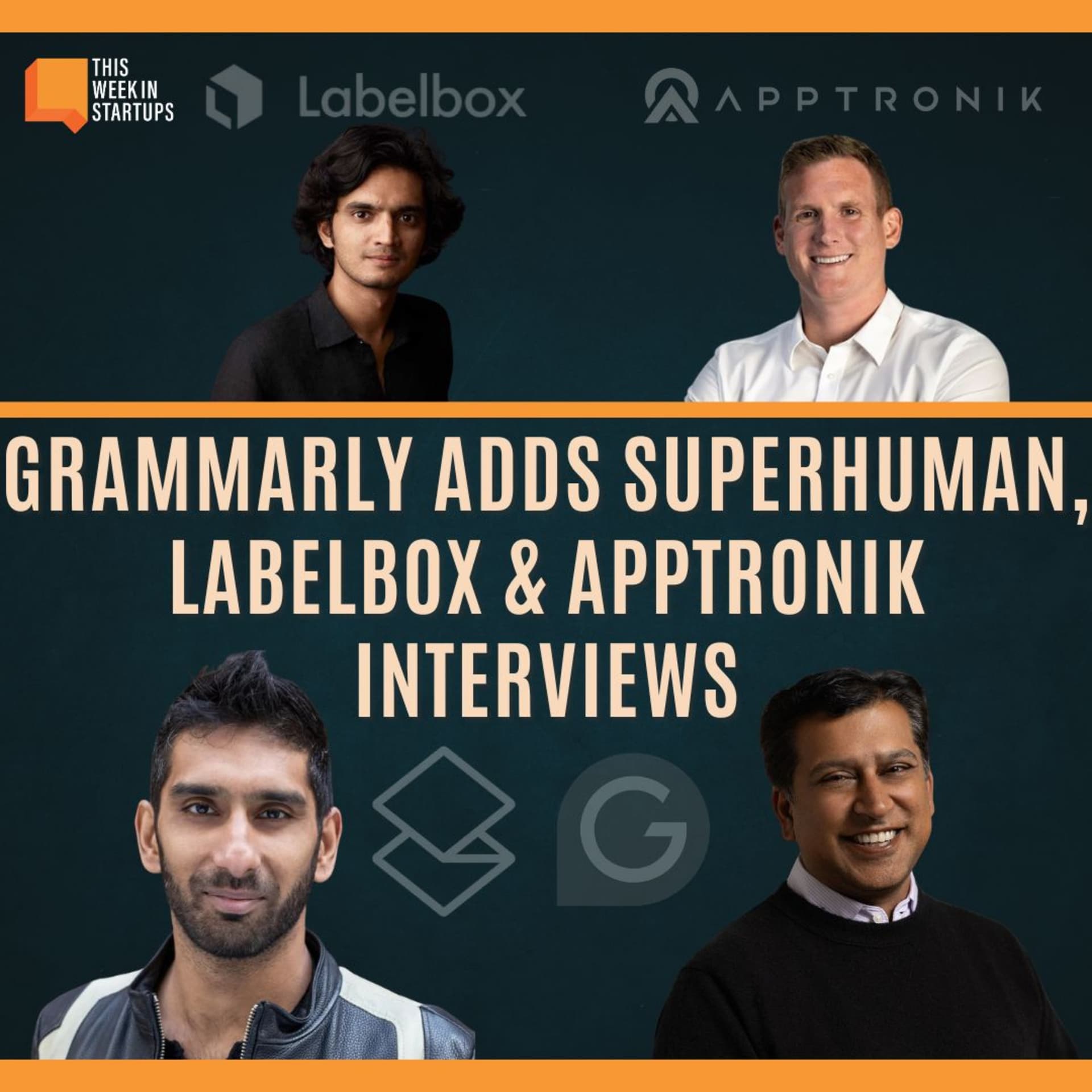
Podcast Episode Notes: This Week in Startups - The Grammarly–Superhuman Megadeal, plus TWiST 500 chats with LabelBox and Apptronik’s founders | E2146
Episode Overview
- Podcast Title: This Week in Startups
- Episode Title: The Grammarly–Superhuman Megadeal, plus TWiST 500 chats with LabelBox and Apptronik’s founders
- Host: Jason Calacanis
- Co-Hosts: Alex Wilhelm, Lon Harris
- Key Topics:
- Grammarly's acquisition of Superhuman
- Impact on productivity tools and email
- Interviews with LabelBox and Apptronik founders
---
Key Highlights
Grammarly and Superhuman Merger
- Acquisition Details:
- Grammarly acquires Superhuman, a high-end email application.
- The merger aims to create an integrated productivity suite that enhances communication through AI.
- Grammarly's Vision:
- CEO Shishir Mehrotra emphasizes building a platform of AI agents to enhance productivity across various tools.
- Superhuman serves as a natural extension since email is a primary communication medium for Grammarly's users.
- Superhuman's Perspective:
- Founder Rahul Vohra discusses the importance of email in professional workflows and the potential for AI to improve email efficiency.
- Assures current Superhuman users that the product integrity and experience will be preserved post-acquisition.
Broader Implications for Email and Productivity
- Email as a Dominant Tool:
- Email is highlighted as the most used application for professionals, reinforcing the need for innovative solutions.
- Integration of AI in Productivity:
- Discussion on how AI can be utilized within email systems for improved communication and task management.
- Future potential of AI agents to triage emails, draft responses, and provide contextual information automatically.
News and Updates on Other Tech Developments
- AI Regulation:
- Current legislative efforts surrounding AI regulation and implications for state vs. federal control.
- Cloudflare's New Product:
- Introduction of a pay-per-crawl model allowing websites to monetize AI scraping, potentially shifting the economics of content usage online.
Interviews with Founders LabelBox
- Overview:
- Focus on data labeling and its critical role in AI training.
- The transformation from human-led to AI-assisted data labeling is discussed.
- Operational Insights:
- Manu Sharma explains the creation of a "data factory" model, combining human expertise with AI to enhance data quality for training purposes.
Apptronik
- Humanoid Robotics:
- Jeff Cardenas discusses the development of the Apollo humanoid robot and its capabilities.
- Market Readiness:
- Insights into the ongoing development and potential market applications of humanoid robots, emphasizing the importance of robustness and task mastery.
---
Key Takeaways
- Strategic Acquisition: The Grammarly-Superhuman merger represents a significant move in the productivity space, leveraging AI to enhance email communications.
- AI's Role in Workflows: The integration of AI within productivity tools is poised to shift how professionals interact with technology, paving the way for smarter email management.
- Market Dynamics: Discussions on Cloudflare’s pay-per-crawl model highlight evolving economic relationships between content creators and AI companies.
- Data Labeling Evolution: LabelBox's approach reflects the increasing sophistication of data labeling technologies, combining human and AI efforts for optimum results.
- Humanoid Robots Future: Apptronik’s advancements in humanoid robotics indicate a shift towards more capable and versatile robots that could transform the workforce.
---
Conclusion This episode covers critical movements in the startup ecosystem, particularly how AI is reshaping productivity tools and robotics. The discussions with key founders provide insights into the future of work, the importance of innovation in AI, and the ongoing challenges and opportunities within these rapidly evolving industries.
Written by AI. May contain mistakes. Listen to the episode to check what was said.
Transcript
Automatic transcript. May contain errors.0:00So I think the days of hard coding something to pick up a box, those days are over, right? So we have reached this inflection point, not just in humanoid robotics, but in robotics as a whole, to where it's very clear that learning is going to be the future. This Week in Startups is brought to you by Northwest Registered Agent. Starting your business should be simple. With Northwest Registered Agent, you can form your entire business identity in just 10 clicks and 10 minutes. From LLCs to trademarks, domains to custom websites, they've got you covered. Get more privacy, more options, and more done.
0:37Visit northwestregisteredagent.com slash twist today. Retool. Bridge the gap between AI demos and business impact with technology that's designed for developers and built for the enterprise. Visit retool.com slash twist and try it out today. And AWS Activate. AWS Activate helps startups bring their ideas to life. Whether you're just launching or already funded, apply to AWS Activate today and receive up to$100 ,000 in credits. Visit aws.amazon.com slash startups slash credits. Hello and welcome back to This Week in Startups. My name is Alex. I'm joined today by my co-host, Lon Harris. Lon, how you doing?
1:24Great to be here. How exciting. I'm very excited. There is a lot of news today. We are going to have in a little bit the CEOs of both Grammarly and Superhuman to talk through their enormous deal, the implications of it, what they're working towards, why the deal came together, how it came together. So much to get through. But Lon, first, there's a couple of news items we absolutely have to touch on. The first thing that I want to double click on for folks is that we've talked about AI regulation here on the show quite a lot. There was a push in the House and Senate to perhaps limit state level AI regulation.
1:57it appears that that is currently off the table. So if you were hoping for one national policy on AI regulation, not a great day for you. If you wanted states to have their own shot at it, well, good news. Lon, your take. They were sort of sneaking that into the big, beautiful bill was the story. They were just like a little, a little hidden, tiny little text at the bottom of the page that said, no state for the next 10 years, I think it was, right? Like no states can pass any limiting AI regulation. I mean, I do understand, like far be it for me to agree with the large AI companies. Like I feel like usually I'm in opposition to them and their policies.
2:38But on this one, I get it. I do understand 50 different states making their own AI regulations is going to be beyond a headache for these companies, like basically impossible if all the states are going in their own little direction. So I do get why you would want to make a federal level rule. I just think this one was a little aggressive. Like you don't want to maybe make it so that states have zero power. I think you just want common sense limits on what they can do that would massively impact development of the entire American AI industry. So I think to me, this feels like I understand the motivation, but it feels like a hammer when what you need is probably more like a scalpel.
3:21i think that's pretty fair and there was movement on 10 years five years sticks and carrots but does appear to be off the table for now we'll see what the house does uh 10 years when you're talking about any kind of rule about ai is like well who even the the ai will be making rules about itself by then like we don't that's so far out in terms of this stuff i feel like it's almost useless like they're gonna be laughing at whatever we thought about ai today in 10 years can you imagine maybe 10 years is just the time it takes to reach agi all right yeah the west world hosts are gonna be like they were so stupid i only watched the first season of that is the second one worth watching um i if we're gonna go deep on west world first season easily by far the best season two gets real heady and philosophical and weird which i like but turned off a lot of people i still thought it was good three and four then kind of completely skipped the rails you don't need to keep going that far but i do like to all right fair enough now lon the other major story before we jump into our interviews today is that cloud flare has essentially flipped the internet economics that we know and love on its head uh the news here is that they have debuted a new product called pay per crawl essentially it's a way for websites to not only block ai scraping and ai pings but also to set a price for scraping their content this matters quite a lot in two contexts The first one is training.
4:46We all know that AI models love to go out into the internet, collect a lot of information that they then use to train their systems to become, in theory, smarter over time. But I think the other context that's even more important is RAG, which is retrieval augmented generation. Essentially, AI models going out to the internet, collecting information and using that as they generate a response for users. This has become a more and more, I would say, frequent use of AI scrapers out there. The problem is, as we've learned from Tolbit, as we've learned from Cloudflare's data itself, those RAG queries don't really send people back.
5:19So the economics of value transfer, if you will, have become incredibly one-sided in favor of the AI companies. So pay-per-crawl allows websites to say, if you want to crawl us, here's the price. And it allows for a kind of middle exchange with Cloudflare mediating the transactions. If this takes off, if this becomes the new standard, it would revolutionize the economics of online content the question though a lot is how many websites will take it up and will the ai companies play ball yeah i'm it's interesting the way ai outputs are structured they purposefully don't send you to the third party like even in claude which we use all the time shout out producer claude shout out they they sort of it like they're making a big show of we are citing sources like they don't want you to think this is hallucinated.
6:12So they're putting those footnotes, but they're so small and they don't even seem clickable. You have to really like take the onus on yourself to click through and see what websites Claude is referencing. They could make those pages look more like a Google result. You're getting a block of text explaining what you asked Claude. And then here two or three well-chosen curated links that would send you to the sources for those information. So I do feel like there are other ways around this, but sure, if paper crawl is the strategy that gets publishers and websites paid, I'm obviously all for it. I feel like the big concern these days is we're doing so much with AI, we're auto-generating so many outputs, We're condensing the web down to these, you know, little, little AI results.
7:03Eventually, we need people to be actually doing the journalism, writing the original websites, creating the sources that Claude is then scraping. And like, we do need to foster those kinds of businesses or they disappear and there's nothing left for AI to reference. So the way that I think about this, just kind of build on what you're saying, Lonnie, is the first order impacts of paper crawl from Cloudflare, if it becomes the norm, is that there will be better online media economics just from day one. The second order effect is that that could lead to more expensive AI subscriptions. If Cloud and OpenAI and other companies are forced to pay for content and data, it might mean that they have to raise their prices.
7:45Fair enough. Third order effects, there'll be a stronger online content ecosystem. Better content will be rewarded, so there'll be more of it. And then finally, I think that will yield long-term better and stronger ai systems because there'll be more real data to pull from but it's going to be expensive to get there the question is what's the uptake how many websites want this i founded the company to do this back in 2009 and uh we failed you're just ahead of the curve man yeah but this is always a good excuse to pull up the old tech rich articles of my companies like birth and then death um but i'm just saying people have been trying to solve this for so long micropayments for individual human visits haven't worked but perhaps micropayments for agents are the way forward.
8:26All I know is I write on the internet for money. So I hope this works. Yeah, I mean, it does make sense to me. And I know we got a million things to get to today. We got to move on. It does make sense to me to make the AI subscriptions more expensive if that is then going to be your window into the world of content, for lack of a better term. Like, we understand that, you know, your Netflix subscription is expensive, but then it's funding all of these international productions like squid game and all the movies and whatever like all of that content gets created because of you're paying the netflix subscription up front it could be the same way you're paying anthropic up front for your claude subscription but then that is in part seeding all of this great media and content from around the web that we still want to see we just want to access it via claude it's like jason says on the show all the time.
9:20It's not that he doesn't want to hear the New York Times Wirecutter tech reviews anymore. He just wants to get them through chat GPT. Yeah, I think it's really cool that this could convert a portion of consumer enterprise AI subscriptions into effective media subscriptions. It's a pretty interesting model. Investors like me are not going to invest in your business unless you're structured properly. So founders, if you're serious about raising money, you need to set up your business the right way. And that starts with a registered agent. Before a venture capitals can wire you a single dollar, they're going to check if your company is incorporated and it's in good standing and it's compliant.
10:01That's where Northwest Registered Agent comes in for just$39 plus state fees. They're going to handle your paperwork, keep you compliant, and make sure investors see you as a serious business concern that's worth putting money into. In just 10 clicks and 10 minutes, Your business is officially investor ready. Thousands of founders trust Northwest. So don't let paperwork cost you your next funding round. Go to NorthwestRegisteredAgent.com slash twist and get your business investor ready today. For just$39 plus state fees, you can set up your company the right way. Fast, private, and compliant. Go to NorthwestRegisteredAgent.com slash twist today.
10:41But you're right. We have to move on. All right. We got to do a polymarket. it yes we do uh and i picked one that is very very apropos to the current moment because why not keep talking about what you and i love the most which is of course mergers and acquisitions in the ai space of course mergers and acquisitions in the ai space because i speak english all right so this is a polymarket market that asks will apple acquire perplexity before september now i had picked this before the Grammarly Superhuman news dropped. We knew long going into this that Apple has snipped around perplexity before that Meta has sniffed around perplexity.
11:20And so I think this is a perfectly fine thing to bet on. I'm just surprised that it hasn't moved more in the wake of the Grammarly Superhuman deal, because I think we're seeing more AI first products by one another. And I think that that same pressure probably implies that Apple really does need to buy an AI champion. So I almost want to say this looks a little bit under voted, if that makes sense. Yeah. I mean, I think perplexity of all of the major AI companies, it feels like it makes the most sense. We know Apple's looking around and senses that Apple intelligence may not be ready for prime time and they may want Siri to be powered by a more established, you know, better sort of regarded model.
12:03And perplexity, we keep talking about, I think we keep coming back to this idea that the way we're gauging the best models and the most used models and the most entrenched, it's not by necessarily these benchmarks of like, can it take the LSAT and get a perfect score? I don't even know what the benchmarks are, to be perfectly honest. But the way that people use them is, are they tied into something else that I'm already using? Like the chat GPT interface obviously gets the most use and like Meta's AI gets a ton of use because it's baked into Instagram and Facebook and Grok gets a ton of use because it's baked into X comma the everything app.
12:44And so Perplexity doesn't have that. If you want to check out Perplexity's models, you got to just go i think it's perplexity.ai you got to like go there and purposefully look something up using perplexity's model and so it makes perfect sense to me like this feels like an obvious collaboration like apple needs a model to power their consumer facing apps that are already being used and perplexity has this great model but nothing to do with it so like bring those two things together and you have this seamless opportunity well i think that people are my i think people are not giving this as much credence because we have also seen news that apple might work with either anthropic or open ai to source their models as opposed to what it's built in-house and if they do that the need for perplexity goes down a little bit lon uh but i'll also just say apple has a history of small acquisitions not big ones and that's also leading against this being a possibility but at the same time if i'm apple and i'm this far behind on AI, I'm probably looking for some help.
13:49So anyways, lots going on over on Polymarket, but Lon, we got to get some interviews because there's a lot of news bubbling. As we said, we have the CEOs of both Grammarly and Superhuman here to answer all of our questions about their enormous deal that shook technology markets this morning. And then after that, we're going to hear from the CEO of Labelbox, all about AI data labeling and how startups are working to fill the gap that Scale AI's exit to meta may have formed. And in the background of that, you will see the glorious Stanford campus. So please enjoy the California sunshine. And then to close off Aptronic, all about humanoid robots.
14:22How much progress have we actually made today? How quickly will we see these in market? It is a twist 500 extravaganza. I hope everyone enjoys it. We've been working very hard to get a lot of these interviews done to bring you what you can't find over there on Twitter. All right, Lon, let's hear from the CEOs of Grammarly and Superhuman. This morning Grammarly, an AI-powered writing tool, announced that it will acquire Superhuman, a well-known email service popular and beloved by power users around the world. Recall that Grammarly was in the news as 2024 came to a close for buying Coda, a startup that built AI-infused enterprise collaboration tools.
14:58The company also sports 40 million daily active users and more than$700 million worth of annual recurring revenue. To dig into the deal, to figure out why these companies are coming together, Please welcome to the show. It's Shashir Mehrotra, CEO of Grammarly, previously co-founder and CEO of Coda, and Rahul Avora, founder and CEO of Superhuman. Gentlemen, welcome, I guess, back to the show. I think of all of our guests, you two have to be among the absolute most frequent. So thanks for making the time. Thanks for having us back, Alex. Hello, hello. All right, so Shashir, earlier this month, you said that Grammarly is, quote, building a platform of AI agents that work seamlessly within your existing tools, a big vision.
15:35How does Superhuman fit into it? Yeah, sure. Really excited about this acquisition, this step today. As you mentioned, our goal is to build the AI Native Productivity Suite with the apps and agents that drive productivity for every individual and every team in the world. We spent last time talking mostly about agents and how Grammarly is the OG agent. It serves as its communication assistant for over 40 million daily active users. And we're basically transforming that platform into a platform of agents that work with you beyond just your Grammarly agent. But simultaneously, we're also building a suite of application for where those agents work.
16:11And the code acquisition was actually the start of that. It gives Grammarly a natural home for one of the most common tasks that Grammarly users do, writing. But as we work to fill out the suite, we naturally turn to the next most commonly used services, which turns to email. Emails, for most people, the dominant communication tool people use, billions of different users, often the most used work app. It turns out that for Grammarly, it is actually our number one use case. So Grammarly is used more frequently in email applications than any other surface. We help people revise something like 50 million emails per week and work across 20 different email providers, Gmail, Outlook, Apple Mail, so on, including Superhuman.
16:59So my view of this was, I actually looked at that category as the next obvious one for Grambling to play in. Email is a category I've been thinking about for a long time. As we were talking about right before the show started, I actually started my career in email. I was a developer on Microsoft Outlook in the 1990s, seems like a long time ago. At the time, Outlook was the most innovative email tool in the world. I got to Google right as the next one came. Gmail came in the mid-2000s. And then after that, basically nothing happened. And until Rahul came along and Rahul and I were starting Superhuman Code Up similar time.
17:36And I saw in him the same spark of I bet we can reinvent this very unappreciated old surface in a similar way that we were doing with documents. And Rahul had a really extremely clear view of how to do it and has done a really amazing job of it. So Superhuman was a very natural next step for us there. I think it's a complete mind shift in how people think about email. We'll talk more about that as well. But for us, it helps us bridge out from agents to building out the application services for the prominent places where people work. All right. So Rahul, Tresher just said that you had a pretty clear vision for the future.
18:18Talk us through from your end why this deal made sense and what you hope bringing Superhuman into Grammarly will unlock that you couldn't have before with just people using Grammarly as also being Superhuman users. Well, I think this deal, like so many, had its roots in a relationship that started a long time ago. We actually met Tisha and I back in 2017. We were at a conference and it was one of those special moments. This is why people go to conferences or why you should go when no one else was around. So we could get into some really deep conversation. This was the lobby conference. So shout out David Hornick and team.
18:51They do an amazing job. And as I think, you know, back then we only did one-on-one VIP concierge onboardings. So I onboarded him right there then, right by the pool. And as those who've been through one of these onboardings know, the very last step is I would ask people to close Gmail and he's, you know, moving his hand around. He finally clicks the close Gmail tab and like another tab catches my eye, which is an app called Krypton. and I asked what it was and Shishir then proceeded to give me the best product demo I'd seen in years like it was this document but it was also a spreadsheet and a database it was a collaboration tool it was an app builder and Krypton kind of stuck at the back of my mind because that's the home planet of Superman which is adjacent to superhuman obviously they eventually renamed Coda and then Shishir was brought in as well as the whole Coda team and product intergrammally AI is here.
19:45It's changing everything, including the way we do business. But Alex, I know a lot of listeners still aren't getting as much out of the AI revolution as they should be. You shouldn't just be asking a chat bot a question you would normally ask on Google. No, your AI app should be connected to all your other systems, making your workflow smarter and more efficient. And that is why Retool was created. Retool makes it simple and straightforward to build your own custom AI powered apps integrated directly into your workspace and the tools you're already using every day. For example, imagine joining a Zoom after having a dedicated AI assistant prep all your meeting notes and then sticking around to give you important real-time context and feedback as your colleagues are talking.
20:27Or a skilled AI CPA, keeping an eye on your books, prepping your taxes, and instantly spotting fraud. Design your own AI agents that help you get real work done today. No more writing endless integration code. No more choosing between performance or customization. Trust a platform that's already being used by over 10 ,000 companies. Check out Retool today and get your AI doing more than just talking. Just go to retool.com slash twist to learn more. That's retool.com slash TWIST. Now, last year in his acquisition announcement, he wrote, and I have the quote here, as I watched the foundational capabilities of AI change just about how every tool and service operates, I started drafting my 2025 planning memo for the team.
21:10I titled it the AI Native Productivity Suite. And that was a moment where my jaw kind of hit the floor because I think, as you know, our vision at Superhuman has always been to build the AI Native Productivity Suite of choice. And email is a critical part of that suite. Jashir touched on it, but it is such a big problem. There's roughly a billion professionals in the world. And on average, this is the average number, we spend three hours a day on email. So that's 3 billion hours every single day or more than a trillion hours every single year. It's sometimes easy to forget this in Silicon Valley, but in general, as professionals, we spend more time on email than we do any other work app.
21:49So we caught up, we had several conversations. It was clear that we share the same vision, which is to build the AI native productivity suite of choice. I think this is going to look a little bit different maybe to what people imagine when they hear that. It is not just apps. It's apps and agents. And that's what we're building. So I want to get into that because when Grammarly bought Coda, my thought was, okay, so Grammarly is a great tool. I use it around the web. Coda is a great tool. We use it for the twist500.com website, for example. Okay, that's the new pane of glass. That's the central interface for all things Grammarly, agents, and Coda.
22:22Now with Superhuman inside the fold, I'm not sure exactly where the center of gravity rests, Or alternatively, if agents are going to follow me around the web and I'm clinging to a dated understanding of what software should be. So which direction are we going? Yeah, I mean, I think our view is we'll do a little of both. I mean, I think the way we think about is agents should be with you everywhere you are. And it's very important that like Grammarly does, follows you into hundreds of thousands of different applications. But they also need a home. And I think the way we think about Coda is we think about it as the first party home for interacting with those agents.
22:58An analogy I use a lot with the team, the product I used to work on before Coda was YouTube. And for YouTube, imagine if YouTube only had embeds all around the Internet, but there was no YouTube.com. So we kind of view that together. And that's how I view both Coda and Superhuman in this world. So just to give you an example, imagine you're writing an email to a customer. and not only do you want to have your grammarly trusted communication agent that's making sure that you get your spelling and grammar correct, you get your tone correct, that you're accurate, but you also have a sales agent that ensures accuracy of all your sales facts.
23:37And maybe you have a support agent that knows everything about that customer's recent support issues, or maybe you have a marketing agent that knows exactly which feature to suggest to that customer. And all of those should happen in that same surface where you want to spend your most productive hours of the day. And so that's how we view them coming together. That's a pretty broad multi-Asian framework and one that seems to spread quite far beyond the companies you purchased today, Shashire. So being a little bit of a brat, but how many more companies are you planning on buying? I don't think I have a limit.
24:13I mean, I do think as you build the suite of the future, I think there's a lot of things that we'll build, we'll buy, we'll partner. I don't think everything has to be done in that way. It was very important to me to take ownership of the most important surfaces that people work in. If you were sort of divide people's work life into what do you do all day, you produce work artifacts, documents, spreadsheets, presentations, so on, and you communicate. And so that's things like email, chat and so on. And so these were certainly the two most important. But we're we're ready to pull in whatever parts of the suite we need to complete that experience.
24:50All right. So Rahul, you wrote in a post over on the Superhuman website that email, quote, turns out to be the perfect place to work with agents. We were joking before the show that I've almost onboarded a Superhuman like four or five times. Sorry. But I'm very curious what that might look like in practice for folks out there who either aren't current Superhuman users or just not sure what an agentic email experience might look like in Shashir's broader vision of productivity. Absolutely. And I think as an industry, we're still figuring out defining exactly what an agent is, which by the way, I think is fine.
25:23At Grammarly, we have a particular point of view. I think one of the things we believe, and this is a little bit unique about our position, and I love that Shashia has this position and the wider company as well, is that it should follow you around. It should be available working wherever you do. You may remember, I have a very deep history in that idea. My last company, Reportive, I think was a proto-agent. Like you didn't have to do anything. It was just always there working on your behalf, researching people, putting it on the right-hand side of Gmail. Grammarly, the product, is a proto-agent.
25:54Whatever writing service you're in, it's there helping you write, helping you communicate, helping you be understood. And obviously the capabilities of those things now are so much more advanced than what we could do back then. But that idea of someone sitting right beside you or like this little thing on your shoulder that's just helping you be brilliant at what you do. Very near and dear to my heart. So zooming out a bit, we think that these AI agents, they're going to work on your behalf. They're going to reason. They're going to problem solve. They're going to incorporate detailed context about your work.
26:25They're obviously going to interact with other systems. And as we've started to see over the last few months, other agents. And for so many people, email is the center of where they work. It's got things like project statuses, customer communication, meeting updates, deal execution, so much more. So you can imagine an agent triaging your inbox before you wake up. You can imagine another agent drafting, I know, right, responses in your own voice and tone. It's all going to happen. We'll get you on the fifth time. An agent incorporating detailed context about your work. Another agent servicing insights, scheduling meetings, and then syncing with your other systems of record, whether that's an ATS, a CRM, could be custom system, a custom integration.
27:03One of the cool things about agents is the API can literally be natural language. and so the glue is easier to build than it ever has been. And then one of the most far out ideas, and we were talking about this just before the show, and you were asking like, does email become the workbench to manage your agents? Well, I think the answer is we'll have multiple places to manage our agents. Sometimes it's going to be in the flow of our work. That's the idea of the agent following you around. But sometimes you're just going to want to go through a list of things and mark those things as done and snooze those things and assign those things to other people and have blazingly fast full-text search over those things and have this app, whatever it is, work offline.
Read the full transcript
27:43And it starts to look awfully like an email client at the end of the day. Email actually is nothing more than a list of things to do. And that is what we're building. It's what we've always been building. I'll add two quick things. And Alex, I know we'll get you onboarded to the product again soon. I think just first off, that the task of dealing with email is its own interesting task. This seems like an odd thing to brag about, but I've been a superhuman user for years and I had Rahul pull the stat for me. So I have currently 144 week inbox zero streak, hitting inbox zero every week for two and a half years.
28:20And that is largely credit to superhuman. So if you view this as a chore, we can do much better than that. I think there's a next level, which is now do you communicate better? Do you communicate more effectively? how much faster do you respond to emails, what's the quality of the responses. And then you start to think about it the way Rahul was just describing, that it's your workbench for working with your agents. And part of our view of it was, why do we care so much about documents and email as being two surfaces we really wanted to have the best first-party experience in, is the places you work with humans are the natural places to work with agents as well.
28:58That's how we think our teams are about to expand. It's a very natural surface for us. On the agent that follows you around, I love that idea. I love the idea of having an assistant that knows my context and can help you wherever I am. Is that something that you can build with technologies as kind of basic as a browser extension? Or do you need a different vehicle to bring that to market so that way it can interact with me across my workflow? Because not everything I do is inside of a browser. We're all familiar with AWS, Amazon Web Services. That's the cloud platform that powers so many of your favorite brands.
29:33But do you know about AWS Activate? That's their program for startups, where they provide up to$100 ,000 in AWS credits for all startups. Whether you're backed by an investor or you're bootstrapping, money is time to keep innovating, time to delight customers, and time for you to keep gaining traction. You need runway, and AWS's Activate is going to help you with that runway. We hear this story from so many of our founding university companies. They're finding product market fit, the words getting out about their product, just a little boost. Finding some savings here or there to get a little extra time can be the difference between getting traction and bringing in revenue, or, hey, let's call it what it is, running out of money, okay, and shutting down.
30:13AWS knows this. That's why they've created the ultimate toolkit for early-stage startups looking to boost growth. With AWS Activate, you're going to get up to$100 ,000 in AWS credits, hands-on support and training, plus exclusive discounts with some of our favorite companies and tools. So start getting the support you need at every stage of your startup journey. To learn more, visit aws.amazon.com slash startups slash credits. That's right, aws.amazon.com slash startups slash credits. Yeah, that's right. Right. I mean, I think the first off, the way Grammarly works, and if we think about Grammarly is really I think it's a very misunderstood product because I think people understand it as as a proto agent, as that OG agent.
30:57But actually, it's two separate products. You know, there's one we think of as the agent platform that brings AI to you everywhere. And the other we think of as your agent. That's the that's your high school grammar teacher in your pocket. And the platform is actually where most of the technology has gone. So Grammarly currently works in your browser. It works on your desktop. There's a desktop application that works on it and on your phone. So there's a, both on iOS and Android, a version of Grammarly that can work across all your applications. So across that, we work across 500 ,000 different applications.
31:30And yes, that's everything from your browser apps, Superhuman, Gmail, so on, but also your desktop apps. Slack is a great example, but people use Apple Notes. People use all sorts of things that are desktop applications as well. And we've done the hard work to be able to read what's on your screen, be able to annotate it in a way that is unobtrusive to you, and then be able to take action on your behalf. We call that the AI superhighway. That's the term we use for it, bringing AI right to the end user. And our view of it is that right now we're only running one car on that highway. We're running your high school grammar teacher.
32:06That's the one car. and we're expanding that so that anybody can build an agent that works across all those different surfaces. So that is a key part of what we're doing. So then Grammarly's kind of back end today is the platform on which many other agents can be built, filling out this AI highway with other cars, to your analogy. That's right. And you're going to see a big shift in the product in the next couple of months and that'll become much, much more obvious. We've been working really hard on it and then we'll start opening up the platform so anybody can do it. I mean, that could be, like we described a couple of examples earlier, it could be things that connect to a system.
32:39Imagine your Salesforce agent wasn't like a Salesforce app that you had to go to, but rather an agent that was with you everywhere and had all your sales data at your fingertips and was just going through and marking up your, whether you're writing an email or a document or so, and marking it up as you go. You can imagine agents that represent people. So I want an agent for, I'm a big fan of Kim Scott's Radical Candor and Kim's building an agent that is, hey, you really want to follow this? Don't read the book and stick it on your shelf, but really have this person that's sitting next to you saying, hey, you're kind of not following the principles of the book right now.
33:08Here's what you should be doing. So I think that market of the set of people I want next to me as I'm working is sort of limitless. And we want to be the platform for doing that. So just to be clear, you're saying that Grammarly is eventually going to have an agent marketplace where other people can build things and deploy them onto the foundation that we discussed that Grammarly has already built that interacts across a user's computing environment. Yeah, that's right. And it's being built on top of a marketplace we built in Coda called the PAX Marketplace, which is already one of the most thriving marketplaces in the world.
33:39There's about 8 ,000 or 9 ,000 of those PAX that have been built, there's 800 or so in the gallery. And so there's already many of those agents already exist. And we're taking those and bringing them over to the Grammarly platform. All right, Rahul, I want to get back to you because when this news dropped, first of all, I was a little bit shocked. I've since kind of figured out what you guys are doing. Frankly, I quite like it. Over on social media, Some people were a little bit confused, expressed concern that their favorite product is going to be taken into a larger company. So for folks out there who are current superhuman users who may not be Grammarly customers, what assurances can you give them, if any, that their experience is not going to become, to use a common phrase, Salesforce?
34:18Well, without commenting on Salesforce, anyone who's watching this has mine and Shishir's absolute assurance that whatever that is, it's not going to happen. Shishu, as he mentioned, has been using the product since 2017, credits his success in his email to the product, and the entire team is moving over. This is an acquisition not just of a product, not just of a team, but of a business, an ecosystem, a brand. It's something really, truly very special. And we have every intention of fully accelerating what it is that we're building and what we're doing here. As a founder, one of the most exciting things about a deal like this is that you have access to significantly greater resources.
35:00So we're going to invest more than ever in AI, as we've talked about. We're going to invest more than ever in our core email experience. Even after building it for 10 or 11 years, we still have a laundry list of things that we want to make better. We're going to build out calendar, and we're actually very close to that. Anyone who's in Superhuman today will see that. Tasks, we're going to connect calendar and tasks and email beautifully together. We're going to reimagine chat, redefine collaboration, pulling on everything that we've learned about work communication for the last 10 years. And then, of course, as Shashir said, we're going to connect all of this up with a new way of working with agents, which we think is going to free all of us up to be more creative, more strategic, and more impactful.
35:39So I get it. It's reasonable to be concerned in a time of massive change. But one of the things that really appealed to me about this particular pair up and Shashir as well being a genuine user of the product for so many years now is this goal to build, that he mentioned to me in the past, to build a stable of some of the best AI brands in the world. And that's very different. He gave me some examples, for example, of when Facebook acquired Instagram or when Facebook acquired WhatsApp or how Google has treated YouTube. That is how we want to think about superhuman at Grammarly. so a crown jewel the one that retains its own identity and will be a piece of a larger puzzle i like that a lot and i'm sure that a lot of folks are going to be very glad to hear that their superhuman experience is not going to change uh now rahul you sold reportive after just a couple years of building it now you've been working on superhuman for a very long time you had a pretty big round back in 2021 i'm curious just from the founder's chair why was is this the right time to sell?
36:46That's a great question. I think there's a few things that people often say, oh, like, was it a growth thing? Or like, is it a runway thing? And, you know, mostly for the insider baseball and for the other founders, I'll share the following. We were actually growing faster than ever. We grew twice as fast in 2024 compared to 2023. We had runway for four plus years, we would have been break even, probably early next year by this point. So it truly is none of those things. It really is that technology is changing faster than I've ever seen in my whole career. And towards the end of 2024, I think a number of companies realized the magnitude of the apps and agent opportunity that we just talked through.
37:31And also they're looking at their own products portfolio. They're realizing they have an email size whole. And I think one of the skills every founder needs is to spot the zeitgeist, to realize when that kind of thing is happening, and then to be able to go and prosecute that opportunity. And so it was obvious to me at the end of last year that there were a number of companies that had that thought. And it makes sense. There's, as I said, north of a trillion hours of time going to email every single year. There's no other work app that we spend more time in. Superhuman is almost actually definitely a one of one asset.
38:05Like we spent 11 years grinding to get to this specific point. And so that was why I knew it was the right time. All right. From the buyer's perspective, this idea of an email shaped hole in everybody's productivity suite, I think is absolutely correct. I think there's going to be a race to build that new AI needed productivity suite. And I felt very lucky to be able to work with Rahul and, come up with a deal that I think will produce great impact for our overall company, for the current superhuman users, but is really a one-on-one product. I mean, there really is, the next best new email products on the market are almost unheard of.
38:43And so I think it's a great partnership to be able to bring that to a much broader group of people. Yeah. And it's not like Gmail has gotten a lot better in the last 10 years, let's be honest. Now, Shashir, you recently secured a billion dollars worth of growth capital with General catalyst. Pretty interesting way to fund growth of the business. I really liked it. You did note that some of that was earmarked for strategic acquisitions. I'm curious, did you use that capital for this deal? And did you have Superhuman already in mind when you secured that capital, or did this come afterwards? Rahul and I have been talking for a bit.
39:14So yes, it was in mind as we went through it. The specifics of the deal aren't being shared, but it was an all-stock deal. So the capital allows us to take bigger bets here. But in general, we're working through how to expand our offering as fast as we can. And having access to an extra billion dollars is a pretty good way to do it. Rahul, was that large pool of capital that you'll have access to now to probably use to grow superhuman an incentive? Or are you more interested in the engineering resources that Grammarly can bring to bear on your, quote, laundry list of to-dos? Well, definitely those two.
39:54Distribution, greater resources. I mean, there are so many reasons to join forces here. It was almost a no-brainer. Pretty clear, actually, in our first conversation that Shashira and I had. Wow. Okay. So, Shashira, then just to wrap us up here, because I think everyone wants to know how this is going to play out in the real world, but your company's enormous. 700 million ARR, making a lot of big deals. So, IPO plans this year, next year, people are talking about everyone getting finally out. Are you one of those companies? Nothing to announce now. I think we're pretty busy building. I think it is quite the gold rush right now as the world adjusts to AI changing many things that we just didn't think were possible.
40:34I mean, the idea that we're going to have agents writing and rewriting all our emails for us just seemed kind of crazy. And now it's completely possible. And, you know, we're very focused on growing that. and when we're ready, we'll take it out to the public markets. All right, well, here's hoping that you guys can eventually take these agents to become so smart that they can, instead of writing the email for me, simply contact someone else's agent, handle the communications and bring back the context I need because then we can just cut out the whole middleman and short circuit email for the future.
41:03But in the meantime, Rahul, Shashir, thank you both so much for coming back on the show. Congrats on the deal and I guess go build. Thanks, Alex. Bye.
41:16Now, you may have seen a major news item in the last couple of days. Meta and Scale AI have come to a$14-15 billion deal. That investment threw an enormous amount of light onto the realm of data labeling. And in the coverage of that enormous news event, a company called Labelbox said that they might generate hundreds of millions of dollars in new revenue this year. Naturally, that got us thinking. We looked into the company. We absolutely had to learn more. So please join me in welcoming CEO and co-founder of Labelbox. It's Manu Sharma. Manu, welcome to the show. Thank you for having me, Alex.
41:46Really excited to be here. And if you're watching the video version of this, I will note that Manu is not using a virtual background. He is on the Stanford campus, which just goes to show, I think, the connection between AI work and academia is holding strong. But Manu, just to start, what is data labeling? And can you tell me a little bit about the difference between human-led data labeling and machine-led data labeling? Yeah, Alex. So nearly every AI breakthrough that we have experienced since AlexNet, all of these models have actually been trained on human-generated data. Back in the days, you know, when around maybe, let's say, 2017 to 2020, supervised learning, which is a technique to build computer vision models.
42:29You may have seen lots of self-driving cars work starting popping up at that time. They were all trained with human-labeled data. And kind of labeling at the time used to be fairly trivial. You're kind of looking at an image and saying, hey, that's a car, that's a pedestrian, and things like that. And that fundamental technology or technique was widespread for all kinds of computer vision applications. and after kind of the transformer kind of innovation or breakthrough appeared, a lot of the focus went into kind of making that unsupervised learning stack work. And turns out, even in that paradigm, you know, these models are learning from, let's say, all the web data, which, of course, is human-generated for all these decades on the Internet.
43:17And then there's also a technique called post-training where the very experienced humans are teaching these AI models to be better assistant. And now the state of the art is that these models obviously are very capable across the board. However, they still lack reliability with agents and performing day-to-day tasks. they're getting better, but even those kind of skills have to be taught by, through human data, believe it or not. And now, you know, there is sort of perhaps a misconception that, you know, like it's kind of machine-generated data or human data. The state-of-the-art or the frontier is essentially hybrid data.
44:08Like there are, like most of the latest cutting-edge data sets that that are being generated that improves these model capabilities are fundamentally kind of AI assisted. So these experts, humans across wide range of domains in human knowledge, coding, mathematics, physics, you name it, they actually use AI systems to kind of produce the very best signal that is then used to enhance the capabilities of the models. So we've had machine-led data labeling. we've had human-led data labeling, and now we have AI-assisted human data labeling. Do you think that's going to be the state of the art for a long period of time, or is this just one more iteration on a cycle of constant change?
44:54So I believe that there is a long road to make these models highly capable and kind of be fully integrated in the economy. So when you look at kind of the adoption of these AI systems, They are obviously amazing and really changing the way we do work. However, these agents are still not as reliable. These agents still need to be taught how to kind of fully automate a task, you know, whether it's maybe even software engineering, like, you know, you're coding with humans in the loop, essentially. But I think, you know, when will be the time where AIs can actually write code for days? or weeks, and humans are sort of like steering or sort of managing them.
45:45And these examples kind of are across the board. You know, when will the AIs be able to be 100 % act as a customer service on your business behalf and sort of like resolve all the issues? And, you know, these kind of capabilities are very lucrative to solve, and they require a ton of new kinds of data. And you have to generate this data somehow. And one of the best techniques that we are pioneering is essentially using technology, AI, and software, and workflows with human experts to very cost-effectively capture human expertise in the data, which then is used to train these models through reinforcement learning.
46:38All right. Now, when I think about you guys, I think that what you described falls into your kind of data factory concept. Can you explain that for folks who might not be familiar with what you guys are saying there? Yeah, for sure. So in the data labeling business, or let's call it like data generation for post training for these models, there is a number of kind of ingredients that goes into it. So first of all, you have to have a network that is attracting and assessing really high-end talent who exhibits certain knowledge that is superior than the AI. It could be just sort of like a base kind of IQ, like humans can have high agency to learn new things and kind of do things that AIs can't do.
47:30But then also there is kind of deep expertise, you know, whether that's, let's say, an aircraft design, it could be medicine and healthcare and so forth. And so you have to have that sort of network and bench. And that's really just a starting point. And so you may have seen like a number of companies popping up as a expert staffing agencies model. And all they're really doing is helping some of these AI labs to hire talent. Now, we take that idea further. We call it Data Factory because you kind of need a workforce to obviously operate in some sort of a setting to actually produce human data.
48:09So Labelbox has been in business for over like seven years building that technology platform. So we build all the tools, the workflows, and techniques to actually produce the data. And so we have a network. And then on top of that, there is a kind of fairly complex and sophisticated technology platform, which uses AI and software and things like that to allow these experts to work in a manner that produces the very best data at a very cost effective kind of parameters. and that verticalized stack, what we call is data factory. And sort of this analogy kind of really holds where, you know, when you're building a factory or you're operating a factory, you've got to have infrastructure, machines, assembly lines, the workflows, the practices, but then you also need the workforce.
49:01And LabelBox is fully verticalized in the sense that we actually produce the data and offer that to our customers that in a manner, you know, They can actually get the data very quickly in a matter of hours, if not days. And it's really the data that these AI labs want ultimately to continue to win in the race. Yeah, it's interesting because if you go back to the SaaS era, there was a lot of discussions about software versus services and how you wanted to be a majority software business. You might sell services at cost simply as an enablement tool for your software business. But it really feels like the way you're describing the data race for AI, there is a strong human component in it, at least at the expert level.
49:47How does that impact how you price and sell label box services? Because I'm curious how you think about the two different sides of the data factory. Yeah, totally. So it's a fantastic question and observation. So, you know, for the first five years of our company, we primarily sold SaaS. We basically built the world's leading data labeling platform, and our platform is used by over 30 % of Fortune 500 companies. And in this context, our customers are bringing their own workforce and operating the entire data labeling operations on our platform. And in those contexts, it would be sort of like a SaaS-based pricing systems where it's based on how much consumption or data customers are generating, and they're paying some kind of a correlated cost to us on that.
50:39And when we decided to fully verticalize and get into kind of data services business, you know, just over a year ago, now we are pricing essentially on the data, like how per example, perhaps. And sometimes it's the value that our data is bringing among our customers. So, for example, just a couple of weeks ago, we enabled one of the leading AI labs to increase the state-of-the-art performance by 15 % on a data set that we created for them. And that could be extremely valuable to that company in the order of hundreds of millions of dollars of value generated. The model just bumps up in a leaderboard, and they are able to onboard more workloads and things like that.
51:27And so that is fundamentally like how we are pricing. It's based like on the value of the data we are generating for the customers. Is it hard to price? Because I feel like value from data is squishy. And you guys, if you're pricing that way, probably want to charge more because you think it's more valuable. And they might want to say, oh, you know, it was only so good. So how do you handle that tension? Yeah, there's always that kind of a discussion around the data and the cost and the value. and it is fundamentally hard to price and it's a new frontier for not just us but many other companies, the native AI apps companies who are essentially like a very similar model where they're kind of automating some workflow and so forth.
52:11And in our business, particularly the challenging part is that every few months, the state of the art is kind of at a much higher end. And so, for example, a year ago, a lot of the data we were generating was around kind of basic assistance, like teaching English skills, like how to write great essays. Now we are producing oral environments for these labs to kind of do this reinforcement learning with verifiable rewards. Very different technical skillset needed, very sophisticated data sets. And, you know, ultimately data is actually becoming more costlier. And the reason is that the expertise needed is becoming more kind of more complex or more nuanced.
53:00However, with that said, we are proud to be saying that we are actually one of the leading companies in the sense that when you look at the data and the cost, we are able to, we are the unmatched in that performance or the empirical curve. And we are able to do that because of a very strong technology stack that is operating on top of the kind of the expert network. I really appreciate that answer. That explains it kind of top to bottom. Mano, I want to go back in time. You guys last raised, the publicly known round was$110 million led by SoftBank, and it was announced in very early 2022. That was pre-ChatGPT's launch and what you might call the starting gun of the Gen AI era.
53:44I presume the market moved towards you in that year. So how much did the release of ChatGPT speed up demand for your company's services? And then if you can, how much did you guys grow last year? Yeah, so the demand has increased substantially. I mean, it's really all engines on fire, you know, since actually like when we decided to enter the data services market. So kind of a bit of a history. Just about up to less than a year ago, we decided to enter data services market. Up until then, we were essentially selling enterprise platforms across the world, across these enterprises. And I'm proud to say that we are powering most of the AI labs now.
54:33And so we've grown from basically entering the market to now powering substantial workloads for nearly all the big AI labs. And, you know, we've been growing very fast since then and basically in hyper growth kind of trajectory. And I think this latest news, kind of the market dynamics that over the last two weeks has further catalyzed or accelerated that growth. And, you know, so it's been really exciting times at Labelbox. And, you know, there are challenges around like how do you scale that quickly and, you know, meet customers and all that. And so, you know, I call it still to be a challenge, but at least it's a fun challenge.
55:17I do want to just verify something. You did say that the sale of scale to Meta and its customers leaving could actually generate hundreds of millions in new revenue for LabelBox. Is that a 2025 metric or is that a total contract value over kind of a multi-year period number? We expect substantial revenue over the next 12, 18 months for sure. We're experiencing it already right now at a much higher steep curve. and it gets harder and harder in larger numbers, but we are very, very excited about what's next in the next 12, 18 months. I appreciate that. Now, with the exit of scale, it could kick off some consolidation in and around your space.
55:58You mentioned some of the startups that are kind of popping up in your domain, admittedly targeting kind of a fraction of what you're doing. But I'm curious with your history of capital raises and success of the company and growth, are you guys interested in going into the market and maybe buying some smaller companies? We do get quite a few interests or inbounds almost every other week from smaller players or companies. And we are always assessing when the right fit is and when it makes sense. So certainly, we are very, very open to it. A lot of it really comes down to the complementary strengths and weaknesses and sort of that match.
56:42But we are actually seeing a lot of M &A activity and interest kind of boiling in the market across within our industry. Just because I have you here and I get to ask you this, by M &A activity bubbling up, is anyone trying to buy you or is this all companies that are reaching out to you as a possible acquirer? It's the latter, yes. Okay. Any names that... It would be wise to say that here. It wouldn't be wise to say those things, but, you know, but let's just say like many, many players are interested in joining forces with sort of leading companies and and so forth. So, you know, I think like any other category, right?
57:27Like there's a lot of enthusiasm. There's a lot of interesting players that have different techniques and different bets that they make. And at some point you expect like, you know, there will be some sort of consolidation. And I think now that the markets are more opening up for M &A, I think we are feeling it. We're seeing that through just like all kind of movements. Absolutely. Now, one thing that I was surprised by, just given how well the company appears to be doing from where I sit, is that, at least publicly, you guys haven't gone back to the capital markets and raised more. Is that simply because you've been running the company pretty efficiently?
58:04Yes, that's right. We've generally ran the company fairly conservatively when it comes to capital and efficiency and things like that. And we really wanted to be very sure and intentional when we go into data services market that we are going to enter to win and have all the key components and capabilities needed for us to demonstrate that. I mean, just over a year ago, we were not doing anything in this space entirely. And so in just like last four or less than four quarters, now that we are plugged into all these labs and we are winning the market share from kind of the other providers, it's really exciting.
58:52And I think we might do something in the future. So one thing that struck me as interesting about your background is that you've worked with drones before. And kind of a tangentially related point, I was also surprised to see that Uber is getting into the data labeling game in a more serious way. What's going on with people that deal with real world hardware systems getting into the data side of AI? What should we take away and learn from that? Alex, so I've been very interested in technology across the board. And so when I was in school, I actually was doing a lot of research in neural networks.
59:30In fact, I remember my earliest times was I was trying to make flight control system in airplanes, like powered by neural networks. And you don't believe like at that time, the neural networks were like three or four layers, and you could count the neurons in MATLAB and Simulink. And, you know, it's just a testament on how fast the technology has moved just from like a decade ago. And so in engineering, of course, you know, a lot of my work was in genetic algorithms and like these algorithms to optimize things. And so a lot of my interest kind of, I suppose, when I was in software technology, startups in Silicon Valley drone deploy and Planet Labs, I saw computer vision starting to take off.
1:00:12And then I sort of like all these things kind of came to me and said, like, hey, you know, I would love to build a company here. And I think there's an opportunity to build some enduring company that kind of sits in between this what we call AI and humans. I do think that, you know, over the next few, like, we are moving into a world where we will be steering multiple, if not millions of AIs, and we would still want to be able to manage them and kind of keep them aligned. And I do believe that to do that, you still have to talk to the AI in some fashion. And the data interface is essentially what LabelBox is trying to build.
1:00:54And the techniques and all these details will continue to evolve. Just how the labeling has changed over the last six years, I think it will be very different in the next few years too. But I think the intrinsic need to continue to manage the AIs will remain the same. And so we are kind of at that frontier and always want to build awesome tools and services there at that layer. Manu, if I'm tracking you correctly, you're saying that the way to speak with or interact with AI models is essentially through bringing them data. Is that correct? That's right. That's right. 100%. The way you ensure AIs are behaving the way you want it to do, or it's representing your businesses, or it's performing certain agentic tasks, you still want some checks and balances.
1:01:45You still want some evaluation data sets to test it before you roll things out. Or when things go wrong, when exceptions happen, you want to be able to have some sort of a human in the loop to make that sort of judgment, like, hey, why it got wrong and how to teach it to get better. And, you know, I think we are very early in the innings of, you know, in AI adoption. I think it's going to power a ton of the economy over the years. And there's going to be just insatiable appetite for new forms of data that ultimately represents human preferences and human intent to translate that to AI systems.
1:02:29Manit, thank you so much. What's the URL and where can people find you on the internet? So, labelbox.com. I'm actually not as kind of present on the social media, but you could probably find me on LinkedIn, old school guy. And on Twitter, I have a handle ManuAero. Yeah. All right. Well, please enjoy Stanford in my stead. I miss California. Manu, we'll have you back on in a couple of months. Appreciate you. Awesome. Thank you for having me, Alex.
1:03:00Today, we have another Twist 500 interview for you. Today, we're not talking about just LLMs up in the cloud. No, we're going to go back to planet Earth and talk about physical things, robots. But not just robots. My favorite subcategory of that group, it is humanoid robots. There's a lot of companies working on this space, everyone from Tesla down to a number of startups, and they're making really big progress, moving us towards a world in which we are not as reliant on human labor as we are today, but instead can ask our friendly robots to do some stuff for us. So please join me in welcoming to the show.
1:03:30It's Jeff Cardenas from Aptronic. Jeff, how you doing? I'm doing pretty good. Thanks for having me on. I want to point out that I did ask about the cactus and his background before we started. And he said, quote, it's a Texas thing. So I didn't know that. But Jeff, I do love to learn. And I'm glad you've taught me about, I guess, Austin-based botany. Is it actually a Texas thing or is that more of a you thing? Well, I think what I said was I'm from Texas, so we have to represent. But no, it's a joke. Texans are very proud of being from Texas, though. So I like to represent. I have noticed that.
1:04:01I have noticed that. All right. So Aptronic is a company that's been on my radar for years now. I think pretty much since you guys announced Apollo, that was back in 2023, it is your humanoid robot. I think it's five foot eight inches, about 160 pounds, can carry about 55 pounds and has a relatively smiley and happy demeanor to it. So just to start, what did I miss there and what has changed in the Apollo model since it was first announced? Yeah, I think I mean, I think you covered the basics pretty well there. We've made a lot of robots, particularly a lot of humanoids since we got started. We're on our 15th iteration of robots since we got started.
1:04:41We've done about 10 iterations of humanoids. I think, you know, the key thing for us is really a much more robust version. So the first version that we showed of Apollo 1 was really an engineering prototype, not designed for mass manufacturing. We only made a handful of those systems. We have the new version of Apollo. Apollo 2 is now built and online in the lab, much more robust, much more scalable, really wins in every sort of performance category we care about. Still roughly targeted at the same payload, a little bit larger battery to achieve that four hour runtime that we're targeting. A lot of times there's a caveat in robotics where if you look at runtime of the robot, it depends on what it's doing.
1:05:24So if you're lifting peak loads the whole time, you're going to get one runtime versus you're doing something light duty. So we've learned a bunch from Apollo 1 and then poured that all into Apollo 2. But we'd already done a lot of humanoids. We had a pretty good perspective of what we wanted to build. And Apollo at the time was the robot that we always wanted to build and really just continuing in the same legacy that we started with. So you said the word robust a couple of times. I'm curious what that means in a robotic context. Does that mean just literally more durable or does that mean just more capable of a wider array of tasks?
1:06:01I'd say both. You can think of the hardware as you don't want to be hardware limited, right? So you need a stable platform that you can train and build models on top of. So if the robot's breaking every day or whatever your mean time between failure is, you can only make so much progress. There's a huge overhead cost of maintaining unstable hardware. So sort of the foundational thing you have to get right in this space is you need a stable platform that you can build on top of. And once you have a stable hardware platform, you can start to build more. You can make them more affordable and cheaper.
1:06:38But kind of that's the base case thing that you need. And these humanoids are pretty complex as you really dive into it. So that was the key thing we wanted from the next version is a really stable, robust platform to build on. So going from Apollo 1 to Apollo 2, is Apollo 2 sufficiently robust and market ready to kind of go past the testing stage with partners? And we can talk a little bit about with whom you're working in a second. But is Apollo 2 a robot that you're ready to kind of take to market in numbers? I mean, I think we're probably going to build, you know, in the hundreds of Apollo 2s.
1:07:13So I would say we're still going to be piloting. I've tried to be very honest about where I think the humanoid market is at overall. You know, the thing I like to point out is humanoids are something that humans have been thinking about for thousands of years. You know, we conceived of humanoid robots before we conceived of computers. The idea that we could build, you know, mechanical machines that could do things we didn't want to do. And we're at the very front end of the humanoid market overall. And so we're still going to be piloting for all intents and purposes for the next year. And we're going to be learning a lot from these pilots as they advance.
1:07:51And I think it's important to sort of define what we mean by a pilot because everyone defines us differently. But we're not at the point where we have a turnkey humanoid that you can drop into your environment and you can just pay it to do work 24 hours a day, seven days a week. I would argue that nobody has that yet, though I think there's several companies that are really on the path to get there. So I still think of Apollo 2 as the next generation of system that is out in the world. It's doing meaningful work, but we're still learning a lot from it. We don't have it dialed in. We're ready to start building tens of thousands of these things just yet.
1:08:29Yeah, well, there's a range there between can drop it in and it can do anything and needs to be hard-coded to lift a box. So can you just, for me, who's not spending every day in the lab and the warehouse watching these things grow and develop, how far along is Apollo 2 compared to, I don't know, a human laborer in a warehouse setting or in, say, a factory setting? So I think the days of hard coding something to pick up a box, those days are over, right? So we have reached this inflection point, not just in humanoid robotics, but in robotics as a whole, to where it's very clear that learning is going to be the future.
1:09:05So really everyone's, that's why there's so much excitement and or hype, depending on how you think about it, is because there's this paradigm shift in the way that we can train robots all together. And learning is clearly the winner and the new paradigm. I think what we're working on now is as we get the ability to do these tasks, we're starting to climb the ladder towards task mastery out in the wild. So can we actually start to do these tasks at the same rate that a human can do them? And in that, it depends on the task that we're working on. So we're working on a range of different tasks, and we're not as fast as a human today.
1:09:41So I'm not going to make that claim. There's narrow portions of a task or a use case that we can start to approach parity with humans. But if you look at the range of things that are involved in even a single use case, we can't do everything at rate for a human. And so this is the work that we're doing is we're climbing this ladder of performance towards task mastery. Does it matter if a humanoid robot can be at parity with humans for a task at speed? Because my thinking is if you can take a humanoid robot and plop it in where you had a human, it can work not 24 hours a day, but call it 22 hours a day.
1:10:18So it has more capacity to do more total time at work. So does it need to be at the same kind of speed parity? No, it doesn't. That's a great point. I think that's something that some folks get confused about. No, it doesn't. it depends on the application though. So, you know, at the end of the day, it's simple ROI math, right? Is how much is the robot cost relative to what you're paying today to do a task? And then what's the rate of that system? And you're just going to do a calculation to determine is the ROI better and sort of moving to this new technology, or should we stick to the same thing we're doing today?
1:10:52In many cases, the interesting thing is that businesses don't have that decision to make because there's a massive labor shortage. So they don't, you know, know, this idea of, do I stick with what I have today? It's like, well, I have a huge shortage and this is a big challenge and a big pain. And so this shift towards technology to humanoids is very interesting, but some of these tasks run already today, three shifts a day. So they're running 24 hours a day, seven days a week. So there's not that bleed over time that you're talking about where if the robot was half the price, you could put, you know, less robots and let it run more robots and let it run longer.
1:11:28So it depends on the application, but there are plenty of applications that might be two shifts a day where you could let the robots run longer, or you could throw more robots at the application, have twice the robots running, and you could still accomplish the same effective amount of work. So yeah, that's interesting. On the ROI point, I just did some quick Googling and I live near Massachusetts. And apparently, according to the internet, Amazon warehouse workers and messages make about 16 bucks an hour. So when I consider ROI for a humanoid robot that might go in and take on a task where you can't find a human, should I be considering like the value output of that humanoid has to be at least like X dollars per hour and kind of set that rate compared to human wages?
1:12:11I guess my question, Jeff, is that just feels a little outdated to me as a concept. And so I wonder if I'm chasing the rabbit down the wrong hole here? I think that's the simplest way of viewing it, but it all depends on really what, you know, what customers are interested in. So there's a whole component where a lot of times in logistics and other things, you might have a line that's actually doing the work that's kidding or sorting something. Then you might have a quality control line where you have a separate process where you're checking to make sure things are done properly. There's opportunities where you can have a robot do both of those things at the same time.
1:12:45And so then you can look at that equation differently. There's also a sort of fully burdened labor rate. If you look at many of these applications, we're looking at about a$25 an hour fully burdened rate where you have overhead. Sometimes in logistics, you're paying temp agencies for many of these workers, and they're trying to flex up and flex down depending on the total work that's needed. And so you sort of have to take this holistic picture where it's maybe very rudimentary, but sort of coming in, if you're way out of the ballpark, if you're$40 an hour compared to this$16 an hour, you're just not in the game.
1:13:22But there are more sophisticated ways of looking at it. And it depends on the customer, really. Yeah. Fully burdened labor costs. If you've never had an employee, it might not make sense to you. But if you've had an employee, you know exactly what we're talking about. I want to talk about Google DeepMind, though. You guys announced a partnership with them. Google, of course, is deep in the AI game. I was watching F1 this weekend and they had written Gemini on every single thing they could. And so I'm kind of curious what that partnership unlocks for Aptronic. Is it just a lot of like help support?
1:13:49Is it just cheaper model access? Are you guys collaborating directly on feeding in your data into their systems? What does that look like and how does it help? Yeah, well, I think it's interesting if you look at, you know, Aptronic and Google working together, I've characterized this as the space race of our time. And it just so happened you have Apollo and Jim and I kind of teaming up here. We didn't plan that, you know, that working out that way. But, you know, my view is this is something that humans have been thinking about for thousands of years. And if we really want to solve it, we need the best people in the world working together on this.
1:14:23I think there's another story, which is if you look at the East versus the West, if you look at, you know, what's happening in China relative to what's happening in the West, I think that's another thread that we could pull. So, but my view coming into this was, you know, this is the future I've dreamed about since I was a kid. And now that we're in the window to make it happen, we don't want to have an ego about doing everything. We want to work with the best teams in the world that are sort of mission aligned in terms of what we're trying to do. And for us, it was very clear that, you know, Google really had the legacy and the scale to really help us make a dent and really make some progress here.
1:15:00So what we're doing is a range of things. We're working together in a very deep way. Google's a big investor in Aptronic as well. And we're really working together to try to push, you know, the boundaries of what's possible here, really push the industry forward. So them on the model side, us on the platform side, but then really coming together and testing this out in the world and getting it out, you know, from the lab out into the real world, hopefully in a really big way. Does it also imply that Google might become an Aptronic customer at some point in time in the future? Because they have a lot of facilities, data centers, like they have a lot of physical inventory that they have to take care of.
1:15:36I think the sky's the limit. You know, it's still early in terms of our engagement together. We've been working together for about a year. We have a lot of respect for what they're doing, not just the technology they have, but the way that they've done it. I think if you think about things like AI safety and other things, I think it's going to be even more important as you start to put this on a highly capable, dexterous humanoid robot. lot. And I've always respected the way that they've handled this. And so, you know, we'll see the partnership still pretty early on. We still got a lot to prove on our side as well.
1:16:08But yeah, the sky's the limit in terms of what we can do together. Well, just as a small aside, as you approach commercial viability over the next year, I really would love to stay as at best as possible what you guys are working on. So please keep me in the loop because it sounds like this is the kind of rubber meets the road moment of all the work that has come before. And now, you know, You're out in the field actually testing and trying things. But Jeff, you're not the only one. You mentioned China earlier. I've been thinking a lot about competitiveness between our nation and our economic and political rivals over in China.
1:16:40Now, I think everyone watching this is familiar with a number of American human and robotic companies, Eptronic, figure, et cetera. Where does China stack up compared to us in terms of their similar projects? and do you think we're going to be leading at the national level or do we have some catching up to do? I think we're leading today. You know, the U.S. made early bets in the humanoid space. We did something called the DARPA Robotics Challenge in 2013 to 2015. So we injected, you know, call it a hundred million plus into this sector over a decade ago. Google itself actually made big investments in the humanoid space almost a decade ago as well.
1:17:20They bought up a lot of humanoid companies and really injected a lot of capital into the space even then. So we've had a head start in this space. But China is going to be a real contender, and they're moving very quickly. And they have a national strategy, which is something we don't have yet. We're working on this today. But they're several years into their national strategy. They also just announced a one trillion yuan national fund to fund their domestic robotics ecosystem. system. That's about$138 billion for those that don't want to do the math or the conversion. Just divide by six and a half.
1:17:58It's close enough. Yeah. So, I mean, they're going to be a real force. And I think they have the supply chain and they have the manufacturing prowess and they have the will to do it, right? This is society transforming technology. Think about what an economy is. An economy is productivity per person. Change the number of productive units in an economy, you change what an economy is, right? And so this is something that we really need to take seriously and that we need to really compete. And one of the things I think the Chinese are doing well is they're working together. So, so much of what I hear in Western media is this focus on competition.
1:18:32How do we stack up versus Tesla or any of the other groups that we're competing against? And if you look at the Chinese, they're sharing data, they're sharing models, they're really working together with sort of a national strategy. And so I think that's something that we really need to think about as we sort of play this out because the implications are going to be really big as we move ahead. But there are some great companies over there and they're moving quickly. So I don't disagree from a high level about your point about sharing data, working together, moving ahead as a group. But also your last round was$350 million plus another 50 and change that came on.
1:19:10So there's a lot of money behind you expecting you to win. How do we balance the power of private investment and free range capitalism with the idea of sharing and being a little bit more collaborative? Because to me, those seem to be at odds with one another. But if there is a way to move forward faster as a national industry, I would love to hear it, Jeff. Yeah, well, I mean, I think I should say we're playing to win. You know, we've been at this for a very long time. I think, you know, this is we talked about the partnerships that we have. But I do think there are things we can work together on.
1:19:45For example, we worked with groups like Agility and Boston Dynamics pushing a national robotics strategy. That's something where a rising tide lifts all boats. We should be both sort of funding at the R &D level, sort of more investment in research labs and other areas. This is something that China's done a good job of. And we should also be encouraging uptake of robotics nationally. This is a challenge that we've had sort of broadly in the U.S. is sort of uptake of automation overall across a variety of different sectors. And so these are areas that we can work together on that we can help push together.
1:20:22And, you know, we're still going to be competing as fiercely as anybody else. But, you know, where we can find ways to work together, we should. Trying to avoid politics as much as possible. I'm going to phrase this in a way that I think you can respond. It doesn't seem like right now there's a rising appetite at the federal level to invest in basic R &D. Is that something that could slow down aggregate improvement in the American humanoid robotics industry? Or is that actually not a concern in this particular domain? I mean, the simple answer is yes. I think if you look at just competitively us versus China, you know, if they're going to pour$138 billion into their sector, you know, what's our answer to that?
1:21:06Right. And so people talk about the money that us or figure have raised. But if you compare that, you know, it's a drop in the bucket. And, you know, we do have, you know, Tesla that has a significant balance sheet and we have others. But I do think at the fundamental level, we're still early days for humanoids. They're saying batteries, motors, all sorts of areas of fundamental research that we want to advance. And so my view is maybe that's not where this administration wants to play. So then let's look at other areas that are going to be important. Let's focus on the uptake and the adoption of these robots across different sectors.
1:21:44How do we incentivize businesses if they're going to compete globally and we're going to reshore manufacturing? How do we incentivize those businesses to buy American robots? And this is an area that I think that they can and will play. So, you know, it's early days, right? This is thinking this is the 1980s for personal computers or something like that, where it's the beginning of a major industry. I think we're at the front end of a 40 year cycle here in robotics. And so there's a lot of different ways that we can build and grow this sector as we move ahead. If we're going to make fun analogies, I have to make one in return.
1:22:19And so does that mean with us being in the 1980s equivalent of the PC era today, humanoid robotics, does that make the Apollo one like the Commodore 64 of humanoid robotics? Like, where would you rank it compared to the historical progression in PCs? I mean, I hope it's like the Apple II, right? I was going to say the Apollo II is going to be like the Apple II. I was trying to throw you a bone. Yeah, yeah. No, I mean, look, I think, you know, these analogies don't hold perfectly, but I do think the PC analogy is the best analogy. I sort of characterize traditional industrial robots like mainframe computers.
1:22:53And you can think of humanoid robots as effectively the personal computer. My view is that humanoid robots are the best chance for robotics to scale beyond the limited applications that they're in to the broader market as a whole. We need this general purpose platform that's much more versatile than these robots that we had in the past. And if you sort of take that analogy, I think it's important to point out that it's early days. I think 50 years from now, there's these debates in humanoids that I sort of get a kick out of that are like, are humanoid type? Are they reality? You know, is it actually going to be next year?
1:23:28Is it going to be two years? And it's like in the grand scheme of things, nobody's going to care if it's plus or minus two years. My investors certainly care. And I try to be very sort of honest about where I think we're at. But I think we have reached this inflection point. And I think 50 years from now, everyone's going to be telling their grandkids about being alive at the time when humanoid robots came about and all of the ways that the world changed and improved as we sort of rolled these out into broader society. Yeah, they're also coming at a great time because as the world ages, we need more caretakers and so forth.
1:24:00And, you know, that's going to, I think, open up a lot of spaces for this kind of labor over the next 15 to 20 years, which is long enough to get it right, in my view. All right, Jeff, just one more before I let you go. You guys are building in Austin, Texas. We started the show with that with a little bit of a joke. But honestly, there has been a lot of folks that are moving to the Texas area to build hardware companies. Also a lot in Southern California, especially in a defense context. I'm curious why the company picked Austin and has it proved to be net accretive to the business to be in the little blue dot in the middle of a sea of red?
1:24:33Yeah. You know, I mean, we picked Austin because we're from Austin. So we spun out of the University of Texas at Austin. Hook him. Oh, sorry. I had it backwards. Yeah. Hook him. Close enough. But, you know, my thesis was, though, I sort of looked at what I call the new economy in Texas. And, you know, we are traditionally an oil and gas state. One of the ways I've sort of explained is you can think of us like Saudi Arabia, where the Middle East, where it's not just that we want new industries, we're going to need them over some time period. And we have this legacy industry that's been built up.
1:25:07And so my thesis coming out of grad school was that robotics is going to change. AI was going to make a big impact in what robots were going to do. And we were going to need major domestic robotics companies, major domestic OEMs. And the options were really the East Coast in Boston or the West Coast in California. And for a number of reasons, I always believe that Texas was the best choice out of all of those. I think in robotics, geography matters, right? We have the Texas-Mexico corridor, component manufacturing, and things that are going to be very difficult to do here in the U.S. can be done in Mexico.
1:25:40We can build a supply chain up where we can leverage the existing automotive supply chain in Mexico into robotics. and then we can get anywhere in the U.S. in less than 24 hours. And so this is my thesis 10 years ago was that Austin would be the place to build this kind of company. This was prior to Tesla and many of these other groups moving to Austin. And I think it's been a good bet overall. So I think Texas still remains a good bet. It's still early in the Texas sort of story if you think about tech and you think about Austin, where it's going to go. But it's been great for us. It's been awesome to see, you know, all the folks move here.
1:26:17And it's been really interesting to see these bets that you have when you don't know any better as a graduate student actually start to pay off where people are starting to talk about Austin and humanoid robots. And, you know, we were kind of right about some of the bets we made early on. And we'll see how it develops. See, everyone, it's not just podcasters. And Austin, there's a lot more going on there. Jeff, thank you so much. And by the way, when you do ship my Apollo 2, my address, I'll just text it to your team and you can just have it delivered whenever you want. No worries. Appreciate it.
1:26:47Sounds good. All right, Jeff, what is the website? And quickly before you go, a role that you're hiring for, you're having a hard time landing the right person. The website is aptronic.com, A-P-P-T-R-O-N-I-K.com. And we're always hiring technical talent. So all across the engineering stack, if you're a great engineer, you want to build the future, you want to do it in a way that is designed to have the best future for humans, then you should come work for us and come check out what we're doing at Aptronic. All right, thanks, Jeff. Talk to you soon. Thanks for having me. Thanks.
From the publisher
Today’s show:
Grammarly is acquiring the beloved email app Superhuman! In today’s extremely timely episode, @alex sits down with Grammarly CEO Shishir Mehrotra and Superhuman founder Rahul Vohra to unpack why they’re merging, how they plan to combine apps and AI agents, and what it means for the future of email and work. PLUS they reveal how Grammarly’s 40M+ daily users already rely on email—and why this deal is the key to building the ultimate communication assistant. Don’t miss this deep dive into one of the most exciting AI acquisitions yet!
#AI #Startups #Productivity #Grammarly #Superhuman #VentureCapital #MergersAndAcquisitions
Timestamps:
(0:00) Introduction to the future of robotics and AI regulation(1:11) Introduction of hosts and overview of today's topics(4:19) Cloudflare's new pay per crawl product
(09:37) Northwest Registered Agent. Form your entire business identity in just 10 clicks and 10 minutes. Get more privacy, more options, and more done—visit northwestregisteredagent.com/twist today!(10:41) Polymarket segment on Apple's acquisition prospects(14:29) Grammarly and Superhuman CEOs interviews
(19:42) Retool - Visit https://www.retool.com/twist and try it out today.(24:09) AI in productivity tools and email agents discussion(29:23) AWS Activate - AWS Activate helps startups bring their ideas to life. Apply to AWS Activate today to learn more. Visit aws.amazon.com/startups/credits(30:46) Grammarly's AI platform and the acquisition of Superhuman(41:16) Introduction of Manu Sharma from Labelbox(41:47) The role of data labeling in AI and Labelbox's data factory(53:44) Labelbox's market position and capital efficiency post-ChatGPT(1:03:00) Advances in humanoid robotics with Jeff Cardenas from Apptronik(1:07:09) Market readiness and capabilities of Apollo 2 robots(1:13:27) Humanoid robotics: Google DeepMind partnership and international competition(1:20:54) US federal support for R&D in robotics(1:22:10) The evolution of humanoid robotics and Apptronik's growth in Austin
Subscribe to the TWiST500 newsletter: https://ticker.thisweekinstartups.com
Check out the TWIST500: https://www.twist500.com
Subscribe to This Week in Startups on Apple: https://rb.gy/v19fcp
Follow Lon:
Follow Alex:
LinkedIn: https://www.linkedin.com/in/alexwilhelm
Follow Jason:
LinkedIn: https://www.linkedin.com/in/jasoncalacanis
Thank you to our partners:
(09:37) Northwest Registered Agent. Form your entire business identity in just 10 clicks and 10 minutes. Get more privacy, more options, and more done—visit northwestregisteredagent.com/twist today!
(19:42) Retool - Visit https://www.retool.com/twist and try it out today.
(29:23) AWS Activate - AWS Activate helps startups bring their ideas to life. Apply to AWS Activate today to learn more. Visit aws.amazon.com/startups/credits
Great TWIST interviews: Will Guidara, Eoghan McCabe, Steve Huffman, Brian Chesky, Bob Moesta, Aaron Levie, Sophia Amoruso, Reid Hoffman, Frank Slootman, Billy McFarland
Check out Jason’s suite of newsletters: https://substack.com/@calacanis
Follow TWiST:
Twitter: https://twitter.com/TWiStartups
YouTube: https://www.youtube.com/thisweekin
Instagram: https://www.instagram.com/thisweekinstartups
TikTok: https://www.tiktok.com/@thisweekinstartups
Substack: https://twistartups.substack.com
Subscribe to the Founder University Podcast: https://www.youtube.com/@founderuniversity1916


