
In short
```markdown
Podcast Summary
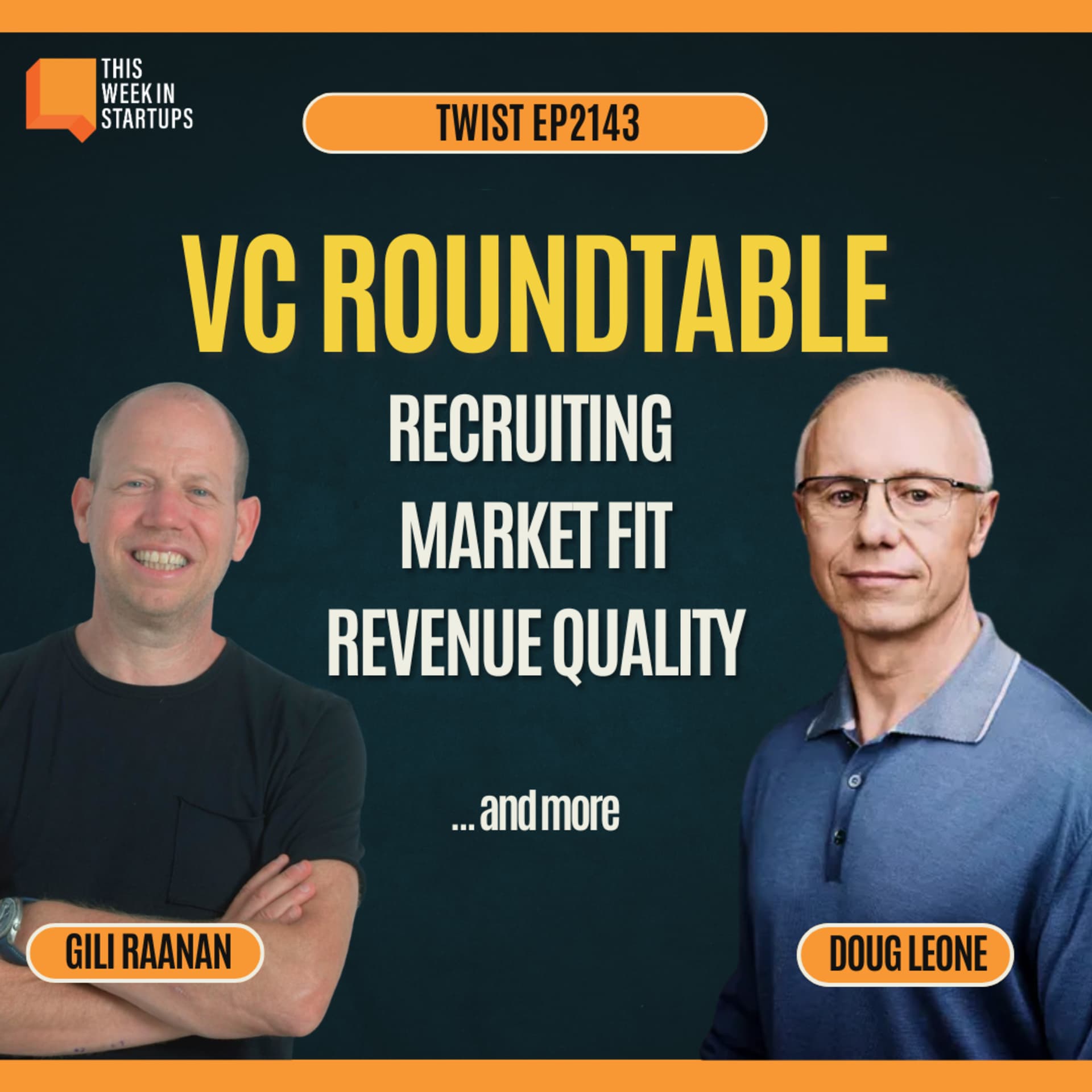
This Week in Startups - VC Roundtable: Recruiting Secrets, Second-Time Founders & Product-Market Fit Myths | E2143
Episode Overview In this episode of "This Week in Startups," Jason Calacanis hosts a roundtable discussion featuring Doug Leone from Sequoia Capital and Gili Raanan from Cyberstarts. The focus is on key insights about startup recruiting, assessing second-time founders, and the realities of achieving product-market fit. Throughout the conversation, they discuss the intricacies of the venture capital landscape, the qualities sought in founders, and the evolving dynamics of startup success.
Key Topics Discussed
- Evaluating Founders and Entrepreneurs
- Qualities of Successful Founders:
- Investors seek second-time founders who have had modest exits, as they often retain the drive and motivation to succeed.
- Emphasis on energy and commitment, particularly in high-stress environments typical of startups.
- The importance of assessing whether founders are "missionaries" (driven by purpose) versus "mercenaries" (driven by profit).
- Second-Time Founders:
- Doug Leone shares insights about the benefits of backing founders who have had previous, less-than-stellar exits, as these individuals often possess a chip on their shoulder and a desire to prove themselves.
- Recruiting Top Talent
- Misleading Resumes:
- Candidates from large tech companies often appear impressive on paper, but can lack the necessary adaptability for startup environments.
- Integration of new hires into a close-knit team requires careful management to foster a collaborative culture.
- The challenge of aligning diverse work cultures, especially when integrating talent from outside the founding team.
- Recruitment Strategies:
- Doug discusses a candid approach to recruiting against big tech companies, emphasizing the unique opportunities and impact one can have in a startup environment.
- Product-Market Fit (PMF)
- Defining True Product-Market Fit:
- The conversation highlights that PMF is not just a product exercise, but rather a holistic understanding of the company’s fit with market demands.
- The iterative process of seeking feedback and continuously adapting is essential for achieving PMF.
- Gili Raanan discusses a structured approach called "Sunrise," which involves rigorous questioning and breaking down the company's business model to ensure alignment with market needs.
- Revenue Quality Concerns
- Assessing Revenue Quality:
- Doug Leone emphasizes the importance of evaluating revenue sources to distinguish between genuine demand and transient market trends.
- Founders should focus on building a solid customer base with meaningful engagements rather than just accumulating numbers that may not translate into sustainable growth.
- Churn and Retention:
- The need for startups to understand their customer usage patterns and ensure stickiness is crucial for long-term success.
- Venture Capital Dynamics
- The Cycle of Overfunding:
- Discussion on the risks associated with overfunding and the impact of venture tourists entering the market, leading to inflated valuations.
- Doug Leone argues that while venture capital has its challenges, the potential for massive returns makes it an appealing field.
- The Importance of Trust in Relationships:
- Building trust with founders is essential in navigating the complexities of venture capital and ensuring mutually beneficial agreements.
Key Takeaways
- Recruiting the Right Talent: Focus on energy, adaptability, and cultural fit rather than solely on pedigree.
- Achieving Product-Market Fit: Emphasize iterative feedback and market alignment over static product assumptions.
- Understanding Revenue Quality: Founders must establish deep customer relationships and ensure product usage to maintain sustainable growth.
- Navigating Venture Capital: Maintain transparency and trust with founders to foster productive relationships and avoid pitfalls associated with overfunding.
Recommendations
- For founders: Focus on building a cohesive team with high-energy individuals who share the mission of the startup.
- For investors: Evaluate opportunities based on the founder's motivation and past performance, considering both successes and failures.
Episode Resources
- LinkedIn Ads: Get a $100 credit for your first campaign [here](http://www.linkedin.com/thisweekinstartups).
- Notion: Organize your work and life at [Notion](https://notion.com/twist).
- CLA: Start with CLA's experts at [CLA Connect](https://claconnect.com/tech).
Conclusion This episode of "This Week in Startups" provides a wealth of knowledge for founders and investors alike, emphasizing the importance of recruiting the right talent, understanding product-market fit, and maintaining strong relationships within the venture capital landscape. ```
Written by AI. May contain mistakes. Listen to the episode to check what was said.
Transcript
Automatic transcript. May contain errors.0:00Tell me a little bit about secrets to recruiting you've learned the hard way. people who look great on paper or, hey, they were at whatever company, Microsoft, Salesforce, whatever, they were selling all this stuff, but it had more to do with that company and their product market fit than maybe the grid of that individual salesperson. Then also, I think it's a really interesting topic of integrating people into the team and making them feel that they're part of the team, even though they came from the outside. Maybe they weren't part of the formation of the company, but you got to make them feel that they're really part of something.
0:34It reminds me of Kevin Durant coming to the Warriors. He never quite felt like he was part of the core, right? So I had given away my secrets on these podcasts. I've known you for a long time, Jason. For example, when I'm recruiting against a Google, I say to the candidate, This Week in Startups is brought to you by LinkedIn Ads. For a$100 LinkedIn ad credit and launch your first campaign, go to linkedin.com slash thisweekinstartups. Notion. Notion combines your notes, docs, and projects into one beautifully designed space with AI built right in. Try it for free today at notion.com slash twist.
1:12And CLA. Innovation takes balance. CLA CPAs, consultants, and wealth advisors can help you get from startup to where you want to end up. Get started now at claconnect.com slash tech. All right, everybody. Welcome back to This Week in Startups. Very lucky today to have two of the legends in venture capital. Doug Leone, who got me my start in many ways in the venture business from Sequoia, which he ran for a couple of decades. Now my guy Roloff and my friend Alfred are running the show. And you know some of his amazing investments. New bank service now. Whiz. Just bought by Google. How are you doing, Doug?
1:56Wonderful. I am no longer a very active partner, meaning I only do an occasional investment, but I am on 809 boards for Sequoia, and I'm fortunate enough to have what I call a good backlog of companies for which I'm in cybersecurity. Yeah. What's it like going into retirement? You're not the type who retires. You seem just as busy. and you told me you were retiring a couple of years ago, you're transitioning. And then every time I go to the office, you're there and it's eight in the morning, nine in the morning. Yeah, it's not retirement. The 809 boards keep me quite busy. I co-founded a biotech company, something I ought to talk about publicly, but we just raised a Series C for$200 million.
2:41I had to be one of the three founders. So that keeps me quite busy. So I've got a fairly full plate. And if something magnificent comes across the desk and somebody wants me on a board and we can make an investment, I'm happy to do it. What I don't want to do is listen to 50 new companies a week. So I'm not really retired. I'm picking and choosing my spots a little more. Yeah. And you brought one of your friends here today, Gilly Ronan, was at Sequoia for a bit and now runs Cyberstarts. That's a venture capital firm that's focused exclusively on cybersecurity. Is that right, Gilly? Absolutely right.
3:19it now famously you guys have been working together for a bit and you did i think the largest acquisition in google's history uh whiz which we just had uh happen earlier this year maybe you could tell me a little bit of background of how this company started gillian and then how segway got involved i'd love to pending acquisition by the way but oh yes that's important. Actually, you know, Weez is a company that both Sequoia and Cyberstarts, Doug and myself were the seed investors. And it's the second time we backed the same team. We were lucky to invest in the first company Adalone in 2012. I was still with Sequoia Capital in Tel Aviv.
4:22They were a typical young team coming out of the Israeli intelligence forces, what many people know as 8200, and we backed them with a small seed. That company had a nice, modest sale to Microsoft three years later. and then happened a real transformation. You know, these guys got a lot of responsibility and built a billion dollar worth of cloud security business within Microsoft and then went out to start their own cloud security business. And we were there waiting for them to go for the... this amazing journey. Doug, this is a reoccurring theme. Second time, third time founders, if they still have the energy, you just snap back them, right?
5:26And then how do you know if this is like maybe their third or fourth company where it's a vanity play, or maybe they're not really into it, or if they still have that energy to lead a company, which we both know is just, that's a large amount of energy you need to have. So there are two funny stories I want to tell you prior to answering your question. The first funny story is when I met Asaf on Adolom, I went to Israel. I met Asaf and somehow he got his wire crossed. He thought I was Don Valentine. And he was very surprised that I was as young looking as I was 10, 13 years ago for a 70-year-old.
6:07And so that's the first part of the funny story. The second part of the funny story, when we invested in Wiz, they did not know what they wanted to build. In fact, I'm now told they created a baloney presentation with Toya the night before so they can pitch something. And truth be known, we had no idea what they were talking about. We have a partner who's far more technical than I called Bogomil. And I asked them, hey, Bogomil, I don't know what these guys said. You got to write the memo because I can't write a memo based on what they told us. it makes no sense. Of course it made no sense. It was a made up pitch, but invested.
6:46And now I'm going to answer your question. The thing we look for is second time founders who had a modest M &A exit. It's one thing you've got second time founders who may be built a$40 billion company and they have the summer house, the third wife, want to go play in LA. But second time founders who had a modest exit have gotten a little taste of success maybe they sold too early and the second time they're real serious and now look here the second time was an m a it's the largest m a in a for a private company ever done it's still an m a uh you know who knows what could have happened whiz if we had kept it uh private maybe would be much bigger but a 32 billion dollars with with uh And with the founder and the board just motivated because it was a great price, we decided to sell.
7:40But we looked for the second-time founders not who had a smashing success the first time, but who had a modest success. Because, yeah, when you had that modest success, you still got a little fire. Yeah, you sold too early, a little chippy, something still to prove, but you got that taste. Yeah, I liked it. And it's worth pointing out, Don Valentine, for those youngins listening to the program, founder of Sequoia from the Bronx, from Brooklyn. Both of us went to Fordham. Yes. A capital. Yonkers, New York. Yeah. And he always had this amazing four-by-four quadrant that he would explain to young folks at Sequoia.
8:22Agreeable, disagreeable, competent, not competent. This where we make our money as venture capitalists. So I guess the punchline, and I don't remember the quadrant, was all the adjectives that people throw at founders, irreverent, doesn't listen. Those are things we look for. And quite frankly, those are the traits the Sequoia partners have. And so we look for those outliers. We look for those people that are special in some ways. They're outliers. and they can be outliers in drive and intellect and knowledge in some ways and they're missiles and our job as venture capital let them do their black magic because that's the part that we can't do but then help them build a business take this incredibly raw asset and if you think of the people coming out of 8200 they're not only in Israel but they're far away from the market and and they haven't been a commercial near a commercial enterprise it's not that they worked at a tech company for five years and have seen something.
9:26And so the magic that they do, we can't replace. We can't come close. What Gilly and I do is the mere moral stuff. Are the things based on many years of experience? When do you hire your first salesperson? What does your first CRO look like? When do you inject product marketing? Those are the kinds of things that I think would become the very best in the world at doing. and I put Gillian along with Sequoia. Hey founders, I want to share with you an experience I love. It's when I get an ad that is relevant and not some nonsense. Like the other day, I got an ad for a fund management platform and it was like a new one I'd never heard of.
10:09I clicked on the ad because, well, I manage four venture capital firms. We scheduled a call with them and it was amazing. How did this happen? Well, I was on LinkedIn because I like to share links from the podcast, The Speaking Startups, right on LinkedIn. In fact, we live stream to LinkedIn three days a week and we get a great audience over there. And I happened to be presented with this fund management platform and it was a direct hit. Like, I mean, talk about hitting the bullseye. If you're in business and you're making a product or service, it's really hard to find customers in the business to business space.
10:38And doing B2B advertising is hard, but LinkedIn makes it so easy because, you know, their tools let you target people by job title, industry, company size, and more. So this fund management platform obviously was looking for people in venture capital who had a fund size and a number of people, maybe 10 people, maybe 50 people. And they found me. They got me. They split the arrow. Boom, right on target. And there's two things you really need to know about LinkedIn going into 2025. First, they broke a billion members and 130 million of those billion are decision makers and 10 million of the billion are C-level executives like myself.
11:13Where can you get to those people? It's really hard. And the second thing you need to know, LinkedIn makes an impact. B2B markers report two to five times higher return on ad spend or ROAS, return on ad spend. You should know that acronym. Compared to other social platforms, 79 % of B2B markers say LinkedIn is the best platform for paid media. LinkedIn is going to let you build the right relationships. It's going to drive results, and you're going to reach your customers in a super respectful business environment. It's not a place where people are dancing around, saying inappropriate things, or debating politics.
11:42Nope. LinkedIn equals business. Business equals LinkedIn. Start converting your B2B audience into high quality leads today. We'll even give you a handy$100 credit on your next campaign. Go to linkedin.com slash thisweekinstartups to claim your credit. That's linkedin.com slash thisweekinstartups. terms and conditions do apply. These tactical, strategic, important parts of the playbook, these things founders haven't done in some cases. So when they come to them, they might, if they're irreverent, if they're a rule breaker, they might want to reinvent it. So maybe you could talk a little bit about that conversation of the founder wants to do something non-traditional, but you don't want to squash the non-traditional, but hey, you probably don't want to get too creative with legal and accounting and the HR department.
12:30And maybe on the margins, they want to totally reinterpret things that, you know, maybe the SEC or the IRS don't want reinterpreted. So maybe you can take us through some of those conversations you've had and when to let the founder run amok and innovate and when to tell them, hey, let's just do this one by the books and save the innovation for the product. Yeah, absolutely. And as you mentioned, I spent nearly a decade with Sequoia Capital before I started, branched out and started Cyber Starts. And one of the learnings I had was that, you know, we spent a lot, you know, specifically at the very early stage, at the seed stage, We spend so many calories on product ideas and technologies and markets that do not exist because within three weeks, it would be something else, regardless of what the founders have told you.
13:29And then three weeks later, it would be something else again. So at Cyberstarts, I became a complete purist on that. And I stopped asking any questions about technologies, product or market, focused solely on the talent. And Wiz is a great example for that, where, you know, they started with a different name for the company called BeyondCorp, different idea. and within 60 days after having a series of conversations with security practitioners, with chief information officers and chief information security officers, they switched their idea to cloud security and the rest is history. And we had those conversations to begin with just to make sure that they are not locked on the idea and understand that we are locked on the team.
14:28And, but it doesn't happen, you know, there are cases where founders have been right with the idea from day one, you know, speaking about another terrific company Doug and I invested in called Island. These guys came to us with the idea to build an enterprise browser. And that was a shocking concept for us. Does the world need another browser? and it turns out that yes, the answer is yes. Specifically inside an enterprise where that is the number one attack vector you can contain. I remember hearing that pitch back in the day and I was like, a new browser, yeah, that's necessary? And it was a really great pitch, yeah.
15:14Yeah, so I don't think there is a cookie cutter for that as long as you keep true, honest conversation with the founders. and you train them not what to do, but what questions to ask and to keep their ear muscle flexed enough to listen well and adapt. I think that's the key lesson from those experiences. You see, the founders are super smart and we learn from founders, recruiting from Google. You know, we have all these lessons that we borrow from one company, if you will. We're inspired, if you're in the jewelry business, by one company and we bring it to another. But the thing you don't want to do is pull the rug from under the founder.
16:07So if we talk about the case of Wiz, the operating plan that was put in front of us was absurd. Or it looked absurd. I mean, revenue growth of that magnitude. We hadn't seen it. I hadn't seen it before. So the deal we cut with the team is let's make sure we have linear headcount increase. You keep on making quarters. We keep on doing this, what looks like an absurd looking headcount. And yet they made quarter, actually they beat quarter after quarter. And so retrospectively, it didn't look so absurd. You know, the fastest company to, well, there was 100, 200 million in bookings and so on. But that was the courage and the vision of yet another way to do things.
16:50And so to me, you want to let the founder run, unless it's something extremely silly, like you said, in finance. We don't want creativity in finance. But here, we have creativity in the speed of go-to-market. It was really, really fast. What was that secret? What was the go-to-market secret they discovered? It was exquisite vision. Exquisite timing and product market fit. That's the only way you can get away with that because the product has to fly off the shelf. but I insisted in linear headcount growth so we could have a check off every quarter. So we wouldn't hire 500 salespeople. I'm making up the number right now and find out that no one's selling and then we're stuck.
17:29If you want to hire 500 salespeople, let's get to it by the end of the year, but let's hire, if you will, 100 a quarter. Again, these are not the real numbers, but it just make the case. So we can preserve cash in case we're off a little, in case we didn't hit the bullseye in the case of whiz they completely hit the bullseye if you think of an arrow and uh and the bullseye they could not hit the middle any better uh but even some of the other company i would say that island has done that sierra which is another data security company uh they didn't hit the bullseye right away we had uh we we had the board meeting oh my god the business plan made sense but people don't seem to be interested in securing their data that lasted two quarters And then the world exploded.
18:16Everybody wanted to secure everything. But that wasn't one that from day one it hit. It took 60 days for the market to come around or maybe a quarter and a half for the market to come around. And now that company is running extremely fast. But the trick is let the founders do their thing and just install some guardrails so you can protect the company. Let's talk about product market fit. How do you know, Gilly, when you've got the start of product market fit and then all the way at the end is you're taking orders, the phone's ringing, the product's flying off shelves, you show up at the storefront and there's 10 people in line already.
18:54You know, you got the best bagels in Brooklyn when people are there and you sell out by noon, you know, but it's a journey to get there. So maybe let's talk a little bit about that journey and the iterative process. And then when the founders actually know, they're sort of tipping in from having to call a customer and convince them and do a long sales cycle to, you know, how many would you like? And then, you know, eventually they just come running in the store and just self-order. Yeah.
19:23Notion AI is an all-in-one AI powered by your work and all in one place. It automatically captures meeting notes, instantly finds the exact content you need, drafts detailed docs for you, and lets you chat with the best AI models. Notion AI just became twice as powerful for teams, making it the best AI tool for work. They've got mail. This email client is integrated with Notion, and it links all your tasks, projects, and databases. They've got offline mode, so when I'm on a flight, I have my entire database. That's key. and they've got a great calendar feature. So I want you to get your personal life and your professional life organized.
20:06Create a Notion for you and your spouse or your partner or your friends. It works great. Make sure you check out all their templates. They're amazing. Notion.com slash twist to start for free. Again, that's Notion.com slash twist to take the first step towards an organized, productive work and life today. That's a great question, Jason, because many people even in the industry believe that product market fit is just a product exercise. I call it company market fit because it's much bigger than just a product exercise. Those companies, at Twiz, Ireland, Sierra, we have the founders run a process we call Sunrise, which takes nine to 18 months.
21:00So it's a long process where you go and ask all the tough questions about your company. In a way, you are going out and breaking your company every week and then fix it and break it again. And you address questions like, you know, What would make people move faster to procurement with me? Not just what's their biggest pain or would they buy it? Would they spend money on it? But what would make them run super fast with me? What are the right channels? How would they evaluate the product? So in a way, it's a simulation for the founders of everything that can go bad for this company the next three years.
21:52But you do that in a very condensed time frame, you know, which is something like 12 months. And if you do that right, and if you ask all the tough questions and you challenge yourself and you challenge your customers. So in a typical sales cycle, in a typical sales call, you don't present your competitive product. If the prospect is happy, you are rushing to get an order. In a sunrise, even if the prospect is happy, you present the competitive product and ask them, why wouldn't you buy from the competition, for instance? So you are breaking the company and then fixing it. And the outcome are companies that are perfectly matching the market.
22:49So a company like Quiz can conclude that process and then go and really run faster than any company has done before. or a company like Island or a company like Sierra, you look at those companies, they run faster than anything else than any of the other players in the market. And the reason is that those companies, not just the product, are perfectly matching the market. Takes a little bit of courage on Doug to ask, wow, what's going to kill this company? Where are the breaking points? Where are competitors actually better than us? Well, so I have a visual that I tell two founders. I said, your company's a river, and there are rocks in the river, and your job is to move the rocks and let that water flow as fast as possible.
23:41And we built a methodology at Sequoia called the merchandising cycle that goes from product management to product marketing to demand gen to sales. And the trick is to debug this merchandising cycle backwards. Why is the sale going fast enough? Oh, because we don't have enough leads. That's the answer you get. Okay, let's get some BDRs. Let's hire some more BDRs. Well, now they get the budget and you have the conversation. You find out, well, you know, it's not a matter of more BDRs. The story's not resonating. Ah, okay, let's debug into marketing. Now we're in product marketing. We're the leader of, and you go online and you type the category, and data showed up on page one, page two, page three of Google in SEO.
24:27Well, if you don't show up on page one, you might as well be in the final scene of the Raiders of the Lost Ark if you're old enough to know what I'm talking about. The warehouse scene. Yeah, your warehouse scene where you're lost forever. Sometimes it's product management and it's never engineering. Sooner or later, the product goes to work and it's often the vision. But assuming the vision's right and the product works, you've got to debug this merchandising cycle from sales on backwards so you can run like a bat out of hell. So that stream, that water can come down as fast as possible. And that is the exercise that we bring, that we ask our founders to go do.
25:03You know, why is it that the plan is the plan? Why is it you want the net new AR to triple next year? Why can't it be four times, 5x? Just as a thought exercise. And usually it's market size, it's cash, it's unit economics on each sale. Maybe they're horrible and you don't want to go any faster. And what it's often is, is Mandarin's ability to manage maximum growth. Because these are young executives. These are young founders. And so once we get on that beat in the issue, then how do we surround them with the right people so they can go faster? And that's what we do as board members. And this process of understanding who the right talent is, this is always a crucible moment.
25:50for a founder. Gosh, I brought a team together. These are all my friends. We went to college together, or we worked on this previous two projects together. But listen, this drummer is not able to drum at the pace. We need a better drummer. And this is where hard conversations that boards happen. How do you manage that piece, Jiliel? And then I'll come back to you, or Doug, you can take it if you want. The hard conversations about talent. So I'll start, and Gilly should give the long answer. To me, it starts with a founder equity split. Because I tell them, you don't get that right, somebody's going to leave the company because the other founders are going to get upset about it.
26:30So have a very honest conversation on what you all bring to the table and get that equity split right. Because if you all go the kumbaya third, a third, a third, it's never a third, a third, a third in talent. It turns out one person usually has, you know, maybe two people have talent. We often see two founders 50-50 where it makes sense, but the moment you have more founders where N is three or above, those equity splits are usually off. And we ask them to think about that good and hard so we can retain these founders because there's no faster way than a founder to be removed by other founders to have a huge equity share and not carrying anywhere that level of load.
27:09So we ask them to be thoughtful at that point among them. It's not for us to opine. And then there's everything else. people in a company that Gilly can address that. Yeah, it's kind of interesting. It turns out the Steph Curry doesn't get paid the same amount as the five players on the bench on the Warriors. Yeah, they all have different salaries based on their performance. But a hard conversation to have, I think, Gilly, because people go socialist. Hey, yeah, we have three founders. That's 33 % each or four of us is 25 % each. And clearly that's going to rub some people the wrong way when the fourth one doesn't show up for work.
27:43you know when I was much younger Doug taught me one you know one lesson which is you know there are many ways to hell but there's more than one way to heaven which means in this case that I'm not sure there's one great way to address it you know take for instance with you have four equal partners and amazing partnership and wonderful company. And we had portfolio companies where founders departed for whatever reasons. I think it all comes back to having true partnership with the founders. It starts in day one. And the same transparency and honest conversation about products, about markets, you know, goes also to the essence and the core of the partnership among the founders.
29:02and if you have established that level of trust with the founders and that's what early stage investors like Doug and myself practice, if you establish that level of trust with the founders, you can resolve any situation and whenever you have people, you'll have social situations that you need to resolve. There's no way to avoid. Yeah, humans are human. and they're going to do human things. But I love the idea of like, hey, let's talk about the equity split because now the entire formation of the company, Doug, is being, the foundation is performance. And what do we get if we perform as opposed to everybody just gets what they get?
29:49It's just a math equation as opposed to a value-based equation, yeah?
Read the full transcript
29:57One of the themes we talk about over and over again on This Week in Startups is making sure you do your chores. I'm no expert on these things. I have some experience. Stephen Estes from CLA is an expert. Let's talk about being cash efficient. Tell us about efficiency and what you see in the top tier startups in your practice. We're seeing kind of an interesting trend out there where companies aren't needing to raise quite as much as they had in the past. You really have to be careful as a founder to only take on as much money as you really need. You've got to do the forecasting, you've got to do the modeling, and you've got to dial it in and get it right.
30:33Otherwise, you're going to end up either not raising enough capital to get to where you're going, and you're going to have to go get venture debt or go back, have an extender to the round, or you're going to give up too much of the company because you just didn't recognize how much money you actually needed. Yeah, very important to get this stuff right, folks. And that's really a bummer when startups don't do things in a button-up way. Always have a great partner, a good partner to have on this adventure. while things change? My friend Steven over at CLA. Visit claconnect.com slash tech. And don't forget to mention that your boy, Jake, Al sent you.
31:05That's claconnect.com slash tech. Start today. Yeah, look, the things get interesting more when you start asking questions of who do you bring in when? What should your salesperson look like? And the answer, the short answer is never suits. The short answer is catching talent on their way up and higher for smarts, higher for hunger, and a bit of experience. I'd rather have that than a whole bunch of experience and all the downsides that go with that. But plugging in this outside talent, imagine you have four founders, even in Wiz, just imagine. You have a close circuit. By definition, you have four people that are like brothers.
31:55They were at Adalum. Now, how do you integrate outside expertise to that so they feel part of that team? That takes conversations. That takes skills. That takes the board being aware of that issue. That takes the four founders being aware of that issue. trust between the founders and the board, because that is not an easy thing. And when you make a mistake, you recognize it quickly and you move on. And it's really that simple. I think unpacking, there's like an important piece to unpack that you said there, Doug, which is, and having been on a couple of boards here and seen this movie, there's some incredible salesperson.
32:31They look incredible on paper. They show up, they've had four top tier jobs. They've got the cufflinks, they've got this polish, but they're not hungry anymore. They're negotiating their exit package on the way in. That's their focus. But this is critical. The person is coming up. They've got enough experience, but they still have the hunger, and they're not just delegating work and maybe more concerned with the accoutrements of the executive position. Yeah. So I've been shocked by people that can sell$8 million a year at a major tech company and can't sell$500 ,000 a year for a startup. That is one of the problems.
33:14The other problems of people that have sold widget versus solutions. A widget is a straightforward sales, a solution. You have to understand the bigger picture. I've been shocked at that. And so those are the mistakes that we tried not to make. And the other thing is, what does your first VP sales or head of sales, as we call them early on, look like? Is he someone that has managed 200 million or someone that's managed 30 million? You can't get the person that's managed 200 million. Because that person, you have no customers. You may have three customers maybe. And so there are these steps you take.
33:50At Snowflake, the first person they hired who was a fairly low-level sales manager ended up running all of sales. And it rose. And it's our hope when we hire these people that they go all the way. But often they have to make a stop and become a regional manager, maybe stop there to get some experience. We hire someone over them. So those are the things we we get to do. And to convince our founders, that's how you should build a team. And we do that often. Gilly, tell me a little bit about secrets to recruiting you've learned the hard way. People who look great on paper or, hey, they were at whatever company, Microsoft, Salesforce, whatever, they were selling all this stuff, but it had more to do with that company and their product market fit than maybe the grid of that individual salesperson.
34:42And then also, I think it's a really interesting topic of integrating people into the team and making them feel that they're part of the team, even though they came from the outside. Maybe they weren't part of the formation of the company, but you got to make them feel that they're really part of something. It reminds me of Kevin Durant coming to the Warriors. He never quite felt like he was part of the core, right? Yeah, absolutely. And, you know, I'll take even a step backwards and mention that many of those cybersecurity, all those cybersecurity companies that Doug and I invested together, and I think those are seven companies by now, they all started in Tel Aviv with an office that's mostly R &D.
35:26So for many companies, when you build an office, you build actually the DNA. You have a center of gravity for that company and you build your DNA once. And once you have 50, maybe 100, maybe 200 employees, most of them in the office, you've got the company's DNA. for those companies that are coming out of Tel Aviv you have to do this DNA build up twice because you build the DNA in Tel Aviv maybe you've got it right but then you need to build another office maybe in New York maybe in San Francisco, maybe another location so you've got to go through that exercise twice which makes it riskier and definitely more difficult and there are many reasons why I've seen new hires that have done amazingly well in previous lives and didn't do well.
36:26Maybe they were younger and hungrier. Maybe they work with a different set of founders that brought different set of qualities to the table. I think when it comes to hiring, especially the first line of executives, it goes back to first principles. How high energy, energy is so important for early stage company because you're going to fail a lot. Early stage is all about failing, learning, and fixing. so high energy high intelligence and terrific teamwork and if you go back to those first principles you have a higher likelihood to do well Doug you wanted to add something to that so I hate giving away my secrets on these podcasts I've known you for a long time Jason For example, when I'm recruiting against a Google, I say to the candidate, my God, working at Google is fabulous.
37:47I said, the food, have you seen the food at Google? It's world class. Ranch, meat. Have you seen those colors? It's always red, yellow. They have those beautiful colors. They have bicycles. The campus is a blast. They pay a lot better. It's not a thing you can do to drive the price of that stock by one penny. You're a small cog in a large machine. Let me tell you about our company. In our company, the food stinks. It rains. When it's sunny and outside, it rains even indoors at times. We don't pay that well. Yeah, you're going to get stock. But if you have an idea at 10 o 'clock, we could implement it at 1030.
38:24And you can change the course of the company. So go look in the mirror and tell me what kind of human being you are. And if you're interested in a job, come talk to us again. And that's how I recruit against the big companies. I force these people to have it come to Jesus with themselves, whether they're just are done in life, basically, or they want to do something. Missionary, yeah. Or mercenary, yeah. Like if you're just going there for the food and the steak and getting your RSUs, they really have. It's so interesting how big tech has created this rest invest culture, even lampooned on the HBO show Silicon Valley with the Hooli company.
39:04And it's like, and Google was such a intellectual powerhouse, but when things get big, it is to your point, like, how do you make an impact? If you're going to go work at Facebook for Zuckerberg, he has to offer you these crazy incentives as AI versus going and working for Elon or, you know, some other company that's got grit and is just starting, you know, from the beginning. Yeah. Yeah. That's exactly right. Look, a new hire can shift the trajectory of one of our little companies. for the better or for the worse, but they'll have impact. Yeah. I want to talk about revenue quality. I know it's like a kind of a boring subject, but it is one of the things I've seen is so profound.
39:47We have these companies that appear to be rocket ships. They're getting elevation and looks like they're going to get to orbit. And then all of a sudden it explodes, goes off. And you're like, what happened? And you look at the revenue quality and churn, not profitable, et cetera. Doug, how do you assess the quality of the revenue of a company and if that needs to be fixed at the early stages? And I see it today with AI, and I think we saw it with apps for a little bit. People would sample a lot of different products, but they didn't actually use them. And AI, I'm seeing this all over the place.
40:24People will spend$300 or$400 on an AI product for the year, put it on their corporate card, and then They never use it. So there's many answers to that. First of all, there are transient markets like we saw with these apps where things exploded. The internet got so big, you have enough people trying things that look like momentum. And if you probably had an AI engine analyzing the quality of revenue, you probably would have been told that. But even if you had a brain, you could have known that. The other, though, that we found in the enterprise where Gilly and I spent a lot of our time is these companies that sold to other little tech companies.
41:00The company formation was so rapid for such a long time that companies got revenue by just selling to all the other little companies. And as long as the venture investors were funding and so on. Now, superimpose that to the fact that you start usually at the low end, the mid-range, and then you get pulled up market. In order to sell to the enterprise, you have to earn the right to sell to the enterprise. And to me, revenue quality starts being interesting. Even if you start at a lower end, by now you get dragged up. I remember when we looked at Figma. Figma, yeah, it all started with credit cards, people buying it.
41:36But now you saw people saying, I want 5 ,000 licenses. Can you send a sales rep over? Holy cow, we didn't have a salesman. It was PLG. We better hire some enterprise sales reps. And so, yeah, you've got to be careful in the enterprise at the low end selling to other tech companies or people trying things for the heck of it. And you've got to look for those leading indicators. You know, a few companies sticking their neck out and wanting to spend a lot more money. And then you know that you have something. And then the low end becomes a lead gen vehicle. It doesn't become revenue. It looks like revenue, but it's really lead gen for everything else.
42:13Yeah, Gilly, it seems like founders, sometimes they learn the wrong lessons. They're hackers. And, you know, I won't mention any specific, you know, startup accelerators, et cetera. But I remember we had to learn this lesson as pre-seed investors when they would show us their first 10 companies. We'd be like, oh, that's pretty promising. Then we said, well, can you just in the Google sheet, when you send us the 10 companies, what date they started, you know, where they, did they use the product and how did you source them? And, you know, we had one company was like, yeah, these seven came, were our, in our accelerator.
42:46And these three were our fraternity brothers. And we're like, have you tried to sell to somebody on LinkedIn, like a cold email? Or did anybody Google you and find your product? And yeah, so the sources of the company, the customers was how we unraveled this little gamesmanship that was occurring. But maybe some thoughts on the quality of revenue, Gilly. So maybe I'll add two insights to that. Because I thought that Doug's answer was perfect. One is most of the companies, all of the companies we invest in, in cyber security, are B2B software companies. And they're all approaching new markets, solving new problems.
43:36So you can go up market, down market, enterprise, SMB, you know, everything is open. And our recommendation is always to start with the more difficult, longer journey, which is to sell to larger organizations. So just go right to the pain, go right to the hardest task? Go to the most sophisticated buyers and users, because if they buy it and if they use it, everyone else would follow. And that's why you see the first deal of Sierra. It was a company that bought it for$400 ,000. The second deal at Wheeze was a million dollars. The third deal at Island was half a million dollars. So those are large organizations, sophisticated users, and they do a lot of diligence before they add a new product to their arsenal.
44:42And that is terrific for the founders, although it looks more difficult on the surface. And it's great for investors to build confidence in the team and in the product. The other insight is that in many of those companies, once they get to 10, 20 logos, So it's not about the first few deals, but once they get to some number of deployments, you know, RRs at the board is that first slide would be usage, not ARR. Show us usage. And if you see the usage graph going like steady, not growing, that's a major red flag. so usage adoption stickiness in that stage super important we have a company we have a company called Zafrin that the first few customers are all four five hundred thousand dollars a lot of it happens because it's the founders who sell those deals and then you start bringing the mere mortals the sales reps suddenly you may see the next ten deals being 150k because now the you know One of the things that we look for is a repeatable sales model.
46:00When is the first deal the founder doesn't have to be involved? And it turns out the founders are often the best salespeople. Yeah, there's an authenticity and a transference of enthusiasm when the founder's in the room explaining why they made something. You feel the enthusiasm just go right across the table, or nowadays the Zoom, to the customer where they're like, I want to be part of this. I want to be part of this new paradigm, yeah? and how do you get salespeople to have that same level? I want to talk a little bit about sort of our jobs as investors and the game on the field. The number of, and it seems like it's because of AI, but obviously cloud computing over the years, WeWork and office sharing, everything has made the cost of starting a company go down and the skill levels going up and the ability to get the first product at the door.
46:54So what are we seeing in terms of team size, Gilly, and what it takes to stand up a product today versus 10, 20 years ago? But even in the last two years with AI and these AI solutions coming, it feels like, my Lord, some companies are getting to their first million with just a handful of people at the company. So are you seeing that as well, game on the field? Look, I think we are still really early on in the cycle. but the trend is there and we would see companies getting to milestones like the first 10 customers, the first million dollars, the first hundred million dollars of ARR with lower number of employees and it would not just be for you know, building products.
47:52It's everything around that. It's, you know, the design, the customer success, support, BDR, and maybe five years into the future sales. So I think that the day where we would see the one employee company with a million dollar ARR is very, very soon. I think the time we would see maybe the less than 100 employees, company with$100 million of ARR is probably... Yeah, it's happening. Yeah, some of these products are catching fire. It's behind the corner. Yeah, some of these co-pilots like Cursor had hit pretty crazy revenue numbers with even more than a million dollars per person, Doug. And you've got enough history in the business to have watched this trend.
48:46And Google, Microsoft, Facebook, YouTube, just Instagram, you guys were investors in that as well. Large number of users, large amounts of revenue coming in with a small number of employees. Yeah, maybe that's going to happen in consumer. And we've all heard what Toby at Shopify said, I won't give you any tech headcount unless you can prove to me you can't be done with AI. But that's a mature company. I actually have a contrarian here. Yes, we can do more with less cost of cloud computing, blah, blah, blah. But we also have to run a heck of a lot faster than we ever had to. There used to be a time, I don't want to update myself here, where we could build a product, get our first few customers, take our time, hire two salespeople, get the U.S.
49:32profitable. Maybe we'd go to Europe. Can't do that anymore. Because if you do that, it's going to take you three years. You'll have 23 competitors. The speed of company building has gotten so fast that we have to high, high count. And also, if you're selling to the enterprise, the enterprise is not interested in a one-man vendor. The enterprise wants to see bodies, wants to see support. Try dealing with purchasing. You know, like after you've sold your product, now you've got to go fight another war with purchasing. Try doing that with an AI agent and see how far that goes. So I think we've got to segregate the B2B and B2C.
50:07I think we're going to see some of these smaller companies in B2C before we see them in B2B. And yes, once you reach the scale of Wiz or Sierra, now we can talk about efficiency in engineering, in R &D, and so on. But when you've got the first three guys working until midnight trying to build a product, I don't think an AI engine is going to help you that much. That's just my view. Yeah. Let's talk a little bit about this concept of overfunding companies. It happens every five, 10 years. New entrants come in, venture tourists, Doug. They start dumping money on top of, you know, companies that we've, you know, really been thoughtful about building.
50:49And founders, of course, look at it and go, hey, Doug, Gilly, I've been offered this crazy, you know, check with no board seat, no information rights. I've never heard of this firm. Or maybe they do public socks and now they're dipping into privates. and that created quite an overhang in the SaaS space. Yeah, Gilly, like where we had maybe companies get overfunded and then you have some members of the board who invested at $2 billion and the other ones invested at$200 million and the companies in between those two sort of realities. And then it becomes a lot of hand wringing and pain and suffering.
51:29Maybe where are we at in that part of the cycle? It seems like people are getting super excited again just this year. Yeah. My view is that the venture business is a complex business. And if it was easy, then everyone would do that. So some of the complexity is to keep the balance between the need for speed and then not throwing too much money on a company. And that's a fine balance because my experience is that in order to build a large, important, sustainable business, definitely in cybersecurity, which is my focus, that's an expensive exercise. It's expensive. You need to build massive amount of code and products, army of people to sell and support the product.
52:41It's an expensive exercise of money and sufficient capital for the company early on. that's really important. But you're right, there are tourists, there are all kinds of unhealthy situations. And again, it goes back to the same elements I've touched earlier, which is, you know, having a honest, transparent conversation with the founders,
53:20And they may have all type of temptations. And you simply address that through a conversation. And if you build the trust, and if you are fair as an investor, the founders would listen. Doug, we've seen this movie over and over again. So you're going to find my answer sarcastic. First of all, the sham of the scam that is called venture capital. Let's take a look at this. We raise money for which we get paid fees for the pleasure of investing the money. If we lose the money, so what? And if we make money, we get to keep somewhere between 20 % and 30%. You wonder why the balance between greed and fear always lean towards greed.
54:16a much more fair review would be here's the money no fees and you have to match dollar for dollar what you raise with your own money now you would see the greed and fear balance so already you have this this proclivity to lean in because of the compensation structure point one point two we have seen every generation and by the way i know my partners or certainly in sequoia market he won't be happy that I said all that, but who cares? You know, I'm old enough that I can say that. Second, we've seen every wave to be stronger and stronger. If we just look at the internet wave, 1995, when Netscape goes public, 1999, two great companies get built.
55:02Then, oh my God, the internet is a fraud, nine, 10 years, death, and then here we go again. Mobile, there wasn't a 10-year gap. There was a two to three or four-year gap between the head fake and reality. And I think AI is going to give us even a smaller head fake. So I think the opportunity in front of us is huge. So you have a proclivity to lean in by the money. And the fact that we know each wave is bigger, is quicker and quicker and bigger and bigger. And so I think we're in for quite a show, actually. And the trick is to pick them though, right? Because if you invest in everything, you're going to get nailed.
55:46And so like everything else, it's a pick them business. And we do know that if you pick them right, chances are it doesn't matter which round you came in. But I'd also urge all your listeners to think about all the dead FMV, all the dead companies that exist. Think about the thousands of companies that have revenue run rates, 30 million growing to 33 million who are being carried on their books, maybe at 120 million value, and they're really worth nothing. And so as you think about leaning in and doing something silly, like some venture investor did four or five, three, four years ago, I won't name any names, who had a theme investing in everything, you're going to get nailed.
56:26And so there's all these great forces. And the trick is just being the right one. There's two or three or four investments a year that matter. And being those, then you'll do just fine. Yeah. And that is over-indexing on the companies that lose, even though your reputation is kind of built with those founders, right? We talked earlier about second-time founders, kind of a sweet spot, you know, and serially investing in teams. Your reputation in some ways is made equally by the companies that don't make it, but obviously the power law defines, you know, by definition is one or two companies per fund determine the fund's success.
57:06Look, the real tough thing is do what Gilly and I do. And that is pick them early, find them early. I mean, it's easy to find whiz at the $10 billion round. It was a made company. And the question on that point was, am I going to make twice our money or six, seven times our money? And nobody knew. And you buy yourself either a poster or a small return and a poster. The real trick is getting there as early as you can. Yeah. And that is a function of your reputation, your deal flow, how many companies you meet with, and your ability to actually identify talent. Yeah, Doug? Yeah. And I might add a little luck.
57:47A little luck does help. I made a trip to Israel. Yes, I may have been a fake Don Valentine, but that trip to Israel is what eventually got Asaf to say, I'd like Doug on the board. So there's all this serendipity that has happened throughout my life. The Ron Conway call on Google, you know, Ron and I became friends. God knows from where we share maybe one glass of wine, white wine, too many. But that led to a Google call. and so these things happen and you just got to do the right thing for years make sure you you you do the right thing by others and if you do that chances are you're going to get some calls at the right time it really is like your reputation and the effort you put in saying yes to a couple of random things works i was at a party once uh not to make it about myself and somebody said you got lucky investing in Uber.
58:48And I said, yeah, you're right. And Travis was standing next to me and he said, I'm going to stop you right there. You don't know this, but J. Cal helped me on my first two companies, Scour and Reds Moosh. And whenever I needed help, he always picked up the phone and he always took me out to dinner and talked to me about my companies. All of that is why he got that investment. Exactly. And you just don't see it. And you and I, Jason, that's how relationship you needed a little help i gave you two hours of my time maybe an hour and now we have a relationship and uh that's the way it's and and gilly the same way yeah you know gilly and i are now friends but that friendship was built by helping one another out it's uh i want to talk about firm building specifically because you know i have this podcast for selfish reasons i love to talk, but it's also a great way to learn.
59:41And here I am, I got my own firm, I'm four funds in, and we all seem to be getting earlier. Earlier seems to be the focus. It seems to be getting very crowded. Obviously, Series B is bonkers. Series A also getting very crowded. People want to take the whole round. So we're all moving earlier. Sequoia has experimented with ARC. I'd like to hear how that's going. I know, Gilead, your firm, you do some incubation. Maybe what have we learned about going earlier and maybe creating some programs for folks? Gilly, I'll start with you. So first of all, we don't do incubations. Okay. We are dedicated to investing seed investors.
1:00:27We are the first Czech with amazing teams that we believe can build important cybersecurity companies.
1:00:42And we started CyberStarts in 2018. It was super small, super humble fund. We started with, the first fund was$50 million, really small, solo GP, and then invested in, I would say, nine teams out of those$50 million. And many people thought that my approach is complete craziness because you've seen a grown-up writing large checks, multimillion-dollar checks to young fellows without asking them, what do they do? and then three years later the world found out that those nine companies valued at over 25 billion dollars that was a major branding event for CyberStart so that's really helped CyberStart accelerate and build into a bigger operation and today we have four GPs, four general partners on the ground in Israel and two operating partners in the US.
1:02:08We've raised multiple funds, more than$700 million. Talk about deal flow. How did you get those first nine and then how do you get deal flow now? I mean, one of the things I've read is that early success in venture capital is a predictor of later success because the founders and the LPs all chase the people who have early success. So there's some manifest destiny there, I guess, or some self-fulfilling prophecy. But the first nine, how do you source those companies? And then today, I'm sure the success of Wiz and Island and other companies drives founders to come to you because they want to have the investor who did Wiz, yeah?
1:02:45Yeah. Yeah, and again, keep in mind that in our business, we are always as good as our next investment. So having a wonderful portfolio, that's great. No complaints. But you always, you know, if you feel too comfortable, you already lost the game. So the, you know, at CyberStarts, the first batch of companies. It was simply through the network of entrepreneurs I've already knew by then, spending nearly 10 years with Sequoia and being an entrepreneur and founder of two cyber companies beforehand. But they were mostly younger guys and girls out of 8 ,200 looking to build their first business. And there weren't, you know, 2018, keep in mind, cybersecurity wasn't cool.
1:03:51No, the opposite. It was this boring office within IT. Nobody cared about cybersecurity. So if you were, you know, a 25, 27 years old individual with a desire to build a cybersecurity company and you had a vague idea of what you like to be, you didn't have many options. So they found me. And I helped them to build those businesses. Now it's a little bit different. And, you know, we are very lucky to get many entrepreneurs call us, but we still, you know, As I said, we don't get ourselves too comfortable. We work really hard to get ourselves in front of amazing founders. Doug, maybe you could talk about this getting earlier and earlier.
1:04:49Sequoia's got a reputation of backing people before the product launches, doing Series A's, and obviously later stage funds now. Maybe a little bit about the ARC program and just how getting earlier is important today. Maybe it's always been. so many roads to heaven uh you can make money at every stage we vertically integrated we had a c fund a venture fund a growth fund and a public market vehicle seed we've done number of seed palo alto networks was a seed doordash was a seed uh and many others series a whiz island uh and so on series b sierra kind enough gilly gave me the call and so many others growth just quickly, you know, Zoom, Snowflake, and even public, Shopify.
1:05:36We made as much money in Shopify in the public market. We held that thing for, you know, we made a ton. But when you get there early, you have a shot investing in every fund, one, and two, you have a shot of really helping the founders set in the right footing. Unfortunately, the venture people, the venture industry has a lot of people, not everybody, but there's a lot of people that don't really have as much experience as you'd like. Let me just leave it at that. So we do want to go early. The ARC program has worked quite well for us. We've decided to limit it, though, not to go en masse, not to have hundreds of companies, because at the end of the day, they all have your brand.
1:06:21those are all founders that expect your help like like you can't say to an art company okay we're only going to give you an hour and a half that conversation is not a brand augmenting type of conversation that destroys your brand and so we keep it tight you know whether it's 15 20 companies a class but that's worked well but we do try to be the first money in uh the first of seed or otherwise. And if we can't meet that, then we want to be the first series A money. Because once you get to series B, now the ownership comes down. Look, the ownership has come down already a whole bunch. We used to own 30%, then 25, then 20.
1:07:00Now series A may get you 15 points. And so it's really brutal. The venture industry was a niche business. Now it's a broad-based business. And everybody and and their mother and father is a venture investors. And so the thing we know is to ingrain ourselves in the entrepreneurial tap community and get there either, as I think of it, through a sales force, our own partners, or an indirect channel. You can tell I'm a go-to-market guy. You are an indirect channel, Jason. You call it things. Gilly's an indirect channel. And so we have both a direct and indirect channel, and we try to get to as many things as early as we can.
1:07:40And when we either miss them or make a mistake, at the series a we try to pass in the most elegant ways because we may want to catch them uh one round later uh and so on amazing all right listen uh great job gentlemen uh let's do it again in a year i'm going to book you both and we're going to check in uh both on your uh very uh modest retirement doug this isn't retirement you're working just as hard you're just as engaged It's a bad word. It's a bad word. You're just as engaged. And look, you look young and you look energetic. You look vibrant. I think it's great that you're still in the game.
1:08:19I don't know about this. It's so weird that a lot of the firms have this forced retirement at a certain age or these weird rules because we're all living so much longer and cognitive function is continuing on. I don't know. And there's all this wisdom to be passed down. So I just love the fact that you're still in the game. And Gilly, it's great to get to know you. And I'll look forward to seeing you in the region the next time I'm over there. And we'll see you all next time on This Week in Startups. Bye-bye.
From the publisher
Today’s show:
In this powerhouse VC roundtable, @Jason sits down with Sequoia’s Doug Leone and Cyberstarts’ Gili Raanan to share brutally honest insights on startup recruiting, evaluating second-time founders, and how to truly find product-market fit. They break down why big-tech résumés can be misleading, how to structure early teams, and what separates “missionary” talent from mercenaries. Plus, the myth of early ARR, the art of founder-board trust, and how AI is (and isn’t) reshaping startup velocity. Must-watch for founders, VCs, and anyone building from 0 to 1.
Timestamps:
(03:25) The origins of Wiz and how VCs know when to invest
(05:17) What qualities are investors looking for in founders and entrepreneurs?
(09:53) LinkedIn Ads - Get a $100 LinkedIn ad credit at http://www.linkedin.com/thisweekinstartups
(18:40) How to know when you’ve reached true Product Market Fit: the experts sound off
(19:20) Notion - Try it for free today at https://notion.com/twist
(25:39) The secrets of recruiting top talent
(29:54) CLA - Get started with CLA's CPAs, consultants, and wealth advisors now at https://claconnect.com/tech
(39:38) Judging a startup’s revenue quality and “founder vs. salesman” deals
(53:38) Is venture capital kind of a SCAM?
(55:00) Seed Investing: “Pick them right and early”
Subscribe to the TWiST500 newsletter: https://ticker.thisweekinstartups.com
Check out the TWIST500: https://www.twist500.com
Subscribe to This Week in Startups on Apple: https://rb.gy/v19fcp
Follow Lon:
Follow Alex:
LinkedIn: https://www.linkedin.com/in/alexwilhelm
Follow Jason:
LinkedIn: https://www.linkedin.com/in/jasoncalacanis
Thank you to our partners:
(09:53) LinkedIn Ads - Get a $100 LinkedIn ad credit at http://www.linkedin.com/thisweekinstartups
(19:20) Notion - Try it for free today at https://notion.com/twist(29:54) CLA - Get started with CLA's CPAs, consultants, and wealth advisors now at https://claconnect.com/tech
Great TWIST interviews: Will Guidara, Eoghan McCabe, Steve Huffman, Brian Chesky, Bob Moesta, Aaron Levie, Sophia Amoruso, Reid Hoffman, Frank Slootman, Billy McFarland
Check out Jason’s suite of newsletters: https://substack.com/@calacanis
Follow TWiST:
Twitter: https://twitter.com/TWiStartups
YouTube: https://www.youtube.com/thisweekin
Instagram: https://www.instagram.com/thisweekinstartups
TikTok: https://www.tiktok.com/@thisweekinstartups
Substack: https://twistartups.substack.com
Subscribe to the Founder University Podcast: https://www.youtube.com/@founderuniversity1916


