
In short
This Week in Startups: Episode E2169 Summary
Episode Title
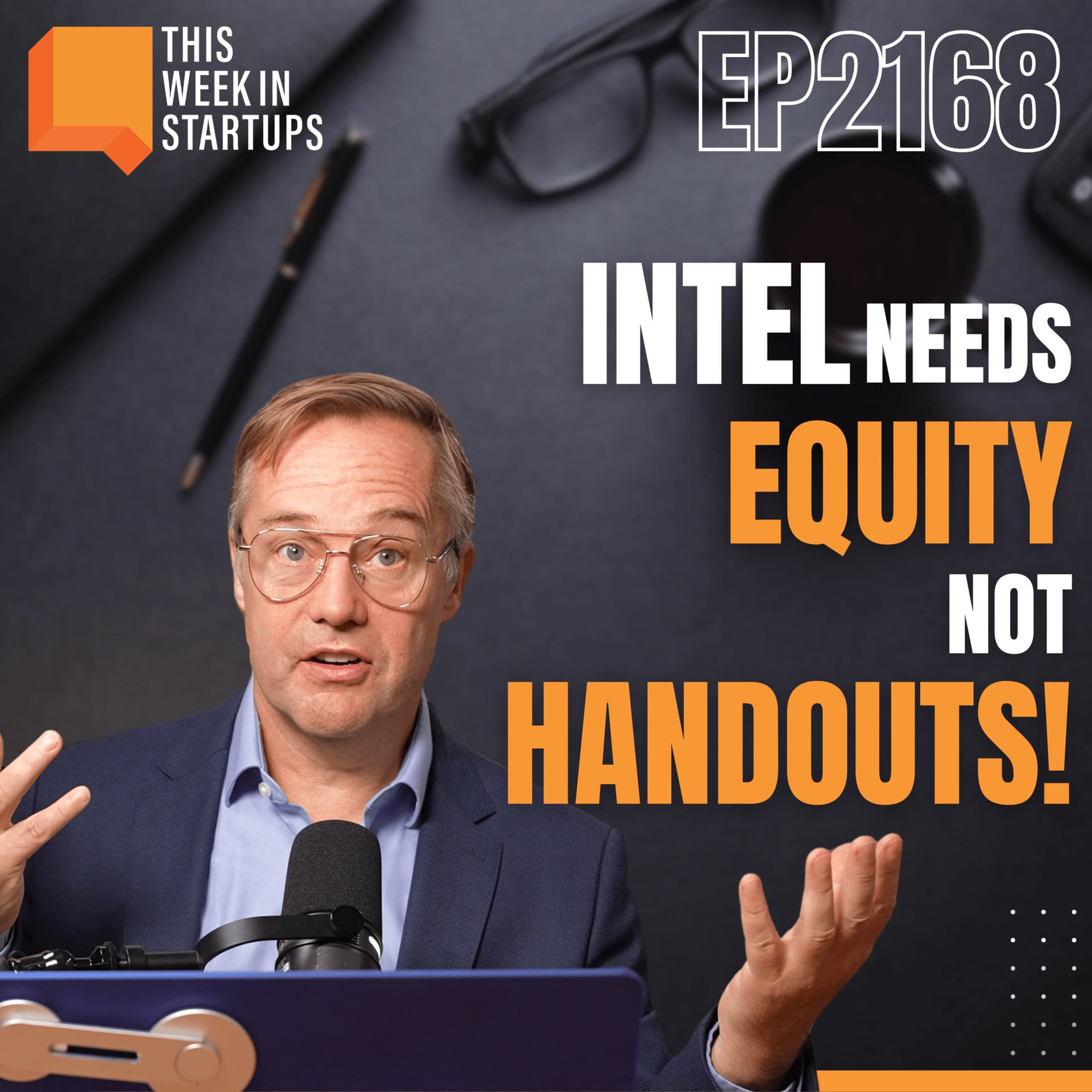
xAI’s App Store lawsuit, Intel shares vs. grocery stores, and Netskope’s IPO
Host
Jason Calacanis
Guests
Alex Wilhelm
Episode Overview
In this episode, Jason and Alex discuss various pressing topics in technology and business, including the pervasive cynicism surrounding innovation, the U.S. government's acquisition of Intel shares, the Netskope IPO, and recent developments in AI, including the lawsuit involving xAI, Apple, and OpenAI.
---
Key Topics Discussed
- Cynicism vs. Optimism in Technology
- Jason reflects on the tendency for new technologies to face skepticism.
- Argues that cynics serve a purpose: they prompt curiosity and improvement in technology.
- Example: The debate around AI technologies and their development.
- Intel Stake Acquisition
- The U.S. government has secured a 10% stake in Intel through conversion of grants into equity.
- Jason supports this move but expresses concerns about it becoming a trend in government dealings with corporations.
- Discussion on historical precedents of government bailouts and loans, including Chrysler.
- Government Involvement in Business
- Critique of the style in which the Trump administration executed the Intel deal, likening it to a form of "state-sponsored capitalism."
- Ethical concerns regarding corporate reliance on government aid, especially for affluent corporations.
- xAI’s Lawsuit Against Apple and OpenAI
- Elon Musk's xAI is suing Apple for what they claim is anti-competitive behavior in the App Store.
- Discussion of monopolistic practices and how they affect competition in the AI space.
- Netskope’s IPO
- Netskope is going public, having raised significant funding and showing strong growth metrics.
- Explanation of SASE (Secure Access Service Edge) and its importance in cybersecurity.
- Discussion of the implications of Netskope’s IPO for venture capital returns.
- Perplexity Offering Revenue Shares to Publishers
- Perplexity announces a new subscription model that shares revenue with publishers.
- Jason praises the decision, suggesting that it could serve as a model for other tech companies.
- Discussion on the importance of compensating content creators fairly in the face of AI advancements.
- Leading the Future PAC
- Introduction of a new PAC aimed at influencing American AI policy, backed by prominent figures in Silicon Valley.
- Discussion of the implications of such PACs on the relationship between technology and government regulation.
---
Key Takeaways
- Cynicism as a Catalyst for Improvement: Critiques of technology can drive innovation and improvements.
- State Intervention in Corporations: Government equity stakes can be beneficial but should be approached cautiously to avoid anti-capitalist trends.
- Legal Battles in Tech: The increasing prevalence of lawsuits around monopolistic practices signifies the growing tensions in the tech landscape.
- The Importance of Revenue Sharing: Providing revenue to content creators is imperative in the evolving digital economy, especially with the rise of AI models.
---
Conclusion
The episode encapsulates the challenges and opportunities present in the current technology landscape, emphasizing the delicate balance between innovation, regulation, and the free market. Jason and Alex’s discussions shed light on the evolving dynamics between government, corporations, and the public, advocating for equitable practices in the rapidly advancing world of AI and technology.
---
For more insights, subscribe to the TWiST500 newsletter or check out additional TWiST episodes for a deeper dive into startup culture and technology trends.
Written by AI. May contain mistakes. Listen to the episode to check what was said.
Transcript
Automatic transcript. May contain errors.0:00There's a lot of precedent for the government getting warrants, equity, or loans. I never liked the giving away of the American taxpayers' dollars. I never liked that, especially when it comes to corporations. Why? Because corporations are taking this money and it's free money for them. And then the American people get caught with the bill, which seems tremendously unfair because all of those executives and shareholders are going to reap the benefits of every American putting up$100,$200,$300 each. This Week in Startups is brought to you by Squarespace. Turn your idea into a beautiful website.
0:41Go to squarespace.com slash twist for a free trial. When you're ready to launch, use offer code twist to save 10 % off your first purchase of a website or domain. Public. You take investing seriously. Public does too. Build a multi-asset portfolio and earn an industry-leading 4.1 % APY on your cash with no fees or minimums. Learn more at public.com slash twist. And Vanta. Compliance and security shouldn't be a deal breaker for startups to win new business. Vanta makes it easy for companies to get a SOC 2 report fast. Get$1 ,000 off for a limited time at vanta.com slash twist. All right, everybody.
1:24Welcome back to This Week in Startups. I am your host, Jason Calacanis. Been doing this for 14 years, over 2 ,000 episodes. We do it three days a week, Monday, Wednesday, Friday. You get your tech news, you get your startup news once in a while, politics, markets, all of those good things with me. Of course, the legendary journalist, writer, Alex Wilhelm of TechCrunch, CrunchBase, Mattermark. I think that's all the gigs I can remember that you had. That's pretty good. That's pretty good. Jason, I'm glad to be back, man. Monday and things are, it's crazy. Our docket is about four shows long today.
2:00If you want reference. What happened? We're supposed to get like slow summers. We can go do a lot of Ask Jasons. We can do founder advice, but no, it's just insane amounts of news. It just never ends, does it? It's been pretty nuts. I will say though, at least it's all pretty interesting news. It's not like a bunch of boring stuff that makes us drag through it. I mean, we got big AI companies fighting. We got big political news about how the industry is going to look in the next couple of years. We have IPOs, we have acquisitions, and even perplexity of wanting to give money back to publishers.
2:32Yeah, it's got the whole bag today. Oh, wow, I'm interested in that story. And we're starting to organize, I had asked you on Friday's show, all the bets we're making. So we do have a Twist Bets that'll be up and running shortly. For those of you who want to track our bets, It'll be at thisweekinstartups.com slash bets. If you find any bets we made over the history of the show, let us know. You can email alexw at launch.co or jason at calacanis.com if we missed a bet. But we're trying to track these bets. We're going to put them on a calendar. The This Week in Startups calendar will eventually exist at thisweekinstartups.com slash calendar.
3:08Producer Oliver will have that up and running. And, of course, the docket every day, thisweekinstartups.com slash docket. You can see what we're going to talk about. You can put your comments on it. And we're going to get to that big Intel news. But, you know, I just thought I would start, I don't know if you saw my tweet before the show, Alex, but I want to talk about cynicism and optimism. Okay. If I may. Okay. Please. We need cynics. We need cynics. We need people who say, this technology is garbage. It doesn't work. Here's why. Those haters, cynics, in my case, the jaders, the Jason haters, the haters make you greater.
3:47And when people are cynical about technology, what I find is I get curious, you know, in that whole Ted Lasso thing, get curious about the darts. If you have never seen that incredible scene, did you ever watch that? The Ted Lasso there, Alex? I've seen the first season and a half. Okay. It's worth getting in there, but there's that great scene of where they're playing darts. I won't spoil it for you, but you know, it's basically get curious. And so there's an account that keeps posting incredibly negative, cynical stuff. And I love this account. Pull it up, Alex, if you don't mind. I don't know.
4:20I can't remember the name of this account, but somehow the For You algorithm on X, formerly known as Twitter, kept bringing up this person. What's their handle? So everybody can follow them? It's underscore open CV underscore. They go by the name of Speck, S-P-E-C. and I don't know what their icon is there, but you know, Brett from Brett Adcock from his company is figure, I think. Yep. Yeah. And he's working on those robots. If you play the video clip here, you'll see a robot folding towels. Okay. And yeah, it seems like it's doing a reasonable job folding a towel. Folding a towel is, I find it very zen.
5:04I enjoy folding and I enjoy doing laundry once in a while, But to be honest, it just fold that towel perfectly and put it into the laundry basket. And it did it in under a minute, right? Yeah, it looks like. And they're making it harder on it, Jason. They're throwing towels on top of towels, changing out the basket. The idea here is to show that it's not just a, it can only do this towel into this basket. It's durable. It's pretty good at this. Right. And so this cynical person said$1.6 billion just to finally fold the towel, which I totally get the cynicism. We spent a billion six. But then what my mind always goes to is, well, was that a billion six well spent?
5:42And if you divide that, it's like a hundred million hours of work, which is like, you know, 12.5 million eight hour shifts of arduous, painful laundry folding, which if you divide those into five shifts a week, it's like two and a half million full-time jobs folding laundry, which means this entire investment at$10,$15,$20 an hour in the West, which is what you would get paid in the West, probably$15 to$25 an hour, and maybe a little bit less in the emerging and frontier markets, maybe$1 to$10. That means this whole investment pays off in a year. It's positive ROI almost immediately. So while you can enjoy shaking your fist, and saying, oh my God, we're wasting so much money.
6:31Well, the folding of towels is obviously the sorting of packages, which they showed in the previous one, is the stocking of shelves, is the moving dangerous equipment back and forth. They're doing arduous labor like laying bricks. That robot, if he can fold towels, that's a more complex task than making a brick wall. Stacking bricks and moving bricks is arduous and painstaking and folding a towel is more complicated. So Jason, just to say, I've done brick laying. I've laid brick walls and I have to protest here. I would say actually it's way harder than folding towels. I don't know if it's a harder job for a robot, but oh my God, trying to lay bricks straight turns out way harder than you'd think.
7:17At least in my experience. For a human that needs to have a level and needs to lift, I don't know what a brick weighs, but it's gotta be a half pound or a pound, right? I don't know how much standard brick is. the cinder block is definitely over a pound. And, you know, it will do that task even easier because that's a perfectly symmetrical item and you have a very finite goal. You just stack them and alternate things. It'll be able to do that with its vision system without even using a ruler or a level that will kind of be built in. It could eyeball it with the fidelity of these new cameras and LIDAR and et cetera.
7:51So anyway, if you're a technologist, if you're doing something, The cynics will come after you. We see this all day long. If you go on, there's a really interesting battle going on that I keep getting dragged into because of my affiliation with Uber and Tesla and Waymo, which I own a bunch of shares of Google. I keep getting dragged into it where people are saying, oh my God, FSD is going to take over the world. Oh my God, FSD is not going to work. It's not ready. All of this hand-wringing and cynicism. Every time a cynical person points out what FSD or Waymo fail, and there's a great subreddit, FSD.
8:31There's an FSD subreddit on Reddit, and all they do there is post perfect drives and imperfect drives. And you can be certain. Is it Tesla FSD? Probably. Okay. it has videos all day long with what hardware level somebody has and what software they're using. And then there's this FSD tracker. There are haters on both sides of these. And you will see, you know, FSD make a mistake. You will see FSD save somebody's life. And what all this does is it creates a free research department. This is the free testing group that technology companies get to have. You'll see it also with people dunking on AI when it makes mistakes.
9:17It's kind of like a great aspect to being an entrepreneur is that whenever you do something super ambitious like self-driving or AI, whatever it is, the haters will come out, obviously these humanoid robots, and they'll tell you exactly where you're screwing up, what the edge cases are, and all of that goes back into the models, goes back into your arsenal as a founder, and you can make a better product. So embrace the hate, embrace the cynics. They will give you a roadmap to finishing your product and completing your project. If you're getting these cynics coming after you, it means you're doing something right.
9:53Yeah. That's it. It means you're doing something right. So there you have it, folks. Just my little rant for the day. We got a lot of news to do here. Let's get into it. Founders have to move fast. It's part of the job, but that's not an excuse for sloppy work. It's gotta be tight. It's gotta be right. No matter how accelerated your timetable, your security and compliance has to be perfect. For fast-moving teams like yours, you need Vanta. They're gonna help you get audit ready at the rapid pace to which you're accustomed. They're gonna keep your work and data secure with continuous monitoring, even as your company team and infrastructure grow and evolve.
10:31That's why fast-growing companies we all know and love, like Ryder, Cursor, Langchain, They all trust Vanta as their partner to build a scalable foundation from day one. Security and compliance may not be the most fun or exciting thing you're going to do in your startup journey, but it's essential. You need to get it right. And to get it right, you need a trusted partner like Vanta. So here's your call to action. Join 10 ,000 ambitious companies that are already scaling with Vanta through their Vanta for Startups program. Go to Vanta.com slash twist and save$1 ,000 today. All right. First up, Jason, the big news.
11:06I think out there in the world today is that the U.S. government has secured its 10 % stake in Intel as expected. Recall this was something that was reported as in the works for some time, but as of the end of last week and through the weekend, we learned more about this. The Trump administration is going to convert about$8.9 billion in grants that were yet to be paid out into about 9.9 % in the company. Jason, I can pause here or I can do a whole bunch of details, but I don't want to just yell at you for five minutes. Well, I think let's hear from the principals. What does our president say about what's going on here?
11:39And then maybe I'm sure there are people who are looking at this state-sponsored capitalism and have issues with it. And, you know, then I'll give my ruling, my judgment. All right. First up, here is Trump in the Oval Office discussing the deal in response to a reporter question. There have been reports that you're considering taking the stake in intel. About the 10 percent? About the 10 percent. Yeah, I met a man who was a very nice man, and I called for his removal because I saw something by a man named Tom Cotton, a senator from Arkansas. He was a great guy, a friend of mine, a supporter of mine, big supporter.
12:11I'm a supporter of his name. And he wrote a pretty nasty story about the head of Intel. And I said, well, that's right, he should resign. And he came in, he saw me, we talked for a while. I liked him a lot. I thought he was very good. I thought he was somewhat a victim, but, you know, nobody's a total victim, I guess. and I said you know what I think the United States should be given 10 % of Intel okay it's given 10 % you keep going Intel has been left behind as you know compared to Jensen and some of our friends Nvidia some of the people and the people in because it should have never been Intel was the biggest most powerful chip company in the world and And then they started leaving and they started going to foreign countries, in particular Taiwan.
13:00And if we had a president that would have said, OK, you can go to Taiwan, but we're going to put a 100 percent tariff or 200 or 300 or 500 percent tariff. Anybody that sells into the United States has to pay. They wouldn't have left. All right. So now we have one more clip just before we get your response. Let's hear next from I believe it's Howard Lutnick on CNBC discussing the overall investment. My guy, Howard. Intel to be successful in America. Okay, we'd like an American transistor built in America, right? We'd like an American to be doing that. So Donald Trump says, hey, look, let's turn the money that Biden was going to just give away and turn that to equity for the American people.
13:40Yes, it is a worse deal than giving it away. But when you put this money in the hands of Donald Trump, you're going to get a better deal for the American taxpayer. That's who Donald Trump is. And it's obviously the right move to make. Well, all right. You may be obvious to you. Do you get governance here? By the way, once you're in for 10 percent, do you have to go in for even more? No, no, no, no, no, no, no, no. Come on. No, no, no, no. What? Come on. Stop that stuff. It's not governance, right? We're just converting what was a grant under Biden into equity for the Trump administration. I get that.
14:13I get that. I just asked if you're going to get governance. You're not 10 percent of the company. You don't. Why? Why wouldn't you want some voting? Non-voting. OK. No, stop. Stop. Well, I'm not overdoing it, but you got a golden share on U.S. steel. So it's not like impossible to imagine that you do want some level of governance here if you're going to put 10 % of taxpayers money into the company's taxpayers money. All right, Jason, those are the two clips I think are most pertinent. OK, so what do you think? Yeah. Like a lot of the things this administration does, specifically President Trump and even Jason Calacanis can have this opinion.
14:54You may not like the style, like the personal attack in the beginning and all that stuff, but on the substance of it, there's a lot of precedent for the government getting warrants, equity, or loans. I never liked the giving away of the American taxpayers' dollars. I never like that, especially when it comes to corporations. Why? Because corporations are taking this money and it's free money for them. And then the American people get caught with the bill, which seems tremendously unfair because all of those executives and shareholders are going to reap the benefits of every American putting up 100, 200,$300 each, which is approximately, I think, the value of this.
15:3915 billion, I've heard, 20 billion in loans and grants. There's a portion of the CHIPS Act, which was grants, a portion which were loans. And the majority were grants. Grants is another way of saying free money from the American taxpayers. I don't think we should ever do that. And if you look at, you know, sort of Howard's position on it, why should it, why should it be free? And if you go back, you know, there was this Chrysler bailout, and I just asked producer Claude to remind us of this. So the Chrysler bailout actually happened twice in US history, both during major economic crises. I remember the first one, I forgot that they got a second ballot, but the 1979 to 1980 ballot, that occurred when Jimmy Carter, no Republican, trust me, he was, that's Bernie Sanders style left.
16:31Congress, Congress, not the executive branch, Congress passed the, who has the power of the purse, they passed the Chrysler Corporation Loan Guarantee Act, provided 1.5 billion, a lot of money, in 1979 in federal loan guarantees, not direct loans, federal loan guarantees. In exchange, Chrysler had to make significant concessions, wage cuts from workers, plan closures, and bringing in new management led by the very famous Lee Iacocca. The company had to match federal guarantees with private financing, so they couldn't just take free money from the American taxpayers. They had to go get it matched, which is a way of forcing evaluation, forcing reality, right?
17:12We'll match it, but we're not going to just give you free money. And here's the kicker. Chrysler successfully paid all the guaranteed loans by 1983, seven years ahead of schedule, and the government actually made money on the deal. And then if you were to look at Tesla and Solyndra, and I think Fisker was including this, there was a similar loan given by Obama, again, a Democrat, to a bunch of high-tech companies for energy reasons, right? So the government might want, for national security reasons or for environmental reasons, to encourage things like electric vehicles and electric energy like Obama did, or to save Chrysler and save all those jobs and save an American company, an iconic American company.
17:57But how you execute it is critically important. And the way Biden executed it on the CHIPS Act, and listen, he had support from, I think, both parties, was to just drop money on people's heads and with no recouping to the American taxpayer. So I don't like the style in which Trump did this because he does things in a bombastic style that feels, let's call what it is, like bullying. And that's just his style, the name calling the bullying. I don't like this guy. I like this guy. It all gets so personal, but this isn't personal. It's business. And on a business level, if Intel didn't want this money, they could pass on it.
18:40They could go to the private sector and they could get money. The reason they're taking government money is because they need to, they have to, and it's still a great deal. So I like it. Are there things that we need to be careful about? Yes. This can't become the trend. It can't be that every company has to pay a 10 % VIG to the American taxpayer because that feels like anti-capitalist. So here we are with the Republican Party and we're saying, hey, wait a second, this feels like socialism. It's very hard to understand what each party is doing when you hear them speak. Because when they speak, they're always trying to appeal to either the lunatic left or the fringe MAGA people.
19:23So I just look at the actions. You take away all of the rhetoric, and you just go to Howard Lutnick's comments, and you look at the actual actions, we get some equity, they pay back the loans, any combination of that, I'm fine with. What we don't want is to see this become a trend where every company has to, I don't know, maybe SpaceX has to give 10 % of the company, or Uber has to give 10 % of the company, or Coinbase, in order to get the license for this, that's to give 10 % of the company. That would pervert free market dynamics because then you would have the next company say, I'll give the government 20%, favor me.
20:04Give me an advantage over the other companies. So that's what we want to look out for. That hasn't occurred. But that is a valid concern that all Americans, Republicans, Democrats, have independence in between should be on high alert for. In this case, we're just taking loans and we're getting our money back. So I think it's reasonable if it doesn't become the new standard and that great companies are forced to take deals like this. Can you imagine Apple, Google, or Facebook, or SpaceX being forced to do this? I can't imagine that because they don't need money. They're wildly profitable companies that are well-capitalized, that are growing share value, growing share prices.
20:43So anyway, that's my take on it.
20:47Every time you turn on the news, it's about AI getting smarter and smarter. These models are writing perfect code. They're acing the world's most difficult exams. And it turns out they're also pretty good at making money. That's why there's public.com, the investing platform for people who take their money seriously. What really sets public apart are their AI powered tools and features. Check this out. You can ask public a question about any stock in plain language and get a straightforward answer. If you want to see why a particular stocks price jumped or crashed, they've got a clickable AI generated summary right there in the performance chart.
21:22You can build multi-asset portfolios on public stocks, bonds, options, obviously, but hey, maybe you want a little crypto in there, some ETFs. I will advise you to try public.com and access industry leading yields like 4.1 % APY on your cash with no fees or minimums. Plus, for a limited time, earn 1 % match on all IRA deposits, IRA transfers, and 401k rollovers. Never too soon to get that retirement dialed in. So go to public.com slash twist today to fund your new account in five minutes or less. That's public.com slash twist. Disclaimer, paid for by public investing. Full disclosures in podcast description.
22:00So just a couple of small things. One, in the CHIPS Act bill, Jason, there was actually a profit share component to it for profit over a certain threshold. So it wasn't a complete giveaway. There was an expectation of some of the money coming back if the deals went well, if the grants went well. And TSMC was very nervous about this, but ended up going along with it. So grants and loans are different. Yeah. And there's tax credits. There's all sorts of things that the government does that involves money in the private sector. I guess my question is, where do you hope the line is drawn? Because the Department of Energy, for example, gives out grants to like fusion startups.
22:38Yeah. And we could say, you know, okay, you guys got some money from us to work on fusion. So now is the government going to become an investor in every fusion startup? Like, you know, these are names that we've talked about on the show. And I'm trying to figure out what's the line in the sand that you're hoping is held. Yeah. The line in the sand for me is no free money. no free taxpayer money until that deficit starts going down. If you want to do loans, if the companies absolutely need it, or it's critical for American sovereignty and strategic, like energy might be, okay, loans. But never, under any circumstances, should we be giving free money anymore, especially to people who are affluent.
23:20So you don't think that Trump saying that this guy should be fired and then saying to him in the Oval Office, I want 10 % of your company is a non-coercive transaction. Because to me, that seemed really awful. That's the valid criticism. And that's why I said people are not going to like the style. Republicans especially don't like this style. It feels like a narco capitalism, which is another way of saying like anarchy plus capitalism. It's a narco capitalism is the term people have been using. The people who hate that most are business leaders. The people who hate that most are Republicans. They don't want that.
23:56They don't want Trump doing that stuff. However, he insists on doing it. And then you have people like Lutnik, like Bessent who come in and clean it up and make it absolutely reasonable. And those people are opting into it. So Intel's opting into this. They don't need to do this. And if Intel could go raise money, I'm sure there's, you know, sovereign wealth funds in the world who'd love to invest or loans if it was a vibrant business. It's obviously not a vibrant business. It is analogous to Chrysler in the Jimmy Carter example, where this is a company that's on the brink of either insolvency or collapsing.
24:35And we're saying, you know what? We should keep this company. Now, Bill Gurley had a different take, which I thought was really interesting. Here's my take. If the government is the lender of last resort, in quotes, they should 100 % take equity and arguably 100 % of the equity. Failed to do this with GM, Goldman Sachs, United, and other airlines, how do you know if they are the lender of last resort, the company takes the deal? This is the key insight. So again, people will be triggered and rightfully so, or concerned, either word. You know, like you could be triggered, like losing your mind over it.
25:16Or one could be concerned by the way in which Trump goes about these things, bullying, threatening, whatever you want to coercing. But the truth is, if Intel was NVIDIA, they'd be like, yeah, that's great. We don't need the money. We don't need the taxpayer money. We're happy to. That's a great, great example, Jason. How much do you think it would, it's worth to own a sixth of NVIDIA's future China business in equity terms? because what they did there is they didn't say you need grants. They just said, if you don't give us your money, you can't sell there. So to me, my concern is if we put everything into this little box and we say it's going to stay in this box, sure, we can have an argument about the conversion of grants to equity in this one case in Intel, which is a company that struggled, etc., for sure.
Read the full transcript
26:00But when I see Besson saying things like, and this is a quote, it would be great if the U.S. could start to build up a sovereign wealth fund, so I'm sure that at some point there'll be more transactions, if not in this industry than other industries. This sounds like the rollout of a new plan to collect at the federal level chunks of technology companies just for the cost of doing business. And I think that would be very bad for our national competitiveness. I know I'm a free trade guy, but I just don't think that Trump is going to do a better job helping run Intel than Intel would have done on its own.
26:29And the poison pill with the foundry business, it just makes me very uncomfortable. It is, like I said, something we have to monitor. If it becomes like a standard playbook, it's going to feel like anarchy. And I think the people around Trump understand that and they are trying to contain this concept. That's my inside take. All right, Jason. So over on X, the Everything app, quite a lot of people are discussing the kind of conflation here of capitalism and socialism. And there was a lot of complaints about the New York mayoral election and having a couple of government run grocery stores that could perhaps offer goods at a lower price.
27:09And people are saying, hey, why is socialism bad in New York? But great if it's Intel and the government taking golden shares, taking equity stakes, demanding cuts. So what's your response to the people out there who see some intellectual inconsistency? Yeah, completely valid. And you have to look at the details. So in the case of the government-run stores, the concept was the government owns the store, the government's competing against the other supermarkets, government is paying the rent, and the goal is to undercut the supermarkets in New York. In this case, Intel needs loans. Nobody's willing to give them to them.
27:52The government gives those loans, and in exchange for those loans, we get equity as opposed to making it a grant. The equivalent would be, let's say there was a supermarket chain in New York. Let's call it, I don't know, Whole Foods. And Whole Foods had this sprawling market share in New York, and they were going to shut down, and then there would be no food available. and it would cause New York to have a real problem with people being able to buy food. And it would put us at a competitive disadvantage. There could be crazy second order effects. And you said, as a stop gap, we're gonna give a loan to Whole Foods and we get 10 % ownership in it for keeping it afloat so they don't shut down these stores and people don't lose their jobs and people still have access to food.
28:39That would be the equivalent. So it's pretty easy to see the difference between those, but they are both in the zone of government intervention, government engaging in private markets. When you peel them back, it's absurd to want to do that with supermarkets, which are a low single digit percentage business. And so there would be no reason for the government to try to compete with a highly functioning market. It's not like it's not a highly functioning market. You have bodegas, you have Costco and giant retailers and everything in between in New York. So it's a vibrant, high-functioning market.
29:20With the chips, it's not a vibrant, high-functioning market if we have the dependency on Taiwan. And if we lose access to those chips, then we wouldn't be able to make cars, missiles, appliances, and any number of things that we need for the security of the country. So that would be the difference. One's a national security issue, one's not. If you want your business to succeed online, it has to stand out, and that's why you need a beautiful, world-class website. The good news is you don't have to hire an expensive designer anymore, nor do you need a bunch of developers. No, Squarespace has all the tools you need to claim your domain and start building your company.
30:01Hey, maybe you got a product to sell. Maybe you want to show off some samples of your work. Maybe you've got a new service you're providing? Well, Squarespace is the all-in-one tool you need for your business to grow and flourish. And they offer beautiful templates. Maybe you want to start an online course or you're scheduling appointments for people. Maybe you're generating client invoices. All of that is built into the product. Everything you create with Squarespace is pre-optimized to show up in search engines as well. So you don't need to hire some expensive SEO person. Nope. They're building your meta descriptions.
30:32They're setting you up with an auto-generated sitemap, and the SEO is done before you even get started. Plus, there's a new AI-powered feature. It's called Blueprint, which makes it easier than ever before to customize your website and make it really pop. So check out squarespace.com slash twist for a free trial. And when you're ready to launch, go to squarespace.com slash twist to get 10 % off your first website or domain purchase. That's squarespace.com slash twist. Moving on, let's talk about XAI suing Apple and OpenAI. Jason, if you go back in time, a couple of weeks, Elon Musk discussed that he was unhappy with what he considered to be unfair treatment at the hands of Cupertino.
31:10And he said it was going to sue them. And then we all forgot about it for a couple of days. And then the suit dropped today. So just so everyone knows, that was not an empty threat. That was a real threat. I have read a good chunk of the lawsuit. But just to rewind the tape for everybody, this is what Elon said a little bit ago. He said, quote, Apple is behaving in a manner that makes it impossible for any AI company besides OpenAI to reach number one in the App Store, which is an unequivocal antitrust violation. And Jason, that's an important detail because in the case, in the suit, I should say, XAI accuses both Apple of having a smartphone monopoly and OpenAI of having kind of a general consumer AI monopoly, which I thought was very, very interesting.
31:50Your thoughts? Okay, so this is not a new concept. The makers, Epic Games, the makers of Fortnite successfully sued Apple already for this issue. And there is a major issue of Apple users not being able to load their own software, Apple controlling the App Store, Apple taking a tax on the App Store, and Apple being able to put its partners and put its thumb on the scale. I know this because as an investor in startups, the goal of every startup is to be featured by Apple in the App Store. Apple will pick people to feature in the App Store that have subscription products that pay the VIG to Apple, and they will deprioritize people who don't have it.
32:40How do they do that very subtly? They feature them. They have them at a keynote. They write an editorial take on it. So had many of my investments get those kind of accolades because they pick winners and losers in the app store, then that drives you up in the rankings. So if Google gets priority or because of their search deal or OpenAI because of their partnership, remember OpenAI's chatbot was the default, I guess, at some point, like a year and a half ago, they did a deal to make it the default choice, this is something worth looking at. And it's, in this case, I don't have all the details.
33:27That's what these lawsuits are about, finding out exactly how they favor people. And the algorithm of the App Store is also gameable. There are firms that would sell you installs to try to move you up the rankings. And there's also not only the gaming of it and the algorithm, do they approve you or not? So Apple has far too much power in the App Store and it is limiting consumer choice and consumers' prices going down. Therefore, it is fair game for the government to look into these or for people to sue them. And it's happened before. So this is where Lena Kahn, I think, did get some things right.
34:17She did take actions based upon the rules of favoritism, partnerships, and ecosystems that have a lot of power. Apple obviously has the majority of phones now in the United States. It used to be Android had the majority because they were cheaper. Now Apple, which has cheaper offerings, are now the majority of phone users in the United States. So it is a duopoly. And it's a monopoly on the Apple side because they have the majority of the high paying customers. And so totally fair game. I don't think it's a nuisance suit. I think it will be one of these situations where like Epic Games, it takes a long time to go through the courts, but Apple will lose this one if it goes to bat.
35:01Yeah. What are the remedies here? Do you think, Jason? Do you think it's like more transparency in how apps are selected for the curated lists on the store? Do you think it's not letting Apple have editorial input into deciding what apps to feature? I'm trying to sort out like, what does XAI want here? I don't know exactly, but I think, you know, they would, according to news sources, XAI has asked Apple to integrate Rock with the iOS level and has not been allowed to do so. So that's one thing is to sort of get it into the operating system level. I think for the good of the American public and choice, you should be able to load any app store you want on your phone with a warning.
35:47And then those app stores should be able to offer whatever pricing or deal they want to. So if Apple wants to control their ranking with an algorithm and wants to have this approval process, what if, I don't know, Google had the Play Store on iPhones? And if you had the Google Play Store on your iPhone, just like you can have Google Photos, Google Maps, and a Chrome browser, which originally they didn't allow. Apple blocked any browser under the auspices of like, it's not safe, ridiculous. It should be just like your desktop. You can load whatever software you want on your desktop. You should be able to load whatever software for whatever vendor you want on your phone, period, full stop.
36:29Allow Amazon to have Kindle and Audible and their app store on iPhones and let people buy it. Allow, you know, Google to launch Play. That would be the fair way to do this. And I think that's eventually where we'll wind up. And Apple should just, like they did with browsers, like they did with VLC, the open source media player, like they did with Maps. You can only block these things for so long and you can only act corrupt and biased for so long before a big player with a deep pocket like Epic Games or XAI will come in and say, enough, I'm going to take the time to file a legal brief. So in the suit, if you want to look it up, it's page 18, bullet point 71.
37:18I'm just going to quote you because this is newsy in a way that I didn't expect. In June of 2024, Apple and OpenAI announced a deal. Apple would integrate ChatGPT into iOS. This deal is exclusive. Apple has not integrated with any other generative AI chatbites, including XAI's Grok. XAI has asked Apple to integrate Grok with iOS, but Grok has not been allowed to do so. So what XAI is saying here is that they wanted to be a partner on a similar level as OpenAI ChatGPT inside of Siri and were told no. Is that anti-competitive, Jason, or is that? Super anti-competitive. No, it's super anti-competitive.
37:51And the way these get resolved is, you know, in your settings now, you can set what your default browser is. So if you want Brave like I do, because I want more privacy than even Apple provides with Safari, I can set Brave as my browser. That took a decade, I think, for that setting to be put into iOS. So iOS will keep it closed until they're forced by the government to open things up. but you can pick also your default music player. So if you ask Siri to play a song and you are a Spotify person, not an Apple Music person, you're like Amazon Music or any other music product, I use one called Kobuz, Q-O-B-U-Z, which is a French startup that provides high-res files.
38:37So it costs like 20 bucks a month, but you get these like FLAC level 192-bit files. They're incredible. You can really tell the difference with the proper gear. So I think that's where this all winds up. And the AI, it should be very simple in your settings to say default AI. How do I know that's easy to do it? Well, I have the comment browser from perplexity. But I prefer Claude's models to whatever the default is in perplexity. And in that browser, you can set, I want to use Claude. I want to use OpenAI. I want to use Grok, whatever it is. interoperability and letting the user choose is the way these should all work.
39:20And it's total bunk when they try to block it. Well, the question is just where do you draw the line? Because people are going to brick their phones over this. And I'm always torn between wanting my platforms to be as open as possible and providing enough security that my parents don't download a fake Netflix app and give away all of my money, you know? So for your kids, for your parents, or if If you want to live safely, you could on your Windows computer only download VLC, the Brave browser or comment from the Microsoft App Store and the Microsoft App Store. I guess they check the software and they make sure it doesn't have malware in it.
39:59So you have that choice as a consumer right now on your Windows desktop and you actually have it on your Apple desktop because when you download stuff outside of those app stores, I believe it does give you a warning. Hey, you just downloaded something directly from the internet. Are you sure you want to do this? And so, yes, I am sure I want to risk it. And that could be a very simple toggle switch on your phone. Allow third-party app stores, allow downloading of any app to your phone. Warning, if you do this, you don't have warranty service anymore. You can't go to the Genius Bar. That should be the price you pay.
40:36If you go to the Genius Bar and your phone has Google Play Store or you're downloading raw files and you're raw dogging it from the internet, which people do, it's on you. You can't go to the... When you go to the Genius Bar, the first thing they say is, okay, yeah, you're raw dogging it. We can't help you. You're on your own. I'm fine with that as long as we have open repair rules. So that way Apple can't put you into the box of no return. If they won't fix it and you can't fix it, then sure, that's fine by me. All right, moving on. Jason, Joe Jebbia has been appointed the chief design officer of the United States.
41:10Yeah, I thought you'd have a take on this. Everyone knows that Joe Jebbia is one of the two guys that founded Airbnb. And Airbnb is famous for its design language, if I can use the term. It's just very clean, very easy to use, a well-renowned business. And him bringing those talents to the government strikes me as a pretty darn good idea. The thing that I first thought, though, is just this. Do you know how many websites the government has? it's gotta be thousands tens of thousands is it tens of thousands it's gotta be man i mean there's just so it's a big country it's a big government so his work's cut out for him but i thought this was a good step in the right direction i love seeing people who've already made their bag step up to help in the second or third act of their career so i thought this was very bullish jason your take yeah i can't believe he's doing it uh what an opportunity cost for him he has a ADU startup that is running, you know, accessory dwelling units.
42:08He's a world-class designer. He's an incredible, incredibly large brain. I'm starting to sound like Trump. He's got a big brain. He's enormous. He's the best. You won't believe it. It's incredible. And so fantastic that people are inspired to go do this. I think this is kind of the legacy of Doge and, you know, getting high qualified Americans from the private sector to come in and help the public sector. It's kind of a bummer that that ended early and we don't hear a lot of talk about it from the administration anymore, but I'm glad that this one is here. And I know the producers had a really nice, oh yeah, so here's the design of Airbnb.
42:48I mean, if every government website looked like this, my God, we wouldn't hate the government half as much. The thing I find with the government is when they need money, their websites are super high functioning. And then when you need to get something approved, like you want to get a license to do something or you want to get a building permit, suddenly, if there's not money involved that you're paying, it's arduous and painful. We need to make our websites as good or better than the private sector. Because if you think about it, that will lower costs and increase revenue. And so that's really what they discovered when they did Doge and people could have all kinds of opinions about it.
43:32But one of the great things they did was I think he was involved in when people were either hired or let go, the amount of physical paperwork going down into like an elevator shaft into like some, you know, underground bunker. Subbasement. Yeah, sub-basement, like from the Indiana Jones factory or like warehouse, like that was kind of real. And they were like, the gating factor in how many people we can lay off or hire is the elevator going up and down. And like, you know, Susan and Bob in the file section, their ability to file things. That's absurd. So we could save a lot of money. We could make it more delightful for customers of the government.
44:16and the government could actually make more money by doing this. A perfect example is now TSA Pre and whatever the fast government thing is when you're coming from out there. There's PreCheck, there's Clear, there's Global Entry. Global Entry. So two of those three are the government, right? So Global Entry costs a hundred bucks. So it's a revenue center. And if everybody got, and I think TSA Pre is like 80 bucks for five years. So these are revenue centers for the government. and they make it safer. And if you can do them easily, well, that would reduce the amount of people we have to have at the borders and coming in and out and people can get through quicker.
45:01So quality of life goes up, revenue goes up, and it's just a win, win, win for everybody. The government spends less, makes more, and the American citizens get to, I don't know, get through airport security, get through the border customs faster. Just absolutely great for everybody. So there's a kind of a multi-era effect going on in government design. And producer Oliver, along with producer Claude, put this together for us. And I think it kind of shows different directions, Jason. We might go with our national design language here. The early era, definitely more symbolic, looking a bit like, I don't know, old coat of arms from Europe.
45:38And then we had a modernist era, very, very clear blocky letters. And then in the contemporary era, kind of a hybrid of the two. So which direction do you hope that Joe takes us? Because a lot of people seem to care a lot more about government design now than they did 15 years ago. So we should pick a direction. Where do you want to go? I mean, you know, the Nixon era for federal agencies was very topography designed, which I love. I'm a fan of topography. I'm a fan of like new fonts and that kind of stuff. But I will say the contemporary era where the Space Force logo looks like something out of Star Trek.
46:14It looks like a patch. It's round. It's iconic. I kind of like it. You know, the hybrid between the two. But if I were to pick my personal preference, I'm in the modernist. You know, I love New York. You remember I love New York and the iconic heart for the love is supposed to spelling it out and NASA with the curves. You know, it's just awesome. I'm into, I'm into topography. So I would go topography all day, but I could understand why people like the patches. What do you like best? Oh, I'm so with you on this. And just to give an example about how good this can look, this is the best Microsoft logo they ever put together.
46:55It's definitely slightly inspired by Metallica, but it has this bold blocky feel to it that I just think is tremendous. So whenever I see something like that, it really, it really speaks to me more so than I, you know, Andreessen's doing that, like, um, uh, art, art deco, bronzed statue feel, which always seems a little like too back to the past for me. It doesn't really speak to me as much, but I like the audacity of it. I didn't like the execution, but I give them points for the courage to do something audacious with their logo. Yeah. So I don't want to make a bet here, Jason, because I don't think we can actually make a good wager, but I am curious, what impact do you think Joe's going to actually have here?
47:34Because it's a big government, lots of websites. He is a catalytic figure, but what should we expect from his time in government in terms of design improvements? I mean, I think he can probably fix a half dozen websites per year. And if he does that for three or four years, we could be looking at whatever the most often used, which would probably be social security, Medicare, the IRS, you know, you just go after the big five, it probably is 90 % of people's, there's some power law here where there's five websites that are 90 % of consumers interaction with the government. So I think you should just start with the IRS, Medicaid, Medicare, you know, and, you know, those types of services that impact the largest number of people.
48:24So So I think it could impact 90 % of Americans' interactions in a very reasonable amount of time because of the power of law. All right. Well, then expectations are high then. So, Joe, get to work because we're expecting good things from you. Yeah. Back to work, Joe. All right. Congratulations. I mean, honestly, I don't know how the American government stumbled upon to, like, getting a design genius to work for the government. But here we are. And I think it's amazing. I'd like to see it for other. It was like when they got Megan to be the CTO under Obama, Megan Smith, who worked at Google, like to get like those kinds of big brains to kind of work on these things is awesome.
49:09Yeah. All you have to do is have your company trade sideways for five years and then you eventually go find something else to do. Yes. Sorry. Sorry. A little dad joke there. It's okay. It's all right. We like the Alex dad jokes. I'm getting a jingle button. Dad jokes by Alex. Next up on the docket, Netscope is going public, Jason. We've talked a lot about exits and liquidity and the importance of them. We've seen a number of major debuts this year. Circle, eToro, Figma, Chime. Here's one more for the list. Now, Netscope is not a company that I think most people are going to be familiar with. So just to give a little context here, it has raised more than a billion dollars over its history from Social Capital, Lightspeed, Excel, Iconic, Sequoia, and others.
49:52It was founded back in 2012. It is a Santa Clara-based company, and it works in the realm of cybersecurity, Jason. I love seeing an Asian unicorn. I've stumbled towards the public markets. It's a good thing to see. Yeah. I mean, here we are. Lots of big IPOs going out. I don't know what they do. I would love to hear in plain English what they do. All right. So I'm going to ask producer Claude to go ahead and let us know just exactly what they are up to. Now, this involves an acronym called S-A-S-E, which is pronounced SASE. But if you're not deep into the world of cybersecurity, let's have producer Claude explain to us what's going on.
50:30Hey, this is producer Claude. SASE stands for Secure Access Service Edge. It's a cybersecurity framework that combines network security and networking into a single cloud delivered service. Traditionally, companies had security at headquarters and employees routed all traffic back through that central point. But with remote work and cloud adoption, that became slow and clunky. SAS E delivers security services from the cloud closer to users. It bundles firewalls, secure web gateways, and zero trust access into one platform. This means better performance since you're not backhauling everything, plus simplified management with one vendor instead of multiple security tools.
51:13All right, Jason, does that make it a little bit clearer for you? Sure. Yeah. I mean, we have had this issue because of remote work that the attack vectors are everywhere. You can't just say, hey, we've got a network in our office and we got Cisco routers and it's a closed loop. People have corporate issued laptops, corporate issued phones, and they're traveling all over the world. They're jumping onto Wi-Fi networks everywhere. So that means the data can be intercepted while people are at an airport. People are in a foreign country. People are in a hostile foreign country like you're in China, you know, or wherever it happens to be and your phone gets hacked.
51:56So yeah, I need to get a little bit more up on the cybersecurity space. I wish we had more cybersecurity companies coming through our accelerator. So it's something we need to work on as a firm because watching Palo Alto Networks and what Nikesh is doing over there, it's just never ending, the need for this software, and people are willing to pay for it. I just upgraded Notion, Slack, and Google Docs to the enterprise versions, which basically doubles the cost specifically so we could control issues around cybersecurity so we don't get hacked because of international programs we're doing and traveling around the world.
52:42And the fact that, yeah, yeah, we might have documents around a funding round or board documents. We have to secure all this stuff and you just can't do it without thoughtfulness and partners who have tools like these. So yeah, there's a ton of great reoccurring revenue also in these businesses. Like once you lock into a security vendor, like you don't want to rip it out and change it. You want the best provider who, you know, is as diligent as possible. so it's not like, I don't know, moving from one email provider to another, even that has lock-in, or one CRM to another, that has lock-in, but you could see a company making a decision to move from one to the other and there's a tool to do it.
53:30When it comes to this infrastructure stuff, if you haven't been hacked and you're using Palo Alto or Netscope software or Wiz's software, you're just gonna stick with what you got because the person who got you there, you haven't been hacked yet. You just, if it's a reasonable price and they're not doubling the price, what's the reason to switch? And man, these companies are massively profitable. Just massively profitable. Now, why do we care about Netscope in particular? It's yet another IPO. And the answer is, Jason, enormous venture ownership. So the company raised a lot of money, as we said.
54:08There are three venture capital firms that are noted as greater than 5 % shareholders. and Lightspeed owns 64.5 million shares, Iconic 64.3 and Excel 29.6. This is a company that was valued at 7.5 billion back in 2021, Jason. I don't know where it's gonna price. We just got the filing recently, but we could be seeing nine, 10 figure returns for those venture capital firms pretty easily. And it's starting to kind of pile up. We've talked about individual deals driving liquidity, but now the aggregate's getting quite high. Figma, the other one, obviously. And, um, yeah, beneficial owner is the, is the term of art, right?
54:48If you own over 5%, they'll list you. So when you see an S1 come out, you're like, who owns this? And what some people will do, like individuals, or, uh, they might break it into multiple funds to get under that. Like, let's say you own 12%, you might put 3 % into your, um, you know, a nonprofit or your, your, um, uh, foundation. You might put 4 % into your family trust. You might put 3 % in your name, 2 % in this. So people do play little games to kind of keep their privacy under it. But Lightspeed, Iconic, and Excel obviously wouldn't. And man, they're going to dump, it's going to rain DPI, which is what we need to see for the venture industry to continue.
55:33And the venture industry is continuing. It's been a rough four years under Lena Khan. All the stuff got backed up and now looks like it's full speed ahead. And it doesn't seem like there is any pause on the appetite for more public offerings to the point of which my bestie is doing another SPAC with some details in the SPAC. Chamath is doing a SPAC. And I don't have any inside information on it. He can't talk about it, I think, because I think that's why all these have quiet periods. So I'm guessing he's in the quiet period right now. But I did note that there were new rules around ownership by the promoters, which was the big criticism the last time around of SPACs is who gets to sell their shares and when.
56:24And so I think they're tightening up that offering or all the offerings in the SPAC space. So we might see SPACs come back as a 2.0 SPAC with more consideration. And then hopefully the SPACs don't attract what I would say are the companies that are either too early or too speculative or maybe they're broken. And yeah, that could get more companies public as well if that happens. The language in Chamath's latest SPAC, and if you want to look it up, you can. and it's the American Exceptionalism Acquisition Corp A, implying, Jason, that there will be a B and a C and a D. He has changed his side of the compensation to be aligned with, essentially, the performance of the stock post-combination.
57:11A lot of times in the SPAC 1.0 era, businesses would combine and then crater, and the original promoters would still get paid. In this case, it's going to be much more tied to performance. So if its stock doubles, I think Chamath vests all of his promoter shares. If it's like 50%, it goes down. but we'll see if that actually changes the economics. But in the case of Netscope, Trad IPO, no help needed. You know, this is a company growing 31 % the first half of this year compared to last year. And you'll love this, Jason. Its operating expenses grew 2 % over the same timeframe while its revenue grew 31%, which means that its operating loss fell 43%, operating leverage, you'd love to see it.
57:47And the company's SaaS metrics look pretty strong. I'm curious what it's worth. I really don't know, but it is now generating cash. So it's going to survive, going to do well, and we'll have yet another major dump of capital onto the LPs of the world who can then stop complaining at last. Yeah. And put the money back to work, right? Raise the next funds and keep the funds evergreen. We need to keep venture evergreen. When we plant all these seeds, you have to harvest those returns in order to fund the next crop. And farmers who have a bad season can go busto. And that's where I think we were with our venture community writ large.
58:32Okay. So Alex, tell me about Perplexity offering publishers a rev share. Yeah, this is one that producer Lon jumped up for us. And I think he had a great idea. So Perplexity is an AI search startup. It's a unicorn. It's raised quite a lot of money. It is known for publicity stunts, including offering to buy Chrome from Google. And it also built, as you said earlier in the show, Jason, a browser called Comet. Now, they're going to put together a$5 a month subscription for Comet, and they're going to take 80 % of that revenue and give it to publishers who it accesses or uses for delivering a service from Comet users.
59:10So I was expecting, if a company did this, to give out maybe 20 % of the revenue and keep 80 % for themselves. To see an 80-20 split in favor of publishers is a big surprise to me. And they're also going to allocate, I think it's$42.5 million to be distributed as part of this program. And the argument from the CEO is that, quote, AI is helping to create a better internet, but publishers still need to get paid. So we think this is actually the right solution, and we're happy to make adjustments along the way. I love it. Absolutely fantastic. Aravind, who is the CEO, I've given him a hard time and I will give him his flowers right now.
59:48This is incredible leadership. I don't care how he came to the decision to do this. Obviously, they've been sued by a bunch of folks. Obviously, they got caught with their hand in the cookie jar, it seems. And I am a member of the Comet Plus and I pay 200 bucks a month right now for perplexity. I've been testing it. I don't know if I'll keep paying it or not. I don't know if the browser is worth it. I suppose Chrome and other browsers will have it in there, but I'm going to keep it for another couple of months because he did this. And I was saying there's no reason for an industry standard of 30 % of all LLM revenue going to content.
1:00:27That's what it should be in my mind. Take the total AI revenue from all the training data, et cetera. If people provide their training data, they get put into that pool. And then if that training data gets used in an answer, you get your percentage based on the usage, et cetera. Or you can come up with all different formulas for it. The music industry does this already. If you have a bar or a public space and you play the radio in it, they come to you and they say, hey, you're doing a performance. We own that. Your restaurant does a million a year. We would like$50 ,000 if you want to play music or$10 ,000, whatever it is.
1:01:11And the same thing happened with the Mike Tyson fights in the 80s. I remember in the early days in Brooklyn, you could go to a bar and you could watch the Tyson fight because somebody would bring their home satellite system to a bar and set it up and then run the fight. And they would charge everybody 50 bucks or 20 bucks to come watch the fight. The place would be packed for Tyson. None of that money made its way up to the boxing promoters in the first couple of fights. But this Mike Tyson phenomenon then led to officially sanctioned ones and non-officially. So I remember my dad telling me like, we're not going to have the Tyson fight.
1:01:49We are going to have the Tyson fight. And they, my dad played ball with the folks in the original iterations of this, the mob was running it in Brooklyn and the mob would bring the satellite dishes. They would have the fights and they would work, they would literally put a Lieutenant at the door to collect the money. They would give the bar a thousand bucks. They'd take the other 4 ,000 bucks. It was, it was a racket, allegedly, statute of limitations. Allegedly, yes, absolutely. Allegedly, statute of limitations. questions couldn't joey bag of donuts would be at the door there it is so um yeah sorry i didn't see that coming um i want to make a clarification uh in my introduction to this i was a little bit uh general there's a new subscription called comet plus okay and that is for the browser itself and i'm glad you mentioned that you're paying 200 bucks a month for perplexities higher end offering now jason you're gonna get this comet plus thing included in your current subscription but other folks who may not have the Skrilla to pay for the entire thing can pay five bucks a month for Comic Plus.
1:02:54And then they will be participating, as far as I understand it, in this 80-20 rev share with publishers, which is, again, better than I expected. It's absolutely fantastic. I think they should give 30 % of their basic fees. So I don't know what perplexity costs, not plus. Maybe that's like 20 bucks a month. They should give 30 % of that. So six of that$20 should go as well. And then you should be able to buy upsells, you know, at my Nostra Connus KPMG talk this summer where I predict the future. You can also do something interesting where if you had the New York Times subscription, when you log into Perplexity or Grok, it would just activate the New York Times.
1:03:38And when you did a search, you could check, run my query against the New York Times or not. or you could say run it by default. So imagine if underneath your Grok window, your Gemini window, it had New York Times, Wall Street Journal, et cetera, and you would see these little icons under it. And the little icons under it would be based upon what you had authenticated and you had subscriptions to. So I have FT, I've got some sub stacks like yours, cautiousoptimism.news. Did I get that right? Nailed it. I'm dancing. Got it. Awesome. I could just, it would just say, here's your sub stacks. Here's your things.
1:04:15And okay, I do my search. Hey, tell me about where the stock market's headed. And then it would give me the answer. And then under it, it'd say, and according to cautiousoptimism.news, the New York Times, Wall Street Journal, here's their take on it. So I would get all my subscriptions there. Really interesting, right? So the reason tech companies haven't done this to date is because they weren't facing lawsuits. Now that they're facing lawsuits, and I said this from the beginning, and this is why I said, do not settle any of these lawsuits. Take them to the mat. New York Times needs to take OpenAI to the mat all the way with the lawsuit for indexing their work, using it, and putting it in the output.
1:04:58They need to go all the way until that judgment is about to come down and they settle just like Fox News did with that, what was the vote? Dominion voting, right? Like sometimes you got to take it all the way, folks, to get the big prize. And the big prize here is 30 % of large language model revenue should go to content creators and it will be in their best interest because those would be continuous deals, Alex. That's the key thing. So what I like about the Commod Plus thing is that it's not a one-time, it's not, you know, the New York Times getting$10 million from Amazon for one year's training data.
1:05:32It's a recurring revenue stream for these publishers so they can keep doing the work that fills the AI queries. I mean, prepping for today's show, I ran a number of queries across different AI products. And often it says like, okay, I'm going to run 87 searches and read 400 websites. That's great for me, but it's not great for those websites who have to pay to serve up that information to these AI companies. And if you want, we just had the CEO of Tolbit, Mr. Tozid Panagrani, back on the show to talk about this and the amount of scraping that's going on. And the example that he gave me, Jason, was that there was a football, we call soccer here, a publisher in the UK.
1:06:06And they got scraped some number of millions of times each month by Google for search. And then Google sent them millions of people. And then they ran the numbers on their AI scraping. And they were scraped nearly as many times, like 13 million times by AI. And it sent them a total of, guess, how many people back to the site after 13 million scrapes? 1 ,300.1%. you're off by a factor of two, sir. It was 650, which is zero. So that's why this matters. Yeah. Yeah. It absolutely matters. And I have noticed more and more often people are doing citations and those citations are getting a little more prominent.
1:06:46I think if you're going to do citations, you should pay. If you're going to point people to it and they actually get clicks, then maybe you could work out a deal. But yeah. All right, Jason, what we're going to do here to wrap up the show today is we're going to go through kind of a rapid fire. I want to get your take on a couple of other things that I think are very important. Long show here, folks. Okay, let's go. I know. Rapid fire. XAI has dropped a open weight version of Grok 2 over on Hugging Face. Very well received that they did this. They also released Grok 1 back in the day, as you'll recall.
1:07:22Other news here is that OpenAI earlier in the summer put out two open-weight models themselves. Again, a nice thing to see. The thing that brings me to you, though, is this. There's a quote from The Economist, and they're talking to a recent partner, Martin Casado, who we all know from Twitter. And he says, quote, I'd say 80 % chance that a company coming to pitch us is, quote, using a Chinese open-source model. Now, the question that I have for you is, are these open-weight models that we're seeing, XAI, OpenAI drop, competitive enough with open-source Chinese models to actually get American startups to stop using really low cost stuff from China.
1:07:59I mean, the API calls are getting dramatically lower. So I think this is going to be one of those situations where it feels like theoretically you're going to use an open source model. But if the hardware build out continues unabated at the rate it's going to be, there's going to be a lot of extra capacity, which means the API calls are going to keep going down, which means if it's just 10 % better or 20 % better to have Grok, OpenAI, or Gemini's models, you're going to pay because it's de minimis. The same way you could technically stand up your own storage. And it could be cheaper than Amazon storage or Google Clouds or Azure's.
1:08:50Theoretically, it could be cheaper. Your bandwidth could be cheaper. But for the extra 10 or 20%, most people are just going to go with the never-ending efficiency of these cloud-based models. So I don't buy it. I don't buy it long-term. I don't buy it long-term. I think people are going to just use one of the hosted models, whether it's Claude, whether it's Grok, all these models are so good, so competitive. And the prices will just, I think they'll go down 10x every year or two. And if they go down 10x every year or two, it'd be kind of like, why not just go with the best? Yeah, that's kind of where I land on this.
1:09:29I was surprised by the stat from Andreessen that so many companies were looking at using these open source models. Looking at might be the key thing here. I do think everybody looks at it and people will become agnostic to it. So just like the storage on five different cloud providers is indistinguishable, the response time for CDNs is probably indistinguishable. You might like cloud flares. You might like Google's. You might like Azure's. You might like Amazon CDN or a third-party CDN. It's just going to be one of those situations, you know? All right. One more for you before we hang up the phone.
1:10:04There's a new pack being put together. Now, If you go back to the 2024 elections, the crypto lobby had a lot of work that they got done. They were in the primaries. They kind of won the election, I think, as Politico put it. And Jason, I think it was the Fair Shake PAC from them, backed by a lot of industry participants, has really thrown its weight around. Now, there's a new one. It's called the Leading the Future PAC. It's got money from Andreessen and OpenAI and others. They're going to raise over$100 million to influence American AI policy. Curious your thoughts about this. Is this the future of how we're going to see Silicon Valley interact with DC?
1:10:39All right. This is above my pay grade. There is a future PAC, and they want to influence American AI policy as a group. Yes. The PAC is going to give money to senators, congressmen, House of Representatives, whatever it happens to be, yeah? I guess is the idea. or are they going to run TV commercials? I guess the devil's in the details here. TV commercials, backing candidates and primaries. And I presume a lot of work at the state level, because recall that there was an attempt to ban state-level AI regulations in the one big, beautiful bill. And actually on a bipartisan basis, that was tamped down to essentially you lose access to broadband funding if you do your own state-level AI regulations.
1:11:24Yeah. You know, I've been struggling with this issue. And it's one where there's no easy answer. Slowing down AI means, yes, we might fall behind other countries or regions, but states are going to be impacted by AI and they have an obligation to their citizens to make the best decision for their state. So you can't say the AI race is existential and critically important to win and then say, therefore states don't have the right to chime in. If it's that important, states should have the right to chime in. So I am a fan of, even though it's inefficient, I am okay with it being inefficient if there's that much at stake.
1:12:19I don't think that California should have to have the same rules as Texas and Florida. The citizens might feel in the state I'm in that having a gun on your belt is a tradition and you should be able to carry a gun. I live in this state. I feel like it's okay. Yeah. There are people in New York or California who feel very differently. Should the federal government be able to tell California that, okay, yeah, we're in New York City, It's the OK Corral and everybody on the subway in New York should have a pistol and open or concealed carry. That seems like maybe it's a different set of circumstances.
1:13:02And when it comes to self-driving, if Austin or Phoenix, Arizona, cities, states want to go more aggressively and a state like New York says, hey, we want to be last. Where Vegas and Nevada says we want to be last. We want to protect these jobs. We want to have every car have LIDAR. And yeah, I think the state should be able to do that. I know that's a bummer for some of my friends who want to deploy technology faster, but you can't have it both ways. It can't be the most important technology of our lifetimes and we have to win it. And then the states don't get a say. It's the United States of America.
1:13:45If you want to go to a place where it's top-down, go to India, go to China, deploy it in the MENA region, and you will get to be top-down. And just deploy it across the entire country. Yeah. This is the United States of America. If you want to have a singular leader, you can have that somewhere else. But here we do federal systems and distributed authority. Welcome to the United States. Jason, an absolute treat. We're back on Wednesday, yeah? We're back on Wednesday. See everybody Wednesday. it and great job everybody bye
From the publisher
Today’s show:
On an upbeat and optimistic new TWiST, Jason and Alex are debating why any new innovation or technology gets hit with a wave of bitter cynicism.
PLUS Jason defends the government taking shares of Intel, explains the importance of interoperability, and predicts how AirBnB’s Joe Gebbia will upgrade the US government’s website design.
All that PLUS thoughts on the Netskope IPO, Perplexity offering publishers actual revenue share, a deep dive on the new AI-based PAC, thoughts on open-source LLMs, and much much much more.
Timestamps:
(0:00) Cynicism vs. Optimism and why Jason thinks cynics go after any interesting new technology
(10:02) Vanta - Get $1000 off your SOC 2 at https://www.vanta.com/twist
(11:04) Show Continues…
(14:37) Why Jason supports the Intel deal but worries it will become a trend
(20:46) Public - Take your investing to the next level with Public. Build a multi-asset portfolio and earn 4.1% APY on your cash—with no fees or minimums. Start now at public.com/twist.
(22:00) Show Continues…
(27:02) Is it hypocritical to oppose socialist grocery stores but support the Intel deal? Jason says NO.
(29:41) Squarespace - Use offer code TWIST to save 10% off your first purchase of a website or domain at https://www.Squarespace.com/TWIST
(30:58) What does xAI hope to get out of this OpenAI/Apple lawsuit? Jason and Alex theorize…
(39:12) Why Jason thinks interoperability is so important and how App Stores OUGHT to work
(41:12) How AirBnB’s Joe Gebbia could potentially upgrade the US government’s websites
(49:27) What does Netskope do exactly? SASE?! Producer Claude explains…
(58:32) Alex and Jason celebrate Perplexity rev sharing with publishers
(01:10:02) Jason’s thoughts on the Leading the Future PAC, and US AI policy
Subscribe to the TWiST500 newsletter: https://ticker.thisweekinstartups.com
Check out the TWIST500: https://www.twist500.com
Subscribe to This Week in Startups on Apple: https://rb.gy/v19fcp
Follow Lon:
Follow Alex:
LinkedIn: https://www.linkedin.com/in/alexwilhelm
Follow Jason:
LinkedIn: https://www.linkedin.com/in/jasoncalacanis
Thank you to our partners:
(10:02) Vanta - Get $1000 off your SOC 2 at https://www.vanta.com/twist
(20:46) Public - Take your investing to the next level with Public. Build a multi-asset portfolio and earn 4.1% APY on your cash—with no fees or minimums. Start now at public.com/twist.
(29:41) Squarespace - Use offer code TWIST to save 10% off your first purchase of a website or domain at https://www.Squarespace.com/TWIST
Great TWIST interviews: Will Guidara, Eoghan McCabe, Steve Huffman, Brian Chesky, Bob Moesta, Aaron Levie, Sophia Amoruso, Reid Hoffman, Frank Slootman, Billy McFarland
Check out Jason’s suite of newsletters: https://substack.com/@calacanis
Follow TWiST:
Twitter: https://twitter.com/TWiStartups
YouTube: https://www.youtube.com/thisweekin
Instagram: https://www.instagram.com/thisweekinstartups
TikTok: https://www.tiktok.com/@thisweekinstartups
Substack: https://twistartups.substack.com
Subscribe to the Founder University Podcast: https://www.youtube.com/@founderuniversity1916


