
 Ask ChatGPT


Brazil’s 2022/2023 election stakes, focusing on whether a Lula or Flávio Bolsonaro victory will determine the future of the Amazon—especially illegal mining in Yanomami territory.
Tom Phillips (Guardian Latin America correspondent) reports from northern Brazil (Roraima/Joraima) and the Yanomami area; Helen Pitt (host) interviews him. Yanomami activist “Junior” (named as a well-known Yanomami activist) describes conditions and government crackdown; Joênia Wapichana (indigenous lawyer/politician; former head of Brazil’s Indigenous Protection Service under Lula) appears in the discussion.
Bolsonaro’s era dismantled environmental/indigenous protections, driving rising deforestation and violence; Lula’s 2023 crackdown with special forces reduced illegal mining but is hard to sustain. If Flávio Bolsonaro wins, illegal miners may reinvade; ranchers/miners are already signaling renewed incursions.
Yanomami territory raids on garimpeiros mining cassiterite (tin ore); a Yanomami baby in hospital during Bolsonaro-era crisis; Mucajaí town where voters blame Lula’s crackdown for economic decline; evangelical leader Leandro Gentil backing Bolsonaro; large left-wing protests in Boa Vista with Joênia Wapichana.
Written by AI. May contain mistakes.
Discussion of the Brazilian elections and their implications for the Amazon.
Tom Phillips reports from an illegal mining site and the effects on indigenous territories.
“Tom Phillips, The Guardian's Latin America correspondent, has landed by helicopter in one of the most isolated corners of Brazil.”
Analysis of Lula's election promise to protect the Amazon and Bolsonaro's legacy.
“On his watch, and with his encouragement, 11 million acres of rainforest were chopped down.”
Discussion of Bolsonaro's policies and their devastating impacts on indigenous lands and communities.
“Tom Phillips, welcome back to Today in Focus.”
Exploration of the optimism following Lula's election and efforts to restore the Amazon.
“An area of Amazon rainforest roughly the size of a football pitch is now being cleared every minute.”
Insight into the ongoing challenges and the gold rush impacting Lula's efforts to protect the Amazon.
“So then, come 2022, Lula, who you've already mentioned, he wins the election.”
Discussion of Flavio Bolsonaro's stance on the Amazon and his plans for development.
“And we're not just talking about gold either.”
Explore how local communities in Horaima respond to Bolsonaro's promises.
“And that is obviously extremely, extremely disturbing.”
Learn about the impacts of illegal mining on local economies and communities.
“of Yanomami lands during Bolsonaro's time.”
Investigate the role of evangelical support for Bolsonaro and its implications.
“And when you go to pro-Bolsonaro events in areas like this, what are they actually like?”
Understand the global implications of Brazil's upcoming elections and environmental concerns.
“Go to ShipStation.com and use code AUDIO to try ShipStation free for 60 days.”
Find out how Lula's supporters are mobilizing in response to the elections.
“I mean, just on a human level, we talk about many genocides that take place in different parts of the world.”
Explore the ongoing protests in Brazil against Bolsonaro's presidency and their implications for democracy and indigenous rights.
“But in Rio and Sao Paulo and Belo Horizonte, you have seen hundreds of thousands of people hitting the streets.”
Hear a powerful statement about the enduring strength and resistance of indigenous people in Brazil.
“and I think that gives one some hope for the future, even if Bolsonaro does prevail on Sunday, which is that there will be resistance.”
Explore the ongoing protests in Brazil against Bolsonaro's presidency and their implications for democracy and indigenous rights.
“And that is a message that I've heard up and down the country, and particularly in Horaima, and I believe that is true, that whatever happens, these people are not going to give up without a fight.”

Get the gist, explore an idea or ask about something said.
 Claude
On Today in Focus, what are the key points of this episode?
Searching your listeningAutomatic transcript. May contain errors.
0:00This is The Guardian.
0:08Today, the Brazilian elections and the battle for the Amazon.
0:56We'll see you next time.
1:07It's February 2023. Tom Phillips, The Guardian's Latin America correspondent, has landed by helicopter in one of the most isolated corners of Brazil. He's in indigenous territory, near the northern border with Venezuela. Wow, we've just arrived in a mine and the guys have literally just gone. They must be right in the forest around us. There's a camp with a blue tarp over the top. They are the miners, known locally as the Garimperos. Minerals all over the shop, chainsaws. They've taken over dozens of indigenous Yanomami villages to mine illegally for cassiterite, an oxide used to make tin. There were people here just minutes ago, and they are somewhere here.
1:57So we're moving through the jungle now. We're going to try and get through these paths and get to the camp and the mine. Tom watches as Special Forces soldiers from Brazil's Environmental Protection Agency fan out across an apocalyptic landscape. There is mud everywhere, sodden craters and fallen trees. They're leading the way, three of them, carrying assault rifles.
2:24Beautiful white butterflies on the forest floor. I'm not sure if there are any people here. Before long, they reach a mine. Deserted, except for one forlorn miner who's failed to run away fast enough. It's just after 3pm. We're here in this mine. It's just, I mean, it's just filthy. cans of beer and food everywhere it's like a rubbish dump and this house in the middle wooden house um which the special forces are now setting on fire and the one miner who's been caught here is sat on the floor looking pretty desperate and sorry for himself and says you know if they if they don't shoot me if they don't kill me here which they're obviously not going to do then i'll just go back to boy visa and i'll go to another mine somewhere else and says that mining will never end.
3:16It's a fever. It's an addiction.
3:21What Tom witnessed back in 2023 was the start of Brazil's fight back against illegal mining in the Amazon, spearheaded by its left-wing president, Lula.
3:35Lula was elected on a promise to try to reverse the damage inflicted during the presidency of Jair Bolsonaro. On his watch, and with his encouragement, 11 million acres of rainforest were chopped down.
3:53This Sunday, in Brazil's presidential election, Lula will attempt to win a second consecutive term. But hot on his heels is Bolsonaro's son, Flavio, who's expected to pick up where his dad left off.
4:11Bolsonaro! Now, Tom has returned to the Amazon to find out just what is at stake if Bolsonaro Jr. wins. From The Guardian, I'm Helen Pitt. Today in Focus. What a Brazilian political nepo baby could do to the Amazon and the rest of us.
4:32Tom Phillips, welcome back to Today in Focus. Hello, good morning. Great to have you here. Always a pleasure, never a chore. So you were on the show just a few weeks ago talking about the next generation of Bolsonaros trying to ascend to the highest level of Brazilian politics. It is the presidential election this Sunday. Talk us through who's on the ballot this time. So the two candidates are Flavio Bolsonaro, the son of former far-right President Jair Bolsonaro, and the left-wing incumbent Luiz Inácio Lula da Silva, better known as Lula. And the polls tell us that this is absolutely neck and neck.
5:05Bolsonaro won the first round by 47 % to Lula's 45%. And we think it might be even tighter. I mean, we think there could be sort of tens of thousands of votes in this. And you've just got back from a place called Joraima. Hopefully I've got the pronunciation correctly. Lovely pronunciation. Thank you very much. In northern Brazil. Tell me about what kind of place is it and why did you go there? Joraima is the most northerly state in the Amazon. It is a massive Bolsonaro stronghold. It's where Flavio Bolsonaro got some of his best results in the first round. And it's also a place that's absolutely crucial to the future of the Amazon and the indigenous people who live there.
5:41So that is why I went there.
5:47And I know you've been there many times over the years, but take us back to 2018. You're in Horaima and Bolsonaro Sr. is on the campaign trail. What happened? I was in Horaima reporting a completely different story. And then suddenly out of the blue, he appears on the campaign trail. and I went to the airport. And he came out and was lifted onto a truck by some firefighters. And onto a big sound truck and paraded through town.
6:17Before giving a big speech by a massive statue of a gold miner with a pan in his hand that is the big symbol of Horaima. What you have here, no one has in the world. And up there on stage, he basically started talking about his theory and the theory of his supporters that indigenous people in Brazil have far too much land. The Brazilian rich will also be able to use the road of our exploration. He's often said indigenous people don't want to live in prehistoric villages completely cut off from the rest of society. They want to go to the cinema and they want to buy fast cars. And that is his way and his supporters' way of justifying the encroachment into indigenous lands, because ultimately they want the resources that are underneath their villages.
7:13And then I asked him shortly after at a press conference, what would you do on day one as president if you are elected? And he gave me this very sort of shouty response where he cited Donald Trump and how Donald Trump was kind of tearing his way through environmental law and said he would kick all environmental NGOs from horrible places like England out of the Amazon. Wow. And did he come good on that promise when he took power in 2019? Yeah, he very much did. I mean, his anti-environmental, anti-Indigenous rhetoric and policies, the dismantling of the Environmental Protection Agency, the Indigenous Protection Agency, caused attacks on Indigenous lands to rise.
7:51We've received death threats several times. They would write things like, we know where your son is. The past four years have seen a 15 % rise in the murder of Indigenous activists across Brazil, with the killers rarely brought to justice. It caused deforestation in the Amazon to absolutely skyrocket. There's been an aggressive increase in deforestation since the election of President Bolsonaro in January. An area of Amazon rainforest roughly the size of a football pitch is now being cleared every minute. I've been going to Horaima and visiting the Anamami territory for almost 20 years now. And I remember the first time I went there, I think 2006, 2007, so much of the region was still protected and preserved.
8:33There were deactivated runways from previous gold rushes in the 80s and 90s that had been shut down. And just this sea of rainforest occasionally dotted with these indigenous huts and homes. And then under Bolsonaro, the devastation that was inflicted on those areas was just stunning. I mean, it caused a historic gold rush that saw tens of thousands of wildcat miners pour into the Yanamami indigenous territory. huge huge gold mines heavy machinery operating in some of them that was being airlifted into the jungle by helicopters and planes and taken along rivers just these huge brown gashes a lot of them right next to indigenous communities and you know the humanitarian impact was terrible the rivers were poisoned the animals that the anamami depend on for food were scared away their crops were not tended to and there was a huge huge crisis of infant mortality and during that time i saw the Yanomami baby in a hospital, having a blood transfusion, weighing, my goodness, like a fraction of what she should have weighed.
9:43So then, come 2022, Lula, who you've already mentioned, he wins the election.
9:54And at that point, did you and the indigenous people, did you have hope that they were going to be able to reverse some of that destruction? I flew back to Horaima in December 2022, just after Lula had won the presidential election. I spoke with Junior, who is a very well-known Yanomami activist, and he described the horrors of the Bolsonaro era. He said to me, it was a government of blood. He described the deadly violence and the guns that had been flowing into the territory with the gold miners. The hunger and the environmental devastation.
10:41And he said he was very optimistic that there would be a massive government offensive to kick these miners out as soon as Lula took power the following month in January 2023.
10:58And that is exactly what happened.
11:03A couple of months later, we were the first foreign journalists to be invited by Lula's government to fly in helicopters into the Anamami lands to document the huge crackdown with special forces that was unfolding and has unfolded ever since.
11:26And how easy was it for Lula to kind of repair that damage? It was, as Brazil's former environment minister said to me a few days ago, a Herculean task, just mind-boggling. The Yanomami Territory is this vast Portugal-sized area of rainforest. a lot of it very mountainous, very dangerous to fly in. And for the past four years, pretty much, this immensely brave group of environmental officers, special forces and police, health workers have been flying in and out constantly to try and crack down on the miners, get them out and improve Yanomami health lives. I mean, it has been a massive logistic, you know, very expensive and just on a human level, just exhausting.
12:11Many of the people I know who've been on these missions have gotten malaria. So it's dangerous. It's hard work. But they have achieved real, real results. And, you know, we know that obviously Trump has returned to the White House and he is particularly keen on gold. And gold is one of the things that is mined in Brazil. And I just wonder whether that kind of gold rush, the modern gold rush, has made it particularly difficult for Lula to stop this kind of mining. Yeah, I mean, the gold rush into Yanomami lands has been absolutely turbocharged by record gold prices. It is a hugely lucrative industry.
12:50And we're not just talking about gold either. We're talking about tin ore, which is used in mobile phones, and which I also saw a lot being extracted and other precious metals, and in other parts of Horeima, diamonds and things like that. So yeah, huge amounts of money involved and huge stakes for the Yanomami.
13:08and you've already told us that in the first round of voting bolsonaro jr so flavio is narrowly ahead so that would suggest to me that slightly more than half of brazilians want to reverse the kind of environmentalism of of lula you know tragically the environment and the amazon has hardly come up during this election there was a presidential debate between lula and Bolsonaro a couple of days ago. And the word Amazon was not mentioned a single time. Most people are voting because of completely different issues. And tragically, given that the Amazon makes up such a large portion of Brazil, and given how important the Amazon is to Brazilians, to weather patterns, to the global climate crisis, it's frankly amazing that it hasn't.
14:00But people are voting more on public security, on the economy, on some on culture wars issues in the Amazon, and let alone the indigenous people who live there don't frankly get a look in. What do we know about what Flavio Bolsonaro thinks about the Amazon, whether he wants to basically just carry on what his dad was doing four years ago? I mean, from everything that I can gather from his speeches, his visits there and his past record, his vision for the Amazon is almost identical to his father's vision. A couple of days ago, Flavio Bolsonaro gave a speech in Marabao, which is a ranching town on the other side of the Amazon.
14:38And he said, I am going to make sure that the riches that are located here, i.e. mineral deposits, trees, are developed so that you can benefit from those riches. is. So I think we can expect, effectively, a repeat of his father's presidency when it comes to the Amazon. And that is obviously extremely, extremely disturbing. How's that message going down in places like Horaima, where mining is front and centre? It goes down extremely well in Horaima. Flávio Bolsonaro's results, I think, were even better than his father's there. So we drove 50 miles south from Boa Vista, which is Jorima's capital, to a very small, extremely hot roadside town called Mucajaí, the most Bolsonaro voting town in what was the most Bolsonaro voting state in the whole of Brazil.
15:33And we just started driving around town to try and find some of the voters who had given Bolsonaro nearly 79 % of the vote in the first round. And driving down one street, we saw a Flávio Bolsonaro sticker on a front door with the number 22, which is what identifies him in the electronic voting system. And we decided to knock on that door.
15:56And a 38-year-old single mother called Posimery invited us in. And we asked her to explain why she had actually been the first person in the whole of the town.
16:14She came up really early. She said she couldn't sleep the night before because she was so excited to vote Bolsonaro. And she had a few reasons, but the biggest was that Lula's crackdown on illegal mining had wrecked the local economy.
16:33Her former brother-in-law had once worked in the mines. She said work had dried up, all the shops were closing down, no one was staying in the hotels. and she wanted to see an end to Lula's crackdown so the illegal miners could, quote unquote, get back to work. Is that true? Has Lula's crackdown ruined the local economy? Have all of these hotels been shuttered and other businesses? Up to a point, yes, in quite a small community. I mean, this community was a launchpad for much of the illegal invasion of Yanomami lands during Bolsonaro's time. The ranches all around town are home to these clandestine airstrips that are used by the miners to fly very small planes and helicopters into those mines with miners, supplies, sex workers, cooks, you know, all their equipment.
17:27So, yeah, there has been an impact on the local economy, although, you know, government officials I talk to who are part of Lula's government, they say, well, actually, you know, most of the money coming from illegal mining, 70 percent, does not stay in the region. it is siphoned off it goes to other parts of the world it lines the pockets of these immensely rich criminal mine bosses and actually the people who work in the mines either as miners or as support staff are basically living on the poverty line just about surviving doing this very dangerous and illegal work and yeah sure the local economy and those kinds of towns are dependent on it but it is not money that is helping develop the state in any meaningful long-term sense who else did you meet when you were in the region?
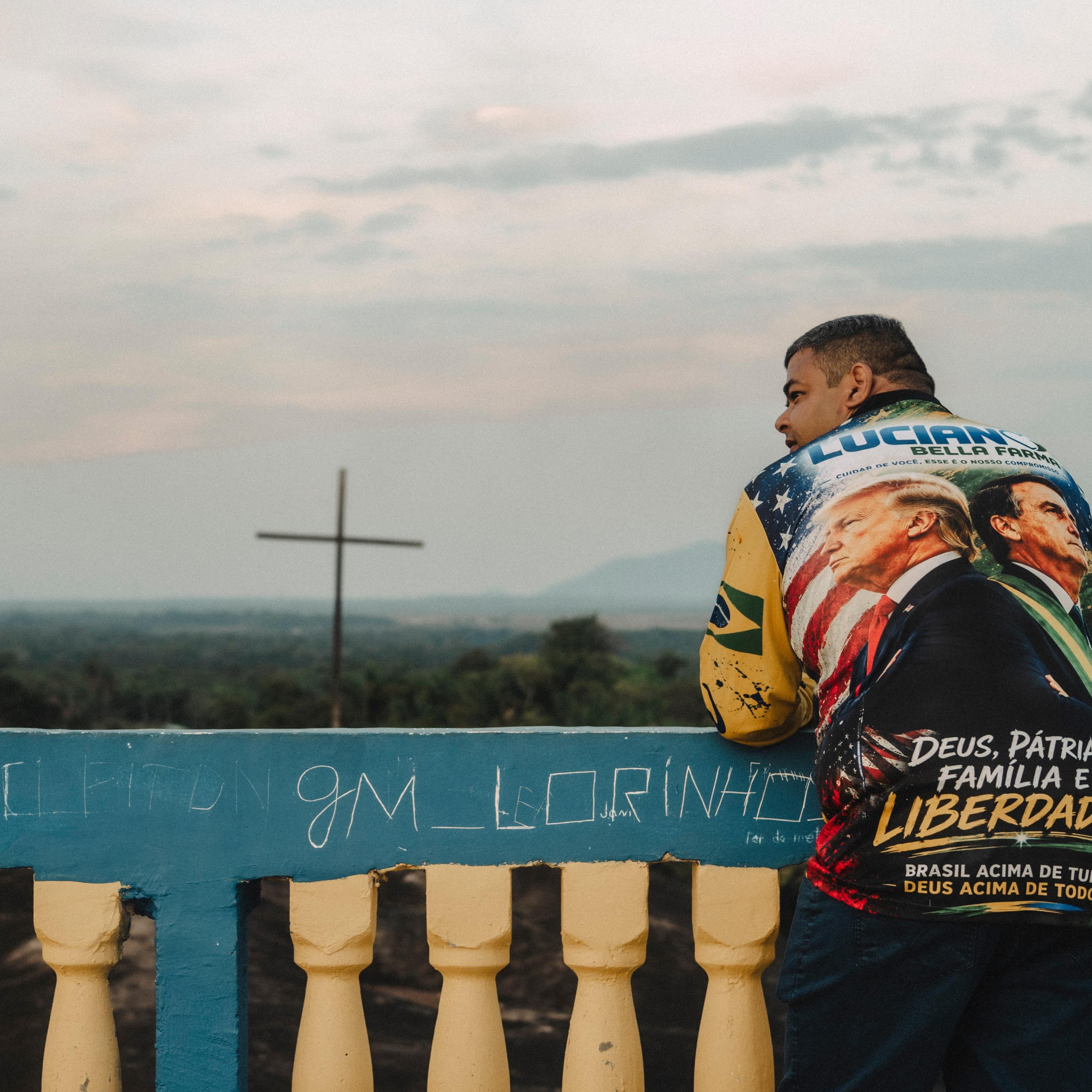
18:12Another character that I met as we were visiting Mukhajai was a chap called Luciano Gomes, who is a Bolsonaro activist and would-be politician. Opa, olha aí. Oh, my God. Who came to our interview wearing this extraordinarily garish shirt. On the front were two pictures of Flávio Bolsonaro and his dad Jair. And on the back was a giant picture of Donald Trump. O Donald Trump atrás, o que ele representa? O Donald Trump, eu acho que representa a América.
18:45And the slogan, God, homeland, family and freedom. And we met at a lookout point overlooking Mukajai, and he explained to me a bit about why he supports Bolsonaro. And again, ultimately, it all came down to mining and the local desire for Lula's crackdown to stop and for thousands of miners to get back to work.
19:14And when you go to pro-Bolsonaro events in areas like this, what are they actually like? When you go to Bolsonaro events, as we did in Gua Vista, you hear this just ear-splitting cacophony of Brazilian funk and Northeastern music with lyrics that if you speak Portuguese and you understand what's being said can be pretty disturbing. I mean, there's a lot of shouting about Bolsonaro and 22, which is his number in the election. But also a lot of very hostile, misogynistic stuff that is said about Lula's wife, the first Leila Júnior, about other left-wing female politicians and leftists in particular.
20:01So at once, the Bolsonaroistas who are there are in very good spirits. They think their candidate's going to win. And they're very excited about a right wing revolution that is sweeping across Latin America at the moment with a bit of help from Donald Trump. But there are some quite disturbing undercurrents in the music and in the behavior and the words of an overwhelmingly male group of voters. Who else did you meet there? I wanted to speak to evangelical leaders and worshippers because the evangelical church has spread massively across Brazil in recent decades, and particularly in the Amazon, where it is really popular on this rapidly expanding agricultural frontier, where people buy into the kind of prosperity theology that is preached by these churches.
20:49And that church is a massive part of Bolsonaro's support base. One of the people organizing the event I went to is a firefighter and church leader called Leandro Gentil. Actually a very mild-mannered, pleasant man from an evangelical church called the Igreja da Fé, the Church of Faith, the headquarters of which is actually in the United States, which I think speaks to the US's church involvement in Brazilian politics. and he said that he saw Flávio Bolsonaro and his father Jair Bolsonaro as defenders of Christian values and those sorts of values that the church fought tooth and nail to protect.
21:29What is it that we are, biblically? Basically being anti-abortion, being anti-drugs, and being anti-gay married.
21:48And he said that within his church, which has about 600 members, Bolsonaro was almost an absolute unanimity.
21:59And one other issue that he raised, which is really important in Roraima and also in Brazil.
22:09Roraima is located right next to Venezuela. People who live there over the last few years have felt and have witnessed firsthand what the economic meltdown under the nominally leftist government of Venezuela, of Nicolas Maduro, the dictator, has produced. and that is tens of thousands of absolute destitute, impoverished, hunger-stricken Venezuelans pouring over the border into Horaima, living on the streets of Boa Vista and Horaima. And they say that Brazil under Lula risks becoming a Venezuela.
22:45Coming up, why these presidential elections matter even if you live nowhere near Brazil?
23:25We'll see you next time. with up to 90 % savings. Go to ShipStation.com and use code AUDIO to try ShipStation free for 60 days. From globalization to innovation, sustainability to market volatility, there's always more than one side to a story. Explore different perspectives on today's most important business and economic issues with the Flipside Podcast from Barclays Investment Bank. Hear two research analysts in a lively debate and get insights from every angle to further inform your view. Listen to The Flipside on your favourite platform.
24:08Tom, if Bolsonaro wins on Sunday, which currently does look like the likeliest outcome, do you think that we're going to see a drastic reversal of all of the work that's been going on in places like Uriama and really across the Amazon? Frankly, you are already seeing illegal miners reinvading Yanomami territories across the Amazon and other regions. We've heard reports in recent days of ranchers sending threatening messages to indigenous communities saying they're on their way back.
24:41When I checked in again with Junior when I was in Bar Vista, he said that in the days since the first round,
24:52he had received reports from Yanomami villages that they'd been called by miners, ordering them to start clearing the runways that had been destroyed or had fallen into disrepair. The head of Lula's anti-mining operation told me that they had received disturbing reports of strange movements around the outskirts of the territory. And on Junior's phone, he's got a mobile phone app.
25:21That I think using satellite information can detect when people are digging holes and doing other damage to the territory.
25:30And he said that in the days since the election, he'd gotten four or five alerts.
25:38Suggesting that actually the miners are already inside. You know, many people might be listening to this and thinking, oh, that's terrible. But whatever the result is, most of our listeners are not in Brazil. Flavio Bolsonaro won't be my president. Can you just tell us why what happens in Brazil really matters to the rest of us around the world? I think I'd say two things. I mean, just on a human level, we talk about many genocides that take place in different parts of the world. You know, the cultural obliteration of a people. That is very much what has been happening in the Yanomami territory over the past few years has happened under Bolsonaro.
26:18There are only 32 ,000 Yanomami villagers who live there, some of them with very little or no contact with the outside world. So on a human level, the cultural and physical obliteration of an ancient people like that with all their knowledge and traditions and culture is devastating and can happen very quickly. So I think on a human level, it is hugely important. And that is, you know, we should all care about that. and of course in terms of the climate crisis in terms of weather patterns in brazil and rainfall the amazon is hugely important it is responsible for weather patterns that are essential for agriculture in other parts of brazil and the destruction of the anamama territory and these rainforest regions of the amazon is devastating for brazil for brazil's economy for brazil's future and for the rest of the world oh lord this all sounds pretty hopeless but tell me are people on the left, are Lula's supporters taking this line down or are they actually fighting back at all?
27:20After a really, really lethargic first round from Lula's campaign, after he lost, it was almost like someone had grabbed left-wing voters, centrists and people on the centre-right too, who believe in democracy, by the collar and said, wake up, you are a whisker away from getting plunged back into actually something potentially much worse than Bolsonaro's government because the results in the recent election mean the far right are going to be hugely powerful in Congress. Bolsonaro will be able to name four, perhaps five judges to the Supreme Court. So potentially, progressive Brazil is in deep, deep trouble if Bolsonaro wins.
27:57And that was a massive jolt. And we have seen this huge wave of progressive left-wing anti-Bolsonaro protests sweeping the country in the last couple of weeks. But in Rio and Sao Paulo and Belo Horizonte, you have seen hundreds of thousands of people hitting the streets. Even in Boa Vista, the capital of Juanaima, where I was, where twice I stumbled across big left-wing mobilizations in a city that voted 73, nearly 74 percent for Bolsonaro. Pretty amazing seeing we're at the heart of one of the most bolsonarista cities in all of Brazil, Boa Vista here in the Amazon. And we have just stumbled across a left-wing student protest.
28:36So they're standing here beside the gold miners Square, one of the big monuments to gold mining in indigenous territories here in Boivista. And they're blocking the roads. They're waving flags, playing music, giving speeches, holding up placards and saying that they're going to stay in the streets until this vote. And they hope they can turn things around. You know, there were students, there were indigenous activists, there were teachers, university professors, all on the streets to warn against not just the threat to the Amazon and the indigenous people into education and healthcare, but to Brazil's very democracy.
29:10And one of the people I bumped into at one of these protests was Joênia Wapichana, who is an indigenous lawyer and politician, who, under Lula, served as the first indigenous head of Brazil's Indigenous Protection Service. And she was there to warn that another Bolsonaro presidency would spell absolute disaster for her people and other indigenous peoples across the Amazon.
29:40of violent disputes. And we don't want to experience this again. And Joenia said something very powerful, and I think that gives one some hope for the future, even if Bolsonaro does prevail on Sunday, which is that there will be resistance. Indigenous people, she told me, are born fighting, they're born struggling, born resisting. They get knocked down, they shake themselves off, they dust themselves down and they carry on and they will not give up.
30:16And that is a message that I've heard up and down the country, and particularly in Horaima, and I believe that is true, that whatever happens, these people are not going to give up without a fight. That was Tom Phillips, The Guardian's Latin America correspondent. You can read all of his excellent reporting from Brazil at theguardian.com. and just before we go if you enjoyed this episode and i really hope that you did perhaps you'd consider leaving us a review we always really enjoy hearing what you think of the show and it also helps other people to find us if however you would prefer to correspond with us in private we have a new email address just for you it is tiff that is t-i-f as in today in focus t-i-f dot questions at the guardian dot com ask us a question suggest ideas for future episodes or guests, we are all ears.
31:04And that is all for now. This episode was produced by Ivor Manley and Eli Block and presented by me, Helen Pidd. Sound design was by Ross Burns. And the executive producer was Sammy Kent. We'll be back in your feeds this afternoon with the latest.
31:22This is The Guardian.
31:32When you're running a growing business, the right systems can unlock your full sales potential and make fulfilling every order effortless. Switch to ShipStation before peak season so you're prepped and ready before the rush hits. ShipStation connects Shopify, Amazon, TikTok Shop, and over 200 more marketplaces with one platform that does it all. You can manage orders, sync inventory, track returns, all automatically. Everything your operation needs, all in one place. Upgrade your shipping operations to stress-proof your biggest sales days and capture every bit of potential revenue. Go to ShipStation.com and use code AUDIO and get 30 days free.
32:03Are we doing enough with AI or are we already behind? The Intelligent Enterprise, hosted by me, Tom Stoneman, is the podcast for leaders who want to be able to answer those questions. On our latest episode, the generation growing up with AI and how they're using it at work. Like I wasn't just asking questions, but I was actually collaborating with it. Follow the Intelligent Enterprise wherever you get your podcasts.


