
 Ask ChatGPT


French lycée (ages 15–18) students blockaded schools and marched nationwide after outrage over crumbling facilities, overcrowded classes, teacher/nurse shortages, and an opaque university admissions algorithm. The protests escalated into street demonstrations, school closures, arrests, and injuries, with a major driver being allegations of police brutality (including stun grenades and rubber bullets). Prime Minister Macron-era officials offered dialogue, but students say they’ve been ignored for years amid broader inequality and political uncertainty ahead of the presidential election.
Angelique Chrisafis, The Guardian’s Paris correspondent reporting from near the protests’ start in Créteil and from blockades in Paris.
barricades built from wheelie bins and trolleys; classes of ~36; students reporting months without teachers; police statistics cited: 6,000+ arrests, 200+ children hurt, 700+ police hurt; cases include Mael (eye injury), Eden (jaw/teeth damage), and a teen losing a hand at Lycée Auguste Biehl; interior minister suspended stun grenades.
Written by AI. May contain mistakes.
An overview of the teenage protests in France, including causes and initial reactions.
“Today, the teenage protests taking over France.”
Exploration of the poor conditions in schools that sparked the protests.
“Angelique, thanks so much for joining us.”
First-hand accounts from students regarding their grievances and demands for change.
“And I've been to other schools across Paris with similar scenes.”
Discussing the widespread nature and scale of the protests, including police response.
“I mean, it looks like the movement's gone viral.”
Examination of violence during protests and the impact of police actions on students.
“Well, can you give me a sense of that scale then?”
Insight into public sentiment and support surrounding the student protests.
“And I think what you have to remember here is France's policing methods.”
Parents discuss their concerns about police violence affecting their children.
“So what have you seen these last Well, we've seen our own kid being under tear gas many, many times in front of his schools.”
Exploration of the systemic failures in the French education system and funding issues.
“it's really shocking to sort of learn about the state of the French schooling system.”
Discussion on how the youth protests are impacting the political landscape in France.
“essentially being under sort of house arrest socioeconomically, and he's promised to fix that, and it hasn't happened.”
The implications of ongoing protests for students and their education amid economic challenges.
“And it's almost as if we've come full circle.”
Insight into the solidarity shown by students across different social strata during protests.
“People are starting to question the way they've been living for a long time.”

Get the gist, explore an idea or ask about something said.
 Claude
On Today in Focus, what are the key points of this episode?
Searching your listeningAutomatic transcript. May contain errors.
0:00This is The Guardian.
0:08Today, the teenage protests taking over France.
0:22This morning I heard children singing the national anthem and grabbing everyone's bins and wheeling them down the street with trolleys to build barricades. You can hear that. You can also sometimes hear fireworks being fired outside demonstrations. It depends where you live. If you're near a high school, you will, before dawn, see children piling up bins as barricades and standing up there, and often with riot police standing by. Riot police versus the kids. Thousands arrested, hundreds injured. It's been a shocking week for France. Schools have been closed, ransacked, some have simply been burnt down.
1:03The kids are fed up with the status quo. And they're furious about a school system that they say is failing them. I mean, they do not have enough teachers to accommodate all the studying that they should be doing, or any means for nurses, I mean, just for basic needs in, like, a school at all. They have rats, I mean, even their schools are falling down, I mean, they don't have any means to work and to, like, be able to study later on. It began with outrage over shoddy school conditions in the banlieue, the deprived suburbs on the outskirts of Paris. But the movement has grown into something much bigger, fuelled by this feeling that no one cares and that their lives are only going to get worse.
1:41We're just trying to protest all week long, to block our schools all week long for the government to actually hear us. And we're going to stop when they change something to the French scholar system because it's a mess. It's really a mess.
1:58By Wednesday evening, in an address to the nation, the prime minister tried to calm things down. The anger of our youth doesn't spurt out of nowhere. We need to strengthen their confidence in this very difficult situation. And to do that, we need to listen to them. And so a dialogue will be carried out. So many young people feel like they've got nothing left to lose.
2:33From The Guardian, I'm Nosheen Iqbal. Today in Focus, on the barricades with French schoolchildren.
2:48Angelique, thanks so much for joining us. Thanks, Nosheen. You're The Guardian's Paris correspondent, which is near to where these protests first sort of kicked off. We've seen tens of thousands of young people on the streets. It looks like the biggest demonstrations for decades. Actually, what triggered that initial wave? Well, in the middle of September, at the start of the school year, there was a high school in Créteil in the outskirts of Paris in the southeast. And this high school had issues that many other schools had. And it decided, OK, this was too much. They had a lot of staff missing.
3:21They had windows leaking. They had people who couldn't be doing their work experience they needed to do because there were no teachers to organise that. And they decided to barricade and blockade their high school and shut it down. But as the weeks went on, other schools in the areas outside Paris that had the same thing, ceilings that had holes in, walls that had holes in, some cockroaches, even rats, they started barricading their schools. And this has now mushroomed with hundreds of schools across France doing the same, barricading, closing the school, and this week marching on the street.
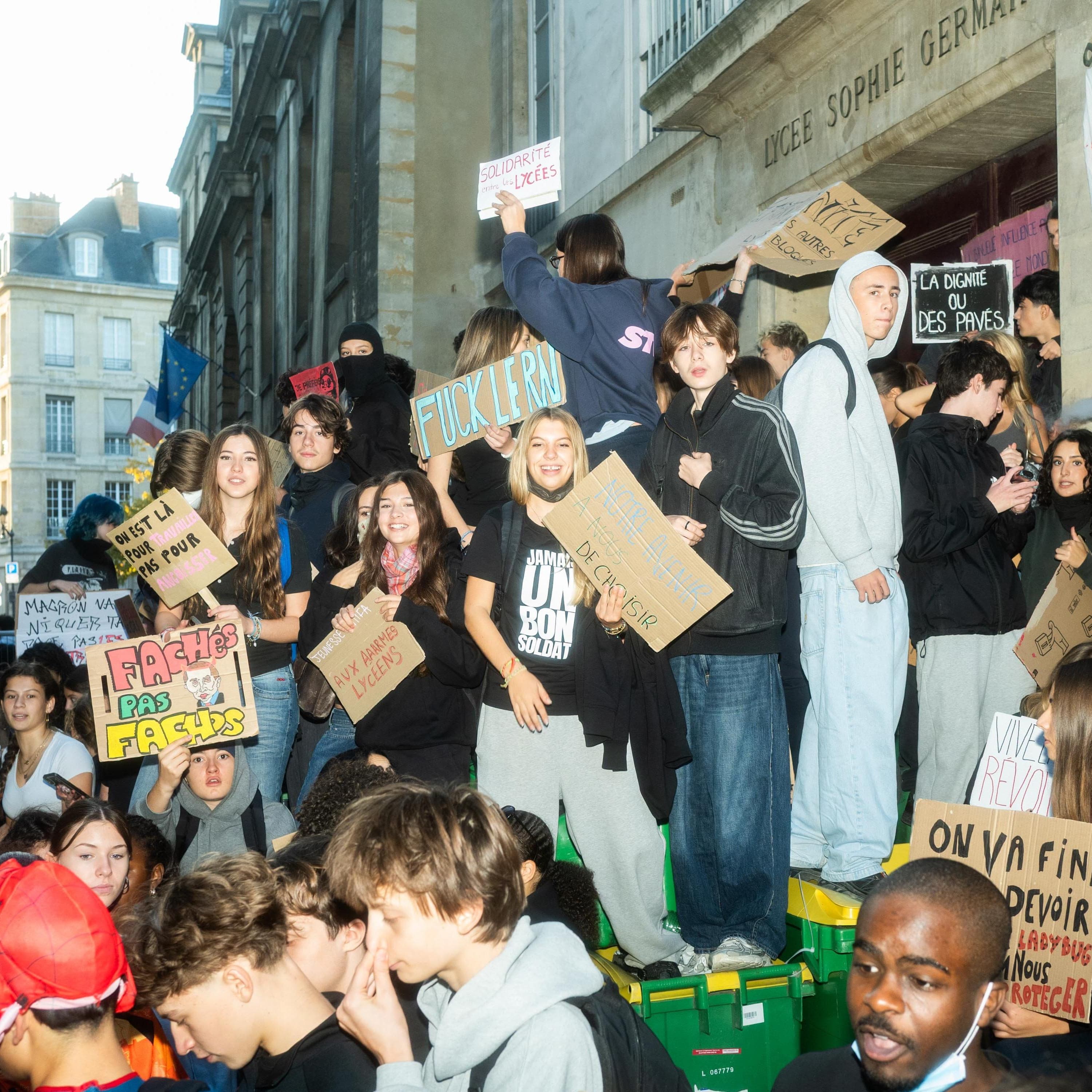
3:59Angelique, you went reporting from one of the blockades in Paris. What did you find? So these blockades often begin about six in the morning, and I went down before dawn, and there were hundreds of students pulling wheelie bins, shopping trolleys, metal barriers to block off their street in this particular school in the centre of Paris. And I've been to other schools across Paris with similar scenes. So you have hundreds of children holding banners saying we're here to protest, not to riot. And those protests completely block the entrance to the schools, often spill out into the street, often with riot police positions nearby.
4:38So how old are you and why are you here? I'm 17 years old and we're here blocking our high school to represent all the high schools, first of all in France, but mostly of the ones outside of Paris who are having a lot of trouble, whether it's finding means for teachers, means for nurses, means for just their whole system that's falling down in all these schools. And so we're here to represent all of them and blocking our schools because we know we are very privileged to be in the centre of Paris and be like a lot of people who are very privileged. And we're here to really represent everybody who doesn't have these opportunities.
5:11There were students on the blockade who were in their final year of school and who felt their mental health was suffering because of the types of buildings they were having to learn in. Maybe they had very decrepit buildings, holes in the roofs. Some children described not having enough chairs in their classrooms because their class numbers were very, very high. For example, 36 children in a class. Very, very long school days in France from 8am to 6pm, sometimes with gaps in between that. And at the end of this, also there is a university application system, which is largely run by algorithms, which is quite opaque and no one understands.
5:49And people feel that with a lack of explanation why children are getting rejected from universities, that they are being discriminated depending where their schools are. Before school, everybody told us the school was supposed to be, what they call in France, an elevator for your knowledge and everything. That it brings you up to a certain level where everybody is at the same stand. Whereas today that is not the case at all. I mean, everybody who lives in a suburb is never going to have the same chances as we do. We are so privileged to live in the center of Paris and be able to protest even. Because some people can't even do that and we can.
6:20And so that is exactly why we're trying to do it today.
6:29And this week we saw those morph into these enormous street protests where hundreds of thousands actually across France of adults, teachers, trade unionist parents joined with the high school children who marched through cities to make their point about their schools being decrepit with a lack of teachers, overcrowded classes and very poor learning conditions. I mean, it looks like the movement's gone viral. Angelique, how have they been organising and what are their key demands? What's worrying the French government is this high school protest that has spread across France is unprecedented in the way it's being organised.
7:09There's no specific leadership. There's no particular school union that's running this. It is children on the ground, at their own schools, blockading together. and because of that nature it's unpredictable and the government was very much taken by surprise. There isn't one specific government change or reform that people are shouting about which the government can then withdraw. This has grown up after years and years of difficulty of school children in high schools, class sizes that are higher than average of neighbouring countries, you have very long school hours and above all you have teacher absences that are not being filled so So you can have children who were saying to me in the street protests who've maybe gone for two and a half months without a teacher in a crucial exam year so they're not getting their curriculum.
7:57And these complaints are echoing around the whole of France. Student protests in France spreading to more cities. Authorities say as many as 500 high schools now shut down and thousands of young people have been taken into custody since the protests began late last month. Well, can you give me a sense of that scale then? You know, the extent of the protests, how far they've spread and the impact they've had so far. This is happening outside high schools known as lycées, where children between 15 and 18 are schooled at the end of their school career. So hundreds of high schools have been blockaded by school pupils for several days, some for over a week.
8:39And there has, of course, been a massive police crackdown by the government. So we've seen more than 6 ,000 people arrested, most of them minors under the age of 18. Of the hundreds of schools that have been closed, the government says around 24 of those have been ransacked in some way, often with fires being lit and destroying the entrance areas.
9:05I've seen some really dramatic and some really moving footage of young people you know just teenagers as you say they're telling people that they're not actually daring they're just desperate and we've seen them blockade roads you know there's human chains of parents and teachers separating them from the police. Anjali just how violent have these protests been and who's been getting hurt? Well government statistics show that more than 200 children have been hurt. The interior ministry say more than 700 police officers has been hurt. And the education ministry says, and this is what is interesting and new for the government, that 85 teaching staff has been hurt.
9:41One of those teachers who was hurt, for example, was a physics teacher in his late 50s in the south of France. He was trying to deal with a tree that had been set alight outside his school. And two 16-year-olds, allegedly, because they have been arrested, threw petrol at him into his face and into his hair. He says, look, I understand the reason for these protests, but I find it very strange. Teachers have said they find it very strange that teachers as this kind of authority figures can be targeted. I think it's important to say that that is not everywhere. It's in a few isolated cases. One of the main issues is how the government has responded and the level of the police reaction.
10:19I guess the other thing is that People, at least from here, if you look at social media, there's lots of clips of riot police, you know, just headed towards kids. And, you know, there's that shocking story of that child that lost his hand. At the Auguste Biel High School in northern France, parents and students are in shock. This video shows him collapsed on the ground moments after his hand was torn off. The incident is thought to have been caused by a stun grenade of this sort. Can you tell me more about how that's been received by the public in France? The key issue and now one of the key drivers of this protest movement is the idea of police brutality.
11:03So there are currently investigations into alleged police brutality over the last few days after some very, very serious injuries of children. So there was Mael, who was a 16-year-old in the town of Tours in the middle of France, who lost the use of an eye. possibly because of a form of rubber bullet an investigation is underway there was a 14 year old boy called Eden who was in the northwest of Paris he was actually videoed he was sort of kicking towards police officers so he was at very close proximity and it appears allegedly that he was fired on by the police officers in the video you can see him recoil and fall to the ground with his legs shaking and he has actually had his jaw partly blown away and his teeth his mother said this week that he can barely, he can't speak and he can barely drink through a straw.
11:50Now there is an investigation underway. That police officer has been charged and suspended. In the north of France where a 15-year-old has lost his hand, when an investigation is ongoing, it may have involved some form of police grenade. The French interior minister has announced in the last hour or so the suspension of all stun grenades by the police, that after several nasty incidents amid those protests by high school students across France. And I think what you have to remember here is France's policing methods. They're very unlike other European countries. In France, there is a heavy amount of use of explosive weapons against civilians.
12:30There is a form of crowd control, crowd repression, what you can call it what you like. Even when they're children. Well, this is a thing. We've seen it before. Do you remember the Gilets Jaunes protests in 2018 and 2019, where people protesting against the government and over fuel tax took to the streets in bright yellow vests. Now, in those demonstrations, this type of weaponry was being used, a form of rubber bullet launcher. You had a thing called a sting ball grenade with high explosives. And amongst the gilets jaunes, we had at least 17 people lost eyes, several people lost hands, and people had their faces mutilated.
13:03The difference here is these demonstrations are happening by children, some as young as 14 or 15. And the government's initial response was a policing response rather than a political response. And riot police were sent out and there were running battles in front of schools. And given that, how much public support do these young demonstrators have? Well, the public support has been quite high if you look at the street protests. Certainly many parents have been supporting children, although of course there There have been viral videos online of parents marching up to blockades and dragging their children off them.
13:39But ultimately, many parents associations have been supporting. Teachers have been supporting.
13:47I spoke to some parents on the Paris march whose son has been demonstrating west of Paris. He had been tear-gassed. He's in his final year at school. And they had come to the demonstration with him to protect him.
14:01It's not fair because it's not the same everywhere and we shouldn't have education different on one side or the other of Paris or the suburbs and we're here today because we want to support our children but we also want to protect them from what is going on with the police and the violence that we've seen with the police these last few days. So what have you seen these last Well, we've seen our own kid being under tear gas many, many times in front of his schools. Just because he has his phone on his, he was not filming. He was just sending a text. And a woman came to him and said, take your phone down in your pocket.
14:40And he was not quick enough. And she spray him. She spray him. Yeah. So violent. Yeah, no, it's unbelievable. There are fireworks going off over Place de la République.
14:58There have, of course, been images of people, and many of the high schoolers that I have spoken to have said, it's not us, we don't know who it is coming outside these protests, but fireworks, for example, being fired horizontally in the direction of police or even teachers. Those sorts of issues have also been on TV, and there would be people on the right who are very critical for what they call a form of chaos being allowed to take over the country. But there is an understanding amongst many teachers and parents that public services in France, and that includes schools, are not working, are being run into the ground.
15:35And I think there are many parents who've seen their children missing classes and struggling in school, who feel that they need to support their children. And the government didn't expect hundreds of thousands of people to take to the streets across France. in support of these kids.
16:04Actually, I've got to say, it's really shocking to sort of learn about the state of the French schooling system. I mean, I thought we had it bad here when we had this crisis a few years ago with like a hundred schools closing due to like crumbling concrete. But what you're describing is systemic, has been endured for decades and kids have reached a breaking point. But I wonder, was it always this bad? You know, is there anything that can be pinpointed as to why this became the trajectory for education in France? Yeah, so I think we have to remember that in France, they actually spend higher than the average of most developed nations on secondary higher education.
16:43So we're talking about the high schools between 15 to 18 year olds. The government's spend is actually quite high on these schools. So analysts are saying, well, how is the money being spent and what's happening? Yeah, quite. Where's it going? Right. So the upkeep of school buildings is something that regions are in charge of. It's sort of devolved to regions, but regions saying our budgets are too small. We're doing our best, but we can't, you know, we can't renovate schools fast enough. And a lot of what is at the heart of this is this festering issue of inequality in French society. which means that a child born and schooled in a deprived area of France has less chance of escaping their socioeconomic background than in most other developed nations.
17:26And that is because if you come from a disadvantaged area, you're often in a disadvantaged school. Yes, the government is aware of these disadvantaged schools and would say, well, we're increasing funding to them. Yes, but often the staffing isn't there or younger staff who are there or much more teacher absenteeism, which isn't being replaced. And so you have a kind of two-tier system. What Emmanuel Macron in the past has talked about, essentially being under sort of house arrest socioeconomically, and he's promised to fix that, and it hasn't happened. Anjit, just how bad are the government's finances?
18:02Well, the government is in a difficult situation at the moment where it's trying to get a budget passed for next year. And you'll remember that we've had a merry-go-round of prime ministers who've had to resign over failing to get budgets through a very divided parliament. And for the last two years, we've been in a system in France where there's no majority government. The far right is very present in parliament. Emmanuel Macron's centrists have shrunk. The left is also present, but not present enough and very divided amongst itself. And it's going to be very difficult to push a budget through.
18:36And also, France has a lot of public debt. It's borrowing to pay for its public services. It needs to get its deficit down. And the prime minister says, look, I'm going to do that by cutting funding for public services.
18:52The students are protesting the far right. But could the movement actually be a win for Marine Le Pen? That's coming up.
19:12All in all, none of this can be a good look for Emmanuel Macron. France is six months away from a presidential election. He's facing a growing far-right threat from Marine Le Pen, as you've said, who at the moment is being seen as the frontrunner in that race. Angelique, what problems does this youth movement then pose for him? Usually you will have a protest movement that's very linked to a government reform that a government can take off the table. And in the run up to an election, you usually don't see this type of movement because people are engaged in policy debate and they're looking ahead to who the next government, who the next president might be.
19:48What is also very, very clear on the barricades, in the chanting that you hear and on the street protests is that many of these students and high school students are very worried about the run up to the presidential election. That's why we're also get committed before the elections that come in May. And because here we have a party that's named the Rassemblement National. So it's extreme right. And it's extremely racist. And it's getting up. It's getting up. It's getting up. And if it's getting elected, the suburbs, you don't hear a thing about it. It's going to get worse. The culture, the education, everything is going to get horrible.
20:35So we're protesting against fascism. Many of these students can see that Marine Le Pen, the far-right anti-immigration candidate, who's running for the fourth time, despite having a recent embezzlement conviction, upheld on appeal, and she's now taking it to the highest court. She is currently the front-runner in a very confused political landscape at the moment because it's uncertain who she'll be running against. The radical left, Jean-Luc Mélenchon, also has a certain dynamic behind him in the polls. There are other centrists also vying for a position. But what is certain is that Marine Le Pen and the far right are increasing their support.
21:16Emmanuel Macron, of course, is standing down after 10 years in office. He was the youngest president France has ever had in the modern era. He promised that he would listen to people. He promised that he would deal with this social inequality. He started off having lots and lots of consultations. And it's almost as if we've come full circle. And we're now finding students saying, we've not been listening to him. The social inequality, we can't see an end to it. And he's had numerous consultations with the public, including even about long school hours. And the outcome of that has been simply put in a drawer and everyone's ignoring us.
21:50Meanwhile, Le Pen has accused the left of fomenting the riots, I think probably in reference to Mélenchon going out on the streets to protest with them. And there was also the mayor who was stopping police from attacking teenagers.
22:06She's also seemed to, or reportedly had a word in Trump's here, who posted, as he does without fact or reason, what's happening in France is nothing less than out of control mass migration. This isn't about schools. This is about Islam wanting to take over a once great country. Now, none of that seems consistent or true to what we've heard from you or the protesters wanting better school conditions. How has Trump's take gone down in France? I mean, Trump's take is seen as just completely ridiculous. It's so far off the mark that I don't think it's even garnered a response here. And it's seen as him just using France, which does provide quite striking imagery on TV of burning wheelie bins.
22:49He's using that clearly for his own political purposes. Actually, politically in France, though, it's very interesting because the government wasn't listening to students at the beginning of this and decided, and in fact said this is a problem of urban violence, decided to treat it as if it was a question of rioting when it was far more complex than that with many, many peaceful demonstrations outside schools. And the government, instead of actually listening to the students, they said, well, look, this is not students. This is being stoked by what they called was the radical left, Jean-Luc Mélenchon's party, La France Insoumise.
23:22They're stoking it and I quote, their proxies on the ultra-left. Now, the reason that has created problems in France is because it's clearly absurd. There have been local councillors, mayors, local politicians from La France Insoumise, LFE, coming past protests. But to suggest, and even they wouldn't suggest that they're running these, is to somehow suggest that students and the high school students have no minds of their own, that they can't somehow organise on their own behalf. And so that has actually backfired against the government, even among students that don't necessarily support LFE at all.
23:57It's a way of the government to somehow discredit young people and not listen to young people's voices. And what impact does this have on a generation who can't get the education they need and doubly whacked by this poor economic growth? And particularly, as you said, from those already starting from a place of disadvantage, what happens now? It's not quite clear what happens now and I think that's the problem and I think what has happened with this protest is that emotionally it has drawn in lots of different types of people including students and the government's very scared that if students start blockading universities they can have quite a high reach especially as well if workers start joining in over fuel costs and the cost of living but one of the things that really struck me was I was talking to three students from the Paris banlieue who are sports science students and they were blockading their university north of Paris in the banlieue and they said you know the way we were taught at school we had buildings collapsing we had holes in the wall we had to sit on the floor we didn't have enough chairs another person who had a philosophy exam at the end of the year no philosophy teacher and they said we actually put up with that and it wasn't till we got to university when we started meeting people who'd been in at school in rural areas or other city centre areas that we realised hang on that wasn't normal.
25:12People are starting to question the way they've been living for a long time. Within that, there's always the risk of the government collapsing and the prime minister having to leave. It's very, very chaotic feeling in France, a lack of trust in politicians, a lack of certainty in what kind of response the government can give.
25:33And how long this might go on for and also what other people might join in. And what happens next? How long will this go on? So it started last week and we're planning to do what we call, like, what was called actually a black week, which is to try and protest all week long, to block our schools all week long for the government to actually hear us. And we're going to start when they change something.
26:00Angelique, you've reported from so many protests over the years, but this one really seems to have hit a nerve. What struck you the most about what you've seen? So at each barricade in Paris, certainly, and in the Bonne-Ure, you have hundreds of children piling up metal barricades into a kind of a mountain outside school gates, completely blocking all entrances. And then hundreds of cardboard signs done with felt tip. Some of them saying, we're here to protest, we're not here to riot. I heard them, I stood in front of them singing, and they sang about solidarity, solidarity, solidarity.
26:35We want solidarity with children in poor areas. We're in Paris, we're struggling, but they're struggling more than us. And in fact, a teacher said to me, we think that we grow up in a generation of social media kids who are very selfish, really narcissistic. And she said that these demos actually fly in the face of that because we've seen students all over Paris demonstrating in solidarity, even from the richest private school in Paris this week, which no one has ever seen a barricade outside there, saying, no, we've all got to stand together. And teachers say this is actually really positive about the political engagement of a young generation.
27:13That was Angelique Crisafis, Paris correspondent for The Guardian. My thanks to her. Do follow her and John Henley's reporting on this story all at theguardian.com. And that's it for today. This episode was presented by me, Noshi Nikbal. It was produced by Tom Glasser and Saskia Collette. Sound design is by Breen McNamara and the executive producer was Huma Khalili We'll be back this afternoon with the latest
27:44This is The Guardian


