
 Ask ChatGPT

 Today in Focus
9 Jun 2025 · 12m · 6 chapters
Protests in Los Angeles sparked by ICE immigration raids, followed by Donald Trump ordering 2,000 National Guard troops to the city, bypassing California Governor Gavin Newsom, escalating tensions and prompting legal/political backlash.
Chris Michael, The Guardian’s US breaking news editor in London; he reports from and has covered the LA protests and crackdown.
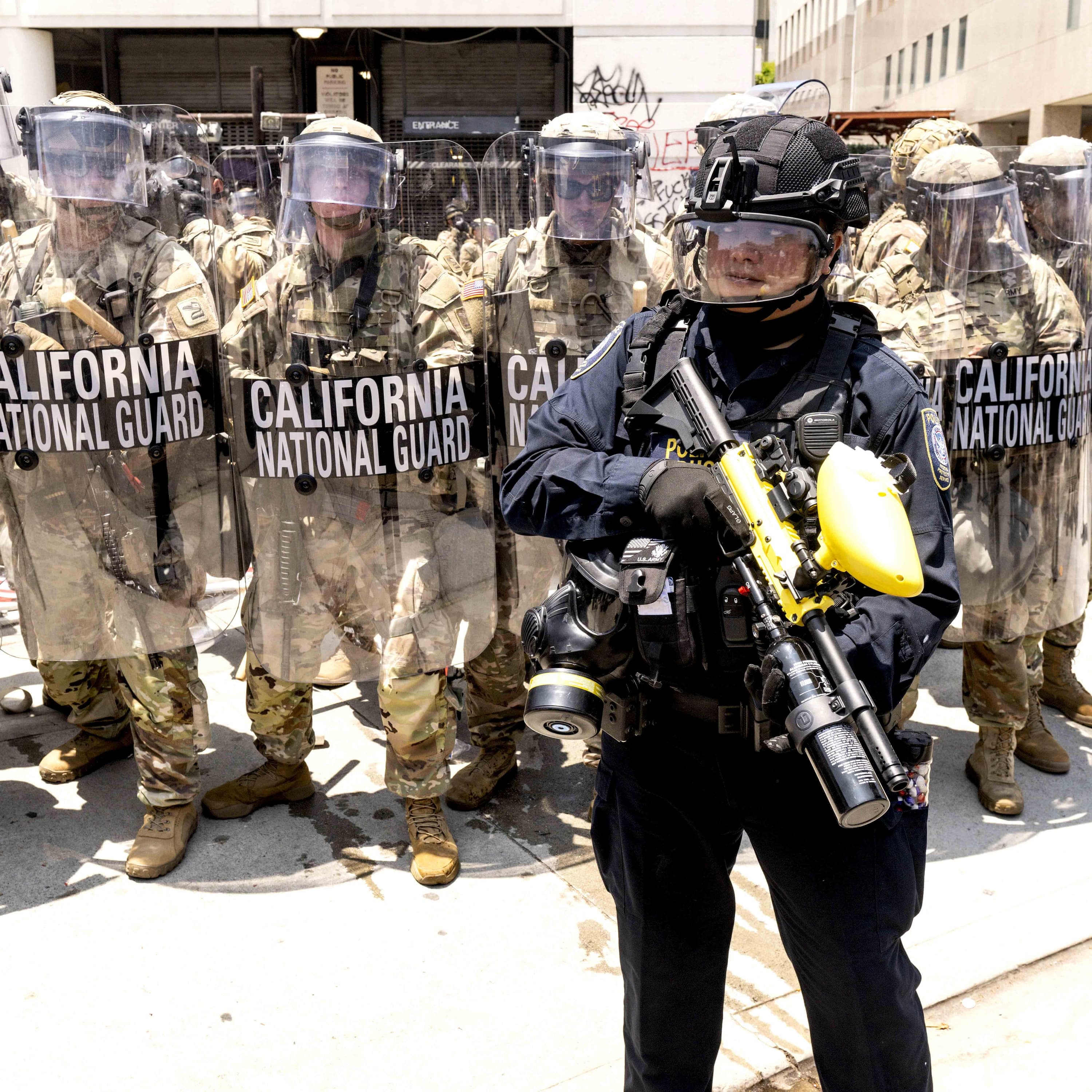
The National Guard deployment is unprecedented and “authoritarian,” blamed for inflaming a situation that was initially mostly small/limited clashes. The Guard’s role is unclear but is mainly to support ICE/immigration enforcement. Downtown LA is declared a no-go zone with arrests possible.
ICE raids at Home Depot parking lots (including Paramount) and in the garment district; David Huerta arrested while observing; comparisons to 1992 LA riots and 1965 Alabama civil-rights troop deployment; planned “No Kings” protest June 14; similar, more heated protests in San Francisco.
Written by AI. May contain mistakes.
Exploration of the protests triggered by immigration raids in L.A.
“but soon other protests were breaking out across the city.”
Discussion on how protests escalated and Trump's decision to intervene.
“Chris Michael, you're The Guardian's US breaking news editor in London, and you've been across these protests in Los Angeles over the weekend and the crackdown that's followed.”
Contextualizing Trump's unprecedented deployment of the National Guard.
“on Saturday morning, there was a rumor of another raid at a Home Depot in a neighborhood of the city called Paramount, which is a predominantly Latino working class neighborhood.”
Analyzing the implications and legality of deploying troops in civilian situations.
“Those were huge widespread riots after the beating of Rodney King, a black man by police.”
Describing the mood in L.A. and how recent actions affect the local community.
“And just to be clear, I mean, you talk about the LA riots, what we're seeing on the streets of LA is so far from that in terms of these little, mostly peaceful protests with small flare-ups.”
Discussing political responses and potential legal actions from California.
“And so you have people who have been living in L.A.”

Get the gist, explore an idea or ask about something said.
 Claude
On Today in Focus, what are the key points of this episode?
Searching your listeningAutomatic transcript. May contain errors.
0:00This is The Guardian.
0:05This afternoon, Trump's shock decision to deploy the National Guard against L.A. protesters.
0:24It was the middle of the afternoon on Friday in downtown Los Angeles when a few dozen protesters assembled outside a clothing factory. They'd heard that law enforcement agents were inside carrying out an immigration raid, part of Trump's plans for sweeping mass deportations. Riot police from the LAPD arrived, but soon other protests were breaking out across the city.
0:56By Saturday, the crowds had grown and tensions between police and protesters were starting to flare. We continue to see these Border Patrol agents firing what appears to be flashbangs or different tear gas canisters. Then on Saturday evening, Donald Trump made a decision that sent shockwaves through U.S. politics. He ordered 2 ,000 National Guard troops to the streets of L.A., bypassing California's Governor Gavin Newsom and using rare and unprecedented federal power. I said, look, you've got to take care of this, otherwise I'm sending in the troops. That's what we did. He's lit the proverbial match.
1:36He's putting fuel on this fire. Democracy is in the balance. From The Guardian, I'm Lucy Hoff. Today in Focus, the protests in Los Angeles and Trump's dramatic escalation.
1:53Chris Michael, you're The Guardian's US breaking news editor in London, and you've been across these protests in Los Angeles over the weekend and the crackdown that's followed. First of all, what sparked these demonstrations in the first instance?
2:07Chris Michael: Well, on Friday in Los Angeles, ICE, the immigration authority in the US, conducted several raids at sites across the city, places like Home Depot parking lots where day laborers would gather to get work for the day. And at a couple other places, including in the garment district. These raids were pretty intense. Quite a lot of people were picked up, detained, and there were some quite small protests around that. People showing up basically to say, why are you taking my friends away in vans? There were limited clashes between police who were brought in and the people who were protesting. They were quite small in scale and in nature, and they sort of went on throughout the rest of the day.
2:56Chris Michael: The president of California's largest union, David Huerta, was also arrested, detained at one of these protests while merely observing. And that seems to have annoyed people and been one of the initial flashpoints. Okay, so how did things escalate beyond that? on Saturday morning, there was a rumor of another raid at a Home Depot in a neighborhood of the city called Paramount, which is a predominantly Latino working class neighborhood. Rumors of this raid really spread. As it happened, the raid itself did not happen, but border agents did show up, but lots of protesters did as well. I mean, you know, again, a few hundred people, but things sort of escalated from there.
3:41Chris Michael: Police were called in. The protests didn't exactly get violent, but they seem to encourage some other small-scale protests around the city with people basically up in arms at immigration authorities coming in and gathering people up to who knows what, detain them and worse, possibly deport them. Breaking news. Protesters and federal agents clashing in Southern California over recent ICE arrests. Police cracking down on protesters, declaring it an unlawful assembly, ordering the crowd to go home. then Donald Trump decided to intervene. He announced that he would be sending in the National Guard and that 2 ,000 National Guard members would come in.
4:24Chris Michael: That is really being blamed by many people for inflaming a situation that might have been a little bit tense but was fundamentally under control. Sending in the National Guard is really an unprecedented move on Trump's behalf. I guess it's unprecedented for Donald Trump, But have we seen anything like this from a U.S. president before? Well, the most recent time it happened was in 1992 when the L.A. riots happened. Those were huge widespread riots after the beating of Rodney King, a black man by police. But those were troops that were called in at the request of the governor to help deal with the protests.
5:04Chris Michael: In this case, Trump has sent in National Guard troops over the authority of the governor of California, Gavin Newsom, who says, we don't want them, we don't need them. Don't inflame the situation. The last time a president tried to do this, sending in National Guard troops over the request of the governor, was 1965, 60 years ago. And in that case, actually, it was Lyndon Johnson who sent in the troops to protect civil rights protesters in Alabama. So really unprecedented. And a very stark contrast and one that perhaps Donald Trump has in his mind. For him, is this about optics? It's about a political calculation about how this will look to his base.
5:43Chris Michael: Yeah, absolutely. There's a political element to it, but it's more than that. It is really an authoritarian move. He is planning to use U.S. troops against Americans on U.S. soil, which is illegal and frankly outrageous, a real overreach of his authority and a scary moment for the US. And just to be clear, I mean, you talk about the LA riots, what we're seeing on the streets of LA is so far from that in terms of these little, mostly peaceful protests with small flare-ups. What will the National Guard actually be doing in LA and what powers do they have? Well, a lot of that is deliberately unclear, but they have been sent in mainly to support ICE, to support immigration officials.
6:31Chris Michael: They won't really be doing a whole lot. And in fact, so far, they really haven't been doing a whole lot. It's kind of the principle of the thing, sending in troops like this when you're talking about policing or immigration enforcement. Most of the violence on the authority side has come from the LAPD and to a certain extent the LA Sheriff's Office. when these events are in broader LA County. It does seem as though the police have been exercising some restraint. There appears to be a sort of effort not to let things escalate too much. But of course, when you then say, well, we're sending in the National Guard, and by the way, we also reserve the right to send in US military to any place in the country for events that might be happening now or might be predicted to happen, that just pours fuel on the fire.
7:20What's the mood in LA today? And what are authorities saying to people who might want to turn out again?
7:26Chris Michael: Well, they've declared all of downtown LA a sort of no-go zone. So if you show up to protest, you can be arrested. So the authorities are really trying to put a stop to it. The mood is tense. This is a city that has been through quite a lot recently. The fires that completely decimated many neighborhoods weren't long ago. And Trump took a very antagonistic approach to that as well at the time. He also blamed Gavin Newsom and the mayor of L.A., Karen Bass, for not supposedly turning on the taps to help fight the fires, which is a completely ridiculous thing to say and was untrue. But he set up California as a kind of punching bag.
8:08Chris Michael: Many of the people that are being arrested in these immigration raids were people who helped fight those fires. And so you have people who have been living in L.A. for 10 years, 20 years, who are either firefighters or volunteers helping fight the fires or with the cleanup, all of a sudden seeing family members being arrested. And you can see why the nerves were a little raw and why this could have sparked into something that is now slightly out of control. And is this a kind of tinderbox situation where by sending the National Guard, Trump has really inflamed the situation. Perhaps this will become a kind of series of protests in opposition to him on the streets of Los Angeles and perhaps elsewhere.
8:50Chris Michael: Yeah, that's possible. There are certainly protests planned for later in the week, which were already planned, something called the No Kings protest on June the 14th. This is likely to bring a lot of people out for that. In San Francisco, there were some similar protests. They were actually, although quite small, a little bit more heated. The confrontation with police was very direct. There were some protesters really pushing metal barriers against police, police pushing back. So it's very possible that we'll see this kind of thing spread throughout the week. I mean, I think the fact that it's Monday morning now in LA might calm things down a little bit during the week as everybody sort of resumes their normal Monday to Friday working routine.
9:34Chris Michael: But I think looking ahead to the weekend, you know, there could be a showdown. We know Trump wants a showdown and it's possible people will give it to him, even though Gavin Newsom has said, you know, don't give him this, don't give him violence, because that's what he wants. He wants the pretext of an insurrection so that he can respond with sort of an iron fist. So against all of that, what have we been hearing from Democrats and what could we expect to happen next, particularly in this head to head between Trump and the governor of California, Gavin Newsom? Well, there's been outrage. Bernie Sanders said it was authoritarianism in action.
10:14Chris Michael: Gavin Newsom is really up for this fight as well. You know, if Trump is up for it, so is Newsom. It looks kind of quite good for him. He's been inviting camera crews into his situation room to talk about, you know, the threats that have been made against him. The border czar, Tom Homan, said he would arrest anybody who gets in the way of immigration enforcement. And when asked, does that include the governor? He said, you know, anybody could be picked up. So Newsom was then like, you know, bring it on, tough guy, come and arrest me. So there's that sort of political theater element to it. There will also almost certainly be lawsuits.
10:55Chris Michael: The state of California could sue the federal government. So yes, it will definitely go to the courts. But Democrats in Congress are sort of somewhat hamstrung. They just don't have that much power in either the House or the Senate. And of course, they don't control the presidency. So, you know, strong words might be the limit to what they can do, at least for now. Well, Chris, thank you so much. Thank you. Thanks again to Chris Michael, The Guardian's US editor in London. And for more on the LA protests and their fallout, head over to theguardian.com where there's rolling coverage of events on the ground.
11:30We'll be coming back to this story later in the week for a full episode of Today in Focus. so do keep an eye out for that in your feeds. That's it for today. This extra episode was presented and produced by me, Lucy Hoff. Additional production and sound design by Ivor Manley and the executive producer was Homa Khalili. We'll be back tomorrow.
11:52This is The Guardian.


