Ask ChatGPT


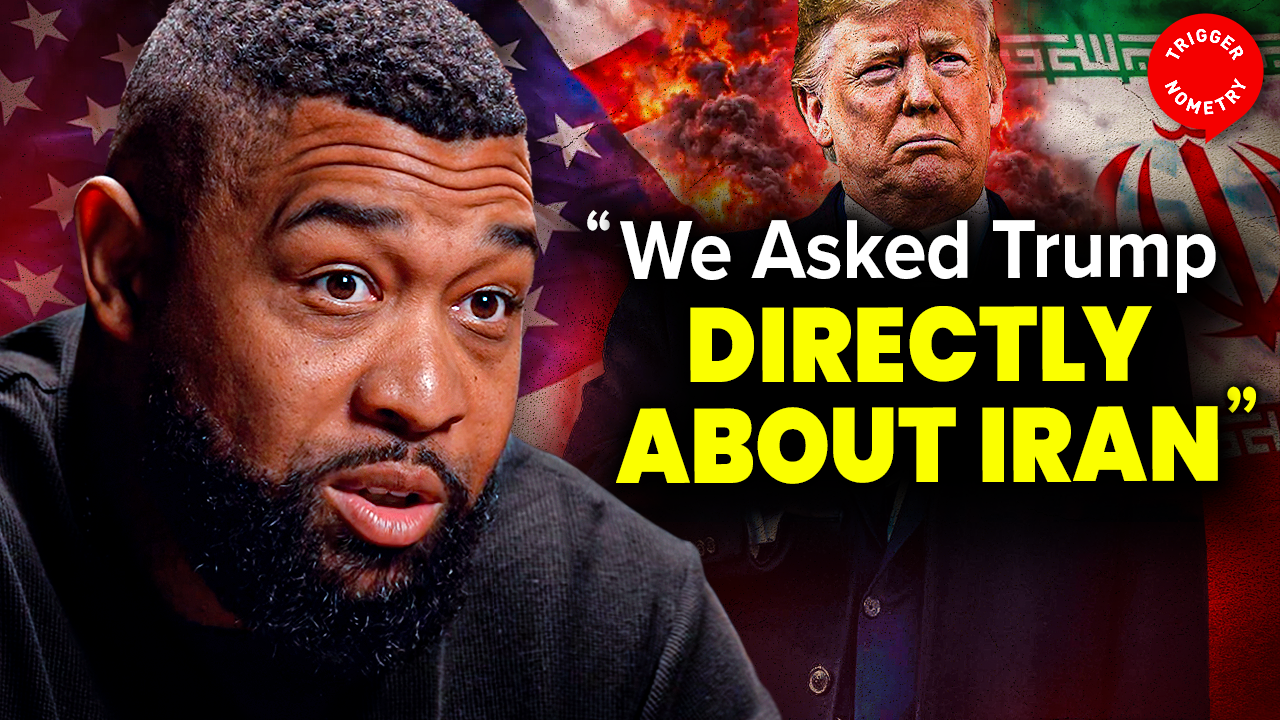
Dave Smith (anti-war libertarian/political commentator) debates TRIGGERnometry host(s) about the Iran strikes and broader U.S. foreign policy, especially whether the 12-day war and the later Iran war were “wars of choice,” whether Iran getting nuclear weapons is a deterrence problem, and how Trump’s messaging (including claims about Iran being “two weeks away”) is viewed as dishonest. They also discuss Trump’s political legacy, MAGA’s durability, and the Ukraine war/diesel-deal headlines and moral hazard.
Dave Smith is the main guest, a political commentator known for libertarian-leaning anti-intervention views and long-form debates. The hosts are TRIGGERnometry’s regular hosts (not individually identified in the transcript). They reference other figures: Robert Pape (academic on escalation/deterrence), Jeffrey Sachs, John Mearsheimer, Tucker Carlson, Alan Dershowitz, and ex-special forces (unnamed).
Written by AI. May contain mistakes.
Dave Smith discusses the reception of his previous appearance on the show.
“which are absolutely free at hillsdale.edu.”
The hosts and Dave Smith reflect on productive political conversations and the challenges of differing opinions.
“The comments don't reflect the majority of what the people who watched it think necessarily.”
The conversation shifts to the complexities of war and differing viewpoints on military interventions.
“Nobody really thinks that, like, it was.”
A detailed discussion comparing past and present military engagements, especially in relation to Iran.
“And we've been saying that from basically day one, which is very counter to what people expected us to be saying.”
The hosts and Dave Smith debate the implications of nuclear weapons in the Middle East.
“The fact that he was willing to go to war with Iran once, that same guy went back again.”
Discusses the implications of nuclear weapons in global politics.
“And I think, you know, I don't know, to get into, like, abstract libertarian theory or something like that.”
Explores varying threat perceptions regarding Iran's nuclear ambitions.
“So this is what I'm saying, is there are people who have a different threat assessment of that.”
Examines past fears of nuclear proliferation in India and Pakistan.
“just means is no one can mess with them now.”
Analyzes military strategies and their effectiveness in addressing threats.
“And she goes, his office, and you're like you know, like, and that just kind of made the whole thing fall apart.”
Critiques the lack of a clear strategy in the current approach to war.
“But this war, it's unlike any of the ones I've ever seen, not in terms of a humanitarian catastrophe so far, but just in terms of how incoherent the sales pitch has been from the very beginning.”
Discusses how war decisions impact presidential legacies.
“You know, you overhaul the health system.”
Debates the consequences and outcomes of the 12-day war in Iran.
“is no bad thing, very little cost, you know, in terms of lives and all.”
Explores how different leadership affects military strategy and responses.
“It's definitely true that there were some people who I admire very much.”
Discusses the potential risks and outcomes of military engagement in Iran.
“So putting a gun to your head and playing Russian roulette, drinking eight shots of whiskey and driving home.”
Discussing the lies behind justifying wars and the political consequences.
“I've never seen a president lie us into war, and I've seen a lot of them, where no one believed the official story.”
Exploring the future and meaning of the MAGA movement in current politics.
“It's four words that convey at least four crucial thoughts, like one crucial thought per word.”
Analyzing how economic factors, like rising diesel prices, affect Trump's base.
“I mean, the old adage, the very famous adage is it's about the economy, stupid.”
Examining the implications of Trump's foreign policy regarding Ukraine and Russia.
“Well, we've been launching as wars ever since.”
Debating the effectiveness of Trump's negotiation strategies in foreign policy.
“And you're just going like, shut the f*** up.”
Explore Trump's misconceptions about the Ukraine conflict and its impact.
“I'll win at grinding it out, and Vladimir Putin doesn't seem to very much care how many people got to get grinded out.”
Discuss the implications of Trump's statements and actions after significant events.
“And you know, him and Rob, they disagreed.”
Explore the discussion on Donald Trump's responsibility regarding the Israel lobby and military actions.
“because I do certainly agree with you that in the tone of a lot of things I've seen him say, he's almost excusing responsibility for Donald Trump.”
Examine the complexities of who influenced Trump's decisions on military action and the implications of those decisions.
“We know that they presented information and that nobody else in his cabinet really bought into it.”
Discuss the concepts of agency and accountability in the context of Donald Trump's actions and external influences.
“Like, it's just he got convinced that this would be easy.”
Analyze the impact of the Israel lobby on U.S. foreign policy and military interventions.
“No, that doesn't make sense, Dave, because you just said I hold him 100 % responsible, and then you say the Likudniks are mostly responsible.”
Investigate the historical context of U.S. military strategies concerning Iran and the role of perceptions in those strategies.
“Everyone's always trying to trick everyone, though.”
Explore the nuances of the discussions around Iran's nuclear capabilities and international negotiations.
“You care if they have a nuclear program just for civilian power?”
Analyze the current dynamics within the Democratic Party and its challenges moving forward.
“I don't find that to be like wild speculation.”
Discuss the implications of recent political shifts and the rise of democratic socialism.
“And that does concern me because I have a lot of worries about who some of these people are.”
Discussing the influence of leftist ideologies on American politics and potential election outcomes.
“Let's say it was just cardboard Democrat.”
Analyzing the lack of strong leadership figures in the Democratic Party and its implications.
“But I think that it's quite possible that after particularly after these midterms, the next two weeks, I think probably the Republicans are going to have a really, really bad day.”
Examining AOC's political moves and the perception of authenticity in leadership.
Evaluating the rise of economic populism as a response to wokeism and its effects on voters.
“But then there's also a part of you that goes like, you coward.”
Discussing the affordability crisis and its roots in currency debasement and economic policies.
“I think one of the problems the Warhawks have is that the Iranian nuclear program is not on the top ten of anybody's issues, you know?”
Exploring the impact of gender perspectives on political conversations and decision-making.
“That's a big advantage from what the woke 1.0 had.”
Highlighting the need for rational approaches in policy-making amidst emotional discussions.
“It's just not you can't only make decisions from the perspective of how do we look after vulnerable people?”
Exploring the reasons behind the unaffordability of homes for younger generations.
“We're having an unaffordability crisis, okay?”
Discussing the implications of government spending and national debt on the economy.
“It almost feels like everyone in leadership, it's like the, you know, the boat's going down and the rats are just getting, you know, Nancy Pelosi's like, dude, I'm making stock trades.”
Analyzing how inflation affects different socioeconomic groups and the broader economy.
“And one of the reasons I think it doesn't really get talked about, I mean, we talk about it all the time and you've got, I think, a very good articular summation there.”
Comparing the struggles faced by different generations regarding housing and lifestyle.
“Well, ain't that a random choice, right?”
Discussing the financial advantages of owning assets in an inflationary economy.
“So this isn't like an official appraisal, but just like the realtor sold me my house, goes, we've estimated that your house has gone up like$200 ,000 and something.”
Engaging in a conversation about the perceptions of Winston Churchill and historical narratives.
“I'm the older one who is established, doesn't need the welfare and we're giving it to me.”
Examining the lasting impact of historical figures on society and their recognition.
“the utmost respect for functioning alcoholics.”
The discussion explores Winston Churchill's significance and historical context during World War II.
“Okay, so what is it you want to argue about?”
Participants debate the misconceptions and popular narratives around World War II, particularly regarding Churchill and Hitler.
“and then later became the Prime Minister during the war.”
The conversation shifts to the complexities of wartime decisions and the consequences of intervention or non-intervention.
“to the war, and it's really, I think, um...”
The speakers discuss whether World War II was justified and the implications of its outcomes on future conflicts.
“Well, I know when I wrote about what I termed the war cry, it's a very controversial term, blah, blah, blah, blah, blah.”
A critical examination of lessons learned from World War II and how they apply to contemporary conflicts and perceptions of war.
“And so, no, what starts is you have Woodrow Wilson saying he's going to make the world safe for democracy.”
The discussion focuses on the rationality of historical and modern leaders in the context of escalating conflicts.
“So that's the mythology that I think most people want to blow up.”
Exploring the concept of rational actors in historical and contemporary conflicts.
“because basically Germany was broken up after World War I.”
Discussing the complexities of justifying Allied actions during World War II.
“You have to have how evil Imperial Japan was and what they did to China.”
Debating whether the threat from Hamas constitutes an existential threat to Israel.
“the way that we would see the threat that Hitler posed and the Japanese imperial armies and project posed.”
Analyzing Israel's actions through the lens of regional dynamics and historical context.
“And if they could kill us all on October 7th, that is exactly what they would have done.”
Discussion on the motivations of Israel and Palestine amidst ongoing conflict.
“I mean, I guess we can, we're both just arguing over what their motivations are.”
Exploration of the philosophical implications of government intervention in genocides.
“I think there's nothing wrong with that.”
Examining the libertarian perspective on intervention and its moral implications.
“Whereas like my system, I can have all the liberty for the good stuff, but I can also outlaw all the bad stuff.”
Discussion on the demographic shifts occurring in Western society and their implications.
“But very slowly, the greatest thing that's ever happened to humanity, which is Western civilization, is like completely being erased demographically.”
Exploration of the implications if the US ceased its global policing role.
“Dave, thank you so much for coming on the show.”

Get the gist, explore an idea or ask about something said.
 Claude
On TRIGGERnometry, what are the key points of this episode?
Searching your listeningAutomatic transcript. May contain errors.
0:00Shaq here. What's it like to buy a car from Carvana 100 % online and get it delivered to your door? Let me tell you. Your car is here, Mr. Shaq. Thank you, Mr. Carvana guy. Can't wait to take it for a spin. Only the best for you, Mr. Shaq. Hey, have you always been so big, tall, and handsome? Not always. I was 6 '10 once. Seven days to love it or return it, Mr. Shaq. Not that I would. You never do. No, I never do. So buy your car today on Carvana. Delivery fees may apply. See our seven-day return policy at Carvana.com. Traditional home security only alerts you after a break-in, and that's too late.
0:35SimpliSafe is changing that. Stop. This is SimpliSafe. Police are on the way. We don't just alert. We help stop crime before it starts. Plan starting around a dollar a day. Right now, get 60 % off your new system with professional monitoring at simplisafe.com slash Spotify. SimpliSafe. Ahead of crime in real time. Outdoor deterrence plans start at$49.99 a month. Visit simplisafe.com slash licenses for alarm license information. Dude, that is a disgusting piece of shit, a human being. Donald Trump launched a war of choice. Everyone knows it's a lie. No one believes it's true. It's driven costs up.
1:12It's hurt the economy. It's hurt our chances to win the midterms. Everybody's been waiting for it. Let's talk about Churchill. I have the utmost respect for functioning alcoholics. Okay, so what is it you want to argue about?
1:24Francis Foster: He single-handedly kept Britain in the war long enough to win the war against the greatest evil of the 20th century. The reason you have to undermine the World War II narrative, it's the one counter example to the overall worldview that you have, which is war is always bad, right? No, I don't think... My worldview isn't that war is always bad. The front is obviously where you want to be in the human centipede. Well, I'm glad we've worked that one out. You're not going to give me any pushback on that? No, no. You're just going to let me come on your show and dominate the human centipede portion.
1:54Francis Foster: I feel like it's an air of expertise of yours that I'm not qualified to challenge. This episode is sponsored by our friends at Hillsdale College. Right after this episode, go check out the incredible online courses, which are absolutely free at hillsdale.edu. Dave Smith, welcome back to Trigonometry. Thank you guys so much for having me. Oh, it's great to have you, man. Listen, we thought the last conversation we had from, you know, completely different perspectives was really special actually and uh that's you know sure we'll take some credit but i thought there was credit to your approach well i appreciate that um i literally was just saying you guys i feel the same way uh it was one of that that show that we did last year like stood out to me as one of my favorites of the year uh and just because we we did disagree but it was really good faith i thought and i thought there was a little bit of a thing going into it where like none of us were exactly sure like we kind of thought it would go this way but like we weren't exactly sure yeah um and i don't know it's really i really do value you know obviously when we make these things we put them out it's kind of not up to us what that was anymore everyone's got an opinion on it and that's fine uh but i think to all three of us we were like yo that was cool that was cool that we were able to do it in the way we did i saw you know it's so funny after it man because you have the reaction that kind of we all had and then you see the way other people take it first i saw people you know you never try to obviously you You guys might do a show where there's a million views on it, and there's 5 ,000 comments.
3:21The comments don't reflect the majority of what the people who watched it think necessarily. They reflect kind of the loudest. But I saw people being like, how could you guys be friendly with Dave? You know, and then I saw my supporters being like, Dave destroyed those guys. And your people being like, Dave destroyed Dave. And you're like, guys, just to be clear, none of the three of us think any of this happened. Like, literally, none of the three of us think anyone got destroyed. Nobody really thinks that, like, it was. And also, I don't know, I guess it's just, it was kind of crazy to me to see people be angry at you for just being cordial with me, which, at least from what I know, your show has kind of been your calling card the entire time.
4:02Like, that's what you do.
4:03Francis Foster: That is what we do. But a lot of people, most people, I would say, just want their opinion reflected back at them. And that would be true of your audience as it is ours. It's just everyone. But actually, the thing that we always try and do is have people on from the political spectrum. But the reason it was so rewarding for us speaking with you back then, by the way, we're going to get to our disagreements imminently. Of course, I hope so. But the reason it was so rewarding is that increasingly now when we talk to people from positions that they don't agree with us, this is particularly true of the progressive left.
4:36Francis Foster: I have to say because it's factually accurate, is they don't even know what a conversation is anymore. it's like you're having a discussion and all they want to do is interrupt and derail and okay in a 10 minute pierce morgan debate this is the only way to do it and i get it but once you're sitting down with somebody for two hours which is what we often do it just like it's like like why why are we doing this like what what is the point yeah i think the um the thing that i noticed and i've seen this in several of your interviews with with more left-leaning people which really i got I only see this with the progressive left.
5:09And I will say at some times maybe with elements of, like, the Warhawks, like the worst of the Warhawks, but where they do this thing. It's very hard. It's very frustrating because you can't really prove it. But you're, like, you're actively, intentionally not hearing the point that I'm making. Right. Like, you're working hard. It's not even like you're not. You're working to not hear the point that I'm making, and you know you're doing that. And, like, it's just a very frustrating thing. So, yes, I do. I also, I think, whatever it is, I think the three of us have this as a similarity, despite very different views.
5:41Maybe this is more of a personality trait. But it's almost a thing where, like, I want, I don't want to just, like, win the exchange. I want to actually be correct, you know? And, like, the way to be correct is for me to have a good counter to what your argument is. So, like, I want to hear the best version of your argument, and it's going to bother me if I don't have a good counter to that.
6:02Francis Foster: And by the way, you might change your mind if you hear a better argument. I mean, for example, if we move on to like issues and stuff, I mean, the war in Iran hasn't gone well. And we've been saying that from basically day one, which is very counter to what people expected us to be saying. But we talk to people and we ask them questions. And we went, I actually don't have a better answer than the one that Robert Pappes just sat there and gave us. Right. And we interrogated him for like two hours, trying to find the chink in the armor. I couldn't find one. Yeah. I mean, I'm almost like the only chink in Robert Pape's armor that I can kind of find is just any time an academic is ever going, I have the model and it's going to work this way.
6:45I immediately go like, hey, don't speak with certainty on that. There's a lot of different factors here that none of us are ever going to be able to create a model where we account for every single factor. that being said the way he's mapped out how an escalation trap actually were i mean it's been enormously beneficial for me to read his stuff also by the way i just gotta say because he's blown up off the escalation trap thing and i don't know if ever i found robert pate back in like 2008 2007 uh all right we get it you're a political hipster so i was before when no one was buying tickets to robert pate shows i was out there jamming uh with i didn't i actually don't like his later stuff so much?
7:23Yeah, yeah. I do like the Escalation Trail a lot. But his first book, I'm sorry, I shouldn't know this is his first book. This is the first book I read of his. I don't know what his first book was. But his book, Dying to Win, it's like the biggest study on suicide terrorism, is just phenomenal. Really highly recommend it. I believe I gave you a shout out on Rogan for this, but I may have been wrong. You, and this is something that's very interesting to me. You were like the only guy I saw who supported the 12-Day War, who once this war launched was like, eh, no, I don't think so. Now, there might be others.
7:57Do you want to hear how that happened? Well, sure, but I'm just saying there's one, I just find it very interesting. You would just kind of think there would be a lot of people in that camp, and yet I don't see almost anybody else because from my perspective, you could imagine, when I'm arguing about the 12-day war, the defenses that so many people who were defending the war gave me are all destroyed by this war. You know, no U.S. troops have died. It didn't cost a ton of money. It hasn't turned into a disaster. Like, all these things. And so it would have just made sense to me that a lot of the people using those defenses, when they all were different with this war, would have been like, well, wait, this is a different thing.
8:34And yet, I don't know, maybe I'm wrong, I can't think of another prominent person besides you two.
8:39Francis Foster: I think I've certainly met a lot of people that would say so more privately. Paul would suggest there's a lot of people who feel that way, who were okay with the 12-day war but aren't okay with this one. But in the commentary podcast-a-stand class, it seems like all the people, the Mark Levins and the Ben Shapiros, all the people who are defending this, who are defending the 12-day war, very explicitly, like, on the grounds, mocking people like me, you're all concerned about what we're living through right now happening. Just from, you can understand, from my perspective, I was getting mocked last year for being worried about what we're living through this year, and none of them seem to be phased by it.
9:20Francis Foster: Well, look, there is a Steelman version there which we can talk about, which I think... So the reason, for example, that we're perfectly happy to be pro the 12-day war and anti this war is I don't think these things had to happen. Like, you could have done the 12-day war and even if you realize we didn't get all the nuclear material, you still go, well, taking this next step doesn't make sense, right? So those things don't have to be connected. There's nothing in the laws of physics that said we had to go to this war because we did the 12-day war. However, if people like me were, like, warning and people, like, say, paper warning about an escalation trap, warning that, like, we shouldn't have gotten involved in this at all because it does make it that much easier to get more and more and more dragged in.
10:04There's probably a point to that, too. Like, it's probably—so your point is absolutely correct. It is not—like, you could have done the 12-day war and stopped there. There's nothing—there's no laws of logic or physics that say you couldn't have stopped there. It's also probably true that you're more likely to get this war after the 12-day war.
10:21Francis Foster: Maybe, maybe. But I don't think it's a causal relationship. The mentality of a president who would do the 12-day war to begin with, you're more likely to have. There's a reason why no other president did the 12-day war or this war. Donald Trump did both of them. There's something to that. The fact that he was willing to go to war with Iran once, that same guy went back again. But see, I'm not being argumentative for the sake of it, but to me, they're just completely different situations. Like, if I know you have a gun in your house and you're planning to shoot me with it someday, and I send in an elite unit to snatch the gun out, that's one thing.
10:55Francis Foster: If I start a gangland war in our entire district, that's like a whole different... Based off the gun after you claimed you already smashed the gun last year. Yeah, that makes it a little bit tougher. I'm not denying that's a little bit tougher. It's a whole different kettle of fish. Which brings us to the other thing I was going to raise with you about this, which is I can see the. So this is what I want to explore with you on this issue, because I actually think it's genuinely interesting. The answer that we're going to get Robert Peck back on the show. And the thing I want to explore with him is about the nuclear weapon thing, because the rationale from the people who support dealing with dealing with Iran.
11:32Francis Foster: Right. Is. Well, look, look, Dave Smith. Dave Smith's a clever guy. and his argument is if Iran had a nuclear weapon, like, they'd be really safe, right? And that's why they want a nuclear weapon, right? I'm sorry, I'm just not lying. My argument is that if they had a nuclear weapon, they'd be safe. I think you'd agree that, for example, North Korea has nukes because from the perspective that you have, they want to be safe from foreign aggression, right? Well, I mean, is that just my perspective? I think we'd probably all agree that, yeah, a deterrent is at least part of the reason why all these kinds of...
12:02Right, that's fair. And also, certainly, with maybe the exception of... well, obviously, with the exception of what's going on in Ukraine, with the exception of the drone bomb campaign in Pakistan, but overall, like, say, since World War II, since nuclear proliferation, we don't really mess with nuclear-armed countries. Nukes make you say it. Yeah, that's totally fair.
12:18Francis Foster: But what I mean is everyone would agree on that, right? Sure, sure. So then the question is, from an American and Western perspective more broadly, is are we okay with Iran having that level of safety from our ability to do stuff, given that their actions are incredibly hostile. Well, I guess it's like the word okay there is doing a lot of the lifting, like, are we okay? I mean, I don't know. Are we prepared to tolerate a nuclear run? Are we, the question is, are you gonna launch a war of aggression to stop that? Yeah. And look, I know, I would, like, if that were the question, if it was, to me, from my perspective, if it was Iran is dead set on getting a nuclear weapon, they are breaking out, let's just say hypothetically, you know, before the 12-day war, They had kicked the IEAE inspectors out.
13:05They had announced we're breaking to weapons grade and we're building a nuclear weapon. No, I wouldn't say launch a war over that. I don't think it's worth it. We sat as a country and watched Joseph Stalin develop nuclear weapons. We watched Mao Zedong develop nuclear weapons. We watched Kim Jong-il develop nuclear weapons. We didn't launch a war of aggression over any of them. These are, it is, I just don't think you can convince me that these are not the most evil regimes ever. Mao Zedong had nuclear weapons. Like this is no, I wouldn't say launch a war. But that being said, as I think we argued about this last year and we can do again, that's not what the situation was.
13:39I mean, it just wasn't that we had a situation going into the 12 day war where we had IEA inspections. We had we had verification of what was going on. We had our own CIA, Mossad, an annual threat assessment, all saying that they had not made the decision to start getting nuclear weapons yet. So launching a war over that, to me, is really crazy. To your point, no, I don't like nuclear weapons at all existing. And I think, you know, I don't know, to get into, like, abstract libertarian theory or something like that. But it's not a just weapon. It's not like a gun. A gun can be used with a just purpose.
14:15Even maybe you could argue a bomb can be used with a just purpose. A nuke really can't. A nuke is civilians being destroyed by definition or its uses. I guess that's not true, but typically that's where you're going to drop a nuclear weapon. So no, I don't like the idea of Iran getting nukes. I think U.S. policy has pushed, you know, incentivized a lot of these countries.
14:36Francis Foster: You would accept that happening over fighting a war, right? Yes. So this is what I'm saying, is there are people who have a different threat assessment of that. They believe that Iran getting a nuclear weapon would be very dangerous for the Middle East. It would upset the balance of the Middle East. It would mean that there was the Saudi Arabia would need to get nuclear weapons. And effectively, you get escalation throughout the world now. And now everyone's got nuclear weapons. Right. I mean, that's that's someone could make an argument. Sure. I'm not a reasonable argument. Well, I don't know if it's a reasonable argument to say this is the way it would happen for sure.
15:10I mean, but I remember the Saudi said if Iran gets nuclear weapons, then we will have to.
15:14Francis Foster: If Saudis get nuclear weapon, then other people in the region. will yeah but china got nuclear weapons and japan didn't it's not and they may have said because america prevented them yeah perhaps i'm just saying lots of things like that could happen perhaps america prevents saudi arabia from getting them i don't know i mean i i'm just saying like it's not it's not a given um i i don't i'm not trying to downplay the dangers of nuclear proliferation um that being said it there's also like i don't know you i remember i'm old enough to remember people horror stories about if india and pakistan get nuclear weapons then this is going to be like a heart.
15:47You don't understand. It's a blood feud. They hate each other. They will use the nuclear weapons like there can also be alarmism about what will happen if a country develops nuclear weapons. And quite often, like in the case of North Korea, essentially what it just means is no one can mess with them now. Now, that's not great in the case of North Korea. I mean, I'm not saying I want outside nations to mess with them, but it's allowed them. I guess the regime is in question at the moment, but it's allowed them to continue oppressing their people all this time. It's not great. I don't think George W.
16:16Bush invading North Korea would have been a better alternative, though. I also think as well, if you look at the Iran, one of the main reasons that I was behind it, was against it, sorry, the second one is pure pragmatism. I was talking to a guy who's ex-special forces, and I said to him, what do you think? And he went, look, this isn't going to work. Let's take everything out purely on a geographical level. It's not going to work and so then you have people going oh it is going to work and this is what we should do and you go my man you've never been in the military you've never fired a gun i've just spoken to someone who's ex-sas for about 10 years and he's just broken it down in five minutes so an idiot like me can understand as you're saying this i was literally i'm laughing because i'm just remembering when you guys had um what's her name on the show and i'm she really doesn't like me i'm not trying to like bash her or anything but it's just a funny moment the iranian expat lady who I've debated on Pierce Morgan before.
17:09And you had her on the show, and I literally, she was like making her case for the war, and I feel like you guys just broke her by, after she said everything, you just went you know, like it was just like, like she just goes, Reza Pali has an army of two million people, and you were like, and what's your source on that? And she goes, his office, and you're like you know, like, and that just kind of made the whole thing fall apart. I'll tell you this has been shocking to me through this, forget the 12-day war, this latest war in Iran. uh i've seen this from both the the kind of arch neoconservatives who are still alive like uh what's his name um not i keep wanting to say bill crystal but not bill crystal um the other one the other neoconservative who's at hodd hearts um they were saying this on their podcast hey you guys we don't support this war this is crazy yes we've been advocating for war in iran for for 25 years but like no not like this this logistically doesn't make sense i recently debated alan Dershowitz on the war the topic of the debate was the war six months in and he just refused to debate this war he just goes no in theory I'm for and you're like dude at a certain point no matter what you're for in theory you gotta deal with the logistics eventually if you're trying to put something into policy and it has been shocking I mean I gotta say man I think because it's Donald Trump he's such a unique president in a lot of ways it's also like I I mean, if Donald Trump is not being honest, it's like, you know, it's Donald Trump.
18:34Obviously, he's going to, you know. But this war, it's unlike any of the ones I've ever seen, not in terms of a humanitarian catastrophe so far, but just in terms of how incoherent the sales pitch has been from the very beginning. There was just never any plan. It was always like these crazy announcements like regime change, total surrender, people take over the government, straight to open, all the nuclear, like all these things, like how are you going to accomplish any of this? Never, it's never been clear that there was a strategy.
19:07Francis Foster: The American Revolution wasn't just a row about taxes. It was an argument about who gets to govern, where our rights come from, and what government is actually for. That argument never really ended. Hillsdale College's new series, Revolutionary America from Subjects to Citizens, tells us a whole story across six episodes covering the growing conflict with Britain through independence, the war and the writing of the Constitution. You visit the historical sites, hear expert accounts from Lexington and Concord, Bunker Hill and Valley Forge and get material that didn't make it into the full-length documentary.
19:39Francis Foster: Watching this as a Brit is a strange experience. For six episodes you're essentially watching your own country get it wrong, repeatedly and then lose. Very educational, not great for national pride. This is one of more than 40 free courses Hillsdale offers on the Constitution, the Roman Republic, the American founding, Genesis, the Second World War, and more. All built the same way, taught properly, not dumbed down. I couldn't recommend Hillsdale courses more highly. Go to hillsdale.edu slash trigger to watch. It's totally free. Learn the history. Understand the founding. Start right now at hillsdale.edu slash trigger.
20:15And it's really interesting that you brought up Trump, because this is the one thing that it's really damaged him. Well, you know, we've spoken about, is this the end of Trump? More times than I care to remember. But you look at this and you go, this is a real thorn in his side. Not only politically, but economically as well. Oh, yeah. Well, there's something about, there's certain things that just you tie your presidential legacy to. Launching a war is one of them, you know. And that's not necessarily, I'm not, you know, because we talked about this last time. I'm not claiming that everyone cares about war like as much as I do or as much as the three of us do, you know, for understandable reasons.
20:54But, you know, Iraq, how Iraq goes, that becomes George W. Bush's legacy. How Obamacare goes becomes Obama's legacy. You know, you overhaul the health system. Like how this works out is going to be part of your legacy. And the bottom line here is that Donald Trump launched a war of choice. Everybody kind of knows this was a war of choice. even you guys i i don't even think you guys would really argue with me on the 12-day war being a war of choice you just kind of would think it's a it's a higher stakes choice where there is a potential threat but you're not arguing like we absolutely had to go to war we did not have an option in the way that say like if canada bombed hawaii you'd say we have no choice but to respond to this or something like that right it's a little i'm putting making you an amount of
21:40Francis Foster: let me let me just say in my language and then you can carry on i would say that the 12-day war was the percentage play. Robert Pape would disagree. He would say you had no chance of taking the nuclear material. I think that's a little certain. Yeah, yeah. Not being a military expert, but nonetheless, you know, I don't think these things are as predictable as people claim. So to have a go at getting rid of their nuclear program is no bad thing, very little cost, you know, in terms of lives and all. Well, no, right? I don't think anyone got killed, right? I don't know that it's killed. I don't know if it's clear that no...
22:14No, I think some Iranians died, and I think some Israelis might have died in counter-strikes. But, you know, both those regimes are very hard to get, like, real information from. No Americans died, and there certainly was very low civilian casualties.
22:24Francis Foster: And, by the way, look, when you fight a war, you know, people dying is tragic, but it was part of the calculus, and sometimes, as a country, you might want to go to war. I mean, that's probably where we get into disagreements, but you might want to go to war to protect things that really matter to you, and sometimes, tragically, that means some of your people would die. But that didn't happen with the 12-dose. So to me, it was like you roll the dice, you're not guaranteed to get a good result, but you haven't really lost a huge amount by doing it. So to me, it was the percentage play. So, OK, this is an interesting point.
22:54No, that's an that's an interesting point. Let me say this, because I do think in the spirit of how we were saying about our last show and kind of the different camps in some ways that we tend to represent. or I'll say this. It's definitely true that there were some people who I admire very much. And, you know, people like I think Jeffrey Sachs and John Mearsheimer, Tucker Carlson, who I would say got a little bit out over their skis and kind of said with certainty in the 12 day war, like if you do this, Iran will respond. And they were kind of saying Iran will respond more the way they did to this war.
23:26And there was a clear, very different calculation and a different response that iran had to the 12-day war and to this day now if you go back to 12-day war the big thing that people like me were arguing um is that that risk wasn't worth it like so so look it's kind of impossible to know on the 12-day war like if it's russian roulette and and i'm telling you don't put this bullet to your head and spin and you're going i like these odds i will concede you won in the sense that you pulled it and it didn't blow your head off. It didn't. The Iranians calculation after the 12 day war was still to essentially go.
24:04We just really don't want it, man. And so they they did this response where they gave advance notice. They hit an American base. Nobody was hurt. So they could say, look, we did respond. We had to do something. We can save face with our own people. But enough. And Trump took the off ramp. Now, I even told you last year at the time, I gave Trump all the credit in the world for taking that off ramp. but just to be clear had the iranians responded to the 12-day war which every expert concedes they could have the way they did to this war we don't get out of the 12-day war easy it's it becomes this we get we get sucked into so so you're right in the sense that i will grant you now i would from my perspective i'd compare this more to like you had eight shots of whiskey and i told you not to get in your truck and drive home you didn't listen to me you did it but like you made it home in one piece there's a problem so you're right you could have stopped there you got away with it Hold on.
24:52Francis Foster: There's one thing that's worth, I think, saying is those both of those analogies, you're presenting it as pure danger for no gain. Right. So putting a gun to your head and playing Russian roulette, drinking eight shots of whiskey and driving home. The upside is very low on driving home. You could have taken a... There was an upside that you got rid of an imaginary nuclear weapon or whatever. Fine, fine. Listen, from my perspective, there isn't an upside. Okay, now you're being a little unfair, right? Yes. You're being caricatures, which is fine. Well, no, I think I'm... And it's all fun and games.
25:22Francis Foster: But let's just be real for a second. The potential upside, if you are concerned about Iran developing nuclear weapons, which a lot of people, I think, understandably are, is you had a chance to destroy their nuclear program, solving this giant problem with a very low risk, someone like me would argue, of escalation because you're not creating... I mean, the Robert Pape analysis of this, the reason they didn't react to that war the way they have is it wasn't existential. Now you're making it existential. You are now at a point where they... Clearly, yes. Clearly, the calculation was changed after the first strike of this war where they took out the Ayatollah and his family.
26:01Also, new leadership was put in position, so that changes things. It's different people making the calculations. Well, you're killing their leaders, which you weren't before. Sure, but also whoever... Right. So the event of killing leaders and the emotional charge of attacking your country, killing the family members of leaders, I'd imagine that'd be a pretty emotional thing. Even people who are right now don't like Obama and are saying, Michelle Obama has a dick on the internet or whatever. Even people like that, if a foreign government murdered his girls, who are adults now at this point, but we knew them in America as these little girls.
26:32If someone else murdered those girls, that'd be a serious thing. So that also just saying the person or the group of people making their own risk tolerance is different because they're different people. And from everything I've read, younger and seemingly more radical. But yes, so the calculation changed there and they went, hey, if we don't give America a black eye, this is existential. Whereas the calculation after the 12 day war was like, if we give America a black eye, that's existential. Like if we give him a black eye, Trump's going to respond in a crazy way.
27:00Francis Foster: Therefore, the 12 day war analysis is not Russian roulette. it's very high potential upside for relatively low risk. No, the reason, okay, listen, it's a separate argument. I still agree that it's Russian roulette, but I grant that making the example Russian roulette presumes that I'm right about the fact that you didn't even get some big victory. It's a very useful example to your point. But the point I'm making is kind of separate. And the point I'm making is that when you talk about this with Donald Trump, right? When you launch this, after you've already claimed that we hit Ford, we played Russian roulette or a different example you come up with where Russian roulette shoots a tumor out of your brain.
27:35There's a big upside to it. But we got away with it. We've destroyed that. But now we just want a little more. Like, it's even presented as a choice from the beginning. And in order to make it not a war of choice, Donald Trump now has to tell, again, he gets a little cover because he's Trump. He's the most bombastic, you know, hyperbolic human has ever existed. But Donald Trump has to tell the biggest whopper of a lie that absolutely nobody thinks is real. Literally, no. I've never seen a president lie us into war, and I've seen a lot of them, where no one believed the official story. No one believed.
28:09Right now, Donald Trump is saying, his latest, by the way, he just upped it the other day. It's not L.A. anymore. It's the world. But Iran was two weeks away from a deliverable nuclear weapon, and they were about to destroy America. And that's why we had to go to war. Everyone knows it's a lie. No one believes it's true. You've launched this war that pretty much there was consensus in the country we really don't want to fight any more these stupid wars and he's actually admitted that yeah this is cost this has had costs it's driven costs up it's hurt the economy it's hurt our chances to win the midterms this is it's just such a remarkable moment where you have like he's literally telling you that for this thing that you don't really care about that you that we didn't need to do i'm sacrificing all the things that you put me in for which are to stop the democrats to to get prices lower to turn to make america great again drain the swamp all this stuff we're sacrificing all of that um it's it's crazy to me this is it we're you guys are here in the united states of america on the last two weeks before it's all over the democrats take the house back and you already know what the next two years of politics are going to look like it's just going to be relentless impeachments trials shows you know it's crazy so i guess the question following on from that is is this the end of maga well i guess that depends on what you mean by maga and what you know like maga at this point has come to just mean the people still supporting trump at least that's what it seems like to me you know make america great again which was not trump's original i think some i think reagan used it or something it was yeah but he jumped on it and made it his it's a really brilliant you know I never think about it.
29:49It's really incredible. It's four words that convey at least four crucial thoughts, like one crucial thought per word. It's make America great again. I'll let you know in one little thing. We used to be a great country. We are no longer a great country. The situation is fixable and I'm the guy who's going to turn it around. It's so much information in one little thing. It was a brilliant political strategy. Donald Trump is a to say he's a unique figure is like the understatement of the century I mean it's like who could have taken out the Bushes and the Clintons who could have you know against the will of the Obamas against the will of Brennan's deep state and Clapper's NSA like who could have done this you know like almost if you were writing it on paper it's a video game we need to draft a player who can do this okay make him the richest guy ever and the brashest guy ever and the most famous guy ever and the most callous guy ever and the most camera ready guy ever and like it's such a so when you say like is that well yeah trump's gonna be done something else has to come after this um i think like much of the principles much of the things that donald trump ran on and got americans excited about there's still mass support for i think that you know i'd like to think the areas where i really do look at us as like brothers in arms like soldiers like the areas like like i mean this very sincerely even though this sounds kind of douchey to say it like this but like the people fighting against woke insanity with big platforms are like i don't know man there's a really important service done in all of this this is like absolute societal madness that has swept the western world over the last 15 years and it needs to be combated and it also can't stand up to daylight you know and so that's like what's so amazing about guys who do what you do with like topics like that but anyway that we still won that fight like it's 80 try reintroducing trans and kids today in america dude there it's unpopular like so i don't know if someone who's against that can still be popular in elections that open borders is still unpopular trans and kids is still unpopular fighting stupid wars is still unpopular debasing your currency is unpopular so like we just kind of need like there is potential there for that movement to continue, I guess.
32:06I mean, the old adage, the very famous adage is it's about the economy, stupid. And you're looking at the American economy, you're looking at diesel prices. Diesel prices are affecting his base because these are people, you know, you've got, you know, they work in haulage, they work in farming, they work in manual labor. These are the people who need diesel the most. And these prices rising are going to affect them. Yeah, I mean, it's whatever percentage of people who just have a pickup truck, you know, I mean, not every pickup truck takes diesel, but a huge percentage of them do. And and of course, you know, the as you guys know, well, like the price inflation was such a huge part of his mandate, you know, to for success or excuse me, for his second term.
32:51And I've always felt politically speaking, you know, Joe, like if I want to be completely fair here, if we want to give the devil his due you know donald trump benefited a little bit from the fact that he lost the election in 2020 went away as the ramifications for the year that were 2020 kind of came due in 2021 like in 2020 and i don't know as much about the way uh england handled it but we locked down 49 out of 50 states for at least some period of time we put like tens of millions of people out of work and we printed like i think five or six trillion dollars and passed like five trillion extra dollars of spending bills in the congress just to like hold things over my point being the next year there was going to be some price inflation no matter who was sitting in the oval office and yet joe biden inherited that and then all the trump supporters got to say look at how bad this biden economy is now biden kept printing the money and spending the money so he kept making the problem worse but anyway as donald trump comes in here now all those guys that you're talking about they've not only had to deal with the price inflation of the last few years which is still with you the prices haven't gone down they've gone higher under trump the wages going up are like pathetic uh and and now you have higher diesel prices so it's like yes it's literally being told that the like people whose families are falling apart who are slipping through the cracks that you're gonna have to tighten your belt a little bit more when explicitly i think that's what you know so much like what you talk about like the climate agenda the woke agenda so much of that was always telling people to tighten their belt a little bit more over bull like sacrificing for something that isn't even this grander you know like that's the climate like um demand essentially right is like you sacrifice your standard of living for this great which by the way won't make a difference it won't even make a difference in the greater scheme of things i think that's the way a lot of people feel about the wars as well how many of these projects do we got to sit here and and wait when does the you know when i net uh benjamin netanyahu guaranteed me in 2002 these positive reverberations that we're going to sweep through the region.
34:55Well, we've been launching as wars ever since. When do we get them?
34:59Francis Foster: It brings us to the interesting part of this conversation here, because with all of this stuff, and like with the Israel-Gaza debate, the only reason I personally get involved in it is I really dislike people being dishonest. And right now I'm seeing Trump basically using Zelensky to divert attention away from his Iran. I mean, that's what's happening. Oh, clearly. Like, the diesel prices have fuck all to do with Ukraine. And he's done this amazing deal with Russia. It does nothing. Yeah, I was just reading about it the other day. It's not even a blip. In this month, they will deliver 0.27 % of global monthly diesel supply.
35:34Francis Foster: Like, it's literally got nothing to do with Ukraine. Dude, it's so crazy because I've been on... And I mean, I don't know that we'd... Maybe we're not exactly at this point on polar opposite ends of it, but at a certain point, we certainly were on polar opposite ends of the issue with Ukraine. but man i gotta say and my politics much more would have been like we shouldn't be backing ukraine in this flight we shouldn't have entangling alliances we should do business with everyone including do business with russia because we have 90 of the world stockpile nuclear weapons let's have good relations between the country is kind of my default starting place but like you said it's also just to after years of first of all ukraine didn't just pick a fight with russia okay ukraine has been told explicitly since at least 2014 by the entire west we got your back hey if you have this fight we got your back and i'm sorry like as i've been saying by the way you don't need nuclear weapons well well look and this is after that i'm talking about way after they they denuclearized which i don't know exactly how that would have worked like around you know ukraine staying a nuclear state there were lots of problems with that but even way after they denuclearized no we're saying like stand up to vladimir putin who's trying to put all this pressure on you to join his economic deal join the eu instead we got your back he won't mess with you you're with us don't worry okay even if we can't give you nato membership we'll give you joint military exercise if he attacks you we'll back you up like it's it's literally going to a bar with your uh your smaller friend and being like anyone messes with you i got your back for years and years and years i've been i've been talking about the moral hazard that comes with this type of policy for years but then at the end of that when you're still in the fight to snake you in the back and do business with the other guy just like as you said just so you can have a headline not even to solve the problem but just so that a couple weeks before midterms there's a headline that says big diesel deal maybe the markets react by coming down a little bit some voter the guy you're talking about who's struggling a little bit goes i just read in the paper trump made a big a big diesel deal because if they read into it the way you did they'll find out it's nothing it's like that's dirty man i'm sorry i'm i got to agree with you on that there is something Now you have Steve Witkoff in the Kremlin calling Vladimir Putin a humanitarian.
37:45Francis Foster: And you're just going like, shut the f*** up. Like, you just, this is just dishonest and it's despicable. It really is. Also, I would have respected it more, man, if like, as you know, because you, you know, you followed this thing for years. It's not as if there wasn't a conflict going on through Trump's first four years, right? Like, I mean, Vladimir Putin had not invaded the country yet, but there was a civil war. Vladimir Putin had certainly sent forces in, maybe hadn't invaded with the whole army, but was certainly there were Russian special ops or whatever the hell they call special operations forces over there in the country.
38:16There was Russian money and weapons flowing in. There was a hot war going on where people were dying. So like Donald Trump in this period of time in his first four years sent weapons into Ukraine, tore up treaties with Russia, put additional sanctions on Russia. He's also been in this time for two years. He's had to do that. He's doing this right before midterms. My point is almost like, hey, if you wanted to break with U.S. policy of like supporting Ukraine and you wanted to have detente with Russia and rearrange it. You had all the opportunities in the world and you just didn't have the courage.
38:46You just didn't ever want to spend political capital on any of this. So it's particularly kind of cowardice, I think, to do it at the last minute.
38:54Francis Foster: Well, it's interesting that you use that word because it is a word that I think is appropriate. And the thing is, it's not only about the headline of Big Diesel Deal, it's also about the headline of zelensky being unreasonable so you can put the blame on him when the blame does not belong there well i've always thought i've always you know um when john meersheimer said in uh 2015 i guess it was and i always give him credit for this because like in the context of 2015 at least in the western media i mean everyone was celebrating at this point the success of the maiden revolution and I guess the Yanukovych, I'm sorry, the, why am I blanking on his name?
39:36Who's the guy who followed Yanukovych? Yushchenko. Yes. He might have even been, Poroshenko was probably in the book. Poroshenko, right, right. Yushchenko was before. Yes, he came right before. But so they were celebrating, Victoria Nuland was talking about how they joined the EU. This is now, they're now part of the West. They're a European force. Everyone was celebrating it. Gideon Rose was bragging on the Colbert Report about how he stole Robin away from Batman. And John Mearsheimer said, the West is leading Ukraine down the primrose path. And I remember that phrase because I had to look up what primrose path meant.
40:07And I was like, that sounds awfully nice. What does that mean exactly? Like, you could almost kind of figure out what it meant, but it's Shakespeare, like, leading you down the path to your death that has nothing but beautiful roses next to it. I'm sorry, I'm not a well-educated person. But I was like, oh, that's a beautiful way to put it. But that's kind of been my perspective this whole time. And so I don't look at it like, you know, is Zelensky... Zelensky's a leader. I, you know, political leaders, as we said last time, they're all mafioso leaders. I'm not saying any of them are angels. They're all corrupt.
40:35But like, no, like the West used Ukraine very clearly, like used Ukraine as like a thorn to kind of jab Russia with. And this ended up getting Ukrainians just like absolutely decimated. And, you know, to turn around and blame Zelensky for it now. Yeah, I don't know. I don't know.
40:55Francis Foster: This is what I'm saying. I don't even think it's about blaming Zelensky because Trump is really upset with him. He's just using him to distract from the consequences of his war. Having said, by the way, that he would end the war in Ukraine on day one. And by the way, my view is he actually had the opportunity to do that when he came in for a second term. The only problem is he cut off his leverage at his own knees with his rhetoric, because the way to end the conflict was to say to Putin, look, we can do a deal that neither you or Zelensky are going to be happy with now, or I actually will give them all the support that you fear.
41:31Francis Foster: And again, you might say that risks escalation. I would say this is negotiation 101, which Trump is very familiar with and regularly uses, which is big threat, big reward. Yeah, I mean, like in pure theory, it's not that threat versus reward, like a carrot and a stick can't be used in negotiations effectively. But I mean, I guess I'd be a little bit skeptical after the huge weapons packages that Biden and the EU had poured in there that that was going to get him to back down. I think at that point he had kind of understood, like, I'll win at grinding it out, and Vladimir Putin doesn't seem to very much care how many people got to get grinded out.
42:07And, you know, I think that perhaps, you know, probably because Donald Trump, I don't think, really has a deep knowledge of any of these things, but he probably knew that there was a point early in the war where Vladimir Putin was willing to make this deal if you'd carve him off the Donbass. and so Trump probably just figured I'll be willing to do that. I'll carve him his little piece of Ukraine and that's how easy it'll be to solve this whole thing. You can solve it in a day. The problem was that by the time Donald Trump got in there, Vladimir Putin was going, you're offering to give me what I already have.
42:37That's not really anything. And then I do, I also think that once he got sucked into the talk about the mineral deals and all of that, it ended up just being so convoluted and corrupt and now just getting more and more entangled into this situation. It's just, you know, I don't know. It's the I guess it's just like he never came in with a clear vision of like, this is what my parameters are. This is how we're going to make this piece. It was always just the war wouldn't have happened if I was there. Then I'll solve it. And sorry, it's going to require a little bit deeper of an understanding. And speaking of the deeper understanding, I think it's worth explaining to people that the reason Ukraine can't do what Trump is asking is that basically they've made a defensive,
43:20Francis Foster: position called the fortress belt in the Donbass. Putin doesn't have all of the Donbass. That's true. No, he doesn't have all of it. He does have other territories in addition. But the Ukrainians are effectively defending the most effective defensive line that they have. For them to give that away in this negotiation so Trump can lose slightly less badly in the midterms means the end of their country because they are now unable to defend their country, not only now but the next time something like this happens which it will because ukraine has been going through this for centuries right so the but but what trump's doing is putting pressure on the guy he actually has leverage over uh to try and do a deal that he can't do because it would be suicidal for ukraine to do that deal anyway uh what's interesting to me is uh returning your compliment about being honest is you're one of the few people i think because you're not wedded to MAGA that can say this, whereas loads of people, as we know from speaking to people in America on the right, think this was a terrible mistake, but don't quite say it in the way that you have.
44:26Yeah, I guess that's right. I guess it's because I just never was, um, I don't, I never saw Donald Trump in the same way a lot of Americans saw him, where they got super emotional about him. He was either Hitler or he was the savior. It was never any of that to me. You know, I had already decided that I hated everyone, that they were all a bunch of criminals who lied us into war and they were all just there to extract wealth from the people and benefit their friends. So when Trump came along to me, it was always just like, oh, well, this is funnier than it was before. This is more entertaining.
44:56And also, yeah, I'm just, I guess I'm much more wedded to my principles than I am to any, you know, politician. I also kind of got dragged into supporting Donald Trump. Not that I exactly got dragged in, but it was like, I called at one point the most unenthusiastic vote in human history you know like i just i don't like politicians i don't like democrats or republicans i didn't i was so disgusted by the democratic establishment and what they had handed us over the years and i i still stand by being disgusted over all that stuff uh that definitely contributed to it there were some signals you know to suggest that maybe he wouldn't go in this direction i do think it's been a bit shocking what's happened over the last year.
45:36I think perhaps part of it is like an incentive kind of snowball thing. You know, like once you've lost Tucker Carlson and Marjorie Taylor Greene, but Ben Shapiro and Mark Levin still love you, you might as well play to them instead of playing to the people who don't like you or something like that. But it's almost just seemed like it's gotten crazy how, like, where we are now from where we started.
46:00I don't, I think that Donald Trump, you remember it's this is kind of painful to admit right even though we all knew this was true you know liberals would stand up 10 years ago and they'd go he's a disgusting person you know what a creep and you're like well yeah okay we know that we know but you're running hillary clinton and he's calling her out for what a fraud she is and i'm kind of enjoying this creep pointing out that actually she's acting like she's such a creep your husband's a creep too like i don't know there was something real what but look i'll tell you the one that really got me um was when when joe kent resigned uh over the war i feel however you feel about that this is the counterterrorism director there's a very high position to be resent you know we've seen a lot of wars a lot of innocent people have died over the last 25 years over wars we were lied into um that's maybe the highest level resignation we've ever seen i don't know is there a higher one i know some people resigned on biden over gaza but nothing that high level um so he resigns he goes i can't be a part of this i'm sorry like i just can't be a part there's a guy who's a decorated veteran himself who lost his wife serving in in a war under donald trump donald trump's response to that is to immediately talk about what a loser he is and then talk about how he remarried too quickly dude that woman died in syria under president donald trump's watch and he immediately like what like dude that is a disgusting piece of shit human being and i'm just not gonna not say that you know what i mean like i don't care what i voted for last slash like i it's not to me the thing that really and me and you have talked like off air about this a little bit but like the thing that motivates me more than anything else about this podcast to stay on space and whatever it is that we're doing where the three of us have these conversations and make way too much money for it whatever this is there's a public record and my son is going to be a man someday and he's going to know where i stood you know like in what i said and like the idea that i would just like bite my tongue on that not point out what a horrible man you are like just as a man as a man who's married with kids someone lost their wife dude you should never tell your president of the united states should never talk about their wife that way but she died under your watch in a war we never should have been involved in that you promised to get us out of and then failed to.
48:20I mean, sometimes I wonder, like, are people not afraid of God? Are they not afraid that God exists? Like, if I ever did something like that, it would terrify me that my son's going to know this one day and that I'm going to be confronted by my maker and have to explain this. A lot of you listening run your own business and plenty of you do it on your feet, on site and all weathers. This one's for you. The founder of true work was framing houses for a living when he turned up to work one day in a pair of rock climbing trousers and they outperformed the heavy denim and canvas he'd been wearing for years which raises an obvious question why does most workwear still look and perform like it did a hundred years ago so he built something better the t2 work pant the t2 is an all-season soft shell work trouser Double woven fabric with four-way stretch so you can crouch, kneel and climb without fighting your own clothes.
49:14A water-resistant finish that sheds light, rain and snow. Tough enough to stand up to abrasions and tears on the job site. Articulated knees and lined pockets, each one there for a specific reason, which is roughly six more pockets than I have things to put them in. It's been refined for years based on the feedback from the tradespeople who wear it every day. and I wear them. The quality is genuinely excellent and they last. Get 15 % off your first order at TrueWork.com with code TRIG. That's TrueWork.com with code TRIG. T-R-U-E-W-E-R-K. Built like it matters because it does. For me, it was a Rob Reiner.
49:58Oh yeah, that was bad too, man. Yeah. And you know, him and Rob, they disagreed. But the fact that his son, who was a paranoid schizophrenic, murdered his father and his mother, and then Trump came out and basically, you know, shat on both of them. You're like, this guy just died. You're the president of the United States. Yes, yes. And to be clear, it's that part. Because it's like, I'm a stand-up comic. I know you guys started and you still do stand-up. Like, I'm not against Shane Gillis in a nightclub or Tony Hinchcliffe down at a comedy club making some vicious joke about it because you almost go in there going like, listen, we're coping with obvious tragedy here.
50:37But yeah, dude. And also, man, this is the most boomer thing I'm ever going to say that you guys got on record here. But Rob Reiner was part of Americana, man. Like, forget what the local, the latest little fight over the latest fad for five minutes is, but like a part of America just died. Man, that's Rob Reiner. All of the family. Like, just, I mean, I don't know. It's just, for that, it's such a sad thing when something like that happens. I actually forgot about that until you just brought it up. But yeah, the Kent one got me more because it's just like she died under you as the commander-in-chief.
51:10But, so, also, as I've been saying for years, like, I'm against all these wars because I'm really against them. I'm against government spending because I'm really against them. I really believe in all these things. And from my perspective, Trump has been terrible. It's just a travesty of an administration.
51:26Francis Foster: I mean, the one thing that he has done that's undeniably impressive is dealing with the border. Done great with that. That's incredible. But I want to come back. I mean, you bring up Joe Kennan. It speaks to a very important portion of this as well. Because I feel that I said what pisses me off is when people are being dishonest. And I have to say, when I look at the narrative of Israel tricked America, tricked Donald Trump specifically into war, to me that's just a cop-out. And a lot of people in MAGA use that cop-out now because they don't want to acknowledge the reality. Donald Trump wanted to go into this war.
52:00Francis Foster: It's like my four-year-old, it's me saying, you know what, you know what happened, Dave? My four-year-old tricked me into buying ice cream for him yesterday. Oh my God, I just got so tricked. Well, if your four-year-old was Benjamin Netanyahu, people might believe that more than they would. Benjamin Netanyahu is a more effective politician than my four-year-old. But you get the point. A country of nine million people, right? Very little power, actually. Along with every other country in the world tries to, quote-unquote, air quotes, trick America. Every country in the world is trying to trick America into doing what it wants.
52:30Francis Foster: Hold on, let me finish my point, right? Every country in the world is trying to influence America because it's the hegemonic power. Of course you are. every country in the world is trying to influence china in his direction as well right donald trump went into this war and this is why we changed our opinion over the time because this we i mentioned do you want to hear how we got to our view on on on the run we came to the u.s and the first thing we did was we went on rogan and we were talking about this and people can look this up and i'm there going the coins in the air we don't know how this is going to end and my thing was like there's a plan there's got a there's there could be a plan there could be a plan and they they you know they the american military the american all of these giant institutions they have massive budgets of i i've you know a lot of people in outside america like to make fun of americans as dumb and whatever there's a lot of dumb americans but the smartest people in the world that i've met have been yeah we got some geniuses too you got some geniuses too right so a lot of these geniuses are working in these big well-funded departments crafting it and thinking of shit and and then we spend three weeks in america actually talking to people close to the halls of power people who are in the room or just outside the room or talk to the guys and we quickly realized there is no plan this was just somebody who got carried away after venezuela very excited by the possibility of like doing cool shit and look at how powerful we are and whatever and that's basically and we were like we spent three weeks going like no that can't no that can't be the reason that the world's most powerful nation ever launched the war halfway across the world because the people at the top just got together in a room and there's a bit of group think and the guy has made sure that he's surrounded by people that agree with him so information that's counter doesn't really reach him but that is exactly what putin got that's why putin is in a four four and a half year three day special military operation in ukraine i mean they really did and i've i mean i've read a lot about this and i really am pretty convinced that the neoconservatives really believed that if you put a hashamite king into iraq that the hashamite king with control of iraq could convince uh hezbollah to be friends with Israel.
54:51Like, they really bought... But that's at least a plan. But that's at least a plan. It's a wrong plan. But I'm just saying, okay, but the plan here was, right, it's a dumber plan, but the plan was, it'll work. No, it's not a plan. No, no, it's not a plan. It's more of a hope, okay? But like, yeah, I mean, honestly, it's kind of just a hope that a Hashemite king put into Iraq would get Hezbollah to be friends with Israel. Like, my point being that, I would say, don't underestimate the hubris that men in positions of power can find themselves in. You know, it's like a thing that we're very vulnerable to power and we're very...
55:25Human beings, I mean, in general, like men, we're vulnerable to power and we're vulnerable to hubris and we're especially, you know, like, say, like, coming off something like Venezuela. It is, like... I'm just saying, don't underestimate how much that can play a factor of being like, you know, I'm on a roll. Oh, I don't underestimate that anymore. I don't even see, like, to the audience.
55:44Francis Foster: But that was shocking to us. Yeah, I... Well, I agree. But that is our understanding of what actually happened, right? So why is it Israel tricked America? This is the bit I really don't understand. Well, let me just say real quick, because I want to answer that, but I just real quickly want to say on the Joe Kent thing, and the reason why maybe I'm a little bit more forgiving of him than that, because I do certainly agree with you that in the tone of a lot of things I've seen him say, he's almost excusing responsibility for Donald Trump. You know, like, it's almost like the president was, like, almost as a force that did it.
56:17you know, the Israel lobby. I'm not talking about Kent specifically, it's just the narrative is. But I want to make the point specifically about Kent, which is that I did notice him doing that quite a bit. And then he would almost be kind of ass kissy with Trump, where he'd be like, you and only you, sir, can walk away from this right now. And you have the unique strength and all this. But I always did take that as like, look, this is the only way you're going to maybe reach Donald Trump. And this is his former counter. Like, this isn't just me on a podcast saying this this is literally a guy who he picked to have the most important job keeping americans safe from terrorism so like maybe that's the way to play it from that percent there was a while before tucker broke with trump where tucker was very clearly like against all the things trump was doing but still wasn't quite bashing trump and i think it's a little bit of a weird thing jd vance is in this position too you're in a little bit of a weird position if you're at all in trump's orbit and you want to continue to have his ear then yeah yeah you can't bash him or you're you're done.
57:13That's fine. That's a separate thing. That's fine. But the broader point that you're saying, like, should Trump, you know, have his agency or whatever diminished or should he? Well, clearly my position is no on that. I mean, Donald Trump is responsible no matter what exactly is the story of how he got it. Now, the official story from the newspaper of record in the United States of America is that it was Benjamin Netanyahu and the head of Mossad who convinced him that it would be easy and that they could get the guy over. They didn't convince him.
57:41Francis Foster: Nobody knows who convinced who. What we know is... They made the case and that they... They presented information to him. We know that they presented information and that nobody else in his cabinet really bought into it. Even the most war hawkey of the people in his cabinet were like, Marco Rubio said fanciful. Right. Or whatever the New York Times language was. But that makes my point, which is nobody convinced anybody. Well, we don't know. Hold on, hold on. So if all of his cabinet thought this is BS, right? And he is the outlier here, right? It's not about him being convinced. He clearly wanted, like you said, he was on a roll and he was like, let's do this as well.
58:19I'm not, I'm not admitting that that's a huge part of the story here, but you're also can't just completely omit, which is just objectively true, that first of all, Netanyahu immediately afterward bragged about, he was just bragging his major pitch to, uh, during his election right now to Israel was what? His 5 ,000 hours on American television and meeting with American presidents culminated in this war in Iran. He said, this is the culmination of my life's work. Lindsey Graham, the late Lindsey Graham, was on record talking about going to Israel and meeting, coaching Netanyahu on how to get Donald Trump to be persuaded by this idea of going to war.
58:54The Israel lobby in this country has been advocating for this war for 25 years. This is the neoconservatives crown jewel. Wesley Clark, seven countries on the list of seven. So now, listen, none of that is a direct argument about exactly what convinced Donald Trump in that room this time to go. However, I think when you omit all of that, it's not as if people are just making something up out of thin air. That Israel persuaded Trump to go to war.
59:18Francis Foster: I'm not saying the Israelis didn't present Trump with information that they believe to be accurate, I imagine, about what would happen if he started this war. but what i'm saying is there will be chinese delegations going into the white house for the last 25 years saying we we really think this would be in the best interests of america and there will be russian delegations there'll be chinese uh british delegations oh yeah yeah somali delegations go and we need more learnings whatever right uh there will be lots of this going on it's ultimately up to the president united states to make those decisions 100 and And it's he that's responsible.
59:54Look, if I have a tough time buying that there's not something more to the story than either of us have just brought. Like, it's just he got convinced that this would be easy. It's just, it's a bit tough. Perhaps that's true. Perhaps that's the case. It's a bit tough for me to go, but really? You never thought to yourself, like, I'm really rolling the dice here. And what if the regime doesn't fall? And what? I mean, there must have. also, I know reading, because this has been much more detailed, but I know that I've read a bunch, in fact, John Mearsheimer wrote a bunch about this, and Scott Horton, in his book Enough Already, has a great portion on this stuff, where in 2007, you know, when Dick Cheney was trying to get George W.
1:00:33Bush to invade Iraq, like, George W. Iran? I'm sorry, Iran. Iran, I'm sorry. So, this is by late in Bush administration, he's like, we gotta go for Iran now. Because Iraq is going so well. Well, George W. Bush has finally, like, had it with Cheney at this point. And, you know, he's like, everyone hates me because I've been listening to you this whole time, you know. So, but I know for a fact that, like, the Pentagon really sat George W. Bush down. And we're like, hey, here are the real hardcore... Now, you got to remember, this is also at a time when the war in Iraq and Afghanistan were going on.
1:01:04So we had hundreds of thousands of troops in the region. So, like, what you're seeing right now is nothing compared to what the targets around would have had. But I just... It's hard for me to imagine. No one gave Donald Trump... Like, you're telling me no one in the Pentagon got to him and went, what we would have known? You know, like, you were just talking about how impressive some of these people in the Pentagon are. No one went, so they will close the straight-up for most. So they will touch our bases. So this will cost hundreds of billions of dollars. This will not, you know, there will be casualties.
1:01:29There will, like, that just seems hard for me to believe. But I guess perhaps that's true. Either way, whether that's true, look, if there was something else that persuaded Donald Trump, or if Donald Trump, let's say in the most conspiratorial version you have, Donald Trump is a pedophile in the Epstein files, and they have evidence that he was a pedophile, and they're blackmailing him to get him into the war. It's still 100 % his fault. Okay, don't go into a war. Come out and admit they're blackmailing me. So no matter what the scenario is, I am holding Donald Trump 100 % responsible for it. That being said, I don't think he's a pedophile who was caught in the Epstein files.
1:02:10I certainly don't have reason to believe that. I do think that the Likudniks, the neocons, and the broader Israel lobby are very largely responsible for why we're in this war, why we're even in this conflict to begin with.
1:02:24Francis Foster: No, that doesn't make sense, Dave, because you just said I hold him 100 % responsible, and then you say the Likudniks are mostly responsible. Okay, so let me be so clear to this. Let me try to say this. If I hire you to kill a person, I hold you 100 % responsible for doing it, for killing the person. I'm also 100 % responsible for hiring. So I don't know what that means. You have no less agency. I have no less agency. We're all responsible for the things we do. But it's a whole different situation here because President Trump is somebody who spent his entire life having stuff pitched to him. One of the things that happens when, And I don't know if you I'm sure you've discovered this as well.
1:03:02Francis Foster: When you have money or people think you have money, suddenly all these people emerge out of the woodwork. Amazing ideas for how to convert your money into their money. Yes. So he's been dealing with this his entire life. People are coming to him and saying, you know, Mr. Trump, this is a great deal. This is a great idea. We should do this. We should do that. And a lot of them are going to be well intentioned, but wrong about the reality of what it's going to cause. now if you are someone who takes a deal of that kind or takes information that those people genuinely believe let's say and you act on it and you get a wrong outcome that's 100 on you yet what i see particularly in the new media space is literally no one wants to say except you donald trump is responsible for this war it's all israel tricked america no so i'm saying that's but listen dude and it's it makes no sense to even be more israel more angry at israel like even if that's your perspective it's like so you should be angry at your own leaders for going along with that also as you said why would israel even have to trick america right because america's the superpower because this is where we got the the weapons this is where we make that stuff i mean that's like right so like that's i would be more angry at donald trump either way but like to your example to use your example if i pitch a capitalist on investing 10 million dollars in some idea I have and I just lose all of the money because it's a terrible investment.
1:04:25Yes, that's on him. He chose to invest the money. It's also on me that my pitch was that bad that I like, I don't know. It's on both of us. We both failed together in that venture. So look, I'm just saying if you are if you are a just a pundit on cable news or something like that and you've been advocating for war and around all these years, I'm not saying you're responsible for for the president going, but it's like, hey, look, you got your policy that you've been advocating for all these years. Now I'm going to look at you as it's a disaster and point out I was right.
1:04:56Francis Foster: The tricking thing seems to me like excusing the real decision maker. Everyone's always trying to trick everyone, though. You know, like if you get tricked, that's on you. Like, I don't even know. You know, I mean, like, yes, it was like from my perspective and I think probably yours, too. Right. Like I've heard you say this before. Israel's goal in this was always regime collapse or regime replacement. Right. Degrading Iran's military. They have their own angles and they have their own. So if they come to you and go, no, this nuclear threat is really a problem. It's like, OK, well, if you believe that rather than believing that they're also somewhat motivated by their other goals here, which have nothing to do with their nuclear program.
1:05:31Francis Foster: I do actually think they they reasonably believe that Iran develop Iran wants to develop a nuke because that's what Iran would want to do. I absolutely believe. So number one. And number two, that they rightly believe that would be massively destabilizing to the Middle East. thought i believe they're right to be concerned about that the issue here is and i think one of the reasons people say israel tricked america into the voice the assertion is there's a divergence in foreign policy interest between israel and america which there is because they're two different countries right therefore israel actually knew that this war would go badly but they were quite happy with that because it's not going bad for israel from israel from people this is the argument people make.
1:06:13Francis Foster: I'm not saying it's my opinion. Right. The reason people say Israel tricked America is what they mean is Israel knew this Benjamin Netanyahu. Let's say it's not Israel. Benjamin Netanyahu and Mossad knew this war would go like this, but they're quite happy with that outcome because they've used American power to flatten the run. That's what people would say. That to me is a very bold claim. It may be true. It may not be true, but you'd have to have a tremendous amount of evidence to say the israelis knew this war would go like this it's very possible just like elements of the american military and intelligence of a time said you know if we do this this is what will happen and it's not turned out that it's just i guess it's it's hard yeah look i mean i'm not even arguing what you said it's possible people believe i like i said i've read enough about it that i i genuinely believe people believed iraq would be a cakewalk i'm convinced of that like i don't think they were lying about that.
1:07:07Francis Foster: So that's probably what's happening. This I find a little bit tougher because it's like, I don't know, dude, after the examples of Iraq and Afghanistan and Libya and Syria and Somalia and Yemen, that you'd still come back to this and not even be a little bit concerned with the, the like, okay, I think there's going to be a cakewalk, but there is at least this, you know, like, okay, I understand that initially, right, this is the thing that, which I'll be happy to get a corn to with Coleman Hughes next week. But the thing that we were arguing over the last time, right, when General Wesley Clark said that he saw the memo that the plan was in the next five years, just in five years, we're going to take out seven countries.
1:07:40And then John Kiriakou has an interesting footnote that was similar, that goes along with it, that he said, I think it was in late 2002, early 2003, that he was in the room where one of the CIA director or his assistant said, next year we'll be in Tehran. You know, like the mentality really was, we're going to wrap this up quick and we're going to move on to the next one. Okay, but after that turned into an eight-year civil war where a million people died you'd think at least you know like on the next one you'd have a little bit of like and everybody i know like on all sides of this you know i've been into in this world for like 20 years now and i'm in the anti-war.com guys are all my friends and i'm like these uh this has been the war on the table for 25 years that everyone's been writing about everyone predicted this everyone said around three times bigger it's a much more mountainous region it's much more difficult than iraq or afghanistan this is what they will do if you attack them they can choke off the strait of hormuz they can hit american targets in the region i guess it's just look man i've read i've read my thomas soul i'm a good libertarian i never want to think that government cannot be way more incompetent than you even give them credit for but like you said before with all the smart guys in government it is a little hard to believe that like this wasn't envisioned and particularly for the israelis look i'm i'm speculating here i do tend to think yeah they probably knew there was a chance it would go this way benjamin netanyahu's a little too savvy of a guy he at least knew like it's possible the immediate decapitation won't work but if we get that we've at least drawn the americans in the conflict is at least going to degrade around a little bit and maybe it'll degrade them so much that the regime collapses and we really get what we want so i agree with you that probably there are real concerns definitely there are real concerns in the israeli security apparatus about the nuclear Iran.
1:09:27But I think what you might be leaving out there is that there's other concerns about Iran that have nothing to do with the nuclear program. And in fact, one of the things... Well, one of the things that Israel likes about the nuclear program is that that's the thing that moves Americans to be concerned about Iran. And in fact, this is why Benjamin Netanyahu specifically freaks out every time a deal might be made. It freaks out every time that they might be halting that nuclear program because it removes the pretext for war, which is what he's always really wanted. Dude, they were the ones. And it was all the hawks.
1:09:57And this is where I'll say there is something to be said for like the argument that the Israel lobby or whatever, maybe if you want to call them like advocates of Israel in America. When Donald Trump was in the negotiations for the first round before the 12 day war, if you remember, Donald Trump had said publicly at one point, which he repeated again the week that we were doing the memorandum of understanding. they're like they can have some nuclear program we're not going to say they can't have a nuclear program the way all normal countries have nuclear programs for energy and medical you know radiation they can have a nuclear program and it was the hawks insistence that no it must be zero enrichment and ultimately they convinced him and that was where he went with the you have 60 days we got to get to zero enrichment and that was just like a non you know but i'm saying to me the only reason why you would have insisted on sneaking a poison pill like zero enrichment, because none of you guys care if Iran enriches to 3 % so that they can have...
1:10:53No, that's not true. That's not true. Well, you don't care. You care if they have a nuclear program just for civilian power?
1:10:59Francis Foster: Well, these two things are connected. Civilian power is very easy to convert into military. Yeah, but it's also very easy. Once you have the scientists who know how to do it and you've mastered the fuel cycle, they can break out if they want to. I mean, listen, I'm not saying bombing the bunker busters doesn't do any damage or set them back. The point being more that, like, I think if your real concern was the nuclear weapons and you had the opportunity to have a deal that would bring in IAEA inspectors, lock them in at a low enrichment rate and monitor the situation. Seemed like you'd be happy about that.
1:11:31No, I take your issue off the table.
1:11:33Francis Foster: Again, see, I'm all I'm doing is I'm not even expressing my own opinion, particularly. here. I'm just passing what you're saying for logic. And what fails for me here is adopt the position of someone who thinks that Iran having nukes is a terrible threat to the world. It's not an unreasonable position. Sure. Right. From that perspective, you want to hold them back in the journey towards nuclear weapons as far as you can, as far as you possibly can. Therefore, we know a civilian nuclear program is a facilitator for a military nuclear program because you create the possibility of enriching, etc.
1:12:11Francis Foster: So from a maximalist position of Iran having nuclear weapons is the worst threat in the world, it's perfectly logical to want to keep them to no nuclear program whatsoever. I guess I'm making the point that I'm not suggesting that it's not logical if you don't want Iran to have a nuke to not want them to have a nuclear program at all. I'm saying that in the context of the reality where you know that this is going to kill the deal. They're not going to accept 0 % enriched uranium because no country is going to accept that, and they're no different than that. But knowing that they have, just a few years ago, accepted 3.5, they're at the negotiation table.
1:12:46You've got a real chance for that. My point is the fact that you'd rather blow up the deal than get it down to 3.5 demonstrates that your number one concern isn't the nuclear program. So you're not taking on the logic by saying...
1:12:56Francis Foster: I think there's also a challenge to that, which is if you are someone who is really concerned about Iran developing nuclear weapons, that seems to me, in my experience, highly correlated with also thinking that Iranian regime leaders can't be trusted. Okay. All right. Fair enough. I'm just saying that I think it is not that unreasonable, given this entire track record, to assume that, like, yes, Israel, the Israelis are savvy enough to be well aware that the decapitation strike probably was not going to take out the regime and that they were going like, yes, we still want to push for this war regardless.
1:13:28I don't find that to be like wild speculation. Little bit speculative.
1:13:33Francis Foster: Yeah. Well, we don't know the answer to that, but maybe that's possible. Moving on from that, one of the things that I really wanted to talk to you about, Dave, is something that a lot of people aren't talking about. We're focusing on MAGA. We're focusing on Trump. We're focusing maybe on the collapse of MAGA. We're not really talking about the Democratic Party. So what's going on with that? I don't know, man. Doesn't look good to me. Well, so there's what's going on with the Democratic Party is interesting. You know, 10 years ago in this country, there was essentially, politically speaking, a civil war on the left and the right in the presidential elections.
1:14:12The Bernie Sanders, Hillary Clinton, and the Donald Trump versus everyone. Now, what happened on the right, if you guys might even remember, in 2016, what's his name? Priebus, who was the head of the RNC, he floated out late into the primary season that they might change the rules at the Republican convention to not allow Donald Trump to have the nomination. Because they can arbitrarily just say, oh we decide you need to have a hundred thousand more delegates and no one meets it therefore we get to pick who the nominee is he floated this out and i'll never forget in one of the moves of pure political genius all right this is the first time i ever looked at donald trump and i thought i think he's a political genius was donald trump in his press conference the next day said and i quote there'll be riots in the streets if you try to take the nomination from me and it scared the rnc out of doing it he literally went like he really threatened them and he went listen man, every barrel-chested man in America is a fan of me.
1:15:06And I'm telling him to, like, do there, we will not let you steal this from us, which, by the way, he kind of had every right to do. He had won the democratic process. Okay, so on the right side, there was a civil war, but the North burned the South. Donald Trump won. He took over the Republican Party. For better or worse, that's what the Republican Party is now. And in fact, ultimately, even though Donald Trump was the anti-neocon no new wars he's now been in a weird way you know it's mark levin and ben shapiro's favorite president who anyway it's just kind of a stretch but the only way to take that back over was to take over the trump administration not to find someone else to beat him bernie on the other hand lost but he lost after getting cheated so the democrats had their revolution but the establishment kept control with the insurgency knowing that it was dirty the way they kept the control.
1:15:58So that's kind of been like what's been bubbling for years now on the left. Now, from my perspective, kind of like the outbursts of the young leftists, like wokeism, COVID insanity, whatever, over the last few years, that, I guess all that stuff has been really soundly defeated in the grown-up public argument or whatever. And so it does seem like that's kind of been left there was a very strange dynamic which i still even being me do not completely understand where after october 7th um the left after just not really caring about foreign policy and war since george w bush all snapped back into really caring about it but that changed the dynamic a lot um the you know it really changed the dynamic politically in 2024 now going into this new these last two years i think what's happened here is that there's this the left wing of the democratic establishment has been firmly against israel's destruction of gaza firmly against u.s support for israel and firmly against the war on iran and these are all enormously popular issues at this point you know every bit like i think people on the center right or people on the right got to be honest if we're just admitting what's going on here every bit as much 80 20 issues as the trans and kids and the open borders and all the 80 20 issues that we love that we're on the right side of?
1:17:21Well, opposing the U.S. support in Israel's destruction of Gaza and opposing this war, those are 80-20 issues in this country as well. Are they? Yeah. I mean, if you... Now, support for Israel overall, maybe 70-30, but support for Israel's destruction of Gaza...
1:17:36Francis Foster: Not being douchey, I'm genuinely curious. Billy, would you check that? Yeah, yeah, sure. Would you check that on Venice AI? And check the popularity for the war, too. I mean, I might be slightly hyperbolic if I say 80-20, but 75-25. So the war, if it was 80-20, wouldn't surprise me although i don't think it's probably that high but billy can you check uh us support for israel is that fair question i think that's what yeah i think if i'm right i think it should be somewhere in that ballpark but carry on but i could have gotten that wrong again not being douchey at all no i just so i think i think um and then either way within a democratic primary they're very very popular issues and so i think all these guys have the wind at their back to some degree you know a guy like mom donnie has the winded his back by just being against this stuff within his own base and then it seems to me that there's been a very which clearly seems a very conscious pivot um to like the democratic socialism stuff the economic populism stuff that we're going to get away from you know even aoc is out there saying woke one was crazy or whatever so they're kind of saying we're going to get away from that and we're going to go toward um running on the an affordability crisis, unaffordability, which just drives me crazy.
1:18:46It's like, it's currency debasement. We already had a term for this. Anyway, but that seems to be what they're going with. And I got to say, at least as of right now, electorally, it seems like that's a much better game plan than anything that the Kamala Harris camp had. And that does concern me because I have a lot of worries about who some of these people are. Well, why do you have concerns about them? um all right well let me say it like this this is where i usually start first of all i think there is something so fundamentally dishonest that all these guys call themselves democratic socialists and don't run as socialists and then also say um you're creating a boogeyman if you call it socialism it's like very strange like okay so mom donna you're a democratic socialist so your your position here is that we should what democratize the workplace and like like, nationalize the means of production.
1:19:39No, we should open four more grocery stores, like, with 30 % cheaper meat. You're like, wait, that's socialism? So it's already a moving target. Like, what are you even saying you stand for? Are you saying you're a welfarist who wants slightly more welfare than the big welfare state that we already have? Because that's what you call a moderate Democrat. What do you mean you're a socialist, okay? And then, number two, it's, they do the thing that I do think really liberal Democrats who hate the socialists have no one to blame except themselves for this. But they do the thing where they just pretend government services are free and that you're against free stuff.
1:20:14That seems to be the basic thing. I'm for free stuff for people and you're against it. So you're a bad guy. And you're like, that's the extent of the conversation? So why am I not? Momdani has this proposal. It's like the minimum wage reducto absurdum arguments. Momdani has a proposal for four supermarkets with 30 % cheaper grocery. Okay, I say we do six, 40 % cheaper. Am I a better socialist? Am I a better person? You know, so it's, there's a lot of that. And then I'll also say, at the risk of being maybe a little bit more controversial, and I know this does bother some, even some of my own audience when I talk like this.
1:20:50But like, I don't know. I find there being something a little bit weird about new arrivals being revolutionaries. I don't really like it. I don't really like people who are brand new to your country telling you how we should reorganize the whole thing You know if this ever hits the fan in this country But like i'm pretty damn convinced. I was born here I'm gonna die here and i'm gonna raise my kids in this country But if this thing ever falls apart to the point that I really decide like, you know I gotta grab what I can and my family and I got to get out of here And like japan is kind enough to let me in and let me be in their country and i'm thriving thriving the last thing I would ever do is be like let me tell you about how you have to revolutionize everything let me tell you about what's wrong with everything like dude you just got here um no I'm not saying I'm me I'm not saying I would shut up and I'd still be like hey I think I got some really good points about economics and stuff like that but I just don't like kind of revolution being led by people who are very hostile to the country and very new to the country and the question that I think is on everybody's lips is this it's you see Mamdani and you see the Democratic socialists, how much support do they have away from the New Yorks, the LA, the Columbia graduates?
1:22:01Is the average American going to vote for these people or do they just see them as socialists and therefore crazy loons? You know, it's such a good question. And, you know, even perhaps even we don't even know, say, Mom Donnie. We didn't even really have an experiment of him running here in mayor that wasn't against Andrew Cuomo. Like, it is so, it is hilarious. Like, this is something out of a Monty Python sketch that the best the establishment could come up with was the face of lockdowns who went down for sexual harassment and had a Me Too violation whose side hobby is being best friends with Benjamin Netanyahu.
1:22:38And the way he attacked Mamdani in the Democratic primary was to go, you won't promise to go visit Israel right now. Like, just the dumbest, I mean.
1:22:49Francis Foster: While we're on that, should we bring up the stat, Billy, about Israel support? Yes, roughly from a few stats, around 36 % of Americans support Israel, which is quite a sharp downshift in three years earlier when it was 54%. So it's fallen from 54 % to 36%. But 36 % supporting Israel. I was more saying supporting U.S. financial support of Israel's destruction of Gaza more. So I was saying that would be like 10 points lower than that. But I imagine if you're willing to say in the present climate that you support Israel, you're probably... Maybe you're right. So maybe I over - But certainly still super majorities oppose.
1:23:2365-35. Okay, sure. Fair enough. So anyway, and then within the Democratic primary, I think, I mean, I've seen polls that said 75 % call it a genocide. So to your same point, if you're calling it a genocide, you're probably not supporting your money going toward it. That would be real weird if you met that one person. It's genocide and I'm in favor. I think his name is Ben Gavir. but anyway yeah it's been give your own smotrich might actually meet that uh that camp but um i'm sorry what we were talking about the democratic socialist and we were talking oh yeah yeah so so now even like it wasn't even cuomo didn't even come at him like hey man like there's jewish new yorkers who are worried for their safety there's synagogues that have armed guard like he didn't even come at him with like an he went you won't commit to going to this foreign country so my point being, let's just say it had just been a Democrat, not responsible for lockdowns, not tied with Israel, not just Me Too violations, not murdered old people by forcing them, the senior citizens to take in COVID positive patients as they screamed for help and pleaded, please don't do this.
1:24:29You'll kill people. That's that guy. Let's say it was just cardboard Democrat. We don't even know if Mondani beats that guy. So to your question of like, out of the city. We don't even know necessarily if he wins. We haven't even really run that experiment. The general election was pretty close, actually. My guess, to your question, tends to be I don't think it has that much play. I think a lot of this left-wing stuff plays very, very well in specific areas, but is going to turn people off the broader you get in the American voting base. That's kind of my feeling about it. But I'm not entirely sure.
1:25:06And I think that there's a lot's been done over the last five, six years, particularly with the COVID stuff to kind of upend like the traditional, you know, where the American voter is exactly and what the constituencies are. So I'm not sure. But I think that it's quite possible that after particularly after these midterms, the next two weeks, I think probably the Republicans are going to have a really, really bad day. They're going to lose the House. I think they might lose the Senate as well. and I think that there's probably going to be a lot of feeling amongst the left like they may get a little cocky over the next couple years and be like yeah this socialism stuff is really popular everyone hates Donald Trump we're on the ascendant but we'll see how that goes in 28.
1:25:49Because the interesting thing is I look at the Democrats and I don't see a figurehead yeah I don't see a figurehead I don't really see anybody who I think that's the potential to be you know next leader. I mean, who really is there? No, if you go through them, it's like you could just tell you all the reasons why they won't work. You know what I mean? Like each person you could go, well, this is why this won't be AOC. Here's why it won't be Gavin Newsom. Here's why it can't be this guy. I think that, yeah, that's real. It's really interesting. And I actually think on both sides to some degree, even though, you know, the Republicans have J.D.
1:26:20Vance and Marco Rubio, some people who kind of like logically would make sense. It's kind of wide open on both sides. it's really amazing that no one kind of established themselves as the leader or even a major leader of kind of the leftist movement right now i think aoc was kind of positioned to be it but she just kind of lost it by not she she didn't become kind of like the face of the pro-palestinian movement she kind of wanted to like ease into it and not upset the establishment too much either and then it wasn't until it was really really popular that she kind of like came into it i think that hurt her a lot i think that's kind of like why mom donnie and el saeed have become kind of like the leaders where she was more positioned bernie's just too old and gavin is just too tied to california and too much of a snake too much of an obvious traditional politician you know the democrats need like their own trump they need someone who can like credibly be like i'm against this whole thing that's what they're looking for and but they they've never been able to identify that guy you know and and that to me is the real it's very sexist well i mean let's be real they've tried it the other way yeah and it didn't work but they've never but they've never identified
1:27:33Francis Foster: there are options you could go half and half right yeah you got trans yeah so it's kind of bit of both oh that's true that is true depending on what year it is i don't know what what you are i mean isn't it wild though i do think there's something to like you know is it true by the fact check me on this but isn't it is it true that aoc took her pronouns out of her twitter right that is true and i think like a couple of them right yeah and there is there's something about that do you find i'm sorry from your perspective right because you're probably kind of similar to me on this when they when guys like that do something and you've been a guy you gave the speech at oxford you've been fighting wokeism like professionally for on a high level for years you know and then you see something like that like the tide has turned man like after after losing and losing and losing and losing.
1:28:19Oh, shoot. This take that was very unpopular. You know, I remember someone just shared, this actually made me proud, but someone just shared a clip of my podcast from April of 2020 when I'm just railing against the lockdowns and how all the numbers solved it and blah, blah, blah, all this. And I'm like in, I'm in my mother-in-law's house while I'm doing it. Like right there. And we can see why you were angry. Yes, I was. Listen, you want to get me angry. You don't want me to rant. I'm ranting my phone in my mother's house. Anyway, I actually like her. She's cool. But... And I'm like, oh, I'm proud of that, because it was so unpopular at the time.
1:28:50You know what I mean? And it aged so well. So there's like a lot of that. But there's a feeling, so you're almost like, dude, this was so unpopular. I stuck my neck out there. Now it's the super majority consensus. And they're taking their pronoun and bioxiety. And there's a part of it that you almost feel like good. But then there's also a part of you that goes like, you coward. You liar. No, go down with it. You pin this to you forever. It should be tattooed to your forehead, your pronoun, every one of you. Like, no, you have to defend this because you acted like you really believed it. You not only acted like you really believed it, you acted like we were Nazis for opposing it.
1:29:23And I do think that there's something that Trump captured that J.D. Vance does not capture, that AOC does not capture. That's, you can't be that. You can't be the person who puts your pronouns in and then takes them out when they're not popular. Either go down with this, either go down believing in this or don't ever do it at all. it's going to be very hard to like lead a movement if you don't have that like
1:29:49Francis Foster: perceived authenticity billy give us the fact check so we know whether the last five minutes was all based on the complete fabrication so she does not have her pronouns in her twitter or her linkedin but she used to have them in her instagram okay oh she's really making sure she did used to have them on her twitter so it's like all right look man you're still i get points for that still totally i get half points for the first one full full score but it makes sense because when when when elon took over twitter you know what happened right it's like all the people who were left leaning they basically went to instagram yeah right all right so there well there you go so it's not risky over here it's like it's like uh when the coca-cola will have like their pride flag in their that you know their their billboard here but then their billboard in saudi arabia you know they don't got none of that instagram is the saudi arabia i would actually argue i don't think woke has gone anywhere i just think what happens is it moves on to the next issue and the next issue is economic populism yeah well it's israel and israel and economic populism but and i think this economic populism has got way more the potential for way more traction than any of the other previous issues because people are feeling the pinch people are feeling the pinch and the stats in some ways are undeniable dave you know the ever-growing gap between rich and poor the people who can no longer afford to make ends meet or barely and they did nothing wrong the fact that there's a group of people getting richer and richer and richer etc etc ai i mean look this is fertile ground here let's be honest oh no oh and and and um well look like the major hole that it plugs up moving to like the economic populism is that you're just uh one of the major problems with wokeism as a political strategy is that it was all um bollocks well it well yes but it was all uh it was upper middle class white women world like like um hierarchy of priorities you know like the which is and again not for nothing like nothing against being like an upper middle class like woman and you know in fact i i'm married to one and i support her and i really like her quite a bit um and i like that but like as you i'm sure no right there's just the things you're dealing with like say in your day when you're say like you know are just different and the problems that a college kid has might be who offended them but that's not the problems that like a guy on the job site has that's not the problems that a guy in the military has that's not a you know it's like and one of the major electoral issues that wokeism had is that just like the gender decisions of three-year-olds or climate change or what at microaggressions are not on the top 10 of anyone's issues like no one really cares about these these issues.
1:32:34I think one of the problems the Warhawks have is that the Iranian nuclear program is not on the top ten of anybody's issues, you know? People care about, like, how... What we all... By the way, the only reason we care about all of these more, uh, kind of abstract issues that we're spending this whole show talking about is because all of our immediate issues are taken care of. Like, if your wife was not okay, if your kids were not okay, you'd be much more concerned with that than you are with any other issue, and most people who are living paycheck to paycheck are going to be most concerned with like the price of their mortgage the price of their health care their grocery bills they're like their immediate life making sure their kids are okay and so yes when you're doing economic populism you at least are speaking to those issues and i will say that like you're right in the sense that a major major issue of our time and i think it's probably the same in the uk but it's definitely the case here is that um like i would have said it's currency debasement we've destroyed the currency or damn near destroyed it we've made the price of everything out of control and i mean if there is one stat that i think sums up the problem in the with the united states of america it is that the um the median age of the first time house buyer is 40 the at or average either average or media i can't remember but Either way, it's the average person's first house.
1:33:57They buy it 40 years old. Now, you know, that is, and to me, is purely a result of the currency destruction. So anyway, I say all of that to say that, yes, the Democratic Socialists are talking to the issue, to the crisis, to the real concern. That's a big advantage from what the woke 1.0 had. But the one thing they kind of can't answer is like, well, what created these conditions? What causes prices to go out of control? What is a price? What is an economy? Like, they don't have... It's really something. They don't have thoughts on any of these most basic things. Like, they don't really have thoughts on, like, why...
1:34:31Look, we had a whole debate in the Biden administration over forgiving student loan debt, and it almost never came up why prices of college are so expensive to begin with.
1:34:40Francis Foster: I can tell you why. It's very much the point that you made earlier, which is, Francis and I were talking about it today, and you're not supposed to talk like this, and you're a bad person if you do, but wokeness is fundamentally a feminine ideology. Yeah, yeah. and feminine ways of being actually really valuable for certain things like looking after people so wokeness is about there's a bad thing happening how do we look after people which is a great attitude but you also your point is you sometimes have to go well what how did we get here exactly and that's less that no that's that's sort of more masculine it's almost always any time you're taking on wokeism you're almost always bringing masculinity to a feminine conversation.
1:35:22Yeah. Going like, guys, I understand why we're having this conversation. And by the way, listen, after being married and having little kids, you really appreciate why there is femininity. It's like, oh, why are they so emotional? Because you try dealing with a toddler. Right. Okay. And also, by the way, like when a toddler's, you know, when you have human beings, all that, they're so precious and they're so easy to die. And they're like, if you have a one and a half year old, they're basically just trying to kill themselves all day long. Like all day long, they're trying to commit suicide. And you're going, no, no, no, that will kill you.
1:35:50You can't. And if a car if somebody isn't paying attention to the kid and a kid's about to wander in front of a car, the reaction is not to explain to them how that is logically not a good, you know, like you go, no, and you freak out and you make, because that's what you need that emotion for to protect little ones. And as you said, to take care of vulnerable people, it's not how you make political decisions. It's just a very sloppy way to do it.
1:36:12Francis Foster: I would say it's definitely gotta be, this is why I'm not right or left. Genuinely, people don't believe this, you know, both left and right call us right wing because the right wants us to be right wing and the left also wants us to be right wing so they can attack us. But actually, I think the compassion and empathy side that the left brings to political conversations is important. It's just not you can't only make decisions from the perspective of how do we look after vulnerable people? Because if you did that, you'd never create any wealth or do anything of any kind in the first place. So that's kind of what you're saying.
1:36:47Francis Foster: Agreed. Agreed. And when you lean... Right. So, uh, concern for the marginalized and the vulnerable is something that any decent society needs to have some people are there. So if the left serves a purpose, I guess it's to, you know, encourage us to have that. The problem is that when you get emotional about these things, it's also easy to get sloppy. That's just... That's why you don't want to be emotional in a crisis. That's the exact reason why you want to be calm and rational. It's because you get sloppy. You miss factors, you know? You're so focused on the fact that this schizophrenic homeless guy is a victim that you didn't think to yourself like, hey, this mother, this pregnant woman on the bus is also a victim.
1:37:21There's other victims to protect here. And so I do know. So I agree with you. There's always kind of the I think there's something masculine about what's this going to cost? Where's it going to come from? Who's going to like that's the father advice, right? Like, this is the father, you know, that your son comes to you and goes, I want to go and make it big and show business. I want to start a business and do this. The mother's like, I believe in you. You're a star. Your father sits down and goes, rent is going to be$2 ,100 a month. You're going to need to make at least$5 ,000 a month. You know, like, that's just, that's the way fathers are.
1:37:55But if you're going to sit here and go, like, isn't it an interesting question if you just go, hey, we all grant. We're having an unaffordability crisis, okay? The price of everything is crazy. People can't buy homes until they're 40. Well, look, let's look at things here, okay? My grandfather could buy a house when he was 21. He worked at a factory. He went and got a job, and he could buy a house. His wife never had to work. Now, why would it be, in such a more productive economy, with technological advances the way they are, that we can't get to a point where 20-year-olds who have a job can afford a house?
1:38:26Okay, this is an interesting question. You know, if you go, why are the... Okay, then you added that in the last 25 years, and I don't exaggerate this, we have embarked, and because your currency is tied to ours, you guys have as well, embarked on the biggest printing spree in human history. Right. Okay, like once you have that piece of information, wouldn't you then go, well, golly gee, maybe there's a connection between the two. It is the most intuitive thing ever. This is the most basic law of economics. It's supply and demand. You can't just flood the economy with trillions of dollars every year and think that you're not going to end up.
1:39:02And by the way, the fact that we have military dominance and dollar hegemony, or maybe hegemony is not the right word anymore, but there is so much of the world that still use the dollar as a reserve. We're able to keep it to the level that it is right now. And, you know, if we didn't have any of that and just printed the money, we'd be in Weimar, you know, wheelbarrows full of cash at this point. Anyway, we've had an experiment for 25 years in big government spending and money printing. Like, that's been the experiment objectively. And it's gotten us here. And I just think this was very predictable.
1:39:34I think it's just kind of demonstrated that, like, yeah, all the free market economists were right. That was real economics. This is what happens. You can sit here and promise the government will give you a whole bunch of stuff. It does not work. and that goes back to you know being daddy not in a sexual sense but going talking about talking about the one thing we don't want to talk about in your country and in mine in my country the deficit has just hit three trillion in our country yours is on 40. I mean what are we going to do with it we can't can we can we keep going like this no oh no no there's no and it's so everyone's so irresponsible, man.
1:40:13It almost feels like everyone in leadership, it's like the, you know, the boat's going down and the rats are just getting, you know, Nancy Pelosi's like, dude, I'm making stock trades. Yes, we got, I mean, if you just do the math out for like the next 20 years, if we continue on this trajectory, I think it's like$6.5 trillion a year just to pay for the interest on the debt. We will not make it to that point. Something will crack up in this system before we go there. But it's like the great Ron Paul said in a speech, was but it's like the most just basic wisdom from a previous generation because if you live above your means you're destined to live below your means it's true on a personal level it's true on a family level it's true on a government level the bottom line that no one will admit you know um the either political party or really just like in this never even really comes up much in podcasts or in news shows is that we cannot afford the government that we have we just can't afford it And it's not, we can't afford the entitlements and we can't afford the military.
1:41:09We don't have the money. And so we can't tax nearly enough to pay for it. And we can't even borrow enough to pay for it. And so we just have to print the money. And so that's what you've got now. And then that comes, and that brings in a bunch of other economic factors because it forces you to live in an inflationary environment where you're always printing the money. You know, the Fed is targeting two and a half percent. They're trying to keep, the goal is inflation, but just like not too bad that it crushes you. So you want to keep it in play. But then, of course, what that does is it forces everybody to speculate.
1:41:39Now you're losing money on your you're losing value on your money if you're just holding money. You got to give it to Wall Street. You got to speculate. You invest into things that you wouldn't otherwise have invested into. It creates like all this malinvestment. And of course, in an environment where prices are going up and up and up and up and up, people who own assets do fine. They benefit from the price inflation at times. But who it destroys is the more vulnerable and of course, the young, the people coming into the workforce who don't own anything. They're the ones who get it the worst.
1:42:06Francis Foster: Yeah. And one of the reasons I think it doesn't really get talked about, I mean, we talk about it all the time and you've got, I think, a very good articular summation there. But let's be honest, the majority of the people want this. This is what they want. It's the same in our country. People will say that they will say that they are against tax and spend. If you poll people on tax and spend, they're against it, like 30 something percent it's the lowest it's ever been in the uk or the lowest it's been in decades but if you ask them about specific measures should we cut this should we cut that should we lower taxes oh no no no no no no no no they want more tax and they want more spend and that's right and it's um you know like this is stuff that you know i know the stuff is a little bit dry and maybe boring especially in today's like kind of sensational internet we're gonna get to winston church like i'm telling you we're gonna get to the jews killed charlie kirk just Bear with me for a moment.
1:43:00But if we could just get through Thomas Sowell's basic economics here. You know, like, it's like there is, like, the fact is that, look, something like this old Milton Friedman stuff, right? But it's really true. Something like the sugar quota. You know, you have, like, a sugar quota where this might mean that all of us pay, like,$7 a year more for sugar than we otherwise would. But for the sugar industry, dude, this is worth, like,$100 billion. I mean, not that much, but, like, this is worth billions of dollars. And so how can we ever compete when like just one little inch of spending is such a concentrated special interest and it's only screwing everybody else over like this much, you know?
1:43:39And this is true with every inch of government. It's true. Look, we saw this with Donald Trump, his big mass deportation, you know, effort. Right. So you have this thing where really Joe Biden moves the country to the right on immigration further than really imaginable in my life. By the end of Joe Biden, like the majority of the country support mass deportations. They're like, screw this open borders nonsense. And then almost immediately, like a few months in, Donald Trump announces that we're not going to be deporting farmers and people who work at hotels. Well, ain't that a random choice, right?
1:44:10Like, why did you read? Oh, in other words, big business likes the cheap labor. And we just ran up against to, you know, you. So this is the problem is that you create, as Milton Friedman would have said, when you have government spending, you create this thing that is against the general interest, but is very in this special interest or this special interest. And they will fight like hell to keep that little privilege that they have. So it's a very difficult situation.
1:44:34Francis Foster: That's big business and special interest. I'm just talking about the ordinary person. Oh, yeah, and people also want their benefits. People also don't want, you know, people... You know, I thought it was very interesting, which, you know, of course, it became like a trending kind of hot button issue. But, you know, when there was that$20 burrito thing, like a few... Because there's an interesting thing for young people where, look, there is a point, and I even understand, I'm very harsh on boomers in general, but I do understand where boomers at a certain... Some of them will look at this and go, dude do you know how much harder my life was than like a 23 year old's life is today and in many cases that really is true like they just the amount of luxuries that like a 23 year old today has this boomer and also by the way this boomer's like getting beat with a belt was like had a very different life than you you know led um that being said boomer could get a summer job and pay for his college boomer could get a job pretty easily and you could support a family off that and so it almost becomes a thing where it's like yes you've got a much cooler tv you have much better medicine you have much better you know food but it's really hard to say how do you weigh that verse being able to own a house because i gotta say in my life you know as as with you guys right we're kind of lucky we get to have cool careers we do a career that like you know this is kind of like a dream job you get to do what you really love to do and it's a very narcissistically rewarding job you're in front of the camera you have fans you walk down the street someone recognizes you hey you're the guy from that show that i like you know it's cool but like if i had to compare that to like dude just how cool it is being the head of a household it's just like the most awesome thing man like being a dad is just the best being a husband and a dad like i'm the man of this house i'm like the benevolent king of my little fiefdom i got little people who just adore me like in this insane way like this the cutest little seven-year-old girl in the world runs up and adores me and this wife who adores me for some reason puts up with me like that's so much cooler and i don't know it is really sad that that's the thing everyone can have not everyone can have this not everyone's gonna have like a kind of be a quasi celebrity or something but like everyone can have their own little fiefdom everyone could be the you know that and so i do just think there's something like that was almost missing from that whole burrito debate where it's like it's not either or dude it's not it's not like like who had it tougher or hey it's like there is something to be said for like well i did if the burrito's 20 then like cook at home you know you're 20 i don't know you know how broke i was at 20 it's a but at the same time you kind of can't downplay how much has been robbed from them and that has been robbed by policy of politicians who have gotten filthy rich as they've done it yeah well it's not about i guess what you're saying it's exactly the same in our country it's not about the 20 burrito it's about the million two-bedroom apartment, right?
1:47:25Francis Foster: Why does an apartment cost that much? And I remember, in fact, I really apologize if I said this last time we were on the show, but there is, I just, this stuck out with me that I bought a house like four years ago and I got maybe a year and a half ago, I got a letter from just like the realtor. So this isn't like an official appraisal, but just like the realtor sold me my house, goes, we've estimated that your house has gone up like$200 ,000 and something. And I'm thinking about this. And at the exact same time, I got my baby brother is moving out of New York to go to a cheaper city where he can afford it because he's, he's not my baby brother anymore.
1:48:03He's in his thirties and he won't take money from me and he won't come live at my house. And so he wants to make it on his own. So he has to leave New York in order to like be able to afford to make it on its own. And at the same time, I just got an extra a couple hundred grand of, like, net worth for nothing other than the privilege of living in an inflationary economy and being in the owner class. And so it does, look, man, this is where the socialists almost have a point, but they're idiots for being socialists. There is a socialism to the current system that is favoring the rich over the poor.
1:48:36You know what I'm saying? Like, that is essentially welfare that I just got. I didn't earn, it's almost a quarter million dollars. I didn't earn it. I just sat on owning a thing. And there is something being said. You got like, OK, so there's a younger brother who's coming up in the world. Very bright kid, very good kid, by the way, but is not financially established yet, has to work hard. I'm the older one who is established, doesn't need the welfare and we're giving it to me. But that's kind of insane. And so there I don't know if there's something to that. No, there definitely is. There definitely is.
1:49:07Look, everybody's been waiting for it let's talk about churchill i'm not even the church i'm just the proxy the proxy to darryl cooper way too much agreement so far right and this is just i've
1:49:20Francis Foster: literally just i'm the best people to speak to all of your friends right this is outrageous okay well what happened now what is the latest controversy with the latest controversy did he get us in another war it's the same controversy okay right about winston churchill the worst blah blah blah he's putting in another nicotine you're probably gonna need two you're gonna put a bunch in right nothing these are tucker's patches they'll get me through this tucker carlson jacob reese mogg all this look we we believe in free speech everyone should have whatever opinion they want but if we came to your country right and started slagging off george washington and saying he was the greatest villain of american history no that's not cool i i don't think you'd respect that i didn't like it i didn't like that very much as we ran that experiment i didn't care for it yeah i bet you didn't the accent did make it worse yeah yeah well exactly okay but your accent is superior anyway my point is george washington is such a badass man he won the revolution it's a purely defensive war he gave up the presidency it could have been king gave it up you know i don't deny that because i'm historically literate but these historically illiterate people with whom you are friends, right?
1:50:29It's just too...
1:50:30Francis Foster: What do you not... Okay, let me ask. What do you... Listen, I want to be objective here. And I don't even think me and you necessarily have that far of a disagreement on this. There is something comical about in this conversation with the three of us calling Daryl Cooper a historic illiterate. Just objectively speaking, the guy has forgotten more about history than any of the three of us know. That's true. You may say he's gotten some things wrong, and that's fine. But having only reading one side of the conversation. I promise you he has not only read one side. I promise you. I promise you. This is just a it's nothing we could ever solve.
1:51:04I promise you, Daryl Cooper has read more mainstream history about World War Two than everyone in this room combined. I promise.
1:51:13Francis Foster: Whatever. Come back. First of all, you said George Washington. Really cool. Right. What do you know about Winston Churchill and how cool he was? I can tell you, dude, if you want my listen, dude, I have. the utmost respect for functioning alcoholics. And I just want to make that clear. I want to make that very clear on this podcast. Like, I just do think they are, that is actually what keeps a society running. And they're one of the most demonized and underappreciated groups. The line, as a comedian, the line that you'll still be ugly in the morning, but I'll be sober, is almost, we should all just stop trying.
1:51:50Like, comedy's already been done. Like, no one even needs to come out with another special.
1:51:54Francis Foster: I may say, you're looking at some of the superficial aspects of his career. I would really argue, I think this is very substantive, what I'm talking about. The functioning drunk thing? Okay, so what is it you want to argue about? I don't want to argue about anything on this. I just, I don't think people in America who talk about this stuff appreciate why we all get triggered. Yeah. Because it's incredibly inaccurate and disrespectful the way that people talk about a man that we as a country voted as the greatest living Britain. in the same way that George Washington probably would be, right? Winston Churchill became an MP at the age of 24, 25 for the first time.
1:52:28Francis Foster: He was a war hero, served in war. He has written more words in the English language than anyone, including Shakespeare. Is that true? Yes. Wow, that's pretty crazy. He has a Nobel Prize for literature. Okay. And this is where we might disagree. he kept the he single-handedly kept Britain in the war long enough that things would change on the ground. That was part of it for sure. Long enough to win the war against the greatest evil of the 20th century. Well, I think anytime you're conducting a war to try to get another country into a war there's going to be criticism for that. You just said that's part of it.
1:53:08I'm sorry, you said that was part of it. Churchill's strategy was
1:53:11Francis Foster: Hold on, but this is one part of the historical literacy. Churchill wasn't in charge of Britain when World War II broke out. No, I'm well aware of that. Churchill was deeply unpopular for saying we need to confront Hitler. Yes, he was an advocate for confrontation for Hitler and then later became the Prime Minister during the war. He was an anti-appeasement advocate. Sure, sure. The appeasers were in charge. They were in charge. They pursued the policy of appeasement, which... Well aware of this, yes. But I think the people who are talking about this don't seem to get this part of it. Tucker Carlson is one of these people.
1:53:47Francis Foster: They don't seem to understand that Churchill didn't cause World War II. Churchill was the voice in the wilderness who everyone mocked for saying, this will happen. And then it did happen. And they said, oh, you were right. Come and run the country now, please. That's what happened. Sure, sure. Let me just say, by the way, just like to preface any of this conversation, because despite the accusations of Douglas Murray, I don't actually think I'm guilty of what he accused me of. So I do just want to just claim, I think I've read three books ever about World War II. I've probably seen 25 documentaries about it because it's the most documentary-tized thing ever.
1:54:24And I'm currently listening to Daryl Cooper's series on it. But so I just just claim, I don't really have a very high level of expertise on World War II, and I've never read like a biography of Churchill. But if you want to recommend one, I will read whatever you think the best documentary. of Churchill. So video, Andrew Roberts,
1:54:42Francis Foster: Walking with Destiny. Okay. On our show, and his book is called Walking with Destiny. I have a, what was it? He wrote the Rothschild book, right? The House of the Rothschilds? I don't know, maybe. I might be wrong about that, but I have that book. I think it might be him. But anyway, Walking with Destiny. So I would say this. First of all, I think, obviously, Daryl and Tucker are aware that Winston Churchill was not the prime minister in 39. They don't act like it. Okay, maybe not. But I also think, certainly, um, Darrell, I know, has talked about this quite a bit, but yeah, look, there's no question that Neville Chamberlain and Adolf Hitler humiliating Neville Chamberlain were a huge factor that led to the war, and it's really, I think, um...
1:55:27Even Adolf Hitler, I'd say up there with one of the worst things he did, even with somebody like Adolf Hitler, who is guilty of the worst crimes in human history, because Neville Chamberlain was the most powerful figure in Europe who desperately wanted to avoid a war. And he humiliated him in front of the world. And I think that that was probably pretty devastating to the prospects to not fighting the war. But so, look, I'm aware of all the stuff you said. My take on World War Two is more kind of this. and this is more broadly speaking there is a strange dynamic and there's reasons for this dynamic but world war ii is radioactive in a way that no other war is man you know if i were to come on your podcast and say we never should have fought world war one which i've actually read a bit more about than world war ii that would not be controversial at all in fact i'd be right you both agree with me the war was stupid it was destructive it was horrible never should have fought vietnam you know you might get some pushback if i say we never should have fought the war in Korea, but it's not going to be radioactive pushback.
1:56:26World War Two is different. World War Two is this. It is the it is the worst calamity in human history. It involves the Holocaust in it, too. It involves the creation of the U.S. Empire. It involves the creation of the state of Israel. Like it is such a powerful kind of force that it just sets off a reaction when you talk about it, almost unlike any other issue. And also it is weaponized to justify every war. I don't know if you guys watched, which I don't even recommend. It's a waste of time. I don't know if you watched me debating Alan Dershowitz.
1:57:00Francis Foster: We did not, for the very reason you articulated, I'm afraid. It was not a good debate. Listen, man, I really do like the good ones more than the shit show. It wasn't like a shit show in, like, it didn't, like, turn, like, uh, I mean, he called me an anti-Semite and flipped out at one point calling me names, but it was kind of whatever. But literally, and I'm not exaggerating when I say his entire argument was World War II. His entire argument is we're living in 1930s. This is Germany. And so my beef with it, I find the, you know, the period in time, like, I shouldn't even say I haven't read, by the way, I've read a lot about the Holocaust, particularly, but that's almost like a different thing than just reading about World War II.
1:57:35It's a fascinating period in time. It's the most horrific period of time ever. And it is what's used constantly to justify more and more military activity. So that is kind of like what I find interesting about the whole thing.
1:57:52Francis Foster: Well, I know when I wrote about what I termed the war cry, it's a very controversial term, blah, blah, blah, blah, blah. But my central argument was, and I think this applies to you, actually, the reason you have to undermine the World War II narrative, it's the one counter example to the overall worldview that you have, which is war is always bad. No, I don't think my worldview isn't that war is always bad. But no, I mean, I don't necessarily agree with that. I mean, World War II isn't as if it's like some example where like, look, everything worked out well here. It's like, no, things went really horrible.
1:58:26And you could argue they would have gone even really more horrible without the war, but it's certainly not as clean cut of an example. And I was always -
1:58:34Francis Foster: So it is a clean cut example because we know what the alternative would have been. We know. Well, it's a clean cut example of what? It's a clean cut example of there is a time and a place, just like in your own life, and you're someone who's courageous and, you know, there's different forms of courage. I don't know if you'd be the first running into battle with a machine gun, but you speak up for what you believe. This is something a lot of people fear doing, right? You're a courageous person and you're prepared to make a stand on things you believe in. And I believe if a portion of your audience wanted you to go in a direction that you didn't agree with, you would not go in that direction.
1:59:08Francis Foster: You would actually stand up to that, as we have done on numerous occasions on our show, right? That's for sure, yes. So in the same way that sometimes you stand up for something that you believe in or what is the right thing to do, even though it might cost you, right? It might cost you heavily even. We admire people who do that. And the outcome of that is the terrible thing doesn't happen as a result of that. World War II is the perfect example of why sometimes you have to fight, even though it's horrible, even though the losses are catastrophic. because the thing you are preventing would have been way worse even than that.
1:59:44I don't know. I just don't know if I agree that it's a clear example. Well, let me just say, first of all, I would just say that I think, and this is what I have read a bit more on, but I think the pretty obvious takeaway from all of this is that there was the intervention in World War II, the total victory, the Treaty of Versailles, the international humiliation of the Germans that perfectly kind of led the table for all of this to happen. And so, no, what starts is you have Woodrow Wilson saying he's going to make the world safe for democracy. You have this huge intervention explicitly with the goal of policing the world and democracy spreading that works out in the catastrophe that results in the rise of Lenin, Stalin, and Adolf Hitler.
2:00:21So you already, if you start there, no, you don't have a perfect example of why intervention is the case. In fact, it's a real, like, non-interventionist example of how we never should have gotten... Now, if you want to say, after making this horrific intervention, after making all of these bad decisions, but we get up to this point and we can't change the past anymore so we're right here if you want to argue that world war ii was a just war at that point and the examples would have been worse there is a real argument there i'm not denying there isn't look obviously so you're basically saying you agree with that argument i'm saying if you want to say that when adolf hitler was uh in 34 or something like that if england had just invaded and toppled adolf hitler at the time or whatever.
2:01:01Maybe England invading wouldn't have been the most logistical. Whatever. Yes. Probably in hindsight, knowing everything we know. Yeah, that probably would have presented prevented a lot of human suffering. Also, when the Bolsheviks were just 12 guys reading Das Kapital in a basement somewhere, if you had put a bullet in every one of their heads, probably would have saved a lot of, you know, suffering in Russia. It's hard to know these things at the time, you know, when we can't prosecute future crime. But yes, no, I'm not denying that. Like, I'm not saying that intervention or aggression could never lead to a better result than non-intervention would.
2:01:38I think that would be a silly claim to make. But there is a point where people very intentionally try to extrapolate the lesson of World War II is that the guy who doesn't want to fight the war is always the appeaser. And the guy who does want to fight the war is always the guy getting Adolf Hitler in the basement before he becomes Adolf Hitler. And I'm not like saying like some guy on the Internet used this logic. I'm saying Harvard law professor, president of the Israel lobby, Alan Dershowitz, uses this. George W. Bush used this justification. The neocons have called everyone Hitler who they don't like.
2:02:12And I've every single war that I've been that I've opposed, which in my young career is I already got like seven under my belt. Every war that I've opposed in real time, I've been called Neville Chamberlain for opposing it. So that's the mythology that I think most people want to blow up. whether you think world war ii look and i'll just say this my last thought on it one of the books i've read on world war ii was pat mucannon's uh book which i kind of left it feeling like i don't know that his thesis is correct i think he's got a reasonable case in the same way that people argue hey if we had taken him out earlier it could have maybe led in this direction his argument is that the war could have been avoided if you didn't have the war you wouldn't have the the Holocaust.
2:02:54Francis Foster: How could the war have been avoided? Well, you've got to read the book. But his argument, his argument essentially is that the war guaranteed to Poland is what led to all the, the, the, the, this is the argument that Tucker mentioned. Now listen, again, I'm not prepared to like make the argument. I'm saying the guy wrote a book on it. I read the book. I thought it was compelling. If people who are more, uh, um, have counter arguments to that, have superior arguments, I'm willing to look at them. I did see, which Douglas Murray recommended, I did see that big debate that Pat Buchanan, uh, did where he said he got destroyed.
2:03:22I didn't see it that way. But it was a very interesting debate. I didn't think he got destroyed at all in it.
2:03:27Francis Foster: Well, you say yourself, it's not an error of expertise. No, it's not mine. No, listen, I'm way more, like, if it's, again, this is why I invoke the Douglas Murray thing. Like, I will, like, if we're arguing about the Iran war, the Iraq war, things that I just feel like, hey, I really do feel like I've done my due diligence here and I'm very convinced of my position. I'll argue it. This is what I'm like. I don't know, because I do grant that. Yeah, look, you have a point. And you have. Look, there's also. there's another whole angle without it even being like an argument between the two of us on is that dude if adolf hitler which is almost always the case right if he had just chilled a little bit probably could have won it wasn't really nice no no but that but isn't it a thing but there is a thing about that that it's almost like like even like you look at someone like bernie madoff dude like you could have been like a hedge fund manager but that's you did this to yourself dude if hitler just hadn't declared war on America and hadn't invaded Russia, he probably could have controlled Europe and none of us would have done nothing.
2:04:25Francis Foster: And this is why we have the disagreements or you have disagreements with people who think Iran really must be dealt with. Because what they would say is your framework of seeing the world does not include the fact that some people will not stop. You say basically that Iran is run by people who are rational, acting in their own interest, and we would act in similar ways if we were in their position. And so we do tit, they do tat, right? So we escalate in this way, they escalate in this way. And the reason that there are people who disagree with you about these issues, and again, I'm not even committing myself to that position, I'm just trying to explain why World War II matters in all of this, is that we recognize through history that sometimes there are people who will act in ways that are not rational, but who will do things in perpetuity if they're allowed to get away with it, right?
2:05:24Francis Foster: And so the reason World War II matters here is precisely what you described, which is Hitler was not the sort of person who would be reasonable and stop, because all this shit that Tucker Carlson says about how, well, you know, the Sudetenland was actually populated by Germans and it was taken from Germany after war. It's true. It's absolutely true. And I've often said, as someone who's very pro the Western intervention in World War II, obviously, and very anti-Russia and Putin in the current war, Vladimir Putin had as much justification for invading Ukraine as Hitler did for invading the Sudetenland, because basically Germany was broken up after World War I.
2:06:03Francis Foster: right and he was trying to collect the pieces back together i think he had more of a reason but anyway yeah i'm sorry i'm listening to all you similar yeah yeah yeah i get your point but the broader point is are you dealing with a rational actor and actually i think with putin you're much more dealing with a rational actor certainly than you were dealing with hitler or are you dealing with a one of a kind once in a century kind of person who is absolutely not going to do that. And by the way, I mean, one of the other things that people like, who are critical of the Allies' conduct in World War, what you like to bring up, is the same conversation as it is with Gaza, which is why this all matters so much, that's why I'm bringing it up with you, is the amount of destruction that the West did to Germany and Japan, right?
2:06:47Francis Foster: Dropping nuclear bombs, firebombing, all of this. Now, let's set aside it was a totally different technological environment, you didn't have precision, blah, blah, blah. The reason that Germany got bombed into the ground is that Hitler wouldn't surrender, which was absolutely the rational thing to do because it was clear they'd lost the war. I mean, to many people, historians would say, it's clear they lost the war at the Battle of Moscow in 1941, right? You try to take Moscow, you fail, and from that point on, for the next three years, you're basically doing very, very well, but moving backwards all the time.
2:07:20Francis Foster: And eventually you find yourself within the borders of Germany. Like, at this point, a rational leader who cares about his people goes, okay, we might have lost this one, guys. We've got to surrender, right? But you see with Hamas and Gaza that that is not the case. So my point is, sometimes you are dealing with people who are not rational actors, and when people talk about World War II as a thing that informs their views about other conflicts, that's what they're pointing to. Whereas your argument is always, well, let's look at it rationally. They do this. We would do this in their position. This is exactly the same thing that we would have done if we were in that place.
2:07:58I don't think you're summing up my position exactly. I mean, I'm not, well, first of all, I guess it depends on what you mean by a rational actor exactly. I mean, like, rational, like, what do we mean exactly by a rational actor? I'm not exactly claiming that other people are rational actors. And to the extent that I say, like, we should put ourselves in their shoes and say, hey, we'd react the same way if this happened to us. There are situations where I feel that way, but that doesn't mean that I'm saying that we're all the same, we all have the same motivations, that there aren't enormous differences.
2:08:25So like, OK, to be the reason why I think the the the Israelis or the Israeli government of the pro-Israeli, you know, the Israeli defenders invoking World War Two constantly over the destruction of Gaza. The reason why this has resulted in whatever, it's been like a 50-point collapse in support for Israel in the polls, the reason why this isn't convincing anyone is because on some human level, the only real way to convince people that the atrocities that were committed by the Allies in World War II were justified in the more meta sense is that you have to have Hitler controlled all of Europe.
2:09:05You have to have how evil Imperial Japan was and what they did to China. You have to have this feeling that at least the argument has to be for this to be justified, that something on the scale of this bad was going to happen if we hadn't done that. Right. Like there's there's got to be like it would have been so bad in a similar way that I always felt throughout COVID. The great shout out to the great Tom Woods, who wrote the best book on COVID, Diary of a Psychosis. But he would always say, look, dude, when you look at the non-lockdown areas, and they're doing about the same as the lockdown areas, that should devastate the case for lockdown.
2:09:40It's over. Because you have to, in order to support lockdowns, you have to inherently argue that things would have been so much worse. What exactly that standard is arbitrary. When you have Adolf Hitler controlling basically all of Europe, that's one argument. When you have Hamas that doesn't even really control the Gaza Strip, I just don't think anybody's buying that, like, things would have been so horrible if Israel hadn't destroyed the entire Strip. You don't have the same level of, like, what would have happened over here. Now, to your point, I'm not even denying that some of the people care about the legacy of World War II for the reasons that you're explaining.
2:10:20What I have seen that I'm aware about is that so many people care about World War Two and protecting this legacy so that they can advocate for the next war and so that they can dismiss concerns about targeting of civilians or treatment of civilians. This is the entire Israeli defense. Hey, you guys did it during World War Two. I've watched Netanyahu use this defense.
2:10:41Francis Foster: I don't think it's a very good defense, but I think the point I'm trying to make to you is you don't see the threat to Israel as existential in the way that we would see the threat that Hitler posed and the Japanese imperial armies and project posed. I think there's no question that Hitler was an existential threat to his European neighbors and when you say existential threat, I mean the What like that you would take over the country that they would actually fall not just a threat that like this could hurt us But that this could be the end and the end meaning the regime falls I guess I would describe at the end could also mean the people are slaughtered the end could be you know Could mean several different very significant portion of your population would be killed including many of its leaders I certainly think Hitler was an existential threat to France and Austria.
2:11:32You got me on the record.
2:11:34Francis Foster: No, he was an existential threat to Russia. Sure, sure. Oh, yeah, yeah, yeah. No, I wouldn't. And the entire continent, right? And obviously all the countries that he overtook, for sure. Now look at it from an Israeli perspective. See, you see the Gaza Strip as the Gaza conversation. But from an Israeli perspective, if we zoom out a little bit, objectively speaking, Israel is a country that is surrounded by people who hate them. That's a fact. And not only because, look, we had this guy. Not only for good reason, also for some bad reasons. Well, it's interesting you say that because I was going to do a slightly more steel man version of this, which is we had this guy called Thomas Small on our show, not Thomas Small.
2:12:15Francis Foster: That would be great if you could get Thomas Small. I think he's like 93. Is he alive? I think he's still alive. He is. He's great. Right. So Thomas Small, he's the co-host of the Conflicted podcast. He's a Christian guy who spent a lot of time in the Middle East. And he said, you know, a lot of people talk about Israel being a Western country. And when you do, their actions don't make any sense. Yeah, I think that's a very good point. But if you look at them as a Middle Eastern country, then their actions make perfect sense. So Israel, in his conception, is another country in the Middle East. Now, if you take that perspective, stop applying Western moral rules and all this other stuff to them.
2:12:50Francis Foster: They're basically a country in a region where everyone else hates them. And they don't just hate them for geopolitical and geostrategic reasons. They just hate them because they're Jews. A lot of them do. That's just a fact, right? And Francis, who has, you know, him and I talk about this all the time. He has relatives in the region, or his family is from the region. It's not just Muslims either. It's just there are a lot of people in that region that do not like Jews, right? So Israel is surrounded by people who hate them, who repeatedly say that they will wipe them off the face of the earth and then try to wipe them off the face of the earth to the very best of their ability.
2:13:30Francis Foster: And the only reason Israel is still there is it's strong enough to resist that. Now, when it suffers an atrocity like October 7th, it's not unreasonable for the leader of Israel in that situation to go, well, we're actually dealing with an existential threat. This is part of a bigger thing. This is being funded by Iran. And if they could kill us all on October 7th, that is exactly what they would have done. And that's why people make that argument. Yeah, and I just think the reason why the argument isn't persuading a lot of people and the reason why this argument is kind of losing in the marketplace of arguments is because, look, even as we look back now, with all the stuff that's come out about October 7th, and there's some real questions about what exactly happened.
2:14:14And clearly now, this is kind of weird on the timeline here, but Benjamin Netanyahu, we now know, was warned by Egyptian intelligence, also got warnings, it seems like, from the president of the UAE. Haaretz had a big piece on this. The New York Times then backed it up. Benjamin Netanyahu, I think, is threatening to sue Haaretz over this. It's not exactly clear, but it does seem like the timeline kind of laps up of, like, he's getting all of these warnings. And this isn't just like George W. Bush, like one in a million, you know, flyers. Oh, bin Laden determines attack. This is like the president of the A.E.U.
2:14:47going like, no, dude, they're planning a thing from Gaza. That's going to be really, really big. Then on top of this is the same time it overlaps with where Netanyahu is still sending the head of Mossad to Qatar to beg that the funding keep going in to to Hamas. Then there is this massive security failure on October 7th. So, like, however you want to use this word, like, existential, yes, the people who broke out of Gaza on October 7th were trying to kill as many people as they could kill. I think there's no question about that. The idea that, like, October 7th would have just happened again and again and again and again, I think, is ludicrous.
2:15:22I mean, Israel had been existing next to Hamas for all of this time. Israel's been living next to Palestine since they've existed, and they've been dealing with Hamas since at least 2005. They've been dealing with, or it was 2007 officially. But again, they didn't have to do that. It wasn't an existential threat. Like, if we don't do this to them, we will be completely destroyed. I don't think anyone believes that.
2:15:42Francis Foster: Well, but you've narrowed it back down to Hamas. And I am zooming out with you to the position of Israel as a country within the region. Israel, let's say Israel wasn't full of Jews. It was full of, I don't know, blue-haired people or whatever. It doesn't matter. And everyone in the region hated blue-haired people and hated the blue-haired people's and had its tensions and whatever, and they kept invading the blue-haired people over and over again every single time they could, and it's only because the blue-haired people, I mean, it's a bad example. This isn't the history. Blue-haired people aren't great at defending themselves militarily, but let's say that they were.
2:16:20Francis Foster: You could see why blue-haired people, when something like October the 7th happens, would say, oh, me, when they said they meant to kill us all, they really, really did, right? Sure. So we can't allow, we cannot allow the, we have to do, and this is what actually Israel, I think, should have said better, which is we want to do in Gaza what the Allies achieved successfully in World War II, which is win the war and then win the peace. That's what we want. We want to rebuild society in that part of the world so that the hatreds that animated the beginnings of World War II cannot be allowed to exist.
2:16:59Francis Foster: And that means you're not going to be in a place where in Gaza they teach you to hate Jews in school. We can't have that because the result of that is October the 7th. Well, I mean, I guess I couldn't have thought of a better example of using the World War II model to go, oh, so this is what we do now. we just completely destroy civilians we'd have a total war against the civilian population i think uh well essentially that's the world war ii model that's not what happened in world war ii no but no germany as i said before did not have to be bombed into the ground it didn't just like gaza well parts of it did but but no it didn't because if hitler had surrendered when he lost the war fine fine right so at that point the same thing could have happened without this and it's the same with Gaza.
2:17:42Francis Foster: It's the same with Gaza. I'm stress testing the argument here, right, with you. And you know, I'm not having a go at you. It's a respectful conversation. No, sure, sure. So it's exactly the same with Gaza because you go, well, if Hamas had handed over the hostages and the terrorists who took them and surrendered on the first day of this war, this war wouldn't be going. And Gaza would not have been bombed into the ground. Yes, but again, you could just as easily go, and if Israel hadn't been occupying Palestine, and if... Leah, like, it's perhaps possible that people could have done things different ways.
2:18:14I certainly would have hoped that Hamas would have turned over all of the hostages or whatever, or would have made a deal. And then, in fact, there's actually some conflicting reporting about, like, what deals were offered versus what deals were taken. Look, the story that Israel are these nice Jewish communities who everybody just hates because they're Jewish, and everybody just... Wait, wait, I didn't say that.
2:18:34Francis Foster: I didn't say that. Your blue-haired history is a cartoonish version of one side being hated purely for existing and then being constantly invading. Let me just... No, no, Dave, hold on. We conduct this discussion by not misrepresenting each other, and we've done that for two hours. Well, I didn't think I was misrepresenting. You are. The blue-haired example? Yeah, because I made it very clear that Israel... Remember when I said, Thomas Small, Israel behaves like any other Middle Eastern country, which basically wants to be dominant in the region and will beat up its neighbors if it feels it's in its interest to do so.
2:19:05Francis Foster: And the hatreds go both ways. I think they do. So the blue-haired people, I'm not saying, I mean, no country in the Middle East is innocent. They're all fighting for, like every other country, they're all fighting for survival, whatever. But it's also undeniably the case that their neighbors absolutely hate them. And it's not the leaders as much as it is the population. This is why a lot of Muslim countries are actually kind of pro-Israel, the leaders are, but they are very wary of their populace on these issues because their populace hates Jews. Yeah, our SOC puppet governments, we bribe them to be friends with Israel, but their population, 100 % of them, hate it.
2:19:44Francis Foster: No, we don't bribe them. The governments of the UAE and Saudi Arabia, they're not pro-Israel because they've been bribed. They're pro-Israel because they perceive it to be in the national interest of their country, which they're trying to take in a different direction. They don't want to be in the world. It seems to be a weird splitting hairs. I mean, I guess we can, we're both just arguing over what their motivations are. But I would just say that it's like, look, like, again, if you want to say Israel is just another country in the Middle East and they aggress against their neighbors sometimes, like, sure, I guess I would agree with that.
2:20:17I'm certainly not painting any of the other countries in the Middle East as being angelic or something like that. I just think that, look, Israel, you kind of can't remove from the project of Israel that it really has depended, at least in 67, and before that on Western, you know, backing them up. Like, this is a project of Western power that is propping up this country in this part of the world. And so, like, look, if you want to say, well, look, from the Israeli perspective, this is how they feel, it's like, okay, that's probably true. They probably perceive these people circling them as a threat.
2:20:51From the Palestinian perspective, they have a lot of reasons to perceive the Israelis as threats. You know, I'm looking at this from the American perspective. And I'm saying this is not, first of all, I do, as you said, I don't look at a Middle Eastern country with Middle Eastern values as we all do. We look at Middle Eastern countries with Western values. And we are, like, outraged at the way they fall short of those Western values. Israel is explicitly claiming that they are a Western country. even by your own, you know, like construct here, they're lying, claiming there's something they're not in order to get this unique funding in this unique relationship.
2:21:25I personally think that what Hamas did on October 7th is horrific. I would never want my government supporting any organization who would do something like that. I also think Israel's destruction of all of Gaza is horrific, and I don't want my country supporting that. I'm not the blue haired people or the other haired people. I'm the American over here.
2:21:42Francis Foster: You just don't want to be involved at all. Yeah. And what if just a hypothetical, but I mean, we are talking about one small country surrounded by a hell of a lot of countries that don't like them. What if as a result of America's withdrawal, the entire population of Israel is slaughtered by its neighbors? Well, I certainly wouldn't want the entire population of anything to be slaughtered. And if you were going to say that, like the the withdrawal process, you know, like if you compare it to like leaving Afghanistan or something like that, You were like, well, try to do it in the way that doesn't get as many people killed as possible.
2:22:18You know, try to like at least protect this on the way out. But if you're telling me that this experiment, that this this country started in 1948 and we're now in 2026 and they're not only dependent on foreign aid, but you're telling me like the second this aid stops, everyone's getting slaughtered. I'm not saying that if that's the case, I'm not saying let everybody get slaughtered. Like, OK, we got to figure out some other type of transition plan here. But there is information in that. And the information is that this whole project has failed. If you still are at the point where you are relying on us supporting a country, which is unpopular.
2:22:51Our people do not support your country or what you're doing to your neighbors. But you need our support. Not only your nation falls apart, but you're saying, like, worst case scenario, all your people are slaughtered. Then this is not a sustainable project.
2:23:04Francis Foster: Well, no, I actually personally think Israel needs to get to a position where it's not relying on Western support. not least because I don't think it's going to have a lot of Western support for the foreseeable future. But I was asking you more of a hypothetical, because in your conception of foreign policy, more generally, it's like non-intervention. So I guess what I'm getting at is if 10 million people get slaughtered as a result of non-intervention, is it still the right thing to do? Well, I mean, you've got to get real specific, I guess, about what that case would be. But all the neighboring countries of Israel invade and say, it says in our holy book that we'll find the Jews.
2:23:41Francis Foster: Sure. OK, so we're killing them. It's kind of hard. Like October 7th, but I'm just saying they have a superior. Look, something like that, like Israel is militarily the most powerful country in the region. It is also just very hard to imagine going from not only the place of like complete, full, unconditional support, special relationship to not only are we not giving you. you know it's it's so hard to fathom us just cutting off the financial aid or cutting off the military support but the idea that like if actually israel is about to be slaughtered we just don't lift a finger and just allow it to happen look but that is what you believe isn't it i'd say look in pure theory i don't think like and this is philosophical theory yeah i don't think the role of i think the role of government ought to be the protection of liberty of its people, I don't think the role of government ought to be the policeman of the world.
2:24:31And I do think that, like, one of the moral issues that, look, obviously you've created like, this is really interesting thought experiment stuff. You've created a very real thought experiment. Like, hey, this non-intervention will lead to this amount of deaths. And the problem on the other end of this equation, right, is that if you accept that the role of government is that, like, okay, just in those worst-case scenarios, when there's a genocide about to happen, we go in and we intervene in that, right? Well, now you've put the most powerful people in society, you've given them the power to decide when to use it.
2:25:03So already, just like with the free speech issue that we always have, you've got this major problem of who decides what is and isn't hate speech, who decides what is and isn't. Because if you want, this is the brilliance of maybe not technically a founding father, but one of our most brilliant sons of a founding father, John Quincy Adams.
2:25:18Francis Foster: I think he was the worst villain of World War II, mate. Just you son of a bitch. So that one hurts. He said, you know, if you want to look around the world for monsters to destroy, you'll find no you'll find the limitless supply it will become the dickatrice of the world but will no longer be the rule of our of our own spirit i think there's real wisdom in that you know you're gonna you're you're there's always catastrophes going on all around the world so number one you've now given a blank check to government to all you could right now if you just on that stage well we got sudan we got gaza we got ukraine we got i mean there's a ton of things in the world we'd have to right and then on top of that you create this moral condition by which, look, if there's a humanitarian crisis going on halfway around the world, and I turn to my neighbor to ask him to help, like, hey, man, I know things are tough for you, but can you contribute a little bit to this effort?
2:26:06I think there's nothing wrong with that. But like, by what right do I have to compel him by force to threaten? You know, when you're talking about what we use government for, you're talking about like, what are we ready to throw someone in a cage for? This is why I'm very libertarian on all these issues. So it's not so much if you want to get very specific it's not so much that like there couldn't be an example where intervention might you know like i said with the killing the bolsheviks when they're reading das kapital like there's an example where maybe it could save lives i think there's a recognition with the understanding of like what the founding fathers had the understanding of limited government small l libertarianism that like creating this power is going to do more to undermine liberty and prosperity than restricting the power of government would so in a more general sense not applied to israel like there's a genocide going on over there do i think we should intervene generally no i kind of don't think so i know it's a very like that's a very bitter pill to swallow and i will say like just with the caveat of like not all government interventions are equal there
2:27:08Francis Foster: there might be some you know there was um hold on can we just pause there yes i'm so by that logic you're perfect you believe israel is committing genocide in gaza you while you don't approve of genocide if if america wasn't giving israel help you'd be like well that's not that's not our issue yes yeah and you wouldn't be complaining yeah no that's right i mean look i mean i'm not saying i wouldn't be complaining about it like i might say something about it or yeah if you ask me if you ask me about what's going on in sudan i'm quite happy to i didn't it sounds like a dirty trick no no no it's not no i think it's a fair question and i i do think it's like a tough you know there's a weird i had um recently a very like kind of christian conservative said to me that they go, you know, the flaw in libertarianism is that you have to allow, you have to legalize all this stuff that you know is bad, that you know you hate.
2:27:57Whereas like my system, I can have all the liberty for the good stuff, but I can also outlaw all the bad stuff. So this is a problem you have with your system. And I, my rejoinder to that was like, no, this is a problem we all have with every single system. Even if you go to North Korean style communism, you still have this problem. So, and I asked her, she's a Christian conservator. I said, are you going to outlaw lying? Are you going to outlaw coveting your neighbor's wife? Are you going to outlaw adultery? Are you going to, you know, like there's a million sins that you're not. Yeah. Yeah. Well, no, but actually I don't, you know, they might want to say they would on Twitter, but it's all LARPing kind of, I'm not saying this person particularly was LARPing, but I just mean that like, no, like, look, it is a bitter pill to swallow if you believe in a free society that like someone has a right to ruin their life.
2:28:40Someone has a right to do something really, you know, and likewise in the non-interventionist idea, which is the same thing, not intervening the government domestically and not intervening abroad. Look, if Israel, if Israel was just doing what they were doing and they were able to do it without Western support, number one, I would find there to be something more honorable about just doing it on your own than doing it with other support. I would still be against what they were doing. OK, yeah, I think that's horrible. I don't think you should just bomb a building because you suspect a terrorist is inside of it.
2:29:12But yes, it would not be the issue that I'm spending all my time on. It wouldn't be. I'm an American. I'm to the degree I'm trying to affect any type of thing. It's like I want to talk to my fellow Americans about the policy of our government, you know, so that's because otherwise, I mean, there's just always tragedies going on all around the world. You'll never find an end of them. Dave, it's been an absolutely brilliant interview. Thank you so much for coming on. Final question is always the same. What's the one thing we're not talking about that we really should be? Hmm. All right. I gave the last time you asked me, I gave you the debt.
2:29:41So I'm not it's still a good answer, but I'm not going to give you that one. But I will say, man, and maybe this will be the more controversial one. I think you guys have talked quite a bit about this. But the big thing is the complete demographic change of all of Western civilization. It's just kind of happening. It's a weird kind of, like, you know, boiling frog thing. I don't even know if that experiment actually works, but I know it's a good thing to bring up. But there is something that, like, you know, if you had ever told anyone in 1965 that the London immigration policy and the demographic policy was going to be what it is.
2:30:15Like, you know, like they would have lost their minds about that. But because you did it to them slowly, it's just kind of been accepted. I think we live at too high a standard of life that no one's really going to be revolutionary or violent over it. But very slowly, the greatest thing that's ever happened to humanity, which is Western civilization, is like completely being erased demographically. I find that to be a pretty big deal. I mean, I think there's a couple Eastern European countries that have like a replacement rate and just about everybody else. Like the Irish people are going to go extinct.
2:30:48This is like a tragedy that's hard to put into words. And meanwhile, during the rise of like when it became clear that all of these demographic changes are taking place, happened to be during the rise of wokeism when no one was allowed to talk about any of it. And if you even tried to talk about it, it was only the people who said, all right, screw it, I'll be alt-right. I'll be an alt-right Nazi. Only those people were allowed to talk about the issue. And every other reasonable person just got shamed as a Nazi if you ever even brought it up. If you ever even went like, hey, is this a good idea?
2:31:22This seems like a big change. Well, I think that's going to shape a lot of our politics going forward.
2:31:27Francis Foster: It's interesting you say that because to me that's a very European concern, whereas the United States, from my understanding as an outsider, and correct me if I'm wrong, has always been a country that didn't have a rigid demographic profile that is kind of being eroded. We were always much more fluid, that's for sure. Well, look, I mean, America, I think, unlike European countries, where European nations are kind of true nations in the traditional sense of the word, like they're a people. You know, the Irish are a people. Like you said before, you've talked about this, like, it's not just that, like, British are racist.
2:32:06And that's why if you're born in Saudi Arabia, you can never really be British. It's like, you're just not, it means this group of people and you're not one of this group of people. Italians, Irish, like, oh, now America has, the United States of America has had demographic upheaval its entire history. And it's always had like a radically open definition of what it is to be an American. And, you know, I think Sometimes when people look back and if they see the language of what is it in the initial 1801 immigration statute, where it said all European white men of good standing can come to America.
2:32:40And people today might look at that. Daryl Cooper makes this point a lot. People today look at that like it's restrictionist. They see it today through the modern woke lens and go, oh, so just white Europeans. You don't understand how radically open that was for the time. It's like when people read quotes of Abraham Lincoln being racist, and they think he was a racist. And you're like, no, dude, for the time, that was like the most progressive thing where he was like, look, I'm not saying black people are equal, but like they should have some rights. You're like, no, that was cool. At the time, that was really, really cool.
2:33:09So America, we had massive waves of immigration. We had massive demographic change from blacks in the South moving up to the North. We've always been reinventing who we are. However, who we are was always kind of like 90 % European white, 9 % black heritage of slaves, 1 % other. So even though the definition of American identity was not as clearly rigid or defined as British or Irish or something like that, it wasn't nothing. And now that has just been, you know, kind of like now in one generation, we've transferred that from being what we always were our entire history to being a completely different demographically.
2:33:51So it's not like, I guess it's not as clear as like, oh, the Irish are going extinct. But there is something, I think, radically transformational going on. Yeah. Dave, thank you so much for coming on the show. It's been a pleasure as always. Make sure to follow us on Substack where you get to ask Dave your questions.
2:34:11Francis Foster: Let's imagine a world where your foreign policy is implemented and the US announces that they are no longer going to police the world. Do you believe that no other country will step in to take that role on a global or regional level, or is that just something you're willing to accept?
2:34:45We help stop crime before it starts. Plans starting around a dollar a day. Right now, get 60 % off your new system with professional monitoring at simplisafe.com slash Spotify. SimpliSafe, ahead of crime in real time. Outdoor deterrence plans start at$49.99 a month. Visit simplisafe.com slash licenses for alarm license information.
Triggernometry is proudly independent. Thanks to the sponsors below for making that possible:
- Take Hillsdale College’s online courses for free at https://hillsdale.edu/trigger
- Truewerk: performance work clothes. Get 15% off with Code:TRIG at https://truewerk.com
- Venice gives you the best AI models in one place. Private. Unrestricted. No lectures. Get 20% off your first month: https://venice.ai/triggernometry/dave-smith/2026-10-24
Join our exclusive TRIGGERnometry community on Substack! https://triggernometry.substack.com/
OR Support TRIGGERnometry Here:
Bitcoin: bc1qm6vvhduc6s3rvy8u76sllmrfpynfv94qw8p8d5
Shop Merch here - https://shop.triggerpod.co.uk/
Advertise on Triggernometry: https://trigger-brands.com | or enquire at [email protected]
Find TRIGGERnometry on Social Media:
https://twitter.com/triggerpod
https://www.facebook.com/triggerpod/
https://www.instagram.com/triggerpod/
About TRIGGERnometry:
Stand-up comedians Konstantin Kisin (@konstantinkisin) and Francis Foster (@francisjfoster) make sense of politics, economics, free speech, AI, drug policy and WW3 with the help of presidential advisors, renowned economists, award-winning journalists, controversial writers, leading scientists and notorious comedians.
Learn more about your ad choices. Visit megaphone.fm/adchoices