Ask ChatGPT

 TRIGGERnometry
20 Nov 2026 · 1h 8m · 22 chapters
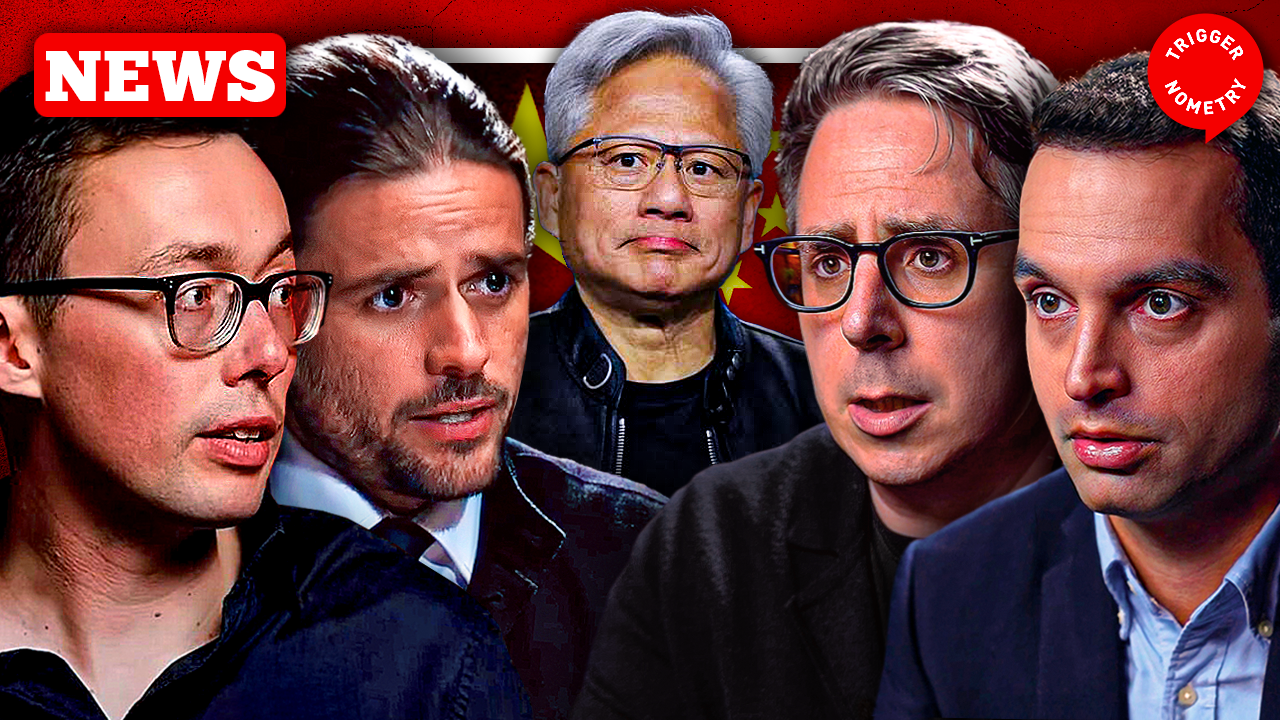
The panel covers (1) Jensen Huang’s resignation from NVIDIA amid allegations of affairs and possible China-linked spying/smuggling risks tied to a business partner, (2) the Trump-Xi-Putin three-way APEC summit described as largely symbolic/a “nothingburger,” and (3) Nathan Kofnas’s Oxford talk on DEI met with blockade protests, plus (4) UK house prices falling to 24-year lows.
Constance and Kissin (hosts); Francis Foster (co-host, “Trigonometry”); Winston Marshall (Winston Marshall Show); Tom Slater (Spike). The episode also references Nathan Kofnas (Oxford speaker) and public figures like Elon Musk, Dario Amodei, Jared Kushner, Steve Witkoff, and Howard Lutnick.
NVIDIA’s AI chips are portrayed as a national-security “single point of failure” (80–90% market share). Allegations include Alice Wang being a Chinese intelligence asset and Megaspeed funneling banned chips to China via Malaysia. The summit yields only minor declarations (UN reform, refined petroleum, nuclear weapons “bad”). Oxford protests blocked entry and involved organized anti-racist groups.
sealed NVIDIA kits found in Malaysia data centers (alleged); petition for Huang’s return (175,000 signatures, including Elon Musk); Oxford blockade at Oriel College; BBC coverage criticized for downplaying violence.
Written by AI. May contain mistakes.
Discussion on the resignation of NVIDIA's CEO Jensen Huang.
“Also, people who couldn't spell anything on placards.”
Exploration of Huang's significance and the implications of his resignation on NVIDIA and AI.
“And one of the interesting things about Jensen Huang is that he's in many ways the personification of the American dream.”
Examination of the spy allegations against Alice Wang and their implications.
“On the 29th of October, the New York Times reported that Jensen had a close relation with Alice Wang.”
Analysis of the fallout from Huang's resignation on the stock market and future implications.
“When he resigned, shares fell as much as 14 % with about$600 billion wiped off at one point, which is one of the biggest one-day falls in stock market history.”
Discussion on differing opinions about the nature of the spy story surrounding Huang.
“has, but also because of the spying allegations.”
Final discussion on the implications and speculative nature of the spy allegations.
“It's not just that this Singapore company, it's a Singapore company with a Chinese CEO.”
Discussion on espionage and national security implications related to NVIDIA's leadership.
“health uh of of nvidia that was explicitly forbidden by nvidia's own rules so there's quite a lot going on it's not just about the spy story it's also about just general conduct but But by all means, carry on.”
Exploration of the implications of Jensen Huang's exit from NVIDIA on the company and the industry.
“We all know that, look, you know, people are important when it comes to companies.”
Speculation about potential corruption involving NVIDIA's executives and the Commerce Secretary.
“And whether this happened, whether he allowed this to happen, whether he was knowing it was going on.”
Discussion on potential corruption related to NVIDIA's investments.
“So we don't know exactly how much they're selling where in.”
Winston shares his amusing experiences with Japanese bowing customs.
“Moving swiftly on, Winston, you are in Japan right now and not that far from me.”
Exploring the implications of the trilateral meeting at APEC.
“Look at the hoo-ha he is putting on here.”
Debating whether Trump's friendly demeanor towards Putin is genuine.
“And as you can see, they're not just snubs.”
Analyzing the symbolic gestures during the APEC summit and their significance.
“time Jared Kushner and Steve Witkoff were in Europe talking to European leaders about finding ways to bring the Ukraine war to a close.”
Discussion on Russia's status and its relationship with China and the U.S.
“I read about this great declaration that they came out of this meeting with.”
Discussion on Trump's leverage over Putin and China's influence in the Ukraine and Iran conflicts.
“So I kind of agree with the consensus here.”
Exploration of Nathan Kofnas's speech at Oxford and the protests against it highlighting free speech issues.
“Nathan Kovnas was invited to give a lecture or speech at Oxford about how DEI is bad for universities and as always he was met by welcoming acceptance of his right to speak freely.”
Analysis of the protests against Kofnas, the impact of cancellation culture, and the response from universities.
“and even then it was only about a third full by the time that the actual planned event rolled around.”
The hosts discuss misrepresentation by the media regarding protests and implications of political violence.
“which were one really kind of confined to the fringes, shows that if people really do take issue with what Nathan Kofnass is saying, the worst thing they could possibly do is behave in this fashion.”
Discussion on the challenges millennials and Gen Z face in accessing the housing market in the UK.
“So that perhaps is one we can give the BBC a pass on.”
Explore the dire state of Britain's housing market and the factors contributing to it.
“And increasingly, I think it's fair to say our generations, which is millennials and Gen Z, Gen Z, as we call them, have been locked out of being able to get on the housing market entirely.”
Discuss the broader economic implications of the housing crisis and comparisons with the US.
“Otherwise, without wanting to play into this, all young people are so hard done by trying to make everything generational, which I don't think gets us very far.”

Get the gist, explore an idea or ask about something said.
 Claude
On TRIGGERnometry, what are the key points of this episode?
Searching your listeningAutomatic transcript. May contain errors.
0:00Tom Slater: Welcome back to this week's Off the Fence with me, Constance and Kissin, my Trigonometry co-host Francis Foster, Winston Marshall of the Winston Marshall Show, and of course Tom Slater from Spike. Gentlemen, we missed last week. It feels like it's been a very long time, but we're back with four absolutely top stories this week. It is, of course, the resignation and possible return of Jensen Huang, the NVIDIA boss, who stepped down after admitting an affair with a woman U.S. intelligence suspects of spying for China. We've got the APEC summit and the first ever three-way meeting between Trump, Putin and Xi.
0:35Tom Slater: The anti-DEI academic and, of course, former trigonometry guest Nathan Kofnus went to Oxford and was met with some pretty aggressive, you might even say violent protesting. Also, people who couldn't spell anything on placards. We will talk about that. And finally, house prices in Britain, real house prices, that is, have fallen to where they were 24 years ago. And in central London, in particular, house prices, even in inflation, including inflation, are absolutely plummeting as well. So we'll talk about why and what that means for you watching and listening at home. Welcome back, everybody. let's crack on with what I cannot call anything other than the story, the strange and miraculous story of Jensen Huang.
1:20Tom Slater: Francis, take it away.
1:23Winston Marshall: Well, this is a story that has actually gripped both the front pages in both America, the UK and all over the world, because it is the downfall of arguably the most important businessman in the world, Jensen Huang, co-founder and boss of NVIDIA, and he has resigned. And one of the interesting things about Jensen Huang is that he's in many ways the personification of the American dream. A man born overseas in Taiwan, started, well, legend has it, the company in a Denny's, that's where he got his idea, and NVIDIA then went on to become a multi-trillion dollar company. Now, a lot of people will go, why does NVIDIA matter?
2:12Winston Marshall: And I'll go through it very quickly. Because it makes the chips that power AI. ChatGPT, Claude, Gemini are all trained and run on them. They own or they have roughly 80 to 90 percent of that market. Think about it like this. For people like me who don't understand tech if ai is the new gold rush then nvidia is basically selling the picks and shovels and nobody else comes close they have practically total market domination at its peak last month it was the most valuable company on earth worth 5.8 trillion dollars and that is more by the way The Meta, Amazon and AMD. I don't know what AMD, by the way.
2:59Winston Marshall: It's an AI company. It's massive. But all of them combined. So this is a very, very real national security issue. Whoever leads in AI is going to be number one, not only economically, but militarily. And this is a reason why the US has banned its best chips from going to China and why China wants them so badly. So this is a major security issue. It's not about one man's wang getting wet. Do you see what I did there, guys? Anyway, this is the timeline of what happened. On the 29th of October, the New York Times reported that Jensen had a close relation with Alice Wang. No relation. Remember, he's from Taiwan, not Dorset.
3:48Winston Marshall: He's a Chinese. She's a Chinese businesswoman who helped run Singapore for Megaspeed. Now, U.S. officials suspect she works for Chinese intelligence. Now, Dino, can we please get the story up from the Wall Street Journal? we can see here that her husband actually has been linked with running data centers in China. Dean, can we get that story up, per favore? There we go. So Alice Huang's husband built a data center empire backed by the Chinese state. So already this story became much, much, much murkier. On the 6th of November, the Times reports a classified memo naming her as a spy for China's Ministry of State Security.
4:44Winston Marshall: Now, it's worth bearing in mind that this has not been confirmed. These are accusations which are still at this story, which are alleged. On the 8th of November, Huang emailed staff admitting he was unfaithful to his wife for 40 years without naming her. quote, my family bears no responsibilities for my choices, I do. Now, at this point, the board investigated him, but they also backed him. On the 11th of November, the Times reported a second affair with Kimberley Powell, an NVIDIA vice president who reports directly to him. Of course she does. 12th of November, Huang resigns. Hours later, Reuters reports a third relationship with another NVIDIA employee, and this person has not been named.
5:41Winston Marshall: And this is a reason why this is more than just a sex scandal. Megaspeed, who, as I said before, Alice Wang worked for, bought nearly$5 billion of NVIDIA hardware in about two years. Megaspeed is under criminal investigation by the US Justice Department and it is suspected of funneling banned chips to China via Malaysia. US officials have reportedly found NVIDIA kits still sealed in boxes at a Malaysia data center. Now again it's worth bearing in mind Megaspeed denies any wrongdoing. And there's a lot of people going, well, actually, Huang is also slightly contaminated here because he spent years lobbying Washington to sell more chips to China.
6:37Winston Marshall: In May 2025, he actually said that China is going to win the AI race. And this month, he has had a very public clash with Anthropic boss Dario Amadeo, who wants a total ban on selling advanced chips to China. That is not Jensen's position. He wants to sell them to China because he believes that the potential good that can come from AI when it comes to things like cancer, technological improvements, is worth the security risk. Now, that's a rather simplified way of putting Jensen's position, but that's, I think, pretty accurate. Now, this is a fallout. When he resigned, shares fell as much as 14 % with about$600 billion wiped off at one point, which is one of the biggest one-day falls in stock market history.
7:39Winston Marshall: Nvidia stocks are now down 30 % from their peak. And this is where it's, I didn't actually know this, but Nvidia is about 6 % of America's main stock index. So this doesn't just hit the investors, this hits pensions and savings, all of this. This affects everything, practically everything and everyone. Now, what has actually happened is he's now trying to come back, make a comeback. He released this tweet. Dino, if we can get it up, please. In which he basically says that he's been overwhelmed by love and support. He talks about his journey, about creating NVIDIA, and also how he let people down.
8:33Winston Marshall: not only NVIDIA, but he let his family down as well. And this is where he also says that actually, if he would be, if people want him back as CEO of NVIDIA, he would be delighted to return. There's also been a campaign with a petition, which has been, which has so far got 175 ,000 signatures one of them is Elon Musk so what's next he is now a campaign to bring him back
9:12Winston Marshall: sorry was that a campaign to bring him back yeah that's a campaign to bring him back yeah 175 000 signatures so far Nvidia have said however that they're not interested at this moment so on the So what is coming next for Jensen is on the 1st of December, he has to attend three House committees, Intelligence, Foreign Affairs and China. On the 3rd of December, the Senate Banking Committee wants to see him too. and although he's admitted the affair he has denied everything else the spying the smuggling and the other two relationships and that is really where we are with this particular story i think this is a story that is going to run and run and run not only for the economic impact it has, but also because of the spying allegations.
10:13Winston Marshall: And one thing to also remember is that, like I said before, there has been no confirmation that Alice Wang is actually a spy. At this point, these are all allegations. And we're going to see, like I said, on the 1st of December, him attending the house committees one of three possibly one of four so i guess my uh the questions that i'm going to put to the panel are what do we think this means for america what do we think this means for america chinese relations what do we think this means for the stock market long term and nvidia itself and the ai boom is this the start of the ai tech bubble bursting Well, can I just start by the one thing I disagree with in your very well put out description of the story is about whether or not Alice Wang is a spy.
11:15Winston Marshall: Now, I actually don't think that this being a spy story is the crux of this story, and I'll get to that, but she is a spy. And the reason she's a spy is if you are a Chinese citizen, you are bound not just by the United Front but by the National Intelligence Act of 2017. Basically everyone is obliged legally to work with the CCP to gather intelligence and to work with them. Now this is what I've been I cover this so much on my show so it's something I struggle to convey but I need to convey. A spy does not mean James Bond. It doesn't mean Robert Pattinson coming along or Tintin with a newspaper with sort of holes cut out for his eyes.
12:00Winston Marshall: A spy, it just means intelligence gathering. If you have a Chinese passport and you wish to see your grandma and grandpa again, you are a spy. Everyone should be considered a spy in that scenario. And in that sense, she is a spy. It's not just that this Singapore company, it's a Singapore company with a Chinese CEO. The company itself was a Chinese company called Seven Word, a gaming company that they it's basically a shell company for that chinese company so the idea that she's not a spy is to me to me absurd i i want to get that out and if you want you got if you guys want to challenge me on that please do um before i go into why i don't think it's a spy story
12:41Tom Slater: necessarily well the only thing worth adding is i think you're right to say that not everybody uh when we think of the word spy i do think we think of a james bond or jason born style situation But for the purposes of what we're talking about, all that would really need to happen is she would need to pass on information or persuade him in the post-coital moment to make certain, you know, to think about things in a particular way that might be helpful to China or her company or whatever. On the other hand, I do think it's worth saying the reporting that was published on which this entire situation is based is based on completely anonymous sources.
13:24Tom Slater: And we've got to keep that in mind for the sole reason that we have been all, I think, burnt time and time again by a mainstream media campaign against people that was eventually proven to be a lie. I do take your point, of course, which is if you're a CEO of a major company and you're someone who's subject to the Chinese jurisdiction, you are likely to at least be in a position where you can be forced to give information. uh the other thing perhaps before you go and that's also worth adding is um part of the reason i think he he resigned from video is that his relationship with the other woman the vp for health uh of of nvidia that was explicitly forbidden by nvidia's own rules so there's quite a lot going on it's not just about the spy story it's also about just general conduct but But by all means, carry on.
14:20Winston Marshall: One thing to add on the spy section is that there's much deliberation and speculation about this four-year gap that Alice Wang has got in her CV and whether she got MSS training in that period. And that is in the realm of the speculative, and it's the difference between her privately or coercively working with the CCP intelligence on some sort of operation and feeding information back, or whether she's… when your man's in the toilet, she grabs his phone and puts a chip in, and so they're gathering even more information on her. So there's some kind of levels of being a spy, which that is in the realm of the speculative.
15:00Winston Marshall: But it's also, if you think about it from the Chinese point of view, these are very brilliant people. They are the antithesis of everything I believe in, but of course they have a strategy when it comes to these AI chips, this type of GPU. I mean, they have to be. It would be a massive negligence for them not to, and this is the perfect plot. So even if it didn't start as an actual mission, you know, get to Jensen Wang, as soon as they worked out that she was dating him, they would have been straight on it. Right, you're doing this, you're doing that, you're working with us. So I assume the Chinese are extremely intelligent, and and know what they're doing.
15:42So I think it's fair to say she's a spy.
15:46Winston Marshall: And compromised, if nothing else, as well. It's something that's clearly part of the picture here. Because not least is it the chief executive position in her own company, which has been pretty credibly accused of funneling Nvidia chips into China via Malaysia and other countries, as Francis was explaining there. Also, the fact that her husband is also part and parcel of this state backed, to a certain extent, state funded push within China to build up their AI infrastructure and to kind of catch up with the Americans. One detail which we have skated over is that her husband is called Kang. So this is Huang putting his Wang in Huang with the potential knowledge of Kang, which is the whole cascade of this story really summed up.
16:26Winston Marshall: But this is something which clearly had like national security implications, even if it's beyond the question of was she trained? Is she an agent? Is she a spy? Because of the fact that there's been so many cases now in America. you've had California tech execs being arrested on suspicion of selling hundreds of millions of dollars worth of chips to China you've had people like the kind of driver of the late Senator Dian Feinstein who was basically found to have been a potential China asset and also the fact that the nature of the AI boom is that it's so concentrated in this handful of companies that you have, if not a single point of failure, then just a handful of points of failure, points of entry, points in which people can be compromised.
17:11Winston Marshall: And if you think, Joel Copkin wrote a piece about this for Spiked for us last week, and he made the point that given the fact that the AI boom has been responsible for kind of a third of that accelerated GDP growth that the US has seen recently, all it would take is a few of these Jenga blocks to be removed or compromised or what have you, for it to have this huge impact, not just on US economy, but obviously the global economy as well. Of course, China are going to take an interest in all of that. And there is also a question to ask about the US as to how alive they were to this particular threat.
17:42Winston Marshall: There was a report in CBS which was pointing out that the authorities in Singapore, where this company was based, Huang's company was based, where they had back in 2025, I believe, interviewed her, seized her passport, were looking for the cooperation of the American authorities, and that wasn't forthcoming. So there's clearly questions to answer there about security, and particularly because of how essential AI has become to not just the US economy, but the global economy. You would think that there would be much greater strenuous interest in keeping that kind of meddling out.
18:15Tom Slater: Well, very much on that point, Tom. I think the context that we should add here is you talked about there's maybe not one point of failure, maybe there's several. Actually, when it comes to the chip, there literally is one point of failure, and that is video. And the thing worth explaining for our listeners and viewers is if you think about AI, I think AI is fair to say will be likely to be a more significant development in human history than even the Manhattan Project, which produced the first nuclear weapons and in fact produced the technology itself. uh ai is likely to have a much more significant impact and the chips are effectively the enriched uranium and plutonium in this example and as francis laid out up to 90 percent of that material is being produced by this one company so jensen huang as the ceo of that company was in a position where him having any sort of relationship with anyone that potentially exposes him to blackmail, to bribe, or even to, frankly, just influence.
19:22Tom Slater: The fact that you have a girlfriend from a particular country that you might not want to have that revealed if you're married and all the rest of it means that you have effectively somebody who's responsible for the production and distribution of 90 % of the world's effectively enriched uranium uh being put by his own actions into that position which is why it's a bigger story you know initially when you hear this story you're like well okay look i don't personally approve of marital infidelity you know etc etc but ultimately this guy built this company from scratch through years and years of hard work is now created this gigantic company that's benefiting millions of people around the world billions of people around the world with the technology that's being created.
20:10Tom Slater: Does it really matter? Well, it matters because as you pointed out, this is a national security issue and it's of the highest level, of the highest level. This is worse than nuclear material being siphoned off or nuclear secrets being shared because of the potential impact on the scale of what we're talking about here. So it is a massive story. And what it highlights is the way that private companies that are doing this are now effectively holding the future of humanity in their hands and one man's extramarital affair can now put the entire global
20:48Winston Marshall: order in jeopardy and i think one of the uh a point to actually talk about here is where does nvidia go from here because jensen wang is the man who co-founded it he is widely acknowledged to be the brains behind NVIDIA, the singular talent, the driving force, the fact that he is no longer at the helm of this company, have they lost their edge? We all know that, look, you know, people are important when it comes to companies. They are the most important thing at a company. But sometimes you have one talent, whether it's in a sporting team, whether it's a business organization that is so singular and special, they can transform an industry.
21:37Winston Marshall: And from everything that I've been reading about Jensen, he might be that person. Does this now mean that NVIDIA, from being a company that has up to 90 % of its share, now that they've lost the main man, it's sort of like the Rolling Stones losing Mick Jagger. Are they going to be the same? and does that mean other companies are now going to have the edge in the market now that they've lost their leader and possibly as well their creative fulcrum? Well, this is, I think, why so many people are calling for Jensen to be brought back in. But just to tie your point, Francis, with Constantin's point, is that actually there needs to be due process and it needs to be, and we'll see this now in the various hearings he's going to go through, Did he break the National Defense Authorization Act?
22:27Winston Marshall: If he knew, if he had willing knowledge that those chips, which were forbidden to get to China, were getting to China through this company, through Megaspeed, then he would be guilty of that. And so that's what we need to wait and see. And I think rushing to bring him back in without seeing whether that was the case feels to me to be foolish. I think we need to know the answer to that question. And there are loads of...
23:02Tom Slater: The other thing... Sorry, go ahead.
23:04Winston Marshall: I was just going to say, sorry, sorry, Tom, just one point very quickly because this is a very short one. We interviewed Steve Eisman on Trigonometry and that interview hasn't come out yet. And we conducted that interview before this scandal broke a few weeks ago now. And he actually said NVIDIA was always fragile anyway because they only have five customers. Now, of course, those customers are very high paying and they make a lot of money out of them. But if your business is dependent on five customers, then it's not diversified. So this was always fragile to begin with. anyway i just thought i'd make that point and just to tack on to that because i think that going back to this point about nvidia being the kind of one point of failure of where the chips are concerned it also means that it wouldn't even take china to influence compromise and what have you even just to discredit him kind of take him out of the game as it were and the impact that was going to have not just nvidia's share price but also on the broader american economy would have been worth it in effect so there's all of these huge risks and potential pitfalls which are created when you have this enormous concentration not just of wealth but as um constantin was talking about this incredibly transformative and therefore quite dangerous technology certainly in geopolitical terms um and especially because of how um central it is just to the u.s economy um and the fact that obviously the ai bubble the ai boom depending on how you want to portray it is so based not on its customers and what have you but the investment and the stock and so on even just a kind of temporary blip a sort of loss of faith in some of these companies is going to have a really outsized and significant impact the one thing also maybe as a side point is it was uh maybe somewhat heartening to find out that at least one of these tech oligarchs was a bit of a shagger I mean there is something at least slightly humanizing about this story in given the kind of parade they're all shaggers but not in a non-creepy fashion they're all these other
25:16Tom Slater: people well no sam altman is is gay married with kids i believe uh darryl amade i'm not so sure about the google guys i'm not sure elon's obviously a top level shagger um yeah i i think you do them a disservice tom not that i necessarily approve of these particular lifestyles um but yeah so tom
25:37Winston Marshall: Your defence of Jensen Wang is that at least he's a shagger. No, my point was that there was something oddly humanising about just a classic infidelity scandal. Whereas normally the sorts of strange things these people get up to is, you know, it's all typical, it's all there. He's got to a certain age, he's bought a leather jacket, he's had a bit of a glow up and his eyes have wandered elsewhere. That's not to condone the behaviour, nor to dismiss any of the broader national security or geopolitical implications. Tom, you're thinking Jensen Wang's just like me. He's having extramarital affairs.
26:09Winston Marshall: I can relate to this dude. That's your response. You just think real bit me. I didn't say relation. I didn't say relation. Tom, is that the reason you bought that leather jacket, mate? I told you that in confidence.
26:26Tom Slater: Anyway, we best start moving on, guys. But one thing I will say is I will give my prediction is I don't think this will have a major impact on NVIDIA in the long run, just because they're such a huge monopoly and the fundamentals of their business model are so strong. It's very, very difficult to see that even losing such an inspiring CEO as Jensen Huang will affect them. unless of course and this is something that's been talked about if he's not reinstated i think he will have no shortage of the ability to raise lots of money to start a rival business of his own and whether that then becomes the next story is hard to see but nvidia in and of itself i would argue is in a very strong position and unlikely to start immediately losing ground just given how dominant they are because it's not like the rolling stones losing mick jagger it's like there was only one band in town and they lost Mick Jagger.
27:23Tom Slater: It's a little bit different.
27:25Winston Marshall: Can I add one just possible thing to keep an eye on on this story, which is that I think it could end up being a big corruption story with the Commerce Secretary Howard Lutnick being not just China Dove, I think, but a very good friend of Jensen Wang. And whether this happened, whether he allowed this to happen, whether he was knowing it was going on. There's an aspect that Nvidia cooked the books, or was it Megaspeed cooked the books on their one of the two? I think Nvidia cooked the books on their sales from Q4 and in 2025 onwards. So we don't know exactly how much they're selling where in. So it might be the case that they were hiding something, that's to be seen.
28:13Winston Marshall: But Lutnik has a huge stake in NVIDIA, not directly. He used to be chairman of Cantor Fitzgerald, it's an investment firm, but his shares went to his kids and they still had a stake in NVIDIA. So there's something going on there, which I have a hunch this might end up being a corruption story rather than a spy story.
28:37Tom Slater: Yeah, and if NVIDIA's libel and defamation lawyers are listening, I'd just like to add the word allegedly before everything that Winston said. Anyway. I'm speculating. Because of my concerns about rising inflation and the coming economic crisis, I've been investing heavily in gold. For me, one of the best ways to safeguard your wealth is by investing in gold. Diversify your investments, protect your savings, or just gain the security of owning a real physical asset. We highly recommend the Pure Gold Company. That is the broker I use to buy my gold. If you're in the UK and want to protect your savings with physical gold, scan the QR code on the screen right now, click the link in the description, or go to pure-gold.co.otf to get your free copy of their guide to buying gold.
29:29Tom Slater: And remember, the price of gold can go down as well as up. Gold is not registered by the FCA and past performance is not a guide for future performance. The site again is pure-gold.co.otf. Moving swiftly on, Winston, you are in Japan right now and not that far from me. I mean, geographically, it's quite far. Konnichiwa. Yeah, don't do that on camera. You know what? I'd love to see you do that on Question Time. Imagine you're on Question Time. Fiona Bruce is like, Winston, you've just come back from Japan. Ha!
30:07Winston Marshall: It's pretty funny here. I got stuck in a bow spiral. I didn't realise the Japanese absolutely love to bow. So when you say thank you, when you say,
30:18Winston Marshall: I'm saying it wrong, but they have to bow when you say thank you. And when someone bows to you, I then say, oh, thank you for the bow. And then what happened is I kept, and then he bowed for the second thank you, and we just ended up bowing and thanking each other. And then I realised he was bowing every time I said thank you, so I kept saying thank because I thought it was funny. Anyway, the reason why that's relevant is because, as you said, we've got APEC.
30:41Tom Slater: Yeah, how I segway from that to APEC, I have no idea, mate, but you crack on.
30:46Winston Marshall: I'll tell you what, so everyone in Japan is, I've seen the news back home, everyone's talking about Putin, Xi and Trump doing this trilateral meeting together and there's a question, is this the new coming together or is this a nothing bugger which I think we should discuss but whilst we're in Japan it's the case that the Japanese Prime Minister is in went down to China for the APEC and she's been massively snubbed and there's basically been a lot of drama and snubbing between all these parties and it's been very dramatic so I'm going to bring Coming up, my assets. Dino, may I have the assets please?
31:36Winston Marshall: So this is Xi Jinping welcoming Trump. Look at the hoo-ha he is putting on here. They absolutely love it.
31:47They're making a big effort and I think that that's worth keeping in mind,
31:51Winston Marshall: particularly with our previous conversation about NVIDIA, given the implicit adversarial nature of the American-China relationship that we were speaking about. This is how they're greeting each other. So this is Trump arriving. And what's our next asset?
32:20Winston Marshall: There's Trump, oh yeah. Okay, so this is Prime Minister Sanei Takeichi. Now, she was completely snubbed, no hoo-ha, but what's really interesting is that the staircase there was not the right height. So they embarrassed her by she has to do this awkward step to come off the plane. Now, the Japanese and the Chinese are really not getting on. In 2025, Takeichi said that they would defend Taiwan, the Japanese, and that escalated badly. You've got to keep in mind that the Japanese territory, the Riko Islands, stretch all the way down to very close to Taiwan. So it's a national security threat for the Japanese, the idea that China would try and take Taiwan, not just the oceans, but very likely because of the American bases on Japanese soil, if they had to do it, it's very likely that there would be escalation and fighting on Japanese territory.
33:24Winston Marshall: So it's front of mind for everyone here in Japan. They're very anxious about it. Everyone I speak to is just China, China, China. They're completely worried about it. They're worried that America won't help them in the event that there is a play on Taiwan. And as you can see, they're not just snubs. So whereas Xi went to greet Trump, they sent a complete non-entity to pick up Takeuchi. And Xi, we don't know the woman that she's there to pick her up. So that's one of the snubs. Then you have another snub which is Xi snubbing Putin and… Who is he? Well, this is Trump greeting Putin.
34:16Winston Marshall: So this is also triggering all the people. I'm going to stop here and ask you guys about this. So Trump greeting Putin and saying, here's my friend. Do you think that Trump really thinks Putin is his friend?
34:30Tom Slater: No. Look, Trump, no. Look, Trump is very, very, like, and Francis and I are aware of this, particularly spending as much time as we do in the United States more broadly. American business culture is incredibly transactional. So everybody's your friend, and everybody's is great and wonderful. And this is what people will say to your face, how they then act behind your back is totally different. And what Trump is doing is he recognizes that in order to do deals with people, it's better if you're polite to them and respectful to them and if you're nice to them, than if you talk shit about them all the time.
35:08We saw it with British politicians who, while having very little power
35:13Tom Slater: to influence events, would nonetheless be very critical of others around the world. And this achieves nothing and it makes you weaker in terms of your ability to get things out of them that you want for your citizens so i don't think trump thinks that putin is his friend and i think this is a talking point that a lot of mainstream media love because they're still stuck in this idea that you know trump russia gay trump was elected by putin and all this other stuff trump is a business guy who's trying to do deals he's trying he's got a lot of things to try and resolve and actually one thing that got somewhat concealed by the APEC summit that we're talking about is at the very same time Jared Kushner and Steve Witkoff were in Europe talking to European leaders about finding ways to bring the Ukraine war to a close.
36:01Tom Slater: And there's actually, for the first time in a very long time, some rays of hope that that war may be brought to an end. But, you know, one of the things that Trump clearly wants is a way to bring the Iran war to an end. One of the things they talked about in the trilateral conversation with Putin and Xi is producing more refined petroleum products. So this is obviously a way to mitigate the problems caused by the Iran war. And that's ultimately where Trump is clearly coming in all of this. And he will say whatever he needs to say to get what he wants without meaning any of it.
36:39Winston Marshall: do you guys agree i also yeah of course look i think the way that we talk about politics particularly when it comes to the way the politicians of the size or and i should i say caliber of donald trump and people could say that oh he's overly friendly to so and so and whatever i just think it's just so basic it's basically primary school level analysis of geopolitics has to be friendly with him i mean what do people expect him to do just walk up to him and just snub him or give him a wedgie it's so ridiculous and the fact that we celebrate I would pay to see that, to be fair.
37:33Winston Marshall: I actually think a lot of people would, to be fair. But the fact that there are certain parts of our political class who applaud the likes of David Lammy because he criticises Trump openly and then has to do almost a snivelling apology when he gets re-elected. Look, if you want things to happen on the global stage, just like in any other form of business, you need to have good relationships with the people around you, even if on a personal level, you might not like them. That's just basic human relations. And the fact that people are talking about this, to me, it's just completely ridiculous. It's one of those things where the nature of these summits is that so much of it is about the symbolism.
38:26Winston Marshall: there was a lot of that excited talk going into this. As you were saying, Winston, it's going to be Yalta 2.0. It was much closer to a giant photo opportunity. And I think when it comes to the symbolism and the mood music, far more significant was the sort of sly digs, I would say, between Xi and Putin rather than Trump referring to Putin as his friend. I mean, that's one thing that was really notable. You pointed to the fact that Xi Jinping greets Donald Trump when he comes off of the plane, whereas it was some sort of chief of staff who were sent to welcome Putin when it came to the big dinner that they had.
38:59Winston Marshall: Trump was at his right hand. Meanwhile, Putin was relegated to another part of the table. Oh, Matthews and the Spectators on a really good piece pointing to all of this. And even things like this, you know, in this meeting in which they just deliver their pre-prepared statements, China somewhat improbably posing as the great symbol of peace and talking specifically about the need to basically bring an end to nuclear weapons, despite the fact it's building up its own nuclear arsenal, desperately trying to catch up with not just America, but also Russia. That again seems to be a sort of, as many people have interpreted, a kind of coded jive at Russia and a constant kind of reminder that we may have agreed to this trilateral summit, but at the same time, we don't see you as an equal, which is something that obviously, if we are talking about the realms of symbolism and what Vladimir Putin is trying to get out of this, is something that he's desperate to sort of bask in the idea that he's one of these three superpowers um who can command equal respect i thought it was quite telling that in those kind of small ways and large ways china was quite keen to put its kind of junior partner if you like back
40:04Tom Slater: in its box to a certain extent yeah and this is why i think i come back to what winston said which is the idea that ultimately especially this trial after a meeting was a bit of a nothing burger and And, Dean, we have this declaration. I read about this great declaration that they came out of this meeting with. If you're looking at the screen now, that's the entire declaration. That's it. Four paragraphs. One which says that they're looking forward to reforming the UN Security Council and the United Nations so it works better. They're planning to increase production of refined petroleum products.
40:39Tom Slater: they recognized that the international criminal court is uh you know going too far and uh they basically agreed the nuclear weapons are bad that's it like that's that's the entirety of this great declaration so it's not as if anything massive appears to have been achieved in all of this and maybe that's not what these meetings are for exactly um and just before winston you you take back over the conversation i just wanted to emphasize how much i agree with what you said tom because russia people don't understand this but russia really is a country that does not belong very much in this conversation in one sense russia is not a major global economy it has a smaller economy than italy or maybe it did until one point but now it's slightly overtaken it's not it's not one of the top three economies in the world um what it does have is a hell of a lot of nuclear weapons, most of them built in the 60s, 70s and 80s.
41:37Tom Slater: So a lot of them very outdated. But it does have huge stockpiles and therefore it has to be taken somewhat seriously. But there is no question that neither America nor China see Russia remotely as an equal. And so in some ways for Putin to even be around that table was a big achievement.
41:57Winston Marshall: Yes, I agree with that. And I do think it's a bit of a nothing burger. So I kind of agree with the consensus here. I also agree with the idea of Trump greeting Putin like that. For me, actually, that's because I don't think Trump has much leverage over Putin. And when I'm watching, and so I'm thinking about the Ukraine war, when I'm watching this also, I'm thinking about the Iran war. And it is the case that China is actually in a position to really accelerate to the end of the war, because they're the ones buying all of the oil off Iran. So actually, in a way, Trump, you could, maybe he's trying, he's kind of there because he's trying, he realized it's important if he can persuade, he's tried many times to persuade the Chinese in this domain, but they won't do anything, partly because it's in the interest of the Chinese, I think, to keep the ayatollahs in power.
42:48Winston Marshall: I mean, it's, as adversaries of, you know, the ayatollahs aren't saying that China is big Satan, They're saying America is big Satan, so it's just trouble for America. So I can see that. And it would hurt China to actually stop buying 90 % of Iran's oil. So I can see why Xi wouldn't, you know, it's not really in his interest, not least because it would also hurt oil prices within China. So that being said, that's what I sort of see going on. And maybe Trump is doing behind the scenes something. he's trying to push the needle and nudge things forward on those issues, but we can only speculate.
43:31Tom Slater: All right, well moving on to our third story. Tom, take it away. Nathan Kovnas was invited to give a lecture or speech at Oxford about how DEI is bad for universities and as always he was met by welcoming acceptance of his right to speak freely.
43:51Winston Marshall: Yeah, should we have a little look at that welcoming acceptance and reception that he got at Oxford University. I believe we've got a clip here of the kind of scenes that greeted him. Wow. This is everything you need to know, really. As you were saying there, Constantine, Nathan Kofnas was invited by the university's Reform UK Society to give this speech at Oriel College on the subject of DEI in universities as a consequence of the role that Kofnas played in exposing Jason Arde. He was the first to go public, although they'd long been circulating in private with the quite clear-cut examples of fabulism, academic fraud, plagiarism.
44:29Winston Marshall: And since Arde's tragic death, found dead at his own home back in August, has essentially been reflexively, to my mind, despicably blamed for his downfall, along with a lot of other journalists who kind of rode in behind after those initial facts were put out there. So it's a combination of that, but also, of course, the fact that, to put it lightly, Coffinas's reputation is pretty radioactive given the fact that as he explained on your show is a self-described race realist, someone who refers to himself as a hereditarian, believes that there are genetically derived differences in IQ between racial groups and so on and so forth and believes that needs to be accepted and for society to be kind of governed and shaped with that in mind.
45:10Winston Marshall: So as a result of that you saw this concerted effort first of all to try to get the event pulled full stop which didn't happen which in the midst of all of this is a bit of a win for freedom of speech to a certain extent it's kind of inconceivable to me that if this had happened even five years ago the oriel college wouldn't have found some reason some you know phony uh health and safety or security concern in order to pull the event they did hold firm and one of the reasons for that excuse me is um this new legislation which has been in place since 2023 the Higher Education Freedom of Speech Act, which has put new pressure on universities, and in this case, this Oxford College, to ensure that freedom of speech is upheld.
45:49Winston Marshall: The issue is, and we see it in those protests, is that the culture on university campuses, where free speech cancellation is concerned, is still as bad as it ever was, I think. The way this form, the form this took on the night was the fact that they couldn't get the talk shut down, they couldn't get to Kofnass himself, so they basically just blockaded all of the entryways and stopped people who had tickets from getting there. I understand that people ended up having to arrive more than an hour early in order to potentially get in, and even then it was only about a third full by the time that the actual planned event rolled around.
46:24Winston Marshall: So this is both a kind of a good free speech story, as far as it actually was physically allowed to take place, but again shows how that culture of intolerance is so pronounced in university campuses and does even though this isn't a new point i think point to how that kind of mix of like menace and also infantile patheticness if that's even the right phrase that the campus left now demonstrate um i don't think even if they got into that room they would be able to take cough nasta task they've so kind of like intellectually disarmed themselves they even in the face of someone who seems to stand against everything that they stand for all they can do is really screech from the sidelines and stop people from getting in but it's particularly given the fact that I think Kofnass's newfound influence shall we say is a good example of that is that they really don't seem to understand that it's precisely these tactics which have elevated individuals like Nathan Kofnass as well I mean his entire career as I know that he's spoken to you about spoke to many other people about has kind of been forged in cancellation it was back in 2024 he had a position at the university of cambridge where he was um essentially hounded out because of a blog post that he put a substack post that he put up about um his call for a hereditarian revolution as he put it um in the wake of the jason arday scandal not only does it become a kind of full-blown folk devil um in relation to that particular story but also was temporarily kind of stood down from his position at ghent university He was only able to stay in that particular post because of the intervention of the US ambassador to Belgium and now has this newfound platform.
48:03Winston Marshall: So, you know, if these are the tactics, it's really not working. And I think also, given the fact that now you have sections of the rights, particularly the young right, who are starting to look at new ideas like race realism, which were one really kind of confined to the fringes, shows that if people really do take issue with what Nathan Kofnass is saying, the worst thing they could possibly do is behave in this fashion. And yet they continue to do it over and over again. So it's a bit of a throwback story in a sense. It's kind of reminiscent of the campus wars that we might have had 10 or so years ago.
48:32Winston Marshall: But I think it also shows that there's a radicalization which is going on, even as the legal framework for free speech is getting a bit better.
48:40Tom Slater: Tom, and you used the phrase campus left a couple of times. Are we certain that this was students protesting? because from the images I saw, it looked fairly organised, the same placards. I mean, there were some very badly spelt placards, which made me suspect it's probably not Oxford University students, although God knows these days, right? Yeah, there we go.
49:04Winston Marshall: Perfect. From what I can tell, it's about 50-50. So there were kind of organic student protests, but there was also Stand Up to Racism, which is this very long-standing left-wing anti-racist quote-unquote group who also called their own demonstration had their own rally and it seems to be a sort of mix of the two but i do think it's fair to say that you know an event like this was always going to generate some kind of response from the more organized sections of student politics even absent the involvement of kind of outsides agitators but it did seem that there were quite a few people involved particularly in the blockades and the more kind of physical aspect to it, who it might be stretching credibility to assume that they were students.
49:47Winston Marshall: Connie Shaw from the Free Speech Union was there and she almost had her way blocked to getting into the event by a man in a balaclava who, from our own estimation, seemed to be at least in his 30s. So as ever, a kind of mix of the students just kind of rising up out of their own reflexive, impulsive intolerance, but also the kind of organised Antifa-ish sections of the anti-racist left who were definitely there in force as well. The part of this story that pissed me off, maybe more than anything, was the BBC coverage of it, where they just say, oh, there are protests outside this race realists speech at Oxford, not mentioning the violence, not mentioning the hounding, not mentioning that they're not letting people in.
50:31Winston Marshall: And this is not a one-off, of course. We missed this, and we would have talk this last week if he'd had an episode last week, but there was a horrendous terrorist attack in Krakow two weeks ago and the BBC reported it as a far-right terrorist. Now the alleged killer, all the evidence that's emerged is that it's a far-left guy, he's a communist with various classic left-wing paraphernalia on his social media. They haven't changed it. That's still up, by the way. BBC Verify haven't kicked in to put down the disinformation they themselves are spreading. In fact, six weeks ago, the BBC put out a piece which they've now taken down describing me as a wannabe commentator.
51:22Winston Marshall: Little they know, I have a bit pop role now on trigonometry, but so, uh, wannabe I think, not anymore, but they also call me a right-wing agitator. And, and like, it's fine, and like, who cares? But at the same time, these guys pretend they're impartial. They pretend that they, they like to think that this institution that is truly fair. Now, I'm not actually saying that they should be completely impartial. They weren't impartial in the Second World War. They weren't giving the Nazis a fair hearing. What annoys me is that they pretend to be impartial, but then they miss, completely misrepresent what's going on.
51:57Winston Marshall: And so if you are not on X, if you are not following on social media, if you're not getting different news sources and you're just following the mainstream media, like the BBC, you just get this impression that the far right are on the march and in, and they're speaking at Oxford, when you can actually, it's the far left who are literally on the march. I mean, they're literally hounding, mobbing and violently attacking, and harassing people and in in case of poland killing people and and the bbc are just telling a completely different story that that of all the things i think that's the thing that winds me up the most i think one of the things i'm sorry francis i'm sorry i'm so sorry i just uh i was
52:36Tom Slater: a little bit struck winston i just went on veniceai and i looked at the story of the krakow terrorist and i said was the krakow terrorist left wing venice says no the evidence points the other way The Krakow gunman is generally assessed as a far-right, ultra-nationalist type, so there's been a political fight over it. Poland's justice minister said investigators found very strong traces of right-wing extremism, including his search history, including Anders Pravick, who's of course the famous far-right terrorist officials described him as fascinated by far-right ideologies and ultra-nationalistic.
53:12Tom Slater: So that perhaps is one we can give the BBC a pass on. But your broader point, I think, is actually...
53:17Winston Marshall: I'm happy to take the loss on that if I'm wrong. I'm happy to say that that was wrong. I think my point would still stand. I will say, though, that the evidence I've seen on that is that he was on far-left marches, he was pro-communist stuff on social media, and he was doing stuff in line with that. Now, if I'm wrong, I'm very happy to say I got that wrong. and the BBC are right on that situation. But I think my point still stands, certainly with the Kofner thing, which is that they are not reporting this as what really happened, which is their duty. Agree. I think one of the things is actually...
54:00Winston Marshall: So we interviewed Nathan and his ideas are controversial, but I think what people forget about Nathan is in many ways, he's an equal opportunities offender. This is a man who did a study into political, you know, people who identify as left wing or right wing and IQ and found that people on the right tend to have lower IQs than people on the left, which actually really pissed off the people on the right. And also, I have a personal bone to pick with Nathan because I matched with a girl on Hinge and it was going very well. and then she asked me what I do. I told her about trigonometry because one should be honest.
54:41Winston Marshall: She looked into it, found Nathan Kosmanus, called me a white supremacist because we've interviewed him, and blocked me. So maybe I don't – basically what I'm saying is I'd probably attend those protests after that as well.
54:54Tom Slater: Nathan has ruined your dating experience. Well, I'm sorry to hear that. Anybody wants to – one final word on this before we move on to our final story?
55:05Winston Marshall: I mean one thing I think would be worth just bearing in mind it does seem that on the left on the whether we want to call it the campus left or the kind of broader woke left first of it hasn't gone away that's a theme that we're all returning to so week after week it might have been pushed back it might be knocked out of certain institutions it might be a bit harder for them to cancel someone on a university campus or elsewhere but they're still very much there but also whilst it's not as if it descended into kind of widespread violence the other night the kind of intensity of these protests is something to keep an eye on i think because it does well we're nowhere near the kind of levels of radicalization and sort of political violence that you're seeing on the left in america at the moment i think would be lying if we didn't see at least um indications of that level of menace in a lot of what's been going on recently so something to watch out for i suppose right perfect well uh final story for this week i thought we
55:57Tom Slater: could have talked about the release of grand theft auto which uh you know all smirking aside i actually think is a massive story because this is one of the few truly massive global products that britain has produced in recent memory uh i haven't had a chance to play it i'll probably wait until it comes out on the pc by which point the culture war debate around it will be old and stale uh but nonetheless uh that was an interesting story but i actually think there's a genuinely important story that has been going largely uncovered in these sorts of shows that we do and elsewhere, which is about what's happening to Britain's housing market.
56:36Tom Slater: Now, obviously, all of us, where I think we're of a similar age, we have lived through a period of time when buying a property, getting on the housing ladder has been getting more and more and more and more difficult over time. And increasingly, I think it's fair to say our generations, which is millennials and Gen Z, Gen Z, as we call them, have been locked out of being able to get on the housing market entirely. Well, one of the things that is happening, and this is kind of a sad irony of the Labour government, which is, you know, all of us, I think, have made the point that it's very important for young people in particular to be able to get on the housing ladder and be able to buy housing.
57:17Tom Slater: And the way that I always envisaged for that to happen was to scrap the regulations that are preventing house building and to encourage massive house building while also restricting mass immigration. So you basically catch up the housing stock to the number of people who are currently in the country. You know, if you've increased the population of your country by 10 million people in, you know, however long it's been, I don't think it's, you know, in the last couple of decades, you're going to have a housing shortage. And I thought the solution was always, well, you build more houses. Turns out that's not what you do.
57:49Tom Slater: What you actually need to do is cause rampant inflation, tank the economy, increase interest rates, and also introduce the Renters' Rights Act and the Mansion Tax, which squeeze the market from both ends. We can talk about those things in detail. But housing prices today in Britain, in real terms, are now back to where they were in 2002. And in inner London, housing prices, even in absolute terms, not in real terms, but in absolute terms, are genuinely plummeting with people unable to sell homes and especially flats for what they bought them for. I know from the town where I live during the summer, there was a rent, a landlord exodus.
58:36Tom Slater: Lots and lots of people were selling flats that they owned, that they rented out. And because of this, rents are now rising rapidly. And the reason they were all selling them is the Labour government introduced legislation, which effectively means your tenants can effectively just live in your house or in your flat, not pay any rent, take the piss. They can give you a two-month notice. And if you now take possession of the new legislation, if you take possession of the flat you own in order to try and sell it, you then can't put tenants back into it for 12 months after you did it, which is effectively making it very, very difficult, even more difficult than it already was for landlords.
59:18Tom Slater: So what this has done is loads and loads of people sold flats at a discount. There's now less rental stock for people to rent. So the price has gone up. And shortly after that, the government introduced the mansion tax, which has compressed the price of property at the very top, combined that with rising interest rates and rapid inflation. You now have a housing market that is going in the other direction, but it's not going in the other direction for the right reason which is there's now enough housing it's going in the other direction because the affordability of housing is now uh now under threat uh even more than it has been in previous times so even though things had improved in terms of affordability for the last few years we're now at a point where despite the fact that technically in real terms house prices uh in certain parts of the country are falling actually it's nonetheless very very difficult for people to buy and on top of that this government has made it much harder for people to find somewhere to rent and so rents are going to keep going up as well.
1:00:25Winston Marshall: I think, I also think that this story, it's a housing story, but there's a tragic element to it, which is, it's also the story of Britain. It's the story of the fact that we are a declining nation. We're declining economically, we're declining socially, we're declining politically, we're declining culturally. And as a result of that, fewer and fewer people want to live here. Fewer and fewer people want to actually rent a house or they want to buy a property or they want to stay in the UK. We're hemorrhaging high net worth individuals. A lot of young people graduating from universities, coming out of college, out of training schemes, are looking around at the UK and thinking to themselves, do I actually want to live in this country?
1:01:13Winston Marshall: and the unfortunate answer for people like me and everybody else is it's a resounding no and every time so I'm currently in New York at the moment and one of the things that I always get reminded about when I'm in America and when I'm in New York is look this country has a lot of problems of course it does but there is an energy here and a dynamism and an optimism in this country that unfortunately is just lacking in the UK and I think part of this story as well is the people who can leave who feel that they are ambitious and they have something to offer are simply thinking to themselves that their future no longer lies in the UK which is really sad for our country.
1:02:02Winston Marshall: I suppose I should declare an interest here as far as reading that people who the house prices and the flat prices have not only been eroded by inflation over time but also that there is this particular problem in London and the south east of particular interest to me because I bought a flat, I'm broadcasting to you now for a flat that I bought in London about four years ago and therefore even those of us of my slash our generation who managed to just about get over the line in terms of being able to buy somewhere even if it's in less than ideal sort of leasehold form the fact that you hammered again is just so frustrating but also the fact that as you say that how warped the whole market has become because you know ordinarily particularly if we're talking about first-time buyers and people who are looking to make that move at the moment house prices going down would potentially be good news but because of course the cost of borrowing is so out of control unless for some reason they were cash buyers and were just handed the cash from the bank of mum and dad or someone else or what have you in order to make that purchase then they're even more scupper than they were before just how out of control warped it's become now of course that's going to have political consequences you know it's a it's a tired line by this point but it's obviously it's obviously correct which is that you wonder why so many younger people particularly those who feel themselves to be sort of downwardly mobile are being so attracted to absurd ideas whether that be wealth taxes rent controls or what have you it's because they feel like anything that might give them some kind of reprieve is welcome um and it's this is such a core issue i think particularly um for parties and politicians of the right which is to provide a kind of answer to those young people which um make sense to them and to make that argument to them that no the kind of solutions which are being presented by this sort of new populist left um are only going to make matters worse, but at the same time something which does genuinely give them a stake in the future.
1:03:53Winston Marshall: Otherwise, without wanting to play into this, all young people are so hard done by trying to make everything generational, which I don't think gets us very far. There's clearly a big issue there that needs to be addressed if anyone's willing to address it. It's interesting comparing the situation in Britain with other countries, particularly America. So the media framing has been, of course, that the inflation that has been one of the drivers for this problem is because of the Iran war and the Russia war. And obviously there's some truth to that, but America, which has the same sort of problems, but an even higher mortgage rate, and they do have property problems, but they're not in the situation we are.
1:04:39Winston Marshall: And I think it's ultimately because it's an economy that's actually more productive and growing in a more healthy way. So we just have this, and I'm just echoing what you guys have sort of point you've already made here is fundamental problems with our economy that mean people, the best young people can do is if they really want to, if they're ambitious, they're entrepreneurial, they're going to look to other countries and they're going to want to leave. It's just, it's a big old mess and I think it's a problem just all the way to the bottom in the way that our leaders have built this economy.
1:05:21Winston Marshall: So it's going to take a big clean up to sort out this problem. It's not as simple as the war ending, I don't think.
1:05:28Tom Slater: Well, what's interesting to me as well, Well, I actually think part of the solution to Britain's economics problems was always up to and including government intervention in the housing market by creating more house building because the building of houses creates jobs, it's economic activity, and then it brings through housing that can be sold to people that tapers off the rapid rise in house prices that we have seen. Perhaps I'm acutely sensitive to this in that I bought a house only a few months ago and So to see house prices going down is not particularly delightful. But I actually have always said this.
1:06:04Tom Slater: I don't really care. I don't care about the value of my house. I think it's really important that housing becomes more affordable for people in our country. And the fact that it isn't is a gigantic problem. So I would love to see house prices continue to go down. Actually, I just like it to go down because we have more houses instead of because people can afford them even less than they could before. which is seemingly what's happening now, particularly as we talked about with rising interest rates. But that is where we are for this week. Gentlemen, thank you so much for being here. We will be back next week, as always, and we will see you then.
This show is proudly independent. Thanks to the sponsors below for making that possible:
-We highly recommend The Pure Gold Company. Get your free Guide to Buying Gold at https://pure-gold.co/otf
-Venice gives you the best AI models in one place. Private. Unrestricted. No lectures. Get 20% off your first month: https://venice.ai/triggernometry/otf/2026-10-30
- 10% Discount with Code “Trigger” - GET YOUR TRIGGER FUEL - https://fuel.triggerpod.co.uk
- Battle Map - 10% discount with code Trigger10 - https://www.jgfox.art/products/a-battle-map-of-the-culture-wars?utm_source=triggernometry&utm_medium=video&utm_campaign=battlemap
Winston Marshall - https://www.youtube.com/@winston_marshall
Winston Marshall X - https://x.com/MrWinMarshall
Tom Slater - Spiked - https://www.youtube.com/@spiked
Tom Slater X - https://x.com/Tom_Slater_
- GET YOUR TRIGGER FUEL - https://fuel.triggerpod.co.uk
Join our exclusive TRIGGERnometry community on Substack! https://triggernometry.substack.com/
OR Support TRIGGERnometry Here:
Bitcoin: bc1qm6vvhduc6s3rvy8u76sllmrfpynfv94qw8p8d5
Shop Merch here - https://shop.triggerpod.co.uk/
Advertise on Triggernometry: https://trigger-brands.com | or enquire at [email protected]
Find TRIGGERnometry on Social Media:
https://twitter.com/triggerpod
https://www.facebook.com/triggerpod/
https://www.instagram.com/triggerpod/
About TRIGGERnometry:
Stand-up comedians Konstantin Kisin (@konstantinkisin) and Francis Foster (@francisjfoster) make sense of politics, economics, free speech, AI, drug policy and WW3 with the help of presidential advisors, renowned economists, award-winning journalists, controversial writers, leading scientists and notorious comedians.
Learn more about your ad choices. Visit megaphone.fm/adchoices