Ask ChatGPT

 TRIGGERnometry
13 Nov 2026 · 1h 21m · 27 chapters
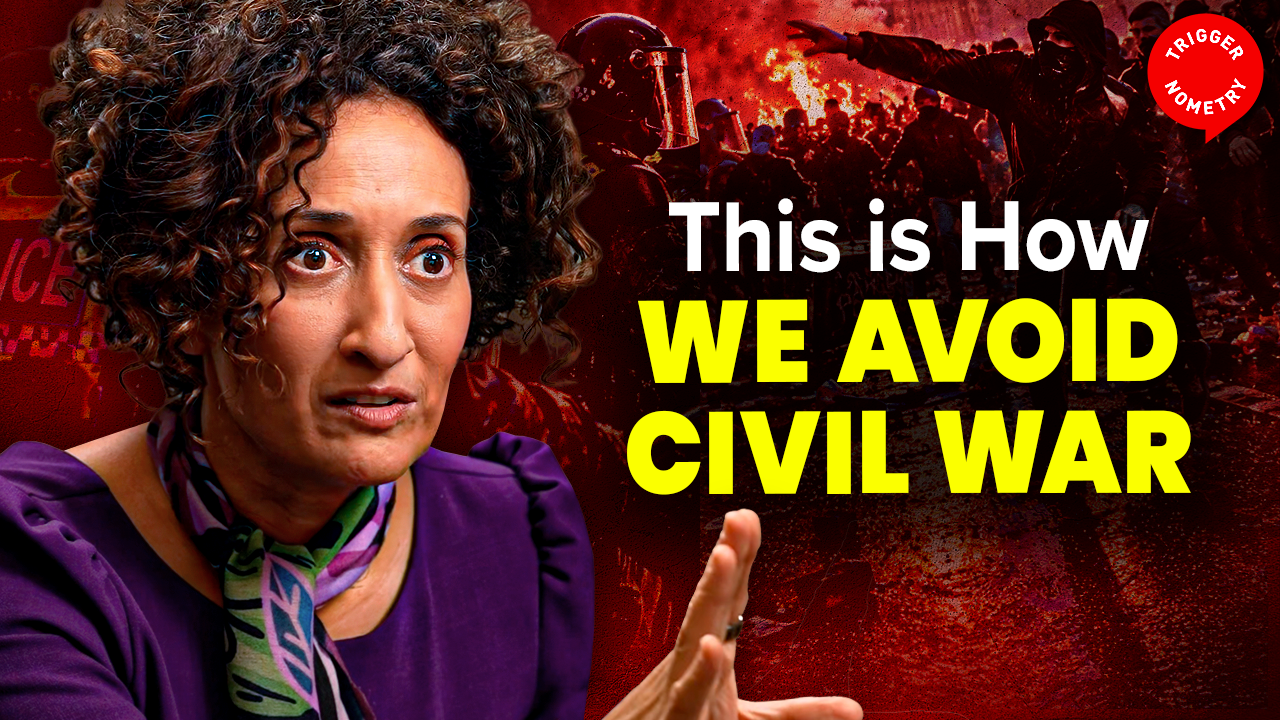
Katharine Birbalsingh argues that “multiculturalism is broken” because schools and media teach children an “oppressor vs oppressed” and victimhood framework, which she claims contributes to political intolerance and even justification of violence. She proposes “multicultural patriotism”: one dominant British civic culture (shared symbols, history, remembrance) while allowing families to keep their own heritage cultures.
Katharine Birbalsingh is described as “Britain’s strictest headmistress.” She teaches/ran Michaela Community School (Wembley) and writes about education reform and culture. She says she entered teaching with a “lefty” goal of helping Black children, later concluding that progressive methods and anti-discipline norms failed.
Progressive teacher-training methods (praise over punishment, suspicion of discipline) are “wrong”; traditional discipline and knowledge teaching improved outcomes (she cites Michael Gove reforms and England’s PISA gains). White guilt is portrayed as shaping institutional decisions (schools, police, judiciary). Young people’s political views are shaped by how history and identity are taught, leading to “civil war on the street” if adults don’t talk.
Flag Day assemblies; singing “God Save the King”; teaching remembrance with poppies and films like 1917 and Dunkirk; students interpreting history via oppressor/oppressed; examples she mentions include Charlie Kirk, Hassan Piker, and J.K. Rowling being labeled “transphobe.”
Written by AI. May contain mistakes.
Explores the concept of multiculturalism and its perceived failures.
“People look at multiculturalism and they say it is broken.”
Katharine discusses her journey from a leftist mindset to embracing traditional teaching methods.
“And I think you're not partisan politically, which is always great.”
A reflection on how educational approaches have evolved over the years.
“The knowledge we were teaching them was perhaps not being taught as it ought to be, but that took me many years to sort of figure out.”
Discusses the importance of traditional values and methods in improving educational outcomes.
“And that seems crazy, but that is how it was.”
Explores the influence of parents and societal norms on children's education.
“And the Gover forms basically established a traditional outlook in teaching, which is to give us traditional teaching methods and traditional discipline.”
Analyzes the issues stemming from multiculturalism and its effects on national identity.
“And also it's important because otherwise people will switch off because education is not a sexy subject.”
Examines how white guilt affects societal and institutional reactions to justice and equality.
“And one of the things you tackle head on and you're uniquely placed, obviously, to talk about is the infiltration of what you call white guilt into society and how that affects pretty much everything.”
Discusses the disparity in celebrating British culture versus other cultures in schools.
“So what does that look like in a school?”
Addresses the decline in national pride among young people and its implications.
“or it might be sewn onto their bags, or that sort of thing.”
A discussion on the evolving sense of British identity and its implications.
“It got to a point where any politician that was being interviewed, the first thing they'd say is, are you English?”
Exploring the idea of multicultural patriotism as a solution to national pride issues.
“But there is a reason why, A, this conversation is pertinent and is being talked about.”
Examining the impact of education on young people's views of British history.
“So when I think of multiculturalism, I think it's like you say, a state imposed thing where the overarching culture of Britishness basically doesn't exist.”
Explore how schools teach remembrance and respect for diverse contributions to history.
“Because we are preparing for remembrance for when we come back.”
Discuss the shifting views on cultural issues between generations and their implications.
“So there's a whole bunch of people who think she's a transphobe.”
Examine the effects of viewing historical figures and events through the lens of oppression.
“Do you know, so another poll I'll give you, people were asked when they think that political violence, well, violence against your political opponent is justified, right?”
Understand the idea of multicultural patriotism and its importance for national unity.
“read it and he said that he read it in one sitting and it was so easy.”
Discussion about the current state of education and the influence of the National Education Union.
“And as someone, everyone can now drink, as someone who taught for around about 12 years, both in the secondary and primary, Look, it's a curriculum, but it's as well the people delivering the curriculum, Catherine.”
Exploring the concept of multicultural patriotism and its importance in society.
“and that's not going to change, not anytime soon, you know.”
Examination of how online platforms are shaping children's education and worldviews.
“Maybe diversity really isn't our strength.”
Explore how technology shapes children's views and perceptions of reality.
“you know, six, seven, eight, nine hours a day, a day, right?”
Discuss the implications of mobile phone usage and propose banning them in schools.
“we don't allow them to drink alcohol, we don't allow them to access porn.”
Examine the self-siloing of youth in schools based on ethnic backgrounds and its consequences.
“which is that in many schools, children from different ethnic backgrounds will only sit with each other.”
Analyze the increasing social divisions and the potential for violence in society.
“This is actually in person, where my teachers are being told that their boss is going to have to leave the country because her boss is brown or black.”
Discuss the importance of instilling values and discipline in education.
“I built Michaela and my teachers and I, we built Michaela with the idea of demonstrating what was possible in terms of schools, you know.”
Learn how school systems can create positive behavioral incentives for children.
“And then the heads of year are monitoring to see, are the good kids being given merits?”
Catherine emphasizes the importance of engaging with children and society.
“Catherine Berbalsing, thank you so much for coming on the show.”
Hosts suggest additional podcasts to enhance listener experience.
“There's an episode here where Jordan talks to a hostage negotiator from the FBI who lays out his techniques on how to get people to do what you want them to do by making them like and trust you.”

Get the gist, explore an idea or ask about something said.
 Claude
On TRIGGERnometry, what are the key points of this episode?
Searching your listeningAutomatic transcript. May contain errors.
0:01People look at multiculturalism and they say it is broken. I do not disagree. It is broken because of what we have done with our children. People were asked when they think that political violence against your political opponent is justified. When you ask people between the ages of 18 to 24, it's one in four people. And for those who identify as progressive, half of them think that if they think your views are fascist, they should be able to attack you physically. Why do they think that? Why do they think that? Because of what they've been taught, right? Because of what we're teaching them through the media, in our homes and in our schools.
0:42If we don't start talking to each other, we are going to have civil war on the street.
0:48Francis Foster: This episode is sponsored by our friends at Hillsdale College. Right after this episode, go check out the incredible online courses, which are absolutely free at hillsdale.edu slash trigger. Catherine Burblesing, welcome back to Trigonometry. Well, thanks for having me. It's always fantastic to have you on, but you have got a book out, which I think, A, wades into very controversial and dangerous territory while navigating all the difficult issues that we are all concerned with at the moment in our country. And you do very well. And I think you're not partisan politically, which is always great.
1:24Francis Foster: you talk about where both left and right are not looking at the problems that we're going to discuss correctly in your opinion and it's really fantastic one of the things i wanted to do for people who haven't seen every interview we've done with you before is actually to talk about the part of your book that's autobiographical because you are known as britain's strictest headmistress but actually you went into teaching with a totally lefty mindset of wanting to help black kids because you believed that black children don't do well in school because there's not enough black teachers, effectively.
1:58Francis Foster: Is that a fair summation? Yeah, because of racism in the classroom and poverty. Racism and poverty, those are the two big things. So you start out as this well-intentioned lefty. You go into education. And what happens? And I start to see that things aren't as I imagined. I saw lots of white teachers working really hard for the black and brown kids in front of them. really dedicated people. And often there was very poor behavior. The systems didn't seem to work. The knowledge we were teaching them was perhaps not being taught as it ought to be, but that took me many years to sort of figure out.
2:39It's over time that you come to see that the things that you imagined were the case just aren't true. And I, well, I just came to change my mind. I came to change my mind about what works in the classroom, that the more progressive methods that we were taught in my PGCE teacher training, the stuff that everyone pushed was just wrong. And that actually, if you gave kids detentions and told them off, that that worked. I found that praise and punishment worked and that the old fashioned traditional ways of raising kids that we were told to move away from worked. And you learn that over years because nobody's telling you that.
3:18So nowadays, things are in teaching thanks to the Michael Gove reforms that happened, you know, between 2012 and 2016 or so. Thanks to those, everyone just takes for granted that we teach knowledge in classrooms. Before then, there was no such thing as a debate between should we teach knowledge, should we teach skills? Everybody just didn't teach knowledge. And that seems crazy, but that is how it was. Everyone was suspicious of discipline. In those days, if you had a, if a kid had a knife in their bag, you were not allowed to search their bags, you know? If you wanted to give a kid a detention, you had to give them 24 hours notice and you'd have to write it in their diary.
4:02And then, you know, they'd be booked for the next day. They'd already be booked and then you wouldn't be able to give them a detention. And you'd say, oh, you've got a detention. And they'd say, 24 hours, 24 hours, is what they used to say. Like, people don't realize. And there's a reason why the results in PISA the international tables that just came out a few weeks ago, that we've done so well. England has done really well. Why? Because of the Gover forms. And the Gover forms basically established a traditional outlook in teaching, which is to give us traditional teaching methods and traditional discipline.
4:37And before that, we were like 27th in the world for science or maths or English it was, and then 21st and so on. Now we're in the top 10 for all three categories of reading, maths and science. And the reason is because we have gone back to tradition. So the one difference I would say now that really distinguishes my school is the traditional values that we've got. That I'm on a big campaign, partly through my book and just generally I'm trying to persuade the world of schools and just the world of families. Because people, when looking at my book, well, one, it's called Diversity is Not Our Strength.
5:24So, you know, that should make it clear that this isn't just about schools. But it isn't just in schools where children learn how to be adults. They also learn how to be adults at home. And I think parents and teachers, I think we're doing the wrong stuff.
5:42Francis Foster: I'm glad you said the thing about this book isn't about schools because I think it's about a lot more than that. And you make very important points about our society. And also it's important because otherwise people will switch off because education is not a sexy subject. But as you've convinced us, as you've convinced me, didn't need to convince Francis that education is important. And it took me a while, didn't it? I have been bashing you for years and years and years. I feel like I'm in detention now. I've been bashing you and so many people because I'm trying to get people to understand just how important childhood is to a country.
6:18And people look at the country and they say, why is it in the mess that it's in? And it's in the mess that it's in because of what we're doing with our children. And nobody understands this. I've been saying it for 25 years. And now I've written a book because I'm trying to explain. People look at multiculturalism and they say it is broken. I do not disagree. It is broken because of what we have done with our children.
6:40Francis Foster: Well, indeed, the central thesis of your book from what I took away from it was that almost every debate we have in our society now that is polarized, that is difficult, that is messy and is ultimately unresolved is a product of the fact that we've been teaching children to think precisely in these unhelpful ways for a very long time. And one of the things you tackle head on and you're uniquely placed, obviously, to talk about is the infiltration of what you call white guilt into society and how that affects pretty much everything. Talk to us about that. Yeah. So, I mean, if you think back to 1995, there may have been a little bit of white guilt here and there, but it wasn't overpowering in the way that it is now.
7:28When people talk about Henry Novak and what happened to him, and they talk about two-tiered justice, and then I know there are many progressives who will say, oh, no, no, it doesn't exist. But actually, if you go through the various different events that have happened in the last 10 to 15 years, in particular, in the last five, six years, we can see a difference. We can see a difference in the way that our institutions are reacting to things. Certainly in schools, and this is something I talk about in the book, although I also mentioned the police, the fact is our judiciary, I mean, we all know something's not quite right.
8:05But where the right goes wrong on this is that the right immediately just jumps to immigration and says, it's all these black and brown people that are the problem. And the thing about black and brown people is that, well, we live here, right? There's lots of people on X who say to me, well, all we need to do is get rid of you, Catherine. We can put you on a helicopter and send you home, whatever that is. We'll send you out of the country. And if we can just get rid of you, everything will be all right. And what I say to the right is, look, obviously that's more the extreme right. Obviously, there's a whole load of people in the center right who don't think that.
8:43But what I am noticing is that there are more and more people in the center right who are so fed up. And I don't blame them. I get it. But they're jumping. They're jumping over to the further right. And they're jumping because they have no other sort of narrative to explain what's going on. And it is much easier to just say, well, look at these brown and black people. They are the problem. And there's no question that there are some black and brown people who are a problem. I'm not saying that there aren't. But the fact of the matter is that most of the people who are making all of these decisions around Henry Novak, Novak, what's happening with the police, the judges, the teachers, these people are all white.
9:23So it's not as easy as just saying, well, obviously the problem is black and brown people, because white people, I believe, are riddled with white guilt. Now, I can't say all white people, but there are lots of them. And it's in our institutions. You know, it's like it's in the blood veins where it's just pumping through everything. And so if the decisions that we're making all of the time are often peppered with this white guilt, then we make the wrong sorts of decisions. And that happens from year dot. So what does that look like in a school? It looks like. So one story I talk about in the book is celebrating Flag Day.
10:10It's a very standard thing to have these cultural celebrations at school. where everybody's celebrating their own culture. Yet no one would ever celebrate British culture. And when I say no one, so we have a British flag that flies outside our school. And this morning I went to assembly and all the children stood. And just before they stood for their headmistress, because we're a traditional school, they sang God Save the King. I sang God Save the King. I sing it every morning, right? Now, it's interesting because in America, That used to be a standard thing. I grew up in Canada, and we sang O Canada every morning in school.
10:50It was normal. Nowadays, that doesn't... It's considered... I mean, it's almost offensive to sing God Save the King. It's very hard to find a school where they would do that every day. In fact, I've never heard of one. I don't know. Maybe I've never heard of one singing God Save the King. How many schools have the British flag fly at their school? We have one flag, and it's the British flag. Most schools have the pride flag or the trans flag. They might be littered with Palestinian flags. The school might not officially itself be flying the Palestinian flag, but you will find children with pins on them, or it might be sewn onto their bags, or that sort of thing.
11:35So the thing is, is that when you are wanting to celebrate all the time other people's cultures, so when I say other people, what I mean by that is other countries, of course children will feel an affinity to the country that their parents are from, their grandparents are from and so on. When, you know, I've been to Jamaica many times. My mother is Jamaican. I have a particular relationship with Jamaica that I do not have with, say, Brazil. That makes sense. When Jamaica Day happens every year, I think, oh, it's Jamaica Day. That's a nice thing, you know. And some people, some people with Jamaican heritage go out and celebrate Jamaican Day.
12:15Great. I eat my plantains as much as any other, you know, Jamaican heritage person. However, if those young people do not also identify as British, we have a huge problem as a country. And that is where, so like this recent, not recent, actually, you began it. You began the conversation around Englishness and Britishness.
12:40Francis Foster: Inadvertently. Yes, well, and it's interesting, because I haven't told you that. But so I have a podcast that started in August and it's called Strictly Education. It's fantastic. I really enjoy watching it. Oh, well, that's so nice that you watch it. So, yes. And my Strictly Education podcast that's coming out. So obviously we're recording this long before this goes out. But the one that's coming out this week is all about you. This could go either way. By the time you're watching this, either Catherine and I are the best of friends or things have gone downhill. Yes, exactly. So it'll be interesting because I'll be interested to hear what you think of what I say.
13:24So the reason it's lots about you is because I begin with talking about you and Fraser Nelson having the conversation about Englishness and Britishness. And I sort of tell the story. And then I explain. Well, in fact, you can tell me right now what you think. I then explained that I think that this conversation, and actually you just said inadvertently, which is the right answer. It's the right answer because you don't think that it's a big deal. Why are we having this crazy conversation over and over again about, are you English? Are you British? If you're an ethnic minority, you need to answer the question.
14:01It got to a point where any politician that was being interviewed, the first thing they'd say is, are you English? We know you're British, but are you English? And then it was a situation where, well, if I'm a progressively minded, sensible person, I'm going to say English. But if I say I'm British, then that must mean I'm far right. That is how it was interpreted. We, the media classes, are all chatting about, are we English? Are we British? Are we English? Are we British? When actually, I'd like to put it to everyone, are we anything? Right? And when I say, are we anything, if we go up to young people nowadays and say to them, Are you proud to be British?
14:37In 2005, 80 % of people would have said they were proud to be British. In 2025, 40 % of people would say that they were proud to be British. And that's not young people, right? The fact of the matter is, is that something has changed over the last 20 years. People are not proud to be British and they don't identify. The point is, do we identify as British at all? Not whether or not we are English or British, but do we feel part of this country? The reason why everyone has, I think it's a massive red herring, the conversation. It's a red herring between English and British, because what everyone's upset about when they're having this argument is that when you say, well, actually, you feel British, you wouldn't call yourself English, that's because you're thinking of Englishness as an ancestry, which is fine, makes sense.
15:27When they say English, they mean it as a civic identity. So the two of you mean something totally different. You mean, when you say British, that's the civic identity. When you say English, that's the ancestry. They are using Englishness just as a civic identity, and that's it. What matters is, do we have a civic identity at all, right? Because I guarantee you, there are a whole load of people who live in this country right now who don't identify as either English or British, right? They identify as being Indian or Pakistani or Jamaican or Ghanaian and so on. That's how they think of themselves.
16:07And that's a problem. Because if a country is not united under one flag, which is why I say we have one flag that flies at Michaela, my school Michaela. If we do not have that, then we will be broken as a society, which is why people feel that multiculturalism is broken. And I get it. The thing is... Can I...
16:28Francis Foster: Since we're talking about my comments, the one thing I only... The only thing I would add is, I think in my conversation, in our conversation with Fraser, the way it was clipped sort of misrepresents the nature of the conversation because I was talking about my own children who were born here, very whiter than anyone in this room, frankly, also not being English because of the ancestral thing. Yes, you did. But there is a reason why, A, this conversation is pertinent and is being talked about. And it's actually the reason that you identify. Because what I'm really thinking about is what is the right identity, civic identity, that we could theoretically all unite around, which is what you're talking about.
17:12Francis Foster: And the reason I don't think Englishness works is there are far too many both ethnic minorities and ancestrally English people who don't accept that ethnic minorities can be English. Therefore, it's not a great identity for us to all unite around. But the intention of what I'm saying is, what is it that we can all unite around in a society that... I don't like multiculturalism, and we can talk about that, multi-ethnic society, in which people from all sorts of ancestries are living in one place. How do we move forward is my question. and I think Britishness is a much better fit for that. And I would argue the fact that you don't fly an England flag outside of your school is kind of what I'm getting at.
17:54Francis Foster: You fly the British flag because that's how you can unite people. Is that fair? Yeah, no, no, no, absolutely. That is what you meant. And that's why when they're saying English is, but they're saying Englishness is a civic identity, you're both saying the same thing. You and Fraser are saying the same thing. And this conversation is only held by the media classes. This is the point. We should not be talking about whether or not we're English or British. What we should be talking about is whether we are British at all, right? That is what's important. And the thing is, it's interesting when you say about multi-ethnic, because I would disagree with you.
18:29And in my book, I talk about this idea and how people more right-leaning will often talk about how multiculturalism is bad, or not bad, but it's broken and it doesn't work, which I get. And therefore, what we need to talk about is a multiracial society or a multiethnic society.
18:50Francis Foster: I would say a monocultural society. A society in which we have one culture, which is British culture. Okay. The thing is, within that British culture, there are lots of cultures. You see, what you wouldn't deny is that we eat sushi and curry and, you know, a variety of foods. What you wouldn't want to deny people is the right to wear different religious dress. You wouldn't want to raise the mosques and the temples to the ground. You want to allow people their different cultures because those are all cultural. So I tell you what, I've got a solution for you. And the solution is in my book. The solution, my solution is what I call multicultural patriotism.
19:33Now, and the thing is, is that some people have read it, and you obviously have read it, and some people have read it, and they said, but everyone is going to hate this, Catherine, because the left are going to hate the patriotism side of it. The right are going to hate the multicultural side of it. You're just going to make everybody hate you. Well, it's true, and maybe everybody will hate me. But what I'm hoping, you see, the thing is, is that we're kind of grabbing at straws. We're looking and saying, but we know multiculturalism is broken. And multiculturalism is broken because it's political multiculturalism.
20:15It's state multiculturalism. That's what it is. And it's being imposed on us. And we're being told diversity is our strength. It's our strength, even though it's bloody obvious to all of us that it is not a strength, which is why I've called my book, Diversity is Not Our Strength. And I've written the book in such a way that I hope the book is such that I really hope that it speaks to people on both the right and the left.
20:39Francis Foster: It does. So you found when you were. I thought when I was reading it that if I were if I was left leaning in my outlook, this would be the most accessible way for me to engage with the ideas you're talking about. Here's a number worth sitting with. A pound today buys about 75 % of what it could in 2020. In other words, it's lost about a quarter of its purchasing power. And it's not only the cash in your pocket. Even savings in the bank can lose buying power if the interest doesn't keep up with inflation. So if your money is slowly losing value, what are you doing about it? Personally, I've bought gold.
21:13Francis Foster: I believe in holding some of it to protect my family from coming economic turmoil. And I'm not alone. And here in the UK, there's a tax angle a lot of people don't know about. qualifying gold is VAT free and UK legal tender gold coins are capital gains tax-free for UK residents. Today's sponsor will send you a free guide to tax-free gold which you can see on the screen right now so you can understand gold properly. It covers what to buy, the risks and the tax rules so you can make an informed choice because gold can fall as well as rise and you should know what's going on. Plus if you're quick you'll receive a free half ounce solid silver 2027 Britannia if you buy gold or silver worth 500 quid or more.
21:52Francis Foster: To receive your free guide to physical gold, scan the QR code on screen now or follow the link in the description or the pinned comment. Can we just do a little bit of definition, Catherine? Okay. So when I think of multiculturalism, I think it's like you say, a state imposed thing where the overarching culture of Britishness basically doesn't exist. And what we celebrate is the cultures of all the different people. And I think, as you say, that doesn't work. And when I mean monoculturalism, I mean, of course, you're allowed to be Jamaican and I'm allowed to be of Russian ancestry and speak Russian to my children and whatever.
22:30Francis Foster: Yes. But that is very secondary to the Britishness of all of us. That's why, that's the patriotism. So multicultural patriotism, what that allows for is that we can each have our cultures. You know, as you say, you speak Russian at home, but you put the country before your own tribal interests. That's the thing. The patriotism is recognizing that you aren't the only person who matters in the world and your group isn't the only group that matters. And that you don't go out there fighting for your group only. In fact, you fight for the country. So these days, there'll be a stat in my book somewhere of the number of people who are willing to fight for the country because they're very few nowadays.
23:16You know, the fact is that we're not willing to fight for the country. We're not willing to put the country first because too many of our young people don't like Britain. This is what we don't understand. Too many of our young people have been taught in their schools, in their homes, in the media, everywhere, that Britain is a racist, bad country. Now, I'm not saying we shouldn't teach the truth in history. You know, Churchill was a complicated man. But the fact is, just teaching our children all the time the narrative of oppressor versus oppressed, and that if you have any kind of victim identity, you might be gay or trans or you're suffering from mental health or you have special needs or you're black or you're brown or you're Muslim or you're Hindu or whatever it is, all of these various different identities make you into a victim.
24:06And therefore, the state, the British state, is the bad, they're the baddies. And Britain is bad. And if we look at the history of Britain, which is then taught to you in such a way that you really see just how bad Britain is, then you grow up disliking Britain. And therefore, in 2025, 40 % of people, not mainly young people, 40 % of people are proud to be British. You know, there was another survey done where one, and the thing is, I just see this. I see this in my life. So I'm quoting kind of, you know, polls and things. But the fact is, to anybody on the ground who's actually got their eyes open, who's in schools, who sees young people, who talks to young people, not the kids at my school.
24:53I'm talking about the kids everywhere else. If you, and you don't believe me, if the people watching this don't believe me, go and find some kids. Go and talk to them. It doesn't matter what color they are. They could be brown and black. They could be white. Ask them what they think of British history. Ask them what they know of British history. And the stuff they're going to tell you about what they know of British history, they'll tell you about Hitler. They'll tell you about the oppression of various brown and black people in America. Here, their only understanding of history will be the view of oppressor versus oppressed.
25:29And if you grow up with that, that is when you then get all of these marches on the street. Now, in my book, as I say, I explain this in more detail, why childhood matters. And as you said at the beginning, every political situation that we're looking at, it is grounded in childhood. So when we're all looking and saying, Gen Z, what's wrong with them? I don't understand it. Why are our young people behaving as they do? the number of 50-year-olds, 60-year-olds who I speak to, who will tell me, yeah, I'm a bit embarrassed to talk to my kids because, you know, they think I'm a bit of a racist. Oh, actually, they think I'm a bit of a transphobe.
26:05Oh my goodness. I just, I just try and avoid those political conversations with my children, right? And I'm sure that your audience listening will be going, that's true, actually. My children do feel a little estranged from me and their friends. and why do they seem like they've come from a different planet? It is because of the way in which we have taught them. And we don't recognize that. And then we all say, what's happening? Now, let me get back to the multicultural patriotism point. Multiculturalism is broken. But we don't want to get rid of the different cultures in the country. I haven't got rid of the different cultures in my school.
26:41I've got kids. I've got Hindu kids, Muslim kids. I've got Buddhist kids. I've got all kinds of kids, right? And I've got Christian kids. Now, I've got everybody. I've also got black kids from Africa, brown kids from all over the Middle East, India. I've got some Chinese kids. I've got kids Caribbean. And I say all of these heritage, right? This is where their heritage is from. All of them are from here, right? Some of them, their parents were born here. Now, some of them, their grandparents were born here. So they're British, but they're also of a heritage from somewhere else. Now, they all have different cultures.
27:18They all eat different foods. They all wear a different dress. Some of the girls wear hijabs. Some of them don't. Some of the Sikh boys will wear bracelets. They dress differently, right? They do different things when they go home. Some of them are learning the Quran by heart, you know, and they go to the mosque and others wear a cross under their uniform, right? So we allow them their different cultures. but there is one overarching culture that binds us together. And that is Britain. And so we sing God Save the King. We sing Jerusalem. We sing I Vow to Thee, My Country. This morning, I was showing them the trailer for their, because next week they've got a reward film.
28:01And our Year 11s will be watching 1917. Why? Because we are preparing for remembrance for when we come back. And every child will wear a poppy. and all of us will recognize the two minutes silence. And in assemblies coming up to the 11th, we will talk about the boys who gave their lives. And those boys will not just be white boys. They will be a variety of different boys from the Caribbean, from Africa and so on. Now, India, et cetera. Like the fact is that we instill a sense of deference and reverence towards the country in our children. and they watch this. Those 011s last year watched Dunkirk, for instance, and so on.
28:46And so every year we're building up a sense of gratitude for the freedoms that we've got. Now, how many schools are doing that, right? How many schools are doing quite the opposite? Because I know of many schools where they wouldn't even have poppies at all. Or if they do, it's a few kids who are buying a few poppies. It's not everybody. And there's this real sense of, well, come on, that was ages ago, you know. And how many schools would have children where they could tell you all of the details of the Second World War, where they would understand that it's not just oppressor versus oppressed.
29:19Like, talk to children. You know, people don't believe me? Talk to children. And I don't just mean 15-year-olds. I mean 25-year-olds. Ask them what they know of history. They will only understand history through the prism of oppressor and oppressed. And so the thing is, when you see it in that way, everything is interpreted that way. Think about J.K. Rowling, for instance, okay? So there's a whole bunch of people who think she's a transphobe. We all know she's not a transphobe. We know that ultimately she doesn't hate trans people or want to harm trans people. She simply believes that women should have spaces that are their spaces and that biological women should be the only people who would enter those spaces.
30:01That is what she thinks. If you were to ask anyone over the age of 45 what they think of that position, most of them would say it's a perfectly reasonable position to take. You ask anyone under the age of 30 what they think of that position, and they will say, it's horrifying, she's a transphobe. Now, so the point is, is that what I'm saying isn't just about race. You know, so my book is called Diversity is Not Our Strength, but it isn't just about race. It's about anything that is seen through the prism of oppressor and oppressed. And the fact is, there's a reason why our under 30-year-olds think the way they do.
30:37Now, not all of them. Obviously, I'm not talking about everybody. And I talk about Gen Z and people will, you know, some people get offended and they say, but, you know, obviously, I'm not talking about all of them. But we notice a real difference. And I'd even say the younger millennials, for instance. Over time, we're beginning to see this. And they have not yet met Gen Alpha. But when Gen Alpha get into the workplace, not just the workplace, but out on the streets, why are we seeing the things that we are seeing? Do you know, so another poll I'll give you, people were asked when they think that political violence, well, violence against your political opponent is justified, right?
31:18You ask people over the age of 75, one in 33 said it would be justified. But when you ask people between the ages of 18 to 24, it's one in four people think it's justified. And for those who identify as progressive, they're political progressives, it's half of them. Half of them think that if they think your views are fascist, they should be able to attack you physically. Right. Why do they think that? Why do they think that? Because of what they've been taught. Right. Because of what we're teaching them through the media. in our homes and in our schools. And we have no idea. And because nobody takes schools...
31:59Francis Foster: So what have they been taught in their schools that make the... I can understand what you say about having a different view of history and all of this stuff. What have they been taught in schools that justifies violence? Well, if, for instance, all you ever hear are about these evil men like Hitler, right? So, you know when people have these ideas, well, if I could go back in history and I could do something. Would you kill baby Hitler? I'd kill Hitler because, well, I'd save millions, right? If other characters, say like Churchill, are painted in a similar sort of light, because for you as the child learning this, well, if you're a racist, then you're an oppressor.
32:42And if you're, you know, an ordinary person, then you are oppressed and not just ordinary, but if you have one of those victimhood, you know, flags, then you are oppressed. then anyone who is an oppressor deserves to die.
32:57Francis Foster: So Charlie Kirk is Hitler. That's exactly right. So why? Charlie Kirk is a great example. Or remember that CEO of the healthcare CEO who was killed? Yeah, exactly. That's his name. So, or Charlie Kirk. You know, Charlie Kirk is a father who, like I know this from just talking to 25-year-olds, forget about 15-year-olds. I'm talking 25-year-olds, right? When I try to explain that Charlie Kirk was a decent guy, they don't understand what I mean. How could I possibly think he was decent? And I say, well, he was a father, he was a good man, he was a good husband. In fact, unlike most people, he actually went to young people in the universities to talk to them, to try and bridge gaps and to try and do something.
33:42You know, when I say do something, what I mean is a lot of people talk and they go on their keyboards and so on. Most people don't go into universities and try and talk to young people. So I have a real admiration for Charlie Kirk for that. And they say, but, you know, he thought that women who were raped should carry the baby to term and they should not be allowed abortion. And I say, OK, but, well, you just disagree with him. And they can't understand that that's just disagreement. They think that he's evil, right? And young people, now I'm not saying that everyone who thinks that he's evil then thinks that they should be physically attacked, because as I've just said, it was one in four.
34:25And for the progressives, it's 50%. So there's 50 % who don't think that. But there's 50 % of them who do, who think that that healthcare guy, so what, that, what's his name? his name will come to me, Hassan Piker, him, he, going on telling everybody how it's quite right that we should steal from supermarkets. They push this idea that, why is it all right to steal from a supermarket? Because the supermarket is the oppressor. Why is it, he, when being asked, well, what about if it was your local restaurant or local shop? Oh, no, somebody in the local a restaurant, somebody decides to leave without paying.
35:09Oh, well, I'd pay for them because he sees them as the oppressed. You're just a little restaurant, whereas a big supermarket, well, they are the oppressor. He is a great example of somebody who sees everything through that lens. And so my book very much explores all of these ideas. It talks about how diversity is most definitely not our strength, but multicultural patriotism, you see, it allows us our different cultures. You see, I think that's one of the ways, because the right says down with multiculturalism, and because the left says diversity is our strength, the two will never meet. Now, what I'm hoping, hoping, is that the people in the middle who lean to the right and who lean to the left, there's the leftist identitarians, they're never going to listen to me.
35:55And there's the extreme right, well, they want me on a helicopter going home, so forget about them. Probably not a helicopter, more like easy, Jim. That's worse. Well, I want a first class ticket. Now, if you lean right or you lean left, I really hope that they read this book because I've done my best to be a teacher in it and try and explain things in a way that people can follow. And Amal Rajan read it and he said that he read it in one sitting and it was so easy. It was a really easy read. and that it explains to people how the other side thinks. That's what, I mean, I don't know. Did you find that?
36:35Francis Foster: Absolutely. That's what I mean by you charted a path between the two shouty extremes very powerfully. That's where it succeeds. I hope everyone reads it. Well, because the reason why I'm putting forward this idea of multicultural patriotism, and what I really hope is that that ends up on the, you know, coming out of the mouths of our politicians, whether right or left, that they'll at least talk about it. Because I want to change the narrative. Because at the moment, the narrative is, throw out multiculturalism. What we need is multi-ethnicity. But that isn't quite accurate. Because, and the left know it.
37:12The left know it. Because they're saying, but people should be allowed to have their different foods and their mosques and their temples and their religious dress. But the right aren't saying that that isn't the case. It's just that they haven't got the term to be able to describe what they want. And the left are saying, no, no, no, no, we need to celebrate all these cultures. Well, fine, but we can celebrate those cultures. But one culture must dominate. One culture must be what binds us together. And that is our patriotism to the country, which is Britain. And that's why I call it multicultural patriotism.
37:45And what I'm hoping that everybody doesn't end up hating me and that I don't alienate everybody, but that actually I hope to bring us closer together. Because if we don't start talking to each other, if we don't start talking to each other, we are going to have civil war on the streets. That's what's going to happen. And you can see it happening in France now, right now. Just look at France. And how did it start? The kids. It started with the children. So everybody who keeps telling me that children are not important, and I'll tell you why. I mean, I shouldn't say this to two guys, but that is because women historically and rightly have always looked after, you know, the children at home.
38:21You know, it's not always the case. And there are house husbands, and I get it. There are exceptions. But generally speaking, it's the women at home who are looking after the children, right? There's loads of women in teaching. And it's often seen as women's work. Children is seen as women's work. And schools, like when you just said, you know, well, education, we're going to lose people because it's not a hot topic or whatever. And you're right. I mean, what you said is right. Well, why isn't it? It should be interesting to people. Schools and children should be interesting to us all. And that is because it's women's work.
38:53And we just kind of glaze over and we think, well, they're kids. Who cares? Children make up 100 % of the future, right? They make up 100 % of the future. I once said to Jordan Peterson, because I go around to everybody. So I've been trying to banging you, banging, banging, banging on your door. Every time I see Jordan Peterson, I'd say, listen to me, children matter. that. When he came to visit my school, I said to him, you never talk about children. You never talk about schools. Because he talks about kids at home, but he never talked about schools. And he said, you're right. And I said, yeah, exactly.
39:26And that's a problem. Now, I have to say, he listened to me because then actually he did start talking about schools. I kept saying to him, look, you talk about universities. You don't talk about schools. You say universities are, you know, these brainwashing machines and so on, and it's a disaster. Well, why do you think they're a disaster because the kids have already been brainwashed before they arrive at university. Right. And then when they're 25 and they're on the streets protesting every Saturday, we all say, what's going on? I don't say what's going on. I know what's going on. I have been shouting about it for 25 years.
39:59That's why we were just saying that I've been on your podcast loads and, you know, you've been very kind and you have tried to give, you know, give a voice to the sorts of things that I've been saying. But nobody's listening. And then I started this podcast, and I started my podcast deliberately because I thought, because what is the point of my podcast? The point of my podcast is to say to everybody, every single episode is rooted in childhood. Everything I'm talking about always comes back to children. And I will talk about political events that have happened. So my podcast this week is about Englishness and Britishness.
40:37Next week, my plan is to look at France. You know, all of it, it's always rooting back into childhood because I need to persuade everybody just how important children are because we've forgotten that children are the future. And children, look, if we care about Britain, if we care about the future of the country, we have to care about our children and we have to care about what we're teaching them. And that's what I'm hoping. I'm hoping multicultural patriotism. And, you know, for all your viewers who have maybe some friends on the left or, you know, when the book finally comes out. Well, actually, this will air on the day it's coming out.
41:20You know, get them a copy of the book for Christmas, you know, get them a copy of the book. because I genuinely, I really think that a left-leaning person, I think you'll find, if your audience gets their left-leaning friends the book, I think they'll find that they're suddenly able to connect a bit more with them and that their left-leaning friends might listen to them a bit more and go, oh, I see where you're coming from now. That's what I'm hoping. I'm just hoping it'll bridge the right and the left a bit because otherwise, well, I don't know. We're stuffed. Otherwise. Many people know C.S.
41:57Lewis as a man who wrote Narnia. Few would know he spent years as an atheist before becoming one of the best-known Christian writers of the 20th century. Hillsdale College's free online course, C.S. Lewis on Christianity, follows that journey and takes his arguments seriously. Across seven lessons, Professor Michael Ward, a leading Lewis scholar, takes you through Lewis's case for objective morality, his advice on prayer, and his thoughts on heaven and hell. It also tackles the hardest question of all. How can a good God allow suffering? Lewis answered it twice. First as a thinker in the problem of pain, then as a grieving husband in a grief observed.
42:38This is one of more than 43 courses Hillsdale offers on the Constitution, the Roman Republic, the American founding, Genesis, World War II and more. All built the same way, taught properly, not dumbed down. I couldn't recommend Hillsdale's courses more highly. Go to hillsdale.edu slash trigger to enroll. It's totally free. Encounter the faith and wisdom of C.S. Lewis. Start right now at hillsdale.edu slash trigger. And we also have to be honest about this as well. And as someone, everyone can now drink, as someone who taught for around about 12 years, both in the secondary and primary, Look, it's a curriculum, but it's as well the people delivering the curriculum, Catherine.
43:21I mean, you look at the National Education Union. They described reform as a far-right party. I mean, let's be honest. This is embarrassing. Yes. Yeah. No, no, no. That's right. That's right. But they're the leftist identitarians. They're way over. Like, they're never going to... But you say they're the leftist identitarians, Catherine. That's the biggest education union in the country. No, I agree. I agree. I agree, but I'm not going to persuade them. So I'm picking the people in the middle, you know, leaning left, leaning right. At the moment, even they are not talking to each other. Even they, right?
43:55So the people who are diversity is our strength no matter what, forget about them. I'm talking about the liberal multiculturalists is what I call them, who lean to the left, who think to themselves, well, of course we've got our different cultures and that's a nice thing. And I live in Hampstead and I go and eat my sushi and my curry and it's all lovely. and I don't understand what's wrong with these people who are complaining. They're obviously far right. Those people genuinely just don't know. They just don't know what's going on. They don't. They don't know what's going on in the streets. They don't know what's going on in Blackpool and in Rotherham.
44:30They have no idea. They don't even know what's going on in Peckham or in Brent. They just have no idea. What I'm hoping is that the book will open a window for them. for them to start going, oh, well, I've never thought about this. Let me think about this differently. And then, I don't know, for those who are under 30, we have a huge job to do there because they really have this oppressor-oppress narrative. And when people don't believe, just go and talk to some of them and say to them, tell me what you know about history. Just tell me what you know. And every event in history that they will put forward to you will be one that fits the paradigm of oppressor oppressed.
45:17And that's why when we then see, you know, like, as I say, it could be J.K. Rowling. Well, she's the oppressor. It could be the Palestine-Israel situation. Well, Israel is the oppressor. They will then interpret everything that way. And then they think to themselves, well, how do we make the world better? well, if only somebody had killed baby Hitler, we would have saved millions of people. That is genuinely how they're interpreting the world. I just think, Catherine, if we're being honest, we need to talk about the people who are involved in education. Not all teachers, of course not. But I come back to the point about the National Education Union.
45:57This is the biggest union in the country. This represents the vast majority of teachers. And they put out statements about recognizing Palestine, reform being a far-right party. And that, to me, that's not just the National Education Union. That shows a deeper corruption of the profession itself. I agree. I agree. I just, you know, that I don't know what to do about. I don't know what to do about that, especially with the current government that's in power. and that's not going to change, not anytime soon, you know. So I always think to myself, you know that kind of poem where it says, God, give me the courage to know.
46:45The serenity prayer. The serenity prayer, there we go. We need to know the difference between the things that I can change and the things I cannot change, the wisdom to know the difference, you know, I can't change that. But I'm hoping I can change those who lean left and who lean right And both of us on the left and the right need to change. And my idea of multicultural patriotism is something that, while it seems offensive to both in the first instance, actually could be the thing that binds us together. And then if those who lean to the left and those who lean to the right are brought together, we become a much stronger entity as people, the kind of sensible people in the centre who disagree about things, but we can disagree openly and happily and able to have conversations.
47:36And then the extremes are, well, forget them. We're in the middle here. We need to try and save the country, right? We need to save the country. Because I, you know, look, I know a lot of people on the left will say there's something wrong with the country. Why are you pretending there are issues? But I think because they just don't realize. They don't know. They don't see the footage that some of us will see when we're online, when you see the footage of the things going on in various parts of the country, but also about what's going on in schools and what children are saying. My views come from what I know children are taught and how they speak and what they think.
48:20I know this, right? And it's interesting because teachers would find it hard to disagree with me. You know, I'd love to find the school that doesn't have a let's celebrate your own flag day. Let's celebrate your culture day. Let's celebrate your food day. And everybody brings in their own foods and their own flags and so on. I'd love to know whether or not they have British flags outside their school. I'd love to know whether or not they sing God Save the King every day. I am most certain that they do not. And who knows? Maybe you will get a flood of calls after this. People writing in and saying that Catherine Burble saying, how ridiculous.
48:56the school next door to me. They have a flag outside. I hear them singing God Save the King. Isn't it wonderful? Maybe we'll hear that. And then maybe they'll send the history curriculum that they're all being taught and it will be similar to the one that we teach at Michaela. I suspect not, right? Because I know what I'm talking about. And I'm trying to tell people because people also don't know. So people send their kids to school. They have no idea what they're learning in school. So this is ever since I gave my speech in 2010. So you asked about my story before. And what I didn't explain was in 2010, I was basically kicked out of the profession and I was kicked out of the teaching profession because I dared to speak at the Conservative Party Conference.
49:35I'm not a conservative. I mean, I'm a small C conservative. I'm not a big C conservative. And I spoke at the big C, you know, at the Conservative Party Conference because I was invited there. And I spoke about how I thought the system was broken. I am still saying the same thing 16 years later, right? I'm saying the same thing. And the system is broken because none of us are looking at what happens in schools, right? And after that 2010 speech, I then went to try and set up a free school because I wanted to show people what was possible in a school, okay? And I talk about this in the book. And I set up this school called Michaela in Wembley, and it has a whole load of kids who are coming from various different immigrant backgrounds.
50:21Just the other day, they went to see, in Wembley, they went to see England play the Czech Republic. And we won, you'll be pleased to know. And our kids were in the stands with St. George's crosses painted on their cheeks and flags and everything. And they were belting out God Save the King. Now, they do this naturally. They don't think about it. It's just part of who they are, because that is how we have raised them, right? Now, the fact is that if every school were doing this in the country, we would not have the problems we've got now. So rather than, you know, for those people on the right who are jumping even further to the right, and they're thinking to themselves, well, look, I mean, it's brown and black people who are the problem.
51:08So let's just, it makes me feel better to jump further to the right and talk about how we're going to send everybody home. Well, OK, you can talk about how you're sending me home, but it's not going to happen. So let's just be real for a moment here. It's not going to happen. And if it did happen, well, that would be an interesting economic discussion. I have no idea. But even if it did happen, do you know what white kids think like these days? Do they know what the majority white schools are like and what the behavior is like? And like, it's this idea that we move out all the brown and black people, that all these white kids will just magically appear and be church going, beautiful citizens who have all the same old small C conservative values of yesteryear.
51:57No, they don't have those values either. None of our young people have those values of personal responsibility, a duty towards others. is sacrificing something that's important to your tribe for the sake of the whole, because patriotism is what matters, right? Gratitude, kindness, decency, all of these sorts of values, being resilient, you know, stoical, jumping over obstacles, not saying I'm a victim, I'm a victim, but instead thinking, where's the obstacle? Let me jump it, you know? That sort of attitude has completely disappeared. And why has it disappeared? That's what we need to be asking.
52:31Not whose fault is it? It's his tribe. It's her tribe. It's not to do with my tribe. And in fact, I'm just going to bunker down with my tribe and end up with my tribe on my own. Look, that's all wrong. And if we continue the way we're going, even if you got rid of all the brown and black people, the country would be finished. Right. We need to stop those on the center right who are jumping over to the right. Don't do that. Embrace multicultural patriotism. And those of us on the left who see the more extreme right growing in numbers, those of us on the left here need to say, OK, wait a minute.
53:08Maybe there is a point. Maybe diversity really isn't our strength. Maybe you can have diversity under one umbrella, under one binding idea, which is Britain, and have patriotism be the thing that holds us together. And so we get multicultural patriotism. That is what we need. That is what I write about in my book. That is what I try and persuade people to do. And I think people on the right and the left, I have a whole chapter dedicated to what the right gets wrong. Lots about the stuff of white guilt and so on. It has to be said. It is mainly the left, really, that is, I charge with the stuff on the way in which they talk about racism, white guilt, and the destruction of our small c conservative values.
53:51That is, you know, that's kind of the first part of the book. And that is, well, it's worth reading. It's an easy read. And I think that if we all try and embrace the ideas in the book, I just hope we can get it into the national conversation so people can actually have a term, a vocabulary. I'm often watching people on podcasts. I don't know, in news interviews and so on. I watch them talking about multiculturalism and every time I think, what you want is multicultural patriotism. Every time I'm listening, I'm like, they don't have the vocabulary. They don't have the narrative. I want to give you the narrative.
54:34Here, have this, have this, talk about this. Because everybody's not sure how to talk about these issues.
54:44Look, two things. Multicultural patriotism, children. If I could just get people talking about those two things, I would have succeeded with the book. And one of the things you actually talk about in the book, and you talk about, it's really interesting the way you discuss it, is you talk about this idea of parallel schools because of mobile phone use. Yes, that's a very good point. And I never actually thought about it like that, but it is quite literally a parallel school because kids are going online and they're learning all of this stuff. Exactly. Exactly. So it's combination. And I didn't thank you.
55:22I don't know why I haven't mentioned it. It's a bit silly of me. Yes. You've got what's happening in the home. You've got what's happening in schools.
55:28Francis Foster: And then you've got what's happening online. And what's happening online is destroying the country. And people don't get this. They don't understand. And they let their kids just sit online. And their kids are being totally brainwashed by what is going on online. And, look, it's a parallel school. Actually, I shouldn't have called it parallel school because it does more damage than school, right? Because it's not just when you're in school. It's also, one, they spend hours and hours and hours on there, you know, six, seven, eight, nine hours a day, a day, right? Honestly, sometimes you think, well, these kids have a full-time job online.
56:12That's what, just being online. watching all the same stuff that is telling them things that are not true, always in the dynamic of the paradigm of oppressor oppressed. That's how they're taught everything online. And so, but it's not just, then they leave school, and then they're at university, and they're online all of the time. And then they're 25, 26, 27, and they're online all of the time. So when I come along and say, I think Charlie Kirk was a good man, they genuinely can't understand what I'm saying. They just think I'm mad.
56:45Francis Foster: Well, it works both ways. And I actually think with technology, it's worse than what you said. You said they're watching things that aren't true. I don't think that's true. I think what they're watching is a selection of things that are true that are not representative of the reality in its coherent context. So, for example, if you're on the left, you will be served, you know, Charlie Kirk is a fascist, videos from Gaza, well, actually, it's from Syria 10 years ago, but pretending to be from Gaza, etc. And if you're on the right, you know, you might be watching endless clips of black people beating up a white guy.
57:19Francis Foster: Yes. And then both of these groups are marinating in the stuff. That's right. And it's true that those black people did beat up that one white person. But that isn't what's happening on the streets in London if you're walking around. But if you sit in your room all day long, then eventually you get to the point where that becomes your complete reality. Yes. Which is why, you know, we've had Jonathan Haidt on the show and we will again to talk about the impact of social media and phones on children. This is something obviously you're very, very strict on at Michaela. And I have been campaigning on this for years.
57:54For years I've been talking about this and nobody would listen to me.
57:56Francis Foster: Do you think we should be banning phones in all schools in the country? Well, that goes without saying. So what else would you suggest? Phones should be banned to children altogether. They should not have phones. in the same way as we don't allow them to have cigarettes, we don't allow them to drink alcohol, we don't allow them to access porn. In fact, we do allow them to access porn because they do it on their phones. So we're lying to ourselves when we're saying we're denying them all these other things because actually the phones give them access to all those things. They should not be watching beheadings and rapes and violence of the type that they are watching online.
58:31And then the poison that that is is then immersed in this idea of oppressor oppressed And like when you were just saying about, oh, it's actually from Syria, but it's from Gaza and so on. The stuff they're watching, they're being given a vision, which is just in the end, it just isn't true what they're seeing. So and we don't understand. They're young. Their minds are impressionable. The brain doesn't stop growing until 25. So they soak up all of this stuff and we don't understand it. And so I give lots of examples of this and explain it all in my book. I mean, the fact is that we don't understand what's happening to their worldview.
59:12So that's why they genuinely, it's when I'm talking to people who really want to understand what I'm saying, they don't understand. What do you mean Charlie Kirk is not evil? They simply can't see it in any other way.
59:26Francis Foster: Catherine, you said something else which has become more prevalent. and people talk about the risk of people will phrase it differently, and you always want to be careful with this stuff, but you mentioned civil war. And you mentioned in your book, you talk about this, that people, effectively, young people, are self-siloing. People will, I mean, there's a passage in your book that I just found terrifying, if true, which is that in many schools, children from different ethnic backgrounds will only sit with each other. Yes, and if they do sit with each other, it's because they all identify against Britain.
1:00:03So there is one way in which children from different backgrounds and so on can be friends in most places. The one way in which they are together is that they are all victims together and they don't like Britain. So that's the one thing that will bring them together. Otherwise, yes, they will be split into their different groups.
1:00:24Francis Foster: And is that why you talk about the rupture in society breaking out into violence eventually? Or is there more to it than that? Well, I mean, you see what's happening in France, for instance. So you see the various news items that are happening and you see, oh, that's just a little trigger there, a little trigger there. It's happening here, it's happening there. If you think about the way in which Britain was in 1995, it wasn't the way that it is now. Things have got... So in some ways, in terms of racism and so on, things have got better, right? In some ways, you know, you had Stephen Lawrence in 1994.
1:00:56You had various issues. When we think about 1980s, there were riots and so on. And even in 1994, I remember when I was in Brixton, there were riots then and so on. So, but look at what's happening in France now. Look at what, you know, when we think about the grooming gangs and so on. This is just, things have got worse in many ways. In some ways, they've got better when it comes to race relations, I mean. So I know this personally. um uh seven eight years ago if i posted online um i don't know my children at um uh celebrating uh you know the england winning singing god save the king and so on uh i only got attacks from the left now i get loads of attacks from the right right um telling us to go home and so on and so forth um i you're talking about the fringe of the right there i think yeah you say that one of my teachers, and she's quite a progressive, I wouldn't consider her to be on the right at all, she was at a party, and somebody came up to her and said, we're going to be sending your boss home.
1:02:01And I thought, sorry, so this isn't just online. This is actually in person, where my teachers are being told that their boss is going to have to leave the country because her boss is brown or black. I mean, the fact is, that kind of thing would never have happened before. Yeah.
1:02:20Francis Foster: Well, this is what I was going to say. As you say, race relations have improved. I think they improved up until a certain point. And what I see now is a regression. That's right. And I agree. And the regression is because of the pushing of diversity is our strength. Exactly. Which is what I argue in the book. And they've radicalized. Well, the entire country has been radicalized by each other's ideologies now. And so the more prominent portion of the fringe of the right is effectively doing the identity politics for white people in exactly the way that actually many sensible people, I think probably yourself included, have been predicting what happened if this woke insanity was pursued in the way that it has.
1:02:59Exactly.
1:02:59Francis Foster: And that's where we are. And that's why a lot of us have this concern that the divisions are such that if this is allowed to continue and if we don't adopt the sort of model that you're talking about, we'll be in trouble. The people who watch this show have generally done more thinking about how governments operate the most. But there's a difference between understanding the problem and having actually built insulation against it. That's the world Mikhail Thorup operates in. He's been living as an expat for over 25 years, visiting more than 110 countries and calling nine of them home. He founded expat money nearly a decade ago to help others do the same.
1:03:35When he helped someone build an international plan B, the knowledge he brings is entirely first hand. every recommendation comes from something he has already done himself. Expat Money works specifically with freedom-minded families and investors who want to reduce their exposure on any one government or any one system. Second residencies, second citizenships, offshore banking, international real estate, legal structures that spread your life across borders. Mikkel has put together a free report called Plan B Residencies and Instant Citizenships. It covers five routes to a second passport, including one that almost never gets discussed.
1:04:11Our foreign residency functions as genuine political insurance, which countries actually make sense depending on what you're trying to protect and what it realistically costs. Go to expatmoney.com slash trigger or click the link in the description of this episode to download the report. There's no charge, no catch. That's expatmoney.com slash trigger. I built Michaela and my teachers and I, we built Michaela with the idea of demonstrating what was possible in terms of schools, you know. So we, and when I say in terms of schools, what is possible? It's possible to teach children well so that they can know their algebra and so on and do well in their GCSEs.
1:04:53But it's also possible to have children grow up with a sense of duty towards their country, a sense of duty towards their families, to their teachers, to believe in something bigger than just themselves. Now, the small c conservative values that we give our children, which I've been talking about incessantly for years, people tend to just disregard that. People know about me because we get great results. We get great GCSE and A-level results, and people know about that. People know about me because I'm the strictest headmistress in Britain, you know? And they think, oh, she's that strict teacher, and she's the teacher who can tell kids off, and, you know, good for her, and so on.
1:05:37Well, great. But we miss what's really magical about Michaela, which is the way in which the children are so polite. You come visit our school. They're so polite and well-behaved. They're so kind to each other. They're so grateful to their teachers. They are decent people. If you go on the buses nowadays and see the children on the buses, do you want to stay on the bus? I mean, you want to get off because they're shouting and screaming and they're horrible. Now, the thing is, is that I have been shouting about this for years and we haven't understood that those children on those buses, well, they're now 25 and 30 years old.
1:06:20right? They're the ones in the streets doing, disrupting in ways that we find horrifying. And it used to be a fringe, right? And in any society, you'll always have a fringe and who cares? But they're growing in number. And that is because the over 75 year olds, where one in 33 believe that violence against your political opponent is justified, to one in four believing that, believing that, and even half of them when you're looking at the progressive ones. And, you know, and I refer to that, you know, because people like polls. They like kind of evidence. Where's your evidence, Catherine? I mean, I don't need any evidence.
1:07:00It's just bloody obvious. Just go and visit your local school. See if you can get in. This is what I always say to people. Don't believe me? Go and visit a school.
1:07:06Francis Foster: Oh, they won't let you in, will they? Oh, funny that. I wonder why they won't let you in the doors. Oh, you just asked to spend the day, did you? Anybody wants to come visit my school, they can come visit. There's tours that happen every day. We get 1 ,000 visitors every year that come to visit the school. And the children will take you around on a tour, and you'll sit and have lunch, as you've done. The fact of the matter is, anyone can come to my school. You try and get into the local school where you are, they're not going to let you in. And if they do, it'll be in October when they have a few tours for the year six families to come around and see.
1:07:41And look, I did this all my life. All the parents always used to come by my classroom. They never went down Corridor D. right you you are put you are sent down certain corridors to see the best teachers and because people don't know what they're looking for and the kids seem to be kind of okay and then they go home and then all the naughty kids come out of the hiding places when when when the parents have gone people don't actually see what's going on in schools they don't see it not only that but you're not listening to the kinds of values that they when you go around and see a school you pop Brown, even when you come to my school, you're not going to see what we teach them in history.
1:08:18You're not going to see the details of how we teach religious education or geography. Do we teach the geography of the country or do we do something else, right? Do we teach about recycling or do we teach about the Lake District? You know, like that is, people don't care. They send their kid to school and they think, well, he's gone to school. It's fine. They don't think about the content that their child is being taught. and they don't think that the content is going to have an inevitable consequence on how they think when they are older. But there's also a point as well, Catherine, which is, look, not your school, but I've taught in a lot of schools, and most schools are fundamentally chaotic.
1:09:00They're fundamentally chaotic when it comes to behavior. I wrote a whole book about it. I've had teachers come up to me going, well, I wouldn't have said it, but you said it, which is depressing in the first instance. But in the second instance... You were only talking about primary. Yeah, primary and secondary. So secondary is 100 times worse than primary. I taught secondary. I taught secondary, and I know it. But my point is something else. What we're teaching kids in those schools is something very profound, which is if you muck around, if you disrupt the lesson, if you behave badly, not only will you get away with it, but you'll get indulged.
1:09:34The kids who turn up every single day and do the work and work hard and don't cause any problems, you will get zero attention because all the attention will go on the world. I used to call them the headliners in the class who will go along and cause mayhem and disruption. That's right. That's right. Now, like, for instance, I have at Michaela. So I personally, every six weeks or so, I'm given a printout of the merits and demerits that each teacher is giving out. And I have to see that more merits by five times are being given out over demerits. And then the heads of year are monitoring to see, are the good kids being given merits?
1:10:19Because you know as a teacher that often what happens is the naughty kids are given the merits. And the reason why the naughty kids are given the merits is because you're desperately just trying to get them to behave as a teacher. Because the systems in the school are not strict enough to help you. So the only way in which you can keep those children behaving is by basically bribing them in some kind of way and trying to be friendly with them. That's the only way you can do it. Now, those habits, what you're talking about there is ritual formation. the ritual formation of those children, the habits that are being given to those children is, oh, wait a minute, you mean I need to be naughty in order to get noticed?
1:10:57Oh, I need to be bad in order to get attention. And so they learn how to do that. And everybody is corrupted over time. So when they then behave like that at 25, right? They're behaving like that at 25 because they learned that when they were 12. And also they then go on social media, behave like that, and then they get retweets. shares all of this because they have, and we see this both on the left and the right. You have people on the left behaving terribly and you have people on the right saying terrible things, doing terrible things or whatever it may be, and they get that validation. That's exactly right.
1:11:32And that just happens right the way through society. Constantine always talks about this. Incentives. What type of behavior are you incentivizing for?
1:11:40Francis Foster: Incentives are everything. That's right. And not just with children. It's with human beings. Exactly. Okay, let's say we've adopted your framework for society. What strikes me, and you and I discussed this when I visited your school, which, by the way, is an amazing experience and really, really special to see. Well, tell your viewers that they... I just did! No, but I mean... Well, I should tell your viewers that if you want to come and visit the school, all they need to do is go on the website and they find the visitor's page and they sign up and they give us the dates they want to come and they are welcome to come and see what is possible.
1:12:12What is possible in a school. Anyway, go on.
1:12:14Francis Foster: Well, and that's really important. But what strikes me, and this, I hear your point about there's people on the right and the left. They're never going to hear your message, and there's no point focusing on them because you're not going to change that. But the reality is, Catherine, you're one person. You are a very special person, not just because you have those values, but because you're a leader. And I know what you have to, you don't get teachers in your school coming in ready to teach in the way that you've created the school. you have to whip them into shape in the same way that, you know, when people come and work for us, we have to get great people and then you, you know, encourage them to think about the world in a certain way and that helps them think how to be and then we are a great team together.
1:12:56Yes.
1:12:56Francis Foster: But to do that, you have to have a Catherine Burblesing in every school in the country and we don't. So what do we do about that? Well, like I say, we have to start small. And in the first instance, we've got a whole bunch of people in the middle, leaning left and leaning right, who don't speak to each other. We literally are incapable of speaking to each other. We have to try and fix that in the first instance and try and get people... When it comes to the diversity conversation, right? The reason why I have multicultural patriotism as the thing that I want us talking about is that once we are united by that and an understanding that we all want the same thing, the whole Britishness, Englishness debate, in the end, you guys are actually saying the same thing.
1:13:36Yeah, I understand. And the fact is we get lost in this conversation.
1:13:41Francis Foster: Catherine, I agree, but I am taking, you've been bashing me over the head for many years. I have been sufficiently bashed over the head now that I'm taking your argument seriously. And your argument is, if every school in the country was like your school, we'd have a different society. Having visited your school, I completely agree. And my question to you is, how do we get to that point? Okay, so the thing in life is that we spend, often people on the progressive left, they spend too much time always saying, the problem is out there, the problem is out there. Yes. All we can ever do in life is to look inward.
1:14:19All we can do is look to ourselves, look inside ourselves, look to our families, look to our communities and think, what are we doing wrong and how can we be better, right? Right. And I think that if each one of us, and that ultimately is what I'm trying to argue in the book, we have to be brave. All of us and all of us shy away from those difficult conversations. All of us, when we think, oh, but he might think I'm racist or he might think X, Y and Z, I'm not going to say anything. Actually, we need to be brave and we need to we need to say what we think and we need to be brave to talk to somebody who thinks differently to us.
1:14:58And we need to be brave to look outside of our own little bubble and think, well, let me try and understand what the other side is saying. What I try and achieve in the book very much is that whenever I'm explaining any political point of talking about any political point of view, I try and explain it. I try and say, look, I don't agree with this point of view, but let me just have a go at explaining what this side thinks, you know. And I'm trying to do that because I'm trying to show I'm not just shutting down and saying, oh, they're idiots. I actually do understand what you think. Now, let me, I'm going to explain what I think you think.
1:15:30And now I'm going to engage with it. I'm going to show you why it is I disagree with that position. And if all of us were to think like that and to think, well, do I actually understand? Do I actually understand what the person who disagrees with me thinks? And is my position reasonable? For all of us to be thinking like that, to be intellectually curious, to be a thinker, It's the only way. Too many of us look for the political Superman who's going to come and save us all. There is no political Superman. There is just you and me. That's who needs to change. We need to change. And the first step in changing is to try and understand what the other thinks and then to engage with it.
1:16:20And that's why I'm hoping with the book that whether you're on the right or the left, that people will engage with it and will give it to their friend who is on the other side, you know, and have them read it and then talk about the ideas and actually try and connect with them. Often we don't do that. Often we just think, you know what, I'll just be quiet on that issue because otherwise we're going to fall out. We need to talk about this stuff because I do think we are, you know, when I say, oh my goodness, there will be civil war, I don't mean tomorrow. I don't know when it's coming. I have to say, you know, for the last, since we opened the school in 2014, I was always saying it's the end of the West, it's the end of the West, and all my staff would laugh at me.
1:17:00They're not laughing at me now, you know? And I have to say, I didn't think it was going to happen this quickly. When I used to say it's the end of the West, I used to say in 100 years, you know, in 100 years. I had no idea this was going to happen in 12 years that I'd be saying, oh my goodness, actually, I can see it happening right now. And the West is worth fighting for. The West is, you know, we're in this amazing building right now. The architecture, the art, the music, the history, the amazing things, all the inventions, everything that the West has brought us. It's something that we should all be so grateful for.
1:17:38And we need to fight to preserve it. And if we just take it for granted because we think that this is normal, this is not normal, right? It's not normal to have traffic lights that go green, amber and red and people stop and go. It's not normal to have parking rules and to park and that it all works. It's not normal to go into a shop and that you exchange things and nobody's fighting over things. Nobody's stealing things right in front of you. This isn't normal. I mean, you know this, you know, and you know this. I mean, both of you know this. You know, like, we need to understand how fragile it is.
1:18:13and we need to look after it. And who is going to look after it? Who is going to look after it in 20 years? Our children. Who's going to look after it even in 10 years? Our children, right? We have to understand how crucially important our children are to the future of the West. And that is the number one thing I'm trying to achieve with the book, Diversity is Not Our Strength, is to try and persuade the adults in the room that we need to be adults and we need to look after our children.
1:18:43Francis Foster: Catherine Berbalsing, thank you so much for coming on the show. It really is a book worth reading, and I hope many, many people do. And by the way, contrary to our reputation, a hell of a lot of left-wing people watch and listen to Trigonometry. Oh, really? So if you are like that, buy a book for your right-leaning friends who need to be dialed in a bit. And watch my podcast, Strictly Education, because that's also to persuade people of the importance of children. Catherine, thank you for coming on. head on over to triggerpod.co.uk where Catherine is going to answer your questions. How do you ensure that your staff are adhering to your ethos, and do you have the means to train other educational establishments to follow your methodology?
1:19:26Yeah, so, well, okay.
1:19:40Francis Foster: Guys, let us take a minute to recommend another podcast. Did you know the average podcast listener has six shows in rotation? So you're most likely not just listening to trigon... Wait, so we know you're cheating on us? This is a disgrace... Francis, it's okay. The Jordan Harbinger show is a perfect complement to trigonometry. Really? Absolutely. Just like trigonometry, Jordan hosts weekly mind-broadening conversations with some of the most fascinating people in the world. But a key difference that I'm a big fan of is that Jordan is focused on pulling actionable growth-orientated advice from his guests.
1:20:15I'm looking at his episode list now. There's an episode here where Jordan talks to a hostage negotiator from the FBI who lays out his techniques on how to get people to do what you want them to do by making them like and trust you. Sounds just like me. Except, you know, I'm more SAS.
1:20:31Francis Foster: You can't go wrong with adding The Jordan Harbinger Show to your podcast rotation. Search for The Jordan Harbinger Show, that's H-A-R-B-I-N-G-E-R, on Apple Podcasts, Spotify, or wherever you listen to podcasts.
Triggernometry is proudly independent. Thanks to the sponsors below for making that possible:
- Venice gives you the best AI models in one place. Private. Unrestricted. No lectures. Get 20% off your first month: https://venice.ai/triggernometry/catherine/2026-11-13
- Take Hillsdale College’s online courses for free at https://hillsdale.edu/trigger
- Get your FREE Guide to Tax-Free Gold from Gold Pensions: https://www.goldpensions.com/trigger (gold can fall as well as rise; past performance is no guide to the future; not FSCS protected)
- Expat Money: download the report to understand offshore banking, second passports, asset protection and international business
https://expatmoney.com/trigger
- GET YOUR TRIGGER FUEL - https://fuel.triggerpod.co.uk
Katharine Birbalsingh returns to Triggernometry to talk about her new book and its central idea of “multicultural patriotism”: celebrating different cultures while teaching children gratitude and loyalty to Britain. She traces her path from well-meaning lefty teacher to “Britain’s strictest headmistress”, and criticises progressive teaching methods, teacher training, the National Education Union, and the identity politics now growing on both the left and the right.
Join our exclusive TRIGGERnometry community on Substack! https://triggernometry.substack.com/
OR Support TRIGGERnometry Here:
Bitcoin: bc1qm6vvhduc6s3rvy8u76sllmrfpynfv94qw8p8d5
Shop Merch here - https://shop.triggerpod.co.uk/
Advertise on Triggernometry: https://trigger-brands.com | or enquire at [email protected]
Find TRIGGERnometry on Social Media:
https://twitter.com/triggerpod
https://www.facebook.com/triggerpod/
https://www.instagram.com/triggerpod/
About TRIGGERnometry:
Stand-up comedians Konstantin Kisin (@konstantinkisin) and Francis Foster (@francisjfoster) make sense of politics, economics, free speech, AI, drug policy and WW3 with the help of presidential advisors, renowned economists, award-winning journalists, controversial writers, leading scientists and notorious comedians.
Learn more about your ad choices. Visit megaphone.fm/adchoices