Ask ChatGPT
 TRIGGERnometry
7 Nov 2026 · 1h 21m · 27 chapters
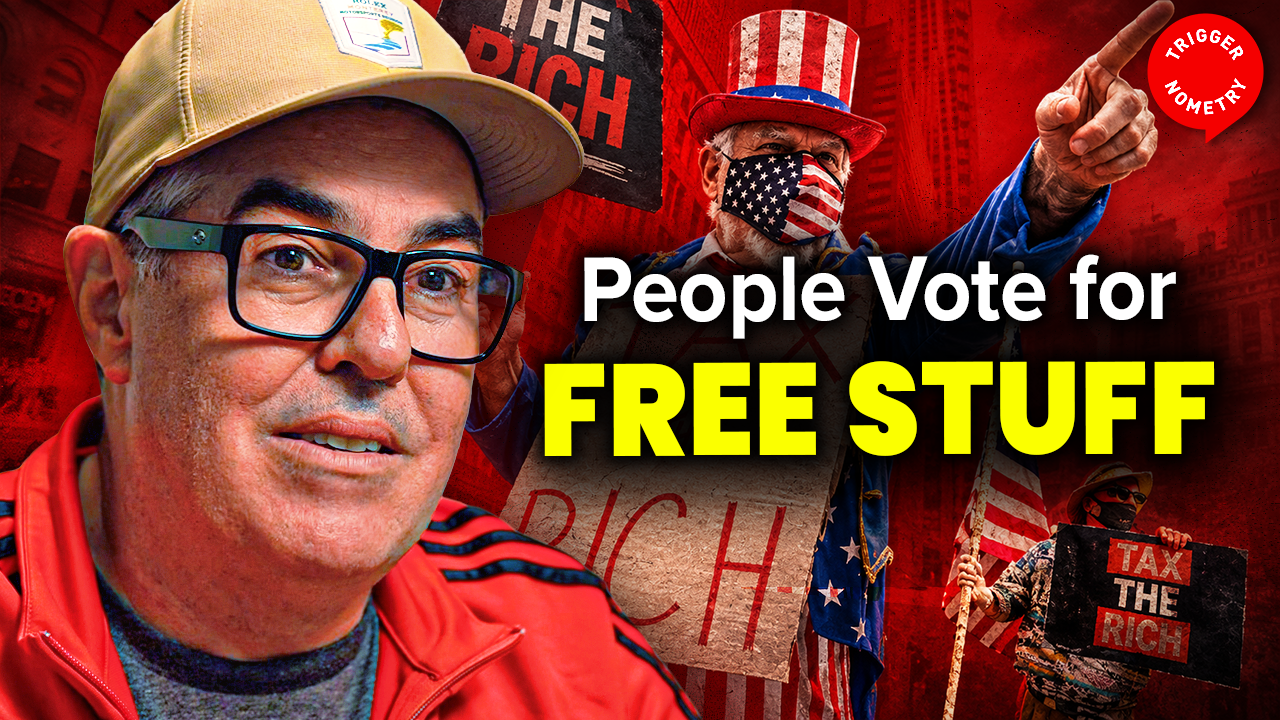
Adam Carolla argues that the “winning message” in politics is envy and fear, claiming politicians promise “free stuff” and “dignity” while blaming the wealthy, which he says breeds resentment instead of motivation. He also discusses how economic pain (especially grocery and fuel costs) drives voter anger more than foreign policy, and how AI/data-center fears are used as a safety-based campaign tool.
Adam Carolla (host/guest). No other named guest is present in the transcript; “Francis” is mentioned as someone he’s speaking with off-mic.
Adam Carolla is a comedian/podcast host known for political commentary and for running “The Adam Carolla Show” (referenced as his frequent appearances after major elections).
Written by AI. May contain mistakes.
Discussing the current political messaging focusing on free benefits and dignity.
“What will you brainstorm, collaborate on, present today?”
Examining how political messages have shifted over time and their implications.
“And you're wearing the wrong color for what happens.”
Analyzing the economic consequences of political decisions and wars.
“I think, look, I think back to two years ago when you were on the show.”
Exploring how rising costs impact public sentiment and political outcomes.
“And then also the Democrats, I mean, the first thing Biden did was cancel the Keystone Pipeline and stop drilling and everything.”
Discussing the long-term effects of political actions and public accountability.
“Yeah, I guess you can't really completely separate them.”
Discusses how economic policies affect everyday expenses and consumer experiences.
“So then he goes, Yeah, but the border, you know, like, okay.”
Explores how fear surrounding AI and job loss is leveraged in political discourse.
“And what happened was because we didn't sign in, it was giving us ads.”
Contrasts the safety-oriented approach of the left with the risk-taking mentality of the right.
“They'll go, give me three months off every year.”
Discusses the increasing role of government in providing safety and dignity to citizens.
“And so I think the AI and the data centers are selling safe.”
Critiques the effectiveness and feasibility of political promises related to safety and support.
“And by the way, I don't know when the government taking care of you became the definition of a dignified life.”
Examines the evolution of safety and comfort in society over time.
“We'll force them to give us their good stuff.”
Explore how innovations have made daily tasks easier and more comfortable.
“and there's a farmer that's down the road.”
Discuss the negative consequences of extreme safety measures on health and society.
“I mean, you know, when you take a look at a car, you know, Model T, Model A, you know, Henry Ford, blah, blah, blah.”
Analyze the balance between safety measures and real-world implications on well-being.
“You don't need a treadmill or a gym membership.”
Evaluate how younger generations perceive challenges and risks in life.
“And in that situation, when people are so used to being safe, the tiniest challenge to that is incredibly scary.”
Discuss the value of overcoming obstacles for personal growth and satisfaction.
“But I told him, you know, I said to him, all right, you want to go?”
Examine the desire for personal achievement versus entitlement in society.
“but I'm going to do it, and then I'll have that satisfaction.”
Investigate the implications of entitlement in political discourse and society.
“One comes along and says, I'm going to give you the opportunity to build a deck.”
Analyze the relationship between work ethic and the growing gap in wealth.
“There's a lot of billionaires out there.”
Explore the significance of hard work, risk-taking, and the disparities in success.
“but I work almost every weekend, as you guys work a lot of weekends.”
Discuss the importance of aspiration over envy in achieving success.
“opportunities that you don't have despite all your success.”
Explore how having a field of expertise contributes to self-worth and satisfaction.
“And by the way, my attitude is like, this guy's got a really nice collection.”
Discuss the negative impact of politicians promising dignity through dependency rather than skill development.
“You know, somebody needs to teach you and work with you, and you can't go, you know, your answer can't be, I know what I'm doing, leave me alone.”
Learn about the significance of dignity and contribution in work, beyond just monetary compensation.
“I think some people think how much you get paid is sort of the end all be all.”
Explore how generational shifts impact personal expectations and attitudes towards work and life.
“I mean, it was, but I was, I am the father of two people who grew up wildly different than I did because I was their dad and they have different expectations quickly, like in one generation.”
Discuss the unforeseen repercussions of governmental policies and their impact on society.
“And also they're incentivized to breed out of people, because let's be fair, you get the politicians you deserve.”
Understand how small acts of kindness can lead to larger, unintended outcomes in society.
“You create something and a system will pop up almost immediately.”

Get the gist, explore an idea or ask about something said.
 Claude
On TRIGGERnometry, what are the key points of this episode?
Searching your listeningAutomatic transcript. May contain errors.
0:01Now for a quick message from Anthropic, the team behind Claude, the AI built for businesses. Customers count on their bank, and banks count on their most important systems. Now those systems count on Claude, and nine of the Fortune 10 companies use it for critical work. See why leading companies trust Claude at claude.ai.span. What will you Canva today?
0:27Francis Foster: What will you brainstorm, collaborate on, present today? What will you resize, post, edit, imagine? What will you research, test, switch, and finally have the courage to pitch? You got this. What will you visualize, design, brand, animate, create, generate? What will you translate, pour your heart into, or have a laugh doing? Whatever you want to make, it's possible. So what will you Canva today? The right message in terms of getting elected today is we're going to get you a bunch of free shit. I'm going to get you all this stuff so that you can live in dignity. They are robbing that person of dignity.
1:13I don't know when the government taking care of you became the definition of a dignified life. I thought those people were losers. When you're in your 30s and your parents take care of you, you're a loser. When the government takes care of you, you're a super loser. Listen, Johnny, you work hard and you study. You one day can be like Mr. Jenkins and live in the big house and drive the Mercedes. And now the dad says to the son, find a rock so we can throw it at the Mercedes. That's where we're at. This is the insidious part of what the politicians are doing. they are breeding that out of people.
2:14Francis Foster: Adam Carolla, welcome back to Trigonometry. Thanks for having me back. I was saying to Francis, I measure American electoral cycles in Adam Carollas. It's like, what, Adam? Because we have you after every big election. Yeah, I know. And you're wearing the wrong color for what happens. Oh, my gosh. I know. After that blue wave, tsunami, whatever we're calling it. Yeah, it's interesting. You know, everyone's kind of talking about finding the right candidates and the right message. But my view is a little more bleak than that. Like the right message in terms of getting elected today is we're going to get you a bunch of free.
2:54And that's about the end of our, I don't know, you know, abolish ICE, defund the whatever, you know, open the border. Like, I don't know if the right, you know, if the right message, like, who are we talking to? Because what used to be the right message is, you know, we're going to be tough on crime. We're going to lower your taxes. Your school systems are going to be great. The border's going to be locked tight and jobs and everything else. And now it's something else. Like it's about, you know, freedom and dignity and free bus rides. By the way, does anyone need a free bus ride? Like public transportation.
3:35Do you know a person that cannot afford public transportation? and if you can't afford public transportation, then you don't have a job. So it sort of takes care of itself. But the message, you know, with the socialist, democratic socialists and all the sort of free this and then sort of with a dusting of like Islamic that and then a little screw Trump in there and F America sort of baked in. I don't know what the right message would be to get elected. It wouldn't be America's great, you know, I love this country and I want to lower your taxes.
4:14Francis Foster: No. I think, look, I think back to two years ago when you were on the show. It was right after Trump won. He won the presidency, winning both the Electoral College and the popular vote. The Republicans won the Senate. They won the House. They literally had everything. And I remember what the mood was like. And I think you have to acknowledge in this situation that Trump with the Iran war really squandered a lot of that goodwill and support that he had. Because up until that moment, he was kind of crushing it. Right? Yeah. I mean, you know, then it kind of comes down to. Well. I mean, I'm not really defending Trump, but let's remove Trump from the equation.
5:02I'm just saying you voted for a guy. The guy thinks he's going to do something that's necessary but unpopular. Would you want that person doing that thing that was necessary yet you knew he could risk votes and party votes and Senate seats and stuff like that? Like if this was a movie, then the hero would do the thing that was unpopular, even though it cost him. And, you know, it could be a principal, the school going, I'm standing up for what I know is right. Then they go, you're going to get fired if you do that. Then he says, I don't care. Some things are more important than a job or whatever.
5:42So, you know, you could you could spin it. So here's my head on it. You can spin it that what did he start that stupid war for? He just cost the Republicans all this stuff. What an idiot. And then you could go, what a hero. He did it knowing that it was probably going to end up this way. So that's character. And then you go, but now we're not sure if we needed the war or not. So that's the in-between part, you know. But just to say, like Iran's horrible. They've been horrible. They're always horrible. They're always funding some death cult du jour. and in terms of putting them out of their misery, I'm all for that.
6:27I know we do a thing where we go, no foreign wars, but I don't know, blowing up people that like blowing up people and constantly blow up people, I'm sort of all right with, you know? I can't say to tell anymore, like in terms of foreign wars, like what is real and what isn't real because we always get some story about, you know, weapons of mass destruction that are hidden, but they're there, you know. We've had a long history of bombing the wrong people or spending too much time in places we shouldn't have been at in the first place. Like, I don't really know who to believe anymore, but it would be nice if Iran was no longer Iran.
7:13I mean, that I get. And then I get that it basically costs the Republicans the House and the Senate. But on the other hand, I don't know, to not have an Iran, maybe it's worth it.
7:29Toby Young: I think the issue is for most ordinary people is that they believe that Trump wasn't going to take them into more wars. He has done. They feel betrayed. and then also there's the economic element of it because you know rising diesel prices rising prices not only with diesel but also the cost of living there's a real anger and frustration there which i kind of get i don't i don't think the democrats are going to do anything to solve these problems no but i understand yeah i think you know i i think the main you know i'm I'm from here, so gas is always more than everywhere else in the nation.
8:12Francis Foster: Here is California. Sorry, here is California. And then also the Democrats, I mean, the first thing Biden did was cancel the Keystone Pipeline and stop drilling and everything. So I have no idea what their new allegiance is to cheap gas. It's weird because all they want to do is stop fracking and cancel pipelines and pull drilling permits. And so it's a little dubious to me that they're also very concerned about fuel prices. But I get the average person. I think where Trump really screwed the pooch is really just the economy. Like and and, you know, because you go no foreign wars, but kind of like, I don't know, there's no boots on the ground.
8:58People aren't coming home in coffins. It's like it's not the top of everyone's mind. Everyone kind of agrees Iran's a piece of shit and they shouldn't have nukes and so on and so forth. I don't really think it's so much that. I do think it's the economy. Like, just everything is super expensive and it bothers people here. Like, you know, Iran is something that I think the people that are really sensitive and really into the minutia and the weeds can be bothered by. But the going to the gas station or going to buy groceries, like it is, you know, especially if you're, you know, I went to, I don't know, El Pollo Loco bought me and my son like three pieces of chicken.
9:53It was like 28 bucks. And I'm like, what? So there's that. I mean, that, I think, I think it's the economy more than the war. I think he ran on the economy. I mean, it's always no foreign wars. I get it. But it was, I think if people, I think if the prices were down at the grocery store, people, people would continue to vote, you know, Republican and Trump. I think it's the economy that really got people. Stuff has not come down.
10:29Francis Foster: Well, the argument would be, I think, that because of the war, the price of fertilizer, of diesel, of gas, what you guys call gas, of what we call gas, all of that, that's all gone up, and that feeds into the price of everything else. Yeah, I guess you can't really completely separate them. But even before the war, you know, What Trump said is, soon as I'm elected, prices are just going to come tumbling down. And eggs are going to go from this to this, and meat's going to go from here to here. You just elect me, and everything gets affordable the next day. And it just didn't work out that way.
11:12Francis Foster: Well, you know, there was this line that people like to use about how the media took him literally, but not seriously, but the people took him seriously, but not literally. But I think, you know, eventually people started taking him both seriously and literally. And as you say, he made, he said, I think he said yesterday when he was asked whether, you know, part of the problem is that he didn't keep his promises. He said, I kept more promises than I made, which is the most, the most, but I think part of this is, you know, like you say, you don't, the, the cost of things hasn't gone down. In fact, I mean, we come to the U.S., it's expensive, man.
11:52Francis Foster: It is expensive. We're not used to that. Like, I know when you go to London, it's expensive. Like, stuff's expensive. But we're not used to that here. Like, we're used to Walmart, tons of stuff for cheap, you know. And so, and the durable goods, like the TV sets and the washing machines and stuff, don't seem to be that bad. But it's the day in and day out stuff, you know, food that really gas fuel. So, yeah. So, you know, I have no idea why he waged war when everyone sort of told him it was going to just screw the midterms. But he damned the torpedoes and did it anyway. And there's a lot of other stuff.
12:38Francis Foster: I mean, I was very hopeful that he would end the war in Ukraine. Hasn't happened. War in the Middle East. Yeah, yeah, yeah. You can go down the list. I agree. And the thing is, closing the border, huge achievement. I mean, it sounds kind of dumb to say, but it was. I mean, objectively, it was not closed before. But even in that process, I think we see the stance now. His vote with Hispanics massively went down. And a lot of people attribute that to some of the excesses of vice. Yeah. Well, the thing, too, about winning, you know, the border or it's sort of like winning a championship or Super Bowl or something.
13:20That was two years ago. Like everyone's sort of like, what's now? You know, that's like, yeah, you said you're going to close the border. You close the border. So what's what else? You know, so there's kind of an element of you don't really get retroactive credit. You get credit for stuff you didn't do, but you don't really get credit for stuff you did do. It's kind of like a marriage, really, if you think about it. They just remember the sh** you didn't do or the stuff you screwed up, you know? And it's not a win in a lot, you know, it should be sort of a scale where he goes, I said the Ukraine war was gonna end momentarily.
14:00That's true. So then he goes, Yeah, but the border, you know, like, okay. But, and job creation and, you know, cutting a lot of federal jobs and waste and stuff like that. But people, all the stuff Trump does, nothing really affects a human being like going to checkout at a supermarket, having them ring it up and looking at that bill and going, oh, wow, like that's right there. The cutting deficit or deficit spending or Medi-Cal or Medicaid or Social Security, that's all kind of distant relative stuff. You know, it's that real like hand the bill at the restaurant, which is I'm always like, I can't get out of anywhere like me in a, you know just me and another guy and we're ordering like sandwiches and one drink or something it's a hundred bucks like it's a hundred it's like it's it's weird and so that's the one that's the one that hits the the stuff where you've taken on the you know unions or whatever that is that's that's too deep a dive for most people do you know the other one and i think
15:21Toby Young: you're spot on because most people it's the tangible and it's the real and the Iran war gives them very something very convenient to point the finger at and to explain the rising cost of prices I think there's another subject that people feel very passionately about and this subject's only reared its head in the last 18 months two years which is AI you know data centers You know, Constance and I were in Texas and we were watching a YouTube channel. And what happened was because we didn't sign in, it was giving us ads. And a lot of the ads were talking about data centers, particularly on the left.
16:01Toby Young: This is a real concern for people as well as AI taking your jobs. And, you know, they were saying things, you know, talking about restricting building data centers, restricting AI, all of this, which sounds to the ordinary person, very, very, very, very comforting. Yeah. Well, the left and the Democrats definitely work on a kind of a fear thing. They get them to work with COVID real well. It works with a lot of stuff. They just get them fearful. And then they say, we're going to assuage your fears. And don't worry. Now we're here. We're going to take care of your fears. And I don't even know where to begin with the data centers.
16:43like it's also weird to proclaim that you're an expert or you know about something that's 10 minutes old that you don't know anything of so i i'm always careful not to wade into stuff where i'm really like who you kidding i don't know anything about this stuff but i do know that you can make it into something and you can then use it effectively and then you can promise that if you vote for me, I will keep you safe from AI and from data centers and so on and so forth. And people, most of the people I know on the left are fear-based and the people I know on the right are more sort of progress-based.
17:28And so if you think about, you take a job like school teachers, you go, okay, school teachers, college professors, people in education, it's always 96 % Democrat or they vote, you know, when they do the thing on college campuses where the professors donated what party did it. It's into the high 90s toward the left, right? Because they will trade money and riches and rewards for safety. They'll go, give me three months off every year. Let's take every holiday off. And every 10 minutes, we'll come up with someone else to celebrate so we can get another day off. Who's a black guy who's done something?
18:15Come on. We need another day off. And in return, we're not getting rich. But we're going to get paid. And they can't really fire us. And what they're saying is, I want safety over flourishing. I'm not here to you know I'm here to make it through safely now I could start my own business but I could go bankrupt and I don't want that and I don't even want all that goes along with that I will trade all this for safety so you have the people on the right and the people on the right are generally more the entrepreneurs or sort of the risk takers you know like in general just less safety oriented like the COVID came around everyone on the left was super locked down safety and everyone I knew on the right was insulted by the safety and didn't want to participate in it.
19:06So there's a safety versus risk. And all you have to do to sell to the safety people to get their vote is explain to them that there is a risk and it could be coming for your job and it could be using up all your water and all your electricity and the safety people will all go, well, then none, none of that. The risk people are like, sure, that could happen, but also we could get our ass kicked by China and we need this, you know, so let's do it anyway. And, you know, as we progress as a culture, we get more safety oriented than we do risk oriented. We are each generation it gets safer and safer and safer everything gets safer all forms of transportation but just general stuff like people say have a safe foot have a safe day instead of have a good day or what have you everybody's there's you know this is a safe space yes thank you when i was growing up there was a football helmet and a crash helmet and that was about it There was no other kinds of helmets.
20:22There wasn't helmet for skateboarding, for bicycling, or for... There was no... There was just two helmets. Now there's 1 ,200 specific helmets because it's safety, safety, and more safety. So it's like, if you're selling safety, that's something that people in America are going to buy. and you will get votes selling safety. And so I think the AI and the data centers are selling safe. The people against it trying to get votes are selling safety.
20:58Toby Young: And that makes a lot of sense because if your bills are going up, if your wages are stagnating, if the dollar, because, you know, quantitative easing, you know, you printed so much money, is no longer worth what it used to be, then you're already going to feel kind of edgy about it. And then someone's coming along going, well, and you're reading about AI or you're seeing it on your phone and then someone comes along and goes, I'm going to protect you from that. If you're that way inclined, you're going to be like, things are not going well. I need someone to help protect me. Yeah, I think just in general, the government's role of protection has grown by leaps and bounds.
21:39You know, they're talking. I mean, Mindani was talking on a podcast and it was like, what is socialism? It's like, it's whatever you need to live in dignity. That's what it means. And whatever you want, the government will provide if you feel like you need this to lead a dignified life. And by the way, I don't know when the government taking care of you became the definition of a dignified life. I thought those people were losers. Like when the government, or by the way, when you're in your 30s and your parents take care of you, you're a loser. When the government takes care of you, you're a super loser.
22:20So the government has expanded its kind of safety net into not only sort of, you know, physical safety, but just sort of spiritual safety. Like we are going to protect you. We're going to uplift you. you're gonna live with dignity, you're gonna have a seat at the table, you know, everybody deserves to live this way, and I'm gonna provide, like, the proclamations that the politicians are making are, first off, they're untenable, it's not, I can't provide dignity for you, especially times, you know, 340 million people. I mean, it's literally impossible, there's not enough money, there's not enough time, And I don't even know what dignity is to you.
23:09It might be different to me, to you, to him. So in general, what government is doing is it's just widening and widening. It used to be like, I'm going to, you know, we're going to keep the streets safe and we'll fill the potholes. And, you know, we'll fight off any any hordes who come here and try to try to take our women. But after that, you know, you're on your own. You know, we don't do that anymore. We're getting into the promise business, you know.
23:40Francis Foster: And I mean, one of the things with the election results, we had Stephen Crowder on the previous guest before you. And he said, if the Democrats take the House and the Senate, there is an 80 percent chance, according to his model, that they win the presidency in 2028, which is kind of historically very likely as you go. And I was looking actually at the cow shields of this. John Ossoff is now in poll position to be the next president of the United States, according to the prediction markets. I thought Buttigieg was the poll position guy.
24:21I'm not sure what position is poll saying.
24:25Francis Foster: But like if you're talking about the ever expanding state, a situation in which the Democrats have the two houses and the presidency. I mean, the whole country is going to go in a more Californian direction. Yeah, and, you know, the experiment might be over at that point. I mean, if your pitch is really nothing but I'm going to extract more money from this group and get it to you guys so that you can have all this stuff that, you know, They don't need all of what they have. It's a weird pitch. It's a super lazy pitch. If you really just break it down, like if you just go, if you really just break it down, like as a politician or really as a business person, like, you know, someone goes, you manufactured doors and windows, you know, and they go, what's your plan for running our door and window shop?
25:25And mine's like, I'm going to go across the street to the successful door and window shop. I'm just going to take their shit. bring it on our show. Good? I mean, yeah, but you go like, yeah, but that doesn't make you that good a CEO, does it? Like, I'm just going to go, yeah, no, we'll bring guns and we'll just go over there. We'll force them to give us their good stuff. They don't need all their doors and windows. They got more than they need. They'll give it to us. Like, that's a pretty lazy, if you think about a concept, except like as a manager or as a politician, just to constantly say, I'm going to get folks that work weekends and holidays to kick down more of their junk, and then I'll kick it over to you.
26:13It's kind of weak sauce. Like if you really think about it, you're like, well, wait a minute. What do we even need you for? Like that's not even a plan. My plan is how do we create stuff? How do we entice this? is how do we get them to be more productive so we can take more of their tax at the rate that it's at now? Like, or whatever it is, you just go and we're going to take their stuff and give it to you. Not only does it sound super lazy and it also doesn't sound like you've got much of a plan, but also it's never worked. So why are we to think it's going to work?
26:48Francis Foster: It's interesting what you said about safety. It made me think, so I have a four-year-old and I read him, he loves knights. So I read books about knights. And as I was reading this book, I realized this has genuinely been happening for hundreds of years because knights used to joust with actual weapons. Then they went down to blunted weapons. Then they went down to, you know, and it just carries on and on and on and on and on until the point where we are now where you literally have parents not allowing their kids to do anything for fear of them hurting themselves. Yes. It's just been this ongoing process for hundreds of years.
27:20Yeah. I mean, it is. I mean, it's an evolution. Safety is an evolution, much like convenience is an evolution. We're wired for convenience, comfort, ease, and safety. So that's built in. So whatever used to be, used to be, we'll go out and hunt. I was like, wow, that sounds like a hassle. And then it sort of came, they were like, okay, there's a butcher over here, and there's the guy who bakes bread over here, and there's a farmer that's down the road. And then at some point, we were like, why don't we just put them all under one roof, and you could just carry the stuff. You go get the meat. Oh, wait, don't carry it.
28:11Push. Push a basket. Put wheels on it. You know what I mean? And then in air conditioning. And then at some point, we went to, why don't they just deliver the food to the house? You know what I mean? And then it was like, why don't somebody just cook the food and then just bring the food? So now it motivates, like the innovation and motivation. I mean, you know, when you take a look at a car, you know, Model T, Model A, you know, Henry Ford, blah, blah, blah. You know, I just drove over here. Well, I didn't drive over here. The Tesla drove over here with the air conditioning blowing and the satellite radio humming and it was no, you know.
28:54So we're made for comfort, safety, and ease. Every single thing just got easier, more comfortable, and safer. So that's how we're wired. the problem is we're not really it's like
29:19our tendencies are for that but also sitting around in air conditioning and have someone bring you food all day leads to an early death and obesity and diabetes and whatever be nice to start off every day with a big glass of wine. You know what I mean? But it's not good. So now we're entering the self-governing phase of existence. No one had to self-govern. The well was five miles away. Start walking. Come home with a gourd on your head. You don't need a treadmill or a gym membership. Life is a gym membership. You know, you're hunting, you're, you know, livestock and, you know, all started at five in the morning, you know.
30:17So now we're in some weird phase where it's like someone had to invent a treadmill because we had to simulate walking to the well because stuff's coming out of the sink for free. You know what I mean? And by the way, not good enough for us. Not a safe. Now, not safe enough. So we are bred, I mean, for safety. And it's going to be hard to tell people, you know, hey, it's starting to become harmful. Like safety can hurt, you know, COVID. the COVID safety protocols hurt a lot of kids, hurt a lot of businesses, hurt economies, hurt people psychologically. Like that under the umbrella of safety, you did a lot of damage and caused a lot of suicides and drug addictions and ODs and stuff like that.
31:14So how safe, you know is this and so then you get into this like appearance of safety which is six foot paper mask you know what I mean now we're just you know mask up in between bites like is this really safety or is this just the illusion and almost delusion of safety
31:41Toby Young: anyone who runs a business knows the moment you're in the middle of five things a phone goes and you make a quick calculation, leave it, call them back later. Except later rarely happens and the call could easily have been the best customer you were never going to get. Today's episode is brought to you by Quo, spelled Q-U-O, the business phone system built so you will never miss a call. What Quo actually does is straightforward. Every call, text and voicemail lands in one place. So whoever on your team looks at it can see the full exchange and pick it up from there instead of starting cold. Several years into running trigonometry, I've learned that most operational problems aren't solved by hiring more people.
32:22Toby Young: They're solved by better systems. This is why Quo stands out to me. It's simple enough to set up in minutes and doesn't require anyone on the team to become an IT person overnight. And when nobody on your team is free to pick up, an AI agent takes a call, answers the obvious questions, and can book someone in immediately. The league doesn't sit overnight going cold, which is usually when you lose a business. There's a reason Quo is the number one rated business phone system on G2 with over 90 ,000 businesses relying on it. Money's on the line. Always say hello with Quo. Try Quo for free plus 20 % off your first six months when you go to Quo.com slash Trig.
33:06Toby Young: That's Q-U-O.com slash Trig.
33:11Francis Foster: And in that situation, when people are so used to being safe, the tiniest challenge to that is incredibly scary. And that's why people freak out. Right, right. And you notice that with the younger generation where it's like they're totally fear-based. So everything feels like potential trouble and not an opportunity. and yeah and and they they sort of grow up in this i don't know call it a bubble but it's it's literally some sort of terrarium of safety that they that they live in and they and they don't know what it's like to sort of you know push it a little bit out there and most of the best experiences of my life, there's been some element of danger or risk involved with it.
34:11Sometimes it's an emotional risk, sometimes like a sort of financial risk. Sometimes it's a physical risk, but every good story, basically when a story is told, danger is there. When a book is written, when a movie is made, it's always, you know, there's a kind of, you know, I quit my job and I didn't have anything to fall back on. And I didn't know where my next paycheck was coming, but I started my own business, you know, and, you know, and there was, well, it sounds pretty scary not knowing how you're going to provide for your family. And then there was always like, it's never like this guy picked a fight with me.
34:54He was about five, two, and he was morbidly obese and he walked with a limp. No, so it's this guy. This guy was 6 '6". He looked like a linebacker, you know? But I told him, you know, I said to him, all right, you want to go? You know, it's always danger, danger, odds stacked against us. You know, we came through. So we're all living the fantasy, like every book, every Disney film, every movie, every novel, every story told, It's always danger. So that must be the part of life we're most attracted to. So why are we trying to snuff out the part that's the main character in every story?
35:39Toby Young: Because if you don't have to, then why would you? Yeah, I know. But you don't have to cook your own food anymore. And you don't have to walk your own dog. and you don't have to involve yourself with many of life's sort of rituals or necessities or what have you. And I would argue that's why so many people are sort of spinning out. Like we need what Dr. Drew calls like an ordinary misery. Like just a part of life where you're like, I don't wanna have to go mow the lawn today, but I'm mowing the lawn. Or I don't wanna go wash my car. I'd rather have the guy come over and detail it or whatever, but I'm going to do it, and then I'll have that satisfaction.
36:28Yeah, you always feel so good when you've done those things. Yes, it's the best. And it's also, you also will, you know, here's what I would say. You, if you, let's just say, we'll take the same subject, but we'll go three or four different directions with it. You go, there's a beautiful deck on the house that you live in. And you throw a party or a barbecue or something, and people come out, and inevitably they go, this is an amazing deck. And the story you want to most tell is, yeah, I put it on myself. When I got here, it was just dirt. I added this baby on myself. So that's the best. you know the the second best is like yeah my father-in-law's a carpenter and he came over and i helped him you know we put this deck on the third worst is like uh was on the house when i bought the house and then the fourth is my dad bought me the house right so don't we all want to tell the story of building our own deck is that the best part now we all the problem is is we want our dad to buy us a house and we don't want to build a deck, but we want the story of building the deck without having to build the deck.
37:51And that's where the politician comes in.
37:54Francis Foster: Well, right. I was going to say, and this is the problem with politics because politicians, you know, there's two politicians. One comes along and says, I'm going to give you the opportunity to build a deck. And the other one says, I'm going to buy you the house with the deck because you're entitled to it. And I'm going to take that guy's deck, which is too big, and give you part of it so you can have a deck. In the UK, we call it he's not paying his fair share. Yeah, we do that out here too. I wish... I would love to pay my fair share. That would be so awesome. That would be so awesome as I know it.
38:35You know what I mean? because my fair share would be so much lower than what I'd pay.
38:39Toby Young: It is subjective, though, isn't it, your fair share? I don't think it's subjective. I think they tamper with verbiage too much, and they sometimes get themselves into trouble, like where they go, you know, my sister donated her eggs for$20 ,000. It's like, well, that's not donating. And your gender isn't assigned at birth. You know, like they get a little over their skis with their verbiage sometimes. But your fair share is. As far as I know, the word share and the word fair is basically if we all rented out this Airbnb for a week and it was seven grand at the end of the week and there were seven of us staying here, then I guess my fair share would be a thousand bucks.
39:32Depends how impressed I am. madam you look pretty white last time i checked i'm half latino mate so we need to factor that in
39:40Toby Young: yeah they have those in uh in england yeah yeah well they have one my mother oh so the to me the fair share to me would be a thousand bucks everyone is all seven people stayed in the house for seven days at seven you know the bill that that would be my fair share now you could kind of talk me into saying, yeah, but the camera guy doesn't make as much as you. So how about instead of going 1 ,000, you go 1 ,200, and he can go 800. And I could go, A, it should be my prerogative. I should be able to go, well, he signed up. He's living in the same house I'm living in. He didn't get any privileges that I didn't get, provided we're all in the same room and we all have the same access to the bathroom and the TVs and stuff.
40:29So my fair share should be that. Our camera guys is looking very upset by this, by the way. I would tend to kick in an extra couple hundred quid for that loser.
40:41But now the government is forcing me to do it. And it's not 200 bucks. It's all of it for a bunch of guys. And then those same people are accusing me of not paying my fair share. And that's the part. I would take a thank you winner very much for working as hard as you do. I would take that. But instead, you get everyone wagging their finger at you, wanting you to pay your fair share. I mean, it's insane. It's pretty easy. There's, you know, 340 million people in this country. I don't know what the collected revenue from taxes, but it could break down into a share. There's a number that could be assigned to every person over 18 who's gainfully employed or whatever it is.
41:32There is a number. And I guarantee the people that you say aren't paying their fair share are paying quite a bit more than what that number would be.
41:41Toby Young: I mean, there's a lot of people, Adam, who are listening to this going, Adam, come on. There's a lot of billionaires out there. There's the first trillionaire. Are they paying their fair share? Because why is there an ever-growing gap between rich and poor? Well, also it's like, I was thinking about my family, and I'll try to answer your question, but I work almost every weekend, as you guys work a lot of weekends. You know, no one in my family ever worked a weekend, ever. All of them, and there wasn't that many of them, but they never worked a weekend in their lives. So just working more, like a lot of the people we're talking about, they don't take off holidays and weekends.
42:28Like they work a lot. They also innovate. And when they innovate, you know, the market repays them. And the chasm between them is true. But like the chasm between a guy who can play in Major League Baseball and have a career and like start versus a guy who's just really good, but at the junior college level. I mean, that is just a massive chasm. And there are always going to be those massive chasms. And the massive chasm is kind of the motivation for those guys. I think I don't see I don't really think the chasm is going to be bridged by getting these guys to kick down to those guys. The chasm has to be bridged by those guys learning a skill or being more productive or figuring out a way to be excellent to kind of pull themselves into closing the chasm.
43:35It's like it's sort of like it's a foot race and some guys are just taken off and everyone else is sort of struggling to catch up. And the government or the left, their thing is like, why don't we hobble these guys and slow them down a little bit so we can narrow that gap? And my thing is, I'd like to get the people that are following them to figure out a way to speed it up.
44:01Francis Foster: Well, it's interesting. So I know the stats for the UK. Billy, can you look this up for the US? So in the UK, the top 10 % pay 60 % of all income and capital gains tax. Right. And the top 1 % pay 30%. Yeah. Now, that's not a share thing because they also make a lot more. Billy, what is it in the US? It's in the same neighborhood. Same neighborhood? So the top 10 % or the top 1 % either. What total share of tax do they pay? It's a thing where the 1 % pays an alarmingly high and then the next percent. And then as you get lower, you get into nothing. But also as you get lower, you use a lot more of the services that a lot of the money is going to.
44:45So it's not just these guys pay more. It's you pay less and use more of what a lot of that tax money is going to.
44:56Francis Foster: So in the UK, more than half of people are at the point where they consume more in tax than they pay. Billy?
45:05Toby Young: The top 10 % of owners pay about 70%.
45:08Francis Foster: 70 %?
45:10Toby Young: And the top 1 % of owners pay about 30.4%.
45:14Francis Foster: That's more than in the UK. Yeah, I guess it is more. Wow. So... The top, just for people who didn't hear that, the top 10 % of people pay 70 % of all the tax. That is insane. Well, the insane part is they get yelled at and AOC wants them to pay more and is demonizing that. And Bernie Sanders demonizes them. That's the part that's insulting. You know, they should be bought fruit baskets and told, thank you very much for what you've done. So the comical part is demonizing the folks that are keeping the lights on around here, which it's just disingenuous when politicians do that. And they also know it's real easy, like Obama would give a speech, you know, you think they think they're smarter than you.
45:58You think they work harder than you. First off, they work harder is such bullshit. And it drives me nuts. Like, I used to work really hard, had really hard jobs, like physical, dirty, just crawling under houses, you know, digging, you know, with a coffee can because there wasn't enough room to get a shovel under there and stuff. Like I had really gritty blue collar, pay nothing, miserable jobs. And I used to work a lot harder than I do now. But I learned to work smarter and like more efficiently. And I also learned to pursue talent and get training and get experience and, you know, meet and network.
46:47I work a lot. I started to work a lot. So when they go, do you think these people work harder than you? No, I don't work harder than a roofer works. I make 50 times as much as a roofer, but I don't work harder. I work smarter. That's what you should want the roofer to do. This notion of like, oh, I expended this many ounces in sweat or burned this many calories. It's stupid. That's what poor people do. That's all I used to do. It's insane. Like this hard, they claim to be hardworking. Now they're smart. They're not hardworking. Now you could say, I work every weekend. And maybe you don't. So maybe that is harder.
47:30But it's not for me. I stand around and tell jokes. I don't have a hard job.
47:35Toby Young: It's also going back to this idea of risk taking. Like there's nothing wrong with being a roofer. It's a very important job. It's actually quite a dangerous job and a tough job. but if you're going to take on the risk because you want to, inverted commas, better yourself, maybe you want to start your own roofing business. That's a risk. All of a sudden, you're going to take on employees. What happens if there's a downturn in the economy? You've still got to pay people. That means that you don't get paid because when you've got your own business, you get paid last. That's how it works. You take the rewards, but you also run the risk.
48:10Toby Young: So I think that's a very important point as well. Yeah, I mean, the people that we're talking about kicking the money down to or the free this or the low discount that or the free transportation or whatever are not taking the risk. And, you know, it's the risk. The risk is what you get paid for. You guys understand this. Anybody in show business understands it's the risk that you get paid for. And it's but also it's not a healthy dialogue to have. And the reason I kind of reject it is when I was poor and I was poor, my family was poor and everyone was poor for an extended period of time. I didn't make any money until I was 31, 32.
49:06I was, you know, zero to 30 poor. and I know people like to you know they like to glorify or embellish their poorness I don't know why but I yeah I was my family was poor we didn't have stuff my mom was on welfare and food stamps and stuff we didn't have any money and I didn't have any education or anything either so I was just going to be poor um but um I never looked around and went what why's that guy got a big house or why is that i was it was aspirational to me you know we used to have shows called uh lifestyles of the rich and famous it was so people like us could go whoa look at that house wow mercedes-benz you know and then you would go man i'd be what what if i could you know and then the message would be study hard work hard you know eat your wheaties one day carb load in the morning And then one day, you know, and it was always that I never had an ounce of envy or ire or anger at successful people.
50:18And when I was a carpenter, I would have at some point I would have to work for successful people. I would be built a house in Beverly Hills, you know, not my house, but the guy who owned the house would show up and I'd talk to him, you know, and I was like, wow, that's a big, expensive house. Bill, I've worked in a lot of really nice houses with people that had money and made good livings. And I was always just kind of trying to figure out how they did it and maybe how I could, you know, get some of it. And the idea that a politician wants to pit me against them, that's insidious. They should be saying, these people know something, and you should basically not be angry at them.
51:11You should be trying to have them tutor you. Like, they should basically be telling you, I'd like to know what they know, instead of resenting them. it also does not help the group that needs to get to them, to anger them, and then to make them think that the reason they're not them is because they took all the money or because of systemic racism or it's because your sexual proclivities. So what politicians do is they go, you should resent them and you're here. And the reason you are here is because they're bad and or and or society hates you. And we don't have a level playing field. And now I have no motivation to work harder and try to get there.
51:59Because why would I? There's systemic racism or the playing field tilted in their direction or it's daddy's money or some bullshit like that. So it disincentivizes these people and it angers them. I mean, what you start to see now is anger. Because at a certain point, I wrote in one of my books some years ago, I said, you know, it used to be this country would be a son, a father and a son taking a walk at night or something. And then a big Mercedes would pull past them. And then the father would say to the son, that's Mr. Jenkins. He lives at the big house on top of the hill. Listen, Johnny, you work hard and you study.
52:43you one day can be like Mr. Jenkins and live in the big house and drive the Mercedes. And now the dad says to the son, find a rock so we can throw it at the Mercedes. That's where we're at. And that's not a society you want to live in. And by the way, Mr. Jenkins, who may have taken some time to mentor your son, is not going to do it. He's just going to hire another security guard.
53:12Francis Foster: Let me introduce you to the people I work with to protect my family against financial instability, inflation, and turmoil. For me, one of the best ways to safeguard your wealth is by investing in gold. And that's why I trust the Pure Gold Company. Here's a smart tip. If you buy UK-minted gold coins like Sovereign's, you won't pay VAT when you buy them or capital gains tax when you sell. All the profit is yours to keep. And the best part? Gold is a completely private investment. It's outside the banking system, so it can't be manipulated by governments or anyone else. Unlike digital assets, it's yours in the truest sense.
53:49Francis Foster: The Pure Gold Company is trusted by first-time investors and seasoned professionals alike. What I really appreciate about them is a knowledgeable, pressure-free approach. They explain everything clearly, so you feel confident about your decisions and they never push you to buy. Physical gold has stood the test of time as a store of value and it offers peace of mind that other assets can't match. It's reassuring to know that even if the banking system falters, your gold and its value remain safe. Whether you're looking to diversify your investments, protect your savings, or just gain the security of owning a real physical asset, we highly recommend the Pure Gold Company.
54:25Francis Foster: Click the link in the description or go to pure-gold.co.trigger to get your free copy of the Investor Guide. That's pure-gold.co.trigger. Take control of your financial future today. And it's interesting you say that about the attitude shift because actually, and you know, this attitude works at whatever level you are. There are people who are so much richer than you and who have so much stuff and so many opportunities that you don't have despite all your success. That you right now, you Adam Carolla right now could take a drive up, you know, into that, like you said, the Hollywood Hills or whatever, and look at houses there and go, I can't afford that.
55:06Francis Foster: Why has this guy got a private jet? It just never ends. Like, if you have that mindset. I could look at some of my old houses and say, I can't afford that. I remember beating off in that room.
55:21Yeah. No, you know what? I collect cars and I have some really interesting cars and some nice cars and I won't bore you, but I have a decent, pretty good collection, but I go to events with guys that are heavy hitters and, and those guys have real car collections, you know, and I know what they got and I see what they got and they know what I got. And I, you know, I'll look at one of their vintage Ferraris and go that, that one car is worth more than all of my cars combined, you know and so there's always a kind of an element when you're talking to just car guys you know what do you got and when the guy says yeah i got a 71 muro lamborghini uh sv look at there's six and a half million bucks right there you know and i got a daytona convertible you know ferrari okay i don't know what that is and you're doing the math and at some point you're going, well, that guy's collection is so much nicer, but I have a nice collection too.
56:26And all I want to do is see if I can work a little harder and maybe get a little closer to his collection for my collection, not decide that he owes me part of his collection, or I'm going to take a drywall screw and put my initials in his door, you know? And by the way, my attitude is like, this guy's got a really nice collection. You should suck up to him a little bit. Why not? You know what I mean? I mean, how could it hurt? And by the way, that's how all those guys roll. They just network and network and network, you know?
57:06Toby Young: Are we talking about Jay Leno, Adam? We have interviewed him in his car garage. I know. It looked good. No, you know what's weird? He has an amazing collection, but I'm not jealous of it because they're mostly not my kind of cars, which is weird. But there are guys I'm thinking of that have smaller collections of cars I like.
57:26Francis Foster: I'm glad you mentioned the word jealous because I'm not jealous. Like, I have a friend who has a watch that is worth more than all my material possessions and my bank account and all of it. I'm not jealous. I think that's cool. like good for him. I do not become less happy or less fulfilled or less satisfied by someone having more. Well, you know what? I think this is an important thing. You need a, one needs a field of expertise. If you have something where you can go, I have an expertise in this, you're never going to feel lesser than in a sense. Like, if you are, you know, like, when I was a carpenter, I had a field of expertise, and it was pretty good, you know?
58:18And I would come into a nice house, and I'd be talking to some guy who was a super successful lawyer or something, and I'd be looking around going, God, I live in an apartment, you know, I could never afford this. But at some point, he'd go, I don't know anything about, I can't hang the door. You're the expert. You could hang the door. And I was like, yeah, I am the expert, you know, standing in his house that I could never afford, you know. And there's a sort of element to owning an expertise. Now, it's not going to work if you're just sitting in a cubicle and you're pushing papers or you work at the DMV or the airport or something like that.
58:58But people used to have trades and skills. And when you have a trade and a skill, there's a kind of dignity to it. And you don't really feel beneath people because the rich guy calls the tradesman and the person with the skill. And it's everything. It's the car. It's the plumbing. It's the electrical. It's the AV system now and stuff like that. Like, you know, the real rock stars for rich guys is the AV guy. Because they invite people over. They go, we're going to watch the Super Bowl. Damn. Damn. And then all of a sudden the AV guy like shows up, you know, that's the rock star. Like that's, that's the hero, but a feeling having an expertise and it could be the law.
59:48It could be medical. It could be a standup comic, but it could also be a welder or a roofer, just owning something and knowing something. and even if it's just playing the cello or having a black belt in taekwondo, like people need that. And all the miserable people you see out there, they don't have a field of expertise. They don't own anything. I don't mean tangible things, but I mean all those super angry 25-year-old chicks that are like pushing against ice and screaming at the top of their lungs or all that, But all those people, there is no way you talk to that chick and she'd go, I'm a certified scuba instructor.
1:00:37Anyway, let me go fight ice. You know what I mean? Like they don't have an expertise. They don't have a skill. People used to have hobbies and skills and expertise. and that evens the playing field real fast because the super rich guy, he may be super rich, but he does not know how to hang that door and he knows it and he defers to you and then thanks you for it.
1:01:03Toby Young: And it also humbles you because the moment you start learning something, you're invariably terrible at it. Yes. You're absolutely terrible. You're trying to do it. It's so basic. It keeps falling apart and then somebody else does it and they just put it together. So it doesn't matter. how many YouTube subscribers you go, oh, you played this venue and X amount of people turned up. If you're trying to hang a painting, you can't do it, and you hammer your thumb, it doesn't matter how much you earn. You're just angry and in pain. And also... That's enough about your life. That's a little theatrical.
1:01:37And your old lady's up your ass and your first son's gag. It's a disaster, I tell you, a disaster.
1:01:43Toby Young: It's non-binary, okay? All right, I'm sorry. I must have misread that. They talk in the trades.
1:01:53Yeah, well, also, if you would like to learn and have a field of expertise, you need to study under people. You know, somebody needs to teach you and work with you, and you can't go, you know, your answer can't be, I know what I'm doing, leave me alone. It has to be tell me more, which is a kind of humbling experience. You know, all the as a carpenter, all I did was learn from old dudes who did it for a long time. And I just I never told him I knew what I was doing or you're not the boss of me or hey, old man, you're not my dad. It was always just like, thank you. OK, all right. I'll do that and I'll do it.
1:02:38And I'll never do it the other way again once you teach me the right way to do it. So there is something, I think, inherent in human beings that needs that kind of sense, like we were talking about before, that needs to make your own meal and take care of yourself. And losing that, I think we lose a lot of our sanity in that. And, I mean, imagine the utopia we would be living in if everyone just had a skill that they would call their own, an expertise, you know, just something where they went, yeah, I can do it. Like, nobody is ever, when you own something and you're good at something and you can apply that and get paid for it, you have a sense of dignity that, you know, listen, your rich uncle could die and make you a millionaire tomorrow.
1:03:37it still wouldn't make you happy and probably OD. But if you had way less money than that guy, but you did it through a trade with your own hard work and so on and so forth, you can't put a price on that.
1:03:51Francis Foster: And I think partly that's because when you have something that you're good at, you inevitably serve other people with that skill. That's how you make money, really. When you said earlier you get paid for risk, I think you get paid for serving other people what they want. That's how the market works. So if you're creating something or you're creating something and other people are prepared to pay money for it, that tells you that thing has value. Therefore, what you do has value. And that's the fulfilling thing about being able to be having that skill or having that thing that you're good at, because it tells you you're serving other people.
1:04:27Francis Foster: Other people value it so much they're prepared to part with their hard earned money for it. And that gives you a tremendous sense of satisfaction. And that's why if you have that, like you say, it doesn't really matter how many billionaires there are. I'm not a billionaire. I probably will never be able to. It's not a goal of mine. I don't feel any which way about that. It doesn't affect me because I have things that I'm good at and I enjoy doing. Yeah, I always started to notice that the guys on the job side had a sort of level of sanity and a sort of a self-acceptance that I did not see in Hollywood or other places where there was a lot of...
1:05:11People felt a lot more neurotic, you know? And just little things like, I would always say... I always, I would do the occasional lunch run for the guys working on whatever project I was working on after I, you know, made money and I was doing my own stuff. And I would just tell them I'm buying lunch. And they'd all just go, thanks. But nobody had any gluten allergies or lactose. There's no special diet. They didn't say anything because nobody had it. Because their stomachs were all good. Like, they were good. Their head was good, and their stomach was good, and they were, like, satisfied. And I would just go on a run and just buy, you know, 10 cheeseburgers and just, boom, you know, and they'd go, thanks.
1:05:59You know, and they'd just eat them. Like, there was no, they were happy to have it. There was no food-borne allergies or anything of that kind. And I started to sort of realize that they were all just a little saner than the normal folks I would see, you know, out in society. And when COVID hit, it really set home that example for me, because none of the blue collar guys I work with had any thoughts about COVID whatsoever. And all the white collar folks I did were all up in their head about COVID.
1:06:36Toby Young: Yeah, I think as well, there's something to be said with the skill that you have, you create something tangible. There's enormous comfort that comes from that. Like you're a bricklayer. You put up a wall. People go, what have you done today? Oh, we're building a house. We put up the main wall today. Oh, that's great. And then you talk to someone else. What did you do? I don't know if they do some faceless corporate white collar job. A lot of the time they can't even say to you what it is that they did. Yeah, I know. It's true. And it was also, I remember these little goals that people need to have that can measure things.
1:07:15Like I could remember showing up Monday morning and, you know, someone would go by the end of the week, Friday, we got to have this garage framed out, you know, and get it framed out, you know. And it was almost a little fun trick goal competition, you know. It's like, oh, it's noon on Friday. Yeah, but we almost got the plywood up on the roof. And it kept you occupied. The time passed much, much quicker. There was a sense of sort of team. And then at the end of the day, you'd be walking out on Friday and you'd turn around and you'd look and you'd see something that wasn't there on Monday. And you get a sense of some purpose.
1:08:02and to deny people of that is almost to torture somebody. That sense of progress, like that sense of, I remember when I showed up here six months ago and there was just dirt on the ground, and now, you know, look at this. To do that and then to repeat that constantly is wildly satisfying. And to do the opposite of that, which is just enter data into something that was kind of infinite, never went away, or work at the DMV just stamping stuff. And also, when you go to the DMV, everyone's miserable for a reason. You're asking them to do something that probably humans shouldn't be doing, which is just sitting in the same place with the same group, doing the same monotonous nothing burger day in and day out.
1:09:00Toby Young: I just remember when I was doing the comedy clubs and I was emceeing a gig, I always had this routine when immediately I asked somebody what they did. And they'd say something like this. I'm an international consultancy operator. Just picking three words. And I used to say, see, that's the definition of a proper London job because it's got three words. Individually, they mean something. You put them together. They mean cool. right and i'd go to and i go this is how you know someone's got one of those london jobs because they can't say what it is that they do and i'd say to them what do you do and they would never be able to say that and you get a big laugh in the room and it'd be funny and then we'd move on but you go inherent in that is a tragedy because people are dedicating the majority of their lives to doing something that they can't explain what it is that they actually do and therefore has no value.
1:09:54Yeah. And they're getting compensated for it. But the compensation thing is, you know, it's all relative and it isn't the end all be all. I think some people think how much you get paid is sort of the end all be all. But the dignity part of work, man, that's the big part. That's the big part. And the balance part of work, too, where you're not just in the same place doing the same thing day in and day out is important. And I think what we're missing is is when the politician says, I'm going to get you all this stuff so that you can live in dignity, they are robbing that person of dignity. Like what they should be saying is, I'm going to help get you trained up and you can have a skill and you can be proud of yourself.
1:10:58I mean, working and earning, it is such a huge part of a person's life. I mean, probably more so for males, but all creatures need to feel like they're contributing. The notion of we'll go get you some stuff and bring it by your apartment so you can get fat off it, it's insane. And it's also like we understand this very well. Like at every national park, every national park, the dumpsters behind the restaurant have a lid with a lock on them because bears will get in there and just start eating. And you don't want the bears coming to dinner behind the restaurant. You want them out doing what bears are supposed to do.
1:11:49And they would tell you it's not healthy to have the bears come and eat for free. The bears are going to get fat. They're going to get dependent on the junk from the restaurant. They're going to resent Adam Carolla. They're not going to vote Republican. So you're going to hurt the balance. We understand it. It's the same thing with human beings. Like, you're going to hurt them. You are hurting.
1:12:11Francis Foster: Coming all the way back around to the beginning of the conversation, I kind of always thought that of all the places I've been in the world, and I've traveled to a fair few countries, America was uniquely a place that was built and populated by people who had that mindset. that it was. I mean, it was, but I was, I am the father of two people who grew up wildly different than I did because I was their dad and they have different expectations quickly, like in one generation. You know what I mean? I grew up hungry and poor and sort of ready to go out and bust my and take chances and do whatever it took and risk and nose to the grindstone.
1:13:02And I would do anything to just get out and get busy and do anything. My two kids, who are good kids, have an utterly different relationship with life. They would not do any of the stuff I did or do now. They don't have to. So they got, I said to someone the other day, they grew up in a house with seven zones for air conditioning. Seven. Six or seven different zones for air conditioning. I said, I grew up in a house that had two zones. We had miserable and suicidal.
1:13:43Toby Young: Did you grow up in Britain, Adam? Well, it's kind of funny because we did have zones because there was a window-mounted air conditioner in one room. And then there was another one over in the kitchen. So in a weird way, we had our own poor version of a zone, you know, but their expectation, what they're willing to do is completely and utterly different than me. And they're my kids and they're not my grandkids or my great grandkids. They're just one off of me. And they have a completely different relationship with life. So, yes, we did come over here and have the pioneer spirit and pull yourself up by your own bootstraps.
1:14:26That was that was then. And this is the insidious part of what the politicians are doing. They are breeding that out of people. Yeah.
1:14:36Toby Young: And also they're incentivized to breed out of people, because let's be fair, you get the politicians you deserve. We can point our fingers at, you know, whoever you want to point the finger at. The reality is they're doing what works. If it didn't work, they'd stop doing it. A hundred percent. And it's never not going to work. If you're running for school president and you're running on a campaign of, you know, do your own homework and don't use a computer or AI to do it for you. and I'm running on a campaign of add an extra hour to lunch and also get a soft serve ice cream machine in the cafeteria for free, well, then I'm going to win.
1:15:17Yep. Now, I'm not going to provide any of that. Or I'll take the soft swirl machine and put it in my bedroom. But I'll win the vote off of that.
1:15:29Francis Foster: On that happy thought, Adam, great having you back. As you know, the last question we always ask is, What's the one thing we're not talking about that we should be?
1:15:41I think last time I was probably talking about gyno-fascism with you. That's a big one. I think what we're not talking about is unintended consequences. These things that they try to put forth, they don't live in a bubble. There's an unintended consequence. So if you say, look, what we're going to do is if you have a child and that child is on the spectrum of autism, then the government will pay$1 ,300 a month for every child. You go, at first blush, you go, well, that sounds like a pretty decent society. Because, yeah, you got a kid and he's on the spectrum and you could use a little extra whatever.
1:16:30But in 10 minutes, everybody's kid is going to be on the spectrum. So, you know, hey, what's wrong with the hospice center in Los Angeles? Because there's going to be hospice centers popping up and strip malls and ice cream stores and morgues. It's all. And then, you know, all the stuff we do that sounds good, you know, San Francisco, we'll just give out clean needles so people can have dignity when they inject. It turns into a show immediately. And what I'm saying is everything has an unintended consequence. And before you offer it, you better think of what that unintended consequence is. Now, you see it with the huge amount of graft and payola and everything else.
1:17:23You create something and a system will pop up almost immediately. You know, we have birth tourism because we said if you're born here, well, then you're a citizen. And all this stuff, just like the kid with the autism or just like a family member who takes care of an elderly person getting a stipend. It all sounds good until 10 minutes later when China is flying people over and they're opening up birthing centers so we can have birth on our soil so your kid can have dual citizenship. I'm just saying whatever your plan is, there is unintended consequences that are coming. And you better think long and hard what that is before you offer the plan.
1:18:16Because once the plan is offered, we have trouble getting rid of it in this country. And then we have birth tourism now and everyone's on the spectrum. And whatever's going on with the Somalians in Minnesota and whoever's going on in Los Angeles and all the Nick Shirley stuff, It's endless because you offered something. And I frankly don't think we can offer it anymore. I think people want to police it. I don't think there's a policing of this many people if you're going to offer this. How do you know how many kids are on the spectrum? You invented something called on the spectrum. Everyone I've ever dated thinks I'm on the spectrum.
1:19:01So I should be entitled to money if you think about it. So I think you have to get rid of the offering. I think many of these things just need to go away. I don't see how we can police them. Obviously, we're not very good at policing them. There's billions of dollars just going out the window. So to me, unintended consequences, no matter whether it's on the micro or the macro level, level. You know, whether it's you going, oh, there's a stray cat out there. I'm going to put a saucer milk out every night for the stray cat. You're going to have a hundred stray cats in a week. You didn't think that.
1:19:42You thought you were being kind to the cat. And maybe you are, and maybe you want to continue to do that. But what I'm saying is, is rest assured it's not just this thing. It's what comes next.
1:19:54Francis Foster: Adam, great having you on. Thank you so much for coming on. We look forward to having you back when something terrible happens in this country, which inevitably it always does. Really appreciate your time. Head on over to triggerpod.co.uk where Adam's going to answer your questions. I've admired how you've maintained your friendship with Jimmy Kimmel, even though you have opposite political views. Why aren't there more examples of Hollywood people who can be friends but have different political points of view?
1:20:43The Secret Society of Semi-Homemade. Listen up. Sam's Club has pre-made dishes for a Thanksgiving feast that's ready in two hours, all while tasting suspiciously homemade.
1:20:53Toby Young: Come join us. Sam's Club. Individual oven times may vary.
Triggernometry is proudly independent. Thanks to the sponsors below for making that possible:
- Venice gives you the best AI models in one place. Private. Unrestricted. No lectures. Get 20% off your first month: https://venice.ai/triggernometry/adam-carolla/2026-11-07
- QUO: Business Phone System for Startups. Try QUO for free, PLUS get 20% off your first 6 months when you go to https://quo.com/TRIG
- We highly recommend The Pure Gold Company. Get your free Guide to Buying Gold at https://pure-gold.co/triggerDisclaimer: Gold’s value can fall as well as rise.Past performance is no guide to the future.Gold is not FCA regulated.
- GET YOUR TRIGGER FUEL - https://fuel.triggerpod.co.uk
Join our exclusive TRIGGERnometry community on Substack! https://triggernometry.substack.com/
OR Support TRIGGERnometry Here:
Bitcoin: bc1qm6vvhduc6s3rvy8u76sllmrfpynfv94qw8p8d5
Shop Merch here - https://shop.triggerpod.co.uk/
Advertise on Triggernometry: https://trigger-brands.com | or enquire at [email protected]
Find TRIGGERnometry on Social Media:
https://twitter.com/triggerpod
https://www.facebook.com/triggerpod/
https://www.instagram.com/triggerpod/
About TRIGGERnometry:
Stand-up comedians Konstantin Kisin (@konstantinkisin) and Francis Foster (@francisjfoster) make sense of politics, economics, free speech, AI, drug policy and WW3 with the help of presidential advisors, renowned economists, award-winning journalists, controversial writers, leading scientists and notorious comedians.
Learn more about your ad choices. Visit megaphone.fm/adchoices