Ask ChatGPT

 TRIGGERnometry
31 Oct 2026 · 1h 42m · 43 chapters
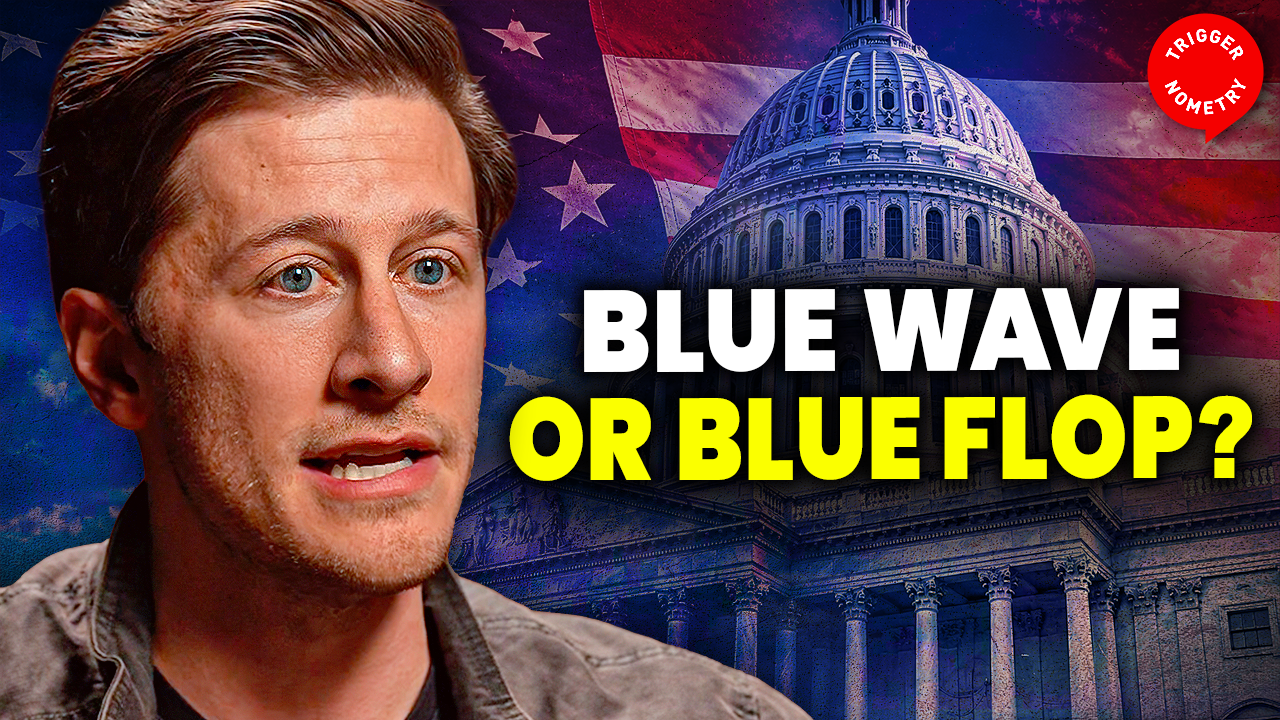
David Pakman discusses U.S. politics ahead of the November 3 midterms, arguing Democrats are likely to win the House but face a tougher path in the Senate. He attributes shifting voter support mainly to economic “salience” (prices up despite campaign promises), then expands to internal Democratic Party splits (center-left vs DSA vs accelerationists vs foreign-policy-focused factions) and the appeal of socialism/communism. He also debates “pardon industrial complex” and preemptive pardons, using the Anthony Fauci pardon as a focal example, and outlines what a potential Democratic-controlled Congress might do (oversight, subpoenas, investigations rather than major legislation).
No guest is identified. The episode is a conversation hosted by David Pakman with an off-mic interviewer/other participant.
Written by AI. May contain mistakes.
Hosts and David reflect on their last discussion and its aftermath.
“David Packman, welcome back to Trigonometry.”
David discusses the shifting dynamics leading to the elections.
“And that's what I want to bring up, right?”
Exploration of how economic issues affect voter perceptions and behavior.
“But people don't think about that when they go to the grocery store or to the gas pump.”
Discussion on the Democratic Socialists' shift back to economic issues.
“I mean, they can say, we've fixed inflation and everything's fixed, which is what Trump has been trying in rallies.”
The hosts debate the relevance of social issues in the current political landscape.
“I mean, Imam Dhani ran on an economic platform, right?”
David analyzes the lack of a clear leader and the fragmentation within the Democratic Party.
“is in stark relief right now because there's so much material to work with in the economy.”
Discussion on the various factions within the Democratic Party and their agendas.
“I don't believe there is any default leader right now of the Democratic Party.”
Explore the divide between radical and incremental changes in political ideologies.
“But they believe that the fringes and the incrementalism just isn't going to work.”
Delve into the beliefs and visions of the Democratic Socialists of America.
“There are folks for whom, you know, our relationship with Cuba and Venezuela, the Israeli-Palestinian conflict, Russia, Ukraine.”
Discuss reasons behind the renewed interest in Marxist ideologies in contemporary politics.
“And so if you ask them, they will have radically different visions of what they are going towards.”
Analyze how economic grievances shape political ideologies and movements.
“But when you identify real grievances, that can make the people you're talking to assume you know how to fix them and that your ideas will improve them.”
Examine the erosion of purchasing power among the middle class over the years.
“What does that mean, 40th to 60th percentile?”
Discuss the housing crisis and its implications for economic stability and living standards.
“I mean, this is all really kind of happening digitally at the end of the day.”
Discussing the need for more housing units and the Democratic Socialists of America's role in the U.S. political landscape.
“You have zoning with everything related to the amount of frontage that's required for each house that limits how many units can be built, how high you can build, all of this sort of stuff.”
Analyzing the likelihood of Democratic candidates winning in key House and Senate races.
“system that they are willing to go with a candidate who, DSA?”
Examining the challenges Democratic candidates face in upcoming Senate races and the potential for enthusiasm among voters.
“But there are a lot of these races where I am suspicious at the level of of enthusiasm that the Democratic candidates are necessarily going to win.”
Exploring what the last two years of Trump's presidency might look like if Democrats control Congress.
“There is no chance of a massive health care bill passing in these last two years if Democrats take either the House and Senate.”
Debating the role of investigations and the potential for political accountability under a Democratic Congress.
“there is a desire for what I would call revenge rather than justice from a lot of the people that are involved in government.”
Discussing the allegations against Anthony Fauci regarding funding and gain-of-function research.
“Specifically though, where and what year was that funded?”
Exploration of legal responsibilities regarding funding gain of function research and its consequences.
“I think that's the way I would summarize it.”
Discussion on the implications of preemptive pardons in politics.
“Well, it quite is because you have people hiring lawyers and saying work on getting me a pardon, get invited to Mar-a-Lago, talk to, you know, et cetera.”
David Pakman explains his ideological alignment with left-leaning policies.
“You're very critical of the right, which is completely fair.”
Analyzing the economic recovery of the UK during Margaret Thatcher's leadership.
“In India, the Kerala state specifically is organized more like some of those countries in Europe I mentioned.”
Debate on the relationship between government spending and economic prosperity.
“So you're saying the country almost went bankrupt because 10 or 15 bands left?”
Discussion on factors affecting business environments and capital flight.
“than when she arrived, falling from 44.6 % in 1979 to 1980 to 39.4 % in 1991.”
Learn about the differences in business environments between the US and European countries.
“All of those things are much easier to do here than they are in the UK and in much of Europe, which is why all of that business is being done here.”
Explore the frustrations Americans face regarding the healthcare system.
“So when you say Denmark has a better business environment than the United States, to me, that's a tenuous claim.”
Discuss the significant costs and issues associated with healthcare in the US.
“I don't really know actually what's going on with the health care here.”
Understand the complexities of insurance negotiations and their implications on prices.
“There are negotiations that happen between providers and insurance systems where they say, OK, you go in for I had an appendectomy, for example, a few years ago.”
Examine the political factors that prevent significant healthcare reform in the US.
“but that would be an example of something that's not working that well.”
Contrast the cultural implications of wealth and healthcare between the US and the UK.
“They just sort of code it a little bit differently.”
Explore the differences between UK and US healthcare systems, including efficiency and private insurance.
“And so I guess what I think probably part of the opposition is it is a system that works well for enough people to keep it going.”
Discuss the varying positions on gun ownership within the Democratic Party and the cultural implications.
“Well, a quarter of Gen Z think political violence against people they disagree with is justified.”
Examine the rise of political violence in America and its correlation with social media and political rhetoric.
“But I do worry that this is a problem that is not easily going to be solved.”
Analyze how language and rhetoric from both sides contribute to the current political climate.
“I think that undoubtedly is the case, which is why I'm asking about it.”
Exploring the small instances of left-wing violence and concerns about dissenting speech.
“Well, if I was a 15-year-old and I was told that somebody is Hitler, I kind of think it would be my duty to go and take them out, right?”
Analyzing how the Gaza-Israel conflict influences UK leftist political views and debates.
“And I think that not that that's a precursor to necessarily somebody takes out a knife or a gun, but I think it's all part of the environment that I don't like around these issues and around speech.”
Discussing the low priority of foreign policy issues among Democratic voters compared to domestic concerns.
“It's legitimate to say, well, we have an interest in the Israeli-Palestinian conflict because we send a lot of aid to Israel, and so the United States is involved, and that's different than Rwanda or whatever.”
Debating the feasibility of a two-state solution and current barriers to peace negotiations.
“I have laid out a plan that has been relatively consistent over the last 15 years as to what I think is the most likely path to lead to peace.”
David Pakman shares his mixed feelings about America's trajectory and societal changes.
“you know, even Netanyahu has now acknowledged that he has a plan for off ramp ramping foreign aid.”
Examining the effects of AI technology on jobs, healthcare, and social structures.
“happen yeah i mean i don't think we will have indefinite republican or democratic rule in this country for the foreseeable future.”
The hosts discuss the challenges of political discourse and the importance of honest dialogue.
“We might not agree with everything you say, and we don't.”
David Pakman emphasizes the need for a shared basis of facts in public discourse.
“We're going to head over to Substack where our supporters get to ask you their questions.”

Get the gist, explore an idea or ask about something said.
 Claude
On TRIGGERnometry, what are the key points of this episode?
Searching your listeningAutomatic transcript. May contain errors.
0:00When it's time to scale your business, it's time for Shopify. Get everything you need to grow the way you want. Like, all the way. Stack more sales with the best converting checkout on the planet. Track your cha-chings from every channel, right in one spot. And turn real-time reporting into big-time opportunities. Take your business to a whole new level. Switch to Shopify. Start your free trial today. Shaq here. What's it like to buy a car from Carvana 100 % online and get it delivered to your door? Let me tell you. Your car is here, Mr. Shaq. Thank you, Mr. Carvana guy. Can't wait to take it for a spin.
0:40Only the best for you, Mr. Shaq. Hey, have you always been so big, tall, and handsome? Not always. I was 6 '10 once. Seven days to love it or return it, Mr. Shaq. Not that I would. You never do. No, I never do. So buy your car today on Carvana. Delivery fees may apply. See our seven-day return policy at caravana.com.
1:00Francis Foster: Last time we had a good conversation, then we had a bit of a back and forth and sniping across afterwards. Oh, I had forgotten about that. Have you? We haven't. No, I had totally forgotten about it. Where is the Democratic Party now? There is going to be movement to the Democratic Party on November 3rd. It is almost certain that the Democrats will take the House. I think the Senate's going to be really a lot tougher. Your country has got into this position where in advance pardon people from their own party the way that Joe Biden did before leaving office, but also it's a tit for tat that seems to me designed to take you down to hell.
1:40The idea of looking at Fauci as a criminal target did not ever really seem warranted to me.
1:46Francis Foster: But that's why you need an investigation to establish. And I would be fine with an investigation. Which is prevented by the pardon that you understand. Trigonometry is proudly independent and sponsors like Hillsdale College make that possible. Access their free library of world-class educational courses at hillsdale.edu slash trigger. David Packman, welcome back to Trigonometry. It's so good to do this in person for once. It is. Last time we had a bit of a, we had a good conversation. Then we had a bit of a back and forth and sniping across afterwards. Oh, I had forgotten about that. Have you?
2:20I wouldn't. I would have been... No, I had totally forgotten about it. I would have been much more apprehensive about this interview over the last month had I remembered.
2:29Francis Foster: I wish we'd told you in advance. And I don't... What was the... What was the nature of it? You sort of said, I came on this right-wing show and here's what happened. Yeah, yeah. And you clipped it and blah, blah, blah. But, I mean, I think it is a center-right show, certainly. Not... This is what we're going to get into, actually. Oh, okay, okay, okay. So, I... We're not trying to go back and relitigate that conversation. No. Nor are we annoyed with you about it or whatever. I just brought it up because it's interesting where we are now, given everything that's going on politically. And that's what I want to bring up, right?
3:00Francis Foster: Absolutely. So one of the interesting things, obviously, the last election here in the United States, Trump wins overwhelmingly. Huge victory. Totally rigged. Well, maybe. Good accent, though. Right? And here we are, only a couple of years later, and the wheels are coming off the bandwagon. I was looking at the Calci market for a potential, they call it, blue tsunami, basically, the Democrats winning the House and the Senate in the midterms, which are coming shortly. Yes. It's approaching 60 % now, and gas prices and Democratic chances of a victory seem to be closely correlated. Yeah. So what do you think has happened that that massive victory only a couple of years ago is now turned into this?
3:46Francis Foster: I mean, it's not unusual, to be fair, for presidents to start to lose ground at the midterms. How do you see it? I think it's very simple. I want to get back to the odds after maybe we can, though, because I take issue with some of the expectations. And maybe we'll agree on that. I don't know. But I think it's really simple. I think that when very specific promises are made during a campaign, not sort of promises that aren't salient to people, like we will reduce the deficit while it will still be positive. But people don't think about that when they go to the grocery store or to the gas pump.
4:21It's sort of like a vague thing that feels a little more distant. I think when there's really specific promises like gas will be 50 percent cheaper, but it's 50 percent more expensive. And every time you get gas, you remember that or groceries are going to come down and then they're actually up and you go to the grocery store and you pay more and you say, I spent one hundred dollars. What do I have here? It's really hard to talk voters out of that. And I don't think this is unique to the Republicans right now. Now, this was a problem for Joe Biden, where the Biden administration was very focused on, here are the macroeconomic indicators that look really good.
4:58And while that can be true, that didn't make individuals who were struggling feel like the economy was going well. This was a problem for Kamala Harris as well. They ultimately lost, of course. I think that that is the majority of what is going on. I think the failed promise on no new, endless Middle East wars is one that it's on the one hand, foreign policy is sometimes more distant from how people vote, but it's having such a direct effect on people's pocketbooks. I think it's basically that. And there isn't much that Republicans can really run on. I mean, they can say, we've fixed inflation and everything's fixed, which is what Trump has been trying in rallies.
5:35I don't think people believe it. Even his own crowds are sort of like not really cheering for that sort of thing. And so you don't have - He could run on
5:42Francis Foster: immigration, but when people are worried about the food bill, it doesn't work. It's hard to Immigration is one era where he actually has had success according to his own metric. By his metrics, yeah, that's true. Yeah. So the Iran war is basically what this is all about. Well, the tariffs were a problem, first of all, in terms of causing rising prices. And then we had the Iran war. And so the price of everything is basically up. Right. Well, and it's interesting. The reason that we're closing the circle about us being sent to Iraq or whatever is we were having a conversation with a friend of ours on the way here actually and we were talking about some of our concerns about the trump administration the iran war you know there's a lot of indications now corruption on a significant scale with it and lots and lots of other things and also some achievements but it's a it's not a universally good picture and he said okay sure i totally agree with all of that and i he said it's not even he said sure i agree he just said i agree with all of that but do you want 10 million illegals coming into the country under one presidential administration which is what was happening under under biden um and that's where we are not we're not american so it's a little bit different but for us it's like we are formerly left-wing voters who just thought the left went off the deep end and i think it's interesting that what you're seeing now in america is the democratic socialists have moved away, the sort of far left of the Democrat movement, have moved away from the woke talking points, the trans, the identity stuff, and have just moved back to where the left used to be, which is economics.
7:26Francis Foster: I'm basically saying everything is expensive and the rich are screwed. You're saying the DSA has moved in that direction? Yeah, I think everyone has. I mean, Imam Dhani ran on an economic platform, right? Yeah, no, that's true. I mean, I think big picture, I think that analysis is accurate. I do think, though, that you have to sometimes look at specific races a little more closely to see the dynamics. And so the way that a Democratic candidate is running in, say, Florida, for example, would be different than in New York City, for example. But I think, to your point, the very tangible salience of the economic issues, I think, is in stark relief right now because there's so much material to work with in the economy.
8:08Francis Foster: Do you think, though, I guess what I'm getting at is more like those voters who would have been pushed away from the left and pushed to the right with social progressivism that they didn't agree with. Do you think the democratic movement more broadly has let go of that, has changed its mind on that, is sort of just gone? We still believe this, but we're not going to talk about it as much because of the economy, as you say. What do you think about that social, what people call woke, I suppose, is woke done? AOC said woke one was crazy, which to me implies there's going to be a woke two. You know, here's the thing about this.
8:43I really try to answer these questions and think about them in the context of what I believe and what I support. And so we would really have to talk to the DSA people to see what they think about that. In other words, are they talking less about trans issues because they found that they are not useful when running elections? Is it because they no longer care about them as much or they simply think that they're not as important? My view is someone who was never big on those issues. And we sort of had a talk about the trans issues last time I was on was that I think what my movement was sort of doing incorrectly was we were being very reactive to the right, wanting to talk about those issues when I never found them to be that important.
9:27I mean, on the issue of like trans sports, I've said before, if we have specific instances where inclusivity is coming at the cost of fairness, I'm going to be right there and I'll say, no, this is a specific instance where the sports league or the governing body should look at that and that's something that should be dealt with. But like Nebraska, for example, where this independent guy, Dan Osborne, is running that I interviewed recently, They have zero trans NCAA athletes. So like my kind of thinking all along was these issues are mostly a distraction from the economic. Now, I think it would be interesting to ask the DSA folks, have they moved away?
10:01I don't know if they have necessarily. Maybe I'll take your word.
10:03Francis Foster: What about the center left more broadly? The center left more broadly, I think, is sort of where I'm kind of talking about this, which is I believe it was a mistake to allow those issues to take such a large place in the conversation. When the economic issues and issues of fundamental fairness, I would have liked to see play a much larger role. That's always been my thing. I've been a big economic guy. One of the things I normally find when we talk about politics, especially American politics, especially Brits, is we always focus on Trump and the Republican Party. And of course, that's very interesting and it's very important.
10:39Where is the Democratic Party now? How do you see them? Are they coalescing around one particular figure? Are they split in the way that the Labour Party might well be in the UK? Yeah. How do you see the Democratic Party at the moment? It's a really good question. I don't believe there is any default leader right now of the Democratic Party. And, you know, it's so funny you bring that idea up. There was a while after the 2024 election where there was a lot of talk of who is going to be the left wing Joe Rogan. And I don't think there's really a desire for that in the left, at least not in the left that I occupy.
11:15I had a dinner a few, about a month ago, with a bunch of creators and some pollsters, and you know, just like Politico types, and they were all trying to figure out, you know, the right gets so quickly united around messaging. Like when the White House Correspondents' dinner shooting happened, within 40 minutes, all of them were saying, this proves we need the ballroom, for example. And we later found, which didn't make sense, the ballroom's capacity would have been half of, it doesn't matter though. They were united instantly, and we later found out that was coordinated. There were signal chats and they were saying, hey, here's the messaging.
11:47And the conversation in the room was, should the left do that? Can the left do that? And immediately the conversation devolved into kind of bickering, where different people were like, well, I'm not going to be told what my messaging is going to be. And someone else said, oh, you know, those messages are usually only tailored towards one demographic. And immediately I had this sort of realization as I sat there quietly, like, this is why there is no one answer to these questions on the left, because from DSA or even further left, like actual communists, all the way to like the kind of Schumer-Jeffries center left, everybody has different priorities and different ideas.
12:21Now, what I do think is important to mention is if you really get people in the room and off Twitter where the communications are just nasty and anti-social and disgusting, I do think that if you were to put up on a board a hundred issues, all of these factions would probably be in relative agreement on 90 of those hundred issues. I do think that the social media platforms, and I write about this in my newest book, exacerbate the appearance of conflict because that's what performs well. But to your question, I do think there is a split, but the split is overrepresented in social platforms relative to what it is on the ground if you go to, you know, Connecticut and talk to voters or Iowa and talk to voters.
13:03And so let's look at that split. Where does that split occur within the Democratic Party? Is it simply center-left, Democratic Socialists of America, or is it more complex? I think that's an interesting entry point. You could say there's the center-left and then there's the DSA. I do think it's more complicated than that. There are, more broadly than DSA, there's the coalition for whom it's essentially a class reductionism. Everything comes down to economic class. Not in the way that I see it where it's economic issues, but it's really everything at the end of the day is class. And so this can include people to the left of the DSA and DSA as well.
13:41I think that that's one group. There is a sort of more overtly center-left group that looks at the current Democratic leadership like Schumer and Jeffries and says, I'm basically fine with that. I think that kind of playing around the fringes of where we are is enough. We don't need more radical change than that. You've also got the accelerationists who are not necessarily DSA. They might be DSA or they might not. But they believe that the fringes and the incrementalism just isn't going to work. There needs to be a massive radical change that's put in place, sometimes even just, like, break everything down to then build it back up the way we want.
14:17I tend, in my first book I wrote about, I'm not an accelerationist. If I look at history over the last 150 years, I think the biggest advancements for the left have come incrementally. And we could talk about some of those examples. So, like, that doesn't appeal to me, but that's another contingent. I think there's a lot of these. And then also there's the group for whom foreign policy has really become like the issue, even though it pulls relatively low for Democrats in general. There are folks for whom, you know, our relationship with Cuba and Venezuela, the Israeli-Palestinian conflict, Russia, Ukraine.
14:49Those are like the main issues much more than domestic. So I think there's a bunch of different groups and splits right now. And let's look at the democratic socialists of America, because a lot of people talk about them. But what is their modus operandi? What do they believe in? What are their policies? What do they want America to be if they came to power? I would recommend asking them. And I'm not saying that facetiously. The reason I mention that is when Jordan Peterson was more of a presence in the public space, I would sometimes comment on things he said and I would critique them. And inevitably, his supporters would write to me and they would go, your critique is based on a misunderstanding or misstatement of what he really means or what he really wants.
15:30And I think the same thing is happening with DSA, where I think a lot of the people that align themselves with DSA aren't actually socialists and may not even necessarily know what that means, while some are. And so if you ask them, they will have radically different visions of what they are going towards. So I think we really have to ask them what vision it is that they want. Not being one of those folks, I don't want to misstate what it is they want to see. Some of them, I believe, have mistaken socialism for simply social democracy. They want, like, Sweden and Denmark, and they've wrongly believed that that is socialism.
16:08I think others actually do want socialism. I think others actually want communism, not socialism. So I think it's better to ask them.
16:14Francis Foster: Sure. And why do you think there is such an appeal for these ideas that you don't agree with yourself, socialism and communism? Why? We had Steve Eisman, the big short investor guy in here the other day. They say this episode will probably go before that one, but we've already had the conversation. And the last question he was saying, can't believe Marxism is back. But it is back. Right. Why do you think that is? I think it's two things. And I'll mention the first one, which I don't think we have to spend a lot of time on, which is I think some people don't understand what those things are. And so they're displeased with the status.
16:50They understand they're displeased with the status quo. They hear about something that sounds different and they go, yeah, I mean, like, let's try that. Can't be worse than this. Can't be worse than this. Well, it can. It could be worse or it might not. Right. But so I think there's some, some is like they don't really know what we're talking about. But I think the bigger thing is there is, and this was the best thing Trump did from a strategy standpoint in 2016, is he identified real and legitimate grievances and problems with the status quo. You could agree or disagree with his solutions. I disagreed with most of them.
17:22But when you identify real grievances, that can make the people you're talking to assume you know how to fix them and that your ideas will improve them. With Trump, it was we're getting screwed by China and I'm the guy who knows how to fix it. Turns out he didn't really know how to fix it. Fine. But identifying the grievance in this populist language appealed to a lot of people. I think it's a version of the same thing that is happening to a great degree with DSA, which is they have a critique, which is a lot of things haven't gotten materially better for many people. across Democratic and Republican administrations, we have a different vision.
17:57And I think that that is compelling when a lot of people are saying, I'm not getting ahead. I didn't get ahead. I don't feel like I got ahead under Trump, nor Biden, maybe not even under Obama. And so the willingness to try something different becomes an easier ask.
18:09Francis Foster: And I know you mentioned, you know, we're best off speaking to DSA people and we always try and invite them on the show, but it's a challenge. Yeah. You don't share their vision, so you must have an idea of what that vision is, right? a little bit. Can you help us with that? Well, if I assume that they are truly socialists and they want to socialize ownership of the means of production, and that means that, for example, companies are mandated to be owned socially by employees regardless of what the creators of those businesses want, that's a vision I'm against. I'm for labor unions, collective bargaining, treating employees well, paying people fairly, all the things that I do.
18:49I really do try to live the vision that I believe is kind of best. That's what I'm for. To the extent that they want to, in an authoritarian way, say, by law, this is how businesses must be structured and they must be socialized. Like, that would be an idea that I'm against.
19:05Francis Foster: And do you think that is what a significant number of them want? It's so hard to say because DSA people call into my show and some of them do say that they want that. And others go, no, I don't think any of us are really advocating for that. And so it's been a difficult thing because much like with the Peterson critiques, where it's like, you're not really, you're criticizing straw men. It's been all over the map in my conversations with the DSA people. I guess if a lot of them are saying it, then, I mean, at least a portion, because Jordan is one person, whereas a movement is made up of a large number of people.
19:40Francis Foster: And if a third of those people, like if a third of MAGA wanted X or half of MAGA wanted eggs. It'd be fair to say that a significant portion of MAGA wants that, right? So, and your view is they're responding to the economic reality for people at the bottom of society who are not winning over the last 20 years in terms of the economic reality? Yeah, I don't even think it's only the bottom, but I think certainly if you divide the economy sort of like into quintiles, the bottom three quintiles, which would include like the 40th to 60th percentile also struggles to afford cost of living in a lot of this country.
20:19I'm going to ask you a question. What does that mean, 40th to 60th percentile? OK, so if you think about the people, zero would be the poorest person and 100 would be the richest person. And you can divide the economy into five pieces. Each is 20 percent. So you've got the bottom 20 percent, 20 to 40, 40 to 60, 60 to 80, 80 to 100. I think certainly that bottom quintile, zero to 20, certainly the second lowest, 20 to 40, and even those who would technically be at the median, like in that 40 to 60, even they express that the cost of living situation, affordability, etc., don't make life easy.
20:59Francis Foster: Winning the war was only half the job. Once the British had gone home, the Americans had to build a government strong enough to keep order and restrained enough to protect liberty. Very few nations have ever pulled that off. Hillsdale College's new series, Revolutionary America from Subjects to Citizens, tells us a whole story across six episodes covering the growing conflict with Britain through independence, the war, and the writing of the Constitution. You visit the historical sites, hear expert accounts from Lexington and Concord, Bunker Hill, and Valley Forge, and get material that didn't make it into the full-length documentary.
21:32Francis Foster: Watching this as a Brit is a strange experience. For six episodes, you're essentially watching your own country get it wrong repeatedly and then lose. Very educational, not great for national pride. This is one of more than 40 free courses Hillsdale offers on the Constitution, the Roman Republic, the American Founding, Genesis, the Second World War and more. All built the same way, taught properly, not dumbed down. I couldn't recommend Hillsdale courses more highly. Go to hillsdale.edu slash trigger to watch. It's totally free. Learn the history, understand the founding. Start right now at hillsdale.edu.
22:08Francis Foster: And why do you think this has happened over Republican and Democratic administrations? Why do you think there's a consistent erosion of the purchasing power of that 60 %? I don't have the last 20 years of purchasing power in my head, but let's assume that at least it hasn't grown dramatically for the purposes of this conversation. I think it's a bunch of different things. I mean, one, the advancements in productivity for workers, in other words, how much they are producing per unit of labor, has increased significantly dating back 50 years. But the vast majority of that productivity growth has gone to the owners and stockholders of companies rather than the workers.
22:49So if things get more expensive, but at the same time, the vast majority of the profits are going disproportionately to the owners and stockholders as a simple matter of mathematics. Forgetting about the ethics of it, which can be debated. Simply think about it as a matter of mathematics. That is going to make things more difficult to afford for people who are sort of middle class and working for a living.
23:10Francis Foster: Do you think it's also something to do with large scale printing of money that's been happening this entire time? You know, that start, I don't weigh in on that as confidently and definitively as some others because I've read very good economic work on both sides. there is the view that any printing of money, any increase to the money supply is inherently inflationary. On the total other side, there's modern monetary theorists who say that that's not how it works. My view right now, and this is all subject to learning more about it and empirical studies, et cetera. My view is that the so-called printing of money, which is arguably a misnomer.
23:51I mean, this is all really kind of happening digitally at the end of the day. Okay.
23:55Francis Foster: The increase in the money supply. The increase in the money supply, yeah. If it's being done for economically stimulative programs, it seems to be a net positive for the economy. If it's being done for non-economically stimulative programs, not so much. So I'll give you an example. Food stamp spending has a really high economic multiplier. The idea being if the government spends, it could be deficit spending or not in order to increase the amount of food stamps that people have. Because of how food stamps work, they're for food. They're mostly spent at local grocery stores, which employ people who then get money to spend at other.
24:32That is a very high economic multiplier. I've not seen good evidence that that sort of deficit spending is bad for the economy.
24:39Francis Foster: But see, that's spending. Spending can come from different sources. You could tax to give people food stamps, right? What I'm saying is when you increase the money supply, you naturally, and we've seen this with COVID both in your country and in ours, when you print money, you increase the money supply. What happens is you get that inflationary spike because there's way more money chasing the same amount of goods that is in the economy. and so over time the people that own assets which go up in price as a result run away from the rest of society which is why you have the people at the top quote-unquote getting richer they're not they are getting richer but it's not because they get a bigger share of the productivity it's just because assets rise in price when we do that I don't I wouldn't I would agree with you but I wouldn't say it's also not just because of that I mean a country of 240 million people yeah no I I think all of these analyses have to be taken together, but I don't have any particular disagreement with that as a factor.
25:35Cool. So how much of all of this is to do with what we have in the UK, which is a housing crisis? How much of this is to do with people? I have a lot of empathy for, you know, millennials and Gen Z. A lot of them did everything they were told to do. They went to school. They worked hard. They went to college. They come out of college saddled with a load of debt. They then go and do a job and they go, hang on a second. Not only can I not buy a house, I can't buy a flat. Not only can I not buy a flat, I can't even rent a flat for myself. I have to live like a glorified college kid into my 30s and 40s.
26:12Yeah, that housing is the biggest single expenditure for most households. So, of course, even small changes to the cost of housing, much more so than like, what's your cell phone bill or does Netflix raise the price by a couple bucks, is going to have a disproportionate impact on people's day to day. Housing's complicated because on the one hand, you have the phenomena in the United States where private equity is buying up more and more single family homes, which is giving them pseudo monopoly power in some markets, not in large cities generally, but in some markets. So that we could look at that and say, well, that's a problem.
26:48There's also extraordinary. Can I just before you move on to that? Yeah, that's really because people talk about this a lot. Yeah. And there's a lot of people, particularly me, who don't know what's going on. Can you just flesh it out a little bit? Yeah, you have companies like BlackRock and others that will just sweep up large portions of homes in certain parts of the country. Sometimes they're buying homes on the secondary market. Sometimes they're going to some of the largest home builders, not like your local developer that builds five homes a year or 10 homes a year, but the ones that are building hundreds of units.
27:19And they'll say, we'll take the entire neighborhood. So that that that's what we're talking about. I had a conversation actually with the governor of Colorado about this, where this is happening a lot in Denver. And so that's what I mean by that. OK. Is that fair? Yeah, that's absolutely fair. So moving on, what was going to be your other point following on from that? It's really difficult to build in a lot of parts of the country. You have zoning. This is like what we would call boring stuff in some sense, but it's extremely important. It's really difficult to build. In some parts of the country, you have large tracts of land that are controlled by municipalities or states.
27:50And it's not that they're unwilling to let those go to allow the building of new units, but it's that it can be a decade process to get all of the right permitting and agree on a price, et cetera. So you've got that as an issue. You have zoning with everything related to the amount of frontage that's required for each house that limits how many units can be built, how high you can build, all of this sort of stuff. You're right. This is boring.
28:14Francis Foster: But we have the same shit in the UK. Yeah. And it makes it... At the end of the day, you need more housing units. That's fundamentally the issue. You need more housing units, which by increasing the supply is going to have a little downward pressure on pricing. And I guess the real question and the one that I think is on everyone's lips and probably at this point, nobody really knows the answer to this, is what is going to be the cut through with the Democratic Socialists of America, not in L.A., not in New York, not in the other big cities, but with the average American living in other states.
28:46You're saying, is the DSA coming to power in those places going to be what solves housing? No, no, no. My question is, are people so angry and disenfranchised with the current two-party system that they are willing to go with a candidate who, DSA? In 2026 right now, as we're recording this, in most of the country, the data seems to suggest no. And I was looking recently at when there is a DSA candidate, how often are they winning? and it's about 5%. So right now, it seems as though the answer is in most of the country, there is not a desire to make the DSA candidate when there is one, the representative.
29:29That may change over time. Maybe the next two years, things get even worse, and then there's more of an appetite for more DSA candidates. But so far, the answer seems to be no.
29:37Francis Foster: Well, setting the DSA apart, I mean, I think as we sit here, it's likely that we talked about the blue tsunami, the Democrats take both the House and the Senate, or at least the House, definitely. What do you think the last two years of the Trump presidency looks like if that happens? Well, should we first talk about what scenario I think is most likely? Sure. I mean, I think that there is going to be movement to the Democratic Party on November 3rd. It is almost certain that the Democrats will take the House, although I think it will be by a smaller margin than some of the predictions suggest.
30:14I think the Senate's going to be really a lot tougher. And I don't I'm not saying I think Republicans will necessarily keep it. But there are a lot of these races where I am suspicious at the level of of enthusiasm that the Democratic candidates are necessarily going to win. I mean, I'll give you one example. There are these three Senate races that are being looked at very closely. There's Maine, there is Michigan, and there's Texas. If you look at the polling, the Democratic candidates are winning all three. If you look at the betting markets, to the extent that you value that, the Democratic candidates are expected to win all three.
30:50I think it's extremely unlikely that the Democratic candidate wins all three of those. Now, they may well win two, or at least one, but that's an example of where I think the polling and the betting markets have gotten a little bit ahead of where I am on the Senate. I think it's going to be tougher.
31:04Francis Foster: Why do you think it's going to be tougher? Well, I, I, a couple of things. One we've seen, especially when there are Republican incumbents, late voters tend to break for the Republican incumbent. We've seen this in Maine with Susan Collins before, and we've seen it with the Texas incumbent Republicans as well. And this time it's not an incumbent because it's Paxton, but same analysis. Now I understand and I'm empathetic to the argument that some of my friends on the left give, which is it's never been this one-sided in the polling just weeks before. This time it's going to be different. Fine. That that may be the case.
31:38But my expectation is the Senate is going to be a lot tougher than some of my friends think it's going to be.
31:43Francis Foster: OK, so say, well, let's talk about both, I suppose. Yeah. Let's say the Democrats control the House and or the Senate as well. Yeah. What does the Trump presidency for the last two years look like? Because I imagine it's a lot harder to get anything done if you're in that Yeah, the Democrats I've spoken to have said, we are not going to vote down everything that Trump wants. There are relatively non-controversial things on which there is bipartisanship, a lot of budgetary issues, etc. So I don't think it is going to become this principle of like, we are a no on everything and nothing will be passed.
32:18Because a lot of this stuff is just about the sort of pedestrian funding of the country. And I don't expect there to be any kind of like gridlock deliberately caused by Democrats. But in terms of, you know, for 10 years, Trump's been promising this beautiful health care bill that's been two weeks away now since July of 2020. It's any day now it's going to be signed in. Now he won't tell us about it until after the election. It's always just over the horizon. There is no chance of a massive health care bill passing in these last two years if Democrats take either the House and Senate. But I'll be honest, there was no chance of it passing anyway because they've not really put forward any good ideas.
32:52but the possibility of a big legislation, I think, is zero. I do think that if Democrats take the House, which I think is the most likely scenario, there will be oversight, there will be subpoenas, there will be hearings. I am a law and order guy, so I know that at a lot of MAGA rallies, there's a lot of lock this person up, lock that person up, and when I hear that, I go, where's the due process? What about we start with an investigation and see if there's any evidence? So I'm not calling for anybody to be locked up, but I am... You're calling for them to be investigated
33:20Francis Foster: and then locked up. No, no, no. I'm messing with you. But also, that is what you're calling for. No, I'm calling for if there is probable cause to believe that there was corruption, let's investigate. And if the investigation turns up the need for a criminal referral, do that. And then let's see whether we get an indictment. I am like, I'm law and order on this stuff. I am not looking to lock up anybody without good reason. And by the way, a lot of the stuff we're talking about wouldn't even lead to people being locked up. Right. Well, but this is kind of how these things always work. This is totally outside of perspective.
33:54Francis Foster: I'm happy to be corrected. But basically, it's kind of like the way it works in Russia, just in a slightly more democratic... I don't know that I agree with that. Well, you don't know what I'm saying yet, so you can't disagree with it yet. In Russia, basically, everyone at the top of politics is a criminal, right? But you only get prosecuted when the people who are in charge of prosecuting decide that you are now inconvenient and it's time to get rid of you. And from an outside perspective, what it looks like to me now, looking at your country from the outside, is when the Democrats are in power, they investigate as much as they possibly can and prosecute and go after Republicans.
34:31Francis Foster: And when Republicans are in power, they do the same. Right. So you saw it with all sorts of things, taking secret service away from former Democratic politicians under the Trump administration, going after people. Now they're doing this thing with Ilhan Omar. Maybe it's justified. Maybe it's not. We'll find out, right? But it just seems to me like your country has got into this position where everyone now has to prematurely, not prematurely, pre, what's the word I'm looking for? In advance, pardon people from their own party the way that Joe Biden did before leaving office because they know the criminal investigations and prosecutions are coming.
35:09Francis Foster: And I guarantee you Trump is going to pardon in advance a bunch of his people just the same right and that to me is so much energy is going to be spent on both sides when they are in power investigating prosecuting pursuing the other side a lot of well first of all it creates obviously a huge gridlock in terms of everything else getting done but also it's a tit for tat that seems to me designed to take you down to hell but i don't i don't know that i agree with that i mean certainly i agree with elements of what you're saying which is that there is a desire for what I would call revenge rather than justice from a lot of the people that are involved in government.
35:48I'm against that. And so that on that we agree with. However, you know, I think one of the there's a lot of criticisms of the Biden administration. But one of the things I think Joe Biden did that I think was a good thing was he did. We don't have evidence is the way I would say we have no evidence that Biden was involved in or directing investigations to start or stop in the way that the Department of Justice has been weaponized by Trump. Now, we can have a debate as to whether it's a matter of degree or whether it's a binary thing where it did or didn't happen. But my view on this, it's sort of like with the trans sports thing, where it's like if you come to me with an example of an investigation that is not warranted by the facts and we have reason to believe was done merely for political retribution, But that's not what ever does it.
36:33But this is again.
36:34Francis Foster: But this is why I brought up the Russia point, because in Russia, everyone is guilty. I don't think here everyone is guilty. I'm not saying everyone is guilty here. I am saying that there is always somebody that you can pursue from the other team when you're in power to take revenge, as you said. And look, the one flagrant violation in my mind of a different kind, but nonetheless, I think it's it's a telling thing. pardoning Anthony Fauci in advance and him then pleading the fifth, you go, well, clearly this guy was up to no good. And all you've done is deliberately made it so he can't be properly investigated.
37:11Francis Foster: And if you're a law and order guy, I assume you disagree with that approach. Well, let's see. I mean, I think one of what I disagree with, it's so funny because we all have to kind of, there's this circle that goes on and we are all maybe picking where do we start the story on the circle. But at the end of the day, I think it's just a circle. Oh, no, I'm saying there is a circle. There is a circle. OK, yeah. Right. So but if you're a law and order guy, I imagine you were not happy about Anthony Fauci being pardoned in advance and then not giving any testimony. What's I've been very. So I prefer people to give testimony.
37:43Absolutely. And, you know, and this applies to both Republicans and Democrats. I'm not being on the fifth. I'm not big on the way that presidential pardon power has been used by Democrats and Republicans for a long time. So all of these elements, we probably agree on that part. I also think that the idea of looking at Fauci as a criminal target did not ever really seem warranted to me. Now, I'm willing to have my mind changed on that, but from all of the stuff that I've been reading and the books about him and the reports, the idea of Fauci as a target after 50 years of basically working, I believe, in basically good faith for the national health of the country, on the circle we're talking about, I would go, well, that's a problem.
38:26If you start there, I understand the pardon, even though I disagree with the ways that the pardons have been used.
38:32Francis Foster: Well, hold on. Anthony Fauci is quite credibly being accused of funding research that may have led to this pandemic breaking out. What research is that? The gain of function research. Specifically though, where and what year was that funded? And he funded it personally? He was, I don't remember the details. Billy, could you look this up with Venice AI? What is the link between the funding of that, the Wuhan Institute of Virology and gain-of-function research and Anthony Fauci? Because I believe there were some emails that indicated, but I'm offering from memory, so we'll make sure to get our...
39:05I'm glad to... Let's take a moment. And I should say, whatever one AI question says, I would want to do deeper research to feel fully informed about it. But Well, let's see what it is. Fauci's agency, NIAID, gave EcoHealth Alliance a multimillion-dollar grant and about$600 ,000
39:24Francis Foster: of it went to the Woodman Institute of Virology, so the money was being direct. Critics say it amounted this amount of funding in function research and the contradiction of Fauci's denials for Fauci and his NIA to dispute that characterization and say it did not force COVID-19. Right. Doesn't seem dispositive one way or the other. Well, no. like a fraction if you're a law and order guy this is the kind of shit you'd want to investigate sure and i'm fine investigating it but you said you're okay with the pardon the idea i understand the pardon because you had a republican party that's what you said you said you understand yeah i'm again i don't like the entire this this entire like i'll pardon all these people before i leave and i don't i don't like that but just speaking as people what we just heard is sort of like fauci worked at an agency the agency around the agent funded a bunch of different well yes but He ran the agency.
40:13I don't think there's any evidence he's personally directing grants. It sounds like what was said was there was a grant which funded a bunch of labs. One lab got$600 ,000. And it's possible that that lab was doing gain-of-function research. No, it was. Well, he said indirectly.
40:27Francis Foster: No, no, it was doing gain-of-function research. But not necessarily with that funding. But they're denying that it caused COVID. And we don't know about that funding being for that project. Listen, I think we're in the weeds here. The reason we're in the weeds here, David, the reason we're in the weeds here is solely there. I think based on you, I'm just holding your argument up and stress testing it. Your argument is that you understand the pardon and you said because you didn't think Anthony Fauci was a warranted target for a criminal investigation. And I said there's a very serious accusation being made against him that when he was in charge of this agency, he contributed to the funding of gain of function research.
41:05So based on what he just read, I don't know that your characterization is accurate. But let me take a step back a little bit.
41:12Francis Foster: But that's why you need an investigation to establish it. And I would be fine with an investigation. Which is prevented by the pardon that you understand. I think the critical part here for me is there's a difference between an investigation into who funded what and the lock Fauci up stuff where we don't even know whether anything he did would even be criminal. Like what I'm saying is if let's imagine that what he said, which was indirect and critics say, which critics say is not the evidence says, it's critics say. Imagine that everything he said instead of being, well, this is what some say, it all happened.
41:46What is the criminality of it? And the problem I had was it was very, when you have senators saying, we got to put Fauci in prison, that seems unhinged to me. Investigate what was funded, et cetera. But jumping to this is criminal and he should personally be in prison seems wacky to me. Sure.
42:04Francis Foster: Fine. saying that someone should be imprisoned before they've been convicted is obviously it's political rhetoric but it's not even convicted it's are we even talking about things that would be crimes well i think that if you were to find out that the leader of a u.s agency was funding gain of function research in another country which would that was deliberate right funding gain of function another country was deliberate because you can't do it in america you're not allowed to thereby potentially causing a pandemic that killed millions of people around the world i'm pretty sure that whoever was responsible for that if they in fact were would be up the creek without a paddle when it comes to the criminal justice system it's it's and i'm not trying to be cagey it's a legal question i don't know if the nih funds 40 labs and one of them i i just don't know i don't know the legal answer but flip i'm fine investigating and i think that the the focus on locking Fauci up from Republicans makes me understand the preemptive pardon while I'm against the pardon industrial complex.
43:06I think that's the way I would summarize it. That's how I would summarize my view. I mean, and if new information comes to light, I'm glad to revisit. Look, I think one of the reasons, let's call it the pardon industrial complex, I really like it. It sounds like a punk band. Well, it quite is because you have people hiring lawyers and saying work on getting me a pardon, get invited to Mar-a-Lago, talk to, you know, et cetera. It is quite a it is it is sort of an industry yeah absolutely but the reason i think i mean let's not just the fauci thing let's just look at that i think the reason it's so damaging yeah is the average american looks at that and not even the average american the average person will read about that and go oh that's clearly corruption why are you going to give a preemptive pardon unless you've done something wrong and so your your thought is all preemptive pardons are inherently corrupt i think i i just think that you they shouldn't they shouldn't be on the table well i
43:57Francis Foster: I don't even know that, though, David, because this was actually the meta point I was trying to make about the country as opposed to Republicans versus Democrats. I actually think you're in the cycle now where if I was the president, I'd probably be giving myself and my kids presidential pardons in advance just because I knew the other side was coming in and going to be as vicious as my side had been. And this is an endless cycle of revenge. That was my actual point. OK. I mean, it's a perfectly fine point to make in the abstract, but we have seen, even to your admission earlier, a level of corruption from this particular administration that certainly warrants investigation.
44:38Now, to your point as to whether there are going to be inappropriate prosecutions, et cetera, I kind of doubt it because the DOJ and Todd Blanchett made clear, we are an arm of the White House. He recently said it. And so I struggle to imagine that sort of bogus ham sandwich type indictments are going to come down from a from an AG who says, I basically do what Trump wants and work for Trump. So I don't have that concern. But if we want to zoom out and say this entire pardon situation is is regrettable and not a good thing for a democracy, I would join you in that. I'm going to be honest with you.
45:15I used to think grilling was simple. Meat goes on, meat comes off. You look vaguely competent in front of your mates. Jobs are good and then I tried to grill anything that wasn't a burger or a steak. My frustration before Hexclad was that while the actual meat takes 20 minutes, scraping the grill afterwards takes 45. At some point, I stopped inviting people over for barbecues because I couldn't face the cleanup. Turns out the problem isn't you, it's the grill. Standard grates were never designed for anything smaller than a steak, which is why your prawns end up in the coals and your salmon ends up in three pieces.
45:52Hexclad solved this with their barbecue collection. The grill pan combines the searing power of stainless steel, the durability of cast iron and nonstick underneath, so nothing wields itself to the surface. It's perforated, so heat and smoke still get to the food, and you still get that proper grilled flavor. But your veggies, your seafood, your fish, none of it is falling through the grates anymore. If you want more control over delicate stuff, there's a grill topper, which gives you a full flat surface for things like fish or thin cuts that fall apart the second you try and flip them. And if you want the whole setup at once, there's the barbecue bundle, the grill pan, plus a hybrid cutting board and carving set.
46:33So you're not running back into the kitchen every five minutes. Over a million customers, more than 50 ,000 five-star reviews. Gordon Ramsay uses this at home and in his own restaurant. and that man is not easily impressed. Every piece comes with a lifetime warranty, so you're not replacing this next summer. Don't spend another season fighting your grill. For a limited time, our audience gets 10 % off with our exclusive link. Head to hexclad.com slash trig. That's H-E-X-C-L-A-D dot com forward slash trig. Tell them Trigonometry sent you. So let's look at the left, because you're on the left. You are very critical of Trump.
47:17You're very critical of the right, which is completely fair. Thank you. Why are you on the left? What is it about the left that you think can actually solve America's problems? In fact, you've got a$40 trillion debt, for example. Well, I tend to look around the world and say, what are the systems that have led to the greatest well-being? and I don't have a sort of emotional or ideological attachment to one thing or the other. I really try, and I don't always succeed, to just try to look at the facts. And so when I look around the world, I don't see any libertarian utopias in the mold of the more extreme libertarians that have high levels of well-being.
48:02So I go, okay, that might point me away from that as a way to organize government. I don't look around the world and see communist regimes and say, wow, things are going so well and these economies are thriving. So when I look around the world, I go, listen, the places that seem to be doing best are places with in Europe, they call it center left. Here we might call it slightly more left countries like Finland and Norway, Sweden, Denmark. If you look at larger countries or at countries at specific points in time, you also find evidence that when the governments were of that mindset is when the countries did best.
48:39A couple examples there. In India, the Kerala state specifically is organized more like some of those countries in Europe I mentioned. It's one of the most economically robust parts of India. You look at Uruguay in South America and the years that they had the sort of equivalent of a president who was more in line with those countries is when Uruguay had some of the fastest GDP growth. So I've sort of attempted to come to my worldview as to what sort of organization of government is best by looking at what has worked best around the world. Because there's a lot of people who are going to be saying, look, David, right, the intentions are all well and good, but this debt, 40 trillion, is unsustainable.
49:23It's only growing. We need to basically cut back on government. OK. Are there examples of countries that have cut their way to prosperity from a point of economic catastrophe? The UK in the 1970s, for example. Tell me more about that. So in the UK in the 1970s, we were on a three-day week. We had incredibly high tax rates, which meant that the highest earners left. A good example is basically every single rock band who were huge in the UK, whether it was Led Zeppelin, whether it was Queen, just went, we are not going to pay these tax rates. We're all leaving. But that's like 10 examples. No, no, no, no.
50:06But what I'm saying is those are high-profile examples of that. There were very many rich people who then decided to leave. As a result of that, the UK became bankrupt. We were known as the sick man of Europe. To the point, we voted in Margaret Thatcher. Now, there is a lot to criticize with what Thatcher did. But what I think is inarguable is she saved us economically at the time from going bankrupt. So you're saying the country almost went bankrupt because 10 or 15 bands left? No. He didn't say that. Come on, Dave. I'm trying to understand, but who else left?
50:42Francis Foster: So he was saying the rich people were leaving. OK. The country was going bankrupt. They had what he was talking about, the three-day week. Part of this was a three-day work week. Yes. OK. Bodies were not being buried because there was a lot of protesters from the organized labor movements, et cetera. And it was partly to do with the oil shocks of 73 and 79 as well. But the fact is, Britain became the sick man of Europe and had to be bailed out by the IMF. The year that that started, so what year did that process start, and what year do you think the country had been saved by? In other words, taken out of that.
51:20Francis Foster: So Margaret Thatcher gets elected and begins all the reforms that Francis is talking about in the early 1980s. Okay. And by the late 80s, the country is booming and continues actually to do very well economically until 2008, basically. And is yours, do you believe that government spending at the macroeconomic level at the end of that process was higher or lower than when it started? You mean in percentage terms? No, in raw dollars or percentage, both. Well, the economy grew, so raw dollars doesn't really matter. How about in percentage? I don't know. We can check if you want. We should check. I would be curious.
51:55Francis Foster: Billy, so use Venice AI. Was government spending as a percentage of GDP lower or higher after Margaret Thatcher's, at the end of Margaret Thatcher's final term? As a percentage of GDP, that's interesting. That was what you were asking. What I assume, if I'm not as familiar with the history of Britain in the 80s, I will admit, so I'm sort of taking it. No, no, no, that's fine. My assumption would be that if the country did improve economically during that time, it was because of growth of revenues, not cutting spending. That tends to be how countries improve economically. Well, it depends what you mean by cutting spending.
52:31Francis Foster: She took on miners and other organized labor, which was forcing the government to subsidize a lot of industry. So they cut spending on that. They probably would have increased spending on the military. But we'll find out what the percentage was. Why is it such an important point? Well, my sense is, in the studying I've done on this, that the way countries improve overall their standing economically is with policy that fuels growth rather than cutting spending. In other words, increasing your income is a much faster and more robust way of improving the economic standing of the average person than cutting spending.
53:10And I think that that's borne out in most of the examples that I talked about.
53:15Francis Foster: So government spending was lower as a share of GDP when the Fash left office than when she arrived, falling from 44.6 % in 1979 to 1980 to 39.4 % in 1991. So it was 12 % lower? It would be 5%. Sorry, I didn't hear. Is it 44 % to 30 %? 5 % lower. 5 % lower. Cool. So it was lower. Yeah. So that would be an example. Well, I don't know that it is because it could just be driven by the growth of revenues rather than by actually cutting any spending. Either way, I have no issue. My view on spending is not that cutting spending is objectively a good or a bad thing. I'm fine cutting spending in areas where I think that the government is making a misinvestment.
53:56It's not a controversial thing. But again, towards my general view, the countries that seem to do best have robust social safety nets. They have good business environments. They are not seeing capital flight, I would say, from high taxes. In a lot of cases, the taxes aren't really that high. I mean, taxes in the United States, depending on what state you live in, you're paying more than a lot of these countries that we're talking about. I think pro-growth, which kind of is what Trump said he would be, that he was going to focus on growth. I think that that is a better way to improve the economic standing of a country.
54:28And I think that we've seen that with the countries that are successful.
54:31Francis Foster: Yeah, but what you said there sounds good because you're saying two contradictory things at the same time. You're saying you want a good business environment and a big, good safety net. But those are tradeoffs. You can't have both. Well, everything is a trade-off in a sense, but a country like Denmark has a strong business environment. It's considered a better business environment than the United States, and they have a stronger safety net than the United States. All the wealth of the future is going to be basically created here and in China because of AI, and it's not going to be created in Denmark.
55:00Well, now you're making a forward-looking argument, but you were asking me how I came to believe what system of government is the ideal system.
55:06Francis Foster: I'm saying if we go forward. Yeah, right. Now we're going forward. Well, look, in fact, we're staying in the present. Okay. Currently, all the wealth of the future and the base of that wealth is being built in the United States and to a lesser extent in China, right? Because all of the wealth of the future is going to be coming from tech, effectively. All the new wealth of the future. It may, or a large share of it. And all of that's happening here because the U.S. has a much better business environment than other countries in the world. It depends how you define that. Well, by the actions of the people who are starting businesses.
55:38Francis Foster: If you're a business person in the UK, and we know hundreds of them, who starts a successful tech business, when it gets to a certain point, even if you're a patriotic Britain loving guy, you inevitably have to leave and go to America because it's easier to raise capital here. It's easier to make money. It's easier to hire and fire people. It's easier to do an IPO here. All of those things are much easier to do here than they are in the UK and in much of Europe, which is why all of that business is being done here. When you look at rankings of environments in which to start businesses, the U.S.
56:14is not number one. And there's a lot of surprising places to some people that are better environments. And I'll give you an example. And by the way, I'm not like a critic of the United States as a place to start a business. Like, we're just having a conversation here, but I'm in the United States. I run my business in the United States. I think it's fine.
56:30Francis Foster: You just said Denmark is better. And then... I'll give you one example of something that can be better if you're trying to start a business. when you have a safety net where you and your employees are not linked to the revenues of the business for health care as an example this can be freeing or liberating in a sense to say i can put everything into this business rather than worrying about how are my employees going to get health care it's just an example i'm not arguing that anything in any particular u.s state is good bad i'm just saying there are reasons i understand why other systems can be good business i'm just Passing everything you're saying through the filter of does this make sense to me?
57:10Francis Foster: That's all. So when you say Denmark has a better business environment than the United States, to me, that's a tenuous claim. And then when I go, well, what do I know about this? I know that basically everyone in Europe moves to America when the business gets successful. That tells me that whatever ranking came out for how easy it is to start a business probably isn't reflecting the full picture. because when you look at the actions of business owners, what happens is they leave as soon as... And we see it in our own industry, by the way, right? So we're like one of the few podcasters that have become big, that have stayed in Britain rather than moving to the US.
57:48We love tax, David.
57:49Francis Foster: Well, actually, to David's point, I mean, taxes in most jurisdictions where you would want to live in this country are high, as high as they are in the UK. And businesses like yours are very successful in those jurisdictions. Sure. In the US, I mean. Yeah, yeah, but they mostly moved to Austin or places like that. But anyway, my point is, business people seem to indicate that the US has a much better business environment. And certainly, my direct experience of dealing with people here is there's a much better business environment. Yeah, I mean, I think it's fine to say the people you know prefer to come here.
58:21I'm here also, right? So it's like, I'm not disputing that. But I think there's this idea that's, I think, very US-centric, which is, this is the best place and the only place and everybody wants to be. here, which is not necessarily true. And on a per capita basis, I don't remember if it's Sweden. There are more per capita billionaires from entrepreneurial ventures in some of those countries. Now, they're very small countries from a population standpoint. So the number is still relatively small. So moving on, there's something that always fascinates me about America, which is your debate about health care.
58:56And I'm a Brit. I don't really know actually what's going on with the health care here. People are very upset about it. They're very angry about it. You see anger that, you know, I know people. But tell me what's going on with health care in the U.S.? Why are people so frustrated, so angry? Why do they feel that the system is unfair? There's many different reasons for this. One gripe is health care connected to your job. And there's the argument, which I think is a fair argument, that people staying in jobs they don't really like because they need health care makes them worse employees. And it's not only worse for them as individuals, but it's also worse for the business to have people working for you who don't really like the job, but they're there because they need health care.
59:41So I think the connection between employment and health care is not an ideal thing. You then have, you have Medicaid. Medicaid is for people below a certain level of income. And depending on what part of the country you're in, The Medicaid coverage that you're entitled to below a certain level of income can be very good, and it can basically cover everything, including copayments, everything, etc. Or it can be poor. That's another area of frustration. Third area of frustration. People who are entrepreneurs or employed individually like me, we don't have group plans through an employer that we can buy into.
1:00:17So I basically buy my plan. I buy my plan from a marketplace. I pay$925 a month. That's just my premium. And I have co-pays. I'm paying for medications. I'm paying for office visits, diagnostics and labs, all up until a certain number. So it ends up being the case that people who work for themselves but make slightly too much to qualify for Medicaid are out of pocket a massive amount of money for relatively mediocre plans in terms of what they cover. So, like, that's another area of frustration. All of these different things are, depending on where you're situated economically or geographically, are things that people are struggling with.
1:00:59There's a shortage of primary care doctors in many parts of the country. Many insurances require referrals from primary care doctors to see specialists. So you call the dermatologist and they say, great, who's your primary care doctor? You go, I don't have one. They say, well, you got to get one. You call one and they say, we can't see you for 10 months. All of those things are areas of frustration with health care in the United States. And a lot of people seem to feel that they're getting price gouged every time they go and see a doctor, every time they go for something as simple as a blood test.
1:01:33Is that a fair representation of what's happening? Well, Price Gouged has a lot of emotional language attached to it. I mean, what I can tell you is the following. There are negotiations that happen between providers and insurance systems where they say, OK, you go in for I had an appendectomy, for example, a few years ago. The retail rate of the appendectomy was$35 ,000. In other words, if I had gone in without insurance and I had just been billed, I would have been billed$35 ,000. That's much higher than just about every other Western developed country. So that's a, as a price tag, that's a crazy price tag.
1:02:10And for, for people who don't know an appendectomy, that's literally a life-saving operation. If you don't have that and you're in your appendix burst, you can get peritonitis and die. And we'll talk about the inelasticity of demand when it comes to a lot of these procedures as well. Okay. So 35 ,000 is like the sticker price. If I were to say, Hey, I'm here, I need an appendectomy. I don't have insurance. Now, my insurance pre-negotiated a rate for an appendectomy with the hospital system. And so they said, listen, whether my appendix bursts or doesn't, whether I get this type of anesthesia or that type of anesthesia, whether I need the socks on my legs that keep the blood flowing during, you bill for that, all that stuff might add up to$35 ,000, we pay$6 ,800 for appendectomies.
1:02:58And so the insurance company has negotiated their rate for their customers with that hospital system. So when people say, well, we need price transparency, this is sort of one of the things that's being talked about, which is, should the cash rates differ so much? And then how does the premium I'm paying to the insurance relate to that? And then the third part of this is a lot of people who don't have the insurance and they get the$35 ,000 bill, they don't pay it because they can't afford it. And so those non-payments, which we say, hey, listen, you got to pay your own way if you don't have insurance, that's priced in to all of the premiums that people are paying.
1:03:34So there's all of this waste and bureaucracy in that system. The argument that people make when they say there should be some kind of universal system, it doesn't have to be Medicare for all, but there's a lot of ways you can get universal coverages. If you eliminate a lot of this stuff, we could just spend less, which would allow it to be cheaper for individuals. And there's a bunch of different ways countries have gotten to that, but that would be an example of something that's not working that well. Now, I'll be very honest, for someone like me who can afford the premium, and I know what my maximum out of pocket for the year is, in a sense, it's working okay for me because I know I can go to the best hospital I want and get a phenomenal surgeon, which is what I had.
1:04:14And I know I paid my 925 for the month, I've got my annual deductible of three thousand bucks. I'm good bill whatever you want. I'm okay The problem is for a lot of the people that make too much to be on the Medicaid plan
1:04:28Francis Foster: How much is too much to be on Medicaid? I don't know the answer to that. I think it's dependent I I actually don't know. Yeah, and it depends on the size of your family also. Okay. Yeah, okay Please carry on. Yeah, no So I think there's a lot of people that are falling falling through the cracks. The other thing is when you look at the uninsured rate It misses all of the people who have a plan, maybe through an employer, but they can't really use it because all of the other costs are so significant. So I know people who have a plan through an employer. It might be five hundred dollars a month.
1:04:58The employee pays two thirds. So like the employee is paying the employer pays two thirds. They're paying three twenty. You pay one eighty. You can afford the one eighty. Your copay is 60 bucks every time you go to the doctor. And if you need labs, you first have to spend two hundred two thousand dollars out of pocket before the insurance kicks in on the labs. because you have a deductible. So a lot of people have insurance that they avoid using unless they are very sick because of the ongoing costs of it. That's bad because it leads to things getting more serious. You end up in the ER. That's not the most efficient place to get treatment.
1:05:30So that would be another problem that there is.
1:05:32Francis Foster: And why is it like this? Well, it goes back to the period between World War I and World War II, actually, or maybe during World War I or right after where there was a lot of momentum to a system like the one Germany had at the time. But it was seen as we don't want to do anything the way the Germans are doing because there were very reasonable assumptions. There were growing tensions with Germany. And so there was a big push at that time. Growing tensions. There was a big push at that time to de-link health insurance from employment. But because the German model was not appealing at that time, this kind of like uh employer-related system developed and and it's been locked in for a very long time but but clearly there's a lot of people who are frustrated about the way the system is built today yeah but if everyone agreed it needed sorting out you'd find a way to sort sort out so there must be some resistance from the right in this instance because you're you're the what you're describing uh is it's a left-wing critique well it would be naturally right it would be but a lot of people on the right do agree with it.
1:06:37They just sort of code it a little bit differently.
1:06:39Francis Foster: So this is what I was asking is, what is the political disagreement that's causing this system to remain as it is? Well, both the hospital system lobbies and the health insurance lobbies are very powerful and significantly entrenched with, it's not only Republicans, it's Republicans and Democrats. Many Democrats are also taking money from these companies. And so there's a feeling and how true it is, you know, we could sort of debate. There's a feeling that the vast majority of elected officials don't really want to kind of upend the system, and they'd rather work around the fringes and make little tweaks that still keep the insurers happy.
1:07:19Francis Foster: Well, okay, that's politicians. Those politicians must have a base of support, though. If you've got a normal Republican who doesn't agree with your point of view on this, what would they say? I would be curious today what they would say. I mean, I think 10 years ago, they would probably say, uh, no, I believe that the insurance companies and the hospital systems are working well together for my benefit, and we don't want to do the socialism thing that Canada has because you wait six months for a hip replacement. You know, I think that the critique would have been something like that about 10 years ago.
1:07:51I think increasingly, and to a degree, Trump has played a role in this because Trump has said the system's not working. His ideas for fixing it, I don't think, have been so good, but Trump has sort of been populist in his language on this i think today you would find much more agreement from your average republican that the system is broken i would be interested in talking to them though
1:08:10Francis Foster: about how they would fix it well i suppose part of it is also what you said which is if you if you're doing well it actually works great for you and this is one of the things i always think about when i think about the difference between our country and yours is i always say america is an amazing place to be rich it's probably the best place to be rich in the world it's kind of a hard time tough tough tough place to be middle class i think that's true and it's a horrific place to be poor yeah and which britain is almost the other way around in in every way like it's actually comparatively speaking this is all comparatively speaking a much more comfortable place to be towards the bottom end and a much less uh good place to be rich in because the government really comes after you and taxes you and also the culture is very different i'm interested in that because I don't know if you saw these man-on-the-street interviews that were done recently in Britain.
1:09:01By whom? I don't know. Okay. But I think it's more than one person. And the question that was being asked of residents was, if you look at the 50 U.S. states and look at their income per capita, have you seen this one? Well, we're poorer than all of them. Exactly. Now, what I was thinking to myself was, it must be sustainable to live there because outside of that income, there are benefits that you get, like access to the NHS, that must in some way subsidize what is a nominally low income. Like, is that your understanding?
1:09:34Francis Foster: Well, we also have tax credits for people who don't make enough money. Okay. Well, don't make enough money is a strange way of framing it. Make below a certain amount. Make below a certain amount, the government tops it up. Right. And we also obviously have a generous welfare system for people who are not working, whether that's because they have a disability or they're between jobs or whatever. So this is what I mean when I say it's comparatively a better place to be poor, because you're not going to starve in the UK. Right. But in America, you kind of could. I think that's right. And so I guess what I think probably part of the opposition is it is a system that works well for enough people to keep it going.
1:10:13Francis Foster: Well, right. And if you are in the position that you are, there is no reason why you think because you see in the UK, people at the top also get private health insurance even though they have access to the NHS. Same in Argentina where I'm from. And the reason is, you know that thing about you've got three factors and you can only pick two, speed, quality and cost. So in the UK, it's free. Actually, a lot of it is good. Not all of it, the NHS is good. But generally, the thing you're compromising on is speed. So if you want to wait six months for a hip replacement, you'll probably get a decent one and it's free.
1:10:48Francis Foster: But you're going to have to wait. If you're someone like you who makes x hundred thousand x million dollars a year why would you want wait six months you're quite happy to get health insurance and get it straight away and have the amazing surgeon that you had what's interesting about that is i have a an american friend who's currently working as a doctor in the uk in the nhs system he's just living there temporarily and he wanted to sort of learned how it works. He did say that even at the NHS facilities in the ER, there are policies where I believe it's that within four hours, you either need to be treated and discharged, or you are determined, hey, we need to keep you here and you get a room.
1:11:31Assuming that his understanding of that is true, that's more efficient than a lot of the ERs in the United States. I mean, like, I know that that's not a hip replacement. This is somebody who's going into the ER, but that sounds okay.
1:11:42Francis Foster: Emergency care in the NHS is brilliant. Oh, it is? Okay. Generally. Yeah. That said, they're a massive waiting list. So that's a target you're talking about. It does not always get. Is that right? No, no, no. So this is the problem with the nationalized healthcare is you're always going to be compromising on speed and availability of service, right? That's the trade-off. And so when you expand coverage more broadly, you give it to more people. It's free or cheaper. At least it's free at the point of use. It's actually very, very expensive because it's not very efficient. But still cheaper per person than in the US.
1:12:17Francis Foster: Yes. But the argument about that always puzzles me because I think partly that's because you're getting way more for your money. When I talk to people who have private healthcare here, it's way better than what we have. They're getting far more advanced technology in terms of The drugs they get, the treatments they get, there's way more availability of all kinds of differences. So you're not comparing bang for buck. It's like you're saying this guy pays way more for his car. He does, but he's getting a Lamborghini. Yeah, that may be. Although a lot of that stuff, I mean, most people have private health care in the United States.
1:12:52And so it's less of an unusual thing. and everybody I know still deals with denials from insurance companies having to fight for the uh the the newest drug rather than the generic like I think that I think that there's a ton of that even with private insurance I mean I have what's technically called private insurance even though it's through one of these marketplaces and I deal with all of that stuff yeah yeah I'm
1:13:13Francis Foster: sure I'm sure I'm sure happens there and by the way the other reason will be your guys wages are so much higher that's true that you're you're paying for an American doctor who's getting paid 500 grand a year instead of a British doctor who gets 80 grand a year. He did mention that the salaries are dramatically lower. Yeah. And you, well, you should see what they are in Argentina. I have friends who are doctors there as well, and it is shocking. Yeah, absolutely. The one thing as well that I think, I think I don't really understand the position of the left, kind of unfair, but is your position on guns?
1:13:46So it seems to me that there's particularly people of the left who are very anti-gun. There seems to be people on the left who are very pro-gun. Okay. What is the Democratic position on guns? There is not one position. What I can tell you is, I mean, listen, you could ask me my position. I think there's a range, and it also is very regional. Like, for example, Vermont, which is a very Democratic state, has a very high gun ownership rate, but the cultural dynamics of that are very different than gun ownership, for example, in cities, in different parts of the country. it's more about hunting and home defense, and it's maybe a little bit more like Switzerland, which has a high gun ownership rate.
1:14:24But culturally, the guns play a very different role. I have a lot of friends on the left who have gotten firearms permits and firearms over the last few years because their view is they don't want all of the guns to be in the hands of the right, which to me is a sort of eye-opening, kind of terrifying thing where it's a little bit of a race to the bottom in a sense. But the point is, I don't think there is a unified position on
1:14:51Francis Foster: firearms on the left. I think what Francis was actually getting at, I suspect, is in the way that we've just had you explain your view of the health care thing. Why is the gun debate such a big thing here? And what is driving those mechanics? Well, I actually think it is not an issue that ranks highly in state, local or federal elections as an issue that voters are clamoring for action on. So I would push back a little bit on the idea that it is such a big issue. What I do think is true is there are so many shootings in the United States. If you go on Gun Violence Archive and you just look at yesterday, usually there's a bunch of mass shootings where at least a couple of people were injured if not killed, especially when it's crazy to say a major mass shooting rather than a minor mass shooting.
1:15:35But when are there these major mass shootings that sort of capture national media attention for several days or longer, there is this sort of period where those on the left say it's too easy to get guns, which I do agree with. Like we have a second amendment. I don't dispute that. But I do think it is too easy to get firearms in a lot of states. We need more ways to limit the types and some specific firearms that are widely available. I think it ignites that because you see the horrors of some of these incidents that take place, incidents that are pretty unique to the United States. If you look around the world at places that have that level of per capita gun violence, they are significantly less developed countries in general and not places that most Americans would say these are the countries in our cohort.
1:16:21When you go, what countries are in our cohort so socially and economically, et cetera, they are countries with almost no gun violence. So I think that that's why it becomes an issue. That being said, it's a pretty bad issue for Democrats to run on in elections, because what tends to happen is you don't really mobilize your key constituencies to come out and vote. Democrats are mostly going to come out and vote for Democratic candidates because of economic policy and because of other issues or because they just habitually vote. But when you take positions that are seen as adversarial to the Second Amendment, the right activates and it can actually be very counterproductive for Democrats to run on that issue.
1:17:01And I found something you said at the very beginning of this bit so interesting where you said that your friends who are on the left were buying guns because they were worried about the people on the right who are buying guns. Yes. They already have the guns. Yeah. I said they already have the guns. Well, there are plenty more available. Yeah. Yeah. But I mean, David, as someone who lives in America, that's that's terrifying. Terrifying. I agree with you. I agree with you completely. And the idea I mean, you know, and to be clear, these are not people that are open or concealed carrying. It's I'd like to have some firearms at home locked up and the know how of how to use them should it become necessary.
1:17:39But it is is motivated by when you see the disparity in gun ownership rates, they get scared. And by the way, this is not my view. This is not something that I've done. But yeah. But that speaks to - You don't have an armory. What's that?
1:17:55Francis Foster: You don't have an armory. You know, I make it a policy of not talking about whether or not I have firearms. He's got firearms. Sorry, we're just messing. No, but that speaks to something far deeper, which is the distrust of the other and the division inherent in your society. Well, I don't think it's so much about political division, but I think it's about this. There is something culturally in the United States that is very different than in Canada, than in Switzerland and other gun-owning countries, where in a lot of these countries, gun ownership aside, the idea that you would use a firearm to try to solve an interpersonal or political dispute or disagreement is beyond the pale.
1:18:38Nobody would ever think of doing that. Not literally nobody, but at a population level, almost no one would think of doing that switzerland with this insanely high gun ownership rate that it's just it's just not happening so i think it's a cultural problem in the united states where it has become i don't want to say anybody authorized it but we have gotten to a place where a lot of people do see it as valid engagement with the system to say here's a problem i might try to solve this problem with a firearm
1:19:06Francis Foster: yeah and what's i think really scary in in the in the context of what we're talking about is If you look at polling, particularly of young people, that is something that has shifted dramatically. Has it? Oh, yeah. In what way? In what way? Well, a quarter of Gen Z think political violence against people they disagree with is justified. Oh, and that's changed compared to what? Massively. The boomers are like one in 33. One in 33 boomers thinks that it's justified to use violence against people. What I mean is for the younger group, what did it used to be compared to the 25? Well, they were 12 years old, so they didn't have an opinion.
1:19:44Those who were that age before. Yeah, I don't know. We'd have to look it up, but it wouldn't be anything like what it is.
1:19:49Francis Foster: And by the way, this is interesting as well. It rises to 50 % for progressives. For progressives of what age? Gen Z. Gen Z progressives. Okay, I would love to see that data. Yeah, so we just had Cass from Berbalsing. In fact, that interview hasn't gone out yet, but this is something that she talked about. I mean, if you want us to look it up with Venice and I can. No, no, just for my own knowledge later, I would love to see that. But do you get a sense that there's a shift in attitudes to violence for political reasons? On the left, a lot of people on the right will obviously point to Charlie Kirk and things like that.
1:20:23No, I mean, well, I guess it depends on exactly what you mean by the question.
1:20:27Francis Foster: What I mean by the question is, do you think more people, particularly on the far left, think it's OK to attack people that they disagree with? Attack them with guns? With weapons of any kind? It's not been my experience. I'm not doubting the results of the poll you're citing. I just haven't seen it. I would love to take a look at it. In terms of incidents, the majority of politically motivated violence comes from the right. Now, to the extent that there's violence on the left, I'm against that, too. I was against the killing of Charlie Kirk. I'm against violence, period. But I do worry that this is a problem that is not easily going to be solved.
1:21:10And to a degree, I mean, listen, I don't want to just make this partisan because I really denounce all violence. If you show me violence, I will denounce it. As we do. Over the last couple of weeks at Trump rallies, there have been protesters that were beaten by people in the crowd. And Trump sort of like encouraged it. And if people on the left are encouraging violence, I'm against that too. But we have like the most powerful person in the country going, slap them harder and don't be, you know. And there was a woman who was just beaten in the head. So when you have that at the top, it's really hard to then for teachers and parents and whoever to go, this is completely unacceptable and beyond the pale.
1:21:49It's like, well, the president was kind of cheering when a woman was beaten at a rally. That's tough. That's very tough.
1:21:53Francis Foster: Well, why do you think this whole thing is happening more broadly? Because as you say, I don't think it's a uniquely left or right thing. You know, Republicans will say it's mostly left. Democrats will say it's mostly right. They've all got their own stat that they want to use. Why do you think it's happening more broadly across American society? I don't want to derail this by, I believe it's clear that it's happening more on the right, but it's, I gave you the stat of our attitudes, right? So you could say, you know, progressives are more likely to use violence. They just don't have guns or they're less likely to get a gun on their less this or less.
1:22:24Well, it depends what type of violence you're talking about. Knives.
1:22:27Francis Foster: That's what I'm saying. Why is this America in general just getting to a position where political violence is increasingly an issue? I don't think there's one answer to it. I think the, unfortunately, the way it has become normalized to engage on social media, which is disgusting. I mean, 98 % of my interactions on social media are extraordinarily antisocial. In person, they're not really that way. But if it carries over, if people are getting amped up on social media, stochastically speaking, probabilistically, some portion will take those emotions and push them into the real world. So I think that that is definitely one factor.
1:23:06I've not seen evidence. You know, there's the idea of dangerous, violent movies and video games. I've seen no evidence that that's a factor. So I don't really go in that direction. I think the coarsening of political language in the Trump era is absolutely a factor. And beyond that, I don't know. I mean, I don't have all the answers on that. I know it's clearly happening and it's terrifying. I mean, I was just on book tour. The security arrangements that we were making on my book tour, the fact that we were even making them was disgusting to me and that everybody was saying, this is just kind of like what you have to do.
1:23:40It's absolutely horrifying.
1:23:42Francis Foster: Yeah. I think that undoubtedly is the case, which is why I'm asking about it. The thing is, it's definitely, I would agree, Trump's rhetoric from 2016 onwards, actually from 2015 onwards is definitely something that contributes to that. I also think portions of the left, particularly during Woke One, as AOC calls it, or just woke, calling everyone Nazi, Hitler, etc., this sort of linguistic expansion to way beyond the remit of those words. Well, if I was a 15-year-old and I was told that somebody is Hitler, I kind of think it would be my duty to go and take them out, right? A lot of 15-year-olds have no idea who Hitler is or really much of what he did, so I'm not sure about that.
1:24:27What I think, which is a commentary on education more than it is. Sure, but I think you'd accept my argument. I would accept your argument. To that point, the number of incidents of prominent left-wing violence with guns against right-wingers for political reasons is small. I mean, I know we're getting back to the data. I reject all of it. I'm against all of it. But it is relatively small. What I do think is a problem is I've seen a lot of videos from various protests, protests for Black Lives Matter or protests for Gaza or all of this different stuff where there is an anti-speech attitude that I detect where people with dissenting views are sometimes sort of shouted out or down or physically pushed out or restrained or that sort of thing.
1:25:14and that is a concern to me as well. I'm against that. And I think that not that that's a precursor to necessarily somebody takes out a knife or a gun, but I think it's all part of the environment that I don't like around these issues and around speech. How big of an issue is the Gaza-Israel situation? Because in the UK, I'll be honest with you, in the left, it's a huge issue. It's a huge issue. I would even argue that it's practically impossible for someone on the left to come out and say that, for instance, you know, have a nuanced opinion or maybe be pro-Israel in certain instances and actually have a future certainly within the mainstream left party?
1:25:54It's a good question. There's a couple different things that are going on at the same time. If you poll Democratic voters, it's a very low priority. All foreign policy, for the most part, is a relatively low priority for voters big picture. If you're on Reddit and Twitter, your perception would be that it is the issue if you pay attention to you know it seems like every town hall has a protester that is solely focused on that issue so i i think that much like in 2020 if you were just looking on reddit and twitter you would assume bernie sanders was going to run away with that primary if you spoke to democratic voters in michigan and south carolina you would have said oh actually they actually do seem to like joe biden better i think that depending on what spaces you occupy, your perception of the issue can be different.
1:26:46I do think, though, to your point, in the 2028 primary, it is probably going to play a somewhat prominent role as a litmus test for some or maybe all of the candidates. That's really interesting. But it makes sense because one of the things I always realize, every time my feet touch on American soil, I go on what's happening in the UK and I'm like i don't really care do you know it's kind of i don't care as much as when you're there because when you're here it's a traitor it feels further afield it just feels further afield because you're so it's so big here there's so much going on you're so far away from everything that why would you care as much about something that's happening in the middle and you're largely insulated from the consequences as well so that was what i was going to get to next which is some of these things do have i mean listen it's legitimate to say the iran war is far away but it's affecting our day-to-day lives.
1:27:39Totally legitimate. It's legitimate to say, well, we have an interest in the Israeli-Palestinian conflict because we send a lot of aid to Israel, and so the United States is involved, and that's different than Rwanda or whatever. So, like, I think that that is a legitimate argument. But in the polling, which is really the only thing we can go by, it continues to rank. Like, trans issues are, they're just nowhere. The most foreign policy is nowhere on there. Guns are very low. But crime, immigration, economics, education are ranking really high. And in a sense, it does make sense because that is what is most day-to-day affecting people in their lives.
1:28:20Francis Foster: And what do you think is the sensible position on Israel and Palestine for the left to take? Well, so what is the sensible? You'd have to ask a lot of different people. I'm asking you. Yeah. I have laid out a plan that has been relatively consistent over the last 15 years as to what I think is the most likely path to lead to peace. And I don't even think we're at a point right now where that conversation can seriously happen. I highly doubt that Hamas and Likud and under Netanyahu are going to be the likely arbiters of a durable peace in that region. So like just putting that very much up. Warranted skepticism, I think.
1:28:55If we were able to get to a point where we felt, all right, the negotiators and the participants are people we think are credible in terms of being able to figure something out. I've talked about like, listen, I'm for a two state solution. I think that there are going to have to be some land swaps for some of the settlements that are in place, which Arafat was okay with at a point at which, you know, he was alive and weighing in on it. I think that Jerusalem is going to be complicated because there are, there's a lot of conflict over Jerusalem. East Jerusalem probably is going to have to be part of an eventual Palestinian state.
1:29:32The contiguity of the Palestinian regions is going to be a topic because Gaza and the West Bank are physically separate. And so like I've seen proposals where it's like, well, you quite literally kind of like need to put a road that would make that a more contiguous state. I've laid out all of these different things.
1:29:49Francis Foster: This is all genuinely great, but we're in dreamland. Yeah. And so, like, I don't think that I mean, listen, so here, what are the big things? If you're arguing that the solution is Israel no longer exists or isn't a Jewish state, I don't think that that's going to go anywhere. If you're arguing that Gaza and the West Bank are absorbed into Israel and Palestinians have no state, I think that that's totally on the other end. And that's also not really going to get us anywhere. I mean, that's those are my big picture views. Yeah, well, I agree with that. The problem is, though, that none of that is actionable today.
1:30:23Francis Foster: No, it's not. And the left screams genocide. People who are pro-Israel will say that's complete nonsense, and they'll have a good explanation of why, which is why you have the complete stalemate that you have. And frankly, at this point, just an endless sloganeering with no relevance to the actual solution. Yeah, I completely agree with you. And so I think a more salient question for today is what would it take to even get credible negotiators to the table? And I have no idea what it would take. It's unfortunately, it seems completely intractable. Well, right. If you're pro-Israel, you say we can't negotiate with Hamas, who are the people who organized October 7th.
1:31:04Francis Foster: And I imagine if you're Hamas, Bibi Netanyahu is not your favorite guy to talk to either. Right. Right. So but where does that leave American support for Israel, in your opinion? Well, it's very fragmented. I mean, I think overall, Israel has really damaged itself from a public relations perspective. And it seems irreversible for as long as Netanyahu is in charge. I mean, it does seem as though that is going to be at this point that would have to change before there would even be the consideration of opinion being revisited in the United States among many. You also are starting to see people on the right who are just sort of like, hey, we're kind of sick of this.
1:31:45Let's stop sending money over there, et cetera. and you have more calls from left and right to cut foreign aid, which I actually kind of think that, you know, even Netanyahu has now acknowledged that he has a plan for off ramp ramping foreign aid. I think that that's probably a good idea from an optics standpoint so that then a lot of people can say, OK, well, we've we've dealt with that piece of it that a lot of you are against. Let's now see if we can move to the next step. But I I wish I had better and more robust ideas on this, but it does not seem like it's going to be going anywhere anytime soon.
1:32:17Are you optimistic for America, David? Oh, boy. I mean, yes. So being Jewish, I am both optimistic and worried everything will go terribly wrong. I think it's sort of like genetically in built into me in some way. I mean, I am a natural optimist. And I don't want to do the whole like Steven Pinker thing where you just go like fewer people over time are dying from famine and war at a global level. like, OK, yeah, like that may be true, but our expectations as we become more advanced as a society also change. So I don't know that those rudimentary metrics really tell you everything. I'm optimistic because if you look even just over the last hundred years in the United States, like forget about like how many people are dying in wars, et cetera.
1:33:01There have been material improvements to standard of living that I think are significant and important. And also, I think we have to be careful of reversals under the guise of a lot of times empires don't last forever and just because things are going in one direction doesn't mean that they're going to go in that that direction indefinitely i don't want to just make it partisan and go only if democrats win will things be better like that's just so simplistic and and i don't think it really relates to the the situation on the ground and it's also not going to happen and it's also not going to happen yeah i mean i don't think we will have indefinite republican or democratic rule in this country for the foreseeable future.
1:33:38Francis Foster: It's the beauty of the constitution and the system of government that you have. In a sense it is, but I am naturally an optimist, so I would say yes. What about AI? What do you think AI is going to do? This is a conversation we've been having with everybody, and actually, wherever you go is what people are talking about. I was introduced to the concept of P-Doom the other day. Have you come across? It's a big thing here. It's basically the percentage of likelihood that everything goes to shit and everyone dies basically. What's your P doing, David? So my view on technology is very much informed by Neil Postman and his writings in the 80s and early 90s about this.
1:34:18And so the movement that is trying to basically stop AI, I think that that's a dead-end waste of time.
1:34:25Francis Foster: But that's to add to your doom though, because you go, you definitely can't stop it. Yeah. And it will be, at the very least, extremely disruptive, but you can't stop it. And you have a collective action problem, and then you add AGI on top of that. Yeah. What do you do next? So my focus would be setting up guardrails that will give us the best chance of maximizing the good that comes from it while limiting the bad, which was Postman's view on every technology. And even if you go back to when we had horse-drawn buggies, and then the automobile came forward, and there was a lot of concern of there are going to be traffic accidents, and all of the horse-buggy drivers are going to lose their jobs, and all of these other different things.
1:35:09Like, well, we now understand the inevitability of the technology of the car. Would we have been better served working on limiting the traffic accidents and finding new jobs for the buggy drivers from the beginning, instead of spending years with people trying to simply suppress the emergence of that technology? that's my camp i'm not a technical person who is going to be able to tell you exactly from a programming standpoint what needs to be done but i think that there are undoubtedly many good things i mean listen i have i have doctor friends who are now using ai who say we on every single uh mole that i biopsy and send in i show it to they have like a medical ai that specifies on that and they're like it's as good as i am at this point and it stands to reason that without biopsies in 18 to 24 months you'll be able to just show some of these tools a picture of your mole you won't have to get it popped out and now you know is this cancerous or is it non-cancer so i think all of those things are good obviously do i of course have concerns about what does this do to people's especially if it starts taking away jobs not only what it does do economically but But what happens to people's sort of sense of self and their meaning and value in the world?
1:36:23I don't have an answer to that. That's a concern. I think that we're going to have to figure that out. I think it was Keynes who used to say, like, listen, eventually we'll all be working 12 hours a week because of technology and have all this leisure time. And that and everybody will be living well. And that was like 100 years ago. And as we see, people are working more than ever, not less. So I'm I'm hesitant to make any of those specific predictions. But I think some of the social stuff and the economic questions are the biggest ones for me.
1:36:48Francis Foster: David, thanks so much for coming back on. I really appreciate the spirit of this conversation. I have as well. And we are not going to have any problems after this one on Twitter, because I'm no longer on Twitter. It was actually on YouTube. Oh, was it on YouTube? Okay. But it's all good, man. It's so far from my memory that I don't even remember the specifics. It's all good, man. Look, when we set out to do the show, we have our own views on things. But the thing that's important for us is to have people on from across the political spectrum. And to have this kind of conversation, which, as you rightly say, because of social media and the way people behave on social media, increasingly is very difficult.
1:37:25Francis Foster: So if people come on here and think they even think they disagree with us, the moment there's any dispute about the facts, we look something up or whatever, it becomes very interrupty and disrespectful. We had this thing with Owen Jones very recently where the conversation just derailed. I heard about that, but I haven't seen it. Was it off the rails? Yeah, and the thing that's irritating for me is that it's a waste of people's time. I feel like the conversation we just had is not a waste of people's time. Well, let's hope. No, it's just guaranteed because people heard your views expressed in a way that they can digest.
1:38:02Francis Foster: They might not agree with your views. We might not agree with everything you say, and we don't. but at least the views have been explored and now everyone knows you know what people of your disposition think about health care or what they think about guns or what they think about the priority rankings of different things they see by the way that there's someone on the center left is actually being honest about israel right you're the first person that's basically said the truth which is it's totally fucked and no one knows how to fix it that's kind of the accurate summation of what you said which is hard to dispute i have to say you can't dispute that that's a fact right Right.
1:38:35Francis Foster: If people in podcast, I always say this, if people in podcast studios could solve the Middle East peace crisis, maybe they wouldn't be sitting in podcast studios. You know what I mean? And so a little bit of that actually factually grounded humility, I think is great for people to see. And people talking across whatever they perceive the political lines to be. I think it's awesome that you came on and I think it's awesome that we had the conversation that we. Why wouldn't I do it? That's the question. Yeah. There's a lot of people who don't want to do it. Is that right? Do you struggle to get certain people on?
1:39:05Francis Foster: Yeah, and when they come on, they derail the conversation into endless interruption, endless gotcha and whatever. And the worry is for me is because they know they don't have the ability to back up what they're saying. You have your views and you've backed them up very well. And we had the discussion because of that. I wish more people from the left could do that. I really do. I think they should. Yeah, I agree. That would be my preference. I agree. All right. We're going to head over to Substack where our supporters get to ask you their questions. Are we right now? Surely. We'll walk into Substack.
1:39:37Francis Foster: We'll do it in the paywall section. Before we do, what's the one thing we're not talking about that we should be? Well, we have lost a shared basis in fact at this point in time, and even for what facts are. So when I think back to the vaccine debate, for example, around COVID, there were a lot of conversations that were not even situating what issues are matters of opinion and what issues are matter of fact forget about whether we agree about the facts like we can't even open the door to what the facts are until we even agree like is chocolates the best flavor an opinion or is it a fact and i think we've we've lost that and i have a lot of problems with people who call into my show and they're arguing with me on a basis that is they're basically putting up opinion up against fact.
1:40:23And I think that we need to recognize that to try to put back on the rails a lot of these conversations. I think your arguments about interruptions and unwillingness are one factor about why conversations can't happen. But when I have some of these conversations and we have lost a shared basis of what we do to establish facts, preemptively derails a lot of the conversations I'd like to have. David, what a pleasure. Make sure to join us on Substack. Will you get to ask David your questions and we continue the conversation?
1:40:55Francis Foster: Will the DSA hijack the Democratic caucus in the same way that the Freedom Caucus hijacked the Republican caucus?
1:41:14You're listening to a quick ad. You know what else is quick? Selling your car on Carvana. Just put in your vehicle information and we'll give you an offer. Done. No hassle. No negotiation. No guy from an online listing lowballing you. Which means by the time I'm done explaining this, you could have basically done it.
1:41:38Still haven't started? Hey, better late than never. Sell your car today on Carvana. Pickup fees may apply.
Triggernometry is proudly independent. Thanks to the sponsors below for making that possible:
- Take Hillsdale College’s online courses for free at https://hillsdale.edu/trigger
- Find your forever cookware @hexclad and get 10% off at https://hexclad.com/TRIG
#hexcladpartner
- Venice gives you the best AI models in one place. Private. Unrestricted. No lectures. Get 20% off your first month: https://venice.ai/triggernometry/david-pakman/2026-10-31
- 10% Discount with Code “Trigger” - GET YOUR TRIGGER FUEL - https://fuel.triggerpod.co.uk
Join our exclusive TRIGGERnometry community on Substack! https://triggernometry.substack.com/
OR Support TRIGGERnometry Here:
Bitcoin: bc1qm6vvhduc6s3rvy8u76sllmrfpynfv94qw8p8d5
Shop Merch here - https://shop.triggerpod.co.uk/
Advertise on Triggernometry: https://trigger-brands.com | or enquire at [email protected]
Find TRIGGERnometry on Social Media:
https://twitter.com/triggerpod
https://www.facebook.com/triggerpod/
https://www.instagram.com/triggerpod/
About TRIGGERnometry:
Stand-up comedians Konstantin Kisin (@konstantinkisin) and Francis Foster (@francisjfoster) make sense of politics, economics, free speech, AI, drug policy and WW3 with the help of presidential advisors, renowned economists, award-winning journalists, controversial writers, leading scientists and notorious comedians.
Learn more about your ad choices. Visit megaphone.fm/adchoices