Ask ChatGPT

 TRIGGERnometry
28 Oct 2026 · 2h 34m · 48 chapters
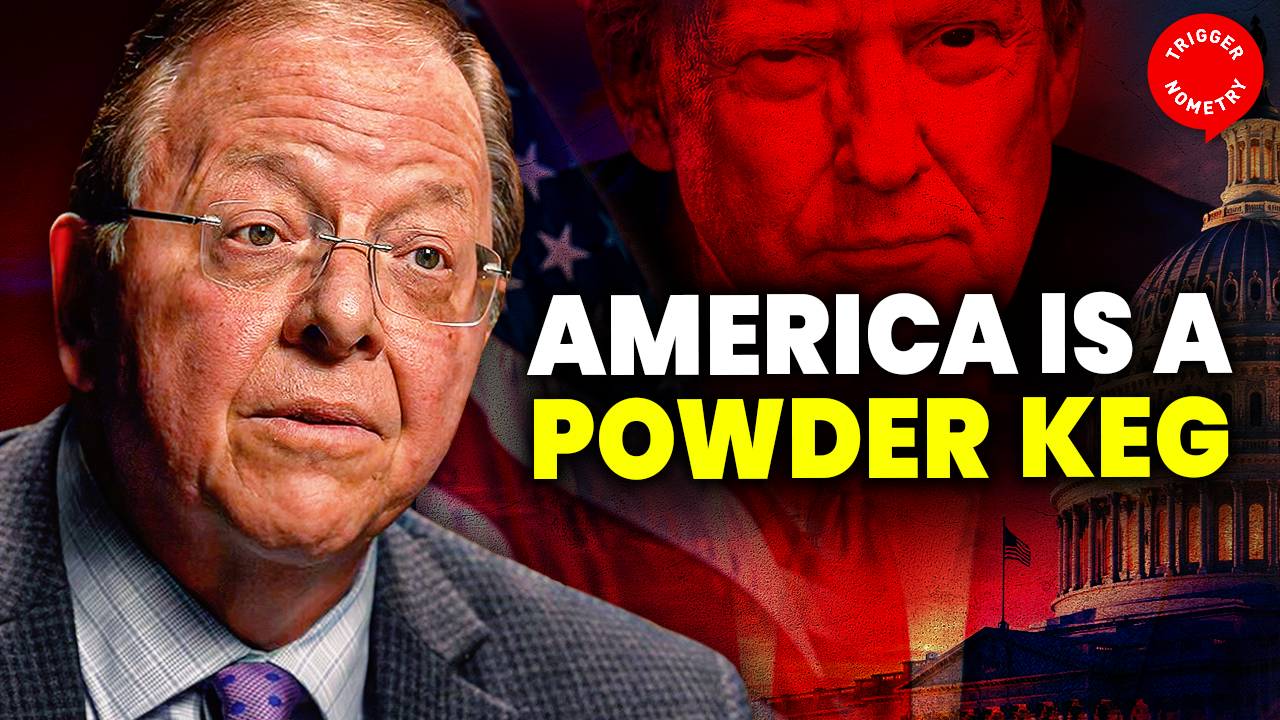
Dr. Robert Pape argues the U.S. is trapped in an “escalation trap” in the Iran war and that political violence and violent populism in the U.S. are also rising ahead of the midterms and into January. He claims the Iran conflict is likely to keep worsening because each U.S. off-ramp carries escalating political costs, making “doubling down” more likely than backing down.
Dr. Robert Pape is a professor and long-time scholar of airpower/strategy and escalation dynamics; he has taught for the U.S. Air Force and at the University of Chicago for decades. He frames his expertise as focusing on the mechanism between military action and political outcomes, not just tactics. The host is not a guest; the episode mainly features Pape.
Written by AI. May contain mistakes.
Discussion on the alarming increase in support for political violence among Americans.
“40 million Americans support the use of the U.S.”
Dr. Pape reflects on his previous predictions about the Iran war and current implications.
“Yeah, well, it's really important to have you on again.”
Explaining the concept of the escalation trap and its implications for U.S. actions in Iran.
“And why did you turn out to be accurate?”
Analyzing the effects of economic blockades and the failures of historical examples.
“That's why this is the most devastating in history, modern history.”
Learn about the disconnect between business strategies and international politics.
“It's not that the blockade wasn't incredibly vicious on German civilians here.”
Explore how military strategies and globalization have transformed warfare.
“So the big answer to that is that we have been working with a model of war that is 35 years out of date.”
Explore how the Ukraine war has demonstrated the second precision revolution in warfare.
“and it is the big failure of what we missed.”
Understand the role of private donors in advancing Ukraine's drone manufacturing capabilities.
“They weren't coming from the British government.”
Learn how the Houthis have adopted advanced drone technology following the Ukraine war.
“Now, the Houthis are, if you look at any description of them, they're numerous, but they're not technologically sophisticated.”
Discuss the potential consequences of U.S. military engagement with Iran in light of drone advancements.
“After we lose, we have, they're using, these Shahid 136s are maybe 20 ,000 bucks a piece, maybe 50 ,000.”
Analyze the wide-ranging economic effects of the ongoing conflict on global markets.
“One of the things we found, even with our audience who are always interested in geopolitics and understanding the world is when the war began, huge spike in interest, You know, really people were very focused in it.”
Learn about the stages of supply constraints and their historical implications.
“It's because of very predictable reasons.”
Learn about the stages of supply constraints during economic blockades, particularly oil supply in historical contexts.
“You see, the first stage, stage one of a supply constraint, this would be true of the economic blockades I just talked about in World War I or World War II, is the scare stage with the prices.”
Discover how Iran leverages its position in international politics and oil markets for its ambitions.
“That is the early part of the summer and very predictable.”
Explore the repercussions of Iran's ambitions on American politics and how it affects the Trump presidency.
“Now, you could say, let's go back to, say, April or May.”
Examine the implications of potentially withdrawing US troops and bases from the Middle East due to Iranian pressure.
“across the board in all the frontline states, including in Saudi Arabia.”
Understand the historical reasons behind US military presence in the Middle East, tracing back to the Cold War.
“Yeah, what it means is the basing agreements that America has with all those countries get totally ripped up and replaced with zero basing agreements.”
Learn about the historical context of U.S. military presence in the Middle East and the oil politics involved.
“The issue that was concerning was whether the Soviet Union would use Afghanistan as a stepping stone to controlling the Middle East.”
Explore the implications of Iran's potential dominance over oil resources in the Middle East.
“When I taught for the Air Force, we never wargamed how we were going to have to send the 82nd Airborne into Tel Aviv to bail Israel out.”
Understand the different political pressures faced by democracies and autocracies in conflicts.
“This is the ultimate strategic disaster, and the consequences are playing itself out.”
Examine historical patterns of how authoritarian leaders can be overthrown and the role of war.
“So the difference between the democracy and the autocracy is not quite we're just vulnerable because we're a democracy.”
Analyze the geopolitical dynamics surrounding Iran's pursuit of nuclear weapons.
“Power is the taproot of wealth, of control.”
Discover the concept of regional balancing and its potential impact on Iran's influence.
“And surely it was worth a shot or, you know, the problem is the Ayatollahs, they're trying to get a nuke that would cause problems.”
Explore the dynamics of power in the Persian Gulf and the implications of regional balancing.
“Now, we feel we have an interest in it, but the states who have the biggest interest are the Gulf states.”
Learn how Ukraine transformed its military capabilities through strategic training and regional balancing.
“And what it does is it balances interests.”
Understand the political strategies necessary for success in American interests amid global tensions.
“So why is it that Putin invades Ukraine and does not win?”
Discuss the implications of violent populism and internal divisions in American democracy.
“Because I believe that unless the president pursues America's interests, the president's legacy is ultimately going to go down in flames.”
Learn about the growing support for political violence among Americans and its implications.
“this is going to be of enormous consequences, and not just for the Iran war.”
Explore the historical instances of political assassinations and protests in the 1960s.
“The last time we saw this in America was the 1960s.”
Examine how rapid social change can lead to radical politics and violence.
“part of the 1960s that led to the civil rights legislation in 64 and 65.”
Discover the implications of demographic changes in America and their impact on political violence.
“Now, there are people who study violence in less mature democracies, like let's say Venezuela or other countries that were sort of like, you know, temporary or fledgling democracies.”
Understanding how demographic shifts are reshaping American politics.
“And then, of course, I'm going to be telling you thoughts on other countries as well.”
Exploring the connection between wealth inequality and rising political violence.
“So this doesn't have to guarantee you upend politics.”
Revealing perspectives from focus groups about justifying political violence.
“You'd ask them a few questions around this line because they'd just taken the survey, you see, and just let them talk and just let them talk.”
How student loan debt affects perceptions of economic fairness and political anger.
“And it really didn't take many people before I really got it.”
Discusses the need for a commitment to democracy and rule of law amidst rising political tensions and potential violence.
“We need commitment to the process of our democracy, and we need that commitment in advance of the tough times, because the tough times, they may be, there may likely be coming.”
Explores the constitutional authority of Congress in declaring war and the implications of the current political climate.
“That includes organizations like the Federalist Society on the right.”
Highlights that a significant majority of Americans across political lines oppose political violence and the implications for leaders.
“And it's a terrifying picture you paint.”
Discusses the need for political leaders to unite in condemning violence and the potential electoral consequences of failing to do so.
“They won't unless we go to the untapped resource the book identifies.”
Proposes a strategy to mobilize the majority of Americans who oppose political violence to advocate for peaceful protests.
“But when you go to intimidate voters before an election, you know what mostly happens?”
Dr. Pape discusses the importance of peaceful protests and the 70% who oppose violence.
“we have a lot of evidence that they do so why not well i talked to a number of the organizers ahead of the event, and I made a case to them.”
Dr. Pape shares his experiences attending political rallies to gather insights.
“and you're watching these things, and it could be on both the right and the left, is a feeling of powerlessness, fatalism.”
The discussion centers on how political violence influences public reaction and activism.
“And there are people listening to their leaders and the leaders need to restrain their own constituents.”
Dr. Pape emphasizes the necessity of understanding motivations behind violence to mitigate it.
“I mean, this was stunning for her to be the one to truly offer the all-in brand.”
Discussion on preventing political violence and the current state of democracy in the U.S.
“And this wasn't just for scientific studies.”
Exploration of the challenges of immigration and the assimilation process over generations.
“It's still the 70%, but what should the 70 % do?”
Presentation of simple policy ideas related to tax reform and immigration control.
“So I present another idea, which is not a new idea.”
Reflection on the discussion and a prompt for future conversations, including potential UBI.
“And so I think the answer here are pretty self-evident.”

Get the gist, explore an idea or ask about something said.
 Claude
On TRIGGERnometry, what are the key points of this episode?
Searching your listeningAutomatic transcript. May contain errors.
0:0140 million Americans support the use of the U.S. military. That also applies to ICE. It also applies to the National Guard to suppress Democratic protesters. You have 60 million Americans who support the use of force to prevent Trump from being president. This is an enormous, enormous radicalization of the body politic. We have historically high support for political violence. in the United States. And it's happening on both sides of the aisle, which is why the actual violence is happening on both sides. What we're about to see in November and December is the coming together of the escalation trap and violent populism.
0:47This was already going to be a powder keg election. And now with the Iran war, you have these two problems happening in exactly the same timeline. We're about to go through, I think, potentially the biggest stress test American democracy has gone through in our lifetimes. Triggerometry doesn't just bring you great conversations. It also brings you great coffee. We created this brew with the help of First Cup. And just like our interviews, it's warm, rich, and with a little kick to get you going. Trigger Fuel is available at the link in the description of this episode. or go to fuel.triggerpod.co.uk.
1:31Francis Foster: Professor Robert Pape, welcome back to Trigonometry. Thanks for having me again. Yeah, well, it's really important to have you on again. There's two things primarily we want to talk about. But I have to say, the reason we're having you back is we had you on the show in March at the beginning of our previous visit to the US. And we were very unsure about what to think about the war on Iran. and we had you on and you basically turned out to be right about pretty much everything. And not only that, people can be right for the wrong reasons, but you actually explained the logic of what was going on in a way that made perfect sense to us.
2:10Francis Foster: And everyone we then spoke to either clearly didn't make sense within that picture and it was just obvious that they were wrong or actually they reinforced your view. And that is exactly what has turned out. I remember one of the people we'd interviewed right around the same time was Senator Ted Cruz. And I mentioned this, who actually turned out to be correct, because you said, if this is still going by the time of the midterms, we've done something very badly wrong. And you see, you see, you see where this situation is now. And I don't believe that what is happening in Iran will be front and center on November.
2:47I don't think that this will extend. If it extends that long, we've done something wildly wrong. I don't believe it will. I think the president said at the beginning, this is going to be a matter of several weeks. This is not, I don't think
2:58Francis Foster: the president is envisioning anything that extends multiple months, much less multiple years. We want to talk about the midterms. One of the things you've been talking and writing about a lot recently is the potential for things to get really nasty in this country with this midterms, but also in January as well. We'll talk about that. But first of all, for people who haven't yet watched our first interview, and I recommend that they do, what is the central core, succinct version of your argument about why the Iran war was going to drag on and ultimately fail for the United States? And why did you turn out to be accurate?
3:38We are in a classic escalation trap. An escalation trap happens when a strong power attacks a weaker power. And the strong power is initially successful. Bombs hit targets, bombs kill leaders. But the weaker power gets stronger. When that occurs, the strong attacker is in a trap. If the strong attacker concedes, says, oh, well, that didn't work out, this is politically disastrous for that strong power. The strong power then, instead of conceding, often doubles down, escalates up, moves up the rung. So it's an escalation trap. It's not because each rung promises a 100%, 90 % chance of victory success.
4:26It's because at each step, there's a ratchet. If you back down as that stronger power, you're the leader, the government, the political party, the platform of the leader is in deep trouble. And at every rung, it gets worse and worse and worse. And that's the escalation trap. That's why we can't just easily get out of it. That's why the idea of President Trump just walking away was always unlikely. I offered numerous off-ramps, did this in March, did this in April. At no point did the administration take any of those off-ramps. So this was not a case where there weren't off-ramps. This is a case where every off-ramp came with a political price, and at every stage, the political price keeps getting worse and worse and worse.
5:22We've seen this in history before. This is a devastating problem to get out of. And think of it like a gambler playing roulette, where a gambler will go in and roulette, you can bet on red. Well, you bet on red and you lose. Now you want to get your money back. You don't just want to win. So now maybe you bet on red 36, but now you've lost again. So now, though you're way in debt, what do you do because you also have a deadline? The bookies are calling for their money back. What are you going to do? The gambler keeps going until they're out of chips, out of money altogether. That is the escalation trap in human terms, human examples.
6:08And we've seen this numerous times in history. this is probably the most wicked escalation trap in modern history because it's not just about the political consequences for the leader who started it. It's not just about the consequences to the society of the leader who started it. This is having worldwide economic consequences that are truly, truly devastating. devastating. We all hope they don't get worse. But as I've been explaining, we are on a trajectory that they will continue to get worse and worse. So the escalation trap comes with enormous consequences. That's why this is the most devastating in history, modern history.
6:56Francis Foster: You've explained the structure beautifully. Now, let's put some meat on the bones of that. If I am an ordinary American who sort of, you know, got several kids and a job and all kinds of other responsibilities. I'm busy living my life. In around March, I turned on the TV or I looked on my phone and I saw that we'd attacked Iran. I'm looking up now going, oh, still going. What has actually happened in this time? And where are we in terms of the conflict itself? What is going on right now? So as the escalation trap has played itself out, we've gone through several stages of the escalation trap that are useful to lay out.
7:38And they're probably best understood from the perspective of Iran in the escalation trap. You see, when the escalation trap began, we bombed the United States and Israel together, bombed Iran February 28. President Trump thought it was just going to be a couple day war. Well, we did hit the target, did kill the leaders, but almost immediately Iran gained power by gaining selective control over ships moving through Hormuz. Now we're all very familiar with that. But in that stage, in March and then early April, the big thing Iran learned is it would survive. It would survive. That was not clear before the bombing started.
8:24Now, it was likely true. I argued it would be true. But those are predictions ahead of time. Those are what we what what happened wasn't just my predictions came came true, but Iran saw it would survive. Well, that then shifted to a new phase of bargaining. And it was bargaining, though, on Iran's terms because there was a ceasefire. But almost from the beginning, on April 8th, and this you also saw written down in the Memorandum of Understanding on June 17th, were terms Iran was setting for what peace would look like. That was a very different stage. So we went from Iran surviving to Iran setting the terms of peace.
9:17That comes as a shock to the administration. Public is still trying to figure this out, understandably. And the administration during this period decides to shift from bombing to an economic blockade strategy, also a known historical loser. So in this escalation trap, the administration, the United States, has gone from regime change bombing, known historical loser since World War I, to a long air campaign, known historical loser since World War I, to economic blockade, known historical loser since World War I. Can we pause there for one second?
10:01Francis Foster: You say economic blockade, known historical loser. People with no expertise, but sort of a logical, rational perspective might go, hold on a second. If Iran is so reliant on their oil and gas and diesel and fertilizer and whatever exports, and we cut that off and they can't get any money in, surely that's a great solution. We are the bigger power. The world is a much bigger economy than Iran. That's a no-brainer. If this was a business deal, that would be exactly the way to approach it. A lot of folks, and I've talked to many, many, many folks in business about this because they make deals all the time.
10:41Well, what do you mean that there's not an incentive for Iran? The problem is that the difference is in a domestic business deal, if I get squeezed and we cut a deal and we sign on the dotted line, there's some court, there's a judge, there's a power to enforce your side. I'm the weaker side. I've made the deal. You're the stronger side. Courts, power in domestic politics enforce that. international politics, there's no court. There's no power. The only enforcement tool is my power to hit you back again. That's a very different world. And so what that means is if I concede because you're hurting me now and I give you that concession, I am going to be weak now with my own public.
11:36My government is embarrassed and so forth, but it's worse than that because I'm now incentivizing you six months from now, a year from now, to come back for another bite of the apple. I already, if I give in to you now at stage one, I am demonstrating to you I am vulnerable at stage two, three, and four, and there is nothing holding you back. There is no court out there. The U.N. is not an international government that has an army that will come and sit on top of New York City and enforce any deal that Trump signs. That's why Trump could sign the MOU literally in front of all of our eyes and five days later break it almost four or five different articles.
12:27And it all just falls apart. As I one of the big predictions after your show, one of the big predictions I made. So I think on our notes, they're going to lay out all the eight predictions, and then you'll see the dates that I made those predictions. They're on the substack. You'll see that these are predictions before the fail, and you'll see that eight out of eight correct calls over these months. And one of them was what I just laid out, the failure of the MOU in exactly those terms.
12:57Francis Foster: So it goes to attempted counter-blockade effectively, right? That's right. So the blockades in history on their own are known failures and they lead to then ground forces usually to actually succeed. So in World War I, Britain with Winston Churchill as first lord of the admiralty did a major economic blockade on Germany in World War I. 700 ,000 German civilians died due to that blockade. Let me say that again. World War I, the British blockade kills 700 ,000 German civilians. They don't, Germany doesn't concede. Now, Germany does ultimately concede when there's a massive ground war and influx of a huge amount of new fresh troops from America.
13:56That changes the balance of power that had been stalled for so long. So it's not that the blockade wasn't there. It's not that the blockade wasn't incredibly vicious on German civilians here. It's that this logic I just explained, which is once you concede to that punishment, you're just making yourself more vulnerable for another round, and there's nobody out there to protect you. You have no protector of a court. So that's why this is not a business deal. See, I think we went into this war with not a great understanding among our leaders of how international politics really works. They might have good understanding how business works.
14:44I'm really not challenging that issue here. I'm really challenging the issue of whether what works in business is going to translate into international politics directly. And this war is showing no, no, there's a huge disconnect here. And if we keep thinking, oh, we just have to find the strike price with Iran, we just have to keep putting enough pressure on them until they crumble. They'll find the strike price. No. And I think President Trump now we're into over eight months. We're starting to get into the ninth month of the war. I think he's finally got the memo that this is not working out like a real estate deal.
15:26I mean, that's really concerning because what you've basically said is when it comes to international politics, they're incompetent. Yes, I think that's right. I think that saying they're incompetent is not the same thing as saying they're dumb individuals. So I want to be clear. I have for 30 years, I taught for the U.S. Air Force. I taught the best pilots in the world. These are not dumb people. Just want to be super clear. I've taught at the University of Chicago for decades. I'm not teaching dumb undergraduates, dumb graduate students. I'm not interacting with dumb faculty of any kind whatsoever.
16:07I deal with very smart business people since we're here. I come to New York almost once a week now. That's why I've come in and out so frequently. And I'm often dealing with people behind the scenes, but these are wickedly smart people, unbelievably smart. Nonetheless, they're not that well informed about, well, how well has bombing really worked on its own in the 40 plus strategic air campaign since World War I? How well have economic blockades on their own really worked? And so what I do is when I'm teaching and teaching in kind of venues like this where short we have a little bit of time. I teach at the University of Chicago, 10-week courses where we go through this in detail, case after case after case.
17:00And whether it's a short course like this or a long course, I'm always saying, name me the case that goes the other way. Name me the case. And this is, I'll say this to generals. I'll say this to admirals. Being a general and admiral doesn't mean you have actually studied this. It means you're a practitioner. You're a tactician. So in a command, there's two things that are privileged in the military. One is tactics. Remember, I taught the best pilots in the world. They weren't asking me how to put a bomb on a target. They wanted to know the consequences of hitting these targets. And there's also command.
17:41That's what equals a flag officer. sir. Those are the two. Now, if you can also squeeze in some background on how well strategies and other year and other decades and so forth, well, more power to you. But that's not so easy to do. That's why the school I taught for at the U.S. Air Force didn't exist before 1991. It was specifically created. It's called the School of Advanced. First, it was School of Advanced Air Power Studies. Now it's School of Advanced Air and Space Studies. It was started by the chief of staff of the Air Force and a few other four stars because they believed that the Air Force didn't know air strategy in Vietnam.
18:25Not they didn't know tactics. And that was the origins of that school. It dovetailed with a lot of my work, which is on the strategy, which means you have military tactics, military action. You have a political outcome. What's in the middle. What is the mechanisms in the middle? The escalation dynamics. That's a very specialized understanding that no matter how many times you bomb a target, no matter how many times you're in the ready room, you're putting, you're assorting, well, do you want to use a MOAB or do you want to use a MOP? Which bomb do you want for which tactical situation? That does not equate to, Will that actually produce concessions?
19:14Will that actually produce the political outcome you want? That's why the school was built. That's why my work has been highly, militaries around the world have found this valuable. Unfortunately, it's not, I don't think our issues here were with the military. I think the issues here were with civilians, and I think that is often true in war. And we're glad we have a civilian control of our military. But I also think that we're probably going to discover when the actual briefing documents are eventually released. And at this point, I don't see any reason why they should be still classified. we're probably going to discover that the military here was not being as forceful as they could have been about the downside risks that were being run here.
20:09Well, you say they're not being as forceful as they could be. Look, there's going to be ordinary people across the US, across the UK, across Europe going, why did they not see this coming? Why were they not being forceful? Why is it that we are stuck in an escalation trap, and all of a sudden my diesel prices are through the roof.
20:30Francis Foster: I'm not what you call a natural businessman. And yet the trigonometry store somehow works, mostly because Shopify built the hard part before we ever opened it. Because the moment someone's actually ready to pay, Shopify makes sure they can. And if they've bought before, their details are already saved, so it's one tap and done. That's time back to grow the business instead of running it. If you want to start the same way, that's shopify.co.uk slash trigger. With Shopify, nothing stands between your idea and a real business. So go make it one. Start your free trial at shopify.co.uk slash trigger.
21:03Francis Foster: Start your free trial at shopify.co.uk slash trigger. So the big answer to that is that we have been working with a model of war that is 35 years out of date. It comes from the first Gulf War in 1991. and that was the splendid Victory War. That was the war in 1991 before many of the people you've described were even born, where in 1991, Saddam Hussein, with a giant army, conquered Kuwait, and the United States built a coalition and decided it wanted to kick Saddam's army, Iraq's army out of Kuwait. It's very similar, by the way, to the problem we have now with Iran controlling Hormuz. Almost not identical, but very, very similar.
21:58What happened in 1991 is the United States, for about a decade and a half, had been working under the radar on a new precision, not just bomb, but precision military that was fusing the stealth technology with laser-guided and GPS-guided bombs and then satellite information and then other sensors that had not really been used in war before. That was what's called the first precision revolution. And it turned out to be an enormously powerful instrument, powerful tool. It was so powerful that in 1991, the United States brought 10 ,000 body bags to the region because we were worried it wasn't going to work.
22:54All this technology hadn't really been shown before. When I taught the pilots in the Air Force who were the first to bomb Baghdad in their first bombing runs to a person, they said they all threw up in their labs. They didn't know this was going to work. I mean, they had thought it was going to work. They had trained for it was going to work. But this is real now. This is for real. They're flying into the teeth of all of that anti-aircraft fire in Baghdad. So this isn't just playing a video game anymore. So we discovered it truly did work. We didn't lose anything like 10 ,000 soldiers, we lost a grand total of 147.
23:35Now, you don't want to lose anybody in a war, but we kicked Saddam Hussein's over 300 ,000 troops, not just a few troops, out of Kuwait with a combined air and ground war in 43 days that cost America 147 lives. Now, that's not, we don't want to lose anybody, but this is not Vietnam. This is not an escalation trap. This was the war, the shock and awe war, that led to the conclusion the American precision military is nigh invincible. Now, of course, nobody ever believed it would be fully invincible. But this is one of the big reasons why in the 1990s, all of the militaries in Europe, they all gutted their military.
24:26They cut their military budgets way down. Why? Well, if you've got Uncle Sam with this precision instrument, how bad could it ever really get? You see, so it's there's once you and then if you look at China, China's looking at this and they had three and a half million men in arms before the first Gulf War. They cut it down to two million. Why have all those people in arms as targets for America? Because you can't win in this. So this was an amazing change of the world. This was the American unipolar moment. This is what led to globalization, the rise of trade as a fraction of world product, because suddenly we could be really confident about the low risks in all these trade routes that we had around the world, including in the Persian Gulf.
25:19Well, this is the war that has upended all of that. It has upended all of that. You see, in the 35 years since America, even with its near trillion dollar military budget, has just been buying based on the model of the first Gulf War. We're, in fact, still going to put out a new aircraft carrier in the next two years. Think about that. We're about to put a new aircraft carrier out that is vulnerable, essentially obsolete on day one. And this is because we have been building according to this model of 1991. Other folks around the world, they haven't been just sticking with that model. So some, like the Chinese, have tried to catch up with that model, and that's what they have been doing, and I explain that.
26:10Others, though, like Ukraine, the Houthis, and now Iran, they have been taking full advantage of the diffusion of globalization. so let's just talk about what globalization has made possible this device this is now diffused all around the world every place i go everybody has one of these right we all have whatsapp we all have gps and so forth these are the components of a shaheed in the shaheed 136 these are the components in fact the shaheed 136 doesn't have components as sophisticated as this because most of the Shahid 130, that's the drone that Iran uses to attack ships and straight and foremost.
26:56Most of those parts are knockoffs of these being made in India. So what you are seeing is that globalization occurred. It led to a lot of diffusion of civilian sophisticated technology. We all use it. And so now, why wouldn't that be integrated in weapons systems, cheap weapons systems? See, the first precision revolution, you had to be the richest country on the planet to have that system that I just laid out. That's why others just were, oh, there's no way anybody's going to take on America. We did see terrorist groups try, but nobody willing to really go toe-to-toe with us in a real war with another state.
27:54And then now, though, as this began to diffuse and as it began to integrate with drones, this has changed the world, the whole world, not just this war. and it is the big failure of what we missed. And what we will be arguing about is how we could have missed this because the first real clear evidence that this world, I call it the second precision revolution, just to be clear, that's my name for this. It was already in train about 10 years ago as these parts were diffusing and you see little bits of it, But with the Ukraine war, this was really the first major demonstration of the second precision revolution.
28:48You see, in February 2022, Russia, with 200 ,000 roughly ground forces, invades Ukraine, including in circles, Kiev. They hold on. But Kiev and Ukraine, they don't just hold on over the next year or two. They start to innovate and they start in late 2022 to build drone factories. Those drone factories were not coming from the Biden administration. They weren't coming from the EU. They weren't coming from the British government. They were coming from donors. And I know because some were in the city of Chicago. They are. Illinois has billionaires. People can go and look at the list and then they can go and look at the list of which billionaires have connections historically to Ukraine.
29:41So I'm not going to name them, but at the University of Chicago Center, my center, the Chicago Project on Security and Threats, we deal with donors because this research costs money, so they're natural people to don't. And so in dinners in 2023 with these donors, these are private, a little bit not too different than where we're sitting right now, they were starting to say, you know, I'm part of this new consortium and it's going to cost X tens of millions of dollars, tens of millions of dollars. I didn't say billions of dollars. And what this consortium is going to do is build drone factories.
30:17And it's going to build precision drone factories. And it's going to be built in western Ukraine. Well, this had never been done before. This was not a product out of the Pentagon. This isn't coming out of the military industrial complex and so forth. This is coming out of innovation in war out of necessity on the part of Ukraine. You got a lot of smart people in Ukraine. They have a lot of people connected with donor money. And for something like$100 million, I didn't say$100 billion, the second precision revolution was born in real time around 2023. And that's when the drones start to occur.
31:01And they start to become a variety of drones. First-person view drones. Well, that is essentially this camera on a drone. So you can see right away how that diffusion of civilian technology was already occurring in a globalized way. There hadn't been the pressure to really kind of concentrate the innovation. That pressure comes with the Ukraine war. It really hits in 2023, and it happens through donors. So the governments are Johnny-come-latelys here because they're stuck in the 91 model. They're stuck in the 91 model. And that's not just the American government. That's the British government.
31:43That's the French government. So this is a generalized failure. And then what happens? The Houthis. The Houthis. Now, the Houthis are, if you look at any description of them, they're numerous, but they're not technologically sophisticated. The word primitive comes to mind. Yes. And this would not be wrong. But if you look at what the Houthis do in the fall after October 7th, so the October 7th major terrorist attack by Hamas against Israel, Israel lashes back against Gaza. Well, this, of course, upsets the whole world. The Houthis are on the side of Hamas and Gaza. Just to stop you there, there are people who are listening to this going, where are the Houthis based, who are they, etc.?
32:30The Houthis are often called a rebel group, and they are in Yemen. So if we think of the Arabian Peninsula, and if we think of, and I'm not sure which side to explain this on, but let's say this is Iran, this is Saudi Arabia, Yemen is just under Saudi Arabia. on the other side of Saudi Arabia from Iran. And they are Shia. Iran, Shia. Not 100 % Shia. Same with none of these are 100%. But Iran, very Shia, is Shia. The Houthis are Shia. Hezbollah is Shia up in Lebanon. But the Houthis, them, were a rebel group that has been fighting different conflicts since the 90s. Long time. Long time. And including with Saudi Arabia.
33:24But what happened starting in 2023 is they started to get some better drone technology, better missile technology. And they're watching from where? Most likely just Ukraine. And they start to attack ships, Israeli ships, and then other ships in the Red Sea. The Biden administration tries to have a little war with them. Couldn't beat Biden administration. Couldn't beat them. A year later, the Trump administration comes in. And the Trump administration in the spring of 2025 fights a 52-day war against the Houthis. 52 days. two aircraft carriers. Basically, it's an air war. And what are the Houthis doing?
34:13Using precision drone and missile attacks against the ships. After we lose, we have, they're using, these Shahid 136s are maybe 20 ,000 bucks a piece, maybe 50 ,000. We have drones too. Our drones are $35 million apiece. So we're using, again, drones built on the model of the 91 model of war. Well, the Houthis end up shooting down seven of our$35 million drones, these Reapers. Think about that. And two of our F-18s. Think about that. So again, this is the primitive group and so forth. And this is against the American military.
34:57Francis Foster: This is kind of the equivalent of Hernan Cortes brings Spanish ships to South America and they sink a bunch of them. That's it. That's kind of what you're talking about. Very similar, very good analogy here. But the thing that makes this worse today is that very same American military, which couldn't beat the Houthis because of this more advanced drone technology that I'm just explaining, which is very cheap. then goes into a war with a bigger version of the Houthis, Iran. This is now a country of 92 million. The strongest opponent the United States has gone up against since Germany in World War II.
35:46Iran has a space program. The Houthis don't have a space program. So I'm just saying, we're right to say that's a very apt description. But they have the drones. And there's lots of relationships here between Iran and the Houthis with the drone technology. So this is not a this is Intel 101 here. I mean, this is the basics. And and so what's happening is there is a second precision revolution unfolding in front of our eyes. And we are actually even engaging with it, either supporting Ukraine or up against the opponent, the Houthis that have it. And we are not taking this seriously enough. So when you say the ordinary person is sort of flummoxed by this, they should be flummoxed by this because there's going to be a lot of books written about the unbelievable disaster we should have seen coming.
36:51So this is not a case where this is a disaster that no one saw coming. Just want to be clear about that. So you had me on, so you hear me. Just 10 days before the Iran war kicked off in February 28, I was giving a briefing over Zoom to our Army War College, our Army War College colonels, and laying out what to expect with the Iran war. And walking through the stages of the escalation trap, the stuff that we all talked about here, this was 10 days before we kicked off. And I just have to tell you that a lot of the model, I've done modeling for 20 years of this. A lot of the folks in that room I was briefing had also modeled for 20 years.
37:42It's I'm I'm able to fuse myself a little more of the political consequences than simply the military. But a lot of the military that I'm briefing, they're well aware and right on the issues of Hormuz, the issues of the different advantages Iran is going to have with controlling Hormuz. And so this is what I mean. It's true that the escalation trap takes us a step further. It also puts us out publicly. It does this with real reputation on the line. So that's what's unusual here. ends. But it is the case that we really should have seen this disaster coming. Men's underpants. Yes, really. I didn't plan on bringing it up today, but it has to be said the majority of men are walking around in underwear that's actively working against them.
38:35And they've accepted it. They shouldn't have. Which brings me to Sheath. S-H-E-A-T-H. Sheath.com. It's underwear designed around a dual pouch system. In plain English, everything stays exactly where it's meant to. No sticking, no chafing, no readjusting halfway through a point while trying to look like a serious person. The fabric is breathable, the design keeps things apart. Apparently, there's an official term for the result, and that term is zen-like separation, which sounds absurd and is also annoyingly spot on. It was created by a veteran during his second tour so it was built in conditions where comfort was a necessity not a nice extra more than 10 000 five-star reviews from people who clearly mean it i've had them on for a few months now not consecutively and honestly the improvement to my daily comfort is more than i'm prepared to go into on a political podcast those who know no head to sheath.com that's s-h-e-a-t-h.com enter code trigonometry at checkout for 20 % off.
39:38Your first pair is backed by a full money-back guarantee, so you've got nothing to lose. Sheath.com. Once you go sheath, you won't go back. Sheath.com.
39:49Francis Foster: And you say disaster. One of the things we found, even with our audience who are always interested in geopolitics and understanding the world is when the war began, huge spike in interest, You know, really people were very focused in it. And over time, you know, people, other things come up in the news and, you know, half of France seems to be burning. There's lots going on. And interest in this wanes. But you say disaster. What has been the economic impact of this conflict? So the economic impact of the conflict is now touching the wallets, pocketbooks, budgets of everybody in America, everybody in Europe.
40:31I just a month ago spent two hours at the EU Parliament talking to members of Parliament there. So absolutely. And also in Asia, also in India, also in Africa, also in Brazil. I've just been invited to go and give a big talk in Brazil. So this is touching, this conflict is touching those pocketbooks in more places around the world than we have seen in my lifetime. In my lifetime. Vietnam War did not have this consequence. I was not born, I was born after World War II. So this was not the Korean War. It's not the Vietnam War. This is not the two forever wars. This is an extremely different problem.
41:15Now, the core reason for this, everybody now knows, which is Hormuz is the choke point for 20 % of the world's energy. If you combine that with the Red Sea, it's 25 % of the world's energy. So this is really a highly concentrated area. But as you said, people were really worried about this in March and April, and then they kind of lost interest. And why would that be? It's because of very predictable reasons. And I've laid this out on the different Substack posts from having studied war and economic blockades and how this will unfold over time, which is it goes through stages. It goes through stages when you have a supply constraints.
42:00You see, the first stage, stage one of a supply constraint, this would be true of the economic blockades I just talked about in World War I or World War II, is the scare stage with the prices. So prices go up immediately. However, in stage one, although prices go up and you get there's a scare that goes, there's a lot of stockpiles. There's stockpiles we don't even know we have. And there are books about this in World War I and World War II that as the blockades come in, the stockpiles we find in America, we find stockpiles of aluminum we didn't know. We have aluminum drives. We do things to get the extra bits of, think of it as money under the cushions of the couch, you know, that we just kind of forget about.
42:55Well, if you're hungry enough, you'll go and get those pennies out. Well, that's the first few months. That's what happened in March, April into May. So there was an initial scare. Prices go up. But then what happened is we discovered we had some cushions. And what were the cushions, the big ones? The Strategic Petroleum Reserve cushion was a big one. The fact that— What's the Strategic Petroleum Reserve? It is 60 caverns in the southwestern United States, 60 caverns that are gigantic. And each of those caverns holds tens of millions of barrels of oil. And we started this in the 1970s after the first oil shock.
43:44It really opens up in 77, 1977. So we didn't have it before that. And we filled it up. And some points we had 700 million barrels. Well, here, for various reasons, we start this war with about 420 million barrels. And that's a lot. That turns out to be a lot, I could explain. But we start drawing it down. And other countries have some supplies as well. So we start. And what that does is provides a cushion. What that means is the prices don't keep soaring because the traders start to see. And this is why there's this big debate going on about what happened. And one of the big things that happened is just the Strategic Petroleum Reserve.
44:29And then we got another cushion because it turned out Saudi Arabia already had an east-west pipeline. They weren't using it. This was a pipeline that was going from Hormuz all the way across Saudi Arabia. It's a long way to the Red Sea, this port called Yanbu. And that was another five million barrels of oil a day, just right there, a day. And then you had China, and we still don't know the quid pro quo. China buys less oil, imports less. We think that Trump made some deal with Xi throwing Taiwan somewhat under the bus to make this happen. That is the early part of the summer and very predictable.
45:12And so you can see these timelines. And my work in the Escalade Trap is actually literally tracking these timelines. And then I say on June 15th, I have a big post, which on June 15th, I say Iran's period of maximum leverage is about to start. June 15th, escalation trap, where I show these buffers are likely to all plateau or reverse or run out. And I show the SPR, that's the Strategic Petroleum Reserve, is going to plateau. There's a set of reasons for that I'm glad to explain. China is not going to import still less oil, so that's going to flatten out. And then also, I said, and that will lead then the Houthis to open the Red Front, to open and attack Saudi oil.
46:05That will be, and it's going to come not in April. It's not going to come in November. It's going to come in the summer. and it's going to come in the summer because this will create maximum leverage for both Iran and the Houthis. And it is exactly what happened. I mean, literally almost to the week, you can see as the SPR plateaus, that's when the Houthis start attacking the Saudi tankers in the Red Sea. And then it gets worse and worse. As the SPR, the Strategic Petroleum Reserve, bottoms out, and it's now bottomed out, We can't go any lower without a risk that the salt walls of the caverns will literally cave in on themselves.
46:46So it's a physical limit at this point. But with that plateauing, that is when the Iran and the Houthis turned up the economic notch. Then I explained, and this is now gets to stage three. Those who are listening, we had stage one. Iran had survival. Stage two, they're negotiating. stage three from July onward is Iran's ambition. And I explain that once you go down this road, there's an obvious set of objectives. The next timeline is what? The midterms. The midterms. Everybody knows the midterms are coming, but they hadn't really processed it in as with the escalation trap. You see what I mean?
47:36That's what I do. I'm taking military action and looking at how it interacts with domestic politics. And I just said that this isn't going to be temporary. They're going to ride the Houthis and Iran. They're going to ride this growing pressure on oil to literally crush President Trump's presidency.
47:58Francis Foster: And I was looking to your point to just to jump in there to illustrate what you're saying looking at the cow sheep odds today 50 59 i think was a blue tsunami we're talking about that's right so that's house and senate and a far far higher than that for for just the senate alone actually even though people are predicting the house is kind of definitely going to fall so they've been successful they have been very successful. Now, you could say, let's go back to, say, April or May. You could say, well, midterms, the in-party always loses some. Well, so April and May, there might have already been problems for the Republicans.
48:41But what Iran did is use this period of maximum leverage to do something that any realist would say is a good idea, which is, if you want to make sure, or do the best you can to make sure that your enemies don't come at you another time, six months from now, a year from now, wreck the presidency. This is going to send a pretty big message. And it doesn't even mean you have to lift your foot off the gas. If the Democrats don't get the memo, you can still do this, and you can start playing politics with them too, you see. So this is a real lever that Iran has. This is why this deal, the MOU deal, was never likely to hold, because it wasn't a stable balance of power.
49:34It wasn't a—this was not like the end of World War I, 1918, Versailles. There had been four years of this war. We're now going to just end it because we now understand what the new balance of power. No, this was still fluid. And what Iran had was its coming period of leverage. It was in front of it. It used that leverage. And the big goal is wreck the Trump presidency. And notice in this third period, I call it the period of Iran's ambition. So I've laid out these stages and different posts on the escalation trap. And in this ambition, their goals are way beyond the memorandum of understanding.
50:15You see, when we have this idea that's still sometimes in the media and being discussed by, say, Pakistan negotiators. Well, let's get back to talks. And you hear, well, Iran has these seven points and they want this. These seven points are money up front to just get in the room. They're not peace. This is to just talk like we are. They want$100 billion as a down payment just to get in the room. So what do they want for peace? I believe it's American forces, all 50 ,000, all American naval forces out of the region. That's what I think they want. And that is, so when we say, when people say Iran's going to drive a harder bargain, I think they're underestimating the actual reality of what Iran's ambition, I'm saying ambition is, which is to become the regional hegemon.
51:17That would be the set point, the stable point for Iran. And if you go and talk to realists about what would it take for Iran to actually become confident in its security, it will need to become a regional hegemon, which will also mean not physically controlling the frontline Gulf states, but likely causing major instability across the board in all the frontline states, including in Saudi Arabia. So the consequences of this war are still unfolding, and they're unfolding in Iran's advantage. And at each stage, if you see the three stages, survival, negotiation, and now ambition, at each stage, the price for Trump to capitulate is enormous.
52:14And Trump doesn't look like he's going to capitulate as Lyndon Johnson in Vietnam did not capitulate. So we've seen this before. And the consequences of Vietnam were bad. Here, the consequences are for the world, including for Britain, including for Europe. But this logic is what we're seeing unfold. And if the Trump presidency collapses, if the impeachment happens with and removal of a number of his cabinet secretaries, as could happen in January, not just impeachment. So Pete Hex said to everybody in Washington, the betting now, I don't know what it is on Polly Market right now, but but the big question is, is he going to resign before he's removed?
52:59What's going to happen first, the removal or the resignation? And this is going to happen with the attorney general is going to be on the hot seat, DHS more. You're going to have a variety of these cabinet officials, not just getting bad news stories about them, not just being impeached, but quite possibly removed. And this is just the unraveling of the Trump presidency. So, and if we get into January and the Trump presidency unravels, or if the Democrats are just going to kind of go down the road of unraveling it, I don't see Iran turning off the pressure economically on America and the world until the Democrats do what Iran wants.
53:46$100 billion up front to get in the room and then withdraw all American forces from the region. and they're going to have the same deal with the Democrats. I don't think the Democrats are going to get in the room and then suddenly find that Iran likes Democrats better than they like Republicans. I think they're going to look at Democrat as another American, is what I think. What does that mean, they're going to ask them to withdraw from the region? What does that mean practically, and what does that mean in terms of geopolitics, in terms of how it's going to affect that region? not only Iran, but also the other countries surrounding them?
54:25Yeah, what it means is the basing agreements that America has with all those countries get totally ripped up and replaced with zero basing agreements. So that means all the bases that are now damaged, we have a wounded basing structure that now exists in the region. There are still troops in the region, but this will probably mean that those bases leave. I can easily imagine Iran demanding the embassies are shut down, that the embassies have to leave, because the embassies are where the CIA does a lot of collection of intelligence. So embassies are not just simply embassies. And everybody knows that.
55:07The Iranians certainly know that.
55:09Francis Foster: It's the same for every country, Robert. Sorry to interrupt. I think it's worth asking a very basic question at this point for people watching. Why does America have troops and bases in the Middle East? What is that for and what does losing that mean? So America started to base troops in the region beyond simply Marines standing in front of embassies with some sidearms in a serious way in the late 1970s, early 1980s, when the Soviet Union, this is back to the Cold War, the Soviet Union invaded Afghanistan. So just to go back in history, the Soviet Union invades Afghanistan in 1979, and the British are already long since past the time they're going to be able to handle this issue.
56:00And what is the issue? The issue that was concerning was whether the Soviet Union would use Afghanistan as a stepping stone to controlling the Middle East. And you could say, well, they would never do that. They would be too hard. But what we did is we invested in the rapid deployment force, four divisions that were these are very expensive. Each division, 20 ,000 troops. So this is not a cheap thing to do. Four divisions that we could rapidly fly in, not just move in over with C. and we could rapidly in a period of just a couple months, so you couldn't ever do it in just two weeks, but a couple months to prevent Iran, I'm sorry, the Soviet Union, from ever coming in and controlling one of the key areas in the Middle East.
56:56There's four puddles of oil in the Middle East, there's Saudi oil, there's Iraqi oil, there's Kuwaiti oil, and then there's Iranian oil. So it could have been a variety of those. And that is when America's commitment to preventing an oil hegemon in the Middle East was truly a military mission. That has continued to this day. And what has happened with this war is we have essentially caused the worst outcome we could imagine, which is Iran on the road to becoming an oil hegemon. That, since for all those years, 50 years, over 50 years, was the number one mission of America in the Middle East. Israel, down there, number two.
57:48When I taught for the Air Force, we never wargamed how we were going to have to send the 82nd Airborne into Tel Aviv to bail Israel out. We just never did that. Israel's got nuclear weapons. There's a whole variety of reasons for that. But wargaming, what would happen with Iran? Oh, no, this was a big deal. This was a very big deal. And so different actors were the threat. So first it was the Soviet Union was the threat. Well, then the Cold War ended. Well, what happened immediately after that? Iraq, Saddam Hussein invades Kuwait. So suddenly Iraq's puddle of oil unifies with Kuwait's puddle of oil.
58:28Saddam Hussein took three of his divisions right up to the Saudi-Kuwaiti border. And you might say, well, gee, Professor Pape, what's the big deal of going to the border? Well, if you got out a map, and maybe your folks will show the map, and you show all the oil fields in the Middle East, you will see that 80%, not 100%, but about 80 % of them are within 150-mile radius. 150-mile radius. So this issue is much more concentrated than most people would know. And so that is what led to America's commitment to the Middle East. That's why we ended up having the rapid deployment force against the Soviet threat to oil in the Middle East.
59:15That's why we beat back Saddam Hussein's threat to oil in the Middle East. That's why the last thing we should have been doing is creating a situation, the disaster of Iran seizing the oil in the Middle East. This is the problem that we face. This is the ultimate strategic disaster, and the consequences are playing itself out. So why am I also so familiar with also the consequences? These would be the consequences. These are what you would always have explained is why would America want to prevent an oil hegemon in the Middle East? It's because if one country controls 20 to 25 percent of the world's energy, it is going to be able to use it as a club for whatever it wants politically over and over and over again.
1:00:12And that's the world we're in. And the only choice that we have right now, I do think we have another option that I'd like to talk about when we get a chance. But right now, the only choice in the next couple months is dramatic escalation, which is most likely going to make all this worse, not better. And this is how we got into the escalation trap. And the escalation trap right now is so tight, it's because of the midterm elections. That timetable is incredibly, is driving all of the politics right now. So everything is essentially in Iran's favor at the moment. And part of the reason is, as unpleasant it is to say, is because we're a democracy, they're an autocracy, so they've got all the time in the world, but Trump hasn't.
1:01:06Yes and no. If they lose, so I definitely hear this all the time, and there is some truth to this, but when autocracies lose and they make surrenders, their leaders end up leaving office and sometimes being killed. So the difference between the democracy and the autocracy is not quite we're just vulnerable because we're a democracy. Remember, in World War I and World War II, America's a democracy. So we actually have had better strategies. We did have a smart strategy in 1991. Our being a democracy in 1991 against Saddam Hussein did not privilege Saddam Hussein over us. That argument was made then.
1:01:49There is a difference here, but it's not the difference you hear most people, the quick, clickbait answer. The big difference is in the pressure not to concede. So when a democracy, when a leader of a democracy is under pressure not to concede, This was true of Lyndon Johnson in Vietnam or Trump today. The consequences are horrendous politically for the administration, for the administration's program, the MAGA program. This is a horrendous political outcome there. Probably economically, Trump's crypto billions will go up in flames, right? not flames, but will disappear because it's built heavily on the assumption he's a lot of power in Washington.
1:02:35That will probably quickly disappear. But there's not really a risk that he's going to be arrested, killed, assassinated by. Well, that's not true for others, authoritarian leaders who have lost. And so Mussolini, just to pick one in World War II, when Mussolini is defeated, he is strung up by his own people. Hitler decides to commit suicide rather than go through all the consequences that are going to happen to him. Putin right now, he's in an escalation trap of his making very similar to ours, except the consequences for Putin are going to be much, much, much worse than the consequences for Trump personally.
1:03:23That said, what I've advised every White House since 2001, presidents care about their legacy. I think that they care a lot about their legacy. And I think that so this difference between the democracies and not, I think is it's narrower than most people think. It's a little different substantively than most people think. But if Iran right now were to surrender the control of Hormuz and make that deal, the IRGC would be in deep trouble over time. They're going to be and they're going to be groups within the IRGC. They're going to start to go at each other because they will have surrendered Iran's power.
1:04:08And when you surrender power, your own supporters want to go at you because the supporters in these contexts are supporting governments for power. Power is the taproot of wealth, of control. So, yes, it's true they also want money. But you don't get money unless you have the power. So the power is the bedrock. You lose the power. Milosevic in 1999 ultimately surrendered Kosovo after a campaign here went on for a few months. And a year later, when Milosevic surrendered Kosovo after he did that, he was toppled. And who toppled him? the Serbian Orthodox Church. Those were Milosevic's supporters. They were not the opposition.
1:05:08They were the supporters. So in authoritarian governments, it's the supporters who topple the leaders who fail. And Milosevic ends up...
1:05:22Francis Foster: Putin is not going to get overthrown by the liberal opposition. No. Is your point. My point is no. Exactly. And this is the way and this is the pattern in history. So this idea that the way to topple an authoritarian government is you want to support the doves. You know, how often have we seen this? It doesn't work. So we keep going through, re-learning the same lesson. If you really want to topple your authoritarian leader, What you want to do is you want to get them in a losing war. They lose territory power. Their own people take care of them. Right. So there's a couple of things to talk about before we talk about your predictions about the midterms and, frankly, worrying things about where America is headed domestically.
1:06:08This is all about to get worse, folks. So I'm glad to have explained how we got here. Yeah. But what's what my nightmare scenarios.
1:06:17Francis Foster: Before we get into that, I'm keen to hear nightmare scenarios, Robert. But before we get to that, there is one counter argument that people make about this conflict, even as they increasingly concede that it hasn't gone well, which is, well, you know, what was Trump supposed to do? Iran's trying to get a nuclear weapon. And surely it was worth a shot or, you know, the problem is the Ayatollahs, they're trying to get a nuke that would cause problems. Then Saudi Arabia wants a nuke and on and on we go. And ultimately, the dynamics, as I understand them from listening to you and other smart people who share your views is it is in Iran's interest to have a nuclear weapon.
1:06:57Francis Foster: Oh, without a doubt. Right. And if they could get one, that would be amazing for them. Out of doubt. Because the U.S. will... I totally agree with this. The U.S. will never touch them. Israel is back in its box, which is why both Israel and the United States are desperate for Iran not to get a nuclear weapon, as well as, of course, they feel that this is a pretty hardline Islamist regime, so you can't trust them with a nuke, and God knows what they'd do with it. Yeah. Right? So, given that you're a president who really doesn't want Iran to get a nuke, what are you supposed to do? There's another option.
1:07:30So it's completely understandable. Smart people will have this reaction. They say the same thing to me about Putin. What do you expect? So I have a lot of Russians writing in on my YouTube channel. What do you expect Putin to have done? And no, there are other options here. It's not up for the average smart person to know what those options are. But the option here for Iran and for other cases, I call it regional balancing. Let me explain this. Regional balancing. So the way the choice set is set up, it's America or America and Israel versus Iran. And in that situation, it's either one side wins or the other side wins.
1:08:16It's a zero-sum trade-off, and you're stuck in the escalation trap. But there is another group of actors here, the Gulf states. I don't mean Israel. I mean the Gulf states. And regional balancing means over time, not in a day, not in a month, but over a couple of years, you strengthen the Gulf states so that they do more and more of the heavy lifting vis-a-vis Iran. Now, when President Trump in May of 2025, listeners may go back and see, he made a trip to Saudi Arabia. He made a trip to the Gulf region. He talked a little bit of this language. He threw it all away when he bombed Fordow. But I'm just pointing out that this option here.
1:09:09Now, I'm not sure how much this was ever developed, but this is an option that I believe is extremely important. and not just for what he should have done. This would have been the option I'm going to lay out for you is if I were there on Friday, February 27th, 315, when all this is being discussed in the Oval Office, this is the plan I would have put forward. And it would have been a plan, a three-year, a multi-year plan for all the way through the end of Trump's presidency. And it would have set up another president to continue it. So this is not a plan where we can get this over and done with in a day.
1:09:50That whole logic is one of the reasons we're stuck in this trap. So what do I mean by that? What I mean by that is the states that have the biggest interests in whether Iran is a regional hegemon is actually not the United States. Now, we feel we have an interest in it, but the states who have the biggest interest are the Gulf states. Because as I was explaining, as Iran becomes a regional hegemon, their whole governmental systems are likely to fragment. That Iran will want their systems to fragment so that the central banks in those Gulf states can't buy Treasury bonds, U.S. Treasury bonds. It will want to end the petrodollar.
1:10:37and it will accept punishment cost to itself because this way it really is the regional hegemon. Well, the states that have the most at interest, at risk here then, are Saudi Arabia, Iraq, Kuwait. Now, some are too small to play a big role here, although they can help on the edges. That would be, say, the UAE. But this idea of relying on regional balancing is the strategy, the road not taken, that is the road that should have been taken.
1:11:12Francis Foster: I don't understand this, Robert. Let's play this out roleplay. I'm Iran. You are America. And you say, I'm going to give the Saudis X, Y, Z support. They get stronger. I'm going to give the Emiratis. Let me do it in numbers here, because I think numbers will be easier. Think of it as pie charts, okay? So if we go to February 2026, America is roughly 60 % of the power in the Persian Gulf. Iran is 20 % of the power. They haven't taken Hormuz yet. And the Gulf states, I mean the Gulf states, are another 20 % of the power. Today, I would say America is 40%. Iran is 40%. and the Gulf states are still 20%.
1:12:00What I think is with regional balancing, what I'm talking about is the United States becomes 20%, the Gulf states 40%, and Iran 40%. Okay, I get that part. So you're not regime-changing Iran. You're setting up a new balance of power in the region.
1:12:19Francis Foster: Right. But if I'm Iran, I still have every incentive to get a nuclear weapon, surely. You do, except in this, now the problem is when you get a nuclear weapon, so too does Saudi Arabia, so too does the UAE. You might even have more. So the discussion changes. It doesn't mean that you dominate Iran so that you can control all the outcomes in regional balancing. No, that's not how regional balancing works. How regional balancing works is you change the incentive structures. And now Iran has real costs here because if Iran wants to have a nuclear weapon, then right away you can see Saudi Arabia, I mean, almost surely, very quickly.
1:13:10And if you're Iran, do you really want to have multiple states? You've already got Israel. Do you want multiple states with nuclear weapons on your borders? or near your country, they might accept that, but this is a real conversation now. And so now you can start to have a real diplomacy where there's actual reasons here on the table for all the sides to come to a more stable agreement. They may not. They may not. I'm not telling you that regional balancing is 100 % likely to solve every problem. What I'm telling you is it's a true third road that does diminish many, many, many problems. And what it does is it balances interests.
1:13:57So America has an interest, but America's interest is not greater than Saudi Arabia's interest here in preventing Iran. And if it turns out that Saudi Arabia literally cannot stand up, they can't develop to the 40 % that what I'm describing, then my position has been very clear. They got to start. They should just move to Hyde Park. They've got a lot of apartments in London, and it's just time to move all 4 ,000 princes because there is no third option here. So the options that you're seeing with the escalation trap are escalation or capitulation. These are both losers. There is a third option, which is not, again, I don't want to paint it as a sure-fired winner, but I want to say it dominates each of the other two.
1:14:47It is better than each of the other two. It is the, now let me give you a case where recently we did this. Ukraine. So 2014, roll back to 2014. Putin takes Crimea. What does the West do? What does the West really do? We don't throw a whole lot of money at it. We give it a little bit of money. Obama, you know, Trump says Obama gave him tents. He gave him javelins. Both of those are small potatoes. We do that. We do that. But you know what we really did with Ukraine? We sent advisors, military advisors, to teach them how to stiffen their army. It's not about money when you want to build an army.
1:15:35It's not about weapons when you want to build an army. You need mid-level, non-commissioned officers. And the Ukrainian military, before 2014, was heavily on the Soviet style, as many militaries are because they were Soviet. And in the Soviet system, the mid-levels are just horrible. They're horrible because this goes back to Stalin. He didn't want to give them any real autonomy and independence at the mid-levels for fear that they would end up toppling him. And this is why this is one of the huge liabilities Putin has. He still has the Stalin style of military. So, yeah, he's got a lot of numbers, but he doesn't have the mid-level to really make those numbers work for him?
1:16:23What we did is we trained the Ukrainian in how to build non-commissioned officers and captains and lieutenant colonels and colonels. This is how you fight with efficiency, with effectiveness. And this is the big change from 2014 to 2022. So why is it that Putin invades Ukraine and does not win? What's the mistake, by the way, that Putin made and all the Western intelligence agencies made? Even this, again, it's puzzling to me that they're making this mistake, but they are. They're thinking it's still the 2014 Ukraine military. It's not the 2014 Ukraine military. This is not just several hundred thousand guys.
1:17:17This is a military that now has actual mid-level officers. They also have in the eastern part of Ukraine for eight years a bit of a training ground here where there's a little bit of a war going on. So you can use it a little bit. I'd put that as a secondary factor. It's not the dominant factor. Well, what is that? That's called regional balancing. That's what regional balancing looks like. It doesn't look sexy. It doesn't look, and notice that most people don't even know we did that, you see, because they're focusing on what's the dollars we're giving to Ukraine? How many patriots, how many javelins are we giving to Ukraine?
1:17:59Should we give them F-16s? Well, this is why you can give them a bunch of F-16s, but if they don't have the mid-level Air Force officers. They can't use them in any meaningful way. And so you first have to spend several years building the core of the military, which are at the mid-levels. That's what's called capacity building. That's what we did with Ukraine. That's why then Ukraine was able to hold off Putin and transform itself with the second precision revolution, because now you're adding to that far more sturdy backbone, you see. So it's not a flabby backbone. You've got some real backbone now.
1:18:44You can build some muscle and you're not just going to fall apart. That's what I'm describing as regional balancing. We've done this multiple times in the past. This is a strategy I've written about in my book, Dying to Win and Cutting the Fuse. It's how we beat ISIS, if you want to know. So we can apply this to a variety of other. How do we win here? See, we're so busy talking about why we're losing and so forth. We're only at the beginning of the understanding here, folks. And I really appreciate the fact that we can actually now open this up to the wider audiences here of the world, the smart folks on social media, because I'm seeing the deep hunger for this understanding.
1:19:30And this is what we now, with eight months of the war, this is somewhat of a silver lining, which is we're about, the world is about to learn a whole lot about why strategies fail and why certain strategies can win. But it's not a matter of pulling a rabbit out of the hat. This is not a case where, oh, President Trump could just have this third pape option here, and that would save him for November 3rd. He wouldn't have this problem. No, no, this would have to be the option of February 27th. He would have to commit to a multi-year commitment to this, then try to work it out that he would hand this off to either, you know, who are Vance or Rubio if it's a Republican or a Democrat.
1:20:13So this is how you actually have a strategy that works. And by the way, Obama had a regional balancing strategy against ISIS. Obama left office. Who did he hand it off to? Trump. Trump finished off ISIS with the same regional balancing strategy as Obama. Literally, Obama did two-thirds. Trump did the final third. And then, of course, Trump says he did it all. Right? Well, every politician is going to say that. So I'm not here to give credit. My role as a strategist is not to build a bigger presidential library for somebody. That's just not what I do. All right. So all the presidents, all these folks are the best politicians in America.
1:21:00They may often seem like they're dunderheads, but they're the best politicians. They will figure out how to spin it to their advantage. And the role for someone like me is to present the strategic alternatives that will actually work in America's interests and, I believe, in their interests at the same time. Because I believe that unless the president pursues America's interests, the president's legacy is ultimately going to go down in flames. That's the real that's why I'm I don't think there's as much difference here. And that's also why I've advised every White House since 9-11. That's Republicans and Democrats.
1:21:45Why is that? Because America's interest is ultimately in their interest as well. Sometimes you have to explain it. So I guess the question is, where do we go from here, particularly when we're looking at the midterms, particularly with the Trump administration? Yeah. So between now and January 3rd, I don't think we can do we can we there is a little bit of movement to this regional balancing strategy I'm laying out in the last month with Saudi Arabia. And you're seeing it's lumpy. It's difficult. Saudi Arabia is not just taking orders from Washington there. But this is how regional balancing works.
1:22:25OK, so it's going to be a lumpy process and it's only at the beginning. And in Saudi Arabia, MBS may make mistakes along the way. But this is this is the actual best option for him as well. It's not clear he knows that yet, but it is the best option. But between now and January 3rd, we have a more immediate problem that's about to get white hot, which is so far. we spent this whole time just talking about the escalation trap and the Iran war. But for the last five years, I've also been working on American political violence, American democracy, the internal divisions in America that are pulling America apart.
1:23:12That's in this book that's just come out, Our Own Worst Enemies. The subtitle is America in the Age of Violent Populism. That is an era where what we're about to see in November and December is the coming together of the escalation trap and violent populism. That is my nightmare scenario that I've worried about for years. So this is exactly about to happen to us in November and December, because when President Trump, if we go forward to November 3rd, the blue wave that's coming, Democrats, of course, can be very, very happy about that blue wave. this is going to be of enormous consequences, and not just for the Iran war.
1:24:06This is going to be enormous consequences here internally in America. Now, a couple of key points that are very important to understand about America's domestic political situation. So, violent populism means that there There is a large minority, not a majority, but a large minority inside of the public that's not a fringe, it's part of the mainstream, that would rather support political violence than accept losing an election. Accept political violence rather than losing an election. and my the book that i just talked about the five years of research is built on 20 nationally representative surveys over five years every few months and we just did one a month ago on support for political violence in the united states focus groups studying the perpetrators of political violence in the last eight years studying all 1575 individuals prosecuted for january 6 And here are some key things to understand.
1:25:18Number one, there are literally today tens of millions of Americans on both sides of the aisle, that is both Republicans and Democrats, who support political violence. On the Republican side, they support political violence for President Trump using the U.S. military to suppress Democratic protesters. in our survey that we just literally took got out of the field a month. Sorry, Robert, just to interrupt by Democratic protesters. Do you mean peaceful Democratic protesters? They will be defined by the administration as not peaceful. The Democratic protesters will look to all normal eyes as peaceful.
1:26:02And you just saw this in Minneapolis last January. So in January, you had an instance of exactly how these numbers play themselves out and why those two deaths of the Democratic protesters in Minneapolis did not calm things down. In fact, they may well have fired up both sides. So what happened in Minneapolis in January is that ICE, that's an immigration unit, very heavily armed, very heavily armed, looked like a military unit, was doing surprise raids in neighborhoods. This happened in Chicago as well. I did a big report on this. I studied all 284 instances of ICE raids into neighborhoods in Chicago.
1:26:50So this is what my center does. We have big research teams. We do lots and lots of this expansive work. So this isn't just a one-man show, but this allows me to know in detail what's occurring. That was called in Chicago Operation Midway Blitz. In Minneapolis, Minnesota, it was called Metro Blitz. Very similar set of operations. And what happened in these cases is that the ICE raids were surprise raids going into neighborhoods, and they were hunting down usually specific individuals. So sometimes they were just doing checkpoints on roads. So it's not always they have a specific individual in mind.
1:27:32But in these situations, they were in ordinary neighborhoods. This would be in around London, Putney. Yeah. Going to Putney. OK, so people in America don't know what Putney is. All right. But you know what Putney is. It's lovely. Yes, it's a lovely town. So imagine there are raids happening here or Black Hawk helicopters coming to Putney. That's what happened in Chicago a mile away from my office. All right. So Blackhawk helicopters, it's not Baghdad. So this is, think of that as coming into, say, Hyde Park in London for people that don't know Putney. So, but the bottom line is, as they came in and they're chasing the person they wanted to go get, the community has said, oh my God, what's going on here?
1:28:17And so they start to organize. They start to be worried about their kids. Putney, walk your kids to school, right? So the same thing in Earl's Court, you walk your kids to school. So people start to become concerned. Well, then they want to start reporting because after all, if these raids are happening and they're happening at times a day when kids are going to school or coming home, it's the parents are wanting to get coordinated here because they don't want anything bad to happen to their kids. And there's all kinds of things that could happen to the kids in this situation. Well, this is what happened in both Chicago and Minneapolis.
1:28:52And this is the circumstance in which the Democratic protesters were filming and taping what was occurring with the ICE agents. And then, as no surprise would happen, in some of those instances, they got right close to each other. We have videos of the two who were killed in Minneapolis, and you can see it looks like they were just doing various filming of various kinds and then, or surveillance, and then they're trying to get away. And as they're getting away, they're just being killed. They're just literally being shot to death. And that is, that instance here happened. How could that possibly happen?
1:29:40And why is it that it wouldn't happened in Minneapolis just once but twice. We're in the era of violent populism. This is a whole new world. This is a new world. So you have, again, just the data from the last month, 40 million Americans support the use of the U.S. military. That also applies to ICE. It also applies to the National Guard to suppress Democratic protesters. That's 40 million Americans. That's not just three people in the White House. And why? Because they want deportations. They want mass deportations. That's the underlying reason. You have 60 million Americans who support the use of force to prevent Trump from being president.
1:30:2660 million Americans. That's one in four American adults. This is an enormous, enormous radicalization of the body politic in the United States. And these folks, these many millions, they are not doing violence themselves. They're supporting violence. And that is what motivates the ICE agents. That's what motivates the, now we've had three Trump assassins. Why are we having this historically high actual political violence? It's because we have historically high support for political violence in the United States, and it's happening on both sides of the aisle, which is why the actual violence is happening on both sides.
1:31:16And it's not just assassinations or these individual events, it's violent protests. So the book lays out and shows that with the George Floyd protests, most were peaceful, but that still meant almost 600 violent protests involving somewhere around 200 ,000 violent protesters. And then we had January 6th. George Floyd would be on the left. January 6th. This is a violent protest to stop the transfer of power from Trump to the duly elected president, who was Joe Biden. 1 ,575. In that case, by the way, since we can study each of those individuals in detail, because they were individually prosecuted in federal courts, and that is, in our country, all public information.
1:32:10Only one in 10 of those 1575 were militia group members. One in 10. 80 % of them were from metropolitan areas. This is not white rule rage. 45 % were doctors, lawyers, accountants, business owners, State Department employees, people from generational wealth. 45 %? They're basically the Republican Party donor base who came. Some of them, we have pictures of them going to the White House Christmas party the year before. So these are, and when I say 45%, that includes 45 % of those who beat cops. So these are not sort of, you might think, the ones who were the least violent. No, this is the era of violent populism.
1:33:01So this is a very different world. It changes who the perpetrators are. It changes the frequency. It changes why we have so easily can have violent protests and also strings of assassinations and assassination attempts. The last time we saw this in America was the 1960s. That's what I was going to say, because there's people who are watching or listening to this going, you know, you make a great point, Robert. But let's be fair, like the late 60s in America, you look at the political activists who were killed, you know, Bobby Kennedy, Malcolm X.
1:33:40Francis Foster: JFK. JFK, Martin Luther King. I mean, these were a whole sway of the people. And then you had the riots on top of it. I mean, you've got it exactly. And that's why there's a whole chapter on the 1960s in the book. But it's important to know that we need to give a name to this phenomenon, even if it has happened before. And the book lays out, it's our book, Our Own Worst Enemies, that there was also an instance of this in the 1920s. So it is called violent populism. And it's when support for political violence and political violence itself moves from the fringe to the mainstream. And when that happens, you get a whole level rise of political violence in the country.
1:34:30And you saw this last in America in the 1960s, where, as you just said, there were a whole string of assassinations. There was a whole string of violent protests in cities. And there were literally hundreds of them, by the way, over years. This is the back half of the 1960s, to be clear. in the 1960s, it's important to understand that there were peaceful demonstrations in the first part of the 1960s that led to the civil rights legislation in 64 and 65. So you could say, well, doesn't that show that demonstrations are good, Professor Pape? Absolutely. I'm not here to tell you demonstrations are bad.
1:35:14Demonstration equal democracy. I'm here to show, I'm here to tell you that my research shows that when those demonstrations go violent, they become very counterproductive very, very quickly and for the protesters own goals. So in the late 1960s, what happened as a result of those violent protests was not more democratic legislation. What you ended up with was bringing in Richard Nixon on law and order. He was a he was a Republican, The opposite of what most of those protesters really, really wanted. Now, it's important then to ask another question, which is, well, OK, but why is it happening every so often?
1:35:57It's not a constant, right? There is fringe political violence in the United States. There's anti-Semitism, anti-African-American violence, anti-immigrant violence, anti-Asian violence. That's happening here on the fringe. And that is happening pretty much year on year on year. What's happened in the last five years, we haven't gotten rid of that hate. We've added to that hate. But why now in our country? Why not 30 years ago or 30 years from now? And what is the commonality with the 1960s? Well, this is the big thing I wanted to understand in the book. This is really the purpose of the book, to get to the root causes of this.
1:36:39Because you see, we didn't have an internet in the 1960s, so you could say it's about the internet. Or we didn't have gerrymandering in the 19th. So there's a lot of things that you might think are driving it. But when you have bigger aperture, you can get a little better understanding. The most important thing is social change. You see, when there's rapid social change in a country, this often creates radical politics in a country which can create rising political violence in a country. And we study this in many countries around the world. Why does Lebanon have so many civil wars? There's a lot of the demographic issues and social issues.
1:37:26But when it comes to mature democracies like the United States or France, we're just seeing violent populism now last weekend in France. Notice that the folks who study mature democracies, they don't tend to study the violence. Now, there are people who study violence in less mature democracies, like let's say Venezuela or other countries that were sort of like, you know, temporary or fledgling democracies. But we're talking about the United States here. We're talking about France. We're talking about Britain. We're talking about Canada. We're talking about Germany. These are this. This is the most mature democracies we have on the planet.
1:38:02You see, this has been my area. What's going on here in America? And then, of course, I'm going to be telling you thoughts on other countries as well. Social change is the crucial variable, the crucial factor. When you have rapid social change, and the details can vary, you often create radical politics. The two social changes that are happening in our country right now are, number one, a demographic shift from a white majority democracy to a white minority democracy for the first time in our country's 250-year history. So since 1776, or the first census is actually 1791, the book will trace this through, America has been essentially 80 percent white.
1:38:56That includes the slaves. So this you can include the slaves in these counts as well. That started to change and I can the date is there. But let me just give you a key data point so that we can follow this. In 1990, we were 76 percent non-Hispanic white as an American people. Today, we're 57 % non-Hispanic white. It'll be another 10, 15, or 20 years, depending on what? Mass deportations. Now you can see why that's the lightning rod issue before we'll become a white minority democracy. And that social change is enormously critical for politics. It changes the political parties, the composition of the political parties.
1:39:47The Republican Party is still heavily, heavily the white party in the United States. The Democratic Party, by far, the more minority-based party. It changes literally who will govern America. So you're seeing right now with Mamdami and others, you're seeing not just new politicians, not just young politicians, but coming from different social backgrounds. This is very different. This is the kind of change that when it happens rapidly, and we're now in the tipping point generation, upends politics in other countries. And that is what's one of the key things that's happening in our country right now.
1:40:35Politicians, they can make this worse. So this doesn't have to guarantee you upend politics. Unfortunately, politicians being politicians, they often stoke the flames. It's often the way for easy votes, easy clicks now on social media. and so I don't want to tell you that you must necessarily have the problem if you have objective this these facts but it is the case that politicians are want to or want to take advantage of this there's a second big change that's happening literally in the same decades we have shifted massive wealth to the top one percent massive wealth to the top one percent And this means the bottom 90 % of America is losing that wealth.
1:41:24That's not just poor people. That's working people. That's middle-class people. That is upper-middle-class people. And this is happening on both sides of the aisle. This is happening for Republicans. This is happening for Democrats. And it's also known as the affordability crisis, but there's a red edge to the affordability crisis, which is this is also leading to why people are so willing to burn down the establishment. In our focus group, so one of the big, we have surveys. The surveys will show you how these two factors are the key leading drivers of support for political violence. They'll show you how they interact with each other.
1:42:08But one of the key things that was so eye-opening in doing this research were focus groups. so when i first got these survey results we i didn't know whether to believe them uh our research teams we have phds who worked on this they're all thanked in the book well the question is well are these just random box checking is this stuff even real you see what i mean so how do you find out you focus group people you basically pick you know these are the people who check these boxes and these are people who didn't check these boxes so let's get them in focus groups and i didn't set it up as he said, she said fights among the people because that's what the media likes to see.
1:42:47They want to see people fighting with each other. No, I did it through similarity. Let's get the people who all agreed on support for political violence, controlled by party in different cells. So you had Republicans support violence, Democrats support violence, and then who didn't in different cells. So they would just get on Zooms, say four or five people, three to five people on a Zoom for 90 minutes. You'd ask them a few questions around this line because they'd just taken the survey, you see, and just let them talk and just let them talk. And it was incredibly eye-opening, incredibly eye-opening because once they realized they were with people who were more or less like-minded here, they got, they stopped being defensive and we couldn't stop the Zoom.
1:43:30They didn't want to keep going. They started exchanging information with them. They wanted to keep going because they were different parts of the country. So they were not all from the same parts of the country. And they didn't know who they were going to be on with either. And so it was just so eye opening because they wanted to share their common views. And these are some pretty extreme views.
1:43:50Francis Foster: What are their views? That violence is justified for their political goals. So there were groups that we had. Remember, I told you one of the questions here was, do you support violence to prevent Trump from being president? That is violence against Trump. Or do you prevent support violence to when Trump was not an officer, to put Trump in office, which would mean you support violence at that point against, say, Biden when he was president. They would talk about that. Now, they would not go so far as to say they themselves would use a gun to kill. They knew they were on a Zoom. This is all with the University of Chicago.
1:44:28We have an IRB, Institutional Review Board. We have privileged their identities and so forth. But even with all those identity protections, What they would do, though, is they would talk about why it was so justified and they were so why it already started to happen and why there should be more of it. So they would explain these arguments, the views, and they were the views that I just laid out for you, which was, number one, the big social changes that are happening in the country. Each side, the one side saw that the transition to the white minority democracy was wholly unfair to the existing people in the country.
1:45:08The other side, that is the traditionalist, so the other side saw that it was wholly not having that transition was wholly unfair to the newcomers. And so you saw right away the differences here. But there was really a pointed thing, which I wasn't. Once we saw the focus groups and we saw how they were playing themselves out, it was just confirming what we had in the actual surveys. The surveys were actually accurate. They were not. We didn't have the situation where, oh, I checked that box, but I don't really mean that. And, you know, no, that just is not what happened. Where they were truly insightful, though, was they were scary on people talking about race wars.
1:45:56That was true. But where they were truly insightful, at least in terms of understanding, that was really, really, I had not really thought through, was when it came to see the consequences of the student loan problem. Let me explain that. So student loans seem like a pretty mundane thing. You take out a student loan, you own some debt. I have kids. If you have kids in the United States, even when you're a professor, you take out student loans. I mean, there's a lot of commonality in the United States about this. But what I didn't know was how people really felt about the student loans they had taken out when they were 20, when they were 50 and still paying on the loans.
1:46:40So we had people in the focus groups, and we didn't even set it up to ask them this question. We were just asking them the questions we had asked in the survey. And they started to explain more fully their thinking about why they were so upset about the wealth shifts and things like that, or their prospects were not as good as their pants, things like that. And what came up right away, and I remember one woman in particular, she was 48 years old, and she just laid it right on the line, which is, I'm 48 years old, she said. I've been paying on this loan for over 25 years. By the time I pay this off, I'm never going to have a house.
1:47:19I'll never be able to save for a down payment. And she said, and this was the part that got me, is they've stolen the future from me. They've taken my future from me. So she felt not just economically pushed or stressed. She felt like she was sold a bill of goods, that you take out these loans, you're going to get a much better life. And she believed the exact opposite. it. She believed universities had benefited from this. That's like the Democrats. She believed the Republican bankers had benefited from this. So this was not just, oh, yeah, it's all the fault of party A or party B. This was much more of the student loan thing is much more complicated than that.
1:48:06And it's about the future being stolen from someone. These people are pretty angry. They're pretty angry. And so it's not about the past. And it's not just about forgiving the debt. There's just a bigger set of problems. In the 1990s, we started student loan programs that were massive, that did not exist before. And we went very big into student loans. And we allowed large numbers of people to take out a large amount of money. And there's no way out. There's no, you can't, the one area economically in our country, in the United States, you can't declare bankruptcy. The only area is student loan.
1:48:51There's no way out of your student loan debt. So if you're in a business and your business goes belly up, you can declare bankruptcy. Now that has a lot of negative consequences. But think about it. If you can't declare bankruptcy, what the consequences are, you are going to feel imprisoned. That is what I didn't really get until I saw that on these focus groups. And it really didn't take many people before I really got it. And I understood now why that economic issue was interacting also with the other issues. so that it's not just one social change, it's these two social changes. And you can start to see right away, then these are about shifts in power.
1:49:41Political power is at issue. So the book explains that what you're effectively seeing in domestic politics is domestic power politics. We're used to thinking of that on the international stage. But this is very, the parties when they're going to elections now, and you see this also in our surveys, many people are worried that if they lose, their party loses the election, the other party will use their time and power to rig all the future elections. So it's, they'll be excluded from democratic politics. It's not that, well, we're just going to lose this election and we're just going to regroup and come.
1:50:23And the political environment is not working against that. The political environment is feeding these concerns. You see this right now with a lot of the campaign ads that are occurring. And you see they're pretty aggressive campaign ads, but they're painting the picture of survivalist campaign ads. existential politics, that's beyond nasty politics. This is not just another turn of nasty politics. And the surveys tell us that this election coming up these next few months, this was already going to be a powder keg election. And now with the Iran war, you have these two problems happening in exactly the same timeline where the red zones on both of them are in the same two months, November and December.
1:51:22And it's just an incredibly dangerous period of time. And what we need right now in our country, more than anything else, is we need our political leaders to stand by the vote, to literally say that if the courts rule that this is what happened in the election, the courts are going to be who decides the outcome. And they're both going to, not that you're going to go to the courts first, or don't worry, if things don't go right, we'll go to the courts. I'm saying go further than that. We need commitment to the process of our democracy, and we need that commitment in advance of the tough times, because the tough times, they may be, there may likely be coming.
1:52:20We just saw today, before I came on your show today in the morning paper, that the Trump administration, the Department of Justice, is trying to invalidate the Alaskan Senate race. Think about that. The Department of Justice has come up with a reason, and their specific reason is that there are candidates on the ballot whose last names are too similar to each other. And therefore, they have started the process to invalidate the Alaskan Senate race. Now, they may well not win that. The courts may push back. What I'm saying is not that there aren't going to be frivolous lawsuits or frivolous efforts.
1:53:08I'm saying that it's terribly important that we start to stand up for the rule of law, which means we have courts that make that decision. And if you don't like how the courts made that decision, then come back and organize a winning campaign in two years. That's the solution. The solution is not the courts are rigged, the courts are junk, they're only good if they come up with the side we want to win. Or if the Supreme Court votes the wrong way, what we've got to do is we've got to come in and we've got to pack that court. We've got to change the number of justices on the Supreme Court because we've got to pack the court.
1:53:48Well, what that's going to mean is the courts are suddenly not independent, completely hostage to the short-term wins, political wins. So what I'm saying is that this situation of violent populism, and especially overlapping with all the possible tensions here with the Iran war, and we haven't started to talk about the different ways they could interact. Now's the time to stand up for the rule of law. That includes organizations like the Federalist Society on the right. Very conservative group of lawyers. The Federalist Society. Why are they called the Federalist Society? Because they support the Constitution.
1:54:38What would be, and by the way, it doesn't have to be just the Federalist Society. What about the American Bar Association? And what about the Federalist Society and the American Bar Association jointly making statements about this? The American Bar Association is famously very liberal, although there are many conservatives who are part of it. So why not have this stand up now? Why wait until we have a violent populist event like we just saw in France over the weekend? And then we're going to try to calm things down when you've whipped everybody up. Let's head this one off at the pass. Why not stand up for and start having political leaders articulate on both sides of the aisle, Article 1 of the Constitution, that it's Congress that declares war?
1:55:26Congress that declares war. In other words, the founders set it up so that it would be the power of war would be in the hands of Congress, not the administration. They're supposed to be the executor. They're only supposed to be there for very temporary emergencies. So yes, you do need to have discretion for the president of the United States. And if we're under nuclear attack and it's only hours away, you don't have time to go to Congress. But that's a very, very short period of time. Not that the emergency period goes on for years and years. Those are our forever wars. In our forever wars, in Iraq and Afghanistan, we never declared war.
1:56:13Congress never declared war. This is just a giant mistake. And now what we're seeing with the Iran war is this is haunting us. But we don't have to just sit with it. What we can do is we can use the period of time now, Now we can use the understanding that we have to take some proactive steps to head these problems off before they become another January 6th or another problem like we saw in France over the weekend. Where then the issue is, do you declare emergency powers? In this country, that would mean the Insurrection Act. So if we wait until these problems metastasize into stage four cancer, the solutions here are not going to be pretty.
1:57:03They don't get better by waiting. They get worse by waiting. The same way if you let cancer metastasize, it's only going to get worse.
1:57:13Francis Foster: Robert, I totally hear you. And it's a terrifying picture you paint. And it makes instinctively logical sense in everything we've been talking about. It's one of the great concerns that Francis and I have had about the way politics is now discussed, as you said. And you explain the rationale behind it. To reduce what you said into simplistic caricatures, the right's concern about deportation and immigration is about the loss of power, as you said. And the left sees the growing wealth of the billionaires, if you like, and the disparity in wealth and the inaccessibility of housing and student debt as its erosion of power relative to the billionaires.
1:57:59Francis Foster: And ultimately, these two tribes see this as their last chance to latch onto power. That's right. Hence, they're prepared to be violent about it. Now, the problem I have, and I don't mean to be doomerous about this, but all the things you called for people to do... I don't see the current players doing that. They won't unless we go to the untapped resource the book identifies. So when you diagnose a problem, you often discover there are some solutions. We just talked about regional balancing in the other case. Here, the very important fact that is maybe the most important fact, even beyond the violent minorities, is 70 % of the American public, and that's 70 % of Republicans and 70 % of Democrats, abhor political violence.
1:59:03Let me say that again. 70 % of Americans on both sides of the aisle abhor political violence. And that is true today. So we just did this survey. The book goes through this and you'll see there's a consistent pattern here in our past surveys. This is the untapped resource. This is the untapped resource in our country that we need to lean into. and it's why when we've had assassination attempts, such as when we had a year ago an assassination attempt against Charlie Kirk, I made this pitch, and the very same pitch I'm making here in the New York Times, other places. In fact, I was probably, I'm not on your show, but I was probably on more podcasts in three weeks than I'd ever been in my life, and we did get Mike Johnson.
2:00:00We got Governor, who's a Republican Speaker of the House. We got Governor of Pennsylvania Shapiro. We had others who came out and endorsed the bottom line, which is or condemned political violence on both the right and the left. They didn't just say it's only a problem when the other side does it. Our side never does. No, they said political violence is wrong. Whoever does it. so they don't have this is important because if you only as a political leader if you're a democrat and all you do is condemn january 6th which is political violence on the right this you know we have survey evidence this makes it worse this this makes it worse because and by the way it doesn't turn out the extra vote for the democrat you might think it does so we've done survey experiments about this very same thing.
2:00:52And it just turns out that you, the political leaders, I think, think, well, it must be going to help me gain votes, right? No, it doesn't. And it's because the folks on the left, you're preaching to the choir, they already think that. The folks on the right hear you being one-sided, and that alienates them even more. And if they were going to vote against Donald Trump. Now they're doubling down for Trump. So it actually doesn't produce these. It's counterproductive is what I'm trying to say, even in the raw political power terms. And that goes on the other side, too. So it's both ways. So the solution here, which we have evidence has happened, has helped at least temporarily before, is for political leaders on both the right and the left to condemn political violence, wherever it comes from.
2:01:46But who has to make that call? Where does that energy have to come from? The 70%. You see, the 70 % are the part, the democracy, and they need to vote in droves, not just have general voting, but the 70%. And they need to speak up. They need to send messages to their favorite leader, could be on the right or the left, and say, we need to stand up for the rule of law now. We need to stand up the very same positions I'm laying out for you. Another policy that would be helpful for the 70 percent to articulate to their favorite leaders, governors, mayors, representatives in Congress, people in the White House, is over the next two months, we would benefit by having a moratorium on armed militarized federal agents in American cities.
2:02:49This we just saw with Midway Blitz was a problem. That's the big operation in Chicago. We saw this in Minneapolis. I'm not saying that the Trump administration certainly has plans to use ICE or other militarized agents in American cities, although there are some breadcrumb indications of that. I'm not saying that it's not about that. It's just a bad policy during this period of a tinderbox when in our election, the political violence danger is not voter intimidation before the election. That's a little bit of an issue. But when you go to intimidate voters before an election, you know what mostly happens?
2:03:34they turn out in larger numbers because just, you know, you're not going to intimidate me. I'm going to go get my friends now. I'm going to really show you. Well, the real danger of political violence in an election is similar to what we saw six years ago, which is the moment the voting stops and the counting begins because it's the counting in an election season that's about the transfer of power. And that's why the counting is so controversial. That's why the certification of the count is so controversial. And that's why the seeding of the winners who have been certified is so controversial.
2:04:16What I just mentioned a few minutes ago, the Trump Department of Justice wanted to invalidate the results of the Senate race in Alaska. That hasn't even been held yet. And they're talking about invalidating the certification. It's the certification they're going to pull the rug out from, if they're trying, they're trying to. This is the actual danger of political violence. This is how political violence is the danger to democracy, not just a few people. And this is what we have to talk about now, because we're coming to these critical months. There are actual steps we can take. And social media, although we complain about it all the time, it's our way to communicate with the 70%.
2:05:06So what's the 70 % solution I'm proposing? I call it the 70 % solution. You want to activate the 70 % who abhor political violence. You want them to say protest, yes, but protest peaceful right next to each other. In the United States just a year ago, we had an example of this on the left, and it could happen on the right too. I'm not saying this could be limited to the left, called the No Kings protest. It was October 18. I know because it was a Saturday. City of Chicago, we had 250 ,000 people show up. I center tracks political violence. there was zero violence not just in chicago there was zero violence in any of the cities of the there were seven million who showed up and we did not have political violence on that day well why not did it just magically turn out that democrats don't do political violent protests no we have a lot of evidence that they do so why not well i talked to a number of the organizers ahead of the event, and I made a case to them.
2:06:17And I said, look, democracy is protest, but you've got to see the dangers of it going violent. And so put side by side, protest with peace, protest with peace, right on the website. Don't bury the peaceful part in the fine print. And by the way, this was a little bit controversial because people might say and organizers might say, well, wait a minute, Professor Pape, we got to get turnout. Why the politician? We got to get turnout. Well, the argument I made to them is the 70 percent of horror political violence, you'll get bigger turnout if they think it will be peaceful. You'll actually get more people if you do this.
2:07:05And you can't prove that this is what happened, but it is consistent with what happened. The fact is the 70 % don't want to be part of something that's going to go south. It's just they don't want to be tarred with this. OK, so it's a it's a lot different knowing or having a much higher degree of confidence that what you're going to do when you have these demonstrations. And there could be good reasons to demonstrate. And it could happen on both sides. I'm not trying to tell you there won't be grievances and so forth. What I'm trying to say is we need to already understand that there is a danger zone coming.
2:07:44And that danger zone is something that we can do something about. And the 70 % is the solution. And we need to use social media. and that's what we're doing here in order to communicate with the 70%. Have them understand the situation more deeply. Have tools at their disposal. There are things they can do. And the third thing, a message I really want to give, because this came through in our focus groups, the 70 % is not alone. You are not alone in part of that 70%. You are not helpless. You are not alone. you really are the power in the democracy. You see, the feeling when you're just sitting on your couch and you're watching these things, and it could be on both the right and the left, is a feeling of powerlessness, fatalism.
2:08:37There's nothing we can do. The fact is, there are things we can do, and it's important to explain that to people. And we have a tool. It's called social media. So we should use that tool.
2:08:54I mean, look, I'm actually kind of at a loss for words of what you've explained, because on the one hand, there's a part of me that goes, it does sound bombastic. But on the other hand, you look at everything that's happening in France. You look at the events of six years ago. You look at the murder of Charlie Kirk. You look at the continuing escalation, both in terms of the violence and in terms of the rhetoric. And you just think to yourself, if we don't do something now, something really serious is going to happen. If you think about the first assassination attempt on President Trump, I mean, that was quite literally an inch away from a potential civil war happening in this country.
2:09:42I remember a friend going to me, what would have happened if that bullet had hit him? And I said the words, I don't even want to think about it. I don't even want those thoughts in my mind because it's too terrifying. You've got it exactly right. I went to four Trump rallies. So when I'm doing the book, I'm not just sitting behind the computer. I'm trying to do as much field research as possible. This is just part of what scholars, not every scholar does this, but a number do. Well, in my world, that means going to rallies. So I went to four Trump rallies. I went to four Kamala Harris rallies.
2:10:19I did them in different parts of the country. So I had a much better understanding. And with President Trump rallies, these are all weekend events. And why is that? You have to fly in on Friday night because you got to be there at 7 a.m. And you're already three hours late. So you're not the gates don't open till 10. OK, so you're not you're already thousands deep. by 7, 8 a.m. You see, so you, you can't come floating in. He's not speaking until 5 or 6 p.m. All right. So, so this is an all weekend commitment. Now I also, cause I knew that would likely happen. I wanted, I also brought with me survey instruments.
2:11:02So I said, Hey, let's take advantage of the fact I'm going to have to be there all day. And so I had these little cards where I asked people to fill out. So, and you're on, and they're all standing, they're all going to be there all day, by the way. Some of them didn't want to do it, but a lot of them did because they've had a lot of time on their hands and you could do it with your phone and so forth. But then that led to conversations because you're also just there for hours and hours and hours. And by the way, once you're at that, those rallies, I went to the Return to Butler rally. So this is not the, this is Western PA, Butler.
2:11:37I'm from Erie, Pennsylvania. I went to the University of Pittsburgh as an undergrad. I had a girlfriend in Butler. So I'm very familiar with this neck of the woods. And the return to Butler rally was where he went after he was shot. And I said somewhere between 60 and 100 ,000. It's hard to know how many people were there. It was so huge. But you couldn't, once you were there in the crowd, you can't leave your spot. Because if you left your spot, that was just going to get filled in. So you were going to be back at the bottom of the 100 ,000 people. So there's no saving your spot. You brought a few bottles of water with you and you stayed there.
2:12:17And that's why hundreds of the people dropped over. And they had EMTs, paramedics to take care of people. And they felt, you might say, well, my God, didn't that make a mess? No, they felt they had purple hearts. They thought they were literally going to walk on coals for this man who was an inch away from dying for the country. And just listening to them, the commitment and so forth, it's unbelievable to be there for hours and just ask them, just, you know, why were you here? Did you come to the first one? And I would say over two-thirds of the people that I talked to that day had not come to the first one.
2:12:59It was the first one that brought them to the second one. So that was the moment in early October. I thought that this really was going to go big wave for Trump because there was a lot of this passion that was not really being captured here, but it was passion, you see. And that's very, very hard to find unless you physically go and engage with people. And that's what I'm telling you is that at the root of violent populism as well. There's passion here. And there are people listening to their leaders and the leaders need to restrain their own constituents. Because once you're a Democrat and you're going to go and lay down the law on those Republicans or vice versa, this is the spiral model.
2:13:52Francis Foster: Well, I was going to say two things there, Robert. The first one is when you and Francis were talking about President Trump's potential assassination, and then you talked about the back-to-Butler rally, you can see very easily that being the victim of political violence activates people. And it was very clear after that assassination attempt that, well, a lot of America moved right behind them. You could see that with the big tech CEOs and Mark Zuckerberg and lots and lots of other people moving over. But then the spiral is inevitable because if you're saying 30 % on both sides support political violence, once violence begins, then the other side gets activated and it's all over.
2:14:36Francis Foster: And then you say, you know, the leaders have to restrain their base. I put it to you, the leaders should begin by restraining themselves. Oh, without a doubt. I couldn't agree. And I'm not sure you've got the casting right for this one, if you know what I'm saying. Well, let's go back to this example that I just gave you with Charlie Kirk. Right. So in the case of the Kirk assassination, we had a very similar set of leaders. Of course, not Kirk, because Kirk had been killed. He was a party activist. He was extremely critical to the election of President Trump, beloved by millions and millions of people.
2:15:13There's absolutely no doubt about it. I was listening to the podcast. So I listened to Kirk several weeks. So I was also just my studies of MAGA and so forth. So I was very familiar with his arguments. I had never, never met him. But what happened afterwards, again, let's go back to this point in time. And there was the country was really taken by this for three weeks. I was literally wall to wall, 7 a.m. in the morning to 8 a.m. at night, every single day for three weeks with all these media podcasts on all sides of the aisle. I was brought on the Megyn Kelly show. I was brought on, I mean, all different parts of folks.
2:15:54Mark Halperin was the one who brought me on the Megyn Kelly network. And so this wasn't just one side and so forth. And I made this case, and I made this case over and over in that period of time, that leaders needed to step up. Well, who really stepped up that was really critical? So I just told you about two of them, which were Mike Johnson, a Republican, and then Josh Shapiro. But there was somebody else who was Erica Kirk. Erica Kirk. At her husband's, the event of the funeral that day, it was on a Sunday, in front of somewhere around 6 to 10 million people gave up watching NFL football to watch this event.
2:16:38And she stood up in front of all of America and really the world and forgave the shooter. Forgave the shooter who had just killed her husband. He wanted to save young men just like the one who took his life. That man. I forgive him.
2:17:13That was a critical moment. Now, what happened literally within five minutes of her forgiving the shooter is President Trump stood up and looked her right in the face. Well, there's a whole let me get through this right in their face and said, Erica, I can't do that. okay now our opinion surveys show that nonetheless support for political violence temporarily came down and so you're right that they're looking for every leader even the president to be absolutely on on board with what i'm suggesting um i'm not i can't tell you that i'm not telling you that that is uh but i'm also holding it to that standard i don't think is is the right thing because what you're really then saying is we have no choice but to rip ourselves apart.
2:18:05I just don't accept that because I have seen this move and I have seen Erica Kirk. I mean, this was stunning for her to be the one to truly offer the all-in brand. And that's a very important, this is now the moment to recall that. And this is what we need now going forward. We need the Josh Shapiros. We need the Erica Kirks. Doesn't matter what others, if there's going to be others pushing on the other side, that may just be the world we live in. But we want to play to and lean into the 70%. And if the 30 % here, this isn't about putting the 30 % on the couch, talking them out of it. So I've been studying political violence, violent perpetrators for decades.
2:19:01Worked with the FBI for decades. Did this with ISIS perpetrators. Worked with the FBI on studying ISIS propaganda so that we could do better jobs of sting operations to prevent ISIS bots before they actually hatched. We went so far as we brain scanned people with fMRIs as they were watching propaganda. It's published in a journal called Scientific Reports, literally scientific studies of this. I worked with Jean Descidi, who is one of the world's leading psychologists here at the University of Chicago that does brain scans. So this was not a, again, you're seeing me talk about this and explain it, but there's a whole support of this research underneath.
2:19:47There's a lot under the water is what I'm trying to say. It's called Scientific Reports for people who want to see how you actually use science to really understand motivations in a deep way. And this wasn't just for scientific studies. This was literally to prevent San Bernardino, the future attacks by ISIS to kill Americans in the United States. And we did, I do believe, stop the number of these plots and did improve more care and how the sting operations were done and more successes and fewer false positives. So I do think that there are ways to go forward. But the most important thing is we've got to just not go down the cynical path because it's too easy to go down the cynical path.
2:20:35And it's understandable. And again, this is not dumb people going down the cynical path. These are smart. It's about, I'm talking to smart folks all the time, and they just need to know more about the problem. That's the book, Our Own Worst Enemies, the solutions, and then why now? Why, you know, it's not just a book to put on the shelf. This is about now. What are we going to do with this election season. And I'm sorry to say we may have been in similar or hopefully not worse problems in 2028. So this is not the last time we'll necessarily be tested as a democracy. We're about to go through, I think, potentially the biggest stress test American democracy has gone through in our lifetimes, in our lifetimes.
2:21:28And it's important to get ahead of it. And we just saw a few days ago in France a reminder, a wake-up call that, hey, you think all these problems are behind you. They'll never happen again. And you saw 500 ,000 people protest peacefully and somewhere around 40 ,000 or 50 ,000 not peacefully. And that part that was the not peaceful way overwhelmed all the impact of the peaceful. This is what I'm trying to explain. And how do you prevent that? The protest organizers, the 70 percent, put up in bright lights, protest, peaceful. Didn't see that over the weekend in France. Just didn't see that.
2:22:12Francis Foster: Robert, there's one other thing that strikes me that we haven't talked about, which is a way to avoid all of this. Now, it's like we talked about Iran. Sometimes big changes take time. But both the right's concerns and the left concerns are concerns because they have been unaddressed by the political elites who have been elected. The reality is, as in Europe, likewise in the United States, there is not support for mass illegal immigration through the southern border, which was allowed on a mass scale. Exactly. Nor is there support for allowing five people to own half the country. Right? Yeah, you're right.
2:22:50Francis Foster: And to me, it strikes me that we can fiddle at the edges. And we certainly, your message that you're putting out there is something that Francis and I have thought and talked about for a long time. Ultimately, democracy and nonviolence is the answer here. But on a long-term basis, I'm frankly disgusted by our politicians in this country and in ours, who have ignored the people for so long that we're even here in the first place. And ultimately, I don't know that this ultimately gets resolved until they start doing what the people demand. And I believe that you are 100 % right. So in the book, Our Own Worst Enemies, I'm not just talking about the very short term.
2:23:33So this is not a book only for two months. It is, of course, an important two months. So I don't, and you understand that as well. But what about beyond that? It's still the 70%, but what should the 70 % do? What are the policies that would actually help. Well, the book, chapter nine, the conclusion explains. Number one, the core, core thing is we need to understand this logic of rapid, rapid social change, which is making the political system fail at accommodating it. When you have rapid immigration like this, as you just explained, the possibility of peaceful assimilation it can't happen and why not well we actually know our sociological studies of assimilation and we've known this for decades have a very clear finding which is it's the third generation that assimilates generation ones typically do a bad job of assimilating my grandfather never really spoke i'm uh from my grandfather came from italy italian catholic world war one um and um And he didn't do such a great job assimilating, okay?
2:24:49He had, he in fact, when he was 30, got an order, a mail order bride from Italy. That was my grandma. And so I never met him because he died. He was so old. I never met him, but my grandmother, also Italian, and also barely spoke English, explained to me that she really thought by the time he died, he loved her. Just think about that, okay? But now his kids, very different. So sometimes it does happen in the second generation. My father, who was a Catholic, ends up marrying my mother, who was a Protestant.
2:25:25But I'm just trying to point out that first generation, assimilations don't happen there a lot. Where they happen is in the second, third, fourth generation. and we know this. This is not a he said, she said argument. This is something we just understand this from sociological studies. So what that means is things have to slow down. You don't necessarily need to think about stopping it. Now, what would that mean in this case? Policies that look very, I wish I had brought these charts, but if when a couple months, We'll do this again after January 3rd. I'll bring the charts. If you saw the pattern of deportation and immigration under Obama and Trump until the very last year of President Trump, they're almost exactly the same.
2:26:23Almost exactly the same. See, Trump never did build his wall. It does get lower. And this was the chart, by the way, at Butler he was pointing to. And he was bragging that he finally, finally was able. But if you look at the period of almost 12 full years, that's eight years under Obama and four years under Trump. You have a very, very similar pattern here, which is you have controlled immigration where immigration is happening in our country year by year. Obama had the dreamers and also deportations of the worst of the worst are happening. So a point I make is, why don't we just use that as the basis?
2:27:07Let's just go there. And I realize it's going to be a fight because some people are going to say, well, I don't want to do it because Obama did it. I'm just trying to say this is a reasonable policy. Right. Okay. And Jay Johnson, DHS secretary under Obama, he's often on Fox News trying to—this is, I think, a reasonable policy. Now, will it stop America from becoming a white minority democracy? Probably not. It will string it out. It'll take more time because there's another factor, which is whites don't have babies very much. And by the way, as immigrants are in the second, third, fourth generation, they too stop having babies.
2:27:51They don't either. Yeah. So it's actually not exactly the racial thing. It's what's happening in modern society. Now, what about the other shift? What about the other shift? So I present another idea, which is not a new idea. So this was the Obama. This thing was not new. This was already in existence. The idea there is a very simple one. And it's a Warren Buffett idea. It's other idea, which is the flat tax, which is just basically the very simple point, which is, okay, maybe under$30 ,000 a year, no one should pay tax in the United States because they're too low, don't pay tax. But everybody above$30 ,000, they should pay essentially the same rate, exactly the same rate.
2:28:36No real exemptions, not for your house, not for charity, no exemptions whatsoever. And this is an idea, Warren Buffett put it this way, which is why is he paying less tax than the person who is doing his taxes or the person who cleans his house? So why does that make any sense whatsoever? And we all know that does not make sense. So that does not mean that millionaires and billionaires cannot make millions and billions. That's not the issue. But it is an issue if it's compounding so fast that their advantages are being, that money is being used. So it just essentially goes into a spiral where they're just making more and more gain on the amount of effort and things are already doing.
2:29:26And so that's, those are two very simple ideas. They're not complex. I think that we need some very simple ideas and people argue about them. But if we don't start with the absolute simplest ideas, then we're not really going to get at any of these policies. And so I think that I'm not telling you that these ideas are 100 % perfect. I'm not telling you that. Similar to our previous conversation, they're just better than the alternatives by far. And that means we should move to them unless somebody truly has a better idea. So just picking it apart and say, well, that doesn't solve this or that.
2:30:10No, no, no. Let's really explain. We have the choices here of mass deportation when you have Republican in office or we have open borders with Democrats. This is the world we've lived in. Is this really working out for America? OK, so then let's go back to the moderate policy. Is it really working out for America that we are just going to have multi-billionaires able to come in and throw, you know,$300 million at an election just in the last minute and try to flip elections? Is that really what we think is a democracy? And so I think the answer here are pretty self-evident. And there are solutions.
2:30:58and I think we should move to those simple solutions unless there's another simple alternative.
2:31:06Francis Foster: Well, Rob, it's been great to have you on to talk about this. The economic piece, I think, is a little bit more complicated. We just had Andrew Yang on there, so it hasn't gone out yet, but we talked about the potential for UBI, particularly with AI and robotics. That'll probably be an ongoing conversation. We do not have time to do that with you today. I would be glad if the worst problem was you had to get Pape and Yang on to work this out. Think what a great world we'd be in. I think we'd be better world than the one we're in. Robert, what a pleasure. Thank you so much. Thank you. We're going to ask you a couple of questions from our supporters.
2:31:43Francis Foster: Glad to do it. Head on over to triggerpod.co.uk where Robert is going to answer your question. Are you of the view that the proclivity to become ensnared in the escalation trap is a common human characteristic? Or is it a phenomenon more relevant to certain cultures, personality types or other such factors?
Triggernometry is proudly independent. Thanks to the sponsors below for making that possible:
- Venice gives you the best AI models in one place. Private. Unrestricted. No lectures. Get 20% off your first month: https://venice.ai/triggernometry/robert-pape/2026-10-28
- Shopify! Sign up for a $1 per month trial at https://www.shopify.co.uk/trigger/
- SHEATH: go to https://Sheath.com. Use code TRIGGERNOMETRY for 20% off- 10% Discount with Code “Trigger”
- GET YOUR TRIGGER FUEL - https://fuel.triggerpod.co.uk
Join our exclusive TRIGGERnometry community on Substack! https://triggernometry.substack.com/
OR Support TRIGGERnometry Here:
Bitcoin: bc1qm6vvhduc6s3rvy8u76sllmrfpynfv94qw8p8d5
Shop Merch here - https://shop.triggerpod.co.uk/
Advertise on Triggernometry: https://trigger-brands.com | or enquire at [email protected]
Find TRIGGERnometry on Social Media:
https://twitter.com/triggerpod
https://www.facebook.com/triggerpod/
https://www.instagram.com/triggerpod/
About TRIGGERnometry:
Stand-up comedians Konstantin Kisin (@konstantinkisin) and Francis Foster (@francisjfoster) make sense of politics, economics, free speech, AI, drug policy and WW3 with the help of presidential advisors, renowned economists, award-winning journalists, controversial writers, leading scientists and notorious comedians.
Learn more about your ad choices. Visit megaphone.fm/adchoices