 Ask ChatGPT


Whether China is “winning” the AI race that matters via AI diplomacy—embedding Chinese open-weight models and their ideological messaging into companies and countries—despite the US still leading at the frontier.
Daniel Remler, senior fellow at the Center for a New American Security, focuses on AI/emerging tech for US national security; previously identified “distillation” as a key US-China AI gap issue.
China’s 2023 Global AI Governance initiative targets two goals: championing the Global South and bypassing US chip export controls. Open-weight models are cheaper and can be fine-tuned, helping adoption, but research finds censorship/alignment to CCP talking points persists even when locally hosted. Ideological bias can degrade functional outputs (e.g., malicious/broken code). Potential backdoors/vulnerabilities may be introduced by security services; an Alibaba-model backdoor was reportedly spotted by Cohere. US response should be more “offense and defense” diplomatically plus more rigorous model evaluation.
Tiananmen Square + code-generation tests (CrowdStrike); Boz Allen Hamilton “broken/malicious” code findings; China’s World AI Cooperation Organization (37 low/middle-income members); Kimi K3 license conditions requiring special agreements for high-revenue enterprises.
Written by AI. May contain mistakes.
Discussing China's potential undermining of US tech leadership.
“America's technological leadership from the inside via Jensen Wang, and by extension, the NVIDIA chief's relationship with the US president.”
Analyzing China's approach to AI diplomacy and its implications.
“And that, in turn, has a lot of potentially very disturbing implications.”
Exploring how China positions itself to developing countries in AI.
“several moves in this direction in its diplomacy.”
Understanding the political dynamics behind AI access and partnerships.
“So the first and most essential really is the basic technological offer from China.”
Examining the embedded censorship within Chinese AI models.
“I guess that the somewhat illicit or the non-transparent aspect to this is the messaging embedded in the AI models themselves.”
Discusses how AI models used in various countries might be influenced by Chinese censorship and ideological bias.
“If one's thinking about the geopolitical advantage that China could get from this diplomacy, there's a real sense in which its messaging is being built into the AI that these countries are using.”
Explores how the U.S. can counteract the influence of Chinese AI through improved technology and diplomatic strategies.
“One point that my colleague Michael said to me was that maybe we overestimate the role that openness plays in increasing the popularity of Chinese AI models.”
Discusses the technological race between the U.S. and China and the implications for global geopolitical influence.
“Rightly or wrongly, it's still always considered to be this kind of race for supremacy, that there's the technological supremacy, but also the kind of assumption is that brings with it a kind of geopolitical influence.”
Explore the challenges and considerations of relying on Chinese AI models.
“And so we should think hard about whether we are not seeding the kind of context of ideas and soft power in much of the world as we focus on this kind of narrow competition, even though it is quite important, right?”

Get the gist, explore an idea or ask about something said.
 Claude
On Stephanomics, what are the key points of this episode?
Searching your listeningAutomatic transcript. May contain errors.
0:00Daniel Remler: For big business, AI opened up a world of promise, but that world of promise turned into a world of pain. Cost spiraling, data trapped, security and governance risks multiplying, and ROI out of reach. That's why enterprises turned to Boomi to connect data, apps, and AI, helping them operate securely, efficiently, and at scale. Boomi turns a world of AI pain into a world of AI gain. As Boomi says, we got you. Head to boomi.com. That's B-O-O-M-I dot com.
0:57Daniel Remler: The Chase Mobile app is available for select mobile devices. Message and data rates may apply. JPMorgan Chase Bank, N.A. Member FDIC. Copyright 2026. JPMorgan Chase and Company. The world of business is constantly evolving, and Comcast Business keeps you totally in step with secure AI-backed networking in more than 100 countries. They're powering over 90 % of the Fortune 500 and millions of small businesses. That's a lot of muscle. And behind it all, thousands of experts answering your call at 2 a.m. like it's 2 p.m. One partner powering how business gets done for companies around the globe. When you add it all up, no one does business like Comcast Business.
1:41Daniel Remler: Bloomberg Audio Studios. Podcasts. Radio. News. If you're accessing the DeepSeek model, there's a kind of censorship embedded at the software layer. Even the open-weight models, when locally hosted, have this very deep level of censorship and alignment to CCP talking points, and this trend has been increasing over time. And what I think is especially worrying is some other research that's found how ideological bias intersects with, let's say, more functional uses of the models. So there's this study that found that when you asked a DeepSeq model about Tiananmen Square and then asked it to produce code, the code was more likely to be malicious or broken.
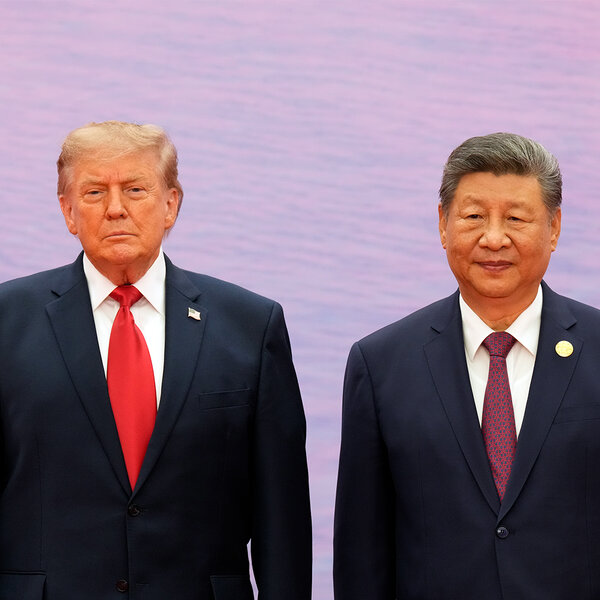
2:23Stephanomics Host: I'm Stephanie Flanders, head of Bloomberg Research, and this is Stephanomics, your weekly guide to the forces transforming the global economy. We have all been reeling the last few weeks at the thought that China might have been undermining America's technological leadership from the inside via Jensen Wang, and by extension, the NVIDIA chief's relationship with the US president. But what if China's most potent weapon in this race for AI supremacy, was hiding in plain sight. The NVIDIA fair is rightly a major scandal, maybe the greatest national security scandal of recent times, potentially implicating not only Jensen Wang himself, but senior members of the Trump administration who may have turned a blind eye to the smuggling of America's most sophisticated chips to China and worked to make US policy in this area more China-friendly.
3:13Stephanomics Host: It would be difficult not to think about all of that this week as we see Presidents Trump and Xi meet again. But there's another front to the AI battle, where China seems to be winning, and there's no secret about how it's doing it. The only mystery is why people aren't paying more attention. Daniel Remler is a senior fellow at the Center for a New American Security who focuses on the implications of AI and emerging technologies for US national security. I wanted to have him on the show after reading a provocative piece he wrote for Foreign Affairs recently on China's AI diplomacy, where he argues, in effect, that the US focus on AI security and technological controls has allowed China to gain the competitive edge when it comes to actually getting Chinese AI models embedded in companies and countries around the world.
4:06Stephanomics Host: And that, in turn, has a lot of potentially very disturbing implications. Daniel, thanks so much for coming on Stephanomics.
4:12Daniel Remler: It's great to be with you, Stephanie.
4:16Stephanomics Host: Now, I should say my colleague, the senior geoeconomics analyst in this area, Michael Deng, who's been on this show a few times, was at pains for me to understand quite how respected you were in this field, that you weren't just some policy wonk who'd written a piece for foreign affairs. And he wanted me particularly to understand that you were the first to identify distillation, which we've talked about a bit in the past, as a key issue in the US-China AI gap. So I'm even more grateful that you've been able to come on. Explain briefly what you think China has got right in its public AI diplomacy and perhaps America's been getting wrong.
4:54Right.
4:55Daniel Remler: So I think it's important to trace China's AI diplomacy from 2023. And it comes just after the launch of Chachi BT at the end of 2022 and the imposition of pretty severe export controls by the United States on exports of chips going to China. And that moment really crystallized for Beijing, both that the United States had an early lead, if not a mastery in this new paradigm of artificial intelligence. And then the chip export controls showed that the United States would take very serious action to maintain this lead over China. That caused a rethink of China's national strategy, including this diplomatic component that I outline in the peace.
5:36Daniel Remler: So it begins with the end of October 2023. They released this global AI governance initiative. It's one of these sort of turgid party speak documents. But I think it's important because it lays down a few markers that would become kind of the hallmarks of China's AI diplomacy over the next several years through to today. And you can really pinpoint these two goals of their strategy. First is positioning China as the champion of the global south of developing countries, and second, overcoming U.S. technology restrictions. Since then, we've seen Beijing make several moves in this direction in its diplomacy.
6:13Daniel Remler: So it pushed for these diplomatic initiatives at the U.N. General Assembly that would promote capacity building for developing countries. It would tout its open-weight AI models. And then it has engaged in this AI dialogue with the United States, both during the Biden administration when I was there and most recently under the Trump administration, where it has similarly pushed this message of opposing U.S. export controls and positioning itself as a champion of the global south, even though the kind of ostensible purpose of the dialogue is risk and safety. So what I argue in the piece is that this kind of very focused approach on these two goals has allowed China to consistently make the argument that the United States is excessively focused on risk or focused on risk in a way that is merely a cover or a smoke screen for inhibiting China's air development and by extension, the development of AI in the rest of the developing world, which China sees itself as a member of.
7:09Daniel Remler: And China, by contrast, has a more inclusive approach to AI. It builds these open-way AI models that can be picked up and used by countries, governments, and enterprises around the world. And it's building kind of parallel institutions that favor that vision. So President Xi Jinping in July was at the launch of China's World AI Cooperation Organization, which is this new multilateral forum that has 37 members, essentially all low and middle income countries, to talk about AI capacity building, open models, et cetera, et cetera. No focus on risk or safety there. So again, that kind of pitch from China.
7:46Stephanomics Host: What's the attraction of that pitch for developing countries and why has it been enabling China to get quite a foothold in these countries from an AI standpoint?
8:00Daniel Remler: There's a few factors. So the first and most essential really is the basic technological offer from China. So these open weight models that I mentioned from China are eight to 10, maybe 12 months behind the US frontier. They're still quite good models from a capabilities perspective, but users don't need to pay through the nose in API costs. They can fine-tune them for their own local purposes. And so there's a greater degree of data privacy, sovereignty, and using these open-weight models for various use cases. And that's, of course, especially important for price-sensitive users, not just in lone middle countries, but even enterprises in the West.
8:42Daniel Remler: So that basic technological offer remains pretty strong. Chinese companies have paired these models with hardware, which, of course, they're very proficient at. So you've seen Huawei, Alibaba go around the world pitching kind of packages of models with hardware solutions for low - and middle-income countries. So that technological offer is very real. Second, at the kind of political level, there is a sense from a lot of low and middle-income countries that they don't have a seat at the table in terms of global diplomacy and that decisions are being made over their head, not just by the United States unilaterally, but potentially by the United States and its allies and advanced economies.
9:22Daniel Remler: And so China is sort of, again, positioning itself as their champion, says, we will give you a voice, right? We will give you the technology. We will kind of lift your voice up at the UN in our own organization. So there's that political element. And then Beijing just asks little of its own partners. And so there's a sense that when Beijing comes to kind of bring a technology offering or to ask you to participate in their organization or support their political initiative, there's less of an expectation that that would come with some other kind of concession. And so it's a relatively low ask for countries that may not be part of so many multilateral organizations or not have the kind of bevy of alliances and partnerships that the United States and its partners have to support Beijing.
10:09Daniel Remler: For big business, AI opened up a world of promise, but that world of promise turned into a world of pain. Cost spiraling, data scattered across disconnected systems, security and governance increasingly complex. AI initiatives struggling to scale, an ROI that remains frustratingly out of reach. The challenge isn't AI itself, it's having the infrastructure AI needs to succeed, which is right where Boomi says we got you. Tens of thousands of enterprises trust Boomi to connect data, applications, processes, and AI. With Boomi, businesses can eliminate silos, automate workflows, strengthen governance, and create the foundation AI needs to perform at scale.
10:50Daniel Remler: The result? Faster innovation, more efficiency, better business outcomes. Boomi turns a world of AI pain into a world of AI gain. As Boomi says, we got you. Head to boomi.com to learn more. That's B-O-O-M-I dot com. This is the Bloomberg Market Minute, brought to you by Comcast Business. The market's faced plenty of challenges this year. Rising energy costs, higher interest rates, pushback to massive artificial intelligence spending, But through it all, stocks keep breaking records. And some analysts think they still can with a focus on the fundamentals. Nadia Lovell is head of global equity strategy at UBS.
11:30Daniel Remler: Earnings has been good and continues to be good.
11:33Stephanomics Host: And while, you know, we might be past the peak in earnings growth, we're not past the peak in earnings level.
11:39Daniel Remler: But others like Miller-Tabak strategist Matt Maley say those challenges could eventually lead to a downturn. Whenever we see a significant rise in bond yields like we have and a significant rise in oil prices like we have, The stock market always or pretty much always ignores it for a while. And Wall Street may be starting to take notice. A recent Citigroup index shows more analysts cut rather than raise their earnings forecasts for corporate America for the first time in more than five months. That was the Bloomberg Market Minute brought to you by Comcast Business, one partner powering 90 percent of the Fortune 500 and millions of small businesses.
12:14Daniel Remler: When you add it all up, no one does business like Comcast Business.
12:22Daniel Remler: When you own your own business, you need to keep things moving. Need to book a last-minute flight? Earn a$300 travel credit to cover that. Need to take a meeting before takeoff? Do it from the comfort of the Chase Sapphire Lounge by the club. Need to catch your breath before you board? Done. Chase Sapphire Reserve for Business. The business card that gives back all you put in. Visit chase.com slash reservebusiness to learn more. Cards issued by JPMorgan Chase Bank. Any member of DIC. Subject to credit approval. Terms apply.
12:53Stephanomics Host: Running a business means keeping pace with the latest tech. You've put a lot into building your enterprise software stack, and scrapping it to integrate AI is out of the question. That's why IBM technology works with all the apps, data, and models you need. It's another way IBM helps you build on the technology you rely on. Let's create smarter business. IBM. Visit ibm.com to learn more.
13:26Stephanomics Host: I said at the start, this was all a sort of AI diplomacy in plain sight. I guess that the somewhat illicit or the non-transparent aspect to this is the messaging embedded in the AI models themselves. By law, Chinese IA models can't go against the Chinese government. You can sit there on deep seek and ask them about the Chinese Communist Party or Chinnaman, and you will get very regulated answers that are consistent with the importance of the CCCP and core socialist values. If one's thinking about the geopolitical advantage that China could get from this diplomacy, there's a real sense in which its messaging is being built into the AI that these countries are using.
14:14Daniel Remler: Absolutely. And there's a slight misconception here because the argument's made that, well, open-weight models, because they can be locally hosted and fine-tuned, right, any user or enterprise that is worried about CCP censorship or ideological bias can fine-tune that out, right, can impose guardrails that would effectively un-brainwash the model, let's say. And it's true that, of course, if you're accessing the DeepSeq model via the app, right, which is hosted by DeepSeq itself, of course, there's a kind of censorship embedded at the software layer. But analysis, including by the U.S. government, has found that even the open-way models, when locally hosted, have this very deep level of censorship and kind of alignment to CCP talking points.
14:56Daniel Remler: And it's not just the topics that, frankly, everyone cites correctly, like Tiananmen Square or the status of Taiwan. It extends to these contentious historical topics that matter to the CCP, and this trend has been increasing over time. And what I think is especially worrying is some other research that's found how ideological bias intersects with, let's say, more functional uses of the models. So there's this study from CrowdStrike that found that when you asked a DeepSeq model about Tiananmen Square and then asked it to produce code, the code was more likely to be malicious or broken.
15:30Stephanomics Host: So if you're sort of a suspicious character, then you get a sort of worse product to put into your system.
15:36Daniel Remler: Yeah, this Booz Allen Hamilton study made that point even more sharply because they interacted with the model kind of as if they were a U.S. government employee and then asked it to produce code and the code was more broken, more malicious. So there's these interactions between kind of censorship, ideological bias and the actual use of the model that are concerning based on what we've read. And this is really an area of research that's still nascent growing, but there needs to be more done.
16:04Stephanomics Host: I mean, it is extraordinary. I mean, to your point about people not paying more attention, it seems like a long time ago, but you know, the focus on TikTok. But if these kind of chatbots and NLMs are going to be embedded in companies, maybe American companies who think that they've taken out the communist friendly pieces of it. And in fact, there's this kind of insidious way that it's actually potentially delivering a worse product dependent on what stance they have towards China, that's extraordinary. I mean, that just feels like we should be talking about that a lot more.
16:34Daniel Remler: Yeah, absolutely. And the problem extends, frankly, farther than just censorship and ideological bias. So, of course, in China, there's a very strong role for the security services to intervene in the development of products and kind of identifying bugs. They have a sort of right of first communication on any bugs that IT or software firms identify. And so you could imagine that the security services would ask one of China's AI developers to build backdoors or other kinds of vulnerabilities in a model that could then be exploited later by the security services. And Cohere, the Canadian AI company, actually identified something that looked like a backdoor in an Alibaba model very recently.
17:18Daniel Remler: And this is something that had only been kind of speculated in academic research work, but this is the first sighting in the wild of something like this from a Chinese AI model. And so as you have these open-way Chinese AI models potentially taken up by enterprises around the world, we're just creating more and more vectors of vulnerability.
17:36Stephanomics Host: Okay. Well, while we sort of try and absorb that rather distressing news, obviously a natural kind of question around this is how America could respond if it understood the arguments and the evidence that you've been making more clearly or more keenly. One point that my colleague Michael said to me was that maybe we overestimate the role that openness plays in increasing the popularity of Chinese AI models. Because he thinks a lot of users will not care that much about the open weight aspect, but they do care a lot about how easy it is to use and how cheap it is and how reliable it is. And if the U.S.
18:16Stephanomics Host: was just better on that, you wouldn't necessarily have to give up that basic distinction between open and closed. Yeah, I think that's essentially right.
18:25Daniel Remler: The United States needs to enhance the diversity of its offerings, not just at the frontier, but kind of right behind the frontier. And package this, I believe, with a stronger diplomatic strategy. because it's not as if the United States is lacking for companies that have incredible technical prowess that could release open-weight models that are as good or better than the Chinese. And of course, we've seen recently Meta release MuseSpark, which is quite a strong open-weight model. But essentially, what I think we're really missing here is a kind of diplomacy, offense and defense on this question.
18:59Daniel Remler: So we need to go on offense to push out America's vision for AI governance that both is about managing the risks, but also about enhancing opportunity around the world. And this is something that we are just not really in the game on right now, in contrast to Beijing standing up this world AI cooperation organization. So we just need to be much more present there and pair it with our own technology offerings as China does. I also think we need to put pressure on the Chinese in these areas of kind of vulnerability that we've just been talking about. So the U.S. has a government organization that can evaluate AI models.
19:41Daniel Remler: It has evaluated Chinese AI models in the past and produced some of this research that I mentioned around censorship, ideological bias. And we could be doing that on a much more regular, rigorous basis, pushing out that information globally, working with our allies and partners like the United Kingdom, like Japan, that have this capacity as well so that every time Beijing asserts the inclusiveness of its models, you know, openness, low price, we are ready with a counter message that brings facts to bear on, well, actually, how good are these models? How expensive or inexpensive are they? But also, what are the potential risks and vulnerabilities and dangers?
20:17Daniel Remler: Because we're just missing an action on that question. It's not the kind of message that U.S. companies by themselves are, of course, going to push. And so I think if you have that kind of positive offense and kind of defensive approach at the diplomatic level, I think you could really shift the playing field in favor of the United States.
20:35Stephanomics Host: I guess at some level, China's right. We may think that the US have had a rather kind of patchy approach to safety and security over the last couple of years. I don't get the impression that President Trump's going to be raising these kind of concerns about open weight models in his, you know, when he has dinner or whatever with President Xi. But do you have a sense that any of this is percolating up to some of the senior levels who are interacting with the Chinese? We talk in terms of kind of hawks and doves towards China within the administration, but this is quite a technical area where, as you said, there's quite a lot of evidence.
21:11Certainly.
21:12Daniel Remler: So Secretary of the Treasury Scott Besson, who leads for the U.S. side, not just the economic relationship and the trade talks, but also this AI dialogue on risks with China, is quite concerned about risks from not just open-weight models, but increasingly capable models in general, and has been very vocal in his view that we need to manage these risks by talking to Beijing in some way. We have begun that important work by establishing a new dialogue with China on SI, designed to guard against shared risk, prevent misunderstandings between our two systems. We also expect to exchange best practices for evaluating and testing advanced models.
21:57Daniel Remler: He's also been clear, especially in recent days, about the importance of export controls on AI chips. And so he's signaling very clearly ahead of the visit that while managing AI risks in dialogue with China is a priority, it is not a priority at the expense of these necessary national security actions, nor at the expense of getting the broader economic and trade relationship right. So I do expect him to bring it up. But of course, even though he says truthfully that the United States is not going to negotiate export controls, the Chinese will, of course, bring them up because it is just part of the playbook that we've been discussing that I mentioned in my piece where they will position U.S.
22:40Daniel Remler: export controls as the obstacle to cooperation, to development. And so they will try to kind of create linkage across these issues, even as we try to silo them and separate them.
22:54Daniel Remler: For big business, AI opened up a world of promise, but that world of promise turned into a world of pain. Cost spiraling, data scattered across disconnected systems, security and governance increasingly complex, AI initiatives struggling to scale, and ROI that remains frustratingly out of reach. The challenge isn't AI itself, it's having the infrastructure AI needs to succeed, which is right where Boomi says we got you. Tens of thousands of enterprises trust Boomi to connect data, applications, processes, and AI. With Boomi, businesses can eliminate silos, automate workflows, strengthen governance, and create the foundation AI needs to perform at scale.
23:35Daniel Remler: The result? Faster innovation, more efficiency, better business outcomes. Boomi turns a world of AI pain into a world of AI gain. As Boomi says, we got you. Head to boomi.com to learn more. That's B-O-O-M-I dot com. This is the Bloomberg Market Minute brought to you by Comcast Business. The markets faced plenty of challenges this year. Rising energy costs, higher interest rates, pushback to massive artificial intelligence spending. But through it all, stocks keep breaking records. And some analysts think they still can with a focus on the fundamentals. Nadia Lovell is head of global equity strategy at UBS.
24:15Stephanomics Host: Earnings has been good and continues to be good.
24:18Daniel Remler: And while, you know, we might be past the peak in earnings growth, we're not past the peak in earnings level. But others like Miller-Tabak strategist Matt Maley say those challenges could eventually lead to a downturn. Whenever we see a significant rise in bond yields like we have and a significant rise in oil prices like we have, the stock market always or pretty much always ignores it for a while. And Wall Street may be starting to take notice. A recent Citigroup index shows more analysts cut rather than raise their earnings forecasts for corporate America for the first time in more than five months.
24:50Daniel Remler: That was the Bloomberg Market Minute brought to you by Comcast Business, one partner powering 90 percent of the Fortune 500 and millions of small businesses. When you add it all up, no one does business like Comcast Business. When you own your own business, you own every decision. Catch the red eye or take the 6 a.m. Make a new hire or promote internally. Celebrate a win with the toast at the gate or unwind at the lounge. Big props to this team. Some decisions are a win-win, like earning eight times points on Chase Travel. Chase Sapphire Reserve for Business, the business card that gives back all you put in.
25:30Daniel Remler: Visit chase.com slash reserve business to learn more. Cards issued by JPMorgan Chase Bank and a member of DIC. Subject to credit approval. Terms apply.
25:38Stephanomics Host: Running a business means keeping pace with the latest tech. You've put a lot into building your enterprise software stack and scrapping it to integrate AI is out of the question. That's why IBM technology works with all the apps, data and models you need. It's another way IBM helps you build on the technology you rely on. Let's create smarter business. IBM. Visit ibm.com to learn more.
26:10Stephanomics Host: Rightly or wrongly, it's still always considered to be this kind of race for supremacy, that there's the technological supremacy, but also the kind of assumption is that brings with it a kind of geopolitical influence. I said at the start, we've tended to focus on the kind of chips piece and the Jensen-Wang scandal has raised lots of questions and concerns around that. And there does seem to have potentially been a really significant effect on a US national security of that. That's one kind of power that the US currently has and is trying to hold on to that supremacy without making the rest of the world feel like its technology is completely inaccessible.
26:50Stephanomics Host: But at the same time, you have this more kind of amorphous power that comes from being the LLM sitting inside companies, sitting in countries. How do you think about the sort of respective weight of those two things. If everybody's using Chinese LLMs, in what sense is China winning if the US is still quite far ahead technologically?
27:13Daniel Remler: Well, in my view, it's a big world. And we often, I think, think of these issues through the very narrow lens of the United States and China or the United States and a few other actors around the world. But the direction of history, as President Xi would say, is moving towards more and more countries having greater economic weight, greater say in the world. And so it matters which of their leading firms, their government industries adopt which kinds of technology. And as we've discussed, right, Chinese AI models have this ideological inflection. They have these risks because of the tight linkage between China's AI ecosystem and the Chinese government.
27:52Daniel Remler: And of course, in my view, the United States and our allies, the AI technologies that we produce have a scope for kind of multiplicity, liberalism. They carry values that we care about. And so we should think hard about whether we are not seeding the kind of context of ideas and soft power in much of the world as we focus on this kind of narrow competition, even though it is quite important, right? We have to get the hard power elements right. We do have to deny leading technologies to China because those matter for its military, its intelligence, its surveillance state. But it would be a kind of pyrrhic victory if we succeeded there, but effectively ceded much of the world to influence by China that effectively congeals into political alignment.
28:35Stephanomics Host: When I'm listening to you, it sounds like it really does come down to how easy it is to swap out of these Chinese LLM models. I mean, if the US ends up with the quote unquote best AI that everybody wants to adopt, then it doesn't really matter that they use Chinese models on the way to that better US tech, the US still gets the advantage. But if it's sticky, if those Chinese models are actually quite hard to swap out, or they get really embedded in systems, then that seems much more problematic, even if the US remains technologically ahead. I know members of the intelligence service that I've talked to, you know, that's precisely the dilemma they have.
29:16Stephanomics Host: They want to have a diversity of tech. They don't want to just be using US hardware. On the other hand, they don't want to do anything that's going to be irreversible. Then they're going to find themselves years from now trying desperately to unpick the Chinese software. So have we reached that point?
29:32Daniel Remler: At this point, it seems like at a technical level, it's fairly easy to swap between models. Now, I say at the technical level, because it's important to distinguish that organizations are different. And just because a high-flying startup in London or Silicon Valley can easily swap between models whenever it likes for whatever tasks it likes, doesn't mean that a Fortune 500 company or even, let's say, like a conglomerate or a large enterprise in the developing world.
30:00Stephanomics Host: Or a hospital that can afford to change its IT once every 30 years.
30:03Daniel Remler: Exactly. A hospital, some large institution in a kind of more rural area or less economically advanced part of a country. It's just going to be more challenging, right? As time goes on, these systems will become increasingly important to the functioning of enterprises. And that means that employees will be trained around using them, right? Workflows will be developed and kind of codified. And so you are adding these institutional elements that make swapping between models, I believe, more difficult. So that's even before we get to the question of how do the Chinese change their relationship to their own AI products.
30:42Daniel Remler: So we've seen a recent trend of these open-weight model developers adding a few kind of conditions to their licenses. So for example, Kimi K3 from Moonshot, which is a Chinese head developer, that model's license says that you need a special agreement with Moonshot in order to host the model if you are an enterprise above a certain kind of revenue threshold. And that special agreement effectively is a way for Moonshot to claw back some revenue from companies, in particular U.S. hyperscalers hosting that model. And so we may see as Chinese companies come under increasing financial pressure, you may see them add these conditions onto the licenses, which also means that they're creating leverage against companies or countries that are using these AI models.
31:30Daniel Remler: And that itself may be a hindrance to models being swapped here and there.
31:35Stephanomics Host: Daniel Remler, this is an aspect of the AI race that we have not talked about nearly enough and I think should be thinking about very hard even as we read all the headlines about Jensen Wang and look at this ASEAN summit this week. Thanks very much.
31:49Daniel Remler: Absolutely. Thank you, Stephanie.
32:03Stephanomics Host: Thanks for listening to Stephanomics from Bloomberg. It was hosted by me, Stephanie Flanders, and I was joined by Daniel Remler from the Centre for a New American Security. Stephanomics was produced by Summer Sadi and Moses Andam with editorial guidance from Megan O 'Neill and Beth Honsert. Amy Keene is the executive producer for Talk Podcasts at Bloomberg, and Cheryl Brumley is our head of podcasts. Sound design was by Blake Maples and Aaron Kasper. To help others find Stephanomics, please rate and review us highly wherever you listen.
32:41Daniel Remler: The world of business is constantly evolving and Comcast Business keeps you totally in step with secure AI-backed networking in more than 100 countries. They're powering over 90 % of the Fortune 500 and millions of small businesses. That's a lot of muscle. And behind it all, thousands of experts answering your call at 2 a.m. like it's 2 p.m. One partner powering how business gets done for companies around the globe. When you add it all up, no one does business like Comcast Business. If you listen to financial news, you know a lot of time is spent thinking about what's next. The next opportunity.
33:18Daniel Remler: The next investment. The next move. But sometimes what matters most is being ready for what you never saw coming. For more than 75 years, Cincinnati Insurance has worked with independent agents to help protect businesses, homes, valuables, and more. Because planning for the future isn't only about knowing what's next. It's about making sure you're ready for what you can't predict. Let Cincinnati Insurance make your bad day better. Find an independent agent at CINFIN.com. Most meeting note takers get the easy words right and the important ones wrong. The client's name, the acronym, Whisperflow Notetaker is built to get the hard words right.
33:59Daniel Remler: It takes notes on any meeting platform, Zoom, Google Meet, Teams, even WhatsApp calls, keeps every meeting searchable, and connects to Claude or Chat GPT so you can ask, what did we agree to last Tuesday? Free to try on Mac and Windows at whisperflow.ai. That's W-I-S-P-R flow dot A-I. For big business, AI opened up a world of promise, but that world of promise turned into a world of pain, costs spiraling, data trapped, security and governance risks multiplying, and ROI out of reach. That's why enterprises turned to Boomi to connect data, apps, and AI, helping them operate securely, efficiently, and at scale.
34:39Daniel Remler: Boomi turns a world of AI pain into a world of AI gain. As Boomi says, we got you. Head to boomi.com. That's B-O-O-M-I dot com.
The US is still seen as being ahead of China at the frontiers of artificial intelligence. But Daniel Remler, a senior fellow at the Center for a New American Security, argues that may not be the race that matters most.
China has spent the past few years pushing cheaper, more accessible AI models to companies and countries across the developing world, all while presenting itself as the champion of nations shut out of the West’s more restrictive approach to AI. The result, he says, is a form of technological influence that could prove just as important as who builds the most powerful model. Remler tells host Stephanie Flanders why that strategy should worry Washington.
Read more: https://www.foreignaffairs.com/china/chinas-ai-diplomacy-working
See omnystudio.com/listener for privacy information.