Ask ChatGPT


 Unchained
13 Nov 2026 · 40m · 18 chapters
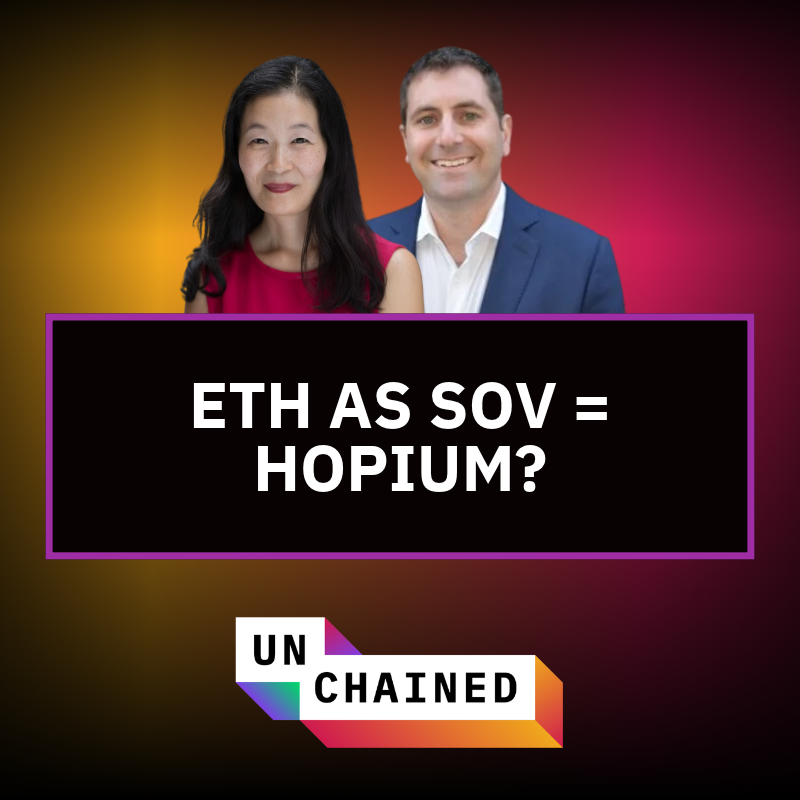
Jeff Dorman argues Ethereum’s ~$240B market cap isn’t justified by direct ETH fee revenue (~$6M/month cited) and that most value is “social/memetic,” not financial or utility. He critiques Vitalik Buterin’s view that ETH should be optimized as a store-of-value rather than a fee-burning token, saying ETH can’t be quantified as a token-capture mechanism because fees accrue to apps (e.g., Uniswap, DeFi protocols) and stablecoin issuers (Tether/Circle), not the L1. He says EIP-1559’s burn link weakened after the Denkun upgrade (fees decoupled from activity).
DeFi Llama revenue rankings; ETH burn example tied to NFT sales (~$180M fees burned in a day); Hyperliquid/Pump/other application tokens as undervalued revenue generators.
Jeff Dorman, Chief Investment Officer and co-founder at ARCA; host Laura Shin.
Written by AI. May contain mistakes.
Discussion on Bitcoin's lack of utility beyond being a store of value.
“Bitcoin would be an incredibly boring country since you can't do anything with it.”
Introduction of guest Jeff Dorman, CIO of ARCA.
“It's our weekly crypto and macro market show with Ram Alawalia, Austin Campbell, and Chris Perkins.”
Discussion on Vitalik Buterin's tweets regarding ETH's role as a store of value.
“Vitalik Buterin made headlines this week when he tweeted that ETH should focus on being a store of value more than being a fee-burning token.”
Exploration of the differences between store of value tokens and fee-burning tokens.
“So before we get into your opinion on what's going on here, can you just explain what the difference is between a store of value token and a fee burning token?”
Discussion of EIP-1559 and its effects on ETH's value and fee economics.
“And as a result, you have a myriad of different opinions and theories, none of which are very well quantified, but that's the gist of it, right?”
Jeff explains the three types of value in cryptocurrencies: financial, utility, and social.
“But it sort of got, I don't know, reverse is not quite the right word, but it lost its importance in the spring of 2024 when Ethereum did its Denkun upgrade.”
Analysis of Ethereum's financial value and its revenue potential.
“Um, you know, I, I think, look, let's start from the basics for a second, right?”
Discussion on Ethereum's utility and social value compared to its market cap.
“Meaning, does somebody have to hold this or own it in some way, shape, or form?”
Comparison of Ethereum's value structure with Solana's revenue and market cap.
“And the reality is even Joe Lubin would admit this because he actually tweeted it out a year ago.”
Discussion on the overvaluation of layer one smart contract tokens in the crypto market.
“And then you look at something like a GameStop stock or a Pepe or Dogecoin, it's basically the opposite.”
Exploration of undervalued crypto tokens at the application layer generating revenue.
“And, but you, so is Ethereum an outlier amongst crypto tokens in that respect?”
Exploration of whether crypto tokens, particularly layer one platforms, are overvalued.
“And so essentially, you're saying that pretty much all crypto tokens are overvalued.”
Discussion on Vitalik's argument regarding Ethereum's market cap and fee generation.
“Bits and Bips is our weekly market show.”
Exploring the rationale behind cryptocurrencies being compared to Bitcoin as stores of value.
“And I think everybody in crypto, it's almost like, you know, Bitcoin was effectively like an immaculate conception, right?”
Discussing the philosophical underpinnings of Ethereum's value proposition.
“So again, I don't disagree that that should be the vision of Ethereum.”
Debating the need for Ethereum to generate revenue through stablecoins and DEXs.
“Like I said, I think you have to have the Holy Trinity.”
Examining the ability to quantify growth metrics that justify fee structures in crypto.
“And the rest of them are commodity businesses that are all competing for the same businesses to be built upon.”
Critiquing the arguments made by Ethereum advocates regarding its future value.
“Because you can't quantify what that means.”

Get the gist, explore an idea or ask about something said.
 Claude
On Unchained, what are the key points of this episode?
Searching your listeningAutomatic transcript. May contain errors.
0:00Bitcoin would be an incredibly boring country since you can't do anything with it. You don't spend it. You don't use it. It's literally a country of just rocks. If I ran Ethereum or Solana or Avalanche or one of the other, you know, 100 blockchains that think they're important, tell me, tell me, give me the number. How big does your network have to get before you start turning on fees and revenues and who are you going to get those fees and revenues? If you give me an answer, I might be the first investor, but nobody can do it.
0:29Hi, everyone. Welcome to Unchained, your no-hate resource for all things crypto. I'm your host, Laura Shin. Thanks for joining this live stream. And first, we'll take a quick word from the sponsors who make this show possible. This episode is brought to you by Nexo, the premier digital assets wealth platform. Earn daily interest on your crypto or borrow funds all through one platform trusted by more than 10 million clients. Find out more at Nexo.com. Geo-restrictions, eligibility, and terms apply. Not listening to Bits & Bips yet? It's our weekly crypto and macro market show with Ram Alawalia, Austin Campbell, and Chris Perkins.
1:03Search Bits & Bips and subscribe. Today's guest is Jeff Dorman, Chief Investment Officer and Co-Founder at ARCA. Welcome, Jeff. Hi. Thanks for having me back. Vitalik Buterin made headlines this week when he tweeted that ETH should focus on being a store of value more than being a fee-burning token. He gave a few different reasons. The fee-burning meme for ETH was never that strong. Quote, optimizing for ETH as a fee-burning token would demand Ethereum and ETH function in ways that are very hard to make compatible with decentralization and capture resistance. And his third reason was, quote, optimizing for ETH as a store of value is aligned with Ethereum focusing on its unique strength, unique strengths, decentralization and crops.
1:50So before we get into your opinion on what's going on here, can you just explain what the difference is between a store of value token and a fee burning token? Sure. And before I get started, just a quick disclaimer. The views expressed are my own as of today and not investment advice. So I think, look, there have been a lot of different opinions and theses around what a cryptocurrency should be in terms of its value drivers. So if you go back to the kind of original Bitcoin days and everything was just some sort of derivative of Bitcoin, like a non-smart contract platform currency, the idea was that these are going to be stores of value, meaning that over time with inflation, you can protect your purchasing power by owning these because in theory, the price of these assets will go up more so than inflation, which is the exact opposite of fiat currencies, which tend to go down.
2:51relative to inflation, and therefore you actually lose purchasing power, right? That was the sort of original thesis of what Bitcoin could be. Then obviously things got layered on like, oh, actually it's going to be a medium of exchange. People are going to actually use this to spend. And then, you know, 15 years later, we know that nobody spends Bitcoin. So that's not really true. And then you had the smart contract platforms come in and it was like, well, how do you think about these tokens, right? Are these supposed to be currencies? Are they supposed to be, the same store of value medium exchange?
3:21Or are they more like platforms where you actually want to look at the revenue and the financial projections of these? Or are they utility coins, something that actually is just useful, something that you have to own in order to use the network? And we've been now going back and forth for 10 years on this and what these are. And as a result, you have a myriad of different opinions and theories, none of which are very well quantified, but that's the gist of it, right? Are you actually supposed to own the token and hold onto it simply because it is going to keep your purchasing power over time? Or is it something else that actually can be valued in some sort of a financial basis or in some sort of a usefulness utility basis?
4:07All right. So let's talk about some of the key developments in recent years that affected ETH as money or how it could be considered money. So the first one would be EIP-1559. That was implemented back in 2021, and it tied high levels of activity on the network to burning ETH. But it sort of got, I don't know, reverse is not quite the right word, but it lost its importance in the spring of 2024 when Ethereum did its Denkun upgrade. And that caused the relationship between activity on the network and the fee burning to kind of decouple. So I'm curious, like, what's your opinion about what type of asset ETH has been like for these last few years now after Denkun?
4:57Like, like, like, in a way, like what I'm asking is why did he even need to make this clarification about what ETH is given that ETH is 11 years old? Well, I think the last thing you asked is probably the most important is if you have to continuously justify what an asset is, then clearly nobody understands what it is. And you're basically scrapping at straws here to try to create value out of something that doesn't have that much value. Um, you know, I, I think, look, let's start from the basics for a second, right? Going back to what I was saying a minute ago, in order for anything to have value, there's really only three types of value that it can have, right?
5:33It can either have financial value, meaning you can actually, um, come up with a valuation for it based on some revenues or cash flows. Um, and you can, you know, argue whether something is, is, is cheap or expensive based on various ratios, but at least there's some tangible metric from the revenues and cash flows that make it worthwhile. In the equity world, this is fairly obvious. You put some sort of a multiple on the cash flows. If somebody offered you a million dollars a year for 20 years, you would pay more than$20 million for that. You would pay some multiple of those revenues in order to get that cash flow stream.
6:13So that's fairly obvious. That's what most assets in the world are valued. Even that's a fairly new concept, right? I mean, stocks have been trading for 400 years and really it wasn't until the 1920s when Graham and Dodd put their equity handbook out there and Warren Buffett started to adopt value investing that people really understood this. But it's pretty well understood now. It's pretty well universally used as a valuation technique. The second form of value is what we were just talking about a second ago, which was utility or usefulness, right? Meaning, does somebody have to hold this or own it in some way, shape, or form?
6:49you know, or is it useful in some way, right? Is it useful as a medium of exchange? Are you using it, you know, to transact with, are you using it to spend? Are you, you know, holding it for some reason? You know, there's a lot of things like, for example, I would consider aluminum pretty useful. It's not very valuable, but it's pretty useful. You know, and then the third type of value is just social value, right? Like mimetic value or, you know, is there a cool factor behind it? You can read all kinds of books from Jonah Berger or Malcolm Gladwell or all kinds of behavioral psychologists that talk about why things go viral, why they have social value.
7:26You can look up the steps, which is talking about like, is there a trigger? Is there an emotional response? Is there a cool factor? And the reality is even Joe Lubin would admit this because he actually tweeted it out a year ago. It was a tweet from January 18th, 2025, where he said Bitcoin is 80 % meme coin, 18 % store of value, 2 % other. And he said ETH is 65 % meme coin, 25 % utility coin, and 10 % store of value. So even he sort of agrees that the majority of the value of these protocols is just in this sort of social value, this memetic value, and this cool factor. So anyway, long story short is if you believe that those are sort of the three types of values and there's really no other type of value out there, then you can kind of look at something and say, all right, well, is this 100 % just financial value?
8:16There's probably some stocks, for example, that are like chemical companies that are basically 100 % financial value. Like nobody thinks it's cool to own the stock of a chemical company. There's very little usefulness for this stock. So it's 100 % financial value. And then you look at something like a GameStop stock or a Pepe or Dogecoin, it's basically the opposite. It's 100 % social value. It's just a memetic value. Maybe GameStop's a bad example because there's some financial value, but you get the idea. These are things that only exist because people think it's cool and are propping up the value for social reasons.
8:52But then you get the smart contract protocols and this is where it gets harder and messier because they really have some form of all three. There's definitely a social component to them. The cult-like nature of owning a layer one and feeling like you're in the Ethereum community versus the Solana community versus the Avalanche community. but there's also clearly some utility value it's not a lot but there's some utility value right you know in order to transact and use these networks you do have to own some of the asset in a wallet you know you could argue that's a very low component of it because you know gas prices are going down overall fees are kind of racing to zero it's not that expensive to transact especially you know some of the newer blockchains but there is some value right and as those networks grow, you would think that utility value would grow as well.
9:41And then of course you have the financial value, which is, you know, do these blockchains actually produce any revenue and can you put some sort of a multiple on that revenue and, you know, anticipate what that revenue will look like in the future in order to come up with a value. So, you know, long story short, and I'll let you jump in in a second. Like, you know, when I look at each of those three things and the sum of the parts for Ethereum or for Solana, and actually we wrote a blog about this years ago, you know, actually looking at the sum of the parts and breaking it down. It's probably closer to 75 to 80 % of the value of these chains is purely in that social value camp.
10:18And that's why they trade the way they do. Because when that social value starts to oscillate, there's not a lot of financial value or utility value as sort of a floor to keep these things afloat. And by social, that's the memetic. It's the same as the mimetic? Yeah, right. The idea of it's a cool factor. It's something that you just sort of want to own. You speak it into existence. So, you know, going back to - And you think that even for Ethereum, it's like the utility is minimal. Well, yeah. I mean, let's do the math for a second, right? If I'm on DeFi Llama right now and I look at 30-day revenue, Ethereum is not even in the top 50.
10:56It's barely in the top 50. It did$6 million of revenue in the last 30 days. So let's, you know, let's give them the benefit the doubt and say that this was a pretty bad month, let's double that to 10 million. Now you're talking$120 million per year of revenue for Ethereum. Let's slap a very generous 20 times multiple on that. You're only looking at a couple of billion dollars of financial value there. And you wouldn't count securing the layer twos. You wouldn't have some sort of inclusive way of measuring, even if it's some fraction of that activity, you wouldn't include that? Well, even if you did, I mean, how much is that really worth, right?
11:40I mean, there's a billion chains. There's virtually no cost to move in between chains. As an economist, you would call that perfect substitutes. I don't know. I wouldn't put a huge value on that. But then on the utility value question, that's what you really asked. It's estimated that there's 200 million Ethereum wallets out there. And it's estimated that on average, people own about 0.1 ETH. So that means 20 million ETH is basically just sitting idle for purposes of gas or other things. So you take 20 million ETH times the current$2 ,000 per ETH, you're talking 40 billion. So ETH is worth, what, 200 billion?
12:19And I can only come up with 45 billion of that. That's actually quantifiable. So the other two, it's$246 billion asset, and I can come up with maybe$50 billion worth of tangible reasons why it's worth something. That leaves$200 billion left over of just social value or hopium. And, but you, so is Ethereum an outlier amongst crypto tokens in that respect? Or is it just one of many crypto tokens where the analysis would be pretty much the same? No, Solana is basically the same thing, right? Solana is not even in the top 100 on DeFi Lama in terms of revenue. And they'll argue, anybody who's a Solana bull will argue, but we need to win as the biggest network before we worry about revenue.
13:04Okay, well, the last 30 days, the Solana network has generated 1.7 million of fees. Right? So same thing, even if you're generous and called that 5 million monthly, and now you're looking at, what, 60 million in annual fees? $60 million in annual fees. Slap whatever multiple you want on that. it's not worth more than, you know, five or$10 billion. And Solana has a, what,$50 billion market cap. And then if you look at the utility function, same problem, right? There's only 100 million Solana wall. It's a little bit less than about half of Ethereum. On average, people own about 0.02 sol. So you're talking 2 million sol, you know, at most that is actually owned for the purposes of gas and actually using it.
13:51Again, at$100 a soul, you're talking$200 million worth. It just doesn't get you anywhere close to the$50 billion that people think this network is worth. And so essentially, you're saying that pretty much all crypto tokens are overvalued. Is that... I mean, it almost feels like it's not super particular to Ethereum, right? No, I wouldn't say all crypto tokens are overvalued. I would say all layer one smart contract platform tokens are overvalued. There's plenty of incredibly undervalued crypto tokens at the application layer that are generating a ton of revenue and fees relative to the actual market caps.
14:27Again, going back to DeFi Llama, Hyperliquid is doing 70 to 100 million per month. You slap a 25 times, 20 times multiple on that. Now you do have a 20 to$25 billion token. Same with Pump Fund. Pump Fund did 50 million. You annualize that, that's 600. And that's in the depths of very little activity happening on chain, they're still doing$600 million a year of revenue. And you have a token that is, you can't even find it on my list. It's so far down. You got a token with a$1.5 billion market cap that's doing$600 million of annualized revenue and using 50 % for buybacks. That's a three times price to sales ratio and a six times price to earnings ratio of one of the biggest earners in the entire platform.
15:12You can do the same thing with Aerodrome and Sky and all these other DeFi platforms. I think that the reality is the fat protocol thesis, which was intellectually interesting 10 years ago by Joel Monegro and I think Chris Bernisky, it was so flat out wrong and has shaped 10 years of misinformation and miscalculations in this space when it's just easily provable that it's just not true. The value does not accrue to the layer one protocol. It accrues to the applications built upon these protocols. Huh. All right. So in a moment, we're going to talk a little bit more about how value accrues to layer ones.
15:53But first, we'll take a quick word from the sponsors who make this show possible. What if your crypto could do more than just sit in your wallet? Nexo is a digital assets wealth platform where you can generate daily interest on your crypto or borrow funds against your assets. Today, Nexo serves more than 10 million clients. Find out more at nexo.com. If you like this show, there's another one from our network you should be listening to. Bits and Bips is our weekly market show. On Mondays, Ram Alawalia, Austin Campbell, and Chris Perkins chat about where crypto and macro collide. It's sharp, it's fast, and it has its own channel.
16:32Search Bits plus sign Bips and subscribe.
16:38Back to my conversation with Jeff. So Vitalik made an argument against ETH being a fee-burning token. He said, quote, the bulk of that burn was crypto internal use cases. And he said, if ETH had dropped by 10x, then the profits from those use cases would have also dropped because all the buyers would have had much less money to play with or to pay with. And he cited, for example, like, I guess it was the other deed NFT sale. He said that was$180 million in fees burned in one day. But he was essentially saying like, like if, if the value of ETH was a lot less than, then that would have been a lot less.
17:20So he, he then wrote quote optimizing for ETH as a fee burning token would demand compromising decentralization and capture resistance. If we decide we actually want to optimize ETH for burning fees to justify a present day$270 billion market cap, then Ethereum would essentially be functioning as a world-scale major corporation. And he said it would be somewhere around L 'Oreal, number 55. What's your take on his argument there? Well, I mean, it's not wrong. If you start to only focus on fee generation, then yeah, you basically become a stock, right? And I'm not arguing that that's all a blockchain should do is focus on fee generation.
18:00But the flip side is also true that if you don't care about fee generation and you only care about being this, you know, payment token within a network, you know, the best way to think about it is to think about like, what if you were in some sort of a closed nation, right? So it actually shout out to my old colleague, Nick Hodes, my old colleague, Nick Hodes, who I think wrote a piece on our ARCA blog five years ago talking about, you know, should you, uh, uh, I think that the title of it was our blockchains businesses are nations. This was back in February of 2022. We've been writing this blog for almost eight years.
18:31So But, and the whole crux of that is, should you value a blockchain based on the revenues like a business, or should you look at it like a nation? So let's take the nation example for a second, because that's the counter argument to the revenue. Let's say that you just discover some island that is completely uninhabited, and you decide that you're going to populate this island. Well, on day one, that island is worth something, right? It's worth some speculative value of what this land could be used for. But if it's never actually developed and never used, it's really not worth that much. It's always just going to have some speculative value of what it could be used.
19:09But if you start to invest within that island and you start to build roads and you start to bring people in and you start to build schools and hospitals and businesses, eventually you start to have much more value in that nation because of one reason, tax receipts. You have to actually tax the businesses and the people that are living and using that island. That's what Ethereum and these other blockchains don't do. They don't tax the applications. So if you're just going to create this island and you're going to say, we have the currency that can be used on that island, in our example, EtherSol, but we're not going to tax the businesses that are using the island to create value, what is that currency worth?
19:54Right. If again, if you're in a closed ecosystem where you never leave the island, you don't really care about the strength or the depreciation of that currency because you're never using it across anywhere else. Right. You're only using it in this closed ecosystem. ecosystem. Like, you know, if I, if I live in the United States and I never plan on ever, ever, ever leaving the United States and we don't have any imports or exports and it's a closed ecosystem, I don't care what the strength of the dollar is. I'm only spending in dollars. The only reason I would care about the strength of the dollar is if I'm traveling abroad and my purchasing power is higher, right?
20:25So if you're in this closed ecosystem and you're only spending ETH in this closed ecosystem, again, you don't care about the value of it. It doesn't matter if it goes up or down, but more importantly, there's just no real value if you don't tax the businesses and the applications that are on there. So the only way that that currency will have greater price appreciation is if you start to take a tax on the businesses on there and people start to leave the island and start spending that currency other places, in which case that relative strength matters. So I just don't see that ever happening. We've already proven that there's going to be hundreds of blockchains.
21:02People can move fluidly back and forth. Even even this new wave of RWA tokenization is happening on every blockchain. It's like, you know, this guy partnered with Canton and this guy partnered with Avalanche and this guy's building his own network. And this, you know, there's no continuity here that you're never going to have this closed ecosystem where every, all the activity is happening in one place. As a result, you're constantly kind of fluidly moving back and forth. And if you're not creating any value within the ecosystem, I just don't understand how the native currency can be viewed as anything other than a business.
21:35So I guess what I don't fully understand is like Ethereum probably has the largest ecosystem in crypto, even more so than Bitcoin, which has a bigger market cap. But in terms of the sheer amount of activity of all sorts, it's for sure Ethereum. Like if we're going to pick one place where like if we truly are making a country, you know, out of crypto, like one of the probably the only two places and like i know i'm gonna get a lot of hate for saying these things but probably the only two networks in crypto that could legitimately become countries are bitcoin and ethereum right like just am i wrong in thinking about like i don't know why you're it seems like you're saying that bitcoin would be an incredibly boring country since you can't do anything with it you don't spend it you don't use it it's it's it's literally a country of just rocks, but sure.
22:33But it seems like you were arguing the opposite of what I just said. Well, yeah. So first of all, if you go back to the Joe Lubin tweet, I think is what triggered you asking me to be on the show and my response to it. I don't disagree with anything that Joe Lubin said about Ethereum, the protocol. Ethereum, the protocol is fantastic. Like you said, it's the leader in every category. But the problem is everyone continues to try to equate the strength of the protocol with the token. And like I said, there's just no real tangible ties to the token price based on how cool the platform is. And I'll go even further there is we've had a ton of experiments over the last 15 years in crypto, most of which have failed, right?
23:15Social trading has failed miserably, gaming, NFTs, all this stuff has failed. The only three things that are clearly up and to the right and without a doubt growing are stable coins and payments, undeniably. Even with the recent blip post the Binance hack where stable coin AUM has fallen 15 billion over a longer time horizon, AUM of stable coins is growing and payments and transactions are definitely growing. All of Wall Street is now in this. All the banks are looking at this. Stable coins and payments are not going away. That's use case number one. Use case number two is the tokenization of assets.
23:51You could argue that all of crypto to date has just been one giant experiment because all we did was make up a bunch of crypto assets, 99 % of which have no value and a few of them do. And we're testing the blockchain rails to see if they work. And now that we've proven they work, now the real assets are coming, right? There's 700 trillion of bonds, stocks, real estate and commodities that are eventually moving their way on chain. Again, you look at any graph of RWA tokenization and it's up and to the right, right? There's just more and more tokenized assets, more and more trading volumes of tokenized assets.
24:21I mean, even Binance and Hyperliquid are effectively just stock trading platforms now because people have just largely stopped trading the nonsense crypto assets that haven't amounted to anything. And then the third use case is DeFi, which ties all of that together, right? When you have more assets on chain and you have more dollars on chain via stable coins, you're going to have to place to borrow and lend and trade those assets. And that's why every chart in DeFi is up and to the right as well. DeFi used to be less than 1 % of total crypto transactions relative to like Coinbase and Binance and the centralized exchanges.
24:52Now, DeFi transactions are 25 % of all volume, and that's just going to continue to grow. So you have three viable use cases of crypto right now, stable coins and payments, RWA tokenization, and the connector of the two, which is DeFi. So if you wanted to make a very lazy argument and say, well, I want exposure to all three of those, what should I buy? The answer would be Ethereum, right? Because Ethereum does loosely give you exposure to all three of those, right? It's probably the most generic way to get exposure to all three of the growth assets. By the way, I didn't mention Bitcoin, because Bitcoin gives you exposure to none of those things, right?
25:27Bitcoin is this anomaly that at this point shouldn't even be connected to crypto, because it's a totally unique, different asset that has nothing to do with the growth of blockchain. You know, most investors who say, you know, I want to be long crypto, I'm long Bitcoin. It's like, okay, well, you're not long any of the three things I just mentioned, which are actually growing, but okay. But anyway, so you might make the argument that that's why I want to own ETH, or maybe you believe in Salon or Avalanche and that's why you want to own them. That's fine. The problem is, think about those three areas.
25:55And again, I mentioned DeFi Llama, which I'm looking at as I'm talking here and looking at the revenue. The top revenue producers, Tether and Circle are one and two. Those are stable coins. Hyperliquid and Sky and Arrow are in the top 10. Then you've got Polymarket and Pump, which are a little different, right? Prediction markets, but you can argue prediction markets are a form of DeFi. All of the revenue that happens on chain happens from stable coin and payment providers, and it happens from the DeFi applications. So if you're a layer one, like Hyperliquid, for example, and you also control the DeFi revenues and the stablecoin revenues, which they do, right?
26:39Even Circle doesn't make any money off of the USDC that is on Hyperliquid. They pay it all to Hyperliquid as a distribution. So Hyperliquid owns the L1, but the L1 is not really valuable other than the ability to let you control the chain. And then they make all of their money from the DEX fees and the stablecoin fees that are built upon it. That's a viable business, right? You've got the holy trinity. You've got all three. You've got the distribution through the L1 and you've got the fees through the DEXs and the stablecoins. Then you look at Ethereum and it's the exact opposite. Ethereum has the L1, but all of the actual revenue and businesses that are built upon it are going elsewhere.
27:16The DEX revenues don't go to Ethereum. It goes to Uniswap and Aero. The stablecoin fees don't go to Ethereum. It goes to USDC, Circle, or Tether. And as a result, like I said, unless they start taxing those businesses, I just don't understand how you can put a high valuation on the L1 just for hosting when there's 100 other blockchains out there that can host just as easily. So what do you think is the best way for Ethereum to go? Do you think that they can become a store of value asset? Do you agree with Vitalik's take there or do you think that's misguided? I think it's really misguided, right?
27:56I mean, again, like a store of value, you're saying you're a currency, right? And I think everybody in crypto, it's almost like, you know, Bitcoin was effectively like an immaculate conception, right? It was a one in a billion long shot that it actually worked. And then everyone starts to comp to it saying, oh, well, Bitcoin can be a store of value, we can be too. And it makes no sense. It's like saying, oh, because the dollar became the superpower of the world over 150 years, then all of a sudden, the Zimbabwe dollar is also going to be a store of value, even though it hyperinflates every year.
28:28You can't just point to the one that worked and then say everything is a comp to that. There's no rationale for ETH, the token, to be used in any way, shape, or form outside of the Ethereum network itself. So if you're going to argue that ETH is a store of value or even a medium of exchange, you have to also argue that every other blockchain is going away. The entire world is going to be run on blockchain and it's all going to be run on Ethereum. And there's just no evidence to suggest that. Well, so the one thing is that when I was reading his tweet, it seemed like essentially because of crops that being a store of value for ETH was the most aligned.
29:06And that made sense to me because it sort of felt like it was of a piece. If you think of crops is being very cypherpunk then store value fits right alongside there and it sort of goes back to you know cypher the cypherpunk movement's kind of libertarian roots as well so in that regard i actually felt like philosophically it actually does make sense if crops is their guiding mission but you do you see it that way or what do you think of that well you just said philosophically right now you're getting back into social value if all it is is based on philosophy, then it's just that memetic social value again.
29:47It's that cult thing. So again, I don't disagree that that should be the vision of Ethereum. I'm not involved enough in any of these layer one blockchains to tell you what I think they should do. I'm pretty agnostic in terms of chains. I care about the businesses being built on these chains, not the actual chains themselves, because I think they're just a commodity that has perfect substitutes and will never matter. But if you do believe, and I'm not saying I'm right, if you do believe that Ethereum is the superpower, and Ethereum is going to take over the world, then quantify it. How many more apps need to be built on Ethereum?
30:21How many more stablecoins need to be on Ethereum? How many more transactions have to happen on Ethereum before ETH actually has value? And how come nobody can do that? I've been asking for every single time somebody puts out a long blog or a tweet talking about ETH, I say the same thing that I said to Joe Lubin, which is, why can't you quantify this? Why is the thesis for ETH always just a bunch of gobbledygook about how good the protocol is, and nobody has a way to tie it back to why the ETH token itself will accrue value from it? tell me how many, like just how many more transactions do you need?
30:53How many more apps do you need? How many, like somebody quantify it. Tell me what you need. And is that even feasible to warrant the valuations we have on these things? And so if you were in charge of setting ETH's monetary policy and, you know, kind of figuring out what the token should represent, then how would you design it? I think, I think the only successful layer one is what Hyperliquid's doing. Like I said, I think you have to have the Holy Trinity. I think if all these L1s could start over, let's, actually I'll back up. Let's look at what are both, Tether and Circle are both stable coins, right?
31:30And what are they both doing? They're trying to build their own chains and they're trying to build their own DEXs, right? What are the DEXs doing? The DEXs are trying to build their own stable coins and they're trying to build their own chains, right? What are the chains doing? Most of them doing nothing, but what they should be doing is building their own stable coins and building their own DEXs. So if you go back and say, if we could start over with a clean slate, we shouldn't allow all of this value to be built on top of our blockchain without getting some of the revenue from it. So if you're not going to build your own native DEX and build your own native stablecoin, so again, Hyperliquid built their own native DEX, right?
32:04They have an L1, but they built their own native DEX, which was generating a ton of fees. But then they also act as the distribution agent for stablecoins and take almost all of the revenue that the stable coins create, that's a viable business, right? Now you can grow and have the revenue generators as well. So if you could go back in time, what Ethereum should do is they should have their own stable coin and they should have their own DEX and not allow all these other businesses to be built upon it. If you can't go back and you can't roll that back, then again, it comes down to taxing. You have to tax these applications for running.
32:35If you believe that your security is so important and these applications need you so badly, then tax them and prove that you're worthwhile. See how many actually stay and pay the tax versus going to another cheaper blockchain. And what would you charge for that tax? Like what rate would you set? That I don't know. I'd have to, I don't want to speak out of turn having not done the math or thought about that, but I'll put some thought into that. But I mean, it would have to be a pretty high number, right? Again, like if the argument is that the security of ETH is so important that people should be willing to pay for it.
33:06And right now they're not. Yeah, this reminds me of when Martin Koppelman proposed that Ethereum do native rollups. I thought that was a great idea, but yeah, they didn't go that route. I mean, you know, it's funny, like most of the time when you have people on your show or other arguments, it's always, well, Bitcoin's better than ETH, or ETH is better than Bitcoin, or ETH is better than Sol, or Sol's better than Bitcoin. And they're basically just saying, because we're in the top 10 by market cap, therefore we're the same and we can compare ourselves. when the reality is, if you look at, you know, the last two years of returns, the only tokens that go higher are the application tokens.
33:42Um, you know, hyperliquid, uh, uh, uh, pump, arrow, uh, Venice, um, you know, you name it, uh, derive, right. That's, it's radium. These are all the application tokens that make all the money. So tax them. If you, again, like that, that's, that has to be the answer is you've now gotten to a point where you think you built something so great, and you don't think people will leave or businesses will leave, extract a fee. And until I see that, I just don't know how, I don't know why you're comparing Bitcoin to ETH or ETH to Sol or Sol to Bitcoin just because they have the same market, you know, higher market gaps.
34:18Like they're just not the same, right? Bitcoin is this, you know, one in a billion anomaly that no one will ever replicate again. And the rest of them are commodity businesses that are all competing for the same businesses to be built upon. And what do you think of the argument that in order to grow, you kind of need to subsidize a certain period to get adoption. And then after that, you can start ramping up fees. Like, do you think that any of the chains are in that phase and should use that strategy? I think that strategy makes all the sense in the world. But again, it comes back to if that is the strategy, why can't anybody quantify that?
34:59right? Like nobody thought Facebook was going to be worth a ton of money without ever generating revenue. The people who were bullish on Facebook, and by the way, Facebook was pretty polarizing 15 years ago as well. People were like, well, these guys don't make any money. All they are is this platform that everyone's coming on and using for free. And the visionaries who actually believed in Facebook, the stock, said, well, that's short-sighted. They're just trying to grow the biggest network in the world. And then eventually they'll turn on the fees. Okay. Well, there were a lot of analysts out back then who were quantifying that.
35:28You can use Metcalfe law or whatever nonsense you want to talk about a value of a network. But eventually, it comes back to if you actually grow that network to a size that matters, then you start collecting fees from the people using it. And Facebook obviously has turned that on, as have other social networks and other technology platforms. But again, it wasn't like when you invested in Facebook or Google or other companies back before they had a lot of revenue turned on, it wasn't like you couldn't see the vision. A lot of people saw the vision. Some people believed it, some people didn't, but you could at least quantify.
35:58You could say, this is what it's going to look like in the future. So why can't anyone do that? That's the whole argument. If I ran Ethereum or Solana or Avalanche or one of the other, you know, a hundred blockchains that think they're important, tell me, tell me, give me the number. How big does your network have to get before you start turning on fees and revenues? And who are you going to get those fees and revenues from? If you give me an answer, I might be the first investor, but nobody can do it. Yeah, no, I mean, it is a good question. It's just that I think the analysis would require variables that are kind of constantly changing.
36:33And so that's probably why you're not getting a good answer is because any analysis would be fixed at a certain point in time, and then the circumstances would change. So at least that's how I think about it. But one, I guess one other thing, frankly, is like... your description there is the definition of hope with no valuation. I mean, that's basically what that's, you know, that you can't, you can't underwrite that thesis. You're on your bait. You're underwriting the thesis of, I think one day things might be good. Is it basically what you're saying? Because you can't quantify what that means.
37:07Yeah. Yeah. I guess like the only other thought that I'm having too, is that I, I think like I could, I could imagine some Ethereum people resisting what you're saying because it is, at least to my mind, and I think you admit it as well, that some of your ideas would be very centralizing. And because Vitalik literally wrote out that crops is their guiding light and this sort of value idea is in line with crops, I think he's, you know, telling us very directly, he's trying to move away from centralizing, at least the way that ETH is designed. So that's just why I think some of your philosophy maybe just doesn't even align with what they want to do.
37:53Yeah, but with all due respect, Vitalik is clearly a genius. How many times has he written something and gone back on it over the last 10 years? I mean, none of these things that him or the Ethereum Foundation ever say or do ever actually hold. They're all just ideas. And by the way, Ethereum might be worth$10 trillion dollars one day. I'm not suggesting that I'm right and that it can't be worth a ton one day. I'm simply suggesting that the people who want to keep convincing everyone how much it's worth and why it's so valuable need to do a better job of convincing because they're not laying out any tangible facts that any logical or reasonable investor could underwrite.
38:29All right. All right. Well, we'll call it here. I'm sure some Ethereum people are going to be upset with what you said, but we'll hash it out on the timeline. Thank you so much. I hope I'm wrong. I hope I'm wrong. I hope I hope it is worth 10 trillion one day. I just, I can't get there based on anything that I've seen today. So I hope people get angry at this and start sending me why, you know, why they think it should be worth a trillion or 10 trillion. And I will happily read and respond to everything set my way if it's logical and has actual tangible selling content. I mean, your critique might spur them to improve their argument and their thesis.
39:05So that would be a good outcome. Absolutely. All right. Well, Jeff, thank you so much for sharing your insights on Unchained. Thank you for having me. And thanks to everyone who joined this live stream. We will catch you next week. Bye for now. Nothing you hear on Unchained is investment advice. This show is for informational and entertainment purposes only. And my guest and I may hold assets discussed on the show. For more disclosures, visit UnchainedCrypto.com.
39:35Thank you.
Vitalik Buterin wants ETH to be a store of value. So why does value pile up in apps like Hyperliquid and Pump.fun instead of Ethereum? Jeff Dorman lays out his fix.
========================================================
Thank you to our sponsor!
Put your crypto to work with Nexo: earn daily interest or borrow funds against your assets on one platform trusted by more than 10 million clients.
Find out more at https://unchainedcrypto.com/go/nexo-podcast-sn.
Geo-restrictions, eligibility and terms apply.
========================================================
Vitalik Buterin argued this week that ETH should be valued as a store of value rather than a fee-burning token, tying the asset's worth to Ethereum's decentralization and its CROPS principles.
Jeff Dorman, Chief Investment Officer and co-founder of Arca, tells Laura Shin the pivot is "really misguided." By his math, Ethereum's roughly $6 million in monthly revenue and the ETH sitting in wallets for gas account for about $50 billion of tangible value, leaving roughly $200 billion of what he calls "hopium."
Dorman lays out why value has flowed to applications like Hyperliquid and Pump.fun rather than to layer 1s, why he thinks Bitcoin's store-of-value run can't be copied, and why Ethereum would have to build its own stablecoin and DEX or start taxing the apps built on it. His challenge to ETH bulls: put a number on how big the network has to get before the token captures any of that value.
Host:
Laura Shin, Host / Unchained
Guest:
Jeff Dorman - Chief Investment Officer and Co-founder of Arca
Timestamps
🎬 00:00 Intro
🎙️ 00:59 Bits + Bips: search Bits + Bips and subscribe to our weekly crypto and macro show at https://www.youtube.com/@Bitsandbips
🔥 01:19 Why Vitalik Buterin now wants ETH valued as a store of value, not a fee burn
📊 10:44 Jeff on why L1s like Ethereum and Solana look overvalued but apps don't
💰 16:00 Nexo: Generate daily interest on your crypto or borrow funds against your assets at https://unchainedcrypto.com/go/nexo-podcast-yt
🏝️ 16:44 Vitalik's L'Oréal comparison and Jeff's case that untaxed chains are islands
🌍 21:39 Why Jeff calls ETH the 'lazy' bet on stablecoins, tokenization and DeFi
🪙 27:46 Why Jeff calls Vitalik's store-of-value pitch for ETH 'really misguided'
🧾 31:07 How Jeff would fix ETH: copy Hyperliquid's 'holy trinity' or tax the apps
Learn more about your ad choices. Visit megaphone.fm/adchoices