Ask ChatGPT

 Unchained
20 Nov 2026 · 32m · 14 chapters
Base’s push to become the “blockchain for agent finance,” plus updates to its trading, payments, financing, tokenization, and agentic micropayments. Jesse Pollack (head of Base) argues agents will dominate economic activity, and on-chain programmable money will power an open marketplace where agent teams outperform single agents.
Jesse Pollack is head of Base at Coinbase; he previously handed the Base app to Kobe (Jordan/Kobe mentioned) and says he refocused on Base’s core chain.
Base is growing week-over-week across trading, payments (USDC), financing, and agent use of x402. Base aims to be the settlement layer for global finance, prioritizing product-market fit over “flashy” partnerships. Tokenized equities are expanding globally; U.S. rollout is tied to regulatory progress.
tokenized equities crossing $1B weekly volume; Broadridge collaboration for on-chain voting/dividends; Citi accepting USDC into business bank accounts; 200ms blocks; B20 token standard (permissionless, ~250 assets, billions in trading volume); agent micropayments for inference/data via x402; Solana surpassed for on-chain financing; Pump.Fun call-out rewards for Base trading.
Written by AI. May contain mistakes.
Laura introduces Jesse Pollack, head of Base, and discusses the current setting.
“It's our weekly crypto and macro market show with Ram Alawalia, Austin Campbell, and Chris Perkins.”
Jesse shares recent updates and metrics on Base’s performance.
“Yeah, well, I mean, these offices are so beautiful.”
Discussion on growth metrics and new product launches at Base.
“And I'd say that's driven by a few things.”
Exploration of how agents are utilizing Base for micropayments.
“which we launched about four weeks ago and now have something like$30 million of tokenized equities borrowed.”
Jesse elaborates on Base's mission to build a blockchain for global finance.
“I mean, Ice is making so many deals, you know, that there's the Layer Zero, DTCC, Citadel thing.”
Discussion on the importance of product-centric strategy in crypto adoption.
“I think tokenized equities is a great example of this.”
Insights on how Base collaborates with traditional finance institutions.
“We have billions and billions of dollars of assets that are already live in this economy.”
Discussion on the recent technical upgrades implemented at Base.
“Bits and Bips is our weekly market show.”
Learn about the frequent upgrades and features of Base, including B20 token standard and performance improvements.
“And then since then, we've done four upgrades total, we'll have a fifth one before the end of the year.”
Explore how Base is navigating regulatory challenges and opportunities with the SEC for U.S. market entry.
“I think it's a great example of how we can actually do that specialization that makes it more possible for people to build great financial services on top of base.”
Discuss the importance of trust and education in introducing tokenized equities to potential issuers.
“And so we're excited to be sharing more about that in the coming months.”
Understand the evolving relationship between Base and the Coinbase Wallet as they expand functionalities.
“We're literally talking about like global internet money that lets us do all of these things that have historically been so expensive and so inaccessible for so many people.”
Examine the discussions around introducing a Base token and the path toward further decentralization.
“So a little over a year ago, you announced you were going to explore a BASE token.”
Learn about the potential of agents in the global economy and their impact on finance.
“What are some other features or ways that you're thinking about how to build that?”

Get the gist, explore an idea or ask about something said.
 Claude
On Unchained, what are the key points of this episode?
Searching your listeningAutomatic transcript. May contain errors.
0:00One of our guiding beliefs is that we think that agents are going to be the majority of actors in the new global economy over the next few years. Because in the same way that a team of people can often outpace the smartest individual, a team of agents may be able to outpace the smartest agent.
0:21Hi everyone, welcome to Unchained, your no-hype resource for all things crypto. I'm your host, Laura Shin. Thanks for joining this pre-recorded live stream, live from BASIS Batches Day, the demo day. Batch 4 in New York City. And first we'll take a quick word from the sponsors who made the show possible. This episode is brought to you by CAPE, America's privacy-first mobile carrier. Same premium service you'd expect from any other carrier, but designed so your number, your location, and your data actually stay yours. Get 33 % off six months at cape.co slash unchained. Not listening to Bits and Bips yet?
1:03It's our weekly crypto and macro market show with Ram Alawalia, Austin Campbell, and Chris Perkins. Search Bits and Bips and subscribe.
1:15Today's guest is Jesse Pollack, head of base. Welcome, Jesse. Thanks for having me. Excited to be here. Thanks for being here yourself. Yeah, well, I mean, these offices are so beautiful. I feel honored to be here. Yeah, we're lucky to be here and lucky to be able to bring people together in the space and talk about all the incredible businesses that are getting started on base. Yeah, yeah. I'm excited to dive into it. The last time you were on the show, it was just after you had handed the base app to Kobe and were focusing on base. and you've been heads down. There's been like all these updates, like all these technical upgrades.
1:52So tell us like how you've been spending your time in the transition, like where your focus has been. Yeah, well, a lot's changed since then and all in exciting ways. You know, I handed the base app off to Kobe. We rebranded its Coinbase wallet, brought it back to its roots. I think that team is off to an incredible start. They're cooking. I don't know if you've used the product, but it's feeling really great. I use it on a daily basis. And I really just dug back into base. And I think in the four months since then, base is now growing basically week over week and all the core metrics that we care about.
2:23And so that's across trading, payments, financing with agents. We're seeing pretty incredible acceleration. And I'd say that's driven by a few things. One is the technical upgrade, as you mentioned. Two is the launch of totally new products that didn't even exist four months ago, like tokenized equities, which just crossed a billion dollars of weekly volume on, which is pretty wild. And then three is just that I think we've really started to zero in on the growth motion and the go to market for these products that are starting to have pretty incredible product market bid. And so maybe just to walk you through that very quickly on the trading side, we're seeing a ton of demand for the spot business that we have on base.
3:02I'm trading crypto majors like Bitcoin and Ethereum, trading tokenized equities, increasingly also trading of FX, which is becoming a bigger and bigger category of people trading dollar stable coin, non-dollar stable coins. On the payments side, base continues to be, you know, the preferred rail basically for USDC. We do billions of dollars of payments volume every month. A lot of that's also starting to be driven by agents. On financing, we just crossed Solana and are now the second biggest financing market on chain after Ethereum. That is crypto majors, people borrowing against Bitcoin and Ethereum, but also people lending out their USDC and businesses starting to borrow that, as well as tokenized equities, which we launched about four weeks ago and now have something like$30 million of tokenized equities borrowed.
3:48And then finally, on the agent side, I think really just in the last six weeks, we started to really dial in the product market fit for what agents are using X402 to actually buy things with. And that is inference and data. and basically once we kind of figured that out we've now started to see really consistent growth where agents are using x402 to make micropayments for either acquiring trading data like information on equities or tokens or to pay directly for their inference so that they can actually make you know one cent or two cent payments for compute as they go and so you know since i shifted my focus back to base or really just you know zeroed in on the the core chain being able to see all of that growth to come together and then being able to ship a bunch of upgrades like 200 millisecond blocks um uh better infrastructure for tokenization with b20 which our tokenized equities are launched on and a whole host of other things it's just been super exciting and um yeah i'm fired up to be here with all the batches teams that are launching on top of the platform yeah so we'll dive into some of the details around i mean you just listed so many things i can imagine you're working on so many things um but i did want to like zoom out because obviously also we're in this time in crypto where it's like clearly the adoption race is on and there's all these questions around you know which chains like how they're structured and all this stuff and obviously earlier this year Vitalik said that Ethereum is going to focus more on the L1 and you know that the L2 scaling strategy isn't as much of a focus and so I was curious like how you even think about base in that respect when also we're seeing like all of these Trapfire players make deals with you you know, IceWhip, TradeXYZ, Hyperliquid.
5:32I mean, Ice is making so many deals, you know, that there's the Layer Zero, DTCC, Citadel thing. I mean, there's just so many of them. So like, how do you think about Base in that context? Yeah, well, at the highest level, the mission for Base is to build the blockchain for global finance. And so that's really being the settlement layer, the infrastructure that connects trading, payments, financing in this global platform that makes it super low cost, super easy, and super accessible to do anything with money. And so I think starting from that mission, our focus right now is really just on building products that customers love.
6:04And I'd say, you know, there's always going to be people who are making noise about announcements and partnerships. But, you know, we, of course, are going to work long term to build long term institutional relationships as well. But I think the thing that we care the most about is bringing products to market that people are actually using. I think tokenized equities is a great example of this. And we were a little bit slower to market in terms of how we did that, because we wanted to work really closely with Coinbase to build the tokenization standard that could support trusted equities. We actually just announced a whole Broadridge collaboration where we're doing voting and dividends and all the other things in a totally standardized way that anyone else can build on top of.
6:42And we also wanted to bring a product to market that was one to one, that was fully trusted, that didn't have any weird debt structures in it that actually gave people the rights of the underlying shares that they were holding. But then when we brought it to market, I think what we focused on was making it a product that was actually in the market. And we're now seeing the results of that. We're seeing an incredible retail demand from outside the United States, where I think a lot of people don't have access to traditional equities. And then we're also seeing the, I think, power of the base existing DeFi economy that had historically been built just around stable coins and crypto assets.
7:17That's now being able to kind of absorb this new massive asset class and grow around it. And so I think that's what's driving this really rapid growth in the financing markets, really rapid growth of trading. And I think that that's a reflection kind of our of our philosophy, which is like build great products, bring them to market, put them in the hands of customers. And so I do think that over the next few years, it is going to be competitive. You know, like I think I said earlier on a different conversation I was having, I think just like in the last 18 months, maybe it's become clear that crypto has incredible product market fit for financial services.
7:52And that was probably should have been obvious to all of us. But it's now very clear. It's like trading, payments, financing. This technology works. It's 24-7. It's global. It's way lower cost than the crazy things that we've historically done in the legacy financial system. And I think what that means is that means we now have players from pretty much every side converging to say, OK, how do we use this technology to help our business grow faster? And then how do we also use our business to help build network effects that are sticky, that are sustainable, that are monetizable and that can build a platform that other people want to build on?
8:27I think one of the benefits that we've had with Base is that we've now been doing this for a long time. We're four years in. We have billions and billions of dollars of assets that are already live in this economy. We have some of the deepest financing markets, the highest yields. And I think that that means that when businesses of all sizes are going out and making buying decisions, maybe they're going to have other partners who might say, hey, we want to do a big splashy announcement. But when they're actually going to say, OK, where can we build the best product? Where can we have the most liquid trading?
8:57Where can we have the cheapest borrowing or the highest yield offering in terms of earn for our customers? the defaults increasingly becoming base because the product itself is working better than anywhere else. And I did also want to ask. So. Sorry. So when you, you know, look at kind of all of these deals with Tradify, like are you also thinking about how to position yourself in that respect? Are you feeling like just building products that work? Do you feel like you need to kind of bring the existing customers on TradFi along as well? Absolutely. I mean, I think the next phase of crypto adoption is going to be kind of a parallel path of new kind of entrants using the technology to figure out how can they build great products and grow really quickly.
9:49These are things like agentic finance businesses and existing institutions who have distribution, who have assets, figuring out how to leverage the technology to make their businesses more efficient. And we definitely want to help folks do that. And so, of course, I just mentioned the Broadridge collaboration where we're working with the people who do basically all of the governance interactions for all of the equities in the United States to define the on-chain voting standards, to define the on-chain dividend standards that then get directly plugged into our tokenized equities. Another example of this is we just worked with Coinbase to enable Citi to now accept USDC directly into their business bank accounts.
10:27And so now if you're a business on Citi, you can actually accept stable coins on base. And that's a pretty incredible example where it's just like, oh, this is a clear product value that Citi is going to be able to deliver to their customers that they're using the Coinbase developer platform and base to do because it's the best product that enables them to do that. And so, again, I think our philosophy here is we want to build great products. We want to use those products to solve problems for our customers. And we see a ton of problems in the legacy financial system where existing large scale financial institutions, banks, fintechs, neobanks are going to choose base and choose Coinbase developer platform and choose other products built on base because it lets them build a better trading product or a better payments product or a better financing product.
11:12And that's going to be the lens that we focus in on. rather than doing kind of like pre-announced name, brand, flashy partnerships. And so, again, I think people are going to take different tactics, but our approach is very much a product-centric one. I think that's kind of always been the defining characteristic for us of BASE is like we never got too lost in the technology and we never got too lost in the kind of like partnership angle. It was always about how do we just make a really, really powerful platform and then enable people to build really great products on top of it. All right. So in a moment, we'll talk about some of the technical upgrades that BASE has made.
11:44but first we'll take a quick word from the sponsors who make this show possible. If you hold crypto on your phone, your biggest vulnerability isn't your wallet. It's your carrier. AT &T, Verizon, and T-Mobile have been breached again and again. And SIM swaps are still one of the easiest ways for attackers to drain accounts. That's where CAPE comes in, America's privacy-first mobile carrier. Same premium service, but CAPE rotates the identifier on your SIM every 24 hours deletes your call and text metadata after a day, and protects against sim swaps with a 24-word recovery phrase that only you control.
12:23You also get two middle-to-end encrypted secondary numbers for banking and signups, so you stop handing your real number to every app that asks. Go to cape.co slash unchained and use code unchained for 33 % off your first six months. If you like this show, there's another one from our network you should be listening to. Bits and Bips is our weekly market show. On Mondays, Ram Alawalia, Austin Campbell, and Chris Perkins chat about where crypto and macro collide. It's sharp, it's fast, and it has its own channel. Search Bits plus sign Bips and subscribe.
13:06Back to my conversation with Jesse. So BASE just recently went through a number of upgrades. It feels like you're on this accelerated timeline. So you cut block times down to 200 milliseconds. Just tell me about the different features that you're most excited about and why you prioritize those. Yeah, and all of this kind of acceleration actually started at the beginning of the year when we decided to really take control of our technology stack. before we were building on a separate open source technology stack that served us really well. But as we kind of zeroed in on this vision of building base instead of blockchain for global finance, we realized that we needed to be in the weeds and details to make sure that we could kind of specialize the chain to solve those really hard problems around trading and payments and financing.
13:57And so we did our first upgrade onto this new stack called Azul, I think in February or March. And then since then, we've done four upgrades total, we'll have a fifth one before the end of the year. Next year, I hope we'll have something like 20. And so we kind of want to make upgrades this thing that we don't even talk about anymore, where the chain is literally upgrading almost every other week to keep delivering features that just work better for the customers who are depending on it. In terms of the upgrades that we've launched this year, the most recent one was 200 millisecond blocks. Before we had kind of a half version of this, but for the people who care the most about latency.
14:33These are market makers, these are searchers, these are high frequency traders. It wasn't really cutting it. And so we just built 200 millisecond blocks directly into the chain. That means that for everyone, they instantly just got 10x upgrade. Before it used to be two second blocks, now it's 200 milliseconds. That means that faster than a human can perceive a transaction, the transaction is going through. And so that just means more efficient markets. It means a better user experience. We're super excited about that one. And the one before that that I was probably most excited about is this upgrade called B20, which is actually a token standard.
15:05It's equivalent to the ERC20, but really oriented towards real world assets and people who are bringing assets out of the legacy or traditional financial system and bringing them on chain. And so it gives folks the controls that they need around compliance, around privacy, around doing memos and ISO so that if you're issuing a stable coin or you're issuing a tokenized equity or you're issuing a private fund or you're issuing any other kind of asset that has a foothold in the traditional financial system, you have all of the primitives that you need out of the box in order to build that infrastructure and bring that asset to market.
15:45And so to date, since we launched the B20, there's been billions and billions of dollars of trading volume on top of tokens that were launched on top of the B20 standard. And then we actually see it as something that is a really powerful tool for actual asset issuers, but also tokenization platforms. You know, the B20 isn't a tokenization platform. We're not going to go and compete with people who are going out into the market and trying to find all of those issuers. Instead, we want to basically take out all the complexity so that when you're bringing a tokenization platform to market, it's that much easier.
16:20And so, yeah, it's been exciting to see that adoption. I think it's a great example of how we can actually do that specialization that makes it more possible for people to build great financial services on top of base. So you mentioned earlier the tokenized stock launch on base, and I guess that was right before the SEC's innovation exemption. So that's why these are offshore. Yep. So how do you think about how to create a U.S. launch or is that just a different product or, you know, what are your thoughts on that? Yeah, well, the first thing is I just want to give credit to the SEC and the CFTC.
16:55I think it's been so awesome to see how I think like forward thinking that those agencies have become where they're actually like engaging in good faith and trying to figure out, OK, like how do we use this new technology to unlock innovation in American capital markets? You know, like we have always been the home of innovation globally. And I think there was a period there where it's like, are we going to keep being able to do that? And to see that now kind of reinvigorated and for us to be pushing the limits of like, yeah, we can use tokenization. Yeah, we can use crypto blockchain as a platform for unlocking and, you know, exporting U.S.
17:29capital markets to the world. So there's more demand. So there's more access. That's just got me super fired up. Yeah, well, actually, just a note. I had Jamie Selway, the director of some, I forget. Anyway, he's at the SEC. And he literally said on my podcast, he said something like, oh, we used to have like a closed door or something. And now we have a welcome mat or I don't know. So he acknowledged that. Yeah, yeah, it's real. And I met with Jamie and I met with the SEC and the CFTC before and after. And it is like night and day because it really is like, oh, like these people now want to understand and they want to work with us.
18:06And that's been just super, super encouraging. Yeah, so the first version of the product for tokenized activities that we brought to market, we did bring to market outside the US. It was before the innovation exemption. We felt like bringing a fully backed, non-debt, direct security to market globally that would be accessible to global customers was super, super important. with the SEC creating that innovation exemption. We're also really excited to bring it to the United States. We think there's a ton of innovation opportunity there. We think that getting in market, experimenting, helping the SEC show American companies, hey, this is actually a really powerful lever to increase access so that more people in the United States around the world can hold your stock.
18:48So to show those American companies that it doesn't have to be a scary thing. These assets can have voting rights. They can pay dividends. You can know who your holders are. You can do cool new things like equity rewards or equity giveaways that just previously weren't possible. All of that, I think, is just a huge opportunity for a business like Coinbase, who is trusted, who I think people see as kind of the leader of crypto innovation to come in and make a mark. And so we're excited to be sharing more about that in the coming months. yeah well i just realized so for the b20 version um do you get permission from the issuers no the so the b20 version uh that is currently out there is fully permissionless okay so it works across all the defy um and it is uh you know free floating and we've now listed i think 250 assets okay i was trying to i was like trying to count i was like there's way too many to count yeah way too many to count that's what we want to be yeah i think today we have more assets and deeper liquidity, better execute than anyone else.
19:54And have you had conversations with potential issuers? I'm curious what they're saying to you. People are watching this OKX ICE thing and it seems like they're really against it or whatever. But when you're in the rooms with these CEOs or whoever you're talking to, what? Yeah, I mean, it's still early, but we're definitely having conversations with all sorts of people. I'd say that with any technology change, there's always going to be some hesitancy and reticence where folks don't understand it. They might be nervous about it. And I think what it requires to bring people along is just like education and conversation.
20:30And I think that if you try and move too quickly or you try and go too broad or you try and not do that work, it probably won't have this intended effect. Like then you end up in a big fight on Twitter with a public company CEO, maybe? Yeah, I'm not going to comment on any of that. But I think that, again, our approach with Coinbase has always been to be measured, to be slow and steady, even if it means that sometimes people are out ahead of us. That's why we invested in doing tokenized equities the right way, where it was one-to-one fully backed, where there was no debt instrument, where we have voting, where we have dividends.
21:07And so I think as we think about bringing those into the U.S. markets, nothing about our philosophy is going to change. We're going to keep trying to be the most trusted, the easiest to use and the partner that any business in the United States or around the world can come to and say, hey, I have this question about crypto or I have this question about tokenized equities. like what do you guys think and we'll give them the honest truth we'll we'll tell them what the pros and cons are we'll help them understand what the the benefits are and then we'll let the technology speak for itself because i think at the end of the day if you try and convince people or you try and pull the wool over people's eyes it's never going to work the only thing that works is letting the incredible power of this technology shine through because it is incredibly powerful technology.
21:49We're literally talking about like global internet money that lets us do all of these things that have historically been so expensive and so inaccessible for so many people. And now we can do them at basically zero cost, 24-7, 365, and they can be accessible to anyone anywhere in the world. And if we just let that technology speak for itself, I think we're going to get good results, even if it takes a little bit more time. Yeah. Yeah. That makes sense. So I'm going to ask you a question that might hurt your heart. Hopefully it won't. But the base app obviously has becoming less base centric. Yeah.
22:23You know, it's renamed now to Coinbase Wallet. They're adding, you know, other chains and products that are not base related. How would you characterize the relationship between base and the Coinbase Wallet now and going forward? Yeah, well, I think, you know, one of the things that made it really easy for me to want to hand the base app over to Jordan to Kobe was that me and him have always had a really good relationship. Even before he joined Coinbase, it was something where we, I think, really just trusted and respected each other from afar. And then I was a part of the push to really bring him into the business.
23:01And since he's joined, it's now been a little bit more than a year. He's just had such an incredibly positive impact on the business. And he's been someone who, again and again, I've been able to turn to with, you know, hard problems, you know, committing to hard things, and he's been there. And so I think when we were thinking about, okay, what do we want the next chapter to be for this product, having that as a backstop was pretty incredible. And it made me feel like, oh, yeah, like, let me focus on the chain, because this guy is way better at building trading products than I am. He's a trader.
23:34And that means that he's going to be able to bring a better product to market. it. And so that's been the foundation. I think since then, yeah, I'm super excited about the direction that they're taking it. I think the truth is that if we build the best product and we bring traders into it and we make base the best product underneath the hood, it's all going to work itself out. Again, just like I was saying with the legacy financial system, I think the same thing is true with trading products where you can't really convince traders of things one way or another. You really just have to let the assets speak for themselves.
24:09You have to let the underlying infrastructure speak for itself. And so that's why we've been so focused on making base incredibly fast, incredibly cheap, making it liquid. We now have the most liquid Bitcoin, Ethereum, other crypto major spot markets, most liquid and highest volume equities markets. And I think we're just going to keep focusing on making that product, the product of the chain from a trading payments financing perspective, better than anywhere else. And then that's going to lead to not just Coinbase wallet, but every wallet on the market naturally gravitating towards base as an offering.
24:42And, you know, you saw this maybe yesterday where we actually are working with Pump.Fun. And they're, you know, giving call-out rewards to people who are trading assets on base. You're going to see us working with other products. We want to make it so that base is the blockchain for global finance. And being the blockchain for global finance means being that almost like exchange-like platform where any wallet or any broker or any neobank or any neobrokerage can plug in and get the best version of the underlying financial infrastructure they're looking for. All right. So a little over a year ago, you announced you were going to explore a BASE token.
25:18So I'm curious at this point, what questions do you need to answer before you have a decision on that? You know, I think at the beginning of BASE, when we started BASE, we made a really conscious decision that we weren't going to do a token at that point. And that was because we wanted to make sure that we weren't getting distracted too early on by kind of the noise that comes with the token and that we weren't kind of clouding our ability to find product market fit from a product perspective and just really making sure the product worked in and of itself, putting aside any incentives or economics that you could layer on with the token.
26:02You know, I think last year when we kind of shared the early preview with the ecosystem that we were starting to explore base token, we actually still had that same philosophy. Like we didn't want to get distracted. We also didn't want to cloud our product market fit and our ability to read that. But one of the things that we've always done with base is that we've always built in the open. And I think as we started to see base mature more and it was growing into, you know, a bigger, bigger blockchain, you know, kind of rising up the ranks, starting to be this place that people were trading and doing all these other things on.
26:33we had to have real conversations with ourselves and with our team and with the Coinbase team about, OK, as we think about further decentralizing base, as we think about aligning all the different participants in the economy, as we think about continuing to be at the cutting edge of kind of the technology innovation that comes with blockchain, a token can be a potentially really powerful lever about that. And so we wanted to start looking at that and start layering it into the decisions that we could make about how to continue pursuing those goals. Now, if we look at the progress we've made this year, I think we've been able to continue investing in the technology of the chain at a really aggressive rate.
27:14We've also been able to really continue dialing product market fit with these use cases that I talk about, trading, payments, financing. And I think what all of that has kind of led to is us continuing to explore, but also not being in a rush. When we think about when is the right time for us to kind of further decentralize base, when is the right time for us to explore this kind of thing, it really is about making sure that we are, again, not distracting ourselves, that we are accelerating the growth that we're seeing in front of us. We feel like we have a lot more work to do there. So no additional comment other than that we're excited to keep exploring.
27:53And we see that it could be a potentially powerful lever in the future. You mentioned earlier that you're preparing base for this agentic future. What are some other features or ways that you're thinking about how to build that? Yeah. So I think one of our guiding beliefs is that we think that agents are going to be the majority of actors in the new global economy over the next few years. And that means that as we're thinking about how do we evolve based on blockchain, we have started to think about it as being agent first. where we're almost to the point where instead of calling base the blockchain for global finance, we want to say the blockchain for agent finance, because we think that so much of the way that money moves is going to start to be driven by agents of both the kind of like agents being deployed by humans, but also increasingly some of the agents being sovereign economic actors in the global economy.
28:47And so, you know, I'd say the places that we're seeing growth today are agentic payments, where I mentioned kind of paying for inference and paying for data. We're also seeing growth in agentic finance, increasingly where people are using agents to run all kinds of trading strategies, whether that's investing in equities or spot crypto, or doing kind of the things that we've historically said market makers researchers do, where it's very high frequency trading to kind of make the markets that are the blockchain. And so our work with base is basically making both of those use cases work much better in the short term and then kind of looking out into the future and figuring out what do we think comes next and i actually think brian had a really great tweet about this yesterday i don't know if you saw but um i think increasingly we believe that um there's going to be an open marketplace for agents where um you know today we have this almost uh monopoly where um the easiest way to get really powerful work done is to use a frontier model that you kind of like single player mode the frontier model runs it gives you great output for coding and a bunch of other tasks that are really well turned to it i think as as we we see these systems mature our thesis is actually that we're going to increasingly see agents built on open models that work in teams where agents are collaborating and you can actually kind of like farm out a piece of work and then it can be multiplexed across many agents working collaboratively outpace the frontier models.
30:17Because in the same way that a team of people can often outpace the smartest individual, a team of agents may be able to outpace the smartest agent. And so when we think about that open economy and open marketplace of agents, I think our thesis is that naturally the place where that market's going to emerge is going to be on-chain. Because agents naturally gravitate towards programmable money because they are programmable themselves. And so as we're thinking about what comes next, like what's the thing that comes after the agentic payments and the agentic finance, which we're investing in today and we're seeing really, really rapid growth on, we really think it's going to be the agentic market where all of the world is basically going to be transacting in this marketplace of agents that allow them to get more stuff done.
31:01And so that's going to be something you'll hear a lot more from us on in 2027. Oh, wow. Okay. That sounds super exciting and super interesting. Well, Jesse, thank you so much. It was great chatting with you. Thanks for being here. Yeah. And thanks to everyone for joining us. We will catch you later. Thanks for joining my conversation with Jesse Pollack at Base Batches Day. I will be interviewing two of the builders at Base. And you can check out those interviews on Unchained Premium, our subscription product. Nothing you hear on Unchained is investment advice. This show is for informational and entertainment purposes only.
31:33and my guests and I may hold assets discussed on the show. For more disclosures, visit unchainedcrypto.com.
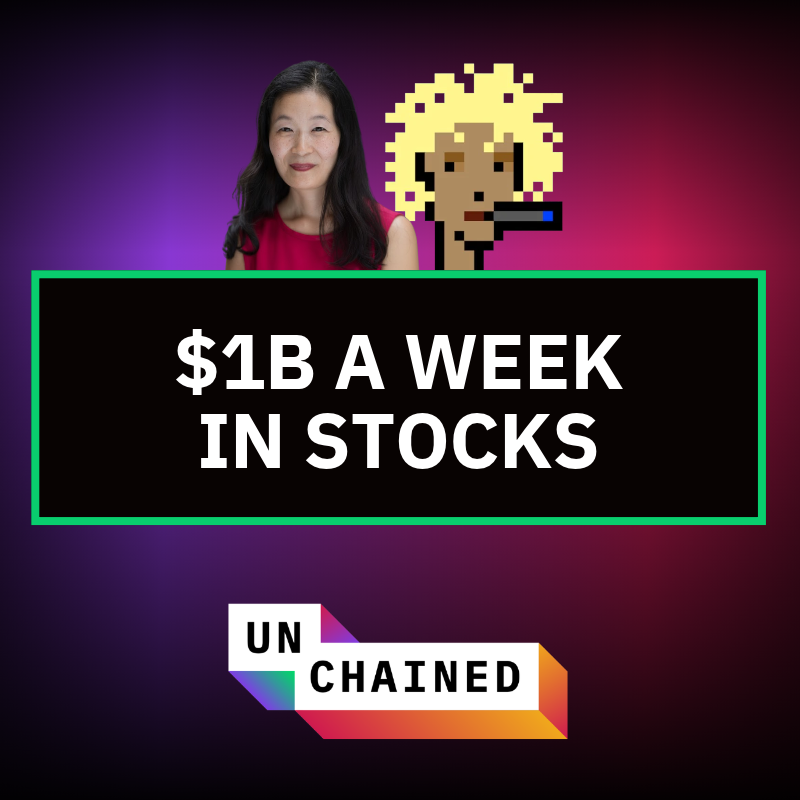
Tokenized stocks on Base just crossed $1 billion in weekly volume. Jesse Pollak lays out what's driving it and how Base plans to bring them to the US.
========================================================
Thank you to our sponsor!
Your personal information may be more exposed than you think. Cape is a privacy-first mobile carrier built to help protect your data and reduce unwanted tracking. Get 33% off your first 6 months with code UNCHAINED.
========================================================
Four months ago, tokenized equities didn't exist on Base. Now they have crossed $1 billion in weekly volume, and by Jesse Pollak's count, Base has passed Solana to become the second-biggest onchain financing market after Ethereum.
Pollak, creator and head of Base, joins Laura Shin at Base Batches Demo Day in New York City to make the case for shipping products over flashy TradFi partnership announcements. He points to Citi business clients accepting USDC on Base and a Broadridge collaboration on onchain voting and dividends.
He also walks through 200-millisecond blocks, the B20 token standard, plans to bring tokenized stocks to the US under the SEC's innovation exemption, and why a Base token is still being explored but not rushed. His biggest bet comes last: that teams of agents built on open models could outpace frontier models, and that the market for them will emerge onchain.
Host:
Laura Shin, Host / Unchained
Guest:
Jesse Pollak - Creator and Head of Base
Timestamps
🎬 00:00 Intro
🎙️ 00:57 Bits + Bips: Search Bits + Bips and subscribe to the weekly crypto and macro show at https://www.youtube.com/@Bitsandbips
📈 01:34 How tokenized equities crossed $1B in weekly volume on Base
🏦 04:53 Why Jesse is betting on products over flashy TradFi partnerships
📱 11:43 Cape: Get 33% off your first 6 months with code UNCHAINED at https://unchainedcrypto.com/go/cape-yt
⚡ 13:04 How 200-millisecond blocks gave everyone on Base a 10x upgrade
🇺🇸 16:27 What the SEC's innovation exemption means for tokenized stocks in the US
🪙 25:07 Why Jesse says Base isn't in a rush to launch a token
🤖 27:51 Why Jesse thinks agent teams on open models could outpace frontier models
Learn more about your ad choices. Visit megaphone.fm/adchoices