Ask ChatGPT
 Unchained
18 Nov 2026 · 1h 4m · 34 chapters
The episode explains why many U.S. public companies are opting out of tokenized-stock trading on “tokenized securities venues” (TSVs) under the SEC’s September 17 innovation exemption, and what the SEC and tokenization providers say the benefits and rules are.
Written by AI. May contain mistakes.
Laura introduces guests Brett Redfern and Jamie Selway.
“Today's topic is the great big tokenized stock controversy.”
Discussing the current state of tokenized stocks and companies opting out.
“You know, I was saying that I never expected that an area that I initially perceived to be somewhat boring would end up being so interesting.”
Jamie shares insights on the regulatory approach to tokenized stocks.
“Like, what do you make of all of these companies that are opting out?”
Brett discusses the challenges issuers face with tokenization.
“And that's the way to to have it have lasting, sustainable effect in the U.S.”
Exploring issuer options for opting in or out of tokenization.
“And so they went out, they got the notices, and then companies were getting hit from law firms who were like, oh, make sure you don't miss these notices and you only have 30 days to respond.”
Discussion on competitive dynamics among exchanges and reactions to tokenization.
“but then decide later that TSVB is a good fit.”
Laura addresses negative perceptions and their impact on tokenization efforts.
“I think in many issuers' minds, tokenization was done to them as opposed to done with them.”
Discussing a recent ad campaign that criticized tokenization.
“Mellanick tweeted, quote, a NASDAQ listed company exec told me their rep reached out, suggesting they object to tokenized trading of their shares on OKX ICE and offered to hold a call to discuss why.”
Brett and Jamie clarify misconceptions about tokenized stocks and regulations.
“one interesting new piece of technology to make secondary trading more competitive.”
Exploring issuer responsibilities and the upcoming tokenized stocks discussion.
“I would expect issuers to do a bunch of homework and understand if in their fiduciary duty to their shareholders, if this technology makes sense.”
Breakdown of tokenized stocks, their benefits, and trading venues.
“So we kind of, you know, started to talk about this through the controversy, but let's just break it down on a brass tacks level.”
Discussing the potential advantages of tokenization for stock issuers.
“Part of it is that there's utility that comes into those securities, right?”
Exploring how tokenization can enhance market access and reduce trading frictions.
“The second is this notion of an investomer, which is a term I learned from one of Brett's colleagues.”
Examining the reconnected relationship between issuers and investors through tokenization.
“I mean, that last point to me reminds me of the, They had some kind of delay in the money being accessible.”
Responding to issuer concerns about stock price, liquidity, and volatility.
“start to move into issuer-sponsored tokenization and you start to bring these securities back on register and make the actual security the token.”
Understanding the impact of younger investors on liquidity and pricing mechanisms of tokenized stocks.
“venues, which is increasingly more common.”
Learn about the challenges of trading tokenized stocks over weekends and market pricing.
Explore the details and design choices behind the SEC's five-year conditional exemption.
“innovation exemption that the SEC issued on September 17th.”
Discover the strategic design choices the SEC made regarding tokenized stock trading.
“Clarity was a bit of a backdrop in terms of what we might get legislatively.”
Understand the SEC's stance on issuer consent for tokenized stocks and the implications.
“will never allow these synthetics or derivatives?”
Learn how Securitize tokenizes stocks and how it differs from SEC's exemption.
“with innovation exemption in interesting ways.”
Examine how different market models affect trading tokenized stocks compared to traditional stocks.
“You also have some from like non-tech forward companies like ExxonMobil, GameStop, Salesforce, Disney.”
Discuss the launch of Canton’s TSV and its potential implications for the market.
“So basically, what you're doing is putting a tokenized wrapper on something that pretty much fundamentally acts like a stock.”
Learn about the emerging tokenization landscape and key players involved.
“was a viable, had AMMs that sat on top of it and was a public permission chain by the standard under the exemption.”
Explore the impact of innovation and competition on tokenized assets.
“I think it's a very wide spectrum, right?”
Understand the ongoing concerns and FAQs about tokenization implementations.
“You can have a TSV over there with a prop AMM.”
Discuss the implications of DeFi activities involving tokenized stocks and regulatory perspectives.
“There are always questions when it gets down to implementation of something new, all these unanticipated things, large and small.”
Examine the potential and future uses of tokenized stocks as collateral.
“Brett mentioned Jump, their partner, there are others, obviously.”
Analyze the relationship between offshore tokenized stock markets and SEC's regulatory authority.
“Now, that's not to say that that can't be appropriately done, but just to say that for sure.”
Discusses the compliance issues with offshore synthetic tokens and potential SEC actions.
“with unregistered exchanges overseas, then that's not copacetic.”
Examines the potential for revising rules to allow synthetic tokens and the associated risks.
“the perspective has been to build within the US and not worry about tearing down offshore.”
Addresses the counterparty risks involved in synthetic token investments and potential market shifts.
“that that's the best direction for this, this evolution to take place.”
Discusses the potential for tokenizing ETFs and the SEC's role in future developments.
“So let's now touch on ETFs because that came up And it does seem to me that that would be a prime candidate for tokenization.”
Explores what the SEC is looking for in tokenized stock trading and future rulemaking timelines.
“So final question, Jamie, what is the SEC looking for during this period of tokenized stock trading under this exemption to inform their final rulemaking?”

Get the gist, explore an idea or ask about something said.
 Claude
On Unchained, what are the key points of this episode?
Searching your listeningAutomatic transcript. May contain errors.
0:00Brett Redfearn: If U.S. investors are accessing these synthetic tokens overseas, that's not compliant. So action could be taken. If something happens to the underlying issuer and things go sideways for whatever reason, that token holder isn't holding anything anymore. They could be completely wiped out in those positions.
0:20Jamie Selway: Hi, everyone. Welcome to Unchained, your no-hype resource for all things crypto. I'm your host, Laura Shin. Thanks for joining us live stream. And first, we'll take a quick word from the sponsors who make this show possible. This episode is brought to you by Nexo, the premier digital assets wealth platform. Earn daily interest on your crypto or borrow funds all through one platform trusted by more than 10 million clients. Find out more at nexo.com. Georestrictions to eligibility and terms apply. Today's topic is the great big tokenized stock controversy. Here to discuss are Brett Redfern, president of Securitize, and Jamie Selway, director of Division of Trading and Markets at the SEC.
1:00Jamie Selway: Welcome, Brett and Jamie.
1:02Brett Redfearn: Hi, Laura. Thank you. Good to see you. Thanks for having us back.
1:06Jamie Selway: Yeah, excited to chat. You know, I was saying that I never expected that an area that I initially perceived to be somewhat boring would end up being so interesting. um so we're seeing that tokenized stocks they've launched on one venue they're about to launch an okay i okay x ice but the vast majority of companies who were notified that okay x ice hoped to tokenize their stocks have opted out 67 so far have opted out and in the end the vast majority of the companies that are going to be tokenizing their stocks on okay x ice are crypto related. And I'm curious, did you expect to see such a negative response?
1:48Jamie Selway: Like, what do you make of all of these companies that are opting out? And Jamie, why don't we start with you? Sure. Yeah. So Laura, thanks for having me on. I don't think we had an expectation, so to speak. I mean, our role here is to facilitate innovation, to allow the private sector to do what it's going to do. I mean, for us, it was centrally important that consent be part of the mix. So to give issuers choice in terms of whether or not to tokenize their shares to work with a company like Securitize or a platform like OKX ICE. But we weren't, I mean, nothing in our minds were foreordained. I guess zero opt-ins would have been bad and probably going 70 for 70 would have been excessive.
2:35Jamie Selway: So I would also say that it's extremely early. I think the innovation exemption turns two months old in a couple of days. So it's extremely early. I don't know if we've seen too much or too little interest. We've seen interest. People are taking it up. I think it'll be a very long game. But I think importantly to us, you know, this, you know, the prospect of tokenization, the issuer needs to be persuaded and they will take it up at the right pace. And that's the way to to have it have lasting, sustainable effect in the U.S. Brett, what about you? What's your take?
3:10Brett Redfearn: Yeah. So so first of all, as you probably know, we're very familiar with this space, with tokenization and what is happening in AMMs and liquidity pools and securitize. I think we were we were we were game on to be a part of a TSV from the beginning. I think part of the challenge here is a lot of issuers just didn't understand it. They didn't understand, you know, how do AMM liquidity pools work? What exactly is going on with tokenization? And so when the innovation exemption came out, and I agree with Jamie, like I think it's great that they included the issuers as part of this. But I think when it first came out, there was, you know, kind of a pretty quick movement.
3:46Brett Redfearn: People wanted to get involved and they wanted to notify companies and they wanted to be out early. And so a lot of the notices went out to a lot of companies in some respects before there was a really good opportunity to educate those companies about what was going on. And so they went out, they got the notices, and then companies were getting hit from law firms who were like, oh, make sure you don't miss these notices and you only have 30 days to respond. And if you don't respond, you're in there for five years. And so I think the opt out was sort of the easiest short term solution for for some of them who just didn't, you know, have the time or the energy to really learn what this was about.
4:21Brett Redfearn: And unfortunately, that's kind of how it got started. And, you know, as you know, law firms and there were others out there who were who were raising issues. But I think as they get to see how it works and understand a little better, I think that we have a more promising opportunity going into the future.
4:35Jamie Selway: And the way it works is that they can always opt in later, right? It's like they're declining now, but later on they could always pick it back up. That's right. And it's, it's really TSV by TSV. So an issuer may say no to TSVA, but then decide later that TSVB is a good fit. I would also say that I think competitively, my understanding is okay. X-ICE, you know, they, they, you don't have to allow issuers to opt out after the 30 day period expires, but they've decided as a matter of, as a matter of making the, their platform more attractive to allow people to opt, issuers to opt out after the 30 period expires.
5:13Jamie Selway: So our exemption are sort of the minimum rule set. You can innovate on top of that and offer more issue or choice if you decide. So again, I think it's really early days and we'll see what creative minds can do with the foundation of the exemption. Yeah. And that's something. Oh, and just quickly, I want to define TSV, it's tokenized stock venue or tokenized securities venue. And we'll get into like all the rules and everything in a little bit, but I didn't want to kind of bogged down the beginning with all the kind of fine details. So go ahead, Fred.
5:47Brett Redfearn: No, I was going to say we did the same thing. So as you know, we have launched our Securitized Stock Program, a custodial entitlement token model, and we are making those securities available to OKX's TSV, possibly others as well, if they're interested. And we have also been telling any issuers who are doing these tokens with us that if they decide to opt out later, we will support them potentially pulling back if it's not going the way they want. So I think when a company knows that they have a choice and it's not like, oh, if I miss this 30 days, then I'm in for five years, then I think they're going to be more amenable to trying something that's innovative and experimental like this.
6:27Jamie Selway: Yeah. And Flora, if you don't mind, if I could just step back, I think that we are operating for better, for worse on the backdrop of some negativity. And this came about from all this offshore activity, all the unregulated, synthetic token offerings cast a bit of a pall over the project. I think in many issuers' minds, tokenization was done to them as opposed to done with them. They weren't bought in. They weren't partners with these venues. It was just something that sort of happened. They found out about it. And so I think we're repairing a bit of a negative initial experience by doing it the right way onshore.
7:02Yeah.
7:03Jamie Selway: So people may recall that in the summer there was a spat, I guess you can all add a Twitter spat between Adam Aaron, the CEO of AMC and Vlad Tenev of Robinhood because Robinhood had tokenized AMC stock offshore. So that kind of kicked off maybe some of the potentially negative views of different public company CEOs to tokenized stocks. But I did want to add one other bit of intrigue, which is, I don't know if you saw that Jacqueline Mellanick tweeted, quote, a NASDAQ listed company exec told me their rep reached out, suggesting they object to tokenized trading of their shares on OKX ICE and offered to hold a call to discuss why.
7:54Jamie Selway: And in this screenshot she posted of the text message, the exec at that company had finished the tweet saying, NASDAQ is definitely partly behind this. So I thought that this had to do with some kind of competitive something rather, you know, trying to thwart a competitor. I don't know what your perception is of what she reported there. I assume that one's for Brett.
8:22Brett Redfearn: I'm sure Jamie is not going to say anything unflattering to a regulated entity in this certain sense. I mean, look, there were multiple parties who were raising issues. If you think about what a TSV is, it is an exemption that says you don't have to have an exchange. You don't have to have a broker-dealer. You don't have to have any of the traditional intermediaries involved, and we're going to create a secondary market where investors can meet and they can transact. So it's understandable that some intermediaries might think that that as a competitive model isn't necessarily great for their business model.
9:01Brett Redfearn: But it's also, I think that there might be some competitive dynamics in place. Certainly the NYSE or ICE with OKX kind of came out early with a platform offering. But then again, NASDAQ, I think they're moving forward with tokenization. They have another model that they're going. Maybe they think that model is better. And so, but listen, for exchanges, a lot of what it's about is being close to issuers and keeping those issuers on their exchange. I think that's a fundamental starting point for a lot of them. So I can see that they would do whatever they think might assist in that objective.
9:36Jamie Selway: Competition is of a central interest for us and under Chairman Atkins' leadership. So tokenization is one way, one innovative way, one interesting new piece of technology to make secondary trading more competitive. So not the only one, but a really important one that's in focus now. So with heightened competition comes spats, to use your term, like the one you described. It's natural, it's competitive forces. It's all good. It all flows to benefits that are derived by the end investor, which is what we're trying to achieve. Yeah. And, you know, one thing just to circle back to the point about issuers potentially being able to opt back in later.
10:19Jamie Selway: You know, I noticed that JPMorgan Chase told Coindesk that the bank is still interested in tokenization, even though they had opted out of the OKEx ICE thing for now. And they said, quote, we are encouraged by the potential of tokenization, but also need to be thoughtful about how our shares are represented and traded. We've decided not to participate in this venue at this stage, but we'll continue to evaluate opportunities as the market develops. So it's clearly like, you know, we're keeping an eye on this and like might do it later. One other thing, though, that I just have to call out, I'm sure you guys saw this.
10:54Jamie Selway: In late October, the Common Sense Leadership Fund, not a group that I've ever heard of, ran a full page ad in the Wall Street Journal saying, attention, public company CEOs, your stock, their tokens, your problem. Crypto will soon tokenize your shares on unregulated venues. Act now to protect your company and investors. And I just find this fascinating that this group felt compelled to do this. The one thing that I noticed was, OK, Yanks at least doesn't appear to be phased. Co-chairman Andrew Cuomo seemed almost energized. He said, game on in response to this. So what do you make of this ad campaign?
11:40Brett Redfearn: I mean, I will jump in really quickly and say, I think, first of all, Laura, I think you know that we, in fact, also ran an advertisement in the journal a couple days later that, in some respects, responded to that. I don't think everything in that article was, in fact, true. And we looked at some of the aspects of it. And it was, you know, we use the term FUD sometimes. And it did It seemed like it was making statements that really didn't appreciate what was happening, certainly with the OKX, Ice TSV and our participation in it. And so we wanted to clarify some of what was going on there. Secondly, it would be nice if people, if they want to come out, if they would be identified.
12:15Brett Redfearn: Right. So, you know, knowing who or what is concerned is not a bad thing. But, you know, look, I guess there are some people who, you know, who think this is a dangerous thing or it's not good for their business model or whatever. And they're coming out pretty, pretty strongly against it. And, you know, it's unfortunate because I think it's a pretty contained and smallish, you know, innovative experiment here and worth a try. So hopefully, you know, things like this don't scare other companies away from from being willing to try.
12:45Jamie Selway: I'm going to try not to take exception to the use of the term smallish there. but I would say, look, it's a free society. Tokenization is not everybody's cup of tea. So people have clearly got the right to defer and make choices, right? People have agency about methods to trade and list, et cetera, et cetera, particularly the issuer. But I would take issue with a couple of statements in that ad. Number one, the notion that it's totally unregulated is wrong. I mean, these are exempt entities but there are a number of requirements, right? Be a U.S. person, operate with permission wallets, subject yourself to public notice, obviously limitations in terms of your activity, submit yourself to the SEC examination regime.
13:28Jamie Selway: So I think unregulated is a bit of a stretch. And also, trying to divide the issuer from the token by saying your security, their token. I mean, no, this is expressly not about synthetics. that expressly requires that all the rights and privileges of the security holder be represented in the token. So there is no wedge. It is precisely similar. So I think misleading in two important respects. But again, it's early. This is complicated stuff. It's got potentially incredible promise for the issuer. I would expect issuers to do a bunch of homework and understand if in their fiduciary duty to their shareholders, if this technology makes sense.
14:08Jamie Selway: They're not going to, I think, take their cue from a one-page scare ad in the journal. Yeah, let's hope not, especially because so much of it was misleading. All right, so in a moment, we're going to talk specifics around the tokenized stocks and these different venues. But first, we'll take a quick word from the sponsors who make this show possible. What if your crypto could do more than just sit in your wallet? Nexo is a digital assets wealth platform where you can generate daily interest on your crypto or borrow funds against your assets. Today, Nexo serves more than 10 million clients. Find out more at Nexo.com.
14:44Jamie Selway: Back to my conversation with Brett and Jamie. So we kind of, you know, started to talk about this through the controversy, but let's just break it down on a brass tacks level. What are the benefits of tokenized stocks?
15:01Brett Redfearn: I mean, listen, I'm jumping quickly. And the first thing that I want to say is it's very important to distinguish between tokenizing a stock and what is involved in tokenization and the TSVs themselves. TSV is one venue that a tokenized stock could trade. And so I think as you're aware, we offer a platform to trade tokenized stocks through a broker dealer with Reg NMS and best execution and CAT reporting and all the things that are typical of a normal stock, quite frankly, today. So the benefits of tokenization and then the different platforms, those are two different things. And one of the things that did happen with the TSVs was some people thought tokenization and TSVs were more or less the same thing.
15:40Jamie Selway: But one thing that maybe I don't even understand is so each tokenized stock is particular to the TSV. You cannot take your tokenized stock and trade it across a different TSV. Is that correct?
15:57Brett Redfearn: Well, tokenized stocks and TSVs are two different things. So you'll see people are tokenizing like Apple and Tesla and NVIDIA or whatever, names like that. So if you tokenize a stock, you can have it trading on multiple. It could trade on multiple different platforms, right? Depending upon what chain that that is trading in. Or it could be bridged to another chain. So you could have the same tokenized stock, right? So there's a separate question related to sort of fungibility across platforms. On OKX ICE, it's trading on X layer without getting into the details. And so on our platform, we have them trading on Solana, but there is an ability to bridge between Solana and X-Layer for the stocks that are overlapping potentially between the two.
16:38Brett Redfearn: So it is a it is. No, I don't think one tokenized version of a stock would only trade on one.
16:45Jamie Selway: OK, OK. But so I interrupted you. So continue your trade of thought. No.
16:51Brett Redfearn: So you asked about the benefits of tokenization. And it's really important to note, you know, why are we doing this right? Because some people are like, why are you tokenizing stocks? We all agree that the U.S. equity markets are phenomenally liquid, right? And they're very efficient. So a lot of people aren't complaining about the U.S. equity markets. The thing about tokenization I think people need to understand is when we think about blockchain technology, composability, programmability, and we start to think about what is unlocked in a security that is tokenized, there's a lot of amazing things about it.
17:22Brett Redfearn: Part of it is that there's utility that comes into those securities, right? So we're creating tokenized stocks that will be used in a lending pool or be able to use as collateral or portable collateral or be able to be transferred peer to peer, not necessarily always requiring a broker dealer or finding access to global markets. You'll see like one of the things, and even though we have some criticisms about the synthetic model, I will say this. One of the things that they found was they found a market. They found that there were a lot of investors around the world who are really eager to get access to securities in the United States.
17:56Brett Redfearn: And they're buying them up even though they're lacking some of the basic things of others. So between the utility, the expanded market access, I think a quicker path to 24-7, there are a lot of other things that come with tokenization that investors are starting to learn about.
18:13Jamie Selway: So, Laura, I don't want to be promotional. And as I thought that, I forgot that I probably should have started this conversation with my disclaimer that anything I say on your podcast should only be attributed to me and not to the chairman, the commissioners, commission, or any of the professional staff of the division. I would say that there have been two sort of interesting ideas that we've heard in terms of why tokenization might make sense to the issuer. One is, you know, the younger investor who potentially lives in a wallet only, doesn't want a brokerage account, wants to hold, you know, every asset in tokenized form, wants tokenized NVIDIA side by side with Bitcoin, Ethereum, Solana, what have you.
18:54Jamie Selway: And that may be an investor that's just not going to be available to the issuer if they're not offering their securities in tokenized form. That's one. The second is this notion of an investomer, which is a term I learned from one of Brett's colleagues. You know, the idea of, you know, the issuer using the connectivity to its cap table on a retail side to essentially, I don't know if cross-sell is the term, but associate, you know, individuals that are interested in their stock or their securities, but also interested in their products. So, yeah, this is not something that's really, I think, possible.
19:32Jamie Selway: Certainly not easy in today's environment where, you know, things are held in the street name of the DTCC. So the idea being that if the issue, if the corporate issuer has got more visibility into the individuals on this cap table and you're a prominent consumer company or other companies, I'm sure, you can make good use of that information to mutual benefit. So these are just two things we've heard. I'm sure there are lots and lots of others. Again, it's quite early. And again, we're going to look to the innovators in the private sector to find the creative ways for this technology to draw value.
20:05Jamie Selway: Yeah. I wanted to add some others. Rebecca Redig of Gito tweeted, or she published an essay on X saying, quote, first, stablecoins have found true product market fit and money that moves in seconds cannot be paired with assets that take a day or more to settle. Second, tokenization allows for expanded access to U.S. capital markets in the same way that stablecoins expand access to the U.S. dollar, although I guess that sentence refers to the offshore ones, not the ones under this exemption or any of the others in the US. But still, point stands. And then she said, third, frictions in our current markets have real costs.
20:45Jamie Selway: Every day between trade and settlement carries counterparty credit risk and settlement risk. Settling transactions on chain closes that window. I mean, that last point to me reminds me of the, They had some kind of delay in the money being accessible. And when they had to, can somebody explain what happened there? They needed billions of dollars basically because people were doing so much trading and there was like some delay in settlement or something. Yeah, I mean, look, Rebecca's very bright. And I think that she's making arguments along the lines of collateral mobility and a little bit off the run from innovation exemption, which focuses on secondary trading of securities.
21:26Jamie Selway: But collateral mobility overnight, over the weekends, when there's no banking system available, whether that's stable coins or tokenized money market funds, incredibly exciting. And as I'm sure your listeners know or your watchers know, the DTCC's tokenization pilot, three-year pilot, went live last week. And that's, you know, it's got lots of possibilities, but one core, you know, prospect of it is collateral movement, you know, using tokens, particularly over the weekend. So, so collateral efficiencies can be, you know, can be delivered and to avoid situations like Robinhood's liquidity crunch around the meme stock craze.
22:06Brett Redfearn: Yeah, I think I would add that it's important also when you think about the types of tokenized securities, there's sort of this custodial model, but there's also the issuer-sponsored tokenization where we go directly to the issuer. The issuer is involved in it. We remove the securities from seeding company at DTCC. It goes back on register of the transfer agent, and then the token is the security. So part of this, to Jamie's point, is reconnecting issuers, companies with investors, where once we do this, then they actually become re-intermediated with those customers. So they have a line of sight into who the investors are that are out there.
22:43Brett Redfearn: And in so doing, they can say, okay, well, these are investors or they're really good customers. I can offer them discounts. I can offer them benefits. I can facilitate voting for them. And so this investomer concept is really an interesting thing that is unlocked when you start to move into issuer-sponsored tokenization and you start to bring these securities back on register and make the actual security the token.
23:10Jamie Selway: So let's also talk about just some of the specific objections that I happened to notice. For instance, there was a fiber optic maker applied optoelectronics. They mentioned that their reasons for opting out was because they were unsure how tokenization would affect the stock price, liquidity, and volatility. So let's say that I represent Applied Optoelectronics. How would you explain to me, or maybe you wouldn't, but go ahead and explain how you would respond to an issuer that had those concerns? Again, it's stock price, liquidity, and volatility. I mean, maybe I'll start and then kick it to the private sector quickly.
23:57Jamie Selway: I mean, I would say, you know, that is exactly why, to Brett's earlier point, the TSVs should be engaging with the issuers that they presume to list because, you know, any CFO, right? I don't know. I don't know. Stock price is probably next to godliness in terms of his or her focus. And that's closely related to liquidity and volatility. So, you know, you passionately care about that. So I would think that, you know, a TSV that's purporting to offer a benefit, you know, to your company by listing it, you'd want to, you'd want to engage in that dialogue and you want to speak to, you know, probably not stock price, right?
24:32Jamie Selway: Because that's more of the company than the venue, but certainly liquidity and volatility, how, you know, it would be enhancing as opposed to enhancing liquidity and potentially reducing liquidity. But that would be the argument that the TSP would make. And they can make that along the lines of the protocol they're using to trade, the AMM they're using to trade, their client base. But I would expect a healthy dialogue around exactly that because that, Lara, is precisely the kind of dialogue that issuers have with traditional exchanges when they make the listing decision or maybe the decision to switch venues, which is increasingly more common.
25:09Jamie Selway: They make that decision based on the liquidity and volatility, the market quality dynamics of that venue. And I wouldn't think a TSV would be that much different.
25:19Brett Redfearn: I mean, I think the points that I would add to what Jamie said there, which was great, is first of all, to the extent that you have all of these younger investors around the world with wallets who are really interested in US securities, you're adding investors and therefore you're adding, essentially you're adding liquidity to the product. So I don't know why an issuer wouldn't say, oh my God, the universe of investors who are interested in my stock has just gotten a lot bigger, that's generally a good thing for companies. The second thing I would say is the pricing mechanism. So when you talk about the price, this conversation comes up all the time.
25:53Brett Redfearn: So all the stocks that we've listed in our program, we've reached out to all of the issuers for the SecureTie stock program. We've had conversations with several of them. On the broker-dealer platform that we're doing, it's the same thing. So it still trades at or inside of the national best bidder offer, and it trades completely in sync with the marketplace today. So in that particular platform, sort of the non-exempt world, the pricing is pretty much akin to how it would be in the standard market. And then in the TSVs, it is a different pricing mechanism. So you know how automated market makers work, and it's supply and demand within a given venue, and it's very formulaic.
26:29Brett Redfearn: But the reality is, as more participants come into the market, you'll get more arbitrageurs as well. And so market makers across any marketplace, they tend to keep prices in line. So if things are out of line at all, they're going to be trading in other venues and they're going to help to bring those prices back in line. And so I think that's part of what this experiment is, to see how that unfolds, to see how it works, and to see how arbitrageurs and market participants help to make sure that those prices remain efficient.
26:55Jamie Selway: And is that what you would expect to happen, for instance, over weekends when there's kind of a greater opportunity for the prices to diverge that eventually arbitrageurs would kind of step in?
27:09Brett Redfearn: well well so you know so it's interesting as you know the u.s equity markets are going 23 5 on december 6th and when that happens the sips right so the the market data feeds that are out there are going to be much more active for almost you know almost 24 you know almost 24 hours for that full trading day when that happens there's a different reference price that exists we're also looking at the reference price that are being created in the perp market and then the weekend is another whole story. So in the weekends, it is harder to find reference prices. You are reliant more on perpetual futures.
27:44Brett Redfearn: I think for securities that don't have perps, I think it gets a little more challenging. But I do believe that some of the ATSs that are currently trading in those overnight hours are also planning on launching over the weekend. And so the price formation process is sort of upping the bar as we go farther out into greater trading hours, and eventually it will get there for the weekends. But I think initially, I think the weekends are, you know, people need to be pretty careful, I think, still on Saturdays and Sunday for pricing because the reference prices are a little bit weaker than they are in some other marketplaces, especially if there aren't perks.
28:18Jamie Selway: All right. So now let's get into the details around this innovation exemption that the SEC issued on September 17th. It's a five-year conditional exemption. It lets these tokenized securities venues or TSVs trade tokenized versions of exchange listed stocks through permission to automated market makers without registering as exchanges. So there's kind of a number of different design choices, I'm sure, that had to be worked through in order to issue this. So Jamie, do you want to talk us through some of the choices that the SEC made in designing this and why it was designed this way? And you can choose any of the specific features you want.
29:00Jamie Selway: Yeah. I mean, so, so I think we began, so I joined the commission, um, last June. So June of 2025, uh, there'd been an incredible, um, sort of a trajectory of engagement going on with the crypto task force and commissioner purse who's since moved on. Just did a really nice job standing up, uh, really, really flipping the script, so to speak, and, and, um, ensuring that the agency was going to be engaging as opposed to, um, something else, uh, with respect to the crypto, uh, community and the digital community. So that changed and there was a lot of really good feedback. So I think the, the idea that, uh, AMMs, uh, were, were the most, um, you know, relevant and an interesting place to start that came out a lot of, um, a lot of industry, uh, you know, discussions with, uh, people, people that wanted, they wanted to trade.
29:44Jamie Selway: And so we were sort of confronted with, um, you know, the AMM model, which is different as Brett alluded to than the traditional two-sided quote model. Uh, we were confronted with entities that were non-traditional by our lights that weren't interested in the exchange credential, that weren't interested in the brokerage credential. So it didn't really fit in terms of our traditional approach. So that led to the design decision, so to speak, of using an exemption as opposed to changing definitional rules. Five years was another design decision that was ensured to keep us on the hook. to do permanent rulemaking right after we learn, get some experience with innovation exemption, figure out what works, what doesn't, and then propose changes to actual rules.
30:32Jamie Selway: Clarity was a bit of a backdrop in terms of what we might get legislatively. Another design decision that we took was volume limitations and listing limitations. So limiting TSVs to 25 basis points of share of the most liquid stocks and 2.5 % share of less liquid stocks. We wanted to essentially begin in a controlled fashion, a very cabin fashion. I guess the final, probably the most important design decision was the idea of 30-day issuer consent, just in talking through with the prospective platforms and thinking through what the issuer experience might be. And then, frankly, looking at the non-U.S.
31:14Jamie Selway: experience where issuers were sort of not asked. They were sort of just tokenization of something that happened. to their securities. And there was a lot of dissatisfaction. That was probably the final, you know, design choice that we made. And, you know, one other thing that was interesting to me was obviously we're seeing so much of this overseas activity happening in these derivatives. And obviously the exemption does not allow for that. And I'm curious, you know, what the thought was about just specifically focusing on ones that have the approval or opt-in of the issuer. Yeah. I mean, to not do synthetics, to require sort of all the rights and obligations of security, that was, frankly, when we listened to the digital asset community, that's really what they wanted.
32:05Jamie Selway: They want to trade sort of an asset that's got equivalent, essentially the securities entitlement. That's what they wanted. They did not want to do derivatives. I think there seems to be a perception from at least the folks that we spent the most time with over the past 18 months that the derivative form is maybe not as investor-friendly as it might be. It's an interim step. And if they could do the security directly, either by the third-party model, as Brett referenced, or the issuer-sponsor model, that was the best outcome. And do you think that's something that will be codified in the rulemaking that the U.S.
32:43Jamie Selway: will never allow these synthetics or derivatives? Or is that something that might be considered later on? Well, I mean, never is a long time. I mean, obviously, there are exchange-listed derivatives sort of around NMS securities today. So those could be structured and then therefore tokenized. So never say never, but as a place to start for this exemption, which is powerful. I mean, you're essentially operating as a trading platform without the requirement to be a regulated, registered, I should say, a registered exchange or broker. That's a powerful, powerful exemption. So I would hope that we can get out of the exemptive realm within, say, a year or so and get to rulemaking.
33:32Jamie Selway: So I certainly wouldn't foreclose those rules extending to tokenized derivatives, but as a place to start with the securities themselves, that was logical to us.
33:45Brett Redfearn: I think the synthetics also starts to kind of tie into sort of the security-based swap roles as well, right? So there is a rule regime around security-based swaps and CEFs and so on and so forth. So there were some things about that particular model that started to sort of pull in other regulatory implications going down that path in the United States that just made it difficult for people to kind of make that choice here. Okay.
34:10Jamie Selway: Okay. And one other thing I have to ask about is that the Securities Transfer Association wrote a letter to the SEC asking that the exemption apply only to issuer-sponsored tokens. So this is like the model that Securitize does. So why did the SEC instead choose this kind of opt-out for the third-party tokens rather than requiring the issuer consent? Well, I mean, Brent made this point earlier and he's 100 % right. The exemption goes to the listing and trading of tokenized assets. It does not speak to how that tokenization process happens. So I think that that was an area where, humbly, we were silent on it, just because there's lots of ways that can be done.
34:50Jamie Selway: I mean, I also would say that the DTCC's program, three-year program, is third-party tokenization. And presumably, that could interoperate with innovation exemption in interesting ways. So I think foreclosing, so it's said differently, the exemption is not tailored to one methodology of tokenization, but rather it's open to multiple. Okay. So now, Brett, as I just alluded, Securitize also does tokenized stocks, but not through the exemption. So go ahead and explain how Securitize's offerings differ from those under the innovation exemption. Right.
35:31Brett Redfearn: So I think it's a really good question because it's really important to note that there's a big difference between sort of the tokenization of a stock or a security and then the secondary market where that could trade. Right. So the tokenization that we do, and you mentioned issuer sponsored tokenization, and we're also doing the third party custodial model. Right. So this is sort of this is the bulk of our securitized stocks programs. Either one of those could actually trade on a TSV as a secondary market or either one of those could trade on a regulated platform. So we actually will effectively offer them to vote.
36:05Brett Redfearn: So the securities that we're tokenizing, like I said before, they can come in, they could trade through our broker dealer, they can do it, you know, with Reagan MS, with a market maker, very similar to that. And they will also be able to soon enough trade on the NYSE's ATS or Morgan Stanley's ATS or any other ATS in that framework. Alternatively, they will also be able to trade in the NTSV landscape if the issuer chooses to do so. But I think to direct Reseway's point here, it is important to note that the opt-out is largely for the exempt landscape. So again, for this area where you have TSVs.
36:41Brett Redfearn: But essentially, if an entity like us, if we decide to tokenize a stock, there actually is not an opt-out for that. It is something where we will notify them. We will talk to the issuers. We want them to understand what's happening. And we hope that eventually they'll want to move that to an issuer-sponsored version of this. but but you know opt-out is actually not a thing just for tokenizing a stock
37:03Jamie Selway: okay okay i think i think i understand so i did also want to ask because you know you guys have i believe 25 stock tokens with large companies uh some of them are apple microsoft nvidia alphabet tesla meta amazon by the way some of those are the ones who refuse that okay X-Eyes thing. You also have some from like non-tech forward companies like ExxonMobil, GameStop, Salesforce, Disney. Explain, you know, why it is, how this is different and why you think this pitch was more appealing to those companies than the pitch by OKX-Eyes.
37:38Brett Redfearn: Well, so just today we launched another 22 names. So we're now up to 47 names and it's very possible we're going to be up to 50 very soon. We're sort of looking to get to 50 in the next week or two. So I think that the biggest difference is that while we have reached out to all of these companies, again, we're not asking them to participate in the TSV. That is a separate conversation that is happening. We're sort of tokenizing them. So it's interesting. There are other companies as well who are tokenizing stocks, including in the United States. Not all of them are reaching out to the issuers and saying, hey, this is what we're doing.
38:19Brett Redfearn: This is how it works. This is how we do corporate actions. So we're being very forward in communicating with them. I will say there have been a few who had a kind of a knee-jerk reaction and just shot off the objection letter that they had sitting ready to go for the TSV. And we're like, nope, nope, that's not what this is about. This is not the TSV issue. We're just talking about tokenizing your stock and we'd like to talk to you about it. So it is different because fundamentally what that is doing, where we're not asking for that is, again, this is within the existing regulatory framework, as I mentioned, through the broker, with Reg NMS, with best execution, all of those sorts of things.
38:56Brett Redfearn: And so quite frankly, there really hasn't been much pushback to doing that at all from these issuers.
39:03Jamie Selway: But does it have the same issues of having trading on the weekends that could cause the price of the tokenized version to differ from the exchange version?
39:14Brett Redfearn: so again the market model will be different it is not this is so except for the issuers who have opted into tsvs they're going to be trading through what we what we call sort of a single dealer rfq platform so right now we're working directly like with jump trading they are a partner of ours they have a prop amm they're facilitating trading in that name and we're working with them to try to make sure that to the extent that they're trading with us that they can offer best execution to those customers. Best execution gets trickier on the weekends, but there are still issues over the weekend. But fundamentally, it is a different market model than the AMM liquidity pools that exist in the TSVs.
39:53Jamie Selway: Okay. Okay. Now I understand. So basically, what you're doing is putting a tokenized wrapper on something that pretty much fundamentally acts like a stock. And what the TSV model is doing is not only tokenizing, but then the way the asset is traded is also different. So that's kind of what the difference is. Right.
40:24Brett Redfearn: The exemption is for how it is being traded in the secondary market. I mean, look, it's still different. Tokenizing a stock is still different because the utility, the collateral mobility, the ability to use it in a lending pool or in DeFi. There's a lot of other things that come with the tokenized stock that still exist within the existing regulatory framework. So it's not exactly the same, but certainly the trading roles for the secondary market in the sort of non-opt-out landscape are effectively the same as exists in the traditional markets.
40:54Jamie Selway: Okay. Okay. I think I now get it. So let's now talk about all these different versions of this that's going on. So it's funny, there is a company that did this first, a venue on Canton called TSV. And it launched on November 4, and thus became the first to launch under this exemption. I almost feel like they did it literally just to say that they were the first because they only launched it with one company, which is Canton Strategic Holdings. And I don't think it reach out to any other companies. I wasn't able to confirm that, but there's no news of any denials or them reaching out. So it sort of feels like to me, that was sort of a PR play.
41:42Jamie Selway: I'm curious for your thoughts on why they would launch just with one single stock. I mean, Laura, I'd be careful about too much speculating for the public sector, But one theory we had heard was that it was important for the Canton community to illustrate that the Canton blockchain was a viable, had AMMs that sat on top of it and was a public permission chain by the standard under the exemption. I think they achieved proof of concept with respect to the Canton community, which, as I'm sure your viewership knows, is very interesting, potentially very relevant, possibly growing community in the sense of really particularly around collateral infrastructure needs from a token perspective.
42:40Brett Redfearn: I'm, you know, I'm not exactly sure. I know that OKX TSV, you know, OKX Ice TSV did come out. They did announce they did put it out there. So they had a very clear path and a specific date that they were going to. So they did come out with one name earlier. So I guess they're trying it out and we'll see. Like this is a this five year program. So just because they have one now doesn't mean that there won't be more coming. and we'll see what happens. I'm not exactly sure what the motives are, but they certainly did check the first box.
43:13Jamie Selway: Okay, so as we have discussed, OKX ICE is the one that's making all the headlines because of all these companies that are opting out. But it's not the only one. There's this huge string of these launches that are coming. So obviously the one happening next week on November 23rd is OKX ICE. that's going to list companies like strategies strategies common and preferred shares coinbase circle robin hood bitco securitize and 59 etfs so altogether i think it's over 70 assets but dtcc's tokenization service is already live and will also be expanding to solana in the second half of 2027. NYSE just announced it'll be using Avalanche as its backend for its tokenization.
44:08Jamie Selway: Formation Securities plans to launch in early 2027 with Galaxy Exodus and Forward Industries, and that's going to be on Solana. I'm curious, and let's throw in TSV as well and any others that I missed, but when you look at this landscape, what do you think are kind of the key differences or strategies that you're noticing amongst these potential competitors? I mean, maybe I'll start, Laura. I think it's a very wide spectrum, right? I think the list you just said illustrates some people that are incredibly new, right? They weren't operating in this fashion and they're coming to market with a new venue because it's now possible to do this on chain.
44:48Jamie Selway: You've also got two of the premier legacy names in NASDAQ and both NYSE and ICE, both sides of the house of that global exchange company. So it's a wide spectrum. DTCC illustrates the interest in tokenization. I will add, to plug our team at the division, we did build a website where you can wrap your head around each. I think it's now four for filers of the notice. So if you want to look at sort of, you know, get a link to who's filed a TSV notice and a link through to their actual filings on their website. So that's available, you know, for your audience to go peruse.
45:34Brett Redfearn: I mean, look, I'll just add this. First of all, kudos to Director Selway and this SEC for allowing this innovation to come into the market. It's a phenomenal thing that we're seeing. We all know that blockchain technology is an amazing technology. I think we all know that in earlier days, it had a tough go with the commission and with regulators. And I sort of jokingly referred to, we went from a do not enter sign to a welcome mat for this technology. And so now we're seeing people try a lot of different things, you know, let all the flowers bloom, right? So things are happening in different ways.
46:11Brett Redfearn: I know that they're, you know, here or there, there might be some concerns about, you know, it's a little bit of market fragmentation. But even in the US equity market, it's worth noting that we have, you know, I think it's 18 equity exchanges now going on 20. You have, you know, 35, 40 dark pools, you have multiple single digital platforms. So you're talking about like 60 plus venues in the equity markets, each of which is has a slightly different offering for off for equities. And so now we're seeing some innovative things being tried using blockchain technology. You know, we can have a prop AMM RFQ.
46:44Brett Redfearn: You can have a TSV here. You can have a TSV over there with a prop AMM. So we're going to see a lot of interesting things. And I think the beauty of this is, again, to to Jamie's point, like competition will prevail. We'll see what happens. And, you know, and I think that the end result from that competition will be, you know, innovation in a good way.
47:02Jamie Selway: So, Laura, you put up the website, which is awesome. I really appreciate that. So if one were to scroll around on a little bit, you'd see we did the first batch of FAQs about two weeks ago. And that that's one of many. Right. We'll be we'll be providing more of these as they come. And so the comment file on the innovation exemption remains open. And so, you know, any of your audience should give feedback either by way of the comment file or by, you know, coming in and seeing us or whatever form you want. But I think building out, you know, I mean, the exemption is the exemption. It may change into rulemaking.
47:37Jamie Selway: And we'll certainly try that. The exemption itself may be modified, but really just the administration of the exemption as we get going, you know, we'll be addressing nits and nats, you know, ergonomics of the notice period, right? There have been complaints there. We've certainly heard lots of things. Addressing some of that by way of FAQs, which I think we can envision doing a set of FAQs fairly regularly until we've answered all the questions. There will be questions. There are always questions when it gets down to implementation of something new, all these unanticipated things, large and small.
48:12Jamie Selway: They naturally arise. And because this will be with us for some time and we absolutely want it to be successful and be used to the extent appropriate, we'll be tending to it by providing updated guidance through these FAQs. So I do have to ask about some of these DeFi shenanigans that we saw happen with some of these tokenized stocks. There was that incident with Robinhood's tokenized HIMS and HERS. Basically, there was a meme coin paired with that. I'm not going to name the meme coin. People will probably remember this incident. But basically, the tokenized stock reached a price of$132 against the Friday closing price, which was just under$29 due to this meme coin pool being paired with it.
49:08Jamie Selway: So, you know, what do you think of that type of incident? Do you sort of expect this activity and just chalk it up to, yeah, this is what happens when you marry tokenized stocks and DeFi? Or is that something that the SEC could potentially see itself trying to crack down on?
49:31Jamie Selway: yeah i mean i mean i i you know shenanigans um i think that uh you know the the if you're if you're availing yourself of the exemption you know you're you're you're going to meet meet standards right a lot of them are um around um you know u.s person uh you know permission wallets we don't really have a a market quality standard per se but you know your prices um you know will be made public, I think our standards within 10 minutes, folks will be able to do much, much more quickly than I would imagine. You know, I would say in terms of those kinds of prices, if your prices are, you know, wildly aberrant, right, with respect to where the market is, certainly no broker.
50:12Jamie Selway: I mean, Brett touched on best execution and the duty of a broker. None of that changes in terms of tokenized assets. So I think in terms of you've got every incentive to provide a high quality marketplace, unlike the one that you described. So I would expect that if you're competitive, if you're looking to give investors a good experience, if you're looking to attract any intermediary, certainly brokers who've got a best execution duty, you're going to keep in line. You're going to work with the liquidity providing community. Brett mentioned Jump, their partner, there are others, obviously. You'll line that up so your investors have a quality experience.
50:47Jamie Selway: You won't be executing at prices that are wildly off. And then you mentioned earlier arbitrage, right? Arbitrage is always the great medicine here. Arbitrage keeps prices in line to the extent that venues are open and available, which TSVs presumably would be.
51:06Brett Redfearn: I mean, I'll just add that, first of all, that was very much of an offshore phenomenon. Second of all, it's one of the reasons why issuer choice is actually, or issuer opt-out is actually not a bad thing because for any TSV, if they want to keep issuers interested or they want to get more in, they really have to think about what is the pricing mechanism and how does that work. There will be incentives for market makers and incentives for market makers to do the right thing in these venues. And so it's operating in a construct where I think there is an effort to try to make sure that the prices are somewhat aligned.
51:41Brett Redfearn: But it is a different mechanism and it is something that we know that the marketplace will be watching very closely, certainly on traditional finance. If you're looking at these prices, you can see them. Even though it's a 10-minute reporting, these things are still reporting like on Solana, they're reporting to SolScan or they'll be on-chain reporting. So people will be watching closely and that will be a good incentive to make sure that these marketplaces and the market makers and the participants in the space are doing what they can to make sure that we don't see that shenanigans that we saw in that particular circumstance offshore.
52:13Jamie Selway: And so, yeah, leaving that particular incident aside, like in general, do you think tokenized stocks being used as collateral in DeFi is a good thing or something that, you know, should be encouraged? Or do you see that as, you know, kind of risky and something maybe to shy away from? Like, what's the perception of that?
52:31Brett Redfearn: An asset like a stock, I don't believe that an asset like a stock, you should buy it, park it in your brokerage account. And then when you sell it, that's it. That is all that it means. So these assets, I believe there is an awakening of additional utility that comes with tokenization. And so, you know, think about the stock loan business, for example. Today, a lot of people own stock and those stocks are rehypopulated part of stock, stock loan businesses. Investors aren't really seeing much in that. Like, so when you have a tokenized stock, I actually think at some point in the future, we're going to see, you know, almost like wholesale markets where people can take tokenized stocks and they can actually, you know, get something for the fact that there's going to be a stock loan business.
53:11Brett Redfearn: Or, you know, we believe that you could use it as collateral, right? You could take a security and maybe I have$50 ,000 of a stable security and I need, you know, something to help me use as collateral because I'm buying a car or a boat or something like that. And so those things are unlocked with tokenization. I think the collateral use case is a good one. And I think those markets are really going to unfold as we see how this all evolves.
53:36Jamie Selway: Yeah, so Lara, just to be clear for your audience, so the innovation exemption speaks only to secondary trading. It doesn't allow lending. Now, that's not to say that that can't be appropriately done, but just to say that for sure. You know, to echo what Brett said and add to it a bit, I think we think of tokenization as a function, right? I mean, setting aside the quality of the collateral, right? Stock debt, et cetera. But tokenization as a technology, it enables really mobility, as Brett touched on, and also visibility, right? So if you're using technology that makes real-time inventory calculations, gives greater visibility to inventory and increases mobility, like particularly during the weekend, right?
54:22Jamie Selway: When the banking system is today closed, that should be good in terms of collateral management. It should make lending more efficient. All these benefits should accrue to these lending marketplaces. But that's more about technology and productivity than the quality of assets as a matter of collateral or credit risk. By using new technology, you may have new counterparties with a new set of credit risks. That's not specific, though, to the technology itself. So let's circle back to these synthetics that are trading offshore because they are, I mean, well, okay. So I understand that at least onshore, we are just getting the race started.
55:06Jamie Selway: But at least so far, that market is growing faster than the onshore one and is quite active. So I'm wondering, you know, if that continues to actually grow faster than the onshore tokenized stock market, do you think that the SEC will respond to that in any way or will sort of revise how it's approaching this space? well i you know i think certainly um i think brett brett sort of yes earlier and i'm glad to hear um here his his uh his feedback he's a sophisticated mark christman um it's great to hear that that he and others think that we've struck a blow uh to begin uh to get the u.s into the in the game in terms of competing with these offshore venues uh in terms of what we might do to offshore venues well, our authority is here.
55:57Jamie Selway: Now, that being said, if somehow US-based investors are interacting with unregistered exchanges overseas, then that's not copacetic. So there have been geofencing cases in the past that could be done again. I mean, again, these are not registered exchanges. these offshore revenues, they're not using any exemption that we've provided or fellow regulars have provided. If US investors are accessing these synthetic tokens overseas, that's not compliant. So action could be taken. I think Chairman Atkins, under his leadership, the perspective has been to build within the US and not worry about tearing down offshore.
56:49Jamie Selway: but if investors are being harmed offshore, then certainly we'd take a look. Well, actually, so when I asked that question, what I was thinking was more, would the SEC consider allowing synthetics in any regard? So it's funny to me that your mind went to some kind of enforcement, but what do you also think about, I don't know, revising the exemption or adapting the rulemaking in some way to potentially allow synthetics or in some way respond to this. So again, hypothetically, this is a scenario in which there is greater demand for that type of product than what you guys have carved out with the exemption.
57:39Jamie Selway: Yeah, I think if the brokerage community came to us and said, again, as I said earlier, it's a little bit like a new ETF, right? There are synthetic, there are derivative forms, there are synthetic forms of equity exposure that are compliantly listed in the US already. We have single stock ETFs. We have 2X single stock ETFs. I mean, there's gobs and gobs of that stuff. So if someone said, we want to list synthetics in the US and we want to do it in organized form, that could be done.
58:06Brett Redfearn: I will just throw a couple of thoughts in here. The first thing is offshore, I think to Jamie's earlier point, that they are permissionless. You will notice in the innovation exemption, one thing that we didn't get into too much is they still need to be OFAC compliant. There are rules around the participants that are in there. One of the questions is, if you have completely permissionless trading, there's some question about where these tokens effectively end up and whether they could end up with illicit actors or whether they could, to use a term, they blow back to US investors as well. In that circumstance, you potentially have a situation where you have US investors who may even be insiders that they're not being tracked because they're permissionless security.
58:48Brett Redfearn: So that is one feature of the synthetics. The other thing is, if you have a security, I always think that when we do tokenization, we want to make this more and we want to make it better, right? Not, not something less. And so if you take a security and you say, well, we're going to strip it of dividends or we're going to strip it of voting, or we're going to strip it of other things. Like, I don't necessarily think that that's the best direction for this, this evolution to take place. So certainly dividends should be there. Some of the, some of the synthetics now are sort of passing through some dividends and sort of a token is tokenized form voting.
59:23Brett Redfearn: We're still a little ways off of bringing voting into that. But let's make, when we do tokenization, let's make it something more, let's make it better for investors. And I think, you know, again, if you do take away a lot of frictions, like you'll have a lot of activity. But again, this was really the first iteration of this. I think the rest of this market is going to catch up. People are going to see the benefits of these other tokens. And we think that they have a pretty good fighting chance of being a really prevailing form of tokenization.
59:50Jamie Selway: Yeah, I think something that is interesting to me is, I understand what you're saying. And I, in some ways agree with you, like, like everything that you guys are saying does seem better than, than the investor. But interestingly, there was an investor, Will, uh, Manitas or Manitas who tweeted, it's just increasingly clear that actually holding the underlying equity is not only unimportant for the marginal SPV buyer, but maybe actually undesirable. The market will trend towards synthetic exposure. No one actually wants to hold these things. It's just so obvious. So, you know, do you have a response to that?
1:00:29I will give you a quick response, which is that there is counterparty risk in these synthetics.
1:00:35Brett Redfearn: If something happens to the underlying issuer and things go sideways for whatever reason, that token holder isn't holding anything anymore. They could be completely wiped out in those positions. And so that's a little bit different than when you have this. So I think there is more counterparty risk. And if you read any of the documents that come with it, they're outlined, I don't know how many investors do, but they're outlined in pretty stark terms what those risks are. And I think, you know, let's just hope, let's hope nothing bad like that happens. But to the extent that it does, I think that that might create a little bit of a different lens upon which people look at these.
1:01:11All right.
1:01:11Jamie Selway: So let's now touch on ETFs because that came up And it does seem to me that that would be a prime candidate for tokenization. So, you know, when do you expect that we might see that? And, you know, would you agree that potentially this is like a very, very obvious way that ETFs should eventually all exist? Yeah. I mean, Laura, I think if you do look at a league table of synthetic activity, I think you find some ETFs pretty prominently featured there. They're active. So the exemption is for all NMS securities. So if it's listed on National Securities Exchange, it's eligible. I do think that the issuer has got to consent.
1:01:58Jamie Selway: So in the context of an ETF, it'd be the issuer's sponsor.
1:02:03Brett Redfearn: we're very excited about we're very excited about um about tokenizing etfs and bringing them to marketplace and and we're hopeful that um that we'll we'll find a path forward very soon and i think you've seen you know with the okx ice announcement i think their intention is to do so with a lot of the the direction etfs and so hopefully we'll be seeing a bunch of etfs end of the space in the U.S. very soon. All right.
1:02:27Jamie Selway: So final question, Jamie, what is the SEC looking for during this period of tokenized stock trading under this exemption to inform their final rulemaking? And when do you expect to issue the final rulemaking? I feel like my boss, Chairman Atkins, has joined the call. Yeah, I think it's hard to say. I think we've gotten some experience, right, in terms of what do we need. We've gotten some experience. We've gotten great feedback. You know, they're informed the FAQs. It's still early. I think if the feedback continues and we see, you know, OKX ICE and others deliver on some of the early promise, I think we'll be in pretty good shape.
1:03:08Jamie Selway: I think we need to be working on final rulemaking. I think we're framing it up now. That's got to be a 2027 event in terms of getting a proposal out there. all right great well it has been such a pleasure chatting with both of you thank you so much for joining unchained thank you thanks to hospitality and thanks to everyone for joining this live stream we will catch you later this week bye for now the thing you hear on unchained is investment advice this show is for informational and entertainment purposes only and my guests and I may hold assets discussed on the show for more disclosures visit unchainedcrypto.com Thank you.
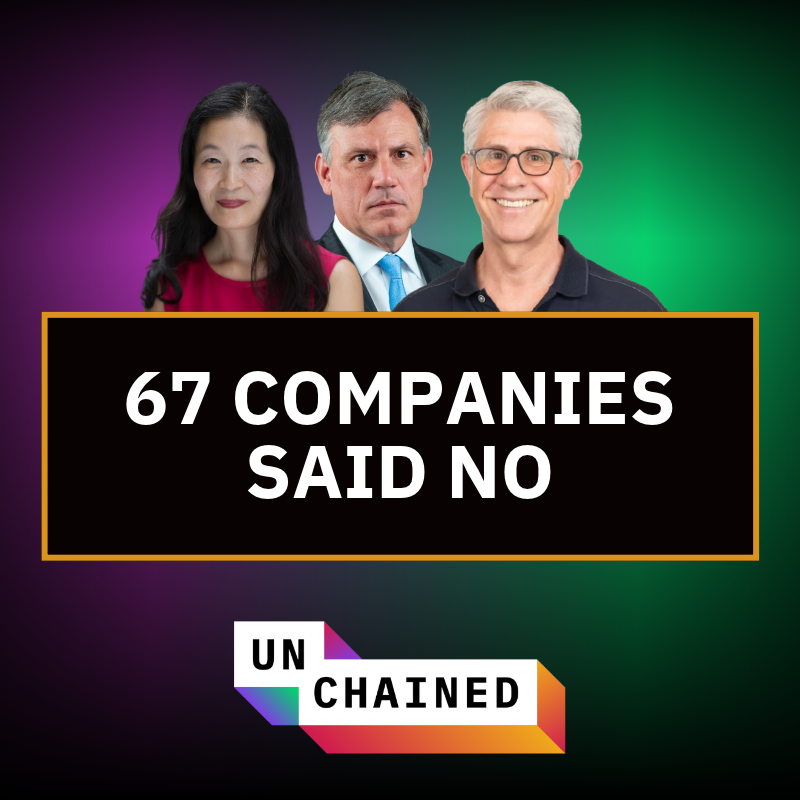
SEC Director Jamie Selway and Securitize President Brett Redfearn on why 67 companies opted out of OKX ICE, and what could bring them back.
========================================================
Thank you to our sponsor!
Put your crypto to work with Nexo: earn daily interest or borrow funds against your assets on one platform trusted by more than 10 million clients.
Find out more at https://unchainedcrypto.com/go/nexo-podcast-sn.
Geo-restrictions, eligibility and terms apply.
========================================================
Sixty-seven companies have opted out so far of having their shares traded on OKX ICE's tokenized stock venue, and a full-page Wall Street Journal ad warned CEOs that crypto would soon tokenize their stock on unregulated venues.
Jamie Selway, Director of the SEC's Division of Trading and Markets, and Brett Redfearn, President of Securitize, join Laura Shin to sort out what the SEC's innovation exemption actually allows. Selway lays out its design: a five-year term, volume caps as low as 25 basis points, and a 30-day issuer consent window. Redfearn argues that tokenizing a stock and trading it on a TSV are two different things.
They also cover the Hims & Hers token that hit $132 offshore, weekend pricing, why synthetics are off the table for now, and the "investomer." Selway says a rule proposal has to be a 2027 event, so the next year of trading may shape the rules that follow.
Host:
Laura Shin, Host / Unchained
Guests:
Brett Redfearn - President of Securitize
Jamie Selway - Director of the Division of Trading and Markets at the SEC
Timestamps
🎬 00:00 Intro
🚪 01:26 Why 67 companies opted out of OKX ICE, and whether they can opt back in
📰 07:09 From the AMC spat to the WSJ ad: where the issuer pushback came from
💙 14:32 Nexo: Earn daily interest on your crypto or borrow funds against your assets at https://unchainedcrypto.com/go/nexo-podcast-yt
🔗 14:57 Why Brett says tokenizing a stock and trading it on a TSV aren't the same
📊 23:19 How Jamie and Brett answer issuers worried about price and volatility
🏛️ 28:26 Jamie on the exemption's design: 5 years, volume caps, 30-day consent
🪙 35:25 How Securitize's tokenized stocks trade outside the exemption
💊 48:37 The Hims & Hers token that traded 4.5x higher than the stock: could it happen under the exemption?
🌍 55:01 Will the SEC ever allow tokenized synthetics in the US?
📅 01:02:33 When Jamie expects the SEC to propose final rules for tokenized trading
Learn more about your ad choices. Visit megaphone.fm/adchoices