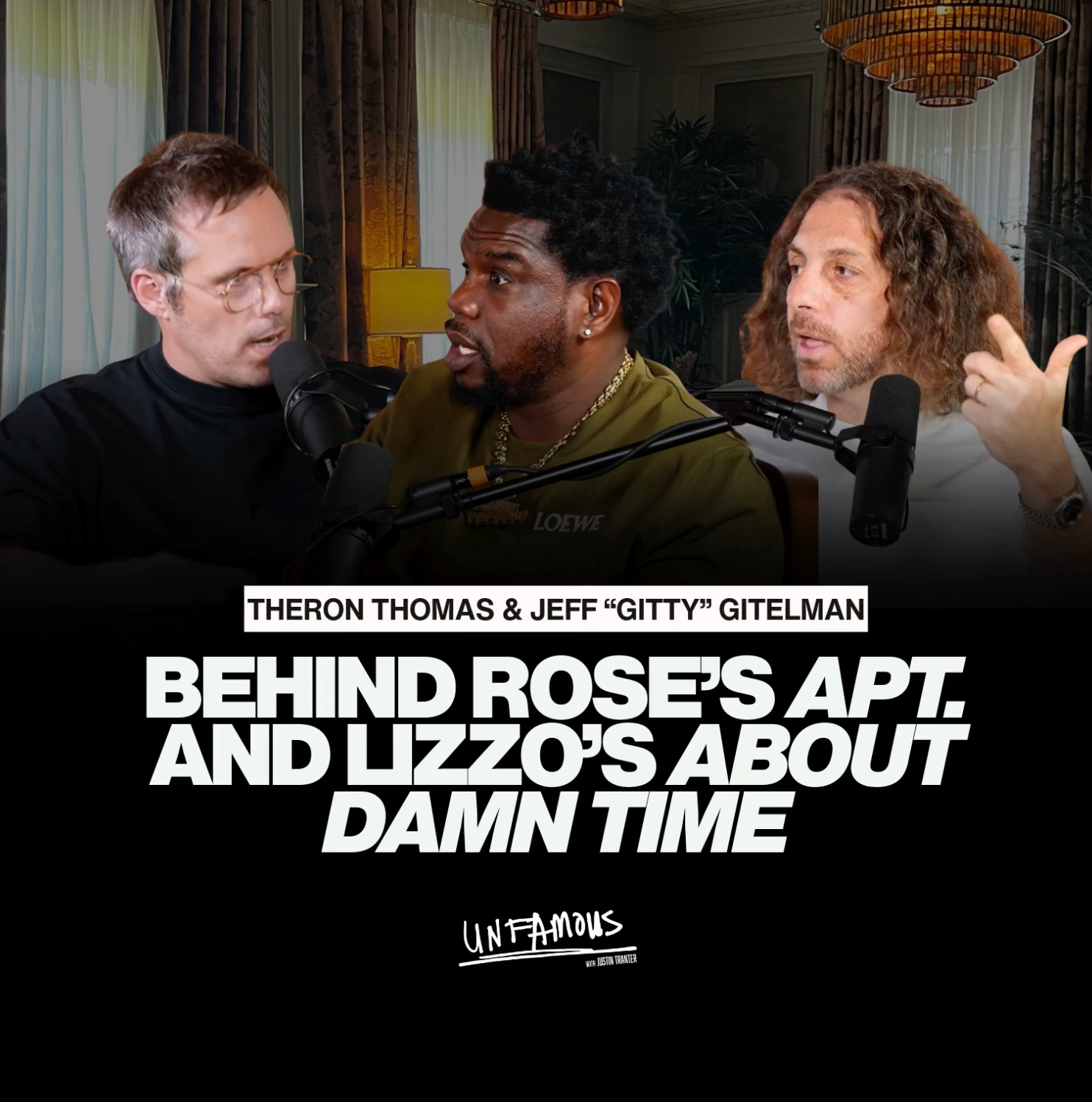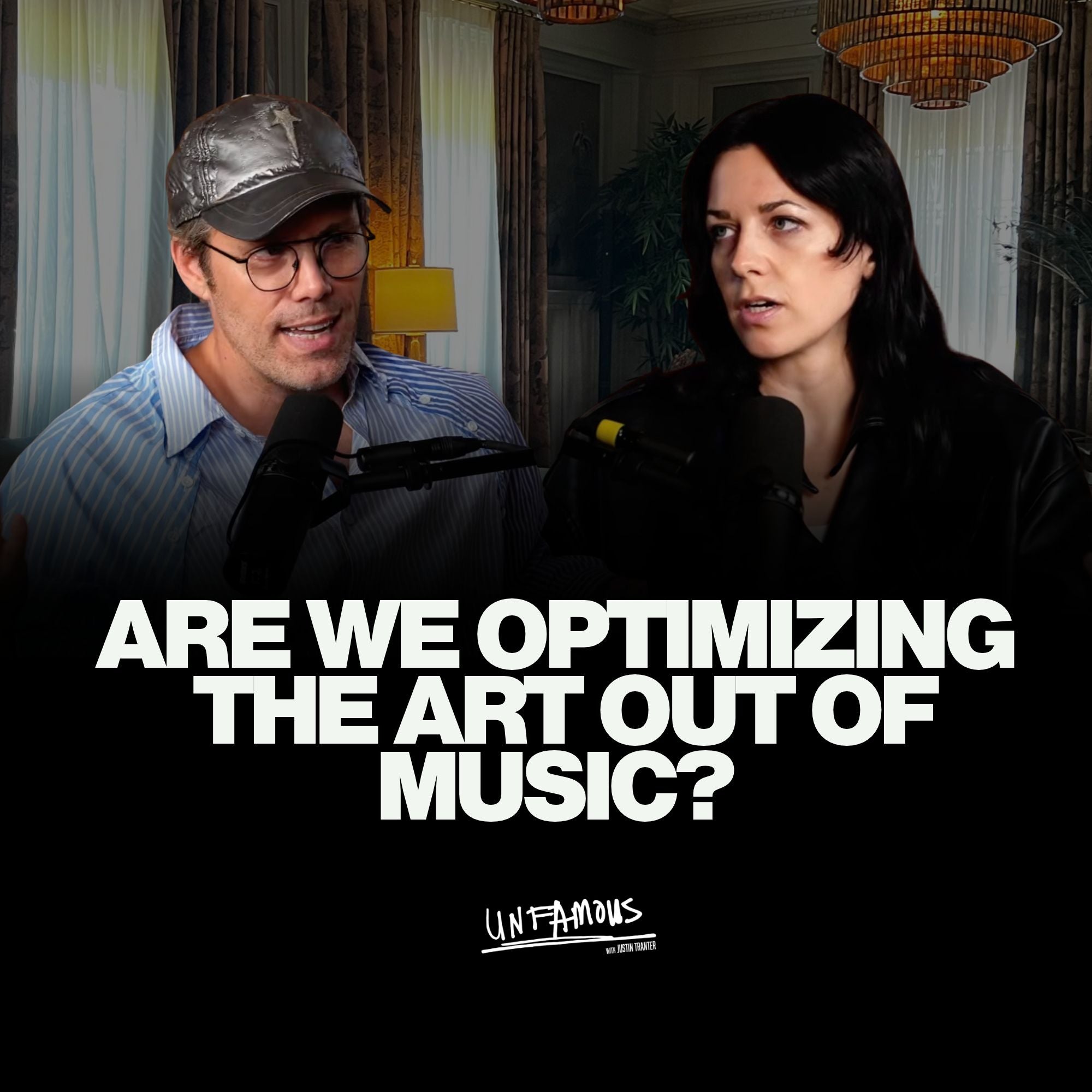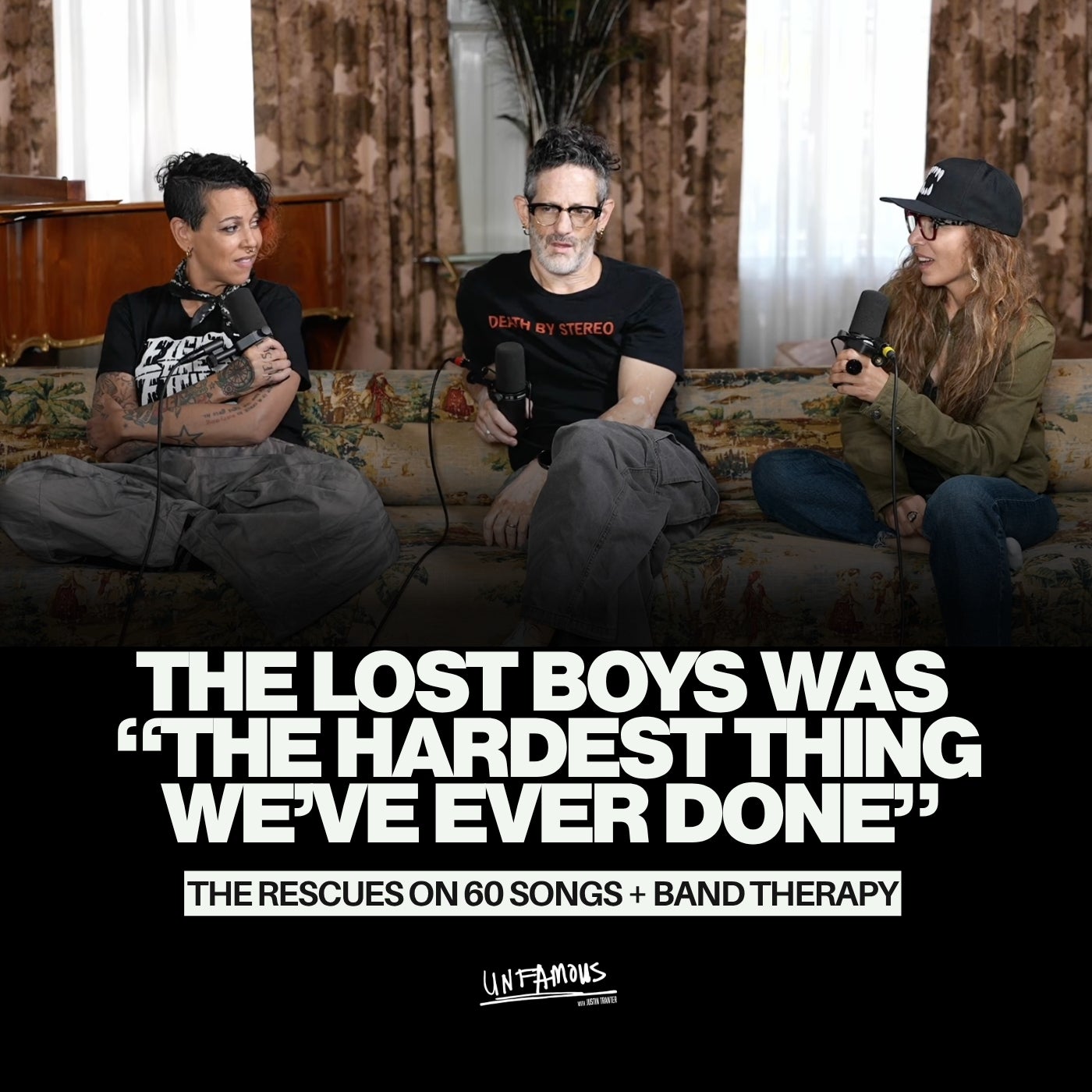
 Unfamous with Justin Tranter
21 Oct 2026 · 27m

 Add vo to ChatGPT or Claude to ask about everything you hear
vo listened to this episode to put together the overview and transcript, so there may be the odd mistake.
How songwriting and producing work behind the scenes—especially music publishing splits, sampling vs interpolation, and producer psychology/structure. Guests discuss when to “pull the plug” on interpolations, how publishing percentages get negotiated, and how producers emotionally guide sessions while engineers handle technical work. They also break down lyric/melodic “song math” and argue for broader artist development (performance, stamina, and singer-songwriter growth).
Ant (behind-the-scenes songwriter; writes songs for/with other artists; also has an artist project) and Morgan Stewart (co-creator of Unfamous; behind-the-scenes songwriter/producer perspective). Ant has a B.S. in Psychology.
Structure enables creativity; interpolation can boost hit odds but costs publishing; producers must manage emotions/personality; artist development for singer-songwriters is under-discussed.
Paul McCartney taking 100% publishing; “The Wonder Years” version; Selena Gomez “Bad Liar” interpolating Talking Heads “Psycho Killer”; Fallout Boy “Centuries” interpolating Suzanne Vega via Tom Steiner; Fifth Harmony “Like Mariah” (interpolating Mariah Carey); Ed Sheeran “Happier” lyric-structure breakdown; Ant’s “Good Luck Babe” and Justin Bieber “Sorry” melodic math; Michael Jackson and Beyoncé artist development; K-pop training; Kurt Cobain visual response.
0:00Ugh, I hate Mondays. King's Hawaiian Cinnamon Swirl Bite? Uh, Taylor Hanson? Sure, I'll try one. Mmm. Bites, bit-a-ba-da-ba. Hey, let's get back to work, please. But Taylor Hanson's making my day way better with these new soft and swirly King's Hawaiian Cinnamon Bites. Taylor Hanson? Nice. Try one. Mmm. Bites, bit-a-ba-da-ba-do. King's Hawaiian Cinnamon Bites. Don't you love them? There's nothing like it. Sweet swirling is all good.
0:30Justin Tranter: But sometimes Paul McCartney says, I'm taking 100%. Managing personalities. That's really where producing is. The producer was the creative leader. And then once the computer took over, the producer became the technical leader. Someone has to be handling the emotional production as well. Like I fucking love structure. And I think a lot of people think that's like the enemy of originality and creativity. I think it actually creates a freedom for creatives. I love breaking down songs into who, what, where, when, and why per line. It should just be very simple. Is there a way to know when to pull the plug on an interpolation early?
1:11Justin Tranter: Ladies, gentlemen, and everyone in between, welcome to Unfamous. We are doing these little fabulous sort of recap, highlight reel episodes. and it's me and my co-creator, Morgan Stewart. And I am so overjoyed at how well this episode did. It traveled very far. The reason why I say that is because they're both behind the scenes creators. So Ant does have an artist project on the side, but most of his life is spent writing songs with and for other people. So when I saw the numbers on this episode, I was so pleasantly surprised as a fellow behind the scenes songwriter to see that an episode with a behind-the-scenes songwriter and a behind-the-scenes producer do so well made me really happy.
1:58Yeah, and the reason why it did do so well is because it truly is like a masterclass in all things like songwriting, song math, structure, producer psychology. Industry shit, too. Yeah. A lot.
2:10Justin Tranter: They explained a lot of industry stuff. It was so nice having an episode with just behind-the-scenes people because we just got to really geek out. Like the whole episode is just like geeking out. That is why we are going to start with how sampling affects your publishing. Now, I knew the song from a TV show. It was The Wonder Years. I didn't know that was a Paul McCartney song. I found out via email that you're not getting paid. However, Sir Paul McCartney, I appreciate you. thank you for the beautiful words in the email he says one of the best versions of his song he's ever heard i'm taking all the publishing i was like you deserve it sir because i'm a michael jackson fan okay so when that song came out yes you had you made zero money zero publishing so to break it down right so if you use a small piece or a large piece of somebody else's song and create your own art from that then you have to go to the original writers and say hey let's negotiate splits and you hope that there, I have a Selena Gomez song called bad liar.
3:20Justin Tranter: And the baseline is from talking heads, psycho killer, uh, which David Byrne wrote the lead singer. He was very nice to us. And you know, we really wrote the whole song over his baseline. That was the original spark. And, uh, he, it was equal splits. Yeah. So 25 me, 25, Julia, 25, Ian, the producer, 25, David Byrne. But sometimes Paul McCartney says, I'm taking 100%. But then sometimes we have Jermaine Dupri and Brian Michael Cox who say, you know what? I'll give you your regular percent. It really is just up to whoever owns the publishing. So this also to get extra geeky, this is what we call an interpolation.
3:58Right.
3:59Justin Tranter: So there's a sample where you're using the actual master recording from someone else's recording. Right. And you take that actual master recording and you put it into the track. And whether it's an instrumental thing or a vocal thing or both, that's a sample. But that also is using their publishing. So you're using their recording, their master side of their money, of their original piece of art. And you're using the publishing, the writing of their piece of art. So that on a sample, which, you know, there's so many iconic hip hop songs and pop songs that sample. But I think these examples that he's talking about, this is just interpolation.
4:44Justin Tranter: So on in my Bad Liar reference, Selena Gomez song, that's just an interpolation. We replayed the bass line. It's in a different key. It's not the exact same thing as Psycho Killer. or in my song, Fallout Boys, Centuries, we interpolate...
5:01Justin Tranter: Suzanne Vega, Queen, Legend. Tom Steiner. Tom Steiner. Obsessed. That was my first hit ever. And it was because when the producer, he had already made the bulk of the track and when he pressed play and there was the interpolation of a 90s singer-songwriter who's lesbian adjacent. I was like well I have to write I have to write to this Honor her Honor her And so I think on that one So it's not a sample Because we don't use Suzanne Vega's voice From the recording of Tom Steiner Somebody else re-sing it Because it's in a different key So it's an interpolation So we just had to get Suzanne Vega To clear the publishing of it And tell us how much she wanted And that song We did this 12, 13 years ago, but she took like, I think 15 % to use her do do do's, but it's not a sample.
6:00Justin Tranter: It's just an interpolation. So is this something you find out about, like, after creating the song? Like, is there a world in which you're like, okay, I'm going to interpolate this. Like, is there a way to like, know when to pull the plug on an interpolation early? Yeah, there is. if it's like someone in the session starts, oh, what if we interpolate Blah-Di-Da and it's the most famous, one of the more famous songs of all time, but you're only using it like buried in the track. And you're like, well, so we're going to give Madonna 90 % publishing for something we can barely hear? Madonna deserves it.
6:41I don't care.
6:42Justin Tranter: She deserves everything. She deserves the world. We bow down. just using a famous name that came to mind. But then like, if it is, it's a really good cheat code, right? So like, if you are interpolating something and it's really famous and it's already gonna make the song that, the chances of the song becoming a hit, whether you think interpolating is cheesy or not is not the point. The point is, is that it does give you a better chance said a hit because it's like, oh, I recognize that it's familiar to me. Oh, but they've kind of changed it a little bit. How cool. Um, which was, you know, so much of, of hip hop, you know, of, of especially early hip hop was all based on samples and interpolations.
7:30Justin Tranter: So I think it just depends on what the creative goal is. You know, if the creative goal is you're just trying to get a fucking hit. Yeah. You, you do the sample or you do the interpolation and you know, they're going to take a big piece of your money. Like I wrote a song early in my career for Fifth Harmony called Like Mariah. Wow. Someone wanted to interpolate Mariah. And so I was like, well, Mariah being a superstar, being a massive songwriter, she's going to take a lot of publishing. So let's fucking milk it. Let's call the song Like Mariah. That's smart. Because if she's going to get, she's going to take a lot of the money, which she should.
8:13Justin Tranter: she deserves. So let's milk it. Love. So the next thing we're going to talk about is actually the psychology of producing and who can really zoom out and see like the entire creative and emotional picture of what you're creating. So I think there's a difference between a beat maker, an engineer and a producer. How do you find the balance to being right? Someone who's checking on someone's what, what pronoun are you using. Let's make sure we're cutting right to the heart. So how do you find a way to balance the two duties that you have to handle in a session? I like, I love playing and actually producing hands-on, like making beats.
8:56But really, when you get to work with great people, when you get to work with a Justin Turner, you know what I'm saying? You're able to like step back and see the whole song. You step back and see it from 30 ,000 feet. So I like to see it from the ground floor. and from 30 ,000 feet.
9:13Justin Tranter: Were you always good with people? Is that like a natural skill since you were young? I wanna say yeah. And then I actually have a Bachelor's of Science in Psychology. So I actually like understand a little bit like about like interpersonal communication, you know? And how people interact and how to best interact with different people. Two things. One, they dress better than most pop stars. Just fabulous. Yeah. to just casually dropping that you have a crazy degree in something that has nothing to do with music is so glamorous. I think this clip is really important because pre-computer being the main instrument for producing, most producers, their job was emotionally guiding the process.
10:05Justin Tranter: and there was engineers handling the technical side of it. Right. And so when we think of fucking Quincy Jones, when we think of, you know, pre-label mogul Jimmy Iovine, producer Jimmy Iovine, when, you know, the list goes on of these people that we all worship, they very rarely were like touching the board. They very rarely were setting up the microphone. It was, the producer was the creative leader. And then once the computer took over, the producer became the technical leader, which not complaining because me being like the emotional leader in sessions. Yes, I'm a songwriter first and I write my ass off.
10:48Justin Tranter: But a lot of times my success in the room is I'm actually emotionally producing the session because the producer is technically producing the session. They are handling so much in their computer that they, and this is a broad stroke statement. Of course, there's producers I work with who do both as well. But once the computer took over, what a producer does has drastically changed. And Bongo, as I've worked with Bongo many times, he can handle everything in the computer, but his vibe is at a million, you know? And it's something that a lot of young producers who are so obsessed with a computer forget that someone has to be handling the emotional production as well.
11:38Justin Tranter: But again, if you're not good at it, that's okay. Make sure there's people in the room who can emotionally get everyone across the finish line while you are technically handling it. I'm comparing it to being a creative director. A lot of people are like, what is even a creative director? It's like managing people, emotions, personalities, making sure everything's connecting and we're also reaching the finish line. I was going to say, I think it's done. Yeah. That's the other thing. It's like, in an interview, Benny Blanco called me like the greatest camp counselor in pop music history. Yeah. And it's just like, even though Benny is such an emotional producer, technical as well, but like he also, it's like helpful to have me in the room just because like, you know, a song is getting finished that day.
12:22Justin Tranter: It's just like, no, I'm gonna cheer us all on and I'll put my fucking leg over my head and we're gonna get a song done. You know, there's also the other side, which is like the formula and the song map. I love breaking down songs into who, what, where, when, and why per line. It should just be very simple. And in song structure math, a lot of popular pop songs have the why in the chorus as the four in the chorus or as the one, if it's going to be the main thing uh i love how ed sheeran gets to his why he's one of my favorites okay if you can do it if you can't we'll edit this out if you can do it break down i got an ed sheeran so my favorite ed sheeran song to break down is this song called happier it's on the divide album yep and the the first line of the song is uh walking down 29th and park so that's a where Yep.
13:18It's a when and it's what's going on.
13:21Justin Tranter: Yep. I saw you in another's arms. That's a what and a who. Only a month we've been apart. That's a when and a what. You look happier. That's a what and a who. So that's the song structure for the first four of that. Jesus Christ. He keeps the same song structure and breaks it right down in the next section. Saw you walk inside a bar. Who, what, where is going on like he says something to make you laugh who what's going on i saw that both your smiles were twice as white as ours yeah you look happier first off his imagery is so it's sickening yeah it's like i saw that both of your smiles were twice as white as ours you look happier so it's who what's going on yep ain't nobody hurt you like i hurt you beautiful thing to say just a what Ain't nobody loved you like I do Beautiful thing to say, just a what Promise that there's others that deserve you Wait, no, that's the second verse, I'm sorry Promise that I will not take it personal If you're moving on with someone new Why?
14:25Because baby, you look happier You do My friends tell me one day I'll feel it too And until then I'll smile and hide the truth That I know I was happier with you Stop playing with me
14:38Justin Tranter: He really loves that song loves it which fucking slay when he did this i actually got like emotional i was like moved because it's just like anyone who cares that deeply about art i just think is the coolest person yeah and what i loved learning about song structure is well i just love structure in general like i fucking love structure and i think a lot of people think that's like the enemy of originality and creativity but like i mean if we didn't have structure for this it would just be two people talking in circles. Yeah. We need structure. I think it actually creates a freedom for creatives.
15:15So if you always know you have this North Star to bring it back to, or where the lyric or the next word or the conversation needs to go, you can feel free to go on a little bit of a tangent because you always know where to come back to.
15:28Justin Tranter: Yeah. It's also so cool. It's so rare. In so much of pop music, we talk about melodic structure and for him to break down lyric structure was so cool and refreshing. But I would like to share a little melodic structure for the people watching who are trying to learn all the geeky shit about songwriting. The best melodic tool that you could ever use is to make sure that the melodies in each section of your song are starting in a different place on the phrase. So either on the one, before the one, or after the one for each section so that it feels exciting each time. I'll break down one of my songs because I just sang it at a charity event so I can actually remember it off the top of my head.
16:22Justin Tranter: Good luck, babe. Chapel Rowan, that I was lucky enough to co-write with Chapel and Dan Nigro. Verse starts before the one. So one, two, three. it's fine before the one one two three it's fine one pre-chorus is after the one uh one two three four one you don't want to call it off and chorus is on the one one two three four you it's technically a little bit before the one but it really lands on the one one two three four you could kiss a hundred boys in bars. Got it? And then the post-chorus is one, two, three, good luck, babe, back before the one. So everything is moving in different places. Or Justin Bieber, sorry, that I was lucky enough to co-write with Julia Michaels.
17:15Justin Tranter: One, two, three, four. I know you know that. On the one. The verse is on the one.
17:25Justin Tranter: Three, four. And then the chorus after the one. One, two, three, four. Is it too late now to say sorry? So that every section is setting itself apart. Hello, my little unfamous friends. So the thing about the algorithm, Lil Miss algorithm, is that she doesn't want to let people know about our podcast unless she thinks that people love it. So if you follow this podcast, what do the old school YouTubers say? Like, subscribe, and follow. If you do that for me, then you will help the unfamous message of the beauty of the art of collaboration reach more people. So please do me just a cute little favor and follow this podcast and share it and do all those fun things.
18:16Justin Tranter: Bye. Also, for both of those songs, really simple, easy to follow in terms of where the notes are going. So, one, two, three. It's fine. It's cool. Nice and low, right? And then the pre-chorus is a big build up. But you don't want to call it off. Da-ba-da-ba-da-da-da. Da-ba-da-ba-da-ba-ba. Up, up, up, up, up. And then the chorus, the highest notes we've heard. So, of course, the verse notes are here. The pre-choruses climb up. The chorus stays up really, really high. Really, of course, there's many examples where like the pre-chorus is higher, the chorus is lower, this and that, but really easy to follow melodic math for both of those songs.
19:04Justin Tranter: You gotta go and get angry at all the low and then boom, is it too late not to say sorry? Higher. Really dumb, really helpful tricks. Make your chorus the highest part of the song. I remember in like, you know, because when you're writing a song, so much is happening, but I remember like in vague memory, like making sure while we were writing Good Luck Babe, which is such an emotional story song, to in my head quietly making sure, okay, so I know our verses before the one, our pre-chorus is after the one, like making sure that the melodies were all in different parts of the phrases. Even though the main point is to tell this really awesome specific slash universal story about someone who's clearly in love with you, but not ready to love you yet.
19:52Justin Tranter: But also making sure the melodic math was hitting all the things that we wanted to hit. Speaking of development, our next clip is about the importance of artist development. What do you feel like music is missing? Artist development. Absolutely. Okay, explain that for the friends at home who might not know. My favorite artist of all time is Michael Jackson. And he went through artist development before he ever got to Motown. Just knowing how to interview, how to stand, how to walk how to talk as a performer how to perform a song how to hold a microphone how to dance and sing and perform long periods of time and not lose your breath yeah Beyonce is an amazing a credit to like the the hard hard work it takes to run on a treadmill and be able to perform in high heels like it's it's ridiculous so as she went through an immense amount of artist development from her father and from the amazing group Destiny's Child that she was in.
20:53So I think in today's world where it's beautiful having the opportunity to get on the internet and show the process while you're learning, I wish the people that say I want to be an artist could actually go through the bootcamp. Artist development bootcamp from the people that came out of it. Yeah. I think what's,
21:14Justin Tranter: you know, he, both of his examples were about like fathers, which is a whole different conversation. But the part that I'm going to focus on is about, they're both like performers. Yeah. And I think that we, whether it's, it's Beyonce or Michael or Madonna's like modern dance training, like there, there are K, the K-pop system. There are so many examples of like that type of artist development of choreography, stamina, cardio, blah, blah, blah. I think that the other kind of artist development that doesn't get talked about enough is, you know, the singer songwriter, which is, you know, my favorite kind of artist that still needs years and years.
22:05Justin Tranter: Of course there are the freak accidents of Fiona Apple writing criminal at 16. Right. You know what I mean? And the fucking, Olivia Rodrigo's and the Billie Eilish's, these like freak accidents of teenagers writing better than most 40-year-old professional songwriters. Being a 16-year-old who writes the best song anyone's ever heard, that's not a business plan. That's not, that's not, that's not, you can't base your life on that. I think the artist development of the singer-songwriter is still just as important of like, what are your songs mainly about? Have you written enough songs for them to be great?
22:39What is your songwriting perspective?
22:44Justin Tranter: What are you bringing to the pop music landscape? And pop is a huge broad term. It just means popular. What are you bringing to the pop music landscape that is slightly different than everybody else killing it right now? And I think that that conversation about artist development doesn't get talked about nearly enough because it's a lot more like, ethereal it's not as like tangible of like are you on the treadmill right you know and i think that that is such what is your if you're a singer songwriter you still got to be thinking about your visual do you know i mean like even the examples of visuals that seem super casual a kurt cobain uh my queen and ethel kane like these visuals are specific as fuck and whether they were accidental like Kurt Cobain's it was not accidental it's grunge is an a very clear response to hair metal yeah like very clear sonic response and visual response to hair metal like anyway so I think that the artist development is missing and Ant is so right everything he said is completely valid but I think that we never talk about the like singer songwriter side of artist development Yeah, and I think in addition to development of the creative skill set, there's also the development that has to do with like how to deal with growing a fan base when it explodes.
24:14Justin Tranter: It's so hard. How you're going to deal with comments like mental health, you know, also like learning how to protect yourself on tour, how to like protect your voice, make sure you're not burning out. Like being ready for that is you could crash and burn and like you're finally achieving your dream. Like you need help in that type of development. It's super important. Well, I think too, like if the creative vision is developed enough, I think it's also a lot easier to handle the insanity of fame. Because it's like, no, this is what I, my album is me. The outfits I'm wearing are me. Yeah. Even if it's developed and you have collaborators helping make the best version of you, I think when something feels very truthful to who you are and thought out and developed, it's a lot easier to survive something that feels like artifice.
25:13And that was our episode. I love it.
25:15Justin Tranter: I love that episode so much. I love both of them so much as artists, but also what a great, it's just so cool to me to see that like, An episode without a very famous pop star did really well. Yeah. Because people want to learn. Yeah. Yeah. Again and again and again and again. I am still sick. Hello, hello, everyone's favorite part of every podcast where we say please follow and subscribe to this podcast wherever you listen so you don't miss future conversations. And also, pretty please take a cute little second to rate the show. It's one of the biggest ways you can support us. See you next Wednesday.
26:23Don't you love her? There's nothing like it. Sweet swelling is all good.
Paul McCartney can love your version of his song and still take 100% of the publishing. So how does any of this actually work?
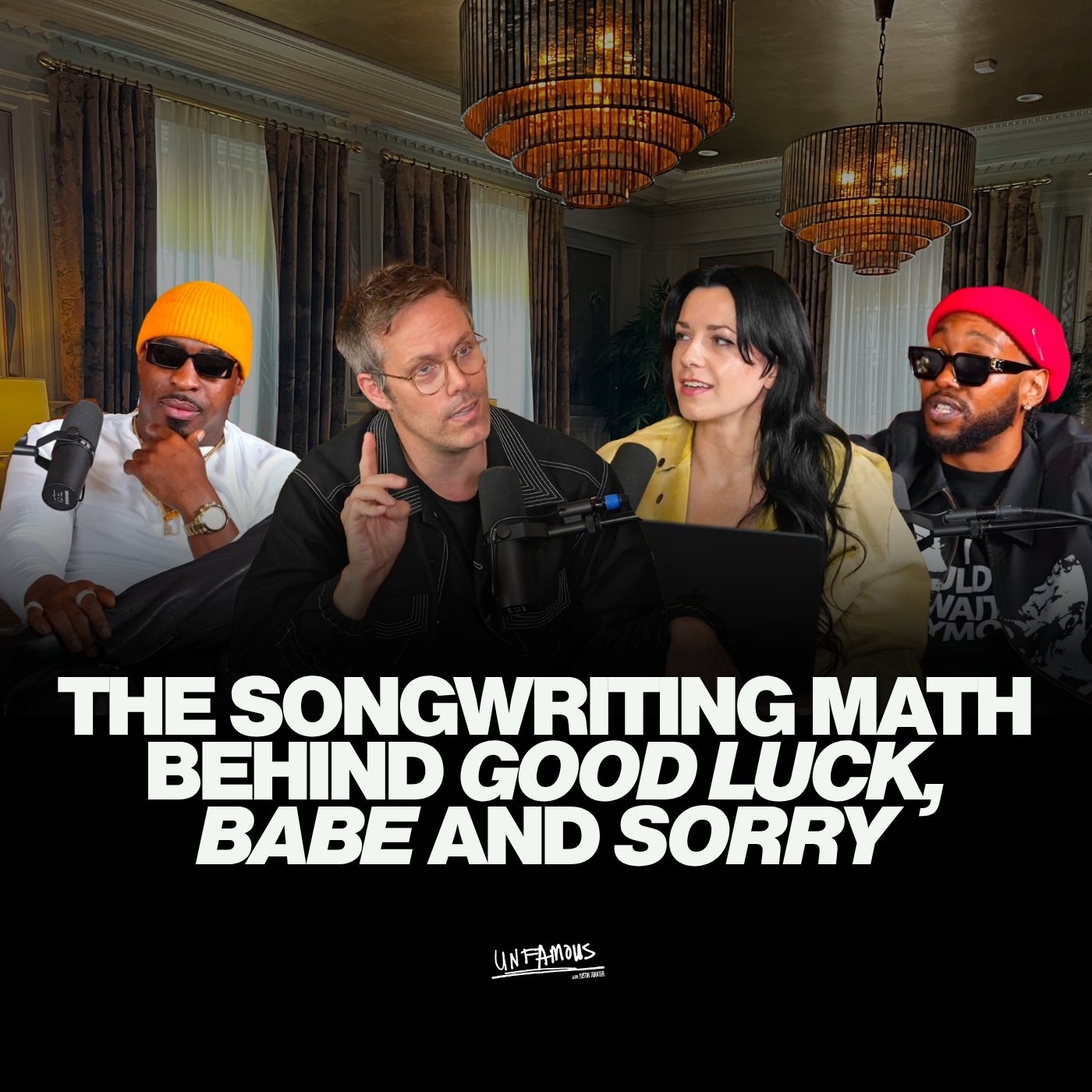
In this Unfamous recap, co-creators Justin Tranter and Morgan Stuart revisit the biggest lessons from producer Bongo ByTheWay and songwriter/artist Ant Clemons, starting with Ant’s Paul McCartney story and a breakdown of the difference between samples and interpolations, when borrowing something familiar can increase a song’s chances of connecting, and when the publishing cost may no longer be worth it.
Then the conversation gets into the less-visible mechanics behind great creative work: why producing is as much about managing personalities as operating a computer, how Justin uses who / what / where / when / why to map lyrics, the melodic math he used while writing Chappell Roan’s “Good Luck, Babe!” and Justin Bieber’s “Sorry,” and why Bongo and Ant believe artist development still matters, from songwriting and performance to having a creative identity strong enough to survive success.
Chapters
0:00 Paul McCartney, Producer Psychology & the Rules Behind Hits0:42 Why the Behind-the-Scenes Creators Connected
1:52 Paul McCartney Took 100% of the Publishing
3:24 Sample vs. Interpolation: What You’re Actually Paying For
5:32 When Should You Kill an Interpolation?
7:46 The Producer’s Job Is Emotional, Too
11:58 The Song Map: Who, What, Where, When, Why
14:22 Why Structure Creates More Creative Freedom
15:22 The Melodic Math Behind “Good Luck, Babe!” and “Sorry”
19:26 What Music Is Missing: Artist Development
21:22 Singer-Songwriters Need Development Too
23:33 How Do You Prepare an Artist for Success?
Credits
Unfamous is hosted by Justin Tranter
Created by Justin Tranter & Morgan T. Stuart
Produced by Justin Tranter & Morgan T. Stuart
Written & Researched by Morgan T. Stuart
Director: Morgan T. Stuart
Co-Director + Cinematographer: Olivia McCrary
Audio Engineer: Mike Sabri
Camera Assistant: Kolbi Samantha
Special thanks to Mark Beavan, Jimmy Knehans, & Cory Jasin.
Chat with the Unfamous team: https://tr.ee/jwPZ3j
Learn more about your ad choices. Visit megaphone.fm/adchoices
Scan the code with your iPhone camera
Listen in the app.