 Ask ChatGPT



The episode explains why conventional grid transformers (iron core + copper coils, optimized for 60 Hz AC) struggle with today’s changing power flows, and how solid-state transformers (SSTs) built from semiconductors could add bidirectional conversion, higher-frequency operation, monitoring, and active control. It argues SSTs are becoming viable due to cost declines from power electronics, plus urgent demand from solar/batteries and especially AI data centers.
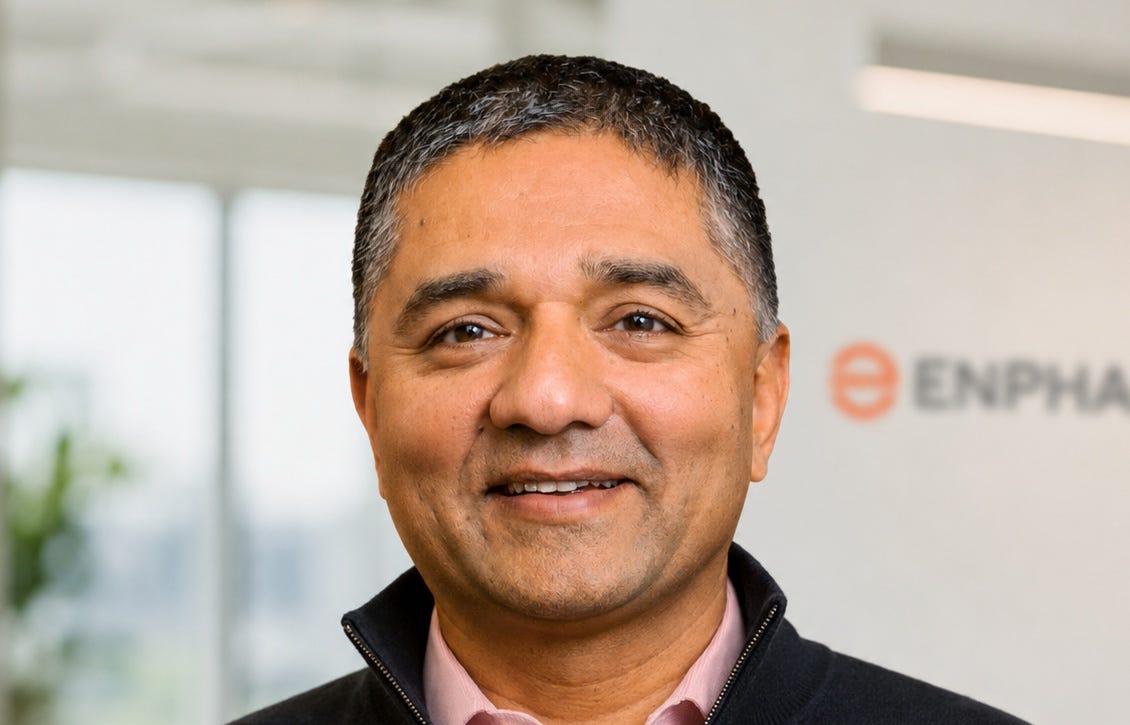
Raghu Belur, co-founder of Enphase. Enphase pioneered microinverters for rooftop solar, deploying millions of panel-level inverters and using software/semiconductors rather than “big box” centralized power electronics.
Written by AI. May contain mistakes.
Explains the function, history, and limitations of conventional transformers.
“The vast bulk of the transformers on the grid today, including the gray boxes on the top of poles that you see all around your neighborhood, are cheap, sturdy, and dumb as a box of rocks.”
Discusses the evolution of power generation and the necessity for grid modernization.
“With no further ado, Raghu Belur, welcome to Volts.”
Details the advantages and working principles of solid state transformers compared to traditional ones.
“Hey, there was nothing wrong with horses and buggies either.”
Explains the technology behind solid state transformers, including their construction and functioning.
“And as I understand it, there's been a lot of this idea of making a more intelligent device goes back a ways.”
Learn about how solid-state transformers operate and their advantages over traditional designs.
“I take AC and chop it up and I make it into flat DC output, right?”
Explore how software integration enhances transformer functionality and performance.
“When you rely heavily on software and semiconductors, a few amazing things happen, right?”
Discuss the slow evolution of the power grid and the challenges it faces in modern times.
“So there is some physical limitation that I won't get over.”
Delve into the concept of distributed architecture and its benefits in power electronics.
“Look at fires here in California, right, as an example.”
Learn about the transition from traditional solar inverters to innovative microinverters.
“So you're chaining together small repeatable modules rather than building bigger ones.”
Learn about the shift from traditional solar inverters to microinverters and their benefits.
“Because this was fully bidirectional, et cetera.”
Discover how solid-state transformers are revolutionizing power electronics.
“You're making it into power electronics.”
Understand the impact of materials like copper and gallium on transformer design.
“you can customize the size based on how many modules you have, basically.”
Explore the benefits and manufacturing advantages of using gallium in electronics.
“So actually, on the contrary, GAN is actually commodity.”
Learn how gallium nitride (GaN) offers unique benefits for solid-state transformers.
“which is on one die, we can flow the power in both directions.”
Explore the potential cybersecurity risks associated with modernizing the grid.
“Briefly, let's talk about cybersecurity.”
Understand the market potential for solid-state transformers in data centers.
“around the clock, looking for vulnerabilities to get into the grid.”
Discover how solid-state transformers can improve efficiency and reduce costs in power systems.
“It makes sense because you're dramatically simplifying the powertrain from the way it is today.”
Explore the application of solid-state transformers in data centers and their potential market impact.
“You say the later adopter, the next big market after that is going to be solar and batteries.”
Discover the transformative potential of smart neighborhood transformers in the energy grid.
“So the CapEx part, I think there's so much value.”
Learn about the intelligent energy systems in modern homes.
“I have my solar, I have my batteries, I have my smart EV chargers, I have my smart robot running around.”
Understand the need for evolving transformers for modern energy systems.
“So that whole transformation has to happen and it will happen because that's what power electronics does.”
Discuss the potential for solid-state transformers to achieve cost parity.
“that needs to happen from our point of view before we can go attack that problem is we need to prove reliability because those transformers are extremely reliable.”
Explore the challenges and discussions around utility adoption of new transformers.
“You get to scale, you get to fully automated manufacturing, you get to a very efficient supply chain, all of which is feasible.”
Learn about the importance of smart transformers in decentralized grids.
“But no reason, at least the folks that we are speaking with, they are looking at it very seriously.”
Discover how intelligent components improve grid efficiency and reliability.
“shared from household to household without ever going up into the bulk grid.”
Understand how solid-state devices are integrated into the existing grid.
“But bear in mind that when we talk about SSCs today and you talk about PV, you talk about front of the meter BESS, you talk about data centers, you talk about fast DC charging, they are already connecting to the grid.”
Address objections regarding cost, efficiency, and lifespan of solid-state transformers.
“And it's just worth emphasizing that that market, 60 million of these things dwarfs the data center market and the PV market.”
Discuss the durability and lifespan of solid-state transformers versus traditional ones.
“Like, currently, these are more on a pure CapEx basis, but A, they're coming down.”
Explore the challenges of heat management in solid-state transformers.
“And when I think about, you know, when you start replacing pole top boxes in neighborhoods, utilities having to come and replace those every 10 years, that's a substantial increase in operational costs.”
Learn how telemetry improves monitoring and reliability in energy systems.
“So you think like a 25-year warranty on a solid-state transformer is not out of the question in a few years in whatever.”
Understand how solid-state transformers handle faults and protect the grid.
“And all that engineering transfers pretty straightforwardly from your solar inverters to your SSTs, like it's the same type.”
Discuss the advantages of solid-state transformers over traditional systems.
“So how is the system performing under these grid conditions?”
Learn how solid-state transformers can intelligently handle faults in the electrical grid.
“breakers to shut off and then sort of you cut the damaged you cut off the propagation of that fault electronics can't do that because the switches would destroy themselves if they tried to do that.”
Explore the necessary policies and innovations needed for modernizing the power grid.
“I think it's pretty clear to me that like power electronics are gonna eventually take over the grid like they've taken over everything else.”

Get the gist, explore an idea or ask about something said.
 Claude
On Volts, what are the key points of this episode?
Searching your listeningAutomatic transcript. May contain errors.
0:06Raghu Belur: All righty. Hello, everyone. This is Volts for November 4, 2026. The transformative potential of solid state transformers. I'm your host, David Roberts. Electricity moves long distances at high voltage, which is efficient. It gets used at low voltages, which is safe. Transformers are what step the voltage up and down along the way. Every bit of power you use has passed through several of them. The basic design of a transformer, copper coils wrapped around an iron core, has barely changed in a century. The vast bulk of the transformers on the grid today, including the gray boxes on the top of poles that you see all around your neighborhood, are cheap, sturdy, and dumb as a box of rocks.
1:07Raghu Belur: Right now, the U.S. can't make them fast enough. It takes years to get one. Engineers have long talked about replacing conventional transformers with electronics. A solid state transformer, mostly made of transistors, would be smaller, could handle DC as well as AC power, and could actively monitor and manage the power flowing through it. The catch has always been cost. Nobody needed a smart one badly enough to pay five to ten times the price of a dumb one. That is changing, and the two markets driving it make a somewhat awkward pair. One is solar farms and big batteries, which produce DC power.
1:57Raghu Belur: The other is AI data centers, which want more DC power inside their buildings and will pay almost anything for speed. The long-term prize, though, is not the big transformers at data centers. It is the little ones in local communities, the gray boxes on poles, where rooftop solar EVs and heat pumps are complicating matters. It's all surprisingly fascinating. My guest today, Raghu Belour, co-founded Enphase, which broke up big solar inverters into tons of smaller ones to be tucked under each rooftop solar panel. Now he's trying something similar with transformers, creating small modules that can be Lego'd into medium or large infrastructure.
2:48Raghu Belur: Let's get all into it. All right, then. With no further ado, Raghu Belur, welcome to Volts. Thank you so much for coming. Good morning, David. Thank you. Thank you for having me. Super excited to be here. I am excited to get into all this. Let's assume listeners also have liberal arts degrees like me and don't necessarily know a lot about transformers to begin with. Let's just start with the basics of what a transformer is. Why do we have transformers all over our grid? And what are they doing? And how are they doing? Conventional transformers. Got it. I think it goes back 100 plus years when the first the grid was kind of conceptualized.
3:31I think the U.S. grid, I consider it to be a 20th century marvel. And I think it's done amazing things for us. Delivered power, energy, energy drives economies. And you see how the U.S. has done. But I think we also have to be cognizant of the fact that nothing remains static in our lives, right? Everything changes, everything evolves. And that's the one thing that I see that the grid hasn't really done as well is evolve with the times, especially in terms of the technology evolution. So when power was first generated, they were all done very locally and they were all microgrids at the time. And then when people realized there is a lot of value in tying different generation and loads together, you can actually make the system much more available, much more reliable.
4:27And so they started connecting all of these microgrids together. And they used really sophisticated control structures like primary, secondary, and tertiary control to tie them all together. But one of the core elements, and you mentioned this, of tying these microgrids together and as it got farther and farther apart, as the power generation plants became bigger and bigger and the loads became farther and farther away, you had to find a way to efficiently transmit these electrons from where the generation was and where the load was. And you saw as generation became bigger, and so they started to move them farther and farther away from city centers and where people were living.
5:11And so you needed to move those electrons efficiently. And the transformer was one way to do it, where you generate it at a lower voltage, then you boost up the voltage. And when you boost up the voltage, the amount of current for the same amount of power that the wires have to carry is very low. And the losses in wires goes as a square of current. So I squared R are the losses. So if I can reduce the current, I reduce the losses to a lower level and I consume it at the other end. So everything was great.
5:45Raghu Belur: The analogy I always hear is that if you analogize it to water, current is the amount of water going through and voltage is the water pressure. So, at the beginning of the journey, you increase the pressure, basically, so that it will flow longer. But you can't let it come into your house at that pressure because it would blow up all your devices. So, they have to lower the pressure before you put it into houses, basically. And transformers are boosting the pressure and then lowering the pressure, basically. Lowering the pressure. That's exactly what they do. And they do it extremely well, right?
6:18The transformer that has been there for 100 plus years take AC. And by the way, this was the other debate, DC versus AC. And we all converge around AC. And traditional transformers, by definition, are AC or alternating current that moves at 60 hertz. And so you boost up the voltage. You reduce the amount of current that you have to transmit. The power remains the same. When you get to the other end, you step the voltage down. In between sections where the voltage is boosted up could be hundreds of thousands of volts. So the amount of current that you have to push is very, very small. And then when you step it down, you have all that power available.
6:56And so here was something that's been a workhorse for 100 plus years. It's very reliable. It's very efficient. And so the question is...
7:07Raghu Belur: Well, yeah, I mean, it's worth saying, because this kind of blew my mind as I was looking into it. It's just a piece of iron, a rod of iron with two copper wires wrapped around it. One sort of takes the high voltage, does something with the magnetic field that is transferred to the other copper wire. We don't have to get too far into it. But the point is, it's very analog and very simple and cheap and durable, which is why they've worked so well for 100 years. Absolutely right. And they've been efficient. They've been cost effective and they've been reliable. So why change? Hey, there was nothing wrong with horses and buggies either.
7:48But we didn't stay with them. We moved because that's part of the modernization of our lives.
7:55Raghu Belur: Before we move on to what a solid state transformer is, let's just quickly say like what a conventional transformer can't do, right? It can lower the voltage, but what can it not do that you might want a transformer to do? So another way to think about it is it does one thing and it does it very, very well. Right, right. So it takes AC in and puts AC out at different voltages and does it very, very well. The things that it doesn't do is transform to different voltages. So for example, can I get AC in and generate DC out? Right. Can I take DC in and generate AC out? Can I take DC in and generate DC out at different voltages, different frequencies?
8:38The second thing it doesn't do is this is kind of the next level of detail if there is noise in the system, for example. You know, we are now encountering different types of loads that we hadn't encountered before. Things like data center is a good one, right? Where the load fluctuates a lot and generates a lot of what are called harmonics. can you, in a traditional transformer, all that is just passed through. It is blind to it. So those are some of the limitations of the traditional transformer. However, let's take a step back, right? Why, again, move away from horses and buggies? I think the big picture is, if you look at how lives have evolved, loads have changed, right?
9:24You know, historically, you know it's all been centralized right you have big generation plants you have then you have transmission distribution and your house is a load and it's a simple consumer of energy but over time what's happened is we have evolved to where we have become prosumers of energy so we have started installing solar on our homes we produce our own energy we have batteries we store And a lot of times we push energy back into the grid as well. So it's no longer a unidirectional power flow. Now the power flow has become completely bidirectional, right? So now the demand on how the system operates needs to evolve.
10:06So bottom line is that the grid needs to modernize and they need to modernize by adding more intelligence into the grid. One of the limitations of the traditional transformer is it is not very intelligent. So if you can add more intelligence, remember, I've not talked about SSD as yet. Let's put that aside for a moment. I just need to increase the intelligence of the grid, which means can I control my power flow more efficiently? Can I monitor my power flow more efficiently? Can I collect just significant amounts of data on how the system is behaving? Think about this as a complete system of centralized generation, consumption, as well as distributed production, right?
10:51If I can be very aware of everything that's going on, every electron that's being generated, consumed, and electron flow, if I can do all of that very effectively, I can make the grid far more efficient. You know, it's dangerous to say, oh, I'm going to increase the utilization of the grid because your grid is underutilized. There's a danger of averages there. But nevertheless, there is something that can be done
11:20Raghu Belur: without adding. The brute force approach would be, let's add more and more and more generation. We should do that. We should do that. But we should also make the whole delivery and management of power flow far more efficient. There's an opportunity to do that And that's where you start thinking about how do I do that? Right. So let's talk then about what a solid state transformer is. And as I understand it, there's been a lot of this idea of making a more intelligent device goes back a ways. And the terminology has shifted somewhat over the years. I think people sort of converged on this term solid state transformer.
12:03Raghu Belur: But just tell us, you know, if the old transformer is a piece of iron with two copper wires wrapped around it. What is a solid state transformer? What makes one solid state? You know, McMurray, I think in 1970, I believe, was the first patent they filed around what is truly the modern solid state transformer. Basically, it is an electronic transformer. Instead of relying on traditional copper and iron only, you do this through modern electronics, through semiconductors, through wide band gap devices like silicon carbide and gallium nitride. You operate the converters at much higher frequency. So I can go from any voltage to any voltage, any type of voltage to any type of voltage, and everything in between.
12:52And I get to monitor very carefully. I get to control very carefully how the power flows from input to output or output to input because all these devices can be made fully bidirectional. So I'm just adding that intelligence.
13:08Raghu Belur: I don't want to get too deep into this, but let's just dwell for a moment on what's happening inside this thing. And again, loosely, I would say is how I understand it. But as I understand, basically, the transistors are chopping the power up into much higher frequency. And then once you have a much higher frequency, you need a much smaller transformer, basically. So there's still a transformer in there. It's just very, very small relative to conventional transformers because you don't need as much sort of the iron amounts to storage. You don't need as much storage if you have super high frequency.
13:46Raghu Belur: I don't totally understand what that means, chopping up the power, but is that roughly accurate? Okay. That is exactly what it does. In the case of when, if you're taking AC in and generating DC out, it's actually a rectifier. I take AC and chop it up and I make it into flat DC output, right? But what you explained is exactly what it is because I'm running it at much, much higher frequency. The traditional transformer is called a line frequency transformer. That's a 60 hertz transformer and that's why it's so large. If I can run the frequency much higher, say 10 kilohertz and in the case of nphase, is hundreds of kilohertz, then my size of my transformer shrinks.
14:31So that's one. The second thing that I can do is I don't need to process the entire power of a transformer in one block. I can make small repeatable blocks, stack them intelligently, right? And then that way, each piece of electronics is only processing a small amount of power. So, and there, you know, different people have different approaches. You can, for example, build a five megawatt transformer with, say, a hundred kilowatt power converter, or in other cases, Enphase is an example, where we may do it using five kilowatt building blocks, but it's just a different approach. But what you do is those two things where you run at much higher frequencies, the transformer itself, the galvanic isolation or the transformer itself shrinks, and I can also break it down into smaller chunks.
15:29Raghu Belur: So these things are smaller and smarter. One of the questions I got kind of from the audience when I threw this out there is each of these modules that we'll get into later has a chip in it. So they all have little tiny computers in them. So they're programmable by software. So one of the questions is how much of this is software controlled and how much is limited by physical materials? In other words, if you have a transformer that's attached to, I don't know, a solar field, could you pluck it out and go attach it to a data center and just program it differently? You know what I mean? Like how much of a range does the software get you versus you have to build different physical transformers for different physical tasks?
16:16Yeah. So, you know, again, it depends on the approach that you take. I'll give you the end phase view of it, if you may. You know, any modern electronics today has microprocessors or microcontrollers built into it, right? That's what they rely on. And by definition, when you have a microcontroller, you can run more sophisticated control algorithms in there. And all of that is done in firmware. All of that is done in software. You're monitoring a lot of inputs, outputs, as well as all the control parameters that are in there. You can look at what happened. You can do diagnostics on one if a failure were to occur.
16:56This is the part that I was talking about, where you're adding a lot of intelligence, you're adding a lot of software. And when you make it, when you rely heavily on semiconductor and software, that's exactly what Enphase has done over its last 20 years. When you rely heavily on software and semiconductors, a few amazing things happen, right? Right. Semiconductors and software, if you look at the technology history, if you look at smartphones, if you look at your laptops, etc., they continue to improve and increase in performance over time. And they don't asymptote in cost. Unlike copper and iron, where they become incompressible, right?
17:37I mean, copper and iron is copper and iron. I mean, I buy them by weight, whereas I can buy because of semiconductor integration, because of software, I never slow down my trajectory for cost reduction, increased reliability and increased performance. This was the core premise of how Enphase started, said even those big box inverters or a lot of copper and iron in them, instead of making power devices, let's make power electronics because power electronics is better in cost, better in performance, better in reliability, and doesn't asymptote those functions.
18:19Raghu Belur: I wrote a whole post about this once many years ago. I should dig it up. But this is sort of characteristic of the whole clean energy transition. A lot of what's happening in the clean energy transition is substituting intelligence, substituting computing for materials, basically. And this gets you around the limitations of materials, the physical and the sort of supply chain limitations of materials. You're just using intelligence instead. And intelligence you can increase. Over time. Forever. Yeah. You know, transistors cost FEM2 dollars, right? So you can add more and more compute in them. We have shown that.
18:59But there are some fundamental physics that you just cannot get around, like the thermals, right? Right. I mean, I'll never be 100 plus percent efficient, but I can get to 98 and a half, 99 percent efficient. I still have a percentage of loss.
19:13Raghu Belur: Yeah, sure. I still have to manage that 1 percent loss or one and a half percent loss is all in heat. And I still have to manage that heat. So there is some physical limitation that I won't get over. But all of those are also workable problems, right? Because I'm not stuck. In this copper and iron world where I can't do a whole lot, I can do significant about it. Well, let me ask on that front, like when you start thinking about it, it's very striking that power electronics has sort of moved into everything around us. In our cars, our phones, power electronics has sort of taken over everything except the grid, which is striking, I think.
20:01Raghu Belur: What is your explanation for why power electronics rule everything around us, except for the sort of foundational infrastructure that we use to distribute electricity? Why has the grid been so resistant and so slow? What makes solid state transformers sort of viable today where they weren't, you know, yesterday? Yeah. Again, like I said, the grid is a marvel of the 20th century, but it hasn't evolved. It needs to evolve. Everything in our lives, you nailed it. Everything in our lives revolves around power, power management, power electronics. Look at our future, right? As we move into the world of physical AI, what do these robots need, right?
20:44They all need batteries. They all need power. Look at satellites. Look at every aspect of our lives. We are relying heavily on power electronics. I wear a smartwatch. I carry a smartphone. Everything relies on power, power electronics, and power management. And it's just because things are far more efficient. The old watches used to do one thing, whereas my smart watch monitors my health in real time, right? It is amazing how much data it collects.
21:13Raghu Belur: I guess the question is, has that revolution not reached the grid for some sort of physical reason or some sort of technological reason? or is it just institutional? Do you know what I mean? Social and political. Like, why hasn't it taken over the grid yet? I think it's a combination of things. First, it is institutional, right? The grid tends to think in changes that occur a little bit more slowly because the grid needs to be very reliable, right? We heavily rely on making sure that those electrons are delivered to our house all the time. They're delivered inexpensive. and safely and cleanly.
21:56I think that the grid has to evolve because the world is evolving around it much, much faster than the rate at which the grid is evolving. I mean, look at things like, look at the loads are changing. We just talked about it. I have two EVs at my house, you know, and I want to charge whenever I want to charge. And, you know, we are going to be releasing a bidirectional EV charger. Now, my EV is not just a consumer. it can also feed energy back into the grid, right? We have solar, we have batteries, we can control how we consume our power. We're just driving so much intelligence to the home. That's the notion of a distributed architecture, right?
22:36However, everything in between, you need tends to be not very intelligent. So the grid is evolving at a rate that is significantly slower than the world around us that's evolving, right? Like we talked about physical AI, robotics, everything is coming around. It's just around the corner from us. And we need to evolve our grid as well. And it has to evolve faster. So it's a combination of technology adoption and some institutionalization of the way the grid is. It's just the way it is. But I think it's more, look at climate change. Look at fires here in California, right, as an example. Or fires actually all over the U.S.
23:16And we have to deal with hardening of the grid as well. This is why we started Enphase. We looked at it and said, wow, the grid hasn't evolved at the rate at which our lives have evolved. And what can you do about it? Obviously, we were not going to go out there and start a company that would attack that problem out of the gate. We said, let's think about distributed architectures because we know they always went in the long run. In network parlance, I always say push intelligence deeper into the network. let the endpoints be autonomous, make autonomous decisions, but have the benefit of network effect because they're all hyper-connected, right?
23:55Hyper-network. That's the notion.
23:56Raghu Belur: You're speaking my language now. So let's talk about this distributed architecture. So there are lots of different companies popping up right now, we should say, in this space, trying to make different versions of solid state transformers. You know, as you say, the need for this has sort of come up relatively suddenly, but very, pretty intensely. So there's a lot of people responding. Your approach is somewhat unique in that it is a distributed architecture. So you're chaining together small repeatable modules rather than building bigger ones. So talk maybe first, just very briefly, about how you applied that philosophy to inverters.
24:37Raghu Belur: That's how you got started, is in the solar inverter field. And then how that same philosophy transfers over to transformers? I do a lot of thinking, as you can imagine, for my job. That's part of my role is one of the dangers of if you have had success in a certain field is, you know, as they say, if you're a hammer, everything looks like a nail. You don't want that. You overlearn some lessons. Precisely. I'm very introspective about this, and I always step back and think about, hey, is this the right approach to solving a problem? First and foremost, most clearly. What problem are you solving?
25:12You always start there. And what's the right approach to solving that problem? A bit overused, but always thinking about it on a first principles basis. So distributed architectures is something that I'm very strongly believe in. And so it was very clear in my mind that when we were trying, going to solve this SSD problem, solid state transformer problem, we said we must do it using a decentralized or a distributed approach, because there are three things that happen when you're distributed. Over the long run, you get better cost, better performance, better reliability, right? And so what did Enphase do, right?
25:48Enphase really, over the last 20 years, and we have shipped about 30 plus gigawatts of power electronics for solar, for batteries, and now for EV chargers. To put a finer point to it, we have shipped 90 million microinverters today, right? We are making millions a quarter. So what have we done? We have really architected a piece of power electronics design or architecture that is, I'm going to get into a little bit of detail, it's called single stage, very high frequency using what's called predictive control. We really don't have a traditional boost it, PWMA chop it up, feed it back, look at error, and then converge.
26:37We don't do that. We actually run a mathematical model of the converter within our own chip. We build our own async, run it in there. It's very, very fast. We calculate our control vectors in nanoseconds and then we predict what the output needs to be. And as long as it's in the safe operating area, we go, that is the right output. And that's how we get fantastic response time. So just to, apologies for the words that I'm using here, single stage, very high frequency from 250 to 500 kilohertz using predictive control built in and all the controls is on our own custom chip, on our custom ASIC. We had over five generations of ASIC, nine generations of inverters.
27:23And now we also use what I call wide band gap devices. A lot of people use silicon carbide. We use gallium nitride. And there's a reason why we chose GAN over silicon. We are big fans of wide band gap devices. Actually, that's one of the key enabler for it's both the compute capability plus the availability of wide band gap devices that's really enabled solid state transformers. to be a viable technology today. So what we did was we took this piece of power electronics platform that we have built. And when we started, it was solar. We use the same thing and we said, hey, now we're going to put it inside a battery.
28:03Why? Because this was fully bidirectional, et cetera.
28:05Raghu Belur: Well, let's just pause for a second on what you did on solar. So solar used to be, it used to be if you put a bunch of panels on your roof, they would all connect to one big inverter. And if that inverter went down or screwed up somehow, the whole installation goes down. You broke that big inverter up into these little micro inverters where you put one on each panel. So they're all kind of doing the same thing, but at a smaller scale. The benefit of that is if any one of them goes out, it's a small degradation in the performance of the field. And you can just go replace that one without a huge repair job.
28:45Raghu Belur: So you shrink inverters down. That was your first product. That's your main product still. Yeah, can I rephrase the shrinking part a little bit? You know, that was the conventional approach when people had tried microinverters before. They said, let's take a big box inverter and we'll shrink it down into something smaller. We just take all the components and we'll change the values of them and make them smaller. And our approach, we realized that that would have been the wrong approach. We really re-architected it from the inside out, made it a more digital device, heavy reliance on semiconductors, heavy reliance on software.
29:22And that's where that single stage, high frequency predictive control system, which was very mathematical in its architecture, came about. That was one of the approaches. But the rest, everything that you said was absolutely right. Actually, it does improve performance because now you're optimizing the output of every single solar panel. And every panel and its microinverter acts like independent energy producers. So I'm just tying a bunch of energy producers together. So if I have any impairment on one of them, dust, debris, shade, whatever you on one of them, it has no impact on the rest of them.
29:59The rest are operating at their max capacity. The one that's impacted is impaired, whether it could be temporary because if it's a shade that's just coming through. So you improve performance. The second one, absolutely right. I don't have a power conversion single point of failure, right? If I do have one, first, I can make this bulletproof because it's not a power problem I'm solving. I'm solving a power electronics problem using a lot of semiconductor and software. And that can be made extremely, extremely reliable. And then also when you make it into a microinverter that you put on the back of every single solar panel, you're converting DC to home AC wiring.
30:38And right there at the panel, it becomes a very Lego block, plug and play architecture. So the simplicity was another big driver. David, it's funny. It's been such a long time since I've explained the value proposition of the solar inverter. It's kind of funny.
30:56Raghu Belur: I'm constantly harping, preaching on the merits of distributed architecture in a variety of systems. And we talked about it in the context of the greater bunch on this pod. You know, every chance I have to just underline that, you know, I mean, you're just describing the basic benefits of distributed architecture, the repeatability, the reliability, cheapness. You're on the right side of technology history. Well, yeah. If you do distributed architecture, but they're hard to do. They really are hard to do. So then how does that apply to solid state transformers? You're doing a similar thing. You're taking this old analog device.
31:30Raghu Belur: You're making it into power electronics. Right. And you're taking one big thing and replacing it with a chained series of smaller modules. Yep, precisely. For example, a five megawatt system or a five megawatt transformer or a five MVA transformer. And we are building it with a thousand of these five kilowatt power converters. Right. So each power converter just takes a little bit of that power and converts it. And so working together, they convert those. They make five megawatts. Right. Precisely. And so I get all of the benefits we talked about. One of the benefits, of course, we talked about, you know, reliability.
32:06For example, a historical failure rate over the last 20 years is about 500 dppm or defective parts per million, which is 0.05 % is our failure rate. So we have a very well-proven track record because of our architecture. And more importantly, because of the way we build our system. So everything from, hey, we make one thing and I don't care if it's in the US at line to line, 60 hertz, 240 volts, or it's in Europe at line to neutral, 230 volts and 50 hertz. Or if it's in a battery, I just change it in software. So when you make one thing, you can make it at very large scale and you can really control the manufacturing process.
32:53You can automate manufacturing process because it's a piece of electronics.
32:58Raghu Belur: And get on that cost curve. Get on that sweet, sweet, sweet cost curve. Beautiful. Exactly right. And it's cost and it's reliability. Because I just do one thing and I make it over and over and over again. Simple example is look at today's modern data center. It's not like one big monolithic computer. It's a bunch of GPUs that are tied together with software. Like, you know, in the case of the NVIDIA GPUs, there's an NVLink 72 that ties all of them together to produce a supercomputer, basically, right? We take the exact same approach instead of doing it with one giant or a smaller blocks of giant power modules.
33:36And these are power devices. We turn the problem into power electronics. We make a thousand of them and we have it done. We already do it at scale for our solar and battery applications today at homes. And we are just taking that platform and extending it into the data center market.
33:54Raghu Belur: So just to help people visualize, basically, your transformer is a box of these modules. You could think of them like books on a bookshelf. And the size, you can build a transformer of any size just by sticking more of these modules in. They're like Legos. you can customize the size based on how many modules you have, basically. You nailed it. That's exactly the approach. Just like if you think about a data center and if you have TPUs and GPUs, you can build bigger or smaller data centers. You can make modular data centers just by changing the number of GPUs that are in there. Of course, you get some benefit from one family of GPUs to other, but those are incremental, not, you know, if I want to go from a 100 megawatt data center to a gigawatt data center, I change the number of GPUs.
34:42If I want to go to a one megawatt transformer to a five megawatt transformer or a 10 megawatt transformer or an MBA transformer, I just change the number of Enphase power modules that go in there or microinverters that go in there. That's exactly the answer.
34:57Raghu Belur: Let's talk briefly about materials here, about how this affects materials and supply chain. I'm guessing, you know, copper is emerging, I think, as sort of a limiter on a lot of grid infrastructure, especially, you know, as we get these bigger and bigger loads. If you just use traditional transformers, the only way to handle bigger and bigger loads is just bigger and bigger transformers, which means more and more copper and copper is starting to be a problem. How much copper does one of these solid-state transformers save relative to a similarly sized conventional transformer? Yeah, I don't have a specific number, but I assume it's like a hundredth or a thousandth.
35:41There is no copper in a, I mean, our whole five kilowatt power module, the entire power module, all the power electronics with wideband devices, we do have a transformer at a core. The transformer and core weighs nothing, right? And, you know, grams, hundreds of grams.
35:57Raghu Belur: Very little copper then. Very, very little copper. Almost all of it is in the power electronics itself, which is all of the semiconductor devices. Actually, the biggest contributor to weight, I believe, is the, we encapsulated in silicon potting so that it can be outdoors, it can be rained on. We don't care. Like, you know, think about our microinverters. They sit on a roof in Arizona. they sit on a roof in Alaska, right? Extreme temperatures, extreme weather. And so we encapsulate them in silicone potting. They are waterproof. And so that's probably the bulk of the weight. And it's got nothing to do with the copper or iron that's in there.
36:37And so for us, whatever it takes to make the system much more reliable, so the supply chain moves away from, it's not just the supply chain of copper and iron, it's also the manufacturing process. You go to traditional high-volume pick-and-place surface-mount technology type of technologies, very traditional PCB manufacturing technologies, rather than, for lack of a better word, handicraft or building these copper and iron transformers, right?
37:08Raghu Belur: What about the gallium, though? You know, to get back to your materials question, you've chosen gallium as this wide band gap. I don't have to get into the physics necessarily, but you need gallium. And that's not necessarily easy to find. And these gallium switches you're using are not necessarily easy to find. Is that going to be a bottleneck? hey there everybody don't worry i'm not going to tell you about a new mattress or push a credit card on you this isn't an ad there are no ads on volts it is supported entirely by listeners like you if you'll indulge me for a second i'd like to ask for your support i started volts because we're all surrounded by depressing news about climate change and misinformation about clean energy and it's never been more important to share the stories of the real people on the ground doing the real work of transition and all the ingenuity and courage and public spirit they are bringing to it.
38:05Raghu Belur: People are hungry to hear these stories, to learn from and find inspiration in them. I've heard from people who change majors or careers after hearing episodes of alts, people using it in classrooms and community groups, even state legislators who have passed bills inspired by specific episodes. Sharing these stories matters. It makes a difference. If you have found value in it and want to help me continue doing it, I hope you will join the community of paid subscribers at volts.wtf. It's about the cost of a cup of coffee a month. If you don't like subscriptions, you can make a one-time contribution, leave a review on Apple or Spotify, or just tell a friend about Volts.
38:44Raghu Belur: I am grateful for any and all support. If you're already a paid subscriber, thank you. And now, back to the show. Is that going to be a bottleneck? Yeah. So actually, on the contrary, GAN is actually commodity. GAN is gallium nitrate. Gallium nitrate. That's what you're using for your switches. Correct. So GAN is commodity. And let me explain. And that was one of the driving factors as well for our architecture is because we wanted to run the converted higher and higher frequencies. The higher the frequency you go, the passives, like the transformers, the chokes, et cetera, they shrink in size.
39:26When they shrink in size, you can drop the cost down.
39:28Raghu Belur: Instead of 60 hertz, which in sort of like physics terms is incredibly slow, that's the grid speed. You've got little switches that are flipping back and forth like several hundred thousand times. 500 ,000 times a second. 500 ,000 times per second. You're creating very high frequency, which is why your transformers can be so tiny. Yep. And then we also do some very smart things because we have our own ASIC, because we are the way we construct it. When we do the switching, we do what is called soft switching, which means that we only switch when those frequencies, when you cross the zero point.
40:03So you don't create a lot of what are called harmonics. You don't create a lot of EMI and EMC or electromagnetic interference. Right? And so we have a very, unquote, from an electronic noise point of view, a very quiet system. So GAN is really interesting.
40:21Raghu Belur: But if harmonics come in, can you smooth them out with your program switches? Absolutely, we can, because we can effectively shape the size or shape the waveform because we have control over it. Right. Because we can mathematically compute and say, okay, let's shape the waveform. The second thing is with GAN, it's really interesting. Unlike silicon carbide, by the way, I've said this, we were one of the first companies, I think, to ship silicon carbide-based microinverters. And our first inverter, 2008, had silicon carbide devices in it. And that's what most of your solid state transformer competitors are using is silicon carbide switches.
40:59Raghu Belur: And you've chosen GAN instead. We eventually moved to GAN about 10 years ago. We made a strategic decision. And the reason for that is threefold. One, like I said, I want to be able to run the converter at higher and higher and higher frequency because I can drive the cost down and increase the reliability. And GAN enables us to do that. The second thing, and I'm going to get into some details here, the way GAN is built on top of silicon. It's GAN on top of silicon. So there is mostly silicon and a thin epitaxial layer of GAN on it. So the manufacturing process is much, much, much simpler than silicon carbide.
41:37Silicon carbide is the second hardest material in the world. And so, you know, manufacturing process is much hard. Ingots are much smaller compared to the GAN ingots, right? And so there's advantage in terms of manufacturing. And then the third thing, a little bit esoteric is, for us, we use something called as bidirectional GAN. We actually work very closely with the GAN industry to basically do this, which is on one die, we can flow the power in both directions. So again, you drive the cost down compared to what you would do in silicon carbide, which would require two dies. So the amount of die space that we have is much, much smaller.
42:17So GAN was a very deliberate choice. And by the way, it was a good choice for our approach, which is very high volume commodity components, automated manufacturing, high frequency. It was a good approach for us. I don't fault others for using a silicon carbide approach, but in some sense, architecturally drives you to do that because you're building power systems, not power electronics.
42:44Raghu Belur: It is the case, though, that China controls almost all gallium supply. No, not for this. We have no exposure there. In fact, when you think about manufacturing, there's something called as, I'm going to digress just one moment just to answer your China question. There is something, we have to understand the critical nature of the transformer is such that it is being categorized as critical infrastructure. Yeah. It is part of our grid. It's national interest. You want to make sure that everything is controlled, especially in this modern world where you do remote upgrades and there's software control, et cetera, right?
43:24You don't want to have what's happening in Europe with 200 gigawatts of solar that is not necessarily in their control, right? And so we have to be very careful and mindful of the pieces of electronics that we are adding to the grid. all solar that's been installed even in the home sits on the national grid. You want to be very careful about ensuring that you are what is called FIAC compliant or foreign entity of concern compliant. So for us, when we think about all the components that go into the power module or the microinverter that we are making for solid state transformers, we have an 85 % supply chain overlap between what we already do with our current solar and battery microinverter.
44:08So we have leveraged everything that we have done there, 85%, like I said, and built this device. And GAN supplied them up because the amount of GAN that we are using is so small. Like I said, it's mostly silicon and there's a GAN layer on it. We are not subject to any GAN supply chain concerns.
44:30Raghu Belur: You're not worried about any materials bottlenecks moving forward? Yeah, I'm not concerned about it. Not at this time. You know, things can change. We live in a very dynamic world, but I'm not concerned about it. By the way, we already have the manufacturing footprint. We have the capacity today to make 3 million of these devices per quarter. That's what we do for solar and batteries. That's the capacity we have. So 12 million devices. And so we have 50 plus gigawatts of capacity available today to make solar batteries, solid state transformers, et cetera. Okay. Okay. Briefly, let's talk about cybersecurity.
45:10Raghu Belur: I think a lot of people, their initial gut instinct is when you say, I want to move the whole U.S. grid over from these dumb analog devices to computers, basically, like little computers in every node of the grid, people think, well, computers can be hacked. And does this not make the whole grid hackable? Does this not increase what they call the attack surface for cybersecurity threats a zillion fold. How do you think about cybersecurity? We bank online. All our banking information is available online. We transact every day. I mean, I don't remember the last time I transacted with notes. You know, I use electronic payment schemes all the time.
45:55Do you have to pay more attention? Yes. But more importantly, is the technology available to make things more secure? Absolutely, right? So you have to think everything from hardening during the manufacturing process. When I say hardening, I'm talking about cyber hardening to in-use, to managing who gets to upgrade these systems. Are these systems, you know, you can even close format. You can say, hey, I'm going to only have a very controlled environment and how they get upgraded. I think both, of course, U.S. has done an incredible amount of work in terms of cyber, but so has Europe. Europe is also doing a lot of work in terms of all of the cyber-related stuff.
46:35Absolutely a major problem to be solved, but we solve those every day we are solving these problems, right? Like I said, we bank online, we transact everything online. So these are all solvable problems. I'm not concerned about it.
46:50Raghu Belur: And you don't lose any sleep thinking about, in two or three or five years, giant swarms of AI agents that have no purpose in life but to find vulnerabilities in the grid, working constantly around the clock, looking for vulnerabilities to get into the grid. You don't worry about that. No, I do. I do. I do think about it. Without, you have to, right? But that same applies to every element of our lives, right? Can somebody hack into my phone? Can somebody hack into my computer? Can somebody hack into my bank? But that's a race that we are in. There will be the good guys defending and the bad guys attacking.
47:31It's just the nature of the world we are living in, right? We live in a highly, highly interconnected world. I apologize for being generic about it, but that is the reality of it, right? We have to make sure that we harden our systems at every level, starting with, you know, we call it a birth certificate. We actually create birth certificate for a device that is manufactured on our line. So we know that nobody's spoofing our devices as well, right? So it starts from there. And then you look at software. So you look at firmware, then you look at application layer software, and then you look at, hey, where are the safety functions versus what are application functions?
48:14You try to segregate those and you make sure that you are always updating and upgrading with the right safety protocols in place, right? But those mechanics exist today because a lot of systems are already doing it today. And so look at cars.
48:29Raghu Belur: Yeah, yeah. Like we said earlier, I mean, power electronics have taken over everything else. Look, EVs and smart car and autonomous driving and cars. And you could have an impact there. But I think it's constant race that you're in. You're going to constantly make sure that you're ahead of somebody who intends to do harm. All right. Let's talk about the markets. I mean, transformers are everywhere, but you have this sort of chart in your white paper about the first markets, the big markets, and then the later markets. It's worth saying, interestingly, that trains, oddly, a lot of trains already have solid state transformers in them for some reason.
49:11Raghu Belur: But the next big proximate market that you're going after is data centers. So let's talk a little bit about why these are suited to data centers. One thing, and you mentioned this earlier, is just that a data center load, because of the way AI works and AI training works, is just going to be jumping up and down constantly. It's a very dynamic load. load. So talk about just what need are data centers creating and then how do solid state transformers meet that need? Yeah. So like in every business, you look at business opportunities and look at demand and data center was one place where very significant demand has been created.
49:59And it's because of exactly the things that you pointed out. A couple of things are happening. One is the load's becoming extremely dynamic, particularly training loads, because of the way the transformers are computed, mathematically operated on, coefficients are generated, etc. So these loads may go from 10 % to 100%, you know, five times a second, right?
50:20Raghu Belur: Yeah. So they're fluctuating a lot. But the second thing that's a big driver also is just the amount of power that these computes are beginning to demand, right? If you look at old data centers, per rack, which is a seven-foot telecom rack, used to be 30 kilowatts. Today, they went to 150. Today, we are already at 250 kilowatts. And now, we are talking about getting them up to a megawatt. Now, recall the very first narrative that you had, which said, hey, what do transformers do? They boost up the voltage. So, if you stay at 50 volts and it's a megawatt, you're looking at 20 ,000 amps. 50 volts is what traditional racks run at, 48 or 50 volts or 54.
51:04There's some nuance there, but let's assume 50. You're talking about 20 ,000 amps of current that you have delivered to each of the servers in a megawatt rack. That's just not feasible. So what do people do? What's the push? The push is to go to 800 volts DC out of the gate. Eventually, the National Electrical Code limit is sitting at 1500 volts DC. But the push is, let's go to 800 volts DC so we can drop the amount of current that we deliver to each server by almost 20x or 18x. And so we go, if you drop the amount of current, the amount of copper that you need is much, much less, and the losses are much, much better.
51:44Raghu Belur: So this is all by way of saying that data centers are shifting toward using DC inside the building, basically. That's exactly right. There's a push to move towards 800 volts DC inside what's called the white space or the space where all the computer infrastructure lives. And where did 800 come from? That's an interesting story as well. 800 came from the automobile industry. Because when you do DC charging of your cars, you do them at up to 800 volts DC. So they said, hey, let's just take 800 volts DC that the car industry has solved or continues to solve. Let's take that voltage and apply it to data centers as well.
52:26So that's where the solid-state transformer goes from medium voltage, which is 34 ,500 volts AC to 800 volts DC. That's where 800 comes from. And 800 volts DC solves that problem of very high current at 50 volts, which is not good. And we go to 800 volts DC and deliver 800 volts DC to the server. Now, within the server, we got to do a bunch of gymnastics because the GPU still runs at one volt or less than one volt. But we are breaking the problem down, at least to the servers. Let's make the delivery as efficient as possible. And that's the driver for 800 volts DC. So that's the data center problem, if you may.
53:09It's solving the dynamic load problem, making sure that that dynamic load is not reflected back to the utility. Because if you reflect that back to the utility, that would be very bad because rotating machine, whether that is within the data center or the utility, is really impacted by this dynamic load. So we have to make sure, and batteries play a very big role, along with SSDs, to ensure that this dynamic load that the GPUs create is not reflected out to the utilities. Right.
53:44Raghu Belur: So you want something in between those loads and the utility that smooths it out and that presents basically a smooth, steady demand to the utility, to the bulk grid. To the bulk grid and solve this load problem, which is racks going up to a megawatt and it's just not practical to service them with 50 volts DC. And this is something we should say that is very much current and underway. Like 800 volt DC is not yet the standard. I don't think it's fair to say this is something that people are shifting to at the moment. And this is why you think it's a big opportunity for SSTs. Absolutely right. And I think we have said 2027, you should expect pilots at 800 volts DC and then deployments in 2028.
54:32I mean, it could be maybe end of 27 where you start seeing those first signs of deployment and then 2028, you should start seeing a ramp up. And I expect that any company or companies that deliver viable SSDs will see quick adoption because it makes sense. It makes sense because you're dramatically simplifying the powertrain from the way it is today.
54:55Raghu Belur: What are you saving? What equipment are you substituting for? Like, what is this going to do tangibly in data centers? What are you getting rid of if you shift to an SST? One of the use cases is you do eliminate what's called the double conversion UPS. So there are two conversions that take place. So there's this traditional transformer, then you have a power control system or a PCS, and then you have a UPS, and then you have another PCS, and then you go create 415 volts or 480 volts AC. And then from there, you transform yet again to 54 volts DC. And then you transform yet again at the server.
55:30How about I simplify that train and go from medium voltage, 34 ,500 volts to 800 volts. Which is what you get from the grid. Which is what I get from the grid in one shot. Boom, straight into the server. And then of course, server does the rest of the conversion. I mean, there are estimates, right? These are estimates. And again, it depends on configuration. But estimates are you could save as much as, you know, 4.5 % to 5 % inefficiency.
55:57Raghu Belur: I mean, this is obvious to everyone, but we just say it anyway. Every time you convert, you lose it a tiny bit. Like all those conversions, you're losing tiny increments. So the fewer conversions, the better, basically. Absolutely right. If I can make something 4 % to 5 % more efficient, that's one. The second one is I can also reduce the cost because I have one piece of equipment versus multiple pieces of equipment, right? So I can see some significant improvement in cost. And by the way, I mean, without getting into the details here, Enphase, specifically because of our approach, because we do the single stage power conversion, we have a very, very fast response time.
56:34We can actually have additional savings because of the battery that you use. You can rely on the big battery energy storage system, the two hour or four hour best that's sitting farther away in a yard. Again, those are really details, but we can save a lot more money than going the traditional route or even what I speculate will be the traditional SST route. So we have some additional benefits. I don't want to go there. So there are CAPEX savings, efficiency savings, and now along comes reliability savings as well.
57:01Raghu Belur: Well, I'll go there very briefly, but the idea I think is like, instead of having a battery next to each server rack, doing this kind of smoothing and converting everything. BBU, yep. Yeah, you just have one big battery outside and the SST is doing all the smoothing work for you, feeding it into. So you don't need those individual batteries by every reg. This is the idea. That is the general idea. But you put that big battery at the SST or do you rely on a bigger battery that's sitting maybe a quarter mile away in a gigawatt data center, which is a two hour or a four hour BESS? So a gigawatt data center may have a four gigawatt hours of batteries, which is, what is it?
57:48It's going to be about 30 plus acres. So it's sitting a quarter mile away. I interconnect on medium voltage. I interconnect those batteries on medium voltage using an SSD. And then I do the power conversion. And then I can, can I absorb those load fluctuations at 10%, 100%, five times a second? And do I have to absorb it locally at the SSD or can I absorb it? Absorb means by definition batteries. Right. Or can I absorb it in the yard quarter mile away? Remember, quarter mile away in a BESS. Right.
58:23Raghu Belur: And then theoretically, you're separating building big battery facilities, which you can just build batteries and use all the efficiencies of that. And then building the data center separately without all the batteries in it. you separate those two things, you can make each of them more efficient. And you increase the amount of compute that you can add in a white space. That's the big driver. Right, right. Because you're literally saving space. You're saving 150 % of the space because today 50%, there's this notion of a side rack which contains the battery backup unit, the power supply unit, the power distribution unit, and etc.
59:03So if I can simplify that entire powertrain, and if Enphase can show that, hey, you don't even need that local battery anymore, hey, that could be a huge advantage to the entire system.
59:16Raghu Belur: Yeah, yeah. Lots more compute in the same building. Yeah. So the question comes, if I save 5 % in efficiency, do I take that 5 % efficiency to saving electrons, saving energy? I think that's a very good reason to do if you are power constrained, which in a lot of cases we are. Right. But in the other case, it means I can add 5 % more GPUs. I can add more GPUs, which means I can generate more revenue. I can be more efficient. My demand of tokens per watt improves. So hyperscalers need this and have a lot of money. So they're the first big market that SSTs are going after, approximately. This is all semi-speculative.
59:59Raghu Belur: We're talking about pilots of this next year, maybe, and then, you know, the industry shifting to SSTs, 28, 29, 30, something like that. But that's the big market with a lot of money that you're going after first, correct? Yes, I'm far more bullish as an engineer. I think about it on a first principles basis. I go, why wouldn't you put something that's more reliable, more efficient, and lower cost? And so if you believe in the AI, in the AI transformation, which I'm a believer in, I think you should expect this to happen sooner than later. Yes, but it's always the engineering mindset running up against the institutional conservatism of.
1:00:44Raghu Belur: People with lots of money who have been doing things a certain way for a long time. It always goes more slowly than one might like. But one way or the other, these are about to move into data centers in a big way. 100%. Let's talk then about, so that's kind of the first big chunk here after. You say the later adopter, the next big market after that is going to be solar and batteries. So talk about why SSTs are particularly well suited for solar and battery installations. So the battery problem we're going to solve in parallel with the data center problem. Because like I mentioned, you're going to put an SSD in front of the battery, in front of the BESS, because you're not going to transmit DC out of the battery over a quarter mile distance.
1:01:31It's too low a voltage. You want to bump that up to medium voltage, which you can either do it using a power control system plus a conventional transformer, or you could just put an SSD there and I can do it.
1:01:43Raghu Belur: Right. Power control system plus transformer replaced by? A single device that does both. Precisely. So we'll solve the data center and the best problem almost simultaneously because they go hand in hand. It's part of the Enphase vision. Enphase vision is always that you never make individual widgets. They're all part of a system and they all have to cooperate and operate like a system. So that's our view. But then the next big opportunity, I mean, if you look at just the utility scale PV market itself for 2027, And it's 30 to 40 gigawatts, right? It's a massive opportunity that you want to play in if possible.
1:02:24Raghu Belur: To say nothing of the global. Oh, global is even bigger. Growth, which is even crazier in a lot of places. So why do these work well with utility-scale solar? One of the biggest things that you can do, you know, today, if you look at conventional PCS systems, at least this is the in-phase perspective, the conventional PCS systems with a utility transformer. Again, you're simplifying sort of two components. you're going to a single component. So instead of one thing converting from AC to DC or vice versa, and one thing adjusting voltage, you're converting and adjusting voltage in one machine. In one machine.
1:02:58Raghu Belur: Just to repeat that one more time. Exactly. And then when you have a system like ours, you know, remember, as I mentioned, in a 5MVA SSD, we have a thousand of these. We actually undersubscribe our inverters by about 6%. So what that means is I have 60 additional inverters. They still run, all thousand of them run, but there are like approximately 60 additional inverters that are just sitting there. They're all underutilized by about 6 % in power. So I can dramatically increase the reliability, not of the copper and iron transformer, but that pair of copper and iron transformer plus the PCS. Because of the approach that we are taking, we can dramatically improve the reliability of the PV system.
1:03:46So, you know, typically they tend to be five-year warranty. Can we think about potentially offering 20-year warranty? You know, it becomes feasible. You know, obviously our focus today is on data centers and BSS, but that's definitely possible that we can 3x or 4x.
1:04:05Raghu Belur: So you think you can take an existing utility-scale solar field replace the converters and transformers on site with SSTs, and that would increase the reliability of the existing field? Absolutely. Our approach, that's exactly how, in a retrofit scenario, that's what would be the selling point, saying, hey, we can really do something. And, oh, I forgot to mention one really interesting thing. Remember those thousand devices that I talked about? Each one of them weighs about eight pounds or so. And it's about two feet long, an inch and a half tall. Because they are racked in a backplane, so think about it like servers are, they plug into a backplane.
1:04:50We are building a robot, a cobot. Because there's medium voltage there, you know, instead of sending a human being there, you know, send a simple robot that opens the door and slides one out if it's failed and slides another one back in.
1:05:04Raghu Belur: Right. It's just like unplugging one of these things and plugging a new one in, basically. It's as simple as that, replacing one of these modules. And you built a robot that can do that. Yeah, we are working building it. We have not built it yet. But that is something, because it's so light, it's feasible for us to do that. If this thing weighed hundreds of pounds, if our power modules were really big and weighed hundreds of pounds, that would be a difficult proposition. So we can hot swap. You don't have to take the whole system down. Right. And you can do it with a robot. So all of the regulatory requirements around trained personnel and all of that gets much, much simpler because you're doing it with a machine, not with a human being.
1:05:44And just, I don't know if we said this, but it's just worth saying that solar fields create, generate in DC or they generate AC and you have to convert it to. The other way around. The panels are all connected in series. They create DC, and then the power control system takes that DC, converts it into low-voltage AC, and then the big medium-voltage transformer takes that low-voltage AC and boosts it up into grid interconnection at 34 ,500 volts.
1:06:12Raghu Belur: And SST will basically do all that in one? In one shot. One step, one machine. One machine, yeah. You're going to increase reliability and reduce CapEx, I guess, is the vision for solar in the future. Yeah. So the CapEx part, I think there's so much value. I would rather than pin down a specific thing. I mean, there's so much value creation, whether that is through CapEx, OPEX, REL, all of those contribute. I mean, it's all about total cost of ownership. So I want to be clear that you think about it. Yeah, yeah. Well, maybe this is a good time to talk about this because maybe I shouldn't have skipped this in the first place.
1:06:47Raghu Belur: but everybody, of course, when I toss this out online, everybody wants to know about cost. One of these solid state transformers, just on a pure CapEx comparison based, compared to a traditional transformer is much more expensive. It's like five to 10 times more expensive than a conventional transformer. The idea here is the system that you are enabling with solid state transformers is going to be cheaper than the system that involves dumb transformers, basically, if I can shorthand the whole thing, because you're going to save on some capex because you have one machine instead of two. You're going to save on operating costs because you have higher efficiencies, et cetera.
1:07:33Raghu Belur: That's the theory of the case here. Is that right? Yeah. And I wouldn't quite characterize it as 5 to 10x, but it will be more expensive to begin with. But because it's semiconductor and software. We can continue. We are on a cost curve. Remember, we are just starting these conventional transforms in around for 140 years. Then you solve the supply chain problem. You solve the reliability problem. You solve the O &M problem. There are so many problems that we can solve with this device. But like every new technology, you got to start somewhere. You got to prove yourself, and then you build from there.
1:08:11And that's all feasible with this because it's been done before, right? We have done power electronics.
1:08:17Raghu Belur: It's like many clean energy technologies. They're going after data centers because hyperscalers have the money to fund these early technologies, basically, early deployment. And then you drive the cost down, you move into solar, and then you drive the cost down further, theoretically. And then you get into my favorite piece of all this, also the most speculative part of all this, but I think the really interesting future vision here, which is get cheap enough, start working well enough. Then you go after the Transformers at the neighborhood level. There are 60 million of these things in the U.S.
1:09:01Raghu Belur: these gray transformer boxes that people see around their neighborhoods on top of poles, all of those are transformers. So all of those are pieces of iron with two copper wires wrapped around them. Many of them, I think I read somewhere, something like half of them are basically at the end of their rated life cycle. So this is of great interest to me. What could you do with a distribution grid where every one of those transformers was smart, was a solid state transformer that has this software control? What could that enable? And that is exactly, I don't think it's a nice to have. I think it's a necessity.
1:09:53Raghu Belur: Because of this bidirectional distributed energy evolution we're going under. Absolutely right. Because of this transformation that we are going through where the homes are becoming the units of intelligent. I have my solar, I have my batteries, I have my smart EV chargers, I have my smart robot running around. I have a lot of power needs in my house and my house is becoming absolutely intelligent in how it produces energy, how it stores energy, how it consumes energy and how it networks my energy to the rest of the neighborhood, my rest of the country. right? Next of the state, rest of the country.
1:10:33So that whole transformation has to happen and it will happen because that's what power electronics does. And so a core element of that transformation is this neighborhood transformer, that gray box that either sits on the ground or sits on a pole that needs to evolve. And so absolutely, I think that's going to happen. The most important thing that needs to happen from our point of view before we can go attack that problem is we need to prove reliability because those transformers are extremely reliable. Cost is not something you really worry about because we know we are on a cost asymptote that will, you know, we can compress cost with software and semiconductors far better than you can compress cost with copper and iron.
1:11:20Raghu Belur: I'll just put it to you straight. Do you think there is a future where manufacturing of these modules is scaled up sufficiently, you've ridden the cost curve down far enough that you can get on something like cost parity with a straightforward analog transformer. Is that the goal or just to get closer? No, it's the goal. And I think it's achievable. I don't know in how many years, you know, it could be three years, it could be five years. I'm not talking about 50 years, right? You're talking about a cost curve that is not in the very distant future. It's not the next two years, right? We are still scaling, but this is a question of scale, right?
1:12:00You get to scale, you get to fully automated manufacturing, you get to a very efficient supply chain, all of which is feasible. We have done this with solar. You can really do this for traditional transformers as well. Now comes the institutional part.
1:12:16Raghu Belur: Yeah, I was going to say the technology piece, I believe, persuading utilities to change something fundamental that they do is, to me, a much more intractable problem. Actually, David, you'll be surprised. I think we are having a lot more discussions with utilities about solid state transformers. They see this technology coming. They see the value of it. Now, that doesn't mean that adoption happens overnight, but they do see the value of it. And so they are curious about it and they want to learn about it. we are talking to them we are having some good conversations with them so i think the adoption could be faster than one could one thinks interesting is any utility out there using solid state transformers on pole tops yet or are solid state transformers not really ready yet for that like is anybody piloting it or trying it at all as far as i know i could be wrong i and at least in the u.s i don't believe so there could be some pilots there could be some lab systems that are running, but I don't know.
1:13:19But no reason, at least the folks that we are speaking with, they are looking at it very seriously. But I don't know what the timeline for adoption will be, but they're definitely looking at it safely.
1:13:30Raghu Belur: But is it fair to say, if we want the kind of grid that we talk about all the time on Volts, which is a grid that looks a lot more like the internet, where there's a lot more action at the distribution at the local level, where all these local devices are being networked together, balanced off one another, where power is being shared from household to household without ever going up into the bulk grid. All of this sort of local ground up grid architecture that we talk about here on Volts all the time. You can't get there without something like this, I think, without smart transformers in the middle of it all.
1:14:14Raghu Belur: Is that fair to say, do you think? It's absolutely fair to say. Today, we are making small steps towards it with things like VPP, flexible interconnection, etc. So we are doing that today, right? Flexing the home, flexing businesses. This is part of that first thesis I was mentioning, you know, we need to make the grid incredibly intelligent, which means all elements of the grid, all components of the grid need to have built-in intelligence that can not just monitor, but monitor and control the power flow. That's how we make the grid modern and more efficient, more reliable, drive the costs down, et cetera.
1:14:53But bear in mind that when we talk about SSCs today and you talk about PV, you talk about front of the meter BESS, you talk about data centers, you talk about fast DC charging, they are already connecting to the grid. On the grid side, we are interconnecting 34.5 kV or 13.8 kV. Sorry, they will be connecting. They are in some sense an extension of the grid. It's just past the meter. But in the case of front of the meter, they are part of the grid. So you are interconnecting an SSD into the grid. So they need to understand how an SSD behaves. And that's the beauty of it. That's the first step to acceptance by the utilities.
1:15:34They go, oh, okay, I see you have an SSD. You have a 50 megawatt PV array, and you're interconnecting that 50 megawatt PV array with an SSD, not with a PCS and a traditional transformer. Now, I understand what the behavior of that SSD.
1:15:49Raghu Belur: So grid operators will see these things operating in PV fields and data centers. They will be connecting them to their grids and this will give them a close look at how they operate and some confidence to eventually spread them into the neighborhood level. And it's just worth emphasizing that that market, 60 million of these things dwarfs the data center market and the PV market. Like that's the big prize basically is like infusing intelligence all throughout the distribution grid and not just at these select nodes. Simply put, U.S. grid is 500 gigawatts. That's a lot of transforming going on.
1:16:35That's a lot of transformations that need to happen now. Some of it happens at the transmission line. Some of that happens at the distribution line. But it's a 500 gigawatt grid. First, we've got to grow that. You're not going to become 500 ain't going to cut it.
1:16:47Raghu Belur: Yeah, we want to 2x or 3x that if we're going to electrify everything. Precisely. We've got to 2x or 3x that, and we've got to do it intelligently. We've got to do it smartly. We've got to do it fast. We've got to do it reliably, and we've got to do it cost-effectively. Let me throw a couple of common objections at you, just sort of speed around here for you to respond to. The first is cost. I think we sort of addressed that. Like, currently, these are more on a pure CapEx basis, but A, they're coming down. They're going to come down the cost curve. and B, they're sort of replacing multiple other kinds of equipment and C, they're enabling operational savings.
1:17:25Raghu Belur: So you think on like a total cost of ownership basis, they're already competitive and they're going to get more competitive. That's the cost question. On efficiency, a good old fashioned iron transformer is about 99 % efficient. It's extremely efficient. I think like solid state transformers are in the sort of 96, 97, 98 range. No, we are targeting 98 and a half. 98 and a half. You're targeting that or you've reached that? Oh, no, we'll reach that. We'll reach that. That's the target and that's where we'll reach. And so that's not a limiter at all. No, it's not at all. Efficiency is not the limiter.
1:18:07Okay.
1:18:08Raghu Belur: And then the big ding I see is lifespan. A piece of iron with two copper wires wrapped around it is quite durable and will last for 50 plus years with very little maintenance. Your solid state transformer currently has a 10 year warranty. So I guess that is substantially less of a lifespan. And when I think about, you know, when you start replacing pole top boxes in neighborhoods, utilities having to come and replace those every 10 years, that's a substantial increase in operational costs. How do you think about the durability question? Yeah, you have to work on it. So first thing, warranty is a business construct.
1:18:52Design life is going to be much, much longer than 10 years, right? So, look, today our solar microinverters, which sit on a roof in Arizona and sit on a roof in Alaska, are warranted for 25 years, right? So, you know, electronics can be made very, very, very reliable. They follow a different reliability curve, right, in terms of useful life and wear out, etc. But we can solve those problems. And the problem is worth solving, is my point, right? because of the intelligence and because of all the other benefits that I get with it. Is it going to be 40-year warranty from day one? No, it shouldn't be.
1:19:34It won't be. But is that something that we can work over time? Absolutely. You bet. Nobody thought that we could offer a 25-year warranty on a piece of power electronics on a hot, hot roof in Arizona.
1:19:48Raghu Belur: So you think like a 25-year warranty on a solid-state transformer is not out of the question in a few years in whatever. Absolutely. It's not out of the question. And what about eventually getting to 50 to matching traditional transformers? Is that even something that's on the horizon or do you think there's some limiters? You know, with current technology, a 50 is a bit of a stretch. I haven't even thought about it because of where wear out begins. You have to drive the MTBF way up. Let's get to 25 first. Okay. What about heat, electronics, do not like heat. Summers are getting hotter. It's hot inside data centers.
1:20:30Raghu Belur: The massive variety of operating contexts in which transformers show up is really kind of mind-boggling. How do you think about heat and thermal management? Yeah, it's a straight-up design function. I can design something so if it's 98.5 % efficient, I'm losing a percent and a half in heat so I can do the math and how much that is on a per inverter basis and then it's a simply a question of picking the right components making sure that you have sufficient design margin and making sure that you can dissipate that heat and not allow any one single component to be a point of failure right that's what we do that's what Enphase does is design equipment that sits in very harsh environments, like on a roof, for example, very high temperature environments with minimum failures.
1:21:26And so it's a design parameter.
1:21:28Raghu Belur: And all that engineering transfers pretty straightforwardly from your solar inverters to your SSTs, like it's the same type. Yeah. Funny enough, I joke about this. In some sense, the SST thermal problem, It's in a more benign environment than being on a roof. Yeah, roofs. There are a lot of different kinds of roofs, a lot of different kinds of weather. A lot of different kinds of roof. And you really don't have a lot of control in how they get installed. Because we, you know, our installers install them. We train them. But, you know, we are all humans and we don't have a huge amount of controls.
1:22:04But what you do have is you have telemetry built into all of these devices. So we have a deep sense of, hey, how is the system performing under these grid conditions? Grid is very harsh, by the way. Grid is extremely harsh. So how is the system performing under these grid conditions? How is the system performing under these load conditions? How is the system performing under these weather conditions? So we have deep sense about that.
1:22:31Raghu Belur: And theoretically, you can get information about degradation before you get total failure, right? if you have these telemetric? Absolutely. So, you know, they are all running diagnostics on themselves. And we are all networked. So we have, whatever, 90 million that we have shipped. We have networked these devices. We are in 5.2, 5.3 million homes worldwide. You can imagine how many grids that is, right? How many different types of grids those are. And so we get data from all of them in real time. We know exactly what happens, how are these behaving, and so the intelligence is there in these devices that says, one, hey, I see an abnormal situation because of the control system that I was talking about, our own ASIC, they will go, oh, I don't understand this situation.
1:23:20It's out of my safe operating area. I'm just going to shut down for a little bit because to protect myself. We do that as a normal course of operation, right?
1:23:30Raghu Belur: Interesting. But if there's a degradation as well, we are reporting up saying, hey, my performance is degrading, and it could check on me, or it's now getting to the point where it's more intelligent. It says, hey, this is what's wrong with me, and I'm having a headache or whatever, right? Send me an aspirin. One other safety question. In an analog grid, when a tree branch or something falls or a cable or something causes a short, an iron transformer will push this huge surge of current which is the signal to all the fuses and breakers to shut off and then sort of you cut the damaged you cut off the propagation of that fault electronics can't do that because the switches would destroy themselves if they tried to do that.
1:24:22Raghu Belur: How do you address that specific problem? How do you address faults or, you know, tree branches or squirrels or things that go wrong in the grid? How would those be absorbed and communicated so that you could cordon off the problem? It's interesting that it's posited as a problem. Actually, I see it as an advantage, right? I'm not dumping, you know, hundreds of thousands of amps into a fault, right? Like what a conventional transformer would do. I'm intrinsically current limited. Now, the intelligence there needs to say, hey, I recognize that as a fault, or I recognize that as a normal load fluctuation, right?
1:25:02And that simply has to do with the DIDT, or rate of change of current. So I have a lot of intelligence built into my system to recognize what's a fault. And if I recognize what's a fault, finding a way to trip a breaker, for example. So there's a lot of work that's going on. And for example, you may have heard of solid state breakers. That's something that's coming and people are working on those and we can trip those.
1:25:26Raghu Belur: Yes. I had a guy, I wrote an article about this in Vox years ago. I felt like over five years ago, a guy who was making circuit breakers, solid state, basically like the same thing you're doing with transformers, he's doing with circuit breakers. And I always thought that was so brilliant, such a brilliant idea, because that's a little piece of intelligence between every single grid and every single device. And I always wondered, like, what happened to that? Are those things catching on? I always wondered what happened to that guy. No, no, that's happening. That's happening for sure. Yeah, you know, look at it.
1:25:59Do you want to deal with a 100 ,000 amp problem? Or do you want to deal with a, hey, I need to recognize what's the fault and deal with a few thousand amp problem, right? But I need to recognize the rate of change occurring. And I have all the intelligence there. I know what's a fault, right?
1:26:14Raghu Belur: So this will be much better at isolating faults, basically. Without a doubt. Without a doubt, because I can be smart enough not to take the entire system down. I can isolate faults much more efficiently, much quickly. As long as I have that intelligence, I can trip a fast tripping breaker, for example, right? Those are all doable. This is a good engineering problem and it's a good place to be, not a bad place to be. I do hear this as being posited as a problem and I don't see it as one. Well, I guess, you know, people get used to a certain way of responding to things and they, you know, inertia is a real thing.
1:26:53Raghu Belur: Okay, I've kept you for too long. Just as a final sort of, let's look forward a little bit. I think it's pretty clear to me that like power electronics are gonna eventually take over the grid like they've taken over everything else. with all the benefits we've been talking about for this whole episode. But how is it going to happen on a one, two, three year basis? Are there any sort of policies that you would support? We have this transformer shortage right now. And so all these places are ramping up their manufacturing of traditional transformers. And I sort of feel like we're at the spot where we need a bunch of new transformers, a bunch of these pole top transformers are wearing out.
1:27:39Raghu Belur: We're kind of at a spot where like, we really need to get these SSTs going and out as quickly as possible before we just get sort of a surge of the traditional ones installed. I guess I'm just wondering how it all plays out. Do you have policies or policy recommendations? What would you like to see happen in the next two to three years outside of your own company, just in general? In general, yeah. I think policies absolutely will play a role. Things like UL standards, they need to catch up because this is a whole new venue of dealing with power electronics on the main power grid. So there's a lot of work going on in the UL standards making bodies, the National Electrical Code.
1:28:20So it starts there, working with our first responders and firefighters saying, hey, here's a new piece of equipment that will argue that it's going to modernize the grid while making it more safe, right?
1:28:32Raghu Belur: Safer for the technicians that are out there repairing it, you mean? Safer for the technicians that are repairing it, safer for the first responders if there's a tree that falls across and how do you deal with faults, etc. So I think this all has to be viewed from the lens of this is the gateway to a modern grid, which we need to get to urgently given our lives are transforming around us. Right. On the policy side as well. Right. We have to have lawmakers, you know, recognizing that this such a technology exists. So it's a lot of education to the lawmakers that says, here's a brand new technology.
1:29:12And it's going to be, again, the gateway to the transformation of the grid, gateway to the modernization of the grid. But along with it comes things like, hey, we need to make sure that there is cyber-related guardrails around it and intelligence built. And so I think you recognize what the future is and you go knock out those barriers because those barriers are worth knocking out because you have to. You don't have a choice but to get to a more modern grid.
1:29:42Raghu Belur: And I would say just to anticipate what I think is probably on some listeners' minds, this would absolutely be necessary for quote unquote winning the AI race if that's your concern. But it will also be necessary just if the grid moves more towards inverter-based resources like wind and solar, which is happening. Also going to be necessary if transportation is electrifying, heat and cooling is electrifying, industry is electrifying. All of these changes point toward a smarter, more software-controlled grid. It's not just an AI thing. It's not just for data centers. 100 % correct. It's just the data center is maybe a point of entry.
1:30:30Raghu Belur: A leading indicator. Yes, a leading indicator. But again, like I said, we don't have a choice but to modernize and make our grid far, far more intelligent. But more importantly, do it rapidly because we can't wait for another 50 years for that to happen. This needs to happen in the next five to 10 years. And that's just going to be transformative for all our lives and our children. slides. All right. Well, we'll leave it there. This has been predictably fascinating, Raghu. Thank you for staying with me for longer than I asked. You know, I could talk about this for hours, but thank you for coming on and walking us through it.
1:31:08Awesome, David. Thank you. I actually had so much fun. You just have a way of asking the right questions and directing the narrative. It's amazing. So much fun.
1:31:17Raghu Belur: Well, thank you. Thank you. All right. We'll talk soon. thanks everybody you've been listening to volts founded and hosted by me david roberts produced by nate peavey and supported entirely through the generosity of listeners like you if you value conversations like this please consider joining our community of paid subscribers at volts.wtf see you next time
1:31:50Thank you.
Power electronics have taken over almost everything in our lives, with the exception, oddly, of the power grid itself — it is still held together by tens of millions of analog, iron-and-copper transformers, the design of which has barely changed in a century. Solid-state transformers replace the dumb gray box with something that can monitor and steer power or convert it from AC to DC and vice versa. In this episode, Enphase co-founder Raghu Belur, who built his company by dividing big solar inverters into thousands of small ones, explains how he’s trying the same thing with transformers, why AI data centers and big solar and battery projects are the first markets, and what it would take to put a smarter transformer on every pole.
Chapters:
00:00 – Introduction
03:02 – What a transformer does
07:53 – What conventional transformers can’t do
11:43 – What makes a transformer solid state
15:27 – How much is software, how much is hardware
19:40 – Why power electronics hasn’t reached the grid
23:54 – Enphase’s distributed approach
31:23 – Building transformers from 5-kilowatt modules
34:58 – Copper, gallium nitride, and supply chains
43:44 – Cybersecurity
47:23 – Data centers and 800 volts DC
59:29 – Solar and battery storage
1:05:18 – The cost question
1:07:02 – Neighborhood transformers and the utilities
1:15:37 – Efficiency, lifespan, and heat
1:22:24 – Handling grid faults
1:25:27 – Standards, policy, and the next few years