Ask ChatGPT

 Wharton FinTech Podcast
28 Aug 2026 · 31m · 13 chapters
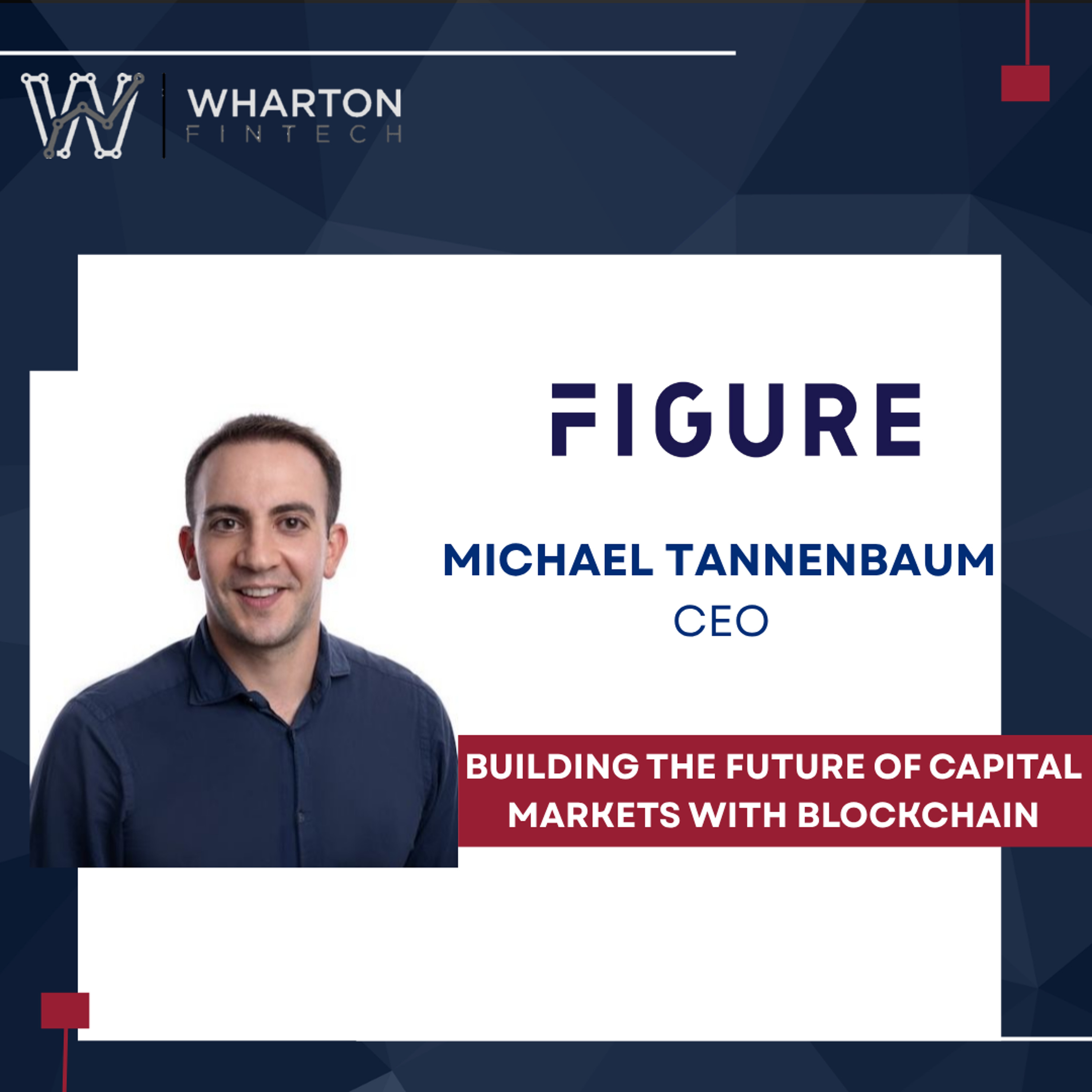
FIGURE Technology Solutions CEO Michael Tannenbaum explains how blockchain-based capital markets aim to reduce mortgage and consumer-credit friction by cutting origination/diligence costs, preventing double-pledging/selling, and enabling tokenization. He also discusses how AI complements blockchain (“AI is the brain, blockchain is the nervous system”) and how FIGURE is expanding from mortgages into auto and marketplace products.
Michael Tannenbaum, CEO of FIGURE Technology Solutions; previously senior leadership at SoFi (scaled consumer lending) and Brex (built corporate card/expense management). Earlier career included investment banking at JPMorgan and private equity in San Francisco. FIGURE has originated $30B+ in home equity loans and is a largest non-bank HELOC lender.
Mortgage origination cost drops from ~$12,000 to ~$1,000 via automation and blockchain tracking; blockchain “digital padlock” prevents double pledging; tokenization can increase liquidity by standardizing assets on-chain; AI handles identity/income/collateral checks while blockchain provides an immutable truth layer.
double-pledging issues tied to “tree-caller bankruptcy” and “cockroaches” comments; FIGURE’s first public equity listed and settled entirely on-chain; auto expansion using an AI quality-control layer with loan attributes put on-chain; property-level description automation from deed-to-note matching; marketplace products including tokenized commercial paper (FIGCO Prime) and mortgage marketplace (FIGCO Connect).
Written by AI. May contain mistakes.
Explore Michael's transition from investment banking to fintech leadership.
“To get us started, could you introduce yourself?”
Discuss the structural challenges Figure aims to address in the lending ecosystem.
“I now wanted to shift gears a bit and talk about the problem space that Figure operates in.”
Understand how Figure uses blockchain to change asset ownership and reduce costs.
“with the tree-caller bankruptcy earlier this year, as well as first brands of MFS.”
Learn about the concept of tokenization and its importance for capital markets.
“As you just mentioned, Figueroa was one of the first to tokenize real-world assets and I believe recently made history with the first public equity listed and settled entirely on chain.”
Discover how AI and blockchain work together in Figure's infrastructure.
“had the most impact is on science, you know, from ChatGPT, RomDang, and consumer search.”
Explore how AI and blockchain are envisioned to interact in capital markets.
“And those things can be done by AI instead of people.”
Discussion on the strategic decision to expand into the auto finance space.
“that's been trained on our own processes.”
Insight into the complexities of mortgage processes and AI's role.
“that dictates the mortgage, has to reference the property and exactly in the exact same language as the deed.”
Analysis of the decision-making process behind the IPO and its timing.
“So you mentioned the IPO that happened this past fall.”
Exploring future growth prospects and market opportunities for the company.
“And while I'm not going to say if we had waited one day, it wouldn't matter.”
Insights on how to identify industries that are ready for disruption.
“We're going to have to bring institutional investors there as well.”
Learn how to recognize and target overlooked customer bases in finance.
“But sometimes customers are potentially ignored for a reason.”
Discover how to assess product-market fit and when to double down on efforts.
“And you also will start to see kind of results compounding on themselves without a lot of work.”

Get the gist, explore an idea or ask about something said.
 Claude
On Wharton FinTech Podcast, what are the key points of this episode?
Searching your listeningAutomatic transcript. May contain errors.
0:15Michael Tannenbaum: Welcome back to another episode of the Wharton FinTech podcast. I'm your host Mili Tomar and in today's episode we are excited to welcome Michael Tannenbaum, Chief Executive Officer of FIGURE Technology Solutions. Figure is a leading blockchain-based capital markets company and the largest non-bank HELOC lender in the country, having originated over$30 billion in home equity loans. Leading figure is Michael Tannenbaum, who brings a wealth of experience building and scaling some of fintech's most recognizable names. Prior to Figure, he held senior leadership roles at SoFi, where he helped scale its consumer lending business and at Brex, where he was part of the team that built its corporate card and expense management platform.
1:02Michael Tannenbaum: In today's conversation, we'll delve deeper into Michael's career journey from investment banking to leading one of fintech's most innovative companies, explore some of the structural gaps in mortgage and consumer credit markets, how blockchain is being used to address them and what the future of capital markets as a whole looks like as tokenization and AI continue to reshape the industry. We hope you enjoy the episode. Michael, welcome. Thank you so much for joining us today. To get us started, could you introduce yourself? We know you started your career in investment banking at JPMorgan and spent a number of years in the C-suite at some of the biggest names in fintech.
1:45Michael Tannenbaum: We'd love to hear a bit about what prompted that transition from traditional finance into fintech and ultimately what led you to figure?
1:55Mili Tomar: Thanks for having me. I've had a bunch of roles, both in early stage fintechs or scale fintechs. The through line has been, I've been an operator at a variety of scales and really close to the metal, as they say. He started, as you noted, in investment banking, but I specifically was in the financials group. So FIG were focused on banks, insurance companies, FinTech. And I always liked that space. I studied mortgages in college, actually as a research associate at the business school, doing a lot of research with the real estate Institute there. So it's always been an area of interest of mine.
2:38Mili Tomar: And I went on a more traditional path, initially invested banking, and then went into private equity out in San Francisco. I decided to go to San Francisco because I wanted to get on the ground floor of a company. My father actually was a CFO of biotech startups, which is under the last, and that's kind of the industry there. And so I grew up with an interest in being on the ground floor of entrepreneurial organizations. And a big part of the reason why I chose to go to private equity in San Francisco is that's where tech and also fintech was emerging at that time. 2012 was when I moved. And I was tracking a bunch of different fintechs as part of my just interest, what you're reading about that on TechCrunch.
3:21Mili Tomar: When I started to approach the end of my two-year program at private equity, I started reaching out to a bunch of different fintechs and had a number of conversations landed on SoFi. It was a business that I really understood because they were working with a very attractive customer base and, you know, getting them early and then expanding the products that they sold into. And then from there, I was promoted a number of times at SoFi. Ultimately left to join Rekt super early before it was even called Rekt. So it was just an idea of corporate credit card, link with expense management. I joined that company when it was based in the kitchen and had just the two founders who had themselves three years younger than I was.
4:02I called myself CFO, but at the time I was sort of chief of nothing.
4:06Mili Tomar: So it was just a fake title. And then that company scaled as well, just like SoFi did and became quite big and just so richly, Gap01 provides a billion in change. And then I joined Figure as the CEO. Figure and so have I have Mike Cagney as the founder in common. I joined in the winter of 24 and I took the company public this fall in September and we've now been trading on NASDAQ for about 70 months.
4:32Michael Tannenbaum: Congratulations on taking the company public. That is so exciting and we wish you all the very best. I now wanted to shift gears a bit and talk about the problem space that Figure operates in. So just to set the stage, what are some of the biggest structural challenges and barriers in the financial ecosystem and lending ecosystem today? And what is Figure solving for and how?
4:57Mili Tomar: I talk about Figure at a high level as doing full-man asset ownership, what the internet did for content creation. And if you're familiar with that analogy, prior to the internet, a lot of the power in content was owned by distribution. So newspapers, for example, there weren't star content or journalists, and instead it was all intermediary through the newspapers. And similarly, people paid funds for those newspapers to subscription. And then the internet came and sort of democratized access. most content became free and ad supported. And you found the rise of essentially whether people, whether it be podcasters or journalists or Substack or all these things that have allowed and kind of restored economics to people that would have had historically had to have been employees of.
5:49Mili Tomar: And similarly at Vigor, what we've done is we've approached asset ownership, whether it be an asset creation. So in our case, a lot of it is mortgage. And we've turned over a lot of the economics of creating a mortgage to the people that manufacture them, right? To that would be banks, fintechs, mortgage companies. And at the same time, we've also improved the economics of the ultimate asset owners, which are the investors. And all of the middlemen that kind of sat between those players are being disrupted through our blockchain-based capital market. That's at the highest level. More specifically, what we've done is we've taken the cost to originate a mortgage, for example, and changed it from about$12 ,000 to$1 ,000.
6:35Mili Tomar: Done that by automating our processes and using a blockchain-based approach to capital markets, which prevents, say, someone from having to hire a third-party diligence firm to check the attributes of the loan four different times as the loan trades. Instead, we take those attributes up run and put them on blockchain in a mutable benefit. We also prevent someone from double pledging or double selling the loan because the loan is tracked on a blockchain and the ownership of that loan and any lien encumbrances, say at the accounting level for a mortgage or the deal tracked by that system and they can only have one owner.
7:15Mili Tomar: And you've started to see double pledging as an issue in the capital markets with the tree-caller bankruptcy earlier this year, as well as first brands of MFS. You might have heard Jamie Dagan saying there's cockroaches out there. This is what he was referring to. And FIGURE has built a capital market that prevents those types of issues by tracking the prominence of a loan as it moves throughout the capital markets cleanly and putting a digital padlock on it. So FIGURE has changed the capital market and in turn restored a lot of the economics either to the manufacturer of the loan or to the ultimate buyer of the loan.
7:50Mili Tomar: And we're moving a lot in the middleman that used to operate in the, call it bowlers of the capital bank.
7:56Michael Tannenbaum: This is a mere fundamental question, but Figures built everything on the Providence blockchain from day one. Could you walk us through that bet and why you believed blockchain was the right foundation for a lending business?
8:09Mili Tomar: A lot of it comes back to SoFi. So founder of SoFi is also the founder of Figures. And when I was the chief revenue officer at SoFi, He and I had some conversations about the inefficiency that we saw in a couple of areas. One was the fact that loans would travel throughout the capital markets and be verified and re-verified and you pay to do so each time. And we figure we take about 80 % of the cost out of that third-party diligence. So it would be about 120 basis points of diligence and warehousing costs that we remove. And that's really material when you're talking about the scale of assets that we're talking about.
8:53Mili Tomar: And so if we did about$1.5 billion monthly origination, that would all be subject to that cost and time. And consumer lending was a way to force the market to blockchain. And one of the things that I like to highlight is that of all the companies that have gone public in the blockchain space this past year, really only two figure and circle represents a fundamental use of blockchain infrastructure to improve the way financial services is done. Most of the companies trade crypto, right? DeToro or Bullish or Gemini or Coinbase or even Romano. That's about trading crypto, which there's nothing wrong with that.
9:34Mili Tomar: But it's not fulfilling the promise of blockchain to change financial services in the way tokenization is for figure, stablecoin is for circle. So because of that, I kind of look at us as creating differentiated content or product on chain. And in our case, it's real assets through our tokenized mortgage and now I will love.
9:57Michael Tannenbaum: That's a really good segue because I wanted to talk a bit about tokenization. As you just mentioned, Figueroa was one of the first to tokenize real-world assets and I believe recently made history with the first public equity listed and settled entirely on chain. For our audience here, could you explain what tokenization really means in practice and why it matters for how capital markets work?
10:19Mili Tomar: Tokenization is a broad word. I'll talk about what it means at Figueroa, which is taking a asset, a real-world asset, So something that exists like a loan or an equity and putting it on a blockchain and using that to lower costs, increase transparency, and ultimately increase liquidity. And I think it's that last point, the liquidity piece that stands out for video. Because in the broader capital market, most of the capital markets and most of the capital liquidity out there is off-chain, right? If you are looking to do something on chain, you're definitionally dealing with a much narrower base of capital because most capital is not to organize, right?
11:01Mili Tomar: And so the use for blockchain is where you can standardize and you can create homogeneity in an asset class or in a way that doesn't already have it. And our mortgage is probably the best example because prior to Figure, people would buy and sell individual mortgages and do loan level diligence rather than the pool level because there was no liquidity in that. What figure has done, as we've said, for the 300 different partners that we have, every one of them manufactures the loan with our technology in exactly the same way. So you don't look through to the partner one or partner two that does the loan.
11:43Mili Tomar: You don't care. It's all just homogenized figure production. And the only thing that really works like that is Fannie Mae. Right? Fannie Mae is the only thing I'm aware of that standardizes across capital. Because ultimately, if you buy a Fannie Mae mortgage, you don't care who originated. We know that Fannie Mae has kind of set the standards. Fannie Mae works exactly the same way, except what Fannie Mae does is we also provide the technology for someone to do it. And so we're like a combination of a software system plus a capital market that's embedded. and that's on blockchain rails. And that has created this liquidity on blockchain and has allowed people, because this asset is attractive, to kind of encourage them to come onto blockchain and almost force them if they want.
12:26Mili Tomar: And people didn't want to buy assets on blockchain. Most people prefer not to. But we said, if you want to buy these assets, you have to do it on chain. And so we've used the attractive technology we've created to force investors to buy assets on chain.
12:41Michael Tannenbaum: Yep. Not to complicate things further by bringing AI into the picture, but how does AI layer in top of the blockchain infrastructure that FIGURE has built? Are these complementary forces or does one take priority over the other?
12:55Mili Tomar: A phrase we use is that AI is the brain and blockchain is the nervous system. And as AI changes, especially the software of Enscape, for now, the place that AI has had the most impact is on science, you know, from ChatGPT, RomDang, and consumer search. Most of the impact has been creating white code, right? That's where AI has really accelerated. And that's why you've seen the change in the market cap of a lot of software companies is because people are focused on this. And so for us, software, Revolve has been a company that has been very explicit that we don't sell SaaS, we sell a capital market, and you can't AI your way into AAA.
13:36Mili Tomar: So, you know, that is a phrase we use, but at the same time, AI is super valuable for changing ultimately the processes that are going to be the processes that are done to make a factory alone. So what do you actually do when you manufacture alone? You check identity, like KYC, you validate identity, you underwrite income, you underwrite or value collateral, like a half score, an automobile. And those things can be done by AI instead of people. But blockchain is going to be the truth layer beneath that, that ultimately says, well, the way that that was done is accurate and it happened. and the attributes of that process are immutably placed on chain upfront because in a world where agents can do anything, it becomes, you know, fraud becomes a bigger problem and tracking the provenance of an asset becomes even harder.
14:34Mili Tomar: And so there's this natural way for if AI is the brain and blockchain is kind of the nervous system effectuating the activities of that in a way that is standardized and transparent and ultimately serves as the truth. and so we see blockchain as very much interacting with ai in that way and being a important the intersection of those two is very much where figure is focused on and i think our expansion into auto is a great example of this because with ai you need actual data and use cases to trade and we have that given we've done 22 billion of assets and so we were able to take what we've done and translate that from mortgage into the auto space and bring on a new auto originator called Agora that rather than build out a whole new capital market and origination system, we're able to work with them, essentially adapt their loan origination system, put those attributes on chain and use an AI layer that says quality control and verifies against what they've done.
15:43Mili Tomar: that's been trained on our own processes. So just as an example, we've trained income, you know, identity when you're checking IDs and matching it against OFAC lists and sanctions lists and all that. That process is not unique to figure. Everybody has to do that. And so we can then use what has been trained on our system on another third party and kind of get the benefits of quality.
16:07Michael Tannenbaum: That makes better sense. And I love the analogy of AI being the brain and blockchain being the nervous system. I'm curious why you picked auto as the industry to explore this intersection versus continuing to work within the lending space.
16:21Mili Tomar: Well, the auto space just represents like more of an agentic use case where you have like a KYC agent and that you can then apply to multiple use cases. Because honestly, if you were just going to do KYC, it's not that far or expensive. So it may not be the best agentic use case just for all of the things that figure does, but I can give you some examples of things that we've done at figure that don't necessarily apply outside of figure, but are also good uses of AI. What is what we call the property level description? So in the mortgage manufacturing process, the mortgage note, meaning kind of the document that dictates the mortgage, has to reference the property and exactly in the exact same language as the deed.
17:09Mili Tomar: It has to be exact. Otherwise, the note is invalid. If you've ever met a deed, it will be a lot of legal language. It's kept at the county somewhere. It's not in a readable format. And it will say, you know, on the 48th parallel, seven degrees north, parcel 66, 644, whatever. And it's a lot of language. And so lifting that from one document and putting it on another used to be manually transcribed and stare and compare. and we use AI to automate that process and then check and validate that process. But that's not necessarily something that, besides mortgage, everybody can use. It's not as repeatable or transferable as something like identity.
17:52Mili Tomar: But those things are important to the processes that figure. And then we also use third-party vendors. And then customer support is one of the more advanced areas of AI. We use Defagon, which maybe people are familiar with. to one of the leaders in customer support AI. And that's the area where we thought we didn't necessarily have, that was a buy versus build decision. And actually we reversed. We started by building it and we were building our own custom chat bot. And we said, let's focus on the things that figure, kind of your point, what is figure two uniquely, property level description. Maybe identity isn't unique, but it's transferable across the capital market.
18:35Mili Tomar: whereas something like customer support, I think better to use somebody that's doing that across multiple different companies because when we bring on auto loans to our ecosystem, for example, we're not doing support for now, right? We're just doing capital markets. Ultimately, we're a capital market company. So we're focused on the intersection of AI and capital market rather than just AI at large. And so lastly, I would just say that on the customer acquisition standpoint, AI, you know, a lot more third party experimentation vendors are used as well. So when we're talking about marketing or sales, we're much more open to working with third parties versus building it ourselves.
19:13Mili Tomar: Because again, we don't really, and most of what we do is do to do anyway, need to be to see. We don't really see ourselves as needing to develop proprietary AI that. Because it's not as core to our diet.
19:25Michael Tannenbaum: That's a really great explanation. Thank you. The next set of questions is more about figures growth and future development. So you mentioned the IPO that happened this past fall. What was the decision-making process like? What made the board and the team comfortable that that was the right time? And why did you think that an IPO was the best way to jumpstart the next phase of growth for a figure?
19:53Mili Tomar: IPOs have been less common in FinTech than they used to be. And the window has not been open for a while. by 21 was this big IPO window. Some companies went public and he re-graduated it. Some didn't. I think SoFi, where I used to work actually is one of the companies that sound really well was IPO and that was actually SPAC. So it goes to showing me that I think ultimately the fundamentals of the company are probably what matter versus the mechanics of the IPO. All the mechanics of the IPO can matter short-term. Actually, to go back to 2014, Square's IPO was pretty challenged. It wasn't a strong IPO at the time.
20:28Mili Tomar: made through and loaded together to track its way of NPO like I was at the time. And I remember it was not the success that Square Ben became. And so that said, of course, if you're running an IPO, you want to optimize and make it as good as you can. The market has been slow as interest rates have risen, and there started to be a window both for fintechs, but especially for blockchain companies with the election of Trump. The SEC changed pretty dramatically in terms of its approach to crypto and blockchain companies. And for FinTech, we saw that as a unique moment in time. So not only did we see market window opening, but also a regulatory window opening.
21:11Mili Tomar: And as the steward of the company and the person kind of responsible for its future, I felt that we needed to hit that window. because you can see it emerging and timing is everything in life, but also especially in an IPO. And just to give you that example, we came out of the Labor Day holiday right away and started our show. And there was actually some debate about that because that doing it so quickly was going to make our pricing on September 11th. And that was controversial slightly because it's a celebratory day on a day that is not typically the celebratory one, but it's also a market, it's not a market holiday.
21:54Mili Tomar: You know, people walk on to the 11th. So we decided that the positives of going out with the negatives. And while I'm not going to say if we had waited one day, it wouldn't matter. I will say that three weeks after our IPO, the government shut down and the SEC was thinking you could not get the clearest United to go bubble. So it just goes to show you like anyone, fund, I mean, think about Iran, right? Like, think about the tariff tantrum, like all these things can happen like that, you know, in a blink, and you can totally change the market. And you need a constructive market to go public, especially for a company like FIGURE, right?
22:30Mili Tomar: FIGURE is not dunking donuts, right? Where everyone understands exactly what it does. And the demand barely fluctuates in the economy. That's not FIGURE, right? We're blockchain, you know, we're way out there in terms of the risk curve. Our stock beta is high, who are growing 100 % year over year. So we're totally in a kind of company that in a positive market, it keeps barbara receptive. And in a list-off market, there's not a lot of interest that did there. So we knew that. I mean, it was really important. So timing was just so critical. And if we had waited three weeks, it would have been a totally different story.
23:04Michael Tannenbaum: Thanks for bringing that into context. I didn't realize the timing was overlapped with the government shutdown. But I think it's doing fairly well. The stock is a 2x, I believe, since you guys are cute. I'm just curious, like looking ahead, what are things that you're excited about and what are some hurdles that are kind of top of mind for you? And then also kind of adjacent to that, I want to talk about the marketplace buying platform that was launched.
23:28Mili Tomar: Yeah, I am excited. So we're, like the consumer loan marketplace that we operate is, as I mentioned, has executed into a massive camp, right? We have all consumer finance that's addressable. We do about 1.3 billion a month of volume through a marketplace in a market that does almost 2 trillion. So really big opportunity. And we, as I mentioned, we're growing 100%, the 50 % market. So we're growing 150 in a market where people thought it started with 40. So it's something we're really proud of. And our blockchain products are growing even faster. So you mentioned Foncetize Prime. That's our short-term, essentially tokenized commercial paper market.
24:16Mili Tomar: So FIGCO Connect, which is the mortgage marketplace, is generally a place where people buy and sell mortgages permanently. Those are 30-year assets, so that's going to be more of an institutional market. Whereas Democratized Prime is a place that people are hourly lending and borrowing against assets. And that is going to be both institutional and retail because there's a lot of people that want to lend to something for an hour than own something for 30 years. totally to value. But that's Democritus Prime because it's so short term, it's competing with warehouse lending and it's bringing borrowers like fintechs who want to access financing quickly and cheaply without a 120 day plus diligence process and millions of dollars of legal fees.
25:00Mili Tomar: It brings in this marketplace for liquidity. And it also, if you zoom out, is bringing yield to stablecoin, right? Because the borrowers, sorry, the lenders on the market are people who own stablecoin looking for yield. And they stake out stablecoin and then as a result, can lend to someone who has a tokenized asset that wants to borrow. And Abe, Camino, those are versions of this, but what we're doing is similar, but with real-world assets, right? With mortgages, with auto loans and that is a really big idea and it's actually much more scalable in many ways than what we do within your connect because it's down the way yeah and so what do you think about
25:41Michael Tannenbaum: the ceiling aspect are you thinking more uh with the lens of institutions like you mentioned big
25:47Mili Tomar: techs or individuals it's been both right now in crypto it's a bit of a and because it's a bit of later, the there's not as much speculation activity. And so as a result, you don't have the yields in the space. There's not as much people borrowing the demand to borrow and buy a point is not as high because prices have gone out. So people aren't leveraging themselves. And as a result, there's just a start there. People are starving for yield. People in stable point don't know how they can get yield. And so that then makes the interest in what figure is doing that much more because we're bringing tokenize, you know, essentially triple A backed backed by U.S.
26:24Mili Tomar: housing, backed by cars. And that's attractive to retail, semi-institutional. But it's also, if we're going to bring all of the capital markets on chain, we can't only scale with retail. We're going to have to bring institutional investors there as well.
26:40Michael Tannenbaum: In the interest of time, I wanted to close things out and ask a couple of advice-related questions because I think they would be helpful to everyone in the room here and everyone that will listen to this podcast. A theme I noticed throughout your career is that you were often the first mover. You were the third person to get hired at Brex. You did a lot of interesting work at SoFi in the consumer lending space in the early stages of that company. My question is, what do you look for when you're identifying an industry that's ripe for disruption? What are the specific signals or questions that you ask yourself?
27:15Michael Tannenbaum: And then how do you build conviction to act on those signals?
27:19Mili Tomar: I think a lot of what you have in this room based on your education at Lourdes is actually value in that sense. And I always looked at companies' gross profit. And I know that sounds basic, but a lot of times you meet entrepreneurs or you kind of hear ideas and people's idea of scaling is to do something that's negative gross margin. And that's not value-free. So I feel like I, that with it, the tech in particular, I also try to focus on having a quality customer, right? Cause it's also sounds so basic, but so many people are, they'll, they'll focus on what they see as an underserved customer or an ignored customer.
28:03Mili Tomar: But sometimes customers are potentially ignored for a reason. I don't mean this in a normative sense, like I'm not, I'm not passing judgment, but what I'm more saying, but what I'm saying is like, you know, if you look at the SoFi customer, it was it was you all right it was people who were graduating from professional schools with student debt and had a great promise for the future but had a problem if you look at the brex customer it was generally initially foreign startup founders without credit scores but had raised a bunch of money to start a company but couldn't get a credit card yeah right and that is also a really attractive but ignored customer base and that those are very fundamental and and And they also look at businesses that are themselves already successful.
28:49Mili Tomar: So, you know, credit card is the jewel of many banks. Everybody's interested in growing credit card balances. There's always the analysts for card customers. And on the SoFi side, while student loan wasn't necessarily a jewel, you all probably know from your time here in undergrad, there's lots of focus on getting people young and building a financial services relationship. But Dan and I was on the student of Canvas as an undergrad, you could still market they're out there they're out in the financial crisis so you could actually you know citibank was like there i'm marketing the students because you get these relationships young that that changed the financial process but the point is is like those you have to look at kind of the obvious places where value is created but maybe someone doing that in a different way is what i focused on and i think those are skill sets that are people in this room that have a business grounding are
29:37Michael Tannenbaum: very able to do so once you've identified a problem area and kind of even more customer segments how do you then like dumble down or or build convention how do you know like this is the
29:48Mili Tomar: path of pursuing at what point do you say i think about this in terms of product where i fit and product where i fit you can sort of feel because you're generally getting word of mouth you're typically attacking a hair on fire problem right something that people really want to change and fix. And you also will start to see kind of results compounding on themselves without a lot of work. It will be not that painful. And I think when you're banging your head against the wall and trying to scale something and it's not working, doesn't mean that it won't work, but it means you don't yet have product or a good bid.
30:25Mili Tomar: And so you can sort of steal that. And when you have it, that's when you know to kind of double down. And until you get that, you know, you're sort of always evaluating.
30:33Michael Tannenbaum: Michael, this has been such an insightful conversation. Thank you so much for joining us today on the Wharton FinTech podcast. We really appreciate you taking the time. Thank you for listening to today's episode of the Wharton FinTech podcast. We hope you enjoyed today's conversation. Please don't forget to leave us a review, share it with anyone who might find it valuable, and follow us on social media to stay up to date on all things FinTech. Thanks, and we'll see you next time.
In this episode of the Wharton FinTech Podcast, Mili Tomar sits down with Michael Tannenbaum, CEO of Figure.
Michael shares his experience leading Figure and how the company is building a blockchain-native capital marketplace that seamlessly connects origination, funding, and secondary market activity..
We discuss: structural inefficiencies in today's lending markets; blockchain and AI's impact in financial services; what tokenization means in practice for real-world assets; the shape of the industry as a whole as these emerging technologies continue to influence it; Michael's career journey and Figure's path to becoming a publicly traded company