
In short
Podcast Summary: Y Combinator Startup Podcast - Fintech 3.0: Now Is The Best Time To Build In Crypto
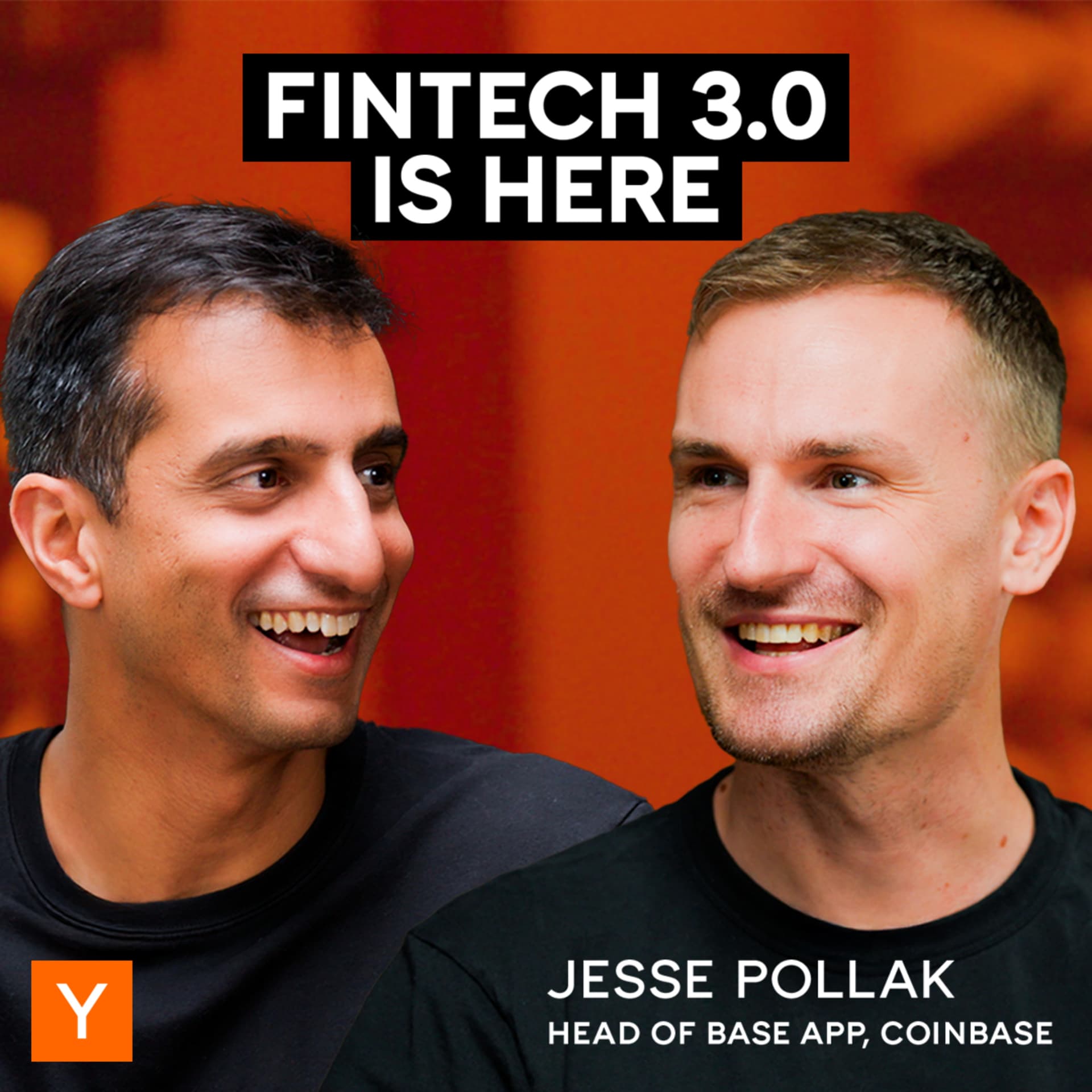
Episode Overview In this episode, Y Combinator's Harj Taggar and Base's Jesse Pollak discuss the emergence of Fintech 3.0, emphasizing the current opportunities in the crypto space due to regulatory clarity, consumer adoption, and advanced technologies. They explore the potential for entrepreneurs to leverage these developments to create impactful products and services in the crypto ecosystem.
---
Key Concepts
Transition to Fintech 3.0
- Fintech 1.0: Originated in the 1990s (e.g., PayPal), introducing consumers to online payments.
- Fintech 2.0: The last decade's innovations building on legacy systems for improved consumer experiences.
- Fintech 3.0: The current phase, allowing for a comprehensive overhaul of the financial system using programmable software (crypto).
The Present Moment in Crypto
- Acknowledgment of a unique opportunity for innovation as infrastructure has matured.
- The tools and technologies available now enable the creation of consumer experiences that were previously impossible.
Infrastructure Improvements
- Development of Blockchains: Enhanced scalability and reduced costs have made building applications feasible.
- Layer 1 vs Layer 2: Layer 1 blockchains (e.g., Bitcoin, Ethereum) provide decentralization, while Layer 2 solutions (e.g., Base) enable scalability without sacrificing core principles.
---
Discussion Highlights
Opportunities for Builders
- Innovative Use Cases: Entrepreneurs are encouraged to identify specific areas in finance, commerce, and consumer experiences that can benefit from crypto technology.
- Automated Market Makers (AMMs): Suggested as a potential starting project for developers to illustrate the ease of building in the crypto space.
- Regulatory Clarity: Recent developments in regulation are seen as a positive shift, encouraging innovation by removing legal uncertainties that previously hindered startups.
The Role of Stablecoins
- Impact of Stablecoins: They offer access to dollar-like stability globally, enabling better economic conditions in countries with weak local currencies.
- Neobank Innovations: Startups like Dollar App and Aspora are leveraging stablecoins to provide banking services in emerging markets.
Tokenization
- Definition: Moving traditional assets into a programmable blockchain environment.
- Emergent Asset Classes: Beyond stablecoins, there is excitement surrounding the tokenization of content and creator economies, enabling creators to monetize their work directly.
---
Advice for Founders
Essential Attributes of Successful Founders
- Technical Proficiency: Founders should have a deep understanding of the technology they work with.
- Customer-Centric Approach: Constant engagement with users to identify problems and validate solutions is crucial.
- Persistence: The journey requires consistent effort and the ability to adapt based on feedback and experiences.
Collaborations and Ecosystem Growth
- Partnerships with Established Platforms: Collaborating with entities like Shopify for commerce applications can create new opportunities for startups.
Conclusion The current landscape for crypto startups is characterized by unprecedented opportunities for innovation, especially in light of regulatory advancements and improved infrastructure. Entrepreneurs are encouraged to leverage this moment to create meaningful, consumer-focused solutions that capitalize on the strengths of the crypto ecosystem. Y Combinator remains open to funding projects in this space, with an emphasis on quality teams and transformative ideas.
Call to Action If you’re an entrepreneur interested in building within the crypto space, consider applying to Y Combinator to gain support and resources for your venture.
Written by AI. May contain mistakes. Listen to the episode to check what was said.
Transcript
Automatic transcript. May contain errors.0:00We've entered the golden age of crypto building where we finally have the tools and now it's about of entrepreneurs coming in and saying, how do we use these tools to make 10X impact for businesses or to build new consumer experiences that were previously completely impossible? And the moment is now to break through because we've done the infrastructure work. The tools are in place, the stable coins, the chain, and now it's about putting it together into that magical experience that grows like wildfire across the world.
0:34I'm really excited to be joined here today by Jesse Pollock. Jesse is the founder of Base, which started life as Coinbase's blockchain, but has since expanded into essentially the everything app for crypto, right? You can use Base to trade crypto, store your own crypto, and build community with other people in crypto. Thanks so much for being here, Jesse. Thanks for having me. The reason Jesse's here is that Y Combinator and Coinbase are together putting out a joint request for startups building in crypto. We both believe that there's never been a more exciting time than right now to build in the crypto world.
1:04And we're going to talk about some of the reasons we feel that way. And what are some of the specific ideas and areas that we think founders should be paying particular attention to as they go out and build really awesome crypto products and services. Okay, Jesse, in our request for startups blog post, we mentioned this progression from this idea of fintech 1.0 through to fintech 3.0. Maybe you could talk us through how you think about that. So I think about fintech 1.0 as the 90s, things like PayPal, where consumers for the first time got comfortable paying for things online. I think about fintech 2.0 as this wave of the last decade of startups that built on top of the existing legacy financial system to deliver friendlier consumer experiences with money.
1:43Now I think about fintech 3.0 as the opportunity to rewrite it all, to basically start from the ground up and say, how do we make the financial system work better for everyone by building it on top of the programmable software platform that includes money and is crypto. Okay, Jesse, so AI had its sort of magic moment with the ChatGPT launch. Do you feel like crypto is maybe going through its own ChatGPT moment right now? Candidly, no. And I think the reason I say no is because if you ask a friend or family member, I don't think they'd say, oh yeah, I have had a magic moment with crypto. I think instead they might be fearful.
2:17They might not actually know what crypto is doing on a day-to-day basis. And so the thing that's powerful about that is that that's the best time for us to be building and the best time for YC entrepreneurs to be trying to break through. And the moment is now to break through because we've done the infrastructure work. The tools are in place, the stable coins, the chain. And now it's about putting it together into that magical experience that grows like wildfire across the world. What exactly has changed? What exactly has developed that makes it feasible to build this technology today that wasn't possible even like five or six years ago?
2:48Yeah, so when we're thinking about building crypto apps, we're building on top of a stack. And that stack has a few different components, but the ones that I think have really progressed in the last few years are a few. So the first is chains have really matured. And you can kind of think about the chain as the programming environment where you're building all of these applications. So to AWS, the chain is kind of the next generation of that, where you can imagine you write code. It runs on this globally distributed computer. Anyone can access it and participate in it. And that's the substrate where you can build.
3:18And the problem that we had with the chains five years ago was you could do that, but it was slow and expensive. And so when you were trying to build an application and you wanted to maybe send a stable coin or you wanted to enable someone to create something, you'd have them try and send$5 and it would cost$5. It's like that doesn't work for building a consumer application. And the thing that has shifted over the last few years is that those costs have come massively down. And whether that's with Base or Solana, we actually have this scaling that's happening where now you can build those applications.
3:48And instead of it costing$5 to do something, it costs five tenths of a cent or five hundredths of a cent. And that opens up the aperture of what's possible. Yeah, I think this was like the classic criticism of crypto years ago was just, hey, like, okay, like it sounds cool, but actually it's like, it's like cheaper to send a wire transfer than like the gas fees on like certain chains when they're congested. A hundred percent. And we think about this as the broadband moment for crypto, where when we were in dial up of the internet, you couldn't have the applications that exist today. And then gradually we scaled the throughput, scaled the bandwidth, and that led to these new breakout experiences that really powered the growth of the internet over the last 20 years.
4:22One thing I think people hear about, but they might not always understand in detail is the difference between a layer one blockchain and a layer two blockchain. Do you give the audience a little bit of explanation? What exactly is the difference and what did layer two blockchains unlock? Yeah. So when you're thinking about a layer one blockchain uh what the way i think about this is is really that it's a a piece of infrastructure that sits at the bottom of the stack right and the the big ones that people talk about and and use and kind of are adopting today are bitcoin ethereum and solana and they all play different roles they're all complementary in different ways but they all play this role i think at the base layer of being maximally decentralized and trying to make it so that they are a global platform that's a piece of infrastructure that anyone can build on without being fearful of being censored.
5:07And that's this really important substrate because you need that decentralization to make it so that no one company or one country can kind of co-opt what's happening on that platform. Now, the thing that Ethereum pushed forward over the last five years was they said, hey, if we want to get to the sort of scale that can enable the next Google to grow, that serves billions of people, there's inevitably going to be some trade-offs around this decentralization and the security that it provides and then the scalability that actually lets you drive down those costs. And so what Ethereum said is we're going to think about how do we build an architecture where on top of that layer one, we can kind of create an ecosystem of what they call layer twos, which take that infrastructure, take that decentralization, and then bootstrap off it, build on top of it to scale while preserving decentralization as a core characteristic.
5:54And this is exactly what base does. So what base does is you can kind of think about it like an HOV lane. We sit on top of Ethereum, we take millions and millions of transactions, we compress them and we publish them to Ethereum. And that means that when we're compressing them, we can get a ton of efficiency, which lets us drive down costs a thousand percent. But because Ethereum is sitting at the base layer, it brings that decentralization, it brings that censorship resistance to make it so that base can stay this open global economy that anyone can participate on. Now, Solana, I think, has gone to the other side of the spectrum and they said, hey, we're going to do it all at the L1.
6:27And I think that that's a really cool and powerful design choice as well. And this is one of the things that I think is really exciting about where we are at crypto is that we're exploring a bunch of different paths. People are learning kind of in every single part of the world. And then we're all converging back those learnings to build out these products and this infrastructure that's going to enable that next wave of adoption. Engineers, maybe they're learning a new technology, like usually often have their own like go-to app that they try and build to learn it, right? Like, I mean, for me, it's usually trying to build like a simple blog, like engine or something like that.
6:56If someone wants to start building with crypto and sort of understand like what the power of like a layer two blockchain is or base is, what's your recommended like, you know, Hello World or blog engine app that they should? One app that I think will just be really powerful is building a interface that lets you interact with a swap, like an AMM or an exchange, right? So one of the really powerful things that crypto enables, enables you to seamlessly swap between assets. You can swap between Ethereum and a stablecoin or between multiple stablecoins. And the way that happens is through what's called an AMM or an automated market maker, which is kind of an exchange that's written in smart contracts.
7:32And those things are really simple, right? What previously was, you know, hundreds of thousands or millions of lines of code has been distilled down to a simple formula and then written into hundreds of lines of code that sits in a smart contract that lives on base. And I think one of the really kind of easy and cool hello worlds is building a UI that serves as an entry point into one of those exchanges. Because then you can see, oh, I can connect my wallet. I can build this little interface that lets me take an asset that's in my wallet and swap it to another asset in my wallet. And I don't need to sign up for an API key.
8:05I don't need to get permission from anyone. All I need is to write a little interface. And so I think that that's a really good hello world. Another thing that I think is a really good hello world is actually going in there and building your own AMF, right? It is literally just a function that's kind of defining the relationships between how one asset swaps to another. And it's on the order of hundreds or thousands of lines of code. And so that's a little bit more complex. Like you're getting into the smart contracts, you're figuring out like, how do I actually make these kind of swaps work? But I think that that learning experience of saying, hey, if you look at the New York Stock Exchange or any traditional exchange, This is huge amounts of infrastructure, huge amounts of overhead.
8:45And now that can be distilled into hundreds of lines of code. I think that that's kind of an aha moment for a lot of people. On the regulatory front, because that seems like it's a big catalyst for this particular moment in time for crypto. There's lots of news around like the Genius Act is going through and you've got various bills trying to regulate the crypto market. In what ways have you seen regulation hold people back from being able to like really innovate with crypto over the past few years? And how is that changing now? Yeah, well, I think this is something that really impacted startups of the type that are coming into YC and trying to be successful.
9:18And I've been working with builders over the last five, six years to try and figure out how can I help them be successful building on chain. And the thing that has been really consistent is that so many early stage builders and late stage builders ended up spending like equivalent or more money on lawyers than they were on engineers. and you know if you're coming into YC and you're interviewing and you're like hey we're going to be spending more money on lawyers than engineers like my gut is that the YC partners are going to say okay like maybe you're not building in the right business here like really are you as a three-person team going to be able to be successful?
9:51Yeah this was actually really what happened for us a lot of those application cycles in 2021, 2022 like we will look at it and feel like okay like what's the domain expertise you need to build something really good here and it was actually like if you're building a hardware company you're building robots you kind of need to have like some experience building hardware and robots. And we felt that with crypto, it was actually like you needed to really be paying attention to the regulatory aspects of it and understand securities law. And I know if you're putting like real estate on the blockchain, you need to understand what all the legal implications of that were.
10:20And a lot of the time we'd be in interviews and we just feel like the teams had no understanding of it all. And it was unclear how you would ever go to market or build any trust. Yeah. And the thing I would say is I don't even think that that's an indictment of those teams. That's an indictment of the fact that the regulation has been massively unclear. Yeah, right. Like there literally hasn't been rules of the road for entrepreneurs to build on this new platform and be successful. And so the impact that we've seen of that is that it's basically just chilled out people from being successful. Right.
10:46If you have to spend more money on lawyers than engineers, how can you apply the YC principles of being customer centric and doing things that don't scale? Like literally you're being forced to do things that much bigger companies should be doing instead. And so I think that that has been this massive kind of constraint on innovation for the last decade. And I think the thing that's just started to shift, we're still in the early days, but it's really happening, is that now that we're starting to have regulatory clarity, whether that's with stable coins from the Genius Act or potentially with all of crypto tokens with the Clarity Act, what's that leading to is it's leading to those entrepreneurs now having more certainty.
11:22They, oh, these are the rules of the road. And therefore that idea that previously I would have to go get a ton of legal opinions on, can I do this? They can now just go and do it. And that is such a lowering of the barrier to entry for the entrepreneur in the United States or outside of the United States that I think it's going to lead to a ton more innovation. And going back to kind of the scaling things that we talked about, you know, and kind of what's enabling this next chapter, we talked about scaling the chain. I think that's a huge part of it. I think the regulatory unlock is another huge part of it that's changed.
11:55I think stablecoins maturing is a third huge part of it that's changed, where you now have programmable money. That's the money that we're all used to, that we can all use. And then I also think that we've kind of had a bunch of breakthroughs on wallets and simplifying wallets and making it so that they can be integrated into the user experience in a way that's not scary. And so those four things, chain scaling, regulatory clarity, stablecoins emerging as a really powerful tool, and then wallets getting simpler and simpler, I think have matured to the point where we've entered the golden age of crypto building, the golden age of on-chain building, where we finally have the tools and now it's about entrepreneurs coming in and saying, how do we use these tools to make 10x impact for businesses or to build new consumer experiences that were previously completely impossible because we couldn't program things on a global stage, we couldn't move money at the speed of light, but are now possible.
12:49and how do we actually use that to create this value? I want to talk about stablecoins more. So like you mentioned though, is that so far it seems to be outside of trading like the killer use case, specifically within the Y Combinator community and our portfolio of companies. I was just looking at this, some of our fastest growing companies at the moment, the AI companies definitely get lots of attention, but we have companies like Dollar App in Latam, Aspora in India. These are essentially neobank services that are really built around stablecoins and their growth rates are incredible. I'm sure you guys have seen this at Coinbase too.
13:20Let's start with this. Why have stable coins taken off in this way? And actually I'm curious as someone who's been around crypto for so long, has it surprised you? Did you think it was going to be stable coins all along? I don't think we thought it was going to be stable coins all along. I mean, I remember when we launched USDC, I was in the war room at Coinbase. We launched it in collaboration with Circle. I think at the time we felt like we got to go do this, but we're not really sure what's going to come from it. And candidly, like the first two to three years of USDC, we had launched it, but it didn't grow that much.
13:50Like it took us a while to get to a billion dollars of issuance. It took us a while for people to be like, oh, this is a meaningful thing. Now, you know, there's almost$200 billion of stable coins in the market. So I think it's kind of feels obvious. But even in 2017, 2018, 2019, when we were just getting started here, I don't think it felt obvious at all. Now, I think the thing that stable coins unlock, which has been the primary thing that's driving this, is they enable programmable money to come into the existing financial system and give, in particular, programmable dollars to anyone in the world.
14:21And this is a big unlock because previously, prior to stable coins, if you were an entrepreneur outside of the U.S. or if you were just an everyday person outside of the U.S., you actually didn't really have a way to access dollars. You couldn't open a dollar account. You couldn't get a dollar savings account. You couldn't get a dollar business account. And that meant that whether you were trying to transact with other businesses or consumers in dollars, or you were just in an economic local environment where your currency wasn't really working for you, maybe because it's massively inflating or maybe because it is unstable in other ways, you were cut out of accessing the dollar system that actually did work pretty well.
14:57And so I think the first big unlock that Stablecoins has done is basically said, okay, now everyone in the world can access dollars. And not just can they access it, they can build with dollars. And they can build with dollars on this new programmable platform where their dollars can move instantly, globally, and basically for free. And so that for me, I think was the first thing. Now, there's a ton of other things that Stablecoins are going to unlock. But that alone was a 10x, 100x improvement for hundreds of millions of people around the world. And I think it's the thing that's led to this growth of from zero to almost$200 billion of stable coins in the world today.
15:31And it seems that, I mean, that maps up pretty well with what we're seeing, which is where, like, in particular, these sort of like the neobanks, the dollar app and Aspora, like the killer use case really seems to be remittances and sending money internationally, like instantly cheaply. Yes. What are some of the other, like, applications of stable coins that you're personally really excited about or do you think builders might not recognize as great opportunities? Well, this is one where I think that there's an opportunity that runs counter to the narrative because there's a ton of excitement about dollar stable coins.
15:56And I'm really excited about dollar stable coins. I think there's so much more that we can do with them. But at the same time, you know, as I've talked to builders and as I've talked to regulators and businesses in countries around the world, so many of them have excitement about dollar stable coins because they solve an immediate need. You know, if I have inflation in my country, I can now save in dollars. And that helps me, you know, have a more stable savings account or more stable business account. At the same time, when I talk to those folks, I think that there is an intuitive feeling of, oh, man, we have our own local economy and we don't want that economy to be dollarized.
16:29Right. Like if I'm in Kenya or Brazil or Nigeria or Indonesia, we have excitement about building our own local economy on the Brazilian real or the Nigerian Naira or, you know, that, you know, kind of excitement about investing in one's local economy. and then the, I think, kind of intuitive feeling of, ooh, there's this tension between getting the value from dollars but also not having dollars dominate in a way where they crowd out the local economy. I think, to me, that is one of the most exciting opportunities to kind of lean into. And what we're seeing start to be that opportunity is that now, alongside the dollar stablecoins, you actually have entrepreneurs in all those countries who are creating stablecoins for their currencies.
17:15So you have a Brazilian real currency, you have a Nigerian Naira currency, you have an Indonesia rupee currency, you have a stablecoin for every country. And what that means is that you can take all of the innovation that has kind of been built on top of dollar stablecoins, whether that's, you know, easy to send or it's easy to borrow and lend with, or it's easy to swap to other things and apply them to your local economy. So now you want to do business loans in your local currency. Great. Take a bunch of the stuff that's already been built and apply it to your local stablecoin. And that opportunity to take this technology and make it so that it's actually an empowering technology for local economies.
17:54I think that that is one of the most exciting things. And it's still early. It's still small. But for builders like the builders coming through YC who are coming from all around the world and who are excited about taking on those hard challenges, I think that that's going to be a place where there's massive amount of opportunity for impact. So for those founders and those builders in those countries, it maybe isn't clear in each of those markets which the winning stablecoin, like in the US, it's USDC, but in those markets, it might not be clear. So do you think those builders should go out and try and like, should they start their own sort of circle coin based consortium and launch a stablecoin?
18:26Or should they try and pick which they think is the winner and build around that? I think both, right? And you're going to have entrepreneurs that want to pursue different things, right? If you're starting a local stablecoin, it's going to look like working with the government and working with banks and figuring out how do you do custody in a secure way. I think that's a massive opportunity. And we actually just put out a request for builders for base where it's like, we want to talk to entrepreneurs in every single country in the world who are doing that work because it's so, so important and we want to support them and help them be successful.
18:53Now, at the same time, a lot of builders might not be excited about that, right? They want to be building product instead of building the relationships with banks and figuring out how to custody. And I think one of the really, really powerful things about crypto is that it's built in such a way where it's composable, right? And so if you build around one stablecoin and then another stablecoin starts growing really quickly and you think it's actually going to be better for your business, it's not going to be that hard or that expensive to say, OK, great, now let's support that other one, too. Because, again, they're all running in the same computer and they're all programmable.
19:26And so you really can build systems in such a way where both can plug in. And so I'd say if I'm an entrepreneur who maybe isn't interested in starting the local stablecoin, but does want to be building solutions that use local stablecoins, I'd think about, you know, how do I build my solution in a way that works with all of these stablecoins? How do I make it so it works with dollar stablecoins too? Because I think that kind of flexibility, that's actually what consumers and businesses are going to want. They're going to want the ability to have my payments app and be able to save in dollars, save in my local stablecoin, swap between them, earn interest on both, borrow with both of them.
20:00And I think really for the first time that's actually possible with crypto because it's all running on this programmable platform. YC's next batch is now taking applications. Got a startup in you? Apply at ycombinator.com slash apply. It's never too early and filling out the app will level up your idea. Okay, back to the video. How about for like US centric builders? How should they think about the opportunities to build in stable coins right now? And maybe a bit of a segue here, but I know that Coinbase just launched like a commerce payments protocol with Shopify. How does that tie into this and how does that create opportunities for founders in the space?
20:37Now that we have the fast chains, we have the scaled stable coins, we have the mature regulatory environment, we have the easy to use wallets. I think the opportunity is basically looking at every single part of the financial system that exists today and figuring out how do we turn that from legacy systems that in many cases are 50 to 100 years old into programmable smart contracts that live on chain. And you can look at every part of the world and be like, wow, look at this system that is written in cobalt that, you know, has millions of lines of code that has all of this cruft that has massive fees.
21:10Can we write that into a smart contract that's 500 lines of code? And the answer is yes. It's literally yes. And this is exactly what we saw with Shopify. You're talking about, you know, this commerce payments protocol that we built that lets any Shopify store in the world accept USDC on base from anyone else in the world. And the thing that we did to unlock that was we embedded with the Shopify team. And, you know, shout out to Toby and Shopify. They came to us and said, we think the moment is now for us to look at all of our existing acceptance systems and figure out how can they be rewritten in smart contracts.
21:42And what we did over a nine month period was exactly that. We went into their systems, which are literally millions of lines of code, where they're doing things like escrow, they're taking taxes, they're doing, you know, fees, tariffs, refunds, chargebacks, like all of this business logic around accepting money for a good, which, you know, for most of us, I think is kind of behind the scenes. But for a business like Shopify, like it is the scene, it's the thing that you're doing. And they said, Okay, how do we now translate that into a smart contract? And the crazy thing is that after nine months of work, we translated into smart contract and that smart contract ended up being about a thousand lines of code.
22:21Interesting. So literally like stuff that previously was a million plus lines of code, now a thousand lines of code because it's a thousand lines of code running in this open platform computer where you have money built in, you have stable coins built in, you have the ability to do escrow, you have the ability to do fee splits and value splits between all these different parties, all natively in the code. And I think, you know, still a ton more work to do there. But the mental model that entrepreneurs should be taking is there are opportunities like that in every single part of the United States in global economy.
Read the full transcript
22:57Yeah, I think like one of the lazy criticisms of crypto has always been it's like, oh, it was supposed to be a decentralized system, but then you need chargebacks, you need escrow. And now we're just like reinventing the same thing over and over again. There's no innovation here. It's clear why this is better for Shopify and Coinbase. So this is like way more efficient. It's going to be faster, cheaper and a better user experience. How about again for the founders though? How do they build around this protocol and what are the opportunities for them to capture value for themselves? I think it's a really interesting and important clarification, you know, because I do think sometimes people look at this and they're saying, oh, like, is this giving up the core values of crypto?
23:31And from where I sit, the place where decentralization is really, really important is at the very bottom of the stack, right? You need decentralization at the Ethereum layer at base, because what that enables is it enables this global platform that everyone can come and participate on. Now, on top of that platform, the thing that we're seeing is that if you just myopically say, okay, now not only does the base layer need to be decentralized, every single thing that goes up and down the stack also needs to be decentralized. You're basically throwing out what we've learned about building businesses for the last hundred years and saying, oh, no, no, no, no, like that stuff's wrong.
24:03And actually like, it's right. Like Shopify is the world expert at commerce. And so we should probably listen to them and say, hey, what if instead of saying they don't know what they're talking about, we say, no, they know exactly what they're talking about and they can figure out how to use these new tools and that decentralized platform at the bottom to build their existing systems in a way that is more efficient. And so I think the opportunity for entrepreneurs is basically saying, okay, let's say I'm a business that needs to do acceptance or I'm building a product that needs to do merchant acceptance.
24:32How can I take a tool like the commerce payments protocol and use it to build an acceptance product that is 10 times cheaper and 10 times faster than other acceptance products on the market? And there's going to be so many opportunities like that, whether it's with acceptance and merchants or it's with lending and borrowing or it's with other forms of credit or it's with trading that mental model of we now have this new platform how can i translate it lower the cost lower the barrier to entry deliver that 10x better product and use that to disrupt incumbents so that i can go and get more market share i can build a more important business that actually changes the world in a bigger way i think that's the mental model and who are some of the um who are some of those incumbents that founders should have in mind when they're thinking about disrupting?
25:18Can you say that? You know, I'm not going to name names, but I think if you look at the way the internet works today, the internet originally didn't have money programmed into it, right? And so what ended up happening is you basically had to figure out, okay, how do we add money to the internet? And what that led to is you have a small number of intermediaries who played the role of bringing money into the system. It theoretically was supposed to be a native protocol, right? Literally. It was supposed to, right? We were supposed to have payments in it, but then we decided not to. And so that led to this point where you have these intermediaries, whether they're payments networks or social networks, that have basically said, we're going to play the role of bringing together these two-sided markets.
25:58You know, the payments networks are buyers and sellers. The social networks are creators and consumers. We're going to sit in the middle and we're going to mediate the transactions happening between them. We're going to enable the buyer to buy something from the seller. We're going to enable the consumer to interact with the content from the creator. And we're going to take a fee for that. Because when we build that network effect, we're going to actually have proprietary access to it. It is our network effect. And then we're going to monetize it. And I think the thing that's shifting with crypto is those network effects are being turned inside out.
26:29Where it's when we're onboarding people on chain and we're bringing them into these new systems, they're actually entering an open network. Where when you join the network, anyone can now start to participate. And so if you have stable coins, you can do a payment to someone else with stable coins. And that's not mediated by one payment processor that's checking out every debit card and credit card that's going through the system. It's sitting on an open platform that anyone can build into and anyone can participate in. And so I think the thing to look for when you're an entrepreneur right now is where are those really scaled network effects that have been built up around intermediaries who are intermediating transactions, whether those are social transactions or commerce transactions or financial transactions, borrow, lending, trading.
27:14And then how do we use this new open platform to mediate those same transactions in a way that's 10 times cheaper, 10 times faster, and 10 times more globally available? And I think that globally available one is a really, really, really important one because it's going to be the thing that's going to enable everyone, regardless of where they're born, regardless of where they live, to participate in these new value creation systems. And I think it's going to lead to the world becoming a lot better place. And actually like sparks some memory for me of like, I think sort of like the first cycle of crypto applications we saw years ago, a characteristic that we also often felt of some of the teams, probably the weaker teams, is that it felt like they were putting like the crypto solution in ahead of the problem.
27:52And it was sort of like, like hammer searching for nail. Yeah. The thing that's been really exciting about some of the stablecoin companies that have broken out, I think, is that it's not even clear that their users know that they're using stablecoins per se. Like it's just a technology from their perspective is, oh, now I can like send money back from India to the US like instantly. It's way cheaper. The user experience is great. I think our advice to founders would definitely be look for those sorts of opportunities where you understand the technology deeply enough. You've read the commerce payment protocol paper.
28:21You know how this all works, but you're looking for like actual problems. and the users might not even be aware that you're using crypto to solve their problems. I think that's usually a better approach to finding good startup ideas. 100%. It's all about how do we solve real problems for everyday people, for everyday businesses. So if we zoom out, stablecoins are essentially just one type of tokenization. Maybe could you explain what does that actually mean to tokenize something? And then are there other types of assets you're excited about seeing be tokenized and brought on change. If you think about the existing financial system, you can kind of think about all of these large classes of assets, right?
28:58Stable coins map to, you know, fiat currencies, right? You have the dollar, you have the euro, you have the yen, you have hundreds of fiat currencies from all the countries around the world. That's obviously not the only class of assets. You also have stock, you have bonds, you have real estate, you have all of these complex debt structures. And all of that today sits inside of the existing financial system, right? Maybe it's the stock certificates that sit with the DCCC. It's this whole world of records that map to financial assets that sit inside legacy systems. And so when we're talking about tokenization, I think one of the big swaths of tokenization, I think the one that most people think about when they're thinking about tokenization, is basically how do we take all of those asset classes and move them out of the legacy books and records and into this new programmable environment?
29:50How do we move them from the records that maybe started 100 years ago when we had the first stock certificates into smart contracts that live on base? And that is a massive opportunity, right? Like, again, there's trillions and trillions of dollars of assets in the world. And I think we can all imagine that if you take all the assets that exist and then you put them into a platform where they can be programmable, they can move instantly, they can move basically for free, they can be accessible to anyone globally in the world, that's going to create a lot of value for the world. And so we're really excited about seeing that.
30:24And that's what we're seeing every day on base right now. It's like people are bringing stock, they're bringing bonds, they're bringing more stable coins, like I talked about earlier. They're actually bringing collateralized debt positions. Like every single thing you can imagine, it's being moved from the legacy system into the new system. The other class of tokenization that we're also really excited about, which I think is a more emergent thing, is whole new asset classes that don't exist in the traditional world. Yeah, what are some examples? And this is, I think, a thing that you have to quit a little bit to see it.
30:53And it can run counter to, I think, the advice you were maybe just giving to entrepreneurs, right? I think one way of thinking about crypto is, okay, how do we look for existing systems that are broken? And how do we use this new technology to make them more efficient and deliver value to customers with that? I think the other way of thinking about crypto that we really believe in and we do not think should be askewed is saying, okay, we have a new platform. What if there's stuff that like wasn't possible before or that we couldn't believe before that is now newly possible in this new platform?
31:26and what if that is actually 10 times bigger, 100 times bigger, 1 ,000 times bigger? If we were in the early 2000s or the mid-1990s, I think if we said, okay, the big thing about the internet is we're gonna bring all of the books on chain and we're gonna bring all the news things on chain, I think a lot of people might have said, yeah, that's the big thing. And they all would have been wrong because really what the big thing was about the internet was all of the content that none of us knew even existed from billions of people all around the world that's now enabled by the social global internet that exists today.
31:55Are there directions like this that you're excited about? Things that just don't exist that can only exist in sort of like an on-chain world where this program will money? Yeah, I'd say the biggest one that I'm excited about, and this is something that's a big part of what's happening on base right now and what's happening with the base app, is the idea that we have a whole creator economy that's built right now. But currently, the creators and the content that they create aren't actually valued as assets. And that is because the content and the creators, again, they're kept in these locked up systems where those network effects are controlled by a small number of corporations.
32:28And those corporations monetize it. They monetize that content to the tune of literally hundreds of billions of dollars a year. But the creators don't actually have access to that value. And so I think one of the biggest asset classes that we believe is about to emerge is content and creators and creator capital markets. where for the first time, you're gonna have creators that start to say, hey, I wanna use this new platform to raise capital for myself. I wanna bring my content into this new free market. And then I want to have that content be valued by the market. And so for instance, on the base app, it's a new social product where every single post that you make is a coin and every single creator is a coin.
33:07And what that means is that the content and the creators are getting valued in real time. So when I post, I get tons of people trading that asset. just like they're liking and commenting on Twitter or other social platforms. And what emerges from that is A, a value for my content, which I can then monetize by borrowing against, lending against. I have a whole suite of content that now is literally valued in the free market. And then B, there's all of these offflows of value from every single trade that get routed back to me. And so what we're seeing happen is that when creators bring their content into the free market, they make more money.
33:43Because now that content isn't being taken by someone else. It's being owned by them and they're actually benefiting from it. And so for us, when we look at the internet today, we can see that that's what powers it. But we can also see that it's not an asset that's realized for creators. And so we're so excited about bringing that into this new platform and actually making it something that people can access. Let's just talk about the founders and the teams themselves. Coinbase is unusual in that you're both a product company and you also invest in these teams yourselves. When you're looking for teams to invest in the crypto world, what are some of the attributes you look for?
34:16Like, how do you tell that this is like the type of team that can build something great in the crypto world? And maybe what are some of the success stories so far? Yeah, and I'll start with one thing that we don't look for, which is that we do not look for people in a certain part of the world. OK. Because one of the superpowers of crypto is that everyone's on a level playing field. Whether you're in the United States or you're in Nigeria or you're in Argentina or you're in Indonesia, everyone has a fair shot because they have access to the same economic platform and they can participate in this global economy that we're building.
34:44So that's one thing we're not looking for. everyone can build on base. Everyone can participate in this next wave of innovation. Now, in terms of things that we are looking for, I think that they honestly mirror YC a lot, right? We're looking for a small team of people who are builders, right? It's like, do they actually have the skills? We never, almost never see it work where it's like, I have an idea and I'm going to farm it out to someone. You have to be a builder. And whether that's, you know, writing the code or building the community or creating content, doing the work and being in it every single day is the only way to build a successful product, successful startup.
35:18So that's the first thing. I think the second thing that we're looking for is we look for people who understand the technology, right? If you wanna be someone who breaks through and actually delivers that 10X improvement, you need to see the connection between how can I solve this problem with this technology? And that requires understanding the technology. And so doing that work to write your first smart contract or build the interface to a DEX, That is the learning that then builds the muscle for having those intuitions around, okay, here's the opportunity that's going to enable me to kind of break out in the next way.
35:48So that's the second thing that we look for. And then we have this phrase, which is that we look for people who are based. And what that means to us is it means that they work hard. It means they do the right thing. It means they push boundaries with creativity. They're willing to take risks. It means that they put the team over the individual. Like they want to go and do something that's bigger than just themselves. And that value set is again and again, the sort of people that we love building with, because they're the entrepreneurs who show up day in, day out when it's hard, when it's easy, when people don't believe in them to try and make the world a better place.
36:26Another area that's obviously capturing lots of attention right now is AI. And we're just seeing all these magical AI companies building great products and growing really quickly. It seems like AI and crypto should be a very natural fit with each other. So maybe can you talk a bit about that? Where do you see the opportunities for those two technologies intersecting? And maybe how does Coinbase think about the opportunities for founders there? I think it is a special thing that crypto and AI are growing up together right now. Because when you look at the problems that AI has, I think you can solve a bunch of them with crypto.
36:55And two of them stand out to me. One is in a world where AI proliferates, it's going to be really hard to know what's real. And crypto provides a level of hardness and verification that I think can connect to AI in a way that solves that problem. Like if you have millions and millions and millions of things being created, being able to use crypto rails to authenticate them and verify them and say, hey, these things are connected. These things are real. I think that that's going to be a huge unlock. The other one, which I think I'm maybe more excited about, is that AI is about programmability. It's about enabling agents that at their core are computers and writing software and reading software and consuming software.
37:32And what better substrate for those agents to be operating on than money as software, right? If I'm an agent and I want to be sending money to other agents or transacting, I want to be using something that's natively built for me. And I think that's exactly what we're seeing happen with crypto right now, is that crypto is plugging in as a platform that enables agents to transact natively. So instead of going and trying to operate in a browser over the legacy rails, they just call the smart contract and it does the thing that they want to do. And so I think that that kind of substrate of crypto serving as a platform, both for verifiability and money, that agents can then transact on top of as their native substrate, it's going to be hugely powerful.
38:10Yeah, it totally maps onto what we've seen in AI too. It's like people, you sort of anthropomorphize that agents a little bit. And it's like they actually, to do the work, they need like their phone number, they need an email inbox, they need a browser that they can like actually use. And so, yeah, it makes total sense that they would have their own wallet and that would be a crypto wallet. I have a question for you, which is that, you know, you've talked to a lot of companies, I assume, through the interview process that are doing crypto. What are the crypto companies that have stood out to you as like exciting for YC and what are their characteristics?
38:38Yeah, you know, I mentioned a couple of them like Dollar App, Aspora, sort of both in sort of like the neobank built around building a new experience for their users with stable coins in particular, but just more generally a better experience for users in those countries. I think a really interesting one that I personally involved with that I'm excited about is called Courtyard. And they started out as a sort of a collectibles marketplace. And what they, I think they were doing was interesting and innovative is that they wanted to like actually verify that the collectibles were like authentic.
39:08And so they would actually manually verify that like the baseball card was what it said it was or the collectible toy was what it said it was. And then put that onto sort of like the blockchain is just like, you know, immutable proof of the authenticity and then sell that on the marketplace. Another question I have is you've now seen the arc of lots of startups being built. What would you say to crypto builders who were like, we've been here for 15 years. It hasn't happened yet. Like, we're tired. Yeah. Very good question. This time is different. It really doesn't actually feel like that. YC's philosophy, first and foremost, is just like fund the best teams and fund the best founders.
39:49There's a particular DNA or founder that we want. It's like Brian, it's like you, it's like very like technical, like technically minded engineers who are willing to go out and learn about customer pain and business to the extent they need. And I think the reason I'm most excited about stuff now is just I think there was a period of time where crypto wasn't attracting all of those people. And it was sort of a mix. Some of them have always been there. But there was also just a lot of people who were there for like the speculation and basically trying to make money really quickly. And I think now is the first time I feel really that the stars are aligning where you're seeing really strong technical teams who want to solve real problems, actually paying attention to the space.
40:25I think it is largely what you said, actually, like the chilling effect around the regulatory environment on this stuff, I think just scared away a lot of those people. And now it feels safer to build in the space. And so we're just like, I feel each batch we're seeing like people coming in. I think stablecoins are sort of like the obvious entry point into it because it's like, you know, the most clearly regulated space, the most clearly sort of understandable use case. But I think you extrapolate that line out forward, like 12, 18 months from now, we'll just be seeing more high quality teams, especially of that sort of like YC and Coinbase DNA, like working on crypto ideas.
40:57Yeah, the builders are getting better and better. It's awesome. Maybe do you have some closing advice for some of the technical founders out there who want to build in the space? What's one bit of key advice you can leave them with? Yeah, my advice would be come up with a thesis of what you think is broken and then show up every single day trying to either prove or disprove that thesis. That work of showing up, talking to customers and doing it is going to be the thing that leads to the successful startup. So let me ask a final question. Is YC open for business for crypto? Yes, 100%. I mean, we absolutely want to fund all the great teams that are working on crypto.
41:30I love it. So excited. So excited to be here. So excited to be doing this. And so excited to hopefully see hundreds and hundreds of incredible startups being built on crypto, backed by YC in the coming years. So if you're a builder, if you're an engineer and you're interested in building a crypto startup, YC would love to see applications from you. And we'd love to work together with Coinbase on helping you succeed. Thanks so much for being here, Jesse. Thanks for having me.
From the publisher
We are entering the era of Fintech 3.0. Regulatory clarity, growing consumer adoption, and low-cost chains have paved the way for a golden age of building in crypto — and at YC, Base, and Coinbase we want to fund builders to seize this moment. In this episode of Main Function, YC's Harj Taggar and Base's Jesse Pollak sat down to discuss what kinds of companies they're most excited to see, why this is such an exciting time in crypto, and what the future could look like onchain.More on our latest RFS: https://www.ycombinator.com/blog/build-onchain


