
In short
Y Combinator Startup Podcast - Episode Summary
Episode Title
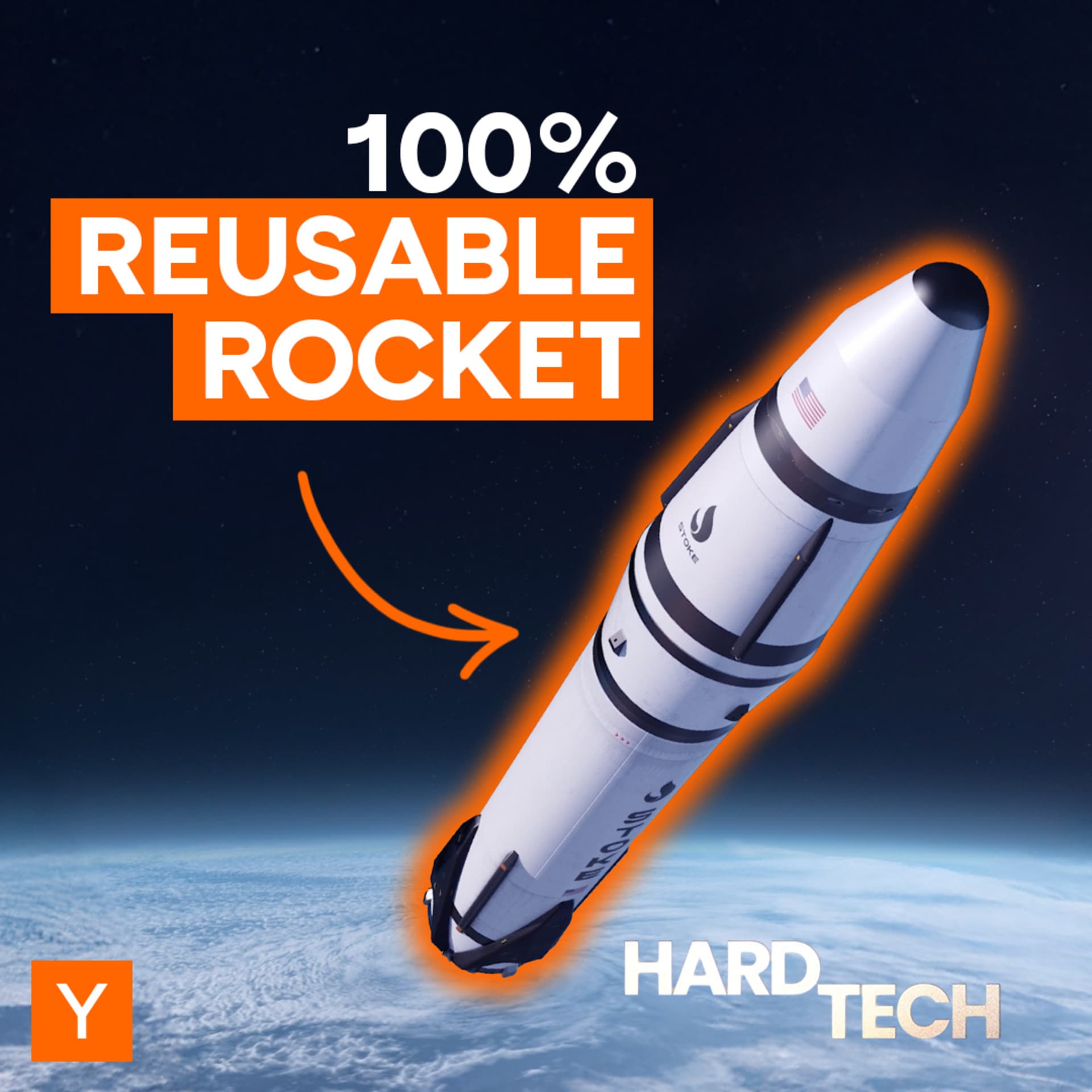
Inside The Startup Building Reusable Rockets Podcast Description: We help founders make something people want. Episode Description: Stoke Space is racing to build the world’s first fully reusable rockets that can launch, survive reentry, and fly again and again. In this episode, YC’s Aaron Epstein sits down with Stoke Space co-founders Andy Lapsa and Tom Feldman to discuss their ambitious project, their obsession with efficiency, and the potential future of spaceflight.
---
Key Takeaways
Introduction to Stoke Space
- Objective: Developing fully reusable rockets with aircraft-like reusability.
- Innovation: Unlike most rockets that can only reuse the first stage, Stoke Space aims for the entire rocket, including a reentry-capable second stage capsule.
The Market Context
- Current Launches: Approximately 150 commercial space launches per year.
- Potential Growth: Full reusability could drastically increase launch frequency and reduce costs, enabling more diverse applications in space.
Technical Architecture
- Nova Rocket:
- Two-stage orbital rocket.
- First stage designed for effective reentry and landing.
- High-performing engine focused on fuel efficiency.
- Andromeda Capsule:
- Survives reentry using a custom heat shield with cold liquid hydrogen and thrusters for controlled descent.
Founders' Journey
- Background: Andy Lapsa and Tom Feldman were jet propulsion engineers at Blue Origin before founding Stoke Space in 2019.
- Motivation: They were motivated by the problem of rockets being disposed after single use and recognized a lack of rigorous pursuit in creating reusable technology.
Challenges and Risks
- Starting a Company: Leaving secure jobs for an uncertain startup journey was a major risk, especially with personal responsibilities.
- Fundraising Struggles: Faced difficulties in raising funds, particularly during COVID-19, which initially disrupted their plans.
Milestones and Achievements
- Funding: Raised approximately $990 million to date, operating efficiently compared to competitors.
- Progress: Completed first full engine test in 2022 and moved into a new manufacturing facility in 2024.
Key Strategies for Success
- Rapid Prototyping: Building prototypes quickly to demonstrate feasibility to investors.
- Iterative Development: Emphasizing the importance of quick iterations and learning from failures to refine designs and processes.
Importance of Software
- Operational Efficiency: Developing proprietary software (Boltline) to streamline processes from manufacturing to flight management.
- Future Development: Incorporating AI and other technologies to enhance factory operations and maintenance scheduling.
Vision for the Future
- Operational Goals: Envision frequent launches (potentially daily) using their reusability technology.
- Impact on Industry: Successful implementation could revolutionize space access, similar to the impact of the iPhone App Store on mobile applications.
---
Conclusion Stoke Space is positioning itself at the forefront of space technology by tackling one of the most significant challenges in rocketry - full reusability. The founders’ journey from engineers to entrepreneurs highlights the risks and rewards associated with innovation in the aerospace sector. Their commitment to efficiency and adaptability in both hardware and software development signals a promising shift in how we approach space exploration.
Written by AI. May contain mistakes. Listen to the episode to check what was said.
Chapters
Tap a time to open that second in VOThe Vision for Reusable Rockets
0:45 to 2:37
Discussion on the importance and potential of fully reusable rockets.
“Andy and Tom invited me to check out their headquarters in Kent, Washington, just outside of Seattle.”
Hardware Architecture of Nova and Andromeda
2:37 to 4:24
Detailed description of Stokespace's rocket designs and their functionalities.
“The second stage goes the rest of the way to orbit.”
Founders' Journey to Stokespace
4:24 to 6:25
The personal stories of the founders and their motivation to start Stokespace.
“What's the most badass thing you can do with engineering?”
Overcoming Challenges in Fundraising
6:25 to 8:09
The hurdles faced by the founders in raising capital and navigating the market.
“I had a three-month-old at home, and I had a really good paying job that I was quitting.”
Building Prototypes and Facilities
8:09 to 11:21
Insights into the early development of Stokespace's prototype engine and facilities.
“Oxidizer stuff on one side, fuel stuff on the other side.”
The Role of Software in Rocket Development
11:21 to 13:55
Exploration of how software integrates into the manufacturing and operational framework.
“You can't analyze everything to perfection.”
Building the Launch Site at Cape Canaveral
14:01 to 14:34
Learn about the construction progress at the historic launch site in Florida.
“the same place where John Glenn launched to become the first American to orbit Earth back in 1962.”
Testing and Qualification of Systems
14:34 to 15:03
Discover the testing processes for structural and avionics components.
“we go and test those from a structural perspective and also at cryogenic conditions.”
Vision of Success in Rocket Launching
15:03 to 15:26
Explore the potential impact of successful daily rocket flights.
“If we are successful, we are flying this thing every day.”
Transcript
Automatic transcript. May contain errors.0:00The team at Stokespace is going after the holy grail of rocket science. Stoke is building fully and rapidly reusable rockets with aircraft-like reusability. Today, only this section of rockets can be reused. But Stoke space is focused on the entire rocket, including a stage two capsule that will finally be able to survive the brutal re-entry to Earth. This could open the door to all kinds of new opportunities in space. I think if you have something that can go up and come back to the place where you want it to go, when you want it to go, So I think it is like the iPhone app store moment. People are going to come up with like absolutely crazy ideas for how to take advantage of that.
0:44So how did two founders go from testing rocket engines in their backyard to solving for one of the hardest problems in space travel? This is the origin story of Stokespace.
1:04Andy and Tom invited me to check out their headquarters in Kent, Washington, just outside of Seattle. It's an area that's quickly becoming known as a hub for space tech startups. What are you building at Stoke Space? Building fully rapidly reusable rockets designed to go to space, through space, and back from space, really to lower costs, improve availability, and improve reliability of access to space. Today, there are only around 150 commercial space launches every year. While that's a record for the industry, it's a drop in the bucket compared to where things could go if rockets become fully reusable.
1:41With only 150 potential transactions and most of them getting taken up by Starlink, there's just not that much availability. And so there are customers who are willing to pay quite a bit more to get the availability. But to make the space economy more ubiquitous, more diverse, and to enable some of these new verticals and applications, yeah, cost is a huge barrier. Describe the hardware architecture itself. Can you walk us through the designs of the Nova and the Andromeda? Nova is a two-stage orbit rocket. First stage functions similarly to other rockets. It punches you out of the atmosphere and comes and restarts the engines to land either downrange or back at the launch site.
2:21It has one of the highest performing rocket engines in terms of fuel efficiency that's ever been produced. That was a big technical bite for us to bite off as a small company. But I think it's one that is paying off and it's a very important component to long life and rapid reusability. The second stage goes the rest of the way to orbit. Typically, rockets are thrown away completely. In the last few years, the industry has shown the ability to reuse the first stage, which has been transformative. It allowed companies to scale from maybe a dozen or so, 10 to 20 launches per year, now to that 150 number.
2:55But the second stage is still thrown away on every single mission. That's in large part because the Stage 2 capsule is traveling at 17 ,000 miles per hour as it drops out of orbit. Because of that high speed, it eventually breaks down as it heats up to more than 2 ,700 degrees Fahrenheit during its descent. So these are multi-million dollar machines that not only have to get built, but they have to get tested and acceptance tested to prove flight worthiness. And then they go to space and they get thrown away. Here's how their stage two or upper stage Andromeda capsule is able to survive re-entry.
3:30After releasing its payload, it'll close up and re-enter Earth's atmosphere. At that point, the custom heat shield takes effect. It uses cold liquid hydrogen flowing through a heat exchanger to absorb the extreme heat of reentry. Then 24 small thrusters kick in to help it slow down and land at the right angle. What rapid reusability allows you to do is to scale the flight frequency without having to scale your factories and your test facilities and all of the infrastructure that comes with it. It seemed like that was the thing that you thought needed to exist in the world. and if somebody else wasn't going to do it, you needed to do it.
4:06Yeah, that's right. How did you get interested in building rockets? Was this something you were always interested in as a kid growing up? From as far back as I can remember, you know, doing Estes rockets in the backyard with my cousins. It really just kind of took off from there, pun not intended. From pretty early on in high school, it was pretty clear that I wanted to do propulsion. It was like, let's do engineering. What's the most badass thing you can do with engineering? Well, it's probably like rocket propulsion. Tom and Andy met while working as jet propulsion engineers at Blue Origin. They left to start Stokes Base in 2019.
4:42How did you guys ultimately decide to leave and start your own company together? Pretty quickly, it became like, all right, Andy and I are going to go start a company. And at the time, we had no idea what we were going to do. We were like, all right, let's start a company. Let's brainstorm some things that sort of like meet in the middle of our Venn diagram of like desires and skills and problems that need to be solved. And then it was like, it kind of clicked one day that like there is this problem, you know, people are still throwing away rockets. And like we really didn't see anybody actively working super hard to like, you know, attack that problem with rigor, combined with the fact that we thought we had a pretty good idea on how to solve it.
5:19And it was like, all right, that's a thing. There were more than 150 rocket companies at the time that were around. And I assume you looked at all of them. What was the thing that convinced you that you should start your own and that it would actually be better and out-compete what they all were doing. It was not intuitive to start a company. It wasn't the first inclination. We looked at a lot of those and a lot of it was, you know, a bunch of PowerPoint stuff that didn't seem like it had a very bright future. And we were certainly both hardware people. And so we kind of understood what it would take to take some of those PowerPoint ideas into reality.
5:52Their key insight was that if you focused on reusability from day one, you could decrease cost and increase availability and reliability. But even though they believed in the idea, it was still a massive risk. At the time when you were starting this company, you both obviously had very comfortable jobs. You had small children. It seems like it's a huge decision to go and actually decide to make the leap and start a company and start from zero and nobody else in the trenches except for you two. It felt wildly irresponsible, to be honest. easily the hardest decision that I've ever made personally.
6:27I had a three-month-old at home, and I had a really good paying job that I was quitting. Let's give ourselves a time-bounded scenario where in six months, if we don't have any kind of legitimate traction, that's going to be the sort of cue to reevaluate. And because we really didn't know anything about what we were doing when it came to starting a company. And so, you know, a lot of the first few months was just like, A, was heads down engineering, and B, it was like, what does it even mean to start a company? We started in September 2019, so it wasn't long before the pandemic was a real thing.
6:59And then we were really like, oh shit, was this the right move? It was right up against the clock on the six-month thing that we finally were able to get some traction. I think we got our first check sometime around that time frame, and then we were off to the races. With that first check, they started building a prototype engine and testing it in a shipping container in Tom's backyard. So at that time, Andy's in the basement, powerpointing like crazy to try to hone the story. And I was like welding this steel structure in the garage and then taking it out to the shipping container and bolting it in.
7:35And that was kind of like how we spent our days for the better part of like two months. We knew we wanted to demonstrate some hardware. We knew that with a reasonably small amount of money, we could develop a pressure-fed gaseous hydrogen liquid oxygen thruster and be able to show fire coming out the end and say, you know, hey, early investors, we want to do this thing. Here's a teeny tiny little piece that we already did. All right. So these are the shipping containers where it all started. This is where it started. So this one was primarily for storage. This one was where the actual test cell was.
8:06Walk me through this one. The test stand, you can still kind of see like an imprint of it there. Oxidizer stuff on one side, fuel stuff on the other side. Actually, the original workbench that I built It was probably the very, very first thing I ever built for Stoke. It's still out there, I'm pretty sure. We had what we called our run tank. It was really a cylinder. Then we had storage outside of the wall. Bunch of valves along the wall, bunch of valves sort of right at the test article there. Yeah, we probably built this entire facility in two months, maybe? I remember distinctly a day in January where I remember having a feeling like, okay, we're convinced.
8:44Now what do we do? What led you to IC? We wildly underestimated the challenge in raising money. If there's one thing we totally missed on, that was it. We had no Rolodex. We had no, you know, rich uncles. We had to do it all organically. Right when we started to raise money, COVID hit. The market shut down. Nobody was entertaining anything except trying to keep their portfolios alive. It was a really tough environment. YC obviously has a network second to none. that can help us learn to speak the language and understand the fundraising process and the whole path. And that's the reason to do it.
9:22YC was a big part of that early stage. And I think YC also added some momentum to the round, right? I'm curious, how did you get good at fundraising? A lot of the venture world, especially at the time, was geared towards SaaS. We have a very different story and a very different financial model than a SaaS business. And so at that early phase, my goal was just, hey, get introduced to a different angel who may be a little bit closer to investing in a hardware company. There was one piece of advice that was extremely important and I carry with me all the time and I will pass on and that is get good at hearing no.
10:01It is tough to keep it going when all you hear is no after no after no to just keep the conviction and keep the fire alive to keep going. And how much have you raised so far to build all of this? We've raised about$990 million to date. We have certainly not spent close to all of it. I think we're operating very efficiently compared to some of the other groups in our industry. But it is, you know, it's been a journey to get to this point. Over the past few years, they've hit several major milestones. In 2022, they completed their first full engine test. In 2024, they moved into this 168 ,000 square foot factory.
10:41Next up will be their first launch into orbit, which is planned for later this year. We have engineering space here as well as manufacturing. We build everything from avionics and electronics. Every part of the rocket gets built in here. We have engine assembly over to our left. We have additive manufacturing to our right. We have structures behind us. This is where it all happens. The facility is designed to build about seven vehicles per year. How do you balance the speed of execution with the patience that's required for this deep technical work and building something that has a long time horizon?
11:19This is very tricky. I think you have to know that this is hard. You can't analyze everything to perfection. And at the end of the day, rubber meets road and you have to test. And so the speed at which you can iterate becomes fundamentally important to your ability to do the hard thing as quick as possible. You do have to plan for failure. So when, for example, if you're developing a rocket engine and the engine fails how soon can you learn the lesson from that one make any change that you need to change and get the next one out there there better be one on the factory floor basically ready to go if it's going to be fast right we want the ability to make every part on the rocket ourselves as you learn more your overall development timeline and therefore your overall development cost is tied to how quickly you can iterate and if you can't make parts yourself then your iteration cycle is dependent on a out-of-house supplier we'll go learn something on a test stand, tear it down, drive it back here, pull it apart, run a change in the machine shop, drive it back out there, integrate on the test stand, and we're off and going.
12:24So a one-month cycle is down to a day or two. Talk about the importance of software in building this company. This was something that was surprising to me, is how key it is, not just to the actual product that you're building, but to how you run your company. This company has to scale from building things in a literal garage to flying government payloads or even humans on a vehicle that is overseen by the FAA. And somehow you have to bridge from garage to that. And that bridge is often very, very painful for a lot of companies. In our industry, we build a rocket and ship it, and then that's it, right?
13:00It launches and it lands in the ocean and you never see it again. But what we want to build is a vehicle that's going to go to orbit, fly around and come back again. And we want to turn that thing around as fast as possible and go again and again and again. So did it work well? How long have the parts been in service? When do I need to go and do preventative maintenance? When do I have to go do unscheduled maintenance on things? All of these questions are kind of staring us in the face. We're in a moment in time where software can automate a lot of that. I'm really excited about new developments in AI and other things to make it even more seamless for a factory worker to do their job and also log answers to those questions.
13:40And then you use software to abstract the information, slice it and dice it, and send it to the different functions that need it. So we made the decision very early on, we're going to build our own tool to do all this. We're going to base our operations around it, call it Boltline. And it's been a big part of our success. In addition to their manufacturing and testing facilities, They're building a launch site at Historic Complex 14 in Cape Canaveral, Florida, the same place where John Glenn launched to become the first American to orbit Earth back in 1962. We're working on putting all the pieces together to get to orbit.
14:16We have a massive construction project happening in Cape Canaveral, and that is going fantastically well. We have our first and second stage engines, which are completing their development and qualification. We have the structures, builds that are happening right now. we've built multiple structural qualification articles. We have a facility in Moses Lake where we go and test those from a structural perspective and also at cryogenic conditions. Software and avionics is another big area where, you know, we have hardware in the loop testing where we have all the avionics for the vehicle turned on, integrated together with the flight computer and with the GNC software.
14:53And so we're flying simulated missions all the time, proving that the avionics and the software stack are robust and ready to fly. What does the world look like if you're successful? If we are successful, we are flying this thing every day. What was the moment that you guys actually started to believe that you could pull this off and that your crazy plan would work? The very beginning was convincing ourselves that this was an idea worth pursuing. I got to the level of conviction and the idea that I said, we owe it to the world to try this idea. Whether or not it succeeds, this idea is good enough, it has to be tried.
From the publisher
Stoke Space is racing to build the world's first fully reusable rockets that can launch, survive reentry, and fly again and again. In this episode of Hard Tech, YC’s Aaron Epstein sits down with Stoke Space co-founders Andy Lapsa and Tom Feldman to find out why they chose to take on one of the hardest problems in rocket science, how an obsession with efficiency gives them an edge, and what full reusability could unlock for the future of spaceflight.
Apply to Y Combinator: https://www.ycombinator.com/apply
Work at a startup: https://www.ycombinator.com/jobs


