
In short
Notes from Y Combinator Startup Podcast: Inside The Startup Launching AI Into Space
Podcast Overview
- Title: Y Combinator Startup Podcast
- Episode: Inside The Startup Launching AI Into Space
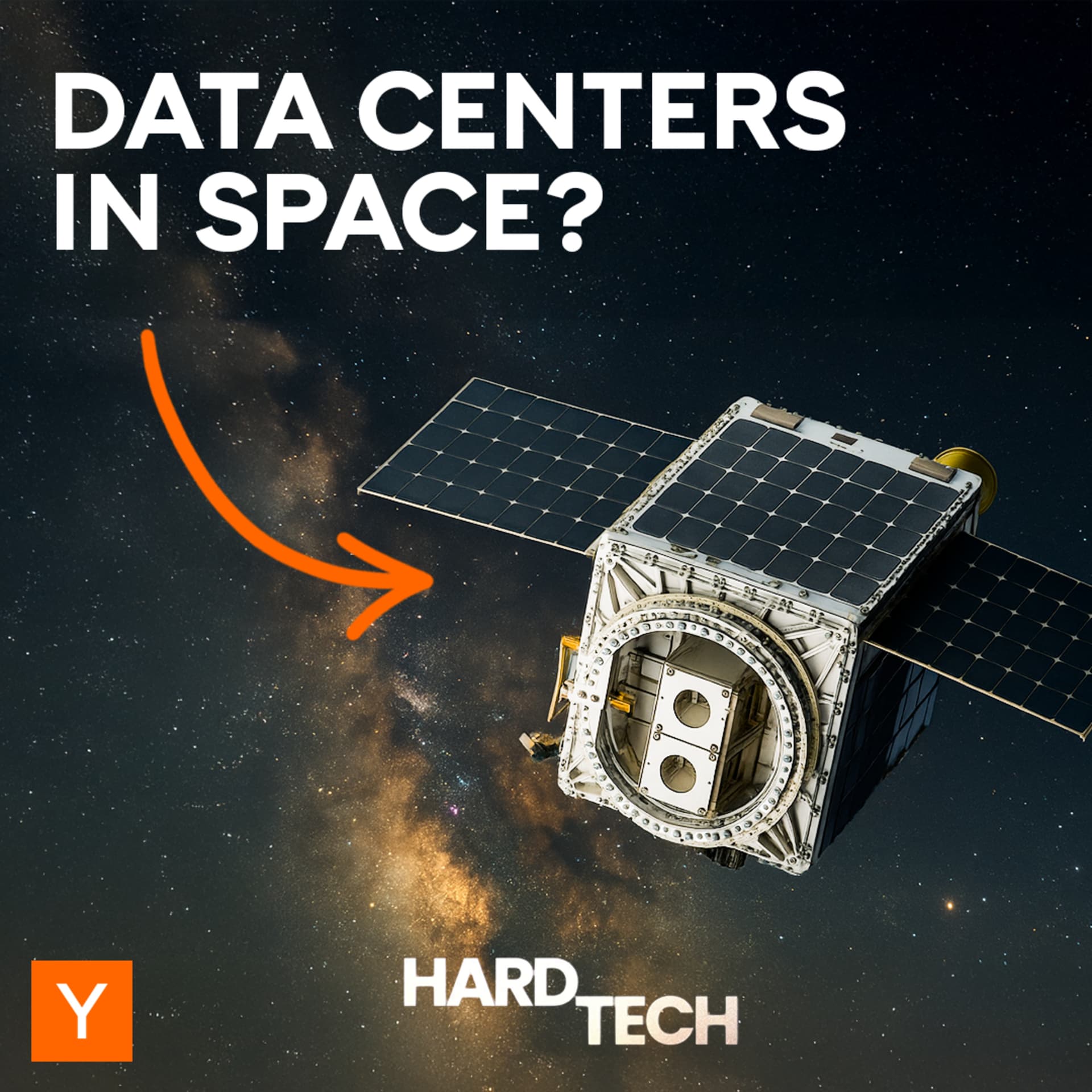
- Description: Discusses Starcloud's groundbreaking achievement of launching a satellite equipped with an NVIDIA H100 GPU, the implications of this technology, and the vision for future orbital data centers.
Key Themes Historical Launch
- First of Its Kind: Starcloud launched a satellite with an NVIDIA H100 GPU, marking the first instance of such powerful terrestrial GPUs operating in space.
- Prototype Significance: The satellite serves as a prototype, demonstrating capabilities that are 100 times more powerful than any previous space-bound computers.
Vision for Space Data Centers
- Orbital Data Centers: Starcloud aims to build the world’s first data centers in space to provide GPU compute for satellites, eventually competing with Earth-based data centers on energy costs.
- Energy Efficiency: Proposed data centers will utilize continuous solar energy and radiate heat into deep space, drastically reducing the need for fresh water and lowering carbon emissions.
Technical Innovations and Challenges
- Thermal Management: Key innovations involve efficient thermal management and radiation shielding to operate advanced GPUs in space.
- Challenges: Addressing skepticism around the practicality of building large surface areas for heat dissipation.
Founders and Team Background
- Co-founders:
- Philip Johnston: Background in software and theoretical physics.
- Ezra Feilden: PhD in engineering, experience in satellite design and NASA missions.
- Adi Oltean: Extensive experience with data centers at Microsoft and SpaceX.
- Complementary Skill Sets: The team combines expertise in software engineering, satellite design, and data center management.
Development Timeline
- Rapid Progress: Starcloud progressed from concept to prototype in just 15 months, a remarkable feat compared to industry standards.
- Upcoming Launches: Plans for a more powerful satellite with enhanced capabilities are already underway for a second launch.
Key Takeaways
- Rising Demand for Energy: Growing energy demands for data centers drive innovation toward space-based solutions.
- Grand Vision: Founders envision a future where most new data centers are located in space, transforming the landscape of AI and data processing.
- Market Validation: Recognition from Y Combinator encouraged the team to pursue their ambitious vision despite initial hesitations.
- Competitive Landscape: Acknowledgment of interest from tech giants like Google, SpaceX, and Amazon in developing similar space-based data centers.
Criticism and Response
- Debunking Skepticism: Addressing concerns about the feasibility of large deployable radiators, emphasizing engineering expertise and practical solutions.
- Motivation from Adversity: Challenges and criticism serve as fuel for the team’s determination and ambition to succeed.
Conclusion
- Future Potential: The concept of space-based data centers offers a radical solution to energy and resource constraints faced by terrestrial data centers, with the potential for significant global impact.
- Long-Term Vision: Starcloud's journey illustrates the complexities and rewards of pioneering ambitious technologies in the space sector.
Written by AI. May contain mistakes. Listen to the episode to check what was said.
Transcript
Automatic transcript. May contain errors.0:28This moment right here down here on Earth. I can see why it seems like a long shot to some people. To me though, the reason for doing this is that the potential impact is absolutely massive. So even if you think there's a small percentage chance of it working, then it's worth taking this kind of risk.
0:52Philip Johnston and his team at StarCloud recently made aerospace history. when they launched a satellite into orbit carrying an NVIDIA H100 GPU. This is the first time anybody's tried to launch data center-grade terrestrial Earth-based GPUs into space. It's going to be the first of many. While it's essentially a prototype, it's still 100 times more powerful than any computer that's ever operated in the vacuum of space. To find out how they went from an idea to launching a demo satellite in less than two years, We visited StarCloud's HQ in Redmond, Washington. Tell us about what StarCloud is working on.
1:29We are building data centers in space, initially to provide GPU compute to other satellites, and then later to compete on energy costs even with terrestrial data centers. StarCloud's goal is to build the world's first orbital data centers. Massive GPU clusters, powered by constant solar energy to run AI compute at scale. Operating in a sun-synchronous orbit, they'll draw uninterrupted sunlight for energy, radiate heat into deep space, and run with zero fresh water and much lower carbon emissions than data centers down here on Earth. By taking the cloud off Earth, StarCloud can scale almost indefinitely, free from land, grid, and cooling limitations, and ultimately compete with the cost of the largest terrestrial data centers.
2:14Tell us more about how far along you are. We started about a year and a half ago. We've designed, built, and tested our first satellite, and that will be the first satellite that will have an H100 from NVIDIA on board. The purpose of this is really to prove that our thermal management and radiation shielding techniques allow us to operate the state-of-the-art in space. We're going to be running a whole bunch of demonstration workloads on that. We'll be the first to run Gemini from Google on there. We'll be the first to do fine-tuning of model and training a model in space. Why data centers in space?
2:42It seems like people are still struggling to get the compute that we need here, building them on Earth. Like, why is space going to be the next frontier for that? Yeah, so we see a world where almost all data centers, anything that doesn't require very low latency, is operating in space. Surely because of the constraints we're facing on energy terrestrially. And so we're building with a vision to build extremely large, full 40 megawatt data centers. It's about 100 tons. It's what you can fit in one full Starship Halo Bay. And if this works, what does the world look like? It takes a huge burden off the grid on Earth, both the grid and the water supply.
3:17The way that data centers on Earth keep cool is essentially they evaporate lots of fresh water. This is actually causing huge problems in certain parts of the U.S. where they're just sucking the rivers and the lakes dry in order to keep these data centers cool. Our data centers in space require zero fresh water. Instead of being this evaporation process, our heat sink is infrared radiation into deep space. And so we're building these very large radiators that we run a fluid through but doesn't go anywhere. And then that dissipates heat out into the vacuum of space. What led you to ultimately starting StarCloud and being co-founder here?
3:51We're seeing an absolute tidal wave of demand for energy, primarily for data centers, but also broadly electrification within our society. And in the Western world, we're not that good at building large infrastructure projects quickly. Our vision is to put larger and larger satellites in space and prove that this concept works. We can put essentially high compute devices in space that are going to help our customers. If it works, when it works, it will have just such a huge impact on the world, on the development of AI, the way we train and use AI. So this is one of the most impactful things I think I could be spending my time on.
4:28And that's why we're dedicating so much to it. But this ambitious vision hasn't convinced everyone. The concept of data centers in space has raised eyebrows and sparked plenty of heated debate online. I want you to react to Andrew McCallop's viral post. I was wondering if there were any key points in here that you think were easily debunked. The criticism usually is in order to dissipate that heat, you need a large surface area. And they think for some reason that that's super impractical. And my co-founder, Ezra, has a PhD in engineering. Spent 10 years designing and building large deployable structures, solar panels, and radiators.
5:03You just have to build a large surface area. And that's what we're doing. So half our engineering team is building a very large, low-cost and low-mass deployable radiator. So that is the core IP of our company. Is it fuel for motivation for you now? Oh, 100%. You guys are trying to pull off a very difficult business here and very difficult idea that hasn't been done before. Yeah, I mean, I have to say I was very inspired by a talk that Sam Altman gave about maybe eight or nine years ago. And he said something like, it's easier to build a hard company than it is to build an easy company. There's one hard thing, which is, can we operate data centers in space cheaply?
5:34If we can do that, everything else is easier. Hiring amazing people is easier. Getting people to write about us is easier. Even fundraising is easier. It's an unintuitive fact. Yeah, it seems like you are opting for the path that has very high technical risk that you can pull this off. But if you can pull it off, people will want it. It'll be incredibly valuable. There's very little market risk. All these other factors kind of go away. Tingnan, step back. You have a pretty uncommon background to start a company like StarCloud. Yeah, that's true. So I don't come from a space engineering background.
6:06Actually, I started my career as an engineer for the first five years on the software side. And then before that, I studied applied math and theoretical physics, undergrad and master's. And what ignited your passion to start something in space? I've been passionate about space since I was a kid. But I think what made me realize that there is an opportunity here is seeing how quickly the launch cost is coming down. That's in part thanks to companies like SpaceX and startups like Stokespace that are building reusable rockets. The launch capacity might go up by 100 or 1 ,000x because you can refly these things every day and because they're producing so many of them.
6:37And that enables many different business use cases. And how did you come up with the idea for StarCloud? We were initially looking at space-based solar, which is this concept of very large solar panels in space and beaming the power down. We ran the numbers on that and we wanted to know what is the launch cost where that business model makes sense. The number we came to is around$50 a kilo where that would break even. That's a long way from where launch costs are today. So they pivoted to a different idea. The big problem with space-based solar is you lose 95 % of the energy transmitting it from space to Earth.
7:05So, what if instead of sending the power down to Earth, you sent the data centers up? So after we reran those calculations, we came to a launch cost of$500 a kilo break even. We're much closer to that today than we are to$50 a kilo. So that was then the basis of a white paper. In the summer of 2024, Philip and his co-founders pitched the idea to YC. They got in on what was their third attempt. Back then, they were called Lumen Orbit. We're building a constellation of orbital data processing satellites to serve other satellites. What were you focused on primarily during the batch and how did that kind of shape the company?
7:40We were applying only for the first part of the business, which is providing cloud services to other satellites. We knew, and actually we had mentioned it in the interview, that there was this much larger potential business model behind it, which is providing energy for almost all data centers. But we hadn't really been vocal about that and we were kind of a bit, maybe even embarrassed to talk about such a grand vision. I think YC just really encouraged us to go for it. Why was it embarrassing for you to talk about such a grand vision? I mean, when you tell people that within 10 years, it could be the case that most new data centers are being built in space, that sounds wacky to a lot of people, but not to YC.
8:15In just under two years, they were able to build the first demo satellite, the one that's currently in orbit over our heads right now. It seemed like you all have very complementary backgrounds that are perfect for this type of company. My co-founder, Addy, was 20 years on building data centers with Microsoft, and then he was with SpaceX as a principal software engineer. And so he's doing everything on the software side and with the compute module and making these chips work in a high radiation environment. And then my co-founder, Ezra, who's our CTO, spent a decade designing satellites. He worked on NASA's Lunar Pathfinder mission, did the deployable solar panels.
8:49He has a PhD in engineering. And so he is doing all of the satellite structure. So between us, we've got commercial, compute payload, the bit we're doing and satellite structure. So actually yeah the team is extremely complimented.
9:02We are headed into the main assembly facility that we have. This is where we're extending our deployables and iterating on different prototypes. This is where the engineering team sits. This is electrical and software and the mechanical engineers back here. This is the cleaner area of the tube. If that was the clean side then this is what you can think of the dirty side where we're fabricating all sorts of aluminum parts for the for the spacecraft. And so you're building a lot of the parts and assembling things right here in this facility. Exactly, so we're building all of the payload, all of the power, and then all of the thermal dissipation.
9:34Here we have the vibration table which Ezra's setting up for a vibration test of some of the electrical hardware. So this is where we shake the satellite in all different directions, every axis and then into every different frequency, amplitude, etc. I think before us it's been four years for any previous startup to go from day one founding to having something on orbit. 15 months we went from founding to having a satellite design built ready and tested. How were you able to do that so quickly? This is where I give credit to my co-founders. All of the compute module and antennas and everything else they built in-house by hand.
10:06We were working through the night up until the day that we shipped down the payload. So the first satellite is a small sat, It's about 60 kilograms, the size of a small fridge. And on that, we have been responsible for the compute module and the antennas. We've contracted one of the bus manufacturers, a company called Astro Digital, to build the bus. And so, yeah, there's the high-powered GPUs. That's the H100 that we've got from NVIDIA on there. There's a bunch of different antennas that we're testing and using on that one. All of this led up to the historic launch on November 2nd. Good evening and welcome to SpaceX's live coverage of our fourth bandwagon rideshare mission.
10:44On board are StarCloud's StarCloud One, which is looking to prove that modern data center hardware can run in orbit, starting with the world's first NVIDIA H100 GPU deployed in space. All systems are go for an on-time liftoff. Launch director, go for launch. Three, two, one, engines for power, and liftoff. Go bandwagon, go ADD-425.
11:22Over the next few months, we'll be doing all this whole battery of tests we've got lined up. So training the first model in space, running high-powered inference in space, running a version of Gemini. We'll be doing a whole bunch of interesting firsts over the next few months. Say more about your second launch, which you already have planned. What's going to go up there and how is that going to be different from the first one? So the second one is launching in October next year. That's going to be at least 10 times more powerful than the first satellite. And that will fly the Blackwell Architect from NVIDIA.
11:49It will have a whole bunch more GPUs. So that one will be much more capable. It will also have very high bandwidth connectivity through optical terminals. And so we'll have 24-7 high bandwidth connectivity with very low latency all the time. And that's a huge differentiator. While we may be a decade plus away from their grand vision of massive five gigawatt data centers in orbit, they've taken a critical first step and they're not alone anymore. A lot of the big tech giants are now starting to look up way above us. Google, SpaceX, Amazon, they are all exploring data centers in orbit, powered by the sun's rays and cooled by the vacuum of space.
12:26Anything that's worth doing is going to be hard. And, you know, if something is too easy, it probably doesn't have the same potential outcome. And so we decided to do the biggest, most ambitious thing we could, and that's build almost all data centers in space.
From the publisher
Starcloud recently made history by launching a satellite with an NVIDIA H100 into orbit — the first time a GPU that powerful has ever operated in space. It's the first step toward building AI data centers in orbit, powered by continuous sunlight and cooled by radiating heat into deep space.Their approach could one day rival the world's biggest data centers while using less energy, zero fresh water, and far lower emissions.In this episode of Hard Tech, YC's Aaron Epstein visits Starcloud's HQ, where co-founders Philip Johnston, Ezra Feilden, and Adi Oltean explain how they built a working prototype in just 15 months — and why big tech is racing to space for AI compute.


