
In short
Y Combinator Startup Podcast: Episode Summary
Episode Details
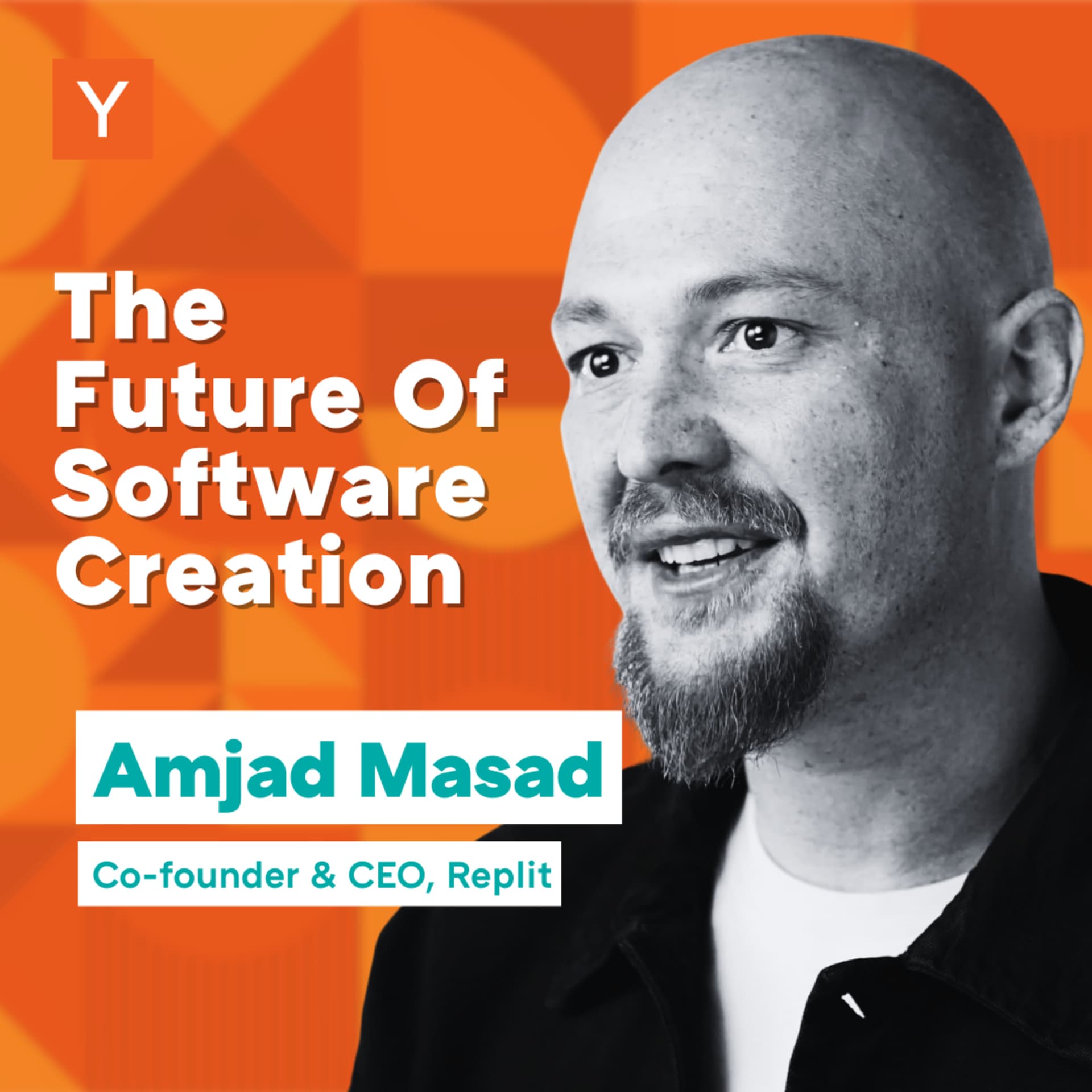
- Title: The Future of Software Creation with Replit CEO Amjad Masad
- Air Date: June 17, 2025
- Speaker: Amjad Masad, co-founder and CEO of Replit
- Valuation: Replit valued at $3B after a recent $250M Series C funding.
Overview In this episode, Amjad Masad discusses the future trajectory of software creation, focusing on the evolution of computing and the impact of AI. He emphasizes his vision of making programming accessible to everyone and outlines how AI is transforming software development.
Key Themes
Historical Context of Computing
- Evolution of Computing:
- Mainframes: Initially required expert knowledge and specialized training.
- Personal Computers (PCs): Transitioned from toy-like devices to essential tools for business.
- Software Engineering: Development necessitated extensive education and training, historically limited to a select group of experts.
The Transformation of Software Development
- Current Transition: Software is moving from expert-only domains to wider accessibility where anyone can create software.
- Replit's Mission: To democratize programming and enable everyone to write software through user-friendly tools and environments.
The Role of AI in Software Creation
- AI Agents: The future involves agents capable of writing code, shifting the bottleneck from coding to providing infrastructure and support for those agents.
- Automation of Software Engineering:
- Predictions indicate significant automation, with tasks traditionally requiring human engineers increasingly being performed by AI agents.
Infrastructure for AI Agents
- Habitat for Agents: Importance of robust infrastructure to support AI agents, including:
- Virtual machines and sandbox environments.
- Support for diverse programming languages and packages.
- Key Components Needed:
- Deployment capabilities, databases, user authentication, and background job management.
Autonomy Levels of AI Agents
- Levels of Autonomy:
- Different stages of AI agent capabilities, from basic code assistance to near-full autonomy (V3 discussed).
- End-to-End Testing: Importance of agents being able to test and validate their own code changes.
Predictions for the Future of Software
- Value Decline: Traditional proprietary software may reach near-zero value as custom software becomes easily generated by AI.
- Business Operations: Shift from specialized roles to generalist employees who can adapt and fill various roles, disrupting traditional company structures.
- Vision of Work: The emergence of a new model where every employee functions more like an entrepreneur, focusing on generating value instead of strictly defined tasks.
Key Takeaways
- Software Creation is Evolving: Individuals without programming backgrounds are increasingly able to create their own software solutions, fundamentally changing the software market.
- AI Will Enable New Ways of Working: The integration of AI agents can lead to generalized roles that transcend traditional job descriptions, encouraging a networked, collaborative workspace.
- Investment in Generalist Skills: Future employment opportunities may favor those who can cultivate a diverse skill set and adapt to rapidly changing technological landscapes.
Audience Interaction
- Q&A Session Highlights:
- Discussion on the future interactions between humans and multiple AI agents for specialized tasks.
- Concerns regarding the future of human work in light of automating cognitive tasks through AI.
- Importance of collaboration and versatility in skills for future roles.
Conclusion Amjad Masad's insights present a compelling vision for the future of software creation driven by AI, highlighting the increasing accessibility of programming and the changing dynamics of work and business operations. The episode emphasizes the potential for innovation and disruption in the tech industry and encourages the audience to embrace new opportunities in this evolving landscape.
Written by AI. May contain mistakes. Listen to the episode to check what was said.
Transcript
Automatic transcript. May contain errors.0:00I was asked to talk about the future of software. So a lot of this talk is going to be about what we're doing at Replit, where we think the future software is headed, and some kind of trying to make some predictions or try to think out loud about really what the future holds. My mental model for our business and really for the moment we're in today, if you think back on the history of computing, mainframes were kind of the first mainstream computing devices, as mainstream as it gets back then. And to use a mainframe, you needed to be an expert. And then PCs came around. And initially, PCs were kind of toys.
0:45You bought a Mac and you did Mac Paint and things like that. There wasn't a real business use case. I mean, people like made fun of Apple at the time until the Excel sheet. The Excel sheet was the first software that was actually useful on computers. And now PCs run world economy. Like they actually, if you go to a data center, it's also only PCs. It's x86 computers. So you go from something that was used by a small group of experts that had to have a lot of training to something that started sort of as a toy and is used by everyone. Same thing with software engineering. Like the modern software engineering career, you can sort of trace it back to the 70s with the rise of maybe Unix and the C programming language.
1:40that's when people started kind of being trained to become software engineers. You still needed four or five, six years of college education. You need another two or three years of training on the job to be able to actually do the job very well. I think today software is going through the same transition from something that only experts do to something that anyone can do. And this is what we're really building Replit for. I've been working at Replit for like almost nine years now and our vision has always been to solve programming, to like make programming, make it so that anyone can write software.
2:29So we built an IDE, We built language runtimes. We built like an online sandbox environment. We built deployments. We built cloud services around all of that. And then when AI came on the scene, we realized that the ultimate expression of our mission is to make it so that you don't have to code. Code is the sort of bottleneck to actually getting a lot more people making software. So around late 23, early 24, we decided to put all our resources into agents. At this time, agents sort of barely worked, but you could tell by looking at a few benchmarks that were headed there. So SWE Bench is a software engineering benchmark.
3:13It is basically a collection of issues on GitHub from major repositories, and the unit tests and pull requests sort of end state of those issues. And the way you test an agent is you put it in an environment and have it solve some of those issues. You could tell like in 22, sort of it barely worked. 23 started sort of working. And you could tell early, sort of early 24, when we're on this trend, where you could tell that software engineering is getting automated or like big parts of software engineering is getting automated. And now we're probably, I think this is like a little outdated. We're like at 70, 80 % sweet bench.
3:51Now, if this benchmark gets saturated, it doesn't mean that we automated all of software engineering, but we're on our way to make really useful, arguably it's already here, really useful software engineering agents. And by the way, this is true of any agent. If any of you are building sort of agents, startups, just like really believe that it's coming. I keep telling my team, we need to be okay with building crappy products today because two months down the line, the models will get better and your business, your product will suddenly become viable. So today's kind of the moment for agents. So Replit kind of went all in on agents.
4:34But agents that can write code is actually the easy part. The hard part is the infrastructure around it. Sometimes I call it the habitat for which the agent lives in. So what you need is you need a virtual machine, ideally in the cloud, ideally not on your computer, because agents can actually also mess up your computer. They could do a lot of scary things. So it needs to be sandboxed. It needs to be scalable. If you're running a product like Replader, you need to be able to scale up to millions of users. And you need to be able to support every language out there, every package out there. The way software engineering agents are trained today is they're trained on standard Linux environment.
5:25They need to be able to use the shell. They need to be able to write to files, read files, but they also need to be able to install packages, either system-level packages, Linux packages, but also language packages. In many cases, agents want to actually use more programming languages. And so a lot of environments today where people are trying to build agents are very constrained. But what you want is an environment as open as possible, similar to the kind of environments that software engineers work in. So what kind of other things you need to ship real software? You need deployments, you need databases.
6:00Really think about everything you do as a software engineer and all those tools need to be accessible to software engineering agents. So actually I saw early today, if you were at Karpathy's talk, he talked about how the coding part is the easy part, so similar to the points of making. but he talked about all the different things that are really unsolved. But in reality, we actually solved a lot of them. So Repl.it out of the gate comes with auth. Agents are actually not very good at authentication. It's better to use a service, built-in service. So Repl.it, actually one line of code, we turn on auth.
6:35So when asked Repl.it agent to integrate auth, it will actually just use Repl.it auth. It will just like basically turn on a setting. And then you have user authentication. You have user management. Those users' information are being stored in the database. You can also obviously deploy the app. You can link a domain to it. We have secrets management, secure ways of kind of using API keys. We have background jobs. You know, a lot of applications need to be able to run continuously in the background, especially in this era of agents. Storage, again, you know, agents need to be able to store things.
7:14They need to be able to grab things from the web, images, documentation, whatever, and store them for the application to use them in the future. A few other things on the roadmap, universal model access. So it's really a pain right now to ask the model to ask for an application that can generate and that can do something with images or videos. You have to figure out which model to use. You have to go get an API key and do all of that. Pretty soon, any model that you ask for at Replit, it'll be just available on your app directly. It will handle the billing and the API integration and all of that.
7:47Payments is very important. Payments not just for your users to pay for your application. Say you're building a startup on Replit, you're an entrepreneur. You obviously need to collect user payments. But also, I think sometime in the future, you would want your agent to have some kind of wallet to be able to go pay for services. So let's say, you know, your agent decides that it needs a tool integration and Replit or whatever system you're using doesn't have a tool integration. It should be able to go put in its credit card and provision that service in the background. A more radical idea is that your agent needs to be able to hire people.
8:31For example, if it hits a CAPTCHA and it doesn't know how to solve a CAPTCHA, it should go and TaskRabbit and ask a human to go solve the CAPTCHA for it. Whatever it is, there's a lot of tasks that you still need humans for, and you would want your agent to be able to have money to pay for services. And similarly, agent to agent. You would want your agent to be able to go on the market and find other agents it can hire. So many YC startups are building agents, sort of agents for accounting, agents for sales. And so you need your software engineering agents to be able to integrate those agents as well.
9:08So I know a lot of people think of MCP as such an agent-to-agent tool, but actually MCP is a more traditional RPC protocol. So it's not really going to solve this. Another model on our sort of business or technology is think about sort of the level of autonomy. So when I started working on what Replit would become like years ago, perhaps decades ago, the state of the art code assist was a language server, right? That's IntelliSense if you're using VS code. And you can think of it as level one autonomy. If you think about the sort of drive assists in self-driving cars or like in cars, you know, would be kind of the lane assist.
9:48That would be the first level. AI code completion, co-pilot, that would be level two. Level three is what we worked on when Replicate Agent first launched. Agent V2, I would call it almost 3.5. It can work up to 10, 15 minutes on its own, but it still needs your input every now and then to test the app and make sure the app is working. And right now we're working on V3. I'll talk a little bit more about V3 in a second. But V3 is sort of level four, right? Like you're almost there. It still needs some of your attention, but it kind of works fully autonomously. four plus, which I assume we're going to get to in the next couple of years, you can really spin up a thousand agents, give them a thousand problems, and reliably be confident that like 95 % of them is going to work.
10:43Like we're going to have a really high liability rate. Any kind of engineer or product manager, really anyone can spin up hundreds, if not thousands of engineers to do work on their behalf. So they need very little supervision, and therefore you can increase your impact exponentially as a programmer. So what we're working on right now with Agent V3 is, you know, it's based on basically three pillars. One is end-to-end testing. So today, computer use is, it models what's called computer use. If you've used OpenAI Operator, it's the idea that models can go into a computer, click around and use a computer like a human does.
11:35They're slow, they're expensive, they're not very good. But this is what I talked about earlier. You want to build a product at the edge of what's possible. Right now, the edge of what's possible is like computer use, in my opinion, is really at the frontier of what these models could do. And I think over the next three to six months, they're going to get a lot better. And it's going to enable an entire new market and also probably start to automate a lot of real jobs. Once we have app testing, you know, this kind of annoying thing that RepletAgent does where it keeps asking you to do QA for it, it'll start doing QA on its own.
12:15And that will allow it to work 30, 40, up to an hour, maybe two hours of work. So the hype today's test time compute, if you think about the sort of O3 or like O-series models or DeepSeq R1, the kind of main insight there is the more tokens the model is able to consume or produce, the more intelligent it gets. Now, today with something like O3, the model is generating a lot of tokens and trying to reason, but a lot of it is sort of solipsistic. It doesn't get feedback from the environment. It's almost like it's just sitting in place and thinking. What you'd want in a real computer environment is for the model to generate hypothesis and test its hypothesis in real time.
13:06So at Repl.it, we built a fully transactional, reversible file system. So when you're on Repl.it, every edit you make to the file system is an atomic snapshot in time. And that allows us to have very cheap copy and write forks of a file system. And so our idea for this is that anytime there's a tough problem, or basically if you have a lot of budget, you can have it on all the time. But every time the agent is making a big change, it forks itself and the environment a number of times to solve this problem in different ways. And then find the best solution and then take that solution and merge it into the main branch.
13:57So think about, you know, the idea of simulations. Like when you're thinking about the problem, you're often simulating different branches of things that you could do. You have different hypotheses you want to test. And so we want to also give agents the ability to do that. So at any given problem, generating a ton of different ways of doing it and then testing all of them in parallel. This will bring up reliability of agents by, I think, two to three folds. So that's sampling and simulations. And then finally is for the model to be able to generate tests for every feature that it creates. Today, Replit agent often creates a feature and then later on breaks that feature, but also true of Cloud Code and Cursor and all the others.
14:50So we want to make it so that once the agent makes a set of changes or feature, it always has tests that it runs on every change to make sure it's not breaking the software. This is actually harder than it sounds like. It sounds like, okay, write tests and let's run them. But often, actually, models are pretty bad at generating unit tests. So there's still a lot of work to do there. It needs to be fast as well so that it happens on every change. So that's what we're working on with V3. That's a lot of infrastructure work. We want to create the best habitat for agents to live in and be able to be the most reliable possible.
15:33But let's fast forward to what I talked about with level five autonomy, really the most autonomous system we can think of. YC's next batch is now taking applications. Got a startup in you? Apply at ycombinator.com slash apply. It's never too early and filling out the app will level up your idea. Okay, back to the video. My prediction is that all application software will go to zero. In other words, software will be dirt cheap, that no one will be making money on the traditional type of SaaS software. I'm not saying this will happen tomorrow or even next year. I gave up on the trying to predict timelines.
16:16I know it's going to happen on the order of years. if anyone with one prompt can generate any kind of software of any type of complexity, then the value of applications will go down to almost zero. So what does that actually look like? So today, in the startup ecosystem, in the tech ecosystem, there's all these generic SaaS, vertical SaaS software. and any of you who's running a small business or even a bigger business, you probably have bought dozens and dozens of SaaS software just to run your business. Even today, you're able to replace large parts of those software by using something like Repl.Agent or writing your own software.
17:02I think in the next few years, again, this will go from maybe 15 % replaceable to 100 % replaceable. So this will really fundamentally change the software market. Just to give you a story, one of our colleagues at Replit, Kelsey, she works in HR. She's never written a line of software in her life. And she wanted an org charge software. She had a few bespoke needs, like she wanted to connect it to ADP, our sort of payroll software. And she had a few features that she wanted. and she went on the market and she couldn't really find an org shot software that exactly fits her needs. They were very expensive.
17:49They were going to cost tens of thousands of dollars a year. So she decided to make it. She took a week, less than a week, three days, and she made org shot software that we're using today that we can go out on the market and sell it as a SaaS product for tens of thousands of dollars a year. So that's like mind blowing, right? I mean, it's HR professional can make software to run their work. That's happening today. Try to project that out a couple of years later. Like the software business fundamentally changes, gets disrupted. Not only software, but I think how we work, how businesses work, how corporations work will fundamentally change.
18:32Today, we have these roles, you know, companies like to specialize. Since the Industrial Revolution, when factories became the main mode of creation, the sort of modern specialization in the economy kind of emerged, where one person is making one part of the product, it goes on a factory sort of assembly line, and another person is responsible for testing it, another person is responsible for assembling it. And so this specialization has been the way the economy has been trending for a long time. And it sort of makes sense, right? You want to specialize people as much as possible. You want them to be as replaceable as possible.
19:19And so this is how the modern economy is built. But once your HR professional is also a software engineer, is also potentially a marketer, is also potentially anything because they can learn anything. They're AI agents. They can do anything for them. Really, you go into the world where jobs will become less specialized, less siloed. And in fact, we're seeing it today and we're at Replit, the way we're structuring our org chart and our business based on this idea. We're building, for the first time, we're building an actual product team, product management team. And our product team is actually made of designers, engineers, and product managers almost always in the same person.
20:06So we're trying to merge a lot of roles together and create this generalist employee. So the R-chart will start to look more like a network than a hierarchy. So it'll look more like an open source project than it will look like a traditional company hierarchy with a marketing department, sales department. every employee will like wake up in the morning and their mandate would not be write this marketing email or, you know, make this, optimize this button. Their mandate would be make the business work, generate value for the business. So everyone is sort of an entrepreneur and that will really disrupt and fundamentally change how companies work.
20:51It's a model that really we haven't, no one has really embraced or even started to talk about. But really, think it through. If everyone has access to a general purpose software engineering agent and sort of agent for every possible role, obviously domain expertise is still important, but it's not as important as it used to be. It's exponentially less important. And this also affects how people build businesses. It affects the opportunities that are available for us in the future. One really interesting book that I read, this book was written in the 80s, which is insane given how good the predictions were.
21:35So I'm just going to read this. Ideas will become wealth. Merits, wherever it arises, will be rewarded as never before. In an environment where the greatest source of wealth will be the ideas you have in your head, rather than the physical capital alone, anyone who thinks clearly will potentially be rich. The information age will be the age of upward mobility. The brightest, most successful, and ambitious of these will emerge as truly sovereign individuals. Now, some of this very bit is a bit dated, the information age, perhaps we call the intelligence age today. But this book predicted things like crypto, remote work, all sorts of things like that.
22:14And this idea of like a sovereign individual, someone so empowered by technology, so empowered by these agents that is able to create enormous amount of wealth individually is going to be the norm. Think about someone like Satoshi. Satoshi created a single person created a trillion dollars worth of value. I don't know what the market cap exactly. Perhaps it's more than trillion dollars of Bitcoin. But like that's a single person. They wrote the paper. They wrote the software. They put it out there and it became a big thing. Obviously, there's a lot of people. It's a big market right now, but it was created by a single person.
23:01And we don't know who they are. And I think that's going to be a common occurrence in the future. The really great thing about it is really the access to opportunity will be universal. The idea of merit being rewarded wherever it arises, doesn't matter if you're in Silicon Valley or anywhere else in the world. If you can think clearly and you can use some of this technology, if you think clearly and generate good ideas, go into Replit, put in those ideas, make the first version of software, today you can start to become more like a sovereign individual. Again, the way collaboration work will be seamless.
23:39Everyone's talking about the$1 billion single person company, but I think that really kind of misses the point a little bit. What's really interesting about it is that you'll be able to assemble groups of people really quickly. You'll also be able to assemble groups of agents really quickly. You'll be able to assemble these companies and also unwind them. You can create mission purpose companies or projects and unwind them really quickly. And in some cases, it could happen in a day or two. And sometimes you might think you're working with another human on the internet, but they're actually an agent built by someone else who's out there doing work for them.
24:18So the way we work and the way people build startups will fundamentally change. As the cost of transaction goes down, goes down to zero, then the reason to hire an employee full-time, you'll have less of a reason to hire full-time employees. So think about like getting an Uber today. The transaction costs, the kind of effort of getting an Uber is just one button on your phone. I think the same thing will be in the future to get a developer, whether it's a software agent or another human being, it'll be just like one button. I want this problem solved. You'll be able to, maybe your agent will be able to go find and interview a lot of different people or agents on the internet and be able to find the best thing to solve that problem.
25:12And so you'll be able to build businesses really at the speed of light. Now, I talked about how application software goes to zero. That doesn't mean that all software goes to zero. Today, you know, Repl.it agents or others, the way it works is the agent makes a piece of software. The user uses the software to solve problems. You can think of those things as intermediate steps. Instead, agents can just solve problems. And for Repl.it, and I'm sure a lot of other businesses, to survive, at some point, Repl.it needs to stop being focused on making applications and start being focused on solving problems with software.
25:53So I want to leave ample time for questions. So I'll end here and open it up. My name is Chynat from Stanford. Nice to meet you. My first question is, in this future, do you see there are potentially humans engaging with multiple agents or will there be a unilateral agent? And if it's in the case of like multiple agents, how would we deal with the fragmentation of data, memory, and context across all these different agents? I think multiple agents. And the reason I think that's true is because let's say I'm someone with true, unique domain expertise. Let's say I'm a lawyer who is top in the world at solving certain cases that are very rare.
26:45And so I have this domain expertise that I'm not going to share in the open source. I'm not going to sell to scale AI so that they can sell to open AI or Google, all of those. I'm just going to keep this resource to myself. But the way I would monetize it, instead of myself going and selling my services directly, I would like imbue this knowledge into an agent that becomes this very specialized agent in this very specialized domain. And then I can scale myself. and so I think people will be building these agents to work on their behalf and then there's going to be agents that go out there and assembles these teams of agents and then there's going to be obviously software development agents and maybe you're running all this through ChatGPT or whatever main interface you have but I think it's going to be a multi-agent world with different contacts, similar to what we have in the world today.
27:44When I go to a lawyer, I need to give them my contacts. And maybe there are protocols. And this is why they talked about how MCP really doesn't solve the agent-to-agent problem. I think there needs to be more interesting protocols in this space. And maybe this is a startup someone builds. Hi, thank you for the insightful talk. My question is as follows. In the not-so-viral future, where we're going to have AI systems that can automate most, if not all, of meaningful physical and cognitive tasks, and there's increasing delegation to agents that work on your behalf and talk to other agents that are working on other people's behalf, then what is left for humans to do?
28:26Or like, what will our human condition look like? Because our physical and cognitive aspects can all be done by intelligences. I think it fundamentally depends on your worldview and belief of the limits of AI versus the uniqueness and primacy of what humans can do. So it becomes a bit of a religious discussion. But my view is there's something special about humans. And my view is that there's a fundamental limitation with how we do AI today. And maybe this gets solved. But AI today can't truly generalize out of distribution. Everything AI can do needs to be represented in the data. So I go back to this example of this lawyer that is expert in the world at very rare cases.
29:18Again, this is something that no one else knows how to do or can do, or whenever there's like a truly novel problem, truly novel case, you still need human ingenuity. to solve that problem. And so I think humans will be more in the creative seat. And I think agents can be creative as well, but their type of creativity are not net new knowledge. It's more like about, which is a lot of what creativity is, bringing a lot of different things together. And so, but this idea of like ideas become wealth is what gets really exciting about it as like people can generate novel ideas and test them out really quickly, which I don't think we're going to get to a point where you can go tell an agent, hey, go find me a business idea and go test all of them.
Read the full transcript
30:13I don't think we'll get there anytime soon. Thanks for your talk. I've been following Replit for many years, and that's actually where I learned how to code as well, was on Replit. So you mentioned the value of clear thinking and ideas being the future. Do you see this as an argument more towards the favor of a liberal arts, critical thinking model of education instead of a more STEM skills-based focus? I don't think they're mutually exclusive, but I do think that the liberal arts will become more valuable. I think today engineers tend to be a little more parochial than they can afford to be in the future.
30:50Because what I showed with the model for what the future company could look like, everyone becoming more of a generalist, I think today engineers can afford to not understand even the business they're in. A lot of engineers are just focused on very narrow domains. So I think people need to have a more broadened worldview and set of skills. But I don't think they're mutually exclusive. I think being scientifically minded, I think, is going to be important. Hi. So I wanted, I was more curious as to where in the tech stack is Replit making a lot of progress? Because as you said, Replit can do tasks for one hour.
31:38And so given that Replit uses probably closed source models, which have no access to pre-training and post-training, where in the tech stack are you making that like amazing kind of innovation that gets your models to work autonomous autonomously for like an hour it's what i was calling the habitat of the model so you know the the commercial models can train really great models they can train them to be as autonomous as possible to be coherent over a long period of time. But us, really any agent company needs to be able to provide the infrastructure for that agent to exist in. And so all these components that I talked about.
32:29So one really crucial thing about Replit is this idea of, you could call it being transactional or atomic. every mutation to the Replit computer environment happen in sync with every other component of the system. So right now in Replit, if you go to your history, you can see previous checkpoints, and you can actually go to any one of them and reboot the application in that state. And so we think that infrastructure is going to be really crucial for how to make the models more and more reliable I think there's a limit on how much the training can increase reliability. But I think the environment feedback and the ability to try things really fast is the way to get to the upper echelon of reliability.
33:21So that's what we're focused on. Hi. So you talk about the generalist employee and how that's the sort of future of companies. I totally agree with this vision. But where I find myself stuck is finding roles today that set me up for that kind of future. What kind of opportunities should we look out for? What kind of positions should we look out for in startups and companies that would prepare us for the skills that are necessary in order to be a generalist, good employee five years down the line when that finally becomes a thing? I know being a founder is one option, but not all of us want to take that career plunge immediately.
33:55Some of us want to work with other people, build teamwork skills, and learn all of those other things as well. How do we go about that? Join startups as early as possible. like obviously you can think of it as sort of exponentially decaying curve where like being the first, being the founder you get the most journalist experience being the first employee and then by the time you get to the 100th I don't know, maybe 100th employee you're sort of like, you're not getting as much of the journalist experience but like just join as early as you can depending on your risk risk profile and all of that.
34:35But even like number 20 at like a Series B company, I think you will get a lot more experience than at a FANG or something like that. Even if you join that startup, you need to be seeking those generalist opportunities. So don't sit there waiting for people to give you tasks. You have that mindset of I'm waking up in the morning, I'm not looking at a to-do list, I'm looking at a mission. And my mission is to make this company succeed or be more valuable. Hi, my name is Shivam. I also wanted to ask about the one hour of autonomous agent development. Specifically, could you elaborate a little more on how you and your team approach how long of a time horizon is worth pursuing, as opposed to improving reasoning for shorter time horizons?
35:22So I think what you're talking about with shorter time horizons is more like, let's work on reliability. And then long-term horizons, like let's work on autonomy, removing the human in the loop and the burden of the human to continue to test and give feedback. So we're doing both. But when I'm talking about reliability, this is more investing in reasoning and more investing in this parallel agent trial and error that I was talking about, what we're calling sampling and simulations. And then for long horizon, it's more about testing, making sure that because as you go longer, there's like a goal drift.
36:08The agent might start doing things that you don't like, but having those guardrails of testing along the way will make it so that it stays more coherent over time. And then as we collect more data about what fails and what doesn't work, you can either go and fine-tune that, or you can just continue to improve the prompts and add more guardrails to make it better. So I think both are important. Hi, I'm Sophia. I've been thankful for your talk and I've been following you at AI for Developers when you were talking about Ghostwriter and the work behind it. But I'm curious to hear more about how agents are kind of oversaturating certain sectors and whether or not you should consider that when you're working on them or joining a startup that's working on something.
37:04I think certainly software is really tricky, software engineering agents. There's a lot of people that want to do that. And if you're coming in late, you want to have a truly novel idea to be able to compete there. But there's a lot of things like who's building the agent for HR or finance? I know one company is doing accounting. A lot of companies doing SDR. For whatever reason, that's very crowded. What I would start with is what are you interested in and where do you have domain knowledge? So the best way to start an agent company is that if you yourself, you're like a compliance officer, you start a compliance officer.
37:50Or you're passionate about compliance. I don't know who's passionate about compliance. But if you're passionate about compliance, go start an agent company. Because you're going to learn the most about it and you're going to have the most domain knowledge. And domain knowledge is the most important thing to build an agent company. Hey, so if the cost of software and building software is going to zero, then by extension, the platforms which build software like Replit, like the value capture will be going down to zero. So how are you planning to make money long term? And how are you going to compete with like the other competitors like Bolt and Lovable?
38:21Yeah, so notice that I said not old software. I said like application software specifically. So I think software will continue to run our lives, but a lot of it will be autonomous. So for example, I build a lot of personal software using Replit. And a lot of it is around managing my life and my family and doing a lot of quantified self stuff, a lot of data about my sleep and all of that stuff. And then I spend a lot of time plotting that data and doing all of that stuff. Like instead, I should be able to tell a Replit agent, here are my goals. You figure out what kind of software that needs to be built.
39:03And you figure out how to operate it. And you tell me what wearables I need to buy and what do I need to log in the morning? What do I need to do? And she'll be able to go make the software, acquire the things that I need in my home, what kind of sensors, and then solve the problem for me. I think Repl.it needs to become a universal problem solver for our company to survive. And I think for a lot of the others, you know, I think it's already, especially the companies that you talk about in the prototyping space, it's already getting really crowded there. I think what Repl.it, where really Repl.it excels today is the fact that it's full stack.
39:42It can go from idea to a deployed and scaled software. Hi, my name is Emma, and I'm really intrigued by your vision of the future where all code is written by agents. But I'm also kind of concerned because there is this kind of known problem where if you train a generative model on data that is generated by another model, you get an issue of like accumulating error, accumulating noise. So my question is, in this future where code is written by agents, is tested by agents, is approved by agents, how do we kind of prevent this exploding error problem while still allowing these models to grow and evolve?
40:14My bet is that pretty soon we're going to move into more of the AlphaZero style of training where you have a more traditional LM that's trained on all of the internet. but then the way to train the next generation of it would be to give it a reinforcement learning environment where it's generating a lot of problems and doing like self-play where solving these problems getting feedback on them and doing it in this like massively parallel way I think this is how we're going to get the next generation software agents it's not going to be trained on human code because like you said there's not going to be human code and so we have to solve this otherwise will plateau very hard.
40:59Hi, I'm quite interested in some of the systems support required for these agents and I find the Universal Package Manager that you've released and your use of Nix quite interesting and you mentioned this copy on write snapshotting and forking and merging and I'm working on a similar thing. Well, you should come work at Repload. I was wondering if any of this is publicly available or something you might be thinking about open sourcing. Yeah, I mean, we open sourced some of our package manager work. We're big contributors to NixOS. So we use NixOS, which is a transactional operating system generator is the best way I can describe it.
41:42And possibly the file system stuff will at minimum talk about it. But this is like active work right now. But yeah, come like intern at Replit and learn all this stuff and then go build it yourself. Thank you. All right. Thank you, everyone.
From the publisher
Amjad Masad is the co-founder & CEO of Replit, now valued at $3B after a recent $250M Series C. He's spent nearly a decade making programming accessible to all—and with the rise of AI, that vision is closer than ever.In this talk from AI Startup School on June 17, 2025, Amjad traces the arc of computing from mainframes to personal computers to a future where AI agents can create software on demand. He predicts that the value of traditional software will approach zero, fundamentally reshaping how companies are built and how work gets done.


