
In short
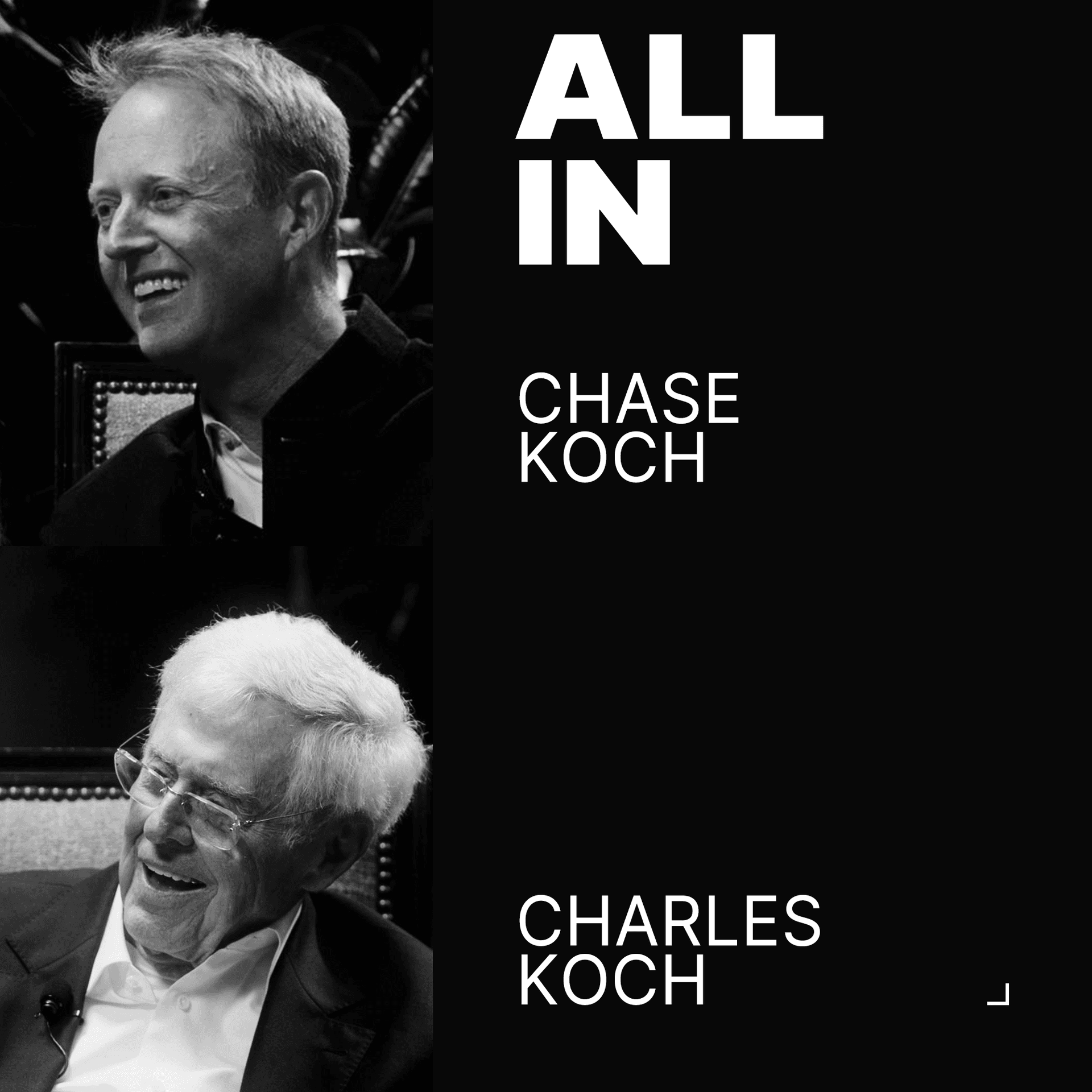
Charles and Chase Koch explain how Koch Industries grew into a ~$150B, private, family-owned empire by using “principle-based management,” capability-bounded expansion, and “experimental discovery” (creative destruction through iterative learning and controlled failures).
Guests and backgrounds
- Charles Koch: Joined Koch Industries full-time in 1961 after MIT; helped turn early, unprofitable operations into a profitable, globally scaled company. Focused on principles like customer value, employee empowerment, and reinvesting profits into new growth.
- Chase Koch: Joined the family business later (started working at ~15); built partnerships and later led technology/disruption efforts (including Koch Disruptive/Koch Labs). Background includes early hands-on work in Koch operations (e.g., feed yard work) and long-term roles across the ag business and technology investing.
Key claims
- Reinvest about 90% of profits into new businesses; grow by building capabilities, not being “industry bounded.”
- Culture change comes from values-first hiring and leadership that actually applies principles, not “sheep dipping” seminars.
- Failures are essential when they are real experiments that teach more than they cost.
Notable examples
- Fractionating trays: culture was protectionist and top-down; Charles changed management, built an Italy plant, and restored profitability.
- “Gas-to-bread spread” in agriculture (late 1990s): overreaching value-chain control; losses and integrity failures; “ass-to-bread spread” nickname.
- Hog feed acquisition: missed “out-of-the-money” contracts; hundreds of millions in exposure.
- Georgia-Pacific: acquisition used management/culture overhaul; example of changing leadership to enable bottom-up empowerment.
- Molex: initially underperformed until Koch principles were applied; then improved.
Written by AI. May contain mistakes. Listen to the episode to check what was said.
Chapters
Tap a time to open that second in VOThe Untold Story of Koch Industries
1:08 to 2:18
Exploration of Koch Industries' history, scale, and unique business model.
“always like to learn about the story of other businesses and the success of those businesses.”
Charles Koch's Journey and Business Philosophy
2:22 to 6:00
Charles Koch shares his journey into the family business and core business principles.
“Now we have more than 130 ,000 in 60 countries.”
Growth Through Failures and Learning
6:04 to 13:24
Discussion on the importance of learning from failures and evolving business practices.
“And because I was good at principles, and that's why we led.”
Overview of Koch's Diverse Business Ventures
13:28 to 14:02
A detailed overview of the various sectors Koch Industries operates in today.
“That's what I mean, we learned from failing.”
Koch Industries' Diverse Business Model
14:02 to 18:01
Learn about the diverse capabilities and business units of Koch Industries.
“We have four different investment firms with different comparative advantages.”
The Importance of Values in Hiring
18:01 to 20:10
Understand the significance of hiring for values over talent at Koch.
“Was it fair to say that you wouldn't consider an acquisition or a new business line if there wasn't some relatedness to an existing competency at the company?”
Lessons from Failed Leadership
20:10 to 24:25
Explore key lessons learned from past leadership failures at Koch.
“Maybe get them to go to work for our competitors or something.”
Building a Culture of Empowerment and Learning
24:25 to 27:24
Discover how to create a culture of empowerment and iteration in business.
“And this is the kind of trouble that you get yourself in.”
Principles of Bottom-Up Empowerment
28:00 to 30:18
Learn how bottom-up empowerment fosters a culture of creativity and learning.
“Most people in most enterprises that aren't owner operators don't want to fail.”
Koch Labs and Experimental Discovery
30:18 to 32:46
Discover how Koch Labs operates as a discovery group utilizing experimental strategies.
“And being in all these different businesses that touch almost every part of the economy, it gives us a big advantage in that.”
Show all 36 chapters
Acquisition Strategies and Culture Change
32:46 to 37:36
Explore the challenges and strategies behind acquisitions and cultural integration.
“Some of our businesses are going to become dinosaurs.”
Transforming Organizations: The Molex Example
37:36 to 41:08
Learn how changing leadership and principles drives cultural transformation.
“I'll just say that is such a rare and difficult thing to pull off.”
The Role of Values in Organizational Success
41:08 to 42:04
Understand the critical importance of values over skills and credentials in hiring.
“Pop, wouldn't you say that, I mean, the common theme on all of these, because we have the same story on Molex.”
Transforming Company Culture Through Talent Mindset
42:04 to 45:02
Learn how a values-first approach to hiring fosters a unique company culture.
“longer than you think to change the culture and almost in every case but I I mean, Pop, tell me if you agree with this.”
Private vs Public Companies: A Competitive Edge
45:02 to 48:25
Explore the advantages of being a privately held company in a competitive market.
“But yeah, no, there is a discipline, right?”
The Role of Founders in Company Culture
48:25 to 51:24
Understand how founder-operated companies can maintain a unique culture and vision.
“And so being private, being in Wichita, competitive advantages, what about being owner-operated or founder-operated?”
Chase Koch's Journey into the Family Business
51:24 to 55:42
Hear Chase's transformative experience working at Coke and the lessons learned.
“No, this is the most remarkable transformation I've ever been talking about.”
Chase's Relational Skills and Business Acumen
56:00 to 57:36
Learn how Chase's ability to connect with people fosters business relationships.
“He understands people and can relate to them.”
Comparative Advantage in Leadership
57:36 to 1:01:04
Discover the importance of recognizing personal strengths and weaknesses in leadership roles.
“So I worked in sales and in marketing and the accounting, the finance, like every piece of it, the trading.”
Empowerment Through Role Alignment
1:01:04 to 1:04:20
Explore how understanding roles can lead to employee satisfaction and productivity.
“So thinking about individuals, how do I self-actualize?”
Educational Principles and Personal Development
1:04:20 to 1:05:28
Examine how education systems can better support individual talents and motivations.
“like capabilities of creating value for others uh then then it's virtue and talents we we've talked about that then it's knowledge that's republic of of science uh creative destruction and all those things.”
Transforming Education for Individual Needs
1:05:28 to 1:10:06
Learn about the shift towards individualized education and its significance.
“from Milton Friedman when they're 10 years old.”
Transforming Education Post-COVID
1:10:06 to 1:12:08
Explore how the pandemic reshaped family views on education and the rise of innovative learning models.
“And one of the things that, you know, we do a lot of research on where public opinion is.”
Koch's Approach to Social Change
1:12:08 to 1:13:15
Dive into the Koch brothers' historical efforts in social change and their reflections on past strategies.
“where you don't know how to interact with people.”
The Meaning of Life and Power
1:13:15 to 1:14:52
Discuss the search for meaning in life and the pitfalls of pursuing power and pleasure.
“I mean, to me, they're the principles of human progress.”
Addressing Societal Ills Through Principles
1:14:52 to 1:16:44
Unpack the dangers of power and pleasure-driven society and the necessity for principled leadership.
“Then if you say, if you've given up and you say, well, I've given up, I'm going to go up for pleasure.”
The Rise of Socialism in Politics
1:16:44 to 1:18:44
Examine the increasing presence of socialism in politics and its implications for the future.
“it's a slippery slope to totalitarianism, authoritarianism, and socialism.”
Empowering Communities to Solve Problems
1:18:44 to 1:23:56
Learn about the importance of bottom-up empowerment and real-world success stories in social change.
“so there's a rising number of political leaders around the country.”
Addressing America's Economic Crisis
1:24:03 to 1:25:10
Discussion on the current economic struggles of Americans and the lack of mobility.
“Let me ask about the economic condition of America.”
The Argument Against Capitalism
1:25:10 to 1:26:35
Exploring the challenges capitalism faces and the impact of monopolistic practices.
“And let me give you an argument why it might not.”
Removing Barriers for Opportunity
1:26:35 to 1:28:06
Discussion on how to remove barriers for individuals to realize their potential.
“They're holding people back from realizing their potential, finding their gifts, realizing their potential, and succeeding by contributing.”
AI as a Tool for Self-Actualization
1:28:06 to 1:28:45
Debate on AI's role in empowering individuals versus creating wealth inequality.
“by comparative advantage which makes everything more expensive so it's just I mean everywhere you look, it's a tragedy.”
Innovations in AI at Koch
1:28:45 to 1:30:09
Overview of Koch's approach to AI and its potential for human empowerment.
“based on these principles of market-based management, based on these these principles of human progress.”
Writing a Book Together: A Father-Son Perspective
1:30:09 to 1:33:08
Chase Koch shares his experience writing a book with his father Charles.
“So listen, we're going to need to wrap in a minute, but before we do, Chase, what was the experience like writing the book with your dad?”
The Importance of Words
1:33:08 to 1:33:59
Discussion on the significance of language and meaning in communication.
Legacy and the Future
1:33:59 to 1:35:03
Charles Koch reflects on his legacy and the promise of the Declaration of Independence.
“Like bringing in AI and have AI as a principal companion to the book.”
Transcript
Automatic transcript. May contain errors.0:00David Friedberg:What an honor to be here. Thank you for hosting us, Forbes, and welcome. This will be put out as the all-in interview, so I'm really excited to share this conversation with everyone on the world, on the internet, and to get some time with Charles Koch, Chase Koch. Chase and I have known each other since 2013 when we overlapped in the agriculture industry, got to know each other. We've been business partners, and Charles and I have gotten to know each other a few times over the years. but I'm really excited for this conversation tonight. So Charles, thank you for being here. Thanks for having us.
0:32David Friedberg:It's an honor. I'm going all in.
0:38David Friedberg:Every few years, a new ad channel opens before the market catches on. That's Axon.ai right now. The AI ad platform behind one of the biggest runs in tech with access to over a billion daily active users. Full screen video ads in mobile games watched for a median of 35 seconds. Businesses are profitably spending hundreds of thousands of dollars a day on it. and most advertisers don't even know it exists yet. The window is open at axon.ai slash all in. In Silicon Valley, entrepreneurs and even mature company CEOs always like to learn about the story of other businesses and the success of those businesses.
1:13David Friedberg:And I've always felt like Coke Industries was that untold story. Probably the most profitable private family-owned business in the world. Maybe I'm off on a couple points, but certainly up there. and one of the most impressive business stories because of the evolution of the business, which I'm hopeful we can hear a little bit about how that evolution came to be tonight. And just for some statistics, if Coke were publicly traded, the revenue would put it easily in the top 25 of the Fortune 500. It's a family-owned business based out of Wichita, founded in 1940 by Fred Coke, with businesses ranging from energy, agriculture, chemicals, building products, consumer products, even cloud computing, and a very active minority investment portfolio with 120 ,000 plus employees.
2:01David Friedberg:That statistic might be off across 60 countries. Very unique operating model, which we'll get into today, including principles around disruptive innovation of the business, reinvesting 90 % of profits in new businesses and growth, meritocratic values. And I'm hopeful that tonight we can take an opportunity to hear about the evolution of the business and talk about some of those principles and maybe we can get started Charles if you could give us a sense of the scale of the business what are the business lines that you operate today and maybe you know provide a little more color to those high-level statistics I shared today I can go back through some of the history and the failures and successes but I'll go through what we've grown since the early 1960s.
2:48And then we had 300 employees. Now we have more than 130 ,000 in 60 countries. And we have increased in value 9 ,000 times over that period.
3:07David Friedberg:When did you join the business? In 1961, full-time, I'd been working. Well, my father, we lived on a farm, and he told me at age six he didn't want me to be a country club bum. So he made me work in all my spare time, which I hated. And so I was always in trouble. And so he was kind of tough on me, rightfully so. And thank God he did. Years later, I asked him, Pop, why were you so much tougher on me than you were on my younger brothers? And he said, Son, you plumb wore me out. When you came into the business, what was the scope of the business? What was the business operating? We had two main businesses.
3:59One was to design and make fractionating trays. That is, that they separate liquids by differences in boiling points. And then our largest business was a crude oil gathering system in Oklahoma. And so my father, and I was, I finished just a few years earlier, finished MIT, and I was working for Arthur D. Little, then a leading consulting firm. And I was, and you'll think this is a joke, at age 25, I was doing management consulting. I mean, I have to laugh at the
4:47David Friedberg:absurdity of that, but they were paying me for it, believe it or not. So my father called me and he said, son, I want you to come back and join the business. And as tough as he had been on me, And as I say, rightly so, I declined. So he called me a few weeks later and he said, son, either you come back to run the company or I'm going to have to sell it because my health is bad and the companies aren't doing well and I don't have long to live. So I agreed because I, well, for a number of reasons. One, the first one is I got three degrees at MIT in engineering, and I sucked as an engineer. I mean, get that.
5:42So how did you get through MIT? Because I was real good at the math and the science and the theory. and I was no good at making or operating things. So I figured out pretty quickly that I wasn't going to make it as an engineer, so I need to be an entrepreneur. And because I was good at principles, and that's why we led. So I was always looking for principles that would help me contribute and succeed. and that's what transformed our company.
6:24David Friedberg:So you come into the business, a couple hundred employees, you said? 300 employees. 300 employees. And how did you think, was the mandate to grow the business? Was it just to keep it stable? No, no, it was, could I take a few minutes to go through those first two businesses? Your show, I'm in. Yeah, that sounds great. Okay, the first one was making a fractionating trace. designing those. We had a president then who was one of our principals, you don't want to be. The negative is top down and obsessed with controlling everybody. So he would send out memos every week demanding on what they spent, how did you spend it on, what did you do what how did you do this right so they were first matter of fact they started ignoring him and then the whole culture was protectionist that is when you saw when they sold the internals for a fractionating tower they wouldn't tell them the design and why we need to know the design so we can correct it no they wouldn't give it to them and then and then what's even worse to satisfy the European market, they didn't even build a plant there.
7:46They had multiple subcontractors do parts of a tray and then bring them all together and assemble with another contractor. Now you can imagine how that was for speed and cost. So we were losing our ass, if you can excuse the expression. And so I changed the management and changed the philosophy. Okay, the first thing we're going to focus on is creating value for our customers. And then the second thing, we're going to empower our employees so they want to do this. And the third thing, we're going to do a plant. We're going to build a plant in Italy to satisfy the European market. We're going to do it all ourselves.
8:35And so we became profitable.
8:42And then we started adding related products. And I'll get to that later. But and and and so we started growing.
8:57David Friedberg:Can I ask a question? Yeah. You come in at 25 plus or minus a little bit and you see the problems at the business. It's not profitable. It's not being well managed. And you overturn the management team. How did you have the confidence at this age coming with the experience you had to take that level of action that quickly? Well, it was life or death. And my father said, you can run this business any way you want. The only thing you need my approval on is to sell. That's the way he talked me into coming back after I said I didn't want to, or I wasn't going to. And then in 1970, what really helped is my brother, younger brother David, joined the business.
9:46and then and then he continued that growth and then you're now running a
9:53David Friedberg:profitable operation you've got a European business and at that point did you start to think about expanding into other products and other well that's it and this is so I was learning all these different principles and and what I saw we were doing not here not just here but in other things is we were building Building capabilities, that is, I looked at it, we need to be capability bounded, not industry bounded. Like, okay, you could say to a certain extent, because we were in the oil industry, oh, that means everybody would say you need to be an integrated oil company, you need to be in everything.
10:35And I was applying to Visual Labor by comparative advantage. No, you need to be in the part of it, of the industry, in the part of the value chain where you can create more value than others. Otherwise, you're going to fail. And that's what we're seeing happening now. There's more specialization by comparative advantage. And so I created this principle called Creating Virtualist Cycles of Mutual Benefit. And what that led us to do is to start this never-ending cycle of growth, innovation, success, and failures. and failures that when we did it right that we learned from and made us better and taught us better how to apply principles to create value and we're still going through that we have a lot of failures and that's when you when you apply creative destruction in your new things if you're not failing at everything you're not doing anything new where did you learn that lesson
11:54David Friedberg:so what was the first major failure that you know they always say you got a plan until you get punched in the face what was the first punch in the face well I had a bunch of them with uh with uh with with that company it was called coke engineering then and like like I said okay we're when we got into refining we created petroleum coke so I said let's come up with a way to to use that as base to make activated carbon and that was a fair we spent a fair amount of money on that And we had a whole bunch of those. And we've had many more. How did you make the decision to shut it down or walk away?
12:35David Friedberg:At some point, a lot of entrepreneurs have this problem. They build something, they're too in love with it, and they don't know when to say enough is enough. Yeah, well, when enough is enough, when we lose our ass enough. No, it's when we decide we don't have the capability to create superior value for our customers and that we're going to be rewarded for. And sometimes it can be the structure of a business. Like a company that case found, the co-disruptive technology, Insight Tech. It does tremendous things, but it is a structure that makes it hard to make it profitable. And so that's the other thing.
13:20So that's another, these are principles that we've learned. Okay, we didn't apply that. What were the principles that we didn't apply that caused us to fail? That's what I mean, we learned from failing. So the businesses where, you ask the businesses we're in now, and Jason, there's Koch people here. You all can catch me up if I, the ones I miss. But we have engineering projects, engineering construction. We have, we build solar plants. We have commodity trading and distribution. We have fertilizers. We have refined products. We have chemicals and polymers. We have glass. We have forest and consumer products.
14:11We have four different investment firms with different comparative advantages. And we have electrical products. And we have software systems for management. Dave, let me just hit one point. Did I miss it? No, you got it. You did a great job. I mean, basically, like, eight wholly owned business unit platforms that he described and then four investment, different businesses. But I just wanted to kind of really drill a point home because when I came out, when I started really hanging out with you and the whole tech community and trying to, like, build that network, a lot of people have the same question that you did about who is Coke, what are you guys all about?
15:04you know I know it's a large private business but being in Wichita, we don't know that much about it. I think this point that is so different about Coke versus almost any other company out there is what my father said on being capability bounded not industry bounded. And you know how do you get from a small crude oil gathering company in southern Oklahoma to all of those businesses that he described. And there's I mean the principles obviously throughout which we'll be talking about in this discussion, but one of the absolute core differences is that whole approach to capabilities. And I would encourage anyone that's in a business and trying to scale, think about it from that lens.
15:47What capabilities have I demonstrated that I can add value to customers and then point it at new industries where I can experiment? This is one of our one of our principles as well, experimental discovery. Not trying to do everything at once and trying to conquer the world but experiment and test does the customer value my product or not and then along the way you know those those core capabilities for us started off as operations logistics trading in the very early days of coke that's what we demonstrated we were good at we were getting great customer feedback but then when we had the capability approach to say okay we started in energy, started in crude oil gathering pipelines and refineries, can we point those same capabilities into natural gas?
16:37Can we point those into chemicals? Let's experiment there. Can we point those into fertilizers? Because then we learned about natural gas. And then then the Georgia Pacific opportunity comes along and it's like hey these are wood products. It doesn't seem similar to these other businesses but it's the same core capabilities we buy Georgia Pacific and along the way it was somewhat of a happy accident that we started learning about consumer products and branding. So branding became a new capability for Coke through acquisition but it started with where do we think we can add value and do a good job on that and collect new capabilities along the way.
17:18So I think that's like a really simple way to think about coke and it's over the course of time like how we're different one other thing i'll mention too um because i've been asked many times it's like well so is it sort of like um you know berkshire hathaway where you have all these different businesses a conglomerate and uh i would say no i mean obviously warren buffett and his team have done an unbelievable job operating the business the way they have but we think about our business very differently instead of operating them all as independent businesses in almost like in silos, think about it as a republic of science.
17:57We're not a conglomerate. We're an integrated set of capabilities.
18:02David Friedberg:Was it fair to say that you wouldn't consider an acquisition or a new business line if there wasn't some relatedness to an existing competency at the company? It depends. I mean, as you see when you read the book, we went through one chapter on creative destruction and what Schumpeter called all the different ways to do that. And one is to create a new management approach. Okay, that's our biggest one. So the question is, when we bought Molex, it makes electrical connectors, which has done fantastic. And at first, it wasn't doing great. So we said, we think if we can get them to apply these principles, it will turn them around.
18:52And we didn't. The problem when we do that, the tendency is to learn the lingo. And so you can call everything by these names, and you still do what you always did. And that's what was going on there. And so finally we got in. No, we had changed the management. And once we did that and they started applying these principles, they took off and now they're knocking it out of the park. But let me go back to failures because, I mean, we're understating our great strength in failures. And that is, I'll give you our worst failures. and what caused it. And it caused this by violating the principle of hiring people first on values and second on talent.
19:55And what I've for years I've told people, look, if you want to hire somebody with bad values because you like them or something, hire them slow and stupid and so we can catch them real quick and get them the hell out. Maybe get them to go to work for our competitors or something.
20:16David Friedberg:Maybe help them get a job. But anyway, that was huge. And then we made that even worse by taking people who were, had terrible values and made them leaders. And so what we call that is rather than we want everybody in the company to be contribution motivated, that I want to succeed by contributing, I want to be rewarded for my contributions, not for anything else. And the value I create for our customers are for the future. And so they would, some of these people were destructively motivated. What they wanted was power or control, and they would hide their failures and make up their successes.
21:16And so I'll give you two examples. One goes back to 1973. You remember the war in the Middle East and everything. And they had gotten us into all kinds of wild, reckless trades. So that could have bankrupted the company. me. And then later, because I mean much later, so it shows you that that repetition penetrates even the dullest of minds, so I needed this to happen a bunch of times. So it finally, okay I got it, I got it, God don't punish me anymore please for my stupid mistakes. So this was, we did it about the same time, our ag group. We put leaders in who were destructively motivated. And in refining, we got a leader.
22:11And they were destroying those businesses.
22:17And so it didn't almost bankrupt, but it almost wiped out all of Koch's earnings in the late 1990s. You'll appreciate that. So does that give you a flavor? Yeah. So you'll appreciate this being an ag guy. To go a little deeper on what happened in the late 90s in our ag business, we called it a strategy the gas-to-bread spread. So we wanted to basically be in every element of the value chain, all the way from pulling the natural gas out of the ground, converting it into fertilizer, making the nitrogen products to grow the crops that would ultimately then end up on the grocery store shelves and being bread.
22:58We got in pizza crusts, all this crazy stuff. When you look back on it, you're like, what the hell are you doing? But it was what he was saying. It's like leadership thinking about we can do anything. And if we could basically kind of control the entire value chain, like we can make that successful, completely violates probably all 41 principles in the book, right? Experimental discovery, knowing where your capabilities are, right people, right roles. And so, yeah, we called it the gas-to-bread spread. Some people called it the ass-to-bread spread, too. And there's another one in there, integrity.
23:38Because when they knew there were losses in some of these, and then they wouldn't tell us they wanted to go ahead anyway. We had a deal within that, you know, like purine a dog food. So one of the things that was acquired was the large animal feed business. Mainly hogs. It was mainly hogs. Yeah, so hog feed. And did no diligence, and this is one of our principles, to apply the scientific method. So disprove your hypothesis as much as you try to prove it. And so we closed that acquisition, and within days, we found out that we had hundreds of millions of out-of-the-money hog contracts. We didn't even look at the contracts.
24:20So, I mean, that's when I think this is really important for founders that want to grow, right? You have this growth at all costs mindset, and you start not asking why not. And this is the kind of trouble that you get yourself in.
24:33David Friedberg:So, let's go back to the management piece. How do you take these principles which you've applied successfully to, I would use the term iterate because for me, like failure is all about iteration to success and finding paths that work, finding businesses that work and ultimately finding people that work. But how do you drive that culture that represents the principles? Because you could create a book and give it to all your employees and say, guys, here's 41 principles. We've sat down. We've thought about it. We've written them. They're going to work. But to actually live them, to realize them, to hold people not just responsible, but accountable to them.
25:09David Friedberg:how do you how did you do that as you develop these over the decades because at first we tried to get them do it through sheep dipping that is you take everybody in you give them a big seminar and i'll go do this and from polani we if you want to read a book that's hard to read i mean if you want really hard one you can read human action this is even harder called personal knowledge by Michael Polanyi who was a chemist and then became a philosopher.
25:45And he goes through what it takes to develop personal knowledge. You have to rewire your brain to have it work differently, right? You have a habit, so you don't need to think about it. And then if you want to change, like, do I brush my teeth first or do I comb my hair first? No, I want to start combing my hair first. And all of a sudden, you're back brushing your teeth first because you're not thinking about it. And so because your brain gets, I mean, you know your body. Let's say you're a weightlifter and you want to be a marathoner. Okay, it's going to take work with intensity over time to change your body.
Read the full transcript
26:27well, your brain's part of your body, so you've got to do the same thing. So we said, okay, we've got to start with, okay, let's find a group that's really interested in this. They're struggling. They're having problems. And here are the principles, and we'll coach them. We'll help them start doing it. And if they work with intensity on it, and then they succeed, then we don't need ship dipping because then the other businesses and capabilities says, gosh, I'd like to do that. So you don't need to call them in. Then we have more demand for people who can help them. And the hardest thing is to have our people in strategy or our principal-based management group who are really good at helping them.
27:17And boy, they're in more demand than anybody.
27:20David Friedberg:So the best thing is success will drive social mimicry. You'll see others. That's it. Here's another take on what he's saying that I think really connects about culture to your question. And that is the essence of principle-based management and all the principles in this book as well. What if you could have a business and a culture, small, medium, or large, where everyone knew what to do without being told? And so that's hard to get your head around, right? because I think most businesses come at it from top down. There's the iconic leader that's the smartest guy in the room, building the strategy and then telling everyone what to do.
28:01And so I think one of the most important principles in this that we tell a lot of stories around is to flip that on its head, and it's about bottom-up empowerment with principles and empowering your talent, your team, your leaders with these principles so that then you use the collective knowledge of everyone, not a couple smart guys at the top of the company.
28:22David Friedberg:Most people in most enterprises that aren't owner operators don't want to fail. They want to keep their job. They want to move up the ladder by being repeatedly successful. And if you want to create a culture of creative destruction, if you want to create a culture of failing and learning from failure, it's very hard to get individuals who live on an income, on a salary to do that because if they fail and then they fail again and they fail again, I'm worried about losing my job. So what you typically see in most scaled organizations is middle management and even senior management when founders or owners don't operate it anymore, saying, I'm going to take the less risky path.
28:58David Friedberg:I'm going to do the less creatively destructive thing. I'm going to do the thing that's least likely to fail because I don't want to lose my job. I want to keep my job, get my bonus, move on to year two and go home to my kids and my wife and take care of the family or whatever the family situation is. And that's my objective. See, and that approach creates perverse incentives. And so we try to align our incentives that we want to reward people according to their overall contribution to Koch's future. So, for example, if they have an experiment, and that doesn't mean doing this thing in ag where you buy all these hogs and you lose hundreds of millions of dollars over what, that's not an experiment.
29:48It's an experiment. A good experiment is where the value, what you learn from this is higher value from this failure than the cost of the experiment. And so when we do that and we're evaluating what the person, you are building capability for the future. That's why we put so much emphasis on are you building capability? And capability, part of it is the culture. And what Chase did with Koch Labs when he started Koch Disruptive, he said, Koch Labs, I want every business to be a laboratory for what we find, both to help us source these opportunities, these tech opportunities, and then we'll let, if they're just trying something, we'll try it out in that business.
30:46And being in all these different businesses that touch almost every part of the economy, it gives us a big advantage in that. But that affected the whole culture. I mean, in your business, don't you want to be part of Koch Labs? We're an experimental discovery group. We're just not a bunch of grunts here grinding stuff out. Yeah, I think the KDT example is a really good one because you asked about motivating and like, what if you fail and then what if you get fired and all that? We tried to basically take a little bit of the Silicon Valley approach and bring the experimental discovery. You learn more and you pivot and learn, have a failure.
31:27But then now I know what I don't want to do. I'm going to pivot my strategy to what may be working. I'm going to keep trying as long as you don't go sync the company with some massive bet, right? and I think KDT was a great experience like I call you know when we did that when we made those first investments you know this in venture you're the the losers fall out first and the winners take a hell of a lot longer to to materialize so if we would have just judged it based on okay guys you got three or four years to figure this out we would have shut down KDT because we you have but but it was that experimental discovery principle and mindset that we applied to it and oh by the way we were learn we were learning so much as coke from seeing the technologies that were coming around the corner that might disrupt our core business and so we value that learning and we rewarded the people that were bringing that knowledge in if you just look at it on the bottom line basis in the first couple years you say just shut this down right but then over time like all these different things and then the returns are starting to come because we thought long term about it.
32:36But it all came from that experimental discovery, one principle, and then creative destructions. Like if we're not in the game on technology and we don't see what's coming, something's going to happen, especially with how fast technology is moving today. Some of our businesses are going to become dinosaurs.
32:53David Friedberg:How much of that risk were you willing to take and did you take on acquisitions? So doing homegrown experiments on new business ideas and strategies and products can be lower cost. But if you're going to do an acquisition, do you have less room for failure? Well, how about this? We were a much smaller company and we bought Georgia Pacific for$20 billion. Can you just tell us what Georgia Pacific is for those who don't know? It's a wood products company and it's got two big pieces to it, building products and consumer products. Well, it's got a third one, but yeah. Okay, I'm generalizing. But go ahead.
33:28Sorry, no, no, no. I'll shut up. shut up you old guy no no no um but but anyway but on on that one when did you buy it and how big of a betting the company move was that the 2005 that was yeah we were much smaller in 2005 i can't remember how much smaller but it was a lot smaller it was a massive bet how did it come up Okay, we were applying this virtual cycles of mutual benefit. We were saying, okay, what's one of these cycles are chemical process industries. And wood creating the pulp and stuff was, matter of fact, we found in my father's thesis, he he he did a a study in maine on this very thing on pulping i mean i found it later but his mit thesis yeah yeah wow so we said okay let's look at the oh and they were they were saying they need to spin off some of those parses the pulping part and we said okay let's buy that and we bought that as an experiment and we did real wealth with it and so we said wow they they have other because that was a commodity business and they were trying to get their price earnings ratio it was like six and if they became more of a consumer products they could get it up to nine.
35:07So we proposed, we met with them and proposed that we buy the commodity part and we'll pay them a high enough price that then they can be all consumer products and get their price and we showed them all the economics and they said that's fine but we'll be sued for constructive fraud because we all have all these lawsuits against us. And so we can't do it, but we like the value. And so we went home and said, well, okay, what if we just offered the whole thing? And a couple of them were getting ready to retire, and the senior officers, so they were really liking it. and they were kicked out of all the board meetings from then on.
36:04But anyway, so we sold them, and that was a time when money was tight and stuff, so nobody came in and topped us. I'll give you just one funny story. We sent one of our people to be the CEO, Joe Moeller, who had been president of the company, and uh and and and he they had it was totally top down bureaucratic they were in atlanta they had this 51 story building there's a 51 you can correct me that's right yeah you got it and and they had a private elevator to get up there and you didn't have to wear a coat and tie but if you came up to visit all the management was on this 51st floor and you had to put on a coat and tie and get permission to come up there and so joe immediately kicked them all out well we fired a bunch of them and then set the remaining ones down to work with their groups and on the regular floor and then regular floor and then turned it all into offices i mean into Meeting rooms open to anybody.
37:19And so that, I mean, you asked about how you get culture change. A lot of business signals like that, particularly when a bunch of them get fired for being so bureaucratic and hierarchical.
37:30David Friedberg:Would you say that that business unit operates like the rest of Koch Industries today? Oh, absolutely. But how long did it take, Bob? I'll just say that is such a rare and difficult thing to pull off. I mean, there's just countless stories of acquisitions where the acquirer thinks that they have culture, thinks that they know how to transfer culture, and literally no one seems to be able to do it. This was one of the insights from Warren Buffett is you find great managers, you let them continue to operate as owners of that business, and they get some profit share or whatnot, and they've got a durable moat so he can make a long-term investment, and he just leaves them and that's all.
38:05Yeah, but that wouldn't work for us, the stuff we buy. Let me give another one, if I could, that was even more difficult. And that is, sadly, my father died not too long after I came with the company in 1967, and we had owned an interest in a small refinery in Minnesota. And so, but two years later we were able to buy it and and it was not being operated very well because the management had let the union control how it was run and so it was run very inefficiently and so the first thing we tried to do is change the work rules. So they went out on strike. And by the way, that was at the start of my honeymoon.
39:05Thanks a lot, guys. And it was violent. I mean, they ran a switch engine and tried to knock down one of our units. They shot high-power rifles in there, and they blocked the gates. I mean, it was impossible to get in there. We had to take helicopter. But we were successful in operating without the union workers for nine months, bringing people in from our other plants, and it operated better than they did. So finally we got the work rules changed, and then we said, okay, we're going to empower the employees. We're going to change the culture. Now, you think that Georgia-Pacific was tough? this was much tougher than that and and so we we we worked and work on it to try to make their jobs better get their opinions get them to work as teams get them to come up with innovations and when they did we reward them and we got the unions to agree with that and and like like one they said a group of them said god we're buying all these spare parts we need uh we can if you if you build a machine shop we can do it cheaper and faster and they did and then other things they saved ton of money for us made things more efficient and now the culture there is fantastic you i mean i mean we're talking about we're not talking about wichita we're talking about minnesota So, I mean, we're so proud of what they've done, and it just, it still blows me away how much they've taken these principles to heart in using them to make that place.
41:01So we've increased the capacity tenfold, and it's one of the best refineries in the country. Pop, wouldn't you say that, I mean, the common theme on all of these, because we have the same story on Molex. you know similar similar but different than Georgia Pacific this was a technology company a connector and cabling a connector company one of the largest in the world that makes products in your iPhone and med tech products your automobile and when we bought that in 2013 it was a Paradigm that needed to be changed you described Georgia Pacific top-down versus bottom-up there was a lot of that too but it was top line thinking versus bottom line thinking it was all about revenue growth right this is a technology company and it was also a public company for 30 plus years as well because the market rewarded and for and so like the whole stock price the public versus private discussion is interesting here and it just what we've learned is it takes a hell of a lot longer than you think to change the culture and almost in every case but I I mean, Pop, tell me if you agree with this.
42:10But in almost every case, it requires changing leadership that has the paradigm of bottom-up empowerment and that learns and applies the principles. Almost every time when we fail, it comes down to ignoring the principles. And that's what the book is about. You can kind of reverse engineer these stories like, well, we missed that principle, we missed this principle. But it comes down to talent and the right people with the right mindset. And I want to share just one story with you that really shows like how we apply this at Cope. He talked about our talent vision being you start with basically culture first, you know, skills second, values first, skills second.
42:52I always add a third dimension to that as well. Values first, skills second, credentials last. And that is a very different mindset than most companies because most companies I think look at it and say, I want the guys, you know, that have the 4.0 from the ivy league school and all that and there's some incredibly smart obviously folks from that but by by our um experience and also is one of the reasons why we stayed in wichita kansas is that we can basically hire the farm team right kids that have grown up on the farm that have that contribution motivated mindset that work their tails off and want to come in to make a contribution as opposed to coming in expecting all this stuff and coming in with more of an entitlement mindset.
43:38So we, case in point, our CIO today, his name's Jared Benson, his first interaction with Coke was based striping lines in our parking lot. So no college degree whatsoever, but he found his way into Coke because he demonstrated that, hey, he knows a little bit about data science and he could help us. This was about 20 years ago. And then ultimately he came in, he proved himself. He was running circles around a lot of the team and like just, you know, contribution motive mindset, adding value. He saw the cybersecurity risk in that wave coming, built a whole capability to protect us from cyber attacks.
44:18And then now he's CIO of the company, guy with no college degree. So, I mean, that kind of mindset in terms of our talent vision and like that values first and someone that just wants to come in and they they just love the job and they want to make
44:34David Friedberg:a difference do you actually codify these principles and everyone at the company has a handbook that lists them out and then they're part of the assessment process for quarterly or annual reviews with people yeah i mean obviously there's the book and he's this is his fifth book it's my first but but so um good profit science of success we have it's my best book because of But hey, Brian, what we did is pretty good too. Hooks won't like that. Right. But yeah, no, there is a discipline, right? And really it comes down to the leaders taking it seriously. And the leader's first responsibility is to help their people.
45:14David Friedberg:Okay, I'm going to put my analyst hat on for a second. Yeah. And I'm going to say my observation, I would create a theory. we can test the theory right now, that being in Wichita, being founder or owner operated, and having this ability to be isolated from a monoculture. I just feel like Silicon Valley, a lot of companies replicate each other. You have to kind of, there's this term that's being used a lot now, over socialization. You have to operate like everyone around you, or you're not part of the, you have to fundraise in the right way and do these deals. You have to hire people this way. You have to do this sort of vesting schedule, this sort of equity.
45:53David Friedberg:Everyone's the same. And if you don't, you're kind of a weirdo. But by being in Wichita, you don't really have that problem. You can think your own way. You can challenge yourselves. You can debate. You can come up with your own principles without feeling like everyone else is conforming to the groups around you. But they can because there are a bunch in Silicon Valley that are challenged. So they're not all that way. They're not all. Yeah. But has it always been a competitive advantage? I mean, did you ever think to move the headquarters to New York City? No, but the main thing, we've never thought of that.
46:26But what we've, sorry about that. I mean, there are advantages of being in New York City. I mean, you have a great mayor now, so they're good to go. But anyway, that's a competitive advantage. That'll be a clear. But this is, no, but the main threat we've had is we had SARS that wanted to go take us public. And I said it would be over my dead body, and some of them thought, well, that would be a good idea. Just like they're thinking about Trump. A lot of people still think about it. I get a lot of nice notices of my imminent death. And they say, okay, your brother died. We hope it was, I know this is painful, but I hope it was slow and painful, and I hope Charles is even worse.
47:21That's the kind of crap we get. But anyway, what the biggest is, the push has been for us to go public. God, we'll be worth so much and stuff. But I think our view, we never could have accomplished what we've had. First of all, we never would have built a principle-based framework. And then we never would have been able to pull off this capability-bounded versus industry-bounded. Because then, I mean, people don't understand it. Now, if you're Buffett and you've sold that long, then people, okay, but he wasn't trying to integrate them the way we do. No one would believe it. and that's because you've got to have a story that the analysts can understand.
48:22Otherwise, we would, like Georgia Pacific, we would have a low price earnings ratio.
48:26David Friedberg:And so being private, being in Wichita, competitive advantages, what about being owner-operated or founder-operated? There's this argument that the best Silicon Valley companies or those who are founder-led for as long as possible? Because the founders are willing to destroy the business creatively. They're willing to think about what's over the hill, make the tough decisions, reinvent the company, hire and fire as needed, be willing to take the short-term financial loss for the long term. Have you been able to get that to distill down into the organization? Because that's the thing that most public companies that are not owner-operated deal with and struggle with is managers that are short-term incentivized and aren't and can't take the big risks and the risks of failure that you're able to embrace.
49:11No, but I think it depends on the values of the owners. One of our principles is that any good partnership of any kind, whether it's marriage, friend, employee, partner, requires three things. It requires shared vision, shared values, and having complementary capabilities that you use to make each other better. And if you'd miss any one of those, you're not going to have a lasting good partnership. And so I remember I was to the YPO group in Wichita. I was presenting, this is like 20 years ago, presenting what we were doing and why. And one of them said, well, how do you get that to work in a private company?
50:02company and and I answered well no it's easier than a public company just like I did and then I I thought who it was and he was talking about his father his father was a total dictator and there's no way he could apply any of these principles in that so it all matters It matters who the owners are and what their values are.
50:29David Friedberg:Can a public CEO that doesn't have a big ownership stake in the company adopt these principles and transform the culture of that company? If you can sell it like Buffett has, but I mean he wasn't doing these principles, but he had a different principle. And that is I'm going to buy companies. I'm not going to take top price. But what's meaningful to them is they run it. so I'm going to buy it and let them run it. And so that was his value that he sold that made him, well, the other one was buying insurance companies so you'd have a lot of liquidity to go do all these things. And those two things are what made him successful.
51:11Right.
51:12David Friedberg:Chase, I want to just go back to your getting involved in the business. We didn't get into that. But how did you get started at Coke? And were you always a believer in the principles from a young age? to where you were around the organization, around your dad. Are you kidding? I'm going to chip off the old blocks. It took me a while to come around. No, this is the most remarkable transformation I've ever been talking about. I'm all even... This is the primo. Here we go. Unbelievable. Do I get to tell my story? To the absolute bottom, to the absolute top. No, he's blown beyond me. He's doing things I wouldn't even dream of or have the capability to do.
51:52So he'll correct me 10 times as I tell the story. Well, because you're too damn humble. So I didn't start when I was 6. I started when I was 15. So he cut me some slack. But it's because I was a pretty competitive tennis player. He was nationally ranked. Until I was 15. He was nationally ranked. That's the first time. So, but at 15, I got burned out. You know, tennis, like typical story where I wanted to hang out with my friends. I wanted to have a good time. I was tired of playing six hours a day. So I started throwing tennis matches intentionally to get out of these tournaments. So I go home and party with my friends.
52:32And he said, look, your attitude is terrible. You can either give 100 % on the tennis court and apply yourself or I'm going to get you a job. I said, I'm sick of tennis. I'm done with it. And so I had the job was figured out the next morning for me. Yeah, but I'm going to interrupt again because this is important. He thought he would get a nice, cushy job in Wichita so he'd go out and party with his friends at night. Yeah. Well, you know, I may be old and slow, but I'm not that slow. Yeah, he was kicked out of a number of schools. I was born at night, but not last night. But yeah, so...
53:13David Friedberg:It's probably a parallel story movie that could be made. Yeah, no, seriously. There really is. Yeah. But basically all my s*** was packed for me. and it was thrown in the back of a truck and six hours later I showed up at a feed yard and I lived in a single wide trailer the whole summer with my boss. I slept on the floor, worked seven days a week and just shoveled cow shit and dug post holes. No, Poppy Boyles, I forgot about that. You were Poppy Boyles. Let's keep it manageable here. So anyway, but the interesting part of that story, even though I went from literally being like, you know, kind of country club rich kid to to doing that within 24 hours.
53:59It was an absolute transformation for me. The fact that he kind of he made me do that. And I chose, but I didn't know what I was exactly, you know, choosing. But by after, you know, I was a month or two into this job, I started like actually feeling like better my better about myself you know it's like i hadn't really made a contribution up to that point in life and then i'm actually i'm working with a team i'm getting paid minimum wage i'm working my tail off i'm adding value even though it may be like just menial work um and this is i go back to um a letter that his father um you know wrote to him and the and his other three brothers No, no, my older brother.
54:44Your older brother. Because I was three months old when he wrote it. This letter about basically like when I pass on, you're going to get what seems to be a large sum of money. I hope you don't squander it. I hope you don't use it for better. I hope you actually apply yourself because I want you to feel the glorious feeling of accomplishment. And it's a really amazing letter. He has it hung in his office. But I, you know, that was the first time I felt that even though it was working at a feed yard. I was like, this feels good, actually. You know, I could have gone down the path of, you know, just kind of staying on the tennis circuit.
55:25I have no idea where I'd end up in life had I had I not gone down that path. And so I basically worked every summer for Coke from that summer on. I worked in the gas liquids plant. I worked in our refineries all the way through junior year in college. I always had a Coke, you know, kind of summer job. But, um, another, so that was an absolute, like, transformation for me in my life. Let me, I give you one more credit here. See, he has great humor, which is great. And that is, Chase has, I have this gift for abstractions. He's like his mother. He has a gift for people. He understands people and can relate to them.
56:07and he can go around like she can or Sterling Barner, who was our president of the early days, who, by the way, was born. His father ran mules in an oil-filled camp, and he was born in a tent, and they damn near died. Never went to college. And... and And he could, whoever he met with wanted to do business with us. And that's the way Chase is. He goes around, meets these people, and all of a sudden they're friends and they want to do business. And that's true for staying together, too. Go to people, you think, oh, they don't want these capitalists or these free enterprise people to do business with them.
56:59and he gets them on our side and shows them the value of these principles. Is that fair? Whatever you said. No, I mean, that's my job. That's what I do now. Origination of partnerships. And by the time I met you, that's when I started getting into technology and trying to build a new community so that we could get access to the most disruptive founders. but one quick story I want to tell because I think it'll be helpful for your audience as well that we haven't touched on yet is the principle of comparative advantage is another meaningful like total shift in my job at coke and my role at coke but also in my my personal life was when I was running the ag business this was this was later on we talked about the late 90s the gas to bread spread and all that this is a separate business with coke fertilizer I spent 10 years in that business really understanding the operations of a business.
58:01So I worked in sales and in marketing and the accounting, the finance, like every piece of it, the trading. And I ran a lot of the smaller business units. But at one point, my boss at the time wanted to add a whole natural gas trading business to it. So he's like, hey, I want to put a parent company called Ag and Energy Solutions. And I want you, I'm going to throw you the keys to the fertilizer business. you're ready to run it and so i was promoted to president of coke fertilizer at that time and about nine months in i realized that i was not the guy for the job and i walked in my boss my boss's office and fired myself and the humiliating right it's like especially being the boss's son and like thinking about oh my god i'm a failure you know i could i couldn't make this work the business was still doing fine but i wasn't doing a good job as a leader and i knew there was someone else that had the comparative advantage to be a great operator CEO, you know, president type role.
59:01And so I learned through all that, call it a failure, and in that job, that I wasn't an operator, and I wasn't a good optimization type leader, and I was a builder. Like, all I wanted to do was go work on the innovation stuff. That was about the time I met you and I learned about Climate Corp and all that I just wanted to go focus on that and then go build the stuff you know this whole idea of creative destruction that would disrupt the core business that I was running and so that whole thing around like understanding your comparative advantage what you're good at and what you're not relative to others that could be doing that job was a huge deal and like my hope was that that was a little bit of an example for other like Koch leaders as well.
59:49It's like if you're not in the right job, like, you know, you don't have to like fire yourself, but but figure out where what your power alley really is and where you can contribute and and and add the most value. So that experience for me, what was amazing, if you look at like what happened after that, we we got a great president to continue to transform the fertilizer business. It's one of our most exciting businesses today and we keep growing with it. So that did better than it would have done had I stayed in the role. But then all of this led to Koch Disruptive Technologies, which we talked about, which is a totally, you know, an innovation platform for Koch to see around corners.
1:00:33So like that one move made one large business much better and also created a whole new thing, right? And so, like, I always think about it. It's like we have 130 ,000 employees. What if that one principle, comparative advantage, what if everyone, like, deeply understood that and redesigned their role to where they are truly, like, in their power alley? And what are the results of the business if we could do that? You're never going to be perfect, but that's the vision that we have and how we apply it. For the organization. For the organization. So thinking about individuals, how do I self-actualize?
1:01:11David Friedberg:How do I find my path of purpose, happiness, success in life by leveraging these sorts of principles in a world that feels radically transforming and continuously constrained? I don't have infinite flexibility. I'm not on the board of Coke. I'm not on the board of my company that I'm employed by. How do I find a path in this world? Because I do think many people today are struggling for that sense of purpose, for that sense of identity, for that sense of realizing their potential and feeling fulfillment in work today. Well, that's, I mean, that's critical. And that's That's why we have, what, 20-some thousand supervisors in the company.
1:02:01And so this is one of their top jobs, is making sure that each employee is in the right role. For example, they're working hard and trying, and part of the work they're doing well in and others not. Well, rather than beating up, you've got to keep doing better. Like there's certain things if you told me I had to do, I mean, I'm good at concepts and logic and math, and to go do something else that's quite different, I mean, I'd be a total failure. And you could whip me till I was a grease spot on the floor and I couldn't do better. And so that's the role of the supervisors, to not go tell them, okay, your role is to go do this.
1:02:48and they're just trying it harder and harder. And so you're making them miserable. And so they hate you. They hate the company. And so that's the way you empower them. That's what Maslow said. He said that everyone has capability. And if you don't develop it and apply it in a way that creates value for others, you may be successful. monetarily or in some way but you'll be deeply unhappy your whole life because you won't be fulfilling your nature your nature and i know what mine is i know what makes people say well you're 90 why don't you go out lie on the beach i said what you want me to die i'd be dead in in a week it's not your nature no it's not my nature my nature is to is to i have this gift and a lot of our people here may say yeah you damn right you use it too damn much so what keeps most people from realizing their gift well I think part of it is an education system so the schools need to be set up okay we're gonna help you find your gift and what you're passionate about and and and and what is motivating to you so the whole system demotivates you and that's what the way businesses are managed you're demotivated our whole deal that's why we we have five dimensions in the in the way we apply this the first is vision you've got to get the right vision like capabilities of creating value for others uh then then it's virtue and talents we we've talked about that then it's knowledge that's republic of of science uh creative destruction and all those things.
1:04:39And then the final one is motivation. And so that's what we need to do. And like Joe Lamont has created this school, he says 90 % or 80 % motivation. And so you have games, you have other things that the kids can do that they learn from and enjoy doing and they want to do more. And that's, I mean, I raised our kids with these principles and I made them do it. So I was piss poor at applying my principles in teaching him this, and he's doing it. He makes a game out of it. He has them reading the book and parts of it, and then they have competition on who can do it better and who's living up to this better, who's applying this principle better, and they're loving it.
1:05:26Yeah, I'm not having my kids listen to books on tape from Milton Friedman when they're 10 years old. Oh, Aristotle. Aristotle. There's plenty of them.
1:05:36David Friedberg:um but um but let me just make you call it you were told or suggested or encouraged to listen to aristotle on tape as yeah yeah yeah no he wasn't encouraged no we'd go sunday evenings i gotta take a note for my elizabeth and and chase and i would go over to my library and i would play these tapes i'd only play it for 10 minutes because i knew chase's attention span little elizabeth was on it boy she was on it she ran circles she was getting straight a's and everything and chase would fall asleep and then then after 10 minutes i'd wake him up and okay what what was his point here is a test every 15 minutes and then you may have seen on on where was it where you talked about uh about you we we worked together to do your air story Oh, yeah.
1:06:28The term paper. Yes. And why don't you tell that story? Okay. Well, I mean, we had a fifth grade paper. Like, choose your philosopher. Write about it. You know, it's got to be 500 words or whatever. So I came up. I was like, I don't know. Like, what philosopher am I going to write about? And so he's like, you're going to write about Aristotle. And we're going to work together on it. But I learned a hell of a lot about Aristotle in fifth grade. and I turned in the paper and the professor had a lot of red ink all over it and said, F, you did not write this. And so I'm like, oh God, you know, this is so embarrassing.
1:07:06And so I took it back to him and I told him, I said, Pop, we got an F on our paper. No, you said you got an F. Yeah. And so, and then I didn't think he was going to pick up the phone and call the teacher. So he said, you know, Dr. Cohen, I'll never forget this. I was hiding under the table during this phone call. He said, Dr. Cohen, you know, I helped my son write this paper and he learned a lot from it. And yet, you know, do you not want me to help my son? Do you not want any parents to help their kids like learn? And he said, you know, I think you have a point, Mr. Koch. And so the next day I come back and it had 90%.
1:07:51written on the top. See, I made a contribution. Let me go back, it's a great story, I know, but let me go back to something I think you were getting at around how do you remove more barriers for more people. And this is really kind of the stand together story. He mentioned education. I just want to use one example of how important we feel like transforming education is. Then we also feel like it's a movement with tremendous opportunity right now. And so our vision for education is to go from a teach-to-test model, teacher at the front of the classroom, you know, talking at kids, to one that's individualized education.
1:08:39Because we all, as we talked about, we all learn differently. Everyone learns differently. Yeah, and all of our kids learn learn differently as well so we did the research at stand together and prior to covid and stand together just oh yeah sorry so stand together for those that don't know this is really um you know comes from my father's efforts on social change which he's been working on for for 60 years and stand together in 2003 was created that really um i think we had the insight of we can do a lot more together versus do it alone. If we operate in philanthropy and social change in silos, we're just not going to get the leverage to drive the change that we want to.
1:09:22And so Stand Together is made up of, you know, close to a thousand business leaders. It's just like the name describes. It's a community of business leaders that align on vision and values on where we want to see the country. And it's really around this pretty simple idea that every human has a gift but there's so many barriers across all of our institutions education you know broken education system a broken criminal justice system bad policy holding people back so you can't chase the American dream and build a business all of these things right so we're very broad in terms of the issues that we focus on but education is one of the biggest ones and so I described the vision of where we're trying to help take it and be a catalyst for change.
1:10:11And one of the things that, you know, we do a lot of research on where public opinion is. And prior to COVID, roughly 20 percent of families were open to a new model of education. Very low. Right. And then everyone saw during COVID how screwed up the system was. And they saw their kids come home and they learned to have a lot more on YouTube learning than they actually did in the classroom. So after COVID, three or four years later, you look at that same data and it's 70 to 80 % families are open to a completely, you know, to transform the education system. Because everyone now understands that it's just broken.
1:10:48So we're supporting, we have these amazing preferred partnerships, as my father described, whether it's Joe Lehmont with what he's doing at the Alpha School, like closing the motivation gap and meeting kids where there are and bringing like gamification and like the principles of fortnight into education in a way that kids are like he's taking kids that are failing students to top of the class in three months because he's meeting them where they're meeting where they're they're at and solving the motivation gap and like making learning fun and cool right sal khan did the same he's a huge partner with khan academy and a really interesting one that we partnered with the Walton family on is the Vela Fund, basically applying venture capital to education entrepreneurs.
1:11:34So coming out of COVID, there were thousands of pissed off parents and teachers that were just fed up with the systems. Like, I'm just going to create my own school, you know, these small micro schools. And so with a relatively modest amount of money over the last five, six years, we've helped create and seed over 5 ,000 schools. So what's happening is there's this huge movement where people see is like, my kids are learning the skills of what the future is going to be like. Not this teach-to-test model where you don't know how to interact with people. The reality is it's project-based learning.
1:12:13They need to have exposure to these AI models. You don't ban them. You empower them with these models. And so it's one of the most exciting movements that I think Stand Together is really leading on. And we need more partners that are willing to get behind this.
1:12:31David Friedberg:I want to go back though, Charles. This work at Stand Together has taken off. I know a lot of people that are engaging with you, Chase, on this work. And everything you say is so sensible. It always feels so obvious. can we go back to the work you've done historically in social change and what you got right, what you got wrong? Because the narrow view of the word Koch comes from a broad public perception of political activity that I think has been amplified and the narrative has been written for you. And I don't think I've personally seen a lot of conversation publicly from you about what you did when how you were thinking about social change.
1:13:06David Friedberg:Maybe you can go back to the origins of the work you started to engage in and try to drive social change. And over time, what you got right, what you got wrong. Well, it started with these principles. I mean, to me, they're the principles of human progress. But rather than, as Frederick Douglass said, I'll work with anyone to do right, no one to do wrong. I was only working with the people who believe in all of these and and so we were limited I mean with work I work with a lemon Libertarian Party and that got so narrow and that and then they started fighting over who has bigger greater more purity in these principles to get in exactly like and that one brilliant guy but but totally this way he says I he said my libertarianism is plumb line anybody disagrees I be purged so it's almost like the Communist Party doing the same thing that Lennon did and then they admired Lennon yeah he had the right strategy well no you can't go murder anybody that does like so it doesn't work for Liberty it works for totalitarianism and so well and then and And then I started reading Maslow, Euseikian Management and his strategy.
1:14:31And then Viktor Frankl is the one that really got me going. And Viktor Frankl, this tremendous insight, he says, the problem today is ever more people have the means to live and no meaning to live for. so if you can't find a path to a life of meaning which comes from as I said from finding your gift and using it to succeed by helping others succeed in a way that gives your life meaning then you have two choices you can either choose to go for power or you can go for pleasure and and you see this today and you see this through the the history of the world so if you if you choose power then you're always going to want you become addicted to power i want more power i need more power and we've seen that in our as i said in our businesses but you damn sure see that in politicians and you see that in all the dictators in the world.
1:15:51Then if you say, if you've given up and you say, well, I've given up, I'm going to go up for pleasure. And you dedicate yourself to pleasure without considering the long-term consequences, then you're going to experience failure. You also have a tendency to become an addict, to become suicidal, and to even engage in crime. And we see both of these today. So the problem today is when you have a world that is based on power and pleasure, it's a slippery slope to totalitarianism, authoritarianism, and socialism. And that's what we're saying today.
1:16:58So that's the solution, is to help people find their gift and a way to apply it that enables them to succeed by helping others succeed. And so what does that mean? That means we need to, all of us, more fully live up to the promise and the Declaration of independence to better apply these principles of human progress. And then the other thing that I screwed up on is for the first, I've been at this more than 60 years, and for the first 50, I avoided politics or major party politics. I mean, being a libertarian party, there was no thought of winning. The only reason I got into that is, well, this is a time people are listening.
1:17:57They're interested in politics, so we'll engage in that because people are talking. So we'll throw that in the hopper in hopes it takes on. Well, the way we did it, it didn't take on at all. It blew up in our face. But we decided we needed to get in because we desperately needed some principle-based policies. Look at all the policies that we have today. They're destructive. they're leading to more and more power and pleasure socialism and authoritarianism and the mistake we made or I made is trying to do it through one party you can't do that so now we follow Frederick Douglass' advice to work with anyone to do right and no one to do wrong
1:18:44David Friedberg:where are we in the cycle? so there's a rising number of political leaders around the country. Initially it was in local elections, and now it's on kind of the national stage, declaring themselves socialist or some form of socialism. Are we kind of on an upswing? Upswing? What are we doing? I thought hell was down, not up. Damn. So, where are we? I think we continue this, but we're going to hell in a basket. It's what Thomas Jefferson said. He had slaves, but what he said about slavery, he says, if God is just, I despair for the future of our country. That's kind of where I am. If God is just, I despair for the future of the country.
1:19:38The people we're electing, both Republicans and Democrats, I mean, and the mistreatment, I mean, you look at what's being done. I mean, occupational licensure, the way they're treating illegal immigrants, you name it, across the board. and the socialists, the way they're treating all the crime, all of that is,
1:20:13we've got to elect people who have some principles beyond power and pleasure.
1:20:22David Friedberg:What are your principles for changing people's minds? It's what Chase says. We find them where we are, just like we have in the company. and we show them this doesn't get results. Now, if you're a dedicated communist, if you're like Trotsky, is if we can get rid of private property, we'll get rid of greed, and then every man will be a Goethe and a Beethoven, and we will be able to create ever-ready warehouses of all the goods and everybody can go in because out of their goodwill they'll be making all this stuff. If people still have those fantasies, it's never worked in history. But it's different this time.
1:21:14Yeah, well, that's right. And so that's what we're trying to do at Stand Together. Dave, what we've learned on this is to change minds and change paradigms, you show versus tell. and go back to what we were talking about before, bottom-up empowerment as opposed to top-down control. I mean, I think that's like an overarching umbrella principle on all of these. So our whole thing was staying together, and that's, I think, why it's growing exponentially is because we have stories of we believe in people. We don't need top-down to come in and tell people how to solve problems. That's the book that Brian Hooks and I wrote, which we just we have a new edition based on the 250 and we got and martin luther king iii wrote a forward to it and and that's that's another book besides this one if you're interested in these the very these ideas we're talking about on social change there's much more in that on than than this book on that although we have quite a bit on this book one of the key concepts in that is if you believe that people aren't the problems to be solved, the people that are in the problem, they're the ones with the best ideas and they're the source of the solution.
1:22:32That's a totally different mindset, right? And I mean, that's what Stand Together does. We talk about venture capital a lot. We bet on people that have found something that works. Just give a quick example. Scott Strode from the Phoenix. We found Scott. His story is amazing. It was about eight years ago where he battled addiction most of his life. He had a mentor that put him in the gym and got him boxing gloves. And exercise was the thing that helped him kick addiction. And what he did, he's like, well, if this helps me, I think I can help other people with this same concept. He built a gym called The Phoenix, combined the power of community with others that are struggling with the same thing, multiplied by the power of exercise.
1:23:18and he was getting insane results, like relapse rates that were below 10%. So what we do is like, instead of like some top-down program to handle addiction, go bet on Scott. And that's what we've done the last seven or eight years is we've gone from, he had a couple gyms in Colorado when we met him, you know, impacting a couple thousand people. He just hit a million people basically overcoming addiction in this last year. That's a movement, right? And I mean, that's a key difference, I think of Stand Together is like, how do you do what you're talking about at scale and help people change paradigms?
1:23:53You show them with stories like Scott, that let's believe in the people and let's bet on them to transform society.
1:23:59David Friedberg:So for addiction and crime, that resonates wholeheartedly. Let me ask about the economic condition of America. Kids are graduating college. They got hundreds of thousands of dollars in student loan debt. No one can afford to go to the doctor. Grocery bills are too high. People are worried about paying for their next grocery bill. You look at the polling data, the survey data, the average American is really struggling. I think more than half of Americans, 60 plus percent, maybe 63 percent, have negative equity. They have more debt than they have assets. And everything's getting more expensive and no one's moving up the economic ladder.
1:24:31David Friedberg:There's no mobility anymore. People are really struggling. And then they're looking on TV and they're seeing spaceships launching up to space, holding flowers out the window, smiling and laughing. and it's a really dark time and it really leads people down this path of I need the government to help me. I need support. I need help. I need to elect the people that will fix this for me. How do we address the economic crisis that's facing the average person in America, the lack of economic mobility, the principles around these distraught situations? Fantastic. But this fundamental economic crisis that we're facing?
1:25:04That's a damn good question. it's it's like here's the question okay the eggs have been scrambled it's your job to unscramble them right so that's the problem once you create these uh entitlements i mean you almost can never get rid of them i you you almost need well maybe uh maybe argentina if he can pull off what he's done because they were in worse shape. But they went through it. Yeah. We haven't gone through it. Well, maybe we will get in there.
1:25:39David Friedberg:Well, let me ask a question. Does capitalism work long term? And let me give you an argument why it might not. The success at Koch Industries is built on an algorithm, your principles. And you've been able to adapt that algorithm. And as a result, scale your business, generate cash, reinvest that cash, generate more cash, reinvest that cash and so on. And you've scaled 9000 X. You've built a compounding advantage in your business. Right. As is the case with all successful capitalists, you build a compounding advantage. The problem with compounding in any system is it eventually eats all of the whatever is in the system or it makes it hard for others to compete in that system or participate effectively in that system.
1:26:16David Friedberg:And that's the argument that's being made today against capitalism. How do we counter that idea and share that capitalism should be more accessible to all, that everyone can participate and everyone can benefit, that it doesn't end up in this monopolistic end state where no one. Well, it starts from removing the barriers. That's what I said. We've got to work for a system where we remove the barriers. They're holding people back from realizing their potential, finding their gifts, realizing their potential, and succeeding by contributing. Okay, so we should start like occupational licensing. All of this, there are hundreds, as you know, of occupations where they make it so tough.
1:27:05All the local people who are in that business make it impossible for anybody who starts with nothing to do it. And then the way we're treating illegal immigrants, the one here working and contributing, we harass them and are going to kick them out. No, we ought to welcome them and kick some of the others, the bad ones out. But, I mean, so some of this is basic. And then we've got to reward people who want to contribute. That's why we keep, you've got to get people to be contribution motivated. Then you're going to have a life of meaning. And that's what Viktor Frankl was trying to tell us. And if we don't, we're going to fail.
1:27:51and we're failing because we're taking away the chance for most people to have a life of meaning because we're setting up all these obstacles and and I'm not picking on one party or the other they're both doing and then set up all these tariffs which undermine the divisional labor by comparative advantage which makes everything more expensive so it's just I mean everywhere you look, it's a tragedy.
1:28:19David Friedberg:There's a debate happening at this moment on AI, regulating AI. How does AI become an enabler of self-actualization, giving every individual the capacity to develop themselves, accelerate and succeed, versus making a fewer number of people even more wealthy and taking jobs away from the masses? What's your view on where AI is taking us? Well, it depends on how it's done. I mean that's why we backed Cosmos who is who is doing backing people who do AI based on these principles of market-based management, based on these these principles of human progress. And why don't you tell everybody what you've done in the in the book with AI?
1:29:01I mean just one principle on like our approach to AI is just simple concept of permissionless innovation. I mean the cost of AI to get it in people's hands is dropping it just to an incredibly cheap level that hopefully everyone can have access to that and then combine that with their gifts to unlock their potential and learn 10 100x faster. That's I mean from an AI standpoint that's that's that's our mindset on it but and that's what we're doing internally at Koch as well. I think one of the most exciting innovations that we have is all around human empowerment, back to bottom-up empowerment with principles.
1:29:39So not only are we trying to make sure that we have the right supervisors that are helping people understand their principles so they can apply them. With the book, we've created an app. I sent it to you, Dave. I don't know if you played with it or not, but it's called Principal Companion. You can download it in the App Store. and it's really taking off within coke because it's just another way to engage with principals in a very simple way and meeting people where they are whether it's chat GPT or Claude and solving a problem in five to ten minutes that otherwise would have taken a long time we're basically powering it with the principals that are in the book to like any problem so it's one field you know whatever your problem is in business and philanthropy and if you run a sports team or you're having problems with your kids yeah it helps you with that right and so i think that's just one example of how we're trying to like really drive human and it doesn't give you an you can't say well i got this problem what's the answer no it asks you questions okay okay given that have you thought about this have you thought about that so it's a socratic method and we know what happened to Socrates.
1:30:51David Friedberg:Okay. So listen, we're going to need to wrap in a minute, but before we do, Chase, what was the experience like writing the book with your dad? What's it like working with your dad? There's a lot of ways I can go with this one. One of the biggest lessons learned from your dad. Yeah. I want to give you a chance. It's absolutely incredible. I'd say it's probably the most important project that I've ever worked on, getting invited into writing this book. And I've said to many people, I've learned more in the last 18 months than I probably have the last 18 years just because when you write something as you know the the depth of learning and going back into the details of the stories figuring out how to tell that story in a book in a way that connects with as many people as possible I always say like you really don't know something until you have to teach it and writing a book is a form of like trying to teach others with it so my depth of learning because I I got to be alongside this guy.
1:31:49And there's many others across Coke that contributed to this book as well. But learned a tremendous amount. The other thing of just doing this with him, he applied the principles to the book writing process. So it's like everything, and it's so consistent. It almost drives you nuts in terms of applying principles to everything. but principles like openness, creative. He's written, this is his fifth book, this is my first, but he wanted to drive creative destruction of his first four, right? And so I think bringing me into it, just bringing a fresh perspective, bringing technology to it and telling stories in a different way, that's an open mindset.
1:32:37He could have easily, look, I'm the boss. I've done this before. What the hell do you know? But he had that mindset to it and, you know, applied the principles to it. But I will say he's such a stickler with words. And you should talk to my mother about this and how it drives her effing nuts. But so I got kind of an 18-month window on what it's like to be mom, maybe. But, you know, we had one chapter in there on stewardship. and I think we're on we're on version 27 of it or something yeah I rewrote it I was like I think pop 15 times myself you are not applying the principle of marginal analysis version 26 was pretty damn good and so so anyway we but we had a lot of fun with it yeah of course there was tension in terms of how you you'd write something or whatever but overall most important project i've ever worked yeah now words have meaning i mean people say the proof is in the pudding no the proof of the pudding is in the eating for god's sake that means nothing the proof is in the pudding yeah what you stuck your foot in it yeah he corrects the coke leader on that in about every meeting we're in so oh and then i used to give grammar lessons in our
1:34:00David Friedberg:discovery board what's it like working with chase what's it been like writing the book it's i mean I thought he'd help some with the book and he would get us a perspective on how to reach young people and do some things and improve it from his perspective. But he's taken it to a whole level. Like bringing in AI and have AI as a principal companion to the book. And all of these that are way beyond me. So he's taken, as he has in everything, taking it to a whole level beyond where I am. You've written a lot of books. You've built an unbelievable business, one of the greatest on earth. You've engaged in extraordinary social and civic engagement.
1:34:48David Friedberg:What do you want the legacy to be? I want us, I want our country to more fully live up to the promise in the Declaration of Independence. Charles Koch, Chase Koch. Thank you. Chase Koch. I'm going all in
1:35:21I'm going all in
From the publisher
(0:00) David Friedberg welcomes Charles & Chase Koch
(1:04) Koch Industries Overview: Scale, Business Lines & History
(2:21) Building the Business: Early Days & Charles Koch Joins (1961)
(11:31) Failures, Creative Destruction & Learning from Mistakes
(19:22) Culture & Principle-Based Management
(33:53) Georgia-Pacific Acquisition & Culture Transformation
(56:17) Stand Together: Education Reform & Social Change
(1:12:37) AI, Economic Challenges & the Future of Capitalism
Thanks to our partner Axon.ai for making this possible.
Axon.ai — AppLovin's AI advertising platform reaches over a billion daily active users across mobile games. Full-screen video ads with a 35-second median watch time. Advertisers are profitably spending hundreds of thousands of dollars a day and advertiser access is still in closed beta. The window is open at https://axon.ai/allin
Follow the besties:
Follow on X:
Follow on Instagram:
https://www.instagram.com/theallinpod
Follow on TikTok:
https://www.tiktok.com/@theallinpod
Follow on LinkedIn:
https://www.linkedin.com/company/allinpod
Intro Music Credit:
Intro Video Credit: