
In short
Podcast Summary - All-In with Chamath, Jason, Sacks & Friedberg
Episode Title
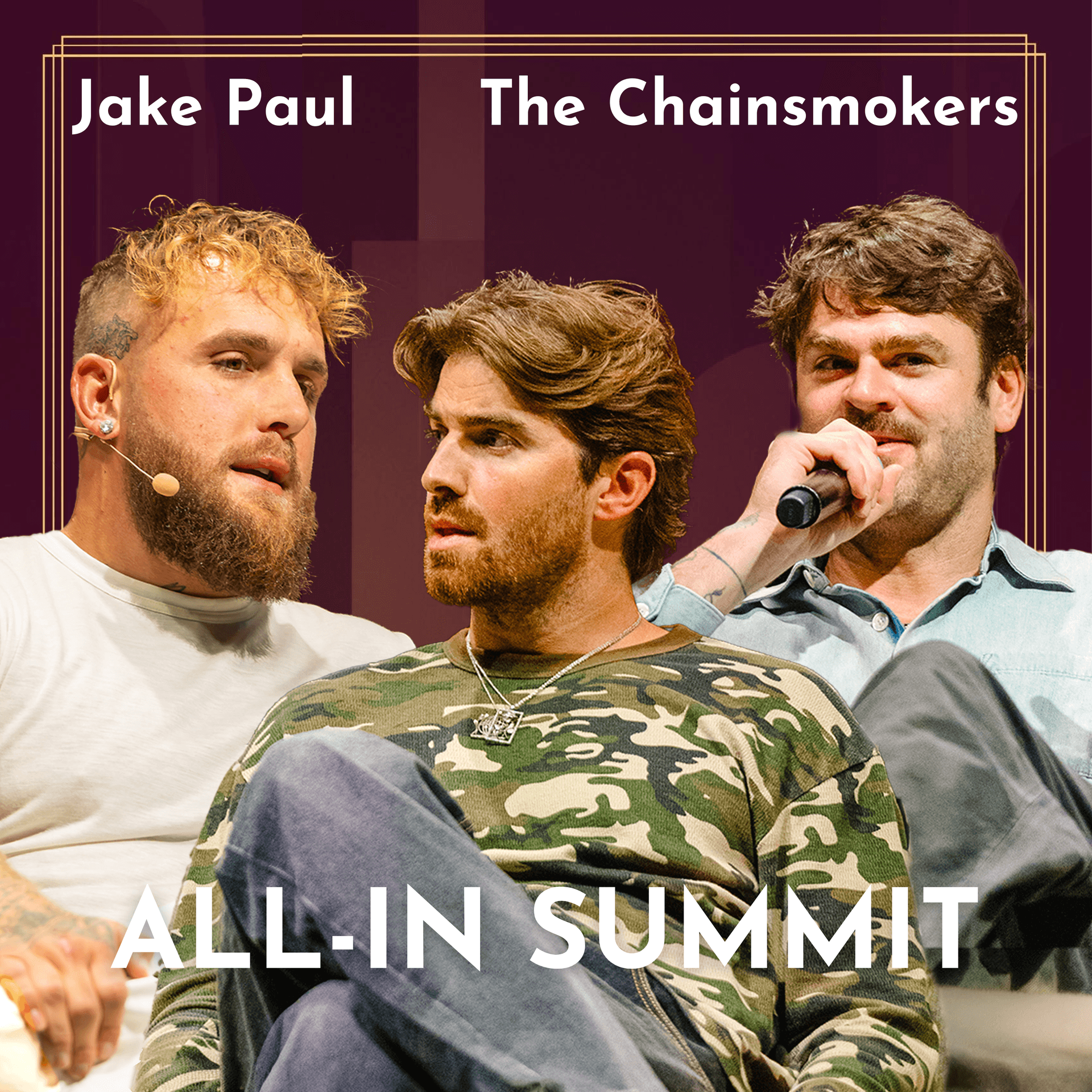
DOGE Kills Its First Bill, Zuck vs OpenAI, Google's AI Comeback with Bestie Aaron Levie
Episode Overview In this episode, industry veterans Chamath Palihapitiya, Jason Calacanis, David Sacks, and David Friedberg engage in a wide-ranging discussion that covers current events in technology, politics, and finance, including a guest appearance by Aaron Levie, CEO of Box. Key topics include the impact of DOGE on political spending, the competitive landscape of AI, and Google's resurgence in the AI space.
---
Key Discussions
Bestie Intros
- Hosts: Chamath, Jason, Sacks, Friedberg.
- Guest: Aaron Levie, CEO of Box.
Aaron Levie's New Role
- Discussion on Sacks's new role in crypto and AI regulation.
- Positive impact expected in both sectors.
DOGE's Political Impact
- Discussion Time: 18:42
- DOGE's influence on a significant spending bill in Congress was noted.
- Conversations around the potential paradigm shift in political funding and public discourse.
Conspiracy Corner
- Discussion Time: 48:25
- Speculations on drone sightings in New Jersey and their implications.
- Various conspiracy theories regarding the drones and government oversight.
Zuck vs. OpenAI
- Discussion Time: 57:36
- Mark Zuckerberg’s alignment with Elon Musk against OpenAI.
- Analysis of the competitive landscape of AI and the potential consequences for business software.
Google’s AI Comeback
- Discussion Time: 1:27:29
- Google’s advancements in AI technology and their efforts to reclaim market share.
- Notable mention of the introduction of new models and tools, emphasizing their infrastructure and data advantages.
---
Key Takeaways
DOGE and Political Spending
- The hosts discussed how meme stocks like DOGE are influencing traditional political funding mechanisms.
- Emphasis on the democratization of political engagement through social media.
Regulation and AI Landscape
- Sacks's role may lead to a focus on promoting innovation while avoiding over-regulation in AI.
- Debate over the balance of fostering development against the risks associated with AI technology.
Google’s Strategy
- Google is repositioning itself aggressively in AI, countering earlier perceptions of being behind in the technology race.
- The data advantages from platforms like YouTube can enhance their AI models, contributing to their competitive edge.
General Sentiment
- The episode encapsulated a broader sentiment of excitement and urgency regarding the rapid advancements in technology and the evolving political landscape.
---
Conclusion This episode of "All-In" provides a comprehensive overview of some of the most pressing issues in technology, finance, and politics. The discussion reflects the hosts' deep expertise and insights, particularly with regards to evolving technologies and their societal implications.
Follow the Besties
- [Chamath Palihapitiya](https://x.com/chamath)
- [Jason Calacanis](https://x.com/Jason)
- [David Sacks](https://x.com/DavidSacks)
- [David Friedberg](https://x.com/friedberg)
- [Aaron Levie](https://x.com/levie)
Social Media
- [Twitter](https://x.com/theallinpod)
- [Instagram](https://www.instagram.com/theallinpod)
- [TikTok](https://www.tiktok.com/@theallinpod)
- [LinkedIn](https://www.linkedin.com/company/allinpod)
Music and Video Credits
- Intro music and video credits provided, indicating the collaborative nature of the production.
This episode serves as a microcosm of ongoing debates in technology and governance, highlighting the intersections between innovation, regulation, and societal dynamics.
Written by AI. May contain mistakes. Listen to the episode to check what was said.
Transcript
Automatic transcript. May contain errors.0:00J .K .L. what just happened to you? You have a moment an emotional moment. I don't know. You know, I've been trying to get over sacks and um, smart to get over your ex. Even when they didn't treat you well, we were in a co -dependent relation. Yes, we were. And we were working on it. You have no one to fight with anymore. Who are you going to fight with, J .K .L.? That's me emptiness you feel inside because you're a fighter. You're a street brawler and you have no one to brawl with anymore. So you feel well, you're the first guy to jump under the table in a bar fight. I mean, there you go. There you go.
0:28That's what I was saying. I feel like if shit goes down, I feel like Saks and I would have like, we would have thrown down, we're f**king bulldogs, we would have fought like tooth and nail. Okay. I have this image. I have this image. It's like we're in a bar. Okay. And all of a sudden, you talking to me? A fight is about to break out. Four thought bubbles appear. Okay. Jake was like, let's go get him. Saks is like this guy's a dip sh**. Let's roll. I'm like, look at that chick, she's so good looking. And then Freeberg's like, what will happen to my invite? Duck. Freeberg's like, how do I get out of this unscathed?
1:29All right, everybody, welcome to the number one podcast in the world with me again today for better or worse, your Sultan of science, David Friedberg is back. How you doing, Friedberg? I see you're a pawn, only a pawn in their game. What's going on with the pawn background? The imposter syndrome. Pond or queen? What is that from a movie? What movie is that from? It's called the imposter syndrome. I just like some French new wave, I'm not aware of this. I've learned that three birds backgrounds is some like weird secret communication language. There's a small but fervent group of people that are really into these backgrounds.
2:11They're always trying to figure something out. Absolutely. Of course, with us again, Chema Folly Hoppatiya, your chairman, dictator. You doing Chema F? Nice winner. Thank you, sir. Good to see you. You're excited to see you. I know. Look at this. Three or four besties will be getting the slopes. Three or four besties will be skiing together. There might be, Aaron, where are you going for the holidays? Oh, actually, I'm, I'm, we'll be in, next week. What? Well, there we go. New bestie in, Aaron, are you staying in the town? In the town? Just at the hotel. Okay, this is perfect. We're all gonna be there, bro.
2:42This is $2 ,000 a night. How many rooms you got with the kids and the fam? You have three? We have boxes at all time highs. It can be zero. What did you get? You start buying Bitcoin with your treasury? How, what do you mean boxes at an all time high? Are you doing a Michael Seller or something? You know, it turns out if you were, if you didn't get crushed during the post COVID period, you can just keep, keep cranking. So that's what we've been doing. Oh, you've been building a real business. Of course, with us now, our new fifth bestie, Aaron Levy. He is the CEO of the publicly traded company box, which means he's got the most to lose by coming here.
3:16So welcome back to the program. A centrist sex. Based on what you guys were just talking about before this recording started, I have no idea what we're in for. Yes. Listen, we're living in an age of meme stocks and people selling convertible notes to buy Bitcoin for their treasury and then becoming a Nasdaq 100. It's that simple. Aaron, when you see a company buy billions of dollars worth of Bitcoin and get added to the Nasdaq 100, what method of suicide do you think of taking your own life with? There was a brief week in 2021 where the thought crossed my mind. So, Sipuku, you're just going to use the sword, the short blade?
3:59We have a very sophisticated audit committee that prevented the action. So, I... Well, you do this for me. Just do this for me. Take... How much cash does box have in the books? Ballpark. We just did it convert, so we're probably 600, 600 or 700 million. Okay, here's what I want to do. A little experiment for next week. Just by putting 5 % of the treasury 30 million in Bitcoin. And then you will invite you back into weeks and we'll see what happens. Okay, just put 5 % of the treasury in Bitcoin. Hey, everybody, here's another announcement, a little housekeeping. As you know, we successfully got the all -in .com domain.
4:36That was a big victory for us. And we now have an email list. So four years into this, Michuguna, we now have the ability to take your email address and spam you with all kinds of great information like a notification when the pod drops. Wow. So compelling. Insights from the besties who you've had enough of. And first, I'm on overpriced event tickets to come hang out with us. Wow. This is the compelling pitch we have for giving us your emails. So, if you'd like to give us your email and get spam, go to allin .com and let the spam begin. All right, that's out of the way. Sacks is out again this week.
5:17I don't know what's going on. We've been trying to figure out where he is. He's at my A. If anybody knows. He's in DC this week. Yeah. Oh, is that what's going on? Did you see all the meetings? I know. All the things are ceases. He's in meetings. makes. Mr. Sacks went to Washington, creating waves, but Mr. Sacks is in Washington. Have you guys seen the photos? Aaron, what do you think of Sacks in this role? I think it's a strong kick.
5:50Let the genuine reflecting begin. Hey, Warren. So Crypto, I'm a little bit indifferent on. I haven't, you know, so we haven't spent much time there, leaned in much but there, but on AI, I think it's a very strong pick. And I think you want somebody that is, has a general sort of deregulation, anti -regulation bent at this stage in the evolution of the technology. I think there's risk of sort of slowing down too much progress right now. And I think that I think he'll provide some good parameters and principles around how to avoid that. So I think very strong. And then, you know, crypto again, don't know too much about.
6:36And then we'll see the rest of the topics. As a software CEO of a public company, when the Biden administration was putting forward their proposals on how to regulate AI and have definitions on the size of a model and what the models could or shouldn't do and the regulatory authority they would have over the software that's written. What was your reaction? And you were supporting Harris at the time, I believe, or Biden at the time, right? But like, how did you react to that when you saw those proposals and just to be clear? I don't know the EO that they went out. Yeah, there was the EO, but then they were also drafting.
7:11Yeah. They published a lot of detailed drafting. And then obviously California had its bill, which you probably saw as well, which specified, like the number of parameters in a model, the size of a model, and it had all these kind of constraints. In reverse order, was against SB 1047, it felt like, you know, you had two big issues. One, you probably don't want state -by -state legislation on this topic that's gonna be year in the world for avert if every state has a different approach to this. And then second, secondarily, if you just look at how it evolved from the very first proposal to the final proposal, and unfortunately, the kind of underlying philosophy that was in the bill, it was very clearly a sort of like viewing, you know, basically AI progress as inherently risky right now.
7:55And so it just ratcheted up the different, you know, levels of consequence for the AI model developers. And the risk is sort of the second or third order effects of that, which is like, does Zach then want to release the next version of Lama if you're taking on, you know, that much risk. And, you know, even the incremental updates, the liability you have in terms of any of the model advancements. And so right now we're benefiting from just an incredibly competitive market between five or six players and you want them running as fast as possible, not having to have sort of this, you know, a whole council before every model gets released because they're, you know, in fear of getting sued by, you know, the government for hundreds of millions of dollars if one person does something wrong with the model.
8:38So that was the problem with SB 1047. That's been the problem with some of the proposals on national legislation. I felt like the first EO, it didn't have a lot of teeth in it. So it kind of was more like, let's watch this space and continue to study it. The actual current head of OSTP, or the provocar, a lot of folks in Silicon Valley know her. She's actually very strong, very technical, understands the valley well, is not a sort of, does not lean into over -regulation. So I actually think OSTP has had a pretty good steward even under Biden, but I think the efforts that SACS would be leading, I think, would lean even more toward AI progress and not accidentally over -regulating too early in this journey.
9:24Let me ask you a question then about crypto. You're not into crypto. Crypto is a little bit harder to regulate. With SACS being there, what do we think the one, two, or three things he could do to actually You may crypto, not a scam, not have consumers get left holding the bag. Obviously, sandboxing projects, maybe having people know your customer, you know, some basic regulation there, the sophisticated investor test comes to mind. What do you think SAC should do in terms of crypto regulation in the short term in the New York? That's a really good question. I think that today there are a lot of really valuable use cases that can sit on top of crypto rails.
10:14I think the most obvious one is how you can have real -time payments using stablecoins. I think the United States government is already using some of these stablecoins for a bunch of purposes. The number of companies that are beginning to adopt and use stablecoins is actually growing very... Take a second to find stablecoins for the audience to see. Yeah, should be about... Let me define what a stablecoin is, which is that you put a dollar into a wallet somewhere. And in return, you get a digital token of that dollar. There are two big purveyors of stablecoins. There's Tether and then there's USDC, which is this company called Circle.
10:57I think the easiest way to disambiguate them is Tether is abroad, I think it's run out of somewhere in the Caribbean, and USDC is American. It's run by this company called Circle. The other difference is that there is some ambiguity around how these assets are secured. So what a stable point is supposed to do is when you give them a dollar, they're supposed to go and buy some short -term treasury security so that that dollar is always guaranteed, right? Because if they, if you had a billion dollars of stablecoins, but only 900 million dollars of assets to back them up, there's an insolvency risk there.
11:39There's a run on the bank risk, right? So theoretically, a billion dollars of stablecoins should have a billion dollars of cash in some short -term fungible security. What's incredible is, at the scale in which these stablecoins operate, that has turned out to be an enormous business. Why? When you give them a billion dollars and get a billion dollars of stablecoins in your turn, they just go and put it into the bank and when interest rates are 2, 3, 4, 5%, they're making billions and billions of dollars. They get the float. They get the float. So these businesses have turned out to be incredible.
12:13But that's beyond the point. The point is that a lot of companies that you would never think. So for example, SpaceX uses these stablecoins. How do you think they collect payments from all the Starlink customers when they aggregate them in all of these long -tailed countries, they don't want to necessarily take the FX risk, the foreign exchange risk. They don't want to deal with sending wires. So what they do is they'll swap into stablecoin, send it back to the United States, and then swap back to US dollars. So it's a very useful utility. So number one is I think we need to make those rails, the standard rails in the United States.
12:49And what that does is it allows us to chip away at all of this decrepit infrastructure that the banks use to sort of slow down and tax a process that should never have been taxed. So there's a good competition in a way, Chema. It's incredible. Now the banks have somebody to challenge them for money transfer and money storage and it could be regulated and stable, but I guess the question is, yeah. But that's the first thing. But then the second thing it allows you to do is you start, you can see a world where now you can have real competition against the traditional rails, specifically visa, mastercard, American Express, because when you look at great companies like Stripe, I use Stripe, I pay them 3%.
13:31If I use stable coins from Stripe, I don't pay zero, but I don't pay 3%, it's kind of somewhere in the middle. If I was technically adapted implementing stable coins through the entire stack of my product. So I use it for this learn with me thing where we publish research. I would save a lot of money. So the idea that you can take that 300 basis points you paid to these companies and crush it to zero would be a boom to global GDP because that's 3 % on many tens of trillions of dollars. Aaron, you're shaking your head. This is something that you're experimenting with a box or you're aware of or a problem that you recognize.
14:14No, no, just the, I mean, the credit card rails is, I mean, the tax on transactions is obviously insane. So, so the stable coin being the intermediary for that in the future makes total sense if you could get everybody to kind of coordinate against that. So, yeah. Well, and regulating it would get people off of tether, hopefully, which has a checkered, colorful, sorted pass. You can go look it up, but they've had many, many legal, But I think again, I think it looks like there are even a thing. But yeah, but in fairness to them, I think again, both of these two companies look as of today. Again, you have a jurisdictional issue, difference.
14:48But as of today, it looks like they're both pegged one for one. But anyways, the point is if Saks can really push the adoption of stablecoins number one, and then number two is to incentivize much, much cheaper transactional rails, then I think he can go to Bitcoin and these other more long -tail crypto projects off of the back of momentum because these first two things I think everybody will embrace and he won't get caught in a political quagmire. These other things you have these opponents always coming into the system and they have even Bitcoin like when I said this thing about encryption and quantum and Even though I thought I was very clear, the crypto community on the internet went absolutely crazy all last week.
15:38Yes, they know. I'll be honest. Yeah. But the thing is like some of the Maxis piled on, then when they actually took time to understand the technicalities of what I was saying, other people realized that was right, then they were tweeting it. My point is that world is so religious, animated and energized that I think it's hard to use them as the first place where you find progress. So I would tell Zach, go to stablecoins, then disrupt the visa rails and then go to the other stuff. I would go stablecoins and I would go even before that, the accreditation test that I've been talking about because the SEC has that mandate.
16:12People were educated, Aaron. They could buy crypto and know they're going to lose their money or know that something's a fugacy, a fugacy, whatever it is. Yeah, I mean, I'm sure we want to move on, but I guess there's a parallel universe where so no matter what, obviously, Gensler did not get his arms around this whole thing. That was a big mistake. But there's sort of like defy slash financial crypto, where almost everything is deflationary, it improves the rails. if you believe in Bitcoin as this, you know, the store value and digital gold, like all of those things can actually kind of make sense and be a bit rational and like improve things.
16:57And then, you know, unfortunately, or not depending on your views, there was this other sort of, you know, fractal event that happened, which was, oh, let's also use these things as a means of, of kind of creating a virtual currency and token and equities and tokens for anything, where that then runs into basically the SEC remit of like, are these things securities or not? And is there insider trading or not? And can anybody issue them at any time and promote them on Twitter or not? And so, I think to some extent, if you could get back to crypto 1 .0, which was this is a financial infrastructure, I think you would have avoided a lot of the sort of noise and challenges with crypto.
17:40Now, you can't put it back in the bag, But there's like I don't think you could get 10 crypto people to agree on how you regulate that second category because Some people some people believe I should be able to issue an NFT on anything and I should be able to to trade that and And at the same time they would obviously they would sort of claim well. That's just the same as a as an aftermarket You know a seat to a concert and yet another group would would be treating this as as effectively, you know a security And so you I don't know how you're ever gonna real that in and without some people being upset within the crypto community.
18:14All right, well more to come and sacks will be back, sacks will be back and we will be rotating the fifth seat amongst friends of the pod and newsmakers. Sorry, did I already get rotated out based on what is up? Well, yeah, basically the energy was a little low, but you know, I mean, I think, well what you already had to warn people about this is a, what you're resting part right versus we're boys and then we'll just make a decision. Okay, okay. All right, listen, doze is fully operational. Elon and VV have helped kill the last minute omnibus spending bill. Wednesday night, the bill had been killed and we were looking at the government shutting down starting Friday, December 20th.
19:00Today, when you were listening to this for some quick background in September, Congress approved a bill that would keep the government funded through December 20th. the day this episode published. Keep that December date in mind for a second. This Tuesday, December 17, three days before the deadline, leaders in Congress unveiled what was presented as a bipartisan stopgap bill that would keep the government funded through March 14. That kind of bill is called a continuing resolution. Basically, it'll give you more time for the incoming GOP majority to reach an agreement on the funding for the government.
19:33But there are two major problems with the bill. It's a rush job, it had to pass the house in the Senate by Friday night after being presented on Tuesday. It's absurdly long. 1500 pages with $340 billion in spending, including pay raises and better health care benefits for the members of Congress. My Lord read the room gentlemen and ladies funding for a global engagement center for another year. That's the disinformation watchdog group that was wrapped up in the Twitter files, $130 billion to renew the farm bill for another year, $110 billion in hurricane disaster aid, just money being thrown everywhere, a billion three to replace the Francis Scott Key Bridge in Baltimore.
20:13The VVK had some spicy comments on it. Congress has known about the deadline since they created it. In late September, he said the urgency is 100 % manufacturing designed to avoid serious public debate. But serious public debate is exactly what's happening on Twitter. People are screenshotting and using chat GPT and Quad and Gemini to work their way through these documents and it looks like this is not going to happen free burger thoughts. So the proposed bill made no real change to the current spending level of the federal government at roughly $6 .2 trillion on an annualized basis, which by the way is roughly call it 23 % of GDP.
20:57Just to give you some context, In 1860, nearly 100 years after the founding of the United States government, federal spending to GDP was less than 1%. And it took off during the Civil War for a couple of years. But we're at these kind of like unprecedented levels year after year now, really speaking to how the federal government has grown as we talked about many times so much in our life. And you know, at some point, our roads were really bad back then though. Yeah. Yeah, our roads were really bad back then, but lots of them. But remember the objective of the Republic was to have the states make local decisions about how to take care of their infrastructure.
21:38The national highway effort obviously changed that in the mid -20th century. But this was kind of the original intention of the Republic. It wasn't to have the federal government come in and employ people, provide insurance to people, provide energy markets to people, own football all stadiums, et cetera, et cetera, et cetera. If you go through the list of things in this bill, I think $100 billion of natural disaster relief, everyone says that seems very reasonable. That's something the federal government should do when we have a natural disaster we need help, we need support. That's a great thing for the federal government to do.
22:14But think about the incentive it creates. It distorts markets. So we've talked about this in the past in areas where you have a higher probability of natural disasters and people have paid a lot of money for their homes, pay a lot of money for infrastructure, should the federal government come in and rebuild those homes and provide capital to those individuals and those businesses to help them rebuild those homes if there's a high probability of natural disaster events happening again in the future. It means that the cost of insurance doesn't matter and the cost of real estate doesn't matter because the federal government effectively can come in and support those prices.
22:46In the same way the federal government comes in and supports the prices in agricultural products through the work in the farm bill and through the biofuels mandates which were also proposed to be extended in this thing. So the federal government's playing both a market role and also this role that I think fills the gap where people want to have a customer, where there isn't a customer and an employee, or where there isn't one. So how did we get to this point? So the first principle is perspective. We've kind of, I think, lost a narrative on what the federal government was meant to do. If you think about the simple rubric in a bill, just go back some period of time and someone says, hey, I want something.
23:22I want to have this in this bill. and you're the representative that's supposed to vote on that bill and say yes or no, it's very hard to just say no, we are not going to spend that money. What's the incentive to say no? The alternative is you say yes, but give me X as well. There is an incentive in that response. And the incentive there is to get something for your electorate, the people that voted you in as a representative of the House, which is how we ended up at this point where everyone says, I want something if you're going to get something and eventually the government, the federal government swells to spending roughly 24 % of our GDP.
24:00The biggest mistake, I think the founding fathers made was that they didn't create constitutional limits on spending and enrichment. This was because they had these deeply held philosophical beliefs that relied on the house of representatives to provide a check by the people. If you read the Federalist papers, and I went through a couple of these recently, and I out some of, I think the key points, but in the Federalist papers 10 and 51, James Madison emphasized that the structure of government was meant to ensure that both state and federal governments would limit each other's excesses, including their financial ones.
24:34And then in the Federalist paper number 58, he said, the House of Representatives has control over the quote, power of the purse, which gives the people's representatives authority over taxation and spending. But they also warned, along with Alexander Hamilton, of the dangers of unchecked government power through burdensome taxation and excess spending, which would ultimately erode individual freedoms. So they recognized that there were gonna be limits, but their expectation was that the House and the individuals that were electing people to the House that were members of this Republic would come in and say, we're gonna keep that from happening.
25:10And clearly something went wrong along the way that we got to this point where again, spending is 24 % of GDP. And I think that the biggest thing they got wrong was that they didn't create these constitutional limits on federal spending or taxation through either a balanced budget, structure, spending as a percentage GDP, no federal debt or term limits, or all of these other mechanisms that could have been introduced at the beginning that could have created some structural limits. Instead, they assumed that there was this natural limit that would emerge as a function of the democratic process because of how they formed the government.
25:48But not want the freedoms of the people of the time. Back then in 1776, this was a pioneering country where everyone wanted to come here to have freedom to do anything they wanted, everywhere they wanted to build a business, to homestead, to be rugged individuals. It was entrepreneurial, yeah. It was, and over the last 250 years, we've gotten used to an increment in lifestyle every year and discovered that we have a mechanism to force the increment in lifestyle through the actions of government. And so the electorate has stood up and said, I want more each year and I want the government to provide it for me if the free markets are not doing it.
Read the full transcript
26:28And that's really where we kind of got to this point where I think we elected people to the house who ultimately had this incentive that said, if I give you this, I need to get this and we ended up swelling this. So I don't know if it cracks with Doge. I really don't know if people step up and recognize the limits of government and what the limits should be of the federal government on an electorate basis. It's an amazing moment to see that Elon went on Twitter and said, Hey, guys, this is nuts. And everyone said, this is nuts. We're not going to elect you if you do this. If that momentum and that transparency can keep up, I hope that people start to connect the dots.
26:59If this isn't a free launch, that the federal government spending is not limitless and it's not unaccountable. Aaron, I think we have enough people who are notable now speaking up about this excess spending and the out of control debt that it's now invoked to talk about austerity, to talk about inefficiency. And that really all comes back to Doge and dare I say, you know, the conversations we've been having this podcast for two years that this is becoming acute. What are your thoughts on this vibeship, this complete pivot where we've gone from my Lord, everybody's saying, I got to get mine. You got yours.
27:38I'm getting mine to name and shame. They're naming and shaming now. It's very specific pieces of pork in these bills, including stadiums for NFL. People are like, why is the NFL getting this? If there were 20, 30, 40 billion dollars? Just quick thoughts. One, Patrick Carlson had a tweet yesterday that basically said this sort of this big misinformation kind of created by people that want to be slow is that you have to sort of choose to of fast, good and cheap. And I think basically, you know, Elon's companies have sort of always effectively kind of proven the opposite, which is actually if you just like start to ask the question, like, why does that thing have to cost as much?
28:24You know, if you're building a rocket or designing a car or developing batteries, like what, you know, if you just do ground up, why does that have to cost as much? And so what's interesting is that probably if most people looked at what the government was spending on, they wouldn't even feel like, like, you know, it's not even helping helping them in the disaster relief sense of, I think, that there are probably people that actually do experience the benefits of disaster relief. It's actually just all of the overhead that we've created to getting anything done in the government that could actually make the government better serve that all of the constituents.
28:57I was talking to a sort of a nameless individual in the government the other week where by Congress they have to hire contractors to do work. and the contractors, the contracting firms charge them two and a half times the sort of cost of an individual employee that they could otherwise hire. And so now they have to outsource the work and they don't have any accountability mechanism for that contractor. And so I think there's not a single American that could look at that and say, this is like actually working well. Like, yeah. We are spending more money to do less and the ultimate outcome is actually lower quality.
29:35And so you have to, at some point, just kind of do a little bit of a reset moment. And that's obviously the upside of Doge, is like, it breaks every rule of us thinking about how you would actually go and attack this problem. We thought you'd attack it through meetings, and we would do it through congressional processes and research. And it's actually just, it is obviously a much more sort of founder, startup oriented way to approach this. There's going to be lots of things that are broken glass around the edges. There's no question, but I think what's interesting about this week's event is I think that there's been this underlying kind of notion of like, you know, Elon and whatnot at all, you know, don't understand the government enough to be able to change it.
30:18And it might actually be the case that the government doesn't understand Elon in the sense of like he will just see this thing through. and the tools that his disposal and Doge's disposal is sort of, you know, completely unprecedented in terms of the ability to put anybody in Congress on notice if, you know, if basically they are promoting things that are not making the country better. So the thing that we saw this week was actually that playing out. Everybody's been wondering, well, what are the actual, you know, what are the formal mechanisms Doge has to accomplish and enact change? And it's like, you just saw it.
30:52Like, they can just create enough visibility and spotlight on the problem that it causes it a level of discomfort in supporting moving forward with whatever that thing is. And so I think it's interesting. I know opinion on the actual elements of the bill other than from a process standpoint and a new kind of case study of how this is going to play out is I think we're seeing some early indication of what Doge will will be able to do. Aaron, how do you feel about this Doge effort as someone who is a public like Harris supporter. So you've come out, I think you've been public about this. But I wanna understand why people wouldn't be supportive of this effort, right?
31:33Like what is the motivation for people saying this isn't a good thing we shouldn't be doing this? Like there's a lot of folks that have gone on these shows, it's like they blast Elon, they blast with egg. But aren't these principles, like shouldn't they just be universal that we should not be wasting money and stuff? Sure, of course. Now, I mean, so to give some credit, you have Rokana supporting it, you have Federman supporting it, Bernie Sanders. You have Bernie Sanders had a good call out for you a lot. You have everybody has their thing in the government budget that they don't like, so it's assuming that they see that as something toge can contribute to.
32:09You could probably get actually broad support. There's a classic sort of reflex within, within probably Democrat party on, at this point, just because of Elon's supportive Trump that if something is an Elon project, they're going to instantly respond no matter what the thing is as a negative without, you know, kind of actually saying, is this, does this actually support actually something I do agree with? And so that's it. It's all part of saying none of its first principles, right? Yeah, which is, which is, but it's going to be true. But which isn't everybody? That's going to be true of both sides.
32:42Like Michelle Obama, Michelle Obama was like, let's get kids healthy and all of a sudden now it's invoked to do that. So I think we're just in an environment where anything will become partisan. What's interesting is that because of the, you know, some of the frost party elements of Trump and now his cabinet is it might pull in more of the Democrat party than would usually happen. And I think because of Elon and the people that are surrounding Trump, you probably have a bit more air cover for the Rokhanas of the world to also step up because if it was like Steve Bannon and Trump doing Doge, it would be like, ah, okay, you know, maybe this is not the thing to, you know, lend credibility to for, for pure political reasons.
33:23If you have, you know, some of the best entrepreneurs that are out there actually like literally in the cabinet driving this at some point, you know, it is an IQ test if you're, if you're on board or not. Shabbat, this is a sea change that we're seeing. And to Aaron's point, this administration gets to pick their priorities, but everything can't be a priority or it's not a priority. Therefore, they've picked the priority of smaller government, more controlled spending over say, nasty partition or removing more rights from women to choose when they have an abortion, etc. So this seems like a distinctly different focus for Trump 2 .0, the second term.
34:01What are your thoughts on what we saw this past 72 hours? It was the most to this bill. It was the most incredible change in how politics will be done going forward. I think that people are probably underestimating what happened here. This was a multi -hundred billion dollar gift that was stopped on a dime over 12 hours of tweets. points. You would have never thought that that was possible. The point is to put a dagger in something that big that had so much broad support just a few hours earlier, I think it's so consequential in how the United States can run going forward. So building on what you said, Chema, also very interesting here is the fact that Trump hasn't taken office yet and they're having this huge impact.
34:56This is occurring a month before he's even in office. If they can stop this, what will they do when they actually are in power? I think right now you're seeing the first order reaction which is about the bill itself, and I think that misses the point. The bigger issue is going forward, you will have the ability to, and part of it is because we have a set of tools now that allows us to do this, to read 1 ,500 pages in a matter of minutes, to summarize it into the key essential elements, to really understand what's being asked and what's being offered. And then to put it in a digestible format that normal people can consume, then all you'll have to do is just connect the dots and tell your congressman or congresswoman that you'd like or dislike this thing.
35:44And what you're gonna see is a much more active form of government. And I think that's the really big deal. The fact that it really becomes the voice of the people. Now, the alternative can also happen. Imagine there is a piece of legislation that is very controversial, but it turns out that people actually want it. Then the opposite will also happen and can also happen now. So I think that it's a very nuanced and interesting way that governance can happen. The other thing that I'll say though, which is funny is we should have a segment called today in hypocrisy. And if I was running the segment, what I would say is today in hypocrisy, you have a group of people, i .e.
36:25the Democrats who are very upset and who now point to Elon as sort of like some shadow cabinet minister or some shadow president -elect or some shadow first buddy, right? First buddy. I love that. Except then I thought to myself, well hold on a second, like there was like some something untoward happening in the shadows and I thought, well actually this is the exact opposite. The guy is tweeting in real time his stream of consciousness. You absolutely know everything that he wants because he just lays it all bare. And at the same time, I thought it was really interesting. The same people who were saying that were the ones that finally admitted that they were hiding Biden for the last two years.
37:08And I thought, did we just miss this? Like the same people that are like hold on Elon, I don't like the fact you're telling us what you actually want on Twitter transparently while we hired our president of the United States in a box. Well, yes, so you're referring to a Wall Street journal story that broke. I think this week in hypocrisy Jason take it away. Yeah, I mean, it was just as we said on this pod, we knew that they were hiding him. Now the cover up is worse than the crime and the cover up is a cover up. They were not letting him take meetings. They were limiting access to Dean B. Phillips came on this program shout out to him.
37:46Congratulations. Shout out to you. run, you know, he just told the truth here. He's not up for it. He's sundowning, you know, terrible situation. People get old and people have cognitive decline. The end. Question. Hold on a second. So just the gig contrasting compared. Trump is not even in office. You know, Elon is not a member of the cabinet per se. These are effectively today still private citizens. When there's all of this noise about what happened over the last two days to stop an absolutely ridiculous pork barrel bill. But when are we going to double click into what decisions have been made in the last two years that were actually Biden's versus surrogates that just decided and who gave them the authority to make those decisions?
38:30If they're going to do Aaron and you and I are left leaning moderates, I think that would be the most accurate way to describe us. I mean, if they want to do an investigation, there should be an investigation to, did they know that he was in massive cognitive decline and let him stay in charge of the nuclear codes. Do you agree or disagree? This is sort of not the part of politics I think about as much. So I'll leave that up to you as the other left -leaning moderate. So, yeah. No, I just wonder if like this is a crime that they, like what if he turns out he actually has Parkinson's or Alzheimer's, like a diagnosis.
39:06It's not out of the realm of possibility that they covered up an Alzheimer diagnosis schemaugh. And if they did, is that criminal? I mean, it's unethical. It's deeply unethical. It's very dangerous. Yes. Again, it just goes back to the people elected Joe Biden. He won fair and square. He ran on a specific mandate that the people endorsed. I just think it's devious though that certain figures in that White House took a level of power and decision -making authority that they were never entitled to. If they wanted that, they should have run and they should have been elected. That's what we all sign up for.
39:49And so I think that idea that we let that happen or that that happened to the American voting public is, I think, very unfair. That's why I think you have to realize that and you've said this before, we need these checks and balances going forward. And I think the way that you have these checks and balances again is veer towards transparency. The more transparency there is. And again, this is where I'll say, you may or you may or may not like Donald Trump, but the one thing you will never have to be worried about is whether you will not be able to hear from him in first person. You have any hair for him.
40:27That is absolutely true. I mean, simple suggestion here, Chama. If you're ever in doubt, you will be able to know very quickly where he stands on whatever topic is important to you. And I think that that idea is very important because then if it's filtered through somebody else because of some health issue that's then covered up, we're making decisions that impact the entire world. We're making decisions that impacts the economy. We're making decisions that touch hundreds of millions of American lives. Who are making those decisions? Yeah, it's kind of crazy. I have a simple suggestion here with these bills, by the way, when they're 1500 pages.
41:03How about for every 100 pages you release, you have one day of review. So if you want to release 1500 pages, 15 business days review, that's a reasonable maybe three weeks. And then just stop doing 1500 at a time, break these things up into 200 or 300 pages at at that time, I just love the fact that people are motivated and they have the will and the desire to focus on these, focus and desire, because people have to have the will and people did not have the will to get in the weeds and examine the spending. And now it's becoming, like, invogue, it's becoming a pastime to question the spending.
41:40This is a really great moment in time for America. The other thing Jason that we haven't done is, I think that killing the bill was step one. The thing that America has not yet seen, and I think Aaron brought this up with the Patrick Collison tweet, which is just excellent. Nick, if you just want to put it up there, it really is true. America still believes that the more you spend, the more you get. We do. At the core, that's why there are 1500 pages of spending in here because people want things, because they want things to be better. What we need to train people to understand is actually that it's the lies that are told that make you think that with more money comes a better outcome.
42:23And we see every day in Silicon Valley, we all start with next to nothing as a startup and we outmaneuver and we out execute companies all day long with way more resources. So it is nothing to do with the resources. Contraint leads to great art, Aaron, your thoughts. No, I mean, I can't add that much more to this. I think there's probably a little bit of a disconnected times from the voting public and broad constituents from then those that have seen this in real life, inside of a company, having to start up and scaling up. Just the perverse incentives to build bigger teams, spend more, your project then is more important and the more dollars it gets.
43:04We have all of these systems in place, which is the stuff that gets attention are the things that you spent more on. So you have all these weird incentives to actually have your thing literally cost more, to have more overhead because you've brought in more contractors into the project that then you're going to get some future benefit from in some way. So you have a lot that is sort of fully broken in this and there's no... It's hard to imagine any other way to veer off from that path other than something that does shake things up as much as Doge is doing. All right, listen, we can't do any worse than being massively in debt.
43:43So just let's have a culture of how to do it. Yes, you can. You could have run away debt. I mean, I think we already have that. This is for people who maybe are rooting against Trump in the audience or rooting against this because they're super partisan. All I'll say is I know these individuals around Trump root for them and root for this process, please, because this is a path to fixing the most acute existential problem we have, which is our debt. You don't have to like Trump to like Elon, to like Vivek, and to like these other individual sacks included. There are great people who are being called to serve.
44:19Let's judge them based on their performance. That's all I ask for the people who hate Trump, who hate these individuals, judge them on their performance. They've come out with a bold plan, let them cook. Once they've cooked, then judge their results. That is what I'm telling everybody who hates Trump and who hates this administration, and it was partisan on the other side. Yeah, I think we'll judge the results. I'll just start out one more thing in this, because I think the branding of Doge is often the efficiency side, which people always go to the spend side. But the core layer to that is the regulations that obviously are expensive to maintain.
44:58And that's what creates layers and layers of overhead on reviewing everything that's coming in then to the government. And you know, and unfortunately we have great examples in California where literally we spend more to do less. And it's because we've ratcheted up these layers and layers of regulation. and I have friends literally doing climate tech in like climate tech, you couldn't imagine something more probably left -leaning Democrat that they can't actually get things done in California, the state that you would imagine to be the most kind of climate first, you know, friendly state because of the amount of regulation that prevents them from getting things done.
45:35So, you know, there's actually this like, you know, total combination of actually a few regulations you'll spend less money in government, and you'll actually grow the economy faster, which will create more jobs, like all of the things get solved, the more efficient you get, you know, kind of, you're at large on all of the topics. So this is spending, great point, Aaron, regulations next. And let's see what they do there. I was in the room when Antonio Grasas was doing zero, based budgeting at Twitter now X, and Sax and I were looking at roles for people. What this team can do in terms of making things more efficient.
46:15It's amazing what can happen when you do zero based budgeting and when you just think from first principles, do we even need to do this? Does this need to exist? Take all these regulations, put it 20 year clock on half of them, a 10 year clock on the other half. Can I just get one more random example? Feel for it, edit it out. Chimathi will like this because it came out of meta. Do you have you followed the Z standard compression library from meta? So this open source library We needed to have next -gen compression on data. We finally took us probably too long, but the team worked insanely hard, implemented this compression algorithm.
46:49We literally, our uploads and downloads got faster. We spend the less money on networking and compute, and it took some re -engineering of the system. That's just not a concept that people go into problem solving with, which is like, what if the thing actually was cheaper to run and it was better? And so think about all the systems of government that could be that could just be upgraded and then you would spend less money actually Maintaining them. I mean we spend you know hundreds of billions of dollars weight way too much on legacy Infrastructure technology we could automate more you can spend the way less money and then get better outcomes So this is just happening everywhere and I don't think people realize that the scale of the opportunity So and I'll just give an example when we went into Twitter nobody was coming to the office There were people who hadn't committed, who hadn't come to the office, who hadn't committed code in six months.
47:38So what were they doing, right? So you start looking at the data, then they were spending an enormous amount of money on SaaS software that nobody had logged into. And then they had desk software for route people around. That was costing $10 per day, per desk, per location, whatever. Nobody was coming to the office, but they were paying for software to route people to the right desk in office sweeping. The waste, when I tell you the waste and the grift, and I'll just call it what my interpretation is stealing. They were stealing from those shareholders. The government is stealing from taxpayers.
48:12It has to be fixed. Let our boys cook. Trayberg, you get the final word before we go on to conspiracy corner. You've got nothing. All right, let's go straight to conspiracy corner. Everybody put your tinfoil hats on. There are drones over New Jersey. Thursday morning, the FAA banned drones. This is breaking news in parts of New Jersey until January 17th due to, quote unquote, breaking news, special security reasons. They also warned that the government may respond with deadly force against drones posing a threat. This thing is getting crazier by the day. There have been thousands of reported drone sightings in New Jersey and bordering states.
48:50Over the last week, here's some examples, play the clip, Yadda Yada, until Thursday morning, White House officials have been dismissive, saying repeatedly that nothing significant is going on. One of the theories was that the drones were looking for nuclear material, aka a dirty bomb or lost radioactive material or the ultimate, a lost nuclear bomb from like an actual nuclear warhead from Ukraine. On Tuesday morning, the mayor of Belleville, in the Jersey suggested the drones could be looking for that radioactive material that went missing on December 2nd. That was radioactive material uh, germanium 68 will get details on that from free burg in a moment.
49:34And then of course, conspiracy theories are going wild. It's Iran, it's UFOs, and my favorite project blue bee, which is that NASA is using holograms and other technology to create a new world order and religion in projecting Jesus into the clouds. You can look that stuff up or we'll have Alex Jones on in Saxe's seat one week. Okay, free, Barg. You're the genius here. Tell us what's going on. I think there are three likely explanations. The first is that the government's got some activities that can't be disclosed. So we don't know and they can't talk about it. No one can either say yes or say no to it.
50:07So that's kind of one that's pretty possible. The second is these are just individuals with a bunch of drones messing around having fun, trying to wreak havoc. It could be fun, a bunch of kids. I think we've all been there. The third is what I would call kind of a bit of a more nefarious, like this is my conspiracy theory. I think it could be considered a sia. Okay, so right now the US has a significant regulatory burden on drone utilization in a commercial setting. And it's very hard to use drones. You have to have line of sight to the operator. These things aren't supposed to go on their own.
50:44there's all these rules and restrictions and so on and so forth. Meanwhile, you've got countries like China rocketing ahead. So I don't know if you guys know the company, Maytwan in China, you know the food delivery company. If you guys, did you know that they do a large amount of drone delivery of their food now? It was not aware of that. We're testing that here in the US. The drone delivery business in China is already $30 billion a year. And they're also launching a pretty significant fleet of what we would call kind of the EV tolls or flying cars. The expectation is that by 2030, there'll be 100 ,000 flying cars moving people around in China.
51:19And these are huge efficiency gains. In fact, with Mate2an, you can now order food while you're on the Great Wall at one of the ramparts and it'll bring the drone will bring the food to you while you're walking the Great Wall as a tourist. And in the US, the reason that these things haven't taken off and the reason we don't have a large kind of drone industry, which is clearly emerging, is going to be a huge economic driver for China and others around the world, is simply the regulatory restriction. And so if you were going to try and mess with the US's ability to move forward with the drone economy, you would probably try and wreak some havoc, stoke some fear, and get people to say, hey, this doesn't seem cool.
51:58What's going on? I don't like that there's all these drones in the sky. I'm freaking out. And try and get the regulators to come in and say, hey, we're banning drones. And set up everyone, including the people in the government to say, we should take a beat. We should think a little bit before we deregulate. We should do this. Who's the motivation? Who rules and postmates? No, no, no, no, not driving. No, no, no, no. It could be the other government. That's my side point. This could be a side point. All your sadness could be China doing this to try to slow down our economy? Think about it. If you're going to pass a bill in Congress to make drones more freely romable in the skies, you're going to reference back this crazy story in New Jersey.
52:35Everyone's freaking out about it. And you're going to say, hey, wait, what about all that stuff that happened in New Jersey? Maybe this doesn't make as much as people are kind of scared about it. We shouldn't rush. We shouldn't rush. We shouldn't rush That would be my side off theory. That's my you know kind of Conspiracy theory tinfoil hat. I don't often do them, but that's what I would kind of think about the first show Should be proud Alex Jones be proud Aaron. Uh, why don't you jump fence and tell us you're a best conspiracy theory of this No, no, I'm off. This is that was all crazy pills when I just heard Yeah, take some I think there's like 10 higher side -obs you would do if you wanted to get us to have a collapsing economy than going after drone deliveries.
53:13But no, I, what would they be? What would they be? I mean, I will first of all, I think. I think you'd have AI like do a robot that would, I think you'd have a robot AI thing that goes, runs a muck, wasting, waste. Oh, a robot, robot comp. Yeah, I think that would be way sooner than you worry about food delivery. No, you have 10 self -driving cars, hop the, you know, hop the curbing and crash into a storefront. Self -driving is on ice for two years. That would be, you know, an example. Chimathi Arthur, you got some conspiracy here. What do you think is going on here? No. But I thought that the most credible thing was that they were looking for radioactive material.
53:53That somehow got lost. Why would they only look at night? Actually, it's interesting you say that. There was somebody on Twitter, X, who claims to be an expert in this field. And there's a startup actually that I just talked about which one can a coa the great? I think I might have been king coa the great shout out to king coa the great is mom's basement eating why Can coa he's a You always try to get me bad because he said I was trying to dox him you always can't can coa he's great No, I just think it's his lyrus that people are retraining King coa the great as if he's like this great journalist and he's a mom's basement eating hot pockets or he's working for Putin He's a really good.
54:33I don't know. Do I want my really good Jake is Jake Cal or can co I don't know who do you take? I'm your crazy air is pretty good. I like my I subscribe to cancola. Yeah, Aaron Levy you have a favorite I you you ought to some capital of King color. What do you like? I got to some capital to I think he's Absolutely. I'm liking Geiger these days. Oh, you're a tiger capital I read all PC breaks PC breaks. I think the nighttime thing would be it would be at least typical of this government to do to a strison defect of just like, maybe if we cover it up, nobody'll see, and then obviously it's the biggest thing.
55:09Yeah, and they've been going these lights on them. Yeah, like the lights on them. Yeah, it's like, this is exactly what it is. There is a startup that makes, we really looked it up, and there is a startup that makes drones to do this specific task who look for dirty bombs in ports, and ports obviously look for these things. It's a known threat. This is not rocket science. I'm sorry, and why and why only at night? To people because that they can read the signatures better was the very that at night You can read the signature which doesn't make sense to me science guy you want to come in here? I don't see how I don't see how nighttime you'd get a better read on radioactive material It doesn't make any sense so that mean no sense.
55:49That's how I'm like a crazy thing But anyway, we're living in crazy times Speaking of crazy by the way, that was my first conspiracy theory in 200 made episodes of the Olympus I actually can participate in conspiracy corner now. I'm coming back next week with a better one. Okay, take it. Read us some more news. Go to Google News and read us some more news. We can do another guy. Jesus Christ, man. Read a **** for us. God, you do it. God, not only get the doctor in front of you. Okay, so today the Dow Jones industrial leverage is up 23 ,000 to 44 ,000. I tried a high one. And you guys make your little good.
56:24Gary Gettler said he's super happy and skin. That's enough. I'm going to be. I thought it was cool how he read the entire congressional bill earlier. Yeah, Jake I love to fill a bus. I'm not fill a bus. We are. Listen. Yeah, let's do another story. Let's see if you can contribute something
56:43Your contribution was amazing. I was actually using chat GPT to go into the To the going to the founding fathers papers and Yeah, I was reading these federalist papers with German number 13 and number 44
57:04I'm just comparing the lyrics from Hamilton the musical
57:21Can't wait can't wait to see you a little more let's go Oh my god. Can we just just ended here? Yeah. No, do it do it because I want to talk about opening. You want to talk about open out? Yeah, give him his red meat. Give him a red meat. All right, here's an update on closed AI flipping and Sam Altman supervillain Sam Altman secure in the back. Meta wrote a letter. California's eternal channel. That's open yet. On Open AI for profit conversion, two months ago, Open AI announced a $6 .6 billion funding round, $157 billion valuation, they're protecting $3 .7 billion in revenue this year, pretty great revenue growth.
58:05But there's a poison pill in the deal. Open AI must convert to a for profit within the next two years, or investors can ask for their money back. And right before they announced this round you remember CTO Mira Morati and two other top researchers Resigned many people saw this as a protest Elon who put the first 50 million in and co founded open AI is currently suing the company and seeking a court order That would stop the for profit conversion now Zuck is joining team alone Elon and Zuck are in some Weird pairing up. They're not in the ring not in the octagon. No last week, Metta sent a letter asking California's attorney general to stop opening eyes for a profit conversion.
58:50What do you think of this? We've got them now not in the octagon, but they're in the political arena, Chimapha, or that's... I think that this is so interesting. So I was looking at all of these things. If you put them all together, it paints a really interesting story. So you have Elon filing an injunction, which basically says you should not allow this conversion to happen until we sort out all of these details because if you're allowed to convert and then I win, it'll be very messy to go backwards. I think that that's a pretty credible legal argument. Then you have Zuck basically say, hey, Elon's right, this company should not convert.
59:30But the more interesting thing that really got me thinking about this was a chart that Menlo Ventures put out. Nick, can you just show this? What this shows is just what's happened in the last year. And what do you notice? What you notice is the market share of OpenAI has changed pretty meaningfully from half to about a third. And what you see is anthropic double metaroughly staying the same Google picking up steam. And it started to make me think this is very similar to a chart that I would have looked at when, you know, in 2006 and 2007 when we were building Facebook because we had this huge competitor in my space that was the de facto winner and we were this upstart and it made me think is there a replay of the same thing all over again where you have this incumbent that pioneers an idea and they start with 100 % share and then all of these upstarts come around from nowhere and then I thought well what is better today if you are a company that's just starting versus if you were the incumbent.
1:00:43And I think that there's a handful that are worth talking about. So the first is when you look at what XAI has done with respect to NVIDIA GPUs, the fact that they were able to get 100 ,000 to work as in one contiguous system and are now rapidly scaling up to basically a million over the next year, I think what it does Jason it puts you to the front of the line for all hardware. So now all of a sudden if you were third or fourth in line XAI is now first and it pushes everybody else down and in doing that you either have to buy it yourself or work with your partner and I think for the folks like meta that translates and explains why they're spending so much more sort of like this arms race.
1:01:25If you can't spend with my competitors I'm just War. In a capital war, I think the big companies like Google, Amazon, Microsoft, Meta, and brands like Elon will always be able to attract effectively infinite capital. And their cost of capital goes to zero, which means they'll be able to win this hardware war. Okay, so put a pin in that. Then the second thing is what happens on the actual data and experience side on the training side. If you listen to Ilya Sitzkaber, if you listen to Andre Carpathy, what they effectively are saying is there's this terminal asymptote that we're seeing right now in model quality.
1:02:09So what happens? A lot of these folks are now experimenting on the things around the model, right? The user experience, how you use it. Can I keep things in memory? Can I cut and paste these things from here and there? Because what it says is like the data is kind of static and brittle. But it's actually not, that's what we said before, because you have this corpus of data on X that's pretty unique. I I suppose if Elon fed in all this connectic data that he controls through Tesla, that's very unique. Does that all of a sudden create this additive pool of information? Possibly. And then the third thing is when you look at that chart, what that chart says is, we're going to second, why are corporates moving around?
1:02:50And what I can tell you just through the 1890 lands is we are completely promiscuous in how we use models. And the reason is because these models offer different cost quality trade -offs at different points in time for different tasks. And so what we are seeing is a world where instead of having two or three models you rely on, you're going to rely on 30 or 40 or 50 and you're going to trade them off and you're going to use effectively like an LLM router to disin - You know, to balance them, yeah, and to route them. Or just to manage and route them and then there's an intelligence above that that's constantly and be tasking and figuring out prompt optimization across these models.
1:03:29So it's this thing where we were very well -liked on OpenAI. Now we're reliant across three or four. Ideally, we'll be reliant on 30 or 40. And so I just see this world where it's all getting commoditized quite quickly. And so I'm just like sort of scratching my head like where is the market value here? Aaron, your thoughts, I know you're very promiscuous when it comes to all of them. I'm such a lot. I mean, we have a very similar model, which Moss said, which is what we're agnostic, so we work with multiple AI vendors. But the, I think a friend, deep in AI land a couple years ago, right before Chatsby T said, there's no secrets in AI.
1:04:08And I didn't totally understand kind of at the time, it hadn't registered with that meant, but very quickly it kind of became obvious, which is the research breakthroughs sort of propagate insanely quickly across the AI community. And so back back to its mouse framework, if you just think about it as if the research Effectively becomes open at some point in time quickly enough because either the researchers move or people publish it or whatnot Then it really is a compute game and then maybe a data access game and that means that there's four or five at scale players that can that can fund this and And I think as we've seen in other areas where it's an infrastructure play you eventually have the underlying service with enough competition, you have the underlying service eventually trend toward the cost of the infrastructure.
1:04:54So what we should expect is that the price of a token in AI land basically will be whatever the price of running the computers are, and maybe with like a plus 10, 20 % margin. Do you see this same thing happen with storage? I remember in the early days, box and drop box, and YouTube, you all had this major innovation with storage. And how did that play out? Let me give you a fun stat. that we give our customers unlimited storage, we have 82 % gross margin. So what happened was the price of the underlying storage has gone down by hundreds of times since we started the company. And then all our value is in the software layer on top of the storage.
1:05:34So we've benefited by this incredible just, ruthless competition between Western digital, C gate, other players that are just trying to pack more, more, more, you know, basically more storage density into these drives. And every couple years, they have a new breakthrough. We're now, you know, upcoming, we're heading to where maybe a 50 terabyte hard drive. When we started the company, they were kind of 80, 80 give us. How much of your time in the early days was spent on dealing with this infrastructure issue and then how much of your time and your leadership team's time is spent on this issue now?
1:06:06Yeah. So, so back in the day, like if we had, you know, 10, 10 people in engineering, 80 % of them was doing pure infrastructure work. Now if we have 1 ,000 people, be inverted in terms of the ratio. So you just get more leverage both as the, you get the advancements in the technology, but then also as you get scale. But all of this is to say, you should basically anticipate a world where, and I think Zuck is this interesting counterbalance on all of this because of open source. If at any moment you know that Zuck will basically provide an open source model that is at kind of best -in -class benchmarks and at the frontier, then there is a limit on how much you can charge for the tokens of your hosted model, because anybody will then be able to go host the open model and be able to provide infrastructure around it.
1:06:53So if you always have that counterbalance, and the tokens eventually kind of look the same, the output tokens kind of look the same. Isn't it also the truth that major enterprises, is Fortune 500s, 200s, you know, 20 years ago weren't interested in open source. And now that's kind of their default. They want to buy into open source because they don't want to be locked into a vendor. It's actually not even necessarily the case that the customer has to pick the open source vendor. They might buy it through an abstraction layer that is letting them get the benefit of open source, but still buy through a proprietary open source.
1:07:26So you believe open source wins? I believe in AI. No, no. So I believe open source causes pricing to always be extremely low. Right, but so okay, but in this case, do you think open source is gonna ultimately win the day in models? No, not necessarily. You don't. No, because only meta has the scale to be able to provide. I think what Aaron is saying here. Let me let me maybe try to frame it. I think what he's saying is there'll be open source models. There'll be close source models but the price that Aaron or me or anybody else pays these model makers will effectively go to zero. Got it. And it'll go to the cost of the compute to be clear with a little bit of margin for the work of the project.
1:08:08The air fee, the physicality of that compute got it. Now, it's important that I said back and say, I still think you could probably have the entirety of the model providers make 10 times more revenue than they do today because we're just literally in like the first percent of the total tan. So it'd be a mistake to think that that has some kind of downward pressure in terms of the long -term economics of these businesses, especially because I think OpenAI's revenue stream is increasingly looking like a SaaS revenue business as opposed to just the API kind of token pricing. So none of this is to provide any sort of color on what would you bet on today?
1:08:42I agree with Tremoth that you're going to have maybe not 30 providers, but let's say you at least have five to 10 good choices all competing heavily for the next breakthrough. Like literally this morning Google had a breakthrough in sort of this reasoning oriented model from their Gemini family. But at a two point now, yeah. Yeah. And so what's incredibly great is, it's sort of the best time ever to be building software, assuming that you have a play in the market that lets you remain differentiated. And the key there is just do enough on top of the AI model that there's enough value there. You know how much the world spends on software and software related things every year?
1:09:18It's about $5 trillion. dollars. So there's like, call it like a trillion and a half of software licenses, a trillion and a half of consulting and a trillion and a half of IT folks inside of companies, plus or minus a little bit more. You get about five trillion and that's compounding 13 % a year. I'm pretty sure that the market here shrinks by an order of magnitude. And instead of fighting over five I think we'll be fighting over 500 billion. Aaron, you buy that? No, not at all. I mean, I don't know if you want to make the case more, but. Well, the only reason is that I think that as we deliver the software development process from humans, I think the unit costs of creating code effectively becomes so cheap that it's going to be very hard to differentiate the products, the way that they are.
1:10:12So an example would be that let's say you use, I don't know, pick your favorite piece of software. I don't want to pick on anyway, that's why I'm not saying. I just say office suite. Let's pick an office suite. Everybody's got one. Sure, I just let's pick let's pick on Excel because maybe that's like, sure, Excel, Google sheets. Yeah, it's not it's not that Excel isn't valuable. It's incredibly valuable. It's what is the marginal cost of creating the Excel equivalent that is good enough that people switch. The marginal cost today is very expensive. And you can see that because it's what it costs Google to make sheets.
1:10:49But that's humans. So the real question is if you have a legion of bots that works 24 -7 incrementally and increasingly more accurately every day. The question is what is the marginal cost? And I think the marginal cost of that is going to be very cheap. And when you do that, it's very difficult to price it anywhere near the same. And the reason is that other companies will then replicate it and say, hold on, if Excel wants to charge $100, I'll charge 50 and I'll take a lower margin. That's just what supply demand economics. Yeah. So, so, so I think I think there's, I just don't agree with the TAM compression because I think there's another kind of counter event that's happening that the AI is is really going after services.
1:11:37And so that then conversely expands the TAMA software where IT budgets weren't usually applied to those types of things, but we can get in that in a second. But I think we've already seen this though, and it hasn't exactly played out as you're saying. So you already have like a Zoho is this really interesting business, it's probably a couple billion revenue at this point. And it's basically a suite of extremely low cost affordable software products by category. The cycle time of Zoho is poor. But that's not been that's not been the reason people don't switch though. They know it's all it's all lever to humans I just think it's not a good product.
1:12:11It's it's decent enough Why do you think people don't switch air? I do agree with you Aaron by the way that when you bring sir that Whole offline services category online and you automate them with AI I agree with you that that tab could be ginormous all I'm saying is the traditional software tab today what people spend and $5 .1 trillion on, I think people will spend $500 billion on. And barely if that. There may be other things that people spend money on that are wrapped in AI. Yeah, I guess the counter, and maybe you look at an ERP system or a CRM system or something else, like that is sort of, like those things are totally screwed.
1:12:52No, but this is my point. The opposite, like the last thing you wanna touch is the system that is like powering your supply chain? The companies I talk to, they're consistent like rip it up. Get us to a point where we can rip it up. And the reason is because what they've realized is they'll spend 50 to $100 million a year for five features. And they're like, just give me these five features as workflows. Yes. Give me a simple, crud database and just get out of the way. And it's like the trade -off for that makes a lot of sense because look, let's face it, like when you have to build one piece of software that has to sell to 50 ,000 companies.
1:13:28The reality is that that piece of software is trying to do everything and then some, and it's trying to solve two or three use cases, plus around five or six common use cases that are generalized. For 50 ,000 customers, so you end up with 50 ,000 features. You know, it's really interesting because Aaron, you kind of alluded to, there's a tam expansion moment there, and I'm seeing this on the front lines. We run a program found in University. I've talked about it here before where we see people pitching us. They're year zero startups, two or three person teams, and what they're doing is they're not going after existing legacy software.
1:14:02They're kind of going after jobs. They're looking at a position or a job somewhere. This is an accountant. We're going to take an accountant. We're going to make the number one accountant in the world that's an AI agent and agent. We're going to make a podcast producer with podcast AI. We're going to make a virtual assistant with Athena. We're just seeing it over and over again. That's a whole nother category where you study a person's behavior as they work, a social media manager, and what they do. And then you replicate it with AI. And that's something that just hasn't previously been done. So there could be two things occurring here, Chimoff and Aaron at the same time, which is a deflation in legacy systems and there'll be replaced.
1:14:44And then additionally, human capital and jobs that are easy enough for AI to do with as an agent will also expand the term. You are on the same time. You are completely right about the usage. All I'm debating is, when you have to price something, you have to look at the total cost of what it took to make it. And then you wanna try to build in a reasonable amount of margin and some reasonable expansion and you discount it back. And this is what you think it's worth. Even though you may not think you're doing that when you implicitly price something that way, that is what's happening underneath the hood to the unemotional buyer of that good.
1:15:23And all I'm saying is, if what Aaron says before, which I agree with is true, which is the cost of using a model to get to an output effectively goes to zero. But it's somewhat what I've been saying before, the marginal cost of compute goes to zero. The marginal cost of energy goes to zero. The real question is, what does it take to make a good in the digital world? Let me ask Freibern question here. you're back in the CEO slot at Ohio, you're doing it every day, Dave, you're making these choices as to what SaaS products and how you're going to solve problems. Are you looking at it saying, I'm going to hire developers who can work 10X because of all these new tools and I'm going to build my own internal systems.
1:16:04Are you looking and saying, I'm going to buy off the shelf SaaS products. What are you doing when you make your own decisions every day, David Freiburg? Well, I try and encourage the teams to build stuff that better meets our needs and then it can actually be a better solution and it can be built in -house. And I think we did a, I think I mentioned this last episode, but we did a hackathon where we brought in people to learn how to use cursor and chat GPT to build software that had never done it before to try and create this as a capability for people broadly in the organization and they were great tools.
1:16:41It came out of it. So I think that that's really the future. And this is kind of like, you know, I'd say early generation, but as we get to further later generation capabilities, you could see the instruction to a chat GPT or like interface. Hey, I'd love to do the following things with a piece of software. It shows you a couple options. You pick one, shows you a couple UX. You pick one. It does user testing automatically for you. It does QA for you. And ultimately it puts it into production for you, which is the biggest challenging step right now. He still need engineers that can load stuff into production and do Q8 but if all of that gets automated as well Now any user in a company can actually stand up software to do something for them I'm not a developer you're saying for not developer stand up software maybe so Chimatsu just to clarify are you There's two different ways to approach the lowering the cost of developing software one is that it just creates more competitors in each of these categories which then lowers my price because now there's there's some down our pressure Dave's bringing up a different example, which I'm going to build my own software at effectively the price of zero.
1:17:41The challenge on this, especially the second one is, is like when you, like most organizations don't want to be in the business of having to think about about building their own software. They just like want it done for them. Like it's like not a core part of their, like so you know, your business would be very unique relative to the broad economy, which is like, I just want, like just like, I want a place to put my CRM records. I want a place to like just like have my HR get managed. And I think the downward pricing pressure due to software cost lowering makes total sense. I don't think it's a 10x factor.
1:18:11But I think that we've always had a long tail of applications that enterprises build. You do that Microsoft access, now you do it in retool. So the next era of that will be obviously AI built and there'll be 10 times the amount of that software. But it's not obvious to me why that would go after the core systems of running a business because most companies are not looking to reinvent the wheel of that. We're working with an aerospace partner. We won't say who it is. And we sat there and they walked us through what they deal with to make the things that they're making. It's convoluted. And this is not a software problem.
1:18:49It's that there is no piece of software that understands how they want to run their company. And so instead, they have to morph their org chart to the tools that are available. So I think what Friedberg is saying is some version of that as well. He's probably there were probably people there using the tools that were available and as a result at some point some HR Person said we need to hire this other person and this other person and Instead what what it allows companies to do is just completely re -imagine how do you want your company to work and What is the business process you actually need to implement and then let's just get that built and?
1:19:24And, you know, I don't know if you guys saw this, but Sathya Nadella had this clip that's gone pretty viral in the last couple of days, where he effectively said the same thing. And what he's effectively saying is, all these big software systems are business rules, wrapping a database, plus an incredible go -to -market team. You know, and this is what Alex Carp points to as, sharp knives, steak dinners, and basketball game tickets. I don't know if you guys saw that clip. I did see the clip. Yeah, he likes to win based on product, not on sales effort. Nick, you should find this clip. We don't play golf.
1:20:02What we do do is we play software. If you want to actually compete, compete on your product. And what's very special, and yes, do I enjoy humiliating people who have better steak dinners and sharper knives and better golf? So yes, I do. You know what? I really like that we win in that way. It makes me very happy. And it makes our clients happy. But it really points to the heart of how the software industrial complex, that's what I call it, this $5 .1 trillion, the software industrial complex, how has it evolved? I think it's people that build good point products, but when the market, meaning the shareholders and the public investors, demand growth, you have this natural expansion.
1:20:44And what do they do? They inflate the feature set, they inflate the cost, and then in order to sell that, they inflate the set of incentives that they give to the buyer. So the CIO inside of these large organizations, they control budgets. They're equivalent to like state level budgets in some cases. You know, what do you think the CIO of a top five bank is spending? It's probably 15 to 20 billion dollars a year. They are getting wind and dined to a way that you could not even imagine. I don't even think the CEO probably understands. And that filters down through the org and so they make these totally ruin our whole game here Well, I'm just I'm just pointing it out like it's I mean, I'll say the game of the field But here but here's another part of the game in the field if these tools Make your team yeah 10 26 % whatever you can quantify more effective at their jobs Then it's a diminimous amount for most organizations who have created very profitable businesses I see this where I was mentioning some companies earlier and their SaaS pricing is broken because the number of employees at a company has been going down because people are getting more efficient.
1:21:57So now they're looking at saying, well, what value do we provide with this podcast, you know, producer in a box and whatever it does? They say they were starting with like $99 a month or $49 a seat. I said, listen, just charge a minimum of $500 to get the software. Nobody complained. And they got rid of the bottom tiers. So there's a value being created here that is so great that I don't think everybody's going to roll their own like Friedberg because they're going to be like, you know what? This is so great. It's 6 ,000 a year. I'll just buy it. It is today. And in five years, just like we're all going to, and we're all using a chat like interfaces more frequently.
1:22:38You go to your chat like interface and eventually you realize you can ask it to build some tool for you that does something. And it renders the tool and it makes it possible and it stands it up in production and suddenly you're using it at your company. And then you ask it to do another tool and it does it exactly to spec and you define the UX you want, you define what you want it to do. And it works and it interoperates, but you and really clearly and really cleanly with the other tool. And there's a big aspect of this where you can start to build all of the software infrastructure that you as an organization and want.
1:23:11Right. But I think you and Aaron, you and Aaron mentioned this though, the extreme difficulty is not that front and part that's easy. It's like, I think it's less than three or four percent of the work. The 96 % of the work is how you actually integrated in the backend and how do you envision it? How do you have controls and how do you do security? Because those things fail and those are implemented in a bot in a highly regulated market as an example. You may not actually be allowed to operate. Let's go through that example and let's say that you're in a bank and you tell the AI figure out all the security and permissions and authority rules that are necessary for me to operate as a bank and it can actually render it.
1:23:52It sounds far fetched today, but there's no reason that in seven years that is not the standard is your that I don't have the ability to say go look at all the software that's out there in the world today. So that will be? So that will be? security standards and you can actually instruct the AI to operate like a large number of software engineers. No, I think to operate today. The practical issue where the rubber meets the road there is when there is a penetration and a regulator who's a human because it will not have been a bot comes in knocks on your door and you're like, well, here's this immutable log of the things that I did and they're like, I don't want an immutable log who the hell tested this show me the unit test that you created and signed off on.
1:24:33So there is a critical human in the loop problem on that other 95 % which is where I agree with Aaron. In like stage one, like we're in stage zero. No, no, you will need, I think it's in stage five and six. I think you'll need governments to take an entirely different risk posture for highly regulated markets. I don't see that happening in any time in the near future. In life sciences, if you want anything in a clinical system, I don't need to tell you ever happens and be able to prove that you tested every single thing. So the idea of a probabilistic AI system generating the kind of code for you in a clinical trial workflow, like I just think, yeah, it's going to take a lot of change from regulators.
1:25:17Yeah, I mean, we've got another decade of evolution here to make these things sustainable and have a high quality. I think it'll happen faster than everyone thinks. Yeah, I think actually that's, like there's actually no reason why that wouldn't be a good thing if that did happen to be clear. I think though back to Jason's earlier point though, then the counterbalance on the TAM compression is just now the sort of thing that we think of as software that market now is much larger. So if you're selling secure, but that means that if you're selling, let's say $50 ,000 of security software, maybe that goes down a little bit to $25 ,000, but you might sell $100 ,000 of the new agent.
1:25:58Yeah, so I agree 100 % with that. But my only comment is the software industrial complex today has to shrink because the strangle hole that it has on how companies run is incredibly high for an experience that's incredibly poor. Nobody raises their hand and says, gosh, this piece of enterprise software that I use in my day to day life is as good as Instagram or TikTok. Nobody says that. Well, I mean, except about box. I was reading the review earlier today. Okay. just box was just a rating for a true. I love box. I love box. Well, I mean, just a take a symbol. We're very simple for people. So is it dollar box?
1:26:42Is that what it is? I'm putting a J trade in here because I may have to J trade this. It sounds like a really great opportunity for me. All right, listen, Aaron, you just got Kramer. What was your I'm just loading up on MSTR and Bitcoin. I'm doing a, I'm shorting Bitcoin and I'm buying MST. I don't know what that. I'm not, I'm not trading stocks right now. I'm focused on investing in 100 startups per year, 100 new startups per year. I'm putting the first check into them. That's what I do. All right, listen, enough. This has been a great episode. Aaron, you're amazing. Thank you for coming on constantly.
1:27:18Everybody follow. Sorry, before we wrap on AI. Can I just tell you guys, are you out leaving? you're at Aaron. Yeah, yeah, yeah, I love you. Livia is that the French pronunciation? L -E -V -I -E? L -E -V -R? Have you guys seen the Vio model from Google? Yeah. Have you guys talked about how Google has like gotten some information credible there? They are. They're back in the whole cylinder. I literally paid shut up to Sundar. Uh, and Sergey's going to work every day, by the way. He's at work. What can Brown do for you, Jake? I'll Sundar back in the group chat. Okay. By the way, do you guys see Genesis yesterday?
1:27:49Well, okay. Let's let me just put this up here and then I'll tee it up to your freeberg Google has been putting out new models. They have this new Google Gemini And they have one with deep reasoning and their 2 .0 model I did a side -by -side test same prompts with our friends in deep mantra on this week and startups Just this week we did multiple tests. He was he has the oh one pro the $200 per month Gemini was beating that hands down for me And I think he conceded that with their free model and their $20 model if we just gave a decent prompts, I think Google now has reached parity and they have an app out.
1:28:26Freeberg, what are your thoughts because people were counting them out. And here we are. I think not only have they caught up, I think they have exceeded what are your thoughts? They were late. The compounding effects are playing out and it's only going to continue to compound. And I will say the data repository at Google, the engine that they have the infrastructure, the team, everything down to components is advantaged. And so everyone's been kind of counting them out, but it's clear. They're in it to win it. They're here. Three percent of the usage of open AI is consumer. 70 % consumer. What does that mean for them as as Gemini and Google get get momentum?
1:28:59I think you'll end up having a Gemini that has ads eventually. And you could pay and have no ads or you could not pay and have meaning do you provide enough value and of enough quality where folks don't need to then folks stay on Google? I'm asking you whether it impacts open AI, the quality of Gemini as it increases, or do you think that these usage cohorts are roughly set? I jump back and forth personally. My experience is I don't feel like I've got embedded data on open AI or on Gemini that makes me stick with one. Just like with Google, I'm going to go to the best interface, the best engine.
1:29:36So I do think that there's fungibility here and people will move over as they realize better results, better performance. But I will say that what we're seeing now with the data advantage at Google. So, you know, the internet, all these LLMs are language models trained on text from the internet, right? There's called it 50 billion words on the internet. And I think if you estimate the data repository in these training sets, it's like probably a couple terabytes, one to five terabytes or something like that. But if you look at the video data that's out there, there's hundreds of billions of hours, or 100 billion plus hours of video data.
1:30:08a large amount of that is sitting on YouTube. And by some estimates, there's a thousand exabytes of video data on the internet. So about a billion times more video data than there is word or text data. And I think we just saw that play out with the VO model that launched yesterday, but here's some examples of VO. Google has all of this YouTube data, you know, whether or not they're using it to train, I don't know the answer. I don't think they're allowed to was what I heard from the insiders. They have to read that as well. I heard that it terms the service to get explicit permission to use it, But you're right.
1:30:39These models are tremendous. Whatever they're using. And it's basically rendering physics or it looks like it's rendering physics. Now Genesis came out yesterday and it's open source. So you can actually go play with this Genesis model, which similarly renders the actual 3D objects into a 3D environment. So rather than rendering a two -dimensional set of pixels to look at a video visual with Genesis, as you can see here, you can type in a prompt. And it renders this extraordinary video that also has underlying it the three -dimensional objects that make up the video. Which means you could change the angle, right?
1:31:15And you could work with it. And also with Google and this, you can start to implement three -dimensional models based on some prompt that says something like, I want to have the camera angle at this point in the room. I want to have the room look like this. I want to have this color, this wallpaper. And suddenly everything starts to prompt in a way that you can actually render in real time a video game a movie a Visual experience and it goes to this point that we're unleashing the capacity for human Imagination and creativity with these systems because it's no longer just a look alike Two -dimensional image.
1:31:48It's now an actual three -dimensional object that then renders the visuals to make this happen So we're starting to see I think the next era of these models that goes beyond just text prediction What do you think Aaron? Yeah? There was another release last week of an experimental project for browser use by Gemini, which is another advantage because YouTube has obviously an incredible amount of screen -sharing data and videos. So, you have, like, we just think about Visual as just like, okay, it's going to be, you know, for developing CG characters or something, but it's actually just like, like, just all of the use cases of a computer are also on YouTube.
1:32:25project mariners is the name of it, right? Where you're a Chrome extension AI can control your browser to do things. And if you go to the AI studio from Gemini, they have a mode where you can turn on your webcam and then you basically, it has full visual kind of access to anything. And so they're cranking and it's super exciting because like, you can tell that Google's have spoken up and they are just on full assault. So I mean, just in 10 days, the quantum, the AI, open source, Gemini updates. It's like every morning you're waking up to us and our tweet that is, that is some new breakthrough.
1:33:03So. Well, yeah, it's amazing when you fire 20 ,000 people who weren't doing any work and were involved in D .I. nonsense. And then you, yeah. So hey, and it sure shows up. That's not the point. The point is they've had this compounding a infrastructure advantage, data advantage, personnel advantage. And now they were just a little late to the game. But when you have a veteran. But they were distracted. They were distracted with nonsense. You know that's true. Come on, the first version of this came out. It was making Abraham Lincoln. Remember, African American and that big association. Like they were distracted.
1:33:36OK, a big part of Google's orientation historically has been don't mess up the machine. in a classic kind of big company dilemma, where if I do something that's either disruptive to my core business, or if I do something wrong where I will invite regulatory and consumer scrutiny, I'm going to get wrecked. And so they avoided launching stuff early. And what they've done is they've changed the posture in the last two years. And now the posture is launch early, launch aggressively, push hard. We have to win this battle, or we're going to get eaten alive. And it's amazing to see the founders and Sundar leave this organization.
1:34:08Yeah. I think there were a lot of question marks a year ago. but I think that the questions have been answered. I agree. I'm saying it right now. I think we've hit peak OpenAI in the market. I think they're gonna be the number three or four player. I think Gemini, meta and XAI are going to lead them. If we're sitting here in three years, I think OpenAI's number three, four, five, not one or two. I don't think they get the one or two slot. What do you think, Aaron? OpenAI, who's in the one and two slot? I don't think you wanna bet against Sam and Greg. You don't want to bet against Elon, you don't want to bet against Sergey now, you know, in office with Sundar, you don't want to bet against Zuck.
1:34:48So I think the rankings are kind of less interesting as much as just the fact that it's like, game is on. You do not have, you do not have incumbents that are sleeping at this point. That's just going to push everybody forward. So it's just an incredible time for everybody. What a time to be alive. All right. For the Sultan of Science, David Freiburg, the Chairman dictator to my Paihapatia and I don't I don't have a nickname for you Aaron Levy, but we will have one soon. This is the All In Podcast. We miss you, Saksipu. We miss you. Say, come back soon, Saksipu. Come back soon, Saks. We miss you.
1:35:21All right, everybody. Have a great Christmas break, and we'll see you shortly. Go sign up for our spam at allin .com. Sign up for the spam newsletter. We'll send you some updates on the podcast. No, it's a good thing to sign up for. I'm joking. I'm joking. Sign up at allin .com. Love you guys.
1:35:38Love that. I tried. Brain man David Sackett. I'm going on a beach. And it said we open source it to the fans and they've just gone crazy with it. I'm the US Ice Queen of kilowatt. I'm going on a beach. What? What?
1:35:58Besties are gone. I'm going there. That's my dog taking it away. It's your driveway. It's a fix. Wait, I don't care. Oh man. My hamlety ass will meet me at the end We should all just get a room and just have one big hug or two because they're all It's just like this like sexual tension that we just need to release some of them What your, that beat, what your, your, your beat Beer of B Beat, what? That's good for you We need to get merch these aren't that bad I'm doing all this
1:36:31I'm doing all this
From the publisher
(0:00) Bestie intros
(3:07) The Besties welcome Box CEO Aaron Levie!
(5:40) Thoughts on Sacks's new role, what areas he can have immediate positive impact on in crypto and AI
(18:42) DOGE's first casualty and its paradigm-shifting potential
(48:25) Conspiracy Corner: What are the drones over New Jersey!?
(57:36) Zuck joins Team Elon against OpenAI, AI's competitive landscape and downstream impact on business software
(1:27:29) Google's AI turnaround, future of AI physics and video models
Follow the besties:
Follow Aaron Levie:
Follow on X:
Follow on Instagram:
https://www.instagram.com/theallinpod
Follow on TikTok:
https://www.tiktok.com/@theallinpod
Follow on LinkedIn:
https://www.linkedin.com/company/allinpod
Intro Music Credit:
Intro Video Credit:
Referenced in the show:
https://www.cbsnews.com/news/government-shutdown-continuing-resolution-march-14
https://x.com/Jason/status/1869816646954823916
https://docs.house.gov/billsthisweek/20241216/CR.pdf
https://www.cbsnews.com/news/government-shutdown-house-vote-continuing-resolution
https://x.com/KobeissiLetter/status/1869730547851051029
https://www.cbsnews.com/news/continuing-resolution-government-shutdown-2024
https://x.com/VivekGRamaswamy/status/1869407887983821089
https://avalon.law.yale.edu/18th_century/fed58.asp
https://x.com/patrickc/status/1869422495985750459
https://x.com/chamath/status/1869773044832718917
https://x.com/SpeakerPelosi/status/1869871681830879256
https://x.com/RepJayapal/status/1869823494588162475
https://x.com/elonmusk/status/1869485580276629975
https://x.com/elonmusk/status/1869482581181554704
https://x.com/elonmusk/status/1869487359420727338
https://www.wsj.com/politics/biden-white-house-age-function-diminished-3906a839
https://www.cnbc.com/2024/12/19/faa-drone-flights-are-temporarily-banned-new-jersey.html
https://www.axios.com/2024/12/19/openai-bret-taylor-nonprofit-restructuring
https://openai.com/index/scale-the-benefits-of-ai
https://www.nytimes.com/2024/09/25/technology/mira-murati-openai.html
https://www.theverge.com/2024/12/13/24320880/meta-california-ag-letter-openai-non-profit-elon-musk
https://x.com/DailyPalantir/status/1869097046889882057