
In short
Podcast Summary: All-In with Chamath, Jason, Sacks & Friedberg
Episode Title
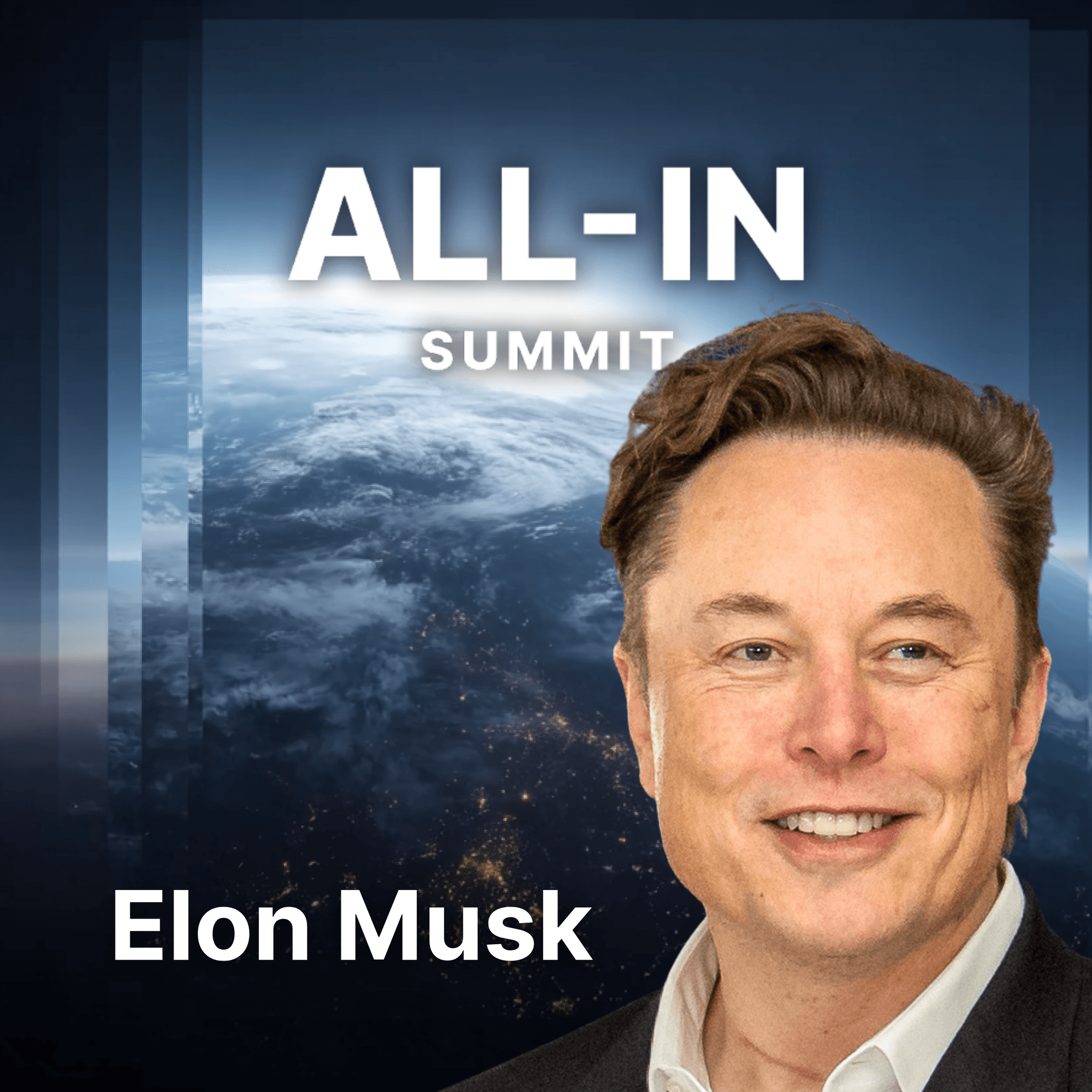
Elon Musk on DOGE, Optimus, Starlink Smartphones, Evolving with AI, Why the West is Imploding
Episode Overview In this episode, the hosts welcome Elon Musk to discuss a myriad of topics including his experiences with DOGE, the development of Tesla's Optimus robot, advancements in AI through his company xAI, the future of SpaceX's Starlink smartphones, and broader societal concerns regarding the direction of the West.
---
Key Discussions and Highlights
- Introduction to Elon Musk and DOGE Experience
- Brief reflection on Musk's engagement with DOGE.
- Musk's proud demeanor while discussing his involvement with the Dogecoin team.
- Optimus: Progress and Potential
- Musk envisions Optimus as potentially the greatest product ever created.
- Discussed the "hands problem", emphasizing the importance of human-like dexterity.
- Current challenges with supply chains and actuator designs for humanoid robots.
- Estimated production costs of Optimus and importance of achieving economies of scale.
- Tesla: AI5 Chips and Full Self-Driving (FSD)
- Introduction of AI5 chips and their expected performance improvements over previous versions.
- Musk believes the current chips will yield self-driving safety that is significantly better than human drivers.
- SpaceX: Starlink-Enabled Smartphones
- Announcement of a $17 billion spectrum deal to enable direct connectivity from satellites to smartphones.
- Musk's vision of a future where users can replace traditional phone carriers with Starlink.
- Timeline for rollout: Expected hardware updates in smartphones within two years.
- xAI: Evolving AI Models
- Discussed advancements with Grok, xAI’s approach to training AI using a vast corpus of human knowledge.
- The potential for a Grokipedia as a more reliable source of truth compared to current platforms like Wikipedia.
- Scaling laws and the diminishing returns of compute power when building AI models.
- Evolving with AI and Societal Concerns
- Musk expressed concern about the implosion of the West, citing declining birth rates and cultural shifts.
- Discussed the vacuum left by religion and the rise of dystopian ideologies in its absence.
- Emphasized the need for a renewed sense of optimism and purpose in society.
- Understanding the Universe and Space Exploration
- Musk's ambitions for exploring the Moon and Mars, emphasizing the importance of becoming a multi-planetary species.
- Discussed the possibility of a self-sustaining city on Mars and the timeline for achieving this goal.
---
Key Takeaways
- Optimus has the potential to revolutionize robotics but faces significant engineering challenges, particularly with human-like dexterity.
- Advancements in AI hardware (AI5) are expected to drastically improve Tesla's FSD capabilities.
- Musk envisions a future where Starlink offers comprehensive global connectivity, potentially replacing traditional mobile carriers.
- Societal decline is a pressing concern for Musk, who sees a lack of optimism as a major factor driving cultural issues in the West.
- The exploration of Mars is framed not just as a goal, but a necessity for the long-term survival of humanity.
---
Conclusion Elon Musk's insights on technology, AI, and societal challenges paint a complex picture of the future. His ambitious projects like Optimus, Starlink, and space exploration reflect a forward-looking vision that is both innovative and deeply intertwined with pressing global issues. The discussion invites listeners to consider the implications of technological advancement on society and the human condition.
Written by AI. May contain mistakes. Listen to the episode to check what was said.
Transcript
Automatic transcript. May contain errors.0:00I believe Optimus is gonna be the greatest product ever created by human. Elon Musk and his XAI startup have built the largest and most powerful artificial intelligence training supercomputer in the world. As far as I know, there's only one person in the world who do that, you know. This is an arms race of epic proportions. He's a big finger! You guys went on Fox the other day with the Doge team. You thought Elon's faith not knowing while they were speaking with a grin here to hear He was proud. X AI has acquired X in an old stock transaction. Tesla's first robo taxis are officially on the road.
0:39The company's board proposed a new compensation package for the CEO that could have just about a trillion dollars in stock. He gets nothing if he doesn't hit the numbers. SpaceX will buy wireless spectrum licenses from Echo Star for its Starlink satellite network for about $17 billion. Three, two, one.
1:06There's a filly.
1:11There's his flash down. How do you have time? I never understand you. Yeah, well, I do work a lot. Ladies and gentlemen, Please welcome Elon Musk. All right. All right. Where are you? Alto. You're in Palo Alto. I'm not watching to DC. I'm at Tesla Global Engineering Headquarters in Palo Alto. Yeah. So no more watching to DC. Your back at work. You're focused. Yeah. Yeah. Haven't been to DC since May. Okay. That was a hell of a side quest. Any lessons from your time in Washington, DC? The government is basically unfixable.
2:12I poured David's noble efforts. It's good to have talented people in the administration. But at the end of the day, I feel like we have our national debt, which is insanely high. The interest payments exceed the defense department, sorry, war department budget. And Nikki Bryzing. So if AI and robots don't solve our national debt, we're toast. which is a great segue. Optimus is I think going to be the greatest product in the history of humanity. What's the progress like and how much of your how many of your cycles are going specifically to optimist? What's the timeline?
3:13I think Yeah, I know everything would be take a long time. We've got time.
3:25We're finalizing the design of Optimus version 3.
3:32And that really is going to be a very remarkable robot. It will have the essentially the manual dexterity of a human, meaning a very complex hand, an AI mind that can navigate and comprehend reality, and we made in very high volume. Those are the three things that are missing. Like, if you see any other robotics company, they're missing those three things. those are the three really hard things.
4:11And I spend actually at this point,
4:19it might be more of my mental cycles than anything else, any of the single thing on Optimus. That's solving for real world AI, I, all of the electro -mechanical issues of optimists, the supply chain and production challenges of it, because there is no supply chain that exists for humanoid robots. So it has to be, we have to recreate it from scratch and which requires doing a lot of vertical integration. None of the actuators in optimists are available from an existing supply chain. So, but I think it is accurate to say that if successful, Optimus will be the biggest product ever. And the cost of it at scale, 20, 30, 40 ,000 dollars in robot, what do you think the first wave of them will cost and when will we be able to buy one to work on the ranch?
5:21I think that the marginal cost of production once you hit a million units per year is probably around the $20 ,000 range. It sort of depends on how much you spend on the AI chip in the robot. But, and you need to achieve a lot of efficiencies in the actuators. There are 26 actuators per arm, like 26 electric motors, gearboxes, and power electronics.
6:03So the AID chip will be pretty expensive. but that might be like five or $6 ,000 of the bill of materials, maybe more.
6:17But I think at volume, add a million units a year, the production cost is probably in the order of $20 ,000, maybe 25, something like that. And price will be as a function of demand. Elon, can you maybe explain to everybody why the hand is so important to get right and why, you know, the actuator design is so unique and, you know, why it's so difficult, why nobody makes it and why you have to start there almost to build the rest of the robot properly. It turns out that human hands are incredibly evolved to be this incredibly sophisticated machine. Like, your hand is actually a remarkable thing.
7:04It's look closely at your hands and think of all the things you can do with your hands, which is a lot. I can't think of many things. I was just thinking about something. Your hands are very versatile instrument. Yeah, you can give a high five. Very versatile. You know, you can swing a baseball bat, you can thread needles. You can put thread in a needle. You can play the piano with violin. You know, you could disassemble or assemble a car. are the hands are incredibly versatile instruments. And most of the muscles of the hand are actually in the forearm. So your hand is kind of like a, like it's like a puppet.
7:57Like it's mostly a puppet. The muscles are coming from the forearm and they're pulling the tendons, which are, you know, they're also human tendons designing or human tendons evolution is incredibly good. So you've got this wave of tendons. You've got, I think you even had something like, depending on how you counted, 27 or 28 degrees of freedom per hand. It's amazing. So in order to create a robot that can be a generalized humanoid, you must solve the hand's problem. So we had our hands. Knees hands. So is it like when you were first building Tesla where the supply chain doesn't exist and now you have to go out and find folks to work with and build all this vertical integration get support?
8:52Is it literally like it's just nowhere to be found and you're going to have to build all of this stuff up? Yes, we could not actually buy the actuators for any amount of money. simply didn't exist. Even though there are, and at 10 ,000 electric motors out there versus sizes and shapes, we've had to design every electric motor gearbox and the controlling electronics from scratch, basically from physics -first principles. The good news is you've got a lot of experience with factories over the last couple of decades. So how challenging is this versus cyber truck? Model Y Gigafactory, you know, yeah, the Faber -J egg known as the Model X.
9:37Yeah, right
9:41It's hotter than any of those things. Okay. Yeah much hotter Significantly, yeah, yes, well Harder these stars. It's more, not hard. Starships harder. Okay. So somewhere between a Model X and a Starship. Yeah. Is it, is the, what's harder the hardware or the software? Right now we're struggling with the, the final design of the hardware. Like I said, it's really primarily the hand. Not to just, just, just miss the rest of the robot. But the rest is also important. But the hands of the inclusive of the forum are a majority of the engineering difficulty of the entire robot. And then let's assume you get past the hardware challenges.
10:29How much do you sort of get for free based on all the progress that's happening with LLMs? Will consumers just be able to interact with this, talk to the robot, ask them to do things, it'll understand, and sort of, yeah. Yeah, no problem. You're spending a lot of time with Annie, I noticed, a lot. Not that long. Maybe I went a little over the top promoting Grock Imagine. Well, but in all seriousness, those characters and these robots that seems to be, you know, like maybe they... You could get the embodiments of Annie, I suppose. Yeah. Why the human form factory lawn, you could make something that's maybe better than a human, or maybe simpler than a human to do specific tasks and maybe better than a human to do more things than a human can do, how do you decide to make it just like a human?
11:21Well, if you wanted to do all the things that a human can do, it turns out you need a human part robot. So if you wanted to do a subset, that's much easier.
11:36But it turns out humans evolved to this shape capabilities that we have for good reasons. Actually, there is, there's value to having four fingers in the thumb. And even the pinky actually is quite useful. It toes are much more a question lock, but Well, also humans have designed the world as well, so we designed it for us. If we can make a humanoid robot it'll be immediately backwards compatible with what we've built the world for. Exciting. Elon, there's another part of the robot. So there's the yellow lambs, there's the actuation of the hands. But also there's the silicon that runs it. And there was, you know, Dojo, I think you posted on X, AI5 and AI6, and it just seemed like you were incredibly excited about the direction in which the silicon layer was also going.
12:43Can you tell us about that and what that is and what are we building here? What is being built? Is it a complement to everything that exists in the world? Is it a potential long -term competitor? What is it?
12:59Yeah, so it tells that we basically had two different chip programs, one dojo and one dojo on the training side and then we call AI for, it's just our inference chip. that the AI force was currently shipping in all vehicles, and we're finalizing the design of AI5, which will be an immense jump from AI4. By some metrics, the improvement in AI5 will be 40 times better than AI4. So 40 % 40 times. And this is because we work so closely at a very fine rate level on the AI software and the AI hardware. So we know exactly where the limiting factors are. And so effectively the AI hardware and software teams are co -designing the chip.
13:59So a 40X improvement in the silicon, I think then as it, as everybody here in the audience experiences it, is that just an almost like an order of magnitude increase in the quality of FST and the safety that you experience as a Tesla driver and then the quality of the robot. Where does it all manifest when you bring it up and actually get it into production? Yeah, to be precise, the 40X is on, if you see it like compared to the worst limitation on AI4, which is running the softmax operation. Yeah. We currently have to run softmax in around 40 steps in emulation mode. Whereas that'll just be done in a few steps, natively in AI5.
14:45AI5 triple also be easily handled mixed precision models. So you don't have, it'll dynamically handle mixed precision. There's a bunch of sort of technical stuff that AI5 will do a lot better. In terms of nominal sort of rural compute, it's 8 times more compute. about nine times more memory, roughly five times more memory bound with. So, but because we're addressing some core limitations in AI4, you multiply that by that ADEX compute improvement by another 5X improvement because of optimization at a very fine grain silicon level of things that are currently suboptimal in AI4, that's where you get the 40X improvement.
15:32You had, I'll keep going. So, now that's it. I am confident that the current chips, AI -4 chips that are in the cars will achieve self -driving safety that is at least two to three times that of human and maybe even X. And the software that will be released for that is coming out over the next few months. So, version 14 will be the biggest upgrade in Tesla software since version 12. We are increasing the parameter count by an order of magnitude.
16:16There's a lot of reinforcement learning that's been used. as we, there's like, you can think of AI sort of as a way of compressing reality and some of those compression steps, we're too lossy and we address the lossiness in the compression steps. So these are all software updates that'll go out, so just over their updates. your car is going to feel like it is santeant by the end of the year. It feels that way already to be honest. I saw in the trades that she spent about $17 billion on some spectrum and that. So some catch change to enable your satellites and the Starlink network to connect directly with phones.
17:11What will that look like in a year or two? Are we going to drop our Verizon account and just expand our Starlink account? What? Thank you. We're kind of hoping because Verizon kind of sucks. How many of you want a Starlink phone? Who wants a Starlink phone? Is it technically possible? I know you can't see it, but it's everyone. Yeah, it's actually. Alright, cool. So, this is kind of a long term thing. And it will allow SpaceX to deliver high bandwidth connectivity directly from the satellites to the phones. But there are hardware changes that need to happen in the phones. So since these frequencies are not supported in current phones, the chipset has to be modified to add these frequencies.
18:09And that probably is a two -year time frame. So the phones that are able to use the spectrum that was acquired probably start shipping in around two years. And then we also need to pull the satellites that are going to communicate on those frequencies. So in parallel, we're building the satellites and working with the handset makers to add these frequencies to the phones. and then the satellites and the phones will enhance shake very well to achieve high bound with connectivity. But the net effect is that you should be able to watch videos anywhere on your phone. Wow. And it's going crazy. And what do these frequencies, would they work indoors inside buildings?
18:53Like the phone currently does? And so will you be able to have basically like? If you're in a building with a thick metal roof, than no. No, the same types of normal homes. Elon, is your vision for this that instead of having an AT &T account or then roaming when you're in the UK or you're in India, it's just we could have one direct deal with Starlink. It works all over the world eventually, not today, but at some point. Is that the end goal? That basically we don't need a regional carrier. We have a global carrier and that would be you. That would be one of the options. To be clear, we're not going to put the other carriers out of business.
19:34They're still going to be around because they own a lot of spectrum.
19:40But yes, you should be able to have a starlink, like you have an AT &T or B -Mobile, Verizon or whatever. You could have a account with Starlink that works with your Starlink antenna at home, with Wi -Fi as well as on your phone. And yeah, it would be a comprehensive solution for high bandwidth at home and for high bandwidth direct to cell. Could you buy some carriers to have more spectrum? Maybe you could bivorize it? Not another question, I suppose, if that may happen. Let's talk about, let's talk about Starship. You just had a really what appeared to be a phenomenal launch. How close is it to being predictable and ready to go in a commercial setting?
20:36I think we'll recover the ship next year. We've got one more launch of the stalling version version two stack, but there's only one booster and ship left. That's in the version two design. And then thereafter, it's version three, which is a gigantic upgrade, because that's got Raptor three and pretty much everything changes on the rocket with version three. So version three might have some initial TV pains because it's such a radical redesign. but it's it's capable of over a hundred tons to orbit fully reusable and I think it's I think I think unless we have some unless we have some very major setbacks space X will demonstrate full reusability next year catching both the booster and the ship and being able to deliver over a hundred tons to a useful orbit.
21:42What is the best rocket in the world do now in terms of tonnage to space? Well in terms of commercial rockets this this Falcon Heavy which we'll do in with side boosts of reuse we'll do about 40 tons. This is five times bigger. Yeah. Two or a half times bigger, but Stasha will be full reuse, full reusability. Got it. Okay. So everything comes back. Elon, after the explosion that happened with the failed launch, there was a lot of sorry. Which failed. The more recent one, the more recent would with the Starship Hat, with the Big Boom. Yeah, and the Big Boom on the base. And there's a lot of proclamations that there's gonna be environmental and FAA and all these other sorts.
22:42The recovery back to the launch pad again was incredibly fast. How did you get back so fast, not just technically and work wise, but just like regulatory clearance wise, because they said there were gonna be all these questions and reviews and so on. How did you guys manage that? Well, there were a lot of questions and reviews. We got through them all and credit to the SpaceX team. They worked incredibly hard and they got the next server booster tested and on the pad and flown and used credit to the SpaceX team, very proud of them for doing such a job, a great job of recovering. I mean, it's just creating a fully reusable open or rocket is one of the hottest engineering problems ever.
23:31It's certainly, you know, I candid it for most difficult engineering project ever. You know, it's on the podium at least.
23:42So, that's been the goal of SpaceX from the beginning, from 2002. And here we are 23 years later. So it's a long journey. And with a super talent, like by far, I think the most talented group of rocket engineers that it's ever been assembled. And we're finally next year, I think, we'll be able to achieve full reusability. And what are the big technical blockers that you're focused on there between now and that full reusability? Are there some showstoppers where you're just kind of literally just Obsessing over trying to figure out still or is it more about getting through a side of a laundry list of your learnings and just integrating it into the next launch?
24:33Well That the For full reusability of the ship There's still a lot of work that remains on the heat shield So no one's ever made a fully reusable orbital heat shield like the shuttle heat fuel had to go through nine months of repair after every flight. Right. So no one's ever made a fully reusable orbital heat shield. And is that a material science problem or is that an engineering problem or both? Yeah I mean it's a material science engineering problem. So it's but we really are looking at the fundamental physics here. Again, physics post principles and trying to figure out how do we make something that
25:22is it can withstand the heat, it's very light, it doesn't transmit the heat to the primary primary structure. And that whose integrity is intact. They don't crack. And then as you ascend, if you hit some grain, the tiles don't dissolve and rain. There's a lot of different issues. And then you really need to know that these tiles are working. And you can't go through this laborious inspection. So at Reliance V, we're at these tens of thousands of tiles, all work and don't need to be republished or checked one by one. That's what's the case with the shuttle. Can we maybe switch now? It's like, I mean, who else were you talked about Tesla?
26:20Then you go to SpaceX. Now I'd like to ask you some questions about GROC. and XAI. You want to just give us an update. I think you kind of talked about where the next -gen model is. And you said something incredible. I still don't think people really understand it, which is there's going to be a next training run where you expect not to start from the common web and common crawl where you expected an enormous amount of synthetic data. Just tell us about how the evolution of GROC is going. and this innovation and why it's so important.
Read the full transcript
26:58Yeah, so we're running a lot of, using a lot of inference compute and reasoning to look at all of the source data, which is really the corpus of human knowledge. And then thinking about each piece of information and then adding what's missing and correcting mistakes and removing falsehoods from that training data. So it's like if you take the Wikipedia as an example, but this really applies to books, PDFs, the websites, every form of information. The GROC is using a heavy amount of inference compute Let's say to look at as an example a Wikipedia page and say what is true, partially true or false or missing In this page now rewrite the page to include to correct the remove the falsehoods Correct the half truth and add the missing context Well, Elon, by the way, could you just publish that?
28:15Could we create like a Grocapedia? I mean, that would be great for our bio pages, which are disaster. Wikipedia is so biased and it's a constant war. If something gets corrected five minutes later, there'll be an army of people trying to, I mean, it's become hyper partisan and there's hyper -police activists all over it. So if you do fix, for example, Wikipedia is a source of truth, It'd be great to publish that just so that the world has it. All right, I'll talk to talk to you about that. So talk to the team about that like a GROC video, whatever. This here's the GROC video version. It'd be interesting.
28:53And then just have it out there, please. We're in terms of people here like it. In terms of training GROC 5, you're scaling up your super cluster in classes in Memphis. Can losses do not. Yeah, but there was a second one. Yeah, could you give us an update on that and then also as part of that, where are we in the scaling laws? If you scale a bigger cluster, do you get a more powerful ai model? Is there a point of diminishing returns or like how much more compute, if you throw twice as much compute at it, do you get a 10 % better model? Do you get a 100 % better model? Like is it log linear? What I guess how much more juice is there left in scaling hardware do you think?
29:42I think there's a natural logarithmic function associated with the amount of compute. So then like say for arguments say like Henex more compute will double the intelligence. Maybe that's that might be a rough rule of thumb. But you know that still means that you know go from 100 IQ to 200 IQ. Still pretty, pretty big deal.
30:08And I think we'll see intelligence continue to scale all the way up to where most of the power of the sun is fondest for compute, and then ultimately most of the power of the galaxy. Sort of quadrachev to quadrachev three scale compute. So I guess, why don't you think about our official intelligence, not as sort of this, you know, a destination that you reach, but really as part of the overall escalation of intelligence that we are aware of. You know, human intelligence, the host of scale, as the population has increased and we've been able to store more and more information human intelligence to scale.
30:57Now, because of population declines and low growth rate, human intelligence is somewhat plateauing and will actually decline. And my guess is that I think that we might have AI smarter than any single human at anything as soon as next year. And then probably within 5, like say 2030, probably AI is smarter than the some cool humans. Do you think humans are on the decline because the AI is evolving? Do you think there's this evolution of the ecosystem on Earth that's underway that we don't really understand the structure of what's going on? but...
31:46Yeah, maybe we implicitly know that it's coming.
31:59I mean, I hope the birth rates went around. I'm a big proponent of increased birth rate, obviously. Well, you're doing anything about it or no? Yeah, I've said a good example. You know, we had a big conversation at this conference we didn't expect, which is suicidal empathy, the West, this declining birth rate. I noticed you've been pretty active about it. And open borders. And open borders. It's like let the invaders in. It took their talk. Could all three of those be the same thing? It seems like there's a number of symptoms of the West being suicidal. The most obvious one being the birth rate is not at replacement level.
32:42So obviously if that continues indefinitely, then the West will literally not reproduce enough to replace itself. But there's other things too. There's the fact that the borders were totally opened to the point where Western culture, the social fabrics started to come apart. And you see this especially in Europe where there are the indigenous cultures of the UK or France or Germany are starting to potentially be taken over by cultures of people who are bought in and aren't assimilating. You have crime where we have this case on social media right now, this young woman, Irene, who's just killed in a senseless way on a subway, which is horrific enough in and of itself, but then in addition to that, the elite media does for whatever reason, just refuse to cover it, like it didn't exist.
33:30So you have this issue of crime that's not being addressed or even - and no knowledge of this. Like it's almost like we're trying to deny the reality of the spiral and this, yeah. So you have all these data points that seem to suggest that the West is suicidal or doesn't seem to want to defend itself or propagate itself. Look, I think everyone in this room thinks that life is awesome, right? It's pretty great. And I think we're living. Yeah. And when Alex Carp was here earlier today, defending the West that got some of the loudest applause of the conference. So I guess we probably don't really understand what's going on.
34:14We don't really. Yeah, what's your take, Elon? Because you know, what's your take on the suicide of the West? Yeah. What's going on? I'm very worried about it. Yeah. I'm very worried about it. You know, I think there's this. Let's just say that the actions of the West or indistinguishable from suicide. It's so... It's... And look, at least in America, there's generally a sense of optimism. But when's the last time you talked to someone from Europe, who lives in Europe, who's optimistic? Not for a while. Decades. I like even one. It's rare. So I think unless people have a sense of optimism and purpose about the future, they suicide might be just what happens.
35:08Like having a child is an act of optimism about the future. So if you're not optimistic, just put it there.
35:20So, I think we need to maybe give people a sense of optimism and excitement about the future and I believe that the future will be better than the past and that we're more interested in having kids. Did religion play a role in the past, Elon, to kind of play Kate and make folks feel that way? Yeah, I think so. Nature of course of vacuum. And if you take away religion, then I think you actually, you get something in this place which is actually worse than what was there before. I mean, it's like destructive, basically. You get like the white workmind virus, filling the whole that religion used to have.
36:03taking the place of religion. You get these dystopian de facto religions that are very self -destructive. So I think perhaps some sort of revival of religion, or at least what we need is some coherent philosophy of that people can get excited about. You know, I mean for me, it's a philosophy of curiosity. I'm curious about the nature of the universe and I want to go out there and I want humanity to be out there exploring the stars. Maybe meeting alien civilizations. Maybe in some cases we see the ruins of a long -get alien civilization, but they were very strong for 10 million years. You know, the kind of stuff that you see in Star Trek in a non -distopian sci -fi book or movie or show.
37:02And so I'm just to have a philosophy of curiosity of like I just want to know what's going on and in order to know what's going on we must have an increase in the scope and scale of consciousness. We must expand consciousness. We must grow humanity and we must extend humanity in order to comprehend the, to understand the universe, or even what question should we should ask about the answer that is the universe? You know Douglas Adams, book, the Hitchhaggers guy, the galaxy is actually a deep book on philosophy disguised as humor. And what the point he was trying to make in that book was that the questions are the really, the hard part.
37:53The answer is the universe. Like the answers everything you see around you. But but but what are the questions that we don't know to ask? Now some of the questions I guess I do know I'd like to know is the standard model of physics correct about the origins of the universe Are we actually 30 point eight billion years old? How does the universe end is and then heat death or in some other way? You know We might be Elon can you talk about the whole sort of simulation question are we a simulation maybe So, where do you think we find the answer first in AI or in the stars? Because you're pursuing both, obviously.
38:38Yeah. I don't know if I hope more people can get behind a philosophy of curiosity because I think it's very exciting and inherently optimistic. Because there's this amazing sense of wonder about the nature of the universe. And when you uncover some secret to the universe, that's amazing. And you're like a whole world of understanding is opened up. I mean, we used to not even know where all the continents were. You know, it used to be like just the math would be there be dragons. Like when they sailed in that direction they didn't come back. I mean the moon base. That's all they knew. I kind of feel like the moon base or just going to the moon for real this time would be a big step in the right direction.
39:40And you still have the moon plant? What's the status of that? Is that still on the agenda? Yeah, I think having, I think we want to try to reach new heights as a civilization. So I think it's fine to go to the moon, but we should go to the moon in order to establish a lunar base, like a lunar research base. Yeah. I mean, there are parts of the moon that are perhaps older than parts of Earth. and we might understand more about the nature of the universe if we had a science based on the moon. That would be very cool. And then we obviously want to go beyond the moon to Mars and well they self -sustaining city on Mars.
40:23I do think that there is a folk in the road of human destiny where if we can establish a self -sustaining city on Mars the key test being if the resupply shifts from Earth, the stuff coming for any reason, does Mars continue to prosper or does it die out? At the point at which Mars is able to prosper and grow on its own, the probable lifespan of consciousness is dramatically greater because we are no longer dependent on everything going right on Earth. You know, there's always some possibility of self -analysis on Earth with the World War Three example, or a super virus, or a meteor, like that's a story of the dinosaurs.
41:09We know from the fossil record that there have been many mass extinction events. So the question that I was always wondering about is, will the civilization arc continue to ascend such that we can make Mars self -sustaining before the civilized arc descends? Because the window of opportunity to make life faulty planetary exists now for the first time in the four and a half billion year history of Earth. Elon, I'm just assuming that we get there and you're there. You know, you'd be the elder statesman. You'd have the moral authority of Mars. How do you run Mars? I just want to emphasize again that's more important than the form of governance on Mars or who's there in the early days.
42:09What really matters is that Mars is a self -sustaining that we are truly a multi -planet species and and such that we achieve planetary redundancy. So that if something, and obviously we should do everything possible to make sure life on Earth is great, but there's always some risk of an annihilation event on Earth. Like it's itself annihilation or some natural disaster. And so the probable lifespan of consciousness increases dramatically as soon as we are multi -planet species with the key test being can Mars survive if the resupply ships stop coming? So again, like the first missions to Mars are not that important.
42:56The what matters is can you get sufficient tonnage to Mars such that Mars can prosper on its own and that means it has to have all of the ingredients of civilization. It's not just that you need to build, for example, a chip factory on Mars or chipfab on Mars, but you need the ability to build chips. Do you have a sense of the time scale? Like, let's assume starship is at a state starting in, you know, 2026, then there's going to be a bunch of testing obviously, there's going to be a bunch of early testing. We only have certain launch windows. So there's a bunch of time constraints. Is this a 50 year thing in your mind?
43:33Is it 150 year thing? Is it something that is for our generation, or is it our children's generation? Where do you see that point if it's optimally possible? you know things go and break our way. I think it can be done in 30 years. If provided there's an exponential increase in the tonnage to Mars with each success of Mars transfer windows, which is every two years. So every two years the planets align and you can you can transfer to Mars. So I think in roughly 15 but maybe as few as 10 but I saw 10 to 15 ish Mars transfer windows if you're seeing exponential increases in the tundish Mars with each Mars transfer window then it should be possible to make Mars self -sustaining in about, hold it roughly 25 years.
44:32Amazing. That's incredible. Alright ladies and gentlemen Elon Musk we'll see you in our back in town we miss you. See you in person next time. Thank you brother.
From the publisher
(0:00) Introducing Elon Musk, and reflecting on his DOGE experience
(2:47) Optimus: Progress and potential, the “hands problem”
(12:20) Tesla: AI5 chips, impact on FSD
(16:50) SpaceX: Vision for Starlink-enabled smartphones, $17B spectrum deal, Starship update
(26:16) xAI: Next-gen Grok models, Colossus 2, scaling laws, “Grokipedia”
(31:29) Evolving alongside AI, implosion of the West, the religion vacuum
(37:36) Understanding the universe, going to the Moon, what happens on Mars?
Thanks to our partners for making this happen!
Solana: https://solana.com/
OKX: https://www.okx.com/
Google Cloud: https://cloud.google.com/
IREN: https://iren.com/
Oracle: https://www.oracle.com/
Circle: https://www.circle.com/
BVNK: https://www.bvnk.com/
Follow Elon:
Follow the besties:
Follow on X:
Follow on Instagram:
https://www.instagram.com/theallinpod
Follow on TikTok:
https://www.tiktok.com/@theallinpod
Follow on LinkedIn:
https://www.linkedin.com/company/allinpod
Intro Music Credit:
Intro Video Credit: