In short
Podcast Summary: Solana's Anatoly Yakovenko on Crypto's Next Era: Quantum, AI, and the Future of Money
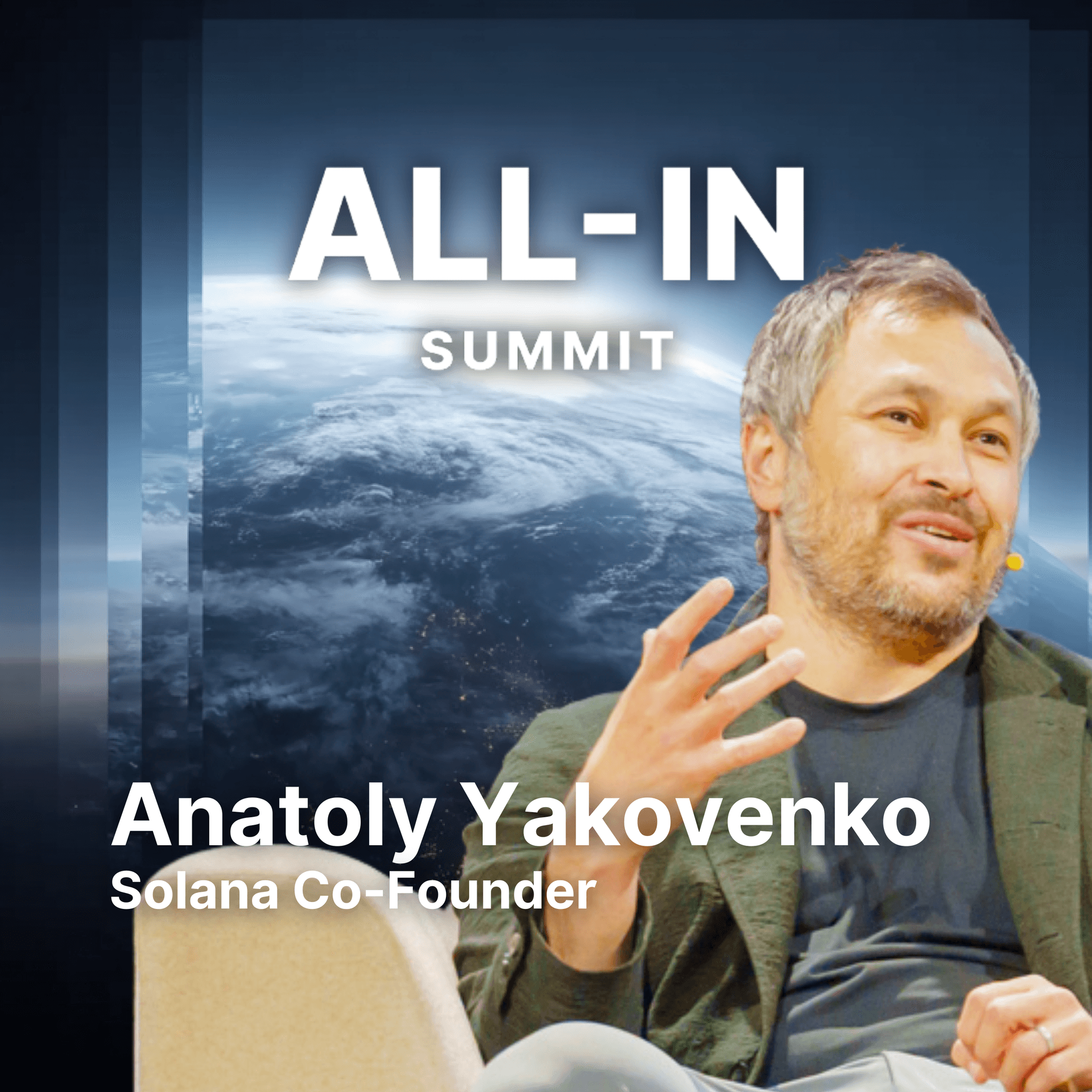
Episode Overview In this episode of the All-In Podcast, co-hosts Chamath Palihapitiya, Jason Calacanis, David Sacks, and David Friedberg interview Anatoly Yakovenko, co-founder of Solana, one of the fastest-growing blockchains. They discuss the current state and future of crypto, including its evolution under different political administrations, unique applications beyond finance, the impacts of quantum computing and AI, and the pivotal role of stablecoins.
Key Highlights
Introduction to Anatoly Yakovenko
- Co-founder of Solana, a prominent blockchain project.
- Leads the charge for Web3 innovation and mass adoption of crypto.
Crypto Under Political Leadership
- Discussion on how crypto has evolved under Trump vs. Biden.
- The stablecoin boom is reshaping the landscape of US treasuries.
- Regulatory changes could unlock significant stablecoin markets.
Exchanges and Mass Market Adoption
- Contrast between traditional exchanges leveraging blockchain vs. crypto-native platforms.
- Yakovenko discusses what it would take for crypto to reach the mass market.
Exciting Crypto Verticals Beyond Finance
- Exploration of areas such as social media, intellectual property rights, and real estate.
- The potential of the CLARITY Act to facilitate better integration of crypto and traditional assets.
The Impact of Quantum Computing and AI
- Yakovenko emphasizes the impending breakthroughs in quantum computing.
- Potential synergies between AI advancements and crypto technologies.
Bitcoin's Future and Resilience
- Discussion on Bitcoin's market cornering and resiliency.
- Concerns about the implications of wealth concentration among players like MicroStrategy.
Ethereum and Its Position
- Insights into Ethereum’s role amidst the rise of Solana.
- Yakovenko expresses admiration for Ethereum and its founder, Vitalik Buterin.
The Future of Payments
Visa and Mastercard
- Yakovenko argues that Visa and Mastercard function as technology companies.
- The disruption potential of stablecoins may pose risks for traditional banking.
Key Discussions
Vision for Financial Technology
- Yakovenko shares his vision of a unified global ledger for finance, enabling instantaneous transactions globally.
- Emphasizes the importance of velocity of money and assets.
Regulatory Challenges
- Addressed the complexities of launching crypto projects in the US and the burdensome legal costs involved.
- Advocates for clearer regulations to encourage innovation.
The Evolution of Public Understanding of Crypto
- Draws parallels between the initial confusion surrounding the internet and the current understanding of crypto.
- Anticipates a gradual improvement in public comprehension as more people interact with crypto technologies.
The Role of Community and IP Rights
- Discusses the potential of NFTs to foster communities and new intellectual properties.
- Envisions future models where creators have equity ties to their projects through crypto mechanisms.
Conclusion Anatoly Yakovenko's insights reflect optimism about the future of crypto, emphasizing the need for regulatory clarity, technological innovation, and community involvement. The conversation highlights the transformative potential of crypto technologies, quantum computing, and AI in reshaping financial systems and markets.
By the end of the episode, listeners gain a nuanced understanding of not only the potential of Solana and other blockchain technologies but also the regulatory and market dynamics that will shape their future.
Partner Acknowledgments
- OKX: Building crypto portfolios.
- Google Cloud: Supporting next-gen unicorns.
- IREN: Accelerating AI projects.
- Oracle: Advancing enterprise productivity.
- Circle: Provider of the USDC stablecoin.
- BVNK: Financial infrastructure powered by stablecoins.
- Polymarket: Information market for futures.
Follow the Podcast
- Social Media Links:
- [Chamath](https://x.com/chamath)
- [Jason](https://x.com/Jason)
- [David Sacks](https://x.com/DavidSacks)
- [David Friedberg](https://x.com/friedberg)
Listeners are encouraged to follow the podcast on various platforms for more insights into tech, economics, and the evolving landscape of cryptocurrency.
Written by AI. May contain mistakes. Listen to the episode to check what was said.
Transcript
Automatic transcript. May contain errors.0:02Anatoly is the CEO of a little crypto project known as Solana. One of the fastest growing blockchains in the world. As CEO of Solana Labs, he's driving Web3 innovation. BlackRock, the world's largest asset manager, expanded its$1.7 billion tokenized money market fund to Solana. Why don't we all switch to Solana? I mean, Solana sounds like it's actually commercial, and the other guys sound like that they're antique. Everybody in the world should be a customer. Crypto will eventually win. It's inevitable. Ladies and gentlemen, please welcome Solana co-founder Anatoly Yakovenko.
0:45There he is. Oh man, thanks for having me. Keep doing it. Thank you. Welcome. Thank you. How much of a difference has David Sachs made in the first six months as cryptozar for your industry? Oh, it's been incredible. I mean, I think it's night and day. I don't know if the industry would have survived another four years of the Gensler regime. The Genius Act, I think, is going to unlock, you know, people estimate one to ten trillion dollars worth of stable coins that are going to be on public permissionless chains. So if you kind of look at those charts, who owns treasuries, and be with China, Japan, et cetera, countries, right now I think Tether is somewhere around number five.
1:31I think within five years, the internet is going to be the largest holder of U.S. treasuries. And at such a scale that I think, you know, I'm an engineer. I cannot honestly comprehend how that's going to change finance, but I think it will be transformative. Upside, downside? I mean, are there concerns there as well with that huge impact and democratization? or are you kind of a libertarian, let the chips fall where they may, so to speak? I think it's a huge opportunity to really accelerate American innovation and spread American finance around the world. I think we actually have the best financial system in the world.
2:10It's the most trusted, the most robust, the best regulatory environment for what it's worth as well. But it was built after World War II before the internet. so its APIs are kind of like a fax machine based. What crypto is allowing, I think, is this new technology stack built on top of the internet that's completely Western aligned. It's for transparency. It's for capitalism. But now we can actually interface Western US-based finance to the rest of the world. And I think America is going to benefit primarily from this. Not dissimilar to our media business going around the world and infecting people's consciousness.
2:51When you were getting Solana off the ground, how much of it was a technical and architectural vision that you had versus maybe a set of trade-offs that you were trying to solve that ETH didn't fill or Bitcoin didn't fill, and you said, I'm just going to try and do this? I think, you know, I can't speak for all founders, but, you know, I think founders are driven by kind of crazy vision. They have to be a little bit insane. So my insane vision is always this idea, like imagine finance 20 to 50 years from now, the science fiction version of finance. What I imagine is a single giant ledger, a single computer for every market in the world.
3:33That means it's available in Nairobi, New York, in London, in Singapore. And all of these things are synchronized at the round trip time of speed of light through fiber around the world or through Elon satellites. That's 120 milliseconds. So a dollar can be in New York, in London, in Singapore, in Nairobi in 120 milliseconds. So velocity of money, velocity of assets are as fast as physics allow. This is what nerd pilled me on building this. It's a physics problem. It's a massive finance problem. It's a really fun engineering, low latency. And did you feel that you had missed it somehow? When I had my kind of eureka moment and I did the back of the envelope calculation for design, I'm like, oh, this is a thousand times faster than ETH.
4:24And when I started talking to folks in the ETH community, they're focused on settlement. Settlement doesn't have these latency problems. You can do settlement in minutes and that's fine. So I always felt that Ethereum being world's settlement layer, Solana is the world's execution layer. and you know so far so good execution is where all the money is made so I think we're on the right track and a fast execution engine can also do settlement that's kind of a feature you've been super critical about two projects meme coins even though they do throw off I think some revenue for Solana and also the idea of a crypto strategic reserve What about those two projects tweak you a bit?
5:15I think primarily we could not predict what's going to happen on chain. We called it blockchain and NASDAQ speed. That was our tagline. And the idea was always how do we get stocks and bonds and treasuries and real world assets on chain from all around the world to be traded by everybody around the world. but it turns out that is a much harder legal and regulation problem than it is an engineering problem but anybody in the world can create markets for anything including meme coins including nfts and those things took off i think in part because of how slow regulation was to catch up which makes it annoying that yeah those are the things that come out instead of your true mission yep we saw We saw Dina from NASDAQ here yesterday.
6:00She announced the tokenization of securities that were going to trade on the exchange. There seem to be a lot of regulated exchanges and businesses that come from that kind of deeply regulated background starting to experiment with blockchain technology. Do you think they're going to be advantaged or disadvantaged given where they're coming from? Does the lock-in with regulators, the relationship with regulators, the lock-in with the market participants give them some leg up? or do you think that the disruptors are ultimately going to be able to operate more freely and more quickly? This is the big challenge.
6:30I think the advantage that we have that we are very nimble and we can operate everywhere in the world, the advantage that they have is that they're already regulated. They're already operating with those assets that we want on-chain in the United States. But they don't have global availability. NASDAQ is still in this little sandbox. So we'll see what happens. I think once the regulators allow public keys like cryptography to manage and transfer assets, that's the interface that you can wrap around and start moving anything from inside NASDAQ to Solana and vice versa. Once that interface exists, I think the genie is out of the bottle.
7:11The toothpaste is out of the tube. Do you ever meet with the regulated exchanges? And are there ways to build integration and partnership that benefits both? Of course. Yeah, so we've talked to folks, I think, across the spectrum from banks to regulated exchanges and regulators themselves. Solana is fundamentally a protocol. It's like an email standard. It's a bunch of software. The people that run it don't report to me. I can't fire them, so I can't stop it if I wanted to. And if we succeed, if the protocol is awesome and globally synchronous and super fast, NASDAQ would make more money by just running a Solana node and integrating with it more directly.
7:50So to me it's ultimately a win-win. We're never going to build an exchange that is onboarding US institutionals and serving US customers. We want NASDAQ to do that and to run it on Solana and that would be great. There's a common claim by the masses, meaning not everybody that's all in on crypto, that it's still extremely complicated to understand. You know, even if it's like just minting and burning or, you know, yield farming, you say it to just like the norm core person and their eyes glaze over. What's the turn in the abstraction of all of this stuff that makes crypto truly mass market? I actually think that the human brain has to change to adjust to it.
8:32I agree with you. It's really complicated. But I landed in the States in 1992 from the USSR effectively. and there's no way my parents could understand what a web link was, right? So it's all, whenever you have new technology, it just takes people a long time to adopt it and build a mental model for it. But now they do, they understand the web after years of using it. So I think as stable coins proliferate to the back office in a lot of companies, people will figure out, oh, the secret key is actually really important. I need hardware, I need PKI, I need trusted displays, all of the security stuff.
9:07and they will build a mental model for cryptography, having true ownership over something that is globally transferable. I saw a chart recently that showed that the number of L1 and L2 projects keep growing year over year over like the last three or four years. Why is that happening? I think because there's... What need are they filling? Well, I think the opportunity is so big to be the Google of finance, right? if you're like the one place for all of finance, all markets run, that is a massive opportunity. So I think people are going to keep launching L1s and L2s and they're all competitive. They're all competing with Solana and that's fine.
9:47I love competition. Until somebody wins it. I think as long as we're laser focused on improving the product, making it faster, cheaper, more reliable, we have a really good shot of actually becoming that global execution engine that's serving all of finance. Outside of finance, what do you think is the vertical that has the most promise over the next five years? In crypto or in general? In crypto. Whether it's for Solana or any crypto project, where do you think people aren't putting enough attention? I think all the stuff that people have tried. It's kind of like early 90 days, experimentation, Frontster.
10:29all of those things failed until there was a critical mass of people that understood how the web works and then Facebook took off. So I think even the weird experiments with NFTs being a way to create a community of artists to build a movie or story and create true new IP, all that will happen just five years from now or 10 years once we hit critical mass. So a lot of false starts and somewhere in that graveyard you might find some really good ideas. Absolutely. Just like what happened. And then the social network concept always seemed to me to be such a winner, you know, whether it would be like a dig or a Reddit format where you could vote things up with a cryptocurrency, your comments were somehow related to that.
11:08And there were a couple of little experiments I remember looking at for investment, but candidly, I didn't think the founders would pull it off. And I was right in that case. Is that the one that you think could break out if Elon put into X, Dogecoin are put in Solana and there was some sort of currency inherent to the objects and the behaviors? I personally think that you could build a competitive product to TikTok with crypto if the magic you caught that kind of lightning in a bottle because the monetization mechanism with crypto is so different than the ad-based one and the ad-based one kind of creates this forcing function for a lot of spam and duplication to ride to the top.
11:48How would that work? Just describe your product thinking there, that new kind of experience. How do you think it would work? I think you're kind of seeing some of these things play out with meme coins where you have creators that are associated with a coin that continues to have market cap and traction. And now the regulatory environment isn't here yet to clearly tie the success of that creator to the value of that coin. You need to remove a whole bunch of bottlenecks there, but the product exists. people watch that particular creator stream and go buy that coin. Once it actually looks like an investment thing, that Jason would be like, okay, I have all legal protection to actually put money in here.
12:28This is related to the financing question I was asking Neil and Ari about, which is can creators raise funding this way, and then can they deploy that funding, but then the coin holders can actually have equity in that project and in the performance of that project over time, rather than it just be, you know, If the regulatory environment changes, like people have been dancing around this, but like there's this project that I love, Clainosaurus, it's these cute little dinosaurs that are, they've, like kids love, it looks like a Pixar dinosaur. They've won awards for their animations and they raised funding because they created this collective set of dinos.
13:04Now, it would be awesome if those dinos could actually have copyright and revenue association in the future. but we can't do that yet and that's frustrating. But it could totally happen once we have enough clarity. Well, just imagine we bought collectibles and if we all bought Marvel Comics when we were younger but we had equity in Marvel, and 30, 40 years later those characters hit and you own... It could be Beast. It could be Mr. Beast. Or it could also be the next creator. You're watching an up-and-coming creator. You want to bet on them. Is that the next piece Sax is working on? Is that the...
13:36The Clarity Act is the big piece. It's kind of a big piece of legislation. For everybody, yeah. So, again, I'm an engineer. This is from my lens is raising money in the U.S. and trying to launch a token. We raised a seed in A round. It was about$14 million, which is amazing. It was, you know, like outright crazy success for a first-time founder. I had to spend$2 million of that on lawyer fees, which is more than 10 % of my runway, to figure out how to launch a token in the United States. And because I have kids in the U.S., this is my home, never leaving it, so I had to do it in America. A lot of founders actually just left to do it outside of the U.S.
14:16So the Clarity Act is a whole bunch of complicated legislation to try to minimize, hopefully, that cost to make it much easier for founders to launch. It's far too much friction right now. It provides clarity. Our partner, David Sachs, launched a company a few years ago that was trying to tie crypto to real estate, like a real-world asset. Tell us about what that movement is all about and what the utility is that is there if it works? So people want real-world assets on chain because there's demand in DeFi for non-correlated assets. If everything that is in crypto, all this innovation around risk management in real time between borrowers and lenders, it's useless because if everything's a meme coin, everything's correlated, it'll all crash at the same time.
15:06There's no hedging. right and the only free lunch in and finance is uncorrelated assets if you have true hedging so we need real estate bonds insurance whatever have you that has oil oil exactly commodities but like even california fire insurance it would be awesome to put that on chain because then people could actually buy insurance um all those assets if thank you All those assets, if they exist in this kind of global, synchronized giant state machine environment, can all be used together to reduce risk for the entire system because they're uncorrelated. And that's actually the only free lunch you can get in finance.
15:50So there's a lot of demand for them, and the technology is there to leverage them. Now we just need kind of the regulatory side to catch up. Can I change tracks a little bit? You're an engineer. You work in cryptography. Have you visited quantum projects? What do you think is the state of development in quantum computing? Everyone's got a different story. How much is hype in marketing? How much is real? What do you think is going to happen? Honest answer, I feel like 50-50 within five years, there is a quantum breakthrough. Part of that is because of how fast they are. Just define breakthrough.
16:25You can run Shor's algorithm? We should migrate Bitcoin to a quantum-resistant signature scheme. This is my bet. And this is because we're just so many technologies are converging right now. And this asymptotic rate AI and how fast is accelerating going from a research paper to an implementation is like astounding. so I would try to encourage folks to speed things up my key for this is Google and Apple adopt a quantum resistant cryptographic stack, this is the time to go migrate because now the consumer side of it is effectively solved and you don't have to kind of... So you watch where Google's going Yeah I think people should be worried if you're in the field but for the general public quantum computing is such a massive unlock in terms of how much we can process that it's going to be as big of a wealth creator if we pull it off as AI.
17:25So I think this is, to me, a lot of work, engineering work. We have the right people to do it, but for everyone else, it should be a huge opportunity. But to your point, the reports on the breakthroughs on the Willow project at Google are driven by AI modeling. AI is unlocking a lot of the capabilities to make it real, which seems to be an accelerator. It's pretty powerful. What's the intersection of all of that world of just AI in general and crypto? This is a funny thing to ask because I feel like AI is going to be everywhere and crypto is going to be everywhere. But where those lines cross is just really, really hard to pinpoint.
18:02I don't want to say something lame like, oh, we all have agents sending money around because that's kind of obvious. I mean, I think the first attempt was to kind of say and maybe there are distributed networks of compute, and maybe we can run distributed learning or distributed inference, but those projects really haven't taken off and really generated any momentum. Yeah, not yet. And again, because they're competing with a data center that is all co-located, that is funded with traditional finance and those things. And yeah, you can put those assets on chain, and that's a lot of ways how I think things are going to integrate.
18:36Probably the most singularity bet we can make is you have an agent that is a creator that is like an X personality that you can interface with tokens and buy into and pay for the GPUs. That could be fun. Bitcoin has turned out to be surprisingly resilient. But now we're starting to see certain players corner the market on large percentages of it. And that was never supposed to happen. So if something like MicroStrategy owns 6%, that's actually maybe 50 % more than that because there's so many dead coins out there. Does that worry you, the centralization of Bitcoin? And does that mean there's an opportunity to start the game anew?
19:21I think Bitcoin is resilient to these entities collapsing. Now, it's not going to be without painful risk that in terms of like people that own Bitcoin, but the thing is it'll survive that. and all the properties of Bitcoin that people value will remain through that transition. So if you really value Bitcoin, you should see that as an opportunity to own more of it. Even if somebody were to own 20 % or 30 %? It seems like there are people who actually have this intent. That's why I'm asking. I think as long as it's an open global competition to acquire Bitcoin and anyone can participate in that and we don't end up in some kind of regulated nightmare, you know, like you can't acquire gold or something like in the 70s, I think Bitcoin would survive those kinds of shocks.
20:12Is Bitcoin valuable enough now where it makes sense for, I guess North Korea does this, but I was just going to generalize and say like state-sponsored ways of either trying to penetrate it, hack it, take individual accounts. Like it just seems like there's an emergent trend here of this. its beauty is that it's the simplest protocol you can build because it is focused on just settlement it's very easy to understand from an engineering point of view and proof of work is kind of a it is a brilliant it's a masterpiece in terms of elegance and simplicity and it's very robust to all sorts of attacks now that doesn't mean that you can't have an attack that could cause rollback that's unexpected but I think it's extremely hard to pull off, very unlikely, and the internet is so super connected that it can automatically kind of respond and take action.
21:09I actually meant more just like states targeting accounts that have large Bitcoin holdings and trying to figure out who owns them and then just basically getting them to give them the coins. Yeah, those kind of state-sponsored wrench attacks. I think what we should do living in the West is really have strong opinions about property rights and how important they are and how foundational they are to wealth creation in the West and America. I completely agree with this. And this is our best defense. I completely agree with this. And be hyper transparent who owns the coins. Because then it's like you can't take away something that everybody knows you own.
21:48But when you try to hide your ownership of it, more likely it's easier for somebody to take it away. I think privacy is a right. So it's somebody's right to be able to do that. But I think our best bet in wealth creation is actually defending these rights and defending the right of somebody to own Bitcoin if they want to. It's extraordinary that it hasn't been hacked with so much at stake. Maybe you could speak to it as just an architect herself. The reason it hasn't been hacked is because it's so simple. And, you know, as an engineer, you always strive for simplicity to achieve a certain outcome.
22:22You can't always achieve that. Solana is much more complicated because the outcome we're striving is hyper performance and it's just hard. So, like, Solana is much more complicated as a result of that. But Bitcoin is designed for a very simple settlement layer that is, I think, you know, the coolest thing, the coolest piece of software written in the last 20 years is, I would say, the Bitcoin, like, Nakamoto implementation. There's been an enormous reanimation in the ETH market recently. Where do you think that comes from? Is that market-driven and speculatively driven? Or do you think that there's a fundamental reimagining of where ETH lives between Bitcoin over here and Solana over here?
23:05I'm honestly a huge fan of Ethereum. I think Vitalik is an amazing person, amazing engineer, and has a very strong vision. It's very different from my vision for Solana. and it's really cool to see those two play out. If I could predict what I do could cause a price change, I'd be a lot more successful. Well, you've been pretty successful. But, right, it's just really, really hard to attribute the work that you're doing. Okay, so look, your transaction network is quite liquid. It's going to become more and more and more as you have more validators, more clients, all that stuff. Another market that seems has built a monopoly or a duopoly around transactions who's a little bit at risk is Visa and MasterCard.
23:49What do you think about that? My like contrary opinion is that I think Visa and MasterCard are more technology companies. And if you look at their like profit margin on the gross payment volume, it's like 10 basis points. It's like vapor. I think the issuer and receiver bank, those are the most disruptible pieces on there because their profit margins are like 2%, like much, much bigger. And Visa is a technology company that owns end-to-end the customer. If they could remove the banks out of the loop and just do stablecoin transfers behind the scenes, I think they become a lot more successful and they can do a lot more for a lot less.
24:29Long stablecoin, short banks. Not an investor, but maybe. Chamath? Seems like a good premise. I can't comment on this. So that's a yes, everybody. Everybody short the banks and go long stablecoin. I'm telling you to do this. This is financial advice. Unless it doesn't work out.
24:53Thank you. Thank you so much.
24:59Thank you so much. Thank you. You're awesome, dude. Appreciate it.
From the publisher
(0:00) Introducing Solana Co-Founder Anatoly Yakovenko
(0:55) Crypto under Trump vs Biden, stablecoin boom, what it means for US treasuries
(5:56) Traditional exchanges using blockchain vs crypto-native exchanges, how crypto gets mass market
(10:02) Most exciting crypto verticals outside of finance: social, IP rights, real estate, CLARITY Act
(15:57) Quantum computing, AI's impact on crypto
(18:48) Bitcoin: resiliency, market cornering, risks, future
(22:45) Ethereum, Visa/Mastercard
Thanks to our partners for making this happen!
OKX - The new way to build your crypto portfolio and use it in daily life. We call it the new money app. https://www.okx.com/
Google Cloud - The next generation of unicorns is building on Google Cloud's industry-leading, fully integrated AI stack: infrastructure, platform, models, agents, and data. https://cloud.google.com/
IREN - IREN AI Cloud, powered by NVIDIA GPUs, provides the scale, performance, and reliability to accelerate your AI journey. https://iren.com/
Oracle - Step into the future of enterprise productivity at Oracle AI Experience Live. https://www.oracle.com/artificial-intelligence/data-ai-events/
Circle - The America-based company behind USDC — a fully-reserved, enterprise-grade stablecoin at the core of the emerging internet financial system. https://www.circle.com/
BVNK - Building stablecoin-powered financial infrastructure that helps businesses send, store, and spend value instantly, anywhere in the world. https://www.bvnk.com/
Polymarket: https://www.polymarket.com/
Follow Anatoly:
Follow the besties:
Follow on X:
Follow on Instagram:
https://www.instagram.com/theallinpod
Follow on TikTok:
https://www.tiktok.com/@theallinpod
Follow on LinkedIn:
https://www.linkedin.com/company/allinpod
Intro Music Credit: