
In short
Podcast Summary: The College Crisis: Heads of Dartmouth & Berkeley Debate the Decline of US Universities
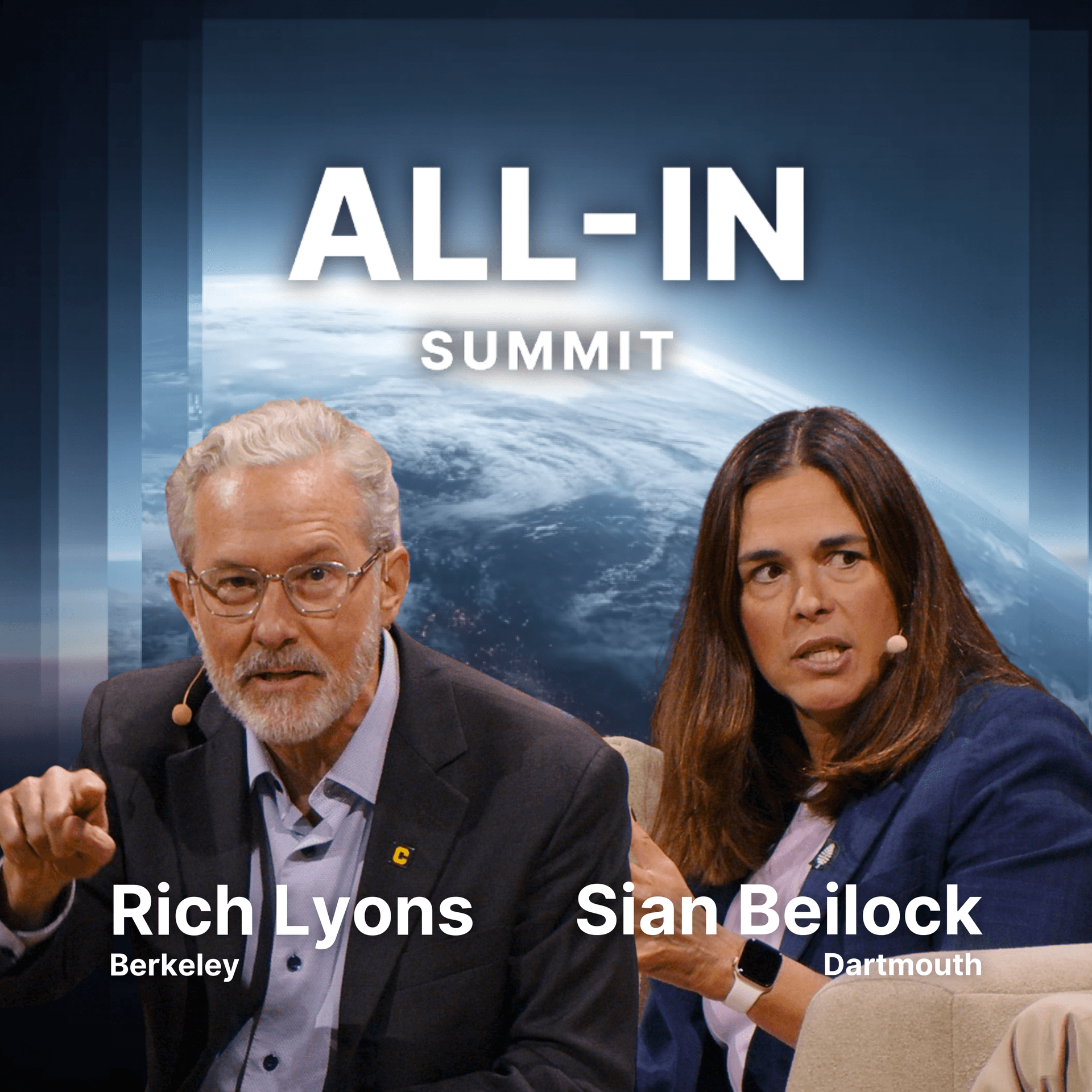
Episode Overview In this episode of the *All-In Podcast*, hosts Chamath Palihapitiya, Jason Calacanis, David Sacks, and David Friedberg engage in a discussion with President Sian Beilock of Dartmouth College and Chancellor Rich Lyons of the University of California, Berkeley. The conversation focuses on the challenges facing U.S. universities, including rising student loan debt, diversity and inclusion initiatives, administrative bloat, and the impact of AI on higher education.
---
Key Topics Discussed
- Student Loan Burden
- Statistics: U.S. student loan debt reached an all-time high of $1.48 trillion.
- Impact: Struggling students face challenges finding jobs post-graduation, leading to discussions on the sustainability of the current education funding model.
- Diversity, Equity, and Inclusion (DEI) in Universities
- Perspective: Both leaders emphasize the importance of viewpoint diversity and argue against the notion that DEI initiatives diminish academic merit.
- Implementation: Dartmouth has reintroduced standardized testing to ensure a diverse pool of candidates excelling regardless of socioeconomic background.
- Administrative Bloat
- Concerns: There is criticism of the rising number of administrative positions within universities, potentially detracting from the core educational mission.
- Response: Both institutions are looking to streamline operations and minimize bureaucratic inefficiencies.
- Political Dynamics and Higher Education
- Trump vs. Ivy League: The discussion touches on political perceptions of elite universities and the need for institutions to maintain neutrality.
- Viewpoint Diversity: The importance of fostering an environment where multiple political viewpoints can coexist is highlighted.
- The Decline of K-12 Education
- Issue: Participants express concern over the academic preparedness of students entering higher education, citing a decline in civics education and critical thinking skills.
- Call for Reform: The need for improved K-12 education, along with a focus on enhancing teacher training and curriculum, is emphasized.
- The Role of AI in Education
- Future of Learning: There are discussions about the potential impact of AI on traditional learning environments, with a consensus that AI can complement but not replace the human elements of education.
- Strategic Planning: Institutions are beginning to integrate AI into their operations, particularly in administrative functions.
- Endowments and Financial Viability
- Role of Endowments: Discussion about how endowments support financial aid and research initiatives, crucial for maintaining the quality of education.
- Meritocracy: Both leaders assert a commitment to meritocratic admissions, emphasizing that endowments do not dictate student selection processes.
---
Key Takeaways
- Accountability: Universities must take responsibility for student outcomes and consider ROI for education.
- Cultural Shift: There is a recognition that higher education must adapt to changing societal and economic landscapes.
- Future Challenges: Both institutions are proactively identifying and addressing challenges related to administrative efficiency, educational quality, and the evolving job market.
- Engagement: Initiatives like the bipartisan student-run political union at Dartmouth serve as models for fostering constructive dialogue among students.
---
Closing Thoughts The episode concludes with a sentiment of optimism about the future of higher education. Leaders emphasize their commitment to improving student experiences and outcomes while navigating the complexities of modern educational demands. They highlight initiatives aimed at enhancing civic engagement and critical thinking skills, which are essential for preparing students to be effective leaders in a diverse society.
Written by AI. May contain mistakes. Listen to the episode to check what was said.
Transcript
Automatic transcript. May contain errors.0:01I was a city hair conjured planning about how I'm going to pay back all my student loans. We've played over 300 jobs. I don't have a job. Student loan debt just reached an all -time high $1 .48 trillion as a June of this year, a historic drop in U .S. college enrollment. We exist to educate, to teach you how to think, not what to think. We'd better be thinking about big transitions or transformations if I can use the word because So there's a lot of new competition coming into our market. Ladies and gentlemen, please welcome Berkeley Chancellor Rich Lions and Dartmouth President C. on Bylock.
0:48Hello, sir. Thank you for joining us. Hi, thank you so much. Thank you. Good to see you. Good to see you. Nice to meet you. Nice to meet you. Nice to meet you. Go Bears. Go Bears. Go Bears. All right. All right. Big Green. Let's not forget the Big Green. Welcome. Okay, so what an interesting time to lead a university in a America. So many things to talk about. But I wanted to start with the premise that student loan debt seems to be a challenge on the young population, the emerging working population today. At the same time, government research funding seems to be getting cut back and there seems to be questions about the administrative overhead fees that are getting paid.
1:37What is the business model of the University today, the revenue and the expenses, and what does it look like going forward from your point of view and how are you planning for that? Let's just start with that broad picture about the business model and how it's changing. There's a lot to that question. I'll start and Cian will certainly have lots to contribute. You know, when we, at the top level, if we think about, you know, how do we sustainably provide the fundamental and translational research that we're so formative educational experiences that many of you have had in these great universities.
2:15So one way to think about that is on the research side, if there is less federal funding coming in over time, and I think that's a good bet, can we partner more with industry? Are there other sources? Is there a way to gear philanthropy even more toward the kinds of research that we need to make sure we're doing? So we are thinking about what that bundle, that funding model looks like on the research side. And on the education side as well, you mentioned debt and an issue that that's become. I think what you would find, whether at Dartmouth or at Berkeley, that if you're coming to one of these institutions from a lower income family, you're probably paying no tuition.
2:52And many of them are leaving with very little debt. So to say there's all these higher education institutions and then to talk about averages, I think you would be surprised at how much support lower income students are getting. Yeah, and I would just add to that that I don't think education is one size fits all and it a place like Dartmouth Which is I would talk about it as a different kind of ivy It is cheaper to go to Dartmouth if you're lower or middle income now than it was 10 years ago And that's because of the philanthropy that we receive from amazing alums and families and That is what we want to do.
3:28We want to make Institutions a place where anyone can go regardless of background bring the best and brightest together and send them off without a huge debt burden. We package without loans. A third of our students go for free, and they come out on average making more than they would otherwise if they hadn't gone to a school like Dartmouth. But I think it comes down to the institutions having some responsibility for pushing out students and making sure that they're not serving them in education that then they can't find jobs in. And so as we think about loan burdens and others, I do believe the institutions have a responsibility to their students, and I think we have to do a lot more in talking about ROI than we do right now.
4:07So in that case, one follow up to that. Does that mean that we have too many universities in the United States and they charge too much generally? So you guys are leading to the top institutions in the United States are all of the second here, the third here, the fourth here that are providing perhaps negative ROI on the cost of their education. Do they need to kind of get shut down or reformed or what's the future of that? I think if you aren't thinking about the ROI and that is part of what you're delivering. It's a fair question to ask. And I also think that we've pushed too many people to think that college is the end all, be all.
4:41There are different ways to be successful in this country. I certainly think there's a place for an amazing elite education like Dartmouth if we are teaching students how to think and not what to think. But the idea that everyone needs to go to a four year college or university, I think that's outdated. Let me ask you about different degrees and loans and the risks that you take. I mean $70 ,000 a year tuition, but you're not on the hook for it. Students who take these loans are on the hook for it, and their brains are not fully developed. Would you, I can confirm this, okay? Well, the neuroscience data suggests that your front -line text isn't developed.
5:21And you can't diss. Boy is a little bit later than girls, by the way. Right, and you can't. And you can't. I did okay. I went to Fordham, I did okay. The point I'm trying to make here is, shouldn't you, the university, be on the hook for these loans and shouldn't you be responsible for the outcomes for these students and would you be in support of having the loans and the amount of the loans match the desirability of the degree and its ability to monetize in the post -graduation? or said differently, would you guys underwrite the loans? Yeah, look, I think we do at Dartmouth because we don't, our students are packaged without loans.
6:03They don't take out loans and in fact, for a student in a middle income family, Lauren middle income family is about 5 ,000 a year to go to Dartmouth. So we do underwrite in that way. Now you ask the question about other institutions where students are coming out with high debt and low ROI. I think it is fair to ask what share of responsibility the institution should take. And I do think that that's part of the reforms that we need to think about in higher ed writ law. So you're in favor of it. I'm in favor of the institutions having some responsibility. But and at Dartmouth, we take that responsibility very seriously.
6:34Do you think they should take responsibility? Should you take responsibility for the outcomes? Well, the word responsibility, so I'm an economist, is a responsibility the financial liability at the end of the day or as people have been saying, look, if we are not providing an economic pathway for our students on average at Berkeley, you're talking about Berkeley now or Dartmouth. You know that people will stop coming and they will stop taking loans. So that market mechanism is working pretty well as it is and we are producing really wonderful outcomes. I think the earlier question about what about more than 1 ,000 higher ed institutions in this country and I think there is pressure on the whole system.
7:14But we are certainly making sure we have a brand new program called Social Sciences, Career Readiness, Internship Program, and so we are launching lots of new things to make sure that we are providing that kind of support. I push back and say I don't think the market's working exceptionally well because I think students are coming out over burdened with loans without the kind of job prospects that we have responded to. What would happen if we ended the federal student loan program? Yeah, I mean, I think it's an interesting thing to think about. What I don't want to do is throw the baby out with the bath water.
7:48And that there are student loan programs that are really helpful to some students in terms of being able to go to the school they want and to get the education they want. Is DEI the bath water? Let me ask you guys actually a question. What is the correlation between DEI and scholarship? Is there one? I don't think having a diversity of thought and thinking about merit are mutually exclusive. I think that's a false dichotomy. We were the first Ivy League to bring the SAT back at Dartmouth and many of our peers followed. And the reason as we looked at the data and what we found was that it was a great equalizer in finding students from lower income backgrounds and higher income backgrounds who were succeeding in something that's less actually susceptible to financial input like letters of rack and what you did for the summer.
8:37and a better way for us to find lower income students who are excelling where they are but maybe don't have the prep or the background. So I think it's a false background. You think there was no impact to the quality of the actual scholarship but the professor's taught the language that was used all this concept of like microaggressions all this stuff that got in the way of teaching math and science. You don't think that happened? No, I think that we have to focus on our core subjects and merit, but I think the idea that I believe in diversity. I think we should have a diversity of people at the table from lived experience to political ideology.
9:16I think we have better outcomes if we can sit together and push at each other, and I have conservative views on my campus and more liberal views on my campus, and I have students who come from veteran families, and students who come from the middle of the country, and students who come from the coast, bringing people together with different perspectives, allowing them to push at each other, you get the best outcomes. And do you notice that the schools veered away from that or did we spend any period of time? I'm just curious veering away from what you just said or no. Yeah, I've said nothing to see here or is everything Of course no, I mean I think I'm be the first one to tell you that I think higher education as a responsibility to reform from within What is the reform that what happened?
9:53I think we lost sight of what our mission was were educational institutions or not political Institutions were not social advocacy organizations. How did it happen? Yeah, thank you. How did it happen? And just to say when we lose sight of that mission, people don't trust what we produce. Whether it's the students or the knowledge. How did it happen? There's a lot of theories for what exactly went wrong. I think having strong leadership and being clear about what your values are is a really important point part of this. I spent much of my academic career at the University of Chicago, and I think that's a place that was very clear about the fact that institutional neutrality is the way to guess the best outcomes.
10:33that it's, we don't shout down speakers, that we don't set up encampments, that declare a space for one ideology. Those are all things we've been pushing at Dartmouth, and we are excited about where we are going and the outcomes, but we have worked to do. Rich, Rich, how should I do? See, Sam at Berkeley? Sam at Berkeley. How are we doing at Berkeley, Rich? Hey, no, beware of the caricature problem, because Berkeley undergraduates produce more funded new businesses than the undergraduates at any other universities. We lift more people further up the economic ladder than any other university in the country.
11:12And so the caricature problem is very real here. Berkeley, I have been saying very publicly that we meet, I'm agreeing with what you just said, that we need to move in the direction of institutional neutrality. I'm talking about viewpoint diversity all the time. Do we have some getting better to do? You better believe we do. We were thinking we were so tolerant. I think we weren't very tolerant of viewpoint diversity And we're we have a new course called openness to opposing views It got launched this summer 5 ,000 people have signed up for it We have something called the Berkeley Liberty Initiative.
11:44It is exploding on campus Do we have people on all sides of the spectrum? We sure do but people keep pointing to one side of the spectrum It's like look what's going on at today's Berkeley How should Chamoth or I explain to our Asian daughters or sons if they don't make it into one of these schools because you have to admit somebody for diversity who got lower grades in a lower SAT score. How do we explain that? We don't admit in that way. We're learning for students with great scores, great grades and who have grit and ambition and allow us to bring a class together where people can push and get make better ideas.
12:29For the... It's... Sorry, sorry, it's been the law since 1996 in the state of California. We can't use race or gender or affirmative action. It's literally illegal. We get audited for this all the time. So if that's what you meant by your question, we don't do it. And it's part of the California Master Plan for higher education. That a third of our incoming class every year, our community college transfers. They're grittier, they're older, they're more first -gen. And if that's the diversity you're worried about, then I think we have a different view. I'm talking broader, not just to your universities, but to what we've seen at other universities, perhaps Harvard would fall into this category or others.
13:05And we do think about that. What are we explaining to our kids in terms of? Or maybe the general question, what Jason is trying to say is, what message does that give the broader American student and the broader American parent about what is actually happening in higher ed? when a case like that gets litigated to the Supreme Court. Look, again, in a place of viewpoint diversity, you can have different views on affirmative action, and we have different views of that on our campus. Our goal, and as we've always done at Dartmouth, is we're looking for the best Embraiderous students, and that's not only just a test score or a grade, because that doesn't tell the whole story, but we're certainly bringing students together based on all of the things they do, and we're not picking students to fit any sort of quota or system.
13:52And the University of California has effectively been aligned with that decision since 1997. Tell us about the growth of administrators versus professors. There's another sort of common, maybe it's an accurate statement or a misconception that many of these elite institutions in America have been overwrought by administrators. And they get in the way, they gum up the system, they have all these ideas, they turn out to be idiots, ideas are idiotic. That's a theory. Have you seen that play out at your two fine institutions or nothing to see there either? Do you want to go for it?
14:34I will start. We for years, and we have further to go, but we have been talking about bureaucratic burden. We actually have an initiative when we just call it bureaucratic burden, and there is too much of it at Berkeley. Berkeley is a very, very large organization with lots and lots of people. So as we think about how do we make some of the hard decisions for making things faster? And we've been working very, very hard at that. The clock speed of the world is going up so fast and the clock speed of these institutions pace for change. That gap is widening and we need to get better at getting better.
15:08So I promise you with AI and many other things. It's like, well, academic advising, how is that going to change for the AI? It'll change a lot. We're going to always need human academic advisors in my view, but that world is going to change a lot. How do you navigate what's on campus? Last point is, you know, when you talk about the mental health of our students, I think if you went back to when you and I were undergraduate at our universities, the idea that the university would help people with mental, like scaled mental health services, they weren't there. They are there now. So you could say you shouldn't be doing that.
15:40but the expectations of what we are providing have risen quite a bit. And I'll say that I think it's a totally fair question and we always need to be thinking about moving our resources more towards the academic enterprise. I mean Dartmouth is a place where you're in a classroom with a faculty member in six to 20 students. It's a very special thing that doesn't happen at all institutions. But we also have a lot more compliance that we have to deal with that's come in from government over the years that we have to staff up to deal with. and I like the idea of rethinking that relationship in a way that allows us all to do our work better.
16:13Let's talk about for one second. What President Trump has done with his settlements with Colombia and the proposed ongoing thing with Harvard, there's going to be some settlement. Just walk us through what the implications of that are and the cascade effect and the waterfall as it trickles through the, you know, to other institutions and whether you guys will have to be party to something or what that means. Look, I believe in the fierce independence of our educational institutions, and I worry that if we are swaying in one direction or another based on who is in office, then we don't have the trust of the American people.
16:51And I think we failed in some ways to show that we could self -regulate and do that ourselves. But the goal in my mind is to get back to a place where it's clear that universities don't aren't political organizations aren't taking a position that we are focused on bringing the best and brightest to go out and contribute to our democracy and we can do that ourselves. Rich? Yeah and I think that you know if you look at trust and confidence and when it started to diminish across all kinds of institutions but including higher ed you know that that predated by quite a bit the the election which was less than a year ago so I don't want to confound things where they really shouldn't be confounded.
17:31Why have we been losing trust and confidence? To grossly oversimplify its cost, its career, and its culture. And we could go into each of those and talk about it. The cost thing came up, you know, are the career opportunities there and by culture it sort of have things got too progressive or not a tolerance enough of viewpoint diversity. Those are all reasonable things to talk about. But so I think part of The questions that are being asked under this administration and even before that, many of them it's like, yeah, we need to be more reflective. I just said, I think there's two little viewpoint diversity.
18:05Let's go to culture. David, you had a great career at Stanford and that was during the politically correct era. And then we saw safe spaces, trigger words, and students feeling they were being harmed by words. I'm curious what your thoughts are on culture on campus from your perspective having lived through it. because this does seem to re -emerge every couple of decades. Well, political correctness never ended. It just got renamed. I mean, I think they renamed it woke. They're moving some other things in between. Peter Till and I wrote an article for Stanford Magazine back in, I think it was 1995, so 30 years ago, called the Case Against Affirmative Action.
18:47And it was basically making the case for completely colorblind admissions, having it be strictly based on merit. and not taking race into consideration. And obviously that argument did not prevail and win the day because we had this Supreme Court case a couple of years ago that basically said that I think it was at least Harvard, I can almost speak for every college, but basically was still engaging in racial discrimination. And so I think that article or that argument clearly was losing in practice for 30 years until the Supreme Court reached that decision. So I think this is why there's a lot of skepticism on these issues.
19:24And I think you have a wave of presidents, and I think leadership matters, coming to the forefront and talking about what we need to do in this space. At my inauguration two years ago, I just finished my second year, and I'm the third longest serving Ivy president right now.
19:43There's been a bit of turnover a little bit. Side, tell us. Did you watch the Claudine Gay testimony? And what did you think when you were watching that train wreck happen. Yeah, what was going on in the group chat? While it was hurtling in the Ivy group chat, Ivy group chat was hurtling in the group chat. Oh, I'm getting a break off. Look, I mean, I think we have responsibility to be different kinds of campuses. And the testimony, I think, was an outcome of being a campus that wasn't protecting. The people wasn't inclusive and wasn't calling balls and strikes when we need to. And we've been very clear at Dartmouth that We value free expression, but your free expression can't rob others Which means no shouting speakers down and no taking over parts of space and declaring it for one ideology That's not free expression.
20:31It's just John Stuart Mill philosophy of spears of influence Just don't check with others, but let me let's let me just ask what do I just want to follow in the rich isn't the like best part of Berkeley shouting over the speakers I'm going to get through traffic over there sometimes and you've got a thousand students on the freeway. It's like kind of the tradition. There's a difference between free speech, that's a protest. Yeah, protest is fine. And so I think that's a really important distinction and it's really important for leaders to be clear. Protest is fine. I have protest outside my office all the time.
21:05I have students chalking messages. That's fine but the problem is when one person's free speech takes precedence over another. And nobody's disagreeing with that. The Hector's video is something we talk a lot about. We are coming down on people. It's not appropriate, right? So people are outspoken. People are, you know, that's part of Berkeley's tradition. I will often say to people, free speech university, hundreds of ways and places to express your free speech rights, and no more tense, and no more blocking, say, their gate. So it's sort of like, look, we need parameters that help this to be as constructive as possible.
21:38But the John Stuart Mill marketplace for ideas, We're trying to keep it as open as we can and that is something I'm just going to I worry about the idea for our faculty and our community The idea that we're going into a world where there are acceptable questions and unacceptable questions. That's about that. That's 1984. Going upstream and I just want to go upstream with you guys for a second. Where's this coming from and what's going on in K through 12? Yeah, I think we don't talk about K through 12 enough. I think we really have to go back. Our students are landing on our campus without having civics, without having practice engaging in difficult conversations.
22:15I mean, I think we really have to move backwards and not just think about the university setting because we're getting them much later. And for the, we train all of our students at Dartmouth, go through Dartmouth dialogues to learn how to have conversations with people you disagree with. I believe it's like a muscle. You have to train it through practice. Are they showing up basically just unprepared? A lot of them through COVID didn't have these skills. And we've seen this in different ways where you, at one point, when we were in school, if you had a fight with someone, you'd have it face -to -face, then it went to text messaging.
22:44Now it goes to you leaving a long voicemail on someone's voice memo and then not even engaging. And if anyone who has teenagers out there when I tell my 14 -year -old to pick up the phone and call someone, what are you talking about? We have to get those muscles back. and a university setting, a college setting, is the place to do it. We're not just about knowledge transfer, we're about forming the identities of our future. Well, the freebergues point though, I just wanna ask the point of question. I think it came out today, but high schoolers are graduating, woefully unprepared. It's not just the skills of debate.
23:16This is fundamental math, science, English, they can't read, they can't add. They can't write. What? What is happening in our primary and secondary high school education system? What is broken there that's delivering these kids to you so academically unprepared? I understand emotionally, but let's just first address the first part. I think they're both and I mean I'm not an expert in K through 12. I don't have all the answers there, but I'll say that one thing is that we're not getting rid of income gaps in In achievement in K through 12 students come into kindergarten at very different levels depending on their parents income And they leave at those same levels if we were doing something important and successful in terms of education in the US we would see differences and changes there and I think we have a lot of work to do to think through a K through 12 system That's not serving the entire Is there any low hanging fruit there?
24:05Is it like having the ability to have more tutors Extending the school to a to 5 p .m. Having summer sessions if you could as an you know educator and somebody who works in this field Is there any low hanging fruit that we could say hey president trump? We need a you know 25 billion more dollars a year to do this Yeah, I mean, it's a great question. I would say one thing is making sure that we're putting good teachers in the classroom. School unions are a problem. What does good mean? Component enable to teach at different grade levels and the ability to... Measure their outcome. Hold students accountable and push them forward.
24:44And my research before I became a college president, I study performance under stress and an anxiety. so it's been helpful the last few years. But one of my findings is around teachers, especially in lower grades being really unprepared in terms of math competency and transferring that on to young students. The teachers themselves don't know how to add. Well, I think there's a very, no, I mean, I think it's interesting, there's probably a very good teacher emerging, which is AI. How are you guys thinking about whether higher education should even exist and what the role of higher education and classrooms and teachers and textbooks are in a world where I have a personal tutor available to me to walk me through the knowledge transfer at my own pace to think critically.
Read the full transcript
25:29AI seems to have the potential to play so much of the role of what higher education and even K through 12 education has played historically are you guys calculating for your strategic planning with AI and what does it do? Well, I'll start with that. So my daughter just graduated three months ago. I have two kids. She just finished college. and I'm astonished by how much she has developed. And I think most parents would have a similar experience. And I think if you stripped out sort of the knowledge, the part that you could easily access with AI, she would still astonish me in how much she has developed.
26:07That's a residential university and all the interactions and all the things and the challenges and the overcoming them. And so, you know, the idea, people were predicting with massive open online courses the death of universities 15 years ago. And I really think that when you start realizing that's what makes it so darn transformative. And at least any AI I've seen so far is not getting close to what we're able to do. I think these uniquely human skills, there is such an important part of a residential community that allows that to come together. I'm a big proponent of how we think about integrating AI into what we're doing.
26:50Dartmouth actually was the birthplace of the term artificial intelligence in a 1956 summer conference where people got together and talked. We developed basic. We were the first institution to put it in all the math classes. I think thinking with technology is so important, but there is a human element of developing young people 17 to 25 that universities really can excel at. And I think that's one of the reasons that the culture issue and the idea that we're teaching students what to think instead of how to think I think is hit such an important point is because this is exactly what we should be doing.
27:30We should be thinking teaching those kind of critical skills that allow students not to be in a safe space but a brave space where they learn how to be uncomfortable and interact with them. They're not fair enough, but I predict AI will play an important role. And I predict that the teacher's unions are going to fight tooth and nail from seeing AI show up, and it's going to challenge our ability to kind of provide this advantage for our students. And meanwhile, in other countries around the world, particularly looking across the Pacific, things are going to be very different than they are here.
28:02What is the conversation with the teacher's unions who are so politically connected, who can be so troublesome. And we saw this recently with the Longshoreman's strike that happened where they didn't want to have automation that would provide faster lower costs, unloading and loading of the docs and so on. It made it really hard what's going to happen with respect to the teachers' unions and their ability to kind of move through this accelerating transformation that's going to be underway. Well, I'll start. I think categories of labor across the economy are going to be under threat. So it's easy to start with thinking about organized labor, but not organized labor is going to be terrifically under stress.
28:42And I think that a lot of people are going to be pushing back on what's about to happen. So I think that's the larger frame. It's really how jobs across white collar, In fact, I think a lot more unrepresented jobs are going to disappear as a result of AI than represented jobs over the next 10 years. We don't know, but I think overframing in terms of representation, at least for me, is missing really the core issue here. There's been a lot of talk about recent graduates having a hard time finding jobs and that for at least male students, the degree versus non -degree in terms of unemployment has now shown no difference.
29:30It used to be, if you had a degree, you had roughly double the chance of getting a job. Are you seeing that in the ground? I know you have elite institutions, but are you starting to see that even at your incredible universities? And are you concerned? Yeah, I mean, I think again we have to talk about what the future of work is. We haven't seen that at Dartmouth. Our students are succeeding in getting jobs. but again we're not just teaching students how to code. Everyone who gets an engineering degree also takes classes across the sciences, across humanities. We're teaching them how to think across difference in many ways, which I think are these uniquely human skills.
30:06I hope that will be important for being a leader. What's on that small list of uniquely human skills or attributes that you most want to get into those students? I really do believe that the ability to listen and have a conversation and speak face to face and have eye contact to have empathy to understand that even if I don't agree with you, you are a human. We have these things together and we're working towards some sort of positive democracy, I would say is at the top of the list. We've been working with David. I have the two Davids in fact. We've been working with that. It's a muscle. I think you can build it over time.
30:40They're getting there. Yeah, look, there's no question. I was talking to an alum and somebody who's close, very senior. and I said, what should be in our strategic plan? And he said, keeping humanity relevant. If that's not a big deal, I don't know what is. And as we think about the sorts of skills that we're gonna need in our students, I think a sense of agency is something that pops to mind for me. It's like a sense of agency. I kind of, I can act on the world. I'm not act purely acted upon and it's partly my responsibility. And that goes so far beyond the way we think about education at least traditionally as mostly knowledge transmission.
31:22And I think we can do that in our classrooms. We have some curriculum that does that. They do perceive themselves as victims at times. Let me maybe shift it for the last question and maybe where we started to end. One of the things that has happened is that with the costs of higher ed, there's been the emergence and the importance of endowments. And as these endowments have emerged, there's been a perception, and then those things have been laid bare, that there are side doors and back doors and all kinds of different ways in which to get into schools. The varsity blues thing is like a perfect example of just the manipulation of the system that just again to your point, people lose trust.
32:04What role do endowments play? How much influence do they exert when it's good? When they can't fund a budget, what happens? just walk us through that cycle where there's a perception that they could be doing more Harvard's got a $55 billion dollar endowment but just walk us through that for each of your institutions how reliant you guys are on this and the impact it makes on you being able to be totally meritocratic. Yeah I mean I will say very clearly that we are looking for the best and brightest students our endowment is a way that allows us to fund students regardless of their ability to pay.
32:43And our financial aid from our endowment, hundreds of millions of dollars each year to support students so that they come out with out loans and they're ready to go. And that is because people believe in the institution. So it is a way, an important way that private citizens give back to support what they're doing. And I think it is extremely important to what we do. It also funds our research. There's a lot of talk about indirect costs and what those actually mean. we lose money on every research dollar we bring in. We spend our endowment to create the buildings, to create all of the compliance.
33:18You can't make discoveries in the middle of Main Street. You've got to do that in a scientific enterprise where we are putting the skin in the game. And I think it's great that people are giving back to be able to do that, but it doesn't drive our decisions. What I think of it is this support to do the good work we need to do. Yeah, and if I may just add a little bit, I know we're out of time, but I think our endowment and for students is far, far lower. And like Sian, it's going into scholarships for our students and the accessibility. It's like what's the effective cost of these educations, even with our lower prices.
33:49And also on the research end, right? We've got something called the Innovative Genomics Institute. A lot of that was philanthropic capital that came in and went into an endowment and CRISPR comes out of it and some other things that are changing the world, right? So it's really important that we have that kind of funding both on the education and research side. And I just say that there's multiple inputs into the system. I think the endowment is important. I think having a really robust partnership with government that makes sense is really important for the American innovations and discoveries that we're doing.
34:20And then for people who can pay the tuition, paying tuition is another aspect of that. But all of those come in to try and create what we're trying to create. Before we wrap, we've pointed out a lot of problems and challenges. and left you guys in a kind of defense state. I want to just give each of you an opportunity to talk about what you're excited about at the university that you're leading. Maybe just take a minute. What gives you kind of optimism? What do you encourage by? What are you looking forward to accomplishing as we kind of finish up the segment? Well, thanks. I'll start. A true of Dartmouth, as it is for Berkeley.
34:55We view these things. We hope you do too, as some of society's most valuable assets. To what you show, we put them over the next decade. that's sort of what we've been entrusted with, right? And so if you said, on the education front, for example, economic mobility, right? What would it look like to double down on economic mobility? When a third of our students are already transfer students from junior, from community colleges, and sort of like, wow, could we get even better at that? I think we can, we can do better at that, right? And as we think about the research, it's like, what are these fundamental science makes sense?
35:27So you're thinking about the biology revolution or the AI revolution or planetary and human health. I mean, these are things that I believe we all need these institutions to be contributing to massively and that's part of what's going into these strategic plans. So I think you should be rooting for us. We are rooting for you. Yeah, and I would say a few things. One, Dartmouth has the most rural academic medical center in the country. We serve a huge population of people not connected to the institution and I'm excited about how we double down and Make health systems better. I think that's such an important part of what we do as universities And the second thing I'll say is that I am very Excited about our students just one other thing that Dartmouth is doing that is so impressive We have one of the only bi -partisan student -run political unions in the country co -chaired by the Dartmouth Conservatives and the Dartmouth Democrats, and those students are changing the culture at institutions.
36:29Last year we had a debate between Kellyanne Conway and Donna Brazil. We had Cornell West and Robbie George. They're dealing with DEI, immigration. They are talking about the issues and putting it out there, and they're creating a culture where it's cool to have conversations and be uncomfortable instead of shouting each other down. We should be excited about that because they are the next leaders of our free world. Awesome. Thank you both. You've got tough roles. We appreciate you being here today. Thank you. Thanks for coming. Thank you. Thank you so much. That was awesome. Thank you. Appreciate it.
37:04Thank you.
From the publisher
(0:00) Introducing Dartmouth President Sian Beilock and Berkeley Chancellor Rich Lyons
(1:14) The student loan burden
(8:03) DEI at US universities
(13:56) Administrative bloat
(16:12) Trump vs the Ivy League, viewpoint diversity
(21:56) Impact of K-12 education declining
(25:13) Will AI learning kill higher education?
(29:14) Rising unemployment among recent graduates
(31:35) Role of endowments
Thanks to our partners for making this happen!
Solana - Solana is the high performance network powering internet capital markets, payments, and crypto applications. Connect with investors, crypto founders, and entrepreneurs at Solana’s global flagship event during Abu Dhabi Finance Week & F1: solana.com/breakpoint. https://solana.com/
OKX - The new way to build your crypto portfolio and use it in daily life. We call it the new money app. https://www.okx.com/
Google Cloud - The next generation of unicorns is building on Google Cloud's industry-leading, fully integrated AI stack: infrastructure, platform, models, agents, and data. https://cloud.google.com/
IREN - IREN AI Cloud, powered by NVIDIA GPUs, provides the scale, performance, and reliability to accelerate your AI journey. https://iren.com/
Oracle - Step into the future of enterprise productivity at Oracle AI Experience Live. https://www.oracle.com/
Circle - The America-based company behind USDC — a fully-reserved, enterprise-grade stablecoin at the core of the emerging internet financial system. https://www.circle.com/
BVNK - Building stablecoin-powered financial infrastructure that helps businesses send, store, and spend value instantly, anywhere in the world. https://www.bvnk.com/
Polymarket: https://www.polymarket.com/
Follow Sian:
Follow Rich:
Follow the besties:
Follow on X:
Follow on Instagram:
https://www.instagram.com/theallinpod
Follow on TikTok:
https://www.tiktok.com/@theallinpod
Follow on LinkedIn:
https://www.linkedin.com/company/allinpod
Intro Music Credit: