
In short
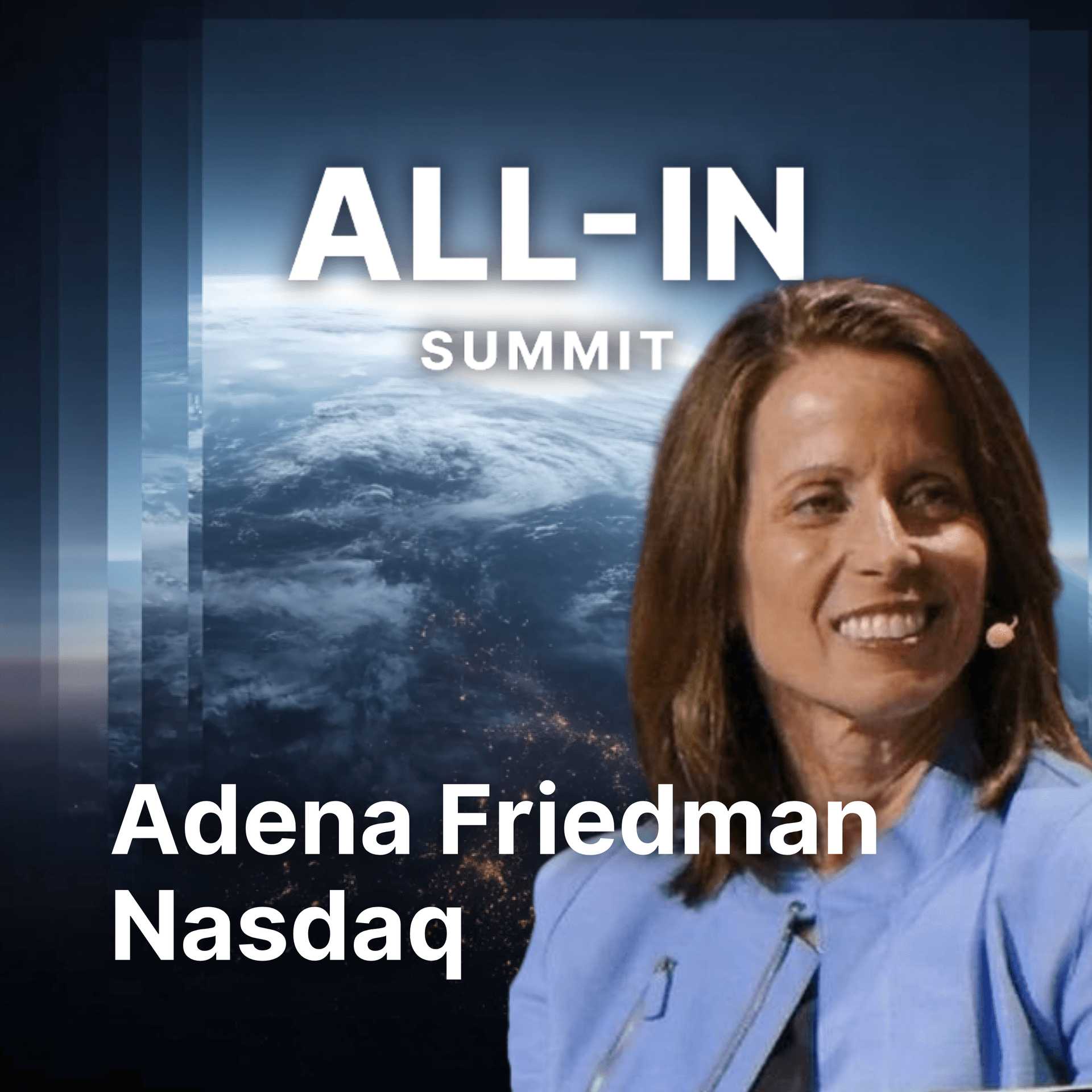
Podcast Episode Notes: The New Era of the Stock Market with Nasdaq CEO Adena Friedman
Podcast Overview Title: All-In with Chamath, Jason, Sacks & Friedberg Episode: The New Era of the Stock Market with Nasdaq CEO Adena Friedman | All-In Summit 2025 Description: The episode features an in-depth discussion with Nasdaq's CEO Adena Friedman on the evolution of stock markets, Nasdaq's new initiatives, and the intersection of technology and finance.
---
Key Highlights
Introduction of Adena Friedman
- Introduction: Adena Friedman recognized as a transformative leader in the financial sector.
- Nasdaq's Growth: Nasdaq under her leadership has significantly expanded its operations and revenue.
Nasdaq's Business Expansion
- Beyond a Stock Exchange: Nasdaq is evolving into a broader market infrastructure provider.
- Business Segments:
- Market Technology: Providing technology to 17 markets globally and licensing to 135 other markets.
- Index Business: Managing $700 billion in assets.
- Trust Building: Focused on anti-financial crime technologies and market surveillance.
Major Announcement
Tokenization in Markets
- Tokenized Securities: Nasdaq will start offering tokenized equities, integrating them within its main markets.
- Extended Trading Hours: Aim to transition to 24/5 trading, allowing for more robust market participation.
- Streamlining Post-Trade Processes: Tokenization is expected to reduce friction in capital flow management.
Evolution of the IPO Market
- Current State: The IPO process is perceived as burdensome, leading companies to stay private longer.
- Proposed Changes:
- Reform in disclosure and litigation requirements to facilitate easier access to public markets.
- Support for direct listings and SPACs as alternative paths to going public.
Market Dynamics and Regulatory Environment
- Convergence of Traditional and Digital Markets: A growing collaboration with regulators to create frameworks for both traditional and digital asset markets.
- Balancing Investor Protection with Innovation: Emphasis on the need for regulatory clarity to foster innovation in financial markets.
Discussion on Active vs. Passive Investment
- Index Funds vs. Active Management: The shift towards index investing and its implications for returns and market dynamics.
- Opportunities for Active Managers: Market imbalances created by passive investing could present opportunities for active strategies.
Concerns about the Federal Reserve
- Fed's Independence: Discussion on the importance of maintaining an independent central bank for long-term economic stability.
- Data Quality and Decision Making: Questions raised about the Fed's ability to make informed decisions based on quality data amid evolving economic conditions.
Current Market Risks
- Commercial Real Estate: Discussion on the potential risks associated with climbing defaults in the commercial real estate sector.
- Bank Stability: Assurance that banks are managing real estate exposure effectively, with a focus on distributed risk within the banking system.
---
Key Takeaways
- Nasdaq is positioning itself as a technological leader in the global financial landscape.
- Tokenization and extended trading hours are significant steps toward modernizing equity markets.
- Revising the IPO process is essential for encouraging companies to go public sooner and democratizing investment opportunities.
- The balance between regulation and innovation remains crucial in the evolving financial ecosystem.
- Ongoing discussions about the Fed's role and the implications for market stability are critical for investors.
---
The episode provides a comprehensive view of the current changes in the financial landscape, emphasizing innovation, regulatory challenges, and the future direction of equity markets.
Written by AI. May contain mistakes. Listen to the episode to check what was said.
Transcript
Automatic transcript. May contain errors.0:00Over the last year to date, up 14 percent over the last year, Nasdaq shares up 40 percent over the five year period, more than doubled up over 100 percent. You've been on a real tear. She is often on the list of not just the most influential women in finance, but just the most influential. Adina transform Nasdaq into a global tech powerhouse. Adina is a deal maker at her core. Nasdaq is in the business of deals. We are here to advance economic progress for all. Ladies and gentlemen, please welcome Mazdaq CEO Adina Friedman.
0:41Welcome. Thank you, nice to meet you. Nice to meet you. Nice to meet you. Nice to meet you. It's great to see you. Adina. It's great to be here. Welcome. Thanks for coming out. What a day you've been having. Yeah, so you caught some of the action earlier today, right? I did. I did. I've been watching from behind the scenes. It's been amazing to watch. I had to hang in backstage. Should you have a favorite moment or speaker? Oh, I never liked to pick favorites. At NASA, we don't pick favorites. We have great companies, but obviously, Renee is a wonderful NASA classic company that I've been trying to know very well with ARM.
1:13So I would say always had great conversations. You, but. Sorry, but NASA is more than a market. I think I wanted to start with this real important question. Because when we were talking, I didn't realize that NASDAQ was more than just the NASDAQ market that we all know, maybe just for the audience, you could just share a little bit more about the broader business. Sure, thank you. Well, so first of all, we are really proud of our foundations of market. But as we started to grow and expand the business, first of all, when I became CEO, we had about $2 .5 billion in revenue. Today, or as of the end of last year, we had a little over $2 .5 billion of EBITDA.
1:46So we've grown and expanded the business quite dramatically. And how we've done that is taking our core as a market and saying what more can we do for our clients? So we are an architect of modern markets. We provide our technology to our 17 markets and we sell it to 135 other markets around the world. So market infrastructure is our business and we do that globally. Then the second is really being powering that innovation economy like companies like Rene, you know, RM and other great companies. So we've expanded that. So our index business now has about $700 billion dollars of assets under management that are tied to those great innovators.
2:20In addition to creating better abilities for companies to navigate the public markets and investors to find investments. And you had a big announcement today? And then the third is also building trust across the financial system. And that is anti -financial crime, technology, markets surveillance technology, other technologies that the banking industry and the broker dealer industry really need to manage their lives in the markets. And you're right, we had a big announcement today. Which almost Vlad foreshadowed before you actually. Yeah, and actually it goes right back to that first filler being the architect of modern markets.
2:55You want to tell people what? You think we should? Yeah, yeah. So this morning we announced that we're going to be bringing tokenization into our markets, so making sure that equities are tokenized and traded on market in the markets, not in a side sleeve, but actually in the core markets. So the eventual goal or is it today 24 by 7365? Equities just let it rip constantly. I mean, I think we are all moving in that direction. We announced several months ago that we're moving to 245. So we're moving that way. So Saturday and Sunday not? Not for equities yet. I think that we have to, we're walking before we run.
3:33But I think that getting to 245 is a major advancement for the US equity markets. And then on top of that, now with tokenization, and if we can introduce that also into the markets, it allows us to really think about streamlining the post -trade processing, bringing and modernizing elements of the market that have a lot of friction. We are hyper -resilient and we're hyper -scaled. We managed, like today, we had 95 billion messages come into our systems today. And we had an median return time of 20 microseconds on from order to trade. We handled like 3 million messages a second. It's hugely scaled.
4:07But then at the same time, you know, once that trade occurs, there's a different process. And then the post -treat process, as we know, is an area where tokenization really shines. And really cutting down the friction, managing capital flows across the global ecosystem, and really bringing that capability into the markets is going to be the next. I'm sure it's your reaction to this. You know there's this very famous curve, which is like, you get this early font of insanity, and then there's the trough of disillusionment, and then you grow through. and does it seem like crypto is actually a block chain?
4:40It's just, it's finally real. It's like there's real companies doing real things, stablecoins, what SACs did with the Genius Act. Well, I actually want to point to that because honestly, having regulators who want to work on bringing it into the mainstream and want to create the rules of the road is such a refreshing thing because I think that it allows us all to understand how we can operate within a world where there are tenants of investor protection. The technology is going to have things we can and can't do, but also being forward -thinking and forward -leaning and how the technology is going to be applied is going to be critical.
5:15So we're very excited about the fact that we finally have this convergence of regulatory regulation between the traditional markets, the digital markets, how do we bring it all together to frankly advance all markets? And we're very, very excited about that. And I don't mean this to be glib or anything, But wasn't there like a concept around the markets having an end of the day at four o 'clock allowing people to have a life and to sleep and to not have this anxiety? Are we all going to live in a world where we have to check our stocks at two in the morning or some crazy event happens in the world.
5:48God forbid a terrorist attack or a hack or something and now we've all got to wake up at three in the morning and decide do we trade or not? Was that the resistance to this? And then how do you justify it? Like, hey, it's going to be worth the fact that none of us are ever going to sleep again. Yeah. So I think first of all, I started it now as again, 1993. And back in the 90s, we had a vision to go to 24, 7 markets. And we just couldn't achieve it both technologically. It wasn't the technology wasn't there to do it, but also regulatory. And part of it, big part of that was that resistance from the industry saying, I like to be able to finish my day and go home.
6:26And actually, we need those points in the day. I mean, the market open and the market close will continue to exist in a world of 24 or five markets. But you'll have like a US trading day and you'll have non -US trading day. And so, and we already, our systems turn on at four and they turn off at eight o 'clock at night, four in the morning at eight o 'clock. Trading occurs during that entire period of time, but the official trading days of the United States are 934. I don't anticipate that changing because we have to have those moments for like the Navs to be set for mutual funds and things like that.
6:56But allowing the entire world to trade these securities, I mean, we have the Nasak itself. We have the top seven companies in the world this one, Nasak. So those companies are global. Investors have global interest. The Nasak 100 is one of the most traded products in the world. The futures trade, 24 or five. So why shouldn't the underlying? So that's how we look at those non -US trading hours. And then the trading hours and trying to find that confluence in the way that it will work. There's a lot of hand -wanging about the number of companies that have gone public, the weight of being a public company, the state, private longer moment took Uber 11 long years, Stripe is private now close to 15 years, SpaceX.
7:38And we have some folks who maybe think things should run differently. We had Spotify go public in a direct listing. You have Chimath experimenting with SPACs. What should the IPO market look like? And how can we make it now that we have a government that's maybe a little more Engaged let's say and less napping as administration How should the IPO market change and that process change to encourage people to maybe not stay private so long because all the gains are being captured By the elites by the qualified purchasers the accredited investors can barely get in and let alone the public By the time the public gets in, it does feel like, oh, I'm getting into Instacart, and it's gonna go sideways for a year or two or three.
8:23Yeah, so I mean, first of all, I think it's really good to remind all of us why the public markets are so important for the economy. When a company goes public, they get access to billions of investors, and every citizen in this country gets a chance to become an owner in the economy. And when we look at just the performance of NASA I was like 100 over 40 years of its existence. The average return on the 10 100 over those 40 years is a 14 .25 % annual return. So that's double the broad market. It's an incredible return. If individuals have access to these great companies, as I saw your pot a few weeks ago, showing the performance of the public markets, it's such an important part of our economy to engage the population in the economy and the growth of the economy and the success of the economy.
9:11So I've always believed in the balance between public and private markets. I think there are reasons for them both to thrive and be great, great for everyone. But the public market experience has become this massive burden. And I think that we call it like you have to cross the Rubicon to become public. And it's become very daunting for CEOs and companies to take that decision. So we have talked very closely with the SEC and others about what can we do to lighten the load, to make it so that it's not such a huge change. We've advocated for changes in disclosure reforms, proxy reform, litigation reform, all of those things, there's such a different existence, it shouldn't be so different.
9:54Does the burden actually improve the quality of the companies that are public? Does it improve the fraud rates? It's a good question, and I actually do think that you will find that there is really good valid reasons for certain disclosures. I think disclosure is a cleansing event. But they have to disclose so much more than that's actually necessary for an investor to make a smart investment decision. Let's strip that away and get back to the core disclosures. And then offering different ways to actually enter the public markets. We think the direct listing, we've actually worked closely with Bill and others on a direct listing with the capitals.
10:31Like, why not? We have that ability today. And so, and then Spax or another, another avenue to public markets. ICO's over time, we'd like to kind of bring that as a, that to me is frankly a direct listing, a tokenized record listing. So how do we bring all those capabilities into the markets and make them available and make these companies feel like it's exciting? What if that requires the SCHODer, sort of one follow up if I may, that requires the SCC to take a little bit more risk and they seem like an organization that is incredibly risk off and you know very conservative in their approach. Did they need to change their approach to be a little bit more forward thinking in your mind?
11:10Well I first of all I would say that Chair Atkins is my first meeting with him was just amazing. He's great. You know he is forward leaning. He wants to create change. He wants to make IPOs great again. He wants to really support the public markets. While also frankly looking at elements into the market structure in the established markets and saying does this all need to exist? Because there's a lot of that too. And then also really embracing the crypto ecosystem to say what elements of this could be brought in that regulatory convergence is real. How can we create a regulatory road for crypto markets?
11:47How can we actually create a regulatory road for tokenized securities markets? How do these things kind of convert? Well, can I ask you this? He's a great, I would say he's off to a great start. Outside of the equity markets, the biggest liquid pools that are trading right now, whether it's the actual tokens or perps or what have you or the crypto markets themselves, it would seem relatively logical that you guys or others would want to play in that game and why don't you? Yeah, I think what's held us back is the lack of regulatory clarity. I say that NASA is really good at operating regulated markets.
12:22And so you ask us to go into a completely unregulated space. That's a pretty different existence. The risk tolerance is much higher. We want to make, I mean, we are always investor protection first, always. So how do we make sure that we create the right structure with fairness and equality for our investors while also being really big innovators? We've moved our markets to cloud. We've kind of really brought forth a lot of modern technology into markets. But we also operate best when we have the rules of the road. What's happening now in Washington is the potential for rules of the road. And that gives us an opportunity to participate in a market that is not going to be available to us.
13:00And is that something that if the federal government just creates that clarity, you know, you could compete with Coinbase, you can compete with Binance, you can compete with OKX, you can compete with the decentralized. I would say that what we would want to do is really work with our institutional clients, because they also have not been able or willing to play in the market. There are risk tolerance. We have a similar profile. So if we can actually bring the Estatial ecosystem into crypto assets, we bring tokenization into securities assets. That's a really interesting way for us to play a role in really helping evolve these markets and bring them to the mainstream.
13:33And whether, you know, many flowers will bloom in that ecosystem. Today all of your markets are equities. These are securities that have secured interest in an underlying business asset. There's a business that's buying and selling stuff and has employees and does stuff. But much of what we see the volume today in prediction markets and crypto markets, there aren't underlines. These are, there's a point of view on some value of, for example, in the prediction markets in event. And historically, you'd have to figure out a way to play that event with some equity trade. Does the prediction markets actually kind of create a new way to express investment PCs that are kind of going to perhaps be a superset of the way we trade equities?
14:21Or are these just fundamentally different that owning an interest in a business is different than having a point of view on a thesis? I mean, I have to say the options markets are as much a prediction market as the other prediction markets. So we own and operate the largest options market placing in the United States. And so we are really, you know, we're very engaged in looking at how do you think about you are making a decision as to with the direction of travel in an underlying equity. But you're not actually trading in the underlying equity. So options are, I think, a great reflection of a prediction market.
14:55The difference, though, is that in a prediction market, it's a binary yes -no versus an option market you're layering in your bets across multiple price points and different durations. There's, by the way, a million and a half strikes in the options markets today. But so it's, I think that in some ways the prediction markets make these types of, these types of bets, you know, more accessible to more people because the options markets are quite complex. Prediction markets are a little bit more simple. So there is an opportunity, and I think it's also good that the SEC and the CFTC are joining forces to think about these markets much more comprehensively because if we can bring that regulatory paradigm across the markets and make more of these kind of asset classes more accessible.
15:40I think that's good for everyone. Maybe you could talk about private markets and the secondary sales that are occurring. There's an SPV boom. We heard of Vlad talk earlier today about tokenizing open AI and SpaceX and I know when Masayoshi San wanted to buy a a bunch of Uber when it was a private company. They did that through NASDAQ, and I guess second market. Yeah, NASDAQ private market. NASDAQ private markets, which came through the acquisition for second market. Yeah, that's right. I remember my history, correct? That's pretty good. So how do you think about those opportunities and aggressively going after them right now?
16:22I take it you are invited into those, and people hire you to do that. But what about making markets for an open AI share or space -seq shares or striped shares? So I think the first thing we focus on in Nasdaq private market is being issue or first and how we work with these private companies. So you know they are private companies and they're private for a reason they want to have control over their shareholder base and yet they want to create liquidity for their employees, their early investors, etc. and there is a second market that is created on the back of these private shares. So how do we work with them to allow that to happen in a fair way to make it so that we can introduce them to other investors that they want to have in their cap table.
17:04SPVs are a way to do that. You can roll up a lot of wealth interests in a company and create an SPV through a known institution. And so the institution becomes the owner. Remember, the wealth clients are not actual owners of the shares. They're owners of the SPV that are owners of the shares. But letting the issuer have the ultimate decision on whether or not they invite those investors in. And I think it's actually really important in the private context. And that's kind of part of, I believe, is what makes another private market different than other providers in the private space is we always partner with the issuers.
17:38Because they're going rogue, basically. They're going around the backs of the CFO and CEO of those companies at times, and it does piss them off. Yeah, I think it's important always to realize that the issuers, the companies,
17:55especially they have as owners, let's let them continue to do that as private companies. Once you enter the public market, then you've got public investors and it is a different responsibility. There is different risks that's involved in opening the aperture to billions of people. I think there should be disclosures also provided as a result of that. In that private marketplace, let's make sure that we keep some controls in place around that. The stock market has mostly flipped from individual stock pickers to just an absolute abundance of index funds. It kind of compresses returns in some way.
18:32It's hard to find like a lot of alpha in the market. You have an enormous concentration with the top seven, eight or nine companies as a percentage of the overall market. When you see these kinds of structural things, what does it tell you about the moment of the cycle because you've seen it now for 30 years. Yeah, yeah, I have. Well, first of all, I think that the rise of index investing is making investing more accessible in general. It's a very, very inexpensive, very accessible and very liquid way to have a view into a sector or a return profile or a theme and not have to pick stocks. And as retail investors, it's hard to sit there and be a stock picker.
19:13It takes a lot of time. I worked with my son when he was a teenager. or you really wanted to do it, so I had to teach them how to read an S1 or a 10K. It's been some time on it. But indexes give makes, I think, investing much more accessible. However, I also agree with you that you also have to balance it with active management. You have to have active investors. And at the end of the day, I always say that there's a balance between the passive and active world within the markets. And whenever it skews towards the passive, what happens is that that creates arbitrage opportunities for the active.
19:43If the herd really kind of starts to move the socks in a certain direction, the active manager should step in and take advantage of that arbiter. Well, beyond Indiana. But the real foundation of it, though, Chalath, is this that the NASA -200 or these innovative companies are performing the way they're performing for a reason. And it becomes very difficult to beat the index because these companies are very hard to find companies that deliver a better return than they do. And I think that's where Active Management has struggled just because they are trying to beat a benchmark, but that benchmark is such an attractive benchmark.
20:18Let me ask a question unrelated to NASDAQ. Your role on the board of the New York Fed from where you sit and your role in capital markets. Do you think that there is a trend of de -dollarization underway? There's a report that just came out on central bank holdings that have shown Dollar denominated I think it was treasuries declining from 60 to 40 percent Gold going from 10 to 20 percent over just the last decade with some acceleration perhaps underway Obviously China selling down treasuries. What's your view on where we are? With respect to spending with respect to central bank interest in in dollar denominated assets and what that implies for our markets Yeah, I mean, I think first of all, I am a huge believer in dollar as a reserve currency and the fact we will be persistent as a reserve currency over a long period of time.
21:11I think our economy is just such a powerhouse. I think that the rule of law and the stability that we have and that we deliver to the world is going to continue to provide that anchor for the dollar to be the reserve currency. But, you know, investors will express themselves that they see certain risks started in manifest. I do think as we've you guys talk about a lot, you know the amount of debt that we have in the country is something that is We're starting to see manifest itself in the markets and we'll make it so that they look for alternatives If they feel like the return characteristics of a of a Treasury or different than what they could get in another The risk way to returns versus other currencies or other treasuries that they're going to express themselves I I believe in the US I feel like I believe in the power of the US economy to work its way through this I believe that you guys talking about it a lot is actually going to help us make ourselves work our way through it.
22:02Does the Fed? And the Fed, I think the Fed is a staunch believer in the reserve currency. I don't think that they have any, you know, at least my experience with them is that they don't have any significant concerns that have arisen from what you talked about. Do you think that there's a data issue at the Fed? You know, I've talked about this before. I just, I worry that, you know, sort of bad inputs, bad decisions, and they don't necessarily benefit from the best of what's available. and quite frankly the best of what's available is held close by certain companies and not really shared broadly because they think is their edge.
22:33So I'm just curious how enabled the Fed is to actually see the T -leaves and actually see what's actually happening on the field. I can only say, I mean, I can just speak from my own experience. The Fed is very data driven. They get sources of data, private sources of data, public sources of data. they'll get private databases of information that they're not going to disclose or they're not going to share others as an input. But there are many, many inputs that they take into consideration and they share every 10 days we go through and understand a market updated, economic update to help us understand a frame what's happening in the economy and they use that data.
23:11They're quite wedded to understanding the data. But they'll take in new sources if new sources become available or they find something that that could be useful, they will absolutely take that into consideration, but it won't supplant everything else that they're looking at. Do you have concerns about the Fed remaining independent? We've seen a bit of pressure from this administration. We've seen it from other administrations in the past, but where your thoughts broadly on the Fed and independence and the importance of that and their mandate? Yeah, I mean, I know there's a debate, you know, even in the public.
23:40Healthy debate. I held debate, I would say, on that point. I do have a point of view. I do think that the Fed, we've benefited for almost 250 years on having Fed independence. I think that it's important to have the allow the Fed to think long -term and that's why the term of the Fed chair is six years like to think longer term than through individual political cycles and to be data dependent. And I agree to Moth like there should be new sources of data that are made available to allow the Fed to continue to make those smart decisions. But I think in terms of the decision making within the Fed, that independence allows them to look through a lot of different noise in the economy and to think longer term.
24:20Are they going to make perfect decisions every time? No. Are they political? Like, 2020 hindsight, we could all look back and say, we would have done it differently. Are they a politically driven organization in your experience? Yeah, my perspective in my experience is that it is a very data driven, very apolitical. I mean, the New York Fed has been very, very focused on just looking at the economy, looking at the market. They take pride in that. I take it. A huge amount of pride in that. And they have, you know, there's definitely, I mean, they've gone through some very different political cycles.
Read the full transcript
24:51I've been there for almost six years. And yet, it's been a very steady process of evaluating the monetary policy, very steady. Well, they also do a lot to operate the economy. It's pretty cool. Yeah. Do you think that we need to think more about the underlying leverage that the Fed enables in market participants? And specifically, I've said this, I worry that we financialize so much of the economy that hedge funds. They can take on so much leverage that even if you have 60, 70 billion, you're running a trillion long. And a trillion is not what it used to be, but it's still a lot of money where you can really screw up the infrastructure of America if you blow up or if you know things go wrong.
25:38And there just doesn't seem to be this robust check and balance anymore yet again. I mean we had it for a few years coming out of the GFC because everybody was so burned by it. But I think that all these risk measures, if you look at them, many of them say, you know, a lot of these folks are running very levered. So I don't know if you see that from your vantage point. I mean, certainly, as the CEO of NASA, we do see it in not so much in our specific ecosystem, although there are highly levered, let's say ETFs and other things like that. Certainly outside the regulated markets in the crypto space, there's a lot of leverage there too in the derivatives markets there is.
26:19But at the same time, I think there are a lot of checks and balances within the securities ecosystem that forces us to go back towards the mean and there is an oversight that the the SEC has on what levered products are at least brought into the public markets. In terms of the Fed and looking at levered, I think that the way that they focus it is what really truly creates systemic risk. And the GFC, the GFC really introduced the fact that there are certain banks that introduce systemic risk by capitalizing the banks the way they have. They feel like they've addressed a lot of that. And yes, some of that activity moves off outside the banking system that they don't necessarily have complete control over.
26:57But their view is that it's distributed enough that it doesn't necessarily create a systemic risk or having it too big to fail hedge fund for instance But that's that's how they kind of manage that that risk. I you know leverage is all part of the system But we also I think there's a responsibility We all have to think about how much where do you see the biggest risk in the markets today all market? So it's there's a lot of talk about climbing defaults in commercial real estate and the catalyzing effect that may result from to link with sea rates, starting to climb, where I've accredited. I have a credit.
27:29I've heard about those now for several years. And I also would say that the banks, to the extent they have a lot of real estate in their portfolio, they've been working through that. I do think that as we start to be in an environment where we can start to see rates come down, I think that there'll be a lot of pressure that's eased off of some of those concerns. People are also coming back to work, like commercial real estate's going through a cycle, but it's not, it's gonna go through different cycles. So, but I do think that a lot of banks have been working through those issues and have been managing actually quite well.
28:02We have over 5 ,000 banks in this country, so it's also, again, it's pretty distributive risk. So I'm gonna go by stocks tomorrow. I think that's a pretty good deal. We were saying, you're taking a Tina Freitman for being here today. Thank you. Thank you. Thank you. Thank you. Thank you.
From the publisher
(0:00) Introducing Adena Friedman
(1:16) Nasdaq's business, expanding beyond a stock exchange
(2:44) Big announcement! Nasdaq will offer tokenized securities, crypto going mainstream, the 24/5 trading schedule
(7:21) How the IPO market can change to help companies go public faster
(13:37) Evolution of markets: predictions, options, SPVs, secondaries
(18:18) State of the stock market, role at the NY Fed, data issues at the Fed
Thanks to our partners for making this happen!
Solana: https://solana.com/
OKX: https://www.okx.com/
Google Cloud: https://cloud.google.com/
IREN: https://iren.com/
Oracle: https://www.oracle.com/
Circle: https://www.circle.com/
BVNK: https://www.bvnk.com/
Follow Adena:
Follow the besties:
Follow on X:
Follow on Instagram:
https://www.instagram.com/theallinpod
Follow on TikTok:
https://www.tiktok.com/@theallinpod
Follow on LinkedIn:
https://www.linkedin.com/company/allinpod
Intro Music Credit:
Intro Video Credit: