
In short
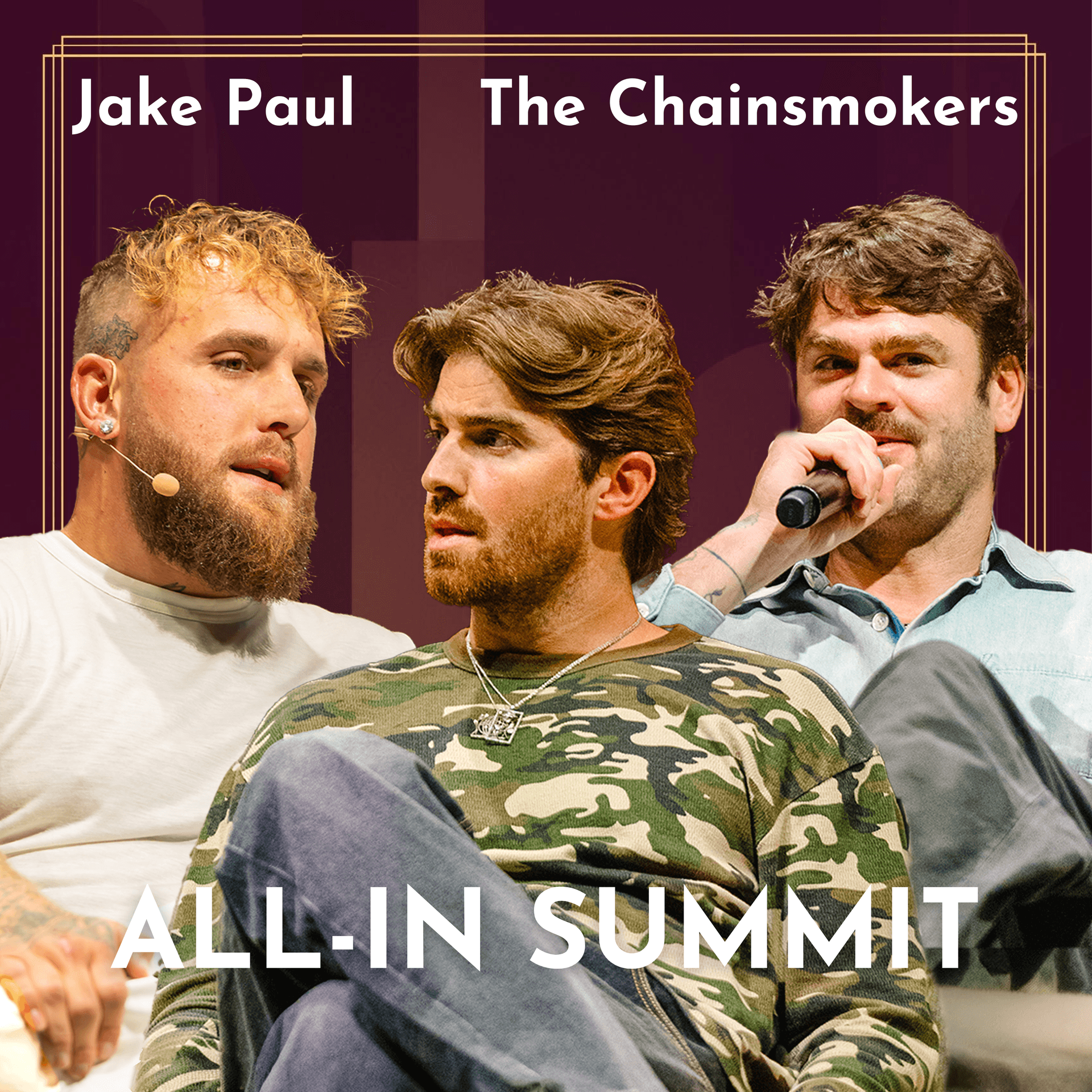
Podcast Summary: All-In with Chamath, Jason, Sacks & Friedberg
Episode Title
Trump Takes On the Fed, US-Intel Deal, Why Bankruptcies Are Up, OpenAI's Longevity Breakthrough
Episode Overview In this episode, the hosts discuss various impactful topics, including Trump's recent actions against the Federal Reserve, the implications of a new US-Intel deal, the increasing trend of corporate bankruptcies, and OpenAI's advances in longevity research.
Key Points
- Bestie Intros and Summit Updates (0:00 - 9:45)
- The episode starts with light banter among the hosts and updates about the upcoming All-In Summit taking place on September 8th and 9th in Los Angeles.
- Trump vs the Federal Reserve (9:45 - 36:45)
- Partisanship of the Fed:
- Discussion revolves around whether the Federal Reserve (Fed) operates independently of political influence.
- Chamath argues that the Fed is inherently political, akin to other government appointees.
- Concerns are raised about Trump's recent firing of Fed Governor Lisa Cook and the implications for Fed independence.
- Policy Criticism:
- Chamath critiques the Fed's approach to monetary policy, suggesting that it relies on outdated data and is ineffective in its current form.
- US-Intel Deal (36:45 - 51:37)
- Discussion on the recent decision for the US government to acquire a 10% stake in Intel as part of the CHIPS Act.
- Insight into how this could shape future US-China relations regarding technology and manufacturing.
- Concerns about the potential for the government to increase its stake in private companies.
- Rising Corporate Bankruptcies (51:37 - 1:12:12)
- Current Trends:
- Correlating the rise in corporate bankruptcies with high-interest rates and the economic climate post-COVID.
- Sacks notes that real estate refis are becoming problematic as the debt comes due.
- Creative Destruction:
- Chamath argues that increased bankruptcies might be a necessary phase of economic cleansing, allowing for the reallocation of resources.
- OpenAI's Longevity Breakthrough (1:12:12 - End)
- Discussion of OpenAI's new model, GPT4B micro, which helps in accelerating longevity research by optimizing proteins that could rejuvenate human cells.
- Examination of the implications of these findings for future healthcare and aging.
Key Takeaways
- Fed Independence: The debate continues over whether the Fed can remain impartial amidst political pressures and how its decisions impact the economy.
- US-Intel Stake: The acquisition indicates a shift in how the US government approaches technology and national security.
- Bankruptcy Trends: The rise in corporate bankruptcies signals a potential reallocation of capital and resources necessary for a healthier economic environment.
- Advancements in Longevity: OpenAI's innovative use of AI to address biological challenges could signal significant advancements in medical science.
Conclusion The episode encapsulates a range of pressing subjects that tie together themes of politics, economics, and technological advancements, showcasing the dynamic interplay between these areas in shaping the current landscape. The hosts provide a blend of humor and serious analysis, making it a compelling listen for those interested in the intersection of these fields.
Written by AI. May contain mistakes. Listen to the episode to check what was said.
Transcript
Automatic transcript. May contain errors.0:00Oh, look at that. Sorry guys. I got a little visitor. They're moose. Hey buddy, Dr. Moose is landed. Oh, he's out of my desk. Oh, why did your uncle Jason out? Let's see that handsome face. There he is. There's the moose. The moose is loose. Let's see. So I'm going to do a side by side. What a handsome visage. That's the good stuff. That's a stately animal. Can you hear him, buddy? You ready for ranch time? All right, get him out of here. Get him out of here. We got to show the producer.
0:46All right everybody welcome back to the number one podcast in the world. The all -in podcast we're back we're back. It's the original crew. You got your classic. You got your classic and speaking of a classic, freeberg's been tearing it up. What an amazing event. We're going to have September 8th and 9th Los Angeles, the fourth annual, all in summit, all in .com slash events. And now comes the incredibly awkward moment in the program, David's axe, where we see freeberg attempt to do an ad read. I'll just try to do the first one and then I'll interrupt him and say let a professional handle it. But let's give it a shot here.
1:23Let's see how Friedberg does with his uncomfortable promo. These are not your typical event sponsorships. Every summit partner is building and insane activation. All right, stop. It's terrible. Three, two, all right. Oracle's coming and they've done an amazing job. They're gonna build out this amazing bar in the Expo Hall drinks on our friends at Oracle. Yes, and they're gonna be sponsoring the PE and VC dinner as well as the AI infrastructure dinner. We have all these bird of a feather dinners, where you can meet people in your tribe. Our friend, Jeremy O 'Lare, at Circle, he's also supporting it, he's building out a huge tech -out networking lounge right in the heart of the event, and Circle and BVNK are also partnering to sponsor the stablecoin dinner.
2:13So, Martha loves the stablecoin, so he'll be there. And I run, they operate data centers powered by my favorite renewable energy. And they're putting it all you know that's you're gonna be at that. Yeah, absolutely me and my pal Chris right are gonna go there And we're gonna be in the solar tent And it's gonna heat up. Yeah, and we also have how crazy is this BVNK It's not enough. They're doing the stable going dinner with circle They're gonna build out an arcade in the expo also you can get some we have to have a competition You want to do a we want to do what do you want to do you want to play stargate?
2:46Tempest. What are you gonna whatever they have? your game. You and I will see Street Fighter 2 maybe championship edition. We'll do a 1v1 10k, you know, two out of three. I feel like I'm getting angle shot here. Did you like, did you write the code in that? Did you write the editor? We rented the arcade for my bar mitzvah. So I played a lot that way. Yeah. And all seven people showed up for your bar mitzvah. Why is your bar mitzvah like? We was in the back of the year. We had Street Fighter 2 with the that was kind of the highlight. It was in the backyard. I didn't have a fancy thing. That was the big deal.
3:21We got to rent an arcade. Your mom rented an arcade game? That's like a big deal. And you didn't have to pull the big deal. And then, but, you know, but then we had it in the backyard and that was it. It was pretty chill. Very nice, very nice. All right. Well, David Sacks is with us again. Where do you have your apartments, Vichakal? I'm from Brooklyn. We didn't have any of this stuff, man. You know what we have for our birthday parties? You had a choice. Pizza, bowling or both. And basically we went to rent a bowling alley get a couple of lanes get a couple of pizzas And yeah, you're a can invite a dozen of your friends and that was fun.
3:54It was fun There you go and after that we robbed some stores and tags Tag the archery Did some Betty crime Yeah, how about you Saks? Do you have a bar mitzvah sex? What was your theme when you are mitzvah? Was it Reagan? Was it Reagan Bush was your theme? What did you have with your theme? the Reagan Parmits. No, I mean, when would this have been, this been 1985, I guess? Yes, as a tribute to Richard Nixon or was it, uh, I wasn't involved in politics back then. You weren't in politics yet? Oh, it was not. No, I didn't know anything about it. When did you get the political bug? Was it in Stanford?
4:30When you, always Stanford, yeah, when they tried to show political correctness down our throat, then, um, had a negative reaction to that. They created a reactionary kind of like this whole Gen Z. I mean, If you look at the polling, this generation of kids are super conservative because it's a big reaction to a wokeness being shoved down their throats. And they're total squares. They do not like to do anything that is on the margin in any way unethical or a hack. I have my daughters. I pieced off the matriety to skip the line. My daughters wouldn't let me hear at the end of it. And I said, what do you think the matrix needs there for?
5:14What do you think $50 bills are for? They designed the 50 to get attainable before everybody else. They felt like it was inequality. That is unfair. They literally gave it, you know, everybody else is waiting online and then you went to the front line, you gave the woman the $50 and she sat you immediately, that's not right. There's other people who can't afford to do that. And I said, the other step problem, work harder. It's a poor new lesson for me. I don't know why I told them. How are you doing, Tramoth? You're back. Tramoth, you're back on America. I can tell you're back. How was your decompression?
5:46You did a decompression stop? In Vegas or something, how did you decompress? Did you stop at like, Laura Piana and do a decompression stop? What did you do? No, not and I went to this island last week, which is between Sicily and Tunisia, called Pantelidia. It's an incredibly beautiful island, but she got really sick. So we didn't have much of a vacation last week, actually, when I was posting from there, she was not well at all. and we were gonna consider flying home early, but then she got better than we went to Milan and decompressed for a few days in Pacta bags and came home on Monday. You're a little shopping Milan?
6:18Good shopping Milan. No, you're wondering. By the way, by the way, let me say something. Nann and I bought a pair of Ons. And do you guys have a pair of Ons? I've resisted. You talking about the fun of running shoes? Yeah, we bought the walking shoes. I and I walked all summer. These shoes kick ass. They're really good. I'm ditching all my Nike's to change your Nike's for on running. Yeah, on cloud is actually technically I think I bought like the cloud monster. I think or something like that very nice and Fantastico. Comfortable use the promo code Jamal and you get 15 % off on here if my friend Roger Federer is listening, which I know he does from time to time.
6:58I would love to help on Oh my god hold on a second. You drop that Jamal. Here's the name back. Yeah, I'm just going to go to the podcast. This guy named Jonathan on the pod. You know, he did a great deal with on, he got like a bunch of equity and he helped build that business. He deserves all the success in the world. He's a phenomenal, he would be. A lot of brand extensions going on. My friend Ben Stellar, I was talking with him this morning. Sorry, I dropped another name. Back on the table. I was talking to my friend Ben Stellar. He's doing, you're going to love this, David. Stellar's soda. He's doing his own soda brand.
7:33So we did a little pow wow little pow wow to the the comedian the comedian the actor the genius Jewish Tom Cruise Where's the way it was the guy I haven't heard that name in a long time is he still relevant? Shots fired shots fires. Oh, Jason. You had an announcement this week. You wanted to make I did we just sort of soft -launched That we're gonna be bringing found university It's one of the things I do. My day job is invested startup. So we created this Foundry University. We do it here in the United States But we had a lot of interest to bring this course on how to build companies around the world and we decided our first city Would be Riyadh.
8:15So we will be bringing our Foundry University along with Sonobl Which is the leading venture firm in the region? There in November so I'm going to be spending a week there and I'm really excited about it if if anybody is starting a company and you want to come, just go to meena .mena .launch .co and you can apply. But yeah, I'm really excited and then we're going to launch it in Asia next. So we'll have it in three cities starting next year. You take equity in the startups that they start? This is like YC. It's kind of a pre -excelerator. So what we do is we, most of the teams are not incorporated yet.
8:55Some are, some aren't. and we teach them how to do that. And then some of them like tax GPT went on to Y Combinator, or they'll go on to our accelerator or another one. And when we watch them work for 12 weeks, we will invest in maybe 10 % of them. So we don't have a fund in the whole issue. We're not obligated, but they're not obligated. Like if you're obligated, we just do it to help the community and get more start -up spilt in. But that must be good. So it sounds like it's deal flow for you too, right? So you get to see the companies. Yeah, what happens is a couple of thousand people apply.
9:24And we meet with half of them on a Zoom call and then we accept the best and then we invest in the best after that So it goes from like 5 ,000 people applying to 50 people going to 10 of them we invest in so yeah, it's a filtering mechanism Okay, so Lots of stuff going on here and I think the number one story remains that Trump is still fighting with the Fed They say you can't fight the Fed sacks, but apparently President Trump is fighting the Fed. You remember he was threatening to replace J. Powell and he did the site visit and while that drama, well, Trump recently fired one of the members of the Fed governor, Lisa Cook.
10:04And you remember he called Powell too late, stupid, numbscal, all these great adjectives here. But breaking, as we're taping this on Thursday, Lisa Cook has officially sued the president, arguing that the White House has no authority to fire her and to just give a little background before we get everybody's opinions. She's one of seven Fed governors, the governor's vote, obviously on the rate cuts. We've talked about here, maybe they were too late to raise rates, maybe they're too late to cut rates now, big debate going on. She was nominated by Joe Biden in 2022 and two weeks ago, the Federal Housing Finance agency, director accused Cook of mortgage fraud, claiming she had two different homes listed as her primary residence.
10:52You're obviously only allowed to have one. This is allegedly. And she did this long before she was Fed governor, but they have sent a criminal refer to the DOJ and Cook has not been charged in any crime yet. So that's important to put out there. And this is all important because as Fed governors can only be fired for cause, you need to have cause. And so Trump has asked Cook to resign. She declined on Monday. He said he was firing Cook for cause for deceitful and potentially criminal conduct. The first time in US history that a president has fired a Fed governor. This has brought up Chimap a lot of issues around the independence of the Fed, which it's supposed to be in its best iteration.
11:36You can debate that as well. And important note, there is an emergency hearing set for 10 a .m. Friday, warning in DC. So by the time we publish, there might be a decision of whether she can continue serving or not ABC news. Reported this will likely go to the Supreme Court. Here's your polymarket folks. Shout out to my guy Shane. Congratulations on the investment from Donald Trump Jr. also joining the board. There's a 25 % chance that Lisa Cook will be out by the end of the year. So it's not huge, but it's not a long shot. Let's stop there. There's more to discuss about the Fed mechanically. Chimath, start with you from the market's perspective.
12:16The Fed's supposed to be independent. So do you have concerns about it being independent? And then does this feel like law fair or tiki -taki, or they're weaponizing the Justice Department to you to get what they want, which is rate cuts faster and more of them? I think that the Fed is no different and any other appointee to a part of the government, which is that they are partisan. Meaning, if I said to you, is the Supreme Court viewed as partisan or nonpartisan, I think that most people at this point would say that the president that appointed them did so because they aligned with his ideology.
12:58If I asked you the political appointees to any department of the United States federal government. Are they political or non -political? And the answer is that they're political. And the idea that we still can't admit that the federal reserve is political is part of the problem. The reality is that the people that appointed these governors did so because the people that were appointed were aligned with their philosophy. And so we should stop pretending that they're independent because they're not. And in as much as they are closer to a regular civil servant, then the Supreme Court of Pointee, which is to say a lifetime appointment, which it's not, then I think it's very reasonable to say that any sitting president should be allowed to remove a Fed governor.
13:48If he believes it's not aligned with the wishes of the electorate and the voters and the plan that was voted in, I think that that's a reasonable thing. It's true for the rest of government. It should be true here. That's the narrow issue. But the bigger issue, I think, is asking from first principles, what does the Fed actually do in 2025? So we have an extremely vibrant and complicated and interconnected 130 trillion dollar global economy. It's moving at the speed of light. The Fed gets together once a month tries to divine what monetary policy, what the money supply should look like, based on data that is often incorrect.
14:37We see that in the BLS data, we see that in the GDP prints, we see it in all of the inputs. And so we've turned over responsibility to a handful of humans using bad inputs. So I think the real question is there are certain parts of what the Fed does that they can continue to do. And I think everybody would probably say it's an okay thing. So just to be very specific here. So I get this right. Could they be a lender of flash resort? Personally, in my opinion, no, I think that Treasury does a better job. I think we saw Treasury do that during GFC. and I think that Treasury has a better mechanism to get the American taxpayer a win than the Fed does.
15:26Do they actually create monetary policy and price stability? I would say that the capital markets and the free markets actually do a better job of that. They define much more what this bread is. I think so far is a much better rate mechanism than the Fed funds rate at this point. Do they do banking, supervision and regulation? Yeah, they probably do a reasonably good job of that. That is probably something that most people would say they could continue to do. Do they do a good job as a payment system in a clearinghouse? Again, probably something that's pretty uncontroversial that they could continue to do.
15:59So I guess my point is Jason, the bigger picture is the two things that are the most dynamic, they are the worst at doing. And so I would actually question whether that responsibility should sit with a handful of humans looking at faulty month old data. So for example, today the commerce department did something that was pretty exceptional. They said we're going to start publishing data to the blockchain. All the GDP data is now going into a blockchain. So can you imagine what this starts? I think, and we've talked about this before, I think employment data from all these employment companies and payroll companies should get published.
16:38this way, GDP data can get published this way, all kinds of economic measures scrub for anonymity should get published so that you can have pricing oracles that actually tell you what's happening in real time. And the markets will then react and set rates in real time. Those are the two most sensitive things that I think the Fed does that creates controversy that they shouldn't be doing anymore. Freiburg, I guess the question that Shema didn't get to there when he zoomed up was, do the independence of the Fed. It's designed to be a very rigorously independent, independent, their partisan. I know that.
17:17But the question I had also for you, do you have concerns about, you know, whether it's President AOC in four years or eight years or President Shapiro moving these things around and firing people like this and the weaponization of the government against government workers as some people are claiming. That was the sort of other piece. Why do you have to use the word weaponization? Like when you appoint somebody to the Commerce Department or to Treasury, is that imponizing that? No, the policy of appointee. You know, the concern people have is that this, that the head of FHFA is the one who is researching you know, her mortgages and that that felt like law fair to people.
18:05You know, the same way people accuse law fair, you know, first of all, the Tisha James against Trump, right? First of all, Bill Pulti is an exceptional American. He's a brilliant businessman. He's actually probably better served sitting at the Fed in some role, quite honestly, because he has been in the rate markets and the mortgage markets his entire life. So if Bill Pulti was able to get this in a reasonable fair and transparent which I have no doubt that he would have done anything other than that. The data is what the data is and I don't know, I'll let somebody else litigate whether that's important.
18:43The more important issue for me is just acknowledging these people are political appointees, these are partisan employees, and this idea that that is independent is maybe something that we should revisit because most of the things that they do can be done by Treasury and other people better. Okay, free bird, where are your thoughts? The members of the board of governors of the Fed, they're appointed to 14 year terms specifically to try and insulate them from the political cycles that occur. I think that that system has meant to kind of create a bit more resiliency to the institution. And so it can operate without necessarily being affected by the, you know, inter -election year kind of whims of politics.
19:26It seems like there is a lot of declarations to basically reduce the overnight rates, the short end of the curve to the short term rates come down, interest rates come down. The problem is, as a lot of economists have talked about, and as we've seen in the bottom market, is that that could really push up the long end of the curve. Because if you suddenly start to flood the market with capital in the short term by dropping rates today, so everyone will borrow, everyone will buy, it'll stimulate the economy, it'll stimulate growth, but it'll also stimulate inflation, and it'll stimulate government spending, then the ability for the government to make its debt payments and the cost of the inflation bears out in the long range, so you end up having 30 -year rates spike up.
20:10So there's a sensitivity that's worth noting here that it's not just, hey, the Fed is in control of the money supply, but there's a consequence to the effect the money supply will have, ultimately, on the cost of borrowing over the long term, and the U .S. ability to services instead. And so I do think it's very important to have an independent board of economists that makes those trade -off assessments that looks at short -term inflation, short -term money supply, short -term demand for capital, elasticity of pricing in the market, and also has considerations for the long -term cost of capital.
20:39So this independence notion, I think, is very critical. The 14 -year appointment term, to me, solves this problem. We have the same issue in the Supreme Court where they serve till the end of their life. And so I do you think that the consideration here isn't just about taking action to fire a member at the board, but perhaps we should go back and relitigate whether the 14 year term is appropriate and whether there be much more specific about the rights that we want to impart on the executive branch of the government to be in charge of the money supply. Any concerns about the, yeah, we'll go to you next, actually, you'll back clean up, but any concerns freeberg on how this is going down that you have another government agency looking into the Fed's governors and then looking for ways to remove them if they are in the other political party.
21:29Do you have concerns about that at all? And this is by the way, I concern that Republicans have also said, hey, this feels like law fairer, this feels like weaponization. Yeah, I mean, obviously, I just think that once people are appointed, if there's reasons that they're breaking the law, then they should be investigated. Everyone in government should be all the time. So there should be ethics and there should be rules and they should be investigated But I don't think that we should use that as a mechanism to get around the 14 year term God 14 year term is the term and if we want to affect that we should change the 14 year term and actually get Congress to do its job Which both sides may agree on to reduce the term Okay, Sachs What's your take on what we're seeing here?
22:15You were obviously quite animated about law fair and the previous administration against Trump. What do you think about what's going down here? Well, this isn't law fair. This is the president pushing back on I think a Fed that's been overly political. And just to agree with Jamath on something, I have to kind of push back on this chivaleth that the Fed is strictly apolitical. All the Fed governors are politically savvy and connected people and they understand the politics of this and the best example is Powell himself. So let's just go back through the history. So in the summer of 2021 we got that 5 % shock inflation print and it was Powell who played along with Biden and Yella and that this was transitory and that trans -tory narrative they used to basically avoid any interest rate cuts or any change of policy for six months.
23:10Now what was the importance of that timing, well, Powell was re -nominated for a second term by Biden on November 22, 2021. So in other words, he went along with his whole transferring narrative to get re -nominated by Biden. And then a week later on November 30th, he said it was time to retire the work transitory. And he then essentially announced that there'd be a policy shift and then they didn't raise interest rates for another several months. and it was a historic tightening cycle, meaning the shock to the economy was incredible because the rate and the velocity of which he raised rates was unprecedented.
23:45So the real question is, had he been truthful going into a nomination process and done it much sooner, would the economy have been better off? And the answer is probably. Yeah, for sure, because in that second half of 2021, we had a bubble, we had an asset bubble, we saw it in startups, we saw it in real state and that bubble was caused not just by artificially low rates but also by the continued QE buying. I think Stan Druckimiller has noted that the Fed, I think they bought something like 180 billion of government bonds and add them to the Fed's balance sheet. So not only were they resisting rate increases during that roughly six month period, they were continuing at QE policy designed to simulate the economy even though we were clearly in a new type of inflationary period.
24:28Do you think that was incompetence or do you think that was political sex? It was obviously political because think about it if Powell had stood up and said no, I think Biden and Yellen are wrong and this isn't transitory or even if it might be transitory, it's still a 5 % inflation print. We got to raise rates or at least we got to stop QE. That's what he should have done. We didn't do that because it would have been contradicting the Biden administration and it probably would have cost him getting renovated for a second. So that was intensely political behavior by Powell and it's the only reason he's in the job right.
25:04100 % and it caused an asset bubble in 2021. It caused the 9 % inflation that we had the following year and it caused the crash that we saw in 2020 to in 2020. And it's causing what we'll talk about later all these bankruptcies now. So just to give the counter here. I think about all those real estate deals that got done in late 2021 because rates were artificially low and they were able to finance them and the valuations were artificially high. And now, you know, that wall of debt needs to be refinanced. Jason, what should the Fed do that is valuable today in meaning when it was created, I could understand how the government moved faster than industry.
25:45I could, I think I can give that claim. It was about providing liquidity too, but 50 60 70 years later where all of private industry is operating literally at nanosecond scale using infinite data using a financial motive to price risk How is it possible that at handful of humans Looking at data that it's a month old has any sense of what's really happening? How is it even? Well, I think it's probably unfair to say they're looking at only data that's one year old and it's also unfair to say that there are partisan groups because if you just look at it statistically, they meet monthly. Yeah, that's true, but I don't think that they take the other 29 days off, obviously.
26:26And if you look just statistically, two of them are nominated by Trump and one was made chairman by Trump and then three were nominated by Biden. There's one vacant seat. So right now, when you look at it, it doesn't make sense that it would be political and they have been acting with very little dissent in their decisions. So just, I hate to bring the facts to the table here, gentlemen, but it doesn't seem like they're doing this in a partisan way. It seems like they're doing it. You could argue maybe they're too slow to react or they're not perfect, but it's certainly not partisan if half. They don't want to publicly contract the Fed Chairman.
Read the full transcript
26:59By the way, you didn't let me, you told me. Hold on, before you say that, they have to send. There's been to send. There's been one or two people who will to send and say, I think we should have a rate cut now. And they vote. And it's not like Powell has like five of the votes. They each vote. It's not a God -king kind of situation. So just factually and statistically, it's an even balanced, unlike say the Supreme Court at the moment. And there's one seat open and there might be two seats open now. How is the leader of the Fed? He needs to get re -nominated. This is why we had a six month delay in stopping QE and not recognizing the fact that we had this big inflation spike.
27:33And that lines up perfectly. Look at the timing. He was re -nominated. But you said it was political. You just glossed over what I just explained that it's that Trump placed him. Okay, maybe it's just a huge coincidence, Jake Hal. But Biden nominated Powell for a second term on November 22nd, 2021. And then on November 30th, Powell finally acknowledges that transitory is wrong. A week later. Okay, you don't think that's a big coincidence? Let me give you another one. I didn't get to present the second part of my argument here, which is that Powell started the rate cutting cycle last fall with a 50 basis point cut right before the election, shortly after Elizabeth Warren sent him a letter demanding a cut.
28:12And let me just read you let me just oh no I want to bring up this letter for a second I want to read this because there's so much hypocrisy here on this issue By the way, it was expected to be a 25 basis point cut and you ripped in a 50 going into the election But everybody was saying by the way, it's going to be a lot of saying at that time not just Elizabeth Warren We were all saying Jason at the minimum be hold on let me finish my sentence please We were all saying on this very podcast that there should be rate cuts because we had seen that that six, seven percent inflation come down and that you were arguing at that time, Shemaaf, that it was time for a rate cut.
28:45It wasn't just a list with more and there was consensus that they were slow to cut rates during that time period. So again, I don't buy a political... Because we could all read it and realize what was happening to the economy, which was like, okay, it's time to find a glide path, but meaning a glide path means 25, 25, wait, 25, not 50, then zero. Oh, okay, that's not a plan. This is from Elizabeth Warren to Powell on September 16th, 2024. So if you must pour the election, she says that we're writing to urge the Fed to cut the Fed funds rate. And she says for months, we've been calling on you to cut the Fed funds rate.
29:27And it says, in fact, it may be too late. Your delays are threatened the economy and left the Fed behind the curve. Inflation has fallen to 2 .5%. well below the mid -22, you could have 7%, and then it goes on to basically say that employment numbers are just slowly so the fed should front load rate cuts to avoid sliding towards a potential crisis. So the bottom line here is that Elizabeth Warren was saying that Powell needed to cut dramatically when inflation was at 2 .5%. Now Elizabeth Warren is saying that Powell needs to stand up to Trump and not cut rates. So you can see the hypocrisy here.
30:01You've got Democrats like Liz with Warren were brow -beating Powell to cut rates before the election. He apparently gave in to that pressure, cut rates 50 basis points, and then once Trump won instead of Kamala, then he stopped the rate cutting cycle. Just a little correction there. It wasn't, you keep saying that Powell makes his decision. He is but one vote. When they had that September 50 basis point cut, which we were all a little bit shocked to buy, people thought it was going to be 25. So it was double. There was one dissenting vote from one of Trump's appointees. So basically the Trump appointees were opposed to it.
30:35It's so - One was the other two weren't. And you'll remember that at the last, I think it was July, two people voted out of step with POW. So they do have dissent there sometimes. So this idea that it's just nakedly political just doesn't add up. He's pointing together the majorities. You're cherry picking the Elizabeth Warren because Elizabeth Warren is about one person. You just think all these things are coincidences. This argument that it was political just can't be true if there's other republicans on there who also voted for it. Well, there are established republicans. Okay. Sure. I know.
31:07I know. Well, okay. I mean, I know there's some conflict within the, within both parties actually. So he does a 50 basis point cut a few months before the election, which can only help the incumbent administration, Kamala, that didn't work. And then when Trump gets elected, he pauses the rate cutting cycle. That is factually true. Well, what it was also factually true is that inflation started to tick up a bit. Additionally, that what the Fed said, not just power, the entire Fed said, we don't know the impact of Trump's tariff policy. And since they didn't understand that and it was unprecedented as well.
31:44And we all admit it was unprecedented and we all admit that it was kind of shocking, which is why the stock market took a no -stive when he started, you know, making really like intense tariff demands. They said, hey, when the tariff stuff, when the data comes in for tariffs, which came in in May, June, and they were good. When that tariff data came in, then they said, you're going to work towards a cut in September. So we're talking about a five -month period here. Hold on a second. You're saying something really important. Okay, look, I just want to pause on this. Let's. You talked about this and what you said was the markets reacted and they went down.
32:20You're absolutely right. But you know what they did? They also reprised that risk well before the Fed got back together. It was within a few weeks that the market had completely reprised what was happening with tariffs. This is why I'm telling you that we are better off imparting the rate setting mechanism to the free market. Because when you have places like commerce and treasury increasingly publish all this real -time data into a blockchain, you can have pricing oracles, Jason, that make these decisions in real time and repric this. Just like the stock market does every day. You say Oracle explain to the audience what you mean by that.
33:01You mean an AI would tell us what the rate should be? No. Every bank will have oracles that divine what they believe the risk -free rate would be. Then what happens is when you have a Treasury auction, in an auction, you submit a bid. And when people submit bids, what happens is you converge on a market clearing rate. That happens independent of the Fed. And so what I'm saying is that if you actually inspect the ability to finance the United States government, the two critical things that happen can be done and are done well today by Treasury plus the free market. So you want to abolish the Fed.
33:38No, for this purpose, for setting the rates. Listen to me, they have four major responsibilities. I think that if you revisit what's happening, you can find two of those responsibilities that probably they can continue to do with a lot of usefulness. But it is clear that the free market does a much better job of setting the actual rate. It's called so far. We all use it. We use Fed funds as a guide, but Fed funds isn't even and specific anymore, it's now a range. They don't give a specific rate. They give a range because they don't know. And it's okay to not know, but we should just acknowledge that that's where we are today, which is we have precise data in the free markets, imprecise data in a group of people.
34:22So there are 12 people that vote in these meetings, seven are the Fed governors that we've talked about, and then five are the Fed bank presidents who also get a vote. And it's very simply the majority wins. and there's a vacant slot now, so there's 11 votes now. We've all been in large board meetings, and we all know that the dynamics of these meetings, there's a leader, that person's either the CEO and chairman or just the chairman of the board, and they're the ones who lead the discussion, and they put together the majority, and they set the agenda, and it takes a revolt by the rest of the group to basically stop their decisions.
34:56So you're trying to diffuse accountability for Powell's decisions here, when he's a leader the Fed and he ultimately has responsibility for their decisions. And by the way, I don't think you'd be seeking to diffuse accountability that way if pallid made a bunch of good decisions. Right? Why would you be trying to diffuse that accountability? I don't have a horse in this race. I don't have zero horse in this race. But clearly you're trying to defend. You're trying to defend the Fed here. I'm just trying to correct the facts. There are 12. Well, there's 11 people. He's the leader of the institution.
35:25He's one. He gets one vote. He gets one vote and just in the last. He's pointing out the majority's just again I hate to bring facts into the discussion but there were two dissenting votes. Bowman and Waller they preferred a 25 % rate cut in July. So there is dissent in this organization. They're going to cut 25 obviously in September. Some of them wanted to do it in July and then August they said yes time to do it. And so we that's why the market popped and probably market is showing that's going to happen September. So we're talking about a 16 -day period. You look so violent. Okay, let me just just do some right.
35:58So, right, Zach, you get the last one. Look, here's the bottom line is I think Trump is right to be frustrated. Powell has been intensely political. He went along with the transitory narrative on Flation to get re -nominated for six months. That created a horrible misallocation of capital. And then a few months before the election, he went along with a 50 basis point rate cut. there was no outrage about Elizabeth Warren jaw -boning him then, like there is now about Trump. And then he stopped the rate cutting cycle and Trump won. When Elizabeth Warren said that, we actually said she shouldn't be doing that.
36:28So, you know, that wasn't like Elizabeth Warren speaks for the country. She's totally irrelevant, Sacks. We all know she's irrelevant. And we all agree that they were behind in the rate cuts. We all agree she's behind the rate cuts. Okay, let's go to the next one. Okay, we're not going to agree on this one. And there's going to be a rate cut in September. So it's all good. The US government just took a 10 % stake in in -towel. Last Friday, Trump announced that the US government would acquire a 10 % of the chip maker. As we all know, there was this chips act to try to ensure chip manufacturing.
37:00There's a lot of chip companies that are US, but they don't actually make the chips here in the United States. Most of the chips in the world are made in Taiwan, one obviously by TSMC. And so these grants were created, nine billion of them were grants. There were also tens of billions in loans, and that was the chips act. We talked about it here many times two years ago. These grants have been allocated. They were not paid out, so Trump and Lutnik came in and said, hey, instead of giving this money for free, we would like to get something for it. And they are going to get non -voting shares. There's no golding share like in China, where you get a board of representation and you can kind of control the board.
37:45This will be passive, no board seats, no governance rights. Let Nick was very clear about that on CNBC. This all happened three weeks after Trump called Intel's CEO, or called for Intel's CEO to resign over his ties to China. President Trump said, quote, the CEO of Intel is highly conflicted and must resign immediately. There is no other solution to this problem, but they found a solution which was to take 10 % of the company. Let's stop there. This has been pretty controversial. I think, Chimoff, in terms of people wondering if this is going to become a playbook. Do you have any concerns with swapping the grant to getting equity?
38:26And do you think they should become a playbook where the US government starts to own percentages of companies in exchange for loans and grants, as opposed to giving loans and grants. Yeah, I think some historical context is important. In 2006, Hu Jintao gave the speech, and in that speech, he talked about six or seven boxes. And the way that he described these boxes was that these are the critical parts of the Chinese economy, that they must persevere and win over the next 20 or 30 years to ensure safety security and prosperity for the Chinese people. And in those boxes were things like semiconductors, were things like rare earths, were things like pharmaceutical APIs.
39:15And what it described was a willingness by state governments in China, as well as the federal government in China, to use the balance sheet to support those companies. Incrementally, Jason, as you said correctly, they would also ask for a golden vote. In return, what did they do? I can talk to you about Rare Earth as one very specific example through my involvement with MP and now within Tellus. The Chinese have an extremely sophisticated market -driven approach to how they help when they are on the cap table. They'll price shape, They'll price dump, they will change the spot markets, they'll perturb the ability for other people to compete.
39:57And what that does is it locks the capital markets because it says we can't compete with these companies, so we're not going to finance an alternative. That has long term strategic negative consequences for everybody that isn't those Chinese companies. So let me just pause there. Now, look at the United States. What the United States has always done is we have been the lender of last resort, but we've never participated in the upside that being that lender of last resort has given us as the American taxpayer. So for example in 2008, you know, we created tarp where we bailed out all kinds of toxic assets.
40:35What did we get in return for that? Nothing. We barely got our money back. When Warren Buffett stepped in to backstop golden sacks, he was able to get the United States government to help him backstop that. Who got all the gains, buff it, and shareholders of Berkshire Hathaway? Who put up more money, the United States taxpayer? Those are but two examples. I think that this approach is the much better approach, which is to say we can do exactly what China did with a couple of tweaks. It's way better, as you said, Jason, to just put in the equity, own something on the balance sheet of the United States not have a golden vote have complete transparency allow the capital markets to finance these businesses but give them a chance to compete all around the world and then the US taxpayer gets some of the upside that is awesome what we have done up until now until what Latinac has done and what the president has done is the opposite which is we have given money away in times of dress with absolutely no upside and I think it has to change.
41:38What are your thoughts here on this model? It is something to think about when it comes to, as Timoff correctly points out, China will subsidize their champions. It's happening right now with BYD. The car company, allegedly, all these car companies are dumping cars all around the world and supposedly they're being underwritten by the Chinese government explicitly to do this, to take away American, German, European auto manufacturers' ability to compete. So what are your thoughts on this? Do you want to see it continue? Or do you think this is kind of a one -off specialized situation? Well, I agree with Jamoth that if you're going to give large amounts of money to chip manufacturers, it's better to get equity for that than for it to be a freebie.
42:27And I think there's two reasons for it. One is it's a better deal for taxpayers. We might be able to recoup the money and even make a return on it. But the other is the incentive for companies, right? We don't really want our companies going to the federal government to try and get bailed out and At least if they have to give up equity or warrants things like that. There's a cost to it We would rather that these companies get financed privately But that didn't happen here until receive something like you know over eight billion dollars under the chips act because We let the free market do its thing and it resulted in chip manufacturing being offshore and it all ended up on the island of Taiwan.
43:05And that's a huge national security issue for the United States because now our whole supply chain for this critical resource is single threaded on Taiwan. So we made the decision as a country to onshore chip manufacturing. That's what the chip back was about. It had large bipartisan support. So there's this priority to bring chip manufacturing back onshore and the question is how you do it. And I think that if you are going to hand out billions of dollars to these companies, you're better off at least again getting something for it, having the taxpayers have some upside in it, allowing the government to recoup and creating the right incentive for these companies, they're not constantly seeking bailouts.
43:44So I think this is a big improvement over where the chips act started. But to answer your question, I mean, what I be looking for lots more opportunities to do this, I think there has to be a national security interest or something of that kind, and I think it has to be a situation where, for whatever reason, the free market has failed to deliver on that priority. Freeberg looks like we're going to have consensus here that we all agree it's better to get some upside or equity for the American taxpayers as opposed to giving free money. There are have been some pushback as to the style in which this was done the bullying of the CEO and then three weeks later, a deal.
44:23So thoughts on that criticism of the administration. Well, just taking a step back, I think it is an indication that the free market has failed in some way. If the government is stepping in to either provide unique regulatory unlock or the government is providing capital or the government is basically stepping in to be the biggest or primary buyer of a private company's products or services, those are the three kind of reasons why I think these scenarios are emerging. So regulatory unlock that's unique, providing capital, or being a buyer. All three, I think indicate that the free market has failed and the government is playing too big a role in our economy.
45:04So I think that that's just the unfortunate circumstance that we find ourselves in and we can recount as we have many times here before, why the government has become so big, why it is too big, and why it is having such an outside influence on job creation, on economic growth, on stimulus, on market strategy, et cetera. And I hear Sachs's point that there are very specific circumstances where we have to fix free market action. And I totally get that. But I think there's these bigger, broader kind of things that are happening, which is the government's also the biggest buyer of products for a lot of companies.
45:35And the government's providing capital, either through contracts or procurement or some structure that is stimulating a very large percentage of the economy. So I do think there is a notion that some have shared, which I don't fully disagree with, which is that there is some degree of socialism underway. That the government is providing such a large role in the economy and replacing so much of the free market. And we can argue why that is and have different points of view on why that is. But that de facto state is an unfortunate state. Now, I think the question is under these circumstances, should the government be getting equity?
46:08I think the answer is yes, I agree with that. And if the government is getting equity, the key question I want to ask is where does it go. There's three places that equity could land. It could just sit on the balance sheet of the federal government, in which case there's no real goals or oversight of the investments. There's no overarching strategy on what to do with that equity over time. How do we, how does the American taxpayer benefit the most? When does the government sell? How does the government choose to sell? Who makes that decision? So the second is then you form a new sovereign wealth fund to hold all these equity assets.
46:38You form a new sovereign wealth fund, then you have a whole group of people that are going to be hired to oversee those investments. They're going to make good decisions, hopefully. They're going to be good investors, good fiduciaries on behalf of the American taxpayer. But I would argue that what we should be doing instead, and as I've mentioned in the past, is use what we already have, which is the OASI, the old -age and survivors insurance fund, which is the trust fund behind social security. That's actually where social security's assets lie. Today, the only thing in that trust fund is US and they're actually a special form of treasuries.
47:11So if you've paid into social security, you're effectively loaning the federal government your money. And then they're supposed to pay you back your retirement benefits in the future. Rather than just loan the federal government money, those assets should be held and will become the largest sovereign wealth fund who makes strategic investments and grow those assets over time on behalf of those American taxpayers as retirees. So I would argue that the right solution of the three options, and former sovereign wealth funds sit on the balance sheet with no strategy. Instead would be to have that sovereign wealth fund sit within OASI that would require statutory changes because the social security trust funds were set up in the 1930s and Congress passed an act that said, you know, you kind of got to hold only treasuries.
47:53So we would have to get Congress to kind of revisit that concept. But I do think that if we are gonna be in the state where the federal government's playing this outside role in the market, we should take equity, but we should be very strategic about where that equity goes and I think the best place to put it is in the social security trust funds, and it can kill two birds with one stone. So rather than create new holes in the government, meaning new spending, new debt, creation of new vehicles for us to spend capital, I think we should fill holes. And one of the holes we need to fill a social security, which is gonna go bankrupt sometime between 2030 and 2033.
48:24I would encourage us to kind of strategically think about evolving this system. I think it's a major moment by the way, because as I've mentioned in the past, in addition to setting up an equity vehicle or based on these deals, the Social Security Trust Fund could also be buying public equities on behalf of the retirees, which would have a significant compounding effect for them. Jacob, what do you think? So, I love the substance of it. We talked about it actually back in the day here. There were a series of loans that Obama set up for Tesla, Selindra, and Fiskar. A bunch of those companies blew out, didn't pay back their loans.
49:01Elon paid back his ahead of time. But the government had no other side to use with interest, of course, yes. And imagine if they just owned about warrants for 1 % of Tesla or something, it could have been incredible. And I'm sure Tesla would have still taken that deal. It wouldn't have been crazy. The thing I don't like about this is the bullying of the CEO of Intel. Now, this is giving a lot of, you know, this is a lot of my challenge with Trump is, or sorry, President Trump, is sometimes the style in which he does something detracts from the actual substance of it. The substance of this is great.
49:38But we are now getting into a situation where it feels like our narco capitalism, like this is crazy that the president goes and bullies the CEO of a company and then says they're to be deported and then settles a deal like this. The optics look terrible and it would have just been much better to say, instead of giving you a grant, we'd like the option to have equity. What would you prefer and then have a decent negotiation when you don't have to threaten to kick the guy out of the country? Do you think maybe that happened, J. Cal? And it just wasn't public. And this was like a lot of things, a public negotiating strategy.
50:12Yeah, I mean, I think probably that is what Trump does. He beats somebody up and then says they're incredible. I just think it detracts from the substance and the good work when you do those techniques because it's now very We should it. Yeah. Do you think we should have a sovereign wall fund? Not when we're in debt the president addressed what happened Tom cotton, you know senator wrote a letter attacking Intel and questioning the CEO Lee Booth Dan's past and The president posted a truth in response to that, but he hadn't met that Lee Boob before. And so the CEO of Intel went in there, got an audience and told his side of the story, which was that yes, he invested in China, but when everybody was doing it, it wasn't controversial at the time.
50:57And I don't, I think he hasn't been involved in China for like six years or something like that. So he cleared up the situation and that's how the conversation has been. But look, I don't. Fire aim ready is like the thing I don't like about when Trump does these things. So yeah, well, I think the American people like when Trump gets results. And you gotta break some eggs to make an omelet. And the question is, is he getting good results? And I think the American people are happier, getting something in exchange for billions of dollars as opposed to just being handed out. Can I buy something, Jason?
51:29Exactly my point to just what she would do it in a more thoughtful way, but maybe it wouldn't work. It's you, Jason would've worked. Absolutely wouldn't work. You mentioned that you don't think that there should be a sovereign wealth fund until we're out of debt. I didn't finish my dollar amount. So that's an interesting question. If we had a sovereign wealth fund and we're $36 ,000 ,000 trillion in debt, I'm with Latinx position that like maybe we pay down that debt and then we can think about that. But sovereign wealth funds usually come from some natural resource, norways, UAE, you know, sourdys.
52:00We don't have some natural resource that is throwing off all this money and yeah, so I don't know how we get one. I'll take the other side. I think that we should start a sovereign wealth fund right now. And who should fund it? Well, the great news is that these Trump tariff deals come with huge amounts of capital that these other countries have committed to spending inside the United States. For example, there is $600 billion now that Japan has to spend inside the United States. There's $300 billion that Korea has to spend. There's another several hundred billion that Europe has to spend. If you add that all up, we've exceeded a trillion dollars of inbound capital on the investment side.
52:40And in those things, we get 90 % of the upside, if you remember. So I think that a lot of that capital should be the seed capital for a sovereign wealth fund. You're right, Jason, that we can then choose to direct some of those gains to things like debt reduction, free brokers right, we could direct some of those gains to fund social security. I think we should set that up right now and it can be additive. So, for example, there's the trillion dollars that these countries are investing in the U .S. 90 -10 carry. It's unbelievable. All of that should go into a balance sheet that the American taxpayer can benefit from.
53:14Number one, two, when we do these programs like we did with MP and we've done with Intel, they're really smart. We need it anyways for strategic reasons, but now we get the backend participation of the equity. That should go into a sovereign wealth fund. All these things make a ton of sense, I think. How are things that I would say? The concern I have is any time we create a new income stream at the federal government or we have some sort of growing asset that you mark up on the book, someone tends to invest ahead of the curve on that. Meaning someone takes that and they're like, oh great, I can spend more now.
53:48I mean, we even saw this in California, you know, Gavin Newsom and the budget, Skyrocketed as the income went up and rather than take the surplus and book it for a rainy day, they went and spent ahead of it and then all of a sudden they had a huge deficit. it. And I do worry that the tendency in the federal government, which is what happened with social security is it's like, okay, all these people are providing this income every year to the federal government, which they're supposed to be paying into their social security trust fund. But then what happened is we raided the coffers. We took all that money and we started spending it on random new programs.
54:18And the problem is by giving the government more assets, by giving the government more income, we set ourselves up for a circumstance with a federal government. The Congress says, great, we got more money to spend. Let's do X, Y and D program and let's do this great. Let's build a high speed train. Let's do this. These are all good for American people and all of a sudden, you know, you don't actually solve any real problems. And this is why my argument is like, we should use it to fill the hole that we have for example in social security and that needs to become an asset that's strictly used as an offset on social security.
54:47Because if you don't put it in that box, it just becomes another spending mechanism. I don't like the sound of taking people's social security savings or the money that's earmarked for social security and having the government act as a venture capitalist and start investing willy nilly trying to get us out of this hole. I mean, I don't think that's going to go very well. But what I think makes sense is that it's an offset, Saxon. I mean, maybe it's just, you know, it's just incremental where it goes liquid. It can be used to pay down the social security treasury obligations as my point. Yeah, look, I think we should just be selective about this.
55:18I think it makes sense in situations where the government was going to do a bailout anyway, because there's a national security priority or some other kind of priority that the government's determined we have to do. You want to get equity for it. It doesn't make sense to give, I mean frankly even Slenderer and Tesla. Where does that equity go? I think that would be held by the software. And how do you keep everyone's grubby hands off of it? Right? So like how do you use it as an asset rather than have it be another mechanism of spending? I like the idea of putting that equity in the software well -funded.
55:51Yeah, I could go to Social Security. I think that makes a lot of sense. I just want sacks on records and he agrees that it should go on association security. Well, I like that idea. I don't like the idea of taking people so security funds. I guess that's about it. I'm not looking at it. Those funds don't exist. Those funds were already taken by the government and spent and there's an IOU sitting in a fucking account. He's like, basically a piece of paper. It is your retirement. We're talking about situations. We're talking about situations like tarp where you had all these Wall Street firms bailed out.
56:19And yes, the rents some of them paid back, But the government should have equity. Should I know what you're saying in those films? I want to make sure that we go somewhere because people book it as income. And then they take a lower deficit year. And they're like, great, the deficit was lower. We can spend more. That's how this gets booked. Perfect. If it's not accounted for separately, it gets blown out. That's what I hate. That's a perfect segue. Grover Norquist wrote an op -ed in the Dallas news. You can pull it up Nick and show it there. About the discussion we had here on the podcast a month ago, I had talked about this, you know, he has his taxpayer protection pledge that Republicans made back in the 80s where you know people signed on to agree not to increase taxes.
56:59Well, we had talked here and I had proposed something similar for spending because we all have concerns about the debt and he pointed out that this is very difficult to do, but he had a really interesting piece of information that I hadn't heard in Colorado, a Democrat state, they have limited the size of the budget to be based upon the population and inflation. So they have been returning money to taxpayers and low -income state interest rate. And he says this model pioneered in Colorado, but other states are now getting onto this, that this could be the model that saves America. And that we could have a situation where the population plus a little bit of inflation equals what you're allowed to spend, gentlemen, your thoughts on Grover Northquest responding to our pitch on the island pod.
57:55Or my pitch on the pod, I guess. What? Okay, crickets. Somebody's got to have an opinion. This is so uncontroversial. I don't know what there is to talk about. What's the analysis we're going to do? Yeah. It'd be a good thing if every politician pledged to not increase spending. But we may as well. You guys aware of Colorado doing this? That they had this device set up? Yeah. Nobody was aware of it. Yeah, it's pretty interesting. So Grover Northwest come on the pod anytime. I actually told Elon and I tweeted as well, this is what the American party should do. This should be the entire American party platform.
58:30Just get senators, house representatives who believe in this and just work on that one issue, balancing the budget. That's the thing that neither party will take on. All right, let's talk about corporate bankruptcy according to N S &P Global Report. So far in 2025 we've seen the most corporate bankruptcy filings since 2010. That was after the great financial crisis you remember or some of you might have been too young. So corporate bankruptcy is according to the S &P are public companies with data of at least two million and private companies with assets or liabilities of at least 10 million. I'm not sure why the public companies is less than the private.
59:07It didn't make sense to me, but there must be a reason. These are also called large bankruptcies. Here's a chart showing you corporate bankruptcy since 2008. The blue bar is through July. Gray bar is the full year. So we're looking at a partial year here, obviously, in 2025. We're at 446 large bankruptcies, seven months into 2025, which should put us on track for the most since 2010. And yeah, nothing close to GFC numbers. but it's not trending well. And if you look at corporate bankruptcies broken down by month since 2020, you can see that bankruptcies are increasing after the massive rate hike cycle in 2022 and 2023.
59:51So obviously rates have something to do with this. What are your thoughts, Chimatham? What we're seeing here? It's not like super dramatic, but it's definitely notable. Yeah, it's notable, but I think it's notable, not for the reasons that the mainstream media tries to describe it in. I read these articles and I was a little bit caught off guard because initially what it said was the tariffs were causing this and I was like, large companies don't go bankrupt 30, 60 days. Yeah, because of the tariffs. This makes no sense, but the narrative was very strong. Basically trying to paint the Trump administration is having caused this.
1:00:30So I just started to look into this and a couple of interesting things to note that the conclusions that I came to. I think the most interesting is that there were a lot fewer bankruptcies over the last four or five years than there should have been. And I think that there are two reasons. The first reason is that you had rates artificially suppressed at zero for an incredibly long amount of time. And so So you had all kinds of companies able to raise enormous amounts of capital that they probably shouldn't have been able to or at a minimum should have done at much higher rates, which weren't really there because the poor rate was at zero.
1:01:18So what that means is that many companies were able to fill the reservoir of money. And then when the core structural business started to fail, they had a lot more oxygen in the tank to survive a lot longer. So I think a lot of what you're seeing, and if you look Jason at some of these companies like Joanne's Fabrics and Party City, these were businesses that were upside down for years. Yep. And a number of these were PE buyouts that, you know, their strategy is to saddle them up with a bunch of debt too, so that speaks to what you're saying. So I think the reason why bankruptcy is up right now is because the reservoir of free money, the money printer that printed, frankly since 2010, up until about 2021, because we still gave an enormous amount of money in COVID, is finally starting to run out.
1:02:06That's number one. But the second is that we actually haven't had a process of creative destruction in American company formation for a while. Yeah, probably since GFC, GFC, right? Yeah, that's a similar thing happened at that time too, Jamal, right? We had always backed up companies that probably should have died. And it kind of, well, what I think what happened was like, you know, startups ran out of money. There's certain parts of, of industries that had some trouble. But by and large, there was no transformational or catalyzing MNA that could have actually happened. And that in part was a structural issue because of the way the federal bureaucracy reacted to it, not just in the United States to be fair, but around the world.
1:02:47And I think When you relax those constraints, what you can start to see are companies identify assets that they want inside of other businesses, be much more aggressive in getting them, businesses that are floundering, being able to see that they're about to run out of money and have the confidence to try to do an M &A deal to survive. You need all of these things to work in lockstep for a market to be efficient. The market was incredibly inefficient since 2010. Art officially suppress rates, a regulatory regime that, you know, disallowed any form of M &A in consolidation. Now that those constraints are lifted, you're going to see a lot of this creative destruction work its way through the economy.
1:03:25That's one big trend. The other big trend, and I think we saw this in Nick, can you please find a tweet from Delian, where he talked about the Chipotle competitor that TK launched? I just want to point to this because I think this is another wave of competition that's going to put a bunch of categories of business under duress, which is, you know, our friend Travis Kalinick, who's the founder of Citigris, what is it called? Citigris logistics? Is that what it's called? Cloud Kitchens is Harry McClub Kitchens. He launched a Chipotle competitor and it's apparently totally kickass and way better than Chipotle.
1:04:00And it just starts to show that there is a wave of competition that's also coming from completely different companies you never would have expected going after a bunch of these businesses. So if you put these two things together, I think you're going to see more or not less bankruptcies, but I think the outcome is probably positive in that you clean out a bunch of businesses that were taking up time and resources. You should allocate a lot of the human capital that are in those companies to different businesses. And I think it would be better off. It's a long list of companies, but I just want to know which one hit you harder for every 21 or who does which one of those bank sees hit harder for you?
1:04:39I'm trying to game you get out here. I think that we should buy. By the way, I mean, we should buy who does Chimap. Guys, we should have a teenage daughter. If you have a teenage daughter, what I'll tell you is forever 21 was shit, that was gonna go to zero anyways. Like you need to belong brandy Melville. You need to belong. Oh God, what is this other one that's like the closer. Hello, but yoga pass, hello. So the kids wear a lot of those. They're into the athletic wear. What's the name of that clothing store? Viewer? Or, you know, we're slow and like always wants the, you know, the skirts and stuff, not Brandy Melville but the other one.
1:05:17Oh, um. Anyways, there's all these brands. Yeah, Forever 21 was not it. Yeah. What do you guys think? Should we do a, should we buy out hooters and put Sydney, Sweden, and a CEO? This could be a great brand extension. I don't know. The chicken wings are amazing. Sacks, any thoughts here on the creative destruction and what we're seeing? Obviously, you can't have to do a tariffs because there are only three months old and it seems largely the company Every company you've mentioned every company you've mentioned is a retail business They have physical locations that people have to go to do stuff or get stuff and I think that this 20 for me had wag Yeah, but yeah, I think But I think the mom's got a retail channel getting flushed out makes sense to you age of Amazon and sheen and target well Well, the retail channel, like others, is highly levered because in order to have a retail store, you have to pay a monthly fee to the physical real estate owner.
1:06:14And so it's unlike other businesses that are services or more nimble and can relocate, you actually, it's the equivalent of having debt. When you sign a lease, you're stuck in a 10 -year debt cycle. You have to pay every month of fixed amount of money and you can't get out of it. So the retailers make a lot of sense. They were basically levered businesses in addition to all of the kind of macro trends of people not going to physical locations and COVID, but I think Shemath has it right, which is this is all kind of syrup era, you know, indigestion that's being washed out. And to the point, like some percentage of overfunded negative unateconomic type businesses are also getting cleaned up in the kind of call it text space, which involves typically a lot of companies that are not tech, but math does tech.
1:06:57So that definitely makes sense to me. Sacks any insights here? Well, just to pick up on this. So, you know, when you show those charts on the bankruptcy, I didn't see a huge trend there. I mean, I can see that there's some pickup since the Zerp era. But it doesn't look like a huge trend to me. We just had a 3 .3 % GDP print for Q2. I think it will have... But that was restated, right? That's what happened today as they restated it. Well, no, there was an estimate. Remember the Atlanta Fed had this 3 .3 % estimate then they reduced it to 3 .0 but now the actual number is in us 2 .3%. So the economy seems pretty hot and it's doing well but I would say that there is some softness in the economy in those sectors that are exposed to high interest rates.
1:07:43And the best example of this is real estate. I remember on this program a year and a half ago we talked about the wall of debt on commercial real estate that was coming due and had to be refinanced and there's 2 .2 trillion of debt, at Siri debt that's maturing before 2028. And what we talked about back then was the banks don't really wanna foreclose on these buildings because then it hits their balance sheet. So everyone has a incentive to restructure this debt and there are a lot of these blended extent type deals where they would extend the debt and work out a lower interest rate. Some people call these deals pretend to extend because you're pretending that the real estate sponsor still has equity in these buildings and they might have been wiped out.
1:08:24Have these started to come back? What I'm seeing is that some real estate developers are starting to lose buildings now. The reason for that is that the debt is coming due and has to be refinanced. And there's two problems when you refinance. One is you're paying a higher interest rate. So now you take a building that was cash flowing and now at that higher interest rate, it might have negative cash flow. In other words, it's basically bankrupt. So those buildings don't make sense anymore and those are situations where you're going to lose the building to the bank. The other problem is when you refinance, you might not be able to get the loan to value that you had before because valuations have also come down because real estate valuations are inverse to interest rates.
1:09:08So in other words, if, you know, let's say you had a building that was worth $100 million before at Zerpa area interest rates, you could borrow two thirds of that to call it $66 million. Now, if the building is only worth, I don't know, $60 million, then you can only borrow $40 million. The amount of proceeds you can get when you refinance is much lower. That gap has to be replaced with something. In that situation, the equity holders would have to come in and do an equity in refinancing, where they've got to put up that gap. The example I gave that gap would be $26 million. The equity holders have to come out of pocket, which is very difficult to do.
1:09:47and they might not want to do it. And in that case, you're also going to lose the building. It's a fact. I have a question. Nick, can you show this image? Sax, how does this friend build on top of that other trend, which is on top of everything else now, it just seems like the real estate financing flows are moving far away from typical office construction towards data centers. So if you add that to the mix, then people seeking funding for traditional office are going to find, or refinancing are going to find fewer lenders. Is that true or not true? Well, yeah, I think there has been a little bit of a credit crunch, but also, there's no reason to really be building so much office space when there's so many buildings that are underwater vacant.
1:10:29Yeah, like a third of the real estate in San Francisco is basically vacant. Still. Still. So why would you build any more real estate? But what needs to happen is those buildings effectively need to go back to the bank and then they need to be auctioned off at some lower price so that new equity holders can come in and new captails be formed. And then you can get the money you need to do the tenant improvements, the TIs, so that you can get more tenants in there. Because right now, one of the reasons why a lot of these buildings are empty is because the equity holders don't have an incentive to put in more money to do the TIs, necessary to sign new tenants.
1:11:03So you got these zombie buildings that even if there was a tenant who wanted the space at some lower rent, the owners of the building have no incentive to do that because they can't put any money into the deal. So like we finally need a bunch of these buildings to go back to the bank or We need rights to come down so that you can do refinancing Without them being these punitive refinancing and I do think that there is a lot of risk in the economy in the sector Because again, if this wall of commercial real estate debt that's coming to you and I think this is the problem You got pal sitting there.
1:11:34You got too late pal sitting there in his ivory tower He's willing to keep rates artificially low so he can get re -nominated and he can help buy it in the yellow And he's willing to cut rates to help Kamala, but as soon as Trump gets in there He stops the rate cutting cycle even though inflation's down to 2 .0 percent So you got this too late pal and the rest of his fed cronies Jake I want to make it sound like they have some Descenting boys that's nonsense in any event. They're all collectively seen there in their ivory tower completely out of touch with what's happening in the economy. And they're being slow to cut rates.
1:12:07And I do think that at least sectors like real estate do need these cuts. Prieber, tell us about Yamann Ockifactors. Yeah, how long can I make this bulldog last? Can I make them last 40 years? That's what I got left. Well, in mice, they are using these Yamann Ockifactors to make the mice age the equivalent of like 250 years now. It's really incredible. And there are human clinical trials starting. So the Yamanaka factors you guys will recall are the four proteins that were identified that basically can turn any cell back into a stem cell. And we'll call those four proteins OSK and M. When these four proteins are applied to a cell, it basically starts to trigger a bunch of gene expression that then turns that cell back into a stem cell.
1:12:58And so that cell becomes youthful again and you can then turn it into any other cell. Later there was research done where they took those four Yamunaka factors and they applied a low dose of them to a cell and rather than have the cell turn all the way back into a stem cell that cell effectively became young again. It started to repair and heal itself, repair its DNA, repair its gene expression networks and the cell returned back to its original state. So the equivalent to think about this in a body is now you've got skin that loses its wrinkles, eye cells that start to see better, brain that starts to work better, muscles that start to work better.
1:13:35And so that is rejuvenation. And so the search has been on, on how do we turn this incredible discovery of using these four proteins into therapeutics that we can then apply and humans can take that rejuvenate cells, reverse aging, and create youthfulness, which has been done by the way in mice. And then the mice end up living for the equivalent of hundreds of years, and there's incredible phenotype meaning physical characteristics that you can see. So this week it was announced amazingly by OpenAI that they developed a model that they call GPT4B micro. So what they did is they took the GPT4 model and they reduced it down so that they just had like, you know, typical good general knowledge, language capabilities and so on.
1:14:20And then they added on a bunch of training data. And the training data that they added on was mostly protein sequences and some biological text data. And then they also said, tokenized 3D structure data. That is describing a 3D structure with words or with some sort of textual form. And so this was kind of a really interesting data set that they then built into the model. And then they used this to say, okay, what else can we do with the OSK and M to make those proteins more effective? So remember, a protein is a series of amino acids. That O protein that I mentioned is a 360 amino acids long.
1:14:57There's 20 different amino acids. So if you were to change just one of those amino acids and perturb them a little bit, you have 20 to the 360th power. That's how many changes you could make to just that O protein to just to try and perturb it. That's more than there are atoms in the universe. So this is a very like numerically difficult problem to tackle if you're going to try and make more efficient proteins. So the goal was like, how do you make a new protein by changing the amino acid sequence? And so they asked that question of this trained LLM and they got a bunch of results back. And remember, each amino acid, by the way, is encoded by three letters of DNA.
1:15:34So you can easily make new proteins by creating DNA, sticking it in a bacteria or yeast, and it'll make the protein you want it to make. And so you can run all these different DNA sequences, try them out and see what happens with that protein. So that's exactly what they did. They did it in partnership with a group called retro biosciences. They had the LLM or the 4B micro model come up with all these ideas on how OSK &M could become more effective. And why do they want to make them more effective? Well today, less than 0 .1 % of the cells that you apply those proteins to actually convert, actually go through the rejuvenation.
1:16:09So we have a long way to go to discover new proteins or getting these proteins to be more efficient. So rather than doing 3D modeling and all the other stuff that other people might be doing, this LLM basically predicted a bunch of proteins and said here's the amino acid sequence and here's the DNA you need to make those proteins. Retrobiobio made them, they tested them, and then they got these incredible results. They actually got these new proteins to be 50 times more effective than the OSK and proteins and basically rejuvenation or cellular reset. Within seven days, they got more than 30 % of the cells to show the markers and by day 12, 85 % of them expressed critical stem cell markers.
1:16:53So this really showed that these new proteins that this model came up with worked. The results really are amazing, but I think a couple things to take away from this. Number one, We have a really incredible path we're on to reversing aging using proteins. We have identified so many new proteins just with this experiment. There are multiple other companies like Altos and others that are investing heavily in this area. We're going to develop therapeutics around these proteins and they're going to have an incredible ability to reset ourselves. Make them young again, fix all the DNA damage, fix all the gene expression damage that causes aging.
1:17:28The functional driver of aging is that gene expression networks are messed up in ourselves and it turns out that this sort of therapy can reset that. So that's number one, it's like, we should be very optimistic about the path we're on in reversing aging. Number two is, like, it's incredible what these LLMs can do. This kind of follows that EVO2 model story I mentioned a few weeks ago that the ARC Institute put out where they just took DNA data, the model didn't know what the DNA data represented, and they found that if you fed DNA into it, they'll tell you if there's an error in it. And they identified all these variants, pathogenic variants in DNA in genes that they had no knowledge of.
1:18:05It just identified patterns. Some of the stuff in protein structure, protein -shaped, protein function may actually be these kind of emergent phenomena, and we can simply reduce them down to letters of DNA. And these LLMs can come up with new ones and write new ideas, and they're working. So there's this whole new area that we don't need to build completely new neural networks that are using graph nets or something else to try and develop predictive models and protein structure, which is going to open up new areas for therapeutic drugs. Freebrew. Yeah, it's working with just text. Yeah. When do you think we go from cellular level to packages of cells to multicellular to?
1:18:47Like, how does that cascade work? So, do you want to have an idea of how? Is that a couple of the therapeutic companies that are working on this reverse aging stuff? Is there actually targeting specific health conditions? And then they have their therapeutics in clinicals now to test for efficacy in that particular target. The idea that aging itself is in like a 2A2B or you're still like your past talks and now you're... Yeah, there's still in one with everything. They're testing, make sure humans can handle it and what the dosing is and all that sort stuff. So it's still like stage one. They got lots of animal model data that seems pretty good, but as we know that stuff can all change as you go into two A.
1:19:27But for now, they are targeting specific disease indications. That's how they're going to get approval of the first batch. And then as that happens, the goal over time is to get aging itself to become an indication and then apply for aging. But, you know, what's your result over under on the first drug using these pathways using these mechanisms of action to get approved. When do you think just knowing the clinical path there I would say we're probably somewhere between seven and 12 years. Seven and 12 years away. Okay. Yeah so the midpoint is like 10 all the time. Yeah like a decade. Yeah. And then you know what'll happen just like we see today.
1:20:12You think there's a version where people fly to Costa Rica making Costa Rica. up, interesting. And can do something for themselves in the next three to four years? Yeah, that's a great question. That's a great question. I think that's a very interesting idea that might happen. That's a really interesting idea that might happen. Because these are proteins. And because I just land in Costa Rica. So I'd love to go up kind of like a hospitality. I'm just kidding. Well, I mean, people are doing this for stem cells right now. Totally getting burned. Of totally getting, I owe no led to Costa Rica. No, I mean, people are using peptides and stem cells and all of these kind of call it alternative modalities.
1:20:54But, you know, the risk with these historically, we could learn that. We could learn that. We could learn that. We could learn that. We could learn that. Open something in Wyoming. Is it Wyoming? Right. But when they over, when you get overdosed on the early version of these proteins and they gave too much to someone, or to an animal, when you have your cells reverse all the way back to being a stem cell, it starts dividing and growing like crazy and that looks like cancer and you can't stop it. It doesn't know how to differentiate back into senescent cells. So there's a major risk in this therapy still because you're actually changing the gene expression networks in cells and taking a skin cell in turn.
1:21:28If it turns all the way back into a stem cell, you don't want a bunch of stem cells growing on your skin. That's not going to be good. Those are going to end up turning into what looks like an axiocancer. And so there's a real path that needs to be explored here on how do you mediate that and How do you modulate that I thought this was both incredible from a breakthrough perspective for this cellular rejuvenation work But also on like what you can do with LLMs I mean this is not like something that people were like hey, let's use LLMs And by the way, I think it also shows importantly That we're gonna have these fine tuned smaller models for specific applications rather than have one massive AI model that does everything for everyone in every context, people are going to take these base models, tune them, and they're going to be far less compute intensive and be extraordinary at specific applications.
1:22:17And this is one very narrow example of that, but it certainly seems to be a use case that should open up the door for many others like it. Yeah, agreed. Hey, Freiberg, I am not fully briefed on this, and it wasn't on the docket, so we can skip this if you're not as well. But RFK has made a lot of decisions about mRNA vaccines and funding them by the government and who should get the COVID vaccine and should we be spending for it? What are your thoughts generally or have you been monitoring? I want to be more prepared for that conversation. Okay. I think it's a good interesting. Because I've heard different things about the funding and then I've heard different things about the rule change.
1:23:00So I just want to make sure I know the fact. It's my listicle tackle it next week. It was interesting. I think he largely wound up where we all wound up, which was like healthy people. Maybe it's not necessary. People at risk. It is necessary, but they're codifying that now. Some people are losing their minds and other people are not what happened. I was in it. So this is all like sort of moving target right now. But RFK withdrew federal funding for mRNA vaccine development and he removed the COVID vaccine from the CDC recommendations for healthy children and pregnant women. And if you want to go get a COVID vaccine, healthy individuals must consult with the physician first.
1:23:45Remember, you could just go to any pharmacy and get shot. Now you have to like consult with the physician. So it's I'm very the COVID. Yeah, the COVID have assessed people are losing their minds. Everybody else is like, isn't that kind of standard where we wound up anyway? Yeah. I'm really interested in hearing or reading his report on autism linkages that he says he sees on data. Yeah, yeah, yeah. I really want to know what they're going to publish on that. That I think is such an incredibly important conversation to be had. And I'd really like to see what they come up with. What's the story then, Freeberg?
1:24:19of why people are so bent out of shape of even talking about the number of vaccines we give to kids. I mean, I understand people are scared or whatever, but it just feels like people are losing their mind over even having a study or a discussion of it. It's one of these dogmatic things, man. I mean, you know, it's like fall in line or there's something wrong with you asking questions. No, it's this idea that you may have made a mistake about the most precious thing in your life, which is your child. I think that there are a certain group of people that when they underwrite a decision, it's just so firm and set in stone that anything that sort of says you made a bad choice.
1:24:58Yeah. Cognitive dissonance. Sent them off the rails. I mean, I re -underwrite my decision. I was like, yeah, I was excited to get it because they told me it would be good for society and it would stop the spread. So I was like, okay, I'm more than willing to do that. You're so magnanimous, Jason. That's why I don't want grandma grandpa to die. You're like Mr. Mr. Magnanimous. You did your part. You did your part. Yeah. That's what it felt like. That's what it's explicitly how they said to help people. That's what it felt like. They said to help people. Do your part. And I was like, okay, I'll do my part.
1:25:33That was like your like your like the, you're like the Muhammad units of COVID vaccines. I mean, I'm gonna say God, the over here, of fact, you should be nominated for Nobel. I mean, maybe I should be nominated for death. in the vaccine. Yeah, you're taking medical advice from Stephen Colbert. And then you wonder why you were a great decision. From the CDC, I thought that they could be trusted. I thought they would tell us the truth. Sorry. I didn't get the memo that these guys were all in good. Here's a little bit of farm companies and they were lying about. Here's a new question for you, Jason.
1:26:05If your underwriting process is going to LinkedIn and looking at somebody's educational credentials, you're an idiot. Yeah, I would agree with that. Yeah, I would agree with that. Yeah. All right. Well, if you've if you've come to this realization about the CDC, why can't you come to it about the Fed? In other words, these are hyperpars and actors who are very totally and they don't know what they're doing. Totally. They're not like this high pass to priest. They should be questions. I'm all for questioning everybody. I'm for questioning. I'm questioning everything. Of course. I was pointing out Nick, Nick, Nick, make a grog, make a grog.
1:26:41Oh my god. Here we go. smoke, bumbling out of a culture. No, I'm the rear folks. Okay. I think the rate should be the same. Hold on. What a joke. I mean, what is Uber trading at? Is it over $88? I'm okay. Fine. Let it rip. Hunt. Let's go for the full 75 bips. Let's go. Free money for everybody. I'm in. Let it rip. All right, everybody. Too late, pal. He'll cut for Biden. He'll cut for Yellen. He'll cut for Kamala. He will not cut for Trump. All right. There's the part of our position. Okay. Even though we have 2 .0 % PCE. Do you think I'll watch your favorite? What's your favorite government agency?
1:27:27I'm in favor of less government. I could take that seriously. Pull this image up. Can I have a favorite agency? Maybe it's us. Oh, God. The secret camera from the Fed. Here's your Fed meeting. The scrolls. Isn't it hilarious, Trimoff? None of us are part of any clubs. You two, Nuckelhads, had to start your own club. I am the part of a club. You had to start one. I'm a founding member of Executive Branch. They do. You had to start your own. I have locker number 27 at Shadow Creek in Las Vegas. Oh, four lockers down for my hero, Michael Jordan. Oh, really? Which is right next to Phil Helmuth, actually.
1:28:05Phil Helmuth is. No, he does not have a locker then. No, no, Phil Helmuth shares Michael Jordan's with him. It's like it sends me no holidays.
1:28:18I'm also a member of Zero Bond in New York and Little Beach House in Malibu. Look at you. It's called the Groucho Marks Rule. We don't want to remember the Venice club that would have us as a member. Absolutely. Can I say one club that I went to by accident I was invited, never been invited again, was the links club in New York, but here's the hack at the links club, which I think is incredible. They have bought so much wine over so many years that the menu shows the price of the wine when they bought it. So I saw Bucks like 75. No, dude, there was like a 82. Well, dude, that's like the 86 inch Bosch and it was 120 bucks.
1:29:02Yeah, that's like Deutsche's. It's Deutsche's club. It's Deutsche's club. That place it's incredible, but what are what are thoughts with for a member and we tried to buy all the wine because we're like what the They sell these prices they say no sense and then they wouldn't let us buy it because we weren't good members But it's incredible benefit It's the price to buy it at they keep it up that it's not only starting all in club. Mm -hmm the all in club Maybe I get my membership approved. I don't know what I'm waiting. I mean I don't know what club all four of us would want to be and I'll be honest with you.
1:29:37I don't know. I mean, if it was a poker table, I think we're done. A poker table. A poker table. Some good ideas. We have a bar. We have that club. It's in my house. No, but I mean, imagine we had one like in five major cities and you could go and play back in Amon or smoke a Stogi. All right, everybody. This has been. Love you boys. Absolutely amazing fun episode of the All in Podcast. Your favorite podcast the number of podcasts in the world, but while you're at it Why don't you tell you knucklehead friends who haven't heard of the pod? Well three of that are left that haven't heard Subscribe and tell them to link and subscribe and whatever go to all in dot com Put your email in maybe get invited to a party See at the summit everybody.
1:30:15It's gonna be super exciting Sacks came over the top The last minute and added Respectacular speakers that I'm not gonna say but sacks came through in the final minute He added three amazing speakers surprise speakers coming at bye -bye We're like your winners ride brain man David We open source it to the fans and they've just got crazy
1:30:56I don't think I'm gonna miss you, I'm gonna miss you. This is my dog taking a wish to drive away. So, wait a minute, I'll get there. Oh man, I'm gonna have to get out of here when we meet. We should all just get a room and just have one big hug or two because they're all just just like this like sexual tension that we just need to release out of there. What, your feet? What, your feet? Your feet. We need to get my feet out of there. I'm going all in.
From the publisher
(0:00) Bestie intros: The Moose is loose at J-Cal Ranch!
(0:46) All-In Summit updates, Jason's new program
(9:45) Trump vs the Federal Reserve: Is the Fed partisan, what should a modern Fed look like?
(36:45) US-Intel Deal: Sustainability, China comparison, could deals like this save Social Security?
(51:37) US Sovereign Wealth Fund
(58:41) Why corporate bankruptcies are trending up in 2025
(1:12:12) OpenAI's novel LLM-based approach to longevity research
Join us at the All-In Summit:
Summit scholarship application:
Get The Besties All-In Tequila:
Follow the besties:
Follow on X:
Follow on Instagram:
https://www.instagram.com/theallinpod
Follow on TikTok:
https://www.tiktok.com/@theallinpod
Follow on LinkedIn:
https://www.linkedin.com/company/allinpod
Intro Music Credit:
Intro Video Credit:
Referenced in the show:
https://www.nytimes.com/2025/08/28/us/politics/lisa-cook-trump-fed-lawsuit.html
https://www.housingwire.com/articles/pulte-cook-new-criminal-referral-mortgage-fraud
https://truthsocial.com/@realDonaldTrump/posts/115092130707196133
https://www.cnbc.com/2021/06/10/cpi-may-2021.html
https://www.federalreserve.gov/newsevents/speech/powell20210827a.htm
https://www.npr.org/2021/11/22/1052741845/biden-reappoints-jerome-powell-as-federal-reserve
https://blockworks.co/news/powell-we-can-retire-the-term-transitory-inflation
https://www.statista.com/chart/28437/interest-rate-hikes-in-past-tightening-cycles
https://www.firstlinks.com.au/druckenmiller-biggest-mistake-history-fed
https://www.pbs.org/newshour/economy/u-s-inflation-at-9-1-percent-a-record-high
https://www.reuters.com/markets/us/futures-slip-last-trading-day-torrid-year-2022-12-30
https://truthsocial.com/@realDonaldTrump/posts/114987288040725570
https://x.com/Pavel_Asparagus/status/1960369680457113764
https://openai.com/index/accelerating-life-sciences-research-with-retro-biosciences