
In short
Cross-domain generalization via causal transportability for zero-shot and few-shot learning, contrasting “fast” vs “slow” adaptation.
Guest backgrounds
No guest names appear in the transcript; it’s a single-host explanation of causal transportability theory and related algorithms.
Key claims
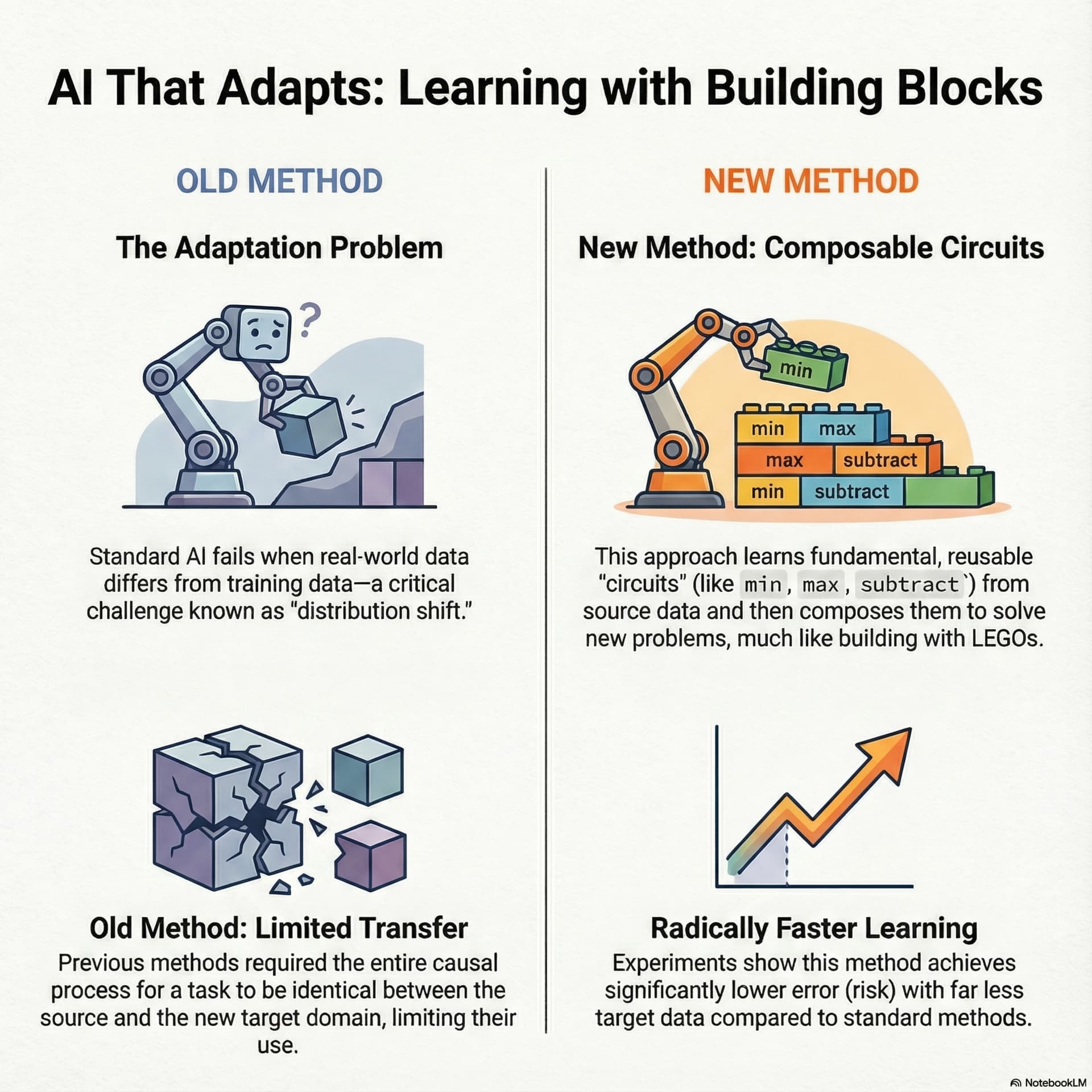
Statistical invariance (assuming P(Y|S) holds everywhere) fails under distribution shift. Human-like fast generalization comes from shared causal mechanisms. Causal Transportability theory formalizes which knowledge transfers. ModuleTR enables zero-shot reuse of a shared atomic mechanism; CircuitTR extends this by composing transportable modules into a causal computational circuit, with adaptation speed determined by minimum circuit size L. If any circuit component is not transportable, learning falls back to the slow regime. CircuitAD approximates circuit search with a transformer-like architecture using causal attention and two-stage training; it works when tasks are structurally simple/transportable.
Notable examples
Traffic recognition across cities (distribution shift); noisy subtraction where parent variables change (X1,X2 vs X3,X2); GCD computed from limited modules (max/min/subtract) requiring a long circuit (slow) vs adding mod operator collapsing circuit size (fast).
Written by AI. May contain mistakes. Listen to the episode to check what was said.
Chapters
Tap a time to open that second in VOUnderstanding Distribution Shift
0:45 to 2:12
Exploration of how models fail under distribution shifts in different environments.
“And, you know, that's often because we treat these problems as purely statistical.”
Defining Cross-Domain Generalization
2:12 to 2:52
Clarification of terms like zero-shot and few-shot learning in AI.
“We're talking about cross-domain generalization, and it sort of comes in different flavors.”
Module Transportability Explained
2:52 to 4:53
Introduction to module transportability and its role in overcoming zero-shot learning limitations.
“The insight is it's simple, but it's really powerful.”
Limitations of Module TR
4:53 to 8:00
Discussion on the limitations of module transportability in complex tasks.
“It only works if the target function itself is already present, module for module, in your source library.”
Introducing Circuit Transportability
8:00 to 9:27
Explanation of circuit transportability and its necessity for complex algorithms.
“The weakest link ruins the speed for the whole chain.”
The Role of Structural Knowledge
9:27 to 14:00
Insight into how structural knowledge impacts adaptation speed in AI models.
“And the theory shows the adaptation rate is only marginally worse than if we had the full oracle knowledge.”
Understanding Fast and Slow Learning
14:00 to 14:43
Explore the relationship between structural complexity and learning speed in AI.
“We can get zero-shot learning with Module TR or fast few-shot learning with Circuit AD, but only by mapping out the transportable components based on an underlying causal structure.”
The Impact of Latent Variables
14:43 to 15:25
Learn how unobserved confounders can diminish the benefits of structural knowledge in machine learning.
“If you have unobserved confounders, so latent variables that influence both your inputs, X, and your outcome, why the powerful benefit of all that large source data starts to erode.”
Transcript
Automatic transcript. May contain errors.0:00Okay, so let's untack this. this really foundational challenge in all of machine learning, generalization. It's kind of the moment of truth for any AI, right? It truly is. You know, you can train a model on a massive data set, let's say recognizing traffic in one city. That's your source domain. Then you go and deploy it in a totally different city, maybe one with different traffic rules, different weather, the target domain. And all of a sudden, the model that was 99 % accurate just fails. spectacularly. And that drop off, that's the infamous distribution shift, loss of external validity. Exactly.
0:38Because the underlying data, the distributions, they just aren't identical. So all the guarantees you thought you had, they just evaporate. The model can't adapt. And, you know, that's often because we treat these problems as purely statistical. We look at P of Y given S, the probability of an outcome given the features, and we just assume it should hold everywhere. But it doesn't. No. Arbitrary differences between these environments create an almost arbitrary barrier for learning. Traditional statistical invariance, it just breaks the moment the context changes. But if you, a human, learn to drive a small car, you can hop into a huge truck and adapt almost instantly.
1:13You don't need a year of retraining. So why? Well, because you understand the underlying causal structure. The mechanism is the same. The wheel turns the tires. The gas pedal makes it go faster. I see. So the core idea here is that the human advantage, that brilliant, fast generalization, whether it's zero shot or few shot, it's built on causality. To get this into AI, we need to formalize a structure, something that constrained which parts of our source knowledge are provably relevant and stable in the new domain. And the blueprint for that structure, the thing we're analyzing today, is causal transportability theory.
1:47That's right. This theory gives us a really rigorous mathematical way to identify which pieces of knowledge are stable and useful. So our mission today is to dive into the two big advancements that turn this theory into actual speed, module transportability, and the more powerful circuit transportability. Okay, before we get into the mechanisms themselves, let's just quickly define the landscape for you listening. We're talking about cross-domain generalization, and it sort of comes in different flavors. Yeah, the main split is really about target data. Is it there or not? So domain generalization is the toughest case.
2:24You have huge source data, but you have zero target data. That's pure zero-shot learning. You have to predict based only on what you already know. Exactly. And then there's domain adaptation. And that's when you get a little bit of data from the new environment. That's it. You get a small, precious handful of labeled data points from the target domain. And that enables few-shot learning. We're going to see how just those few samples can change everything. So we've established that the old statistical and variance idea often fails. How does this first concept, module transportability or module TR, break through that zero-shot barrier?
2:58The insight is it's simple, but it's really powerful. Even if the full probability distribution, P of Y given X, changes a lot, the underlying mechanism, the specific function that defines the outcome Y from its direct cause as its parents, might be shared. So the inputs themselves change, but the math that links them to the output stays the same. Precisely. Let's use a really concrete example, a simple numerical task. Imagine in our source domain M1, the output Y is just a noisy function of X1 and X2. Let's say it's just noisy subtraction, Y equals X1 minus X2 plus some noise. Okay, so X1 and X2 are the parents of Y.
3:35Got it. Now in our target domain M star, the underlying operation is the same, but maybe the physical inputs are different. Now Y is determined by X3 and X2. The parents of Y are now X3 and X2. too. The causal diagram has literally changed. The arrows pointing to Y are coming from different places. Absolutely. The parent set is different, but the mechanism, the actual function, is identical. Noisy subtraction of the second parent from the first. So if we have that big M1 data set, we can train a perfect predictor that understands the mechanism of noisy subtraction. And this is where the magic happens.
4:07If we know, just qualitatively, that the mechanism is shared and we know the new parents are x3 and x2, we can just reuse that function we learned. Use a plug in the new inputs, reordering them if you need to, and just like that, you get zero-shot generalization in the new domain. We didn't need a single data point from there. So ModuleTR is just the formal algorithm for this. It formalizes that exact procedure. It finds all the source domains that share the mechanism you care about, pools all their data, and makes sure the parent variables are mapped correctly to match the target's structure.
4:39It's using structural knowledge to guide data selection. And the guarantee is clear. If the mechanism is transportable, your error rate drops fast with n, the big source data size. If not, you're stuck relying on that tiny target data set, n. But module tr has a really serious limitation. It only works if the target function itself is already present, module for module, in your source library. Right. What if the function I need is more complicated than just subtraction? What if it's a whole series of steps? Exactly. Module TR is limited to finding these single atomic invariant functions. So now let's talk about a much harder target task like, say, calculating the greatest common advisor, the GCD, using an algorithm.
5:21Okay, GCD is an algorithm. It's a sequence of operations. Right. And if your source domains only give you simple modules like max, mine, and subtraction, none of them individually can solve the GCD problem. Module TR will fail because that complex target function just isn't in the source pool. So the solution has to be compositionality. We need to build the complex algorithm by sequencing those simpler transportable source modules. And that must be circuit transportability. That's it. Circuit TR lets us model the target function as a causal sequence, a computational circuit built from these basic operations.
5:55So instead of looking for invariance in the final function, we look for invariance in the components we use to build it. This sounds way more complicated than module TR. What kind of rich domain knowledge do you need to make this work? You need two things. First, the causal diagrams for every domain, showing the exact flow of the circuit. And second, and this is the big conceptual leap, you need a discrepancy oracle. The name oracle makes it sound like you have perfect prior knowledge. What does this thing actually do? Think of it like the ultimate lookup table for sharing mechanisms. It's not just telling you if the final output function is the same.
6:31It's telling you if a specific step in your target circuit, say, the subtraction at position I in the target domain J, can be accurately replaced by a mechanism you learned at position I1 in source domain J1. So it's like a mechanism passport. It maps components across different locations and different domains. Perfect analogy. And with that knowledge, the CircuitTR algorithm works by pooling data not for the whole task, but for each individual transportable step in the sequence. You train those little components on huge source data sets. And then you just put the pieces together. The algorithm composes and marginalizes them to get the final prediction.
7:08I have to ask, for listeners who aren't statisticians, what does marginalizing mean here, practically? It's simpler than it sounds. Composition is just chaining the functions together, running the algorithm step by step. Marginalization is just. mathematically ignoring all the intermediate variables you created along the way. You only care about the final prediction. Why? So you just get rid of the intermediate steps to get the final answer. Exactly. And the theory confirms that this composition is what dictates the speed. If every single module in that circuit is transportable from your large source data N, you get guaranteed fast adaptation.
7:44But there's a catch, right? Here's the crucial threshold. If even one component, one single line of code in that complex algorithm, is unique to the target domain. Well, that component has to be learned from the small target data, n. The error rate immediately switches to the slow regime. The weakest link ruins the speed for the whole chain. That theoretical framework is, it's airtight. But it demands this enormous amount of prior structural knowledge. The causal graphs, that perfect discrepancy oracle. It feels a bit like you solved the problem by assuming the hardest part was already solved.
8:19That's a fair criticism. And that brings us to the few-shot solution that's actually designed for reality, Circuit 8E, which is agnostic adaptation. It's for when we only have that small labeled target data in and no explicit map of the structure. How can it be agnostic? How does it discover this implicit structure without just testing every single possibility forever? Well, the theoretical model does involve an exhaustive search, but it's a targeted one. It generates this huge but finite pool of candidate predictors. Every candidate in there corresponds to a different hypothesis about the underlying structure, a possible circuit.
8:52And then you use a tiny held out validation set of your target data to simply pick the best hypothesis from that pool. Wait a minute. If you're testing millions of hypotheses against a tiny validation set, aren't you just going to massively overfit to that small bit of target data? That is the critical challenge. But the power comes from where those candidates were trained. They were all trained on the large source data based on their own hypothesized structures. The target data isn't learning the function. It's just selecting the most accurate pre-learned function for its new context. Okay, that makes sense.
9:27And the theory shows the adaptation rate is only marginally worse than if we had the full oracle knowledge. You just add a small complexity penalty. This connects directly back to the complexity of the task itself, the minimum circuit size problem, or L. This feels like the core idea for you to remember. If you take away one thing, it's this relationship. The speed of adaptation is defined by L, the minimum required circuit size. Fast adaptation is only guaranteed if L is a constant, meaning the target task is simple enough to be built easily from the modules you already have. So let's go back to that GCD example, but focus on the functional basis.
10:03If my source basis is sparse, I've only got max, min, and subtract, I can still calculate GCD, but it's a ridiculously long and inefficient circuit. That's right. The circuit size L becomes proportional to the vocabulary size cubed. That's huge. This means you need a massive amount of target data, N, just to get a stable result. It's structurally mandated slow adaptation. If we enrich the source basis, if we just add one more powerful mechanism, say the mod or modular operator. The minimum circuit size L just collapses instantly, becomes logarithmic. That single structural change, providing a more powerful tool in your basis, flips the problem from slow to fast adaptation because the target task is now simple to represent.
10:47That is profound. The speed of learning is less about the data volume and almost entirely about the computational complexity of the target function relative to the tools you already have. Of course, in the real world, that theoretical, symbolic, exhaustive search of circuit AD is, well, it's computationally impossible. You can't explicitly check every single structural hypothesis. So the research had to deliver a practical solution, a gradient-based heuristic that approximates this search. And this is where the engineering gets really fascinating. Absolutely. The architecture they built is implicitly designed to mimic that causal framework.
11:20It's like a transformer, but with very specific changes that force it to make causal decisions. Walk us through the components. You need something to hold the shared knowledge and something to select the domain-specific structure. Correct. The core is the universal predictor. Think of this as containing a set of shared causal functions, our max, min, mod operators we talked about, that are universal across all domains. This is the common toolkit. And the mechanism for choosing which tools to use for which job. That's handled by a domain-specific parent selector, which is implemented using custom causal attention heads.
11:53Now, unlike normal transformer attention that kind of softly blends all the inputs, this uses domain-specific projection motrices and a very sharp softmax function. Why a sharp softmax? What does that do? It's a trick to enforce sparsity. It forces the model to make hard, discrete decisions about which parents are relevant. It's implicitly learning the causal diagram for each domain, It tells the model, choose this parent or don't, instead of blend a little of this and a little of that. That is a brilliant way to embed those theoretical constraints right into a modern architecture. So how does the two-stage training use the different data sizes?
12:31So stage one is pre-training. You use all that large source data, n, to train the universal predictor and simultaneously learn the parent matrices in a mechanism indicator. This indicator basically clusters variables that share causal functions, implicitly satisfying that discrepancy oracle condition. So you establish the universal toolkit and figure out which tools belong to which source domain, and then stage two, fine-tuning. Now you use that small target data, N, only to discover the target's unique parent matrix and mechanism indicator. You select the best pre-trained mechanisms. You don't retrain them.
13:06The final output then uses these little learned switches that decide, for every component, whether to use the reliable transported prediction from the source data or fall back to a new target-only model for the non-transportable parts. And the experimental results really provide the perfect confirmation of the whole theory. They do. When the target task was set up to be structurally simple, to be circuit transportable, the circuit AD approximation method absolutely crushed the naive baselines as the target data size n increased. That's fast adaptation working in practice. But the second the task was made structurally harder, so not transportable with the given modules, the method performed poorly.
13:45The limits imposed by structural complexity proved to be absolute. You just can't compute a circuit if you don't have the right building blocks. So this deep dive really clarifies that rapid generalization isn't some statistical accident, it's a structural necessity. We can get zero-shot learning with Module TR or fast few-shot learning with Circuit AD, but only by mapping out the transportable components based on an underlying causal structure. And the fundamental measure of success is that structural complexity. If the target task is computationally easy to build from your source mechanisms, adaptation is fast.
14:20If it requires a complex, long-winded algorithm, adaptation is going to be slow, no matter how much source data you throw at it. Okay, so we focused on the ideal case, you know, unconfounded data where we see all the causes. But what happens when the real world pushes back? What's the ultimate consequence of relying so much on structure? This brings up a really crucial and I think provocative thought for where this research goes next. If you have unobserved confounders, so latent variables that influence both your inputs, X, and your outcome, why the powerful benefit of all that large source data starts to erode.
14:56You mean the structural knowledge gives you a diminished return? Yes. While structural knowledge still gives you a decent prediction when you have zero target data, experiments show that as the target data size, S, grows large, the advantage from the source data actually vanishes. Structural knowledge, when you have latent confounders, it offers only a temporary immediate advantage. It gets you a great starting point, but it doesn't give you that permanent long-term statistical dominance we see in the clean, unconfounded case, the unobserved complexity, it eventually catches up.
From the publisher
This paper introduces a novel causal framework designed to improve machine learning generalization across different data domains. It specifically presents Circuit-TR and Circuit-AD, two algorithms that leverage causal transportability theory to enable zero-shot or few-shot learning by identifying shared "modules" or mechanisms between source and target environments. While traditional methods rely on statistical invariance, this research focuses on compositional structure, allowing the system to build complex prediction rules in a new domain by combining known components from others. The authors establish a theoretical link between adaptation efficiency and circuit size complexity, showing that "fast" adaptation is possible when the underlying causal structure is small and transportable. Finally, the paper validates these concepts through synthetic simulations, demonstrating that their approach outperforms standard empirical risk minimization when structural domain knowledge is available or can be inferred.


