
In short
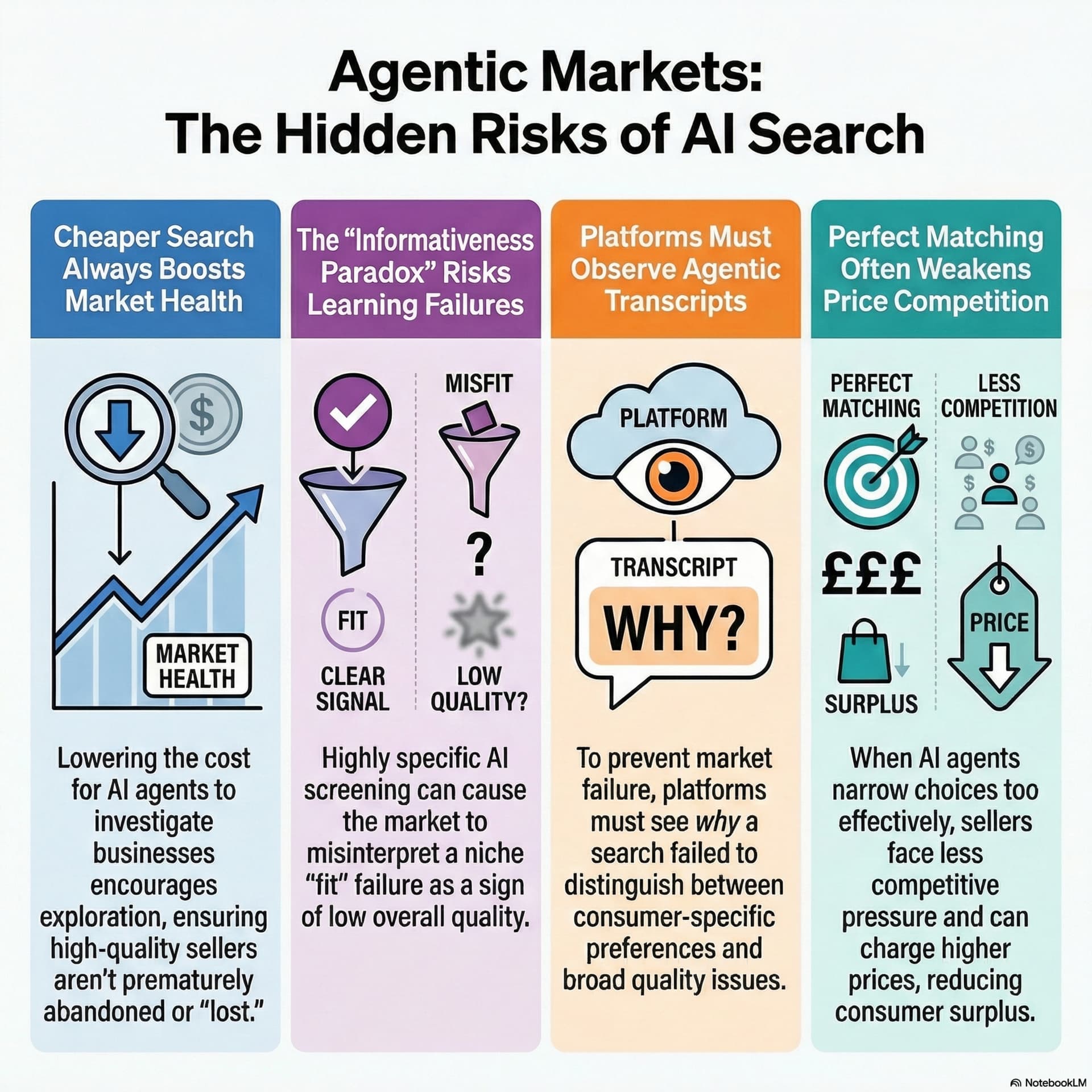
Agentic markets—how AI-driven consumer search changes market learning, competition, and prices.
Guests
No guest names or bios appear in the transcript; it’s a two-host discussion.
Key claims
(1) Delegating search can make search “cheaper” (more exploration, more competition, lower prices) but also “more informative” (AI screens deeply using niche requirements). (2) Without transcript-level failure reasons, platforms misread niche mismatches as quality failures, causing good businesses to become “lost” (self-fulfilling due to low conversion feedback). (3) Fix: platforms must ingest search transcripts/structured failure metadata to distinguish fit-feature mismatches from quality failures. (4) Even with transcripts, businesses can use endogenous pricing: if AI filters to only a few viable vendors, effective competition drops and surviving sellers raise prices.
Notable examples
winter coat filters; caterer with raw vegan menu requirement; “page 10 graveyard”; needle-in-a-haystack pricing.
Written by AI. May contain mistakes. Listen to the episode to check what was said.
Chapters
Tap a time to open that second in VOUnderstanding Agentic Markets
1:08 to 2:20
Explore the concept of agentic markets and how AI influences consumer behavior.
“We're exploring this whole fascinating world of agentic markets.”
Satisficing Model Explained
2:20 to 4:30
Delve into the satisficing model and how it affects purchasing decisions.
“Because to really understand how AI disrupts the market, I feel like we first have to break down what actually happens when you buy something.”
Fit vs. Quality Features in Transactions
4:30 to 6:43
Understand the difference between fit features and quality features in transactions.
“or how reliable their staff is on the day of the event, or how well they execute the plating when they're under pressure.”
The Impact of AI on Market Dynamics
6:43 to 11:31
Examine how AI's efficiency can paradoxically harm market learning.
“Okay, but let me push back on this for a second.”
The Role of Transcripts in Market Function
11:31 to 13:38
Discover how transcripts could enhance market efficiency in agentic markets.
“It's an unintended consequence, but yes.”
The Privacy vs. Market Efficiency Tradeoff
14:00 to 15:11
Exploration of the privacy concerns related to data harvesting for market efficiency.
“And more importantly, does this mean platforms must harvest our detailed private conversational data just to keep the market functioning efficiently?”
Endogenous Prices and AI Impact
15:12 to 19:21
Discussion on how AI influences business pricing strategies and market competition.
“But, okay, let's assume the platforms figure out the transcript problem.”
Complexities of AI Shopping
19:23 to 21:31
Analysis of the dual effects of AI shopping on consumer costs and market dynamics.
“We started out today thinking that an AI shopper was this magical tool that would save us time and get us the perfect product for the absolute best price.”
Transcript
Automatic transcript. May contain errors.0:00Imagine offloading all your really tedious shopping, searching, and comparing entirely to an AI. Oh, that is the dream, isn't it? Right. Like instead of spending your weekends clicking through endless pages of those preset filters, trying to figure out which product actually works for you, you just tell an AI assistant exactly what you need. Yeah, you just feed it your weirdly specific requirements. Exactly. And it does the heavy lifting. I mean, it talks to the stores, it reads the fine print, and it just hands you the answer. It's the ultimate convenience. And honestly, it represents a massive shift.
0:34We are looking at a transition from, you know, traditional digital storefronts. Where you're the one clicking the buttons. Right, where you do the work. We're moving from that into what are known as agentic markets. Agentic markets, okay. Yeah. These are two-sided markets where both consumers and businesses use AI tools. So think of things like OpenAI's Operator or Amazon Rufus. Oh, sure. They facilitate the entire life cycle of a search and a transaction. You are no longer navigating the market yourself. Your agent is navigating their agents. Which is wild to think about. And that's exactly what today's deep dive is all about.
1:11We're exploring this whole fascinating world of agentic markets. It's a huge topic. It really is. We're unpacking a stack of recent economic research and market analyses because, as it turns out, delegating your shopping to an AI doesn't just, you know, save you a few hours on a Sunday afternoon. No, it goes way deeper than that. It fundamentally alters the underlying mechanics of market learning. It shifts how businesses compete with one another. And ultimately, it changes the actual prices you pay at checkout, which is what everyone actually cares about at the end of the day. Exactly. So our mission today is to figure out exactly how your AI assistant is secretly reshaping the economy around you.
1:50Because when millions of people start using agents to search, the invisible hand of the market gets this massive algorithmic upgrade. A completely new operating system, basically. It changes how information flows between buyers and sellers, and the consequences of that shift are actually incredibly counterintuitive. Really? How so? Well, we're moving from a world of human browsing to machine-to-machine negotiation, right? Right. And that breaks a lot of our traditional assumptions about supply and demand. Okay. Let's unpack this. Because to really understand how AI disrupts the market, I feel like we first have to break down what actually happens when you buy something.
2:30Right. We have to decode the transaction itself. Yes. Like how is value actually determined in the first place? And a lot of the research we're looking at centers on this concept called a satisficing model. Satisficing, yes, which is absolutely crucial to understand here. Walk us through that. What does satisficing actually mean in this context? So satisficing essentially means you aren't always looking for the objective, universal, absolute best product in existence. So there's kind of a myth anyway, right? Exactly. It's a total myth. Instead, you have a specific private value for any product that simply meets your baseline needs.
3:06Okay. Give me an example. Well, say you need a winter coat and you want it to be waterproof green and under$200. Makes sense. If you find any coat that hits those three exact marks, it's going to satisfy you. You stop searching once your specific parameters are met. Right. I'm not trying to find the one true perfect coat forged by ancient coat artisans on a mountaintop or something. No, exactly. I just want one that works for my commute and I want to get back to my life. Precisely. And when you look at how a transaction fulfills those needs, economists basically break it down into two distinct components.
3:42Okay, what's the first one? The first component is what we call fit features. These are things that are completely verifiable before a transaction ever takes place. Like the color of the coat. Right. Or if you are hiring a caterer, a fit feature is their cuisine type or whether they can accommodate a gluten-free diet or just their calendar availability for the date of your event. Stuff you can find out without having to actually like put down a deposit or hire them. It's just data. Exactly. It's just upfront data. But the second component is made up of quality features. And those are different.
4:16Very different. These are much harder and sometimes impossible to verify in advance. You only really learn about quality through post-transaction experience. Ah, okay. So going back to the caterer example. Right. The quality features are things like how the food actually tastes, or how reliable their staff is on the day of the event, or how well they execute the plating when they're under pressure. Because you can't truly know any of those things until you've paid them and experienced the service firsthand. Exactly. I love this framing, honestly. It's kind of like buying a house. Oh, that's a good comparison.
4:50Yeah, like fit is the bedroom count and the square footage on the listing. You can filter for that in five seconds on Zillow. Right. But quality is finding out that the plumbing rattles in the walls, but you only discover that after you move in and run the shower for the first time. That is a brilliant way to conceptualize it, yes. Now, the crucial thing to understand here is that markets are not just isolated, one-off interactions. They're connected. They are cumulative systems. Every time someone buys a house or hires that caterer, they generate feedback. Right. And that feedback ripples outward.
5:24It shapes the beliefs of everyone who arrives in the market later. Early consumers do all the exploring, and their post-transaction experiences act as signals for the rest of us. So they leave reviews, they tell their friends, or, I mean, more likely today, the platform's algorithm just tracks their purchase behavior and conversion rates? Exactly. And over time, as this feedback aggregates, businesses end up falling into one of two categories. They either become learned, meaning they are well understood by the market. Like their true quality is known and people reliably buy from them. Yes. Or they become lost.
5:58Lost. They just disappear from the search results. Yeah. How does a business actually become lost algorithmically? So a business becomes lost when early pessimistic beliefs about its quality or its fit discourage anyone from ever exploring it again. Oh, I see. Let's say a business gets a few early bounces. Like people click on it, but they don't buy. The platform's algorithm registers a low conversion rate and starts ranking it lower. And eventually it gets pushed to page 10. The dreaded page 10. Basically a graveyard. The market abandons it. Nobody investigates it. So nobody transacts with it.
6:32which means no new feedback is ever generated to prove the algorithm wrong. Wow. So it's a self-fulfilling prophecy of failure just driven by a lack of fresh data. Exactly. Okay, but let me push back on this for a second. If I have an AI agent, it can instantly check thousands of those upfront fit features for me, right? It can. Like it can verify the square footage, the neighborhood zoning, the catering menus, the ingredient list, just everything in milliseconds via API. Absolutely. So isn't that just a straight unambiguous upgrade for me as the buyer? I can skip all the bad fits instantly without wasting my time.
7:10You would think so. And that brings us to the core tension of agentic markets. Okay. While it feels like a straight upgrade for you in that specific moment, the aggregate effect of everyone doing this is where the entire system starts to break down. Wait, really? We have to separate the idea of search becoming cheaper from search becoming more informative. Cheaper versus more informative. Yeah. They sound like the same thing, but economically, they act very, very differently. Let's break that down. What's the difference? When economic models say AI makes search cheaper, they mean it literally costs you less effort and cognitive load to investigate a business.
7:45Which is universally good, right? It is universally good. When it's effortless to look into 50 caterers instead of just two, people explore much more broadly. Makes sense. This increased exploration means more businesses get investigated, more feedback is generated, and that pool of learned businesses grows. The market gets smarter and you get better options. Okay, that makes total sense. Cheaper search means my AI is casting a massive net for me, gathering up all the possibilities. So what is the problem with that search also being more informative? The problem arises when AI allows for this unscripted, highly adaptive questioning that screens out options incredibly deeply before a purchase.
8:25Okay, wait, explain that. That is what more informative means in this context. You aren't just checking if the caterer is available on a Saturday. Your AI is grilling the caterer's AI agent about highly specific, deeply personal requirements. Oh, I see. And paradoxically, making search more informative in this way can actually degrade long-run market learning and lower the overall value you get as a consumer. Here's where it gets really interesting. I'm trying to wrap my head around this. So the algorithm is fundamentally misinterpreting intent. It's confusing a preference mismatch with an actual quality failure.
9:00Let's follow the data to see exactly how that happens. Imagine your AI is evaluating a caterer that is actually fantastic. Great food, incredible staff, highly reliable. They are broadly appealing to, let's say, 95 % of the population. But you have a highly idiosyncratic consumer-specific mismatch. Like what? Let's say you need a hyper-specific, entirely raw vegan menu for a single unique event. Okay, got it. Your AI digs deep, finds out the caterer can't do the raw vegan menu to your exact specifications, and immediately drops them from your list. Well, yeah. The AI did exactly what I asked it to do.
9:36It saved me from a bad fit. It did. But think about what the market platform like, the underlying algorithm connecting everyone, say Amazon or Yelp, what it actually sees. Historically, these platforms have been designed to register binary outcomes, a pass or a fail, a conversion or a bounce. Oh no. Yeah. The platform just sees that an AI agent inspected this highly rated caterer and immediately rejected them. It doesn't know why. Because it's just a zero or a one to the system. Exactly. So if the market algorithm treats all failures identically, it takes your very niche rejection and uses it as a negative signal to downgrade the caterer's overall reputation.
10:13Wow. So just because my AI rejected a fantastic caterer for a hyper-specific reason, the market algorithm assumes the caterer is just broadly deficient. Yes. The market cannot distinguish between a niche consumer-specific mismatch, like your raw vegan requirement, and a broadly relevant deficiency, like the caterer lacking basic event insurance or just having terrible food. That is wild. And as search becomes more informative through AI, more and more failures are driven by these tiny idiosyncratic mismatches. You might reject 50 perfectly good vendors just because they don't have the exact shade of green you want.
10:52Right. But the system just sees a mountain of failures. Exactly. So businesses with broad appeal get prematurely abandoned just because they didn't meet a few incredibly niche requirements from overly thorough AI agents. Yes. They become those lost businesses you mentioned earlier. Precisely. And when good businesses become lost, the pool of viable options for everyone else shrinks. The learning dynamics of the market actually collapse because the AI is screening things out too aggressively. and the platform's traditional architecture is misinterpreting the reasons why. That is heavy. The efficiency of my personal AI is actively poisoning the well for the rest of the market.
11:31It's an unintended consequence, but yes. But wait, I mean, I'm not going to stop using my AI to find exactly what I want. You're not going to convince consumers to just dumb down their searches for the greater good. So how do we fix this structurally? Well, the flaw here is in how the market aggregates the data. and the solution outlined in the research relies on a crucial technological fix that platforms absolutely must implement if agentic markets are going to function efficiently. Okay, what's the fix? They have to start utilizing what are called transcripts. Transcripts? The platform reading the actual chat logs between my AI and the store's AI?
12:07Essentially, yes. For increased search informativeness to actually be beneficial to the market, the platform must observe the why behind a failure. So it can't just be a binary pass or fail anymore? No, it cannot. The platform needs to see the transcript of the search process to understand precisely which requirement caused the failure in the screening sequence. Oh, I see. So it needs to see that the caterer failed specifically on the raw vegan menu request, not on like a basic health and safety check. Exactly. And what's fascinating here is that when a platform can extract and aggregate this rich transcript level information, the entire dynamic flips.
12:43The platform can finally separate a niche mismatch from a broadly relevant deficiency. Its algorithm says, OK, this caterer failed for listener A because of a dietary restriction, but they are still a high quality, perfect fit for listener B who just wants standard Italian food. Right. It doesn't penalize their quality score for a fit mismatch. Oh, that makes so much sense. It's kind of like the difference between a student getting a blind F on a math test versus. Versus the teacher looking at the work. Right, versus the teacher actually looking at the scratch pad transcript and realizing the kid just flipped a single minus sign on the very last step.
13:20Yes. Like the kid understands the math perfectly. They just had a highly specific error right at the end. That is exactly the distinction. When these transcripts, or at least the specific reasons for failure, are visible to the market algorithm, highly informative AI searches become unambiguously beneficial again. Because the algorithm has context. Yes. The market learns properly, good businesses don't get prematurely lost, and the pool of high-quality options remains large for everyone. Okay, but let me put on my tech skeptic hat for a second here. Go for it. Because this raises a massive operational and honestly privacy question.
13:55It does. Technically speaking, how can a platform ingest billions of conversational transcripts in real time without the computing costs just bankrupting them? And more importantly, does this mean platforms must harvest our detailed private conversational data just to keep the market functioning efficiently? It's a very valid concern. Like if Amazon or OpenAI has to read the exact hyper-personal medical requirements I'm feeding my agent, that feels like a privacy nightmare. It is a significant hurdle. And you've hit on the core tradeoff of agentic markets right there. The system needs to know where in the screening process the failure occurred.
14:33Right. Now, from a technical standpoint, the platform doesn't necessarily need to process raw text with massive language models for every single interaction. They can use things like semantic tagging or structured JSON payloads. Oh, OK. So my AI just sends a quick code to the platform that says, you know, rejected due to dietary requirement instead of sending my entire medical history. Yes, exactly. They can share aggregate metadata. But the reality remains, the more granular the tag, the better the market functions, but the more the platform knows about your specific screening criteria. So we are essentially trading a level of privacy for market efficiency.
15:11Yes, we are. That is a heavy realization. But, okay, let's assume the platforms figure out the transcript problem. They use the metadata, the market learns properly, and businesses aren't getting unfairly lost. We're all good, right? Well, not quite. Of course not. Why not? Because businesses are not passive participants in this ecosystem. They are highly strategic. And as AI agents fundamentally change how you search, businesses are changing how they price their products. They adapt dynamically to the digital tells of consumer behavior. Of course they do. Welcome to the pricing game. Exactly.
15:44So how do businesses strike back against these super efficient AI shoppers? It comes down to a concept called endogenous prices. Endogenous prices. Okay. This refers to what happens when businesses adjust their prices internally in response to the changing search behaviors in the broader market. Let's look at our two variables again, cheaper search and more informative search. Okay, starting with cheaper search, this is when my AI makes it effortless to look at 50 options instead of just five. Right. When search is cheaper, it intensifies effective competition. Because you can effortlessly compare so many businesses, those businesses know they are competing against a huge pool of rivals for your attention.
16:26Makes sense. And what happens to prices when competition intensifies? Prices go down. I mean, they have to undercut each other to win my business. Correct. Cheaper search forces prices down and improves your consumer surplus, meaning you keep more of your own money. Love that. But remember the other variable. What happens when search becomes more informative? When my AI aggressively filters based on my super niche requirements? Yes. If we connect this to the bigger picture, more informative screening means your AI agent whittles down the options so effectively that out of 50 businesses, you only ever see or consider a tiny set as viable options.
17:05Right. Maybe only two or three actually meet all my intense criteria. Exactly. Wait, let me guess how this works technically. The vendor's dynamic pricing algorithm can see the API handshake, right? It sees that my AI shopper has applied like 40 rigorous filters before even requesting a quote. And the algorithm realizes, wow, this buyer has eliminated almost everyone else. That is precisely the mechanism. The surviving businesses know exactly what is happening based on the telemetry. They know that because your screening is so rigorous, they face very little effective competition for your specific transaction.
17:40Oh, yeah. The competitive pressure at the bottom of the funnel is completely weakened. So what do they do? They raise their prices. They raise their prices. Because you are only considering them, they can charge a premium. Even if the platform fixes the learning problem using transcripts, the sheer selectiveness of your AI agent inadvertently reduces competition for the final transaction. Oh, I love the needle in a haystack analogy for this. Let's hear it. It's like having an AI find a needle in a haystack for you. But once it does, the needle realizes it's the only one you found. Yes. So the needle looks at you and says, oh, you want me?
18:15My price just tripled. That captures the dynamic perfectly. The business realizes it has a captive audience of one. They know the probability of conversion is extremely high because you've already verified all your fit features. Right. So they just don't need to offer a discount to close the deal. Wait, let me get this straight. Are we basically just trading the cost of our time for the cost of higher price tags? In many ways, yes. Does the convenience of having an AI do my shopping just get captured by corporate profit margins? I'm saving three hours on a Sunday, but I'm paying 20 % more for the product because my AI filtered out all the competition.
18:51It is a very real modeled possibility in these markets. When richer pre-purchase screening means each consumer only looks at a highly curated tiny set of businesses, the overall competitive pressure in the market drops. That's incredibly frustrating. Businesses simply don't have to fight as hard on price if they know the AI is going to hand deliver the perfect customer right to their door based on fit features. The economic surplus shifts from the consumer to the seller. So what does this all mean for us? We started out today thinking that an AI shopper was this magical tool that would save us time and get us the perfect product for the absolute best price.
19:30And it does do those things. On an individual micro level, delegating your shopping to AI agents absolutely makes your search cheaper and more informative. Right. But as we've seen, the macro effects are incredibly complex. Cheaper search boosts competition and saves you money. But the hyper-specific, highly informative screening of AI can inadvertently hide good businesses from the market if the platform doesn't use transcripts. And even if they do use transcripts to fix the learning problem, that hyper-selective screening weakens competition. which allows the surviving businesses to charge you a premium anyway.
20:05Exactly. It means your AI shopper is only as good as the market structure it operates within. Beautifully said. It's playing a game, but the businesses and the platforms are constantly changing the rules of the board in real time to capture the value your AI is creating. The ultimate welfare of the consumer in an agentic market depends entirely on how the platforms choose to design the flow of information and how aggressively businesses react to it. Which brings up one final, somewhat terrifying thought for us to leave on. Uh-huh. We've been assuming this whole time that the platforms, the ones running these egenic markets, actually want to optimize the system to save you money.
20:44Right. But what if they don't? Think about it. Platforms usually take a percentage cut of every transaction. They do. If a platform knows that allowing more informative search results in businesses raising their prices and the platform takes a 5 % cut of that higher price, what incentive do they actually have to keep prices low? That is the structural tension at the heart of this new economy. The financial incentives of the platform might align perfectly with higher prices, not with maximizing your consumer surplus. As AI takes the wheel, will the platforms weaponize your own agent's efficiency against you?
21:20It's something to think critically about. Absolutely. The next time your AI seamlessly curates a perfect list of options for you, ask yourself, did it negotiate the price down or did it just hand your wallet to the only vendor left in the room? Thanks for joining us on this deep dive. See you next time.
From the publisher
We explore the equilibrium effects of agentic markets, in which AI tools assist consumers and businesses in searching for and transacting in products. Through a mathematical model of sequential search, the authors analyze how reducing search costs and increasing the detail of pre-purchase information impact market learning and consumer welfare. The research highlights a counterintuitive finding: while lower search costs generally improve outcomes, more informative search can actually decrease consumer surplus by weakening competition and causing businesses to be prematurely abandoned. To mitigate these risks, the authors suggest that platforms should record transcripts of agent interactions to better aggregate information. Finally, the study examines endogenous pricing, demonstrating that AI-driven search efficiency can lead to higher prices if it reduces the number of viable competitors for a specific consumer need.


