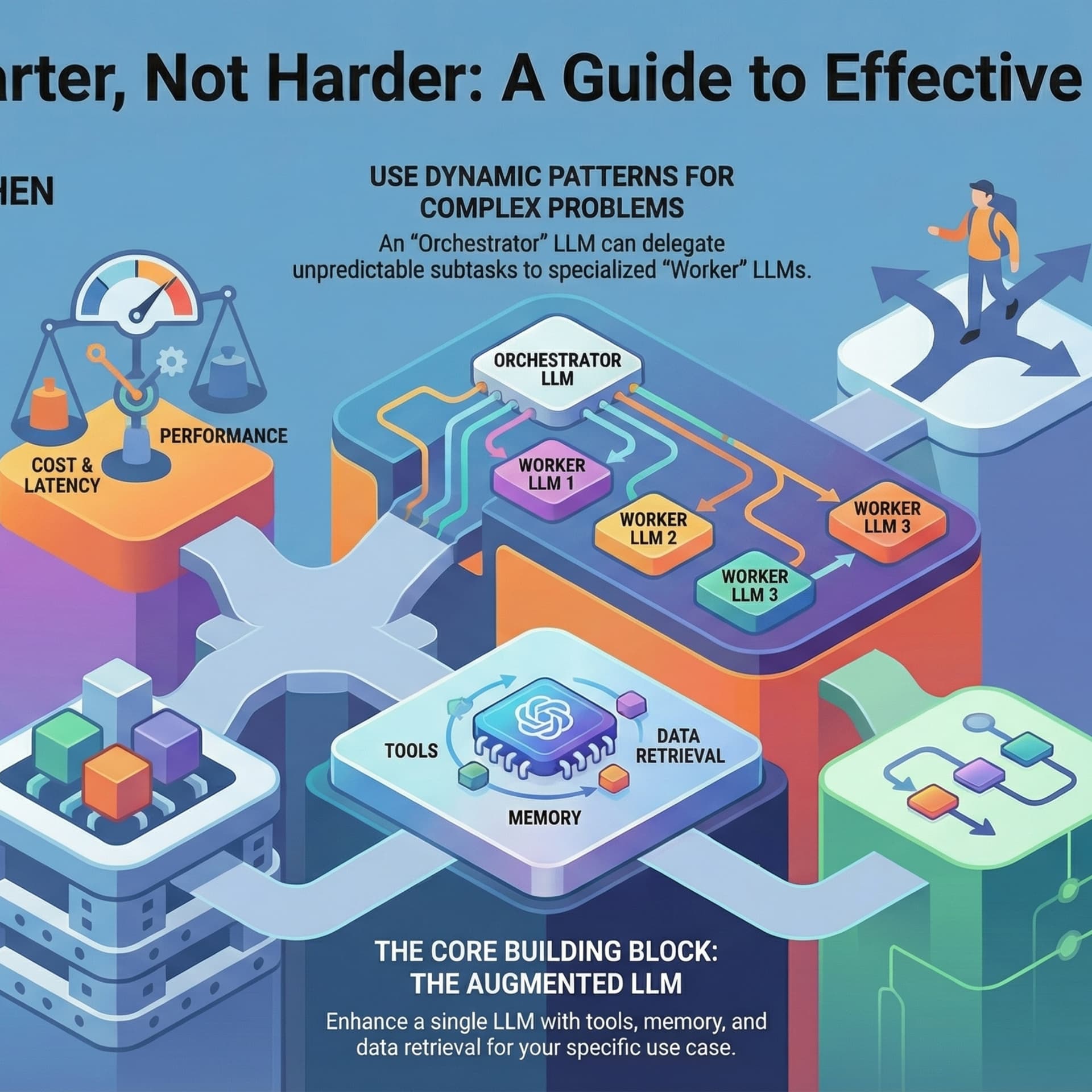

In short
How to build reliable “AI agentic systems” from Anthropic, emphasizing least complexity, transparency, and especially the agent-computer interface (ACI) for tool reliability.
Guests
No specific guest names are provided in the transcript; it’s a host-led “Deep Dive” discussion summarizing Anthropic’s guide.
Key claims
Most production success comes from simple, composable, rigorously tested patterns (workflows) rather than fully autonomous agents. Start with a single well-prompted LLM call; quantify cost/latency vs accuracy gains. Avoid “framework paradox” opacity by using native APIs or requiring transparent prompt logging. Agents need verifiable “ground truth,” strict termination conditions, and sandboxed testing.
Notable examples
Prompt chaining for code summarization with static analysis gates; routing by query complexity to cheaper Claude Haiku vs Sonnet/Opus with confidence fail-safes; parallel guardrails via voting/sectioning; SWE-bench coding agent; computer-use virtual desktop agent; ACI mistake-proofing by requiring absolute file paths instead of relative paths.
Written by AI. May contain mistakes. Listen to the episode to check what was said.
Chapters
Tap a time to open that second in VOComplexity of AI Agents
0:45 to 2:19
Discussing the challenges developers face in creating reliable AI agents.
“They've synthesized the lessons learned from helping, I think, dozens of industry teams build these systems successfully.”
Defining Workflows vs. Agents
2:19 to 4:24
Exploring the critical distinctions between hard-coded workflows and true AI agents.
“Because if we're talking architecture, clarity is absolutely essential.”
Simplicity and Complexity in Design
4:24 to 6:49
The importance of maintaining simplicity while designing AI systems.
“And when you choose to build an agent, you are consciously signing up for the, let's call it the volatility, but also the flexibility of model-driven decision-making at scale.”
Framework Paradox in AI Development
6:49 to 8:58
Analyzing the pitfalls of using high-level frameworks in AI development.
“You need to measure the marginal performance gain against the marginal increase in time and money.”
Building Augmented LLMs
8:58 to 11:07
Understanding the foundational elements of augmented LLMs for AI agents.
“That sounds like an absolute disaster in a production environment.”
Workflow Patterns in AI Systems
11:07 to 14:00
Introduction to workflow patterns like prompt chaining and routing for AI systems.
“Anthropic emphasizes using protocols like their model context protocol, which is essentially defining a machine-readable, perfectly clean API for the LLM.”
Routing for Specialized Tasks
14:00 to 17:08
Learn how routing helps in classifying inputs for better task handling.
“You've used the chain structure to introduce external reliability, the static analysis, and you've isolated the creative task, the summary, from the analytical task.”
Parallelization Strategies in AI
17:08 to 19:41
Explore the benefits of parallelizing tasks for speed and confidence.
“regardless of what its initial classification was.”
Dynamic Task Management with Orchestrator Workers
19:41 to 23:24
Understand how orchestrator workers adaptively manage tasks in AI.
“This is the first real taste of dynamic delegation.”
Achieving Autonomy in AI Agents
23:24 to 28:00
Delve into the complexities and risks of autonomous AI agents.
“And that's the crucial takeaway from this whole section of Anthropics Guide.”
Show all 15 chapters
Real World Applications of AI Agents
28:00 to 29:51
Explore how AI agents tackle real-world issues and their benefits.
“involves having an agent attempt to fix real historical GitHub issues from popular open source projects.”
Core Principles of Successful AI Design
29:51 to 31:46
Learn about the foundational principles for effective AI agent design.
“This is just a perfect natural fit for this technology.”
Understanding the Agent-Computer Interface
31:46 to 34:04
Delve into the importance of designing effective interfaces for AI agents.
“Automated tests verify functionality based on the existing specifications.”
The Importance of Clear Documentation
34:04 to 36:08
Discover how clarity in documentation impacts AI agent performance.
“Code inside a JSON object is harder for a model to generate correctly than code inside a standard markdown code block.”
Evolving API Design for AI Reliability
36:08 to 39:26
Examine how API design must adapt for AI agents to ensure reliability.
“They depend entirely on the agent knowing its current working directory, which is a mutable, complex state that it has to keep track of in its head.”
Transcript
Automatic transcript. May contain errors.0:00Welcome back to the Deep Dive. If you're building anything with large language models right now, you've probably moved past that simple single prompt phase. Oh, for sure. You're now wrestling with how to build these complex, reliable, multi-step systems, what we all just kind of loosely call AI agents. And I think loosely is the key word there. It's a problem. It is. The number of conflicting definitions, all the different frameworks, the architectural approaches, it can be paralyzing for developers. The promise of this fully economist agent is so exciting, but the actual path to getting something into production feels like a minefield of complexity.
0:39Absolutely. And that is exactly why today we're going to try and cut straight through that noise. We are doing a deep dive into a really comprehensive, deeply practical guide from Anthropic. They've synthesized the lessons learned from helping, I think, dozens of industry teams build these systems successfully. So our mission here is to give you that practical playbook. How do you turn raw LLM capability into a trusted, production-ready architecture? And, you know, the single most important insight they share is, well, it's maybe the most crucial one for any engineer listening. Which is? The most successful implementations are not the most complicated ones, not by a long shot.
1:16They all rely on simple, composable, and just rigorously tested patterns. So we're here to unpack that philosophy. Yep. We're going to establish some clear architectural definitions and really just give you the roadmap. Okay, let's unpack this then. We're going to start by establishing the core architectural differences. What separates a simple, you know, hard-coded workflow from a truly autonomous agent? Critical distinction. Then we'll dive deep into six specific production-ready patterns that you can actually implement today. And finally, we'll finish with the developer's playbook, the specific engineering principles for avoiding those common pitfalls.
1:53Like runaway complexity, debugging nightmares, all the fun stuff. Exactly. So you should walk away from this deep dive with a crisp and clear understanding of how to build reliable, maintainable, and powerful LLM systems. Think of this as your technical shortcut. We're trying to turn the excitement of that proof of concept phase into the reality of an enterprise-grade implementation. All right, let's start at the very beginning with definitions. Because if we're talking architecture, clarity is absolutely essential. It has to be. Anthropics starts with this big umbrella term, agentic systems. That's the whole category.
2:28But inside that category, they say we have to differentiate between a workflow and a true agent. And that distinction, it's paramount. I mean, it's everything because it dictates where the control actually resides in your system. In the code or in the model. Exactly. And that single choice has huge implications for debugging, for cost, for reliability, everything. Okay, so let's get precise. How do they define a workflow? So workflows. These are systems where the LLMs and all their tools are orchestrated through predefined code paths. Okay, so a fixed path. Think of it like a strict non-negotiable flowchart that you, the programmer, personally wrote.
3:08Step A always happens. Then step B, maybe there's a programmatic check in between. A little gate. A gate, exactly. And then step C happens. They offer really high predictability and consistency because the logic, the sequence of execution. Yeah. It's all fixed and transparent right there in your application code. The model is just executing tasks within these bounds that a human engineer defined. Right. So the human programmer, at the end of the day, maintains ultimate control over the sequence and the process flow. The LLM is this dynamic, intelligent component that's executing a single step, but the overall structure is static.
3:45That's it. So now let's contrast that with a true agent. Right. Right. An agent is where the LLM dynamically directs at our own processes and tool usage. The model itself maintains control over the how, the what, and the what's next. So it's making the plan. It's making the plan. It executes a tool call. It observes the feedback from the environment, what Anthropa calls the ground truth. And then it decides the next move, all on its own, inside this continuous loop. Okay. That is where the architectural rubber meets the road. It's the core question. Are you coding a reliable, consistent flow or are you handing control over to the model's emergent reasoning loop?
4:23Exactly. And when you choose to build an agent, you are consciously signing up for the, let's call it the volatility, but also the flexibility of model-driven decision-making at scale. Which you only want to do when you have to. You only want to do it when it's necessary for these highly complex tasks where the pass forward is genuinely unpredictable. But you have to know it comes at a significant cost, and it's a major, major hit to your ability to trace what's going on. Yeah, that leads us perfectly into Empropic's main guiding principle. The principle of least complexity. Yeah. This is the architectural North Star.
4:58Their advice to engineers is simple. Find the absolute simplest solution that achieves your performance criteria. Only increase complexity when you can demonstrably prove that the added layers are necessary. And what does simplest usually look like in their view? What's the starting point? The initial default should almost always be just optimizing a single LLM call. Really? That's it? That's it. We're talking about things like enhancing your core prompt with advanced retrieval systems, like R-Reg, or optimizing the context window with really relevant documentation, or even just integrating a few high-quality in-context examples.
5:33Most problems, they argue, can be solved or at least greatly simplified just by improving the quality of the input for that single invocation. This taps into that critical, and I think often ignored, trade-off of all agentic systems. It is so often ignored. People get so excited about chaining models or building autonomous things, they just completely forget they are often introducing serious, serious engineering debt. That's the reality check, right? Yeah. Egetic systems, fundamentally, they trade latency and cost for better task performance. Every single additional LLM call you make is a blocking operation.
6:08You're waiting. You're waiting. You wait for the model to think, to generate an output, to validate it, and then maybe call an external tool. That adds seconds. Real, perceptible seconds of lag to the user experience. And the cost, too. I mean, we've seen this. If a single complex query costs, say, five cents to run, a four-step orchestrator loop can easily drive that into the dollar range, especially if you have a high-volume application. Precisely. And this is where the engineering discipline comes in. If adding, you know, three more LOM steps gives you a 5 % accuracy increase, but it triples your latency and quadruples your cost, is that a viable business decision?
6:46Probably not. Usually not. Anthropic really stresses that you have to rigorously quantify that tradeoff. You need to measure the marginal performance gain against the marginal increase in time and money. If you can get to 90 % performance with a single well-prompted call, that final 10 % gain you get from a five-step chain had better be justified by something critical, like user retention or a strict compliance requirement. That is the kind of sound engineering advice that prevents those runaway AWS bills we hear about. This is. Now let's talk about a major source of that early complexity, which they call the framework paradox.
7:21Oh, this is such a classic trap. We have these amazing tools now, right? There's the CloudAgent SDK. Amazon Bedrock has its own frameworks. You've got tools like Rivet and Vellum. Right. They're everywhere. And they're designed to simplify the standard low-level tasks, defining your tools, calling the models, managing conversation history. They lower the barrier to entry, which is, on the surface, fantastic. But the paradox is that the simplicity up front can often lead to massive complexity down the line. It absolutely does. These frameworks introduce these really powerful but also really opaque abstraction layers.
7:59When things are working, it feels like magic. But when they break... When a multi-step process fails, those abstractions suddenly obscure all the critical details. You can't easily see exactly what the LLM received as input or exactly what his intermediate thought process was before the framework parsed it and moved on. So if your agent fails on step three of five, you're not debugging your core prompt logic anymore. You're debugging the framework's proprietary logging structure. Exactly. And that is a nightmare. For example, a framework might silently prepend some boilerplate instructions or some context variables to the beginning of your system prompt.
8:35Under the hood. Totally under the hood. So if the model starts exhibiting some weird behavior and you try to replicate the prompt outside the framework to debug it, you won't be able to because you won't see the true system prompt it actually received. This makes deterministic reproduction and correction almost impossible. You end up debugging the abstraction instead of the fundamental LLM logic. That sounds like an absolute disaster in a production environment. So what's the pragmatic best practice here? Start by using the LLM APIs directly. Anthropics experience shows that the fundamental patterns we're about to cover, things like prompt chaining, routing, they can often be implemented in just a few dozen lines of native code.
9:16And that native code is transparent. It's transparent, it's easy to log, and it's easy to trace. You have full control. Okay, but what if a team decides they really do need the efficiencies that a framework offers? Then if you must use one, you have to ensure two things. First, prioritize frameworks that offer high transparency, The ones that explicitly log the final resolve prompt that gets sent to the model. You need to see the raw input. And second. Second, you have to treat it as a very thin wrapper. Anthropic notes that incorrect assumptions about what the model is actually seeing beneath the abstraction.
9:50That is the single most common source of unpredictable errors. Simplicity and transparency must always, always win over convenient abstraction. Okay, we've internalized the philosophy. Simplicity first. Now let's get into the nitty-gritty, the foundational building blocks and tropic rec events. We start with the core element itself. Right. The basis of all these agentic systems is what they call the augmented LOM. This isn't just a text generator anymore. It's an entity that's actually interacting with an environment through interfaces. And it's enhanced with three things, retrieval, tools, and memory.
10:22Yes. And the crucial point here is that the current frontier models are incredibly capable of using these augmentations actively. They don't just passively receive context anymore. What do you mean by actively? I mean, they generate their own search queries to feed the retrieval system. They look at a list of available tools and select the most appropriate one based on their task objective. They can even determine what information from the current turn is critical to retain in memory for the next turn. So from an engineering perspective, the key focus here is less about the prompt itself and more about the interface you give the model.
10:56Precisely. You still have to tailor these capabilities to your specific use case, of course. But above all, the interface the LLM uses to interact with the world has to be pristine. Like an API for the AI. That's a great way to put it. Anthropic emphasizes using protocols like their model context protocol, which is essentially defining a machine-readable, perfectly clean API for the LLM. If your tools are poorly documented or your context is messy, the LLM's performance just collapses immediately. Okay, so assuming we have a pristine augmented LLM, let's move to the easiest architectural pattern to implement.
11:32Workflow 1. Prompt chaining. Right. Prompt chaining is just sequential processing. You take a big, complex task, and you decompose it into a fixed sequence of easier, smaller steps. The output of LLM call number 1 becomes the structured input for LLM call number 2. So you're basically trading one very difficult one-shot prompt for several much easier prompts, which should increase the overall reliability. That is the core goal. You're trading a bit of latency for a lot more accuracy. By reducing the cognitive load on each individual LLM call, you drastically reduce the odds of hallucination or just outright task failure.
12:11You're managing the complexity by isolating each piece of it. And you mentioned earlier these programmatic checks or gates, which sound crucial here. They are the safety net. A programmatic gate is just a piece of deterministic code that you write, and it runs between the LLM steps. Give me an example. Okay, so say step one is generate an SQL query based on this user request. The gate after that step might be a simple script that ensures the output is valid SQL syntax, and maybe more importantly, that it doesn't contain dangerous commands like drop table. Right, a sanity check. A sanity check.
12:43or if step two is generate a JSON object, the gate ensures the output is actually valid JSON before you pass it to the next LLM or back to your application. These gates prevent that garbage in, garbage out problem across the entire chain. Can you walk us through a scenario that really demonstrates why this chain is so much better than just a single call? Sure. Let's use a developer scenario. Imagine you're trying to summarize a complex piece of open source code for a new documentation portal. Okay. A single LLM call might really struggle to simultaneously analyze the code structure, check for potential security vulnerabilities, and write a concise, marketable summary for a non-technical audience.
13:23It's too many different hats to wear at once. So we chain it. We chain it. The example one. An LLM analyzes the code base, and its only job is to output a structured markdown list of key functions and their dependencies. Super simple task. Okay, that's the analysis. Then step two is your gate. Your code runs a standard off-the-shelf static analysis tool on the initial code to verify those dependencies and flag any known vulnerabilities. Then you inject those results into the context. So you're bringing in an external, reliable tool. Exactly. Then, step three, a second LLM takes the structured list from step one and security warnings from your gate, and its sole task is to generate that polished, marketing-friendly summary.
14:01You've used the chain structure to introduce external reliability, the static analysis, and you've isolated the creative task, the summary, from the analytical task. The result is a much higher quality, verifiable output. I can really see the power in that kind of structured approach. Okay, moving to workflow two. Routing. This is where we start to introduce specialization based on the input. Yep. Routing is basically just classification. An initial step classifies the incoming request and then directs it to a specialized follow-up task, or a specialized prompt, or even a specialized toolset. It's like a switchboard operator.
14:35Perfect analogy. And it's essential for enforcing a good architectural separation of concerns. And why is that separation so vital? Why not just have one big smart prompt? Because in any real-world product, your input is going to vary wildly. What? A single, monolithic prompt that's designed to handle both a simple refund request and a deeply technical support query. It's going to be suboptimal for both of them. You'll make compromises. Routing lets you maintain dozens of highly specialized, highly optimized prompts and tool sets downstream. Okay, and the classification itself, that can be done by a traditional algorithm like RAJAX or keyword matching, or it can be done by an LLM.
15:13When do you pick which one? The rule of thumb is if the input can be easily classified by simple keywords, let's say a user query contains the word invoice or billing, just use a traditional algorithm. Why? It's faster, it's cheaper, and it's 100 % reliable. Don't use an LLM for a job a simple if statement can do. Okay. But if the input is more nuanced, for example, if you need to determine the sentiment of a user's message or the intent of a complicated paragraph, then you use an initial lightweight LLM call the router to handle that classification. Anthropic highlighted a really interesting use case for routing, cost optimization.
15:50That's not something I'd immediately think of. How does that translate into real world dollars? This is where good architecture can pay massive dividends. You set up your router LLM to classify queries based on their complexity. Easy, medium, hard. Exactly. The easy transactional or very common queries get routed to smaller, faster, and significantly cheaper models like Claude Haiku, for instance. The workhorse model. The workhorse. Then the complex, ambiguous, or rare queries that require deep reasoning get routed to the more powerful but much more expensive models like Claude Sonnet or Opus.
16:24But wait a minute. If your entire cost optimization strategy relies on that router correctly classifying easy versus hard, isn't that router LLM now the single most dangerous point of failure in the entire system? Yes. Because if it gets it wrong, you've just given your hardest problem to your cheapest, least capable model. That is exactly the kind of constructive friction that engineers have to design for. It's a great question. You absolutely must heavily test and prompt engineer that router. you might even use redundancy as a safeguard. How would that work? A small, cheap model does the initial classification.
17:01But if its confidence score for that classification is below, say, 70%, it automatically routes the request to the higher tier model as a fail-safe, regardless of what its initial classification was. Ah, so it has an, I'm not sure, escape hatch. Exactly. The investment in securing that router pays for itself almost immediately by reducing the number of expensive model calls by, in some cases, 80 or 90%. That brings immediate clarity to the business case for this pattern. Okay, let's move to workflow three, parallelization. This is all about running simultaneous processes for, as they say, speed or confidence.
17:36Correct. And there are two major variations here. Variation A is sectioning. This is where you break a task down into independent subtasks that can run at the exact same time. The classic use case is latency reduction for any tasks that aren't sequential. Can you use that guard ray example again and explain why parallel is so much better than doing it sequentially here? Sure. So a user submits a query. Your system needs to do two things. Process the core task of the query and also check for compliance or inappropriate content. Right. If you try to force one LLM call to do both of those things in a single prompt, you're going to introduce prompt conflicts.
18:13The model has to split its attention, and the quality of the main task often suffers. So you run two in parallel. You run two specialized LLM instances in parallel. One is focused solely on the core task. The other is a specialist, focused strictly on running guardrail checks. Since the user's perceived latency is only as long as the slowest of the two components, you haven't really added any wait time, but you've dramatically increased the performance and focus of both tasks. Okay, that's sectioning for speed. And variation B is voting. Voting is purely about increasing confidence and robustness.
18:46You run the same task multiple times, and then you aggregate the outputs programmatically. So you're looking for consensus. Exactly. And there are a couple ways to introduce diversity here. You could run the task with the same model, but give it slightly different specialized prompts each time. Or you could run the task with entirely different models, say, Claude, plus a highly fine-tuned internal model you've built. It's like getting three different medical opinions on a diagnosis. It's exactly like that. If you're reviewing critical data, say you're trying to detect personally identifiable information, or PII, leakage in a stream of documents, you can run three parallel checks.
19:24If two out of the three vote that PII is present, you flag the document. This helps you balance the risk of false positives and false negatives, making the final outcome highly robust against the subtle failure modes of any single LLM call. Okay, so that covers the fixed structure workflows. Now we're about to introduce a bit more dynamic complexity with workflow four, orchestrator workers. Right. This is the first real taste of dynamic delegation. Here, you have a central LLM, the orchestrator, that dynamically determines the necessary subcasts on the fly. Then it delegates them to worker LLMs or to tools and synthesizes the results when they're done.
20:01So how is this fundamentally different from the parallelization pattern we just talked about? In that one, the tasks were also run simultaneously. The key difference is that in parallelization, the subtasks are predefined by your code. We, the programmers, know ahead of time that we need a guardrail check and a main process check. It's a fixed structure. It's a fixed structure. In the orchestrator worker's pattern, the orchestrator determines the tasks based on the specific input. The orchestrator has to first plan the process dynamically. If the user's task is simple, it might decide to delegate to just one worker.
20:34But if the task requires, say, interacting with five different databases and an external API, it will spin up six specialized workers simultaneously and manage that entire execution flow. So the big gain here is flexibility, but the cost is that you now have to prompt engineer a manager, the orchestrator. Exactly. This pattern is best suited for tasks where the required steps are highly unpredictable. The complex coding agent scenario they mentioned is a perfect fit. A user submits a bug report. The orchestrator analyzes it and determines, okay, I need worker one to analyze this stack trace, I need worker two to search the code base for related files, and I need worker three to write a new test case to reproduce the bug.
21:16It dynamically manages that whole process, which a fixed workflow could never, ever handle. That makes sense. Finally, workflow five, evaluator optimizer. This introduces an iterative loop, which just sounds expensive. It is expensive, no question. But it can buy you significant gains in quality when you apply it correctly. It's an iterative refinement loop. You have one LLM that generates the initial response, the generator. Okay. And then you have a separate LLM, the evaluator, that critiques that response based on a very clear set of criteria, and it provides specific feedback. The generator then takes that feedback and refines its response, and it can loop through this process until the criteria are met or you hit an iteration limit.
21:54So when is that extra cost and latency actually justified? When should I choose this over, say, just a simpler prompt chain? Anthropic says you should use it when two conditions are met. First, when you know from experience that when a human articulates feedback on a task like editing a document or analyzing a report, the LLM's output dramatically improves. If human feedback makes it better, it's possible LLM feedback can too. And the second condition? The second is when the LLM itself can reliably provide high-quality, actionable feedback, not just vague suggestions like make this better. It needs to be specific.
22:31Does the evaluator model need to be a more capable or maybe a more specialized model than the generator? Often, yes. That's a great strategy. For instance, if the generator is focused on writing creative marketing copy, the evaluator might be a fine-tuned version that's been specifically trained on your company's compliance rules and brand safety guidelines. It acts as the domain expert. Or, in a complex research task, the evaluator might analyze all the gathered data and determine whether the information is comprehensive enough to answer the user's question, and then instruct the generator to perform additional, more targeted searches if it's not.
23:05This prevents the system from just settling for incomplete information. So what's fascinating here is that we have these five incredibly flexible, powerful workflows. Right. But none of them technically meet that initial definition of a true autonomous agent. That's right. Because the overall control flow is still defined by the code, by the programmer, not by the model itself. And that's the crucial takeaway from this whole section of Anthropics Guide. Maximize your reliability with these structured workflows first. Only make the leap to a fully autonomous agent when these compositional patterns have been tried and have failed to deliver the necessary flexibility for your use case.
23:45Okay, so let's talk about that leap. The Leap to True Autonomy. This next section focuses on the autonomous agent, where the LLM is fully in the driver's seat. It's in charge of planning, execution, and error recovery. Right. And agents are really only now becoming production viable because the LLMs themselves are maturing so significantly in their core reasoning and planning capabilities. They're just getting better at handling multi-step tasks and maintaining context across dozens and dozens of turns. So can you walk us through the agent's core execution loop? What does that actually look like?
Read the full transcript
24:17It's a cycle. The agent starts with a high-level command from a human, the objective. Fix this bug or research this topic. The mission. The mission, exactly. It then enters this perpetual loop. Observe, plan, act, and reflect. It first generates an initial plan, that's the plan step. Then it executes the first step of that plan, which often involves using a tool, that's the act step. And then, and this is crucial, it receives ground truth back from the environment. That's the observe step. We mentioned ground truth before. Can you define that a little more clearly? It has to be verifiable reality, right?
24:50Exactly. It cannot be the model's own opinion. It must be external verifiable feedback. This is the raw output of a tool call or the result of executing a piece of code or a structured JSON response from an API. The agent uses this real-world feedback to assess its own progress, to self-correct its errors, and then to generate the next iteration of its plan. That's the reflect and plan part of the loop. And this loop just continues until the objective is met. It continues until the objective is met or a failure condition is hit. Okay, so how do we, the human developers, maintain any semblance of control here?
25:27This sounds like it could easily go off the rails. You do it through rigorous termination conditions and predefined checkpoints. You can build your agent to pause for human feedback at critical junctures or whenever it encounters a hard blocker it can't solve on its own. A phone-a-friend moment. A phone-a-friend moment, exactly. Yeah. And they also must have hard stopping conditions like a maximum number of iterations it's allowed to run or a maximum budget it can spend on API calls for the task or a clear success signal that terminates the loop. You absolutely cannot, under any circumstances, allow an agent to run indefinitely in a loop.
26:01That feels like rule number one. So when is this complexity, this risk, actually necessary? When do you choose this path over that structured orchestrator worker model we just talked about? The ideal use case is for genuinely open-ended problems. Yeah. Problems where it is truly impossible for you, the programmer, to predict the number of steps required and where any kind of hard-coded path would just break down immediately. Can you give an example? If the task is solving a bug in a sprawling legacy code base, for instance, the agent might need two steps if it's a simple typo, or it might need 20 steps involving reading documentation, writing tests, and refactoring multiple files if it's a deep architectural problem.
26:39You can't predict that ahead of time. So the agent is really acting as a generalist problem solver, adapting its strategy based on the real-time feedback it gets. That's right. But the prerequisite for this is a profound level of trust in the LLM's ability to plan and to recover from its own mistakes. Yeah. This level of autonomy means not only higher costs, but a very significant risk of compounding errors. Explain that. A minor mistake in planning on step three, which goes unchecked because there are no programmatic gates, can lead the agent down a completely irrelevant and useless path by step 20.
27:12It can waste a huge amount of resources and potentially cause incorrect actions in the real world. So how does Anthropic suggest we mitigate that specific risk? It seems like the biggest danger. Extensive, exhaustive testing in sandboxed environments is absolutely mandatory. You need rigorous guardrails. And not just the content filters we talked about, but resource guardrails. For example, you need to rate limit the agent's ability to use expensive tools or set maximum execution times for any external code it tries to run. You have to build systems that safely isolate the agent from the real world until you've fully mapped out its common failure modes.
27:50What are the best examples they point to where this level of autonomy really pays off, where it's worth the risk? The coding agent they build to resolve tasks in the SWE Bench benchmark. For listeners who aren't familiar, SWE Bench, the software engineering benchmark, involves having an agent attempt to fix real historical GitHub issues from popular open source projects. So real world problems. Real world problems. It's a highly variable, multi-file, multi-step process. The number of steps is completely dynamic. Another great example is their computer use reference implementation, where the agent is basically operating a virtual computer interface.
28:26It's clicking menus, typing into applications to fulfill complex user instructions. These are tasks that you just cannot solve with a fixed chain or workflow. Okay, we've covered the architecture. Now let's move to the engineering philosophy that actually makes these architectures successful in practice. Anthropic boils it down to three core principles. And these apply equally to both the complex workflows and the true autonomous agents. They're universal. Principle one, maintain simplicity in your agent's design. Which we've hammered on quite a bit. Don't add a complexity layer just because it's cool or it's the new thing.
28:58Keep your prompt, your list of tools, and your execution logic as absolutely simple as you can possibly make it. Principle two, prioritize transparency by explicitly having the agent show its planning steps. This is just non-negotiable for trust and for debugging. If your system fails, you have to know why the agent chose the action it did. This means having the agent output its reasoning, its sort of internal monologue, or its step-by-step plan before it actually executes a tool call. And that transparency is also crucial for things like regulatory compliance. And for building user confidence.
29:33Users need to see what the agent is thinking. Okay. And principle three. Carefully craft your agent computer interface, your ACI, through thorough tool documentation and testing. This is really the focus for the rest of our deep dive. It is. It's the most actionable piece of engineering advice in the whole guide. But before we get super technical on that, let's quickly revisit the two application domains where these principles seem to yield the highest, most immediate value. Right. First up, customer support agents. This is just a perfect natural fit for this technology. The task requires both fluid, natural conversation, and taking external actions.
30:09The agent has to be a good conversationalist, but then it has to use tools to do its job. Like pulling data. Right. It needs to pull order history from a database, query a knowledge base for troubleshooting steps, and then execute actions like issuing a refund through a payment API or updating a ticket status in Zendesk. And the success criteria are very clear. Exactly. The resolution of a ticket is measurable. This allows for really tight performance monitoring and, crucially, for things like usage-based pricing models where a company might only charge for successful resolutions. This creates a fantastic feedback loop.
30:46When the agent fails to resolve an issue, you know exactly which tool interaction or which piece of prompt logic broke, which allows for immediate iteration and improvement. Okay, and the second domain, which is arguably more technical, coding agents. This domain is great because the problem space is so structured and the solutions are verifiable. That verifiability through automated testing is a complete game changer for building autonomous systems. The automated tests act as that perfect objective ground truth we talked about. Precisely. If the agent proposes a code fix, it doesn't need a human to look at it and say, yeah, that looks about right.
31:23It can just execute the existing test suite, receive a pass or fail report, and then use that completely objective feedback to iterate on its solution. And Anthropic's success with the SWE benchmark really demonstrates this. It does. It shows that agents can handle these complex, multi-file software engineering tasks when they're given this kind of verifiable feedback loop. But the caveat here is still important. The human role is not eliminated. Absolutely not. And it shouldn't be. Automated tests verify functionality based on the existing specifications. But human review remains essential to ensure that the agent's solution aligns with broader architectural standards, code quality best practices, security protocols, and future maintainability.
32:06Functionality is one thing. System integrity is a whole other ballgame. Now, let's focus entirely on that third principle, the agent-computer interface, or ACI. The tools themselves need dedicated engineering attention. Right. Anthropic's rule of thumb here is pure gold, they say. You must invest as much effort in creating a good agent-computer interface as you would in designing a great human-computer interface, an ACI. That's a powerful statement. Think about it. Your tool definitions, the functions you expose, the arguments they require, the descriptions you write, that is the LLM's API documentation.
32:43If that documentation would be confusing for a junior developer on your team, it is absolutely going to be confusing for the agent. And the key insight here is that this isn't just about functionality. It's about the cognitive difficulty of the format that the tools require. This is where we get really specific and practical. In traditional software engineering, writing a code diff versus rewriting an entire file, they are functionally the same to the compiler. The end result is the same. But for the LLM, they are fundamentally unequal in terms of how reliably it can produce them. Why are diffs so much harder for the model to produce correctly?
33:15Because writing a standard diff requires the LLM to manage enormous formatting overhead. Specifically, it has to calculate and maintain perfectly accurate line counts in the chunk headers. You mean the at LLineCount plus LLineCount at syntax? The exact syntax. This requires the model to track numerical data and relative positions perfectly across potentially very long sequences of text. And LLMs, for all their intelligence, often struggle with precise counting and maintaining that kind of numerical fidelity. It's just not their strong suit. So you're essentially asking the agent to perform a task that strains one of its weakest cognitive abilities, numerical precision, at the same time that it's trying to solve a complex coding task.
33:59You're introducing unnecessary complexity in cognitive load. Similarly, look at structured output formats. Code inside a JSON object is harder for a model to generate correctly than code inside a standard markdown code block. Why is that? Because if you use JSON, the model has to correctly handle escaping all the special characters, like new lines and double quotes, inside the string values that contain the code. Markdown code blocks, on the other hand, are a naturally occurring format that it saw millions of times in its training data, and they require zero internal character escaping. The path of least resistance for the model is often the most reliable path for your system.
34:36So the core suggestion here is to design the ACI to play to the model's strengths, while avoiding burdens like managing numerical state or dealing with tricky character escaping. Exactly. Keep the format as close to naturally occurring text found on the internet as you possibly can, and give the model enough token space to articulate its plan before it generates the required output format. If the model is forced to prioritize these tedious formatting constraints, it often sacrifices the quality of its core reasoning. This leads perfectly to this engineering concept they bring up, Pokey Oak, or mistake proofing.
35:08How do we apply that idea to designing tools for an LLM? Pokey Oak is a manufacturing concept. It means designing an interface or a process so that mistakes are physically or logically harder to commit. For tool documentation, this means writing documentation that anticipates and explicitly prohibits common errors. So really good doc strings. The best doc strings you've ever written. A great tool definition needs comprehensive examples of how to use it, clear boundaries of what the tool doesn't do, and explicit input format requirements. You need to write it as if you were training the least experienced developer on your team, who you know is going to make every possible mistake.
35:48An Anthropics-specific anecdote about the absolute path issue beautifully illustrates this principle in action. It is the perfect example. While they were building their SWE bench agent, they found that the model struggled significantly with tools that required using relative file paths, especially after the agent had navigated away from the root directory of the project. Why are relative paths so hard? Because they're ambiguous. They depend entirely on the agent knowing its current working directory, which is a mutable, complex state that it has to keep track of in its head. So the model was just getting lost and failing because of this ambiguity in its state management.
36:23Exactly. And the fix was profound in its simplicity. They didn't try to retrain the model or write a more complex prompt to help it understand relative paths better. They changed the tool itself. Wow. They just modified the tool's API to always require absolute file paths. This forced the agent to be explicit and unambiguous about the location of any file it wanted to touch, and the agent immediately started using this method flawlessly. They said they spent more time perfecting that tool interface than they did on the core system prompt for the agent. Wait, hold on. So the solution was not to debug the agent's logic, but to debug the logic of the interface that you handed to the agent.
37:03That feels like a fundamental paradigm shift for how we think about API design. It is. We're moving from designing APIs just for human comprehension to designing them for machine reliability. It is a critical lesson for anyone building these systems. When your LLM agent is exhibiting unpredictable failures, the first place you should look is not the system prompt or the temperature setting. It is the agent computer interface. Is the format too complex? Is the documentation ambiguous? Are you asking the model to manage a state, like its relative position in a file system, that is prone to cognitive error?
37:36Fixing the ACI often unlocks massive immediate performance gains. Hashtag, tag, tag, ITROs. This deep dive has really shown that the path to robust LLM implementation is defined by architectural sobriety, not by complexity. The core message from Anthropic is just incredibly practical. Success is about building the right system, not the most sophisticated one. You have to start simple, utilize the power of those transparent workflows, the chaining, the routing, the parallelization, and only graduate to autonomous agents when those simpler methods demonstrably fall short for your specific problem.
38:08And we established those three pillars that really guide this success. Maintain simplicity in your design, prioritize transparency by making the agent's plan visible, and rigorously, rigorously perfect your agent computer interface through meticulous tool documentation and testing. That ACI work. Yeah, that ACI work, exemplified by making mistakes harder. That whole poke-y-yoke approach, that's where the real engineering battle is won or lost. That focus on the ACI, on prompt engineering your tools just as much as you prompt engineer your core system prompt, that feels like the single most actionable technical takeaway for anyone building these systems right now.
38:46It is. And it leaves us with a really interesting final thought. If the success of these emerging AI agents depends so heavily on us creating flawless, unambiguous interfaces for them, for the ACI, rather than solely focusing on the human computer interface, it raises a profound question for you, the engineer, to explore. If we are moving toward a world where LLMs are primary users of our APIs and our documentation, is the level of clarity and mistake proofing that's required for an LLM agent about to become the new gold standard for all programming interfaces? If an LLM can understand it flawlessly, then surely the human developer who inherits that code in six months can too.
39:22Something to think about as you start designing the documentation for your next system.
From the publisher
This white paper from Anthropic shares practical advice regarding the construction of successful large language model (LLM) systems, advocating for simple, composable patterns and only increasing complexity when demonstrably necessary. It defines a crucial architectural distinction between workflows, which follow predefined coded paths, and autonomous agents, which dynamically direct their own decision-making and tool usage. The source outlines several common patterns for these agentic systems, built upon the foundational element of the augmented LLM, which incorporates retrieval, tools, and memory capabilities. Developers are advised to prioritize design simplicity and transparency by starting with direct API calls rather than relying heavily on abstraction frameworks. Ultimately, the text stresses that success hinges on extensive tool documentation and testing to ensure reliable performance in applications like customer support and coding.


