In short
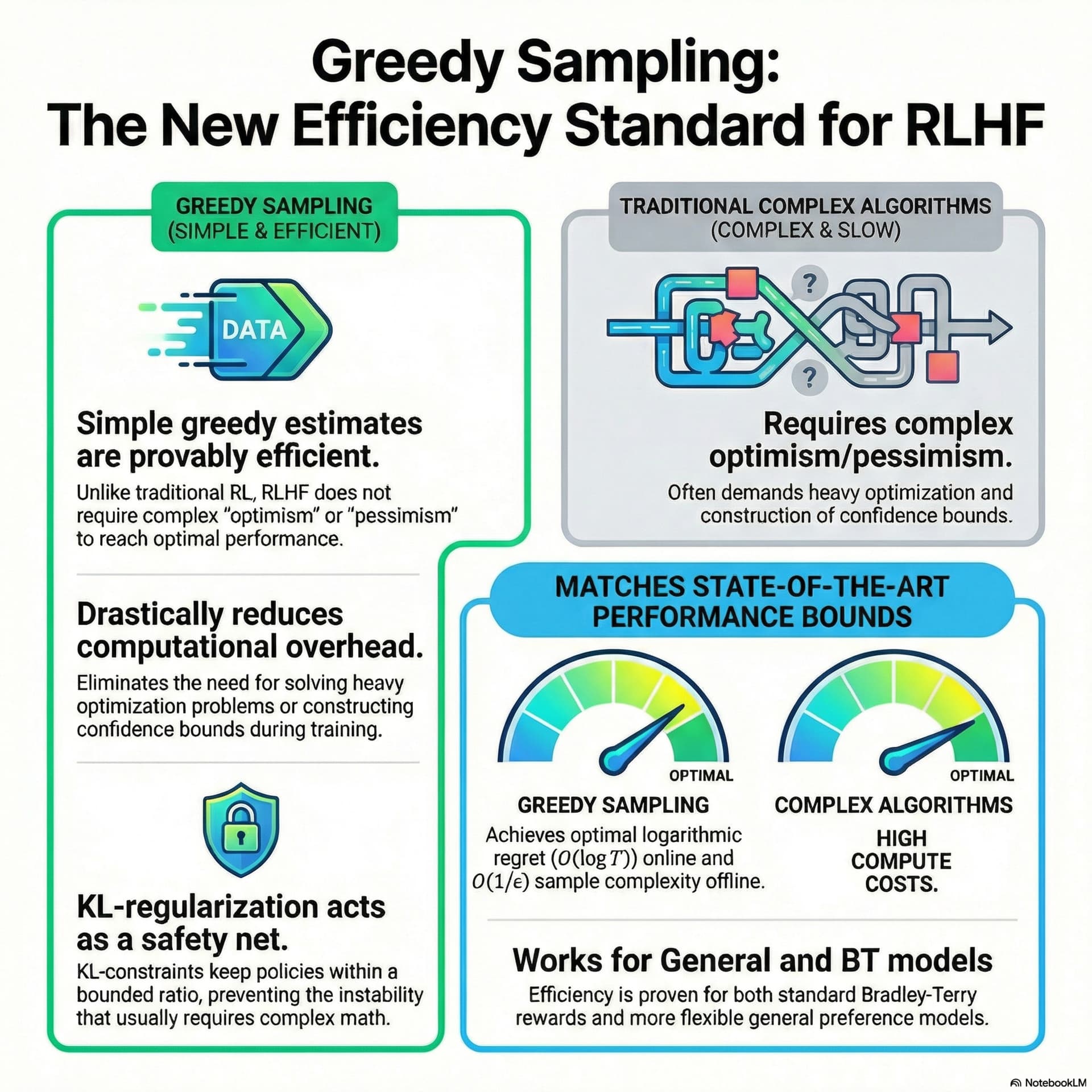
RLHF training for LLMs argues that “greedy sampling” (always pick the currently best option from observed data) is provably efficient, removing the need for expensive exploration bonuses, because KL regularization bounds how far the policy can drift.
Guest backgrounds
No guest names or bios are provided in the transcript; it’s a host/interviewer plus a second speaker who explains the technical details.
Key claims
Greedy sampling matches complex “optimism” strategies’ regret/convergence rates (logarithmic regret bound) under KL regularization; the only difference is a small early constant-factor gap. KL regularization acts like a leash/anchor, creating bounded likelihood so exploration isn’t needed. Works for general preference models (rock-paper-scissors cycles) and offline RLHF with “single policy coverage.”
Notable examples
Toothbrush overthinking; restaurant dilemma (exploit vs explore); maze local-optimum trap; KL “leash” analogy; rock-paper-scissors preference cycles; regret plots where greedy and optimism lines track closely.
Written by AI. May contain mistakes. Listen to the episode to check what was said.
Chapters
Tap a time to open that second in VOUnderstanding RLHF and Decision-Making
1:40 to 3:00
Discusses how RLHF operates by using human feedback to guide language model training.
“We're going to explain why, counterintuitively, the dumber strategy might actually be the smartest move for LLMs.”
Exploration vs. Exploitation Dilemma
3:01 to 4:25
Analyzes the classic exploration vs. exploitation dilemma in AI training and its implications.
“It accounts for the fact that human preferences aren't always so linear.”
KL Regularization as a Safety Net
4:26 to 6:33
Breaks down KL regularization and its role in maintaining model performance during training.
“So to fix that, researchers came up with these very smart, very complex strategies.”
Greedy Sampling Efficiency
6:34 to 7:58
Explains how greedy sampling can outperform complex algorithms in certain scenarios.
“Because of that KL leash, the mathematical distance between the policy you have now and the absolute perfect optimal policy is strictly limited.”
Application in Offline Learning
7:59 to 10:39
Discusses how the findings apply to offline learning, making it more practical for AI development.
“So all that extra math, all those bonus terms, it was adding literally zero value in terms of how fast the model learns.”
Conclusion: Embracing Simplicity in AI
10:40 to 13:00
Reflects on the importance of simplicity and constraints in AI development and decision-making.
“They did, in a simplified mathematical sandbox.”
Transcript
Automatic transcript. May contain errors.0:00I have a confession to make. I am a chronic, incurable overthinker. Oh, yeah. Give me an example. Okay. So last week I needed to buy a new toothbrush. Simple. Right. Should be. But instead of just grabbing one, I stood in the aisle for like 20 minutes reading reviews on my phone. I was cross-referencing bristle density, ergonomic grip scores. I mean, I was looking for long-term gum health studies. For a toothbrush. For a toothbrush. But here's the thing. I have this deep belief that the more complex my decision making is, you know, the more variables I account for, the better the outcome will be.
0:33It just feels safer. It's the measure twice, cut once idea, but taken to an extreme. We tend to equate effort and complexity with being correct. Exactly. And what's wild is that it's not just me. The entire field of artificial intelligence, specifically how we train these massive language models, has been suffering from the exact same anxiety. That's a really good way to put it. For a long time, the consensus was that to make an AI helpful and safe, the training algorithms had to be incredibly complex. You need all these mathematical safety nets, these complicated strategies to explore the unknown.
1:07But today, we are talking about a revelation that completely flips that table. We're looking at new findings in reinforcement, learning from human feedback, RLHF, that basically tell us all, stop overthinking it, just be greedy. It is a bit of a bombshell in the research community. I mean, we're talking about mathematical proof that greedy sampling, literally just picking the best looking option right in front of you with no complex adjustments, is not only faster, but provably just as efficient as the super complicated algorithms we've been relying on for years. And that's our deep dive today.
1:40We're going to explain why, counterintuitively, the dumber strategy might actually be the smartest move for LLMs. And it all comes down to a concept called KL regularization. Which turns out to be this secret safety net that was doing the hard work for us all along. It's a fascinating story about how constraints can actually give you the freedom to be simple. So let's set the stage. Most of our listeners know RLHF is the secret sauce that turns a text predictor into an assistant. But maybe walk us through the actual workflow where this decision-making happens. Sure. So at its core, RLHF is a preference game.
2:16You give the LLM a prompt like explain quantum physics to a five-year-old. Okay. The model then generates two different answers. We'll just call them action A and action B. And a human or maybe a reward model trained by humans picks the winner. They say, yep, action A was clearer or action B used too much jargon. Precisely. Now, to make that useful for training, you have to turn that thumbs up into math. And the standard way to do that is with something called the Bradley-Terry model. Right. Right. That's the one that assumes every answer has a hidden score, like in a video game. Action A is worth 10 points.
2:48Action B is worth 5. We don't see the points, just that A won. Exactly. And the model's job is to look at thousands of these wins and losses and try to figure out those hidden scores. But, and this is important, there's a more complex, more flexible way to look at it. The general preference model. Right. It accounts for the fact that human preferences aren't always so linear. In the Bradley Terry world, if A is better than B and B is better than C, then A must be better than C. But life isn't like that. It's more like rock, paper, scissors. That's the perfect analogy. Rock beats scissors. Scissors beats paper.
3:23But paper beats rock. There's no single best option with the highest score. The general preference model tries to capture those messy circular probabilities. Which sounds way more realistic, but I'm guessing it's also much harder to solve mathematically? Traditionally, yes. Much harder. Okay, so this brings us back to my toothbrush anxiety. The classic problem in all of this is exploration versus exploitation. The restaurant dilemma. The restaurant dilemma, yes. Do I go to the burger joint I know is a solid 7 out of 10? That's exploitation. I'm using what I know to get a guaranteed good result.
3:57Or do you try that new fusion place down the street? It might be a 10 out of 10 or it might be a 2 and give you food poisoning. That's exploration. And if I never explore, I'll never find the 10. But if I explore too much, I just eat a lot of bad dinners. Right. And in standard AI, like training a robot to navigate a maze, exploration is everything. If the robot is purely greedy and only takes the step that looks safest right now, it gets stuck. It just shivers in a corner because it's afraid to find a better path. It hits a local optimum and just stays there forever. So to fix that, researchers came up with these very smart, very complex strategies.
4:32You mentioned optimism in the face of uncertainty. Right. So that uses algorithms like UCB or upper confidence bounds. The math basically says, hey, I haven't tried action B very much. I'm uncertain about it. So I'm going to artificially add a bonus to its score just to force myself to check it out. It's like building mathematical curiosity right into the code, forcing it to be adventurous. It is. Yeah. But the problem is calculating those bonuses, those confidence bounds. Yeah. It is incredibly expensive computationally. How expensive are we talking? You're solving a heavy optimization problem at every single step of the training loop.
5:06For a huge LLM, that overhead is massive. It slows everything down. And this is where the new findings come in and just flip the whole table. The research says, forget the math, just pick the winner. That's the greedy sampling proposal. Just look at the data you've seen so far. Run a standard maximum likelihood estimation, which is basic statistics, to see which option has won the most and pick it. No bonuses, no artificial curiosity. But wait, if you did that in the maze, the robot gets stuck. Why doesn't the LLM get stuck in a loop of just, you know, mediocre answers if it's not exploring? That is the million-dollar question.
5:43And the answer isn't in the sampling method itself. It's in the training objective. It's that KL regularization we mentioned. Okay, KL regularization. We see this term all the time. Let's really break down what it's doing here. I like the analogy of a leash. A leash is perfect. Or an anchor. When we do RLHF, we're not training a model from scratch. We're starting with a model that has already read the whole internet. That's our reference model. Right. It already knows grammar and facts. We want to make it more helpful, not make it forget English. Exactly. So K-regularization is a penalty term in the math.
6:16It says to the model, sure, try to get the human to like your answer. But if you drift too far from your original reference model, if you start talking weird, I'm going to penalize you heavily. So it's tethered. It can explore, but only within a certain radius of its base knowledge. And that tether creates something called bounded likelihood. This is the key technical insight. Because of that KL leash, the mathematical distance between the policy you have now and the absolute perfect optimal policy is strictly limited. So unlike the robot in the maze where the exit could be miles away in some direction, it's never even looked.
6:53In RLHF, the perfect answer is guaranteed to be mathematically close to where you already are. That changes everything. If I know my lost keys are definitely within five feet of me, I don't need a complex search strategy. I can just look around. That's it. That's the core insight. Because the search space is already constrained, a simple, greedy walk toward the best-looking data is enough. You don't need the artificial curiosity because the solution literally cannot be that far away. Okay, that makes intuitive sense. But let's talk proof. Does the math actually hold up? The research talks about a logarithmic regret bound.
7:27What does that mean for us? So regret is just a term for how many mistakes you make over time compared to a perfect strategy. A logarithmic bound, or log t day, means your mistake rate drops off incredibly fast. So you learn quickly. Very quickly. And the sample complexity is also really good, meaning you don't need an insane amount of data. And what's shocking is that these numbers, for example, greedy strategy, are identical to the numbers for the super complex optimism strategies. Wait, they're identical. The convergence rate is identical. So all that extra math, all those bonus terms, it was adding literally zero value in terms of how fast the model learns.
8:06In terms of the rate, yes, zero value. The greedy approach keeps up perfectly. That's wild. It's like finding out you can run a marathon just as fast in flip-flops as in$1 ,000 running shoes. Well, to be fair, there is one tiny trade-off, the constant factor. Okay, here's the fine print. Imagine two runners. They're running at the exact same speed, that's the rate. But the greedy runner starts maybe 10 yards behind the optimism runner. So the optimism runner gets a small head start. Why? The math suggests the greedy strategy might make a few more mistakes right at the very, very beginning of training.
8:40But because the learning rate is so fast, that initial gap closes almost immediately. In the grand scheme of things, it's negligible. And if you think about wall clock time, how long it actually takes to run the training. Greedy probably wins. Because the optimism runner has to stop every few steps to solve a huge calculus problem. He's carrying a backpack full of rocks. While the greedy runner is just sprinting ahead. Exactly. Traveling light. I want to go back to the general preference model, the rock, paper, scissors one. You said that's usually much harder to solve. Does greedy really work there too?
9:13This is one of the most surprising parts. Yes, it does. Why is that so surprising? Because normally with those cyclical preferences, simple algorithms get confused. They just chase their own tails. To solve it, you usually need these massive tournament structures where different models compete against each other. Like a gladiator arena inside the computer. It basically is. And it's very expensive. But this research shows that because of the KL regularization, because the models can't drift too far, even the simple greedy approach finds the best possible compromise without needing the whole tournament.
9:47That's a huge simplification. Okay, what about online versus offline learning? This seems to apply to both. It does. In the offline setting, where you just have a big static pile of data, this is even more important. Right, because you can't ask for new feedback. And the big fear there is the model hallucinating or making bad assumptions about gaps in the data. So the standard fix is pessimism, where you heavily punish the model for trying anything not explicitly in the data set. Which sounds like another one of those computationally impossible optimization problems for a big LLM. It often is.
10:19But greedy sampling just works with the data it has. As long as the good answers are somewhere in your data set, what they call single policy coverage, greedy will find them. Again, the KL leash prevents it from wandering off into dangerous territory anyway. So this makes offline RLHF actually feasible for more people. It makes it much more practical, yes. Let's talk evidence. They ran simulations, right? They did, in a simplified mathematical sandbox. And if you look at the plots in the study, it's really stark. You see the line for regret, for the complex optimism strategies, and then you see the line for greedy.
10:54And they're tracking together. They're practically hugging each other. The greedy line is a tiny bit higher at the start. That's the constant factor we mentioned. But the slope, the rate of improvement, is identical. It's a perfect visual confirmation. It's humbling, isn't it? We spent all this time building these intricate mathematical castles convinced we needed them, but the safety was already built into the foundation. It really is. We took these exploration strategies from fields like robotics, where a robot arm has no prior knowledge and you absolutely need them, and we just pasted them onto LLMs without fully appreciating that the context was different.
11:29An LLM isn't a blank slate. It already knows how to talk. The context is everything. And we were playing by the old rules. So what's the practical takeaway? If I'm a developer, does this change how I write my code tomorrow? It absolutely can. It means your training pipeline can be much leaner, much simpler. You can strip out all that complex UCB calculation code. Which means faster training runs, less memory usage. And fewer bugs. Simple code is easier to debug. It really lowers the barrier to entry. You know, we started this talking about my toothbrush saga, about how humans overthink things.
12:03But it sounds like AI researchers are just as guilty. We are. We love complexity. It feels rigorous. We assume if an algorithm is hard to understand, it must be powerful. But this whole discussion is such a great reminder of the power of constraints. And that's the final thought I want to land on. We usually think of a constraint, like that kale leash, as a bad thing. We think, don't hold me back! But here the constraint is exactly what enables the simplicity. It grants you the freedom to be simple. Because you know you can't fall off the cliff, you don't have to waste all your energy mapping out where the cliff edge is, you can just run straight for the goal.
12:38That's a beautiful way of putting it. The limit enables the efficiency. So next time you're paralyzed by a decision, whether you're training a billion parameter model or just trying to order dinner, maybe take a page from this playbook. Check your constraints first. Exactly. If the stakes are bounded, if you have a safety net, maybe stop over calculating. Just be a little greedy. Pick the winner and move on. Trust the data right in front of you. Trust the data. Thanks for exploring this with us. We'll catch you on the next Deep Dive.
From the publisher
This research explores Reinforcement Learning from Human Feedback (RLHF) under the KL-regularized contextual bandits framework. While traditional methods rely on complex optimistic or pessimistic estimates to manage uncertainty, the authors prove that greedy sampling—directly using empirical estimates—is surprisingly efficient. By leveraging the structural property that optimal policies remain within a bounded likelihood ratio of the reference policy, the study establishes logarithmic regret in online settings and optimal sample complexity for offline learning. These findings apply to both the Bradley-Terry reward-based model and general preference models, offering a more computationally efficient approach to aligning large language models. The theoretical results are further validated through simulations that show greedy sampling performs comparably to more sophisticated, resource-intensive algorithms.


