Ask ChatGPT


 Best AI papers explained
13 Nov 2026 · 22m · 16 chapters
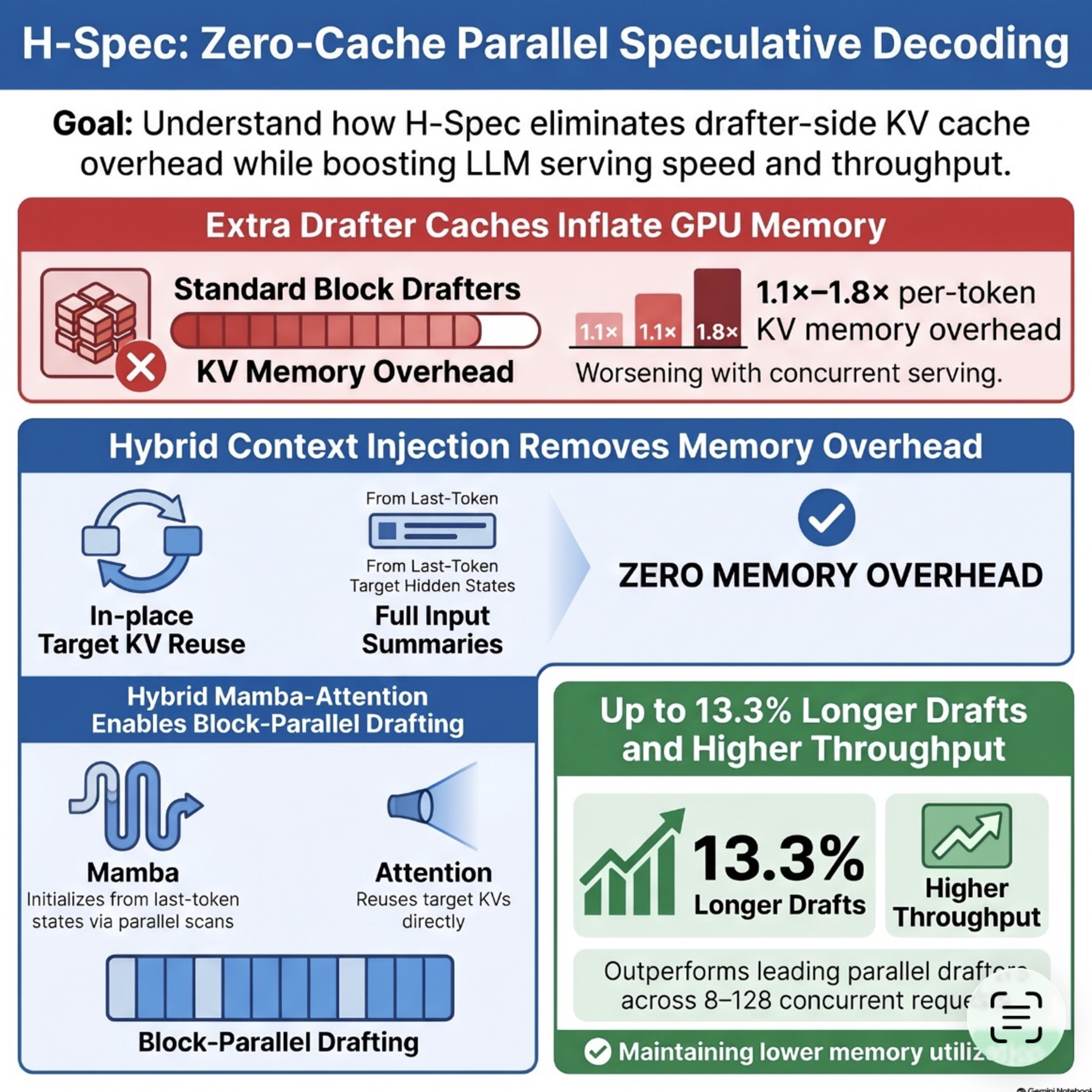
Explains why speculative decoding for LLMs is slow and memory-heavy, focusing on block diffusion drafters that require a separate drafter-side KV cache via KV injection. Introduces H-Spec, which removes the duplicate KV cache overhead by using hybrid target context injection: reuse the target model’s KV cache in place plus inject only the last-position hidden state as an O(1) global summary.
No guests mentioned; it’s a single-host deep dive.
Duplicate drafter KV cache can raise per-token GPU memory up to 1.8x; KV injection time can grow 4.7x at 128 concurrent users. Direct KV reuse without the global summary drops accuracy up to 16.5 points.
Benchmarks on Llama 3.18B and QN3 vs D-Flash/D-Spark/P-Eagle show up to 13.3% higher mean accepted length and up to 12.6% lower inter-token latency; best throughput at 128 concurrent requests. Tradeoff: slightly slower for short prompts (<512 tokens). Ablation: removing Mamba or attention drops draft quality up to 30.5%.
Written by AI. May contain mistakes.
Discussion on the inefficiencies and memory challenges in AI models.
“And you know, the paradox here is that the very tools engineers built to speed these models up are the exact things creating that massive memory bottleneck.”
Explanation of how autoregressive models generate text token by token.
“So to understand the cure, we first need to diagnose the disease.”
Introduction to speculative decoding and its analogy to a restaurant kitchen.
“If they do it all step by step, the food is going to be flawless, but dinner is going to be three hours late.”
Discussion on the drafter's function and how it impacts speed and accuracy.
“Specifically using architectures known as block diffusion drafters.”
Exploration of KV injection and its inefficiencies in AI models.
“The overhead of creating that duplicate memory bank is staggering.”
Analysis of how memory management affects AI performance in real scenarios.
“Sharing the big model's cache directly without duplicating it.”
Discussion on the necessity of global context for accurate AI predictions.
“When the junior chef only looks at the raw ingredient list in the shared cache, they lose the context of what they were actually trying to cook.”
Overview of HSpec and its innovative hybrid approach to AI architecture.
“It gives the junior chef a one-sentence summary of the entire recipe.”
Exploration of how Mamba and attention work together in HSpec.
“It combines two completely different historically competing AI mechanisms into one single engine.”
Explanation of the Markov head's role in maintaining grammatical accuracy.
“While Mamba is handling the big picture trajectory, what are the attention modules doing?”
Learn how H-Spec addresses parallel generation and memory issues in AI.
“Token number three doesn't know what token number two is because they were born simultaneously.”
Discover the significance of H-Spec in solving the scaling crisis for AI systems.
“I mean, why does this matter to the person sitting at their laptop waiting for a spreadsheet analysis to finish?”
Explore the benchmark results that demonstrate H-Spec's superiority in speed and efficiency.
“Theory and elegant architecture are one thing, but hardware doesn't lie.”
Examine the trade-offs of H-Spec when dealing with low traffic scenarios.
“But the true supremacy of HSpec shows up under heavy load.”
Learn about the importance of Mamba and attention in H-Spec's architecture.
“If you need to print 10 ,000 flyers, the setup time is completely worth it because of the throughput.”
Explore the potential future applications of H-Spec's architectural innovations in AI.
“HSEC cleverly recycles the big model's context in two distinct complementary ways.”

Get the gist, explore an idea or ask about something said.
 Claude
On Best AI papers explained, what are the key points of this episode?
Searching your listeningAutomatic transcript. May contain errors.
0:00Welcome to today's Deep Dive. Right now, some of the smartest AI models on earth are just completely choking on their own memories. They really are. It is a massive problem. Because, I mean, we expect our software to be instantaneous, right? You click a button, a window opens. But behind the scenes, when you ask a chatbot to, say, write an email or analyze a data set, it is often generating this digital traffic jam so massive that it nearly doubles the memory it needs just to function. Yeah, it is wild how inefficient it can be. So you are sitting there staring at that blinking cursor, watching the text generate word by Agonizing word.
0:36And that delay isn't a lack of computing power, is it? No, not at all. It is a fundamental architectural speed limit in how the AI actually thinks. Which is crazy. And you know, the paradox here is that the very tools engineers built to speed these models up are the exact things creating that massive memory bottleneck. Wait, the speed up tools are causing the slowdown. Yes. We are constantly forcing these systems to choose between speed and memory efficiency. And under heavy traffic, that compromise just falls apart entirely. Okay, let's unpack this. Because today we are exploring some incredible technical data on a new architecture called H-Spec.
1:12Right, the new hybrid model. Exactly. It's a breakthrough that completely rewrites the rules of AI design to shatter that speed limit. We are looking at how researchers have found a way to make massive language models significantly faster, while paradoxically using way less memory. It is a really elegant solution to a very messy problem. So to understand the cure, we first need to diagnose the disease. Why is generating AI text so inherently slow at a foundational level? Well, it basically comes down to the mechanics of autoregressive generation. Autoregressive generation. Okay. When an LLM outputs a sentence, it is calculating the probability distribution for one single token at a time.
1:54Just one token. Exactly. Like a piece of a word. Exactly. But to make an accurate prediction for that one little token, the model has to run a mathematical cross-reference against the entire context of the conversation up to that point. Oh, wow. So it has to look back at everything. Everything. It reads the whole history, runs the math, and predicts one token. Then it appends that new token to the history, rereads the new whole history, and predicts the next one. That sounds exhausting. It is a strictly sequential, computationally heavy loop. You literally cannot skip a step. So to break out of that sequential loop, the industry developed a workaround that today's research focuses on pretty heavily, which is speculative decoding.
2:36Right, which is brilliant in theory. The best way I can visualize this mechanism is by imagining a high-end, three-Michelin-star restaurant kitchen. That is actually, like, a highly accurate way to look at the architecture. Okay, good. So you have the MasterChef. The MasterChef represents your massive target model, the one running on billions of parameters. The big brain of the operation. Right. Now, if the master chef has to chop every single onion, reduce every sauce, and plate every single leaf of basil one by one. Which is that autoregressive generation we just talked about. Exactly. If they do it all step by step, the food is going to be flawless, but dinner is going to be three hours late.
3:14The throughput is a complete disaster. Yeah. So to fix the throughput, the restaurant brings in a junior sous chef, which represents the draft model. Right. The drafter. This is a much smaller, much faster, but maybe slightly less capable AI. And the junior chef preps a whole tray of ingredients at once, guessing several future tokens in parallel. Yes, all at the same time. They bring the entire tray to the master chef. And then the master chef, using their massive parameter count, reviews the entire tray in one single highly parallelized glance. Which is way faster than doing it themselves. Right.
3:50If the prep work is good, the master chef approves it all at once. Instead of doing the work step by step, the big model just grades the small model's homework in one pass. Exactly. But the entire concept relies on a very delicate balancing act. How so? Well, for this to actually speed up your chatbot, that junior sous chef has to be incredibly fast but also highly accurate. Oh, because if they make a mistake. Right. That accuracy requirement is where the bottleneck begins. Because if the master chef looks at the tray and sees that the onions are diced all wrong, they have to throw the whole tray in the trash and just do it themselves anyway.
4:28Oh, man. So you lose all the time you supposedly saved. Exactly. The big bottle spends all its processing power rejecting bad drafts, which entirely wipes out any speed advantage you thought you had. Which leads us to the hidden trap that today's data exposes. Because to increase the junior chef's accuracy, developers started outfitting them with much more complex tools. Right. They needed the drafters to be smarter. Right. Specifically using architectures known as block diffusion drafters. Yeah. Models like D-Flash are a prime example here. D-Flash. Okay. These block drafters are cutting edge because they don't just guess one token sequentially.
5:03They predict an entire block of tokens simultaneously in parallel. That sounds like it would be much faster. It is. But to make those highly accurate parallel guesses, the small model needs to know exactly what the big master chef is thinking. It needs deep mathematical context. And how is it currently getting that context? Through a mechanism called KV injection. Okay, KV, key value, right? Yes, key value. You can think of the KV cache as the AI's short-term working memory. It is a literal matrix of mathematical representation stored in the physical VRAM of the GPU. Basically documenting every token process so far?
5:40Exactly. Now, in these block drafters, to give this small model context, the system extracts the hidden states from the big target model and projects them into an entirely separate duplicate KV memory bank. Wait, specifically for the drafter to use? Yes, a separate bank just for the drafter. Wait, if the big target model already has this massive KV memory cache of the conversation sitting right there on the server, why is the drafter building a duplicate? Right. I mean, why not just share the big model's existing cache directly? Copying gigabytes of data that is already sitting an inch away on the same silicon seems like a massive waste of resources.
6:18This raises an important question, and it is the exact anomaly the researchers behind this new architecture targeted. Because it just seems so inefficient. It is. The overhead of creating that duplicate memory bank is staggering. The technical data reveals that building this separate drafter side KV cache increases the per-token GPU memory usage by up to 1.8 times. Wow. Up to 1.8 times? You are nearly doubling the memory footprint just to store duplicate information. Yeah, it is a massive memory tax just to guess a few words ahead. That is wild. And to put that in perspective, think about an enterprise deploying this AI for customer service.
6:57You aren't just serving one person. You were serving hundreds of concurrent users. Right. Tons of chats happening at once. Exactly. The data highlights a stress test run on the Quantum 3 8B model serving 128 concurrent users. Okay. 128 people talking to it at the same time. Yes. And at that level of traffic, the time it takes just to perform that KV injection, just to copy the context over to the drafter, skyrockets by 4.7 times. Oh my god. 4.7 times slower just to copy the files over. Just to copy the memory. Yeah. So the very mechanism designed to speed the AI up is creating a fatal bottleneck when the system scales.
7:38It's like the kitchen is so busy printing duplicate order tickets for the junior chef that the printer jams and nobody is actually cooking the food. That is exactly it. The hardware simply runs out of bandwidth, trying to shuttle duplicate memories back and forth. Okay, so back to my question about the straightforward solution. just pointing the junior chef to the master chef's existing order tickets. Right. The direct sharing. Yeah. Direct target KV reuse. Sharing the big model's cache directly without duplicating it. They had to have tested that first, right? Oh, they did test it first. And it failed spectacularly.
8:11Really? Yeah. When they modified a model like D-Flash to just reuse the big model's existing memory cache directly in place, it worked acceptably for the first couple of guest tokens. Okay, so it started fine. Started fine. But as the drafter tried to predict further ahead in the sequence, the quality of its guesses completely collapsed. How bad of a collapse are we talking? The benchmark showed drop in accuracy of up to 16.5 percentage points on complex agentic tasks. Wow. A 16.5 percentage point drop. I mean, that means the junior chef is burning the garlic on almost every other dish. Yeah, the master chef's going to be throwing out whole trays of food.
8:51But why? Why does sharing the memory directly cause such a massive failure in accuracy? Because the drafter loses the big picture. The big picture. Yeah. The researchers realize that a KV cache, while great for fine-grained, token-by-token details, it lacks a global summary of the prompt's overarching semantic meaning. Oh, I see. When the junior chef only looks at the raw ingredient list in the shared cache, they lose the context of what they were actually trying to cook. Ah, so to make accurate parallel guesses, the draft model actually needs two complementary pieces of information, not just one.
9:25Precisely. First, it absolutely needs the target model's existing KV cache, reused in place to get those specific local details without duplicating memory. Right. But second, it needs a global summary. It needs the target model's hidden states, but crucially, only from the very last input position. Why just the very last token? Because of the sequential nature of how transformers process language, the mathematical state of the very last token acts as a highly compressed vector of the entire sequence that came before it. That is cool. It is. It's essentially a zip file of the semantic meaning of the whole conversation up to that exact moment.
10:03Okay. And because it's just the state of one single position, it takes up zero extra scaling memory. It has an O of one memory overhead. O of one. Meaning it's constant. Exactly. The memory requirement remains completely flat, whether the conversation is 10 words long or 10 ,000 words long. Okay. Going back to our kitchen analogy. Let's do it. Sharing the memory cache directly was like handing the junior chef an incredibly detailed list of 50 ingredients, but giving them zero instructions on what to do with them. Right. They don't know if they were making a soup or a salad. They have all the data, but none of the trajectory.
10:37Exactly. But this new method, what the researchers call hybrid target context injection. Yes. It gives the junior chef a one-sentence summary of the entire recipe. That's the last token hidden state. Like, we are making a vegetable stew. Right. Plus, it gives them access to the specific ingredient list, which is the shared, non-duplicated KV cache. You get the global trajectory, and you get the local details. And you achieve both without spending a single extra megabyte of GPU memory to duplicate data. Conceptually, that is an elegant solution. It really is. But building a neural network that can actually process two totally different types of context at the exact same time sounds like an engineering nightmare.
11:18How did they actually build the machine to execute this hybrid injection? This brings us to the actual architecture they created named HSpec. HSpec, right. And to make this hybrid injection work, HSpec does something incredibly unorthodox. It combines two completely different historically competing AI mechanisms into one single engine. Okay, what are they? Mamba and attention. Here's where it gets really interesting. Mamba and attention working side by side. Yeah, it's pretty wild. For anyone who might not be deep in the weeds on AI architectures, we need to clarify why combining these two is such a radical concept.
11:54What is the fundamental mechanical difference between them? Think about how they process history. Attention, which is the mechanism behind almost all modern transformers and powers, the KV cache we've been discussing, It processes history by keeping everything accessible at once. It's like reading a book by keeping every single page open on your desk simultaneously, so you can constantly cross-reference them. Which sounds very thorough. It is highly accurate, but it takes up a massive amount of desk space, or in this case, memory. And Mamba? Mamba is a modern take on a recurrent architecture. Instead of keeping all the pages open, Mamba is like reading a book and writing a one-sentence summary at the bottom of each page.
12:37Just a summary. Right. And then bringing only that summary with you to the next page. It constantly updates a tiny, fixed-size internal state, rolling the context forward and forcing compression as it goes. So they operate on entirely different mathematical philosophies. How does HSPEC force them to collaborate in the same draft model? Well, HSPEC takes that tiny O of 1 global summary we talked about, that last token hidden state from the big model, and uses it to initialize the Mamba modules. Okay, so Mamba gets the zip file. Exactly. Because Mamba is built for compressed states, it takes that summary and evolves it across all the future draft positions in a rapid parallel scan.
13:19Mamba sets the overarching semantic trajectory for the predictions. While Mamba is handling the big picture trajectory, what are the attention modules doing? The attention modules inside HSpec are hooked up directly to the big MasterChef's in-place KV cache. Oh, I see. So while Mamba plots the course, attention consumes those fine-grained token-by-token details from the shared memory. So Mamba is looking at the recipe summary. Attention is constantly referencing the open ingredient list, and they are synthesizing that data simultaneously. Yes. And there is one final architectural piece required to make it all flow.
13:58What's that? Because these block diffusion models predict five or six future tokens at the exact same millisecond, those tokens don't causally know about each other. Wait, what do you mean? Token number three doesn't know what token number two is because they were born simultaneously. Oh, right. Because it's parallel. Exactly. And this can lead to minor grammatical hallucinations. So H-spec includes a lightweight component called a Markov head. A Markov head. How does that fix the parallel generation issue? The Markov head acts like a microscopic, lightning-fast grammar checker. Okay. It does a rapid left-to-right sweep over the parallel drafted tokens, looking only at the immediate links between adjacent words.
14:40It enforces causality. Just making sure the words actually make sense next to each other. Right. Ensuring that word B mathematically and logically follows word A. It smooths out the grammar before sending the entire block to the big master chef for approval. Okay, I have to step back and ask the critical question here. Why should you, the listener, care about the fact that Mamba and attention are living together in this HSpec architecture? I mean, why does this matter to the person sitting at their laptop waiting for a spreadsheet analysis to finish? It matters because it solves the scaling crisis.
15:14Remember that 1.8x memory tax? Right, the massive duplication cost. Because HSpec uses Mamba for the overarching context, and Mamba thrives on that tiny fixed-sized summary, HSpec completely eliminates the need for that duplicate drafter-side memory cache. It just wipes it out entirely. Yes. And by eradicating that memory tax, AI providers can serve vastly more concurrent users, like you and thousands of others, at the exact same time, on the exact same hardware, without their servers buckling under memory overload. So your AI remains fast, even during peak rush hour. Exactly. Theory and elegant architecture are one thing, but hardware doesn't lie.
15:55When they put HSpec on the track, what did the scoreboard actually look like? Let's look at the hard benchmark data. The technical data is highly definitive. They benchmarked HSpec against the top parallel drafting baselines in the industry. Which ones? Models like D-Flash, D-Spark, and P-Eagle. And they ran these tests across major target models, specifically LAMA 3.18B and QN3. And how did the Mamba Attention Hybrid perform? It dominates the field. HSpec improves the mean accepted length, meaning the MasterChef approved significantly more of the JuniorChef's guesses, by up to 13.3%. That's a solid jump.
16:32It is. But more importantly for the user, it improves the actual inter-token latency speed by up to 12.6%. Generating text 12.6 % faster while using less memory is a massive leap for an end user. Oh, for sure. But the true supremacy of HSpec shows up under heavy load. When the researchers simulated high traffic at 128 concurrent requests, HSpec achieved the highest throughput of all the tested models. All while using less memory. Exactly. It maintained the absolute lowest KV cache utilization. It was objectively the fastest, and it consumed the least memory. Okay, as a natural skeptic, I have to look for the catch.
17:11This sounds entirely too perfect. We're getting more speed, we're using less memory, and we're predicting with higher accuracy. Where does H-spec struggle? Right. There's always a cost. Yeah. In computer science, you don't get something for nothing. There has to be a trade-off. What's fascinating here is that the trade-off reveals itself at the absolute opposite end of the spectrum. H-spec struggles when the system is nearly empty, or when the user's prompt is very short. Really? Why would it be slower when there's less traffic that feels backwards? Because combining Mamba and attention creates a computational graph that is internally far more complex than a standard single architecture drafter drafter.
17:51Oh, so just turning it on takes more effort. Yes. The baseline math required to initialize both systems is heavier. So if you only have one or two users on the server, or if your prompt is under 512 tokens, HSpec is actually slightly slower than the baselines. the heavy machinery takes a fraction of a millisecond longer to spool up. I see. It's like booting up a massive industrial printing press. That's a good way to put it. If you need to print 10 ,000 flyers, the setup time is completely worth it because of the throughput. But if you just need to write a quick post-it note, the heavy machinery actually takes longer to warm up than it would take to just write the note by hand.
18:28That is the exact dynamic. But the data clearly demonstrates that the moment you scale past that 512 token mark, or the moment you add a realistic enterprise number of users to the server, that initial spool-up cost becomes completely irrelevant. Because the benefits compound so fast. Right. The Mamba efficiency kicks in, the memory savings compound, and HSpec absolutely crushes the competition. It is an architecture explicitly built for scale. And just to prove that both pieces of this Frankenstein engine are actually pulling their weight, they ran an ablation study, right, where they actively turn off parts of the architecture to see what breaks?
19:04They did. They ran tests where they completely removed the Mamba summary mechanism and just relied on attention. Okay. And conversely, tests where they removed the attention details and just used Mamba. And what happened? In both isolation tests, performance plummeted. Removing either component caused massive drops in draft quality, up to 30.5 % in specific tasks. 30.5%, that's huge. It definitively proved that both a global summary and the fine green details are strictly necessary. You cannot cook the meal without both the recipe summary and the ingredient list. So what does this all mean? Today's research shows us that HSEC has managed to surgically remove a massive memory bottleneck in AI inference.
19:47Instead of building a resource-hogging duplicate memory bank for the Junior Chef draft model, HSEC cleverly recycles the big model's context in two distinct complementary ways. It uses a recurrent Mamba architecture to process a tiny zero-memory summary of the big picture, and it uses attention modules to plug directly into the big model's existing cache for the fine details. Beautifully summarized. The result is an AI that types faster, handles way more users at once, and doesn't crash the server. That covers the immediate breakthrough perfectly. But if we extrapolate this data and connect it to the bigger picture, there is a lingering implication here that is arguably even more disruptive.
20:25Oh. Where does this lead? Well, think about the foundational concept HSPEC just proved. It proved that you can use a tiny, highly compressed, O of 1 recurrent Mamba state to successfully predict the future in parallel, with enough accuracy to satisfy a massive target model. Right, it is incredibly memory efficient. Yes, it solves the memory crisis for the drafter. Well, what happens when researchers inevitably try to apply this exact same Mamba attention hybrid trick to the gigantic target models themselves? Oh, wow, applying it to the MasterChef. Exactly. If this hybrid structure works so flawlessly for complex parallel guessing, could the main multi-billion parameter AI models of the future eventually ditch their own massive memory-hogging KV caches entirely?
21:14That would change everything. Right. Could the foundational models we use every day eventually rely on this kind of recurrent summary structure as their primary way of reasoning? H-Spec might not just be a patch for today's speculative decoding bottleneck. It might actually be a preview of the baseline architecture for all language models tomorrow. That is a wild thought. Replacing the MasterChef's entire memory system with something completely new, essentially eliminating the concept of a KV cache as we know it today. It's definitely on the horizon. We will absolutely have to keep our eyes peeled for that next wave of technical data.
21:48Until then, the next time you are staring at that blinking cursor, waiting for an AI to finish its sentence, just know that there are engineers out there successfully figuring out how to build a better, faster, and more memory-efficient machine so your data can get served up right on time. It's only getting faster from here. Thank you so much for joining us on this deep dive. Keep questioning the tech you interact with every day, and we will catch you on the next one.
H-Spec is a novel parallel speculative decoding framework designed to accelerate large language models by eliminating the memory-intensive drafter-side Key-Value cache used by traditional block diffusion methods. Instead of projecting hidden states into a separate cache at every input position, it uses a hybrid target-context injection approach that combines in-place target KV reuse with the target model's hidden states from solely the last input position. This architecture leverages a Mamba-attention parallel drafter, where Mamba modules initialize from the last-token hidden states using a parallel scan, while attention modules directly consume the target KV cache. Evaluations demonstrate that H-Spec improves both mean accepted length and inter-token latency speedup across diverse tasks while achieving superior serving throughput and lower KV cache utilization under concurrent workloads compared to existing baselines.