
In short
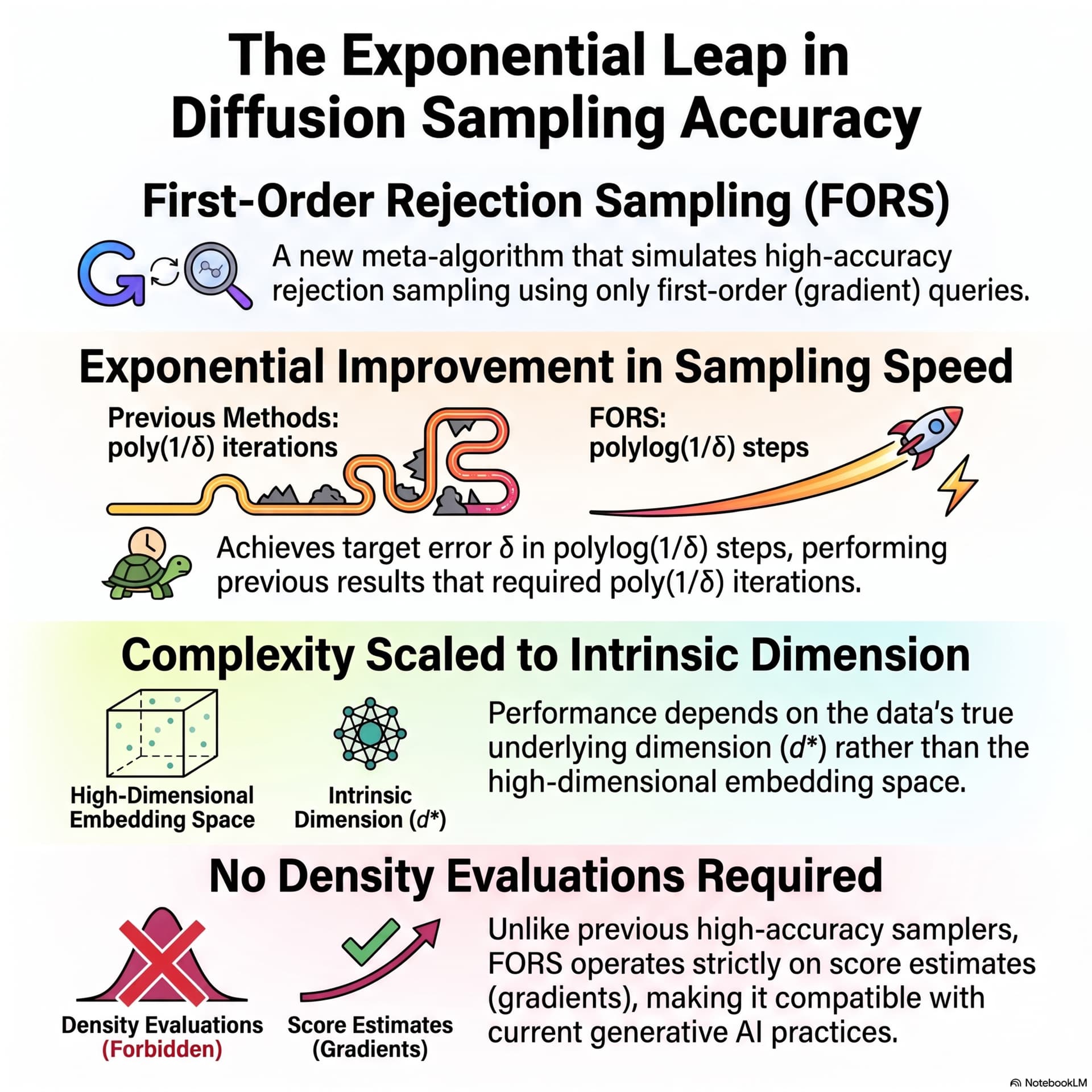
A 2026 theoretical breakthrough on high-accuracy sampling for diffusion models and log-concave distributions using only first-order information (gradients), avoiding the “polynomial wall” of standard DDPMs.
Guest backgrounds
No guest names or bios are provided in the transcript; only two hosts discuss the work.
Key claims
Standard diffusion sampling needs about 1/delta steps for error rate delta and is proven unimprovable. The paper introduces first-order rejection sampling (FORRS/4RS) that simulates rejection sampling using only score/gradient queries via Bernoulli factory ideas, Taylor series, and Poisson-controlled sampling, with truncation safeguards. It achieves polylogarithmic scaling in 1/delta and extends to log-concave distributions via proximal sampling.
Notable examples
“Blindfolded mountain” slope-only navigation; cat-image denoising; log-concave “Mount Fuji” shape; delivery-truck routing and drug-discovery probability modeling.
Written by AI. May contain mistakes. Listen to the episode to check what was said.
Chapters
Tap a time to open that second in VOThe Mechanism of Denoising Diffusion Models
1:56 to 3:06
Learn about the core process of denoising diffusion probabilistic models and their challenges.
“And in the process, well, they fundamentally changed how we think about probability of machine learning.”
Understanding Polynomial Time Complexity
3:06 to 5:38
Discover why achieving hyper-accuracy in AI models leads to polynomial time complexity issues.
“You take a pristine piece of data, let's say it's a high-resolution image of a cat, and And you progressively destroy it by adding Gaussian noise, step by step, until it looks like pure television static.”
Rejection Sampling and Its Dilemma
5:38 to 6:48
Examine the central problem of performing rejection sampling without knowing density.
“To break the wall, you have to invent entirely new math.”
Introducing First-Order Rejection Sampling (FRS)
6:48 to 10:40
Unpack the concept of FRS and how it simulates rejection sampling with limited data.
“I mean, if you don't know where you are in the mountain, how can you definitively say, yes, this is the valley, I accept this spot?”
The Role of Taylor Series and Poisson Distributions
10:40 to 12:06
Understand how Taylor series and Poisson distributions work together in the FRS algorithm.
“Imagine you are feeling the slope of the mountain, and your neural network suddenly glitches and tells you the slope is a perfectly vertical, infinite drop-off.”
Gaussian Tilts: Enhancing Sample Proposals
12:06 to 14:03
Learn how Gaussian tilts improve the performance of FRS in generative models.
“But if we connect this to how a full generative model actually runs, we are missing a vital piece of the puzzle.”
Exploring the Curse of Dimensionality
14:03 to 17:50
Learn about the challenges posed by high-dimensional spaces in generative AI.
“Then you hand it over to Foraris, which acts as the fine-tooth comb, to inspect every rock inside that spotlight and filter out the exact right data point.”
Breakthroughs in Log-Concave Distributions
17:50 to 20:16
Discover how recent advancements impact both AI and mathematics.
“By solving this problem for AI diffusion models, they solved a much older, broader problem in general mathematics.”
Rethinking Artificial Intelligence
20:16 to 22:22
Contemplate how these mathematical breakthroughs could reshape AI development.
“It proves that you can achieve exact simulation from continuous dynamics using only local first-order information, provided you use that information cleverly enough.”
Transcript
Automatic transcript. May contain errors.0:00Imagine you are blindfolded in a massive, rugged, mountainous landscape. Okay, I'm picturing it. Right. And your goal is to find the absolute lowest valley in this terrain. But because you're blindfolded, you can only feel the slope of the ground directly under your feet. Just the slope. Yeah, exactly. You have absolutely no map to tell you your exact altitude or, you know, where you are in relation to the rest of the world. So how long would it take you to find the bottom? Oh, I mean, if you can only feel the slope and you're completely blind to the larger map, you are going to be taking some very, very cautious steps.
0:36Right. You'd sort of shuffle your feet, figure out which way is tilted downward, take a tiny step, stop, and recalculate. Yeah, because if you take steps that are too large, you might accidentally step right over a narrow valley. Exactly. You end up walking up the side of a completely different mountain. Yeah. But, you know, taking those tiny steps means it takes practically forever. It's incredibly inefficient. Right. Now, what if there was a mathematical shortcut? What if, instead of shuffling along endlessly, you could just feel the slope at a few strategic spots, do some quick math, and then magically deploy a parachute to drop exactly where the absolute bottom of the valley is?
1:14I love that. That is a brilliant way to visualize the exact fundamental limitation that AI researchers have been wrestling with for years. Because that scenario, navigating a massive, complex landscape by slope alone without knowing the altitude, that's the core bottleneck. It is. It's the absolute bottleneck of modern generative AI. And that is exactly what we are unpacking in today's deep dive. We're looking at a major theoretical breakthrough in artificial intelligence. Yeah, a really exciting one. We've got a fascinating 2026 paper from a team of researchers at MIT and Yale titled High Accuracy Sampling for Diffusion Models and Log Conquase Distribution.
1:53Rolls right off the tongue, doesn't it? Oh, yeah, completely. But the mission today is to explore how these researchers cracked a notoriously stubborn mathematical wall. And in the process, well, they fundamentally changed how we think about probability of machine learning. It is genuinely a paradigm shifting paper. I mean, they managed to take an entire class of algorithms and transition them from sluggish polynomial accuracy guarantees to lightning fast exponential ones. Which is huge. It's massive. And they did it by inventing a meta algorithm they call first order rejection sampling or ORRS.
2:284S. Right. So if you are listening to this and you've ever wondered why getting hyper accurate, flawless results from AI image generators takes so much intense computational power, or if you just love a good aha moment where a clever workaround breaks a fundamental rule of mathematics, this deep dive is for you. Absolutely. And to really appreciate how big of a deal this breakthrough is, we need to understand why the AI was shuffling its feet in the first place. Right. Let's start there. We need to look at how denoising diffusion probabilistic models, or DDPMs, actually function under the hood.
2:59Okay. Lay it on me. The core mechanism is surprisingly counterintuitive because it relies on a process of destruction. Destruction. Yeah. You take a pristine piece of data, let's say it's a high-resolution image of a cat, and And you progressively destroy it by adding Gaussian noise, step by step, until it looks like pure television static. So wait, the model's first step is just reading the data. How does turning a cat into static help it learn anything? Because the magic of the model isn't in the destruction, it's in learning to reverse it. Oh, I see. It learns to take static and slowly denoise it back into a cat.
3:36But here is the crucial detail that causes all our problems. The model does not memorize the entire map of where all possible cat images live in the data universe. To use our earlier analogy, it never learns the overall map or the exact altitude of the mountain. Precisely. It only learns a score function. Okay, let me make sure I'm following this. Score function is just the gradient, right? The slope of the ground. Yes, exactly. It's the gradient of the log density. The model is standing somewhere in the static, and the score function tells it, Well, the data looks slightly more like a cat if you move in this downward direction.
4:10And that's it. That's it. It only knows the slope of the ground at the specific point it's currently standing on. So returning to that blindfold analogy, because you only know the slope, the score, and you don't know your exact altitude, the density, you are forced to take those incredibly tiny cautious steps. Precisely. In mathematical terms, standard DDPMs suffer from what we call polynomial time complexity. Okay. Let's say you want to get a highly accurate sample, meaning you want your error rate, which we'll call delta, to be extremely small. Delta being the error rate. Got it. Right. For standard diffusion models, the number of steps you have to take scales polynomially.
4:50Specifically, to get an error rate of delta, it takes roughly 1 over delta steps. Let me put some real numbers to that. If I'm comfortable with an error rate of 1 in 100, I need 100 steps. But if I want true, hyper-accurate performance and I need my error rate to be one in a million, I suddenly need a million steps. The better I want the AI to perform, the exponentially more computationally expensive it becomes to run. It becomes completely unscalable. And what makes this so frustrating for researchers is that prior to this paper, it was actually mathematically proven that this one over delta limit was unimprovable for standard DDPMs.
5:27Wait, unimprovable? Yeah, you could throw the biggest supercomputer in the world at the problem, and the underlying math of the algorithm would still hit that exact same polynomial wall. Wow, so you can't just write better code or buy faster chips. Yeah. To break the wall, you have to invent entirely new math. Exactly. The researchers realized that if they wanted to skip those tiny incremental steps entirely, they had to step away from standard diffusion. Makes sense. Now normally in statistics, if you want to skip directly to a perfect sample without taking tiny steps, you use a classic technique called rejection sampling.
6:01Okay, what is rejection sampling, practically speaking? Think of it like throwing darts at a board to figure out the shape of the target. You propose a random point, evaluate it, and then either accept it or reject it based on how close it is to the ideal distribution. Sounds straightforward. It is, but the catch is traditional rejection sampling requires you to know the exact density. It requires the altitude. You need the full map to know the probability of accepting or rejecting your proposed dart throw. Wait, we just established that diffusion models don't have the map. They only have the score function.
6:35They only have the slope. Exactly. That is the central dilemma of this entire paper. How do you do rejection sampling when you only have gradients? How do you reliably accept or reject a sample using only the slope? This sounds completely impossible. I mean, if you don't know where you are in the mountain, how can you definitively say, yes, this is the valley, I accept this spot? It does sound impossible, but that's where the researchers introduced their meta-algorithm, first-order rejection sampling, or FORS. Okay, here we go. It is designed to simulate rejection sampling using only first-order queries, meaning only the slope.
7:11And to pull this off, they had to reach into a wonderfully abstract area of probability theory known as the Bernoulli factory problem. Okay, a Bernoulli factory sounds like something out of a theoretical physics fever dream. Break this down for me. What is it? A Bernoulli factory is basically a mathematical vending machine. Imagine you have a coin, but it's warped. Warped? Yeah, it lands on heads with some unknown biased probability. You don't know what the odds are. The Bernoulli factory problem asks, can you take that warped coin, flip it a few times, and use those results to simulate an entirely new coin that lands on heads with a very specific, mathematically perfect probability that you actually want?
7:51That is wild. It is. In the case of this paper, the researchers need to generate a biased coin flip to decide whether to accept or reject a proposed sample based on the exponential of the density. But again, they don't have the density. Right. Calculating the exact density would require calculating the slope across every single inch of a path, which is exactly the computational nightmare they're trying to avoid. So how does the FRS algorithm use the vending machine? Instead of calculating every inch, FRS takes just a few random, unbiased estimates of the slope along a path. It just samples it.
8:25Yeah, it feels the ground at a few scattered points between where it is and where it wants to go. Yeah. Then it uses a combination of Taylor series expansions and Poisson distributions to feed those scattered slope measurements into the Bernoulli factory. Okay, hold on. We've just dropped two massive mathematical terms there. Taylor series and Poisson distributions. I need an analogy here. How do these two things actually take scattered slope measurements and turn them into a perfect coin flip? Let's take them one at a time. A Taylor series is a way to guess the shape of a complex winding road by only looking at the exact spot you were standing on.
9:00If you know you are standing on a slight uphill slope that's curving to the left, a Taylor series lets you mathematically predict, well, the next hundred feet probably keep curving left and going uphill. It's a localized guess. But a guess gets less and less accurate the further away you project it, right? Exactly. And that's where the Poisson distribution comes in. A Poisson distribution is a way of modeling random events occurring over time or space. In Fortchesse, the Poisson distribution acts like a mathematical manager. I'm a manager. Yeah, it looks at the Taylor series DESs and dynamically dictates exactly how many random slope measurements you need to take along the path to keep the error in check.
9:39It says, you know, don't just guess the whole path from step one. Take a measurement here, skip a bit, take another measurement there. Okay, I have to push back here because this still feels like statistical sleight of hand. I get that. You're saying they are guessing the altitude by taking a few random slope measurements, predicting the gaps with Taylor series, and using a Poisson distribution to tell them when to measure again. And they use that incomplete information to feed a Bernoulli factory that spits out a perfect accept or reject coin. How does that not compound into massive catastrophic errors?
10:16I mean, neural networks aren't perfect. Their slope estimates are always slightly flawed. Shouldn't a bad slope measurement totally derail the entire factory? That is the exact critical flaw that usually kills these types of theoretical models. But the brilliance of the FRS algorithm is in its safeguards, specifically something called truncation. Truncation meaning they put a hard limit on things, like clipping the bounds? Exactly. Imagine you are feeling the slope of the mountain, and your neural network suddenly glitches and tells you the slope is a perfectly vertical, infinite drop-off. Oh boy.
10:48Right. If you feed infinity into the Bernoulli factory, the whole algorithm explodes. Truncation acts as a safety valve. It clips that measurement and says, no, the slope can only be a maximum of, so, 85 degrees. So even if the model hallucinates a crazy slope, the algorithm just caps it and moves on. Yes. The researchers mathematically proved that even if the neural network slope estimates only have L2 accuracy, which means they only need to be accurate on average in terms of mean squared error, the FRS algorithm still holds together. That's incredible. It is. The combination of Poisson-directed sampling and truncation naturally controls the variance.
11:26It guarantees that the final coin flip it produces has the exact correct probability of accepting the sample without ever calculating the actual density. So what does this mean for our big picture? We were stuck at the polynomial wall. It means we finally bypass it. By eliminating the discretization errors that come from taking tiny shuffling steps, 4S achieves that hyper-accurate delta error rate, not in one over delta steps, but in what's called polylogarithmic one over delta steps. And for anyone keeping track, moving from polynomial to polylogarithmic is an exponential leap in efficiency. That is taking the helicopter down the mountain instead of shuffling your feet for a million steps.
12:05It is a massive theoretical victory. But if we connect this to how a full generative model actually runs, we are missing a vital piece of the puzzle. What's that? Well, FRS gives us a mathematically perfect filter. It tells us exactly whether to accept or reject a sample, but it doesn't tell us where to look in the first place. Right. If you just blindly propose random coordinates in a massive data landscape-like, guessing random combinations of pixels hoping to hit a cat, 4S will just reject them all day long. Exactly. You have a perfect vending machine, but you're feeding it terrible input. Precisely.
12:40You need a highly educated first guess before you ever ask 4S to evaluate it. And that brings us to the next massive innovation in this paper, which is Gaussian tilts. Gaussian tilts? Okay. To make 4S work efficiently in practice, the algorithm has to create a proposal distribution. It uses the local slope to project a Gaussian approximation, a simple bell curve of where the data should be. I'm visualizing this like standing on the side of the mountain with a massive spotlight. You feel the slope under your feet and you realize, okay, downhill is that way. So you cast your spotlight down the mountain.
13:14The bell curve is the beam of light illuminating the general area where you think the valley is. That's a fantastic spatial analogy. But there's a problem. A simple circular beam of light isn't enough because the true shape of the target data is incredibly complex. Right. It's not perfectly round. No, it's almost certainly not a perfect symmetrical bell curve. So the researchers apply a tilt. How does that work? By integrating the score function along a quick path between a couple of points, they figure out the difference in density. They use that local information to literally tilt or warp the shape of that Gaussian bell curve so that it better aligns with the true complex landscape of the data.
13:56Ah, so you don't just point the spotlight. You put a lens over it that bends and focuses the light to match the jagged contours of the valley. It casts an incredibly educated net over the right area. Then you hand it over to Foraris, which acts as the fine-tooth comb, to inspect every rock inside that spotlight and filter out the exact right data point. That synergy between the Gaussian tilt proposing the location and FRS refining it is the engine of this breakthrough. It's beautiful. It really is. But naturally, this raises an incredibly daunting question, one that plagues all of modern machine learning, the curse of dimensionality.
14:32Yes, I was actually just thinking about this. We're talking about valleys and spotlights, which are three-dimensional concepts. But generative AI deals with high-resolution images that have millions of pixels. A single 4K image is a point in an 8 million dimensional space. How can you calculate Gaussian tilts and integrate paths in 8 million directions at once without the compute time absolutely exploding? Doesn't the math just break down? Normally, yes. The curse of dimensionality is the death knell for theoretical algorithms like this. The more dimensions you add, the exponentially harder it becomes to find anything.
15:07So how do they get around it? The researchers counter this with a secret weapon in their mathematical analysis, the concept of intrinsic dimension. They denote this as d star. Wait, I need you to unpack this for me. The raw number of pixels, the 8 million dimensions, we'll call that the embedding dimension, right? The regular d. Yes. How is the intrinsic dimension d star any different? Every single pixel has to be calculated, doesn't it? The math can't just ignore the pixels. It doesn't ignore the pixels. It ignores the emptiness between them. The embedding dimension D is the size of the container.
15:40The intrinsic dimension D star is the actual complexity of the data inside the container. Let me give you an example. Please do. Imagine having a single long piece of string tangled up inside a massive warehouse size 3D room. Okay. The room has three dimensions. That's your embedding dimension D. There is a vast amount of empty air in that room. But the string itself, no matter how wildly tangled it gets, is just a one-dimensional object. It only goes forward and backward along its own link. Okay, I'm waiting over there. That's the intrinsic dimension D star. Oh, I see. The algorithm is smart enough to trace the string, completely ignoring all the empty 3D space in the rest of the warehouse.
16:20Exactly. This maps perfectly to what we call the manifold hypothesis in deep learning. Think about an AI generating images of human faces. Yes, a 4K image has over 8 million pixels. But those pixels cannot just be randomly colored noise. Right, or it wouldn't look like a face. Exactly. If it's going to look like a human, the pixels have to form eyes, noses, specific lighting gradients, and skin textures. They follow incredibly strict structural rules. So the data of human faces lives on a highly structured, low-dimensional manifold embedded inside that multi-million dimensional pixel space. Precisely.
16:58Because of those strict rules, the intrinsic dimension D star of a data set of faces is vastly, vastly smaller than the millions of pixels that make up the image file. That makes so much sense. The paper proves that as long as the data follows certain Lipschitz conditions, which basically just means the slopes of the manifold don't change infinitely fast, the complexity of this new sampler doesn't scale with the massive pixel count D. It scales with the intrinsic dimension D star. That is an absolute game changer for AI scaling. It means as we move to higher and higher resolution generation or even massive 3D environments, the theoretical math behind the sampling doesn't instantly collapse under the weight of the raw data points.
17:38The compute time is dictated by the complexity of the concept of a face, not the resolution of the image. It's a massive win for making diffusion models theoretically sound and wildly more efficient. But what is truly remarkable about this paper is that the researchers didn't stop there. There's more. By solving this problem for AI diffusion models, they solved a much older, broader problem in general mathematics. All right, let's look beyond AI art for a second. We're talking about the second half of the paper's title, The Log Concave Dilemma. First things first, what exactly is a log concave distribution, and why should anyone outside of an AI lab care about it?
18:15A log concave distribution is a type of probability distribution that is foundational in statistics, economics, and logistics. Visually, if you take the logarithm of its density, it forms a perfectly concave shape, like a smooth, single-peaked dome or Mount Fuji. Okay, Mount Fuji. Because it only has one peak and no hidden valleys, it is the ideal shape for solving massive optimization problems. Optimization problems like what? Like routing thousands of delivery trucks across a country to minimize fuel, or modeling statistical probabilities in drug discovery. For decades, the rule for sampling these log-concave distributions was simple.
18:52If you wanted high accuracy results, you absolutely had to evaluate the density. You needed the full altitude map. But if you only had the gradients, the local slopes? You were forced to use discretization methods. You had to take tiny shuffling steps, which always, always introduced discretization error. You were permanently stuck behind a polynomial wall, just like the older diffusion models. But because 4S figured out how to do rejection sampling using only gradients. Exactly. The researchers took 4S and slotted it into a mathematical framework called a proximal sampler. Think of a proximal sampler like setting up base camps on your way up Mount Fuji.
19:29Base camps, got it. Instead of trying to calculate a path to the peak all at once, you just optimize your path to the next base camp, which is a much easier problem. And by using 4S at each of those base camps, they achieved the first ever polylogarithmic complexity sampler for general log concave distributions using only gradient evaluations. They completely bypassed the need for density valuations while maintaining hyperaccuracy. This is why I love doing these deep dives. This isn't just about making generative AI faster. This is a foundational mathematical breakthrough. They took a sledgehammer to a wall that mathematicians thought was solid concrete.
20:05They really did. And it impacts how we optimize supply chains, how we model statistics, and fundamentally how machines learn anything at all. It's an incredibly elegant solution. It proves that you can achieve exact simulation from continuous dynamics using only local first-order information, provided you use that information cleverly enough. Okay, let's summarize the terrain we've covered today. We started with the rigid polynomial wall that was bottlenecking denoising diffusion probabilistic models, the curse of taking tiny steps because we only knew the slope, not the altitude. And to break through it, we explored the first-order rejection sampling meta-algorithm, or 4RS.
20:45we saw how the Bernoulli factory trick, combined with Taylor series and Poisson distributions, allows us to flip a mathematically perfect acceptance coin using just those local slopes. We looked at how Gaussian tilts act as a spotlight to help the algorithm cast an educated net before 4i acts as the fine-tooth comb. We learned how the secret weapon of intrinsic dimension, D star, allows the math to ignore the empty space in the warehouse and scale with the underlying concept of the data. And finally, we saw how this breakthrough ripples out into the broader world of mathematics, solving the long-standing problem of high-accuracy sampling for log-concave distributions using proximal samplers.
21:24It is a phenomenal piece of work from the teams at MIT and Yale. But before we wrap up, we always like to leave you, the listener, with something to chew on, something that stretches these concepts into the future. For me, this raises a fascinating question about the nature of artificial intelligence itself. Oh, I like where this is going. If an AI can now perfectly sample and reconstruct the incredibly high dimensional complexities of the world, relying entirely on touch, the local gradient, rather than needing a site map of the full density, does that change how we should build artificial general intelligence?
21:59That's a huge question. Are we wasting time and compute power trying to build massive omniscient systems that see the entire data landscape when mathematically it is vastly more efficient to just build systems that feel their way to the perfect answer. That is a wild thought to mull over. Maybe the blindfold isn't a limitation after all. Maybe feeling the slope is actually the optimal way to navigate the mountain. Thank you so much for taking this deep dive with us today. Keep questioning the landscape, keep feeling for the slopes, and we'll catch you on the next one.
From the publisher
This paper introduces a new algorithm called first-order rejection sampling (FORS) to achieve high-accuracy sampling for diffusion models and log-concave distributions. By utilizing only score estimates (the gradient of the log-density) rather than density evaluations, the researchers provide a method that converges exponentially fast, requiring only polylogarithmic steps relative to the target error. This represents an exponential improvement over previous sampling techniques that typically scaled polynomially. The authors demonstrate that their approach is robust under minimal data assumptions, with complexity primarily determined by the intrinsic dimension of the data. Furthermore, the framework successfully addresses the log-concave sampling problem, matching state-of-the-art performance without needing complex density-based filters.


